London’s Sincerity in Quest for Truth of Skripal Case in Serious Doubt
Sputnik – April 7, 2018
Anton Utkin, a former UN chemical weapons inspector in Iraq, told Sputnik that the decisions by the UK with regard to the poisoning of former Russian spy Sergei Skripal demonstrate that London isn’t truly committed to getting to the bottom of the case.
According to the chemical weapons expert, right now London is “sitting an examination” on the sincerity of its objective quest for the truth in the attack on Skripal and his daughter Yulia, who were found unconscious at a shopping center on March 4, which the UK promptly accused Russia of orchestrating.
“London’s disinclination to provide any information on the case, its unwillingness to cooperate and reluctance to openly investigate the matter so that everybody understands their moves and what is going on, indicates that the exam hasn’t been passed,” Utkin told Sputnik.
As for the accusations by UK Foreign Secretary Boris Johnson that Moscow tried to undermine the independent inquiry of the Organization for the Prohibition of Chemical Weapons (OPCW) by proposing a joint UK-Russia investigation into the matter at the emergency session of the OPCW Executive Council, the expert said that the joint investigation would be self-defeating for the UK.
“I’m afraid London wouldn’t be able to accept the results that it would be possible to achieve within a joint investigation,” he said, “They will fight it tooth and nail.”
The analyst also pointed out that OPCW was invited by the UK to provide “technical assistance” rather than inspection.
“Inspection has a unique right to collect samples wherever its wants and interview whoever it believes is relevant, while the OPCW technical assistance delegation has no such rights. It can collect samples where it is allowed to and interview only those approved [by the UK],” Utkin said.
“And taking into account that it is a technical assistance, in accordance with the confidentiality agreement under the OPCW concord, technically the results of the analysis shouldn’t be made public,” he explained.
Ahmet Uzumcu, director-general of the OPCW, said Wednesday that the results of the sample analyses of the substance used to poison Skripal and his daughter were expected to be received by early next week.
“Once the results of the analyses of the samples are received, the secretariat will produce a report on the basis of these results and will transmit a copy of this report to the United Kingdom,” he said.
According to Uzumcu, the United Kingdom has expressed its wish to be “as transparent as possible” and has already indicated its preference to disclose the report to other state parties of the OPCW. According to Utkin, it is still possible that London will change its mind, taking into account that suspicions are accumulating around the UK’s accusations against Russia.
He stressed that the UK has already violated a number of provisions of the OPCW convention; for instance, by failing to make efforts to settle controversial issues through the exchange of information and consultations and by issuing an ultimatum, with Peter Wilson, permanent representative of the UK to the OPCW, demanding explanations from Russia within 24 hours, while Russia was given no information on what it should explain.
“In accordance with the the Chemical Weapons Convention (CWC), the party is given 10 days to respond, but after 24 hours had passed, Russia was accused, and that was it,” the expert noted.
He said that what Russia can do is abandon moves dependent on voting by the organization’s Executive Council and simply continue staying within the bounds of the convention, as it has so far. On March 13, upon being faced with all the ungrounded allegations, Russia requested that the UK provide the necessary information and offered to switch to a dialogue mode, in accordance with article 9.2.
“Russia offers all ways of cooperation but stumbles across unwillingness to cooperate,” Utkin said, adding that the Convention allows for a number of steps to overcome this reluctance.
For example, Russia can submit a request via the Executive Council asking explanation from the UK, which would mean that without negotiating on the issue all 41 countries would demand that London provides the information. Or via a similar request Russia can demand details from all the countries that at some point produced Novichok, the nerve agent in the case. At a recent Executive Council session Russia provided information backed by evidence on a number of countries where the nerve agent could be produced.
“I believe it is becoming obvious that many countries made haste by following the UK demarche”, Utkin concluded.
See also:
Moscow: UK Justification for Refusal to Grant Skripal’s Niece Visa “Doesn’t Hold Water”
UK Justification for Refusal to Grant Skripal’s Niece Visa “Doesn’t Hold Water”
Sputnik – April 6, 2018
LONDON – The Russian Embassy in UK criticized on Friday the statement by the UK Foreign Office about the violation of immigration rules by Viktoria Skripal who applied for a UK visa, saying that it “does not hold water” and suggested that the UK Embassy should have assisted Skripal in correcting her application.
Earlier on Friday, media reported that the UK Embassy in Russia denied a visa to Viktoria Skripal, a relative of former Russian intelligence officer Sergei Skripal, who planned to visit her cousin Yulia in the United Kingdom.
“This decision is regrettable and worrying. According to a ‘government source’ quoted by the BBC, the visa was denied because ‘it appears the Russian state is trying to use Viktoria as a pawn.’ This clearly means that the decision has been taken out of purely political considerations,” the embassy said in a statement.
“The Home Office reference to a violation of immigration rules doesn’t hold water. The normal way to correct any violation would be for the British Embassy to advise Ms Skripal on the necessary formalities so as to help her comply with the rules rather than deny the visa altogether,” the statement read further.Earlier, after being denied visa, Viktoria Skripal alleged in an interview with the Sky News that “the British must have something to hide.”
The United Kingdom believes that former Russian spy Sergei Skripal and his daughter Yulia were exposed to the A234 nerve agent in the UK city of Salisbury. The UK government was quick to accuse Russia of involvement in the accident and expel over 25 states expelled Russian diplomats. Russia has refuted all accusations, pointing at the lack of any evidence.
Skripal relative denied visa to visit UK and return poisoned relatives to Russia
RT | April 6, 2018
Sergei Skripal’s niece has been denied a visa to enter the UK after claiming she would come and take her relatives back to Russia.
Viktoria Skripal had planned to travel to Britain after her uncle Sergei Skripal and his daughter Yulia were exposed to a chemical agent in Salisbury on March 4.
The UK Home Office said on Friday that Viktoria is not being granted a visa to come to the UK. “We have refused a visitor visa application from Viktoria Skripal on the grounds that her application did not comply with the Immigration Rules,” a Home Office spokesman said.
Viktoria was behind the first public statements from either of the Skripals and the world’s media this week when she released a recording of a phone call with her cousin Yulia.
In the clip, the two discussed Viktoria getting a visa. Yulia flatly told her she would not be granted one.
“Vika, nobody will give you a visa,” Yulia said.
She said she and her father were fine and there were no life changing injuries. She gave little detail other than to say they would address one issue at a time.
Russian Ambassador Alexander Yakavenko said the embassy is currently getting its information from the mainstream media, after being locked out of Britain’s investigation. He says requests for access to the Skripals have been repeatedly denied.
Media Warn of ‘Russian Bots’—Despite Primary Source’s Disavowal
By Adam Johnson | FAIR | April 5, 2018

Washington Post (4/2/18)
One could forgive the average reader for thinking reporters covering bots had been replaced by bots. The formula is something we’ve seen a million times now: After a controversial story breaks, media outlets insist that “Russian bots” used the controversy to “sow discord” or “exploit tensions”; a “Russian bot dashboard” is offered as proof. (These “dashboards” let one see what Russian bots—automated online persona controlled by the Kremlin—are allegedly “pushing” on social media.)
The substance of the concern or discord is underreported or ignored altogether. Online conflict is neatly dismissed as a Kremlin psyop, the narrative of Russia interference in every aspect of our lives is reinforced, and one is reminded to be “aware” of Russian trolls online.
Note the latest iteration of this story:
- Russian Bots Are Rallying Behind Embattled Fox News Host Laura Ingraham as Advertisers Dump Her Show (Business Insider, 4/1/16)
- Russian Bots Defend Fox News Pundit Laura Ingraham as Advertisers Leave Following David Hogg Tweet (Newsweek, 4/2/18)
- Russian Bots Are Tweeting Their Support of Embattled Fox News Host Laura Ingraham (Washington Post, 4/2/18)
- Russian Bots Flock to Laura Ingraham Feud With Parkland Student: Report (The Hill, 4/2/18)
- Russian Bots Rush to Laura Ingraham’s Defense in David Hogg Feud (Washington Times, 4/2/18)
Not to be confused with the Russian bots that were heard from after the Austin bombings from last month:
- Russian Social Accounts Adding to Complaints That Austin Bombings Aren’t Being Covered (NPR, 3/19/18)
- Fallout of Austin Bombings Exposes Racial Tensions, Russian Bots and Media Distrust (France 24, 4/1/18)
- Russian Bots Were Sowing Discord During Hunt for Austin Bomber, Group Says (Houston Chronicle, 3/20/18)
Or the bots from Russia that were seen in the wake of the Parkland massacre:
- After Florida School Shooting, Russian ‘Bot’ Army Pounced (New York Times, 2/19/18)
- After the Parkland Shooting, Pro-Russian Bots Are Pushing False-Flag Allegations Again (Washington Post, 2/16/18)
- How Russian Trolls Exploited Parkland Mass Shooting on Social Media (Politifact, 2/22/18)
One problem, though: The “Russian bot dashboard” reporters generally cite as their primary source, Hamilton 68, effectively told reporters to stop writing these pieces six weeks ago. According to a report from Buzzfeed (2/28/18)—hardly a fan of the Kremlin—Russian bot stories are “bullshit”:

The New York Times (2/19/18)
By now you know the drill: massive news event happens, journalists scramble to figure out what’s going on, and within a couple hours the culprit is found — Russian bots.
Russian bots were blamed for driving attention to the Nunes memo, a Republican-authored document on the Trump-Russia probe. They were blamed for pushing for Roy Moore to win in Alabama’s special election. And here they are wading into the gun debate following the Parkland shooting. “[T]he messages from these automated accounts, or bots, were designed to widen the divide and make compromise even more difficult,” wrote the New York Times in a story following the shooting, citing little more than “Twitter accounts suspected of having links to Russia.”
This is, not to mince words, total bullshit.
The thing is, nearly every time you see a story blaming Russian bots for something, you can be pretty sure that the story can be traced back to a single source: the Hamilton 68 dashboard, founded by a group of respected researchers, including Clint Watts and JM Berger, and currently run under the auspices of the German Marshall Fund.
But even some of the people who popularized that metric now acknowledge it’s become totally overblown.
“I’m not convinced on this bot thing,” said Watts, the cofounder of a project that is widely cited as the main, if not only, source of information on Russian bots.
Watts, the media’s most cited expert on so-called “Russian bots” and co-founder of Hamilton 68, says the narrative is “overdone.” The three primary problems, as Buzzfeed, reported, are:
- The bots on the Hamilton 68 dashboard are not necessarily connected to Russia: “They are not all in Russia,” Watts told Buzzfeed. “We don’t even think they’re all commanded in Russia—at all. We think some of them are legitimately passionate people that are just really into promoting Russia.” (Hamilton 68 doesn’t specify which accounts are viewed as Russian bots; that’s a trade secret.)
- Twitter is clogged with bots, so telling which are Russian and which aren’t is impossible. Bots naturally follow trending or popular stories, like all the stories cited above; how does one distinguish “Russian bot” activity versus normal online trend-chasing?
- Tons of bots are run out of the United States, in totally routine partisan marketing efforts; the singular obsession with Russia lets these shady players off the hook. And, again, it’s almost impossible to distinguish between simply partisan GOP bots and “Russian” ones.

BuzzFeed (2/28/18)
Put another way: These stories are of virtually no news value, other than smearing whichever side the “Russian bots” happened to support, and reinforcing in the public mind that one cannot trust unsanctioned social media accounts. Also that the Russians are hiding in every shadow, waiting to pounce.
Another benefit of the “Russian bots agitate the American public” stories is they prevent us from asking hard questions about our society. After a flurry of African-American Twitter users alleged a racist double standard in the coverage of the Austin bombings in March (which killed two people, both of them black), how did NPR address these concerns? Did it investigate their underlying merit? Did it do media analysis to see if there was, in fact, a dearth of coverage due to the victims’ race? No, it ran a story on how Russia bots were fueling these concerns: “Russian Social Accounts Adding to Complaints That Austin Bombings Aren’t Being Covered” (All Things Considered, 3/19/18):
NPR’s Philip Ewing: Well, there’s two things taking place right now. Some of this is black users on Twitter saying that because some of the victims in this story were not white, this isn’t getting as much attention as another story about bombings, or a series of bombings in the United States, would or should, in this view.
This seems like a pretty serious charge, and would have a lot of historical precedent! Does NPR interrogate this thread further? Does it interview any of these “black users”? No, they move on to the dastardly Russians:
Ewing: But there’s also additional activity taking place on Twitter which appears initially to be connected with the Russian social media agitation that we’ve sort of gotten used to since the 2016 presidential race. There are dashboards and online tools that let us know which accounts are focusing on which hashtags from the Russian influence-mongers who’ve been targeting the United States since 2016, and they, too, have been tweeting about Austin bombings today.
NPR host Ailsa Chang: The theory being that these Russian bots are being used to drive a wedge between groups of people here in the United States about this issue, about the coverage being potentially racist.
Ewing: That’s right.
Nothing to see here! There’s a problem in our society—systemic racism in American media—and rather than an examination of whether it’s affecting coverage here, what the listener gets is yet another boilerplate story about “Russian bots,” the degree, scope and impact of which is wholly unknown, and likely inconsequential. Hesitant to cite Hamilton 68 by name (perhaps because its co-founder mocked this very kind of story a few weeks prior), NPR reporter Ewing simply cites “dashboards and online tools” as his source.

To All Things Considered (3/19/18)
Which ones? It doesn’t really matter, because “Russian bots support X” reports are a conditioning exercise more than a story. The fact that this paint-by-numbers formula is still being applied weeks after the primary source’s co-founder declared himself “not convinced on this bot thing” and called the story “overdone” demonstrates this. The goal is not to convey information or give the reader tools to better understand the world, it’s to give the impression all unrest is artificially contrived by a foreign entity, and that the status quo would otherwise be rainbows and sunshine. And to remind us that the Enemy lurks everywhere, and that no one online without a blue checkmark can be trusted.
The Skripal case and the misuse of ‘intelligence’
By Alexander Mercouris | The Duran | April 5, 2018
The events of the last few days in the Skripal case provide an object lesson of why in criminal investigations the rules of due process should always be adhered to. The reason the British now find themselves in difficulties is because they have not adhered to them.
This despite the fact that – as they all too often like to remind us – it was the British themselves who largely created them.
The single biggest unexplained mystery about the Skripal case is why it attracted so much attention so quickly.
Within hours of Sergey and Yulia Skripal being found passed out on a bench the British media were feverishly speculating that they had been poisoned by Russia.
This despite the fact that no information at that point existed which warranted such speculation, and despite pleas for the investigation to be allowed to take its course from the police and from the government minister responsible for the police, Home Secretary Amber Rudd (who has ever since been conspicuously silent about the whole affair).
Within three days of Sergey and Yulia Skripal being found passed out on a bench – and before any information linking the incident to Russia had become publicly available – the British government’s COBRA committee was meeting – a fact which caused me incredulity – during which a highly revealing article in The Times of London has now revealed it was already agreed that Russia was “almost certainly” responsible.
A Whitehall source added: “We knew pretty much by the time of the first Cobra [the emergency co-ordination briefing that took place the same week] that it was overwhelmingly likely to come from Russia.” (bold italics added)
“It” of course refers to the chemical agent which poisoned Sergey and Yulia Skripal, with the clear implication that by the date of the first COBRA meeting on 7th March 2018 – three days after Sergey and Yulia Skripal were found in the bench – “it” had already been identified as a Novichok “of a type developed by Russia”.
If what this article says is true – and despite the fact that the article is full of tendentious reporting (of which more below) on this one point I am inclined to believe what it says – then that must mean either (1) that Porton Down is highly familiar with the properties of Novichok agents if it can identify the agent used so quickly; or (2) the British authorities already had “other” information before Porton Down completed its analysis which caused them to think that Sergey and Yulia Skripal were poisoned with a chemical agent “of a type developed by Russia”.
If it was the first then note that Porton Down took no more than three days to identify the poison as a Novichok despite the fact (1) that Novichok agents are not in general use and are supposed to be very rare and there is no known instance of their having been used before (it seems that contrary to previous reports the Kivelidi murder in 1995 in Russia did not involve use of a Novichok); and (2) that confirming Porton Down’s analysis that the poison is a Novichok is taking the OPCW’s experts two weeks.
If it was the second, and the COBRA committee came to its view on 7th March 2018 that Russia was ‘almost certainly responsible’ before Porton Down had identified the poison, then the last few weeks have been an exercise in smoke-and-mirrors, with the British authorities pretending that the reason for their belief in Russian responsibility was that the poison used was a Novichok, whereas in reality they came to that belief for some entirely different reason.
If so then that might partially [explain] why Porton Down and the French scientists were able to identify the chemical agent so quickly.
They were able to identify the poison as a Novichok by the weekend prior to Theresa May’s statement to the House of Commons on Monday 12th March 2018 because they were told in advance what to look for.
I do not know which of these alternatives is true. However, for what it’s worth, I believe it is the second because it is the one which makes most sense in light of the known facts.
That this is the likeliest explanation of what happened finds support from The Times of London article which I cited earlier. It contains this highly revealing claim:
Security services believe that they have pinpointed the location of the covert Russian laboratory that manufactured the weapons-grade nerve agent used in Salisbury, The Times has learnt.
Ministers and security officials were able to identify the source using scientific analysis and intelligence in the days after the attempted murder of Sergei and Yulia Skripal a month ago, according to security sources.
Britain knew about the existence of the facility where the novichok poison was made before the attack on March 4, it is understood……
Security sources do not claim 100 per cent certainty but the source has insisted that they have a high degree of confidence in the location. They also believe that the Russians conducted tests to see whether novichok could be used for assassinations.
The disclosure is the latest part of Britain’s intelligence case against Russia, which has been undermined this week by a series of blunders. (bold italics added)
In other words the entire British case against Russia derives not from identification of the poison as a Novichok but from information about the supposed existence of a ‘secret laboratory’ making Novichok in Russia which British intelligence had obtained – or thinks it had obtained – before the attack took place.
That the British case against Russia is intelligence based and is not based on the fact that the poison used was (allegedly) a Novichok is further shown by one case of manipulation of language and one case of crude editing in some of the things which have been said.
The example of manipulation of language is the constant British harping on the fact that the Novichok allegedly used in the attack is “military grade”.
I am not a chemist or a chemical weapons expert but I cannot see how it is possibly to say such a thing given that no military – not even the Russian military – has apparently ever stockpiled Novichok agents for use as a military weapon. How can one say therefore that any particular sample of Novichok is “military grade” if no military has ever stockpiled or used it?
As for the example of editing, it is one which I admit I previously overlooked but which was noticed by the invaluable Craig Murray, whose commentary on the Skripal case has been nothing short of outstanding.
The editing is of what was said by Porton Down chief executive Gary Aitkenhead. Since it was Craig Murray who noticed it rather than discuss it myself I will link and quote to what Craig Murray has to say about it
It is in this final statement that, in a desperate last minute attempt to implicate Russia, Aitkenhead states that making this nerve agent required
“extremely sophisticated methods to create, something probably only within the capabilities of a state actor.”
Very strangely, Sky News only give the briefest clip of the interview on this article on their website reporting it. And the report is highly tendentious: for example it states
However, he confirmed the substance required “extremely sophisticated methods to create, something only in the capabilities of a state actor”.
Deleting the “probably” is a piece of utterly tendentious journalism by Sky’s Paul Kelso.
I did not notice that the key word “probably” had been deleted from what Aitkenhead had said, and as a result my previous article wrongly quoted his words, saying them not as he had said them but as they had been wrongly edited.
It turns out that even what Aitkenhead actually said – that the Novichok agent would have required “extremely sophisticated methods to create, something probably only within the capabilities of a state actor” is almost certainly wrong.
Here is what Craig Murray has to say about that
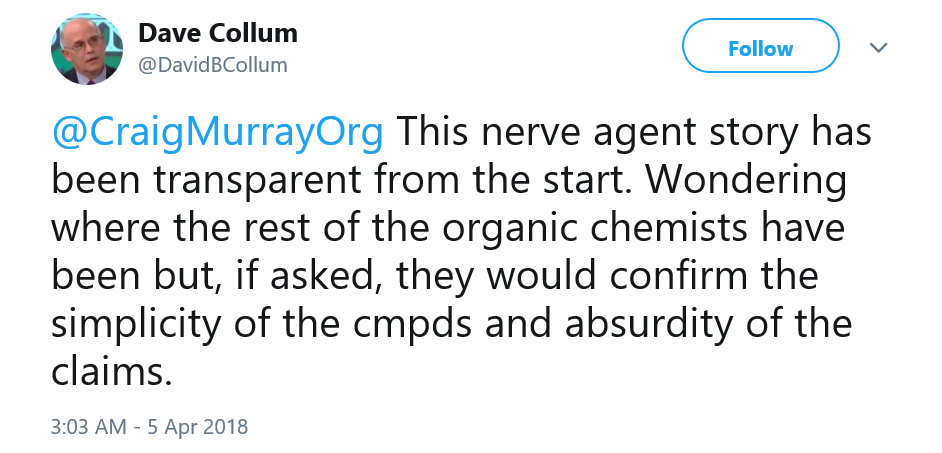
Motorola sales agent Gary Aitkenhead – inexplicably since January, Chief Executive of Porton Down chemical weapons establishment – said in his Sky interview that “probably” only a state actor could create the nerve agent. That is to admit the possibility that a non state actor could. David Collum, Professor of Organo-Chemistry at Cornell University, infinitely more qualified than a Motorola salesman, has stated that his senior students could do it. Professor Collum tweeted me this morning.
The key point in his tweet is, of course “if asked”. The state and corporate media has not asked Prof. Collum nor any of the Professors of Organic Chemistry in the UK. There simply is no basic investigative journalism happening around this case.
That the entire British case against Russia depends on intelligence is further shown by a further strange development in the case today.
This is that the British authorities are now apparently claiming that the fact that the poison which was used to poison Sergey and Yulia Skripal was supposedly found on Sergey Skripal’s door knob is the ‘smoking gun’ which points to Russia.
Whether that is so or not – and I share Craig Murray’s deep skepticism about this – the alleged presence of the poison on the door knob cannot be the reason why on 7th March 2018 the British government’s COBRA committee had already come to the conclusion that the attack on Sergey and Yulia Skripal “was almost certainly” the work of Russia.
That is because the theory that Sergey and Yulia Skripal were poisoned when they came into contact with the poison on the door knob only appeared several weeks after 7th March 2018.
All the evidence points to fact that the ‘intelligence’ the British government used to come to the conclusion – reached within hours of Sergey and Yulia Skripal being found passed out on a bench – that the attack on them had been carried out by Russia must have come from a human source.
If the British authorities really do possess what they believe to be a Russian assassin’s manual (see Craig Murray again) then that all but confirms it. How else would such a manual have come into their hands?
If that human source really was able to identify the particular poison used in the attack on Sergey and Yulia Skripal in advance, then that suggests a very well informed source indeed.
That might be because the source does have genuine access to secret information about a top secret Russian assassination programme, in which case the Russian authorities will by now almost certainly know who that source is.
However given the complete absence of any other evidence of a top secret Russian assassination programme I must say I doubt this (as I have discussed elsewhere, the Litvinenko case does not provide such evidence).
The alternative – which of course is what many people believe – is that this whole affair is a provocation, staged by someone who then tipped the British off that Novichok – a poison of “a type developed by Russia” but which can in fact easily be made elsewhere (see above) – had been used, whilst misleading the British by giving them a trail of false leads which appeared to point towards Russia.
The claim that the fact that traces of the poison were found on the door knob is the ‘smoking gun’ which points to Russia to my mind rather supports this second theory.
If this claim was made before the poison was found on the door knob it suggests that the source knew in advance that it was there, which would tend to implicate the source in the attack.
If the source provided the information about the alleged ‘assassin’s manual’ after reports appeared in the British media about the poison being found on the door knob – which by the way is what I suspect – then that strongly suggests that the source is adapting its information to the changing news, which suggests manipulation of the intelligence in order to implicate Russia.
Whatever the case the fact that Novichok was probably used to poison Sergey and Yulia Skripal (we will only know with any measure of certainty when the OPCW reports its tests) is not proof that Russia was involved.
The British have got themselves into a total mess by pretending that it is.
They would have avoided getting into this mess – and avoided being manipulated by whoever is giving them ‘secret’ information, if that is what is happening – if they had instead done what their law and traditions dictate they should have done, which is allowed the criminal investigation to take its course.
It bears repeating that at this stage no suspect has been identified in the case and even the theory that Sergey and Yulia Skripal were poisoned by touching Sergey Skripal’s door knob is pure conjecture.
Once again – as in the Litvinenko case and the Russiagate scandal – the course of a criminal investigation has been corrupted by the misuse of ‘intelligence’.
How the Ex-Spy Case is Transforming UK Media Into Orwellian ‘Ministry of Truth’
Sputnik – April 5, 2018
The admission by scientists from the Porton Down defense lab that that they could not actually verify the source of the nerve agent used to poison Sergei Skripal and his daughter has not stopped British media from blaming Russia for the affair, or calling on London to take an even tougher stance against the Russians.
Unnamed ‘security sources’ have told The Times that they may have pinpointed the location of the “covert Russian laboratory” which allegedly created the chemical agent used to poison the Skripals.
According to the newspaper, government ministers and security officials “were able to identify the source using scientific analysis and intelligence” soon after the attack. “We knew pretty much by the time of the first Cobra [the emergency coordination briefing] that it was overwhelmingly likely to come from Russia,” a Whitehall source said.
The Times’ source insisted that the security services have a “high degree of confidence” regarding the location where the chemical was produced, but admitted they were not 100% certain.

Screenshot of The Times’ story.
Not to be outdone, The Sun ran a similar story, claiming that a lab run by Russia’s SVR foreign intelligence service in the Moscow district of Yasenevo was the “likely” creator of the poison. The tabloid paraphrased unnamed ‘security sources’, who told the newspaper that the Russian lab is “one of a handful of labs in the world that produces the nerve agent.”

Screengrab of The Sun article.
No Proof Needed
The pair of stories comes 48 hours after Porton Down Defense Science & Technology Laboratory chief Gary Aitkenhead’s admission that the military could not definitively conclude that the nerve agent believed used in the Skripal case was of Russian origin.
The new media efforts to implicate Russia, using unnamed sources and terms such as “likely” and “high degree of confidence” is reminiscent of the kind of language used by the British government in the days and weeks following the poisoning. However, following Tuesday’s revelation by Mr. Aitkenhead, the government and Foreign Secretary Boris Johnson in particular have been reeling from their attempts to definitively claim Russian involvement in the Skripal case.
Some outlets, including The Independent, decided to meet Aitkenhead’s revelations with a stiff upper lip, insisting that Russia’s efforts in the Skripal case, including its “ever more reasonable-sounding but insincere offers” to help in the investigation, don’t change “the overwhelming probability that the novichok nerve agent originated in Russia…” It is simply “inconceivable that anyone other than the Russians” could organize such a plot, according to the newspaper.
As for Russia’s demand that London actually prove its allegations, The Independent suggests that “a legal standard of proof is not required,” adding that the kind of proof asked for by Moscow is “impossible to achieve.” The paper even accuses Labour leader Jeremy Corbyn and others of ‘buying into’ the arguments presented by the Russians.
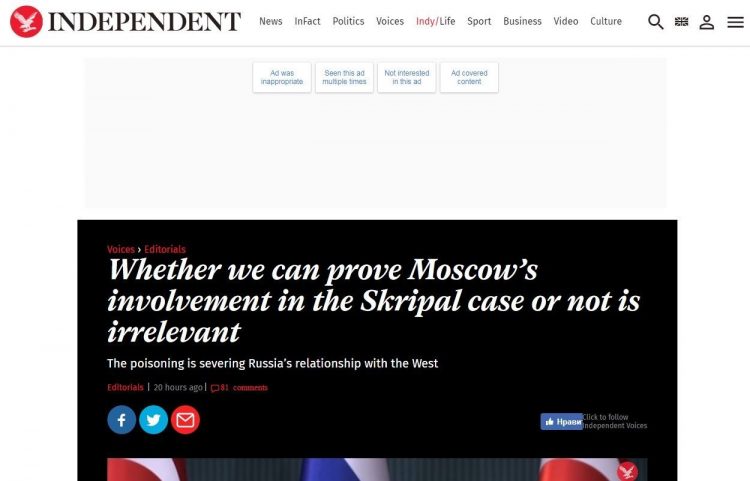
The Independent’s ‘bold’ editorial amid the revelation that Porton Down scientists couldn’t prove the poison’s origin.
Ministry of Truth
Also, even as the case against Russia over the Salisbury poisoning slowly falls apart, some UK and other Western media continue an effort to further poison Russia-Western relations, insisting that Russia is surely responsible for the attack, and criticizing their governments for not being tough enough on Moscow.
Bloomberg, for example, has run an editorial arguing that while the recent expulsion of dozens of Russian diplomats from dozens of Western countries is all well and good, “it’s too mild” to put real pressure on Vladimir Putin and the Russian government.Rather, the business news agency says, the West should band together to turn up the heat to “counter the domestic propaganda that Putin has used to increase his popularity and build anti-Western sentiment. Reaching out to Russians in big cities and neighboring countries, where dissent exists and could be encouraged, the US and its allies should make clear that the cause of their complaints is Putin and his helpers, not Russia at large.”

Screenshot of the Bloomberg piece.
Commenting on the Bloomberg piece, Rossiya Segodnya politics contributor Viktor Marakhovsky quipped that the logic of the story was just brilliant: “When Russia appeals to the citizens of Western countries with criticism toward their authorities, this is propaganda and an attempt to assert influence. But when it’s the other way around, this is a fight against internal propaganda and bringing the truth to Russia,” he wrote.
The Guardian issued its own editorial, recommending paying more attention to the ‘home front’ to arrange a nationwide informational manhunt of ‘Putin’s trolls’.
Complaining about The Guardian’s comments section being “infected” by “Russian trolls,” the editorial says that while not all offending accounts or hashtags may be Russian-made, “its sentiments chime sufficiently with the trolls’ aim for them to boost it.”
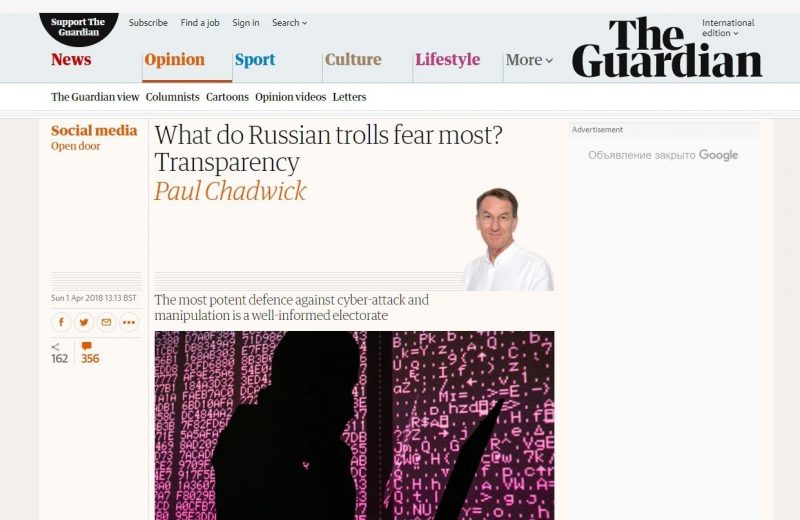
Screengrab of The Guardian editorial.
In other words, Marakhovsky commented, these non-Russian accounts are de facto “enemies because they think and write the wrong thing.” In this way, the journalist noted, the newspaper is effectively calling on Western media “to assume the functions of the Ministry of Truth – to identify both Russian trolls and those who have been infected by their propaganda… and explain to them why their views are wrong, because they happen to agree with the opinion of the Russian foe.”
Russian ex-spy Sergei Skripal and his daughter Yulia were hospitalized in Salisbury, southern England on March 4 following a chemical attack thought to involve the A-234 nerve agent. Sergei remains in critical condition; his daughter has regained consciousness and is making a recovery. London almost immediately accused Moscow for the attack, and initiated a series of measures directed against Russia, including the expulsion of 23 Russian diplomats. Many of the UK’s allies have followed suit. Moscow has rejected London’s accusations, saying claims of Russian involvement are entirely unsubstantiated.
Knobs and Knockers
By Craig Murray | April 5, 2018
What is left of the government’s definitive identification of Russia as the culprit in the Salisbury attack? It is a simple truth that Russia is not the only state that could have made the nerve agent: dozens of them could. It could also have been made by many non-state actors.
Motorola sales agent Gary Aitkenhead – inexplicably since January, Chief Executive of Porton Down chemical weapons establishment – said in his Sky interview that “probably” only a state actor could create the nerve agent. That is to admit the possibility that a non state actor could. David Collum, Professor of Organo-Chemistry at Cornell University, infinitely more qualified than a Motorola salesman, has stated that his senior students could do it. Professor Collum tweeted me this morning.
The key point in his tweet is, of course “if asked”. The state and corporate media has not asked Prof. Collum nor any of the Professors of Organic Chemistry in the UK. There simply is no basic investigative journalism happening around this case.
So given that the weapon itself is not firm evidence it was Russia that did it, what is Boris Johnson’s evidence? It turns out that the British government’s evidence is no more than the technique of smearing nerve agent on the door handle. All of the UK media have been briefed by “security sources” that the UK has a copy of a secret Russian assassin training manual detailing how to put nerve agent on door handles, and that given the nerve agent was found on the Skripals door handle, this is the clinching evidence which convinced NATO allies of Russia’s guilt.
As the Daily Mirror reported in direct quotes of the “security source”:
“It amounts to Russia’s tradecraft manual on applying poison to door handles. It’s the smoking gun. It is strong proof that in the last ten years Russia has researched methods to apply poisons, including by using door handles. The significant detail is that these were the facts that helped persuade allies it could only be Russia that did this.”
Precisely the same government briefing is published by the Daily Mail in a bigger splash here, and reflected in numerous other mainstream propaganda outlets.
Two questions arise. How credible is the British government’s possession of a Russian secret training manual for using novichok agents, and how credible is it that the Skripals were poisoned by their doorknob.
To take the second question first, I see major problems with the notion that the Skripals were poisoned by their doorknob.
The first is this. After what Dame Sally Davis, Chief Medical officer for England, called “rigorous scientific analysis” of the substance used on the Skripals, the government advised those who may have been in contact to wash their clothes and wipe surfaces with warm water and wet wipes. Suspect locations were hosed down by the fire brigade.
But if the substance was in a form that could be washed away, why was it placed on an external door knob? It was in point of fact raining heavily in Salisbury that day, and indeed had been for some time.
Can somebody explain to me the scenario in which two people both touch the exterior door handle in exiting and closing the door? And if it transferred from one to the other, why did it not also transfer to the doctor who gave extensive aid that brought her in close bodily contact, including with fluids?
The second problem is that the Novichok family of nerve agents are instant acting. There is no such thing as a delayed reaction nerve agent. Remember we have been specifically told by Theresa May that this nerve agent is up to ten times more powerful than VX, the Porton Down developed nerve agent that killed Kim’s brother in 15 minutes.
But if it was on the doorknob, the last contact they could possibly have had with the nerve agent was a full three hours before it took effect. Not only that, they were well enough to drive, to walk around a shopping centre, visit a pub, and then – and this is the truly unbelievable bit – their central nervous systems felt in such good fettle, and their digestive systems so in balance, they were able to sit down and eat a full restaurant meal. Only after all that were they – both at precisely the same time despite their substantially different weights – suddenly struck down by the nerve agent, which went from no effects at all, to deadly, on an alarm clock basis.
This narrative simply is not remotely credible. Nerve agents – above all “military grade nerve agents” – were designed as battlefield weapons. They do not leave opponents fighting fit for hours. There is no description in the scientific literature of a nerve agent having this extraordinary time bomb effect. Here another genuine Professor describes their fast action in Scientific American :
Unlike traditional poisons, nerve agents don’t need to be added to food and drink to be effective. They are quite volatile, colourless liquids (except VX, said to resemble engine oil). The concentration in the vapour at room temperature is lethal. The symptoms of poisoning come on quickly, and include chest tightening, difficulty in breathing, and very likely asphyxiation. Associated symptoms include vomiting and massive incontinence. Victims of the Tokyo subway attack were reported to be bringing up blood. Kim Jong-nam died in less than 20 minutes. Eventually, you die either through asphyxiation or cardiac arrest.
If the nerve agent was on the door handle and they touched it, the onset of these symptoms would have occurred before they reached the car. They would certainly have not felt like sitting down to a good lunch two hours later. And they would have been dead three weeks ago. We all pray that Sergei also recovers.
The second part of the extraordinarily happy coincidence of the nerve agent being on the door handle, and the British government having a Russian manual on applying nerve agent to door handles, is whether the manual is real. It strikes me this is improbable – it rings far too much of the kind of intel they had on Iraqi WMD. It also allegedly dates from the last ten years, so Putin’s Russia, not the period of chaos, and the FSB is a pretty tight organisation in this period. MI6 penetration is just not that good.
A key question is of course how long the UK has had this manual, and what was its provenance. Another key question is why Britain failed to produce it to the OPCW – and indeed why it does not publish it now, with any identifying marks of the particular copy excluded, given it has widely publicised its existence and possession of it. If Boris Johnson wants to be believed by us, publish the Russian manual.
We also have to consider whether the FSB really publishes its secret assassination techniques in a manual. I attended, as other senior FCO staff, a number of MI6 training courses. One on explosives handling was at Fort Monckton, not too far from Salisbury. One in a very nondescript London office block was on bugging techniques. I recall seeing rigs set up to drill minute holes in walls, turning very slowly indeed. Many hours to get through the wall but almost no noise or vibration. It was where I learnt the government can listen to you through activating the microphone in your mobile phone, even when your phone is switched off. I recall javelin like directional microphones suspended from ceilings to point at distant targets, and a listening device that worked through a beam of infra-red light, but the target could foil by closing the curtains.
The point is that there were of course no manuals for this stuff, no manuals for any other secret MI6 techniques, and these things are not lightly written down.
I would add to this explanation that I lost all faith in the police investigation when it was taken out of the hands of the local police force and given to the highly politicised Metropolitan Police anti-terror squad. I suspect the explanation of the remarkably convenient (but physically impossible) evidence of the door handle method that precisely fits the “Russian manual” may lie there.
These are some of the problems I have with the official account of events. Boris lied about the certainty of the provenance of the nerve agent, and his fall back evidence is at present highly unconvincing. None of which proves it was not the Russian state that was responsible. But there is no convincing proof that it was, and there are several other possibilities. Eventually the glaring problems with the official narrative might be resolved, but what is plain is that Johnson and May have been premature and grossly irresponsible.
I shall post this evening on Johnson’s final claim, that only the Russians had motive.
Update: I have just listened to the released alleged phone conversation between Yulia Skripal in Salisbury Hospital and her cousin Viktoria, which deepens the mystery further. I should say that in Russian the conversation sounds perfectly natural to me. My concern is after the 30 seconds mark where Viktoria tells Yulia she is applying for a British visa to come and see Yulia.
Yulia replies “nobody will give you a visa”. Viktoria then tells Yulia that if she is asked if she wants Viktoria to visit, she should say yes. Yulia’s reply to this is along the lines of “that will not happen in this situation”, meaning she would not be allowed by the British to see Viktoria. I apologise my Russian is very rusty for a Kremlinbot, and someone might give a better translation, but this key response from Yulia is missing from all the transcripts I have seen.
What is there about Yulia’s situation that makes her feel a meeting between her and her cousin will be prevented by the British government? And why would Yulia believe the British government will not give her cousin a visa in the circumstance of these extreme family illnesses?
US govt spent $9mn on Soros-backed political campaign in Albania – documents
RT | April 5, 2018
Documents the State Department was forced to publish show that it spent almost $9 million on political reform in Albania coordinated with billionaire George Soros. The US government denies the expenditure was inappropriate.
The US Agency for International Development (USAID) channeled funds into a ‘Justice for All’ campaign to reform the judicial system in Albania in 2016. The campaign was run by Soros’s East West Management Institute, according to the conservative watchdog Judicial Watch. The group obtained 32 pages of State Department documents in a legal battle, which concluded with the US government submitting to a Judicial Watch Information Act (FOIA) request in exchange for a dropped lawsuit.
“The Obama administration quietly spent at least $9 million in US taxpayers’ dollars in direct collusion with left-wing billionaire George Soros’s backing of a socialist government in Albania,” Judicial Watch President Tom Fitton said in a statement.
Soros is a billionaire and “shouldn’t be receiving taxpayer support to advance his radical left agenda to undermine freedom here at home and abroad,” Fitton added.
Following the report’s publication, a USAID official told Fox News that the agency did not provide grants to Soros’s Open Society Foundation (OSF) in Albania, which is technically true according to the Judicial Watch publication. Instead, the US embassy in Tirana and the OSF “each provided funding to a local organization to conduct a public opinion poll on attitudes towards the Judicial Reform effort,” a document from February 2017 said. The poll’s result sounded favorable for the judicial reform championed by the OSF and the Obama administration.
“For decades, there has been broad bipartisan agreement in Washington, DC, on the need to promote democracy and human rights abroad,” a spokesperson for OSF told Fox News in a statement, adding: “Of late there has been an unfortunate and misguided effort to politicize this process.”
Fitton and Judicial Watch were especially critical of US Ambassador to Albania Donald Lu, whom the group called in the statement “a holdover from the Obama administration” and an official with inappropriately close ties to Soros. The embassy in Tirana, they point out, frequently asks representatives of the OSF to “participate in technical reviews” of applications for funding USAID receives, according to a February 2017 memo.
Judicial Watch accuses Lu of interfering in Albanian politics by backing the country’s ruling Socialist Party at the expense of the opposition. The group said that in May 2017 Lu declared that the US would recognize the results of the Albanian general election even if the opposition refused to participate.
In March 2017, five Republican senators wrote to then-Secretary of State Rex Tillerson, asking about claims that US taxpayer funds were spent on interfering in the internal politics of countries such as Albania, as well as neighboring Macedonia.
“This includes reports of diplomats playing political favorites, USAID funds supporting extreme and sometimes violent political activists, and the US government working to marginalize the moderates and conservatives in leadership roles,” Senator Mike Lee (R-Utah) said at the time, adding that “this behavior is unacceptable and must be halted immediately.”
Judicial Watch has also made FOIA requests about the activities of Soros groups in Macedonia, Romania and Colombia.
Judicial reform in Albania remains a matter of controversy. In December last year, opposition parties in the national parliament tried to stop the appointment of an interim prosecutor general – with is part of Albania’s transition to the new system – by igniting smoke bombs in the chamber. The radical move was meant to express protest against what they called an unconstitutional move by the ruling party.
Last month, the political establishment in Washington was up in arms over the Trump administration’s proposal to cut the budget for “democracy promotion” activities abroad, specifically funding for the National Endowment for Democracy (NED) and its partisan adjuncts, the National Democratic Institute (NDI) and the International Republican Institute (IRI).
Read more:
Tycoon who pushed Magnitsky Act warns EU minister of ‘career ruining’ opposition to Russia-bashing
RT | April 4, 2018
Bill Browder, the financier convicted of tax fraud in Russia and the driving force behind the Magnitsky Act, has taken aim at the Dutch foreign minister, warning him that opposing sanctions against Russia is dangerous.
Foreign Minister Stef Blok should take note of what happened to his Canadian colleague, Stephane Dion, after he opposed the hard line on Russia, Browder tweeted on Tuesday. Blok had voiced opposition to an EU version of the Magnitsky Act, the 2012 US law blacklisting dealings with the Russian government and certain individuals, enacted over “human rights violations.”
Browder’s tweet was pointed out by the Russian embassy in Canada as an instance of foreign meddling.
After Dion expressed opposition to Canada’s adoption of the Magnitsky Act in 2016, Browder made it a “domestic political issue with [the] large Ukrainian diaspora in Canada.” In January 2017, Prime Minister Justin Trudeau replaced Dion with Chrystia Freeland, a Ukrainian-Canadian with a hardline position on Russia. Canada passed its own version of the anti-Russian law in October that year.
Browder followed up the threat to Blok by singling out two Dutch lawmakers, Pieter Omtzigt and Sjoerd Wiemer Sjoerdsma, for advancing the proposal in a 81-69 vote.
Browder, the CEO of Hermitage Capital, made billions from the 1990s chaos in Russia. He gave up his American citizenship in 1998 to avoid having to pay US taxes, and obtained British citizenship instead. The UK does not have an extradition treaty with Russia, which Browder found useful in 2005, when he was expelled by the Russian government.
Hermitage has been repeatedly investigated for tax fraud. When Sergey Magnitsky, a lawyer hired by Hermitage, was found dead in his Moscow prison cell in 2009, Browder embarked on a global crusade to demonize Russia as a murderous dictatorship.
This resulted in the 2012 passage of the Magnitsky Act, ostensibly enabling the US government to blacklist Russian officials “thought to be responsible” for Magnitsky’s death. In 2016, the law was expanded to have a global scope and blacklist any Russian officials for “corruption” or “human rights violations.” In practice, this has translated into things like stripping Chechen leader Ramzan Kadyrov of his Instagram account.
Both the original act and the 2016 expansion were championed by Senator Ben Cardin (D-Maryland), a well-known hardliner on Russia.
Browder is not content to stop there. He has called for using the EU-wide Magnitsky Act to bully the government of Hungary – or “government kleptocrats who are ruining democracy in that country,” as he described it – into submission to Brussels. He is also supporting the Democrats’ campaign to oust Congressman Dana Rohrabacher (R-California), accusing him of “selling out his integrity and US national security to the Russian FSB.”
Meanwhile, in Russia, a Moscow court convicted Browder of tax fraud in the amount of $79 million and sentenced him to nine years in a penal colony and a fine of 200,000 rubles ($3,470). The sentence was handed down in December 2017.
Blok became the Dutch foreign minister on March 5. His predecessor Halbe Zijlstra resigned in February, after admitting he lied about a 2006 meeting with Russian President Vladimir Putin. Zijlstra claimed that he had overheard Putin talk about plans for a “Greater Russia.” It later emerged he was never at the meeting.
Featured Video

or go to
Aletho News Archives – Video-Images
Book Review
The Maidan Killings and the False-Flag Case
By Freddie Ponton | 21st Century Wire | September 5, 2026
Before the killings that helped bring down Ukraine’s president in February 2014, American diplomats were discussing who should enter its government. In a leaked telephone call, senior State Department official Victoria Nuland told US ambassador Geoffrey Pyatt, “I think Yats is the guy,” referring to opposition leader Arseniy Yatseniuk. Washington had clear preferences and was working to advance them. Later that month, Yatseniuk became prime minister.
Ivan Katchanovski’s The Maidan Massacre in Ukraine examines the violence that preceded that transfer of power. Drawing on television footage, witness testimony, forensic examinations and Ukrainian court proceedings, he argues that elements of the opposition shot protesters and police in a false-flag operation. His case centres on evidence of protesters being shot from opposition-controlled locations, including Hotel Ukraina, overlooking the killing ground. … continue
Blog Roll
 Aletho News
- What changes with Lula or Flávio?
- Britain leads Western media’s demise through ‘fear porn’ narrative
- The Maidan Killings and the False-Flag Case
- Georgia’s Largest Healthcare System Will Fire Employees Who Refuse Flu Vaccine
- The Five-Year Fuel Crisis: Why the World Economy Is Paying for a War It Thinks Is Ending
- Trump’s Big Bluff on Iran
- Swiss scammed out of millions by Ukraine-linked call centers – media
- Germany facing potential ‘violent conflict’ with Russia – spy chief
- Ukraine’s EU neighbors reject new plea from Kiev – Politico
- British Transport Police Facial Recognition Trial Scanned 926,912 People With Zero Arrests
- If Americans Knew
- “We See Our Homes Now From A Satellite, Like Strangers”
- Watch “Gaza: Doctors Under Attack”, originally censored by BBC
- NAZA: Israeli embassies in UK and US promote rival documentary to challenge Gaza genocide allegations
- David Ellison appoints Israeli to lead merged Paramount-Warner studios
- Turkish Red Crescent helps elderly Gaza man walk again after Israel confiscates his prosthetic limb
- Four Palestinians Killed in Israeli Attacks in Gaza
- Two Palestinian youths killed and village razed as Israeli attacks on West Bank continue
- Two more Christian women victims of Israeli raids on Gaza
- Cruelty, Deprivation, Indignity: A Journalist’s 22 Months in Israeli Prison
- New IDF Website Frames Slain Gaza Journalists as Terrorists
- No Tricks Zone
- Latest European Green Energy Debacle; Portugal’s Largest Flagship Solar Park Insolvent!
- Green Energy Debacle: German Expert Professor Fritz Vahrenholt Warns Of Severe Economic And Social Consequences
- Two More Paleo Reconstructions Affirm Meters-Higher Sea Levels Across Ireland, Brazil 7000-6000 Years Ago
- New Study: Earth And Venus Surface Warmth Largely Explained By Convection And Lapse Rate, Not CO2 Or Radiation
- 2025 Nature Paper Claiming Worsening Global Drought Gets RETRACTED …Heavily Flawed
- New Study: ‘Global Drought Shows No Detectable Recent Acceleration Under Climate Warming’
- Economic Masterminds: German Socialists Suggest Taxing Productivity Gains Stemming From Using AI
- The South China Sea Has Not Been Cooperating With The Climate Change Narrative
- Energy Crisis: Germany Enters Heating Season With Historically Low Gas Reserve Fill Levels
- New Study: The Antarctic Ice Sheet Gained Mass From 2020-2024 Due To Staggering Snow And Ice Accumulation

