Media Boosts Obvious Saudi Front Group as Neutral ‘Think Tank’

By Adam Johnson | FAIR | March 28, 2018

Washington Post, 5/31/17
The Arabia Foundation appeared in spring 2016, seemingly out of nowhere, as a Saudi-focused think tank with “ties to Riyadh,” but vaguely independent of the regime. Or at least independent enough so that media wouldn’t represent it as an extension of the kingdom. But the past few weeks have clearly shown it to be little more than a PR outlet for de facto Saudi ruler Mohammed bin Salman and his sprawling, opaque business interests.
After multiple requests by FAIR for its donors, the Arabia Foundation refused to give any, other than its founder, Saudi investment banker Ali Shihabi. It insists it doesn’t take money from “the Saudi government,” but instead is backed by unnamed private Saudi citizens.
The distinction between private citizens and the “government” in the hereditary monarchy of Saudi Arabia is notoriously blurry, but one connection is worth noting: The registered agent and legal counsel of the Arabia Foundation, Eric L. Lewis, represented the Saudi government and related “charities” in the lawsuit brought by families of 9/11 victims over the Saudi royal family’s role in the September 11 attacks. The website of Lewis’ law firm, Lewis, Baach, Kaufmann and Middlemiss, boasts it has “extensive experience representing and advising foreign sovereigns, including the governments of Saudi Arabia, Kuwait and Egypt.”
The New York Times (11/30/18) has described the group as “close to the Saudi government,” while the Washington Post’s Ishaan Tharoor (11/6/17) noted it had “close ties to the kingdom.” That doesn’t stop the Post opinion section from running multiple op-eds from Arabia Foundation figures (5/31/17, 12/20/17, 1/4/18, 1/22/18). In most press appearances, the group is simply identified as “a Washington-based think tank.” Absent documented evidence of who exactly funds the group, why should media not assume—based on its connections to the government and cartoonishly pro–bin Salman line—that the Arabia Foundation is a front group for the government?
In repeated interviews (BBC World News, 3/20/18; Morning Joe, 3/20/18; CNN, 3/19/18) last week, Shihabi, the head of the nominally independent group, spun for war crimes, human rights abuses and a whole host of morally dubious activities carried out by the increasingly despotic Saudi ruler. The Arabia Foundation’s ties to the Saudi government are never noted or even vaguely referenced in these interviews.
On MSNBC’s Morning Joe, after saying the “crown prince” has engaged in a “massive corruption crackdown” (a wholly PR frame discredited earlier this month by the New York Times, 3/11/18), host Mika Brzezinksi teed up Shihabi to comment on Saudi Arabia. The softball interview that followed hit all of the regime’s central premises without question: as well as “cracking down on corruption,” bin Salman is “modernizing Saudi Arabia” and “taking on the religious establishment.”
No one on the panel brought up Saudi Arabia’s ongoing war crimes in Yemen—consistent with MSNBC’s network-wide virtual blackout on one of the world’s worst humanitarian crises (FAIR.org, 3/20/18). The Council on Foreign Relations’ Richard Haas made one opaque reference to Saudi “war with Yemen,” but didn’t note the thousands killed or up to one million infected with cholera; the US-backed war was was simply dismissed as a “strategic overreach.” The New York Times’ Elisabeth Bumiller, another panelist, did get in a question about torture, which Ali Shihabi dismissed as having “no evidence” despite Bumiller speaking with several doctors who witnessed it.
Reliable Saudi stenographer David Iglesias who, as FAIR (4/28/17) noted last year, has been running the same reformist press release for the royal family for 15 years, continued his unique brand of faux criticism, insisting that the Saudi prince was too “bold”—the political commentary equivalent of answering “I work too hard” when asked on a job interview what your biggest flaw is.
Shihabi claimed without irony that what Saudi Arabia needed was “autocracy to affect change,” and a “benevolent autocrat.” His evidence that the masses approved of bin Salman’s “bold, needed” leadership was approved of by the masses? That there has been “no bloodshed, there’s been no demonstration, no domestic strife.” Of course, the last time there were anti-government demonstrations, in 2011, the Saudi military opened fire on protesters, and snuffed out resistance with torture and extrajudicial killings. In 2017, when one Shia town resisted the regime, Riyadh flattened an entire neighborhood. This could perhaps be why the general population isn’t quick to take to the streets, but the Arabia Foundation insist it’s an implicit admission the crown prince is loved and popular.
The CNN and BBC interviews, likewise, didn’t note the Arabia Foundation’s obvious ties to the Saudi regime.
Forbes keeps running “op-eds” by Arabia Foundation fellow Ellen Wald that amount to little more than press releases for Saudi investment opportunities (e.g., 12/11/17, 2/1/18, 3/13/18). Another pundit on the Arabia Foundation’s payroll, Bernard Haykel, writes fawning profiles of bin Salman in the Washington Post (1/22/18) without disclosing he’s a founding director of the organization—instead listing his more benign academic credentials.
The Arabia Foundation is so satisfied with the media’s presentation of its messaging that it routinely tweets out articles it’s featured in and TV appearances it’s had, knowing its messaging is syncing up nicely with bin Salman’s PR tour to the United States. “Yemen is a tragedy. Wars are a tragedy. Saudi is aware of that and is going out of its way to try to address humanitarian issues there,” boasted one tweet, quoting Shihabi’s interview with the BBC.
By contrast, this obtuse inability to connect dots is absent when discussing think tanks “close to” the Syrian government. Never is the Assad-connected British Syrian Society set up as a neutral arbiter of affairs of the Syrian conflict. It is met with disdain, painted as “little more than a Syrian regime propaganda exercise” (Guardian, 10/26/17), the “mouthpiece in the West” (Middle East Eye, 10/19/17) for a war crime–committing tyrant. Those who associate with it, including academics, journalists and British members of parliament, are publicly shamed for participating in a “regime PR exercise” (Independent, 10/29/16). Yet somehow the “Saudi-connected” Arabia Foundation, which cheers on a “benevolent autocrat” as he rains bombs on Yemen and uses hunger as a weapon of war, receives no such moral banishment. Instead, it is dressed up as just another respectable think tank.
The fact that the Arabia Foundation is a thinly veiled PR firm for the Saudi government matters. The average reader or viewer would take Shihabi and his network of mercenary “fellows” less seriously if they were presented as spokespeople for a repressive government rather than quasi-academics from a impressive-sounding “foundation.”
With all the hysteria surrounding RT and foreign influence on the American public, one might think such an obvious racket would give editors and TV producers pause. But the same rules don’t apply to American allies. Their propaganda is treated not like a sinister “influence operation,” but like a respectable group of academics calling balls and strikes on international affairs.
AP’s slanted report on Gaza Return March, corrected and annotated
The Associated Press’s news story on the upcoming Great Return March echoes Israeli talking points…
By Kathryn Shihadah | If Americans Knew | March 30, 2018
The Associated Press, a (usually) trusted name in global news, has been unmasked for its pro-Israel bias, and the ruse continues.
Today’s exhibit is of particular significance, as the people of Gaza are about to embark on a large-scale nonviolent protest. True to form, AP has cranked out a Hamas-bashing, Israel-congratulating piece that fails to provide the accurate information its readers deserve. The report largely replicates Israel’s public relations strategy.
Below are excerpts from the AP article with commentary that will fill in some of the gaps and clear up some misrepresentations. Truth matters.
AP: Gaza’s embattled Hamas rulers are imploring people to march along the border with Israel in the coming weeks in a risky gambit meant to shore up their shaky rule, but with potentially deadly consequences.
Many Americans fail to recognize what is going on in Gaza for precisely this reason: nearly every word of this paragraph is problematic. Hamas has not imposed some kind of tyrannical regime over Gaza; their “rule” is shaky in that Israel has such a chokehold on the territory that the people are starving to death. There is little governing going on.
Grassroots movements have been in the making for years – decades, even – because Palestinians don’t need to be told they should resist the occupation. Many can see their original homes in what is now Israel or the location of their villages from the fence imprisoning them. They remember every day; they pray to God to bring them back home. Their people are being slowly, systematically eradicated.
The “gambit” is indeed “risky” – because Gazans will be nonviolently protesting while in the crosshairs of Israeli snipers, and the “potentially deadly consequences” of the initiative will almost certainly involve unarmed Palestinians dying.
Israel has essentially promised this outcome: Major General Yoav Mordechai vowed, “We intend to do everything to prevent violent demonstrations and terror demonstrations.” While Palestinians have made it clear that they will not so much as throw rocks, Israel has 100 sharpshooters at the ready, drones lined up to drop tear gas canisters, and thousands of troops armed to the teeth.
AP: But the first-of-its-kind protest also comes at a low point for the Islamic militant group and the 2 million residents of Gaza, where conditions have deteriorated since Hamas seized control of the territory from the internationally-backed Palestinian Authority in 2007.
Conditions have indeed deteriorated, but this statement is misleading: Hamas was voted into office by the people of Gaza, and Israel collectively punished them for this by imposing a blockade. Combine that with multiple “wars” against the essentially unarmed population with thousands killed and tens of thousands left homeless. “Conditions have deteriorated” is an understatement.
AP: Beginning Friday, Hamas hopes it can mobilize large crowds to set up tent camps near the border. It plans a series of demonstrations culminating with a march to the border fence on May 15, the anniversary of Israel’s establishment, known to Palestinians as “the Nakba,” or catastrophe.
Let’s take a minute to unpack the phrase that tried to sneak past. “The Nakba” is not just an Arabic name for the anniversary of Israel’s birth: it is the name for the forced exile of 75% of their population and the loss of 78% of their land. This catastrophe occurred in 1948, and tens of thousands of Palestinians who live in Gaza today are among those refugees.
AP: The group aims to mobilize hundreds of thousands of people for the effort, though it hasn’t been able to get such turnouts at past rallies. Nonetheless, a jittery Israel is closely watching and vowing a tough response if the border is breached.
Israel lives in a constant state of jitter, but why? Because the stones in Palestinians’ hands are so dangerous? Because the rockets are so deadly? (See here) Or because if Palestinian voices are heard, Israel will be exposed?
AP: An Israeli-Egyptian blockade, along with three wars with Israel and a series of sanctions by Palestinian President Mahmoud Abbas, have left Gaza’s economy in tatters. Unemployment is well over 40 percent, tap water is undrinkable and Gazans receive just a few hours of electricity a day.
Israel is the occupying power over Gaza. The occupation is now in its 6th decade, and the blockade in its 11th year. Israel has an obligation as occupier to maintain the lives and wellbeing of the occupied. Egypt and Abbas are minor players in this situation.
AP: “Hamas has realized it’s besieged from three sides; Israel, Egypt and the Palestinian Authority,” said Mkhaimar Abusada, political science professor at Gaza’s al-Azhar University. “It feels the crisis is suffocating.”
All Gazans are suffocating, not just Hamas. That is why this movement is happening right now. This is not some ploy by a terrorist organization to make trouble for Israel. It is the organic response of Palestinians who can endure no more, who must resist.
AP: [Mkhaimar Abusada] said that for Hamas, the protests can divert attention from their domestic woes while avoiding renewed war with Israel. “They think busying Israel with this issue may put it under pressure,” he said.
What the people actually think is that perhaps this time, the world will pay attention and finally realize that the level of cruelty and injustice being perpetrated on Palestinians is a huge, ongoing crime against humanity. The hope is not to “busy Israel” but to seek the rights that have been promised them by international law: the right to self-determination, the right to return to the land from which they were exiled, the right to be heard and to receive justice.
AP: A combination of social pressure and curiosity in a territory with few options for recreation could help attract people.
This statement shows an inexcusable level of ignorance: it assumes that Palestinians are content with a never-ending, illegal occupation and blockade; that they would not be inclined to march in resistance against their oppressor; and above all that people attending the protest would come for recreational purposes.
AP: Israel opposes any large-scale return of refugees, saying it would destroy the country’s Jewish character.
It’s hard to decide how to respond to this statement. Yes, having refugees pour into one’s country can be upsetting to one’s culture. The Palestinians were willing to take in Jews in the early 20th century, at a high social cost. The thanks they got for this gesture was to be themselves made refugees. Of course Israel opposes the return of non-Jews. But return they must, according to international law and consensus.
AP: Israeli Cabinet Minister Yoav Galant said, “Hamas is in distress. They are using in a cruel and cynical way their own population in order to hurt them and to hurt Israel.”
Israel has massive military might, and Israel and AP both know it. With one of the most advanced armies in the world, $10 million a day in military aid coming from the US, at least 100 nuclear weapons, and a military that is armed to the teeth, this march is not going to “hurt” Israel in any reasonable sense of the word. The only real pain the state can anticipate is the fear of being found out.
AP: “We will try to use the minimum force that is needed in order to avoid Palestinians wounded and casualties. But the red line is very clear. They stay on the Gazan side and we stay in Israel.”
Only time will tell what “minimum force” looks like, but in a nation where children can be imprisoned for years if they are suspected of throwing a stone, chances are Palestinians will die.
Most Western media, if they cover this event at all, will publish inaccurate, biased accounts that will make the Palestinians out to be the aggressors. They will completely fail to ground the story in the context of illegal occupation and blockade, not to mention dispossession and forced exile. Israel will come out looking like it acted in self-defense, and the injustice will continue unchecked as it has for lo these many years.
Kathryn Shihadah is a staff writer for If Americans Knew.
20 More Questions That Journalists Should be Asking About the Skripal Case
By Rob Slane | The BlogMire | March 27, 2018
To my knowledge, none of the questions I wrote in my previous piece – 30 questions That Journalists Should be Asking About the Skripal Case – has been answered satisfactorily, at least not in the public domain. Yet despite the fact that these legitimate questions have not yet been answered, and many important facts surrounding the case are still unknown, the case has given rise to a serious international crisis, with the extraordinary expulsion of Russian diplomats across many EU countries and particularly the United States on March 26th.
This is a moment to stop and pause. A man and his daughter were poisoned in the City of Salisbury on 4th March. Yet despite the fact that investigators do not yet appear to know how they were poisoned, when they were poisoned, or where they were poisoned, a number of Western nations have used the incident as a pretext for the co-ordinated expulsion of diplomats on a scale not witnessed even during the height of the Cold War. These are clearly very abnormal and very dangerous times.
I pointed out in my previous piece that it is not my intention to advance some sort of conspiracy theory on this blog. It remains the case that I simply don’t have any holistic theory — “conspiracy” or otherwise — for who carried this out, and I continue to retain an open mind. But since the Government of my country has rushed to judgement without many of the facts of the case being established, and since this has led to the biggest deterioration in relations between nuclear-armed nations since the Cuban Missile Crisis, it seems to me that it is more important than ever to keep asking questions in the hope that answers will come.
And so, for what it’s worth, here are 20 more important questions that I think that journalists ought to be asking regarding this case:
1. Have the police yet identified any suspects in the case?
2. If so, is there any evidence connecting them to the Russian Government?
3. If not, how is it possible to determine culpability, as the British Government has done?
4. In her statement to the House of Commons on 12th March 2018, the British Prime Minister, Theresa May stated the following:
“It is now clear that Mr Skripal and his daughter were poisoned with a military-grade nerve agent of a type developed by Russia. This is part of a group of nerve agents known as ‘Novichok’. Based on the positive identification of this chemical agent by world-leading experts at the Defence Science and Technology Laboratory at Porton Down” [my emphasis added].
In the judgement at the High Court on 22nd March on whether to allow blood samples to be taken from Sergei and Yulia Skripal for examination by the Organisation for the Prohibition of Chemical Weapons (OPCW), evidence submitted by Porton Down to the court (Section 17 i) stated the following:
“Blood samples from Sergei Skripal and Yulia Skripal were analysed and the findings indicated exposure to a nerve agent or related compound. The samples tested positive for the presence of a Novichok class nerve agent or closely related agent” [my emphasis added].
So the Prime Minister said that Porton Down had positively identified the substance as a Novichok nerve agent. The statement from Porton Down says that their tests indicated that it was a Novichok agent or closely related agent. Are these two statements saying exactly the same thing?
5. Why were the phrases “related compound” and “closely related agent” added to the statement given by Porton Down, and is this an indication that the scientists were not 100% sure that the substance was a “Novichok” nerve agent?
6. Why were these phrases left out of the Prime Minister’s statement to the House of Commons?
7. Why did the Prime Minister choose to use the word “Novichok” in her speech, rather than the word Foliant, which is the actual name of the programme initiated by the Soviet Union when attempting to develop a new class of chemical weapons in the 1970s and 1980s?
8. When asked in an interview with Deutsche Welle how scientists at Porton Down had found out so quickly that the nerve agent was of the “Novichok” class of chemical weapons, the Foreign Secretary, Boris Johnson, was asked whether Porton Down possesses samples of it. Here is how he replied:
“They do. And they were absolutely categorical and I asked the guy myself, I said, ‘Are you sure?’ And he said there’s no doubt” [My emphasis].
If Mr Johnson’s statement is correct, and the Defence Science and Technology Laboratory (DSTL) at Porton Down has samples of “Novichok” in its possession, where did they come from?
9. Were they produced at Porton Down?
10. How long have they had them?
11. Why has the DSTL not registered possession of these substances with the OPCW, which it is legally obliged to do under the Chemical Weapons Convention (CWC)?
12. Does this admission by Mr Johnson not indicate that “Novichoks” can be made in any advanced chemical weapons facility, as indeed they were under the auspices of the OPCW in Iran in 2016?
13. If so, how can the Government be sure that the substance used to poison Mr Skripal and his daughter was made in or produced by Russia?
14. In her statement to the House of Commons on Wednesday 14th March, the British Prime Minister stated that there were only two plausible explanations for poisoning of Mr Skripal and his daughter:
“Either this was a direct act by the Russian State against our country. Or conceivably, the Russian government could have lost control of a military-grade nerve agent and allowed it to get into the hands of others.”
Other than the actual substance used, is there any hard evidence that led the Government to conclude these as being the only two plausible scenarios?
15. On March 26th, a number of countries expelled Russian diplomats in an apparent response to the incident in Salisbury. Yet at this time, the OPCW had not yet investigated the case, nor analysed blood samples. Why was the clearly co-ordinated decision to expel diplomats taken before the OPCW’s investigation had concluded?
16. Has this not put huge pressure on the OPCW to come up with “the right” conclusion?
17. It is reckoned that the OPCW’s investigation into the substance used will take at least three weeks to complete, whereas it took Porton Down less than a week to analyse it. What accounts for this difference?
18. Will the OPCW be using the samples of “Novichok” that Boris Johnson says are held at Porton Down to compare with the blood samples of Mr Skripal and his daughter?
19. If not, on what basis will this comparison be made, since the first known synthesis of a “Novichok” was made by Iran in 2016?
20. If the OPCW discovers that the substance is indeed a “Novichok”, will this be sufficient evidence with which to establish who carried out the attack on the Skripals or — given that other countries clearly have the capability to produce such substances — would more evidence be needed?
Why did UK court say “limited evidence” Skripals have relatives while cousin interviewed in UK media?
Why did the UK Home Office make no attempt to contact the Skripals’ relatives in Russia? Why does High Court judgment imply they may not even exist when they have appeared on UK TV? More bizarreness in this already very bizarre case
By Catte | OffGuardian | March 28, 2018

Viktoria Skripal, Sergey’s niece, interviewed by the BBC March 28 2018
The Skripal case has been a strange one, even by current standards. The persistent lack of basic information that extends way beyond anything that could seem to be justified by security considerations. The conflicting accounts, the unprecedented government and media hysteria, the complete rejection of due process, and the demands for international reprisals against a sovereign country based on absurdly scant and inadequate evidence continue to be as baffling as they are dangerous.
We’ve already covered the absence of evidence and the various lies and/or misconceptions or confusions on the part of the UK government, including some of the further puzzles, raised by the High Court judgment made by Mr Justice Williams on March 22, about how much it currently knows about the alleged “nerve agent”
But there are other glaring oddnesses in Williams’ Judgment as well.
One, discussed today by James O’Neill, is the contradiction between Russia’s claims to have tried to make contact with the Skripals through formal channels and having been denied or evaded by the UK, and the UK claim to have received no such requests.
Another, related to the above, is the question of the Skripals’ relatives in Russia. This is what the Judgment says about this:
“… Neither Mr Skripal nor Ms Skripal appear to have relatives in the UK although they appear to have some relatives in Russia. The SSHD have not sought to make contact with them. Discussions have taken place with the OPCW TS about precisely what enquiries they wish to undertake. In summary the main issues are
And
“… Given the absence of any contact having been made with the NHS Trust by any family member, the absence of any evidence of any family in the UK and the limited evidence as to the possible existence of family members in Russia I accept that it is neither practicable nor appropriate in the special context of this case to consult with any relatives of Mr Skripal or Ms Skripal who might fall into the category identified in s.4(7)(b) of the Act.
Firstly, these statements seem to contradict each other and themselves. Do the Skripals “appear” to have relatives in Russia, or is evidence for this so “limited” it can be safely ignored? How can such a basic question be subject to such misty uncertainty?
But odder than that is the fact these allegedly theoretical and possibly non-existent or distant relatives consist of at least one niece/cousin and a mother/grandmother. Second and first degree relatives respectively.
And one of them has been interviewed by at least two different UK news outlets.
Viktoria Skripal, allegedly niece of Sergey and cousin to Yulia was interviewed by the Sun on March 14, one week before the court judgment, and again by the BBC today.
These interviews suggest this particular relative is pretty real, and not very hard to locate. If the Sun could find her on March 14, it’s hard to see how she could still be a mere thought experiment and “limited” theory for the Home Office eight days later.
So, since the implication in the judgment that these (very close) relatives are quasi hypothetical is obviously untrue, why has the Home Secretary (SSHD) not “sought to make contact with” the Skripals’ mother/grandmother and niece/cousin?
Is it because they don’t “fall into the category identified in s.4(7)(b) of the Act”
No. The “Act” being referred to is the 2005 Mental Capacity Act. S.4(7)(b) stipulates that before determining what is in an incapacitated person’s “best interests”, the person ruling (in this case Mr Justice Williams) must:
take into account, if it is practicable and appropriate to consult them, the views of anyone engaged in caring for the person or interested in his welfare
Had Mr Justice Williams not been informed that one of these relatives was so “practicable” to consult she’d recently been featured in the Murdoch press? Surely, if he knew how easy to locate they were, his judgment would have reflected the assumption a mother/grandmother, niece/cousin would at very least be “interested” in the “welfare” of Yulia and Sergey?
Do such close and easily contactable relatives really warrant being passed over simply because of “the absence of any contact having been made with the NHS Trust by any member of the family”?
I mean look, these people are in Russia. It’s possible – shocking – they don’t speak English. It’s possible they aren’t clear how to get in contact directly with a rural hospital in Wiltshire. It’s possible they tried but failed.
Would it hurt someone at the Home Office to get on the phone and check things out before assuming they just don’t care and taking the matter to court?
What’s more, far from being indifferent, Viktoria tells her interviewer she is worried about her uncle and cousin and is anxious to get information:

“I would just like to know how [Yulia and Sergey] are. Where they are.“

“If you were offered the chance to go the the UK would you go?”

“Yes, yes”
If this is the case, can we take it as pretty unlikely the Skripals have really made no attempt to contact the UK about their family members?
And, if you look at the wording again:
Given the absence of any contact having been made with the NHS Trust by any family member
It doesn’t actually say no contact has been made does it? It says no contact has been made with the NHS trust. This leaves the undeclared possibility there has been contact made by the Skripals with other departments of the UK state. This would broadly dovetail with claims made by the Russian foreign ministry, which, until at least March 19, has maintained its attempts to gain access to or information about the Skripals have been stonewalled.
If the Skripals have tried to gain information, either directly or through their embassy or consulate, why aren’t they being given any? Why aren’t they being consulted about the medical interventions being performed? Why has Viktoria been told so little since the poisoning, that she tells the BBC she still holds out a fanciful hope the victims may not even be Julia and Sergey?
Altogether, it seems this part of the official narrative is as confused and as hard to reconcile with reality as the clearly unwarranted claims about “novichoks.”
NOTE: The Guardian’s version of the BBC interview with Viktoria is shockingly deceptive. It omits all mention of the main point of the interview – that Viktoria is desperate for information and has received none – and contrives through this omission, and its headline (“Sergey and Yulia Skripal have slim chance of survival says niece”) to give the absolutely opposite impression – that Viktoria has been well informed, may even have seen her relatives and is predicting their small chance of survival from first hand observation. Even in the Guardian’s recent history of poor ethical choices and lies by omission, this is egregious in the extreme.

Strange Things Happen to European Countries Resisting George Soros’ Assault
By Alex GORKA | Strategic Culture Foundation | 28.03.2018
Strange things happen in East and Central Europe that get little mention from media outlets. Two heads of state, the PMs of Slovenia and Slovakia, resigned almost simultaneously. Slovak Prime Minister Robert Fico was a victim of the scandal over the murder of Jan Kuciak, a journalist who was investigating government corruption. The PM had to step down amid mass street protests.
Mr. Fico was known for his support of a stronger Visegrad Group. He opposed Brussels on many issues. It’s worth noting that he called for lifting sanctions and improving relations with Moscow. The PM was adamant that Russia was a reliable energy partner. Is it a coincidence that he was forced to resign amid the anti-Russia campaign triggered by the Skripal case and other obviously concocted stories used as false pretexts for incessant attacks on Moscow? Wasn’t he a threat to the so-called unity of the EU against Russia? He definitely was.
The PM did not hide the fact that his decision was made under great pressure. The ouster was engineered by outside forces, including philanthropist billionaire George Soros. For instance, Slovak President Andrej Kiska had a private meeting with the billionaire in September, 2017. It was a one-on-one conversation. No Slovak diplomat was present there.
According to Foreign Minister Miroslav Lajčák, “George Soros is a man who has had a major influence on the development in Eastern and Central Europe and beyond. That is a fact that cannot be questioned.” PM Viktor Orbán had this say about the event: “George Soros and his network are making use of every possible opportunity to overthrow governments that are resisting immigration.”
Slovenian PM Miro Cerar was attacked by Soros for his opposition to the EU policy on immigration. George Soros did not hide the fact that he was an ardent opponent of Miro Cerar’s stance. “It is an obligation for Europe to receive migrants,” the US financier lectured Europeans. Now the PM has to go, after the results of a referendum on a key economic project were annulled by the top court and the media attacks on his stance regarding asylum seekers intensified. With Cerar no longer at the helm, the opposition movement to Brussels’s dictatorship has been weakened.
Who’s next? Probably Hungary, which has become a target for Soros’s attacks. The American billionaire has invested more than $400 million into his native country since 1989. He has also announced his intention to influence the Hungarian election campaign and has employed 2,000 people for that purpose. The government wants its “Stop Soros” bills to become laws. No doubt Hungary will come under attack for opposing the financier’s network.
Brussels will raise a hue and cry, criticizing the “undemocratic regime” ruling the country. The next parliamentary elections in Hungary will be held on April 8, 2018. It’ll be a tough fight to preserve independence while fending off attempts to impose US pressure through Soros-backed NGOs and educational institutions.
Soros’s activities are also being resisted in the Czech Republic. Czech President Milos Zeman has accused the groups affiliated with Soros of meddling in his nation’s internal affairs. The financier is urging the EU to lean on Poland and compel it to “preserve the rule of law.”
Macedonia, is also resisting the billionaire-inspired subversive activities that have an eye toward regime change. The “Soros network” has great influence on the European Parliament and other institutions. The scandalous list of Soros’s allies includes 226 MEPs out of 751. Every third member — just think about that! If that isn’t corruption then what is? The lawmakers being swayed from abroad dance to Soros’s tune. They do what they are told, which includes whipping up anti-Russia hysteria.
Moscow has its own history of dealing with the Soros network. In 2015, George Soros’s Open Society Institute was kicked out of that country as an “undesirable organization” that was established to boost US influence.
It would be really naïve to think that Soros acts on his own. It’s an open secret that the US government flagrantly meddles in other countries’ internal affairs using the billionaire as a vehicle. Europe is an American competitor that needs to be weakened. USAID and the Soros network often team up in pursuit of common objectives. In March 2017, six US senators signed a letter asking the State Department to look into government funding of Soros-backed organizations. But those efforts went nowhere, Foggy Bottom is always on Soros’s side, whatever it is.
Many European countries are engaged in a fierce battle to protect their independence. The financier’s “empire” is chomping at the bit to conquer Europe by means of bribes and subversive NGOs. These countries and Russia are resisting the same threat. Perhaps that’s why the sanctions against Russia are so unpopular among many East European politicians.
Some Further Thoughts on the Skripal Affair
By James O’Neill | OffGuardian | March 28, 2018
Let the jury consider the verdict” the King said. “No, No” said the Queen: “sentence first, verdict afterwards”. “Stuff and nonsense” said Alice.
The furore surrounding the alleged nerve gas poisoning of Sergei Skripal and his daughter Yulia shows no signs of abating. It continuously puts one in mind of the quote from Lewis Carroll’s Alice in Wonderland at the head of this article.
For those of us with fond of memories of some of the traditional virtues of common-law justice, such as the presumption of innocence, the onus of proof upon the accuser, a verdict based upon evidence beyond reasonable doubt, and a prohibition on prejudicial pre-trial comment, it all seems like a very distant past.
The latest development has been a group of nations, largely in the European Union, but also including United States, Canada, Australia and European minnows like Albania and Macedonia, joining the collective hysteria and expelling, at the time of writing, more than 100 Russian diplomats.
That action will achieve nothing, other than to the poison the cold war atmosphere eagerly promoted by the intellectual lightweights so prominent in the governments from United Kingdom to the United States to Australia. The few sane voices in this cacophony of nonsense, such as those of the governments of Portugal, Greece and Austria, or Die Linke’s Andreas Maurer in Germany who noted in various ways that not jumping to conclusions and actually waiting for the results of the now extant OPCW’s Technical Committee investigation, might be preferable to rushing headlong to a possible nuclear confrontation with Russia, are scarcely heard.
British Labour leader Jeremy Corbyn made similar remarks, only to be savagely attacked by members of his own party, as well as Tory leaders such as May, Johnson and Williamson.
The careful and cautiously worded judgement of Mr Justice Williams released on 22 March 2018 has been largely ignored by the politicians and the mainstream media alike.
Justice Williams was delivering the judgement on an application by the Secretary of State for the Home Department for permission to be given for the taking of blood samples from the Skripals for analysis by the OPCW experts in accordance with the terms of the Convention on the Prevention of Chemical Weapons.
The Skripals were admitted to Salisbury Hospital on 4 March 2018 and it took until 14 March for the British government to invite the OPCW to assist in the technical evaluation of what had caused the Skripal’s illness.
The Judge did not comment on why it took 10 days for this invitation to issue, particularly as the Russian government had correctly pointed out that it should have been done much earlier in accordance with the article 9 of the Convention.
Indeed, May had issued peremptory demands for Russia to, in effect, prove its innocence within 36 hours. The application by the Home Department was necessary as the Skripals, because of their stated medical condition (in a coma, but stable) were unable to give an informed consent. The Judge presumed, probably correctly, if they were able to give consent they would do so. They have a greater interest than anyone else in determining who was responsible and holding them (or their government) to account.
The Russian government, which clearly was an interested party as among other reasons Ms Skripal was a Russian citizen, was not a party to the proceedings, nor, it seems, were they even advised that the application was being made. The Russian government have certainly stated that, and the British government has made no denial.
The absence of the Russians from the application would ordinarily have invited a query from the Judge. He may well have done so, but as the proceedings were held in camera, we cannot establish that. His Honour appears to have accepted a submission from Mr Sachdeva QC, acting for the Skripals, that the Russian authorities had made no attempt to seek access to the Skripals or their medical records.
This is prima facie highly improbable, particularly given the case’s high profile. The Russian government to the contrary has claimed that all their requests for access, medical details and related evidence were ignored or refused by the British government.
It is not possible to definitively resolve that conflict, but the weight of logic, common sense and the evidence we do have would tend to support the Russian position.
There is no reason at this point to question the integrity of the OCPW technical evaluation. It seems likely however, that they may well not be able to ascertain precisely what substance was used to affect the Skripals. Almost certainly, neither will they be able to specify its precise origins, much less who administered it. More than three weeks after the attack we still have no clear idea as to how the poison, if that is indeed what it is, was administered.
That qualified conclusion, which is surely known to the British government, may be a major reason why such a huge propaganda effort is currently being made before the likely inconclusive results are published. It may also account for the meaningless terminology used in statements by the UK government and others that the poison was “of a type developed by Russia.”
That statement in itself is inaccurate. It has zero evidential value, but is clearly seen as having a powerful propaganda effect. Most casual readers of the mainstream media or viewers of the BBC and their foreign equivalents will be unaware of any of the history of nerve agents, or their possession and use by multiple countries, not least the United Kingdom itself.
Perhaps the most depressing conclusion to be drawn from this saga is the one expressed by the commentator known as the Saker (What Happened to the West I was born in? 26 March 2018). He argues that during the previous Cold War, although the West was hardly a knight in shining armour, the rule of law did matter, as did some degree of critical thinking. Now, the West is ruled by an “ugly gang of ignorant, arrogant psychopaths”.
Their hubris will lead to making fatal miscalculations about the degree of Russian resolve, and the ability of Russia, (as was demonstrated so effectively by Putin in his address to the joint sitting of the Russian Parliament on 1 March 2018), that rather than “shutting up and going away”, as Williamson hoped, the simple fact is that Britain will be a heap of radioactive ashes long before Russia “goes away”.
It is significant that China’s Global Times, an official voice for the thinking of the Chinese government, sees the current attack on Russia as a prelude to a similar assault upon China as the crumbling Anglo-American Empire tries to maintain its hegemony. China has not joined the Western chorus of condemnation of Russia. Instead it sees what it describes as the “Russia China comprehensive strategic collaborative partnership” as the best safeguard against Western attack. It is for this reason that the Saker is probably too pessimistic. For the sake of our grandchildren one hopes that he was indeed wrong.
Bolton the Doors, Mind That Johnson, the Neocons Are Coming
By Robert BRIDGE | Strategic Culture Foundation | 27.03.2018
The designation of John Bolton as US National Security Advisor, in addition to the State Department being taken over by the CIA, sends an unmistakable signal that the Trump administration is gearing up for some serious mischief in the Middle East.
In an ongoing administrative shakeup that has witnessed a number of controversial Trump appointees of late, including former CIA chief Mike Pompeo as the new Secretary of State, and Gina Haspel, who ran a CIA ‘black site’ prison in Thailand that used ‘enhanced interrogation techniques’ (torture), as the new CIA chief, the most ominous is undoubtedly the decision to replace HR McMaster with John Bolton as the National Security Adviser.
At a time of high dudgeon in international affairs, Bolton is not the fire extinguisher the world so desperately needs, but rather an incendiary. Indeed, the former UN ambassador has had a direct hand in some of the most egregious US foreign policy moves in recent history, including appeals for regime change in Iraq, Libya, Iran and Syria. According to the warped worldview of Mr. Bolton, the best form of diplomacy is to be found at the sharp end of a missile strike, and to hell with the atomic fallout.
In a March 2015 opinion piece in the New York Times, with a headline that says it all (“To Stop Iran’s Bomb, Bomb Iran”), Bolton rebuked former US President Barack Obama for his “frantic efforts to reach agreement with Iran.” One need not read between the lines in what comes next to understand that Bolton is diametrically opposed to any sort of diplomacy with Tehran.
“The inescapable conclusion is that Iran will not negotiate away its nuclear program. Nor will sanctions block its building a broad and deep weapons infrastructure. The inconvenient truth is that only military action … can accomplish what is required,” Bolton wrote.
Then, speaking about “rendering inoperable” the Natanz and Fordow uranium-enrichment centers, he boasted that the US military “could do a thorough job of destruction, but Israel alone can do what’s necessary.”
Incidentally, that comment is frightfully similar to how Mike Pompeo, the new secretary of state, blithely spoke about an attack on Iran in 2014.
“In an unclassified setting, it is under 2,000 sorties to destroy the Iranian nuclear capacity,” Pompeo, then serving as House member, told a group of reporters. “This is not an insurmountable task for the coalition forces.”
Destroying Iran’s nuclear facilities, according to Dr. John Strangelove Bolton is just the first step of a program that would include “vigorous American support for Iran’s opposition, aimed at regime change in Tehran.”
Bolton also paid lip service to a conspiracy theory, based on a “leaked” UN document (which has yet to see the light of day, by the way), which promotes the idea that North Korea is sending chemical weapon material to Syria in a program that is being financed by Iran. Thus, in one fell swoop, three of the West’s newest candidates for regime change Syria, North Korea and Iran, are scooped up in a net stitched out of the yarn that Syria has an addiction to chemical weapons. If the charges sound preposterous, that’s because they are.
To believe for an atomic nanosecond that Syrian President Bashar Assad, who oversees a relatively respectable military complex, would have anything to do with chemical weapons at this crucial juncture in his political career – especially with the Russian military on his side – is patently absurd. Moreover, why does the West rush to blame Damascus for every chemical attack that happens in Syria (with the White Helmets conveniently on-site to film the aftermath) when it is the rag-tag rebels and terrorists who, bereft of any modern military arsenal, would be the ones most expected to resort to such barbaric, desperate tactics, and not least of all for the purpose of drawing the Western powers into the fray on their side? As some famous Greek once said, ‘To ask the question is to answer it.’
Meanwhile, even before the unholy triumvirate of Pompeo, Haspel and Bolton have been formally embedded into Team Trump, the world must endure the pitiful spectacle of US Ambassador to the UN, Nikki Haley, regularly screeching about obliterating anything that bears the slightest resemblance to a sovereign state.
She even had the supreme audacity to speak about Washington’s readiness to “bomb Damascus and even the presidential palace of Bashar Assad, regardless [of the] presence of the Russian representatives there.”
But these fiercely aggressive birds known as hawks are not just native to the febrile climate of Washington, D.C. This arrogant bird of prey can also be found as far east as the United Kingdom where it has perched in the House of Commons ever since Tony Blair made a hellacious pact with George W. Bush to join the jolly little fight known as the ‘war on terror.’
Just this month, Sergei Skripal, a former Russian double agent, was the target of a suspected assassination attempt in Salisbury, UK the military town where he moved following a spy-swap in 2010. After a brief investigation, UK British PM Theresa May swiftly blamed Russia for Skripal’s illness. Her argument was that since Mr. Skripal had been targeted by a nerve agent called ‘novichok,’ a chemical that had been produced in the Soviet Union, specifically in Uzbekistan, then it stood to reason that Russia was the culprit. Such an argument would be laughed out of any court of law.
Moreover, when Moscow requested samples of the agent from London, which, as a member of the Organization for the Prohibition of Chemical Weapons (OPCW) it was required to do, London balked. At the same time, no good motive can be found to explain why Russia would want to remove a has-been spy – with a traceable nerve agent, of all things – just a few weeks before presidential elections and the opening of the World Cup.
“He was handed in to Britain as a result of an exchange, said Dmitry Peskov, President Putin’s press-secretary, in an exclusive interview with RT. “So, why should Russia hand in a man that is of any importance or that is of any value? It’s unimaginable. If he’s handed in – so Russia quits with him. He’s of zero value or zero importance.”
Amid this outright mockery of the justice system, the buffoonery of Boris Johnson, the UK Foreign Secretary looked right at home. Instead of producing something the West no longer defers to in criminal cases known as ‘evidence,’ the best Johnson could do was conjure up warmed over clichés and compare Russia with Nazi Germany.
“I think the comparison with 1936 is certainly right. It is an emetic prospect to think of Putin glorifying in this sporting event,” he told the Foreign Affairs Committee.
After he was done with his Hitler rant, Johnson speculated as to why Russia would do such a thing.
“The timing (of the Salisbury attack) is probably more closely connected with the recent election in Russia,” he said. “And as many non-democratic figures do when facing an election or facing some critical political moment, it is often attractive to conjure up in the public imagination the notion of an enemy.”
With Putin’s popularity higher than any Western leader, Johnson’s explanation was wide of the mark.
One last word in closing with regards to the Skripal case that many observers seem to have overlooked. Around the time Mr. Skripal was targeted for assassination, purportedly by the Russians, back in the United States the House Intelligence Committee was announcing there had been no collusion between the Trump administration and Russia. Such an announcement was anticipated as early as February. Aside from this being an unacceptable embarrassment for the Democratic Party, not to mention the establishment, which some have taken to calling the ‘deep state,’ it also meant that Russia, as well as Donald Trump, would be cleared of the egregious charges. Clearly some kind of diversionary tactic would have been welcomed.
Was the attack on Sergei Skripal in fact an effort to deflect attention away from the faltering ‘RussiaGate’ case, as well as to keep the anti-Russia propaganda ball bouncing? As for a motivating factor, one need look no further than Russia’s gas contracts with European countries, a lucrative business that at least one global superpower would like more than anything to control. If there is one thing the Neocons like more than war it’s money. Follow the money.
Let’s Investigate John Brennan
Time to find out if CIA interfered in the 2016 election

By Philip Giraldi • Unz Review • March 27, 2018
Former Central Intelligence Agency (CIA) Director John Brennan, a Barack Obama friend and protégé as well as a current paid contributor for NBC and MSNBC, has blasted President Donald Trump for congratulating President Vladimir Putin over his victory in recent Russian national elections. He said that the U.S. President is “afraid of the president of Russia” and that the Kremlin “may have something on him personally. The fact that he has had this fawning attitude toward Mr. Putin … continues to say to me that he does have something to fear and something very serious to fear.”
It is an indication of how low we have sunk as a nation that a possible war criminal like Brennan can feel free to use his former official status as a bully pulpit to claim that someone is a foreign spy without any real pushback or objection from the talking heads and billionaire manipulators that unfortunately run our country. If Trump is actually being blackmailed, as Brennan implies, what evidence is there for that? One might reasonably conclude that Brennan and his associates are actually angry because Trump has had the temerity to try to improve relations with Russia.
It is ironic that when President Trump does something right he gets assailed by the same crowd that piles on when he does something stupid, leading to the conclusion that unless The Donald is attacking another country, when he is lauded as becoming truly presidential, he cannot ever win with the inside the Beltway Establishment crowd. Brennan and a supporting cast of dissimulating former intelligence chiefs opposed Trump from the git-go and were perfectly willing to make things up to support Hillary and the status quo that she represented. It was, of course, a status quo that greatly and personally benefited that ex-government crowd which by now might well be described as the proverbial Deep State.
The claim that Trump is a Russian agent is not a new one since it is an easy mark to allege something that you don’t have to prove. During the campaign, one was frequently confronted on the television by the humorless stare of the malignant Michael Morell, former acting CIA Director, who wrote in a mind numbing August 2016 op-ed how he was proud to support Hillary Clinton because of her “commitment to our nation’s security: her belief that America is an exceptional nation that must lead in the world for the country to remain secure and prosperous; her understanding that diplomacy can be effective only if the country is perceived as willing and able to use force if necessary; and her capacity to make the most difficult decision of all: whether to put young American women and men in harm’s way.” Per Morell, she was a “proponent of a more aggressive approach [in Syria], one that might have prevented the Islamic State from gaining a foothold…”
But Morell saved his finest vitriol for Donald Trump, observing how Vladimir Putin, a wily ex-career intelligence officer “trained to identify vulnerabilities in an individual and to exploit them” obtained the services of one fairly obscure American businessman named Trump without even physically meeting him. Morell, given his broad experience as an analyst and desk jockey, notes, “In the intelligence business, we would say that Mr. Putin had recruited Mr. Trump as an unwitting agent of the Russian Federation.” An “unwitting agent” is a contradiction in terms, but one wouldn’t expect Morell to know that. Nor would John Brennan, who was also an analyst and desk jockey before he was elevated by an equally witless President Barack Obama.
So Morell is by his own words clearly an idiot, which explains a lot about what is wrong with CIA and is probably why he is now a consultant with CBS News instead of serving as Agency Director under the beneficent gaze of President Hillary Clinton.
Well, Trump’s fractured foreign policy aside, I have some real problems with folks like Michael Morell and John Brennan throwing stones. Both can be reasonably described as war criminals due to what they did during the war on terror and also as major subverters of the Constitution of the United States that has emerged as part of the saga of the 2016 election, the outcome of which, ironically, is being blamed on the Russians.
Back in 2013 John Brennan, then Obama’s counter-terrorism advisor, had a difficult time with the Senate Intelligence Committee explaining some things that he did when he was still working at CIA. He was predictably attacked by some senators concerned over the expanding drone program, which he supervised; over CIA torture; for the kill lists that he helped manage; and regarding the pervasive government secrecy, which he surely condoned to cover up the questionable nature of the assassination lists and the drones. Not at all surprisingly, he was forced to defend the policies of the administration that he was then serving in, claiming that the United States is “at war with al-Qaeda.” But he did cite his basic disagreement with the former CIA interrogation policies and expressed his surprise at learning that enhanced interrogation, which he refused to label torture because he is “no lawyer,” had not provided any unique or actionable information. He claimed that he had only “raised serious questions” in his own mind on the interrogation issue after reading the 525 page summary of the 6,000 page report prepared by the Senate Intelligence Committee which detailed the failure of the Agency program. Brennan’s reaction, however, suggested at a minimum that he had read only the rebuttal material produced by CIA that had deliberately inflated the value of the intelligence produced.
Surprisingly the subject of rendition, which Brennan must surely have been involved with while at CIA, hardly surfaced though two other interesting snippets emerged from the questioning. One was his confirmation that the government has its own secret list of innocent civilians killed by drones while at the same time contradicting himself by maintaining that the program does not actually exist and that if even if it did exist such fatalities do not occur. And more directly relevant to Brennan himself, Senator John D. Rockefeller provided an insight into the classified sections of the Senate report on CIA torture, mentioning that the enhanced interrogation program was both “managed incompetently” and “corrupted by personnel with pecuniary conflicts of interest.” One would certainly like to learn more about the presumed contractors who profited corruptly from waterboarding and one would like to know if they were in any way punished, an interesting sidebar as Brennan has a number of times spoken about the need for accountability.
Brennan was not questioned at all about the conflict of interest or ethical issues raised by the revolving door that he benefited from when he left CIA as Deputy Executive Director in 2005 and joined a British-owned company called The Analysis Corporation (TAC) where he was named CEO. He made almost certainly some millions of dollars when the Agency and other federal agencies awarded TAC contracts to develop biometrics and set up systems to manage the government’s various watch lists before rejoining the government with a full bank account to help him along his way. Brennan also reportedly knew how to return a favor, giving his former boss at CIA George Tenet a compensated advisory position in his company and also hosting in 2007 a book signing for Tenet’s At the Center of the Storm. The by-invitation-only event included six hundred current and former intelligence officers, some of whom waited for hours to have Tenet sign copies of the book, which were provided by TAC.
Brennan certainly knew how to feather his nest and reward his friends, but the area that is still murky relates to what exactly he was up to in 2016 when he was CIA Director and also quite possibly working hard to help Hillary get elected. He was still at it well after Trump got elected and assumed office. In May 2017, his testimony before Congress was headlined in a Washington Post front page featured article as Brennan’s explosive testimony just made it harder for the GOP to protect Trump. The article stated that Brennan during the 2016 campaign “reviewed intelligence that showed ‘contacts and interaction’ between Russian actors and people associated with the Trump campaign.” Politico was also in on the chase in an article entitled Brennan: Russia may have successfully recruited Trump campaign aides.
The precise money quote by Brennan that the two articles chiefly rely on is “I encountered and am aware of information and intelligence that revealed contacts and interactions between Russian officials and US persons involved in the Trump campaign that I was concerned about because of known Russian efforts to suborn such individuals. It raised questions in my mind whether or not Russia was able to gain the co-operation of those individuals.”
The testimony inevitably raises some questions about just what Brennan was actually up to. First of all, the CIA is not supposed to keep tabs on American citizens and tracking the activities of known associates of a presidential candidate should have sent warning bells off, yet Brennan clearly persisted in following the trail. What Brennan did not describe, because it was “classified,” was how he came upon the information in the first place. We know from Politico and other sources that it came from foreign intelligence services, including the British, Dutch and Estonians, and there has to be a strong suspicion that the forwarding of at least some of that information might have been sought or possibly inspired by Brennan unofficially in the first place. But whatever the provenance of the intelligence, it is clear that Brennan then used that information to request an FBI investigation into a possible Russian operation directed against potential key advisers if Trump were to somehow get nominated and elected, which admittedly was a long shot at the time. That is how Russiagate began.
So, Mr. Brennan, for all his bluster and scarcely concealed anger, has a lot of baggage, to include his possible role in coordinating with other elements in the national security agencies as well as with overseas parties to get their candidate Hillary Clinton elected. Brennan should be thoroughly investigated by Special Counsel Robert Mueller, to include subpoenaing all records at CIA relating to the Trump inquiries before requiring testimony under oath of Brennan himself with possible legal consequences if he is caught lying.
British accusations against Russia for Skripal poisoning not only unproven, but absurd!
By Tom Stanford | The Duran | March 24, 2018
The British government claims to have overwhelming evidence of Russia’s responsibility in the Salisbury poison attack on Sergei Skripal and his daughter. In his Washington Post article of March 14, Foreign Secretary Boris Johnson went so far as to claim that there was “only [one] plausible conclusion: that the Russian state attempted murder in a British city, employing a lethal nerve agent banned under the Chemical Weapons Convention”. He even connected this with Russia “covering up” the alleged use of “the nerve agent sarin against the town of Khan Sheikhoun in April 2017” by Syrian forces. In a separate statement, the Foreign Secretary tells us it is “overwhelmingly likely” that Vladimir Putin personally ordered the attack. What evidence is there to support such serious accusations?
According to the British government (see e.g. Boris Johnson’s article) and the mainstream media, the following elements are sufficient to incriminate the Russian state with near certainty: the weapon used, the motive, Russia’s past record, the lack of another explanation.
Use of novichok is no proof of Russian involvement
The nerve agent reportedly used in the attack, named novichok, was developed by the Soviet Union in the 1970s and 1980s. The fact that Russian stockpiles of novichok were destroyed under supervision of UN bodies after the collapse of the Soviet Union and that the OPCW (Organisation for the Prohibition of Chemical Weapons) has seen no reason for suspecting any country of continuing to store this deadly agent does not seem to bother the incriminators. Of course, it can be speculated that Russia may have kept the weapon secretly, as does Vil Mirzayanov, the Russian scientist who revealed the existence of the project in 1992 and has lived in the US since 1995.
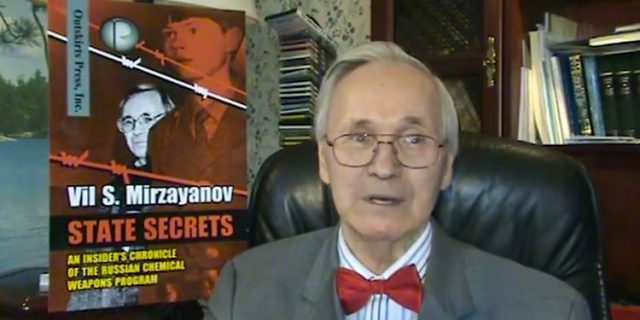
Russian ex-counter intelligence officer Vil Mirzayanov defected to the United States. Now 83 years old, he comments on the Skripal affair from Boston. (Photo credit: Business Insider)
Boris Johnson has announced that over the last ten year Britain has gathered evidence of Russia creating and storing novichok. We are given no detail of what kind of evidence this may be. It could turn out to be nothing more than isolated, unsubstantiated claims made by Mirzayanov and other opponents of the Russian government.
Not only Russia, but other former members of the Soviet Union, or the US, could have secretly stored or recreated the poison. In 1999 US defence officials helped Uzbekistan dismantle a former Soviet facility which had tested chemical weapons such as novichok. Samples, as well as the knowledge required to produce the nerve agent, are highly likely to have become available to countries other than Russia.
Did Russia have a motive?
Russia supposedly had an obvious motive. The argument goes as follows: Sergei Skripal, while still officially working for the Russian military intelligence service, the GRU, had been secretly recruited by the British MI6, and handed over to his new paymasters the names of all Russian agents he knew to be working in the West. Even after serving a few years in a Russian prison and being allowed to emigrate to the UK as part of a spy swap, he would have remained on an official Russian hit list for his act of treason. His murder would serve as a deterrent towards any other Russian agent who may consider switching sides. And to make things even clearer to would-be defectors, the attack would leave some kind of signature pointing to the Russian state as the perpetrator.
On the face of it, the argument sounds reasonable. However, it makes no sense to consider motives as evidence for doing something if we ignore counter-motives, i.e. reasons for refraining from doing it. Suppose you are in your doctor’s waiting room and have been sitting there for quite some time when suddenly an elderly lady, who arrived there just before you, collapses and is rushed to hospital. You had never seen her before. Now imagine the police later suspect some foul play and discover that the incident allowed you to have your own waiting time shortened by ten or fifteen minutes. You had a clear motive for harming the poor lady. Luckily for you, it then occurs to the investigators that your motive for doing so (saving a few minutes of your time) pales into insignificance compared with the reasons that would have held you back, such as the idea of spending years in jail, not to mention your moral conscience or feelings of human compassion.
In other words, motivation is the result of weighing out costs and benefits.
Putin had a clear motive… for NOT doing it
In the case of the Salisbury attack, the foreseeable costs to Russia, and more specifically to President Putin, are enormous. The Russian government spends considerable effort trying to convince the world that it firmly abides by the rule of law, especially international law and agreements between states. Its own statements, as well as the foreign-policy analyses appearing in the Russian state-owned media, all go towards highlighting Russia’s perceived superiority to the US in terms of respect for international law. Such efforts have greatly intensified in the context of the renewed tensions with the West over the last few years.
Russia’s current leaders believe in ending the current US-dominated unipolar world and are striving to recover some of the influence over world affairs that was lost with the collapse of the Soviet Union. This requires having allies, not only state allies, but also Russia-friendly organizations and individuals within states. Any damage to Russia’s international reputation does considerable harm to such prospects.
President Putin himself cultivates the image of a highly principled, responsible and law-abiding person – not that anyone would guess by reading the Western mainstream media! Whatever Russia’s state representatives and media may argue, the Salisbury attack has put many weapons in the hands of Putin’s detractors. In this light, it is absolutely inconceivable that Russia’s president ordered the attack himself. Boris Johnson’s personal accusation not only shows his total misunderstanding of the Russian leadership, but is also utterly irresponsible on the part of Britain’s top diplomat.
Russia had long been hoping that the EU may gradually put to an end its sanctions policy. It is still very dependent on trade with the block. It would be insane for Russia to do anything that could threaten the current Nord Stream 2 gas pipeline project, especially given that the US, with the support of a number of EU countries mainly from Eastern Europe, has been putting pressure on the EU to abandon the project. But Germany, determined to ensure its supply of cheap gas, has so far resisted such calls.
Predictably, the EU has sided with the UK and is officially demanding explanations from Russia concerning its novichok programme – which only makes any sense if Russia was in some way involved in the Salisbury attack, definitely not if it genuinely ceased the production and storage of the nerve agent in the 1990s, as documented by the OPCW!
Could other agents of the Russian state be responsible?
It is also entirely unrealistic to imagine that leading members of the Russian secret service agencies may have acted autonomously and ordered the Salisbury attack without consulting their superiors and not realizing how much damage it would have on Russia’s and Putin’s international reputation. They live in the world of the Russian state elite, continually exposed to its way of thinking, and not cocooned in some fantasy world of their own – unlike many Western politicians and journalists who apparently still live with the image of James Bond-like characters fighting against evil Russian agents!
Any significant agent of the Russian state would be fully aware of the displeasure that a Salisbury-type attack would trigger among the leadership. Supposing players within the Russian state did carry out the attack, it could only be construed as a hostile act towards President Putin and his team.
No sense for Russia to kill Skripal abroad rather than in Russia
This is not a simple case of a former spy-turned-traitor being “executed”. The attack leaves a deliberate Russian “signature” (there is no other reason for using novichok rather than a more discreet or classical weapon) and was carried out on the soil of a foreign country, the United Kingdom, which in spite of the Brexit process remains a highly significant player on the international stage. Whoever the perpetrators may be, they would have foreseen that any improvement in relations between Russia and its Western neighbours would be seriously jeopardized as a consequence.
But what makes Russian involvement even more absurd is the fact that Alexander Skripal was officially released and allowed to emigrate as part of a spy swap. Why would the Russians have waited another eight years before killing him in another country, with the terrible diplomatic consequences that would ensue, when he could have been much more easily liquidated while still in Russia, in a manner that would give would-be defectors an even clearer warning that there is “no way out for traitors”.
Would Russia give up the chance of other spy swaps?
Furthermore, a spy-swap deal implies that the parties involved agree to give up all claims pertaining to the released individuals. In other words they will not try to recapture or kill them, which would amount to a breach of the agreement. A country reneging on such a deal would no longer be trusted for any similar arrangements in the future. Is it reasonable to believe that the Russian government, or any top secret service official in Russia, would be prepared to sacrifice Russia’s chances of making any new spy-swap deals with its Western partners in the future? This is not just unlikely, it is the pinnacle of absurdity! Sadly, Western political leaders and mainstream media are quite happy to believe and propagate such nonsense.
Goal of attack: outrage against Russia
The attack itself does not seem to bear the mark of professional Russian agents. The daughter of the former double agent suffered the same fate as her father. It is only a matter of circumstances that many others were not seriously injured. It is like using a sledgehammer to crack a nut! And the main target, Sergei Skripal, is – weeks later – still reported to be alive! Either it was some very sloppy attack carried out by non-professionals, or the attack was deliberately not confined to Mr Skripal in order to provoke even greater outrage against Russia.
Boris Johnson has apparently recently adapted his interpretation of Russian intentions to take account of these facts. He now claims it was probably specially timed just before the presidential election, “to conjure up in the public imagination the notion of an enemy”. So the Russian president supposedly deliberately provoked British outrage to help him win the election! The Foreign Secretary seems to be completely out of touch with reality. It has long been common knowledge that Vladimir Putin would win with a landslide anyway. Would he wish to cause himself and his country enormous trouble for absolutely no gain at all?
What is Russia’s past record?
We are told there is “a pattern” of state-sponsored assassinations or deaths in unusual circumstances of political opponents, critical journalists and secret service defectors. Deaths attributed to President Putin have included the journalist Politskaya, the political opponent Nemtsov, the accountant and lawyer Magnitsky, the former agent Litvinenko and even the oligarch Berezovsky. In all these cases, the incrimination of the Russian state is based on rather flimsy evidence. The argumentation here is circular: in each case the belief in the Russian government’s responsibility is strengthened by the existence of the other stories. But if none of the stories are true, then the whole argument collapses.
The Litvinenko case does bear a similarity to the current one. Instead of the nerve agent novichok, Litvinenko was poisoned by radioactive polonium, a substance very difficult to obtain and produced only by a few countries – such as Russia – with a nuclear weapons industry. In both cases, it is highly unlikely that the Russian state would choose to leave a “made in Russia” signature on the poison used, with only one major outcome – the poisoning of Britain’s relationship with Russia.
If not Russia, then who did it?
Russia’s accusers claim there are no alternative explanations for the attack: nobody, apart from the Russian state, is understood to have had a motive for the attempted murder. This argument can only make sense to those who believe in the world of an evil, criminal Russia whose only opponents are pure, honest, angelic fighters for freedom and justice.
The main consequence of the Salisbury attack – undoubtedly one that would have been predicted by whoever planned it – is to further damage relations between Russia and the West, or at least prevent their improvement. A long list of countries (Ukraine, Poland, the US and many others) or organizations may believe they have an interest in this – at least they have been doing their best to spoil Western Europe’s relationship with Russia. Of course, the existence of a possible motive does not constitute sufficient ground to suspect anyone in particular. However, on the basis the motives involved, to quote British former Member of Parliament George Galloway, “Russia must be near the bottom of the list of suspects.”
How to get away with murder: blame Russia!
It can also not be excluded that the attack was the work of some rogue “ultra-patriotic” group within Russia (whether within or outside Russia’s state institutions) wishing to undermine Putin’s attempts to mend relations with the West by killing a “traitor” on British soil. In this case, the Salisbury attack would clearly be an act of aggression against the Russian government more than against the UK. And Britain’s refusal to cooperate with Russia would make the UK unwittingly guilty of helping the perpetrators avoid the course of justice.
Another aspect is that we do not know what personal enemies Aleksander Skripal may have had. There may be motives involved that nobody suspects. If, for whatever reason a person or organization with sufficient power wished to have him killed, there was a simple way to get away with the crime: a highly effective cover-up the crime would involve using a weapon that points towards Russia, with the knowledge the British authorities would be unlikely to seriously explore other avenues, especially in the current international climate. The same can be argued in the case of Litvinenko’s murder in 2006.
There is something particularly disturbing about the Western international community rushing to accuse Russia for any crime showing the slightest hint of a Russian connection: it provides criminal organizations and terrorists with assurances that they can avoid being held accountable. All they need to do is to leave some kind of “Russian signature”.
UK reckless attitude is dangerous
The words of Theresa May and Boris Johnson, accusing Russia for crimes it did not commit with astoundingly aggressive and hostile language, will naturally lead the Russian population and their decision makers to believe their country is the victim of an orchestrated attack. Hostility towards the West will increase dramatically as a result. British, European and North-American leaders may have convinced themselves of Russia’s guilt, but have they reflected on the possible consequences of their reckless attitude?
It is urgent to stop the escalation in the Russia blame game, which has taken a momentum of its own. It may be of benefit for the media, who can publish stories that make a good read, with an evil bogey man that everyone loves to hate, or for politicians who, when confronted with problems at home – such as the UK government with its current Brexit troubles – can take the opportunity to look strong in the face of an enemy. However, it is an extremely dangerous game which could have disastrous consequences for the entire world.
Featured Video
or go to
Aletho News Archives – Video-Images
Book Review
The Maidan Killings and the False-Flag Case
By Freddie Ponton | 21st Century Wire | September 5, 2026
Before the killings that helped bring down Ukraine’s president in February 2014, American diplomats were discussing who should enter its government. In a leaked telephone call, senior State Department official Victoria Nuland told US ambassador Geoffrey Pyatt, “I think Yats is the guy,” referring to opposition leader Arseniy Yatseniuk. Washington had clear preferences and was working to advance them. Later that month, Yatseniuk became prime minister.
Ivan Katchanovski’s The Maidan Massacre in Ukraine examines the violence that preceded that transfer of power. Drawing on television footage, witness testimony, forensic examinations and Ukrainian court proceedings, he argues that elements of the opposition shot protesters and police in a false-flag operation. His case centres on evidence of protesters being shot from opposition-controlled locations, including Hotel Ukraina, overlooking the killing ground. … continue
Blog Roll
 Aletho News
- The fallacy of US delusions about Iran’s economic collapse
- What changes with Lula or Flávio?
- Britain leads Western media’s demise through ‘fear porn’ narrative
- The Maidan Killings and the False-Flag Case
- Georgia’s Largest Healthcare System Will Fire Employees Who Refuse Flu Vaccine
- The Five-Year Fuel Crisis: Why the World Economy Is Paying for a War It Thinks Is Ending
- Trump’s Big Bluff on Iran
- Swiss scammed out of millions by Ukraine-linked call centers – media
- Germany facing potential ‘violent conflict’ with Russia – spy chief
- Ukraine’s EU neighbors reject new plea from Kiev – Politico
- If Americans Knew
- An error has occurred; the feed is probably down. Try again later.
- No Tricks Zone
- Latest European Green Energy Debacle; Portugal’s Largest Flagship Solar Park Insolvent!
- Green Energy Debacle: German Expert Professor Fritz Vahrenholt Warns Of Severe Economic And Social Consequences
- Two More Paleo Reconstructions Affirm Meters-Higher Sea Levels Across Ireland, Brazil 7000-6000 Years Ago
- New Study: Earth And Venus Surface Warmth Largely Explained By Convection And Lapse Rate, Not CO2 Or Radiation
- 2025 Nature Paper Claiming Worsening Global Drought Gets RETRACTED …Heavily Flawed
- New Study: ‘Global Drought Shows No Detectable Recent Acceleration Under Climate Warming’
- Economic Masterminds: German Socialists Suggest Taxing Productivity Gains Stemming From Using AI
- The South China Sea Has Not Been Cooperating With The Climate Change Narrative
- Energy Crisis: Germany Enters Heating Season With Historically Low Gas Reserve Fill Levels
- New Study: The Antarctic Ice Sheet Gained Mass From 2020-2024 Due To Staggering Snow And Ice Accumulation

