Venezuelan authorities hit back at their counterparts in Panama and Switzerland this week after they approved new measures targeting Caracas.
Panama’s Economic and Finance Ministry announced this past March 27 that a warning was being issued to the Central American country’s banks advising them to limit and “diligently” supervise financial transactions involving 55 top Venezuelan officials as well as 16 private businesses allegedly associated with the Maduro government.
The list includes President Nicolas Maduro, National Electoral Council President Tibisay Lucena and rectors Tania D’Amelio and Socorro Hernandez, National Constituent Assembly members Diosdado Cabello and Hermann Escarra, Education Minister Elias Jaua, and Culture Minister Ernesto Villegas.
In an official statement, Panamanian authorities categorized the individuals and businesses as being “high risk in the area of money laundering, financing terrorism, and financing the proliferation of weapons of mass destruction.” No evidence was, however, presented to support the allegations.
Venezuela possesses no nuclear weapons and is a signatory of the Nuclear Non-Proliferation Treaty, as well as various other treaties banning the acquisition and development of nuclear, biological, and chemical weapons.
Similarly, many of those accused by Panama of allegedly financing terrorism belong to institutions which were themselves the objects of violent opposition attacks during last year’s anti-government protests – including the Supreme Court, the National Electoral Council, and regional government offices – which the Maduro administration has repeatedly described as “terrorism”.
Speaking Monday, Venezuelan Attorney General Tarek William Saab, who is included on Panama’s list, fired back, describing the accusations as “fake news” and calling on them to provide evidence.
“Show the accounts, my accounts for example, show where my name, my photo appears,” Saab challenged.
Penitentiary Affairs Minister Iris Varela, who also appears on the list, similarly denied the accusations and called on the Central American authorities to publish a “complete list” of all Venezuelan citizens who own assets in the country, placing special emphasis on those mentioned in the Panama Papers.
“Why don’t they do it [publish the complete list],” she questioned. “Simply because they have assets and fortunes that belong to the [Venezuelan] opposition.”
The recent measures follow close on the heels of an announcement last month that Panama will not recognise the results of Venezuela’s upcoming presidential election, mirroring steps taken by the Trump administration and other regional conservative governments in rejecting the May 20 vote.
Meanwhile, Switzerland also moved to apply sanctions against seven high-ranking Venezuelan functionaries last Wednesday, freezing their alleged assets in Swiss banks and applying travel bans.
In response, the Venezuelan government delivered an official letter of protest to the Swiss charge d’affaires Monday, calling the sanctions a violation of the UN Charter’s ban on unilateral coercive measures and charging Switzerland with “subordination” to Washington and Brussels’ hardline Venezuela policy.
“This erratic action… on the part of a historically neutral country like the Swiss Confederation does not create conditions for dialogue and strengthens extremist positions that seek violent solutions,” reads the text of the letter.
Venezuela’s Supreme Court also issued a declaration Monday rejecting the moves as “illegal”. Supreme Court President Maikel Moreno was named in both Swiss and Panamanian measures.
The latest international actions targeting Venezuela have, however, won praise from members the country’s right-wing opposition, including Popular Will party Political Coordinator Carlos Vecchio, who applauded the Panama measures as “the right path at this stage”.
Vecchio is currently in Paris meeting with center-right French President Emmanuel Macron as part of a European tour aimed at drumming up support for more sanctions against Caracas.
During the meeting Tuesday, Vecchio, together with First Justice party leader Julio Borges and ex-Caracas Mayor Antonio Ledezma – who is currently fleeing the Venezuelan justice system – called on Macron’s government to apply “more sanctions” against Venezuela and to “halt Petro, gold, and capital legitimation operations,” referring to the South American country’s new crypto-currency. They also urged the French president and other European leaders “not to dialogue” with Caracas.
Planteamos al gobierno de Francia apoyar Intervención Humanitaria, juicio de Corte Penal, más sanciones, detener operaciones con Petro, oro y legitimación de capitales para salir de dictadura que oprime a nuestro pueblo . y Desconocer fraude electoral. Con dictadura no se dialoga
Opposition presidential frontrunner Henri Falcon, who defied the main opposition in launching his candidacy and has opposed economic sanctions in the past, has yet to issue a public statement with regard to the latest measures from Panama and Switzerland.
So far, only the US and the UK have approved economic sanctions against Caracas, while Canada and the European Union have rolled out sanctions against top Venezuelan officials
International sanctions against Venezuela have been denounced by the UN Human Rights Council as well as by UN Independent Expert Alfred de Zayas, who labeled the US-led measures “crimes against humanity” and called for the International Court of Justice to investigate.
According to Datanalisis, 55.6 percent of Venezuelans oppose economic sanctions against their country, while just 42 percent support individual sanctions targeting top officials.
Edited and with additional reporting by Lucas Koerner from Caracas.
NPR, as FAIR has noted throughout the years (e.g., 8/14/01, 11/01, 2/5/02, 11/15/12, 10/10/14), takes a default pro-Israel line when reporting on the affairs of Israel/Palestine. Its correspondents almost always live in West Jerusalem or in Israel proper, are rarely Palestinian or Arab, and they work consistently to deflect blame for Israeli violence—either shifting blame onto Palestinian victims or dispersing it through false parity.
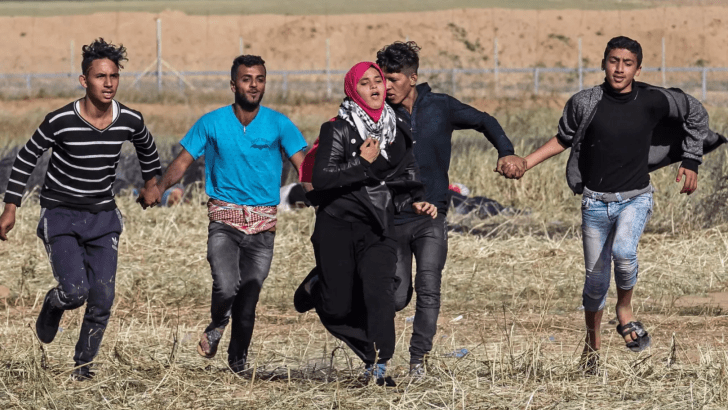
A segment from Friday (All Things Considered, 3/30/18) on Israel’s killing of Gaza protesters provides a case study in this process. NPR host Ari Shapiro set up the segment, an interview with reporter Daniel Estrin, by blaming the 17 dead and hundreds of injured Palestinians on “the militant group Hamas,” framing Israel as totally defensive. From the very first line, blame is deflected from the Israeli military:
Today saw some of the most violent clashes in years between Palestinian demonstrators and Israeli troops.
We do not have one party’s snipers opening fire on another, unarmed party; we have “violent clashes”—a term, as FAIR (8/12/17) has noted before, that implies symmetry of forces and is often used to launder responsibility. The whitewashing got worse from there:
Tens of thousands of people in Gaza answered the militant group Hamas’ call to protest.
Palestinians have no organic reasons for wanting to protest the occupation of their homes; the whole thing was a top-down decree from “the militant group” Hamas.
They threw rocks and firebombs near the border fence with Israel. On the other side, Israeli troops assembled.
This conveys the impression the Israeli military was just sitting around, minding its own business, when it was aggressively attacked by hundreds of Palestinians, then responded to this assault.
The “firebombs” claim is repeated later in the piece by Estrin himself: “Israel responded to Palestinians throwing rocks, firebombs, burning tires.” This isn’t qualified with “according to the IDF” or “the Israeli government”—even though as of now, there’s no independent evidence firebombs were used, much less used before any sniper fire from Israel.
The issue isn’t trivial: The matter of first blood when it comes to the Palestinian/Israeli “conflict” is a crucial one (FAIR.org, 12/8/17); framing Israel as always responding to threats, rather than inflicting aggressive violence on an occupied people, is a critical difference. And subtle framing devices like “clashes,” distorting timelines of who did what, or morphing IDF claims of “firebombs” into fact are how media keep this myth alive, and further delegitimize Palestinian resistance. (It should be borne in mind that opposition to occupation, even armed opposition, is a right guaranteed by international law.)
When FAIR pointed out to Estrin on Twitter that he had reported the “firebombs” as fact and not a claim by the IDF, he responded, “I reported the firebombs as an Israeli claim.” When FAIR showed evidence he and host Shapiro had done the opposite, Estrin deflected: “Be kind; it’s live radio.”
“Explain why this violence broke out today,” host Shapiro asked. It’s not a massacre or an attack or “firing on protesters,” as it is when official US enemies do it; it’s simply “violence breaking out.”
Estrin again took care to re-establish Hamas as the “driving force” and guilty party:
And it was billed as an independent Palestinian protest campaign. But actually Hamas, which controls Gaza, was a driving force.
This effectively militarized the whole of the protest, treating it not as an outpouring of popular grievances but as an operation quarterbacked by “a militant group.” This is where Estrin asserted the protesters used “firebombs” without attributing the claim to the Israeli attackers. Instead, he cited the IDF as a source on crowd size:
And according to the Israeli army, there were more than 30,000 Palestinians at six different spots along the border. Israel responded to Palestinians throwing rocks, firebombs, burning tires. Israel fired tear gas and live fire. It was the most violence in Gaza since the Gaza War in 2014.
A brief mention of the dire humanitarian situation in Gaza was thrown in, but it is blamed on an “ongoing internal Palestinian political fight” that has made the situation “even worse.” Estrin then erroneously told listeners “Hamas took control of Gaza by force a decade ago,” when Hamas actually gained power in Gaza in 2006 through an internationally recognized election. In 2007, Hamas won a civil war with US-backed Fatah, the faction it had defeated in the election, but to say Hamas “took control of Gaza by force” falsely paints it as an usurping force with no legitimate authority.
Asked what will happen next, Estrin shrugged and says more of the same, and that is it.
It’s a brief report, but a highly revealing one: Hamas is at fault, the Palestinians threw “firebombs” first, then the Israeli army “assembled.” The illegitimate Hamas astroturfed the protest, the people are being exploited. Israel just killed those 17 protesters in self-defense.
You can contact NPR ombud Elizabeth Jensen via NPR’s contact form or via Twitter: @EJensenNYC. Please remember that respectful communication is the most effective.
Fugitive Russians in the UK are effectively “hostages” of Western spy agencies, the father of Alexander Litvinenko, an intelligence officer who was poisoned in London a decade ago, told RT, sharing his insight on the Skripal case.
Walter Litvinenko used to support the theory of Russia’s involvement in the 2006 poisoning of his son, Alexander, in London, but he changed his mind after years of analyzing the inconsistencies of the investigation. London said that the fugitive Russian intelligence officer was poisoned with a highly radioactive Polonium-210. Despite an inconclusive investigation, it pinned the blame on Moscow, while the incident was branded as the first ever act of “nuclear terrorism.” Russia has vehemently denied the allegations of its involvement in the incident.
The poisoning of former double agent Sergei Skripal and his daughter, Yulia, in Salisbury on March 4, was, in turn, labeled “the first offensive use of a nerve agent in Europe since World War II.” While it bears similarities to the poisoning of Litvinenko, it was handled with different tactics, Walter Litvinenko told RT.
Litvinenko senior says the poisoning of his son was designed as a widely-publicized false-flag operation to show the world that Moscow was extremely “cruel,” and the way that it allegedly “deals with its enemies.” The ongoing Skripal scandal, in its turn, was launched to provoke a reaction from Russia, he believes.
“They realized that they have screwed up big time [with the Litvinenko poisoning] and decided to change their tactics a bit. Therefore, they do not show [any evidence] now, but keep it all in secret waiting for Russia to react to it. If there was, as they say, the ‘Russian trace’ there, everything would have been clear long time ago,” Litvinenko said.
He believes that, given the different goal, the ongoing investigation is significantly less transparent than it was back in 2006, since it is easier to hide the truth from the beginning than to try and sweep it under the rug afterward.
“It’s the same with Sasha [Aleksandr], if there was the ‘Russian trace,’ it would emerge over and over again up to this day. But the Scotland Yard was not looking for a criminal. Scotland Yard was covering the tracks,” Litvinenko stated. “Now they do not want to show these tracks altogether, since they know they will have to cover them up the same way as with Sasha.”
The Skripal scandal would eventually backfire on those who initiated it, Litvinenko said. “It will be very difficult to hide it all. And they will eventually fail. They will be caught, and Theresa May will be very ashamed. And this clown, their Foreign Minister [Boris Johnson] – he will be very ashamed too.”
Devil’s bargain
Litvinenko, who lost his son after the former officer of the Russian security service FSB fled Russia for London and cooperated with MI6 and Spanish police, says people like Alexander find themselves in a situation where they effectively become hostages of foreign governments and intelligence agencies. He said it applies to both the rich and powerful who have left Russia after having run-ins with the law, such as the late oligarch Boris Berezovsky, as well as less prominent citizens such as Sergei Skripal.
“They are hostages, all of them are hostages of the American authorities, who strive for the world dominance. As long as that’s the case – they will kill the Russians, they’ll kill anybody who’s against it,” Litvinenko said. The wealthy Russians in the UK “are all dependent on the authorities… They are being kept only for their money. And when something happens, they will be blatantly robbed, like it happened to Berezovsky.”
The fugitive oligarch, once one of the wealthiest Russians, was found dead at his home in the UK in 2014. The investigation did not conclusively determine whether he hanged himself with a scarf, or if he was strangled. Prior to his mysterious death, Berezovsky had lost most of his assets and his wealth waned.
Given the previous suspicious deaths of Russian nationals on British soil, Skripal’s fate looks quite grim, Litvinenko believes. The daughter of the former double agent, Yulia, however, might get out of this situation alive, as she was seemingly in the wrong place at the wrong time. Assuming she was of no interest to the intelligence services, the recent reports on Yulia’s conditions improving do not look that “miraculous,” Litvinenko said.
“It’s not beneficial for them if Skripal stays alive. And this girl – she knows nothing. Skripal knows. She simply came to visit her father and got into this,” Litvinenko said. “They’ll let his daughter walk away, probably. But if she knows anything, she won’t get out of it either.”
Those trying to make sense of the Skripal poisoning will have their work cut out following the news which has been coming out about it over the past week.
Firstly, the British police have announced that they now believe that Sergey and Yulia Skripal came into contact with the deadly chemical which poisoned them because it was smeared onto their front door.
This announcement has come after weeks of speculation during which a bewildering range of competing theories explaining how the poisoning supposedly took place have appeared in the British media.
These theories have included claims that Sergey and Yulia Skripal were (1) sprayed with the supposedly deadly chemical by a passer-by; (2) sprayed with the supposedly deadly chemical by an aerial drone; (3) contaminated by the supposedly deadly chemical which was brought from Russia in Yulia Skripal’s suitcase where it had been hidden by some third party; and (4) were poisoned by having the supposedly deadly chemical somehow inserted into Sergey Skripal’s car.
The British and other critics of Russia have recently taken to citing as ‘proof’ of Russian guilt the fact that the Russians have supposedly been proposing various theories about who might have poisoned Sergey and Yulia Skripal.
The British – who unlike the Russians have control of the crime scene and samples of the poison – have however been at least as busy proposing various theories about how Sergey and Yulia Skripal were poisoned.
In both cases the fact that the Russian media and the British media – though not, it should be stressed, the Russian or British governments – have been busy engaging in their respective speculations about who who and how Sergey and Yulia Skripal were poisoned is not proof of guilt.
Rather it suggests ignorance, which if anything (especially in Russia’s case) is an indicator of innocence.
As I have said on many occasions, it is the guilty who so far from engaging in a variety of different speculations tend to come up with a single alternative narrative to explain away the facts, which they then pass off as the truth in order to provide themselves with an alibi.
As to the present theory – that Sergey and Yulia Skripal came into contact with the chemical agent on their front door – note the following:
(1) The British police have not said whether the chemical agent was smeared on the outside of the door or on the inside of the door.
If it was smeared on the outside of the door, then it was an extremely reckless act which might have easily poisoned a delivery person to the house such as a postman.
If it was smeared on the inside of the door, then whilst it might have been placed there by a burglar, the greater probability must be that it was placed there by a visitor.
If so then it is likely that either Sergey or Yulia Skripal or possibly both of them have some knowledge of the identity of this person. That might make the fact that Yulia Skripal is said to be recovering and is now conscious a matter of great importance for the solution of this mystery.
(2) If Sergey and Yulia Skripal really were poisoned with the chemical agent by coming into contact with it because it was smeared on their front door, then that would mean that the chemical agent took 7 hours to take effect.
Russian ambassador to Britain Alexander Yakovenko has claimed that the British authorities have told him that Sergey and Yulia Skripal were poisoned by nerve agent A-234, a Novichok type agent which is supposedly “as toxic as VX, as resistant to treatment as soman, and more difficult to detect and easier to manufacture than VX”.
I am not a chemist or a chemical weapons expert, but such a slow acting poison seems at variance with the descriptions of A-234 and VX which I have read.
(3) The suggestion that Sergey and Yulia Skripal were poisoned by coming into contact with the chemical agent on their front door must for the moment be treated as no more than a theory. It does however appear to confirm the presence of the chemical agent in the house.
If the latest theory that Sergey and Yulia Skripal were poisoned by coming into contact with a chemical agent smeared on their front door begs many questions, then the news that Yulia Skripal is apparently recovering well from the effect of her poisoning, and is now conscious and speaking and is no longer in intensive care, though extremely welcome, in some ways adds further to the mystery.
It suggests that her contact with the poison was either very slight, or – if the poison was A-234 – that its potency has been exaggerated, or that it was not A-234.
That of course adds to the questions raised by the latest British theory that Sergey and Yulia Skripal were poisoned by coming into contact with the chemical agent on their front door.
Regardless, the fact that Yulia Skripal is recovering is very welcome news, not just at a human level but also because she is a key witness in the case.
Perhaps, once her recovery is complete, she can answer some of the many unanswered questions about the case.
However Yulia Skripal’s recovery highlights another extraordinary fact about the case.
In the recent proceedings in the High Court where a Judgment was obtained to allow blood samples to be taken from Sergey and Yulia Skripal in order to enable the OPCW investigators to research the chemical, Sergey and Yulia Skripal were represented by lawyers instructed by the Official Solicitor, a British official who regularly acts for parties who cannot represent themselves.
The High Court Judge who heard the case – Mr. Justice Williams – granted the Official Solicitor’s request for blood samples to be taken, saying the following:
Given the absence of any contact having been made with the NHS [National Health Service] Trust by any family member, the absence of any evidence of any family in the UK and the limited evidence as to the possible existence of family members in Russia I accept that it is neither practicable nor appropriate in the special context of this case to consult with any relatives of Mr Skripal or Ms Skripal who might fall into the category identified in s.4(7)(b) of the Act (bold italics added)
This is beyond strange given that no less a person than Sergey Skripal’s niece – who lives in Russia with the rest of Sergey Skripal’s family including his 90 year old mother – had previously been interviewed by the British media.
In fact Skripal’s niece was telling the BBC just days ago of her lack of knowledge of Sergey and Yulia Skripal’s condition, and was even being reported as saying on Wednesday that she understood that they had no more than a 1% chance of survival – this just hours before the British authorities announced that Yulia Skripal was making an impressive recovery.
This failure to keep the Skripal family in Russia properly informed of Sergey and Yulia Skripal’s condition and of the taking of blood samples from them, is matched by the refusal of the British authorities to allow the Russian authorities consular access to them notwithstanding that Yulia Skripal is a Russian citizen not a British citizen (the Russians say that Sergey Skripal has dual nationality and is also a Russian as well as a British citizen).
This is despite the fact that both a bilateral treaty – the 1965 Consular Convention between Britain and the USSR (of which Russia is legally the successor state) – and an international treaty – the 1963 Vienna Convention on Consular Relations – both appear to require the British authorities to grant consular access to the Russian authorities to Russian citizens such Yulia Skripal who find themselves in difficulties in Britain.
The 1965 Consular Convention between Britain and the USSR was moreover presented by the British government to Parliament and came into legal effect in 1968, which presumably makes it a part of British domestic law.
Article 35 (1) of the 1965 Consular Convention reads as follows
A consular officer shall be entitled to propose to a court or other competent authority of the receiving State the names of appropriate persons to act as guardians or trustees in respect of a national of the sending State or in respect of the property of such a national in any case where that property is left without supervision.
Article 36 (1) of the 1965 Consular Convention reads as follows
(a) A consular officer shall be entitled within the consular district to communicate with, interview and advise a national of the sending State and may render him every assistance including, where necessary, arranging for aid and advice in legal matters.
(b) No restriction shall be placed by the receiving State upon the access of a national of the sending State to the consulate or upon communication by him with the consulate.
Article 5 of the 1963 Vienna Convention reads in part as follows
Consular functions consist in:
(1) (a) protecting in the receiving State the interests of the sending State and of its nationals, both individuals and bodies corporate, within the limits permitted by international law;……
(e) helping and assisting nationals, both individuals and bodies corporate, of the sending State;….
(h) safeguarding, within the limits imposed by the laws and regulations of the receiving State, the interests of minors and other persons lacking full capacity who are nationals of the sending State, particularly where any guardianship or trusteeship is required with respect to such persons;….
Article 36 of the 1963 Vienna Convention reads in part as follows
1.With a view to facilitating the exercise of consular functions relating to nationals of the sending State:
(a) consular officers shall be free to communicate with nationals of the sending State and to have access to them. Nationals of the sending State shall have the same freedom with respect to communication with and access to consular officers of the sending State;
(b) if he so requests, the competent authorities of the receiving State shall, without delay, inform the consular post of the sending State if, within its consular district, a national of that State is arrested or committed to prison or to custody pending trial or is detained in any other manner. Any communication addressed to the consular post by the person arrested, in prison, custody or detention shall be forwarded by the said authorities without delay. The said authorities shall inform the person concerned without delay of his rights under this subparagraph;
(c) consular officers shall have the right to visit a national of the sending State who is in prison,
custody or detention, to converse and correspond with him and to arrange for his legal representation.They shall also have the right to visit any national of the sending State who is in prison, custody or detention in their district in pursuance of a judgement. Nevertheless, consular officers shall refrain from taking action on behalf of a national who is in prison, custody or detention if he expressly opposes such action.
2.The rights referred to in paragraph 1 of this article shall be exercised in conformity with the laws and regulations of the receiving State, subject to the proviso, however, that the said laws and regulations must enable full effect to be given to the purposes for which the rights accorded under this article are intended. (bold italics added)
Article 37 of the 1963 Vienna Convention reads in part as follows
If the relevant information is available to the competent authorities of the receiving State, such authorities shall have the duty:
…..
(b) to inform the competent consular post without delay of any case where the appointment of a guardian or trustee appears to be in the interests of a minor or other person lacking full capacity who is a national of the sending State. The giving of this information shall, however, be without prejudice to the operation of the laws and regulations of the receiving State concerning such appointments;….. (bold italics added)
(I am grateful to John Helmer for sending me copies of these two treaties)
In other words it appears that the British authorities as a matter of both international law and British law should not only have informed the Russian consular authorities of Yulia Skripal’s condition and granted them full access to her, but they should also have discussed with the Russian consular authorities the application to the High Court for the taking of blood samples from her, with the Russian consular authorities rather than the Official Solicitor representing her in those proceedings.
Mr. Justice Williams, the Judge in the High Court case, was clearly worried that the Russian consular authorities were not involved in the proceedings and that members of Sergey and Yulia Skripal’s family had not been contacted or consulted.
This resulted in this fascinating discussion referred to in paragraph 12 of his Judgment
…… As a result of my having appointed a Litigation Friend for Mr and Ms Skripal I raised the issue with the parties of whether this gave rise to any notification obligation pursuant to Articles 36 and 37 of the Vienna Convention on Consular Relations of 24 April 1963 as Ms Skripal is a Russian national although Mr Skripal became a British national. In the field of care cases in the Family Court the President gave some guidance on this issue in In Re E (A Child) [2014] EWHC 6 (Fam). Mr Thomas QC submitted that as there is no domestic implementation of Art 37 no obligation arises. He also questioned whether the court could be a competent authority. He noted that the Convention is implemented by section 1 and Schedule 1 of the Consular Relations Act 1968 and that this does not include Article 37. I note that at paragraphs 41 and 44 in Re E (above) the President noted the issue in relation to the effect of Article 37 in public international and English domestic law. Mr Sachdeva QC drew my attention to the context in which the President offered the guidance and that it was guidance only for the purposes of care cases in the family court. Both Mr Thomas QC and Mr Sachdeva QC also submitted that even if (and it is a very big if) that guidance could be transposed into the Court of Protection there was good reason for not imposing a notification obligation still less the other obligations the President identified in paragraph 47 of Re E. I am satisfied for the reasons set out above that there is no notification obligation in law on this court. The nature and extent of any good practice which might be followed in Court of Protection cases where a foreign national is the subject of an application may require consideration in another case. In practice, the Russian consular authorities will be made aware of these proceedings because this judgment will be published. I do not consider it necessary to list the issue for the sort of further extensive argument that would be necessary to enable the court to determine if any good practice guidance should be given. (bold italics added)
Note that Mr. Justice Williams does not seem to have been told by the lawyers representing the Official Solicitor and the British National Health Service about the 1965 bilateral Consular Convention between Britain and the USSR (see above) whilst the discussion which did take place seems to have been narrowly restricted to a discussion of Article 37 of the 1963 Vienna Convention – with the lawyers telling the Judge that this has not yet been made part of the law of Britain – with nothing however being said to the Judge about what look to me to be the equally important provisions of Articles 5 and 36 (see above).
I am no expert in this area of the law, but it seems to me that Mr. Justice Williams’s unease about the way the British authorities are handling the matter is made clear by the way he went out of his way in his Judgment to say that the Russian consular authorities would be “made aware of the proceedings because this judgment will be published”.
The hearing in which Mr. Justice Williams made his Judgment took place in private, but Mr. Justice Williams specifically decided that the Judgment itself should be made public, as its preamble makes clear:
This judgment was delivered in private. The judge has given leave for this version of the judgment to be published on condition that (irrespective of what is contained in the judgment) in any published version of the judgment the anonymity of the witnesses must be strictly preserved. All persons, including representatives of the media, must ensure that this condition is strictly complied with. Failure to do so will be a contempt of court.
Perhaps I am wrong but my impression from the Judge’s words is that one of his reasons for deciding to make his Judgment public was because he was concerned that the Russian consular authorities should know about it.
In addition, as various people have pointed out, the lawyers representing the Official Solicitor and the British National Health Service seem to have told the Judge that there was only limited information about Sergey and Yulia Skripal’s family in Russia, and that the Russian consular authorities had made no attempt to contact the hospital where Sergey and Yulia Skripal are being treated.
The claim that the British authorities have only limited information about Sergey and Yulia Skripal’s family in Russia is difficult to reconcile with the fact that Sergey Skripal’s niece had by the date of the Judgment already been giving interviews to the British media (see above), whilst the point about the Russian consular authorities not contacting the hospital looks to me something of a red herring since I presume that the British agency which the Russian consular authorities are contacting is not the hospital but the British Foreign Office.
Now that the Russian consular authorities know of the Court proceedings concerning Yulia Skripal which have been underway it would in theory be open to them to instruct lawyers to apply for them to be joined as a party to those proceedings so that they can represent Yulia Skripal in them.
I have no idea whether they are considering doing so, but I do frankly wonder whether the sudden announcement of Yulia Skripal’s recovery – welcome news that it is – might also in part have been intended to forestall such a step by the Russian consular authorities on the grounds that Yulia Skripal is now in a position to make her own decisions.
Irrespective of what happens in the British proceedings, the Russians are now convening a meeting of the OPCW executive council on 2nd April 2018 to discuss the Skripal case and to demand answers to the questions about the case that they have been asking.
It seems however that the only role the OPCW has in the case is to verify the identity of the chemical agent used. It is not a competent body to investigate what the British authorities say is a murder attempt on Sergey and Yulia Skripal, which is currently being investigated by the British police.
The High Court Judgment however appears to confirm that the British authorities are doing all they can to freeze the Russians out of the investigation of the case – which involves an attack on a Russian citizen – and to prevent them from learning any of the facts of the case.
That looks to me to be not just a violation of due process, but based on the texts of the 1965 Consular Convention between Britain and the USSR and the 1963 Vienna Convention which I have seen also a violation of both British and international law.
Given the increasingly strange look the facts of the case are taking (see above), it is however perhaps not so surprising that the British are reluctant to share with the Russians the full facts of the case.
I would just like to express my sincere dismay at the way my government reacted to the alleged recent poisoning of two people in Salisbury.
I recall very well the events that occurred fifteen years ago, when the British parliament was lied to about alleged weapons of mass destruction, supposedly held by Iraq, and which supposedly could strike at Britain within forty minutes. These allegations went almost completely unchallenged by the mainstream media, and our country was subsequently tricked into supporting an illegal war in Iraq. Although many people never believed the propaganda – as evidenced by the million or so protesters who marched through the streets of London at the time resisting the drive to war – the lie prevailed.
At this moment in time we have seen no verifiable evidence for the events that allegedly took place in Salisbury a couple of weeks ago. Until that evidence is forthcoming, and remembering well the deceit my own government has used in the past for its own very questionable ends, I refuse to believe that Russia had anything to do with it, and want to assure you that in this, as in many other areas of government policy, my government does not speak for me.
Neither am I impressed by the unbelievable actions of so many other countries in their expulsion of Russian diplomats from their embassies. Given the fact that there appears to be no verifiable evidence for the Salisbury incident, these actions by other countries defy logic, and strongly suggest some dark conspiracy that’s unfolding. The total abdication of responsibility of the mainstream media in their supposedly first duty of “holding government to account”, by refusing to question and challenge their actions, is yet further proof of the media’s culpability in these events – just as they were similarly culpable for the Iraq debacle of 2003.
I find the behaviour of my government in this matter completely inexcusable, and the public statements of certain of its representatives highly offensive and shameful. At this moment in time, none of them speak for me, and I do not trust a single word our mainstream media has to say on the matter.
If there’s one thing to be gleaned from the current atmosphere of anti Russian hysteria in the West, it’s that the US-led sustained propaganda campaign is starting to pay dividends. It’s not only the hopeless political classes and media miscreants who believe that Russia is hacking, meddling and poisoning our progressive democratic utopia – so many have pinned their political careers to this by now that’s it’s too late to turn back. As it was with Iraq in 2003, these dubious public figures require a degree of public support for their policies, and unfortunately many people do believe in the grand Russian conspiracy, having been sufficiently brow-beaten into submission by around-the-clock fear mongering and official fake news disseminated by government and the mainstream media.
What makes this latest carnival of warmongering more frightening is that it proves that the political and media classes never actually learned or internalized the basic lessons of Iraq, namely that the cessation of diplomacy and the declarations of sanctions (a prelude to war) against another sovereign state should not be based on half-baked intelligence and mainstream fake news. But that’s exactly what is happening with this latest Russian ‘Novichok’ plot.
Admittedly, the stakes are much higher this time around. The worst case scenario is unthinkable, whereby the bad graces of men like John Bolton and other military zealots, there may just be a thin enough mandate to short-sell another military conflagration or proxy war – this time against another nuclear power and UN Security Council member.
Enter stage right, where US President Donald Trump announced this week that the US is moving closer to war footing with Russia. It’s not the first time Trump has made such a hasty move in the absence any forensic evidence of a crime. Nowadays, hearsay, conjecture and social media postings are enough to declare war. Remember last April with the alleged “Sarin Attack” in Khan Sheikhoun, when the embattled President squeezed off 59 Tomahawk Cruise missiles against Syria – a decision, which as far as anyone can tell, was based solely on a few YouTube videos uploaded by the illustrious White Helmets. Back then Trump learned how an act of war against an existential enemy could take the heat off at home and translate into a bounce in the polls. Even La Résistance at CNN were giddy with excitement and threw their support behind Trump, with some pundits describing his decision to act as “Presidential.”
As with past high-profile western-led WMD allegations against governments in Syria and Iraq (the US and UK are patently unconcerned with multiple allegations of ‘rebel’ terrorists in Syria caught using chemical weapons), an identical progression of events appears to be unfolding following the alleged ‘Novichok’ chemical weapon poisoning of retired British-Russian double agent Sergei Skripal and his daughter Yulia in Salisbury, Wiltshire on March 4th.
Despite a lack of evidence presented to the public other than the surreptitious “highly likely” assessments of British Prime Minister Theresa May and Foreign Secretary Boris Johnson, President Trump once again has caved in to pressure from Official Washington’s anti-Russian party line and ordered the expulsion of 60 Russian diplomats – which he accused of being spies. Trump also ordered the closure of the Russian Consulate in Seattle, citing speculative fears that Russia might be spying on a nearby Boeing submarine development base. It was the second round of US expulsions of Russian officials, with the first one ordered by the outgoing President Obama in December 2016, kicking out 35 Russian diplomats and their families (including their head chef) and closing the Russian Consulate in San Francisco, with some calling it “a den of spies”.
Trump’s move followed an earlier UK action on March 14th, which expelled 23 Russian diplomats also accused of being spies. This was in retaliation for the alleged poisoning of a retired former Russian-British double agent in Salisbury, England.
This was my initial reaction back on March 14, 2018, during a live TV segment:
The ‘Collective’ Concern
It’s important to understand how this week’s brash move by Washington was coordinated in advance. The US and the UK are relying on their other NATO partners, including Germany, Poland, Italy, Canada, the Czech Republic, the Netherlands, Estonia and Lithuania – to create the image of a united front against perceived ‘Russian aggression’. As with multilateral military operations, multilateral diplomatic measures like this are not carried out on a whim.
Aside from this, there are two seriously worrying aspects of this latest US-led multilateral move against Russia. Firstly, this diplomatic offensive against Russia mirrors a NATO collective defense action, and by doing so, it tacitly signals towards an invocation of Article 5. According to AP, one German spokesperson called it a matter of ‘solidarity’ with the UK. Statements from the White House are no less encouraging:
“The United States takes this action in conjunction with our NATO allies, and partners around the world in response with Russia’s use of a military grade chemical weapon on the soil of the United Kingdom — the latest in its ongoing pattern of destabilizing activities around the world,” the White House said.
“Today’s actions make the United States safer by reducing Russia’s ability to spy on Americans, and to conduct covert operations that threaten America’s national security.”
What this statement indicates is that any Russian foreign official or overseas worker in the West should be regarded as possible agents of espionage. In other words, the Cold War is now officially back on.
Then came this statement: “With these steps, the United States and our allies and partners make clear to Russia that its actions have consequences.”
In an era of power politics, this language is anything but harmless. And while US and UK politicians and media pundits seem to be treating it all as a school yard game at times, we should all be reminded that his is how wars start.
BIRDS OF A FEATHER: Never in modern history has mediocrity in politics been celebrated as a virtue by so many.
The second issue with the Trump’s diplomatic move against Russia is that it extends beyond the territorial US – and into what should be regarded at the neutral zone of the United Nations. As part of the group of 60 expulsions, the US has expelled 12 Russian diplomats from the United Nations in New York City. While this may mean nothing to jumped-up political appointees like Nikki Haley who routinely threaten the UN when a UNGA vote doesn’t go her way, this is an extremely dangerous precedent because it means that the US has now created a diplomatic trap door where legitimate international relations duties are being carelessly rebranded as espionage – done on a whim and based on no actual evidence. By using this tactic, the US is casting aside decades of international resolutions, treaties and laws. Such a move directly threatens to undermine a fundamental principle of the United Nations which is its diplomatic mission and the right for every sovereign nation to have diplomatic representation. Without it, there is no UN forum and countries cannot talk through their differences and negotiate peaceful settlements. This is why the UN was founded in the first place. Someone might want to remind Nikki Haley of that.
On top of this, flippant US and UK officials are already crowing that Russia should be kicked off the UN Security Council. In effect, Washington is trying to cut the legs out from a fellow UN Security Council member and a nuclear power. This UNSC exclusion campaign been gradually building up since 2014, where US officials have been repeatedly blocked by Russia over incidents in Syria and the Ukraine. Hence, Washington and its partners are frustrated with the UN framework, and that’s probably why they are so actively undermining it.
Those boisterous calls, as irrational and ill-informed as they might be, should be taken seriously because as history shows, these signs are a prelude to war.
Also, consider the fact that both the US and Russian have military assets deployed in Syria. How much of the Skripal case and the subsequent fall-out has to do with the fact that US Coalition and Gulf state proxy terrorists have lost their hold over key areas in Syria? The truly dangerous part of this equation is that the illegal military occupation by the US and its NATO ally Turkey of northeastern Syria is in open violation of international law, and so Washington and its media arms would like nothing more than to be history’s actor and bury its past indiscretions under a new layer of US-Russia tension in the Middle East.
Another WMD Debacle?
Is it really possible to push East-West relations over the edge on the basis of anecdotal evidence?
Former British Ambassador to Uzbekistan, Craig Murray, highlighted the recent British High Court judgement which states in writing that the government’s own chemical weapons experts from the Porton Down research facility could not categorically confirm that a Russian ‘Novichok’ nerve agent was actually used in the Salisbury incident. Based on this, Murray believes that both British Prime Minster Theresa May and Foreign Secretary Boris Johnson, and Britain’s deputy UN representative Jonathan Allen – have all lied to the public and the world when making their public statements that the Russians had in fact launched a deadly chemical weapons attack on UK soil. Murray elaborates on this key point:
“This sworn Court evidence direct from Porton Down is utterly incompatible with what Boris Johnson has been saying. The truth is that Porton Down have not even positively identified this as a ‘Novichok’, as opposed to “a closely related agent”. Even if it were a ‘Novichok’ that would not prove manufacture in Russia, and a ‘closely related agent’ could be manufactured by literally scores of state and non-state actors.”
“This constitutes irrefutable evidence that the government have been straight out lying – to Parliament, to the EU, to NATO, to the United Nations, and above all to the people – about their degree of certainty of the origin of the attack. It might well be an attack originating in Russia, but there are indeed other possibilities and investigation is needed. As the government has sought to whip up jingoistic hysteria in advance of forthcoming local elections, the scale of the lie has daily increased.”
Murray has been roundly admonished by the UK establishment for his views, but he is still correct to ask the question: how could UK government leaders have known ‘who did it’ in advance of any criminal forensic investigation or substantive testing by Porton Down or an independent forensic investigation by the Organization for the Prohibition of Chemical Weapons (OPCW)?
One would hope we could all agree that it’s this sort of question which should have been given more prominence in the run-up to the Iraq War. In matters of justice and jurisprudence, that’s a fundamental question and yet, once again – it has been completely bypassed.
Murray is not alone. A number of scientists and journalists have openly questioned the UK’s hyperbolic claims that Russia had ordered a ‘chemical attack’ on British soil. In her recent report for the New Scientist, author Debora MacKenzie reiterates the fact that several countries could have manufactured a ‘Novichok’ class nerve agent and used it in the chemical attack on Russians Sergei and Yulia Skripal in Salisbury.
The New Scientist also quotes Ralf Trapp, a chemical weapons consultant formerly with the OPCW, who also reiterates a point worth reminding readers of – that inspectors are only able to tell where molecules sampled in Salisbury have come from if they have reference samples for the ingredients used.
“I doubt they have reference chemicals for forensic analysis related to Russian CW agents,” says Trapp. “But if Russia has nothing to hide they may let inspectors in.”
Even if they can identify it as Novichok, they cannot say that it came from Russia, or was ordered by the Russian government, not least of all because the deadly recipe is available on Amazon for only $28.45.
It should be noted that a substantial amount of evidence points to only two countries who are the most active in producing and testing biological and chemical weapons WMD – the United States and Great Britain. Their programs also include massive ‘live testing’ on both humans and animals with most of this work undertaken at the Porton Down research facility located only minutes away from the scene of this alleged ‘chemical attack’ in Salisbury, England.
Problems with the Official Story
If we put aside for the moment any official UK government theory, which is based on speculation backed-up by a series of hyperbolic statements and proclamations of Russian guilt, there are still many fundamental problems with the official story – maybe too many to list here, but I will address what I believe are a few key items of interest.
The UK police have now released a statement claiming that the alleged ‘Novichok’ nerve agent was somehow administered at the front doorof Sergie Skripal’s home in Wiltshire. This latest official claim effectively negates the previous official story because it means that the Skripals would have been exposed a home at the latest around 13:00 GMT on March 4th, and then drove into town, parking their car at Sainsbury’s car park, then having a leisurely walk to have drinks at The Mill Pub, before for ordering and eating lunch at Zizzis restaurant, and then finally leaving the Zizzis and walking before finally retiring on a park bench – where emergency services were apparently called at 16:15 GMT to report an incident. Soon after, local Police arrived on the scene to find the Skripals on the bench in an “extremely serious condition”. Based on this story, the Skripals would have been going about their business for 3 hours before finally falling prey to the deadly WMD ‘Novichok’. From this, one would safely conclude that whatever has poisoned the pair was neither lethal nor could it have been a military grade WMD. Even by subtracting the home doorway exposure leg of this story, it hardly adds up – as even a minor amount of any real lethal military grade WMD would have effected many more people along this timeline of events. Based on what we know so far, it seems much more plausible that the pair would have been poisoned at Zizzis restaurant.
When this story initially broke, we were told that the attending police officer who first arrived on the scene of this incident, Wiltshire Police Detective Sgt. Nick Bailey – was “fighting for his life” after being exposed to the supposed ‘deadly Russian nerve agent’. As it turned out, officer Bailey was treated in hospital and then discharged on March 22, 2018. To our knowledge, no information or photos of Bailey’s time in care are available to the public.
The public were also told initially that approximately 4o people were taken into medical care because of “poison exposure”. This bogus claim was promulgated by mainstream media outlets, like Rupert Murdoch’s Times newspaper. In reality, no one showed signed of “chemical weapons” exposure, meaning that this story was just another example of mainstream corporate media fake news designed to stoke tension and fear in the public. We exposed this at the time on the UK Column News here:
To further complicate matters, this week we were told that Yulia Skripal has now turned the corner and is in recovery, and is speaking to police from her hospital bed. If this is true, then it further proves that whatever the alleged poison agent was which the Skripals were exposed to – it was not a lethal, military grade nerve agent. If it had been, then most likely the Skripals and many others would not be alive right now.
Unfortunately, in the new age of state secrecy, we can expect that most of the key information relating to this case may be sealed indefinitely under a national security letter. In the case of Porton Down scientist David Kelly, the key information is sealed (hidden) for another 60+ years (which means we might get to see it in the year 2080). This means that we just have to take their word for it, or to borrow the words of the newly crowned UK Defence Secretary Gavin Williamson – any one asking questions, “should just go away and shut up.”
Such is the level of decorum and transparency in this uncomfortably Orwellian atmosphere.
While Britain insists that it has ‘irrefutable proof’ that Russia launched a deadly nerve-gas attack to murder the Skripals, the facts simply do not match-up with the rhetoric.
The Litvinenko Conspiracy Theory
It’s important to note that as far as public perceptions are concerned, the Skripal case has been built directly on top of the Litvinenko case.
In order to try and reinforce the speculation, the media have resurrected the trial-by-media case of another Russian defector, former FSB officer Alexander Litvinenko, who is said to have died after being poisoned with radioactive polonium-210 in his tea at a Mayfair restaurant. Despite not having any actual evidence as to who committed the crime, the British authorities and the mainstream media have upheld an almost religious belief that Vladimir Putin had ordered the alleged poisoning of Litvinenko.
The media mythos was reinforced in 2016, when a British Public Inquiry headed by Sir Robert Owen accused senior Russian officials of ‘probably having motives to approve the murder’ of Litvinenko. Again, this level of guesswork and speculation would never meet the standard of an actual forensic investigation in a real criminal court, but as far as apportioning blame to another nation or head of state – it seems fair enough for British authorities. Following the completion of the inquiry, Sir Robert had this to say:
“Taking full account of all the evidence and analysis available to me, I find that the FSB operation to kill Litvinenko was probably approved by Mr Patrushev and also by President Putin.”
Owen’s inquiry was not definitive. Quite the opposite in fact, and in many ways it mirrors the Skripal case as it has been presented to the public. Despite offering no evidence of any criminal guilt, Owen’s star chamber maintained that President Vladimir Putin “probably” approved the operation to assassinate Litvinenko. Is “probably” really enough to assign guilt in a major international crime? When it comes to high crimes of state, the answer seems to be yes.
According to Russian Foreign Ministry spokesperson Marina Zakharova, that UK inquiry was “neither transparent nor public” and was “conducted mostly behind doors, with classified documents and unnamed witnesses contributing to the result…”
Zakharova highlighted the fact that two key witnesses in the case – Litvinenko’s chief patron, UK-based anti-Putin defector billionaire oligarch Boris Berezovsky, and the owner of Itsu restaurant in London’s Mayfair where the incident is said to have taken place – had both suddenly died under dubious circumstances. The British authorities went on to accuse two Russian men in the Litvineko murder, businessman Andrey Lugovoy and Dmitry Kovtun. Both have denied the accusations. Despite the lack of any real evidence, the United States Treasury’s Office of Foreign Assets Control blacklisted both Lugovoi and Kovtun, as well as Russian persons Stanislav Gordievsky, Gennady Plaksin and Aleksandr I. Bastrykin – under the Magnitsky Act, which freezes their assets held in American financial institutions, and bans them from conducting any transactions or traveling to the United States. This is a familiar pattern: even if the case is inconclusive, or collapses due to a lack of evidence, the policies remain in place.
Despite all the pomp and circumstance however, the official conspiracy theory failed to sway even Litvinenko’s own close family members. While Litvinenko’s widow Marina maintains that it was definitely the Russian government who killed her husband, Alexsander’s younger brother Maksim Litvinenko, based in Rimini, Italy, believes the British report is “ridiculous” to blame the Kremlin for the murder of his brother, stating that he believes British security services had more of a motive to carry out the assassination.
“My father and I are sure that the Russian authorities are not involved. It’s all a set-up to put pressure on the Russian government,” said Litvinenko to the Mirror newspaper, and that such reasoning can explain why the UK waited almost 10 years to launch the inquiry into his brother’s death. Following the police investigation, Alexander’s father Walter Litvinenko, later said that he had regretted blaming Putin and the Russian government for his son’s death and did so under intense pressure at the time.
For anyone who is also reticent to accept the proclamations of the British state and the mainstream media on the Litvinenko case, it’s worth reading the work of British journalist Will Dunkerly here.
With so many questions hanging over the actual validity of the British state’s accusations against Russia, it’s somewhat puzzling that British police would say they are still ‘looking for similarities’ between the Skripal and Litvinenko cases in order to pinpoint a modus operandi.
The admission by the British law enforcement that their investigation may take months before any conclusion can be drawn also begs the question: how could May have been so certain so quick? The answer should be clear by now: she could not have known it was a ‘Novichok’ agent, any more than she could know that ‘Russia did it.’
A Plastic Cold War
Historically speaking, in the absence of any real mandate or moral authority, governments suffering from a chronic identity crisis and will often seek to define themselves not what they stand for, but what (or who) they are in opposition to. This profile suits both the US and UK perfectly at the moment. Both governments are limping along with barely a mandate, and have orchestrated two of the worst and most hypocritical debacles in history in Syria and Yemen. With their moral high-ground long gone, both countries require an existential enemy in order to give their missions legitimacy. The cheapest, easiest option is to reinvigorate a framework which was already there, and that’s the Cold War. Reds under the bed. The Russian are coming. It’s cheap and easy because it’s already been seeded with 70 years of Cold War propaganda and institutionalized racism in the West directed against Russians. If you don’t believe me, just go look at some of the posters, watch the TV propaganda in the US, or look at the horrific McCarthy witch hunts. I grew up being taught, “never again!” and that “welcome to the future: those days of irrational paranoia are behind us now.” That madness was mainstream and actively promoted by government and mainstream media.
You would have to be at the pinnacle of ignorance to deny that this is exactly what we are seeing today, albeit a more plastic version, but just as immoral and dangerous.
Dutifully fanning the flaming of war, Theresa May has issued her approval of the NATO members diplomatic retaliation this week exclaiming, “We welcome today’s actions by our allies, which clearly demonstrate that we all stand shoulder to shoulder in sending the strongest signal to Russia that it cannot continue to flout international law.”
But from an international law perspective, can May’s ‘highly likely’ assurances really be enough to position the west on war footing with Russia? When Labour leader Jeremy Corbyn asked these same fundamental questions on March 14th, he was shouted down by the Tory bench, and also by the hawkish Blairites sitting behind him.
Afterwards, the British mainstream press launched yet another defamation campaign against Corbyn with the UK’s Daily Mail calling the opposition leader a “Kremlin Stooge”, followed by British state broadcaster the BBC who went through the effort of creating a mock-up graphic of Corbyn in front of the Kremlin (pictured above) apparently wearing a Russian hat, as if to say he was a Russian agent. It was a new low point in UK politics and media.
When considering the mainstream media’s Corbyn smear alongside the recent insults hurled at Julian Assange by Tory MP Sir Alan Duncan who stood up in front of Parliament and called the Wikileaks founder a “miserable worm”, what this really says is that anyone who dares defy the official state narrative will be beaten down and publicly humiliated. In other words, dissent in the political ranks will not be tolerated. It’s almost as if we are approaching a one party state.
Would a UN Security Council member and nuclear power really be so brazen as to declare on another country guilty without presenting any actual evidence or completing a genuine forensic investigation?
So why the apparent rush to war? Haven’t we been here before, in 2003? Will the people of the West allow it to happen again?
As with Tony Blair’s WMD’s in 2003, the British public are meant to take it on faith and never question the official government line. And just like in 2003, the UK has opened the first door on the garden path, with the US and its ‘coalition’ following safely behind, shoulder to shoulder. In this latest version of the story, Tony Blair is being played by Theresa May, and Boris Johnson is playing Jack Straw. On the other side of the pond, a hapless Trump is the hapless Bush. Both Blair and Straw, along with the court propagandist Alastair Campbell – are all proven to have been liars of the highest order, and if there were any real accountability or justice, these men and their collaborators in government should be in prison right now. The fact they aren’t is why the door has been left wide open for the exact same scam to be repeated again, and again.
Iraq should have taught us all to be skeptical about official claims of chemical weapons evidence, and to face the ugly truth about how majors wars are waged by deception – by our own governments. What does it tell us about today’s society if people still cannot see this?
That’s why it was wrong to let Blair, Bush and others off the hook for war crimes. By doing so, both the British and Americans are inviting a dark phase of history to repeat itself again, and again.
It’s high time that we break the cycle.
***
Author Patrick Henningsen is a global affairs analyst and founder of independent news and analysis site 21st Century Wire, and host of the SUNDAY WIRE weekly radio show broadcast globally over the Alternate Current Radio Network (ACR).
Russia’s embassy in the UK criticized the “hypocrisy” of British authorities who always demand access to their subjects abroad but have prevented diplomats from visiting the Russian daughter of former double agent Sergei Skripal.
The diplomats have consistently requested that UK authorities provide access to a hospital where Yulia Skripal, a Russian citizen and the daughter of former double agent Sergei Skripal, is undergoing medical treatment, but to no avail so far, the Russian Embassy told Interfax news agency on Friday.
“We do understand that various British services are dealing with Russian citizens, but we don’t have any information on what is happening in the hospital,” the embassy said, adding that the diplomatic mission was informed on March 29 that Skripal’s daughter was recovering, but it was barred from visiting her.
“It is hard not to mention hypocrisy of British authorities who demand access to bearers of UK passports on every occasion but deprive Russia of such right,” the Russian mission noted.
Yulia Skripal permanently resides in Russia and came to the UK for several days.
“It is every embassy’s responsibility to render assistance, including legal assistance, to Russians who got in trouble. Unfortunately, the British side blocks us from carrying out that function,” the embassy said.
Not only was Skripal’s daughter denied consular assistance, the former double agent’s niece Viktoria also contacted the embassy in hopes of getting an update on the status of her relatives.
“Unfortunately, we could not inform her because of UK’s position,” the embassy said. Skripal’s niece is willing to come to London, and it is essential that British authorities issue a visa for her “on humanitarian grounds” as soon as possible.
Four weeks after the Salisbury incident, it emerged that Yulia Skripal’s condition finally appeared to be improving. The good news came only one day after detectives revealed to the public that the Skripals might have been attacked in their own home, as the highest concentration of chemicals was found by experts on the front door of their house on Christie Miller Road.
Shortly after the incident, London was quick to point the finger at Russia over the attack on the Skripals. Moscow has repeatedly denied complicity in the poisoning.
In 2017, police in the US murdered roughly 1,184 Americans, according to a survey conducted by The Free Thought Project. The number, however, could be much higher, since independent reports don’t have a “central source” of accurate data.
Kevin Gosztola, a writer for Shadowproof.com, and Paul Wright, founder and executive director of the Human Rights Defense Center, told Radio Sputnik’s Loud & Clear that statistics remain fuzzy because the US Justice Department (DOJ) doesn’t want to be accountable for the problem.
When asked why the DOJ hasn’t kept a record of how many people and what categories of people police officers shoot and kill in the United States, Gosztola said, “The basic opinion that I have… I think that it’s unmistakable that they don’t want to be accountable for the scale of killings going on by law enforcement in the United States.”
“We know that just in our basic daily life that if you don’t collect data on something, then how can you prove that it’s actually taking place?” he noted. “That’s the sort of perspective I think they have.”
“You can say that this is all part of the system to target and oppress and keep certain marginalized groups down, but on a basic level it’s just all about being able to claim that you don’t have any awareness of this,” he added.
What ultimately ends up happening, according to Gosztola, is that independent groups trying to keep track of these deaths are always going to have a “low-balled” number because of misreportings that they’re sourcing.
The US Justice Department’s failure to record numbers “illustrates the fact that no one’s life matters,” Wright declared.
“[For example] if you look at how they document any time a cop dies on duty… they could be sitting in their squad car, choking to death on a donut and that’s being recorded as a line of duty [death],” the executive director pointed out. “Some of these [independent] databases… are only recording shooting deaths.”
“[Cops] don’t just shoot people, they also use tasers, peppers sprays and they beat people to death… there’s lots of ways that the American police state can and does kill its citizens,” he added.
“Just focusing on the shootings doesn’t really capture the full level of brutality and cruelty of the American police state. In some ways, the shootings are the most sanitized ones [when you consider deaths such as Darren Rainey].”
Rainey, who was an inmate at the Dade Correctional Institution in South Florida, died in June 2012 after correctional officers allegedly “boiled” him to death by sticking him in a shower and letting hot water hit him for two hours.
When some advocates of the lone-nut theory of the Kennedy assassination wish to poo-poo the notion that the U.S. national-security establishment would implement a regime-change operation against Kennedy, they bring up Vietnam. They either deny that Kennedy intended to pull U.S. troops out of Vietnam or, alternatively, they scoff at the notion that the Pentagon and the CIA would have replaced Kennedy with Lyndon Johnson for that reason alone.
These proponents of the lone-nut theory, however, miss the point. First of all, it is now indisputable that Kennedy was, in fact, pulling out of Vietnam. Just before he was assassinated, he issued a written order to the Pentagon to withdraw 1,000 troops and bring them home. He also told close aides that once he had won the 1964 election, he would complete the pull-out.
More important, it wasn’t just Kennedy’s plan to pull the United States out of Vietnam that made him a threat to “national security.” The reason he had to be ousted from office and replaced with Johnson was that he had reached a point in his life where he was challenging the entire anti-Russia racket that the Pentagon and the CIA had inculcated in the American people since the end of World War II.
What bigger threat to “national security” than that? By challenging the national-security state’s anti-Russia racket, Kennedy was threatening the existence of the national-security establishment itself, along with future decades of ever-increasing money, power, and influence.
Of course, the national-security establishment didn’t see it that way. The way they saw it was that Kennedy was subjecting the United States to a Soviet (i.e, Russian) victory in the Cold War and, ultimately, a communist takeover of the United States.
What most Americans today do not realize is the monumental transformation of the U.S. government after World War II, when it was changed from a constitutional republic to what is called a “national security state.”
What is a “national security state”?
Well, to give you an idea of what it is, consider that North Korea is a national security state. So is China. So is Vietnam. So is Egypt.
A national-security state is one where the government has a massive, permanent military establishment, one that plays a predominant role in society. Consider all of the thousands of military bases and other military installations all across the nation. Think of all the cities and towns that are dependent on military largess and who live in constant fear of losing their military dole.
A national-security state is also one that has a secretive agency with omnipotent powers to protect “national security.” That’s where the CIA and the NSA come into play. Kidnapping. Torture. Indefinite detention. Surveillance. Spying. Coups. Invasions. Assassinations. All under the notion that someone (e.g., Russia, the Reds, the terrorists, the Muslims, ISIS, Saddam Hussein, North Korea, Vietnam, etc.) is coming to get us.
In the United States, the national-security establishment is composed of three agencies, the Pentagon, the CIA, and the NSA. In countries like Egypt and North Korea, they are all combined together. But the principle is the same: a massive, permanent standing army and secretive agencies with omnipotent powers to protect “national security.”
That’s not the type of government on which America was founded. The Constitution called into existence a limited-government republic, one that had a relatively small military force and no secretive agencies like the CIA and the NSA. No powers of assassination, kidnapping, torture, indefinite detention, coups, and the like.
To get a sense of how our American ancestors viewed standing armies and the threat that standing armies pose to a nation’s own citizenry, see my article “The Dangers of a Standing Army.”
At the end of World War II, there were those within the military establishment that wanted to convert the federal government into a national-security state, notwithstanding the fact that that type of government is inherent to totalitarian regimes.
But in order to accomplish that, they needed a big, official enemy that they could use to scare the American people into acceding to the change.
Enter the Soviet Union. Now, we say “the Soviet Union” but in reality we mean Russia because Russia was the leading and driving force within the Soviet Union.
Keep in mind something important: U.S. officials had made Russia their partner and ally in World War II. The two nations had worked together to defeat Nazi Germany.
But since the proponents of a national-security state needed a new, big official enemy at the end of WWII to justify the conversion of the federal government to a national-security state, they figured that Russia (i.e., the Soviet Union) would fit the bill.
So, they immediately began taking steps to assure that Russia would be converted from partner and ally to a new, official, big enemy of the United States.
President Truman, for example, was advised that if he was to succeed in converting America to a national security state, he would have to scare the American people to death. To begin the split with America’s partner and ally, he summoned the Russian ambassador to the White House and issued an angry tirade of orders and insults. U.S. officials also exclaimed against Russia’s plan to keep East Germany and Eastern Europe under its control, notwithstanding the discomforting fact that President Roosevelt had agreed to give those countries to Russia during the war. And after giving all of East Germany (and Eastern Europe) to their wartime partner and ally, U.S. officials retained control over West Berlin knowing full-well that would serve as a perpetual crisis flashpoint against their new official enemy.
And so the Cold War began. During the next 45 years, Americans were besieged with indoctrination and propaganda about how the Reds were coming to get us. That’s how U.S. forces ended up fighting and dying in North Korea, which was nothing more than a civil war but which was billed as part of the worldwide communist conspiracy to take over America and the rest of the world. Same with Vietnam. Same with Cuba. And Iran. And Guatemala. And Chile. And other countries were made the targets of U.S. regime-change operations, none of which had ever attacked the United States.
In his Farewell Address. President Eisenhower alluded to this monumental transformation of the federal government. He said that Americans should beware that the national-security state posed a grave threat to the liberties and democratic processes of the American people. But here was the kicker: He said that that transformation had been necessary because of the Cold War.
Along came John F. Kennedy, who slowly came to the realization that Eisenhower was wrong. The Cold War wasn’t necessary. It was nothing more than a racket, one designed to keep Americans scared so that they would support the conversion to a national-security state and its perpetual, ever-increasing river of tax-funded military largess.
The fact is that by the time he was assassinated, Kennedy was in an all-out war against the Pentagon, the CIA, and the NSA. The war wasn’t just about Vietnam, another civil war that the Pentagon and the CIA were convinced was part of the worldwide communist conspiracy to take over America. The war between Kennedy and the national-security establishment was much bigger than that. It was a war over the entire future direction of the United States and, implicitly, the continued existence of the national-security establishment.
Would the U.S. continue to be guided by a fierce anti-Soviet, anti-Russia, anti-communist mindset, which would ensure decades of expansion and largess for the U.S. military-intelligence establishment?
By the time the Cuban Missile Crisis was over, Kennedy had decided that the answer to that question was “No.” Knowing full well the dangers he faced, he decided that it was time to bring an end to the Pentagon-CIA-NSA anti-Russia racket.
Kennedy threw down the gauntlet in his famous Peace Speech at American University, where he declared an end to the Cold War and the anti-Russia mindset that the Pentagon and the CIA had inculcated in the American people since the end of World War II. The fact that he didn’t even consult with or advise the Pentagon and the CIA of what he intended to say and instead just sprung it on them speaks volumes about the disdain that he had come to have for the national-security and its constant, never-ending anti-Russia brouhaha.
Kennedy proposed that America and Russia coexist in peace and friendship despite their ideological differences. He even suggested that the two countries could work together on a joint project to the moon, which meant sharing U.S. missile technology with the Reds. He proposed a nuclear test ban treaty, over the fierce opposition of the Pentagon and the CIA. Worst of all (or best of all, depending on one’s perspective), he entered into negotiations with Soviet Premier Nikita Khrushchev and Cuban President Fidel Castro, who had come to the same conclusions, to get all this done — without advising the Pentagon and the CIA, but who undoubtedly had learned about it through secret surveillance.
From the perspective of the national-security establishment, what Kennedy was doing posed a far greater threat to “national security” than anything that Mossadegh in Iran, Castro in Cuba, and Arbenz in Guatemala had done (and that Allende in Chile would do) to justify their being targeted for a U.S. national-security regime-change operation. Kennedy was threatening the entire justification for the continued existence of a national-security state in the United States. In the eyes of the national-security establishment, he was subjecting America to a Russian takeover of the United States.
How easy was it to inculcate the American people with an anti-Russian, anti-Red mindset, both before and after Kennedy was assassinated? Unfortunately, not difficult at all, given the mindset of conformity, deference to authority, passivity, and obedience that is inculcated in the American people in their state educational systems. The ease by which Americans embraced the anti-Russia mindset can best be explained in a famous quote by Nazi official Herman Goering regarding war (think Iraq):
Naturally the common people don’t want war: Neither in Russia, nor in England, nor for that matter in Germany. That is understood. But, after all, it is the leaders of the country who determine the policy and it is always a simple matter to drag the people along, whether it is a democracy, or a fascist dictatorship, or a parliament, or a communist dictatorship. Voice or no voice, the people can always be brought to the bidding of the leaders. That is easy. All you have to do is tell them they are being attacked, and denounce the peacemakers for lack of patriotism and exposing the country to danger. It works the same in any country.
The Arabia Foundation appeared in spring 2016, seemingly out of nowhere, as a Saudi-focused think tank with “ties to Riyadh,” but vaguely independent of the regime. Or at least independent enough so that media wouldn’t represent it as an extension of the kingdom. But the past few weeks have clearly shown it to be little more than a PR outlet for de facto Saudi ruler Mohammed bin Salman and his sprawling, opaque business interests.
After multiple requests by FAIR for its donors, the Arabia Foundation refused to give any, other than its founder, Saudi investment banker Ali Shihabi. It insists it doesn’t take money from “the Saudi government,” but instead is backed by unnamed private Saudi citizens.
The distinction between private citizens and the “government” in the hereditary monarchy of Saudi Arabia is notoriously blurry, but one connection is worth noting: The registered agent and legal counsel of the Arabia Foundation, Eric L. Lewis, represented the Saudi government and related “charities” in the lawsuit brought by families of 9/11 victims over the Saudi royal family’s role in the September 11 attacks. The website of Lewis’ law firm, Lewis, Baach, Kaufmann and Middlemiss, boasts it has “extensive experience representing and advising foreign sovereigns, including the governments of Saudi Arabia, Kuwait and Egypt.”
The New York Times (11/30/18) has described the group as “close to the Saudi government,” while the Washington Post’s Ishaan Tharoor (11/6/17) noted it had “close ties to the kingdom.” That doesn’t stop the Post opinion section from running multiple op-eds from Arabia Foundation figures (5/31/17, 12/20/17, 1/4/18, 1/22/18). In most press appearances, the group is simply identified as “a Washington-based think tank.” Absent documented evidence of who exactly funds the group, why should media not assume—based on its connections to the government and cartoonishly pro–bin Salman line—that the Arabia Foundation is a front group for the government?
In repeated interviews (BBC World News, 3/20/18; Morning Joe, 3/20/18; CNN, 3/19/18) last week, Shihabi, the head of the nominally independent group, spun for war crimes, human rights abuses and a whole host of morally dubious activities carried out by the increasingly despotic Saudi ruler. The Arabia Foundation’s ties to the Saudi government are never noted or even vaguely referenced in these interviews.
On MSNBC’s Morning Joe, after saying the “crown prince” has engaged in a “massive corruption crackdown” (a wholly PR frame discredited earlier this month by the New York Times, 3/11/18), host Mika Brzezinksi teed up Shihabi to comment on Saudi Arabia. The softball interview that followed hit all of the regime’s central premises without question: as well as “cracking down on corruption,” bin Salman is “modernizing Saudi Arabia” and “taking on the religious establishment.”
No one on the panel brought up Saudi Arabia’s ongoing war crimes in Yemen—consistent with MSNBC’s network-wide virtual blackout on one of the world’s worst humanitarian crises (FAIR.org, 3/20/18). The Council on Foreign Relations’ Richard Haas made one opaque reference to Saudi “war with Yemen,” but didn’t note the thousands killed or up to one million infected with cholera; the US-backed war was was simply dismissed as a “strategic overreach.” The New York Times’ Elisabeth Bumiller, another panelist, did get in a question about torture, which Ali Shihabi dismissed as having “no evidence” despite Bumiller speaking with several doctors who witnessed it.
Reliable Saudi stenographer David Iglesias who, as FAIR (4/28/17) noted last year, has been running the same reformist press release for the royal family for 15 years, continued his unique brand of faux criticism, insisting that the Saudi prince was too “bold”—the political commentary equivalent of answering “I work too hard” when asked on a job interview what your biggest flaw is.
Shihabi claimed without irony that what Saudi Arabia needed was “autocracy to affect change,” and a “benevolent autocrat.” His evidence that the masses approved of bin Salman’s “bold, needed” leadership was approved of by the masses? That there has been “no bloodshed, there’s been no demonstration, no domestic strife.” Of course, the last time there were anti-government demonstrations, in 2011, the Saudi military opened fire on protesters, and snuffed out resistance with torture and extrajudicial killings. In 2017, when one Shia town resisted the regime, Riyadh flattened an entire neighborhood. This could perhaps be why the general population isn’t quick to take to the streets, but the Arabia Foundation insist it’s an implicit admission the crown prince is loved and popular.
The CNN and BBC interviews, likewise, didn’t note the Arabia Foundation’s obvious ties to the Saudi regime.
Forbes keeps running “op-eds” by Arabia Foundation fellow Ellen Wald that amount to little more than press releases for Saudi investment opportunities (e.g., 12/11/17, 2/1/18, 3/13/18). Another pundit on the Arabia Foundation’s payroll, Bernard Haykel, writes fawning profiles of bin Salman in the Washington Post (1/22/18) without disclosing he’s a founding director of the organization—instead listing his more benign academic credentials.
The Arabia Foundation is so satisfied with the media’s presentation of its messaging that it routinely tweets out articles it’s featured in and TV appearances it’s had, knowing its messaging is syncing up nicely with bin Salman’s PR tour to the United States. “Yemen is a tragedy. Wars are a tragedy. Saudi is aware of that and is going out of its way to try to address humanitarian issues there,” boasted one tweet, quoting Shihabi’s interview with the BBC.
By contrast, this obtuse inability to connect dots is absent when discussing think tanks “close to” the Syrian government. Never is the Assad-connected British Syrian Society set up as a neutral arbiter of affairs of the Syrian conflict. It is met with disdain, painted as “little more than a Syrian regime propaganda exercise” (Guardian, 10/26/17), the “mouthpiece in the West” (Middle East Eye, 10/19/17) for a war crime–committing tyrant. Those who associate with it, including academics, journalists and British members of parliament, are publicly shamed for participating in a “regime PR exercise” (Independent, 10/29/16). Yet somehow the “Saudi-connected” Arabia Foundation, which cheers on a “benevolent autocrat” as he rains bombs on Yemen and uses hunger as a weapon of war, receives no such moral banishment. Instead, it is dressed up as just another respectable think tank.
The fact that the Arabia Foundation is a thinly veiled PR firm for the Saudi government matters. The average reader or viewer would take Shihabi and his network of mercenary “fellows” less seriously if they were presented as spokespeople for a repressive government rather than quasi-academics from a impressive-sounding “foundation.”
With all the hysteria surrounding RT and foreign influence on the American public, one might think such an obvious racket would give editors and TV producers pause. But the same rules don’t apply to American allies. Their propaganda is treated not like a sinister “influence operation,” but like a respectable group of academics calling balls and strikes on international affairs.
The Associated Press, a (usually) trusted name in global news, has been unmasked for its pro-Israel bias, and the ruse continues.
Today’s exhibit is of particular significance, as the people of Gaza are about to embark on a large-scale nonviolent protest. True to form, AP has cranked out a Hamas-bashing, Israel-congratulating piece that fails to provide the accurate information its readers deserve. The report largely replicates Israel’s public relations strategy.
Below are excerpts from the AP article with commentary that will fill in some of the gaps and clear up some misrepresentations. Truth matters.
AP: Gaza’s embattled Hamas rulers are imploring people to march along the border with Israel in the coming weeks in a risky gambit meant to shore up their shaky rule, but with potentially deadly consequences.
Many Americans fail to recognize what is going on in Gaza for precisely this reason: nearly every word of this paragraph is problematic. Hamas has not imposed some kind of tyrannical regime over Gaza; their “rule” is shaky in that Israel has such a chokehold on the territory that the people are starving to death. There is little governing going on.
Grassroots movements have been in the making for years – decades, even – because Palestinians don’t need to be told they should resist the occupation. Many can see their original homes in what is now Israel or the location of their villages from the fence imprisoning them. They remember every day; they pray to God to bring them back home. Their people are being slowly, systematically eradicated.
The “gambit” is indeed “risky”– because Gazans will be nonviolently protesting while in the crosshairs of Israeli snipers, and the “potentially deadly consequences” of the initiative will almost certainly involve unarmed Palestinians dying.
Israel has essentially promised this outcome: Major General Yoav Mordechai vowed, “We intend to do everything to prevent violent demonstrations and terror demonstrations.” While Palestinians have made it clear that they will not so much as throw rocks, Israel has 100 sharpshooters at the ready, drones lined up to drop tear gas canisters, and thousands of troops armed to the teeth.
AP: But the first-of-its-kind protest also comes at a low point for the Islamic militant group and the 2 million residents of Gaza, where conditions have deteriorated since Hamas seized control of the territory from the internationally-backed Palestinian Authority in 2007.
Conditions have indeed deteriorated, but this statement is misleading: Hamas was voted into office by the people of Gaza, and Israel collectively punished them for this by imposing a blockade. Combine that with multiple “wars” against the essentially unarmed population with thousands killed and tens of thousands left homeless. “Conditions have deteriorated” is an understatement.
AP: Beginning Friday, Hamas hopes it can mobilize large crowds to set up tent camps near the border. It plans a series of demonstrations culminating with a march to the border fence on May 15, the anniversary of Israel’s establishment, known to Palestinians as “the Nakba,” or catastrophe.
Let’s take a minute to unpack the phrase that tried to sneak past. “The Nakba” is not just an Arabic name for the anniversary of Israel’s birth: it is the name for the forced exile of 75% of their population and the loss of 78% of their land. This catastrophe occurred in 1948, and tens of thousands of Palestinians who live in Gaza today are among those refugees.
AP: The group aims to mobilize hundreds of thousands of people for the effort, though it hasn’t been able to get such turnouts at past rallies. Nonetheless, a jittery Israel is closely watching and vowing a tough response if the border is breached.
Israel lives in a constant state of jitter, but why? Because the stones in Palestinians’ hands are so dangerous? Because the rockets are so deadly? (See here) Or because if Palestinian voices are heard, Israel will be exposed?
AP: An Israeli-Egyptian blockade, along with three wars with Israel and a series of sanctions by Palestinian President Mahmoud Abbas, have left Gaza’s economy in tatters. Unemployment is well over 40 percent, tap water is undrinkable and Gazans receive just a few hours of electricity a day.
Israel is the occupying power over Gaza. The occupation is now in its 6th decade, and the blockade in its 11th year. Israel has an obligation as occupier to maintain the lives and wellbeing of the occupied. Egypt and Abbas are minor players in this situation.
AP: “Hamas has realized it’s besieged from three sides; Israel, Egypt and the Palestinian Authority,” said Mkhaimar Abusada, political science professor at Gaza’s al-Azhar University. “It feels the crisis is suffocating.”
All Gazans are suffocating, not just Hamas. That is why this movement is happening right now. This is not some ploy by a terrorist organization to make trouble for Israel. It is the organic response of Palestinians who can endure no more, who must resist.
AP: [Mkhaimar Abusada] said that for Hamas, the protests can divert attention from their domestic woes while avoiding renewed war with Israel. “They think busying Israel with this issue may put it under pressure,” he said.
What the people actually think is that perhaps this time, the world will pay attention and finally realize that the level of cruelty and injustice being perpetrated on Palestinians is a huge, ongoing crime against humanity. The hope is not to “busy Israel” but to seek the rights that have been promised them by international law: the right to self-determination, the right to return to the land from which they were exiled, the right to be heard and to receive justice.
AP: A combination of social pressure and curiosity in a territory with few options for recreation could help attract people.
This statement shows an inexcusable level of ignorance: it assumes that Palestinians are content with a never-ending, illegal occupation and blockade; that they would not be inclined to march in resistance against their oppressor; and above all that people attending the protest would come for recreational purposes.
AP: Israel opposes any large-scale return of refugees, saying it would destroy the country’s Jewish character.
It’s hard to decide how to respond to this statement. Yes, having refugees pour into one’s country can be upsetting to one’s culture. The Palestinians were willing to take in Jews in the early 20th century, at a high social cost. The thanks they got for this gesture was to be themselves made refugees. Of course Israel opposes the return of non-Jews. But return they must, according to international law and consensus.
AP: Israeli Cabinet Minister Yoav Galant said, “Hamas is in distress. They are using in a cruel and cynical way their own population in order to hurt them and to hurt Israel.”
Israel has massive military might, and Israel and AP both know it. With one of the most advanced armies in the world, $10 million a day in military aid coming from the US, at least 100 nuclear weapons, and a military that is armed to the teeth, this march is not going to“hurt” Israel in any reasonable sense of the word. The only real pain the state can anticipate is the fear of being found out.
AP: “We will try to use the minimum force that is needed in order to avoid Palestinians wounded and casualties. But the red line is very clear. They stay on the Gazan side and we stay in Israel.”
Only time will tell what “minimum force” looks like, but in a nation where children can be imprisoned for years if they are suspected of throwing a stone, chances are Palestinians will die.
Most Western media, if they cover this event at all, will publish inaccurate, biased accounts that will make the Palestinians out to be the aggressors. They will completely fail to ground the story in the context of illegal occupation and blockade, not to mention dispossession and forced exile. Israel will come out looking like it acted in self-defense, and the injustice will continue unchecked as it has for lo these many years.
Kathryn Shihadah is a staff writer for If Americans Knew.
Recent disclosures by the Zionist regime show that some 2,069 British nationals were serving in the IDF as of March 2025, according to Freedom of Information (FoI) requests submitted to the occupation forces (1,686 dual British-Israeli, plus 383 multinational). We cannot tell from the figures how many of these were already settler colonists and intend to stay in the colony, and how many will return or have returned to the UK. Presumably, those returning to the UK will number far fewer than 2,000, since many are known to have become permanently residents of the colony.
Additionally, the IDF figures only provide a snapshot, and do not tell us how many have served in the Jewish supremacist military either before or after March 2025. One way into the question of how many genocidaires are living in Britain is to ask how many current British residents were born in the Zionist colony. There is data on that, as we shall see. … continue
This site is provided as a research and reference tool. Although we make every reasonable effort to ensure that the information and data provided at this site are useful, accurate, and current, we cannot guarantee that the information and data provided here will be error-free. By using this site, you assume all responsibility for and risk arising from your use of and reliance upon the contents of this site.
This site and the information available through it do not, and are not intended to constitute legal advice. Should you require legal advice, you should consult your own attorney.
Nothing within this site or linked to by this site constitutes investment advice or medical advice.
Materials accessible from or added to this site by third parties, such as comments posted, are strictly the responsibility of the third party who added such materials or made them accessible and we neither endorse nor undertake to control, monitor, edit or assume responsibility for any such third-party material.
The posting of stories, commentaries, reports, documents and links (embedded or otherwise) on this site does not in any way, shape or form, implied or otherwise, necessarily express or suggest endorsement or support of any of such posted material or parts therein.
The word “alleged” is deemed to occur before the word “fraud.” Since the rule of law still applies. To peasants, at least.
Fair Use
This site contains copyrighted material the use of which has not always been specifically authorized by the copyright owner. We are making such material available in our efforts to advance understanding of environmental, political, human rights, economic, democracy, scientific, and social justice issues, etc. We believe this constitutes a ‘fair use’ of any such copyrighted material as provided for in section 107 of the US Copyright Law. In accordance with Title 17 U.S.C. Section 107, the material on this site is distributed without profit to those who have expressed a prior interest in receiving the included information for research and educational purposes. For more info go to: http://www.law.cornell.edu/uscode/17/107.shtml. If you wish to use copyrighted material from this site for purposes of your own that go beyond ‘fair use’, you must obtain permission from the copyright owner.
DMCA Contact
This is information for anyone that wishes to challenge our “fair use” of copyrighted material.
If you are a legal copyright holder or a designated agent for such and you believe that content residing on or accessible through our website infringes a copyright and falls outside the boundaries of “Fair Use”, please send a notice of infringement by contacting atheonews@gmail.com.
We will respond and take necessary action immediately.
If notice is given of an alleged copyright violation we will act expeditiously to remove or disable access to the material(s) in question.
All 3rd party material posted on this website is copyright the respective owners / authors. Aletho News makes no claim of copyright on such material.