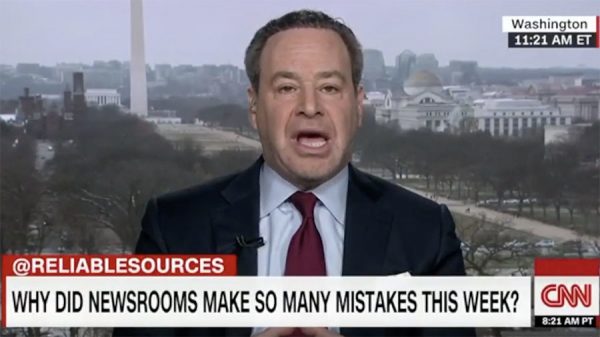
CNN pundit David Frum on fake news: Trust blunder-prone media as they expose Trump
RT | December 11, 2017
Factually inaccurate reports are a natural by-product of fighting Donald Trump’s “system of lies”, CNN pundit David Frum has reassured the public. The Atlantic senior editor’s comments were made in the wake of false reporting by ABC and CNN.
“The mistakes are precisely the reason people should trust the media,” Frum told Brian Stelter, on CNN’s ‘Reliable Sources’ program.
He insisted that “the worst mistakes that press organizations have made in their coverage of [US President Donald] Trump has precisely occurred in their overzealous effort to be fair to the president.”
Frum’s comments come after two major news networks, CNN and ABC, each had to correct “bombshell” reports that showed Trump and his administration in a poor light.
Frum, who is The Atlantic’s editor and was a speech-writer for President George W. Bush, argued that Trump and his supporters are “not well-placed to complain” about the false media reports, because they themselves are engaged in a “system of lies.”
“Mistakes occur in the process of exposing the lies,” Frum claimed. “The liars then complain about the mistakes that are investigating them.”
Likening CNN reporters to astronomers committed to the “discovery of truth,” Frum urged news consumers to trust the press, but also to consult a variety of sources, in order to avoid close-minded thinking. However, Frum warned CNN’s viewers against watching Fox News, which he said did not have “an interest in finding truth.”
Several American news networks have been on the defensive after back-to-back “bombshell” stories about Trump and his associates were quickly revealed as ‘nothing burgers’.
Brian Ross, chief investigative correspondent for ABC News, erroneously reported on December 1 that Michael Flynn, the former national security adviser, would testify that Trump had directed him to make contact with Russian officials while Trump was still only a candidate for the presidency.
The story was considered so damaging to US political and economic stability that the stock market took a hit after it was published. In fact, Flynn had been asked to contact Russian diplomats only after Trump won the election.
Ross received a four-week suspension from ABC after the widely-publicized story, which had been hailed as conclusive proof of Trump’s so-called collusion with Russia. Such contact is nothing more than routine procedure by an incoming administration.
CNN painted itself into a similar, factually dubious corner when it reported that congressional investigators had been provided an email that suggested Trump had been offered early access to leaked Democratic National Committee emails.
The story, which was heralded by CNN as evidence of a nefarious Trump-Wikileaks-Russia trifecta, fell apart within hours, after it was revealed that the news network had misreported the date of the email, which had been sent by a random Trump supporter forwarding publicly available information.
Although it corrected its story, CNN has since avoided explaining how it got the facts so wrong. Its initial report cited “multiple” anonymous sources. However, during his Sunday program, Stelter did acknowledge that the report was “a black eye for CNN.”
CNN refuses to reveal names of “multiple sources” who spread Wikileaks-Trump fake news story
By Alex Christoforou | The Duran | December 11, 2107
Last week was a very bad week for fake news CNN.
CNN was embarrassed (to say the least) after completely screwing up what it dubbed a “bombshell” Trump collusion story, by misreading email dates, and confusing a “4” with a “14”.
CNN had claimed that an email sent to the Trump campaign, containing hacked documents and encryption key, was dated September 4th, days before being released to the public.
This was the smoking gun proving Trump-Wikileaks collusion and by extension Trump-Russia collusion. Only problem was that the real date of the email was ten days after Wikileaks publicly released its leaked documents. Zerohedge noted at the time…
As it turns out, the email was dated Sept. 14. The documents had actually been made publicly available earlier that day. Wikileaks was merely trying to draw the Trump campaign’s attention to the documents.
So, two of CNN’s ace political reporters managed to write a “bombshell” story, which presumably made it through at least one round of edits, and was also probably reviewed by the network’s legal department, without anybody double-checking the date of the email – the crux of the entire. For what it’s worth, CNN said it based its story on the accounts of two sources who had seen the email. But this just highlights the dangers of relying on second-hand information, and should make readers question the next anonymously sourced story they see.
CNN corrected its story after the Washington Post, which managed to obtain a copy of the email, pointed out the error, which transformed the CNN story from a “bombshell” into essentially a nonstory.
Progressive media commentator, Jimmy Dore tore apart CNN, and its fake news cohorts MSNBC, CBS and ABC for not only spreading the fake news, but not having the integrity to issue a proper retraction… at the very least CNN should, as The Intercept’s Glenn Greenwald points out, expose who the “multiple sources” for the story were, and how such multiple sources all misread the date.
It is, of course, completely plausible that one source might innocently misread a date on a document. But how is it remotely plausible that multiple sources could all innocently and in good faith misread the date in exactly the same way, all to cause to be disseminated a blockbuster revelation about Trump/Russia/WikiLeaks collusion? This is the critical question that CNN simply refuses to answer. In other words, CNN refuses to provide the most minimal transparency to enable the public to understand what happened here.
*****
Think about what this means. It means that at least two – and possibly more – sources, which these media outlets all assessed as credible in terms of having access to sensitive information, all fed the same false information to multiple news outlets at the same time. For multiple reasons, the probability is very high that these sources were Democratic members of the House Intelligence Committee (or their high-level staff members), which is the committee that obtained access to Trump Jr.’s emails, although it’s certainly possible that it’s someone else. We won’t know until these news outlets deign to report this crucial information to the public: which “multiple sources” acted jointly to disseminate incredibly inflammatory, false information to the nation’s largest news outlets?
US Allegations of Russia Violating INF Absolutely Unfounded – Moscow
Sputnik – 09.12.2017
The INF treaty, which prohibits the development, deployment and testing of ground-launched ballistic or cruise missiles with ranges between 300 and 3,400 miles, celebrated its 30th anniversary on December 8.
“The United States has long been claiming that we are allegedly exceeding the limits of the Treaty prohibiting the deployment of cruise missiles with a range of 500 to 5,500 kilometers. But there is an interesting pattern — just as with the well-known statements about ‘Russian meddling in the US elections,’ no real evidence is provided … In other words, the accusations are absolutely unsubstantiated, they are not supported either by the technical characteristics of the launcher allegedly not meeting the Treaty, nor by flight telemetry data. And it is understandable why — because it simply does not exist,” Russian Deputy Foreign Minister Sergei Ryabkov said on Saturday.
The deputy foreign minister has explained that the US growing “anti-Russian campaign” is an indicator of US wish to withdraw from the Intermediate-Range Nuclear Forces Treaty (INF), with Washington appearing to be looking for a pretext and trying to create its own ideas for the introduction of new sanctions against Moscow, adding that the dissolution of the document would deal a hard blow to the global nuclear non-proliferation regime.
“So anti-Russian propaganda campaign in the context of the INF treaty looks increasingly like an attempt to project US issues onto another entity. Its increase may be a sign of Washington readying to withdraw from this treaty just as it withdrew from the Anti-Ballistic Missile Treaty,” Ryabkov said.
The high-ranking official has yet again reiterated Moscow’s commitment to the deal, “On our side, we are fully committed to the treaty, always have rigorously implemented it and are ready to continue to do so. However, if one side stops to comply with it, we will have, as Russian President Vladimir Putin said previously, to issue a mirror-like response.”
INF Treaty and Anti-Russia Sanctions
The statement was made in wake of the reported approval of new sanctions against Russia by US President Donald Trump earlier in the day over the alleged violations of the INF deal. The move followed the US Secretary of State Rex Tillerson’s accusations made in September, regarding the alleged violations of the treaty, a claim which has been repeatedly denied and called groundless by the Russian Foreign Ministry.
Moscow has also warned the United States against trying to talk to Russia with the language of ultimatums, or to exert military and political pressure.
The 1987 INF treaty prohibits the development, deployment and testing of ground-launched ballistic or cruise missiles with ranges between 300 and 3,400 miles.
READ MORE:
Why INF Treaty Between US, Russia Remains Key to Global Security
Trump Approves New Sanctions Against Russia Over Alleged INF Treaty Violations
UN Expert: No Humanitarian Crisis in Venezuela
By Rachael Boothroyd Rojas | Venezuelanalysis | December 6, 2017
An independent United Nations expert has publicly stated that Venezuela is not suffering from a humanitarian crisis following a recent trip to the country.
Alfred De Zayas, an independent expert on International Democratic and Equitable Order at the United Nations (UN), visited Venezuela in late November to assess its social and economic progress.
On arriving back in Geneva Tuesday, the UN official told press that he did not think the country’s current economic problems had given way to a humanitarian crisis.
“I agree with the FAO [UN Food and Agriculture Organization] and CEPAL [Economic Commission for Latin America & the Caribbean] that the so-called humanitarian crisis does not exist in Venezuela, although there are shortages, scarcity, and distribution delays, etc.” he said.
“What is important is to get to know the causes and take measures against contraband, monopolies, hoarding, corruption, manipulation of the currency and the distortions in the economy caused by an economic and financial war which includes [the effects of international] sanctions and pressure,” he added.
Venezuela’s opposition and private media have often alleged that the country is suffering from a humanitarian crisis in a bid to promote international intervention from foreign governments and agencies such as the UN. Opposition leaders have made the “opening of a humanitarian channel” to allow more food and medicine imports into the country one of their chief demands in negotiations with the national government, which began on December 1.
However, according to De Zayas, international solidarity is what is needed to help Venezuela overcome the current crisis. He also said that mainstream media coverage of the country is often “theatrical” and “does not help to resolve the problems” that the country faces.
During his visit, De Zayas met with government representatives, including Foreign Minister Jorge Arreaza, as well as with opposition leaders and civil society organizations. He also accompanied the initial talks held between the government and opposition in the Dominican Republic on December 1-2.
The UN expert said he would formulate a series of constructive recommendations to address Venezuela’s crisis and present them as a report to the UN Human Rights Council in March 2018. He has now departed to Ecuador, where he will be carrying out a similar visit.
Venezuela’s economy has been severely hit by the decline in global oil prices since 2014, directly impacting on the state’s ability to import the same quantity of food and medicine as in previous years.
The Trump administration imposed economic sanctions on Venezuela in August, prohibiting US financial agencies from negotiating debt relief with the beleaguered country. Canada has also passed sanctions against individual government officials.
Pentagon quadruples troop levels in Syria to ‘stabilize’ liberated areas
RT | December 7, 2017
The US military has increased the number of troops in Syria from 500 to 2,000, the Pentagon says, adding that the “conditions-based” military presence is justified by the need to “stabilize” liberated areas.
The Pentagon has officially announced that there are now 2,000 troops in Syria – a fourfold increase from the previous figures given. “The United States will continue necessary counterterrorism and stabilization effort,” Pentagon spokesman Colonel Robert Manning said.
“The United States will sustain a conditions-based military presence in Syria to combat the threat of insurgent-led insurgency, prevent the resurgence of ISIS and to stabilize liberated areas.”
Manning claimed that the Iraqi Army and Syrian Democratic Forces (SDF) have liberated about 97 percent “of the people and land” previously controlled by Islamic State (IS, formerly ISIS) in Iraq and Syria respectively. He said the campaign to defeat IS is now in a new phase in these countries.
Coalition forces are still needed in the two countries, Manning said, adding that they will now focus on “train, advise and assist” missions. “As the terrorist group continues to lose territory, important work remains to ensure its lasting defeat.”
The US military has repeatedly refused to acknowledge the number of troops and “military advisers” it has fighting alongside anti-government rebel forces. Under the Obama administration, the Pentagon routinely announced foreign troop deployments, but the Trump administration stopped disclosing such information regarding Operation Inherent Resolve. The policy was reversed in the spring of 2017 in order to maintain the “element of surprise” against Islamic State in both Syria and Iraq.
Damascus views the US military engagement in Syria as illegitimate, as there was no official request for intervention from the government. Early in November, Syrian leader Bashar Assad said his government will deal with any “illegal invader force.” He added that the war in Syria will continue until there is a full “recovery of security and stability to all Syrian lands.”
Washington insists its military presence in Syria is lawful and justified by UN mandate. In mid-November, US Defense Secretary James Mattis claimed the United Nations sanctioned the US presence in Syria.
“You know, the UN said that… basically we can go after ISIS. And we’re there to take them out,” Mattis said. Moscow responded by saying the UN cannot greenlight a foreign invasion of Syria, as it is contrary to international law.
Media reports indicate that the US is not planning to leave any time soon. According to the Washington Post, the US wants to keep troops in Syria long after Islamic State is defeated to help the Western-backed SDF establish “new local governance” structures in order to prevent complete victory by the Syrian government and its ally, Iran.
Read more:
The Cold War Now and Then
By William Blum | Dissident Voice | December 6, 2017
“He said he absolutely did not meddle in our election. He did not do what they are saying he did.” – President Trump re Vladimir Putin after their meeting in Vietnam.
Putin later added that he knew “absolutely nothing” about Russian contacts with Trump campaign officials. “They can do what they want, looking for some sensation. But there are no sensations.”1
Numerous US intelligence agencies have said otherwise. Former Director of National Intelligence, James Clapper, responded to Trump’s remarks by declaring: “The president was given clear and indisputable evidence that Russia interfered in the election.”
As we’ll see below, there isn’t too much of the “clear and indisputable” stuff. And this, of course, is the same James Clapper who made an admittedly false statement to Congress in March 2013, when he responded, “No, sir” and “not wittingly” to a question about whether the National Security Agency was collecting “any type of data at all” on millions of Americans. Lies don’t usually come in any size larger than that.
Virtually every member of Congress who has publicly stated a position on the issue has criticized Russia for interfering in the 2016 American presidential election. And it would be very difficult to find a member of the mainstream media which has questioned this thesis.
What is the poor consumer of news to make of these gross contradictions? Here are some things to keep in mind:
How do we know that the tweets and advertisements “sent by Russians” -– those presented as attempts to sway the vote -– were actually sent by Russians? The Veteran Intelligence Professionals for Sanity (VIPS), composed of National Security Agency and CIA veterans, recently declared that the CIA knows how to disguise the origin of emails and tweets. The Washington Post has as well reported that Twitter “makes it easy for users to hide their true identities.”2 Even if these communications were actually sent from Russia, how do we know that they came from the Russian government, and not from any of the other 144.3 million residents of Russia?
Even if they were sent by the Russian government, we have to ask: Why would they do that? Do the Russians think the United States is a Third World, under-developed, backward Banana Republic easily influenced and moved by a bunch of simple condemnations of the plight of blacks in America and the Clinton “dynasty”? Or clichéd statements about other controversial issues, such as gun rights and immigration? If so, many Democratic and Republican officials would love to know the secret of the Russians’ method. Consider also that Facebook has stated that 90 percent of the alleged-Russian-bought content that ran on its network did not even mention Trump or Clinton.3
On top of all this is the complete absence of even the charge, much less with any supporting evidence, of Russian interference in the actual voting or counting of votes.
After his remark suggesting he believed Putin’s assertion that there had been no Russian meddling in the election, Trump – of course, as usual – attempted to backtrack and distance himself from his words after drawing criticism at home; while James Clapper declared: “The fact the president of the United States would take Putin at his word over that of the intelligence community is quite simply unconscionable.”4
Given Clapper’s large-size lie referred to above, can Trump be faulted for being skeptical of the intelligence community’s Holy Writ? Purposeful lies of the intelligence community during the first Cold War were legendary, many hailed as brilliant tactics when later revealed. The CIA, for example, had phony articles and editorials planted in foreign newspapers (real Fake News), made sex films of target subjects caught in flagrante delicto who had been lured to Agency safe houses by female agents, had Communist embassy personnel expelled because of phony CIA documents, and much more.
The Post recently published an article entitled “How did Russian trolls get into your Facebook feed? Silicon Valley made it easy.” In the midst of this “exposé,” The Post stated: “There’s no way to tell if you personally saw a Russian post or tweet.”5 So … Do the Cold Warriors have a case to make or do they not? Or do they just want us to remember that the Russkis are bad? So it goes.
An organization in Czechoslovakia with the self-appointed name of European Values has produced a lengthy report entitled “The Kremlin’s Platform for ‘Useful Idiots’ in the West: An Overview of RT’s Editorial Strategy and Evidence of Impact”. It includes a long list of people who have appeared on the Russian-owned TV station RT (formerly Russia Today), which can be seen in the US, the UK and other countries. Those who’ve been guests on RT are the “idiots” useful to Moscow. (The list is not complete. I’ve been on RT about five times, but I’m not listed. Where is my Idiot Badge?)
RT’s YouTube channel has more than two million followers and claims to be the “most-watched news network” on the video site. Its Facebook page has more than 4 million likes and followers. Can this explain why the powers-that-be forget about a thing called freedom-of-speech and treat the station like an enemy? The US government recently forced RT America to register as a foreign agent and has cut off the station’s Congressional press credentials.
The Cold War strategist, George Kennan, wrote prophetically: “Were the Soviet Union to sink tomorrow under the waters of the ocean, the American military-industrial establishment would have to go on, substantially unchanged, until some other adversary could be invented. Anything else would be an unacceptable shock to the American economy.”6
Writer John Wight has described the new Cold War as being “in response to Russia’s recovery from the demise of the Soviet Union and the failed attempt to turn the country into a wholly owned subsidiary of Washington via the imposition of free market economic shock treatment thereafter.”
So let’s see what other brilliance the New Cold War brings us. … Ah yes, another headline in the Post (November 18, 2017): “British alarm rising over possible Russian meddling in Brexit”. Of course, why else would the British people have voted to leave the European Union? But wait a moment, again, one of the British researchers behind the report “said that the accounts they analyzed – which claimed Russian as their language when they were set up but tweeted in English – posted a mixture of pro-‘leave’ and pro-‘remain’ messages regarding Brexit. Commentators have said that the goal may simply have been to sow discord and division in society.”
Was there ever a time when the Post would have been embarrassed to be so openly, amateurishly biased about Russia? Perhaps during the few years between the two Cold Wars.
In case you don’t remember how stupid Cold War Number One was …
- 1948: The Pittsburgh Press published the names, addresses, and places of employment of about 1,000 citizens who had signed presidential-nominating petitions for former Vice President Henry Wallace, running under the Progressive Party. This, and a number of other lists of “communists”, published in the mainstream media, resulted in people losing their jobs, being expelled from unions, having their children abused, being denied state welfare benefits, and suffering various other punishments.
- Around 1950: The House Committee on Un-American Activities published a pamphlet, “100 Things You Should Know About Communism in the U.S.A.” This included information about what a communist takeover of the United States would mean:Q: What would happen to my insurance?A: It would go to the Communists.Q: Would communism give me something better than I have now?A: Not unless you are in a penitentiary serving a life sentence at hard labor.
- 1950s: Mrs. Ada White, member of the Indiana State Textbook Commission, believed that Robin Hood was a Communist and urged that books that told the Robin Hood story be banned from Indiana schools.
- As evidence that anti-communist mania was not limited to the lunatic fringe or conservative newspaper publishers, here is Clark Kerr, president of the University of California at Berkeley in a 1959 speech: “Perhaps 2 or even 20 million people have been killed in China by the new [communist] regime.” One person wrote to Kerr: “I am wondering how you would judge a person who estimates the age of a passerby on the street as being ‘perhaps 2 or even 20 years old.’ Or what would you think of a physician who tells you to take ‘perhaps 2 or even twenty teaspoonsful of a remedy’?”
- Throughout the cold war, traffic in phony Lenin quotes was brisk, each one passed around from one publication or speaker to another for years. Here’s U.S. News and World Report in 1958 demonstrating communist duplicity by quoting Lenin: “Promises are like pie crusts, made to be broken.” Secretary of State John Foster Dulles used it in a speech shortly afterward, one of many to do so during the cold war. Lenin actually did use a very similar line, but he explicitly stated that he was quoting an English proverb (it comes from Jonathan Swift) and his purpose was to show the unreliability of the bourgeoisie, not of communists.“First we will take Eastern Europe, then the masses of Asia, then we will encircle the United States, which will be the last bastion of capitalism. We will not have to attack. It will fall like an overripe fruit into our hands.” This Lenin “quotation” had the usual wide circulation, even winding up in the Congressional Record in 1962. This was not simply a careless attribution; this was an out-and-out fabrication; an extensive search, including by the Library of Congress and the United States Information Agency failed to find its origin.
- A favorite theme of the anti-communists was that a principal force behind drug trafficking was a communist plot to demoralize the United States. Here’s a small sample:Don Keller, District Attorney for San Diego County, California in 1953: “We know that more heroin is being produced south of the border than ever before and we are beginning to hear stories of financial backing by big shot Communists operating out of Mexico City.”Henry Giordano, Commissioner of the Federal Bureau of Narcotics, 1964, interviewed in the American Legion Magazine: Interviewer: “I’ve been told that the communists are trying to flood our country with narcotics to weaken our moral and physical stamina. Is that true?”Giordano: “As far as the drugs are concerned, it’s true. There’s a terrific flow of drugs coming out of Yunnan Province of China. … There’s no question that in that particular area this is the aim of the Red Chinese. It should be apparent that if you could addict a population you would degrade a nation’s moral fiber.”Fulton Lewis, Jr., prominent conservative radio broadcaster and newspaper columnist, 1965: “Narcotics of Cuban origin – marijuana, cocaine, opium, and heroin – are now peddled in big cities and tiny hamlets throughout this country. Several Cubans arrested by the Los Angeles police have boasted they are communists.” We were also told that along with drugs another tool of the commies to undermine America’s spirit was fluoridation of the water.
- Mickey Spillane was one of the most successful writers of the 1950s, selling millions of his anti-communist thriller mysteries. Here is his hero, Mike Hammer, in “One Lonely Night”, boasting of his delight in the grisly murders he commits, all in the name of destroying a communist plot to steal atomic secrets. After a night of carnage, the triumphant Hammer gloats, “I shot them in cold blood and enjoyed every minute of it. I pumped slugs into the nastiest bunch of bastards you ever saw. … They were Commies. … Pretty soon what’s left of Russia and the slime that breeds there won’t be worth mentioning and I’m glad because I had a part in the killing. God, but it was fun!”
- 1952: A campaign against the United Nations Educational, Scientific and Cultural Organization (UNESCO) because it was tainted with “atheism and communism”, and was “subversive” because it preached internationalism. Any attempt to introduce an international point of view in the schools was seen as undermining patriotism and loyalty to the United States. A bill in the US Senate, clearly aimed at UNESCO, called for a ban on the funding of “any international agency that directly or indirectly promoted one-world government or world citizenship.” There was also opposition to UNESCO’s association with the UN Declaration of Human Rights on the grounds that it was trying to replace the American Bill of Rights with a less liberty-giving covenant of human rights.
- 1955: A US Army 6-page pamphlet, “How to Spot a Communist”, informed us that a communist could be spotted by his predisposition to discuss civil rights, racial and religious discrimination, the immigration laws, anti-subversive legislation, curbs on unions, and peace. Good Americans were advised to keep their ears stretched for such give-away terms as “chauvinism”, “book-burning”, “colonialism”, “demagogy”, “witch hunt”, “reactionary”, “progressive”, and “exploitation”. Another “distinguishing mark” of “Communist language” was a “preference for long sentences.” After some ridicule, the Army rescinded the pamphlet.
- 1958: The noted sportscaster Bill Stern (one of the heroes of my innocent youth) observed on the radio that the lack of interest in “big time” football at New York University, City College of New York, Chicago, and Harvard “is due to the widespread acceptance of Communism at the universities.”
- 1960: US General Thomas Power speaking about nuclear war or a first strike by the US: “The whole idea is to kill the bastards! At the end of the war, if there are two Americans and one Russian, we win!” The response from one of those present was: “Well, you’d better make sure that they’re a man and a woman.”
- 1966: The Boys Club of America is, of course, wholesome and patriotic. Imagine their horror when they were confused with the Dubois Clubs. (W.E.B. Du Bois had been a very prominent civil rights activist.) When the Justice Department required the DuBois Clubs to register as a Communist front group, good loyal Americans knew what to do. They called up the Boys Club to announce that they would no longer contribute any money, or to threaten violence against them; and sure enough an explosion damaged the national headquarters of the youth group in San Francisco. Then former Vice President Richard Nixon, who was national board chairman of the Boys Club, declared: “This is an almost classic example of Communist deception and duplicity. The ‘DuBois Clubs’ are not unaware of the confusion they are causing among our supporters and among many other good citizens.”
- 1966: “Rhythm, Riots and Revolution: An Analysis of the Communist Use of Music, The Communist Master Music Plan”, by David A. Noebel, published by Christian Crusade Publications, (expanded version of 1965 pamphlet: “Communism, Hypnotism and the Beatles”). Some chapters: Communist Use of Mind Warfare … Nature of Red Record Companies … Destructive Nature of Beatle Music … Communist Subversion of Folk Music … Folk Music and the Negro Revolution … Folk Music and the College Revolution
- 1968: William Calley, US Army Lieutenant, charged with overseeing the massacre of more than 100 Vietnamese civilians in My Lai in 1968, said some years later: “In all my years in the Army I was never taught that communists were human beings. We were there to kill ideology carried by – I don’t know – pawns, blobs, pieces of flesh. I was there to destroy communism. We never conceived of old people, men, women, children, babies.”
- 1977: Scientists theorized that the earth’s protective ozone layer was being damaged by synthetic chemicals called chlorofluorocarbons. The manufacturers and users of CFCs were not happy. They made life difficult for the lead scientist. The president of one aerosol manufacturing firm suggested that criticism of CFCs was “orchestrated by the Ministry of Disinformation of the KGB.”
- 1978: Life inside a California youth camp of the ultra anti-communist John Birch Society: Five hours each day of lectures on communism, Americanism and “The Conspiracy”; campers learned that the Soviet government had created a famine and spread a virus to kill a large number of citizens and make the rest of them more manageable; the famine led starving adults to eat their children; communist guerrillas in Southeast Asia jammed chopsticks into children’s ears, piercing their eardrums; American movies are all under the control of the Communists; the theme is always that capitalism is no better than communism; you can’t find a dictionary now that isn’t under communist influence; the communists are also taking over the Bibles.
- The Reagan administration declared that the Russians were spraying toxic chemicals over Laos, Cambodia and Afghanistan – the so-called “yellow rain” – and had caused more than ten thousand deaths by 1982 alone, (including, in Afghanistan, 3,042 deaths attributed to 47 separate incidents between the summer of 1979 and the summer of 1981, so precise was the information). Secretary of State Alexander Haig was a prime dispenser of such stories, and President Reagan himself denounced the Soviet Union thusly more than 15 times in documents and speeches. The “yellow rain”, it turned out, was pollen-laden feces dropped by huge swarms of honeybees flying far overhead.
- 1982: In commenting about sexual harassment in the Army, General John Crosby stated that the Army doesn’t care about soldiers’ social lives – “The basic purpose of the United States Army is to kill Russians,” he said.
- 1983: The US invasion of Grenada, the home of the Cuban ambassador is damaged and looted by American soldiers; on one wall is written “AA”, symbol of the 82nd Airborne Division; beside it the message: “Eat shit, commie faggot.” … “I want to fuck communism out of this little island,” says a marine, “and fuck it right back to Moscow.”
- 1984: During a sound check just before his weekly broadcast, President Reagan spoke these words into the microphone: “My fellow Americans, I am pleased to tell you I have signed legislation to outlaw Russia, forever. We begin bombing in five minutes.” His words were picked up by at least two radio networks.
- 1985: October 29 BBC interview with Ronald Reagan: asked about the differences he saw between the US and Russia, the president replied: “I’m no linguist, but I’ve been told that in the Russian language there isn’t even a word for freedom.” (The word is “svoboda”.)
- 1986: Soviet artists and cultural officials criticized Rambo-like American films as an expression of “anti-Russian phobia even more pathological than in the days of McCarthyism”. Russian film-maker Stanislav Rostofsky claimed that on one visit to an American school “a young girl trembled with fury when she heard I was from the Soviet Union, and said she hated Russians.”
- 1986: Roy Cohn, who achieved considerable fame and notoriety in the 1950s as an assistant to the communist-witch-hunting Senator Joseph McCarthy, died, reportedly of AIDS. Cohn, though homosexual, had denied that he was and had denounced such rumors as communist smears.
- 1986: After American journalist Nicholas Daniloff was arrested in Moscow for “spying” and held in custody for two weeks, New York Mayor Edward Koch sent a group of 10 visiting Soviet students storming out of City Hall in fury. “The Soviet government is the pits,” said Koch, visibly shocking the students, ranging in age from 10 to 18 years. One 14-year-old student was so outraged he declared: “I don’t want to stay in this house. I want to go to the bus and go far away from this place. The mayor is very rude. We never had a worse welcome anywhere.” As matters turned out, it appeared that Daniloff had not been completely pure when it came to his news gathering.
- 1989: After the infamous Chinese crackdown on dissenters in Tiananmen Square in June, the US news media was replete with reports that the governments of Nicaragua, Vietnam and Cuba had expressed their support of the Chinese leadership. Said the Wall Street Journal: “Nicaragua, with Cuba and Vietnam, constituted the only countries in the world to approve the Chinese Communists’ slaughter of the students in Tiananmen Square.” But it was all someone’s fabrication; no such support had been expressed by any of the three governments. At that time, as now, there were few, if any, organizations other than the CIA which could manipulate major Western media in such a manner.7
NOTE: It should be remembered that the worst consequences of anti-communism were not those discussed above. The worst consequences, the ultra-criminal consequences, were the abominable death, destruction, and violation of human rights that we know under various names: Vietnam, Chile, Korea, Guatemala, Cambodia, Indonesia, Brazil, Greece, Afghanistan, El Salvador, and many others.
Al Franken
Poor Al, who made us laugh for years on Saturday Night Live, is now disgraced as a woman molester – not one of the worst of the current pathetic crop, but he still looks bad. However, everything is relative, and it must be pointed out that the Senator is guilty of a worse moral transgression.
The erstwhile comedian would like you to believe that he was against the war in Iraq since it began. But he went to that sad country at least four times to entertain American troops. Does that make sense? Why does the Defense Department bring entertainers to military bases? To lift the soldiers’ spirits, of course. And why does the military want to lift the soldiers’ spirits? Because a happier soldier does his job better. And what is the soldier’s job? For example, all the charming war crimes and human-rights violations in Iraq that have been documented in great detail for many years. Didn’t Franken know what American soldiers do for a living?
Country singer Darryl Worley, who leans “a lot to the right,” as he puts it, said he was far from pleased that Franken was coming along on the tour to Iraq. “You know, I just don’t understand – why would somebody be on this tour if they’re not supportive of the war? If he decides to play politics, I’m not gonna put up with it.”8
A year after the 2003 US invasion of Iraq, Franken criticized the Bush administration because they “failed to send enough troops to do the job right.”9 What “job” did the man think the troops were sent to do that had not been performed to his standards because of lack of manpower? Did he want them to be more efficient at killing Iraqis who resisted the occupation? The volunteer American troops in Iraq did not even have the defense of having been drafted against their wishes.
Franken has been lifting soldiers’ spirits for a long time. In 2009 he was honored by the United Service Organization (USO) for his ten years of entertaining troops abroad. That includes Kosovo in 1999, as imperialist an occupation as you’ll ever want to see. He called his USO experience “one of the best things I’ve ever done.”10 Franken has also spoken at West Point (2005), encouraging the next generation of imperialist warriors. Is this a man to challenge the militarization of America at home and abroad?
Tom Hayden wrote this about Franken in 2005 when Franken had a regular program on the Air America radio network: “Is anyone else disappointed with Al Franken’s daily defense of the continued war in Iraq? Not Bush’s version of the war, because that would undermine Air America’s laudable purpose of rallying an anti-Bush audience. But, well, Kerry’s version of the war, one that can be better managed and won, somehow with better body armor and fewer torture cells.”11
While in Iraq to entertain the troops, Franken declared that the Bush administration “blew the diplomacy so we didn’t have a real coalition,” then failed to send enough troops to do the job right. “Out of sheer hubris, they have put the lives of these guys in jeopardy.”8
Franken was implying that if the United States had been more successful in bribing and threatening other countries to lend their name to the coalition fighting the war in Iraq the United States would have had a better chance of WINNING the war.
Is this the sentiment of someone opposed to the war? Or in support of it? It is actually the mind of an American liberal in all its depressing mushiness.
To be put on the tombstone of Western civilization
On November 15, 2017, at Christie’s auction house in New York City, a painting was sold for $450,312,500.
- Washington Post, November 12, 2017.
- Washington Post, October 10, 2017.
- Washington Post, November 15, 2017.
- Reuters, November 12, 2017.
- Washington Post, November 2, 2017.
- Wikipedia entry for George Kennan
- Sources for almost all of this section can be found in William Blum, “Freeing the World to Death: Essays on the American Empire” (2005), chapter 12; or the author can be queried at moc.loa@6mulbb
- Washington Post, February 16, 2004.
- Ibid.
- Star Tribune, Minneapolis, March 26, 2009.
- Huffington Post, June 2005.
Remembering Brazil’s Leftist President João Goulart on Anniversary of His Death
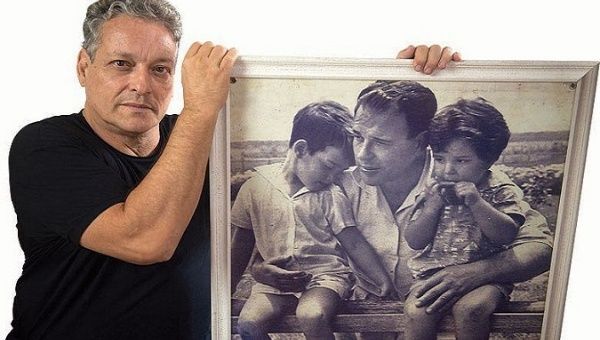
João Vicente Goulart holds a portrait of himself, his father, João Goulart, and his sister, Denize. | Photo: João Vicente Goulart
By Edu Montesanti | teleSUR | December 6, 2017
“Jango was my best friend, a great partner, and the best father to my children. It is still hard to forget,” Jango’s widow, Maria Theresa Goulart told teleSUR.
On Dec. 6, 1976, former Brazilian President João Goulart, popularly known as “Jango,” passed away at 57 years old in his exile with family in Mercedes, Argentina. Officially, he died of a cardiac attack, but evidence points to poisoning.
“There are still some available tissue samples at the Federal Police Criminal Institute of Brazil for a new investigation, as new evidence is expected if we can have more documents declassified and testimonies that would bring new information,” João Vicente Goulart, Jango’s son told teleSUR.
“In the first results analyzed, a substance appeared in tiny amounts which should not be in a human body, called pentaerythritol tetranitrate or erythrin tetranitrate, also known as pentrite,” said Goulart. “It is a chemical with characteristics and end of explosives that, at the time, was only controlled as an exclusive weapon used by the American army,” added Jango’s son, pointing out that secret agents used to infiltrate the family’s house in exile.
“It has been proven that spies removed my father’s documents, they could have easily changed his heart medicine for a poison.”

Jango speaks to a large crowd accompanied by his wife, Maria Theresa Goulart. Photo: João Vicente Goulart
Jango’s body did not undergo an autopsy at the time of his death. His body was buried in São Borja, Brazil, after the assurance that the coffin would not be opened. According to Goulart, “There was severe military repression at my father’s funeral.” There were military officials everywhere, monitoring Jango’s coffin so it could not be opened. In 2006, Mario Neira, a former Uruguayan secret agent, told Goulart that his father had been poisoned.
Overthrown from the Brazilian presidency by a military coup d’état on April 1, 1964, the democratically-elected João Goulart, with more than 70 percent of an approval rating, was exiled three days later with family to Uruguay. In 1973, President Juan Domingo Peron welcomed him. The Goularts were constantly threatened in exile, so the son, João Vicente and Denize, the Goularts’ daughter, left to study in London. Some friends warned former president Jango several times, that he could be killed.
On March 13, 1964, 18 days before the coup, President João Goulart gave a speech to more than 200,000 people in Central do Brasil square in Rio de Janeiro, with his wife Maria Theresa Goulart beside him, for the first time since assuming the presidency. He promised an agrarian reform, reducing remittances of profits overseas, extending democratic rights, along with other very popular reforms.
“Goulart committed the crime of reforming the economy. That was more than (U.S. President) Lyndon Johnson could tolerate and he opted to destabilize the economy and assist a right-wing military takeover,” said the U.S. historian Peter Kuznick to teleSUR.
“The 1964 coup that toppled Goulart’s government was extremely significant,” added Kuznick. “Oliver Stone and I began our documentary about the invasion of Vietnam with a discussion of that coup. We then talk about the Dominican Republic, Greece, Indonesia, and Chile to show that the Vietnam War was part of a pattern.
“A National Intelligence Estimate in the summer of 1963 had warned that Goulart might be establishing ‘an extreme leftist regime, with a strongly anti-U.S. character.’ Johnson’s appointment in December of Thomas Mann as assistant secretary of state to coordinate Latin American affairs was another nail in the Goulart government’s coffin.
“When Goulart responded the next year to U.S. demands to impose austerity on the Brazilian people by instead offering land reform and control of foreign capital and by recognizing Cuba, the U.S. moved quickly to destabilize the economy. Goulart seized U.S. properties.
“Ambassador Lincoln Gordon and U.S. embassy officials urged right-wing Brazilian officers to overthrow Goulart. The U.S. backed Army Chief of Staff General Humberto Castelo Branco. The CIA assisted behind the scenes,” observed Kuznick, who is the director of the Institute of Nuclear Studies at the American University.
The Brazilian historian Victor Schincariol told teleSUR that in order to preserve national peace and people’s security, President Jango didn’t call for a military intervention to protect him. “Goulart was genuinely committed to democracy and social peace. He said that he could not tolerate the death of Brazilians in a virtual civil war.
“At the same time, he knew that the U.S. would support the right-wing forces, which would make the case for the defense of democracy very hard indeed to win,” added the Brazilian researcher at the University of ABC in São Paulo.
On Dec. 18, in the presence of the heads of the military and President Dilma Rousseff, the Brazilian Congress symbolically returned President João Goulart’s mandate, as the OAS exhorted Brazil in 2010 for the crimes against humanity never punished, committed by the military dictatorship that killed 475 people, left 144 “disappeared,” and tortured more than 30,000 people.
There is an Amnesty Act in Brazil, elaborated and passed in 1979 by Brazilian military officials themselves — never addressed in the country by politicians, mainstream media and local elites — that acquits the dictators of the crimes committed between 1964 and 1985.
“Goulart’s and Varga’s legacy was erased, physically and ideologically, by the military dictatorship between 1964-1985. The economy was “globalized;” the case for an industrialization with national capitals, social justice and national independence was substituted by dependence, fascist policies and censorship; the democratic and left-wing forces were imprisoned, killed or left the nation,” said Professor Doctor Schincariol.
“The most important legacy Jango left to Brazil was his tireless fight for workers’ right and social justice,” Jango’s widow, Maria Theresa Goulart told teleSUR. “And for us, his family, his generosity and partnership.”
How Russia-gate Rationalizes Censorship
By Joe Lauria | Consortium News | December 4, 2107
At the end of October, I wrote an article for Consortium News about the Democratic National Committee and Hillary Clinton’s campaign paying for unvetted opposition research that became the basis for much of the disputed story about Russia allegedly interfering in the 2016 presidential election on the orders of Russian President Vladimir Putin.
The piece showed that the Democrats’ two paid-for sources that have engendered belief in Russia-gate are at best shaky. First was former British spy Christopher Steele’s largely unverified dossier of second- and third-hand opposition research portraying Donald Trump as something of a Russian Manchurian candidate.
And the second was CrowdStrike, an anti-Putin private company, examining the DNC’s computer server to dubiously claim discovery of a Russian “hack.” In a similar examination of an alleged hack of a Ukrainian artillery app, CrowdStrike also blamed Russia but used faulty data for its report that it was later forced to rewrite. CrowdStrike was hired after the DNC refused to allow the FBI to look at the server.
My piece also described the dangerous consequences of partisan Democratic faith in Russia-gate: a sharp increase in geopolitical tensions between nuclear-armed Russia and the U.S., and a New McCarthyism that is spreading fear — especially in academia, journalism and civil rights organizations — about questioning the enforced orthodoxy of Russia’s alleged guilt.
After the article appeared at Consortium News, I tried to penetrate the mainstream by then publishing a version of the article on the HuffPost, which was rebranded from the Huffington Post in April this year by new management. As a contributor to the site since February 2006, I am trusted by HuffPost editors to post my stories directly online. However, within 24 hours of publication on Nov. 4, HuffPost editors retracted the article without any explanation.
This behavior breaks with the earlier principles of journalism that the Web site claimed to uphold. For instance, in 2008, Arianna Huffington told radio host Don Debar that, “We welcome all opinions, except conspiracy theories.” She said: “Facts are sacred. That’s part of our philosophy of journalism.”
But Huffington stepped down as editor in August 2016 and has nothing to do with the site now. It is run by Lydia Polgreen, a former New York Times reporter and editor, who evidently has very different ideas. In April, she completely redesigned the site and renamed it HuffPost.
Before the management change, I had published several articles on the Huffington Post about Russia without controversy. For instance, The Huffington Post published my piece on Nov. 5, 2016, that predicted three days before the election that if Clinton lost she’d blame Russia. My point was reaffirmed by the campaign-insider book Shattered, which revealed that immediately after Clinton’s loss, senior campaign advisers decided to blame Russia for her defeat.
On Dec. 12, 2016, I published another piece, which the Huffington Post editors promoted, called, “Blaming Russia To Overturn The Election Goes Into Overdrive.” I argued that “Russia has been blamed in the U.S. for many things and though proof never seems to be supplied, it is widely believed anyway.”
After I posted an updated version of the Consortium News piece — renamed “On the Origins of Russia-gate” — I was informed 23 hours later by a Facebook friend that the piece had been retracted by HuffPost editors. As a reporter for mainstream media for more than a quarter century, I know that a newsroom rule is that before the serious decision is made to retract an article the writer is contacted to be allowed to defend the piece. This never happened. There was no due process. A HuffPost editor ignored my email asking why it was taken down.
Support from Independent Media
Like the word “fascism,” “censorship” is an over-used and mis-used accusation, and I usually avoid using it. But without any explanation, I could only conclude that the decision to retract was political, not editorial.
I am non-partisan as I oppose both major parties for failing to represent millions of Americans’ interests. I follow facts where they lead. In this case, the facts led to an understanding that the Jan. 6 FBI/NSA/CIA intelligence “assessment” on alleged Russian election interference, prepared by what then-Director of National Intelligence James Clapper called “hand-picked” analysts, was based substantially on unvetted opposition research and speculation, not serious intelligence work.
The assessment even made the point that the analysts were not asserting that the alleged Russian interference was a fact. The report contained the disclaimer: “Judgments are not intended to imply that we have proof that shows something to be a fact. Assessments are based on collected information, which is often incomplete or fragmentary, as well as logic, argumentation, and precedents.”
Under deadline pressure on Jan. 6, Scott Shane of The New York Times instinctively wrote what many readers of the report must have been thinking: “What is missing from the public report is what many Americans most eagerly anticipated: hard evidence to back up the agencies’ claims that the Russian government engineered the election attack. … Instead, the message from the agencies essentially amounts to ‘trust us.’”
Yet, after the Jan. 6 report was published, leading Democrats asserted falsely that the “assessment” represented the consensus judgment of all 17 U.S. intelligence agencies – not just the views of “hand-picked” analysts from three – and much of the U.S. mainstream media began treating the allegations of Russian “hacking” as flat fact, not as an uncertain conclusion denied by both the Russian government and WikiLeaks, which insists that it did not get the two batches of Democratic emails from Russia.
(There is also dissent inside the broader U.S. intelligence community about whether an alleged “hack” over the Internet was even possible based on the download speeds of one known data extraction, which matched what was possible from direct USB access to a computer, i.e., a download onto a thumb drive presumably by a Democratic insider,)
However, because of the oft-repeated “17 intelligence agencies” canard and the mainstream media’s careless reporting, the public impression has built up that the accusations against Russia are indisputable. If you ask a Russia-gate believer today what their faith is based on, they will invariably point to the Jan. 6 assessment and mock anyone who still expresses any doubt.
For instance, an unnamed former CIA officer told The Intercept last month, “You’ve got all these intelligence agencies saying the Russians did the hack. To deny that is like coming out with the theory that the Japanese didn’t bomb Pearl Harbor.”
That the supposedly dissident Intercept would use this quote is instructive about how imbalanced the media’s reporting on Russia-gate has been. We have actual film of Japanese planes attacking Pearl Harbor and American ships burning – and we have the eyewitness accounts of thousands of U.S. soldiers and sailors. Yet, on Russia-gate, we only have the opinions of some “hand-picked” intelligence officials who themselves say that they are not claiming that their opinions are fact. No serious editor would allow a self-interested and unnamed source to equate the two in print.
In this groupthink atmosphere, it was probably easy for HuffPost editors to hear some complaints from a few readers and blithely decide to ban my story. However, before it was pulled, 125 people had shared it. Ray McGovern, a former CIA analyst and frequent contributor to Consortium News, then took up my cause, being the first to write about the HuffPost censorship on his blog. McGovern included a link to a .pdf file that I captured of the censored HuffPost story. It has since been republished on numerous other websites.
Journalist Max Blumenthal tweeted about it. British filmmaker and writer Tariq Ali posted it on his Facebook page. Ron Paul and Daniel McAdams interviewed me at length about the censorship on their TV program. ZeroHedge wrote a widely shared piece and someone actually took the time, 27 minutes and 13 seconds to be exact, to read the entire article on YouTube. I began a petition to HuffPost’s Polgreen to either explain the retraction or restore the article. It has gained more than 1,900 signatures so far. If a serious fact-check analysis was made of my article, it must exist and can and should be produced.
Watchdogs & Media Defending Censorship
Despite this support from independent media, a senior official at Fairness and Accuracy in Reporting, I learned, declined to take up my cause because he believes in the Russia-gate story. I also learned that a senior officer at the American Civil Liberties Union rejected my case because he too believes in Russia-gate. Both of these serious organizations were set up precisely to defend individuals in such situations on principle, not preference.
In terms of their responsibilities for defending journalism and protecting civil liberties, their personal opinions about whether Russia-gate is real or not should be irrelevant. The point is whether journalists should be permitted to show skepticism toward this latest dubiously based groupthink. I fear that – amid the frenzy about Russia and the animosity toward Trump – concerns about careers and funding are driving these decisions, with principles brushed aside.
One online publication decidedly took the HuffPost’s side. Steven Perlberg, a media reporter for BuzzFeed, asked the HuffPost why they retracted my article. While ignoring me, the editors issued a statement to BuzzFeed saying that “Mr. Lauria’s self-published” piece was “later flagged by readers, and after deciding that the post contained multiple factually inaccurate or misleading claims, our editors removed the post per our contributor terms of use.” Those terms include retraction for “any reason,” including, apparently, censorship.
Perlberg posted the HuffPost statement on Twitter. I asked him if he inquired of the editors what those “multiple” errors and “misleading claims” were. I asked him to contact me to get my side of the story. Perlberg totally ignored me. He wrote nothing about the matter. He apparently believed the HuffPost and that was that. In this way, he acquiesced with the censorship.
BuzzFeed, of course, is the sensationalist outlet that irresponsibly published the Steele dossier in full, even though the accusations – not just about Donald Trump but also many other individuals – weren’t verified. Then on Nov. 14, BuzzFeed reporter Jason Leopold wrote one of the most ludicrous of a long line of fantastic Russia-gate stories, reporting that the Russian foreign ministry had sent money to Russian consulates in the U.S. “to finance the election campaign of 2016.” The scoop generated some screaming headlines before it became clear that the money was to pay for Russian citizens in the U.S. to vote in the 2016 Duma election.
That Russia-gate has reached this point, based on faith and not fact, was further illustrated by a Facebook exchange I had with Gary Sick, an academic who served on the Ford and Carter national security staffs. When I pressed Sick for evidence of Russian interference, he eventually replied: “If it walks like a duck and talks like a duck…” When I told him that was a very low-bar for such serious accusations, he angrily cut off debate.
Part of this Russia-gate groupthink stems from the outrage – and even shame – that many Americans feel about Trump’s election. They want to find an explanation that doesn’t lay the blame on the U.S. citizenry or America’s current dysfunctional political/media process. It’s much more reassuring, in a way, to blame some foreign adversary while also discrediting Trump’s legitimacy as the elected president. That leaves open some hope that his election might somehow be negated.
And, so many important people and organizations seem to be verifying the Russia-gate suspicions that the theory must be true. Which is an important point. When belief in a story becomes faith-based or is driven by an intense self-interest, honest skeptics are pushed aside and trampled. That is the way groupthink works, as we saw in the run-up to the U.S. invasion of Iraq when any doubts about Iraq possessing WMD made you a “Saddam apologist.”
As the groupthink grows, the true-believers become disdainful of facts that force them to think about what they already believe. They won’t waste time making a painstaking examination of the facts or engage in a detailed debate even on something as important and dangerous as a new Cold War with Russia.
This is the most likely explanation for the HuffPost‘s censorship: a visceral reaction to having their Russia-gate faith challenged.
Why Critical News is Suppressed
But the HuffPost’s action is hardly isolated. It is part of a rapidly growing landscape of censorship of news critical of American corporate and political leaders who are trying to defend themselves from an increasingly angry population. It’s a story as old as civilization: a wealthy and powerful elite fending off popular unrest by trying to contain knowledge of how the insiders gain at the others’ expense, at home and abroad.
A lesson of the 2016 campaign was that growing numbers of Americans are fed up with three decades of neoliberal policies that have fabulously enriched the top tier of Americans and debased a huge majority of the citizenry. The population has likewise grown tired of the elite’s senseless wars to expand their own interests, which these insiders try to conflate with the entire country’s interests.
America’s bipartisan rulers are threatened by popular discontent from both left and right. They were alarmed by the Bernie Sanders insurgency and by Donald Trump’s victory, even if Trump is now betraying the discontented masses who voted for him by advancing tax and health insurance plans designed to further crush them and benefit the wealthy.
Trump’s false campaign promises will only make the rulers’ problem of a restless population worse. Americans are subjected to economic inequality greater than in the first Gilded Age. They are also subjected today to more war than in the first Gilded Age. American rulers today are engaged in multiple conflicts following decades of post-World War II invasions and coups to expand their global interests.
People with wealth and power always seem to be nervous about losing both. So plutocrats use the concentrated media they own to suppress news critical of their wars and domestic repression. For example, almost nothing was reported about militarized police forces until the story broke out into the open in the Ferguson protests and much of that discontent has been brushed aside more recently.
Careerist journalists readily acquiesce in this suppression of news to maintain their jobs, their status and their lifestyles. Meanwhile, a growing body of poorly paid freelancers compete for the few remaining decent-paying gigs for which they must report from the viewpoint of the mainstream news organizations and their wealthy owners.
To operate in this media structure, most journalists know to excise out the historical context of America’s wars of domination. They know to uncritically accept American officials’ bromides about spreading democracy, while hiding the real war aims.
Examples abound: America’s role in the Ukraine coup was denied or downplayed; a British parliamentary report exposing American lies that led to the destruction of Libya was suppressed; and most infamously, the media promoted the WMD hoax and the fable of “bringing democracy” to Iraq, leading to the illegal invasion and devastation of that country. A recent example from November is a 60 Minutes report on the Saudi destruction of Yemen, conspicuously failing to mention America’s crucial role in the carnage.
I’ve pitched numerous news stories critical of U.S. foreign policy to a major American newspaper that were rejected or changed in the editorial process. One example is the declassified Defense Intelligence Agency document of August 2012 that accurately predicted the rise of the Islamic State two years later.
The document, which I confirmed with a Pentagon spokesman, said the U.S. and its Turkish, European and Gulf Arab allies, were supporting the establishment of a Salafist principality in eastern Syria to put pressure on the Syrian government, but the document warned that this Salafist base could turn into an “Islamic State.”
But such a story would undermine the U.S. government’s “war on terrorism” narrative by revealing that the U.S.-backed strategy actually was risking the expansion of the jihadists’ foothold in Syria. The story was twice rejected by my editors and has received attention almost entirely — if not exclusively — on much-smaller independent news Web sites.
Another story I pitched in June 2012, just a year into the Syrian war, about Russia’s motives in Syria being guided by a desire to defeat the growing jihadist threat there, was also rejected. Corporate media wanted to keep the myth of Russia’s “imperial” aims in Syria alive. I had to publish the article outside the U.S., in a South African daily newspaper.
In September 2015 at the U.N. General Assembly, Russian President Vladimir Putin confirmed my story about Russia’s motives in Syria to stop jihadists from taking over. Putin invited the U.S. to join this effort as Moscow was about to launch its military intervention at the invitation of the Syrian government. The Obama administration, still insisting on “regime change” in Syria, refused. And the U.S. corporate media continued promoting the myth that Russia intervened to recapture its “imperial glory.”
It was much easier to promote the “imperial” narrative and to ignore Putin’s clear explanation to French TV channel TF1, which was not picked up by American media.
“Remember what Libya or Iraq looked like before these countries and their organizations were destroyed as states by our Western partners’ forces?” Putin said. “These states showed no signs of terrorism. They were not a threat for Paris, for the Cote d’Azur, for Belgium, for Russia, or for the United States. Now, they are the source of terrorist threats. Our goal is to prevent the same from happening in Syria.”
Why Russia Is Targeted
So, where are independent-minded Western journalists to turn if their stories critical of the U.S. government and corporations are suppressed?
The imperative is to get these stories out – and Russian media has provided an opening for some. This has presented a new problem for the plutocracy. The suppression of critical news in their corporate-owned media is no longer working if it’s seeping out in Russian media (and through some dissident Western news sites on the Internet).
The solution has been to brand the content of the Russian television network, RT, as “propaganda” since it presents facts and viewpoints that most Americans have been kept from hearing. But just because these views – many coming from Americans and other Westerners – are not what you commonly hear on the U.S. mainstream media doesn’t make them “propaganda” that must be stigmatized and silenced.
As a Russian-government-financed English-language news channel, RT also gives a Russian perspective on the news, the way CNN and The New York Times give an American perspective and the BBC a British one. American mainstream journalists, from my experience, arrogantly deny suppressing news and believe they present a universal perspective, rather than a narrow American view of the world.
The viewpoints of Iranians, Palestinians, Russians, North Koreans and others are never fully reported in the Western media although the supposed mission of journalism is to help citizens understand a frighteningly complex world from multiple points of view. It’s impossible to do so without those voices included. Routinely or systematically shutting them out also dehumanizes people in those countries, making it easier to gain popular support to go to war against them.
Russia is scapegoated by charging that RT or Sputnik are sowing divisions in the U.S. by focusing on issues like homelessness, racism, or out-of-control militarized police forces, as if these divisive issues didn’t already exist. The U.S. mainstream media also seems to forget that the U.S. government has engaged in at least 70 years of interference in other countries’ elections, foreign invasions, coups, planting stories in foreign media and cyber-warfare.
Now, these American transgressions are projected onto Moscow. There’s also a measure of self-reverence in this for “successful” people with a stake in an establishment that underpins the elite, demonstrating how wonderfully democratic they are compared to those ogres in Russia.
The overriding point about the “Russian propaganda” complaint is that when America’s democratic institutions, including the press and the electoral process, are crumbling under the weight of corruption that the American elites have created or maintained, someone else needs to be blamed. Russia is both an old and a new scapegoat.
The Jan. 6 intelligence assessment on alleged Russian election meddling is a good example of how this works. A third of its content is an attack on RT for “undermining American democracy” by reporting on Occupy Wall Street, the protest over the Dakota pipeline and, of all things, holding a “third party candidate debates.”
According to the Jan. 6 assessment, RT’s offenses include reporting that “the US two-party system does not represent the views of at least one-third of the population and is a ‘sham.’” RT also “highlights criticism of alleged US shortcomings in democracy and civil liberties.” In other words, reporting on newsworthy events and allowing third-party candidates to express their opinions undermine democracy.
The report also says all this amounts to “a Kremlin-directed campaign to undermine faith in the US Government and fuel political protest,” but it should be noted those protests by dissatisfied Americans are against privileges of the wealthy and the well-connected, a status quo that the intelligence agencies routinely protect.
There are also deeper reasons why Russia is being targeted. The Russia-gate story fits neatly into a geopolitical strategy that long predates the 2016 election. Since Wall Street and the U.S. government lost the dominant position in Russia that existed under the pliable President Boris Yeltsin, the strategy has been to put pressure on getting rid of Putin to restore a U.S. friendly leader in Moscow. There is substance to Russia’s concerns about American designs for “regime change” in the Kremlin.
Moscow sees an aggressive America expanding NATO and putting 30,000 NATO troops on its borders; trying to overthrow a secular ally in Syria with terrorists who threaten Russia itself; backing a coup in Ukraine as a possible prelude to moves against Russia; and using American NGOs to foment unrest inside Russia before they were forced to register as foreign agents. Russia wants Americans to see this perspective.
Accelerated Censorship in the Private Sector
The Constitution prohibits government from prior-restraint, or censorship, though such tactics were imposed, largely unchallenged, during the two world wars. American newspapers voluntarily agreed to censor themselves in the Second World War before the government dictated it.
In the Korean War, General Douglas MacArthur said he didn’t “desire to reestablish wartime censorship” and instead asked the press for self-censorship. He largely got it until the papers began reporting American battlefield losses. On July 25, 1950, “the army ordered that reporters were not allowed to publish ‘unwarranted’ criticism of command decisions, and that the army would be ‘the sole judge and jury’ on what ‘unwarranted’ criticism entailed,” according to a Yale University study on military censorship.
After excellent on-the-ground reporting from Vietnam brought the war home to America, the military reacted by instituting, initially in the first Gulf War, serious control of the press by “embedding” reporters from private media companies which accepted the arrangement, much as World War II newspapers censored themselves.
It is important to realize that the First Amendment does not apply to private companies, including the media. It is not illegal for them to practice censorship. I never made a First Amendment argument against the HuffPost, for instance. However, under pressure from Washington, even in peacetime, media companies can do the government’s dirty work to censor or limit free speech for the government.
In the past few weeks, we’ve seen an acceleration of attempts by corporations to inhibit Russian media in the U.S. Both Google and Facebook, which dominate the Web with more than 50 percent of ad revenue, were at first resistant to government pressure to censor “Russian propaganda.” But they are coming around.
Eric Schmidt, executive chairman of Alphabet, Google’s parent company, said on Nov. 18 that Google would “derank” articles from RT and Sputnik in the Google searches, making the stories harder for readers to find. The billionaire Schmidt claimed Russian information can be “repetitive, exploitative, false, [or] likely to have been weaponized,” he said. That is how factual news critical of U.S. corporate and political leadership is seen, as a weapon.
“My own view is that these patterns can be detected, and that they can be taken down or deprioritized,” Schmidt said.
Though Google would effectively be hiding news produced by RT and Sputnik, Schmidt is sensitive to the charge of censorship, even though there’s nothing legally to stop him.
“We don’t want to ban the sites. That’s not how we operate,” Schmidt said cynically. “I am strongly not in favor of censorship. I am very strongly in favor of ranking. It’s what we do.”
But the “deranking” isn’t only aimed at Russian sites; Google algorithms also are taking aim at independent news sites that don’t follow the mainstream herd – and thus are accused of spreading Russian or other “propaganda” if they question the dominant Western narratives on, say, the Ukraine crisis or the war in Syria. A number of alternative websites have begun reporting a sharp fall-off of traffic directed to their sites from Google’s search engines.
Responding to a deadline from Congress to act, Facebook on Nov. 22 announced that it would inform users if they have been “targeted” by Russian “propaganda.” Facebook’s help center will tell users if they liked or shared ads allegedly from the St. Petersburg-based Internet Research Agency, which supposedly bought $100,000 in ads over a two-year period, with more than half these ads coming after the 2016 U.S. election and many not related to politics.
(The $100,000 sum over two years compares to Facebook’s $27 billion in annual revenue. Plus, Facebook only says it “believes” or it’s “likely” that the ads came from that firm, whose links to the Kremlin also have yet to be proved.)
Facebook described the move as “part of our ongoing effort to protect our platforms and the people who use them from bad actors who try to undermine our democracy.” Congress wants more from Facebook, so it will not be surprising if users will eventually be told when they’ve liked or shared an RT report in the future.
While the government can’t openly shut down a news site, the Federal Communications Commission’s upcoming vote on whether to deregulate the Internet by ending net neutrality will free private Internet companies in the U.S. to further marginalize Russian and dissident websites by slowing them down and thus discouraging readers from viewing them.
Likewise, as the U.S. government doesn’t want to be openly seen shutting down RT operations, it is working around the edges to accomplish that.
After the Department of Justice forced, under threat of arrest, RT to register its employees as foreign agents under the Foreign Agents Registration Act, State Department spokeswoman Heather Nuaert said last Tuesday that “FARA does not police the content of information disseminated, does not limit the publication of information or advocacy materials, and does not restrict an organization’s ability to operate.” She’d earlier said that registering would not “impact or affect the ability of them to report news and information. We just have them register. It’s as simple as that.”
Then on Wednesday the Congressional press office stripped RT correspondents of their Capitol Hill press passes, citing the FARA registration. “The rules of the Galleries state clearly that news credentials may not be issued to any applicant employed ‘by any foreign government or representative thereof.’ Upon its registration as a foreign agent under the Foreign Agents Registration Act (FARA), RT Network became ineligible to hold news credentials,” read the letter to RT.
Even so, Russia-gate faithful ignore these aggressive moves and issue calls for even harsher action. After forcing RT to register, Keir Giles, a Chatham House senior consulting fellow, acted as though it never happened. He said in a Council on Foreign Relations Cyber Brief on Nov. 27: “Although the Trump administration seems unlikely to pursue action against Russian information operations, there are steps the U.S. Congress and other governments should consider.”
I commented on this development on RT America. It would also have been good to have the State Department’s Nuaert answer for this discrepancy about the claim that forced FARA registrations would not affect news gathering when it already has. My criticism of RT is that they should be interviewing U.S. decision-makers to hold them accountable, rather than mostly guests outside the power structure. The decision-makers could be called out on air if they refuse to appear.
Growing McCarthyite Attacks
Western rulers’ wariness about popular unrest also can be seen in the extraordinary and scurrilous attack on the Canadian website globalresearch.ca. The attack started with a chilling study by the North Atlantic Treaty Organization into the relatively obscure website, followed by a vicious hit piece on Nov. 18 by the Globe and Mail, Canada’s largest newspaper. The headline was: “How a Canadian website is being used to amplify the Kremlin’s view of the world.”
“What once appeared to be a relatively harmless online refuge for conspiracy theorists is now seen by NATO’s information warfare specialists as a link in a concerted effort to undermine the credibility of mainstream Western media – as well as the North American and European public’s trust in government and public institutions,” the Globe and Mail reported. “Global Research is viewed by NATO’s Strategic Communications Centre of Excellence – or StratCom – as playing a key accelerant role in helping popularize articles with little basis in fact that also happen to fit the narratives being pushed by the Kremlin, in particular, and the Assad regime.”
I’ve not agreed with everything I’ve read on the site. But it is a useful clearinghouse for alternative media. Numerous Consortium News articles are republished there, including a handful of mine. But the site’s typical sharing and reposting on the Internet is seen by NATO as a plot to undermine the Free World.
Drawing from the NATO report, The Globe and Mail’s denunciation of this website continued: “It uses that reach to push not only its own opinion pieces, but ‘news’ reports from little-known websites that regularly carry dubious or false information. At times, the site’s regular variety of international-affairs stories is replaced with a flurry of items that bolster dubious reportage with a series of opinion pieces, promoted on social media and retweeted and shared by active bots.”
The newspaper continued, “’That way, they increase the Google ranking of the story and create the illusion of multi-source verification,’ said Donara Barojan, who does digital forensic research for [StratCom]. But she said she did not yet have proof that Global Research is connected to any government.”
This sort of smear is nothing more than a blatant attack on free speech by the most powerful military alliance in the world, based on the unfounded conviction that Russia is a fundamental force for evil and that anyone who has contacts with Russia or shares even a part of its multilateral world view is suspect.
High-profile individuals are now also in the crosshairs of the neo-McCarthyite witchhunt. On Nov. 25 The Washington Post ran a nasty hit piece on Washington Capitals’ hockey player Alex Ovechkin, one of the most revered sports figures in the Washington area, simply because he, like 86 percent of other Russians, supports his president.
“Alex Ovechkin is one of Putin’s biggest fans. The question is, why?” ran the headline. The story insidiously implied that Ovechkin was a dupe of his own president, being used to set up a media campaign to support Putin, who is under fierce and relentless attack in the United States where Ovechkin plays professional ice hockey.
“He has given an unwavering endorsement to a man who U.S. intelligence agencies say sanctioned Russian meddling in last year’s presidential election,” write the Post reporters, once again showing their gullibility to U.S. intelligence agencies that have provided no proof for their assertions (and even admit that they are not asserting their opinion as fact).
Less prominent figures are targeted too. John Kiriakou, a former CIA agent who blew the whistle on torture and was jailed for it, was kicked off a panel in Europe on Nov. 10 by a Bernie Sanders supporter who refused to appear with Kiriakou because he co-hosts a show on Radio Sputnik.
Then last week, Reporters Without Borders, an organization supposedly devoted to press freedom, tried to kick journalist Vanessa Beeley off a panel in Geneva to prevent her from presenting evidence that the White Helmets, a group that sells itself as a rescue organization inside rebel-controlled territory in Syria, has ties to Al Qaeda. The Swiss Press Club, which hosted the event, resisted the pressure and let Beeley speak.
Russia-gate’s Hurdles
Much of this spreading global hysteria and intensifying censorship traces back to Russia-gate. Yet, it remains remarkable that the corporate media has failed so far to prove any significant Russian interference in the U.S. election at all. Nor have the intelligence agencies, Congressional investigations and special prosecutor Robert Mueller. His criminal charges so far have been for financial crimes and lying to federal authorities on topics unrelated to any “collusion” between the Trump campaign and Russians to “hack” Democratic emails.
There may well be more indictments from Mueller, even perhaps a complaint about Trump committing obstruction of justice because he said on TV that he fired Comey, in part, because of the “Russia thing.” But Trump’s clumsy reaction to the “scandal,” which he calls “fake news” and a “witch hunt,” still is not proof that Putin and the Russians interfered in the U.S. election to achieve the unlikely outcome of Trump’s victory.
The Russia-gate faithful assured us to wait for the indictment of retired Lt. Gen. Michael Flynn, briefly Trump’s national security adviser. But again there was nothing about pre-election “collusion,” only charges that Flynn had lied to the FBI or omitted details about two conversations with the Russian ambassador regarding policy matters during the presidential transition, i.e., after the election.
And, one of those conversations related to trying unsuccessfully to comply with an Israeli request to get Russia to block a United Nations resolution censuring Israel’s settlements on Palestinian land.
As journalist Yasha Levine tweeted: “So the country that influenced US policy through Michael Flynn is Israel, not Russia. But Flynn did try to influence Russia, not the other way around. Ha-ha. This is the smoking gun? What a farce.”
There remain a number of key hurdles to prove the Russia-gate story. First, convincing evidence is needed that the Russian government indeed did “hack” the Democratic emails, both those of the DNC and Clinton’s campaign chairman John Podesta – and gave them to WikiLeaks. And, further that somehow the Trump campaign was involved in aiding and abetting this operation, i.e., collusion.
There’s also the question of how significant the release of those emails was anyway. They did provide evidence that the DNC tilted the primary campaign in favor of Clinton over Sanders; they exposed the contents of Clinton’s paid speeches to Wall Street, which she was trying to hide from the voters; and they revealed some pay-to-play features of the Clinton Foundation and its foreign donations.
But – even if the Russians were involved in providing that information to the American people – those issues were not considered decisive in the campaign. Clinton principally pinned her loss on FBI Director James Comey for closing and then reopening the investigation into her improper use of a private email server while Secretary of State. She also spread the blame to Russia (repeating the canard about “seventeen [U.S. intelligence] agencies, all in agreement”), Bernie Sanders, the inept DNC and other factors.
As for the vaguer concerns about some Russian group “probably” buying $100,000 in ads, mostly after Americans had voted, as a factor in swaying a $6 billion election, is too silly to contemplate.
That RT and Sputnik ran pieces critical of Hillary Clinton was their right, and they were hardly alone. RT and Sputnik‘s reach in the U.S. is minuscule compared to Fox News, which slammed Clinton throughout the campaign, or for that matter, MSNBC, CNN and other mainstream news outlets, which often expressed open disdain for Republican Donald Trump but also gave extensive coverage to issues such as the security concerns about Clinton’s private email server.
Another vague Russia-gate suspicion stemming largely from Steele’s opposition research is that somehow Russia is bribing or blackmailing Trump because Trump has done some past business with Russians. But there are evidentiary and logical problems with these theories, since some lucrative deals fell through (and presumably wouldn’t have if Trump was being paid off) — and no one, including the Russians, foresaw Trump’s highly improbable election as U.S. President years earlier.
Some have questioned how Trump could have supported detente with Russia without being beholden to Moscow in some way. But Jeffery Sommers, a political scientist at the University of Wisconsin, wrote a convincing essay explaining adviser Steve Bannon’s influence on Trump’s thinking about Russia and the need for cooperation between the two powers to solve international problems.
Without convincing evidence, I remain a Russia-gate skeptic. I am not defending Russia. Russia can defend itself. However, amid the growing censorship and this dangerous new McCarthyism, I am trying to defend America — from itself.
Joe Lauria is a veteran foreign-affairs journalist. He has written for the Boston Globe, the Sunday Times of London and the Wall Street Journal among other newspapers. He is the author of How I Lost By Hillary Clinton published by OR Books in June 2017. He can be reached at joelauria@gmail.com and followed on Twitter at @unjoe.
Featured Video
or go to
Aletho News Archives – Video-Images
Book Review
The Maidan Killings and the False-Flag Case
By Freddie Ponton | 21st Century Wire | September 5, 2026
Before the killings that helped bring down Ukraine’s president in February 2014, American diplomats were discussing who should enter its government. In a leaked telephone call, senior State Department official Victoria Nuland told US ambassador Geoffrey Pyatt, “I think Yats is the guy,” referring to opposition leader Arseniy Yatseniuk. Washington had clear preferences and was working to advance them. Later that month, Yatseniuk became prime minister.
Ivan Katchanovski’s The Maidan Massacre in Ukraine examines the violence that preceded that transfer of power. Drawing on television footage, witness testimony, forensic examinations and Ukrainian court proceedings, he argues that elements of the opposition shot protesters and police in a false-flag operation. His case centres on evidence of protesters being shot from opposition-controlled locations, including Hotel Ukraina, overlooking the killing ground. … continue
Blog Roll
 Aletho News
- Israel expands “incitement” charge to target Palestinian education and memory
- How Israel seeks to reshape Arab classrooms
- Paris bans pro-Palestinian demonstration planned for Oct. 7 over ‘risks of public disorder’
- In August Hanning Treason Case – All Signs Point To Tel Aviv.
- France cleared dozens of military sales to Israel between May and September: Report
- France projects nuclear power as Macron pushes arsenal expansion
- The fallacy of US delusions about Iran’s economic collapse
- What changes with Lula or Flávio?
- Britain leads Western media’s demise through ‘fear porn’ narrative
- The Maidan Killings and the False-Flag Case
- If Americans Knew
- Soldier testimony sheds light on how Israel wages information war
- CIA Report Warns Israel Could Head Toward Civil War, Total Collapse
- Banker Who Exposed Howard Lutnick’s Ties to Epstein Warned of ‘Retaliation’ and ‘Personal Consequences’ in Last Post Before Suicide
- Israeli Attacks Kill Two Palestinians in Gaza
- Gaza genocide at 3: Israeli-U.S. cruelty and the smart, deep resistance to it are changing the world
- As genocide is about to enter 3rd year, little of Gaza remains– Daily Update
- “We See Our Homes Now From A Satellite, Like Strangers”
- Watch “Gaza: Doctors Under Attack”, originally censored by BBC
- NAZA: Israeli embassies in UK and US promote rival documentary to challenge Gaza genocide allegations
- David Ellison appoints Israeli to lead merged Paramount-Warner studios
- No Tricks Zone
- Latest European Green Energy Debacle; Portugal’s Largest Flagship Solar Park Insolvent!
- Green Energy Debacle: German Expert Professor Fritz Vahrenholt Warns Of Severe Economic And Social Consequences
- Two More Paleo Reconstructions Affirm Meters-Higher Sea Levels Across Ireland, Brazil 7000-6000 Years Ago
- New Study: Earth And Venus Surface Warmth Largely Explained By Convection And Lapse Rate, Not CO2 Or Radiation
- 2025 Nature Paper Claiming Worsening Global Drought Gets RETRACTED …Heavily Flawed
- New Study: ‘Global Drought Shows No Detectable Recent Acceleration Under Climate Warming’
- Economic Masterminds: German Socialists Suggest Taxing Productivity Gains Stemming From Using AI
- The South China Sea Has Not Been Cooperating With The Climate Change Narrative
- Energy Crisis: Germany Enters Heating Season With Historically Low Gas Reserve Fill Levels
- New Study: The Antarctic Ice Sheet Gained Mass From 2020-2024 Due To Staggering Snow And Ice Accumulation

