G7’s desire to further embargo Russia a sign of desperation
By Ahmed Adel | April 24, 2023
According to a Japanese government source, the Group of Seven (G7) members are considering an almost complete ban on exports to Russia. However, such a move only demonstrates the desperate position that the G7 finds itself in because its already existing sanctions regime has not only failed to deter Moscow from its military operation in Ukraine, but has boomeranged and hit the economies of the Group much more severely than Russia.
Although G7 countries have stopped exporting luxury goods and equipment related to the military sector to Russia, the source said the latest plan could expand the trade embargo to used cars, tires, cosmetic items, and clothing. Again, these are non-essential items that can very easily be sourced from other markets.
There is credence to this source when considering that Japan will host the G7 summit on May 19-21 in Hiroshima. The centre of discussions will primarily focus on expanding support to Ukraine and strengthening sanctions on Russia, something that Canada, France, Germany, Italy, Japan, the UK, and the US will approve.
The problem for G7 member countries is that if they decide to introduce a complete embargo on the export of products to Russia, they will end up hurting their own industries more as they cut out a major market and allow rivals from China, India and elsewhere to fill the void. For this reason, many Western politicians still fear that a move by the G7 will lead to a harsh reaction from companies that continue to trade with Russia, and more alarmingly, retaliatory sanctions by Moscow.
In addition, from a technical point of view, it is very complicated to implement a total ban on exports to Russia. Russia’s bilateral trade with the European Union in 2021 reached €257 billion, with €158 billion of those being Russian exports to the bloc. Although this has obviously dropped since the Russian military operation began, many problems will still emerge. Despite billions of dollars being slashed from bilateral trade, we are still speaking about tens of billions of dollars, something that is not abstract but is backed by jobs and livelihoods.
It is also unlikely that large economies outside of the G7, such as China, India, Brazil, and South Africa, would join the embargo. This means that it is impossible to impose a global embargo on Russia. In addition, the G7 cannot expect Russia to continue selling its oil and other export goods without receiving payment.
Finally, from a legal perspective, the decision needs to be ratified at the UN level, where Russia and China will vote down such an idea. Therefore, the G7 member countries are just making a cynical attempt to weaken and destroy the Russian economy to supplant a competitor and preserve the unipolar world order.
Importantly, if the G7 imposes a near complete embargo, it will be Europe that will suffer the most and not the US since it is the least dependent on trade relations with Russia. In general, Moscow and Washington do not have deep economic ties, unlike Europe. Western European countries are already in a bad economic situation, and since the introduction of sanctions, they have experienced more damage and inconvenience.
For example, high-tech European products intended for Russia will now lose a major client and they will not so easily find a new one. This situation will lead to European companies having to reduce production, thus leading to lower profits and workers being laid off. Even worse for the West, as already said, is that Russia will not be left without necessary products because they can be purchased from many other countries.
For his part though, Japanese Minister of Economy, Trade and Industry, Yasutoshi Nishimura, refused to comment on the possibility of a complete ban on the export of products to Russia at a press conference in Tokyo. He noted that this issue concerns “diplomatic negotiations.”
Japanese Prime Minister Fumio Kishida has invited Ukrainian President Volodymyr Zelenskyy to join the G7 summit via online stream. In a communique released on April 18, the G7 foreign ministers committed their countries to intensifying sanctions imposed on Russia since the military operation began last year. The foreign ministers demanded Russian forces to immediately and unconditionally withdraw, something which obviously will not happen since it is Moscow, and not the West, in a position of strength.
They also vowed to counter sanctions by Moscow and warned of the “severe costs” that third parties could face if they do not stop providing assistance for Russia’s war effort. However, this is an empty threat as it will be impossible for the G7 to impose a “severe cost” on the likes of China, India, Brazil, South Africa and many others, particularly since their own cooperation is deepening.
Therefore, the G7’s desire to embargo Russia even further will not only humiliatingly fail as all the previous sanction packages have, but is also a demonstration on the desperation they are experiencing in face of Russia’s success in the military operation and rebounding the West’s economic war.
Ahmed Adel is a Cairo-based geopolitics and political economy researcher.
Orbán says the US cannot push Hungary into war – the rest of Europe would be wise to follow his policy
BY THOMAS BROOKE | REMIX NEWS | APRIL 20, 2023
The relentless criticism by the Biden administration towards the incumbent Hungarian government is entirely disproportionate and unjustified, and does little to separate the current U.S. regime from the malign superpowers it seeks to distance itself from. Hungary’s leader recognizes this and is putting his own country’s interests ahead of those of the United States, a stance that Europe would be wise to follow.
Despite pressure from the U.S., Hungarian Prime Minister Viktor Orbán said his country cannot be pushed into joining the war on the side of Ukraine.
“The United States has not given up its plan to squeeze everyone, including Hungary, into a war alliance, to go with the crowd,” Orbán told a press conference last week.
“But I have made it clear several times, and Hungarian diplomacy has also expressed this, that the will of the Hungarian people is clear, and our knowledge of history is quite solid, so we will not allow this.
“We will not allow them to squeeze us into a war. We will not send any weapons, and we will not be involved in a conflict that is not our war,” the Hungarian premier added.
Orbán made the remarks amid growing tension with the U.S. Recent disparaging remarks by David Pressman, Biden’s top diplomat in Budapest, have been dismissive of a country which, whilst remaining on many issues a conforming ally to the United States, has had the audacity to form its own view on matters unfolding on its doorstep, and opted not to become entirely subservient to U.S. interests when the two countries have vastly different worldviews and face inherently different geopolitical threats
“We have concerns about the continued eagerness of Hungarian leaders to expand and deepen ties with the Russian Federation, despite Russia’s ongoing brutal aggression against Ukraine and threat to transatlantic security,” Pressman told a news conference in Budapest last week after criticizing the Hungarian government for retaining its stake in Russia’s International Investment Bank (IBB) upon which the U.S. government imposed sanctions last week.
Hungarian Prime Minister Viktor Orbán berated the shortsightedness of the U.S. decision on state radio, explaining that the Russian-controlled financial institution based in Budapest “could have played a serious role in developing Central European economies,” and expressed concern that the United States simply doesn’t understand the geopolitical climate and should stop acting like it does.
US Ambassador Pressman would push Hungary into war
The intention of Joe Biden’s man in Budapest is to drag Hungary into the conflict in Ukraine, writes József K. Horváth for the Magyar Hírlap newspaper
The Hungarian government withdrew its membership of the IBB the day after the sanctions were imposed, with Orbán stating the U.S. action had rendered the bank’s operations impossible.
“It can’t serve its function,” Orbán said. “We decided that under these circumstances, Hungary’s participation in the bank’s further work has become pointless.”
It’s not the first time the Hungarian government has been frustrated by decisions made in far-away Washington without an understanding of the nuanced consequences for the region.
U.S. government officials have regularly criticized the Hungarian administration for not following suit with the U.S. approach to the conflict in Ukraine, criticism which the Hungarian premier considers to be misguided.
“When I hear about nuclear weapons, or that a Western European country is taking depleted uranium weapons to Ukraine, I think of Chernobyl,” Orbán said while referring to Britain’s decision to send depleted uranium tank ammunition to Ukrainian forces.
“An American would never think of this, but we know that if something happens in Ukraine it’s best if people don’t go out into the streets, so we know what happened then.
“Or if in America they hear that someone died on the Ukrainian-Russian front, they obviously sympathize because it’s a loss, but it is not the same feeling as ours, because I immediately think that the person who died could be a Hungarian person from Transcarpathia.
“Everything that happens there becomes a part of our lives that very day.
“The dimension of the Americans is quite different, so I say that we rightly expect the United States to take note of Hungary’s special situation, its proximity to Ukraine, and to understand that we are therefore on the side of peace and want to stay there.”
Given the continued animosity from the U.S. towards the Orbán administration, it could be assumed that Hungary was an active belligerent nation in the conflict, and yet Budapest has complied with every anti-Russian sanction approved by the European Union, despite voicing its opposition to these actions.
“We have never agreed with sanctions, but we do not dispute anyone’s right, including the United States to impose sanctions if they see fit. We acknowledge these sanctions and roll with them,” Orbán said recently.
Hungary has welcomed tens of thousands of Ukrainian refugees and provided humanitarian aid to Kyiv and the affected areas, and it has denounced the Russian invasion of Ukraine from day one.
As is its right, Budapest has maintained its neutrality with regard to military intervention and assistance, and has refused to change its stance despite U.S. protestations.
Orbán added that his administration is mature enough to retain the longstanding Hungarian-U.S. alliance despite a difference in approach to the conflict in Ukraine.
“The American-Hungarian friendship must endure this difference of opinion,” he stated last week.
Whether Joe Biden and his politically-appointed diplomat in Budapest is willing to accept a difference of opinion and move on remains to be seen.
However, if the recent anti-Russian poster campaigns dotted across Hungary with the support of the U.S. embassy are anything to go by, it is difficult to see a reconciliation in the immediate future between the two countries, at least not while Joe Biden’s Democrats remain in the White House.
Russia-China border region sees surge in investment
RT | April 23, 2023
Ukraine-related Western sanctions against Russia have failed to stop the flow of investment in the country’s far-eastern Khabarovsk Region, bordering on China, Governor Mikhail Degtyarev said this week.
According to the official, a total of 26 new investment projects worth 133 billion rubles ($1.6 billion) were launched in the area in 2022, including a large-scale infrastructure project to build the Pacific Railroad.
“It is comparable to the historical construction of the BAM (Baikal–Amur Mainline railway). It is the first private railroad in Russia to have a length of 500 kilometers. In a short period of time, we have already built 100 kilometers,” Degtyarev stated.
Local projects launched in 2022 include a mining and processing plant at the Kutyn gold deposit in the Tuguro-Chumikansky district, and also the Solnechnaya tin ore processing station. A copper and tin producing plant in the Solnechny district is also nearing completion. The region has also started the development of the Malmyzhsky copper deposit.
Degtyarev also noted that the region last year successfully introduced a simplified procedure for granting land to businesses without them having to bid for import substitution projects, particularly in agriculture, which also drew investors to the area. This year the opportunity was extended to individual entrepreneurs and legal entities involved in import substitution, who can buy a land plot for these purposes for the symbolic sum of 1 ruble.
In his earlier interview, Degtyarev noted that Khabarovsk has been actively boosting cooperation with neighboring China over the past several months, with trade between the region and the Asian powerhouse up 31%, and cargo turnover up by 106% year-on-year as of the end of 2022.
The region also continues working on the Russo-Chinese joint trans-border development territory on Bolshoi Ussuriysky Island, where both Russian and Chinese companies can be residents. They will receive significant benefits for export-import operations, making the territory a de facto free-trade zone.
“We are seeing a turn to the East. There is growth in cargo turnover, growth in industrial production as a whole, and growth in the gross regional product. The Eastern part of the country is now pulling the economy, because the Western regions, unfortunately, faced treacherous sanctions and the collapse of logistics chains,” the official stated.
NATO Expansion versus OPEC+ Oil Shock
By Salman Rafi Sheikh – New Eastern Outlook – 19.04.2023
Finland’s inclusion in, and the consequent expansion of, the North Atlantic Treaty Organisation (NATO), has supposedly brought much joy to the Western world supposedly fighting Russia for the protection of democracy and human rights. The real purpose of this fight, as we already know, is to preserve the West – mainly, the US-led – dominated post-Second World War world order, which assumed the shape of unilateral US hegemony after the fall of the Soviet Union in the early 1990s. With Russia – and China – delivering the hitherto clearest shock to this unilateral hegemony of the US, the latter is doing all it can to win more and more allies to augment its position against a very formidable threat. NATO’s expansion is one of the many steps the West – again, mainly the US – has recently taken to preserve the world order. But the ongoing Russia-Ukraine (NATO) military conflict has changed the world in many significant ways. For one thing, NATO’s expansion notwithstanding, the US cannot possibly even hope to successfully “isolate” Russia globally. As far as China is concerned, the US can neither “decouple” from China without facing a heavy cost, nor will be doing so without geopolitical consequences.
More than anything else, the recent decision of the OPEC+ countries to cut their production levels – and consequently raise oil prices – shows that the world’s most powerful oil producers continue to stand with Russia. This unanimous decision is not just an economic matter. In fact, the ability of the OPEC countries to reject US pressure and follow an autonomous approach – and support Russia – shows how these countries are actually following the Russian and Chinese vision of a multipolar world where countries – or blocks – can act according to their own national interests and without compromising them to appease the US. For the US hegemony, this irresistible drift toward multipolarity is much more damaging for its future than the expansion of NATO. NATO’s expansion means the organisation now has one more country with no significant military power from within Europe as its member, but the consolidation of alternative – and counter-hegemonic – power blocks outside of Europe/NATO means a fast shrinking space across the rest of the world for the US and its allies to force advantageous foreign policy outcomes.
Now, whereas the decision to cut oil production is going to hurt the US and its allies in Europe already facing an economic crunch and a cost of living crisis, the decision also shows an acute indifference to how it will hurt the Biden administration directly both geopolitically and domestically.
Consider this: since the start of the Russia-Ukraine (NATO) conflict, the US has been selling expensive oil to Europe. In March, the US oil sales to Europe hit an all-time high. But this enhanced supply has also led to about a 50 per cent increase in prices. Now, with OPEC deciding to cut its production and raise oil prices, Washington’s European allies – and indeed consumers in the US itself – will now be buying even more expensive oil and gas, which could add to the cost of living crisis they’re already facing.
Domestically, therefore, the Biden administration’s decision to force Europe to cut back their sale of Russian oil and/or put a price cap and thus start an economic war against Russia will become even more sensitive. Politically speaking, the Biden administration’s policy to release oil regularly from the US Strategic Petroleum Reserve in attempts to micromanage the oil prices and keep them abnormally low in the interests of American consumers will become even more difficult to implement in the next few weeks.
For the Biden administration – which is jubilant over NATO’s expansion – its decreasing inability to permanently micromanage oil prices coincides with the start of what many see as Donald Trump’s aggressive presidential campaign.
There are, as such two shocks. The fact that Russia has OPEC on its side means the US and NATO have so far failed to defeat Russia in any meaningful sense at all. Joe Biden cannot claim a victory over Russia for his re-election due next year. On the other hand, Washington’s inability to influence OPEC means drastic foreign policy failure, indicating a Russian success. In geopolitical terms, the OPEC+ move came after a meeting between Russian Deputy Prime Minister Alexander Novak and Saudi Energy Minister Prince Abdulaziz bin Salman in Riyadh on March 16 that focused on oil market cooperation. Therefore, it is widely seen as the tightening of the bond between Russia and Saudi Arabia.
The failure to manage the cost of living crisis and the fact that the Biden administration has lost allies, such as Saudi Arabia, combine to become very crucial rallying points for an assertive Donald Trump, who is already framing hurdles against his come-back in terms of the Biden administration’s “conspiracy” to have him convicted and eventually arrested.
Within Europe, this oil shock will complicate domestic politics and foreign policy even further. Recent large-scale protests in France against pension reform or the widespread strikes in Britain for higher wages will become a recurrent scene. Replication of such protests across Europe could force many of the European countries to reconsider the extent of their support for the US war on Russia (and China).
The oil shock delivered by Russia and Saudi Arabia, therefore, outweighs the shock the US expected to deliver to Russia via NATO’s expansion – which is unlikely to have any effect on the ground in Ukraine, and which Russia has other means to counter.
Salman Rafi Sheikh is a research-analyst of International Relations and Pakistan’s foreign and domestic affairs.
US to double its ‘defense’ budget
By Drago Bosnic | April 21, 2023
Back in late March, top American General Mark Milley, Chairman of the Joint Chiefs of Staff, said that the United States of America would be doubling its military budget in case the Kiev regime was defeated by Russia. At the time, Milley claimed that “not supporting Ukraine now would lead to a massive increase in future defense budgets”. He also added that “it would lead to a global conflict that has been avoided since World War II ended”.
“If that rules-based order, which is in its 80th year, if that goes out the window, then be very careful,” Milley said while testifying before the US Congress on March 23, further adding: “We’ll be doubling our defense budgets at that point because that will introduce not an era of great power competition. That’ll begin an era of great power conflict. And that’ll be extraordinarily dangerous for the whole world.”
Firstly, it should be noted that Milley’s remark about the so-called “rules-based (world) order” supposedly lasting 80 years is completely misplaced. The geopolitical situation in the last three decades has merely been a shadow of the post-WWII global order. With the US conducting virtually incessant aggression against the entire world, any notion that there are actual rules that equally apply to everyone is beyond laughable. However, his claim that Washington DC would need to double its “defense” spending is much more serious and consequential. Ironically, he’s threatening to do that while “warning” about a looming global conflict, one which is solely caused by the US itself, as it’s the only country on the planet with an openly stated strategy of “full spectrum dominance”.
Milley testified before the House Appropriations Committee-Defense on the next year’s DoD (Department of Defense) budget, alongside Defense Secretary Lloyd Austin. The figure for the Pentagon officially stands at $842 billion, $69 billion more than the $773 billion the military requested for 2023. However, the total spending on national “defense”, including work on nuclear weapons (officially under the jurisdiction of the Department of Energy), pushes that up to $886 billion. This is without including the so-called “aid” for the Kiev regime, which stood at approximately $113 billion at the beginning of 2023. However, the updated figure is now getting closer to $150 billion and there’s no indication that it will stop growing any time soon.
General Milley has repeatedly described the conflict in Ukraine as “an important national interest” and “fundamental to the United States, to Europe and to global security”. It could be argued that it’s neither of those things, as the world, the EU and the US itself all have more pressing concerns. Unfortunately, this notion is extremely unlikely to lead to any peaceful settlement, especially as the US Military Industrial Complex (MIC) keeps getting its windfall. While some members of Congress have consistently been skeptical about the “aid” for the Kiev regime, the majority still have a strong preference for the official narrative. The skeptics usually cite “the US and Kiev regime’s failure to more clearly define their strategic goals” as the primary reason for the lack of “more adamant support”.
This clearly indicates that the only “strategic goal” is to keep the war going for as long as possible, which also explains the repeated calls for the perpetual increase of the Pentagon’s budget. However, Milley’s call for doubling it is a major escalation and it’s unclear how exactly Washington DC is planning to achieve such a monumental task. Global military spending for 2022 was around $2.1 trillion, meaning that the US is already at over 40% of the world’s total with its current budget. Doubling it, even over the next several years (also taking into account other superpowers would certainly respond to it) could push that figure close to 60%. In terms of the US federal budget, it would also require further cuts to investment in healthcare, infrastructure, education, etc.
As the military currently spends approximately 15% of the entire US federal budget, obviously, doubling it would mean the percentage would go up to (or even over) 30%. Such figures are quite close to what the former Soviet Union was spending in terms of its overall budget, which was one of the major factors that contributed to its unfortunate dismantlement. On the other hand, it also forces others to drastically increase their own military spending. If China were to follow suit, its military budget would then be close to $500 billion, with Russia’s military budget approaching $200 billion. This would cause a military spending “death spiral” that would be extremely difficult (if possible at all) to control, leading the world into an unprecedented arms race.
However, this “new” Cold War could potentially be far more dangerous than the “old” one, as there would be approximately half a dozen superpowers and great powers competing for influence and a bigger geopolitical footprint. On the other hand, if the rest of the world refuses to respond in kind, such a massive increase in US military spending would only push the multipolar world into greater integration, as it would be the only way to counter US aggression without doubling their own military budgets. Either way, the US is left with a choice – further escalate, not only with Russia, but the rest of the world as well, or find an off-ramp. Otherwise, its inflation will surge so much that the “doubling” of the Pentagon’s budget will happen on its own.
Drago Bosnic is an independent geopolitical and military analyst.
Ninth Circuit Spikes Berkeley’s Gas Ban
By Robert Bryce | April 18, 2023
Three federal court judges just rescued your gas stove and other gas-fired appliances from the nanny state.
Yesterday, in a unanimous opinion, the U.S. Court of Appeals for the Ninth Circuit ruled that the nation’s first ban on natural gas, put in place by the City of Berkeley in 2019, violates federal law. The three judges found that the city’s ordinance was preempted by the Energy Policy and Conservation Act of 1975, which prohibits the implementation of regulations that favor one type of fuel over another.
The first report I saw on the court’s ruling was here on Substack by my friend, Ed Ireland. There’s no doubt that the decision is a huge win for consumers, businesses, and energy security. Indeed, the ruling in California Restaurant Association vs. City of Berkeley, has ramifications that go beyond California and the Ninth Circuit. It should invalidate the dozens of gas bans that have been enacted across the country over the past four years. It may also mean that plans by federal authorities, including the Consumer Product Safety Commission, to ban, or restrict, the use of gas stoves, gas furnaces, and other gas-fired appliances, are kaput.
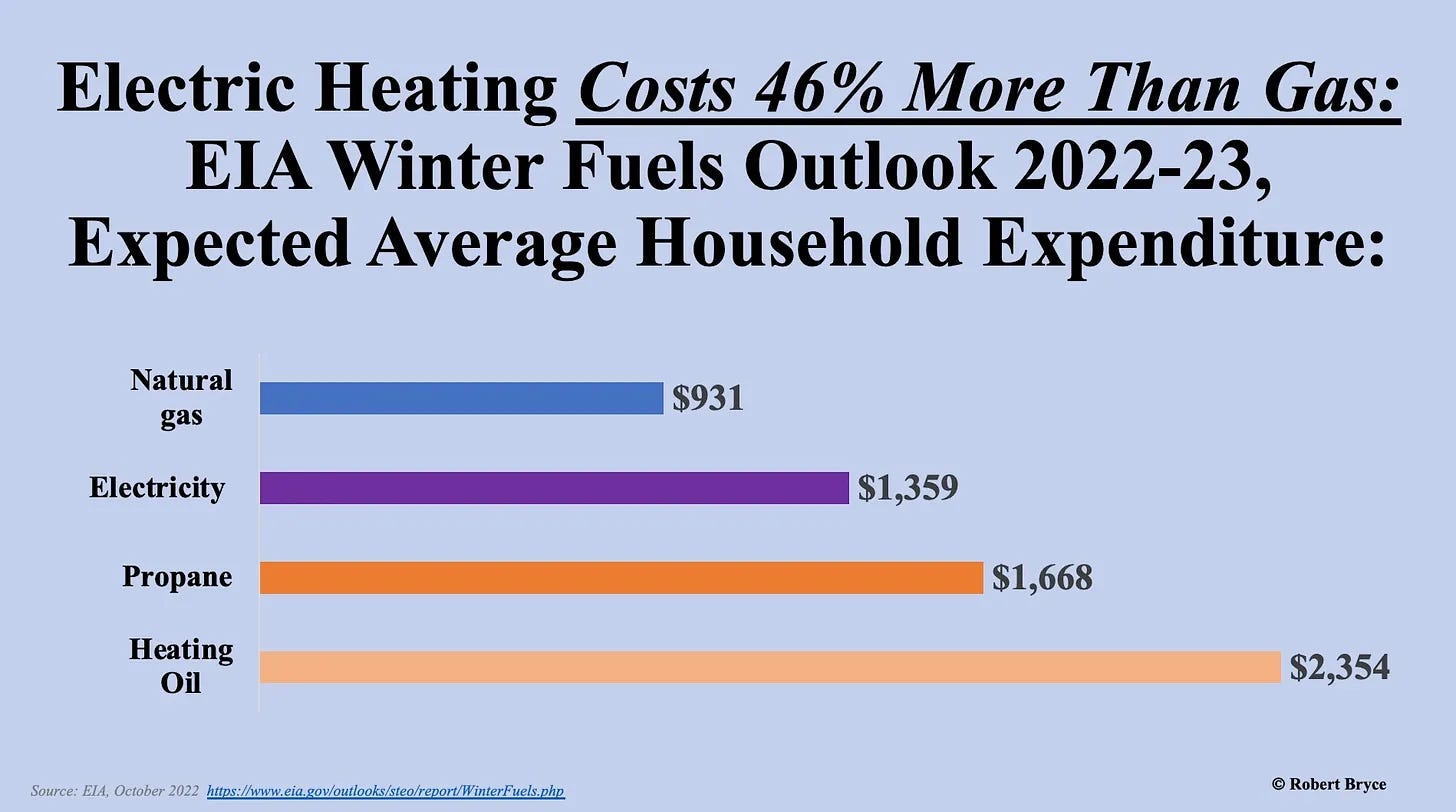
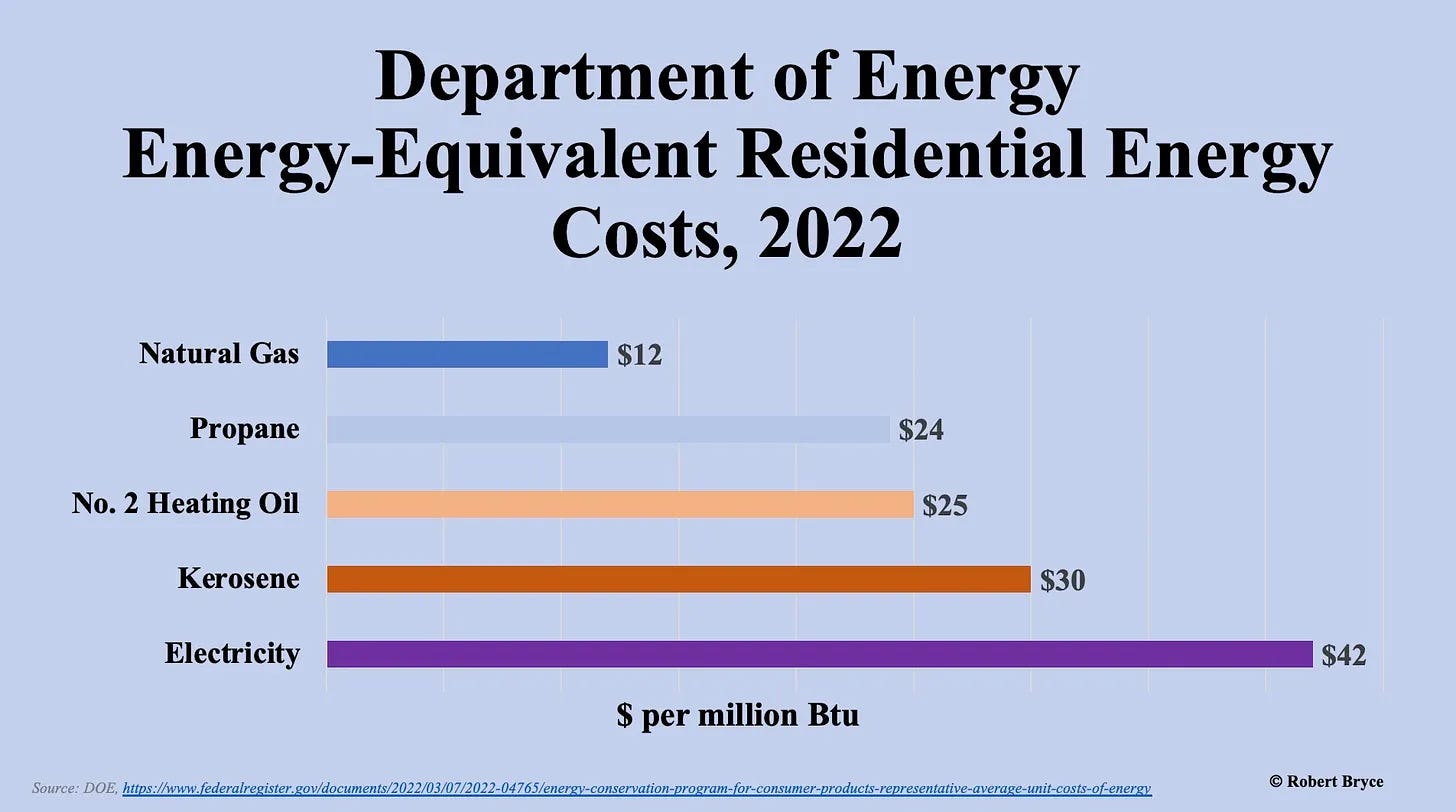
About 47 million American homes have gas stoves and lots of chefs, and consumers, including Energy Secretary Jennifer Granholm, like cooking with gas. The Department of Energy’s own numbers show that heating homes with gas is far cheaper than heating with electricity. Despite these facts, a group of lavishly funded activist groups have been pushing electrify everything mandates that would prohibit the use of gas in homes and businesses and require consumers to rely almost exclusively (including energy for electric vehicles) on our already-shaky electric grid. The electrify everything claque got a boost in January after Richard Trumka Jr., who sits on the Consumer Product Safety Commission, told a Bloomberg reporter that gas stoves are a hazard and that “any option is on the table,” including, presumably, a ban.
Trumka’s comments sparked a storm of criticism. Within hours, the White House issued a statement saying that President Joe Biden doesn’t support a ban on gas stoves.
What has since been dubbed the “gas stove culture war” was ignited in July 2019, when Berkeley became the first municipality in the country to ban the use of gas. Since then, as I explained in January, (See: “The Billionaires Behind The Gas Bans”), several NGOs, including Climate Imperative, the Sierra Club, and Rocky Mountain Institute, as well as Rewiring America, have spent untold (and undisclosed) millions of dollars campaigning and lobbying at the local and national levels to ban the direct use of natural gas in homes and businesses. And thanks to remarkably friendly (and largely unquestioning) coverage from legacy media outlets, they’ve had undeniable success.
The Sierra Club, which operates on an annual budget of about $180 million, says 74 communities in California have “adopted gas-free buildings commitments or electrification building codes.” But that number doesn’t include the most recent ban. On April 13, the Irvine City Council, again according to the Sierra Club, adopted measures mandating that all new buildings be all-electric “on or after July 1, 2023. That puts the number of California communities that have banned gas at 75. The group isn’t just pushing for restrictions in its home state. Last August, it asked the Environmental Protection Agency to ban natural gas appliances at the federal level.
In September, the California Air Resources Board voted to ban the sale of all gas-fired space heaters and water-heating appliances in the state by 2030. New York City and Seattle have banned the use of gas in new construction. Massachusetts is also rolling out a measure that will allow up to 10 communities to ban gas.
As I reported last month (See: “California Screamin’”), the Bay Area Air Quality Management District recently approved regulations that will ban the use of residential and commercial natural gas-fired water heaters and furnaces. The regulation, which only applies to new appliances, prohibits residents in the Bay Area from buying or installing gas water heaters starting in 2027. Also last month, Boston Mayor Michelle Wu, said she is working on a “climate friendly” building code that will hamper or––in the words of the Boston Globe, “discourage”––the use of hydrocarbons in new buildings in Boston.
Following the proliferation of gas bans requires following the money. The Sierra Club has been a prime beneficiary of former New York City mayor Michael Bloomberg’s Bloomberg Philanthropies, which has pledged $500 million to the Beyond Carbon project. In 2019, the pledge was considered the largest ever “philanthropic donation to combat climate change.” The Sierra Club is now getting about $30 million per year from Bloomberg.
For several years, the Rocky Mountain Institute, a group that took in $115 million in 2022, has been ginning up bogus studies that claim gas stoves are a threat to human health. And like the Sierra Club, it is getting big money from super-rich donors. In 2020, the Bezos Earth Fund gave RMI $10 million. RMI said the cash from the group, which, of course, came from Amazon founder and multi-billionaire Jeff Bezos, would help fund its “work with a coalition of partners in key states. The project will focus on making all U.S. buildings carbon-free by 2040 by advocating for all-electric new construction.”
In January, numerous national news stories were published after RMI issued a paper claiming that 12.7 percent of childhood asthmas are due to gas stoves. One of the authors of that paper, Talor Gruenwald, works at RMI. Gruenwald is also a research associate at Rewiring America, a San Francisco-based outfit that calls itself the “leading electrification nonprofit, focused on electrifying our homes, businesses, and communities.” Rewiring America is funded entirely by dark money. It doesn’t publish its budget or file a Form 990. Instead, it is a sponsored project of the Windward Fund, a 501c3 non-profit that does not disclose its donors. Nor does the Windward Fund reveal how much it is giving to Rewiring America.
The January RMI paper didn’t stand up to even modest scrutiny. The definitive analysis of indoor air pollution and gas stoves was published in 2013 in Lancet Respiratory Medicine. It studied half a million schoolchildren in 47 countries over a multi-year period and relied on questionnaires that were filled out by the mothers of the children. It concluded, “We detected no evidence of an association between the use of gas as a cooking fuel and either asthma symptoms or asthma diagnosis.”
Furthermore, just a day or two after the RMI paper came out, the group walked back its claim about asthma, with one RMI official telling the Washington Examiner that the study “does not assume or estimate a causal relationship” between childhood asthma and natural gas stoves.
The Slow Art of Whole-of-Government ‘Warfare’
By Alastair Crooke | Strategic Culture Foundation | April 17, 2023
The Washington Post tells us that President Macron’s China jaunt has created an European ‘uproar’. So it seems. Though on the face of it, his geo-strategic recommendation that Europe should keep equidistant from both the U.S. behemoth and the China colossus, is scarcely so very radical. Yet, whatever Macron’s underlying motivations, his comments seem to have touched raw nerves. He is accused of something approaching ‘betrayal’. The betrayal of America curiously – rather than a betrayal of ordinary Europeans.
Perhaps the irritation reflects our habitual love of comfort, normalcy, and a desire to ‘not rock the boat’. This normalcy bias keeps people frozen in a state of status quo, as if some inner voice intrudes to say: ‘things will be somehow ok. This will pass, and things will again be as they were. “Everything must change, for everything to remain the same”, in the famous quotation pronounced by Tancredi, Prince Fabrizio Salina’s beloved nephew in The Leopard.
On the other hand, Malcom Kyeyune, writing from Sweden, detects a more profound shift under way – an agony writhing within European Atlanticism:
“The war fever that swept Europe in the summer of 2022 made discussion impossible. Ritual denunciations of “Putinists” and even supposed Russian spies became commonplace on social media, and chest-thumping about the immense power of the West and NATO became obligatory. Again, there was a huge pressure not to notice things:
“The only acceptable position was maximalist: Suggesting that a peace deal would likely involve coming to some sort of compromise marked you out as a “Putin loyalist” and “Russian agent.”
“But once again, the fever is starting to break. Few still post about Ukraine on social media; people by and large prefer to pretend it isn’t happening. The chest-thumping has gone away, replaced with a sullen, bitter silence. People aren’t quite ready to admit that the sanctions were a failure and that the West overplayed its hand, but many know these things are true, and that the economic and political consequences of these failures are only really beginning to be felt.”
Is Macron picking up on these ‘vibes’? That is to say, the self-deception, by which we feel the illogicality of going about our daily lives with ‘darkening clouds’ looming ever closer, yet never questioning why Europe is being de-industrialised; why its industry is relocating to the U.S. or China; or why Europeans have to import Liquid Natural Gas at three or four times its going price.
Are Europeans then beginning to notice things again? Are they asking ‘how come’ the economic paradigm has been so drastically eclipsed, or ‘how come’ the fall into mad fervour for incipient wars with China and Russia?
Macron’s equidistant prescription is entirely aspirational. He gives it no substance; he gives no explanation of how strategic autonomy would be achieved, nor does he address the issue of ‘the empty stable’. There is no point in shutting the stable door now after the autonomy horse’ has long fled; It ‘fled’ with the war fever of 2022. We are therefore, where we are. Can the autonomy horse still be led home? That seems improbable.
So much of the ‘uproar’ no doubt reflects the warding-off of uncomfortable admissions, as things begin to be noticed again. Macron at least has opened the issue (however sensitive it may be); He is an outlier for the moment, but is not alone.
EU Council chief, Michel, in an interview, said: “Some European leaders wouldn’t say things the same way that Emmanuel Macron did”, adding: “I think quite a few really think like Macron.” And SPD chair in the Bundestag, Rolf Mützenich, said “Macron is right” and “we must be careful not to become party to a major conflict between the U.S. and China.”
There are multiple revolutions afoot everywhere across the globe. And Macron asks where does the EU fit in, which is fine. But he doesn’t give the answer. To be fair, though, at this point, maybe there isn’t one, for now.
Equidistant from the U.S.? Does Macron mean equidistant from specifically the Neo-con strategy of maintaining U.S. global hegemony through aggressive projections of military and sanctions power? If so, this needs to be made explicit.
For America, too, is undergoing a quiet revolution, and the Macron prescription could need nuancing in the case that the Ukraine war marks the final collapse of the Neo-cons’ short-lived ‘American Century’. There has been a noticeable tone of desperation to western MSM reportage this past week. Ever since the Intelligence leaks, it’s been doom, gloom and panic. The leaks have made uncomfortable truths unmissable (even to those who preferred not to notice) – that the vast ‘optics’ construct that is the Ukraine project is slowly coming undone.
The ‘Saving Ukraine for Democracy’ project was supposed to underwrite the legitimacy of the U.S.-led World Order. In reality, Ukraine has become the “harbinger of terminal crisis”, Kyeyune suggests.
The political path likely to be followed in America however, is far from straight-forward. It is possible though that today’s ‘Other Project’, the ‘western class war’ inversion ‘project’ may similarly collapse in the crisis (in this case) of U.S. societal schism. The Woke ‘project’ is an unlikely one – a strange neo-Marxist construct, in which an ‘oppressed class’ actually is composed of élite affirmative-action intellectuals (who lay claim to the mantle of being redeemed oppressors), whilst Americans, working in industry and in the low-paid service industry, are conversely denigrated as racist supremacist, anti-diversity, white oppressors.
China, too, is undergoing transformation: It is preparing for the war which the American ‘uniparty’ China hawks increasingly clamour. Meanwhile, its ‘political warfare’ strategy is to use geo-political mediation, underpinned by a powerful economy, as the non-intrusive means by which to pursue the Chinese operational art. This project already has re-shaped the Middle East –and its geo-strategic appeal is spanning the globe.
President Putin’s slow, long-term practice of political warfare (as opposed to China’s operational ‘art’) is clearly conceived with an understanding that the slowly-building disillusionment in the West with woke-liberalism – requires time in the chrysalis. In the Russian perspective, this Sun Tzu approach (overcoming the western paradigm, without militarily fighting it) calls for the ‘economy of military application’ within an all-of-system, holistic political ‘war’.
Russia’s is perhaps then, the more complex and more revolutionary: Embracing reform and efficiencies in all areas (cultural, economic, and political) of Russian society too.
China disavows the explicit aim to force a change of behaviour on the West, but for Russia its security is contingent on the U.S. fundamentally changing its military posture in Europe and Asia. This objective requires both patience and employing all complementary means at Russia’s command, (i.e. effectively ‘weaponising’ non-military tools such as financial ‘warfare’ and energy) to overcome the enemy – yet staying at some threshold, just short of all-out war.
The West, by contrast, conceptually separates the military from the political means, which perhaps explains why western analysts misconceive Russian ‘switching’ between military procedures to diplomatic or financial pressures as reflecting some deficiency or stumble in the Russian military machine. It is not. Sometimes the violins play; other times the cellos. And sometimes it is the moment for the big bass drums to sound; It is up to the conductor.
Julian Macfarlane has commented that Russia has started a veritable ‘revolution’, with China now joining in. To make his point, Macfarlane adapts Thomas Jefferson’s “we hold these truths to be self-evident …” speech and glosses it to say “… that all States are equally entitled to sovereignty, undivided security and full respect”. He contextualises this in terms of a Jefferson focus on the tyranny of the British Crown, whereas Putin formulates his multi-polar order doctrine, as versus U.S. hegemonic ‘Rules’ tyranny.
Xi Jinping says it straight: “All countries, irrespective of size, strength and wealth, are equal. The right of the people to independently chose their development paths should be respected, interference in the affairs of other countries opposed – and international fairness and justice maintained. Only the wearer of the shoes knows if they fit or not”.
It is a doctrine winning support across the globe. The EU would be unwise to discount its appeal.
So, back to Macron and the equidistant concept for European Union ‘strategic autonomy’: It is hard to see what space might comprise a median ground between homogenous, ‘Rules Hegemony’ and the Sino-Russian declaration of heterogenic ‘National Rights’. It will have to be one or the other (with perhaps a little ‘betweenness’ just possible, should the U.S. drop its “with us; or against us” dogma).
Equally, Macron warns the EU against the extra-territorial reach of the U.S. dollar (and therefore of sanctions and Third Country sanctions).
Yet, the EU cannot escape the U.S. dollar. The Euro is its’ derivative.
Europe has little autonomous defence manufacturing infrastructure. NATO is the political, as well as the military, framework in which the EU operates. How does it escape from a NATO framework that is so closely meshed in with the EU political one?
The EU is deeply divided on its future path: Macron wants more strategic autonomy for Europe (and Charles Michel says this is supported by not a few member-states), whereas Poland, the Baltic States and certain others want more America and more NATO and a continuing war to destroy Russia. Poland has proved to be a vociferous critic of Western Europe’s perceived softness toward the Kremlin.
Indeed, the war in Ukraine has ushered in a kind of geopolitical shift in Europe, Ishaan Tharoor writes, moving “NATO’s centre of gravity” – as Chels Michta, a U.S. military intelligence officer, recently put it – away from its traditional anchors in France and Germany, and eastward to countries such as Poland, its Baltic neighbours and other former Soviet Republics. In Central and Eastern Europe, wrote Le Monde columnist Sylvie Kauffmann, “the weight of history is stronger … than in the West, the traumas are fresher and the return of tragedy is felt more keenly”.
The EU is deeply divided on structure as well: Warsaw, nervous about a general election due this autumn, is encouraging anti-German paranoia. Its propaganda suggests that Polish opposition politicians are secret agents in a German plot to take control of the EU, and to force degenerate western permissiveness on heterosexual Catholic Poland – a ‘bastion of western Christian civilisation’ – unlike Brussels, which is viewed as a as a “Germanised” conspiracy to overrule the right of independent nations to make their own laws.
Jarosaw Kaczyski, leader of the PiS party, plays with an alternative future for Europe. This would be a Europe des patries, almost on de Gaulle’s model: an alliance of fully sovereign nation states, within NATO but independent of Brussels, which would include post-Brexit Britain, rather than just the EU’s present members. (No EU Third ‘Empire’ there).
In a major speech, the Polish Prime Minister has emphasised that now is the moment to shake up the status quo further West and dissuade those in Brussels who would “create a super-state government by a narrow elite. In Europe nothing can safeguard the nations, their culture, their social, economic, political and military security better than nation states”, Morawiecki said. “Other systems are illusory or utopian”.
Elections are due this autumn in Poland, and polls suggest that the outcome will be close.
It seems that Macron has opened a veritable can of worms. Possibly, this was his intent; or maybe he just didn’t care – his objective being primarily domestic: i.e. to shape a new image in the context of a changing, and turbulent, French electoral landscape.
But in any event, the EU is caught in the midst of a maelstrom of geopolitical change at a moment when it faces the possibility of a banking crisis, high inflation and economic contraction. Simple survival may become more pressing than addressing Macron’s speculative musings about the EU becoming a Third Force.
Czechs rally against ‘warmonger’ government
RT | April 17, 2023
Thousands protested in downtown Prague on Sunday, arguing that the Czech government is devoting too many resources to helping Ukraine fight Russia rather than tackling the energy crisis and high inflation at home. Many are calling on Prime Minister Petr Fiala to resign.
The ‘Czechia Against Poverty’ rally was spearheaded by the opposition party Law, Respect, Expertise (PRO 2022). Protesters gathered at Wenceslas Square, condemning what one called “the lying government” and carrying banners that said “No to war” and “Get out of NATO.”
Addressing the crowd, Jaroslav Foldyna, an MP from the Freedom and Direct Democracy party, said that “the government needs to go before it destroys the country.”
A protester named Renata Urbanova told AFP that the government is “full of warmongers” who “are making us suffer economically.”
A group of people with Ukrainian flags rallied in support of Kiev in the center of the capital at around the same time. Members of opposing camps shouted at each other, but were ultimately separated by police.
A similar anti-government demonstration was held last month. More than a dozen people were arrested and scuffles with police broke out at that event.
The monthly cost of living has increased for most Czechs and up to 70% of households were forced to resort to austerity measures, according to a survey released by pollster Median in January.
At the same time, Prague has supplied heavy weapons to Ukraine, including 89 tanks, and has backed economic sanctions imposed on Russia by the EU. More than 460,000 Ukrainian refugees arrived in the Czech Republic after February 2022, and around 300,000 of them are still in the country, according to Euronews.
Last year, the Czech parliament adopted a law aimed at providing assistance to refugees, which was recently extended until April 2024.
EU in crisis: Eurosceptism persists in Italy, Greece, France, and Poland
By Ahmed Adel | April 17, 2023
Although Euroscepticism has existed since the inception of the European Union, the UK’s departure from the bloc in 2020, the only sovereign country to have left, demonstrated to other member states that it is possible to leave. Many member states are frustrated by forced immigration quotas, scandals such as Qatargate, and a lack of strategic depth by the bloc as it prioritises the interests of the US instead of Europe. Seemingly, it appears that Italy, Greece, Poland, and France are the most Eurosceptic countries.
This lack of strategic depth led to the decline of European economies because sanctions against Russia have been self-sabotaging. When paired with the aforementioned scandals and migration issues, as well as the loss of legislative control, it is understandable why Eurosceptism persists across the bloc.
According to OddsChecker, an online bookie comparison site, Italy was ranked as the country which is most likely to leave the EU,” specifically with odds of 3/1 or 33 percent. It is recalled that in the September 2022 election, the former president of the European Central Bank (ECB), Mario Draghi, was ousted from power by the right-wing populist Brothers of Italy party. In the same manner, Italian Prime Minister Giorgia Meloni had previously condemned the hostility by Brussels against the UK’s decision to leave the EU, describing its actions as an effort to “humiliate the British people who have freely chosen Brexit.”
The next likely country after Italy is Greece, with odds of 6/1 or 16.67 percent. Although Eurosceptism has always been prominent in Greece, it especially accelerated during the sovereign debt crisis, with discussions of a possible “Grexit” entering the mainstream.
Eurosceptic party SYRIZA lost power to the liberal-conservative New Democracy party in 2019, but Greeks are returning to the polls this May. Although it is expected the ruling party will maintain power, the gap between the two parties has now narrowed from ten to five percent over the past year as Greeks are angered by having to pay the most expensive energy bills in Europe and in their majority are against weapon transfers to the Ukrainian military.
Poland comes in third place, with odds of 7/1 or 14.3 percent. President Andrzej Duda, of the ring-wing Law and Justice (PiS) party, has been continuously criticised for limiting freedom of expression and LGBTQ+ rights. However, since Poland positioned itself as a regional player in the context of the war in Ukraine, much of the criticism from Brussels has alleviated.
None-the-less, although Brussels might have quietened its criticisms of Poland, there is still a high degree of eurosceptism within Polish society, something which will grow as the negative effects of the war in Ukraine are crippling the country, resulting in war weariness.
War weariness has set in so much so that Poland, and neighbouring Hungary, took unilateral action to ban grain and other food imports from Ukraine. This is to protect their local agricultural sector, something which still received the wrath of the EU.
“In this context, it is important to underline that trade policy is of EU exclusive competence and, therefore, unilateral actions are not acceptable. In such challenging times, it is crucial to coordinate and align all decisions within the EU,” said a spokesperson of the European Commission.
Poland’s ruling nationalist PiS party are seeking re-election in the 2023 parliamentary election, and people in rural areas, where support for PiS is usually high, are angered about large quantities of Ukrainian grain, which is cheaper than that produced in the European Union, staying in Central Europe due to logistical problems, thus making prices and sales for local farmer’s plummet.
Meanwhile, the fourth most likely country to leave the EU is France, with a 12.5% chance. French President Emmanuel Macron, another liberal like his Greek counterpart Kyriakos Mitsotakis, has been facing endless largescale protests against pension reform. Protestors have sworn to not stop until Macron backtracks on his plans.
At the same time, the French President was branded a “madman” and accused of insisting on a “political coup de force” by Boris Vallaud, leader of the PS deputies in the National Assembly.
When speaking about Macron, Vallaud told LCI and Le Figaro : “When you discredit social dialogue, when you step on the social partners (…), when you do not respect the parliamentary institution, when you brutalise it (…), when in the street you have people demonstrating by the hundreds of thousands, by the millions, yes, it is a democratic coup because you are diminishing democracy.”
What makes eurosceptism all the more interesting is that it spans across different political ideologies, with only liberals in support of the failed European project. In the case of France, it is mostly comprised by anti-Macron elements, whilst in Greece it is represented mostly by SYRIZA, a radical Left party. This is contrasted by Italy and Poland, where right-wing politics prevails.
With Brussels failing to deal with migration issues in Italy, Greeks having a general tendency to be Russophile, Poland being lambasted for not implementing liberal policies, and the French having a desire to be an independent country in the vision of Charles de Gaulle, Eurosceptism is not only a persistent issue, but one that will continue to deepen.
Ahmed Adel is a Cairo-based geopolitics and political economy researcher.
DR-Congo’s Audit & Attempted Renegotiation Of A Chinese Mining Deal Is A Major Move
BY ANDREW KORYBKO | APRIL 17, 2023
Quartz published a concise report earlier this month about the Democratic Republic of the Congo’s (DRC) audit of a Chinese mining deal from the early aughts and attempts to renegotiate its terms more in Kinshasa’s favor. President Tshisekedi claims that his predecessor Kabila agreed to a massively lopsided arrangement, which he claims Beijing hasn’t even perfectly honored. Accordingly, he wants it to pay more taxes as well as invest more in the DRC’s infrastructure like was initially agreed.
This is a major move for several reasons, the first being that the lion’s share of the world’s cobalt reserves (70%) that are indispensable for the green revolution and modern-day technological devices is located in the DRC, almost all of which (80%) is exported to China according to Quartz’s report. Second, China’s positive reputation across Africa is largely based on the perception that it’s a reliable infrastructure investment partner, but the DRC’s latest claims challenge that notion.
The third and fourth reasons why everyone should pay attention to this concern the potential outcome of their planned negotiations. If they successfully agree to new terms, then this could inspire copycat efforts– including those on false pretexts – for pressuring China into revising the terms of other deals elsewhere. Should they fail to agree to new terms, however, then Kinshasa could potentially demand that Beijing sell back its earlier purchased shares in the DRC’s state-run mining firm.
The final reason why all of this is so important is because either outcome could set a precedent that complicates China’s Belt & Road Initiative (BRI) deals across the Global South that have already been under intense scrutiny since the US declared its trade war against the People’s Republic in 2018. While it’s true that some of the unsavory reports and related investigations into those deals were baseless provocations by the US’ intelligence services, others nevertheless have some substance to them.
This means that they should each be approached on a case-by-case basis exactly as the DRC-Chinese one presently is since it’s inaccurate to paint the scrutiny into every deal with the same brush by either dismissing it all as a foreign intelligence provocation or assuming that every criticism is valid. The outcome of this latest audit and attempted renegotiation might set a standard across the Global South in terms of reshaping perceptions about China for better or for worse depending on the ultimate result.
On the one hand, agreeing to renegotiate the deal’s terms would show flexibility on China’s part and thus counteract the weaponized narrative that it’s laid a series of so-called “debt traps” for its partners through BRI. That said, the cumulative effect of potentially setting into motion a series of seemingly never-ending renegotiations on other deals elsewhere could reduce the profitability of its BRI projects, prolong the time that it takes to recoup its investments, and thus imperil this model in the long run.
On the other hand, however, refusing to renegotiate the deal’s terms would feed into the aforesaid weaponized narrative and risk setting the precedent for Kinshasa to demand that Beijing sell back its earlier purchased shares. Instead of setting into motion a series of seemingly never-ending renegotiations on other deals elsewhere, this could catalyze the process whereby BRI states – irrespective of US influence – consider reappropriating Chinese assets just like the DRC might do.
Both outcomes could have outsized consequences for BRI, but the first-mentioned related to successfully renegotiating the DRC-Chinese deal is preferred when all the risks are considered since it would counteract weaponized narratives while also keeping the BRI model alive for the time being. The second scenario could quickly deal immense strategic damage to Chinese interests, especially if US intelligence weaponizes that process, hence why all efforts should be made to avoid it.
It remains to be seen what will happen, but there’s no question that the DRC’s audit and attempted renegotiation of its mining deal with China is a major move that could have far-reaching economic-strategic reverberations in the New Cold War, particularly with respect to its African front. Observers should closely monitor this process for that reason and remain especially alert for any signs of foreign forces like the US’ intelligence agencies and/or media attempting to influence the outcome.
Yellen: US Dollar Global Hegemony Could Be Undermined by Western Sanctions
By Andrei Dergalin | Sputnik | April 16, 2023
More than a year after the United States and its allies imposed numerous economic sanctions against Russia over the escalation of the conflict in Ukraine, US Secretary of the Treasury Janet Yellen has stated the obvious: the sanctions may threaten the hegemony of the US dollar, the world’s reserve currency.
“There is a risk when we use financial sanctions that are linked to the role of the dollar that over time it could undermine the hegemony of the dollar,” she said during an interview with a US media outlet.
Yellen, however, claimed that the US dollar is “used as a global currency for reasons that are not easy for other countries to find an alternative with the same properties.”
She went on to boast that, other than the United States, there is no other country in the world that has the basic “institutional infrastructure that would enable its currency to serve the world” like the US dollar, and that sanctions are still an “extremely important tool.”
When asked during the interview whether Russian assets in the US, which were frozen in the wake of the launch of Russia’s special military operation in Ukraine in February 2022, might be appropriated to be used for Ukrainian reconstruction, Yellen claimed that Moscow “should pay for the damages” it has allegedly inflicted upon Ukraine.
She admitted, though, that there are “legal constraints on what we can do with frozen Russian assets, and we’re discussing with our partners what might lie in the future.”
China releases position paper on Afghan issue to help reconstruction
Regional countries expect China to play a more active role: expert
By Liu Xin and Ding Yazhi – Global Times – April 12, 2023
China released an 11-point paper to fully elaborate its position on the Afghan issue and express firm support for the reconstruction of the war-torn country on Wednesday – the same day as Chinese State Councilor and Foreign Minister Qin Gang started a two-day visit to Uzbekistan where he will also attend the fourth Foreign Ministers’ Meeting among the Neighboring Countries of Afghanistan in Samarkand.
Analysts noted that China is taking concrete measures to push further coordination on the Afghan issue and together with regional countries to help with Afghanistan’s reconstruction and revitalization.
The paper, titled “China’s Position on the Afghan Issue,” lists China’s adherence to the “Three respects” and “Three nevers,” as the first point. These are respect for Afghanistan’s independence, sovereignty and territorial integrity, to respect the independent choices made by the Afghan people, and to respect the religious beliefs and national customs of Afghanistan. China never interferes in Afghanistan’s internal affairs, never seeks selfish interests in Afghanistan and never pursues so-called sphere of influence.
Afghanistan is in a crucial period of moving from turbulence to stabilization. To fully outline China’s policy and propositions in a systematic way and build consensus and synergy among countries in the region and elsewhere on stabilizing and helping Afghanistan, the foreign ministry released China’s Position on the Afghan Issue, Chinese Foreign Ministry spokesperson Wang Wenbin said at a press conference on Wednesday.
Wang noted that the fourth Foreign Ministers’ Meeting among the Neighboring Countries of Afghanistan will be held in Samarkand on Thursday and China is willing to work with neighboring countries to help Afghan to walk on the path for stable development and to realize regional peace and prosperity.
State Councilor and Foreign Minister Qin will attend the fourth Foreign Ministers’ Meeting among the Neighboring Countries of Afghanistan in Samarkand, Uzbekistan and visit Uzbekistan from Wednesday to Thursday, according to information from the Foreign Ministry.
Observers said that the paper on the Afghan issue came on the heels of a 12-point positon paper on Ukraine crisis which was released in February, also highlighting China’s consistent stance in seeking and making peaceful solutions for heated geopolitical issues.
Qin will meet with the President of Uzbekistan Shavkat Mirziyoyev and hold talks with Acting Foreign Minister Bakhtiyor Saidov. They will exchange views on bilateral relations, high-level exchanges between the two sides and international and regional issues of shared interest, according to Foreign Ministry.
Qin’s visit will further deepen mutually beneficial cooperation and bilateral relations with Uzbekistan and Central Asian countries to inject stability in the region amid global spillover effects of the Ukraine crisis, analysts said.
The Wednesday paper which collectively and thoroughly elaborates China’s stance on the Afghan issue will help coordinate neighboring countries’ stance and push a different way from the West and the US in solving conflicts within Afghanistan through political dialogue, Zhu Yongbiao, director of the Center for Afghanistan Studies at Lanzhou University, told the Global Times on Wednesday.
The international community, especially regional countries, expect China to play a more active role on the Afghan issue given its selfless assistance to Afghanistan people, Zhu noted.
The third Foreign Ministers’ Meeting among the Neighboring Countries of Afghanistan was held in Tunxi, East China’s Anhui Province in 2022 and foreign ministers or high-level representatives from China, Iran, Pakistan, Russia, Tajikistan, Turkmenistan, and Uzbekistan drafted a joint statement and an initiative in pooling resources and coordinating to increase their support for Afghanistan, analysts said.
The paper released on Wednesday showcases China’s efforts in promoting mechanism of the foreign ministers of Afghanistan neighboring countries a step forward to bring more light to Afghanistan reconstruction, Hu Shisheng, director of the Institute for South Asian Studies at the China Institutes of Contemporary International Relations, told the Global Times.
Hu noted that currently, Afghanistan is facing new historical changes – after the withdrawal of the US and Western troops, the country has seen no proxy wars and more autonomy.
However, the situation is fragile and can be reversed at any time. And the sanctions imposed by the US and the West are squashing Afghanistan’s chances of future development. While China and regional countries are working to help Afghanistan regain the capability to revitalize itself, the US and Western countries should also take their due responsibility, said Hu.
The Wednesday paper urged the US to live up to its commitments and responsibilities to Afghanistan and noted that “by seizing Afghanistan’s overseas assets and imposing unilateral sanctions, the US, which created the Afghan issue in the first place, is the biggest external factor that hinders substantive improvement in the humanitarian situation in Afghanistan.”
Zhu noted that more efforts from the international community are required given the current problems in Afghanistan, including the Afghan Taliban interim government’s ban on women’s access to education, domestic and regional measures on countering terrorism and Afghanistan’s fight against narcotics.
All these topics will be discussed on Thursday during State Councilor and Foreign Minister Qin and other foreign ministers’ meeting from neighboring countries, said Zhu, noting that a stable Afghanistan not only fits the interests of Afghanistan people but will also contribute to regional stability, creating favorable conditions for countries in the region to seek better development.
Featured Video

ARE PATIENTS BEING PROPERLY INFORMED ABOUT OZEMPIC?
or go to
Aletho News Archives – Video-Images
New Book
Breast Cancer: Before You Consent
A new Unbekoming paperback
Lies are Unbekoming | September 18, 2026
Peter Gøtzsche reviewed every randomised mammography screening trial ever conducted for the Cochrane Collaboration. Cochrane’s headline is that, assuming a 15% mortality reduction, one woman in 2000 avoids dying of breast cancer over ten years. Ten are overdiagnosed and treated. Two hundred experience false alarms.
But that headline assumes the reduction. When Gøtzsche looked only at the trials with adequate randomisation — the higher-quality ones — the reduction disappeared. No effect on breast cancer mortality. No effect on all-cause mortality.
This is the Cochrane finding, published in the establishment’s own database of systematic reviews.
No woman being asked to consent to a mammogram this week knows it.
That is why the new Unbekoming paperback exists. … continue
Blog Roll
 Aletho News
- The Truth About the Trump Shootings with Ken Silva
- ARE PATIENTS BEING PROPERLY INFORMED ABOUT OZEMPIC?
- US lawmaker blocks $2.8 billion weapons sale to Israel: Report
- Yemeni army claims responsibility for strikes on sensitive sites in Saudi capital, Aramco facilities in Yanbu
- Iran Judiciary issues indictments against 159 US, Israeli officials for assassination of Leader, commanders
- Turkiye revokes Iranian bank license under US sanctions campaign
- US-Denmark Agreement on Greenland Is ‘PR Stunt’ Ahead of Midterms
- Araghchi: Military intervention cannot create security; coercion cannot bring peace
- Fraud Squared
- Breast Cancer: Before You Consent
- If Americans Knew
- Inside Gaza’s death trap of collapsing, bombed-out buildings
- The everyday items Israel bans from Gaza every day
- Inside the siege, the ruined buildings of Gaza – Daily Update
- Debunking The Claim That Macklemore Has A “History Of Antisemitism”
- CPJ demands release of arrested Palestinian-US journalist near Bethlehem
- Robert Kraft: The Billionaire Friend of Netanyahu Pulling The Strings Behind the Macklemore/Ed Sheeran Blow Up
- Columbia Administered Fund Gives Big Money to Pro-Israel Groups
- Deportation Case of Palestinian Activist Salah Sarsour Tests First Amendment
- ‘We Will Not Forget’: Palestinians Mark 44 Years since Sabra and Shatila
- Why do we let Zionists decide what we can and can’t say?
- No Tricks Zone
- New Study: ‘Global Drought Shows No Detectable Recent Acceleration Under Climate Warming’
- Economic Masterminds: German Socialists Suggest Taxing Productivity Gains Stemming From Using AI
- The South China Sea Has Not Been Cooperating With The Climate Change Narrative
- Energy Crisis: Germany Enters Heating Season With Historically Low Gas Reserve Fill Levels
- New Study: The Antarctic Ice Sheet Gained Mass From 2020-2024 Due To Staggering Snow And Ice Accumulation
- Study: Ocean Heating Rates From Thousands Of Years Ago ‘Dwarf’ Modern Ocean Heating Rates
- Climate Extremists Target, Attack Large-Scale Power Grid Infrastructure In Germany!
- New Study: Antarctic Ice Melt Has Contributed Less Than 1 Centimeter To Sea Level Rise In The Last 30 Years
- Fear Of Debate: Alarmist German Climate Scientist Calls On Mainstream Media To Discredit Skeptic Voices
- End-Of-August Arctic Sea Ice Extent Hasn’t Fallen In 20 Years, Official Data Show!
 Aletho News