Ideological green policies are tearing Germany’s economy apart
In an interview, Prof. Kurt Lauk, former economic council head and automobile manager, warns half of Germans “will no longer be able to afford a car.” Socially explosive…”a disgrace”.
He also warns of a rapid demolition of Germany’s economic backbone: the automotive industry.
“It is a disgrace what is sitting in the chair of Ludwig Erhard or Graf Lambsdorff. The hostility to technology coming from the Ministry of Economics is unbearable. Everywhere where we are or were world market leaders, we have gone about abolishing it,” Lauk said in an interview . It is the “worst thing that could happen” for German industry.
“For several years now, we have been working hard to destroy this competitive advantage of German industry or to hand it over to other nations. We now have ‘economic heads’ sitting in the Ministry of Economics who have no other professional qualifications,” Lauk added.
Lauk says Germany’s technological advantages are now in jeopardy because the backbone of Germany’s economy and driver of innovation is the country’s automotive industry. “This is where most of the jobs are.”
150 years of technological experience “thrown away”
“The technological advantage of German carmakers through 150 years of experience with the combustion engine, transmissions etc. is being recklessly abandoned, Lauk said. “We are throwing away our competitive advantage and adopting the ‘Chinese drive’. Because 80 per cent of the battery drives come from China. That means China has driven us up against the wall in a strategic situation. And with our naivety, we didn’t realize what was happening.”
Unaffordable for the bottom 50%
Lauk warns that because of e-cars being considerably more expensive than conventional combustion engine vehicles: “The bottom fifty percent of the income pyramid will no longer be able to find a vehicle for less than 40,000 euros.” and thus this group will see significantly restricted mobility.
Tinder dry social powder keg of the haves and have nots
“Today you can get a cheap, suitable vehicle for 15,000, 18,000 or 20,000 euros. That will no longer be the case. We are running into a huge social conflict with this idiotic, singular policy to drive with electric batteries.”
April 15, 2023
Posted by aletho |
Economics, Malthusian Ideology, Phony Scarcity | Germany |
Leave a comment
Buy How is This a Thing Mugs here: https://teespring.com/stores/computing-forever-store
Support my work on Subscribe Star: https://www.subscribestar.com/dave-cullen
Support my work via crypto: https://computingforever.com/donate/
Follow me on Bitchute: https://www.bitchute.com/channel/hybM74uIHJKg/
Source video: Living in This Pod Will Cost You $1,000 a Month: https://www.youtube.com/watch?v=WXB5ivW6PbE
A 3D animated short film about not too distant but a dystopian future. It speculates on the potential consequences of the infamous Great Reset, medical tyranny, woke culture, and green agenda. Everything, that World Economic Forum (WEF) is planning for us. If you’d like to buy me a beer, here is my PayPal address: oleg@3depix.com
Spoiler: you will get to see an animated Klaus Schwab.
My Rumble channel: https://rumble.com/c/c-750647
If you’d like to support my work, you can become my Patron at https://patreon.com/3depix
All Rights Reserved 3D Epix 2023 ©
April 13, 2023
Posted by aletho |
Economics, Malthusian Ideology, Phony Scarcity, Video | California, United States |
Leave a comment
While we were being distracted by the ongoing Russia/Ukraine war – and Washington’s increasing involvement in the war – tremendous developments in the Middle East have all but ended decades of US meddling in the region. Peace is breaking out in the Middle East and Washington is not at all happy about it!
Take, for example, the recent mending of relations between Saudi Arabia and formerly bitter adversaries Iran and Syria. A China-brokered deal between the Saudis and Iran has them re-establishing full diplomatic relations, with the foreign ministers of both countries meeting in Beijing last week. It is the highest level meeting between the two countries in seven years.
Additionally, Riyadh is expected to invite Syria back into the Arab League and Syrian president Assad may attend the next Arab League summit. Syria was suspended from the Arab League 12 years ago when then-US allies in the Middle East signed on to Washington’s “Assad must go” policy that wreaked havoc across the region.
And the nearly decade-long war in Yemen, which has devastated that population, appears to finally be ending, as Saudi Arabia is expected to announce an end to its US-backed war on that country. Troops from the United Arab Emirates are leaving Yemen and a Saudi delegation is arriving to negotiate a peace deal.
To normal people the idea of peace breaking out in the Middle East is a wonderful thing. But Washington is anything but normal. President Biden dispatched his CIA Director, William Burns, to Saudi Arabia in a surprise visit last week. According to press reports, Burns was sent to express Washington’s surprise and frustration over the peace deals going through. Biden’s foreign policy team “has felt blindsided” by Saudi Arabia’s sudden move to get along with its neighbors.
Washington is angry that Saudi Arabia will start trading with Syria and Iran because those two countries are still under “crippling” US sanctions. One by one, as these countries begin ignoring US-demanded sanctions, the entirety of US foreign policy is being exposed as a paper tiger – just bluster and threats.
Middle East developments have revealed a dirty secret about US foreign policy. Washington has for a long time used a “divide and conquer” strategy to keep countries in the Middle East – and elsewhere – at each other’s throats. Sanctions, covert operations, and color revolutions have all been used to make sure that these countries do not get along with each other and that DC controls who runs the show.
As unlikely as it may seem to some, China has moved into the region with a different policy. China seeks business partners, not to manipulate the internal politics of the Middle East. They may be ruthless in their own way, but it is suddenly clear that the countries of this region are tired of US meddling and are looking for new partners.
We non-interventionists are often attacked as “isolationists,” but as I have always said, it is the neocons and interventionists in Washington who are really isolating us from the rest of the world. Nowhere is that more evident these days in the Middle East. It didn’t have to be this way, but if this is the end of US meddling in Middle East affairs then ultimately it is a good thing for the American people… and for peace.
April 11, 2023
Posted by aletho |
Economics, Timeless or most popular | China, Middle East, United States |
Leave a comment
Many in the Alt-Media Community (AMC) dismissed the importance of French President Macron and European Commissioner Von Der Leyen’s trip to China, implying that President Xi wasted his precious time meeting with them over several days all for nothing. In truth, their trip actually served a pragmatic purpose in that it allowed each party to speak candidly about their concerns at this pivotal moment in the global systemic transition, hence why all sides made the time to meet with one another in Beijing.
While it’s true that the two European representatives wishfully hoped that they’d sway their Chinese counterpart around to seeing the NATO-Russian proxy war in Ukraine the same way that they do, that wasn’t the primary reason why everyone took the time out of their busy schedules last week. What really brought them all together in Beijing was the impending inflection point that’s quickly approaching in that aforementioned conflict.
Kiev’s upcoming counteroffensive will be a make-or-break moment. On the one hand, it could wildly succeed in pushing Russia back to its pre-2014 borders, in which scenario China could then feel compelled to arm Moscow as a last resort in order to preemptively avert the possibility of it losing. That would in turn prompt the US to pressure the EU into sanctioning the People’s Republic, thus spiking the chances that they’ll swiftly decouple, which would harm both of their interests while advancing the US’.
On the other hand, however, Kiev’s counteroffensive might not ultimately achieve all that much as evidenced by the Washington Post’s report a month back about how poorly its troops are faring. In that scenario, Russia could either flip the momentum to make a major breakthrough across the Line of Contact and beyond or seriously encourage Kiev to agree to a ceasefire. The last-mentioned possibility would certainly be supported by China and most likely France now too.
Considering the grand strategic stakes connected to the outcome of Kiev’s upcoming counteroffensive, which will probably lead either to a Chinese-EU decoupling per the first scenario or China and France jointly mediating a ceasefire per the second, it made sense why they’d all meet ahead of time. The real drivers of events are the US, its Polish-led Central European partners (which includes the Baltic States), and their proxies in Kiev, whose success or lack thereof will shape the future of Chinese-EU ties.
It doesn’t have to be this way, of course, but the fact of the matter is that the EU is unlikely to be able to effectively resist the US’ sanctions pressure in the event that China feels compelled into arming Russia as a last resort as was earlier explained. They know how painful it would be for their already struggling economies, especially since this dramatic scenario could push them over the edge into a full-fledged recession, but that’s precisely why two of their top representatives wanted to speak to President Xi.
He wanted to speak to them too in order to clarify that China hasn’t yet armed Russia but perhaps also explain why it might feel compelled to do so in the hypothetical sense without directly confirming this contingency plan due to how sensitive it is. Simply put, the EU wanted to know what would have to happen for China to cross Brussels’ “red line” by arming Russia, while China wanted to know whether the EU would be willing to cross Beijing’s “red line” in that scenario by sanctioning it in response.
Both sides also wanted to explore just how far the other would go if they felt compelled by circumstances or pressured by the US respectively, ergo another reason why they all felt it important enough to take the time out of their busy schedules to meet over the past few days. If the whole purpose was just for the European representatives to spew propaganda to President Xi aimed at swaying him to their side in the NATO-Russian proxy war, then the trip wouldn’t have taken place.
The AMC’s top influencers were therefore far off the mark in assessing the purpose of last week’s visit, which failed to account for the pragmatic reason why all three parties prioritized meeting at this specific time. It was important for them to speak candidly about how they’ll react to the two most likely forthcoming scenarios to emerge from Kiev’s upcoming counteroffensive, which will result in them either decoupling under US pressure or working together to broker a ceasefire.
In the interim between their meeting and whichever of those two trajectories their ties are pushed along, all sides at least had something tangible to show with respect to the statements released by Macron and Von Der Leyen after their respective meetings with President Xi. Russia’s TASS drew attention to three highlights from the former concerning their support for a UN-enshrined multipolar world order, peace in Ukraine based on international law, and overlap on many other issues.
While cynics might claim that these statements have more symbolism to them than substance, they’re at least something that all parties can build upon in the scenario that China doesn’t feel compelled to arm Russia as a last resort or the EU largely resists the US’ pressure to sanction it if that happens. In any case, President Xi wouldn’t waste his valuable time staging a multi-day photo-op just for the sake of releasing several perfunctory statements so it should be taken for granted that China’s intent is sincere.
This insight further discredits the AMC’s over-simplistic conclusion that the whole trip was a gigantic waste of everyone’s time and failed to achieve anything worth the three parties’ while. It might not result in avoiding the worst-case sequence of events that was earlier described regarding their accelerated decoupling under US pressure, but the intent was to candidly discuss the future of their ties in that context in an attempt to mitigate the mutually disadvantageous consequences if that unfolds.
April 8, 2023
Posted by aletho |
Economics | China, European Union, France, Ukraine, United States |
Leave a comment
French President Emmanuel Macron has wrapped up a three-day visit to China, accompanied partly by European Commission Chief Ursula von der Leyen, who went home a day earlier.
The dual visit came at a time when EU nations, worried about a growing Sino-Russian partnership, are looking for ways to strengthen their own diplomatic engagement with Beijing.
Von der Leyen’s presence on the trip was widely seen as a “check” on Macron, there to ensure he complied with “European unity” on the matter of the EU’s relationship with China. Before the visit, she gave a hawkish address warning China against supporting Russia in the Ukraine conflict and slamming Beijing for becoming “more repressive at home and more assertive abroad.”
While she urged the bloc to reduce “dependencies” on China, she also opposed full “decoupling” of economies, as called for by the US. Enduring trade relations were made abundantly clear by the fact that Macron was accompanied by a 50-strong delegation of business leaders who came to Beijing to sign deals.
It is unusual that Macron, an advocate of the EU’s so-called “strategic autonomy” in negotiating with other actors on the world stage, and von der Leyen, an ardent atlanticist who is reportedly in the wings to be the next NATO secretary general, were both in China together.
Despite their somewhat conflicting agendas, their visit was a net positive for Beijing and a net negative for US attempts to force the EU to fully take its side in its own geopolitical crusade against Beijing. The US looks upon all attempts by the EU to engage with China with disdain, and does its best to undermine it where possible.
Likewise, when it comes to the Ukraine conflict, China’s effort to open talks by presenting its 12-step peace plan was immediately dismissed by Washington, with US Secretary of State Antony Blinken accusing Beijing of providing “diplomatic cover” for what he called Russia’s attempts to “freeze the war.” However, Xi Jinping’s recent visit to Moscow has apparently shown EU leaders, who would prefer the war to end rather than drag on indefinitely, the potential consequences of “losing China” – and now Macron is urging Xi to mediate a return to the negotiating table by “bringing Russia to its senses.”
In other words, many EU leaders, bar the overzealous and fanatical ones in states such as Lithuania, now realize that they must pursue a diplomatic effort to “keep China on board,” which in turn illustrates the tactical shrewdness of Xi Jinping in preserving his partnership with Moscow without explicitly endorsing the Ukraine conflict. This has given China geopolitical leverage.
It should also be noted that China has never sought to oppose Europe, but its principal objective has been to try and keep Europe out of the American camp at all costs. The EU, after all, collectively represents the largest export market China has in the developed world and is therefore critical to China’s growth and development.
Of course, on the other hand, the US has long been pushing very aggressively to undermine China’s prospects in the EU. It has been waging a public opinion war against Beijing, using its own state-sponsored think-tanks, and pushing issues such as human rights to create negative sentiment and to block engagement, such as on the Comprehensive Agreement on Investment (CAI), which was proposed back in 2013 and is still pending ratification a decade later. Similarly, the US uses bilateral and unilateral diplomacy to undermine China’s relationships with specific European countries in a bid to wreck its attempts to engage with the bloc as a whole.
For example, the US explicitly supported Lithuania in undermining the ‘One China’ principle by opening a “Taiwan representative office.” It also forced the Netherlands to agree to new export controls on sending advanced lithography machines (used for making computer chips) to China. Similarly, because the EU could never agree to a comprehensive ban of Huawei’s application in 5G networks in 2020, the US simply resorted to bilaterally approaching countries one by one, making them agree to the ban until those states that were not on board, such as Germany, were effectively isolated and could not drive the EU agenda.
Ultimately, the EU is a bloc which can only operate by consensus between all of its member states, but if the US can undermine that consensus, it can throw a spanner in the works and break the entire machine. This is why it is so difficult for Europe to truly create an “autonomous” foreign policy capable of serving coherent “European interests.” This means when nations such as France and Germany declare their desire for engagement with China, they of course have influence, but the overall effect is never truly consistent. The bloc is being subjected to a constant tug of war in its foreign policy direction, which ultimately shows that Europe remains more of a passenger, rather than a player, in the world of US-China competition.
However, despite the traditional dominance of the US over Europe, Beijing is by no means out of the game, because as much as the US can play divide and conquer against EU countries, so can China – and the outcome of the visit demonstrates that very well. Having given von der Leyen and her message of “unity” a noticeably cooler reception, the Chinese hosted a cordial tea ceremony for Macron, after signing a joint communique that spoke at length about improving trade, economic and cultural ties, but made barely any mention of the main political sticking point between China and the EU – Beijing’s good relations with Moscow and Xi’s refusal to condemn Russian President Vladimir Putin over the Ukraine crisis.
For China, this is a clear win. For France, this is a win in terms of enduring business and economic relations with China, but a loss in that all of Macron’s attempt to change Xi’s mind on Putin and Ukraine were comprehensively stonewalled.
For von der Leyen, whose mission in Beijing was purely political, it was a complete failure. Not only did her message fall on deaf ears, the wooing of France continued unabated under her nose. But perhaps most importantly, the result of this visit dealt a blow to US agenda, showing that positive relations between China and the EU are worth working towards and Washington’s attempts to drive wedges between them are, so far, futile.
April 8, 2023
Posted by aletho |
Economics | China, European Union, France |
Leave a comment
PARIS – The French Yellow Vest movement is opposed to arms supplies to Ukraine, as it has significantly increased the share of France’s defense spending, Thierry Paul Valette, the leader of the movement’s political arm, told Sputnik on Friday.
“They [the Yellow Vests] are against [arms supplies to Ukraine], because it comes at a price. The budget of the French armed forces will be raised to 400 billion euros [$436 billion], and that is a significant increase,” Valette, who is often referred to as the coordinator of Yellow Vest protests in Paris, said.
The movement unites economically vulnerable groups of French society, who have trouble understanding why their government is increasing defense spending in order to support the military industry of another country, he said.
While solidarity with Ukrainians, especially with women and children, was high in France in the initial phase of hostilities in early 2022, today French people are growing increasingly puzzled by their government’s continuing to shower hundreds of millions of euros on Kiev regime while the economy in their own country is crumbling, Valette said.
“The growing misunderstanding is prompting the rise of populist opinions [in France],” he said.
Valette added that “the support of Ukraine are causing more and more disapproval.”
Neither did the French people choose to sanction Russia at the cost of soaring prices and inflation at home, Valette said, going on to argue that imposing sanctions against Moscow was not a fully sovereign decision of the French government, with French President Emmanuel Macron having made that step at the instructions of Brussels.
Among the consequences of Russia sanctions in France, the Yellow Vests leader listed energy insecurity, price hikes and logistical disruptions.
The European Union has imposed 10 packages of sanctions against Russia over the Ukraine crisis to date. Russian President Vladimir Putin said that the policy of deterring and weakening Russia is the West’s long-term strategy, and sanctions have inflicted serious damage to the global economy.
April 7, 2023
Posted by aletho |
Civil Liberties, Economics, Militarism | France |
Leave a comment
As the war in Ukraine drags on into its second year, protest demonstrations have been taking place in major European cities. They express the growing sentiment that the people are tired of the protracted conflict and fearful of what could come should the war continue even longer. Memories of the catastrophic world wars that ravaged Europe in the first half of the last century and the terrible threat of nuclear annihilation that divided the continent in the second half of the century form the traumatic foundation from which Europeans are voicing their aversion to this conflict, which has the potential to spiral out of control and bring a major war to Europe and the world again.
Broad Opposition to War
There have been protest demonstrations occurring in Germany, France, the Czech Republic, Greece, Spain, Great Britain, Belgium, Austria, Italy, Albania, Moldova, and others. European protests surrounding the anniversary of the start of the conflict notably span the Left-Right spectrum in opposing US-led North Atlantic Treaty Organization (NATO) imperialism as well as the economic hardships that have befallen ordinary Europeans against the backdrop of sanctions on Russia and the funding of Ukraine.
Italian port workers aligned with the Left protested in Genoa specifically to resist the use of Italian ports to supply arms deliveries to Ukraine. Meanwhile in France, demonstrations organized by the right-wing Les Patriotes party in various locations across the country called for France’s withdrawal from both NATO and the European Union.
In all cases, the people on the streets at these events identify involvement in the war as harmful to general economic well-being and have been expressing frustration with their countries’ acquiescence to these intergovernmental and supranational organizations in fueling the violence while simultaneously discouraging dialogue. Feelings of skepticism toward NATO, the European Union, and the United States have become increasingly vocal in Europe due to the way that western countries are handling the war. In the minds of many Europeans, their governments are recklessly following the will of Washington, which could lead them into a serious escalation to a wider war.
German Memory
Germany suffered tremendously during the two World Wars and continued to endure the pressures of division and foreign occupation during the Cold War. A century of pain and turmoil brought about by militarism and intervention still informs the collective consciousness of the country. As part of the anniversary protests, thousands of people gathered around the iconic Brandenburg Gate in Berlin for an event called the “Uprising for Peace,” organized by prominent Left party member Sahra Wagenknecht and the feminist journalist Alice Schwarzer. The rally was a show of support for a “manifesto for peace,” which had already received well over half a million signatures by the time of the rally. It calls for the end of military exports to Ukraine and for negotiations between Kyiv and Moscow. Demonstrations have also taken place in Nuremberg (in response to the German government’s plan to send tanks to Ukraine), in Munich (during the Munich Security Conference), and outside of the prominent US air base in Ramstein where important matters regarding the Ukraine conflict are discussed among Western leaders.
At the rally in Nuremberg, one demonstrator recalled the historical record, explaining that if Germany gets involved in another war with Russia, then “based on history, it is the worst sign that we can send.” He emphasized that “no war must go through Germany, neither with arms deliveries nor anything else, because otherwise, Germany will be in the middle of it again.”
The last time war broke out in Europe between the two countries, it was one of the most catastrophic events in human history. This view echoes the glimmer of hope from just a few months before the start of Russia’s invasion that the completion of the Nord Stream 2 pipeline could have strengthened ties and prevented conflict in Europe, especially with regard to Russia and Germany. Of course, the mysterious destruction of Nord Stream a year later and the report by Seymour Hersh identifying US and allied hands in the sabotage mission completely turned that hope on its head. Those who strive for peace and an end to the bloodshed are understandably disheartened, yet they are motivated to vocally speak out to European leaders to push for peace.
Across the Atlantic and Beyond
These gatherings have run parallel to the Rage Against the War Machine rally in Washington, DC, where Americans protested against the US’s funding and arming of Ukraine as well as the diplomatic negligence in preventing the negotiation of an end to the fighting. Those speaking and demonstrating against US involvement in Ukraine have parallel grievances toward their government and echo those in Europe.
Voices spanning the political spectrum from socialists to libertarians have found common ground in opposing the many rounds of weapons packages and financial aid to Ukraine, as well as the lack of diplomatic responsibility on the part of Secretary of State Antony Blinken in communicating with his counterpart, Russian foreign minister Sergey Lavrov. Since the rally, President Joe Biden has included $6 billion in Ukraine and NATO funding as part of his $842 billion defense-budget request for 2024. Meanwhile, Blinken met briefly with Lavrov on the sidelines of a G20 meeting in New Delhi with no tangible progress on the subject of ending hostilities in Ukraine. While hopes from the American side remain dim, perhaps the protests in Europe may influence decisions at the levels of leadership in their respective countries.
The West’s commitment to Ukraine has also struck opposition from other regions. At this year’s Munich Security Conference, leaders from non-Western countries expressed the necessity of finding peaceful solutions. Brazil’s foreign minister Mauro Viera called upon the world to “build the possibility of a solution,” while Colombia’s vice president Francia Marquez said, “We don’t want to go on discussing who will be the winner or the loser of a war. We are all losers, and, in the end, it is humankind that loses everything.”
Namibia’s prime minister Saara Kuugongelwa-Amadhila stressed the waste of money and resources in the name of hostility which “could be better utilized to promote development in Ukraine, in Africa, in Asia, in other places, in Europe itself, where many people are experiencing hardships.” China went so far as to outline a political settlement to the Ukraine crisis on the anniversary of the invasion.
These statements and efforts show their acknowledgment of the much poorer state of affairs the world finds itself in as the war drags on. The Russian war in Ukraine must come to an end one day, and more people around the world are demanding a solution now.
April 6, 2023
Posted by aletho |
Economics, Militarism | European Union, France, Germany, NATO |
Leave a comment
Neocon control of America has led to the collapse of American global hegemony and the shredding of our nation’s moral authority, according to Robert F. Kennedy, Jr.
“The collapse of U.S. influence over Saudi Arabia and the Kingdom’s new alliances with China and Iran are painful emblems of the abject failure of the Neocon strategy of maintaining U.S. global hegemony with aggressive projections of military power,” Kennedy said Monday on Twitter, sharing an article from Reuters on OPEC+ cutting production to spike the price of oil in defiance of the Biden regime.
“China has displaced the American Empire by deftly projecting, instead, economic power,” Kennedy continued. “Over the past decade, our country has spent trillions bombing roads, ports, bridges, and airports. China spent the equivalent building the same across the developing world.”
“The Ukraine war is the final collapse of the Neocon’s short-lived ‘American Century.’ The Neocon projects in Iraq and Ukraine have cost $8.1 trillion, hollowed out our middle class, made a laughingstock of U.S. military power and moral authority, pushed China and Russia into an invincible alliance, destroyed the dollar as the global currency, cost millions of lives and done nothing to advance democracy or win friendships or influence,” Kennedy said.
Kennedy is absolutely correct.
His point was further underlined last month when Mexican President Andres Manuel Lopez Obrador went off on the U.S. State Department for accusing Mexico of “human rights abuses” when the Biden regime is working to imprison former President Donald Trump, extradite Julian Assange and bombed the Nord Stream pipelines.
April 5, 2023
Posted by aletho |
Economics, Militarism | Iraq, Saudi Arabia, Ukraine, United States |
Leave a comment
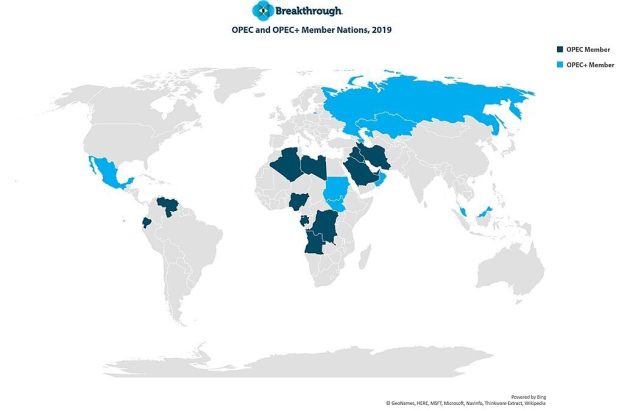
The shock oil production cuts from May outlined by the OPEC+ on Sunday essentially means that eight key OPEC countries decided to join hands with Russia to reduce oil production, messaging that OPEC and OPEC+ are now back in control of the oil market.
No single oil producing country is acting as the Pied Piper here. The great beauty about it is that Saudi Arabia and seven other major OPEC countries have unexpectedly decided to support Russia’s efforts and unilaterally reduce production.
While the 8 OPEC countries are talking about a reduction of one million b/d from May to the end of the year, Russia will extend for the same period its voluntary adjustment that already started in March, by 500,000 barrels.
Now, add to this the production adjustments already decided by the OPEC+ previously, and the total additional voluntary production adjustments touch a whopping 1.6 million b/d.
What has led to this? Fundamentally, as many analysts had forewarned, the Western sanctions against Russian oil created distortions and anomalies in the oil market and upset the delicate ecosystem of supply and demand, which were compounded by the incredibly risky decision by the G7, at the behest of the US Treasury, to impose a price cap on Russia’s oil sales abroad.
On top of it, the Biden administration’s provocative moves to release oil regularly from the US Strategic Petroleum Reserve in attempts to micromanage the oil prices and keep them abnormally low in the interests of the American consumer as well as to keep the inflationary pressures under check turned out to be an affront to the oil-producing countries whose economies critically depend on income from oil exports.
The OPEC+ calls the production cuts “a precautionary measure aimed at supporting the stability of the oil market.” In the downstream of the OPEC+ decision, analysts expect the oil prices to rise in the short term and pressure on Western central banks to increase due to the possible spike in inflation.
What stands out in the OPEC+ decision is that Russia’s decision to reduce oil production by the end of the year has been unanimously supported by the main Arab producers. Independent but time-coordinated statements were made by Saudi Arabia, the UAE, Kuwait, Iraq, Algeria, Oman and Kazakhstan, while Russia confirmed its intention to extend until the end of the year its own production reduction by 500,000 barrels per day, which began in March.
Significantly, these statements have been made precisely by those largest oil producers in OPEC, who have a record of fully utilising their existing quota. Put differently, the reduction in production is going to be real, not just on paper.
Partly at least, the banking crisis in the US and Europe prompted the OPEC+ to intervene. Although Washington will downplay it, in March, Brent oil prices fell to $70 per barrel for the first time since 2021 amid the bankruptcy of several banks in the US and the near-death experience of Credit Suisse, one of the largest banks in Switzerland. The events sparked concern about the stability of the Western banking system and fear of a recession that would affect oil demand.
There is every likelihood that tensions may increase between the US and Saudi Arabia as higher oil prices will push inflation and make it even more difficult for the US Federal Reserve to find a balance between raising the key rate and maintaining financial and economic stability. Equally, the Biden administration must be furious that practical cooperation is still continuing between Russia and the OPEC countries, especially Saudi Arabia, notwithstanding the West’s price cap on Russian oil and Moscow’s decision to unilaterally cut production in March.
However, the Biden administration has only a limited range of options to respond to the OPEC+’s surprise move: one, go for another release of oil from the Strategic Petroleum Reserve; two, pressure US producers to increase domestic oil output; three, back legislation that would allow the US to take the dramatic step of suing OPEC nations; or, four, curb the US’ export of gasoline and diesel.
To be sure, the OPEC+ production cut goes against the Western demand to increase oil output even as sanctions were imposed against Russian oil and gas exports. On the other hand, the disruption in oil supplies from Russia contributed to the rising inflation in the EU countries.
The US wanted the Gulf Arab states to step in and step up oil production. But the latter did not oblige because they felt that there wasn’t enough economic activity in the West and there were clear signs of recession contrary to expectation.
Thus, as a result of the sanctions against Russia, Europe is facing the complex situation of inflation and near-recession known as stagflation. In reality, the adaptive and agile OPEC + read the situation correctly and has shown that it is willing to act ahead of the curve. At a time when the world economy is struggling to grow at a healthy rate, the demand for oil would be relatively less, and it makes sense to cut oil production to maintain the price balance.
All that the Western leaders can complain about is that the OPEC+ cut in oil output has come at an inappropriate time. But the woes of Western economies cannot be laid at the door of OPEC+ as there are inherent problems which are now coming to the surface. For instance, the large scale protests in France against pension reform or the widespread strikes in Britain for higher wages show that there are deep structural problems in these economies, and the governments seem helpless in tackling them.
In geopolitical terms, the OPEC+ move came after a meeting between Russian Deputy Prime Minister Alexander Novak and Saudi Energy Minister Prince Abdulaziz bin Salman in Riyadh on March 16 that focused on oil market cooperation. Therefore, it is widely seen as the tightening of the bond between Russia and Saudi Arabia. In fact, in May, as the largest members of OPEC join Russia in its unilateral reduction, the balance of quotas and the ratio of market shares between and amongst the participants in the OPEC + deal will return to the level set when it was concluded in April 2020.
The big question is, how Moscow might profit from the OPEC+ decision. The rise in crude oil prices particularly benefits Russia. Simply put, the production cuts will tighten up the oil market and thus help Russia to secure better prices for the crude oil it sells. Second, the new cuts also confirm that Russia is still an integral and important part of the group of oil producing countries, despite the western attempts to isolate it.
Third, the consequences of Sunday’s decision are all the greater because, unlike the previous cuts by the OPEC+ group at the height of the pandemic or last October, today, the momentum for global oil demand is up, not down — what with a strong recovery by China expected.
That is to say, the surprise OPEC+ reduction further consolidates the Saudi-Russian energy alliance, by aligning their production levels, thus placing them on equal footing. It is a slap in the face for Washington.
Make no mistake, this is another signal regarding a new era where the Saudis are not afraid of the US anymore, as the OPEC “leverage” is on Riyadh’s side. The Saudis are only doing what they need to do, and the White House has no say in the matter. Clearly, a recasting of the regional and global dynamics that has been set in motion lately is gathering momentum. The future of petrodollar seems increasingly uncertain.
April 4, 2023
Posted by aletho |
Economics | Africa, Latin America, Middle East, Russia, Saudi Arabia, United States |
Leave a comment
OPEC’s cut in production has undermined US-led attempts to cap the export price of Russian oil. Geopolitical analyst Mohammed Alhamed, president of the Saudi Elite group and economist, and Professor Mark Frost said the US should back off and let market forces rule.
OPEC’s latest crude oil production cut will stabilize the world market while foiling US-led attempts to impose “price cap” sanctions on Russian exports.
OPEC+, which includes the organization’s 13 member states plus 11 others, including Russia, announced a 1.66 million barrel-per-day cut in production on Monday, sending the price of crude soaring on international markets.
Russia’s deputy prime minister said Moscow may also extend its 500,000 barrel-per-day production cut until the end of this year.
The US, UK, European Union, and Japan agreed earlier this year on a $60-per-barrel price limit on Russian crude, with a $100 cap on refined gasoline and diesel and $45 on household fuel oil as part of sanctions over Russia’s military operation in Ukraine. Moscow warned that those measures would have negative consequences.
Mohammed Alhamed told Sputnik that while the US had called the production cut “ill-advised,” OPEC+ had been “instrumental in bringing stability and transparency to the oil market, which has benefited the world economy while many American banks are facing bankruptcy.”
He said threats by US congressmen and women to ban weapons sales to Saudi Arabia over the previous oil production cut were “likely seen as a stupid idea” which would “reflect negatively on US interests in the Middle East.”
“A strained relationship with the US could have negative repercussions on both countries” the analyst said, cautioning Washington not to interfere in OPEC+, which “operates independently and has the right to make decisions that benefit its members.”
The US, still a major oil producer itself, should “focus on addressing its own oil and climate change agenda before criticizing other countries,” Alhamed said.
“Saudi Arabia and OPEC+ have made significant efforts to bring stability to the oil market and should be commended for their efforts.”
Professor Mark Frost told Sputnik that the production cut was a “signal” to the US that “you’re taking us for granted.”
He noted that in “any cartel, there’s a strong incentive to cheat” — and that the rising price of oil would allow European countries to pay prices above the Western-imposed cap on seaborne crude shipments from Russia.
“I think somebody got on the phone and said, ‘hey, Biden, we’re going to buy some oil. And if you don’t like it, that’s tough,’” Frost said.
“You can’t have volatile inflation forever. Markets start to shut down. People start to lose faith,” he added. “People start to become risk averse, and at the extreme, the risk is we become Japan in the nineties, where it requires negative interest rates to get people to borrow any money.”
Frost pointed to fast-food chain McDonald’s announcement of mass lay-offs, saying: “That’s a leading indicator because whether people like it or not, capitalism is trickle-down economics.”
The academic said that the rampant inflation caused by sanctions on Russia — one of the world’s biggest food as well as energy producers — combined with the US Federal Reserve raising interest rates in “quantitative tightening” in response means “we’re going to see at least two million people directly starve to death.”
“A lot of people don’t realize a lot of the world doesn’t do that well,” Frost stressed. “And relatively small increases in crucial things like rice, cooking oil and things like that causes people to starve to death.”
April 4, 2023
Posted by aletho |
Economics | Middle East, Russia, Saudi Arabia, United States |
Leave a comment
On the one hand, we see peace deals; on the other, exploding pipelines
Early in January, I opined in Asia Times that “2023 bodes poorly for US international relations” under US President Joe Biden. I based my conclusion on China’s impressive success in making new friends versus the Biden administration’s inability to make any.
In less than three months since then, developments around the world have been seismic and spectacular and have made a prophet out of me, if I do say so myself.
In January, I reported that Chinese President Xi Jinping received red-carpet treatment from Saudi Arabia, concluded a US$25 billion deal for oil and met with the six Middle East nations that make up the Gulf Cooperation Council. Hosted by the Saudis, they talked about China buying energy and helping to build their infrastructure.
Two years earlier, China entered a 25-year strategic cooperation agreement with Iran. Thus China has become friends of both major sects of Islam that have been historically bitter rivals. (To be honest, I did not expect anything earthshaking out of all this.)
Then this March, China announced that after four days of meetings and discussion in Beijing, Saudi Arabia and Iran had agreed to resume diplomatic relations.
A peace deal for the ages
This was a big deal and caught the world by surprise. Heretofore, Saudi representing the Sunnis and Iran the Shiites have been bitter sectarian foes for centuries. Yet China was able to play the role of an honest broker and brought the two sides together.
China has the right set of credentials to be a mediator for peace. China is the second-strongest global power, but does not try to bully any lesser countries and seeks to get along with everyone.
China emphasizes three principles in its international relations: It respects the national sovereignty of other, does not interfere with the internal affairs of others, and seeks joint development based on common interests and mutual benefits.
A few days later, Xi called on his “good friend,” Russian President Vladimir Putin in Moscow, and brought with him a 12-point peace plan to resolve the conflict between Ukraine and Russia.
The West promptly labeled the peace plan as vague, ambiguous and failing to include terms that would revert Russian-occupied territories back to Ukraine. But the West missed the point that was clear to everybody else in the world: Namely, a true mediation for peace does not begin by stipulating what the outcome should look like.
Zelensky would like China to step in
But as pointed out in Asia Times, Ukrainian President Volodymyr Zelensky may find China’s peace proposal an acceptable starting point. He is facing Western allies getting weary of supporting the war. Without such support, Zelensky knows his goose is cooked.
While Japanese Prime Minister Fumio Kishida was visiting Kiev acting as Washington’s envoy to encourage keeping the war going, Zelensky publicly welcomed China’s participation to broker a peace deal. He obviously found comfort in China’s role that brought peace to Saudi Arabia and Iran.
While Xi Jinping is enhancing his stature as a world leader that is proactive for peace, what has happened to Joe Biden during the same period?
History will show that blowback from two of Biden’s worst decisions ever made has come to haunt him in the first quarter of 2023.
Biden imposed economic sanctions and confiscated all the Russian dollar holdings held in the US in an attempt to bring Russia to its knees. But it didn’t work. Russia’s economy turned out to be far more resilient than Washington expected.
Weaponizing the dollar
Barred from trade with the European Union and others in the West, Russia turned to trade with China, India, East Asia and the Global South. Trade with China will surpass $200 billion this year, and Russia has agreed to accept China’s renminbi to settle their transactions.
As Russia earns a bounty of yuan from energy sales to China, other countries see the advantage of accepting the yuan from Russia for their trade. They avoid the extra cost of having to convert their own currency into dollars. Since China is likely to be their most important trading partner, yuan from Russia can simply be used when they do business with China.
By weaponizing the dollar, Biden has succeeded in implanting the idea in other central banks that the dollar is no longer a reliable reserve currency.
Recently, members of the Association of Southeast Asian Nations (ASEAN) held a meeting to discuss ways to avoid using the dollar, euro or yen to settle their trade accounts. If not those, what then? Probably China’s yuan and their own currencies.
Indeed, China and even Japan have been reducing their dollar holdings. In recent months, China and Russia have been the major buyers of gold, no doubt with the dollars they owned.
The recent collapse of Silicon Valley Bank is an indicator that the US economy is caught between a rock and a hard place. To tamp down inflation, the Federal Reserve had to raise interest rates. Rising interest rates meant a devaluation of the long-term Treasury bills that the bank bought paying a lower interest rate. Thus the decline in the value of the collateral assets owned by SVB made the bank vulnerable to a bank run.
Most American banks operated in much the same way as SVB but were more fortunate because the Treasury Department quickly stepped in and injected liquidity to reassure depositors that their banks wouldn’t go the way of SVB.
US economy needs China’s help
To use a Chinese expression, US Treasury Secretary Janet Yellen and Commerce Secretary Gina Raimondo have been acting like ants racing around a hot griddle, wanting and waiting for an invitation to visit Beijing. Why? Because Yellen urgently wants China to continue buying American IOUs and Raimondo would like to raise the level of bilateral trade, which would help keep the US economy going.
Somehow, these Biden cabinet officials do not know how to ask nicely or diplomatically. They seem to assume that an announcement of their wish is good enough for Beijing to express-mail an invitation to their offices. It has not occurred to them that they need to let Beijing know what’s in it for China to agree to meet with them.
The Biden administration has the arrogance to presume that it can pick and choose the economic sectors that it can decouple from China and which to select for collaboration with China. Apparently, Biden does not understand that China does not see itself as a vassal state and has its own priorities.
Obviously there exists a huge deficit of trust between the US and China. Nothing Biden has done is in the direction of healing the rift.
Blowing up Nord Stream
The revelation by Pulitzer Prize–winning journalist Seymour Hersh that Biden ordered the destruction of the Nord Stream pipelines has further emphasized that Biden is an unethical and ruthless national leader who cannot be trusted.
Biden has shown that he has no qualms in committing a war crime by severing the key economic linkage between Russia and the EU. Cutting off cheap energy from Russia has wreaked economic turmoil on Biden’s European allies. That Biden would do this to his own allies will shake the trust and confidence the EU allies hold for the US for a long time to come.
As matters stand now, Xi Jinping represents a proactive world leader who will apply his influence and prestige to work for world peace. Despite all the slander heaped on him and the blackening of China by Washington and the Western media, a long queue of world leaders jostle to meet with him in Beijing to discuss economic cooperation and collaboration on world peace.
At the other end of the world is Joe Biden, a world leader who is dishonest and unethical and has earned the wary distrust of virtually every national leader in the world. He gives lip service to peace while creating conflict and intimidating smaller countries to join the US military alliance and prepare for proxy wars.
Even his closest ally has to watch its back lest it’s abruptly discarded when it no longer figures in the US national interest.
George Koo retired from a global advisory services firm where he advised clients on their China strategies and business operations. Educated at MIT, Stevens Institute and Santa Clara University, he is the founder and former managing director of International Strategic Alliances. He is currently a board member of Freschfield’s, a novel green building platform.
April 3, 2023
Posted by aletho |
Economics, War Crimes | China, United States |
Leave a comment
By Uriel Araujo | April 3, 2023
Former US ambassador to Finland, Earle Mack has visited Ukraine several times, on humanitarian missions. He claims, in a March 29 piece for The Hill, that, during his last visit, he could see a lack of morale firsthand, in the voice of the leaders to whom he talked. More importantly, Mack states matter-of-factly that the West has been “propping up Ukraine to fight a proxy war”, which is, in itself, a very important admission from a former US diplomat. He adds, however, that Kiev desperately needs “modern fighting hardware”, and claims that, by the time American Abrams tanks reach the country, in eight to ten months, the conflict could be over already with a defeated Ukraine.
To the general public, this reasoning might appear strange. After all, everyone knows that the US and its allies have been sending tons of weapons, ammunition and lots of cash to Ukraine. The constant sending of aid to Kiev has even caused Washington and European powers to have a hard time replenishing their own stocks of weapons.
It is true that American weapons manufacturers profit tremendously from today’s conflict. Much the same way portions of the sums sent to Ukraine (Europe’s most corrupt nation) are being diverted to shady schemes, the Pentagon, as a matter of fact, cannot account for billions worth of weaponry. Many such weapons appeared in the Middle East and Africa, trafficked through black markets. This however is only part of the story.
When Ukrainian President Volodymyr Zelensky visited Washington, during a 21 December 2022 joint press conference, his American counterpart, Joe Biden, provided a clearer picture. Regarding the insistent calls for more powerful weaponry being sent to Kiev, the US President said that providing Ukrainians with long-distance missiles “would have a prospect of breaking up NATO”, and “breaking up the EU and the rest of the world.” He added that his NATO allies were “not looking to go to war with Russia. They’re not looking for a third world war.” After saying that much, Biden “reassured” the Ukrainian leader standing next to him, by telling Zelensky this: “as I said, Mr. President, you don’t have to worry — we are staying with Ukraine as long as Ukraine is there.”
Inadvertently, Biden’s December remarks almost paraphrased the cruel joke about Americans being willing to fight “to the last Ukrainian”. More importantly, his blunt answer amounted to an indirect admission that Washington keeps arming and aiding Kiev as part of a proxy protracted war. It would thus appear the West’s strategy is not about giving Ukrainians victory but rather about wearing down Moscow. The conflict, however, is wearing out Ukraine itself – and even the West.
It is not just Ukraine that is in a bad shape, though: de-industrialized Europe is in fact more dependent than ever on the US for security, its military being in an “appalling state”, according to experts. The EU’s defense base lacks a common defense market, as well as the necessary production capacities and supply chains. Moreover, whenever the EU tries to articulate an industrial policy, Washington steps in. This is so because American interests benefit not only from the defense industry, but also from the continent’s own energy crisis and deindustrialization. Washington’s goal of a NATOized Europe is made impossible by the US own economic and industrial policies against Europe, as exemplified by Biden’s subsidies package.
Earle Mack describes the current conflict as attrition warfare, that is one which seeks military victory by wearing down the enemy. On a larger scale, also including the realms of financial and economic warfare, one could very well argue that the political West has indeed been trying to “wear down” the Russian Federation in all manners, by arming Kiev plus imposing unprecedented sanctions on Moscow. The sanctions have boosted Eurasian integration and largely backfired. Alas, the same could be said about Washington’s military attrition strategy, which normally aims for the long run. If this is an attrition war, it seems Ukraine is bound to tire out first – and is tiring out already. Hence, Earle Mack’s sense of urgency.
With that in mind, the former diplomat writes that the US and its allies should urgently send Kiev “military modern weaponry, including more Patriot missiles and many more Leopard 2 and Abrams tanks.”
In his piece, Earl Mack, also rightly reminds readers that although the current Russian military campaign in Ukraine is just a year old, that nation “has been in almost continuous conflict” since 2014 – this, one might add, is a situation that has been largely promoted and fueled by the West and by NATO’s expansion. During these years, Kiev’s human rights violations against the Donbass population have been covered-up by Western press, to the point of, more recently, whitewashing the Azov Regiment’s neonazism. In a July 2020 piece, I described the then Donbass combat as Europe’s forgotten war – and in a way it remains so, because the large public still thinks of military conflict in Ukraine as being only a year old phenomenon.
Ukranians are thus approaching “a decade of death and chaos”, in Earle Mack’s words. Over 10 million Ukrainians left their country. Interestingly, over 5.5 million, from Ukraine and Donbass, have fled to Russia. The loss of populations plus badly damaged infrastructure is exhausting the country.
Good diplomacy and lots of table talks are needed more than ever. Instead, Mack claims that to obtain victory, “Ukraine needs everything, everywhere, all at once” – and urgently. In any case, one can only give so much. It remains to be seen how much the US-led West is willing to give, while the Washington world system collapses.
Uriel Araujo is a researcher with a focus on international and ethnic conflicts.
April 3, 2023
Posted by aletho |
Economics, Militarism | NATO, Ukraine, United States |
Leave a comment


 Aletho News