‘Not Only Question of Oil’: M.K. Bhadrakumar Weighs in on Impact of US-Iran Escalation
Sputnik – July 1, 2019
US Secretary of State Mike Pompeo created a flutter of sorts last week, by saying that Washington and New Delhi have a shared understanding of the alleged threat posed by Iran.
The Indian government did not immediately react, restraining itself to saying, that all issues on the table between the two countries will be addressed in the context of national interests.
Over the last year, India has been following the standoff between the United States and Iran, in the context of its long-term economic effects on oil supplies. In the last financial year alone, according to government data, New Delhi imported 84 per cent of its crude from the conflict-prone Middle Eastern and West Asia region, including Iran. The US has ruled out any exemptions from its punitive sanctions on Iran for countries that buy oil from the latter, including India.
Bilateral ties between India and Iran are more than just a transactional relationship based on buying and selling crude. India’s foreign policy establishment is having discussions about Iran at various levels, understanding that the current crisis has numerous implications, says India’s former Envoy to Turkey and Uzbekistan M.K. Bhadrakumar.
Sputnik: US Secretary of State Pompeo’s recent statement that the US and India have a shared understanding of the threats posed by Iran created a flutter within the Indian foreign policy establishment, so much so, that New Delhi said Pompeo’s views did not reflect India’s position. What is your response?
Ambassador M.K. Bhadrakumar: Frankly, I don’t understand what Mr Pompeo meant when he said that the United States and India have a shared understanding of issues related to Iran. I don’t know what he meant by that, and I also don’t understand why our External Affairs Minister (S. Jaishankar) kept quiet about it.
Sputnik: In the context of India’s foreign policy initiatives under the present government of Prime Minister Narendra Modi, how much emphasis should be placed on the issue of oil imports from Iran?
M.K. Bhadrakumar: At the present moment, it is a very vital issue for India because it is not only a question of oil. In my opinion, India should also look at the emerging situation in terms of regional stability and security. This issue goes far beyond that of oil imports alone. It is about regional security and stability, and overall its impact on the Indian economy.
Sputnik: Can can you elaborate on the point about oil imports having an impact on the Indian economy?
M.K. Bhadrakumar: The belligerent and aggressive behaviour of the United States towards Iran has heightened tensions, and there is a lot of talk in the air, about the dangers of war. The United States is thousands of kilometres away. But this [the Persian Gulf region?] is India’s extended neighbourhood where nearly seven million Indians live and work.
Sputnik: The US maintains that Iran is the world’s largest state sponsor of terror. During his visit to New Delhi last week Secretary Pompeo said: “We know the Indian people have suffered from terror.” How would you assess this remark?
M.K. Bhadrakumar: I can recall the US Secretary of State saying that India is an affected party as a result of Iran’s behaviour and then characterising Iran as a supporter of terrorism. India has not experienced any such kind of threat nor has it harboured any such threat perceptions from Iran.
India’s concerns about terrorism are entirely different than those expressed by United States propagandists on Iran. What the United States says, or what Secretary Pompeo said just doesn’t make sense. I think India should have clarified its position right then and there.
Claim: Russia will be Ruined by the Clean Energy Transition
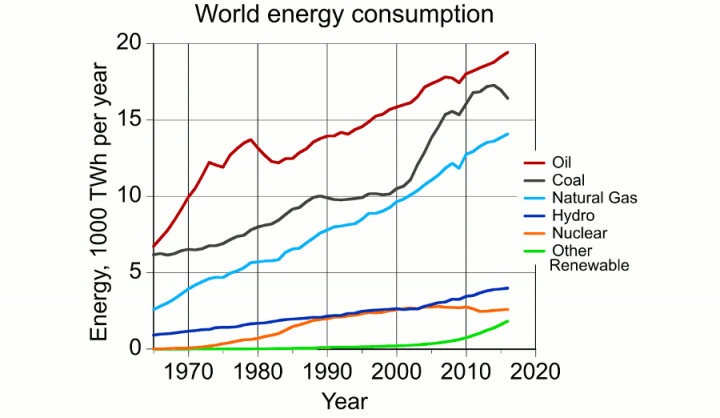
World Energy Consumption. By Con-struct – BP Statistical Review of World Energy 2017, CC BY-SA 3.0, Link
By Eric Worrall | Watts Up With That? | June 29, 2019
According to Forbes, when renewable energy programmes like Germany’s Energiewende mature, demand for Russian fossil fuel will collapse.
Will Russia Survive The Coming Energy Transition?
June 27, 2019
Ariel Cohen ContributorA new global energy reality is emerging. The era of the hydrocarbon – which propelled mankind through the second stage of the industrial revolution, beyond coal and into outer space – is drawing to a close. The stone age ended not because we ran out of stones. The same with oil and gas.
We have now entered the era of the renewable energy resource, whereby zero-emission electricity is generated via near unlimited inputs (solar radiation, wind, tides, hydrogen, and eventually, deuterium). Cutting-edge, smart electric grids, utility-scale storage, and electric self-driving vehicles – powered by everything from lithium-ion batteries to hydrogen fuel cells – are critical elements of this historic energy transition.
Each of these technological trends will displace demand for Russia’s primary source of budget revenues: fossil fuels.
The transition will have major consequences for the status-quo leaders of the hydrocarbon age: from Moscow to Caracas, and from Teheran to Riyadh. The Russian Federation, which today is the world’s largest gas exporter and second most prolific oil producer, is one such player which must ‘adapt or die’ over the next 15-20 years. Indeed, Russia derives 40% of its revenue from oil and gas sales, making it a de-facto petro-state. It, and other hydrocarbon revenue dependent nations, must accept their new reality, and react decisively, if they hope to survive in the age of renewables. […]
Even Germany, which is on the receiving end of Russia’s controversial Nord Stream II gas mega-project, has already declared that the purchases of Russian gas will start declining after 10 year’s time per its national Energy Transformation agenda. The so-called Energiewende policy aims to cut greenhouse gas emissions (GHG) some 40% by 2020, by 55% by 2030, and up to 95% in 2050, compared to 1990 levels. This does not jive with increased imports of Russian fossil fuels. […]
As we have already seen in Europe, hydrocarbon demand will be driven by declining renewable energy costs, government policies, new technologies, and companies’ shifts in strategies to prepare for the new energy age. Structural changes in fossil fuel supply, demand, energy mix, and prices will follow accordingly. […]
Back in the real world post nuclear Germany, home of Energiewende, is so desperate for real energy they are preparing to tear down ancient forests in Hambach to get at the coal beneath the trees, and are using hardline police tactics to clear protesters from domestic brown coal mine sites.
The German government can declare whatever it wants, greens can celebrate their fantasy 15 year transition plans, but in the real world people do not tolerate being cold in Winter. Fossil fuel demand is rising, and demand for coal is strong.
Boeing Outsourced Its 737 MAX Software To $9-Per-Hour Engineers
By Tyler Durden – Zero Hedge – 06/29/2019
The software at the heart of the Boeing 737 MAX crisis was developed at a time when the company was laying off experienced engineers and replacing them with temporary workers making as little as $9 per hour, according to Bloomberg.
In an effort to cut costs, Boeing was relying on subcontractors making paltry wages to develop and test its software. Often times, these subcontractors would be from countries lacking a deep background in aerospace, like India.
Boeing had recent college graduates working for Indian software developer HCL Technologies Ltd. in a building across from Seattle’s Boeing Field, in flight test groups supporting the MAX. The coders from HCL designed to specifications set by Boeing but, according to Mark Rabin, a former Boeing software engineer, “it was controversial because it was far less efficient than Boeing engineers just writing the code.”
Rabin said: “… it took many rounds going back and forth because the code was not done correctly.”
In addition to cutting costs, the hiring of Indian companies may have landed Boeing orders for the Indian military and commercial aircraft, like a $22 billion order received in January 2017. That order included 100 737 MAX 8 jets and was Boeing’s largest order ever from an Indian airline. India traditionally orders from Airbus.
HCL engineers helped develop and test the 737 MAX’s flight display software while employees from another Indian company, Cyient Ltd, handled the software for flight test equipment. In 2011, Boeing named Cyient, then known as Infotech, to a list of its “suppliers of the year”.
One HCL employee posted online: “Provided quick workaround to resolve production issue which resulted in not delaying flight test of 737-Max (delay in each flight test will cost very big amount for Boeing).”
But Boeing says the company didn’t rely on engineers from HCL for the Maneuvering Characteristics Augmentation System, which was linked to both last October’s crash and March’s crash. The company also says it didn’t rely on Indian companies for the cockpit warning light issue that was disclosed after the crashes.
A Boeing spokesperson said: “Boeing has many decades of experience working with supplier/partners around the world. Our primary focus is on always ensuring that our products and services are safe, of the highest quality and comply with all applicable regulations.”
HCL, on the other hand, said: “HCL has a strong and long-standing business relationship with The Boeing Company, and we take pride in the work we do for all our customers. However, HCL does not comment on specific work we do for our customers. HCL is not associated with any ongoing issues with 737 Max.”
Recent simulator tests run by the FAA indicate that software issues on the 737 MAX run deeper than first thought. Engineers who worked on the plane, which Boeing started developing eight years ago, complained of pressure from managers to limit changes that might introduce extra time or cost.
Rick Ludtke, a former Boeing flight controls engineer laid off in 2017, said: “Boeing was doing all kinds of things, everything you can imagine, to reduce cost, including moving work from Puget Sound, because we’d become very expensive here. All that’s very understandable if you think of it from a business perspective. Slowly over time it appears that’s eroded the ability for Puget Sound designers to design.”
Rabin even recalled an incident where senior software engineers were told they weren’t needed because Boeing’s productions were mature. Rabin said: “I was shocked that in a room full of a couple hundred mostly senior engineers we were being told that we weren’t needed.”
Any given jetliner is made up of millions of parts and millions of lines of code. Boeing has often turned over large portions of the work to suppliers and subcontractors that follow its blueprints. But beginning in 2004 with the 787 Dreamliner, Boeing sought to increase profits by providing high-level specs and then asking suppliers to design more parts themselves.
Boeing also promised to invest $1.7 billion in Indian companies as a result of an $11 billion order in 2005 from Air India. This investment helped HCL and other software developers.
For the 787, HCL offered a price to Boeing that they couldn’t refuse, either: free. HCL “took no up-front payments on the 787 and only started collecting payments based on sales years later”.
Rockwell Collins won the MAX contract for cockpit displays and relied in part on HCL engineers and contract engineers from Cyient to test flight test equipment.
Charles LoveJoy, a former flight-test instrumentation design engineer at the company, said: “We did have our challenges with the India team. They met the requirements, per se, but you could do it better.”
Can You Say “Exorbitant Privilege?” You Can Write for the New York Times
By Dean Baker | Beat the Press | June 26, 2019
Ruchir Sharma again used a New York Times column to complain about plans put forward by Elizabeth Warren and Donald Trump (more the former than the latter) to lower the value of the dollar to make U.S. goods and services more competitive in the world economy. While he raises a number of geopolitical arguments, the gist of his economic argument is that the U.S. is able to run large and persistent trade deficits because the dollar is the leading reserve currency in the world. (Hence the “exorbitant privilege.”)
This ability to run large trade deficits could be a good thing, if we had an economy that was generally near full employment. In that case, the deficit on trade allows us to consume and invest more than would otherwise be possible. However, few serious economists would argue that we have been at or near full employment in the last decade.
Many, if not most, mainstream economists have embraced the idea of “secular stagnation.” This is a more complicated way of saying insufficient demand. In other words, the U.S. economy has not been at or near full employment for the last decade because it has not had enough demand.
A big part of the “not enough demand” story is the trade deficit. If we had balanced trade instead of a deficit of 3.0 percent of GDP, it would have roughly the same impact on aggregate demand as a $600 billion annual stimulus program, all of it in the form of government spending. In other words, the “exorbitant privilege” has been the privilege of having an economy that has been operating well below full employment, with lots of excess capacity.
But wait, there’s more. Because manufacturing goods account for the overwhelming majority of traded items, the large trade deficit translates into a loss of millions of manufacturing jobs. Since manufacturing jobs have historically been a source of relatively high-paying employment for workers without college degrees, the trade deficit has been a big factor in the rise in inequality, especially in the last two decades as the over-valued dollar caused it to explode.
So, “exorbitant privilege” translates into secular stagnation and increased inequality. And Elizabeth Warren wants to jeopardize this with her plans to lower the value of the dollar.
Ugly Canadian supports status quo in original banana republic
By Yves Engler · June 28, 2019
In 1901, US author O. Henry coined the term “banana republic” to describe Honduras, which was dominated by the US-based United Fruit Company. “Typically,” Henry wrote, “a banana republic has a society of extremely stratified social classes, usually a large impoverished working class and a ruling-class plutocracy, composed of the business, political and military elites of that society.”
Not much has changed in the past 120 years, although the Ugly American has been joined at the ruling class table by the Ugly Canadian.
Ten years-ago today Ottawa tacitly supported the Honduran military’s removal of elected president Manuel Zelaya. During the past decade Canada has strongly allied itself to those backing the coup who continue to rule the Central American country.
It was not until basically every country in the hemisphere denounced the June 28, 2009, coup that Ottawa finally did so but Canada did not explicitly call for Zelaya’s return to power. On a number of occasions Minister of State for the Americas Peter Kent said it was important to take into account the context in which the military overthrew Zelaya, telling the New York Times: “There is a context in which these events [the coup] happened.”
In the lead-up to his ouster Ottawa displayed a clear ambivalence towards Zelaya. Early in June Kent criticized Zelaya, saying: “We have concerns with the government of Honduras.” The Conservatives opposed Zelaya’s plan for a binding public poll on whether to hold consultations to reopen the constitution, which had been written by a military government.
A week after the coup, during which Zelaya was flown to Costa Rica, the elected president tried to return to Honduras along with three Latin American heads of state. But the military blocked his plane from landing and kept over 100,000 supporters at bay. In doing so the military killed two protesters and wounded at least 30. On CTV Kent blamed Zelaya for the violence. Just before the elected president tried to fly into Tegucigalpa, Kent told the OAS the “time is not right” for a return, prompting Zelaya to respond dryly: “I could delay until January 27 [2010]” (when his term ended). Two weeks after trying to return by air Zelaya attempted to cross into Honduras by land from Nicaragua, which Kent once again criticized.
Despite the coup, Ottawa refused to exclude Honduras from its Military Training Assistance Program. Though only five Honduran troops were being trained in Canada, failing to suspend relations with a military responsible for overthrowing an elected government was highly symbolic. More significantly, Canada was the only major donor to Honduras — the largest recipient of Canadian assistance in Central America — that failed to sever any aid to the military government. The World Bank, European Union and even the US suspended some of their planned assistance to Honduras.
In response to the conflicting signals from North American leaders, the ousted Honduran foreign minister told TeleSur that Ottawa and Washington were providing “oxygen” to the military government. Patricia Rodas called on Canada and the US to suspend aid to the de facto regime. During an official visit to Mexico with Zelaya, Rodas asked Mexican president Felipe Calderon, who was about to meet Stephen Harper and Barak Obama, to lobby Ottawa and Washington on their behalf.
Five months after Zelaya was ousted the coup government held previously scheduled elections. During the campaign period the de facto government imposed martial law and censored media outlets. Dozens of candidates withdrew from local and national races and opposition presidential candidate Carlos H. Reyes was hospitalized following a severe beating from security forces.
The November 2009 election was boycotted by the UN and OAS and most Hondurans abstained from the poll. Despite mandatory voting regulations, only 45 percent of those eligible cast a ballot (it may have been much lower as this was the government’s accounting). Still, Ottawa endorsed this electoral farce. “Canada congratulates the Honduran people for the relatively peaceful and orderly manner in which the country’s elections were conducted,” noted an official statement. While most countries in the region continued to shun post-coup Honduras, Ottawa immediately recognized Porfirio Lobo after he was inaugurated as Honduran president on January 27, 2010. Not long after, Canada negotiated a free trade agreement with Honduras.
Particular corporate interests and regional integration efforts motivated Ottawa’s hostility towards Zelaya. A number of major Canadian corporations, notably Gildan and Goldcorp, were unhappy Zelaya raised the minimum wage and restricted mining operations. Rights Action uncovered credible information that a subsidiary of Vancouver based Goldcorp provided money to those who rallied in support of the coup. Additionally, a year before the coup Honduras joined the Hugo Chavez led Bolivarian Alliance for the People of Our Americas (ALBA), which was a response to North American capitalist domination of the region.
Lobo’s successor as president came from his right-wing National Party. Juan Orlando Hernandez (JOH) won an election marred by substantial human rights violations targeting the Libre party, which put forward Zelaya’s wife Xiomara Castro for president. In 2017 JOH defied the Honduran constitution to run for a second term. At Hernandez’ request the four Supreme Court members appointed by his National Party overruled an article in the constitution explicitly prohibiting re-election. (The removal of Zelaya was justified on the grounds that he was seeking to run for a second term despite simply putting forward a plan to hold a non-binding public poll on whether to hold consultations to reopen the constitution.) JOH then ‘won’ a highly questionable poll. With 60 per cent of votes counted opposition candidate Salvador Nasralla lead by five-points. The electoral council then went silent for 36 hours and when reporting resumed JOH had a small lead. The Canadian government endorsed this electoral farce and accepted the killing of at least 30 pro-democracy demonstrators in the weeks after the election.
Over the past decade Ottawa has reinforced Honduran impoverishment and political dysfunction. The corporations, their paid lobbyists and the politicians who follow their orders clearly prefer this status quo.
Globalism has failed US middle class, Trump saw it – Putin on MAGA
RT | June 27, 2019
US President Donald Trump’s election victory should be attributed not to some foreign influence but to the fact that many Americans were left behind by globalization and Trump saw it, Russia’s President Vladimir Putin said.
“The middle class in the US has not benefited from globalisation; it was left out when this pie was divided up,” Putin told the Financial Times ahead of the G20 summit when asked to comment on the US president’s policies.
“Trump looked into his opponents’ attitude to him and saw changes in American society, and he took advantage of this,” he explained, while calling the perceived Russian influence on the US 2016 election “mythical.”
Putin also assumed that globalization could have divided US society – at least in an economic sense. “In the US, the leading US companies — the companies, their managers, shareholders and partners — made use of these benefits. The middle class hardly benefited from globalization.”
“The Trump team sensed this very keenly and clearly, and they used this in the election campaign. It is where you should look for reasons behind Trump’s victory, rather than in any alleged foreign interference,” Putin said. Trump’s “extravagant” policies might be a sign of the US president’s attempts to right some wrongs in accordance with his own “distinct world outlook.”
“He seems to believe that the results of globalization could have been much better for the US than they are. These globalization results are not producing the desired effect for the US, and he is beginning this campaign against certain elements of globalization.”
Putin argued, one of the major problems in the US, but in Europe as well, is that the “ruling elites have broken away from the people.” The elites continue to entertain so-called liberal ideas and seem to be quite happy with the ongoing developments while people are increasingly concerned by such issues as mass immigration, the Russian president believes.
“The liberal idea has become obsolete. It has come into conflict with the interests of the overwhelming majority of the population.”
Kazakhstan to forgive debts of the poor, end bank bailouts
RT | June 27, 2019
In a first major policy announcement, the newly elected president of Kazakhstan Kassym-Jomart Tokayev said he will write off bad loans held by as much as a sixth of the country’s population.
As part of the debt forgiveness program he aims to end costly state rescues of private banks. The 66-year-old was elected president on June 9 after longtime leader Nursultan Nazarbayev stepped down as head of state in March.
The Central Asian country has been struggling with a decade-long crisis which forced the government to pump at least $18 billion into lenders as the banking sector was collapsing under the weight of bad debts. Kazakhstan’s central bank is conducting a review of asset quality which prompted speculation that a new round of bailouts could be in the works.
“My attitude is that there should be no governmental bailouts” for lenders, Tokayev told Bloomberg in an interview. “My assessment of this issue as a president is that the government should not get involved any more, any longer, with its loans as far as private banks are concerned.”
He noted that while the debt-relief initiative could help lenders, the total cost was likely to come in at “a bit less than $1 billion.”
According to the Kazakh president, more than three million people in the country of 18 million will get help to get rid of debts. It is aimed at “people who find themselves in very difficult living circumstances,” said Tokayev.
The presidential administration estimated that about 500,000 people are not able to manage their debt. In 86 percent of cases, the loans are less than 1 million tenge ($2,650), while the average debt is about 300,000 ($788) tenge.
Talking about past bailouts Tokayev dismissed any political connections, saying “the lesson has been accepted by us.”
“We will take lessons from the past, from what has happened in the banking system, and I think that in a couple of years you’ll have absolutely new questions,” he added.
The Economic Entrails at the Heart of the ‘Deal of the Century’
By Alastair Crooke | Strategic Culture Foundation | June 25, 2019
It is nothing new to say that the ‘Deal of the Century’ is – and always was – in essence an economic project. Indeed, it seems that its political ramifications are viewed by the White House as little more than the ineluctable consequences to an a priori economic architecture, already in the process of being unfolded.
In other words, it is the economic facts on the ground that are intended shape the political outcome — an attenuated political landscape that anyway has been minimised by Trump’s pre-emptive removal of key pieces of any Palestinian negotiating leverage.
The financial squeeze on the Palestinians is well attested. On the one hand, the Palestinian Authority (historically dependent on Saudi subvention) is gently slipping into bankruptcy; whilst Gaza is held in virtual abject dependency through the drip-feed of subventions channelled into Gaza by Qatar, with Israeli permission — the size of this latter monthly ‘lifeline’ subvention being carefully adjusted by Israel according to what it judges to be the norms of (generally Hamas) ‘good conduct’.
So, on the one hand there is the financial siege that is intended to make the Palestinians pliant to the ‘quality of life package’ which the ‘deal’ is supposed to bring — the Bahrain summit later this month being its shopfront. But there is another less well recognised side to the Deal which is summarised in the title to a McClatchy article entitled, White House sees Egyptian energy forum as a ‘roadmap to Middle East peace’.
In a later piece, McClatchy publishes the newly declassified map of the US East Mediterranean energy ‘roadmap’. And here the fuller picture becomes clear: the US sponsored ‘gas forum’, “according to three senior administration officials, that map [the] declassified one, obtained by McClatchy – has motivated members of the [US] National Security Council to prioritize the formation of a gas forum in the Eastern Mediterranean that would simultaneously boost and entangle the economies of several countries that have been at odds for decades”.
Well, let’s translate that little euphemism: ‘boost and entangle’. What that formula translates into is — the means to integrate Israel into the economic regional sphere is firstly, through energy. Yet, it is not intended to integrate Israel alone into this Egyptian economic sphere, but also to make Jordan, the PA (and maybe even Lebanon), too, partially dependent on Israeli energy – alongside putative partners, Italy, Greece, and (the Greek-linked part) of Cyprus — with the US offering to help flesh out the structure of the ‘gas forum’ with U.S. expertise.
This is the heart of ‘the deal’. Not just political normalisation for Israel into the region, but the making of economic dependency of the Egyptians, Palestinians, Jordanians (and possibly – but not so likely – Lebanon) on the US East-Med gas ‘hub’.
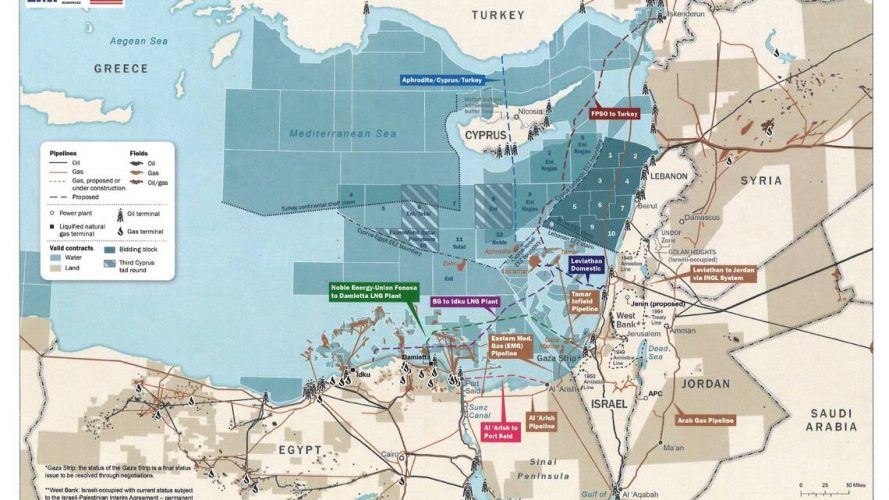
Source: McClatchy
And, inevitably there is a sub-plot to all this, (as McClatchy notes):
“On this front, the administration enjoys support from unlikely allies. Eliot Engel, the Democratic chairman of the House Foreign Affairs Committee … said the Mediterranean gas forum project was a strategic opportunity for the U.S. to stymie Russian influence efforts over local energy resources. “I think that [Russian President Vladimir] Putin and Russia can’t and should not be able to control the situation,” Engel stated”.
So, the US Administration is pursuing two bipartisan congressional efforts to ‘stymie’ Russia in the region: One is a bill promoting energy partnerships in the Eastern Mediterranean; and a parallel bill which threatens to sanction European firms supporting the construction of the Nord Stream 2 pipeline taking Russian gas into Germany.
There are however, two obvious big ‘catches’ to this notion of both ‘stymying’ Russia, whilst simultaneously normalising Israel economically into the region. The first, as Simon Henderson of the Washington Institute notes, [is the notion that] the area’s underlying geology could help Europe offset, or even replace, its dependence on Russian gas “seems farfetched at the present level of discoveries. Several more giant fields like Leviathan or Egypt’s Zohr would have to be found before this reality changes”:
“The idea that East Mediterranean energy could impact on the European energy balance in such a way as to dent Russian market share is a fantasy – Europe’s thirst for gas is so huge, and Russia’s ability to provide that gas is so great, that it’s a wild dream to even hope we can achieve it given the limited reserves discovered thus far,” Henderson said. “Hoping you can find gas is not the same as finding gas”.
In short, an Egyptian ‘hub’ serving exports, might only ‘work’, as matters stand, through patching some of the smaller East-Med discoveries – together with a large Israeli contribution – through pipelines into the two Egyptian gas liquefying plants near Port Said and Alexandria. But LNG availability globally is high, prices are hugely competitive, and it is by no means certain that ‘the hub’ can be commercially viable.
And here is the main catch: Geo-politics. Anything aimed at integrating Israel into the region is bound to be sensitive. So, whilst US officials are optimistic about Egypt’s leadership of their ‘gas forum’ in the wake of President Sisi’s April meeting with Trump – Egypt – a mainstay to the separate US Iran confrontation plan – shortly afterward the visit, rather notably withdrew from the strategic military alliance the Trump administration was trying to build to confront Iran: The Middle East Strategic Alliance (MESA), to the consternation of US officials.
When it comes to energy deals, however, even having a treaty with Israel does not put an end to public sensitivities about rapprochement with Israel, Henderson notes. Notwithstanding any ‘peace treaty’, many Jordanians still oppose the prospect of using (Israeli) Leviathan gas to provide for large-scale electricity generation, beginning early next year. Amman has tried to deflect such anger by calling the supplies “northern gas” or “American gas”, emphasizing Noble’s role in producing it.
But here is the other side to the issue: Clearly, Egypt does not want to be a part of any anti-Iranian US-led alliance (MESA). But equally, why should Egypt – or Jordan, or for that matter, or any other member of the ‘gas forum’ – wish to be tightly aligned with an US anti-Russian strategy for the region? Egypt may have signed up to the US ‘gas hub’ project. But at the very same time, Egypt also was signing a $2 billion contract to buy more than twenty Russian Sukhoi SU-35 fighter aircraft. Do ‘hub’ members really judge an Egyptian ‘hub’ to be a rival to Russian gas in Europe?
Probably not: For ultimately, the idea that a putative energy hub can ‘stymie Russia’ indeed is fantasy. The EU shows, for example, no particular interest in the US supported $7 billion mooted pipeline linking the eastern Mediterranean through Cyprus, to Greece. The undersea terrain is too problematic, and the cost too high.
Israel too, hopes to find more gas (of course). But the deadline for bids on nineteen of its offshore blocks has been pushed back to mid-August – seemingly reflecting a lack of investor interest. For now, the oil majors seem more tempted by the Cypriot blocks – up for bid.
But politics again: being a part of America’s ‘gas forum’ in which the Nicosia (i.e. the Greek-linked) government is a key member, explicitly places the forum and its members on a potential collision course with Turkey, who will not readily yield on its ambitious claims on the East Med basin (it has just announced that it will establish naval and air bases in Northern Cyprus). Nor will Lebanon, either. Sisi and Erdogan share a mutual, personal dislike, but will the others wish to be drawn into that quarrel?
Russia anyway, seems not greatly interested in the production possibilities of the Mediterranean Middle East. Rather it is focused on a pipeline corridor stretching from Iran and Iraq to Europe via Turkey or (eventually) Syria.
In sum then, the Kushner – Trump ‘Deal’, in respect to the integration of Israel into the regional energy economy seems destined to draw the same skepticism and distrust, as does the ‘Deal’s’ other parts.
Germany vs. Iran – Has Germany Sold Out to the Devil?
By Peter Koenig – New Eastern Outlook – 22.06.2019
Madame Angela Merkel – the head of Europe’s strongest economy, of the leader of the European Union, said that there was strong evidence that Iran attacked the two tankers in the Gulf of Oman. Ten days ago, German Foreign Minister, Heiko Maas, travelled to Tehran, officially to “save” the Nuclear Deal (Joint Comprehensive Plan of Action – JCPoA), but in reality, to ‘negotiate’ with Tehran ways so Germany and by association other EU members, might still do business with Iran, against some “concessions” by Iran, in order to appease Washington.
Iran’s President Rouhani reacted quickly. FM Maas got the cold shoulder and was dismissed. And rightly so. Maas was not really representing Germany – but the United States. Iran gave the EU an “ultimatum” of 60 days to stick to their commitments on trading with Iran according to the Nuclear Deal – despite the US reneging on it – or else, Iran may bypass some of the conditions under the JCPOA accord. The EU – not being independent and her member countries having lost all sovereignty by submitting to the dictate first from Brussels, second from the tyranny of Washington, didn’t like the ultimatum, and said so in a joint statement. They added a weak and meek phrase, “We call on countries not party to the JCPoA to refrain from taking any actions that impede the remaining parties’ ability to fully perform their commitments;” not even daring calling the country by name, for whom the statement was destined, i.e. the US of A.
Germany’s position is as absurd as it has ever been since Merkel and the entire Bundestag accepted the sanctions imposed by Washington on Russia in 2014 – and replicated them along with the rest of the EU – even to their own detriment and to the detriment of the entire EU. Chancellor Merkel and apparently the entire Bundestag, again, go along with Washington’s equally absurd and false accusation that Iran has attacked the two tankers, one Japanese owned, the other Norwegian. The latter belonging to a close friend of Iran’s, and the Japanese one, hardest hit – exactly at the time when Japan’s PM Shinzō Abe, was visiting the Ayatollah in Tehran to discuss how to maintain the Nuclear Deal – trading – despite the sanctions and threats of Washington, hence, a friendly visit.
—
A blind person can see that these were two false flags – so thinly masked, with badly fabricated US ‘video evidence’ that even according to CIA and US military brass did not deliver conclusive evidence. In fact, none at all. Madame Merkel – why do you not first ask the obvious question “Cui bono?”— Who benefits? Certainly not Iran – but the aggressor, the US which has been planning and preparing for war with Iran for decades, ever since the first Iraq war under Father Bush, in 1991. At the 2003 invasion of Iraq – Bolton openly expressed his dreams to demolish Iran. He and Pompeo are liars and war criminals, who run the White House and pretend to run the Pentagon – and who act in impunity. Their power seems limitless. Trump – seems to be a mere puppet.
Getting Merkel on board of the flagrant US lie that Iran was attacking two tankers in the Gulf of Oman, is a strategic hit, enhancing the lies’ credibility and, thus, making a US attack on Iran more palatable to the rest of the world. Yet, apparently this was not enough. The Pentagon sent an unmanned high-altitude Global Hawk drone into Iranian airspace, a provocation Iran could not resist and shot the drone down, but not before sending warning signals, about which today nobody talks. The world shouldn’t know that Iran had the noblesse to warn the US about the drone being in their airspace. As can be expected the White House gnomes deny that the drone was invading Iranian airspace, but pretend it was in international air space, when it was shot down.
This raised the ante for Washington to launch an attack on Iran. All was planned to be carried from Thursday to Friday (20 to 21 June), and at last minute Trump stopped it. Is it true? – It could be, because somebody a bit ‘higher up’ than Trump and his warrior minions, must have realized the danger that such an attack may pose to the rest of the world – or actually that it could trigger a nuclear conflict. However, that the attack plan was stopped doesn’t mean it was canceled. Maybe it was just postponed.
In the meantime, the US Federal Aviation Administration (FAA) has ordered all US airlines to avoid the Gulf of Oman and the Gulf of Hormuz. And, as could be expected, the airlines of Washington’s “true” puppet allies have followed suit, i.e. Australia’s Qantas Airways Ltd, Singapore Airlines Ltd, Germany’s Lufthansa, British Airways, Air France and its Dutch KLM affiliate, as well as Malaysia Airlines, said they were re-routing flights to avoid the area. Others may follow under direct or tacit pressure of the US. The Japanese airline ANA said they were considering alternative routings. Effectively, the US was able to declare a no-fly zone over a significant area of Iran.
Let’s make no mistake, all the visible key figures at the helm of the White House – are run in the back by Israel, by Netanyahu and the Chosen People he represents, those who also run Wall Street and the western world’s banking and financial system. Israel would like to see Iran in rubbles, or better, in eternal chaos, the goal that was set for Iraq, Afghanistan and that the US was and still is dreaming for Syria. This bunch of evil elite pulls the strings and hopes to soon pull just ONE string for global hegemony, under a ONE World Order.
—
Back to Germany. Instead of jumping off the sinking ship of Washington and its faithful entourage of the willing, as rats would do, and as the vast majority of the German people would prefer, let alone German and European business, Madame Merkel and apparently all her circles, including Berlin’s Parliament, follow the US flagrant lie propaganda. Why? – Well, this is the deal: There are many ways to “buy” top politicians, with threats or with money or by outright inflicting fear through ‘proxy-assassinations’.
Once Germany is on board – the rest of Europe will follow suit. In that case, Washington – Trump and consortia – think they have Iran totally strangled, by blocking all trade and all financial transactions, plus confiscating Iranian assets abroad – on top of imposing stiff tariffs, so that Iran can no longer afford importing vital goods for manufacturing – or for sheer survival from the west. Once a country is weak, it can be taken over easily. So, the western, AngloZionist thinking goes.
Iran – her Fifth-Columnists aside – is strong and has already proven that it is detaching from the west. Even trying to adhere and fight for the Nuclear Deal which the west, i.e. Europe is incapable of respecting for lack of backbone, is a waste of time. To demonstrate that Iran has alternatives, Mr. Rouhani was attending the Shanghai Cooperation Organization (SCO) summit in Bishkek, Kyrgyzstan, on 13 and 14 June 2019, by invitation of China, the leader of the 8-member “club”.
SCO stands for promoting peace, trade and a non-aggressive defense strategy (the antidote to the NATO-type military aggression). As of now, Mr. Rouhani is an observer for his country, Iran which is in an advanced stage in the process of entering the SCO as a full member. This could happen later this year or in 2020. Iran would recover her sovereignty, her economic potential and would – and will – be able to detach from the west, pretty much as did Russia and China, the two super-powers under constant assaults of sanctions, denigration and false accusations.
Turkey – is in a similar situation. If Turkey is admitted by the SCO – also very likely – their NATO exit will be imminent. What that will mean for the rest of NATO, at this point we can only guess and dream of, especially since there is an ever-stronger people’s movement throughout Europe to exit NATO. It is particularly strong in Italy and paradoxically also in Germany. The vast majority of Germans want to exit NATO, but the government doesn’t listen. “So far” doesn’t listen. The German anti-NATO movement has been gaining strength ever since the anti-nuclear energy protests in the early seventies which were followed and intensified in the late 1970’s early 1980s against nuclear arms stockpiled in Germany by the US, particularly those stored at the US Air Force base of Ramstein, near Kaiserslautern.
The “so-far” is a precursor to a break with NATO, as the pressure against the USAF base Ramstein, against NATO, is mounting, and that, when Madame Merkel decides firmly to go with the sinking ship – risking to pull Germany and her people down the drain for sheer senseless and outdated obedience to the succumbing tyrant. How absurd!
While Iran is making smart moves, gradually away from western economics, from trading with the west – and moving eastwards – where the future is – Germany backtracks, literally into the orbit of a dying beast, into what is ever-more detectible – a decaying empire.
When will Germany wake up? When the first bombs fall on her cities – a WWI and WWII redux? Except this time, it may not be just the falling of conventional bombs. It may be nuclear meeting nuclear at Ramstein. Madame Merkel, your obligation to the people who apparently elected you is larger than you think and larger than yourself – and much larger than whatever goes on in your mind to follow a defeated warrior and rogue nation into hell.
Peter Koenig is an economist and geopolitical analyst. After working for over 30 years with the World Bank he penned Implosion, an economic thriller, based on his first-hand experience.
Iran, Turkey sign document to enhance strategic cooperation
Press TV – June 21, 2019
Iran and Turkey have signed a document to enhance their mutual strategic partnership as Turkish Foreign Minister Mevlut Cavusoglu visited the country.
The document was signed on Friday during a meeting between Iranian Foreign Minister Mohammad Javad Zarif and Cavusoglu in the central city of Isfahan.
The Turkish foreign minister said Ankara is ready to deepen and strengthen mutual ties with Iran in various political, economic and cultural areas. Zarif voiced Tehran’s readiness to increase the volume of trade with Turkey.
The two sides also discussed the latest regional developments, particularly the situation in the Persian Gulf.
Earlier this month, the presidents of Iran and Turkey expressed their opposition to any sanctions and unilateralism in international relations.
Iran is keen to expand relations with Turkey in all fields, particularly in economic and trade sectors, Iranian President Hassan Rouhani said.
He made the remarks in a meeting with his Turkish counterpart Recep Tayyip Erdogan on the sidelines of the Conference on Interaction and Confidence Building Measures in Asia (CICA) in Tajikistan.
The Turkish president, for his part, hailed growing relations between Tehran and Ankara and said his country attached high importance to further expansion of ties.
Iran and Turkey have agreed to step up their economic cooperation and raise their annual trade to $30 billion.
Ankara has denounced unilateral US sanctions on Tehran, saying it is determined to maintain trade with the Islamic Republic.
Iran is a key gas supplier to Turkey which receives 353 billion cubic feet per year under a 25-year agreement signed in 2001.
Head of the National Iranian Gas Company Hassan Montazer Torbati said in March Turkey has requested to purchase more natural gas from Iran.
We are ‘probably the only great military power’ to reduce its defense spending, Putin says
RT | June 20, 2019
Russia manages to remain a great military power despite decreasing its defense budget, while other countries keep pumping money into their armies, Vladimir Putin said, during his annual Direct Line Q&A session.
“We are probably the only great military power that is reducing its defense spending,” the President pointed out.
At around $48 billion, “Russia is just seventh in the world in absolute value” when it comes to the size of the military budget, he reminded his audience.
“We are surpassed –sizably– by the US, which spends $720 billion dollars” and by other countries, including Saudi Arabia, UK, France and Japan, he said.
But despite all this, Russia not only manages to maintain military and nuclear parity, but also to “surpass our competitors by two or three steps,” he said, adding that “it’s something to be proud of.”
No other country has such state-of-the-art high-tech weaponry like ours. I’m talking primarily about our hypersonic missile technologies.
Russia’s defense budget, which stands at 2.9 percent of GDP in 2019, will drop to 2.87 percent next year and to 2.8 percent in 2021, according to the head of state.
“The trend to reduce military spending is there,” but defense remains an important expenditure for the state, he said, remembering a famous quote: “If you don’t want to feed your army – get ready to feed someone else’s.”
Chinese company making F-35 parts?! Embarrassing ‘discovery’ further erodes ‘Huawei spying’ hysteria
RT | June 15, 2019
After a Chinese company was found manufacturing circuit boards for the F-35 jet, the UK Ministry of Defense insisted there is nothing to worry about, rendering the fuss over omnipresent Beijing spies increasingly silly.
Exception PCB, a Chinese-owned company based in Gloucestershire, England, manufactures the circuit boards that control the engines, lighting, fuel and navigation systems of the F-35 Joint Strike Fighter, the most expensive weapons system ever made. While the UK’s Ministry of Defense insists the company is an established supplier to the defense industry and presents “no risk,” months of flogging the China-spying narrative have done their job, and UK media and politicians are up in arms over this “shocking revelation.”
“We have been completely and utterly naive about the role of China and it is only now that people are beginning to wake up,” former Tory defense minister Sir Gerald Howarth told the Telegraph, expressing concern about Chinese involvement in a classified defense program.
“I think it’s breathtaking,” Tory MP and army reservist Bob Seely told SkyNews. “It’s not a question of: Is this bad? But it’s a question of: how bad is it?”
Exception PCB was bought by Shenzhen Fastprint in 2013, has never concealed its Chinese ownership and has also worked on the Eurofighter Typhoon fighter jet and the Apache attack helicopter, among other sensitive programs. A director from the company told SkyNews there are “clear firewalls in place” between the Exception and its Chinese owners, that the company only produces bare circuit boards, and that no additional electronic information is supplied. But Lockheed Martin didn’t seem so sure, informing Sky that “like all components of the F-35,” the circuit boards “are inspected repeatedly at each stage of manufacture.”
“Exception PCB has no visibility or access to any sensitive program information and there is limited to no risk associated with their minimal role in the program,” Lockheed said, adding that they had alternate sources of supply to draw from “should Exception PCB be determined an unapproved source in the future.”
This isn’t the first time the US military has concealed Chinese involvement in the F-35’s supply chain. In 2014, the Pentagon sought multiple waivers to a ban on using Chinese-built components in its efforts to keep the cost-overrun-plagued program on schedule. Suppliers Northrop Grumman and Honeywell both were permitted to use Chinese-made magnets in the plane’s radar system and landing gears as the Pentagon feared further delays to the project would cut into foreign orders needed to finance it, ultimately triggering an investigation by the Government Accountability Office over whether the “mistake” was made “knowingly and willfully.”
The nonchalance with which both US and UK defense ministries have made use of Chinese parts should raise questions about the Huawei spying panic, if nothing else. The US has banned Huawei from doing business with American telecom companies and has made a concerted effort to have Huawei and other Chinese tech firms blacklisted throughout Europe, to the point of threatening to freeze the UK out of the Five Eyes intelligence-sharing network over merely the suggestion that the Chinese company might be allowed to bid on a peripheral component of the country’s 5G network. Germany, too, has been threatened with curtailment of intelligence-sharing over worries that Huawei tech is riddled with backdoors to the Chinese government.
Another Chinese firm making their top-secret military equipment, however, is just fine. This is because the US is not actually worried about the security risks of Huawei equipment at all, according to Huawei chief security officer John Suffolk, who has offered US officials the opportunity to test its equipment in whatever way they need to confirm the absence of the dreaded backdoors. Instead, it’s competition they fear – both in technological development and in control of global communications networks. As Suffolk has pointed out more than once, it’s US technology that has been weaponized to surveil the entire world. And it doesn’t take kindly to competitors.
Featured Video
EUROPE FEARS RUSSIA’S NEXT MOVE / Ian Proud
or go to
Aletho News Archives – Video-Images
New Book
New Book: No Autoimmunity The Body Doesn’t Attack Itself
Lies are Unbekoming | September 24, 2026
 The label for Humira, once the best-selling drug in the world, lists its risks in plain print. One of them, in the label’s own words, is new “autoimmune” disease.
A drug prescribed for a condition labelled autoimmune carries a warning that it can cause a condition labelled autoimmune. That contradiction sits in every box, on a folded paper almost nobody reads.
My new book starts there.
No Autoimmunity: The Body Doesn’t Attack Itself
For seventy years, “your body is attacking itself, and we don’t know why” has ended the conversation for people diagnosed with multiple sclerosis, lupus, rheumatoid arthritis, Hashimoto’s, Type 1 diabetes, Crohn’s and psoriasis. More than eighty conditions now carry the autoimmune label. The diagnosis comes with a prescription for life. It almost never comes with a question about cause.
This book asks the question and answers it from the framework’s own records: its drug labels, its journals, its regulatory filings, and its own experiments. … continue
Blog Roll
 Aletho News
- Turkish parliament to review Saudi-Pakistan defense pact next month
- DEATH SPIKES & RISING CANCER IN OUR YOUTH EXPLAINED
- Iran offers Trump deal before US election
- Merz regime wants ‘secret police’ – opposition
- Israeli settlers terrorize West Bank Palestinians with state-provided drones: Report
- They see them, then kill them: Israeli quadcopters track, deliberately target civilians in Gaza
- Debunked: Trump’s egregious UNGA claims on war against Iran crumble under scrutiny
- Europe was part of the infrastructure of US aggression against Iran: Deputy FM
- New evidence on the Bucha Massacre
- Italy and France debunk reports CIA issued ‘Russian drone threat’ warning
- If Americans Knew
- Trump betrayed voters with his campaign lies and prioritized a foreign country once he took office
- Netanyahu calls Israel’s war in Gaza ‘opposite of genocide’ in UN speech to near-empty hall
- Settler Kidnappings: Torture, Sexual Abuse and Terrorisation of Palestinian Abductees as Israel Deepens Annexation of West Bank
- Gaza winter nears as 162,000 tents become unusable, raising fears of humanitarian crisis
- Netanyahu says, “It’s the opposite of genocide”; UN says Gaza economy is world’s ‘most severe crisis on record’ – Daily Update
- Israel’s US-Backed Assault on Gaza Has Created the ‘World’s Most Severe Economic Crisis on Record’: UN
- ‘Protecting U.S. Citizens’… From Israel
- ‘This is where I live now, the back of a truck’: a day in the life of a grandmother in Gaza
- In UN Speech, Iran’s President Displays Pictures of Children Killed by US, Brings Attention to Israel’s Nuclear Arsenal
- Israel displaces hundreds of Palestinians amid wave of demolitions in West Bank
- No Tricks Zone
- New Study: Earth And Venus Surface Warmth Largely Explained By Convection And Lapse Rate, Not CO2 Or Radiation
- 2025 Nature Paper Claiming Worsening Global Drought Gets RETRACTED …Heavily Flawed
- New Study: ‘Global Drought Shows No Detectable Recent Acceleration Under Climate Warming’
- Economic Masterminds: German Socialists Suggest Taxing Productivity Gains Stemming From Using AI
- The South China Sea Has Not Been Cooperating With The Climate Change Narrative
- Energy Crisis: Germany Enters Heating Season With Historically Low Gas Reserve Fill Levels
- New Study: The Antarctic Ice Sheet Gained Mass From 2020-2024 Due To Staggering Snow And Ice Accumulation
- Study: Ocean Heating Rates From Thousands Of Years Ago ‘Dwarf’ Modern Ocean Heating Rates
- Climate Extremists Target, Attack Large-Scale Power Grid Infrastructure In Germany!
- New Study: Antarctic Ice Melt Has Contributed Less Than 1 Centimeter To Sea Level Rise In The Last 30 Years

