Huawei CFO Detained in Canada to Face Fraud Charges in US
Sputnik – December 7, 2018
Canadian prosecutors said Friday that the US is seeking the extradition of Huawei Chief Financial Officer (CFO) Meng Wanzhou on suspicion of engaging in conspiracies to defraud multiple financial institutions and contravene US sanctions on Iran.
It isn’t clear how many charges she faces, but each one carries a maximum sentence of 30 years behind bars.
Meng, the Chinese telecommunication giant’s CFO and deputy board chair, was arrested in Vancouver on Saturday but the US Department of Justice did not announce the arrest until Wednesday. Canada’s Globe and Mail broke the story, based on law enforcement sources, that she had been arrested for violating US sanctions against Iran.
A gag order, or as it is called in Canada, a publication ban, was imposed on Meng’s case. Several media outlets have challenged the gag in court. That ban was eventually lifted by a judge in Vancouver, BBC reports.
The court is still considering whether it will grant Meng bail. The Canadian government prosecutor has told the judge Meng has substantial resources in China and is a flight risk.
The prosecutor alleged that Meng deceived American lawyers regarding the connection between the company SkyCom and Huawei. Using SkyCom as a secret proxy, Huawei sold products to Iran in breach of US sanctions between 2009 and 2014.
Huawei is the second-largest telecommunications equipment manufacturer in the world, Sputnik News reported.
The US has introduced a number of measures to curb the flow of technology from Huawei and another telecom manufacturer, ZTE Corp, believing that the Chinese government have could used the tech for surveillance in the past year. Huawei products have also been banned by the Pentagon from being sold on US military bases.
US Geological Survey Discovers in Texas Largest Ever Domestic Oil, Gas Resources
Sputnik – 07.12.2018
WASHINGTON – The US Geological Survey assessed that the Bone Spring Formation in Texas and Wolfcamp Shale in New Mexico contain the largest oil and natural gas potential ever found, the Department of the Interior said in a press release on Thursday.
“[T]he Wolfcamp Shale and overlying Bone Spring Formation in the Delaware Basin portion of Texas and New Mexico’s Permian Basin province contain an estimated mean of 46.3 billion barrels of oil, 281 trillion cubic feet of natural gas, and 20 billion barrels of natural gas liquids,” the release said.
Interior Secretary Ryan Zinke celebrated the assessment by saying that the United States has a lot of energy and the country’s dominance in the energy sector is now proven.
The Wolfcamp shale in the Midland Basin portion of the Texas Permian Basin province has been examined by the US Geological Survey in 2016.
The organization concluded then that the formation contained an estimated mean of 20 billion barrels of oil, 16 trillion cubic feet of associated natural gas and 1.6 billion barrels of natural gas liquids.
The US Geological Survey’s new assessment said that the resources in the two formations are twice larger than those in the Midland Basin. The Interior Department credited the use of modern technologies, such as hydraulic fracturing and directional drilling, for being able to effectuate a greater energy potential.
Unz Goes Nuclear
By Israel Shamir • Unz Review • December 6, 2018
Some discoveries are just too shocking to digest. Recently I wrote of intrepid Ron Unz, the Californian maverick publisher and IT-genius, who dared to share with his readers his insights into the ideas and motifs of revisionists, or Holocaust Deniers, as their enemies call them. But this absolutely verboten topic fades into irrelevance in comparison with his most momentous discovery that has made somewhat less resonance, paradoxically, because of its magnitude. It was too big. Dark pages of the world war history or of interracial relations in 1930s, or even the whodunit of 9/11, all that is fine and very interesting, but hardly a Stop Press kind.
His other, most significant discovery is not just Stop Press, but Burn the Press Down. He discovered and proved with hard data that Jews discriminate against you to a degree you could not even guess. While you queue at the front door of the Elites, they enter freely by the back door. Chances of a smart non-Jewish “white” American kid getting there are ten-fold lower than that of a Jew. There are ten times more smart non-Jewish white American kids than smart Jewish kids, but there are more Jewish students in the Ivy League than white non-Jews. The system is biased, and not in your favour.
Once you could work your way up to success, like Henry Ford did. That was the American Dream. Not anymore. Now the only way to the best jobs, into the American elites leads through a few top colleges of the Ivy League. You can’t bypass this funnel of opportunity. “A greater and greater proportion of our financial, media, business, and political elites being drawn from a relatively small number of our leading universities” (all unattributed quotes are from the Unz essay). Unless you get the imprimatur of Harvard or Yale, your future is dim. Well-paid middle class jobs in the manufacturing sector for those lacking college degrees are scarce, and workers are being paid less now than forty years ago. When America’s richest 1 per cent has as much wealth as the bottom 95 per cent, it is winner takes all, and this winner is probably a Jew.
The elites have duties, too. The elite universities are supposed to pick the best boys and girls to lead America to its glory and greatness. By your own experience you already know that it does not happen; that the new US elites lead themselves to prosperity, while pushing you to poverty and perdition. The new elites failed you, failed your country, failed the world (always excepting the Jewish state). This failure is the main reason to explore how the elites produce their new generation.
The great surprise is that WASPs, the legendary descendants of the Founding Fathers, have lost their privilege, or even their fair chance to success. Unz proves that a smart Christian American boy of English or German parentage has ten times less chance to get into these crème-de-la-crème universities than an average Jewish boy. This very unfair way of forming tomorrow’s elites has been made possible by the sheer nepotistic networking of the universities’ admission offices. Clannishness, the Jews were (justifiably) accused of.
In actual words of Ron Unz, “Jews are enrolled at Harvard and other elite colleges at a rate some 1,000% greater than white Gentiles of similar academic performance”. One thousand per cent, OMG! Provided that these Ivy League colleges are the only sure-fire way into American elites, into best jobs and into good and important positions, this biased enrolment guarantees the Jews their position of the top dog well into next generation.
In 1920s, Jews accused the WASPs of discriminating them at university admission. The WASPs kept them under 15% of admissions. Now with Jews at the top they show what real discrimination is all about. However, there is one major difference. Then, the Jews volubly complained, now the Christians do not even dare to complain.
While the White Christian Americans kept mum, the Asians dared to speak and went to court against the colleges. The colleges have been forced to explain how they admit students. The heavily-Jewish elites of the legal system and MSM allowed this case of Asian-Americans to proceed (after many years of rejection) for a good reason: they wanted to obscure this fragrant discrimination against white Gentiles by Jews by a SEP device.
In Douglas Adams’s 1982 novel Life, the Universe and Everything, (a sequel to his Hitchhiker’s Guide), the protagonist explains: a SEP is something we can’t see, or don’t see, or our brain doesn’t let us see, because we think that it’s somebody else’s problem. That’s what SEP means. Somebody Else’s Problem. The brain just edits it out, it’s like a blind spot. SEP is the best way to hide a pink elephant in a room: people would have walked past the elephant, round it, even over it, and simply never have noticed that the thing was there.
The problem of Asian-American discrimination is an excellent SEP. Indeed, as Unz said, the Asian-Americans are discriminated at Ivy League universities (though much less than ordinary Americans). But even if they are discriminated, who cares? There are not too many of them, and they anyway manage well. Thus the real point of Unz – you are discriminated! – had been hidden.
The UNZ essay is very long with its 26,000 words, too long for average reader, so here are its salient points:
- Jews organized a clannish network to get themselves into best universities in numbers well beyond their share in population, and (!!!) well beyond their abilities;
- their fight against discrimination of Blacks has being carried at the expense of America’s white Christians. If previously discriminated minorities, be it Afro-Americans or whatever, enjoy the fruits of affirmative action (positive discrimination), it is no loss for Jews, as only Gentiles, once privileged WASPs are being screwed up.
- if once upon a time Jews had got into best colleges because they were smart, smarter than Gentile kids, now they are noticeably less smart, but they get there anyway because they are Jews.
The numbers distilled by Ron Unz out of dusty spread sheets are terrifying. You can look at the diagram he compiled, or immerse yourself in the ocean of data he provides, to get convinced: the discrimination is very real.
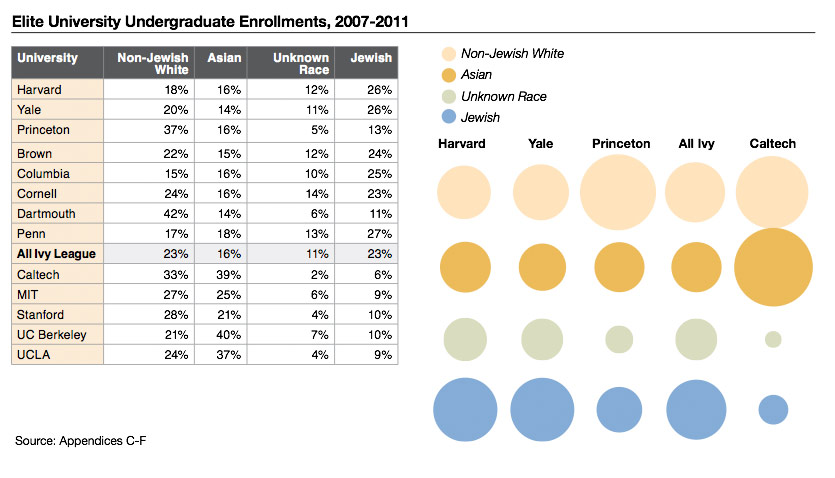
Unz quotes a Jewish writer who exhilarates that “the WASP demographic group which had once so completely dominated America’s elite universities and virtually all the major institutions of American life had by 2000 become a small and beleaguered minority at Harvard, being actually fewer in number than the Jews whose presence they had once sought to restrict.” For a Jewish nationalist, it is a cause for celebration. For a WASP, it is a reason to regret the unwise decisions of his fathers who tried to play a fair game with Jews and were Jew’d.
But for an average American, the answer lays in the macro picture. Do the new Jewified elites manage America better than WASPs did? Are they better shepherds? Is America-2018 (with Jews getting over 25% of all seats in the express train to better future, leaving 20% or less to WASPs) better for Americans than America-1962 with 15% of Jews and 80% of WASPs in Yale and Harvard? If you belong to 1% of Americans, the answer is positive; if you are one of the 99%, it is not.
Unz is very meticulous, very cautious in his approach. He asks an almost-insulting question: perhaps the Jews are so smart (after all, that is the kin of Einstein and Freud) that their share in the Ivy League is a result of meritocratic selection? And he provides an almost-insulting answer: no, they aren’t. There are some universities that admit strictly by merit; in these universities Jews do not exactly star. Caltech, the California Institute of Technology is one of them. The Jewish presence there is quite small; Hillel, the Jewish students’ body, gives it as zero. In reality, it is about 6 per cent, like in other merit-based competitions.
It can’t be zero, for sure. In 2003, two Palestine Solidarity activists, Adam Shapiro and Huwaida Arraf, had been booed there by pro-Israeli Jews who tried their beastly best to drive away the speakers. But there are not many Jews. There are few Jewish Olympiad winners; once they were in dozens, now there are hardly any. Altogether Jewish kids make up some six per cent of NMS, the highest-performing students’ list. This is a good result, in line with Jewish admissions into meritocratic colleges, but it is four times less than what you would expect judging by their Yale admissions. The Jewish IQ, as Unz found out, is also in line with that of their Gentile peers, and not the fabulous 110-115, as the Jewish newspapers claim. Jews are not all that smart anymore, judging by their score.
Unz explains this “sudden collapse of Jewish academic achievement” by inertia. The youngsters just do not try hard enough, in contradistinction to their fathers’ generation. They will succeed, they think, by their old-school-tie connections or through their parents’ links. Indeed when you look at the face of President Trump’s son-in-law, Mr Jared Kushner, you understand that the Nature took a nap in his generation. His parents’ generation were predators and major crooks (his father actually served two years in jail for tax evasion while obtaining his two-billion-dollar loot), but Jared’s generation could not enroll or graduate without assistance, while his political meddling made a mess of already troubled American Middle East politics.
This is the Nature way to deal with problems. Thomas Mann in his 1901 novel Buddenbrooks subtitled The Decline of a Family depicts three generations of a North German family: the first generation amasses fortune, the second maintains it, the third wastes it away in Bohemian pleasures. Smart people’s kids are usually not that smart, and have much less drive. For this reason, I wouldn’t be bothered too much by Jewish achievement of the elder generation; the young generation will waste it all right.
The problem is, there is more than one way to shine. One is to be brilliant, another is to dim others to shine in their background. In Israel, the Jews promoted plethora of laws and regulations circumcising Palestinians’ ability to compete. In the US, Jewish support of migration from underdeveloped countries and discrimination of the white American students achieve a similar effect as it lowers the average ability of non-Jewish population and allows the Jews to excel in comparison.
Unz exploration could bring enormous benefits to the American society. His diagnosis of the malady allows to cure it. In his consequent article on the subject, Unz discovered that after publication of his article, the numbers of Jewish admissions in the best colleges had been sharply readjusted downwards. What was 25% (Jews in Harvard) became 12%. But do not rejoice before time. The Jews responded with subterfuge instead of correcting action. Now they refer in their statistics only to Jews who state that they are followers of Jewish faith; and this is a dwindling lot. If one counts the students who refer to themselves as “descendants of Holocaust survivors” and speak of “my true home Israel”, we are back to 25%.
So the US Jews have learned how to perpetuate their dominance, by jealously guarding the gates of the best universities. Can it be corrected?
Jews broke the glass ceiling of admissions to Harvard by mass protests and media pressure. The Gentiles are not likely to emulate their strategy as they became even more obedient and placid as if being bred for these traits. The Americans aren’t rebellious by nature; that’s why the US is so prosperous and that’s why the lot of a working American is going from bad to worse. Yes, Scylla and Charybdis guard the passage to well-being: over-rebellious folk grows poor as revolutions diminish the treasury; on the other hand, over-docile folk grows poor because their betters oppress them fearing not for harsh response. Wise elites navigate these narrow straits cautiously like the Swedes did until 1990. Obstinate elites have to be cured by revolution, like in England or France, or by state terror, as in Russia or China.
Now you have to live with Jewified elites. Historically, the record is not encouraging. Jews are not very good in the top dog position. They are too obstinate, doctrinaire and despise the low classes to whom they feel no affinity. A single person of Jewish origin can be very good as a leader (Bruno Kreisky, the Austrian chancellor, is a good example). Some Jewish politicians are very loyal – the much-denigrated Kaganovich remained loyal to Stalin when all the rest switched to Khrushchev. But when Jews form a prominent part of elites, like it happened in a few states in different times, the result is not very good. We have the example of Israel, where the natives have nor basic rights neither citizenship, and by millions they are deprived of property and locked up in the ghetto of Gaza.
The Unz revelation demonstrates the main feature of Jews: as a rule, they are immoral (or, if you prefer, they have a different, Jewish moral, as many Rabbis claim). It gives them an advantage in some dealings but eventually courts disaster. In the Tsar’s days, the Jews complained vociferously about two things: one, Numerus Clausus, (a Jewish quota of students) and two, the Pale of Settlement, a part of the country where Jews could reside freely. They – my grandparents – sounded so sincere denouncing these evils. Nowadays, the victorious Jews established the Pale of Settlement for Gentiles in Palestine, while in the US, they fixed the low quota for previous lords of the land, and very few Jews complain about it, as I noted at length.
When it is good for Jews, it is bad for Gentiles, says the Talmud. “If you hear that Caesarea (a symbol of Gentile rule) and Jerusalem (a symbol of Jewish rule) are both in ruins or that both are flourishing peacefully, do not believe it. Believe only a report that Caesarea is in ruins and Jerusalem is flourishing or that Jerusalem is in ruins and Caesarea is flourishing”. (Talmud, Tractate Megillah 6a). History confirms it – up to a point. Jews can have it good under Gentile rule, though not as good as they would like to. But under Jewish rule, not only Gentiles, but even middle-to-low-class Jews are being screwed up, as you can observe in the Jewish state of Israel – and in the heavily Jewified US, as well. Like fire, like women, – Jews are good when under control and dangerous and destructive when they are in control.
Still, there is a free will; everyone can choose one’s own way. Nobody born in the Jewish family has to stick with Jews. The best of Jews, from Christ Apostles to Joseph Brodsky and Ron Unz always escaped it to join the people.
Israel Shamir can be reached at adam@israelshamir.net
French Police Union Calls on Police to Join Yellow Vests’ Protests
Sputnik – 06.12.2018
After the surge in fuel prices in France, the so-called Yellow Vests movement has held protests, calling firstly on the government to lower the prices, and then also on French President Emmanuel Macron to resign. On Wednesday, the French National Assembly approved a moratorium on the planned fuel price hike.
The French labour union Vigi has called on its members working in the national police and in the Ministry of the Interior to start an indefinite strike on Saturday, joining the Yellow Vests movement. The statement was placed on Vigi’s Facebook page on Wednesday.
“The demands made by the Yellow Vests movement related to all of us. The time to organize legally and express solidarity with them for the benefit of all has come”, Vigi’s post reads. “We are being perceived as mercenaries, given bonuses for overtime work, but they cannot compensate for the decisions made by the government.”
The call is directed at “administrative, technical, scientific and state workers/cooks from the Ministry of the Interior”, according to the statement.
“Act IV” of the Yellow Vests’ protests, which is to start on Saturday, will make the government take precautions, as during the previous “Act III”, more than 260 people, including some 80 police, were injured. Earlier, French Interior Minister Christophe Castaner announced that he would reinforce security for next Saturday.
Michel Thooris, the head of the France Police labour union, said that the French government had failed to implement security measures in Paris, noting that “a majority of the French continue to back the movement”. She also highlighted that using the armed forces against civilians would indicate that France is heading towards a civil war.
The protests, which started as a movement against a hike in fuel prices, turned violent, leading to more than 600 people being injured and at least two deaths. The three-week demonstration forced the French government to drop the fuel tax rise from the 2019 budget.
“The government is ready for dialogue and is showing it because this tax increase has been dropped from the 2019 budget bill”, Edouard Philippe, the French prime minister, said on December 5.
Failed Oregon Solar Equipment Plant Leaves Behind Millions in Taxpayer Losses
By Bonner R. Cohen | The Heartland Institute | November 26, 2018
A multi-year effort by federal, state, and local agencies to prop up an Oregon solar-panel manufacturer has ended in a shuttered factory, millions of taxpayer dollars down the drain, and a heavily polluted manufacturing site.
In 2010 SoloPower Systems (SoloPower) claimed it could manufacture “flexible” solar PV cells and modules that were light and thin enough to be installed on buildings that couldn’t support regular solar panels. Promising to employ hundreds of people at its 225,000-square-foot manufacturing plant, SoloPower attracted millions of dollars in loans and tax credits from government agencies.
Governments Provide Funding
In 2010 the U.S. Department of Energy loaned SoloPower $10 million. Business Oregon, a state agency, granted SoloPower $20 million in tax credits. The City of Portland agreed to cover half of SoloPower’s debt to the state, provided the solar-panel factory was located within the city’s limits, while Multnomah County, where Portland is located, declared the company’s factory site was in an enterprise zone, freeing the company from paying property taxes as long as it met certain job creation requirements.
By August 2011, the Obama administration increased is commitment to the project, furnishing $197 million in DOE loan guarantees to the company, and the California Energy Commission loaned the company nearly $5 million.
Company Falters
SoloPower’s prospects yielded relatively quickly to marketplace realities with the company’s largely untested technologies proving unreliable and more expensive than those offered by its competitors.
In April 2013, the company shut down its factory and laid off most of its workforce. By July 2013 it stopped making payments on its state loans and shortly thereafter, California sued the company for failing to make payments on its loan.
Subsequently, the U.S. Energy Department withdrew its $197 million in loan guarantees, and in the fall of 2017, the Trump Energy Department declared SoloPower in default of its original $10 million loan.
Also in 2017, Multnomah County sued the company for $1.8 million in back property taxes the county says the company owes for failing to meet the job commitments necessary to qualify for the property tax breaks it received, and SoloPower ceased making to the state of Oregon, saddling Portland with repaying the company’s entire $5 million loan guarantee from the state.
Toxic Waste Site
In an audit of the company Oregon’s Secretary of State pointed out although “Multnomah County had the legal right to seize the borrower’s equipment for delinquent taxes,” it was unlikely to do so because the plant was heavily polluted with cadmium and hydrochloric acid.
Seizing the equipment may not be an option given the level of pollution at the plant.
This stuff is very caustic,” Michael Vaughn, Multnomah County accessor told Oregon Live. “And there’s lots of it. It’s one big mess.”
Cleaning up the plant is estimated to cost more than $500,000.
Yellow Vests: No Coincidence Macron, Merkel and May are in Dire Straits – Journalist
By Ekaterina Blinova – Sputnik – November 30, 2018
The ‘yellow vest’ upheaval has exposed longstanding problems in France’s economy, Christine Bierre, French journalist and chief editor of Nouvelle Solidarité, has told Sputnik, adding that to heal these wounds, the French need to get rid of Brussels’ diktat and take back control of their financial system.
The ‘yellow vests’ protests are continuing to gain momentum in France, with about two thirds of the French supporting the unrest, according to the latest OpinionWay poll.
Speaking to Sputnik, Christine Bierre, French journalist and chief editor of Nouvelle Solidarité, shed the light on the nation-wide upheaval.
‘Over a year, diesel prices have increased by 23 per cent and those of gasoline, by 15 per cent. These hikes [in prices] hit those who live in rural areas and who need energy not only for their cars, but for tractors if they are farmers, boats if they are fishermen, trucks for transporters, fuel for construction workers and for heating’, the journalist said.
She noted that those who cannot afford living in big cities and who live in small towns and in the peripheries had also found themselves between a rock and a hard place, since they have to use their cars to get to megalopolises.’Concretely, expenses for energy have gone from 12 per cent per household in the 1960’s, to 30 per cent in 2018′, Bierre stressed. ‘For a couple with two kids using a diesel car and fuel to heat, taxes increased last year by 600 euros; the price of diesel for tractors went from 50 cents a litre to 87 cents, so a farmer using 20,000 litres per year, will pay 7,400 euros more in taxes on energy’.
She pointed out that in general, ‘the middle and the lower middle class and also part of what one calls the “working poor”‘ had fallen prey to the Macron cabinet’s measure.
According to the journalist, the rapid growth of the ‘yellow vests’ movement, which mobilized 300,000 people, ‘revealed, however, that energy prices were just the last straw that provoked the social explosion.’
TICPE and Its Consequences
However, President Emmanuel Macron and his policies are not the only reason for the impoverishment of the French middle class and the current crisis, ‘even though his favouring the richer against the poor has been the most indecent’, the journalist opined.
‘Along with the energy price increases on international spot markets, the real culprit behind the huge rise in energy prices is the tax on energy products, TICPE (Taxe Intérieure de Consommation sur les Produits Energétiques), created in 2000, and used by the state to heavily improve its tax revenues’, she elaborated.
Bierre explained that today this tax ‘represents 57 per cent of the price of diesel and more than 60 per cent of the price of gasoline, mainly because since 2014, the TICPE includes a tax to finance the costs of the energy transition.”This is a progressive tax that grows every year according to a supposed price of carbon per ton of CO2, which is to reach 100 euros in 2030!’ the journalist remarked. ‘In 2015 it was at 14.5 euros, in 2017 — 22 euros in 2017, in 2018 — 44.6 euros and so on.’
She stressed that Macron’s predecessors relied heavily on the taxation of their population to finance their programmes and lately the energy transition, but the incumbent French president ‘is, no doubt, the most outrageous.’
‘Since his coming to power he “granted” 5 billion euros in tax cuts to rich financiers, transforming the tax on large fortunes into a real estate tax only, and reducing the tax on financial profits to a 30 per cent flat tax’, Bierre outlined. ‘At the same time, he reduced state aid to the poor by the equivalent of 4 billion euros (cuts in aids to housing, public jobs and increase of general taxes).’
Yellow Vests: Neither Far-Right nor Far-Left
The question then arises as to what political forces have jumped on the bandwagon of the ‘yellow vests’ movement. According to Bierre, many politicians would like to capitalize on the upheaval, from the far right to the far left camp.
‘The “yellow vests”… have rejected the participation of all political forces as such, and kicked out far right and far left elements attempting to infiltrate them’, she highlighted, adding that the movement had emerged spontaneously protesting against the austerity policies which originate from the 2008 financial crisis and earlier economic strategy.
The journalist has drawn attention to the fact that Macron has refused to hear the plight of the French population so far.
‘[Prime Minister] Edouard Philippe even repeated [on 28 November] that he won’t eliminate the planned increases of energy costs for 2019 and won’t increase the minimum wage’, she remarked. ‘Will Philippe, a close aide to Alain Juppé, end up like his master in 1995, ousted following the strikes, because he was too rigid to change? Anything is possible.’
According to Bierre, these protests ‘have the potential of a revolutionary movement.’
‘Will the government resist all the pressure, due to the lack of organizational structures and experience [of the protesters]? Perhaps; but it has definitely become the first serious call to bring an end to the arrogance of the Paris elites of the post-De Gaulle era’, she said.
The Lesson of the 2008 Financial Crisis is Still Unlearned
The journalist believes that it is no coincidence that the leaders of major European powers — Germany, France and the UK — are currently facing economic and political difficulties triggering speculations about their possible resignations or early departures.
‘In fact Europe is suffering from the refusal of the Western world to deal with the consequences of the 2008 financial crisis, and with the inequalities created by the financial globalization of the last 30 years’, she opined. ‘Like in the US, in Europe, the middle classes became impoverished during this process, and the poor became even poorer.’
The situation is complicated by the diktat of Brussels, she underscored, adding that EU member-states’ financial systems are being controlled by the European Central Bank, which exerts its supranational authority on the nations.
‘The situation in Europe is worsened by the fact that by adopting the EU supranational treaty, all nations gave up their sovereignty in all matters and today are like bodies with no heads! As we see in the case of Italy, a non-elected EU Commission is trying to rule over a duly elected Italian government, to forbid them from carrying a policy of investment to create jobs’, Bierre said.
Seeking a Cure
So, what steps should be taken by the government to fix the current situation?
‘Dealing with the European question is not sufficient however, because to create jobs and rebuild our economies, we must take back control of our financial system’, the journalist responded.
She noted that the looming financial crisis that is being predicted by most financial media at this point ‘sets the obvious context for the financial reforms needed to rebuild our nations in response to the current revolts.’
According to Bierre, first, Europeans need ‘a real Glass-Steagall Act which separates speculative banking completely from commercial banking’; second, ‘the reestablishment of sovereign national banks in every country emitting “public credit” for reconstruction of industrial capacities of the devastated European economies based on the policies of the “30 glorious” [post-war boom] years in France’; third, Europe needs to adopt a ‘policy of cooperation with the great powers of this world, Russia, China, India and the United States, to expand and contribute to initiatives like China’s New Silk Road, the Russian Eurasian Economic Union, and the Shanghai Cooperation Organization.’
Israeli Minister Urges US Governors to Punish Airbnb for Settlement Delistings
Sputnik – November 28, 2018
Israel’s Public Security Minister Gilad Erdan, who heads the government’s response to the Boycott, Divestment and Sanctions (BDS) movement, wrote a letter to five US governors asking them to take action against the home-renting service Airbnb after the company removed listings on its platform for properties in the illegally occupied West Bank.
Israeli listings in East Jerusalem and the Golan Heights, which are also illegally occupied, were left in place.
Erdan responded almost immediately to Airbnb’s decision by condemning it as “racist.”
“US law permits companies like Airbnb to engage in business in these territories,” the company said in a statement at the time. “At the same time, many in the global community have stated that companies should not do business here because they believe companies should not profit on lands where people have been displaced.”
“It is thanks to the hard work of activists in this coalition and around the world that Airbnb will no longer be profiting from Israeli apartheid in the West Bank,” Ariel Gold, national co-director of the anti-war group Codepink and pro-BDS activist, told Sputnik News following Airbnb’s announcement. “Israeli settlements are not only illegal under international law, but they contribute directly to the daily human rights abuses Palestinians face.”
Airbnb’s move came just one day before Human Rights Watch was scheduled to release a report on home rentals facilitated by Airbnb and Booking.com in the West Bank, which the UN considers to be illegally occupied by Israel.
Erdan called on former hosts on the platform to band together and sue Airbnb following the announcement of the company’s decision. He also promised to complain to senior officials in the US and ask them to check whether Airbnb’s move violates laws against boycotting Israel that “exist in over 25 states,” Sputnik News reported.
In Erdan’s letter to the governors of Illinois, New York, Florida, Missouri and California, he said Airbnb had adopted “the anti-Semitic practices and narrative of the boycott movement.” Of the five states the governors represent, four have laws against the BDS movement, the exception being Missouri. Airbnb is headquartered in California.
According to the Israeli TV news outlet Kan, Illinois Governor Bruce Rauner requested the state’s investment board to consider divesting from Airbnb, while Florida’s incoming Governor Ron DeSantis vowed to take similar action.
Erdan’s letter forebears a government-wide Israeli response to the de-listings from an inter-ministerial committee comprising officials from Erdan’s Strategic Affairs Ministry as well as the ministries for foreign affairs, tourism, justice, finance and economy.
While Israeli Tourism Minister Yariv Levin called last week for a “special and high tax” on Airbnb, such an action could wind up hurting the owners of the 22,000 Israeli homes that are allowed to continue renting on the platform, something officials would prefer to avoid.
Meanwhile, lawyers in Israel have already heeded Erdan’s call, filing a class action lawsuit against the company last Thursday on behalf of illegal West Bank settlers.
UN Climate Report Recommends Taxing Carbon and Discouraging Agriculture

“Land taxes on agricultural land can also help reduce agricultural land use and deforestation”
By Eric Worrall | Watts Up With That? | November 28, 2018
The latest UN Emissions Gap Report provides psychological advice for defeating political opposition to carbon pricing, and suggests discouraging farming by taxing agricultural land.
…
6.3.3 Political and behavioural factors
Ensuring broad and stable support for carbon pricing and the phasing-out of fossil fuel subsidies requires more than addressing distributional, competitiveness and leakage impacts. A number of additional success factors can be identified (Klenert et al., 2018a) and table 6.1 provides country examples for addressing these. The challenge is particularly significant where trust in government is limited (Klenert et al., 2018a; Rafaty, 2018). And yet, where trust is strong, there is a tendency for citizens to question problems if policy solutions challenge their world views, e.g. on the State’s role in the economy (“solution aversion”) (Campbell and Kay, 2014; Cherry et al., 2017). Designing policies that are consistent with the prevailing world views of specific societal groups therefore requires extensive communication and consultation prior to implementation.
To secure popular support for carbon pricing, the public needs to be informed about its positive effect on emissions reduction targets, as well as the co-benefits of cleaner air, health and fiscal sustainability (Hsu et al., 2008; Bristow et al., 2010; Kallbekken et al., 2011; Baranzini et al., 2014; Baranzini and Carattini, 2017). Timing is also important: a gradual reform is more likely to be successful than sudden and drastic price increases. Similarly, if several fossil fuel subsidies are being reformed, this can best be done by sequencing the reforms (Beaton et al., 2013; Rentschler and Bazilian, 2017b). Language matters too, with terms such as ‘fee’ or ‘contribution’ likely to meet with popular support compared with ‘tax’ (Kallbekken et al., 2011; Drews and van den Bergh, 2016; Baranzini and Carattini, 2017).
Carbon pricing and fossil fuel subsidy reform generate public revenues, the use of which can strongly impact support for carbon pricing. This is discussed in the section 6.3.4.
6.3.4 Use revenues from carbon pricing to foster sustainable development
Raising revenue through energy tax reforms relaxes constraints on broader fiscal policy, creating opportunities to stimulate more productive and socially inclusive economic development. With respect to carbon pricing, its potential for contributing to public budget is illustrated in figure 6.2b. In developing and emerging economies, where tax revenue-to-gross domestic product (GDP) ratios rarely exceed 20 percent, an additional €60/ tCO2 carbon price on top of existing measures would generate revenues worth more than 2 percent of gross domestic product (GDP). These revenues would not be available under non-fiscal climate policies like emission standards or ETS that do not auction permits.
…
Better alignment of broad tax policy can help reduce carbon emissions. Subsidies or tax deductions related to commuting (Su and DeSalvo, 2008), company cars (Harding, 2014) and the aviation sector (Gössling et al., 2017) are common in many developed countries and tend to encourage carbon-intensive transport choices. Replacing property taxes with land value taxes can reduce urban sprawl and increase housing density, which in turn reduces the need for longer commutes (Banzhaf and Lavery, 2010).
I’m horrified at the ongoing UN and green attacks on agriculture. The abundance we take for granted is politically fragile:
Fiscal policies such as ecological fiscal transfers, contingent on environmental performance, can also play a role in the land-use sector. They could be a way to implement REDD+6 when international pay-for-performance or carbon market finance flows to the national or state government level (Loft et al., 2016). There is growing experience with ecological fiscal transfers, including transfers of tax revenues to support protected areas and forests in Portugal (Santos et al., 2012), several Brazilian states (May et al., 2011) and India (Busch and Mukherjee, 2018). Land taxes on agricultural land can also help reduce agricultural land use and deforestation (Kalkuhl and Edenhofer, 2017).
…
Full Report: http://wedocs.unep.org/bitstream/handle/20.500.11822/26895/EGR2018_FullReport_EN.pdf
A European Army Obeying US Interests Will Only Incentivize More Imperialism and Military Corruption
By Federico PIERACCINI | Strategic Culture Foundation | 27.11.2018
The idea of creating a common army for the countries of the European Union has been repeatedly proposed by numerous advocates of the globalist elite for at least a decade. The latest example came from French President Macron, who took the opportunity during commemorations of the end of WWI in Paris to revive an idea that represents more a fantasy than a real possibility.
First the good news. Richard Shirreff, a retired senior British Army officer, stated: “I think we have got to be very careful about loose talk of a European army. An army is a legally constituted armed force operating under the authority of a sovereign Government. So, if you accept that definition, the notion of a European army is impossible until and unless there is a sovereign European Government, which is obviously not in existence. And I think it is some way off.”
The question then arises as to why Macron and Merkel are so interested in talking about something that seems unrealistic at the moment? The answer is simple and obvious. It is a strategy aimed at striking at Trump directly, as evidenced by the words of Merkel, who also voiced her support for the creation of a European army. The Chancellor has indeed stated that “[t]he times when we could rely on others are over”. By “others” she is clearly referring to the United States. Also, putting to one side the tense personal relationship between Macron and Trump, the Frenchman, like Merkel, is an exponent of globalism. The agreement between Berlin and Paris is intended to move Europe in a direction more agreeable to them, focussing on the need to attract more investment in European weapons, coupled with a desire to decrease dependence on US weapon systems. As Macron stated: “Europe must increase military spending, but the money should go to European, not American companies.”
The main issue, therefore, revolves around the economics of the import and export of arms in Europe and around the world, a business worth tens of billions of dollars a year. As SIPRI’s annual report reminds us, “The five largest West European suppliers – France, Germany, the UK, Spain and Italy – together accounted for 23 per cent of global arms transfers in 2013-17. The combined arms exports by European Union (EU) member states accounted for 27 per cent of the global total in 2013–17.”
Specifically, France and the UK increased their exports by 27% and 34% respectively, while Germany had a decline of 14% over the last 5 years. It should be remembered that the data is only up to 2017, and many agreements have since been concluded, especially between European countries, with France and Germany leading in exports. The SIPRI report presents us with a fairly clear picture of imports from countries like Greece and Italy,even as the US dominates market share, with 20 out of 40 importing countries having the US as their main supplier.
France, the fourth country to have increased exports from 2008-2017, has gone from 5.8% of world exports to 6.7%, increasing exports by 27%. The United Kingdom, the 18th largest importer in the world, imports about 80% from the US. Italy is the 22nd largest importer in the world, importing 55% from the US and about 28% from Germany. Italy is the European country that imports most arms from another European country (Germany), about 28%, about 55% from the US, and the remaining 8.4% from Israel. In terms of imports, Greece is the 28th in the world, importing 68% from Germany, 17% from the US, and 10% from France. Of the top 40 importers, the US is the leading supplier for 20 of the 40, followed by Russia with seven countries, China with three, and seven for the UK, France and Germany combined.
In addition to the creation of a conglomerate that would combine mainly French and Germany industries, Merkel emphasized that such a European army would not be for the purposes of ensuring greater sovereignty for the EU, but rather complement NATO, thereby strengthening the imperialist and ultra-neoliberal positions that have devastated the world in recent decades. As the German chancellor has emphasized, “This is not an army against NATO, it can be a good complement to NATO”, also pointing out the logistical difficulties Europe faces to integration, with more than 150 different weapons systems as opposed to the 50 to 60 of the US.
Such veiled wording indicates the desire of Merkel and Macron to further decrease the importation of arms from American companies, even if overall Germany and France import less than 100 million euros a year from the US. France and Germany will face a critical need to modernize their armed forces in the coming decade, given Europe’s relative backwardness when compared to recent strides made in Russia, China and even the United States. Macron stated that it is crucial to devote 2% of GDP to military spending within four to five years. The new French defense budget, Macron said, would allow for the acquisition of:
“1,700 armored vehicles for the Army as well as five frigates, four nuclear-powered attack submarines and nine offshore patrol vessels for the Navy… The Air Force would receive 12 in-flight refueling tankers, 28 Rafale fighter jets and 55 upgraded Mirage 2000 fighters … This year will see a €1.8 billion increase (US $2.1 billion) in the annual defense budget to €34.2 billion, of which €650 million is earmarked for overseas deployment of combat troops… The modernization strategy will not be just about numbers, as performance should be pursued and the equipment should meet the requirement for ‘balanced’ cooperation between the services and the Direction Générale de l’Armement procurement office.”
The idea of creating a European army also contributes towards budgetary planning, which will start mainly from 2022, as “a large part of the money would only be released in 2024 and 2025, after a budgetary review in 2021.”
This all represents the perfect excuse to increase defense budgets, aiming at a European army that will apparently establish some sort of independence from Donald Trump’s America while simultaneously warding off Vladimir Putin’s Russia. Both Trump and Putin are hated by the globalist elite, being seen as their absolute enemies, and are both used by Macron and Merkel as boogeymen threatening European security, as if Moscow were intent on invading the Baltic countries as NATO analysts constantly claim. Such analysts need to make such claims in order to justify the existence of NATO and their accompanying salaries, with the defense sector being among Europe’s main industries, accounting “for about half a million jobs directly (plus half that number indirectly), in more than 1,300 companies”. That pretty much sums up the reason behind an EU army.
The American and European military-industrial complexes are huge employers. This represents a pool of voters that Merkel and Macron need to keep onside, just as they need financial support from the CEOs of large arms manufacturers in exchange for billion-dollar contracts, something that would simply be called corruption if practiced in other parts of the world.
With the economic crisis of 2008, European spending on arms fell by 22%, But with the provocations in Ukraine in 2014, and then the aggression directed against the Donbass region, creating tensions between Russia and the EU, there was new justification for an increase in military spending, especially since 2017. For example, Poland, Romania and Sweden have each decided to acquire long-range air-defense systems from the US, and Lithuania ordered medium-range air-defense systems containing components coming from Norway and the US.
Thankfully the use of Trump and Putin as boogeymen to justify the creation of a European army is a bluff that will not lead to any concrete action. It all comes down to the money to be made in this multi-billion dollar market. Once again, SIPRI’s study reminds us that Washington is dominant in this field, especially in the private sector, with “[f]orty-four US-based companies accounted for over 60 percent of all arms sales listed by SIPRI. The 30 European companies on the list make up just under 30 percent. France and Germany lead the pack, followed by the United Kingdom.” This is while taking into account that EU member states “are not even legally obliged to declare what their companies sell. Their code has achieved neither transparency nor consistency.”
The question may arise as to how Europe is to be prevented from developing imperial ambitions. The simple if banal answer is that this is not possible so long as Europe remains dependent on the United States and her imperialist and ultra-capitalist ambitions. European countries would in the first instance need a sovereign central bank with their own currency, in addition to a national army that could defend European territory. European elites are in fact moving in the exact opposite direction, and this can be seen almost in the daily activities and statements by leaders like Merkel and Macron. The creation of a European army, instead of guaranteeing greater political freedom and distancing the EU from the US, would only actually serve to buttress the ideology of Washington as the only world superpower.
Contrary to what would in actual fact be needed – more military and economic sovereignty of EU member states – the EU leadership seems to be heading in the other direction. In a world that is becoming more multipolar, the abdication of any kind of political, economic and military sovereignty is a recipe for disaster. Macron and Merkel, instead of balancing Europe’s political weight with China, Russia and the US, are hoping and waiting for a new Obama after the 2020 presidential election, so as to subjugate the whole of Europe to Washington’s rule, with Paris and Berlin acting as local satraps, treating the remaining 25 states of the EU as provinces of the Franco-German sub-empire.
Manama Invites Israeli Economy Minister to Visit Bahrain
Al-Manar | November 26, 2018
The Israeli Minister of Economy, Eli Cohen received an official invitation to visit Bahrain in mid-April next year, the Israeli Broadcasting Corporation (Makan) reported Sunday evening.
Cohen will participate in the Startup Nations Ministerial conference, an international high-tech conference organized by the World Bank.
Makan said the 3-day conference will discuss ways to promote economic growth with the participation of decision makers, entrepreneurs and investors from 170 countries.
Last week, the office of Israeli Prime Minister Benjamin Netanyahu revealed that Netanyahu will visit the Kingdom of Bahrain after having recently visited Oman.
Netanyahu and his wife Sarah visited in late October Oman and met Sultan Qaboos bin Said. Netanyahu said at the time that relations between Tel Aviv and a number of Arab countries are growing.
After Giving $15 Million To Soros Orgs, USAID Fires Half Of Its West Bank Staff
By Tyler Durden – Zero Hedge – 11/25/2018
The United States Agency for International Development (USAID) has announced that half of its West Bank and Gaza employees will be let go over the next few weeks, and that operations will completely cease by early 2019, according to Haaretz.
The humanitarian agency has been a longstanding presence in the region for nearly 25 years.
The Trump State Department notified USAID last week that they would need to present a list of 60 percent of its employees to be dismissed immediately – with a full shutdown to ensue shortly thereafter.
The U.S. federal government agency handles civilian assistance to various countries around the world. The USAID chapter in the West Bank and Gaza began operating in 1994, focusing mainly on economic issues including water, infrastructure, education and health. USAID has invested about $5.5 billion in the West Bank and Gaza in the construction of roads, schools, clinics and community centers. – Haaretz
The shutdown is thought to be linked to President Trump’s funding freeze for various Palestinian relief organizations, as dozens of USAID projects in the West Bank and Gaza were suspended – even those which were partially completed.
In the current budgetary year, the United States was projected to have transferred a total of $250 million in aid to various Palestinian organizations. $35 million of which was supposed to be allocated to the Palestinian Authority security forces and $215 million to economic development, humanitarian assistance and coexistence projects, some through USAID. Last August, the United States announced that the money would be diverted to matters were deemed higher priority to U.S. interests. – Haaretz
Meanwhile, approximately 180 employees operating out of the US Embassy in Israel have yet to receive budgeting for their 2018 and 2019 operations – while leftover funds have been diverted from projects to paying salaries and maintaining the organization. US Ambassador David Friedman has given USAID the cold shoulder over the past few months, according to Haaretz, citing officials involved in the matter, adding that Friedman has not held meetings with USAID officials on various projects.
In March, Fox News reported that USAID gave nearly $15 million to George Soros’ Open Society Foundation over Obama’s last four years in office alone, which conducts extensive work in the West Bank / Palestine region – however the funding was primarily for Soros operations in Albania and Macedonia.
According to the USAID website, the agency gave over $18 million to an Open Society Institute (OSI) program from 2005 – 2012 operating in the West Bank, which sought to place prospective Palestinian PhD students in United States partner universities with waived or reduced tuition.
These types of programs are coming to an end, however, at least at the US Taxpayer’s expense.
Featured Video

Death Spikes & Rising Cancer In Our Youth Explained
or go to
Aletho News Archives – Video-Images
From the Archives
Politicians lie
By Mazin Qumsiyeh | Popular Resistance | August 18, 2013
There is no way to say this truth nicely: Politicians lie. That includes Japanese, American, Egyptian, Israeli, and Palestinian politicians! Is there something more common sense than that? Yet, so many citizens around the world believe their own politicians or wistfully acknowledge lies but think it is part of the job needed to run things. They believe even when politicians contradict themselves blatantly. This phenomenon is rather remarkable. It is a dissonance and disconnect from reality that many seem oblivious to. It is very dangerous because it can lead to accepting rationales for going to war. These can be deadly wars that lead to millions of lives lost as happened in what was called World War 1 and WW2. Even when incredible and declassified evidence abound, politicians continue to lie and old mythologies refuse to die. Here are just a few of the countless lies told to us over the past few decades… continue
Blog Roll
 Aletho News
- China pushes back against US on Cuba, Iran
- Ukrainian Soldiers, Potential Mercenaries: Have Gun, Will Travel!
- Burnham’s UN debut… A masterclass in British disinformation
- Iran flights continue despite US aviation sanctions
- Global Tipping Points Lead the World Into a State of Entropy
- The day-after at the White House: USA and Xi Jinping
- The Geopolitical Balance in the Red Sea: The UAE Being Displaced by New Players
- Iraqi resistance group vows to stage airport sit-ins over Iran aerial blockade
- Turkish parliament to review Saudi-Pakistan defense pact next month
- DEATH SPIKES & RISING CANCER IN OUR YOUTH EXPLAINED
- If Americans Knew
- Deconstructing Netanyahu’s pants-on-fire UN rant – Daily Update
- Trump betrayed voters with his campaign lies and prioritized a foreign country once he took office
- Netanyahu calls Israel’s war in Gaza ‘opposite of genocide’ in UN speech to near-empty hall
- Settler Kidnappings: Torture, Sexual Abuse and Terrorisation of Palestinian Abductees as Israel Deepens Annexation of West Bank
- Gaza winter nears as 162,000 tents become unusable, raising fears of humanitarian crisis
- Netanyahu says, “It’s the opposite of genocide”; UN says Gaza economy is world’s ‘most severe crisis on record’ – Daily Update
- Israel’s US-Backed Assault on Gaza Has Created the ‘World’s Most Severe Economic Crisis on Record’: UN
- ‘Protecting U.S. Citizens’… From Israel
- ‘This is where I live now, the back of a truck’: a day in the life of a grandmother in Gaza
- In UN Speech, Iran’s President Displays Pictures of Children Killed by US, Brings Attention to Israel’s Nuclear Arsenal
- No Tricks Zone
- New Study: Earth And Venus Surface Warmth Largely Explained By Convection And Lapse Rate, Not CO2 Or Radiation
- 2025 Nature Paper Claiming Worsening Global Drought Gets RETRACTED …Heavily Flawed
- New Study: ‘Global Drought Shows No Detectable Recent Acceleration Under Climate Warming’
- Economic Masterminds: German Socialists Suggest Taxing Productivity Gains Stemming From Using AI
- The South China Sea Has Not Been Cooperating With The Climate Change Narrative
- Energy Crisis: Germany Enters Heating Season With Historically Low Gas Reserve Fill Levels
- New Study: The Antarctic Ice Sheet Gained Mass From 2020-2024 Due To Staggering Snow And Ice Accumulation
- Study: Ocean Heating Rates From Thousands Of Years Ago ‘Dwarf’ Modern Ocean Heating Rates
- Climate Extremists Target, Attack Large-Scale Power Grid Infrastructure In Germany!
- New Study: Antarctic Ice Melt Has Contributed Less Than 1 Centimeter To Sea Level Rise In The Last 30 Years

