‘Smokescreen’ or Reality? Why Macron’s Prediction on EU’s Breakup May Come True
Sputnik – 26.08.2017
Commenting on President Emmanuel Macron’s recent statement about the EU’s possible disintegration without a social dumping reform, a French expert warned in an interview with Sputnik that such a prediction may come true at the end of the day.
Earlier this week, Macron said that the EU may break up if it fails to overhaul a rule allowing companies to send temporary workers from low-wage countries to richer nations without paying their local social charges.
Henri Sterdyniak is one of the authors of a manifesto, which was published back in September 2010 by a group of economists criticizing neo-liberalism. The document was all about the inflexibility of European economic policy during crises.
The authors slammed the “organization of competition among European workers” and warned that there is a real risk that the European countries will “retreat into in themselves.”
So did these predictions come true? Sterdyniak told Sputnik France that the answer to this question is certainly “yes.”
“The main proof of this was Brexit. Another important aspect is the massive influx of workers from Eastern Europe, as well as the growing popularity of [the right-wing] National Front in France and the Alternative for Germany (AfD) party in Germany,” he said.
“There are a number of factors that show that the popular masses in the developed countries of Western Europe believe that their well-being is threatened by globalization and, especially, by the construction of European architecture,” Sterdyniak added.
He pointed to a “rather strange situation” when “on the one hand, Macron criticizes the very practice of sending EU workers to other EU member states, but on the other – he does not say anything about globalization and the delocalization of industries, which are of greater importance.”
“The consequences of such a practice are much less dramatic than the implications of globalization and competition created by imports of goods from low-wage countries,” he pointed out.
Sterdyniak was echoed by Dany Lang, a lecturer at the University of Paris 13 and the University of Saint-Denis in Belgium.
He believes that Macron’s statements about the tightening of European rule are a “smokescreen” on the eve of a reform of the French labor code.
According to Lang, Macron’s goal is to try to boost his approval rating by making such statements now that “he is working out a new labor code which will severely damage social rights.”
“So let’s see whether any actions will follow these statements,” Land said, pointing to the fact that Poland, one of the main countries sending its workers to France, is not involved in the discussion.
“I think that the European ideal has significantly surrendered its positions. The austerity policy is carried out with unprecedented ruthlessness, particularly in Greece. I do not see why and how the reform of sending workers abroad will help improve the situation,” he said.
According to him, “Emmanuel Macron has no right to uphold social rights given his views and beliefs.”
“There is something paradoxical about a desire to trample social rights across France while saying that you want to protect them at the level of Europe,” Lang said.
Prime Ministers of Czech Republic Bohuslav Sobotka, Poland Beata Szydlo, Hungary Viktor Orban, and Slovakia Robert Fico, join hands to cut a cake to celebrate 25th anniversary of the establishment of the
“The [French] government decrees on labor legislation will be made public in a few days. As for Macron’s statements, they add to the creation of a ‘smokescreen,’ which aims to prevent the discussion on the French labor code,” Lang concluded.
In the run-up to his visit to Bulgaria, Macron said Thursday, “Some political or business circles seek to use the EU’s funds while at the same time developing a system of social and fiscal dumping.”
He warned that “this will lead to the dismantling of the European Union” if the upcoming EU summit fails to clinch a reform agreement.
First tanker crosses northern sea route without ice breaker (Because it is one anyway!)
By Paul Homewood | Not A Lot Of People Know That | August 25, 2017
A commercial LNG tanker has sailed across the colder, northern route from Europe to Asia without the protection of an ice-breaker for the first time.
The specially-built ship completed the crossing in just six-and-a-half days setting a new record, according to the tanker’s Russian owners.
The 300-metre-long Sovcomflot ship, the Christophe de Margerie, was carrying gas from Norway to South Korea.
Rising Arctic temperatures are boosting commercial shipping across this route.
There is only one slight problem – the newly built tanker is actually an icebreaker itself, as Matt McGrath goes on to elaborate:
The Christophe de Margerie is the world’s first and, at present, only ice-breaking LNG carrier.
The ship, which features a lightweight steel reinforced hull, is the largest commercial ship to receive Arc7 certification, which means it is capable of travelling through ice up to 2.1m thick.
On this trip it was able to keep up an average speed of 14 knots despite sailing through ice that was over one metre thick in places.
Popular Science has more details on the project to build another 15 of these icebreaking tankers:
There’s a lucrative shipping route between Europe and Asia that has the potential to cut thousands of miles and months of time off the trip. The only catch: it’s covered with thick, ship-sinking Arctic ice.
Heavy ice blocks the Arctic route from December to July, more than half the year. Even with icebreaking escort ships, few merchant vessels run it.
Now, Daewoo Shipbuilding and Marine Engineering is building the world’s first icebreaker tankers–16 of them–to carry liquid natural gas (LNG) through the route year-round. LNG tankers today have to be escorted by icebreaking ships that clear the way through the Northern Sea Route.
The Yamal LNG project, run by companies in Russia, France, and China, proposes drilling more than 200 wells in the Arctic to produce 16.5 million tons of LNG per year, supported by Daewoo’s first 16 Arc7 tankers. Year-round, Yamal LNG will ship LNG from the project’s Sabetta port in Russia’s Yamal Peninsula westward to Europe, South America, India, China, and South Korea. For the warmer half of the year, it’ll also ship east from Sabetta to Japan and South Korea.
As Russia leans more heavily on fuel exports and the prices for them drip lower and lower, a dormant 17th-century Russian ambition is coming back to life: to open the Arctic year-round.
http://www.popsci.com/worlds-first-ice-breaking-tanker-ships-open-arctic-route#page-2
French oil company Total, who are involved in the Yamal project also have this:
To transport Liquefied Natural Gas from Yamal LNG, which is located in the Arctic and constitutes one of the world’s biggest LNG projects, Total and its partners have designed a new type of ship: an LNG ice-breaker. This innovative solution allows large shipments of LNG to be transported efficiently and at a steady pace throughout the year and without the assistance of ice-breakers. The ship, which is 300 metres long and has a capacity of 172,600 m3, can sail in temperatures that fall as low as -52°C and in ice thickness up to 2.1 metres. Between December 2016 and 2019, 15 LNG ice-breakers will be commissioned. In this article, we delve into this technological microcosm.
The tankers are certified as Arc7, which is the Russian system of classifying ice breakers and ice strengthened ships. The classification goes up to Arc9 for the strongest ships.
So the fact that the Christophe de Margerie has just made this trip has nothing at all to do with global warming.
It is however a reminder that the French, along with Russia and China, will carry on developing oil and gas reserves, regardless of whatever was agreed at Paris.
Virgin release CCTV proving Jeremy Corbyn told the truth about ‘Traingate’
RT | August 23, 2017
Newly released footage appears to prove Jeremy Corbyn did not lie about having to join seatless commuters on the floor during a three-hour train journey last year in a scandal known as ‘Traingate.’
The Labour leader was filmed by freelancer Yannis Mendez from the floor of a train, where he chose to sit instead of upgrading to first class, on his way to Newcastle from London last August.
Corbyn discussed the state of Britain’s privatized rail system, adding that the train was “ram-packed” and that “the reality is there are not enough trains.”
After CCTV footage was released by Virgin boss Richard Branson, appearing to show Corbyn and his team walking past empty seats on the train, he was accused of staging the scene to make a political point.
Plutocrat tycoon Branson tweeted: “What about all those empty seats he passed?”
Following the controversy, Mendez made a formal request for the complete CCTV footage.
It took Virgin seven months to comply. The firm claimed it did not release all the footage due to “technical difficulties.”
The report by Double Down News featuring the footage has gone viral. It shows the “empty” seats were actually occupied, with some passengers only visible when they move into frame, or taken up by small children not shown.
The newly released footage also shows many other passengers also sitting on the floor of the train.
Twitter users are now calling for Virgin and Branson to make an apology for accusing Corbyn of lying.
A Venezuelan Tanker Is Stranded Off The Louisiana Coast
By Tyler Durden | Zero Hedge | August 17, 2017
A tanker loaded with 1 million barrels of Venezuelan heavy crude has been stranded for over a month off the coast of Louisiana, not because it can’t sail but as a result of Venezuela’s imploding economy, and its inability to obtain a bank letter of credit to deliver its expensive cargo. It’s the latest sign of the financial troubles plaguing state-run oil company PDVSA in the aftermath of the latest US sanctions against the Maduro regime, and evidence that banks are slashing exposure to Venezuela across the board as the Latin American nation spirals into chaos.
As Reuters reports, following the recently imposed US sanctions, a large number of banks have closed accounts linked to officials of the OPEC member and have refused to provide correspondent bank services or trade in government bonds. The stranded tanker is one direct casualty of this escalation.
The tanker Karvounis, a Suezmax carrying Venezuelan diluted crude oil, has been anchored at South West Pass off the coast of Louisiana for about a month, according to Marinetraffic data.
For the past 30 days, PBF Energy, the intended recipient of the cargo, has been trying unsuccessfully to find a bank willing to provide a letter of credit to discharge the oil, according to two trading and shipping sources.
The tanker was loaded with oil in late June at the Caribbean island of St. Eustatius where PDVSA rents storage tanks, and has been waiting for authorization to discharge since early July, according to Reuters. It is here that the delivery process was halted as crude sellers request letters of credit from customers that guarantee payment within 30 days after a cargo is delivered.
While the documents must be issued by a bank and received before the parties agree to discharge, this time this is impossible as the correspondent bank has decided to avoid interacting with PDVSA and running afoul of the latest US sanctions. It was not immediately clear which banks have denied letters of credit and if other U.S. refiners are affected.
In an ironic coincidence, these days the state energy company of Venezuela, PDVSA, is almost as much Venezuelan as it is Russian and Chinese. Chinese and Russian entities currently take about 40% of all PDVSA’s exports as repayment for over $60 billion in loans to Venezuela and the company in the last decade, as we reported last year and as Reuters recently updated. This has left U.S. refiners among the few remaining cash buyers. Meanwhile, as a result of these ongoing historical barter deals exchanging oil for refined products and loans, PDVSA’s cash flow has collapsed even as the company’s creditors resort to increasingly more aggressive measures to collect: just this April, a Russian state company took a Venezuelan oil tanker hostage in hopes of recouping $30 million in unpaid debt.
The first indication that the financial noose is tightening on the Caracas regime came earlier this month when Credit Suisse barred operations involving certain Venezuelan bonds and is now requiring that business with President Nicolas Maduro’s government and related entities undergo a reputation risk review. In a while publicized move, this past May Goldman Sachs purchased $2.8 billion of Venezuelan debt bonds at steep discount, a move criticized by the Venezuelan opposition and other banks.
While PDVSA owns the cargo, the actual tanker was chartered by Trafigura:
Since last year, the trading firm has been marketing an increasing volume of Venezuelan oil received from companies such as Russia’s Rosneft, which lift and then resell PDVSA’s barrels to monetize credits extended to Venezuela, according to traders and PDVSA’s internal documents.
Some barrels are offered on the open market, others are supplied to typical PDVSA’s customers including U.S refiners.
Meanwhile, even before this latest sanctions-induced L/C crisis, Venezuela’s oil exports to the US were already in freefall: PDVSA and its JVs exported only 638,325bpd to the US in July, more than a fifth, or 22% less, than the same month of 2016, according to Reuters Trade Flows data.
As for the recipient, PBF received just three cargoes for a total of 1.58 million barrels last month, the lowest figure since February. Other U.S. refineries such as Phillips 66 did not receive any cargo. The US refiner and PDVSA have a long-term supply agreement for Venezuelan oil signed in 2015 when PBF bought the 189,000-bpd Chalmette refinery from PDVSA and ExxonMobil Corp.
Earlier in the month, PBF’s Chalmette refinery received half a million barrels of Venezuelan crude on the tanker Ridgebury Sally B. This second delivery got stuck on tanker Karvounis.
It is likely that soon virtually all Venezuelan cargos bound for the US will share a similar “stranded” fate as one bank after another cease providing L/C backstops to the Venezuelan company, ultimately suffocating Maduro’s regime which is in dire need of dollars to keep the army on its side and prevent a revolution. As for how high the price of oil rises as Venezuela’s oil production is slowly taken offline, it remains to be seen. Three weeks ago, Barclays calculated that a “sharper and longer disruption” to Venezuela oil production could raise oil prices by at least $5-7/barrell. Such a disruption appears to now be forming.
The Neocons Are Pushing the USA and the Rest of the World Towards a Dangerous Crisis
The Saker | Unz Review | August 18, 2017
First, my writing on the wall
In October of last year a wrote an analysis I entitled The USA are about to face the worst crisis of their history and how Putin’s example might inspire Trump and I think that this is a good time to revisit it now. I began the analysis by looking at the calamities which would befall the United States if Hillary was elected. Since this did not happen (thank God!), we can safely ignore that part and look at my prediction of what would happen if Trump was elected. Here is what I wrote:
Trump wins. Problem: he will be completely alone. The Neocons have a total, repeat total, control of the Congress, the media, banking and finance, and the courts. From Clinton to Clinton they have deeply infiltrated the Pentagon, Foggy Bottom, and the three letter agencies. The Fed is their stronghold. How in the world will Trump deal with these rabid “crazies in the basement“? Consider the vicious hate campaign which all these “personalities” (from actors, to politicians to reporters) have unleashed against Trump – they have burned their bridges, they know that they will lose it all if Trump wins (and, if he proves to be an easy pushover his election will make no difference anyway). The Neocons have nothing to lose and they will fight to the very last one. What could Trump possibly do to get anything done if he is surrounded by Neocons and their agents of influence? Bring in an entirely different team? How is he going to vet them? His first choice was to take Pence as a VP – a disaster (he is already sabotaging Trump on Syria and the elections outcome). I *dread* the hear whom Trump will appoint as a White House Chief of Staff as I am afraid that just to appease the Neocons he will appoint some new version of the infamous Rahm Emanuel… And should Trump prove that he has both principles and courage, the Neocons can always “Dallas” him and replace him with Pence. Et voilà!
I went on to suggest that Trump’s only option would be to follow Putin’s example and do to the Neocons what Putin did to the oligarchs. Clearly that did not happen. In fact, one month after the election of Trump I wrote another analysis entitled “The Neocons and the “deep state” have neutered the Trump Presidency, it’s over folks!“.
Less than a month ago I warned that a ‘color revolution’ was taking place in the USA. My first element of proof was the so-called “investigation” which the CIA, FBI, NSA and others were conducting against President Trump’s candidate to become National Security Advisor, General Flynn. Tonight, the plot to get rid of Flynn has finally succeeded and General Flynn had to offer his resignation. Trump accepted it. Now let’s immediately get one thing out of the way: Flynn was hardly a saint or a perfect wise man who would single handedly saved the world. That he was not. However, what Flynn was is the cornerstone of Trump’s national security policy. (…) The Neocon run ‘deep state’ has now forced Flynn to resign under the idiotic pretext that he had a telephone conversation, on an open, insecure and clearly monitored, line with the Russian ambassador. And Trump accepted this resignation. Ever since Trump made it to the White House, he has taken blow after blow from the Neocon-run Ziomedia, from Congress, from all the Hollywood doubleplusgoodthinking “stars” and even from European politicians. And Trump took each blow without ever fighting back. Nowhere was his famous “you are fired!” to be seen. But I still had hope. I wanted to hope. I felt that it was my duty to hope. But now Trump has betrayed us all. Again, Flynn was not my hero. But he was, by all accounts, Trump’s hero. And Trump betrayed him. The consequences of this will be immense. For one thing, Trump is now clearly broken. It took the ‘deep state’ only weeks to castrate Trump and to make him bow to the powers that be. Those who would have stood behind Trump will now feel that he will not stand behind them and they will all move back away from him. The Neocons will feel elated by the elimination of their worst enemy and emboldened by this victory they will push on, doubling-down over and over and over again. It’s over, folks, the deep state has won.
I then concluded that the consequences of this victory would catastrophic for the United States:
In their hate-filled rage against Trump and the American people (aka “the basket of deplorables”) the Neocons have had to show their true face. By their rejection of the outcome of the elections, by their riots, their demonization of Trump, the Neocons have shown two crucial things: first, that the US democracy is a sad joke and that they, the Neocons, are an occupation regime which rules against the will of the American people. In other words, just like Israel, the USA has no legitimacy left. And since, just like Israel, the USA are unable to frighten their enemies, they are basically left with nothing, no legitimacy, no ability to coerce. So yes, the Neocons have won. But their victory is removes the last chance for the US to avoid a collapse.
I think that what we are seeing today are the first signs of the impending collapse.
The symptoms of the agony
- Externally, the US foreign policy is basically “frozen” and in lieu of a foreign policy we now only have a long series of empty threats hurled at a list of demonized countries which are now promised “fire and brimstone” should they dare to disobey Uncle Sam. While this makes for good headlines, this does not qualify as a “policy” of any kind (I discussed this issue at length during my recent interview with SouthFront). And then there is Congress which has basically stripped Trump from his powers to conduct foreign policy. This bizarre, and illegal, form of a “vote of no-confidence” further hammers in the message that Trump is either a madman, a traitor, or both.
- Internally, the latest riots in Charlottesville now being blamed on Trump who, after being a Putin agent is now further demonized as some kind of Nazi (see Paul Craig Roberts’ first and second warnings about this dynamic)
- Organizationally, it is clear that Trump is surrounded by enemies as illustrated by the absolutely outrageous fact that he can’t even talk to a foreign head of state without having the transcript of his conversation leaked to the Ziomedia.
I believe that these all are preparatory steps to trigger a major crisis and use it to remove Trump, either by a process of impeachment, or by force under the pretext of some crisis. Just look at the message which the Ziomedia has been hammeing into the brains of the US population.
The psychological preparation for the forthcoming coup: scaring them all to death
Here are three very telling examples taken from Newsweek’s front page:

Ask yourself, what is the message here?
Trump is a traitor, he works for Putin, Putin wants to destroy democracy in the United States and these two men together are the most dangerous men on the planet. This is a “plot against America“, no less!
Not bad, right?
“They” are clearly out there go get “us” and “we” are all in terrible danger: Kim Jong-un is about to declare nuclear war on the US, Xi and Putin are threatening the world with their armies, and “our” own President came to power courtesy of the “Russian KGB” and “Putin’s hackers”, he now works for the Russians, he is also clearly a Nazi, a White supremacist, a racist and, possibly, a “new Hitler” (as is Putin, of course!).
And then, there are those truly scary Mooslims and Aye-rabs who apparently want only two things in life: destroy “our way of life” and kill all the “infidels”. This is why we need the TSA, 16 intelligence agencies and militarized police SWAT teams everywhere: in case the terrorists come to get us where we live.
Dangerous international consequences
This would all be rather funny if it was not also extremely dangerous. For one thing, the US is really poking at a dangerous foe when it constantly tries to scare Kim Jong-un and the DPRK leadership. No, not because of the North Korean nukes (which are probably not real nuclear capable ICBMs but a not necessarily compatible combination of nuclear ‘devices’ and intermediate range ballistic missiles) but because of the huge and hard to destroy conventional North Korean military. The real threat are not missiles, but a deadly combination of conventional artillery and special forces which present very little danger to the US or the US military, but which present a huge threat for the population of Seoul and the northern section of South Korea. Nukes, in whatever form, are really only an added problem, a toxic “icing” on an already very dangerous ‘conventional cake’.
[Sidebar – a real life nightmare: Now, if you *really* want to terrify yourself and stay awake all night then consider the following. While I personally believe that Kim Jong-un is not insane and that the main objective of the North Korean leadership is to avoid a war at all costs, what if I am wrong? What if those who say that the North Korean leaders are totally insane are right? Or, which I think is much more likely, what if Kim Jong-un and the North Korean leaders came to the conclusion that they have nothing to lose, that the Americans are going to kill them all, along with their families and friends? What could they, in theory, do if truly desperate? Well, let me tell you: forget about Guam; think Tokyo! Indeed, while the DPRK could devastate Seoul with old fashioned artillery systems, DPRK missiles are probably capable of striking Tokyo or the Keihanshin region encompassing Kyoto, Osaka and Kobe including the key industries of the Hanshin Industrial Region. The Greater Tokyo area (Kanto region) and the Keihanshin region are very densely populated (37 and 20 million people respectively) and contain an immense number of industries, many of which would produce an ecological disaster of immense proportions if hit by missiles. Not only that, but a strike on the key economic and financial nodes of Japan would probably result in a 9-11 kind of international economic collapse. So if the North Koreans wanted to really, really hurt the Americans what they could do is strike Seoul, and key cities in Japan resulting in a huge political crisis for the entire planet. During the Cold War we used to study the consequences of a Soviet strike against Japan and the conclusion was always the same: Japan cannot afford a war of any kind. The Japanese landmass is too small, too densely populated, too rich in lucrative targets and a war would lay waste to the entire country. This is still true today, only more so. And just imagine the reaction in South Korea and Japan if some crazy US strike on the DPRK results in Seoul and Tokyo being hit by missiles! The South Koreans have already made their position unambiguously clear, by the way. As for the Japanese, they are officially placing their hopes in missiles (as if technology could mitigate the consequences of insanity!). So yeah, the DPRK is plenty dangerous and pushing them into their last resort is totally irresponsible indeed, nukes or no nukes]
What we are observing now is positive feedback loop in which each move by the Neocons results in a deeper and deeper destabilization of the entire system. Needless to say, this is extremely dangerous and can only result in an eventual catastrophe/collapse. In fact, the signs that the US is totally losing control are already all over the place, here are just a few headlines to illustrate this:
- Iran could quit nuclear deal in ‘hours’ if new U.S. sanctions imposed: Rouhani
- Israel: Netanyahu declares support for a Kurdish state
- Syrian forces take 3 more towns en route to Deir ez-Zor in first airborne operation
- Maduro calls for nationwide ‘anti-imperialist’ drills after Trump’s threat of ‘military option’
- Soldiers of the 201st (Russian) base in Tadjikistan have been put on high alert as part of a military exercise
- Confirmed: Turkey to end support for anti-government terrorists in Syria
- Russia Plans Huge Zapad 2017 Military Exercises With Belarus
A French expression goes “when the cat is gone, the mice dance”, and this is exactly what is happening now: the US is both very weak and basically absent. As for the Armenians, they say “The mouse dreams dreams that would terrify the cat”. Well, the “mice” of the world are dancing and dreaming and simply ignoring the “cat”. Every move the cat makes only makes things worse for him. The world is moving on, while the cat is busy destroying himself.
Dangerous domestic consequences
First on my list would be race riots. In fact, they are already happening all over the United States, but they are rarely presented as such. And I am not talking about the “official” riots of Black Lives Matter, which are bad enough, I am talking about the many mini-riots which the official media is systematically trying to obfuscate. Those interested in this topic should read the book Don’t Make the Black Kids Angry by Colin Flaherty which shows that racist attacks on Whites by Blacks (aka “polar bear hunting”) are on the rise pretty much all over the county. Likewise, anybody who stubbornly persists in ignoring the strong correlation between race and crime ought to read Ron Unz’s seminal analysis Race and Crime in America. Now, before some self-appointed thought police volunteer accuses me as a racist, I am not saying anything at all about the causes of the racial problems in the United States. I am only saying that racial violence in the US is severe and rapidly getting much worse.
The second problem which I see threatening the US society is an extremely rapid delegitimization of the entire US political system and, especially, of the Federal government. For decades now Americans have been voting for ‘A’ and each time what they ended up with is ‘not-A’. Examples of that include the famous “read my lips, no new taxes”, of course, but also Obama promises to stop stupid wars and now Trump’s promise to “drain the swamp”. Americans have been lied to for decades and they know it. There is a widening chasm between the so-called “American values” taught in schools and the reality of power. While officially the US is supposed to stand for democracy, freedom and all the other good things advocated by the Founding Fathers, the disgusting reality is that the US is in bed with Wahabis, Nazis and Zionists. The all-prevailing hypocrisy of it all now threatens to bring down the entire US political system just as the no less prevailing hypocrisy of the Soviet system brought down the USSR (if interested, you can read more about this topic here). The simple truth is that no regime can survive for too long when it proactively supports the exact opposite of what it officially is supposed to stand for. The result? I have yet to meet an adult American who would sincerely believe that he/she lives in the “land of the free and the home of the brave”. Maybe infants still buy this stuff, but even teenagers know that this is a load of bull.
Third, for all the encouraging statistics about the Dow Jones, unemployment and growth, the reality is that the US society is rapidly transforming itself into a three-tired one: on top, a small number of obscenely rich people, under them, a certain amount of qualified professionals who service the filthy rich and who struggle to maintain a lifestyle which in the past was associated with the middle-class. And then the vast majority of Americans who basically are looking at making “minimal wage plus a little something” and who basically survive by not paying for health insurance, by typically working two jobs, by eating cheap and unhealthy “prolefeed” and by giving up on that which every American worker could enjoy in the 1950s and 1960s (have one parent at home, have paid holidays, a second vacation home, etc.). Americans are mostly hard workers and, so far, most of them are surviving, but they are mostly one paycheck away from seriously bad poverty. A lot of them only make ends meet because they get help from their parents and grand-parents (the same is true of southern Europe, by the way). A large segment of the US population now survives only because of Walmart and the Dollar Store. Once that fails, food stamps are the last option. That, or jail, of course.
Combine all this and you get a potentially extremely explosive situation. No wonder that when so many Americans heard Hillary’s comment about the “basket of deplorables” they took that as declaration of war.
And how do the Neocons plan to deal with all this?
By cracking down on free speech and dissent, of course! What else?
Their only response – repression of course!
YouTube, Google, Facebook, Twitter – they are all cracking down on “bad” speech which includes pretty much any topic a garden variety self-described ‘liberal’ frowns upon. GoDaddy and Google are even going after domain names. Oh sure, nobody gets thrown in jail for, say, defending the 2nd Amendment, but they get “demonetized” and their accounts simply closed. It’s not the cops cracking down on free speech, it’s “Corporate America”, but the effect is the same. Apparently, the Neocons do not realize that censorship is not a viable strategy in the age of the Internet. Or maybe they do, and they are deliberately trying to trigger a backlash?
Then there is the vilification campaign in the media: unless you are some kind of ‘minority’ you are assumed to be nefarious by birth and guilty of all the evils on the planet. And your leader is Trump, of course, or maybe even Putin himself, vide supra. Christian heterosexual White males better run for cover…
Whatever may be the case, by their manic insistence, on one hand, to humiliate and crush Trump and, on the other, to repress millions of Americans the Neocons are committing a double mistake. First, they are showing their true face and, second, they are subverting the very institutions they are using to control and run this country. That, of course, only further weaken the Neocons and the United States themselves and that further accelerates the positive feedback loop mentioned above which now threatens the entire international system.
Us and Them
What makes the gradual collapse of the AngloZionist Empire so uniquely dangerous is that it is by far the biggest and most powerful empire in world history. No empire has ever had the quasi monopoly on power the USA enjoyed since WWII. By any measure, military, economic, political, social, the US came out of WWII as a giant and while there were ups and downs during the subsequent decades, the collapse of the USSR only reaffirmed what appeared to be the total victory of the United States. In my admittedly subjective opinion, the last competent (no, I did not say ‘good’, I said ‘competent’) US President was George Herbert Walker Bush who, unlike his successors, at least knew how to run an Empire. After that, it is all downhill, faster and faster. And if Obama was probably the most incompetent President in US history, Trump will be the first one to be openly lynched while in office. As a result, the AngloZionist Empire is now like a huge freight train which has lost its locomotive but still has an immense momentum pushing it forward even though there is nobody in control any more. The rest of the planet, with the irrelevant exception of the East Europeans, is now scrambling in horror to get out of the path of this out of control train. So far, the tracks (minimal common sense, political realities) are more or less holding, but a crash (political, economic or military) could happen at any moment. And that is very, very scary.
The US has anywhere between 700 to 1000 military bases worldwide, the entire international financial system is deeply enmeshed with the US economy, the US Dollar is still the only real reserve currency, United States Treasury securities are held by all the key international players (including Russia and China), SWIFT is politically controlled by the US, the US is the only country in the world that can print as much money as it wants and, last but not least, the US has a huge nuclear arsenal. As a result, a US collapse would threaten everybody and that means that nobody would want to trigger one. The collapse of the Soviet Union threatened the rest of mankind only in one way: by its nuclear arsenal. In contrast, any collapse of the United States would threaten everybody in many different ways.
So the real question now is this: can the rest of the planet prevent a catastrophic collapse of the AngloZionist Empire?
This is the irony of our situation: even though the entire planet is sick and tried of the incompetent arrogance of the AngloZionists, nobody out there wants their Empire to catastrophically collapse. And yet, with the Neocons in power, such a collapse appears inevitable with potentially devastating consequences for everybody.
This is really amazing, think of it: everybody hates the Neocons, not only a majority of the American people, but truly the entire planet. And yet that numerically small group of people has somehow managed to put everybody in danger, including themselves, due to their ugly vindictiveness, infinite arrogance and ideology-induced short-sightedness. That this could ever have happened, and at a planetary scale, is a dramatic testimony to the moral and spiritual decay of our civilization: how did we ever let things get that far?!
And the next obvious question: can we still stop them?
I honestly don’t know. I hope so, but I am not sure. My biggest hope with Trump was that he would be willing to sacrifice the Empire for the sake of the US (the opposite of what the Neocons are doing: they are willing to sacrifice the US for the sake of their Empire) and that he would manage a relatively safe and hopefully non-violent transition from Empire to “normal country” for the US. Clearly, this is ain’t happening. Instead, the Neocons are threatening everybody: the Chinese, the Russians, the North Koreans and the Venezuelans of course, but also the Europeans (economically), the entire Middle-East (via the “only democracy in the Middle-East”), all the developing countries and even the American people. Heck, they are even threatening the US President himself, and in not-so-subtle ways!
So what’s next?
Truly, I don’t know. But my overwhelming sense is that Trump will be removed from office, either for “high crimes and misdemeanors” or for “medical reasons” (they will simply declare him insane and unfit to be the President). Seeing how weak and spineless Trump is, he might even be “convinced” to resign. I don’t see them simply murdering him simply because he is no Kennedy either. After that, Pence comes to power and it will all be presented like a wonderful event, a group-hug of the elites followed by an immediate and merciless crackdown on any form of political opposition or dissent which will immediately be labeled as racist, homophobic, anti-Semitic, terrorist, etc. The evil hand of the “Russian KGB” (yes, I know, the KGB was dissolved in 1991) will be found everywhere, especially amongst US libertarians (who will probably be the only ones with enough brains to understand what is taking place). The (pseudo-) “Left” will rejoice. Should this course of action result in an unexpected level or resistance, either regional or social, a 9-11 false flag followed by a war will be the most likely scenario (why stray away from something which worked so well the first time around?!). Unless the US decides to re-invade Grenada or give Nauru a much deserved thrashing, any more or less real war will result in a catastrophic failure for the US at which point the use of nukes by the Neocon crazies might become a very real risk, especially if symbolic US targets such as aircraft carriers are hit (in 1991 when the US sent the 82nd AB to Iraq there was nothing standing between this light infantry force and the Iraqi armored divisions. Had the Iraqis attacked the plan was to use tactical nuclear weapons. Then this was all quickly forgotten).
There is a reason why the Neocons thrive in times of crisis: it allows them to hide behind the mayhem, especially when they are the ones who triggered the mayhem in the first place. This means that as long as the Neocons are anywhere near in power they will never, ever, allow peace to suddenly break out, lest the spotlight be suddenly shined directly upon them. Chaos, wars, crises – this is their natural habitat. Think of it as the by-product of their existence. Eventually, of course, they will be stopped and they will be defeated, like all their predecessors in history. But I shudder when I think of the price mankind will have to pay this time around.
Implementing Single Payer is Not Rocket Science
By Dr. Ida Hellander | Health Over Profit
Liberals have created a new single payer bogeyman to justify their renewed pursuit of failed incremental policies for health reform (“Medicare for All Isn’t the Solution for Universal Health Care” by Joshua Holland, The Nation, August 2). It used to be that single payer was not “politically feasible”. Now, according to the likes of Joshua Holland, Harold Pollack, and Dean Baker, it’s that single payer advocates haven’t worked out a plan to “implement” single payer, or the “brass tacks.”
In fact, implementation is the easy part of health reform. The Canada Health Act is less than 14 pages long, and is only that long because it is also printed in French. Taiwan, which had a whopping 40 percent of its population uninsured in 1994, installed a universal, single payer system ahead of schedule in less than a year. The ease of adoption of the U.S.Medicare program, as Holland admits, also refutes the myth that a lack of policy detail will sink the single payer movement. Nearly every implementation issue Holland raises is already addressed in the Physicians Proposal for Single Payer National Health Insurance (2015) and Conyers’ bill, HR 676, which is the “gold standard” for single payer legislation.
The “single payer” envisioned in these proposals is not today’s Medicare, of course, but an improved version of Medicare, with more comprehensive benefits, and greater ability to control costs. HR 676 may not specify an exact financing plan, but gives specific enough parameters so that whatever financing plan is adopted (one possible version I worked on is below) will shift the burden from the sick and poor to the healthy and wealthy, and make care free at the point of delivery. Private employers only pay a paltry 20 percent of the current health care tab, which can be recouped with a small payroll tax or tax on corporate revenues (as recently proposed by Robert Pollin for California). Taxes already fund over 65 percent of health care in the U.S., so moving to a publicly-funded plan is a shift, not a radical change.
For one example of what the “brass tacks” of this shift might entail, Gerald Friedman, an economist at U. of Mass. at Amherst proposed this plan for the additional funding: a tax of 0.5 percent on stock trades and 0.01 percent tax per year to maturity on transactions in bonds, swaps, and trades (the so-called Tobin tax), a 6 percent high-income surtax (on households with incomes > $225,000), a 6 percent tax on unearned income from capital gains, dividends, interest, profits, and rents, a 6 percent payroll tax on the top 60 percent of income earners (with incomes over $53,000) and a 3 percent payroll tax on the bottom 40 percent of income earners. It could use a few tweaks, such as exempting people earning less than poverty from the payroll tax, but it’s otherwise a solid example of the kind of policy detail that advocates of incremental reform insist is missing.
Holland also wrongly asserts that physicians will have to be paid less under a single payer, which is false. There are many advantages to a single payer system, not least of which is the saving of $500 billion annually currently wasted on insurance overhead and excess provider bureaucracy – more than enough money to cover the extra costs of clinical care for the uninsured and under-insured, and to eliminate co-pays and deductibles for everyone, without cutting physician pay. Having said that, the single payer will have the ability to shift more funding towards primary care over time, which would help with both access and costs down the road.
Bizarrely, Holland tries to revive Jacob Hacker’s discredited proposal for a “public option” that would compete with private insurers. The premise for Hacker’s proposal is that Americans are “stubbornly attached” to employer-based insurance and don’t want to give it up. Far from wanting to keep their rapidly shrinking employer-based coverage, polls show that about 2/3 of Americans consistently favor Medicare for All. Adding one more insurance company to our fragmented and failing health system will not cover everyone or control costs.
Proposals for incremental reform to “fix” the ACA are on the Congressional agenda, but much more fundamental reform is needed. As Nina Turner, the new head of Sanders’ group Our Revolution, recently said, “If we can go to the moon we can have Medicare for all.” If Congress passed single payer today, we could implement it within a year and save tens of thousands of lives.” Time to get to work.
A ‘new normal’ in South China Sea
By M K Bhadrakumar | Indian Punchline | August 16, 2017
India’s ‘Look East’ policy, which shifted to ‘Act East’ under the Modi government circa 2015, may now have to quickly shift again – to, say, ‘Watch East’. It will be on the one hand a judicious shift in tune with the rapid stabilization of the ASEAN’s relations with China and on the other hand a cathartic experience insofar as the rapid flow of events in the south-east Asian region holds some useful lessons for Indian diplomacy.
Looking back, the Permanent Court of Arbitration’s award of 12 July 2016 on the South China Sea (SCS) has turned out to be a turning point, opening a new page of cooperation between the ASEAN and China. A fair amount of ground has been covered in the past year with the hotline at foreign ministry level to manage maritime emergencies, the operationalization of the observance of the Code for Unplanned Encounters at Sea, and the framework of the Code of Conduct in the SCS. Sourabh Gupta at the Institute for China-America Studies in Washington sums up:
- In fact, every member of Asean, with the exception perhaps of Singapore, yearns for the success of Asean-China political relations – but not at the inadmissible cost of having to capitulate to Beijing’s unilateral and non-conforming sovereign rights claim to oil and gas resources in their respective exclusive economic zones in the South China Sea.
- The current easing cycle, rather, will lend itself to a period of strategic calm in this critically important waterway. Without an agitated local claimant on whose behalf it can claim to be intervening to uphold the stability of the South China Sea, the US has few other tools at its disposal to assert its relevance and authority in this body of water other than to endlessly navigate its length and breadth.
No doubt, the announcement in Manila on Wednesday of a new “modus vivendi” or a new “way to get along” is in sync with the trend outlined above by Gupta. It appears that there has been a diplomatic breakthrough between the Philippines and China. “The Chinese will not occupy new features in the South China Sea nor are they are going to build structures in Scarborough Shoal,” Philippine Defense Minister Delfin Lorenzana told lawmakers in Manila on Tuesday. Cayetano also said the Philippines was working on a “commercial deal” with China to explore and exploit oil and gas resources in disputed areas of the SCS with an aim to begin drilling within a year. (Reuters )
To be sure, when the “frontline state” that is Philippines leaves behind standoffs and brinkmanship with China, something has fundamentally changed in the SCS. There are lessons here for other countries having territorial disputes with China. The Philippine approach under President Rodrigo Duterte is strikingly similar to India’s under the leadership of former Prime Minister Manmohan Singh – “compartmentalizing” different templates of the relationship with China whereby hugely beneficial economic engagement is possible without forfeiting the prerogative to uphold national security interests.
The East Asia Forum has featured a riveting analysis of Duterte’s policy by Prof. Aileen S P Baviera at the University of the Philippines, who writes,
- By de-linking economic relations from management of the disputes, Manila can benefit from Beijing at a time when sustained high growth and investor confidence in the Philippines coincides with a massive investment drive by China as part of BRI… Duterte’s China policy shift also reduces disagreement within ASEAN over the handling of the disputes.
Of course, the success of the policy also depends on China. To quote Baviera, “China would have to downplay nationalist emotions and restrain military adventurism. This could give Duterte breathing space both for repairing relations with China and reorienting the US alliance towards more convergent objectives.”
Ironically, Duterte’s new thinking bears striking similarity with the former Prime Minister Manmohan Singh’s policies toward China. Yet, Duterte’s political personality happens to have more in common with Prime Minister Modi than with Manmohan Singh. Like Modi, Duterte is also a strongman populist. Both thrive on polarizing domestic politics and both pursue controversial approaches to social problems. Neither can claim to have a sophisticated understanding of international affairs. But where Duterte leaves Modi miles behind is in his pragmatism to eschew confrontation and megaphone diplomacy to leave the territorial disputes as a stalemate and instead maximise the economic benefits of the China relationship .
These are early days, but according to reports from Hanoi, the Spanish drilling ship, which has been prospecting in the disputed waters in in Vietnam’s Block 136/3 last month, has left the area after pressure from China. Interestingly, according to reports citing a “diplomatic source with direct knowledge of the situation”, Hanoi’s decision to suspend the drilling followed the visit of a Vietnamese delegation to Beijing.
The big question is whether the tidings from Manila and Hanoi presage a “new normal”. Though the Code of Conduct between China and the aggrieved members of the ASEAN is not yet a done deal, a future order of the SCS based on international rules and norms seems a near-term possibility. The Global Times newspaper carried on Tuesday a “preview” of what a future SCS order might look like – based on principles of “equality”, “balance” and “openness”. Read it here.
Amnesty International – weaponizing hypocrisy for the US and NATO
Tortilla con Sal | Telesur | August 12, 2017
Over the last year, in Latin America, Amnesty International have taken their collusion in support of NATO government foreign policy down to new depths of falsehood and bad faith attacking Venezuela and, most recently, Nicaragua. The multi-million dollar Western NGO claims, “We are independent of any government, political ideology, economic interest or religion”. That claim is extremely dishonest. Many of Amnesty International’s board and most of the senior staff in its Secretariat, which produces the organization’s reports, are individuals with a deeply ideologically committed background in corporate dominated NGO’s like Purpose, Open Society Institute, Human Rights Watch, and many others.
Mexico has over 36000 people disappeared and abuses by the security forces are constant. Colombia has over 4 million internally displaced people with over 53 community activists murdered just in 2017. Amnesty International generally puts that horrific reality in context by including criticism of forces challenging those countries’ authorities. By contrast, its reporting on Venezuela and Nicaragua, like those of other similar Western NGOs, reproduces the false claims of those countries’ minority political opposition forces, all supported one way or another by NATO country governments.
In Venezuela and Nicaragua, Western human rights organizations exaggerate alleged government violations while minimizing abuses and provocations by the opposition. This screenshot of Amnesty International’s three main news items on Venezuela from August 9th gives a fair idea of the organization’s heavily politicized, bad faith coverage of recent events.
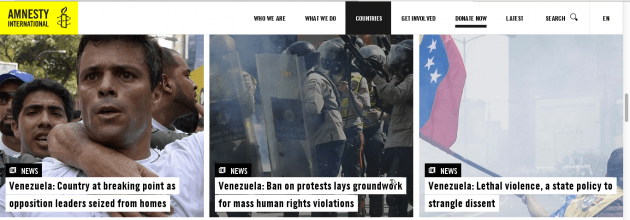
This is identical false coverage to that of Western mainstream corporate media and most Western alternative media outlets too. Amnesty International’s coverage minimizes opposition murders of ordinary Venezuelans, setting many people on fire, violent attacks on hospitals, universities and even preschools and innumerable acts of intimidation of the general population. That headline “Venezuela: Lethal violence, a state policy to strangle dissent” is a pernicious lie. President Nicolas Maduro explicitly banned the use of lethal force against opposition demonstrations from the start of the latest phase of the opposition’s long drawn out attempted coup back in early April this year.
Likewise, against Nicaragua, Amnesty’s latest report, kicking off their global campaign to stop Nicaragua’s proposed Interoceanic Canal, also begins with a demonstrable lie : “Nicaragua has pushed ahead with the approval and design of a mega-project that puts the human rights of hundreds of thousands of people at risk, without consultation and in a process shrouded in silence” That claim is completely false. Even prior to September 2015, the international consultants’ impact study found that the government and the HKND company in charge of building the Canal had organized consultations with, among others, over 5400 people from rural communities in addition to 475 people from indigenous communities along the route of the Canal and its subsidiary projects. There has been very extensive media discussion and coverage of the project ever since it was announced.
That extremely prestigious ERM consultants’ Environmental and Social Impact study, which together with associated studies cost well over US$100 million, is publicly available in Spanish and in English. Two years ago, it anticipated all the criticisms made by Amnesty International and was accepted by the Nicaraguan government, leading to a long period of analysis and revision that is still under way. Amnesty International excludes that information. Recently, government spokesperson Telemaco Talavera, said the continuing process involves a total of 26 further studies. Until the studies are complete, the government is clearly right to avoid commenting on the proposed Canal, because the new studies may radically change the overall project.
Amnesty International states, “According to independent studies of civil society organizations, along the announced route of the canal, approximately 24,100 households (some 119,200 people) in the area will be directly impacted.” But, the ERM study notes, “HKND conducted a census of the population living in the Project Affected Areas. The census determined that approximately 30,000 people (or 7,210 families) would need to be physically or economically displaced.” But Amnesty International’s report omits that contradictory detail, demonstrating how irrationally committed they are to the false propaganda of Nicaragua’s political opposition.
Amnesty International claim their research team interviewed “at least 190 people” concerned about the effects of the Canal. By contrast, the Nicaraguan government and the HKND company have discussed the project with around six thousand people in the areas along the route of the Canal. In that regard, even the local church hierarchy has criticized the way the Nicaraguan opposition have manipulated rural families on the issue of the Canal. But that fact too, Amnesty International omits. Their whole report is tailor made to supplement the political opposition’s campaign for US intervention via the notorious NICA Act.
The Nicaraguan government has made an express commitment to a fair and just resolution of the issue of expropriations. Its 2015 report on the Canal in the context of its National Development Plan, states : “The Nicaraguan government and HKND will guarantee that persons and families on the route of the Canal’s construction will have living conditions superior to those they currently have (without the Canal). To that end, the Government of Reconciliation and National Unity, via the Project’s Commission, will guarantee not just a fair and transparent indemnification of their properties, via negotiations and direct agreements with each family affected, but furthermore will promote actions to improve their economic conditions, health care, education, housing and employment.
But the Amnesty International report systematically excludes that and any other sources giving the government’s point of view, claiming it was unable to access primary sources either from the government itself or from among the Canal’s numerous advocates. However, secondary sources abound that categorically contradict Amnesty’s advocacy against the Canal. Their report specifically and extensively attacks the Law 840, facilitating the construction of the Canal and its sub-projects, but cynically omits a fundamental, crucial detail, while also failing completely to give relevant social and economic context.
The crucial detail is that Law 840’s Article 18 specifically states the Canal project “cannot require any Government Entity to take any action that violates the political Constitution of the Republic of Nicaragua or the terms of any international treaty of which the State of the Republic of Nicaragua is a party.” Amnesty International completely omit that absolutely crucial part of the Law 840 from their report because it makes redundant their advocacy of opposition claims attacking the equity and legality of the Canal’s legal framework. The same is true of the relevant political, social and economic context.
Nicaragua’s political culture is based on dialog, consensus and respect for international law. All the main business organizations and labor unions in Nicaragua and all the main international financial and humanitarian institutions acknowledge that. President Daniel Ortega and Vice President Rosario Murillo enjoy levels of approval of over 70%. There is good reason for that massive majority approval. Among many other factors, the precedents of how the Nicaraguan authorities have resolved relocating populations affected by large projects, for example the Tumarín hydroelectric project, completely contradict the scaremongering of the Nicaraguan opposition propaganda, so glibly recycled by Amnesty International.
Nicaragua’s current Sandinista government has been the most successful ever in reducing poverty and defending the right of all Nicaraguans to a dignified life. To do so, among many other initiatives, it has mobilized record levels of foreign direct investment. In that context, Law 840 explicitly protects the huge potential investments in the proposed Canal, while at the same time implicitly guaranteeing constitutional protections. Similarly, ever since the announcement of the Canal, President Ortega has repeatedly, publicly reassured people in Nicaragua that any families who may eventually be relocated should the Canal go ahead will get every necessary help and assistance from the government.
Just as it has done in the case of Venezuela, on Nicaragua, Amnesty International misrepresents the facts, cynically promoting the positions of the country’s right wing political opposition. In Latin America, under cover of phony concern for peoples’ basic rights, in practice Amnesty International, like almost all the big multi-millionaire Western NGOs, gives spurious humanitarian cover to the political agenda of the US and allied country corporate elites and their governments. The destructive, catastrophic effects of Amnesty International’s recent role in the crises affecting Syria, Ukraine and now Venezuela, are living proof of that.
AIPAC video describes decades-long role in US laws against BDS
If Americans Knew – August 14, 2017
AIPAC, the American Israel Public Affairs Committee, is a powerful Washington DC lobbying organization. In this 2016 video, AIPAC describes how it has successfully worked to create U.S. laws against boycotting Israel over its multitudinous violations of human rights and international law.
The video doesn’t mention the anti-boycott legislation working its way through Congress right now (S.720 / H.R. 1697) that AIPAC helped draft: iak.salsalabs.org/antiboycottbill
Such anti-boycott laws hurt everyone.
They interfere with Americans’ fundamental consumer rights and freedom of speech, often harm American businesses and thereby the U.S. economy, and damage American international relations.
They prevent peace and perpetuate violence in the Middle East. By helping to sustain Israel’s enormous power over Palestinians, they cause Israeli leaders to believe two things: they can ignore international law, and they don’t need to negotiate with Palestinians in good faith to reach a fair and lasting peaceful resolution.
Ultimately, AIPAC’s actions have hurt Palestinians, Israelis, Americans, and the many of others impacted by the Israeli-Palestinian conflict and by Israel’s various wars against its neighbors.
Democratic Demagogues and ‘The Better Deal’
By James Petras • Unz Review • August 9, 2017
Introduction
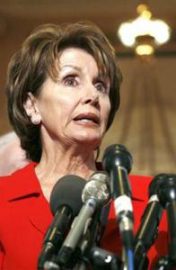 After 6 months of blaming Russia for the Democratic Party’s Presidential election debacle, the Party stalwarts have finally realized that the American electorate is not listening.
Democratic Party investigators in Washington still hold hearings and the mass media are still scandal mongering, but the public is not rallying to their cause.
Trump’s demagogy may have lost its appeal, while the Republican Administration purges and internecine squabbles have been met with a huge collective yawn by the public. The Democratic Party proves itself to be a weird sideshow for the vast majority of American voters… and for good reason.
Their perpetual (corrupt and senile) leaders are unwavering supporters of every indignity and economic hardship that the majority of worker families have suffered for the last three decades.
Democratic Party Senator Chuck ‘the Schmuck’ Schumer and Congresswomen Nancy ‘The Loser’ Pelosi have spent a collective sixty-five years in Congress. Their joint tenure marks a period of long decline in working class living standards and even worker life expectancy, while they have made possible the greatest concentration of wealth in the hands of the 1% plutocrats.
The Democratic Party’s ‘Better Deal’ – But for Whom?
In July 2017, nearly a dozen of the top Democratic Party honchos and Congress people met to spin out a new electoral manifesto for American workers which they are marketing as ‘A Better Deal’.
They issued prophetic press releases claiming to have received (presumably from the Holy Mountain) ‘a new vision of the party’. They claimed ‘the vision’ was also the result of their humble ‘listening to the American people’. They confessed that ‘the American people deserve better’. But their sweetly harmonized collective ‘Mea Culpa’ omitted any mention of the four previous Democratic Party Presidential terms, under Bill ‘The Shill’ Clinton and Barak ‘The Con” Obama, which ushered in this deplorable state of affairs for the American working class.
The Democratic Party’s ‘new vision’ wallows in the muddy demagogic footsteps of ‘The Donald’ Trump: Their new ‘product’ is just ‘demagogy lite’.
Tossing electoral fodder to the multitude, they have trotted out three ‘new promises’: 1. cheaper drug prices, 2. the regulation of ‘monopolies’ and 3. more funds to retrain workers. Their new marketing campaign does not include even a tiny whisper about a single payer national health system (favored by the majority of the public and by tens of thousands of doctors and nurses). Their cheap shots on ‘drug prices’ does not mention how Obama and Clinton facilitated the Big Pharma’s pillage of the public for decades. They mention ‘monopolies’ but made no attack on Wall Street billionaires. Their ‘job re-training’ promises have no provision for any national public employment program. The ‘Better Dealers’ with their ‘New Vision’ have banished all mention of ‘trade unions’.
The minimalist program of these old hack Democrats, re-packaged as the ‘Better Deal’, will not attract American workers for several clear reasons:
Reason #1: The Democrats Have a Rotten Record
For the majority of the American electorate there is no reason to believe or trust the Democratic Party leadership in the Senate. The leading Senate Democrat is New York’s ‘Chuck, the Schmuck’ Schumer, best known for his three decade residence in the pockets of Wall Street, his open loyalty to the dictates of Tel Aviv and his cozy relationship with the Brighton Beach mafia.
Schumer promoted the ‘trillion-dollar tax-payer bailout’ of Wall Street while foreclosing on 2 million household mortgages. He consistently defended AIPAC officials caught spying for Israel and has led the Zionist attack against the UN whenever questions of Israel’s war crimes and ethnic cleansing of the Palestinian people arise. He led the Senatorial Pack of wolves into destroying Iraq in 2003 and Libya in 2011. He has now turned his tribal ire against his ‘fellow’ American citizens, leading the Senate campaign to make criticism of Israel by boycotting Israeli products punishable by a fine of $1 million dollars and 20 years in Federal Prison. Huge numbers of law-abiding Americans who support the BDS movement for justice and international law will now be targeted with felony convictions and loss of their civil rights by the Israel Anti-Boycott Law (S720). That Senator Schumer would condemn thousands of his own compatriots to virtual life imprisonment for the ‘crime’ of exercising their First Amendment Right of Free Speech speaks volumes about his respect for the Constitution. This thug has brow-beaten scores of his fellow representatives in Washington to support this tyrannical legislation by threatening them with the career-ending accusation of ‘anti-Semitism’ if they waver in their fealty to the war criminals in Israel.
Throughout his political career, Senator Schumer consistently supported Federal Reserve free marketer Alan Greenspan, whose wholesale deregulation of the banks and finance sector led directly to the financial crash of 2008.
Geographically closer to Senator Chuck than Tel Aviv are the factory towns, green hills and valleys of Upstate New York where his forgotten constituents have suffered from decades of de-industrialization, 30% de-population and a raging socio-economic crisis of which the opioid epidemic is only part. Meanwhile, the warmonger Schumer prefers to rant for war against North Korea demanding Trump impose trade sanctions on China. If Beijing finally decides to tell Netanyahu how ‘the Shumck’s’ sanction bombast would harm Israel’s lucrative trade with China, a gentle whisper from Tel Aviv would silence Schumer’s bluster.
Peering over his bifocals, ‘Commandante Schumer’ now claims to lead the “The People’s Resistance against Trump”. While his party activists vent against the ‘Trump and the deplorables’ over the internet, Chuck will be attending the Bar Mitzvahs of Brighten Beach mobsters at the Waldorf Astoria and soirees with his Wall Street billionaire backers, consulting over strategy with his real constituents. Under Schumer, New York City has become the most socially and economically polarized and unequal city in the US.
Most voters know that Schumer’s ‘reincarnation’ as a ‘resistance politico’ is laughable and that the Senator’s re-election rests comfortably with the multi-million dollar contributions from his brothers on Wall Street.
Across the nation, most working class voters have dismissed the antics of the Democratic Party’s ‘Maestro of Demagogy’, Bernie Sanders – who spoke pious piffle to the workers while running errands for the ‘Queen of Chaos’, Hilary Clinton, would-be President and life-long Wall Street warmonger.
The citizens rightly reject the Presidential and Senatorial demagogues, Trump and ‘The Schmuck’. According to a recent Bloomberg Poll, 58% of Americans disapprove of the Democrats, a few points lower than the Republicans level of disapproval. An ABC /Washington Post poll revealed that only 37% of Americans believe that the Democratic Party stands for something!
Nine months after the Clinton debacle, the Democrats remain at or below their dismal voter-approval. Trump has skillfully managed to sink a few points below the Democrats.
In other words, nearly 60% of the voters disapprove of leaders from both parties.
The ‘anti-Trump circus and road show’ increasingly takes place to an empty audience. Their “fight” for ‘transgender rights’ attracts the 1% while studiously ignoring the basic life supporting interests of the seventy million Americans (including both transgendered and straight) who work at lousy part-time contingent and minimum wage jobs and desperately need full-time employment at living wages.
In multiple national polls, one hundred and fifty million Americans have registered their support for a national, single payer health system to insure fairness and access to competent medical care. Instead the ‘newly visioned’ Democrats are merely offering cheaper opioids for their social pain. The people want billions of dollars in public investment for deteriorating schools and infrastructures, not bi-partisan (sic) expansion in military spending for seven ongoing wars and new wars in the making.
Warmongers are not Vote-getters
The high level of voter disapproval against the Democrats results from ultra-militarism, as well as their demands for provocative economic sanctions against Russia, Iran, North Korea, Venezuela, Palestine and China – exceeding Trump and his warmongers.
The voters know that the Democrats ‘new vision’ is a thinly veiled recipe for costly new wars and economic sanctions that will spill their children’s blood, cripple their families futures and reduce job opportunities everywhere for everyone.
New Candidates, Grass-roots Movements and the Democratic Party
The Democratic Party’s fiasco and their election losses, as well as the growing realization that the socio-economic demands of the American people are never going to be addressed by the ‘old-new visionaries’, have led to a new ‘crop’ of candidates for the 2018 elections.
Over 200 Democratic Party candidates have registered to run in 2018 elections, hoping that ‘new faces’ and a new style of demagogy will bring back the disenchanted voters. These much-ballyhooed ‘upstarts’ toss out empty promises to the victims of the dying economy, industrial towns in ruins, villages with social and health crises, big cities with skyrocketing rents and stagnant wages. They offer nothing that can bring workers back to a Democratic Party still tightly controlled by the Tel Aviv-Wall Street shilling, war-mongering Pelosis and Schumers.
The Democratic Party ‘insurgents’ try to imitate the ‘Bernie’ Sanders double-speak, attacking the billionaires while shilling for the oligarchs’ stable of loyal Democratic Party hacks. The ‘new vision’ Democrats have motes in both eyes and a long road to regaining the votes of the disillusioned ‘deplorables’!
Media-sponsored trips to Rust Belt States to bad-mouth ‘The Donald’ and his anti-health agenda provides no alternative to the decades of Democratic Party betrayal on health care, especially during the last Democrat Presidents whose policies facilitated the rise of Big Pharma’s prescription opioid epidemic which has killed over 500,000 overworked and underpaid workers since 1999. Their continued refusal to hold these policies and their authors to account does not reflect any vision of a viable solution to the crisis.
Conclusion
In place of the discredited bipartisan electoral system, numerous grass roots groups are emerging: Some are operating parallel to the flurry of new Demo-demagogues while many are working against it.
Many community-based groups have taken radical positions, which demand vast new job programs and public finance for a national, accountable, high quality health care system.
They demand prosecution and long prison sentences for Wall Street swindlers, money launderers, tax evaders and corporate drug pushers.
They demand a 90% tax rate ‘adjustment’ on the trillion dollar corporations- Apple, Facebook, Amazon, Twitter, Google etc.
The grass roots movements are more than just an ‘anti-Trump’ bandwagon (secretly driven by the old pols of the Democratic Party): They are against both parties and all demagogues. They are especially opposed to any phony ‘Better Deals’ coming out of the backsides of the billionaire-backed ‘shilling and dealing’ Democrats!
Featured Video

AIDS Inc. by Gary Null (2007)
or go to
Aletho News Archives – Video-Images
From the Archives
Clash of Civilization, Iran Part II
By Jamal Kanj – Intifada-Palestine.com – January 14, 2011
Israel’s survival kit is: perpetuate conflict, insecurity to rationalize collective hate and finally playing victim.
Devoid of conflict, Israel implodes internally; without hate, Zionism loses its justification; and playing eternal victim to continue blackmailing the West. Absence of this holy trinity, Israel ceases to exist.
From its inception, the house of Zion has mastered exploiting adversarial powers to advance Israel’s cause. For instance, their influence over the Democratic Party in the US began with President Truman’s bid for 2nd term election in 1948.
Responding to strong opposition from Secretary of State General George Marshall and Department experts urging against recognition of Israel, President Truman replied: “I’m sorry gentlemen but I have to answer to hundreds of thousands [Jewish voters] who are anxious for the success of Zionism. I do not have hundreds of thousands of [voting] Arabs among my constituents”
Zionists influence over liberal American politics was matched with the doctrinal school of Conservative theoreticians aligning the Republican Party’s platform with Israel’s objectives. The Neoconservative Zionists, coined Zioncons, invented the “Clash of Civilization” concept to fight Israel’s wars. … continue
Blog Roll
 Aletho News
- 12 Things Your Psychiatrist Was Trained Not to Tell You
- From Unipolar Universalism to Multipolar Civilizational Distinctiveness
- RSF military group defects, joins Sudanese army: State media
- Ireland goalkeeper refuses to play ‘Israel’ as squad weighs boycott
- China pushes back against US on Cuba, Iran
- Ukrainian Soldiers, Potential Mercenaries: Have Gun, Will Travel!
- Burnham’s UN debut… A masterclass in British disinformation
- Iran flights continue despite US aviation sanctions
- Global Tipping Points Lead the World Into a State of Entropy
- The day-after at the White House: USA and Xi Jinping
- If Americans Knew
- Israel forces Gazans to live in constant peril – Daily Update
- Deconstructing Netanyahu’s pants-on-fire UN rant – Daily Update
- Trump betrayed voters with his campaign lies and prioritized a foreign country once he took office
- Netanyahu calls Israel’s war in Gaza ‘opposite of genocide’ in UN speech to near-empty hall
- Settler Kidnappings: Torture, Sexual Abuse and Terrorisation of Palestinian Abductees as Israel Deepens Annexation of West Bank
- Gaza winter nears as 162,000 tents become unusable, raising fears of humanitarian crisis
- Netanyahu says, “It’s the opposite of genocide”; UN says Gaza economy is world’s ‘most severe crisis on record’ – Daily Update
- Israel’s US-Backed Assault on Gaza Has Created the ‘World’s Most Severe Economic Crisis on Record’: UN
- ‘Protecting U.S. Citizens’… From Israel
- ‘This is where I live now, the back of a truck’: a day in the life of a grandmother in Gaza
- No Tricks Zone
- New Study: Earth And Venus Surface Warmth Largely Explained By Convection And Lapse Rate, Not CO2 Or Radiation
- 2025 Nature Paper Claiming Worsening Global Drought Gets RETRACTED …Heavily Flawed
- New Study: ‘Global Drought Shows No Detectable Recent Acceleration Under Climate Warming’
- Economic Masterminds: German Socialists Suggest Taxing Productivity Gains Stemming From Using AI
- The South China Sea Has Not Been Cooperating With The Climate Change Narrative
- Energy Crisis: Germany Enters Heating Season With Historically Low Gas Reserve Fill Levels
- New Study: The Antarctic Ice Sheet Gained Mass From 2020-2024 Due To Staggering Snow And Ice Accumulation
- Study: Ocean Heating Rates From Thousands Of Years Ago ‘Dwarf’ Modern Ocean Heating Rates
- Climate Extremists Target, Attack Large-Scale Power Grid Infrastructure In Germany!
- New Study: Antarctic Ice Melt Has Contributed Less Than 1 Centimeter To Sea Level Rise In The Last 30 Years

