Response to Nation Article on Single Payer: Improved Medicare for All is the Solution
By Margaret Flowers | Health Over Profit for Everyone | August 7, 2017
On August 2, 2017, The Nation published an article by Joshua Holland, “Medicare for All isn’t the Solution for Universal Health Care,” chastising Improved Medicare for All supporters because, in his view, the single payer movement has “failed to grapple with the difficulties of transitioning to a single-payer system.” The article, which doesn’t quote anyone involved in the movement for Improved Medicare for All, begs a response because it shows what liberals opposed to single payer believe. Holland dredges up the same arguments used to keep single payer off the table during the creation of the Affordable Care Act (ACA). He even dusted off a few that were used to try to stop Medicare from coming into existence in the 1960s. And then he attempts to distract single payer supporters away from supporting Improved Medicare for All and settling for something less, as was done successfully in 2009.
The first error that Holland makes is confusing the term “Medicare for All” as meaning that advocates would simply take the current Medicare system, with both traditional and ‘Advantage’ plans, and expand that. This is why it is important to use the phrase “Improved Medicare for All.” As outlined in HR 676: The Expanded and Improved Medicare for All Act, the new system would be based on the current Medicare system, which is already national, but it would be a single public plan that is comprehensive in coverage and does not have out-of-pocket costs or caps. It would ban investor-owned facilities and ban private insurers from selling policies that duplicate what the system covers. A single system is the simplest for patients and health professionals because there is one transparent set of rules.
Most people who purchase health insurance have no idea which plan is best for them because nobody can anticipate what their healthcare needs will be in the future. A study of the Massachusetts health exchange plans done by the Center for American Progress showed that some plans were best for patients with cancer and other plans were best for people with heart disease or diabetes, but that isn’t something that can be advertised up front. Even if it were, people can’t predict if they will be diagnosed with cancer, heart disease or diabetes in the future. HR 676: The Expanded and Improved Medicare for All Act solves this problem by creating a single public plan designed to cover whatever our healthcare needs will be.

A second error that Holland makes is saying that HR 676 calls for the new system to start within a single year. The bill will take effect “on the first day of the first year that begins more than [emphasis added]1 year after the date of the enactment of this Act.” This means that if HR 676 were to be signed by the President in July of 2018, then it would take effect in January of 2020. Holland raises the concern that we can’t move the whole country into the new Improved Medicare for All system that quickly. In fact, HR 676 has transition periods for the Veteran’s Administration, the Indian Health Service, displaced workers and buying out for-profit health providers.
When Medicare was enacted in 1965, more than 50% of seniors were uninsured and the rest had some form of health insurance. Without computers and without a national health system in place, all 19 million seniors were enrolled in the first year (almost twice as many as were enrolled in the ACA in the first four years). At present, the United States has Medicare infrastructure in place and all practicing health professionals have a National Provider Identifier issued to them by the Centers for Medicare and Medicaid Services (CMS). When the new Improved Medicare for All system takes effect, enrollment will be very simple because there is only one plan that is universal and paid for up front though taxes. All health professionals will be in it. Every person could be sent a card, much as CMS does now for people who are turning 65. For those who do not receive a card, HR 676 has a solution – when they present for care at a health facility, they are assumed to be in the system, are treated first and then are enrolled in the system afterwards.
Next, Holland brings up the same arguments used to prevent universal health care attempts in the past. He states that people don’t want to give up what they have. This is called ‘loss aversion.’ It is a task of the single payer movement to build the public support for Improved Medicare for All necessary to overcome any potential loss aversion. Public figures and elected officials can play a role in building support as well.
Holland raises concerns that employers and seniors won’t want to give up their private plans, but that is based on his mistaken belief that Improved Medicare for All will be the same as current Medicare. The reality is that people will be less worried about giving up what they have if they know that it will be replaced with something better and that they will no longer fear losing their doctor as they will all be in the new system. Improved Medicare for All will provide more comprehensive benefits, no out-of-pocket costs and an unrestricted network of health professionals from which to choose. Employers will no longer be burdened with the high costs of health insurance. People with pre-existing health conditions will no longer worry about losing coverage or having to pay more. Unions and employers can offer supplemental plans for extras not covered by the new system, as is done in countries like France, if they choose to do so.
Holland also raises the concern that people will lose their doctor because they will opt out of the system due to low reimbursements. We are already losing doctors because of the current system. Physician burnout was listed as the second biggest concern by the Surgeon General last year. Under Improved Medicare for All, all health professionals will be in the system. There won’t be any place to opt out to. And why would they want to? Health professionals will save tens of thousands of dollars each year on billing and won’t have to worry about whether a patient has insurance or not. They can see anyone who calls for an appointment. And they will have a system with which to negotiate fair reimbursement. Private health insurance doesn’t negotiate with physicians and hospitals. Each year they make an offer and providers can either basically take it or leave it. Doctors in single payer systems that spend much less per capita than the United States are paid well, so the US can certainly afford to reimburse doctors adequately.
 Every transformative change has suffered from loss aversion, but that hasn’t stopped them. When Medicare was enacted, it was called socialized medicine, a government intrusion that would take away people’s choices and freedom and become an opening to government control over our lives. The scare tactics didn’t work and Medicare is one of the most popular parts of our current healthcare system. Desegregation, women’s rights, workers’ rights and more were great changes that were successful and we are a better society for them. Why is the right to health care any different?
Finally, Holland dives into the myth that we can’t afford Improved Medicare for All because it will be too expensive. My first response when I hear this is that the same excuse wasn’t made when we spent $16 trillion to bail out the banks in 2008 and is never made when we invade another country, so why is it raised when it comes to one of the most basic necessities a society can have? The United States has the highest wealth and the highest wealth inequality of industrialized nations. The new “Commitment to Reducing Inequality Index” recommends social spending on education, health and other basic social protections as its top priority. Congress can appropriate the funds to do this. This should be a top priority in the United States as well.
The reality is that the United States is already spending the most on health care per person each year because the market has failed to control costs. That is exactly why we need a single payer system like National Improved Medicare for All. It is the only way to simplify the bloated bureaucracy of the current healthcare system, which would save around $500 billion each year, and to control the costs of medical procedures, medical devices and pharmaceuticals by having a single system that can negotiate fair prices. In addition to the bureaucracy created by a multi-payer system, the US subsidized the insurance industry with more than $300 billion last year. A system based on health, rather than profits for investors, can identify and prioritize our greatest health needs and work to address them.
For example, the US is failing when it comes to care for people with chronic diseases. There are numerous reasons why this is occurring – lack of access to consistent care, inability to afford medications, insufficient time for health education when patients see a health professional, cheap and highly processed food, environmental pollutants and more. An actual health system could take meaningful action to address these issues, and keep people healthier. Think about it: people with high blood pressure or diabetes in the US may not be able to see the doctor regularly or stay on their medicines due to cost, but when they suffer a stroke or kidney failure, and need long term care or dialysis, then they can receive disability benefits and Medicare. How much better and less expensive would it be for everyone to prevent strokes and kidney failure in the first place?
Just as many ‘progressive’ groups did during the health reform process that resulted in the ACA, Holland works to convince us that we don’t need a single payer system, and that we can work with the current system. Once again, Jacob Hacker, a leading advocate for the ACA and single payer opponent, is invoked and we are told that we can add a Medicare buy-in or another form of a public option. We are told that other countries use private insurance, so why can’t we? The Democrats, beholden to the medical industrial complex, want us to believe these false non-solutions that protect the insurance industry. It feels like 2009 all over again.
Rather than go through all of the reasons why these approaches will fail, I urge you to read articles on that topic posted on HealthOverProfit.org (Click here for a list of them). Instead, I refer to a saying used by my now-deceased mentor Dr. Quentin Young: “You can’t cross an abyss in two jumps.” The only way we can get to a universal single payer healthcare system in the United States is by creating a universal single payer healthcare system in the United States. Anything less than that will fail because it will not achieve the savings on administration and prices needed to cover everyone and it will not compete with the powerful private insurance industry.
Throughout time, every great social movement has been told that it was asking for too much. Advocates for worker’s rights, women’s rights, civil rights, etc., were labelled as unreasonable radicals wishing for some pie-in-the-sky change that can’t be achieved. Holland is doing the same to the single payer movement. Don’t fall for it. We have the resources in the US to have one of the top healthcare systems in the world. We have health policy experts who have helped to design excellent systems for other countries. Single payer is a proven solution, unlike the plans being proposed by the Democratic leadership.
One thing that Holland and I do agree on is that there is more than one way to skin a cat, so to speak. We could have an excellent national debate about which type of single payer healthcare system we support – a fully socialized system like the Veteran’s Health Administration, a national health service, or a socialized payer with multiple types of providers as in the Expanded and Improved Medicare for all Act. At the basis of our discussion must be the principles that every person in the US deserves high quality health care without financial barriers.
‘Free trade’ has come to mean powerful interests get whatever they want
By Yves Engler · August 8, 2017
“Free trade” has become a euphemism for “whatever power wants,” no matter how tangentially tied to transferring goods across international borders.
In an extreme example, Ottawa recently said its Free Trade Agreement (FTA) with Israel trumps Canada’s Food and Drugs Act since accurately labelling two wines might undermine a half-century long, illegal, military occupation.
Of little connection to international trade, the North American Free Trade Agreement — and subsequent FTAs — has granted foreign corporations the ability to bypass domestic courts and sue governments in secret tribunals for pursuing policies that interfere with their profit making. Over 75 cases have been brought before the Investor State Dispute Settlement section of NAFTA, which has resulted in tens of millions of dollars paid to companies impacted by Ottawa banning the export of toxic PCB wastes or the import of suspected neurotoxin gasoline additive MMT.
Strengthening this dynamic, Canada’s “free trade” deal with the European Union (CETA) empowers companies to sue municipalities if they expand public services. For instance, a municipality unhappy with private water delivery could face a suit if they tried to remunicipalize (or de-privatize) this service.
CETA, TPP, WTO and other self-described “free trade” agreements also extend patent and copyright protections (monopolies), which stifle competition, a pillar of free trade ideology. CETA’s increased patent protections are expected to drive up already high Canadian pharmaceutical drug costs by between $850 million and $1.65 billion a year. Negotiations to “modernize NAFTA” could end up granting big pharma perks that would effectively block Canada’s ability to set up universal pharmacare. Similarly, the yet to be signed TPP strengthens patents and would increase the length of copyright in Canada from 50 to 70 years after the death of an author.
It is little exaggeration to say politicians have come to employ the term “free trade” to mean “whatever powerful corporations want.” But, the Trudeau Liberals recently broadened the term’s definition even further. In a move to make “free trade” mean “whatever powerful interests want,” they announced that Canada’s FTA with Israel supercedes this country’s Food and Drugs Act.
After David Kattenburg repeatedly complained about inaccurate labels on two wines sold in Ontario, the Canadian Food Inspection Agency (CFIA) notified the Liquor Control Board of Ontario (LCBO) that it “would not be acceptable and would be considered misleading” to declare Israel as the country of origin for wines produced in the Occupied Palestinian Territories. Quoting from official Canadian policy, CFIA noted that “the government of Canada does not recognize Israel’s sovereignty over the territories occupied in 1967.”
In response to pressure from the Israeli embassy, Centre for Israel and Jewish Affairs and B’nai Brith, CFIA quickly reversed its decision. “We did not fully consider the Canada-Israel Free Trade Agreement,” a terse CFIA statement explained. “These wines adhere to the Agreement and therefore we can confirm that the products in question can be sold as currently labelled.”
In other words, the government is publicly proclaiming that the FTA trumps Canada’s consumer protections. But, this is little more than a pretext to avoid a conflict with B’nai B’rith, CIJA and Israeli officials, according to Canadian Centre for Policy Alternatives Trade and Investment Research Project director Scott Sinclair. “This trade-related rationale does not stand up to scrutiny,” Sinclair writes. “The Canadian government, the CFIA and the LCBO are well within their legal and trade treaty rights to insist that products from the occupied territories be clearly labelled as such. There is nothing in the CIFTA [Canada–Israel FTA] that prevents this. The decision to reverse the CFIA’s ruling was political. The whole trade argument is a red herring, simply an excuse to provide cover for the CFIA to backtrack under pressure.”
In another commentary on the government “backtracking under pressure,” Peter Larson points out that CIFTA grants Israel an important concession that seeks to sidestep Canada’s commitments under international law. The agreement says, “unless otherwise specified, ‘territory’ means with respect to Israel the territory where its customs laws are applied,” but omits “in accordance with international law,” which is in many of Canada’s other free trade agreements. This omission seeks to allow goods produced on land occupied in contravention of the 4th Geneva Convention and Statute of Rome to benefit from CIFTA.
David Kattenburg and his lawyer Dmitri Lascaris will be challenging CFIA’s decision in court. On Monday they filed an appeal of the wine labelling and released a statement to the media.
The Council of Canadians and Canadian Centre for Policy Alternatives have recently added their voices to those criticizing CFIA’s decision. The NDP’s trade critic has yet to comment.
Kattenburg and Lascaris’ court challenge offers NDP leadership candidates Niki Ashton, Charlie Angus, Guy Caron and Jagmeet Singh a good opportunity to express their opposition to defining “free trade” as “whatever power wants.”
The NYT’s Grim Depiction of Russian Life

Sakhalin, Russia: photo by Lesya Kim, 19 August 2016
By Gilbert Doctorow | Consortium News | August 7, 2017
Our five-week stay at our home in the Russian countryside was approaching its conclusion when I got an email from a friend in France asking me to comment on an article in The New York Times entitled “Russia’s Villages, and Their Way of Life, Are ‘Melting Away’.”
The article surely met the expectations of its editors by painting a grim picture of decline and fall of the Russian countryside in line with what the author sees as very unfavorable demographic trends in the Russian Federation as a whole. The fact that his own statistics do not justify the generalization (a net population loss of a few thousand deaths over live births in 2016 for a population of 146 million) does not get in the way of the paint-by-color canvas. Nor does the author explain why what he has observed in a village off the beaten track in Northwest Russia, in precisely the still poor region of Pskov, gives an accurate account of country life across the vast territory of Russia, the world’s largest nation-state.
As the author notes, the main source of income from the land of the town he visited was – in the past – linen. That cultivation turned unprofitable and was discontinued. Consequently, the able-bodied part of the population has been looking for employment and making their lives elsewhere (a process of internal migration common all over the world, including the United States).
The author fails to mention that linen production is not a major agricultural indicator in Russia today, whereas many other crops are booming. Linen goes into the lovely traditional handicraft tablecloths and napkins sold to tourists at riverboat landings, and that is the extent of demand.
I could respond to the overriding portrait of countryside decay in the Times article by drawing on my observations a year ago from the deck of one of those riverboats navigating the canals and rivers connecting St. Petersburg and Moscow. From that deck and from the experience of walking around the little picturesque towns where we made stops, I understand that growing domestic Russian tourism has pumped financial resources into historic centers, like Uglich. They are coming alive, with infrastructure improvements and reviving trade.
But tourist sites are not going to be representative of the country at large, either. So I will instead use two sources of information that I am confident have greater relevance to the issue at hand. The first, and surely the most politically significant, comes from a couple of family friends who for nearly 50 years have spent summers at a parcel of land deep in the hinterland, 280 kilometers southeast of St. Petersburg, close to regional industrial center of Pikalyovo, (Leningradskaya Oblast) with its train station along the line linking the northern capital to Vologda.
My Own Eyes
The second source is my own experience in and around our property in Orlino, a hamlet numbering 300 inhabitants in the Gatchina district, also Leningradskaya Oblast, but 80 kilometers due south of St. Petersburg.
The homesteads around Pikalyovo were always hard to get to, with very poor local roads. There was no commercial infrastructure, so the bold and determined vacationers coming here had to bring most provisions for their stay with them. They were rewarded for their efforts by the produce grown in their gardens and by foraging for berries and highly desirable boletes and other wild mushrooms in the surrounding forests.
When the Soviet Union collapsed and the Russian economy followed suit in the 1990s, the Pikalyovo region suffered the kind of economic misery and population loss that the Times describes today in the Pskov region. Our friends saw that normal folks left, and the concentration of drunkards and thieves rose proportionately. The theft of anything of value in common space became acute when scrap metal scavengers pulled up kilometers of electrical cables for their copper content, leaving swathes of the district temporarily without electricity.
Pikalyovo came to the attention of national news during the 2008-2009 financial crisis when its three main industrial enterprises shut down, causing widespread misery. The best known of these enterprises, a clay processing plant owned by the oligarch Oleg Derispaska’s conglomerate Basic Element, caused a major scandal when state television carried reports on how the factory had not paid its employees for months while the boss was seeking and obtaining government assistance with repayment and rescheduling of his foreign loans. In the spring of 2009, there were protest demonstrations in Pikalyovo that resulted in both Dmitry Medvedev and Vladimir Putin personally entering the dispute to pressure Deripaska to do the right thing.
The economic woes of the regional economic hub did nothing to improve the living conditions in nearby hamlets like the one where our friends have their parcel. Our friends started cutting back on their visits and missed a year or two altogether. All of this would seem to confirm the storyline of the Times reporter, but the latest word from Volodya and Tamara overturns the storyline completely.
A Revival
A few weeks ago, our friends decided to go back to the property to prepare it for sale. They had had enough, they thought. However, once there, they discovered things were definitely looking up. A newly completed 35 kilometer highway makes their settlement much more accessible.
But, more importantly, the neighbors have changed – for the better. A retired colonel moved in a couple of years ago and started raising pigs, cows and chickens, offering meat, eggs and dairy products for sale, thereby ending our friends’ need for brought-in provisions. His example attracted others. New and dynamic settlers are putting into practice the “return to the land” trend that is an undeniable feature of current Russian social life. Our friends have decided not to sell, and to spend more time on their property.
In legal terms, the parcel of land my wife owns in the hamlet of Orlino (population 300) is categorized as a “subsistence farm.” The nature of the farming to be done there even features in the plan attached to the cadastral registry: the 700 square meters where the house was built facing the “Central Street” can be used for fruit trees and vegetable garden; the back field of another 700 square meters is allocated for potatoes, cabbage and similar crops.
In the vernacular, however, together with the two-story planed log house we built here five years ago, the property is considered a “dacha,” a summer residence. Nearly one in two urban Russian households has a dacha.
Young people think of dachas as weekend getaway locations to hold a barbecue for friends and family. If they have a feeling for Russian traditions, it is where they take their Saturday banya, or sauna in dedicated outhouses heated by wood burning stoves and then socialize over a beer. Older folks and pensioners find this frivolous. In their view, the dacha is not so much a place to idle time away as it is a place of honest toil, working the land and communing with nature. And even some of the younger generation buys into the concept of growing their own organic foods on their land, thus getting along without industrially farmed supermarket produce, whether domestic or imported.
One hundred years ago, Orlino was populated mostly by wealthy merchants whose businesses were in the extended district. They lived here year-round in substantial houses, some of which have survived to this day. To the back of the houses, what were essentially barns were built on, and there they kept some small livestock. No one in Orlino today keeps chickens, pigs, goats, not to mention cows. But they do till the land with great enthusiasm and look after their fruit trees and red berry shrubs.
The notion of subsistence farming suggests border-line poverty. But Orlino was never poor, and its residents are not indigent today. Oldsters whose pensions are inadequate are supported by their children or nephews/nieces’ families living in the local towns, in the district capital of Gatchina 50 kilometers away, or even in St. Petersburg. In return, these relatives visit in the summer to spend some days of vacation and take advantage of the large lake on the edge of the hamlet, which is lovely for swimming or boating when the weather is cooperative.
Good Use of Land
The notion of subsistence farming also suggests tough practicality. But making good use of the land does not exclude aesthetic pleasures, and every parcel of land in the hamlet is decorated by flower beds showing great ingenuity and effort.
Similarly, in the last year the Orlino farmers have all gone the way of their brethren across Russia and invested in greenhouses made of pre-formed polycarbonate walls, most commonly resembling hoops in profile. Here they put in tomatoes, cucumbers and other highly prized vegetables for their dining table which do not do well in the short growing season of the North, and in the very adverse climatic conditions which were exemplary this year in terms of cool temperatures and incessant rains. Given the expense of these greenhouses, the investment is not so much economically justified as it is a point of pride in self-sufficiency and green-thumb skills.
Electricity is the only utility that spells dependency for Orlino residents. Otherwise, each household has its own well, its own septic tank system, its own gas cylinder for the cooking stove and its own supply of birch logs for a wood-burning stove that is the mainstay of heating.
Many households have cars. The most recent arrivals, being by far the most prosperous, often have four-wheel-drive utility vehicles. This is a valuable benefit given the deplorable condition of many local roads. But then there is a significant minority who depend on the local bus system to get around. It is cheap, runs to schedule and gets you from point A to point B without fuss. The hamlet has a couple of grocery stores, so that staples are always available within easy walking distance.
An Economic Hub
For luxuries, there is the town of Siversk 10 kilometers away. Numbering perhaps 10,000 people, it is the local economic hub, with several factories, including a manufacturer of good quality upholstered furniture.
Siversk has a train station with hourly connections to Gatchina and St. Petersburg. It also has several supermarkets run by major national retail chains, so that you will find exactly the same product assortment as in St. Petersburg or Moscow. And there are a number of high quality specialty food stores and at least one bakery which is indistinguishable from what you might find in Vienna or Frankfurt.
In the not so distant past, even urban Russians had not much interest in salads or in fish. Chicken legs or sausages or pork cutlets for the barbecue were what folks shopped for as main courses. Now even our Siversk stores offer pre-packaged mixed lettuce salads or rucola coming from greenhouse complexes in Greater St. Petersburg.
And the leading fish store offers not only salmon steaks from Scandinavian producers, but several varieties of delicacy fish from Europe’s largest fresh water lake, situated 50 kilometers to the east of St. Petersburg. Still more impressive is the assortment of fish coming down each day from Murmansk: excellent flounder and superb gorbusha, a wild salmon usually considered to be a Pacific Ocean variety but also available in the waters north and west of Siberia. For those with deeper pockets, the fish vendor in little Siversk occasionally offers a fresh sterlet, the magnificent 1 kilogram-size representative of the sturgeon family that is farmed on the Volga in Astrakhan, far to the South.
I offer these observations from shopping to make the following point about the Russian country life as I see it: a lively economy with a population growing ever more sophisticated and aspiring to the good life.
The Lower Strata
When I shared these thoughts with my friend in France, he shot back: what about the lower strata of society? How are they faring?
My ready response draws on my five-year acquaintance with our “average Joe” neighbor in Orlino, Sergei. When we settled here five years ago, he drilled our artesian well, installed the electric pump and all sanitary plumbing in our house. Now he winterizes the house each year and keeps an eye on the property when we are away, for compensation to be sure, but more out of friendship, because he has other, more lucrative sources of income as a subcontractor or day worker on local construction projects. There is a lot of work of this kind now that Orlino’s fallow fields are slowly being converted into housing estates.
Sergei is a master of several building trades. He also drives a tractor. He is mechanically gifted.
Sergei is about 55, the father of a grown son and daughter, the grandfather of two. When we first met, he was living in an apartment in a multi-unit wooden house dating back 60 or 70 years that was neither comfortable nor attractive. In the past three years he has realized a long time dream and built for himself a two-story cement block house, now clad in siding. The interior space is perhaps 250 square meters. When you pass it from the road, in a row of several other very substantial recent houses, you would place it as solidly upper-middle class. And next to his house Sergei has put up a very fine and large greenhouse. Beyond that is an extensive field of splendid potatoes and vegetables.
To be sure, the second story of Sergei’s house still needs work and he and his wife live now only on the ground floor. Moreover, the investment of all spare cash into the house has scuttled other needs. When Sergei’s ancient Toyota pick-up finally rusted into irreparable condition, he found himself without motorized transport. Until further notice, until he can put together the down payment for a new vehicle, he gets around town on a bicycle.
Sergei is no fool. He gripes about local corruption and terrible roads. But on the whole he is satisfied with his lot and optimistic about the future. Any belt-tightening that has been made necessary by Western sanctions he takes in his stride. He is resolutely patriotic.
I realize full well that the observations taken from my personal experience of the Russian countryside and from the experience of close friends is anecdotal and so not statistically significant. But then neither are the observations of The New York Times reporter.
Russia is a vast land and you can pretty much find what you are looking for there. Nonetheless, the gross economic statistics published by Rosstat are upbeat and fully contradict the notion of a country in decline, including its rural component.
Gilbert Doctorow is an independent political analyst based in Brussels. His latest book Does Russia Have a Future? was published in August 2015. His forthcoming book is Does the United States Have a Future?
Modi revisits Iran ties
By M K Bhadrakumar | Indian Punchline | August 6, 2017
The decision by Prime Minister Narendra Modi to depute the minister of transport Nitin Gadkari to represent India at the inaugural ceremony of Iran’s president Hassan Rouhani on his second term is a most appropriate, timely and thoughtful decision. ‘Appropriate’ – because it is a signal that India attaches high importance to relations with Iran. Gadkari is a senior figure in the cabinet – all but prime ministerial material, one might say. ‘Thoughtful’ – because of two reasons. One, Gadkari is also the government’s point person with regard to the strategic Indian project to develop a transit route to Afghanistan and Central Asia via Iran’s Chabahar Port.
Two, it is an assertive statement that India’s cooperation with Iran will not be buffeted by ‘Trumpspeak’. This is timely because the Iran-US engagement has run into difficulties and US officials have spoken of a preposterous ‘regime change’ agenda vis-à-vis Iran. A confrontation seems improbable but a showdown cannot be ruled out, either. If there is a confrontation / showdown, Modi government will come under pressure not only from the US but also from Israel, and India will be in the unhappy position of having to stand up and be counted. Strategic ambivalence, which comes easy to the Indian DNA, may no longer be an option. The previous UPA government of course simply opted to pull down the shutter and fall in line with the US diktat. It will be interesting to see how much spunk the present nationalist government would show to resist pressure on its regional policies, if push comes to shove.
However, India is in good company if it views Iran as a major partner. The presence of the European Union Foreign Policy chief Federica Mogherni at Rouhani’s inaugural underscored that EU does not go along with the US’ sanctions bill against Iran. So, indeed, the presence of Russia’s Deputy Prime Minister Dmitry Rogozin, a close aide confidante of President Vladimir Putin, signals that Moscow has a big agenda to expand and deepen the cooperation with Iran. The Chinese President Xi Jinping deputed He Lifeng, head of China’s National Development and Reform Commission, to represent China. Of course, He is the principal driver of the Belt and Road Initiative in the Chinese government.
Indeed, if the inaugural ceremony was a litmus test of Iran’s integration with the international community, the result is positive and impressive. Nineteen presidents, vice-presidents and prime ministers as well as 18 heads of parliaments attended the ceremony. It is virtually impossible for the Trump administration to ‘isolate’ Iran over its missile development programme or its regional policies. By the way, the participants at the ceremony in Tehran included a high-powered delegation from Hamas and a cabinet minister from Qatar.
Gadkari has promised that the Chabahar transit route will be operational by next year. The country must hold the government to its word. There shouldn’t be any slip-ups. This can be the first significant footfall in an Indian variant of ‘Belt and Road’ initiative. More importantly, perhaps, India must now resuscitate the plans of investments in the Chabahar region for industrial collaboration. The enthusiasm with which we spoke about it two years ago has petered out. Again, a major push is needed to realise the much-talked about North-South Corridor via Iran.
In political terms, a visit by Rouhani to India is overdue. The visit will give an overall verve to the relationship and add momentum to the bilateral cooperation. The Farzad-B gas field project has proved elusive. The revised $11 billion investment offer by ONGC Videsh is pending for a decision in Tehran. The Iranian side has driven a hard bargain, which is understandable since oil is a major source of income for its economy. But then, Tehran must also realize that Farzad-B will be a ‘game-changer’ for the entire relationship with India. Perhaps, this is the single biggest investment offer India has ever made to a foreign country. The business spin-off in the downstream, if the Farzad-B project takes off, will be massive.
Global ‘False’ Witness Targets Nicaragua
By Tortilla con Sal | teleSUR | August 4, 2017
Global Witness is a well-established environmental and human rights non-governmental organization based in Britain.
As with many other similar organizations, its reports often figure in news media as authoritative sources on international issues. Ever since the 1980s and, increasingly so, after the turn of the century, the status of NGOs as trustworthy information sources on foreign affairs has become increasingly untenable as they have been more and more co-opted by corporate interests and governments to promote the Western elites’ neocolonial global policy agenda.
In the case of Nicaragua, in 2016 Global Witness produced a brief, flawed and unreliable account of land conflicts in Nicaragua’s Northern Caribbean Autonomous Region in a report called “On Dangerous Ground”. In June 2017, they produced a report called “Defenders of the Earth”, with a section on Nicaragua even more poorly researched and false than the previous one. Three main reasons stand out to dismiss the latest Global Witness report on Nicaragua as unreliable and in bad faith.
Firstly, the report itself is clearly biased and flawed, from even a cursory analysis of its references and their sources by anyone familiar with Nicaragua. Secondly, the organization’s human and material resources all come from a very narrow managerial class and corporate funding base, overwhelmingly advocating the foreign policy positions of the United States government and its allies. Thirdly, the history of Global Witness clearly indicates its categorical bias in favor of NATO country governments’ policy positions in the countries that figure in its reports and too its systemic defense of the very corporate capitalism whose destructive effects Global Witness superficially and selectively criticizes.
Global Witness sources on Nicaragua
Before looking at the text of the false Global Witness attack on Nicaragua, it is worth looking at the sources they identify in their footnotes, of which there are 23, composed of a total of 44 references. For anyone familiar with Nicaraguan politics and society since the war of the 1980s many of the sources are wearily familiar and readily identifiable as anti-Sandinista, for example, the virulently anti-Sandinista La Prensa newspaper. Some of the references are duplicates and some disguise the fact that while apparently distinct, ultimately the information they provide comes from one single source. (Here’s a link to the relevant spreadsheet for anyone interested in a more detailed analysis.)
Of the 44 references, some of which are duplicates, not one represents the view of the Nicaraguan authorities or others criticized in the report or any source sympathetic to them. 16 references are to sources inside Nicaragua politically opposed to the Nicaragua’s Sandinista government. 25 of the sources are external to Nicaragua but with a long record identifying them as ideologically opposed to the Sandinista government. Of those 25 sources, one might argue that the Washington-based Interamerican Commission for Human Rights or the EFE Spanish language news agency are impartial, but their record is indisputably biased against Nicaragua’s Sandinista authorities.
For all but imperialist ideologues, the Paris based International Federation for Human Rights (FIDH) has been discredited in particular, most recently, by its flagrant partisan bias in favor of NATO country government policies attacking the populations of Libya and Syria. One source, a reference to the law authorizing Nicaragua’s Canal, is completely neutral. Only one media source, El Nuevo Diario, is generally independent. Two references are to sources within the Western environmental scientific lobby, which has its own set of highly questionable biases, prejudices and neocolonial hypocrisy.
“Methodology”
As if by way of justifying this desperately unfair selection of sources, Global Witness also offer an account of what they call their “methodology”. They aver, “We have recorded data about the cases using the HURIDOCS Event Standard Formats and Micro-Thesauri, an approach which is widely used to manage and analyse material of this nature.”
That Global Witness claim is demonstrably untrue. Whatever their aspirations they certainly did not use the HURIDOCS approach.
HURIDOCS (Human Rights Information and Documentation Systems, International) is a European NGO established in 1982 to facilitate networking between human rights organizations around the world. HURIDOCS says its ‟specific role in this capacity-building process lies in improving access to and the dissemination of human rights information through more effective, appropriate and compatible methods and techniques of information handling. HURIDOCS recognises that we live in an age of tremendous advances in information and communication technologies. There is the need to master these technologies to aid us in our human rights work. At the same time, we must be conscious of the fact that the technologies to be applied should be appropriate and responsive to the main focus of the mandates of human rights organisation.”
HURIDOCS exposition of their approach includes the following definitions:
Fact-finding is the process of identifying the violations in one event, and establishing the facts relevant to these violations. Fact-finding and investigation are terms that are used interchangeably.
Documentation is the process of systematically recording the results of an investigation or fact-finding in relation to an event or number of events. Fact-finding and documentation are organically related and should not be viewed as separate processes.
Monitoring is closely observing a given situation in society over a long period of time to see whether human rights standards are met. To carry out monitoring, investigation and documentation of a large and/or representative number of events are conducted.”
Global Witness are not in compliance with the HURIDOCS approach because their practice in their reporting on Nicaragua demonstrably violates all of these definitions.
Their fact-finding or investigation is so heavily biased as to make it impossible for them to establish the facts. Consequently, thanks to this gross fact finding bias, their documentation is partial, often inaccurate and categorically incomplete. Nor do they show any sign of having done due diligence in monitoring consistently over time via ” investigation and documentation of a large and/or representative number of events” or the context of those events in Nicaragua.
Other theoretical considerations
Apart from these chronic procedural failures, other theoretical considerations cry out for clarification.
Global Witness say, “This report is based on research on killings and enforced disappearances of land and environmental defenders, who we define as people who take peaceful action to protect land or environmental rights”.
But in a bitter property dispute between competing communities, clarifying who is defending whose rights becomes a fundamentally important question. Certainly in Nicaragua’s northern Caribbean Coast, unscrupulous Miskito community leaders are themselves involved in provoking these property disputes by illegally selling land to rural families migrating in search of a better life. Miskito gangs have attacked and murdered many such people, a factor not even mentioned by Global Witness. They completely evade the issue of identifying in a responsible, proportionate way whose rights are being violated.
Similarly, Global Witness state, “cases were identified by searching and reviewing reliable sources of publicly online information”. But Global Witness obviously used heavily politicized criteria for deciding what is a reliable source, because not one single reference in their report on Nicaragua gives the Nicaraguan authorities’ side of the story and only one reference can fairly be described as ideologically independent. That renders completely incredible the phony Global Witness claim to systematic research.
They claim their investigation is systematic because “We set up search engine alerts using keywords and conducted other searches online to identify relevant cases across the world.” However, in the case of a small country like Nicaragua, a genuinely systematic search can readily be done covering a much wider range of sources than those accessed by Global Witness without recourse to modish, geeky “search engine alerts”. The poverty of sources evident in the report’s footnotes make Global Witness’s procedure look ridiculous.
Global Witness claim they “verify” the results of their investigation because “Where possible, we checked with in-country or regional partners to gather further information”. But they only cross-checked with ideologically and politically biased organizations, apparently using the same highly questionable, politically compromised sources they cite in their report.
Karl Popper, philosophical darling of the Open Society ideology embraced by Global Witness, explained over 50 years ago in “Conjectures and Refutations” that verification is essentially authoritarian. He argued that a truly scientific investigation requires conjecture and falsification, a search for errors rather than for justification.
If one goes along with Popper, it should surprise no one that Global Witness uses an essentially authoritarian methodology. Self-evidently, their job is not to discover the facts or to impartially establish the truth via a hypothetic-deductive Popper-style process , but to project a manipulative version of events justifying ideologically loaded interpretations favored by their corporate funders, an inherent bias understandably unacknowledged by Global Witness.
Nor is it surprising to learn from their account of their methodology, “While we have made every effort to identify and investigate cases in line with the methodology and criteria, it is important to add that our research mostly relies on public information and that we have not been able to conduct detailed national-level searches in all countries.”
That is not true either. Gobal Witness did not make “every effort” to investigate cases in line with their alleged methodology and criteria because they are flagrantly out of compliance with the definitions advanced by HURIDOCS.
A broader range of sources
Nor is is true that they were unable to conduct a detailed national-level search in the case of Nicaragua, because they could easily have included references from sources that contradict much of the information in the Global Witness report. The following is a brief sample of many other relevant sources, gleaned in a few hours searching on the Internet :
– Indigenous group splits from Miskito party in support of Sandinista government
– Attacks by indigenous gangs on settlers, killing nine
– Miskitos claim their own leaders illegally sold over 3000 acres of communal lands to outsiders
– Historic lease agreement between Canal Authority and indigenous people along the canal route
– Interview with HKND’s Bill Wild about the benefits of the Interoceanic Canal
– HKND’s Bill Wild on the Environmental and Social Impact Study
– Environmentalist Kamilo Lara explains why he believes in Nicaragua’s Interoceanic Canal
– Nicaragua’s Canal – the environmental and economic arguments
– Public Consultation on Lake Nicaragua for the Interoceanic Canal project
– Environmental and Social Impact Assessment of Nicaragua’s Interoceanic Canal – Conclusions and Recommendations
– Bishop accuses political opposition of manipulating canal protests
– Canal protestors attack and injure six police officers
Even this very limited sample of sources, put together from just a few hours searching on the Internet, gives a very different picture to the one presented by Global Witness. So it is false of Global Witness to suggest they lack the resources to be able to stress test and falsify the version of events they have published in their report. Given the tremendous resources and the numerous skilled, experienced, talented people working at Global Witness, only abject intellectual dishonesty explains their failure to report faithfully on Nicaragua
Incoherent claims
Be that as it may, based on their cynically biased sources and their absurdly deficient methodology, Global Witness proceed in their report to make the following claims:
11 defenders killed in 2016 – making Nicaragua the most dangerous country in the world per capita
But, as independent journalist John Perry and others have pointed out, none of those people killed can fairly be described as having being killed for defending the environment. They were in property disputes and all of them were killed either directly or indirectly in the course of those property conflicts. This is true in particular of the case cited by the Inter-American Commission for Human Rights (CIDH) , that of Bernicia Dixon Peralta, her husband Feliciano Benlis Flores and their 11 year old son Feliciano Benlis Dixon. Perry mentions some of the context. More context of the property disputes in the RAAN can be found here, here and here. Not a single person mentioned by Global Witness died in Nicaragua for defending the environment in the way that someone like Berta Cáceres did. Even so Global Witness have tended disingenuously to implicitly compare the situation in Nicaragua with that in Honduras, in particular with Berta’s murder.
The bad faith with which they do so is clear from the second claim in their report on Nicaragua:
10 of those murdered were indigenous people, with most killed in conflicts with settler communities over land. Meanwhile rural ‘campesino’ defenders faced threats, harassment and attacks, including for opposing the construction of an inter-oceanic canal.
Global Witness fails to make clear that groups from the indigenous Miskito people, whom Global Witness inaccurately portray as defenseless environmental defenders, are themselves guilty of murderous attacks against migrants settling land which in many cases the migrants apparently believed they had bought legitimately. Furthermore, the Global Witness report deliberately and falsely confuses the very specific situation of these property conflicts in Nicaragua’s northern Caribbean Coast with protests over the possible displacement of communities along the still to be exactly defined route of the proposed Inter-oceanic Canal 300 kilometers to the south. Global Witness unscrupulously frame their distorted version of events in the two regions to give the impression that in both cases the Nicaraguan authorities may in some way be directly or indirectly responsible for the violence.
In fact, even the New York Times has acknowledged in their otherwise generally hostile anti-Sandinista reporting that the Nicaraguan authorities do what they can with limited resources to protect the rights of indigenous peoples in the Northern Carribean Autonomous Region.
The situation along the route of the Canal is very different from that in the RAAN. Protests against the Canal are exploited by Nicaragua’s political opposition and groups participating in the protest demonstrations have damaged property and attacked police officers. In relation to this situation, completely separate from the property disputes more than 300km to the north, Global Witness claims:
Activists were increasingly criminalized: foreign environmentalists were expelled, community leaders arrested and legislation passed restricting freedoms of speech and association.
However in the very next paragraph, the report quotes anti-Canal activist Francisca Ramirez saying, ““We have carried out 87 marches, demanding that they respect our rights and we have had no response. The only response we have had is the bullet.”
Thus, the Global Witness allegation that rights to freedom of association are restricted is immediately contradicted by Francisca Ramirez declaring her group has organized over 80 public demonstrations to express their views.
Similarly, Ramirez claims “The only response we have had is the bullet.” But, in the next paragraph, we learn “a member of her community lost an eye and another was shot in the stomach”.
Thus, after 87 demonstrations, some of which supposedly involved many thousands of participants and in which “The only response we have had is the bullet”, Ramirez cites precisely two people suffering serious injury and only one of them with a gunshot wound. Ramirez omits that the protesters on the marches she organizes go armed with machetes and home-made mortars. They block highways, intimidate ordinary people going about their business, damage property and attack police officers.
In no Western country would that be tolerated without, to put it mildly, a robust response from the police and security forces. Even so, Global Witness promote Francisca Ramirez’s account as if she and her movement were non-political and non-violent, which they are not. But Global Witness excludes those facts.
Likewise, as John Perry has pointed out, the foreign environmentalists expelled from Nicaragua were involved in a suspicious incident involving a small explosion. Again, a reasonable question to Global Witness is why they excluded this highly relevant information given that in Britain or the United States any foreigner, especially any non-white foreigner, involved in such a suspicious incident would face prosecution and a potential jail term under those countries wide-ranging anti-terrorist laws.
Inaccuracies and falsehoods
Mixed in with these disingenuous, incoherent claims, Global Witness also allege, presumably as supporting context, that the proposed Canal “would force up to 120,000 indigenous people from their land”. This outrageous falsehood is sourced from the pro-NATO, right-wing dominated European Parliament, but is categorically contradicted by the relevant multi-million dollar Environmental and Social Impact report by the extremely prestigious ERM company based in the UK. The falsity of that claim is further confirmed by the Canal concessionary HKND company’s representative Bill Wild who argues that the route of the Canal has been altered to take local concerns into account in such a way that fewer than thirty indigenous families will be directly affected.
Overall, ERM reckons that up to 7210 families or around 30,000 people are likely to be displaced along the whole route of the Canal, over 270 kilometres. The scandalously untrue figure quoted by Global Witness is propaganda from Nicaragua’s political opposition who are exploiting Ramirez’s quasi-celebrity status among Western environmentalists to amplify overseas the marginal support for their unpopular position against the Canal in Nicaragua. That fact is reflected in the incoherence of the arguments set out by Ramirez and her backers in Nicaragua’s political opposition.
If 120,000 people were really going to be displaced by the proposed Canal then the figure of 30,000 protestors from around the country the same political opposition regularly quote to describe national opposition to the Canal just does not add up. Quoting that same opposition figure, Global Witness state, “Francisca has rallied campesino groups from around the country who will be adversely affected by the canal to call for a meaningful say in its development. In June 2015, 30,000 people gathered for an anti-canal protest – Francisca organized 40 trucks so her community could attend.”
In Nicaragua, the cost of hiring a truck or a bus to carry 60 people or a similar amount of material goods on a round trip of 100km is around US$120, while a round trip of 300km costs about US$175. So hiring 40 diesel-guzzling trucks and buses with their drivers will have cost a minimum of US$4000. But Ramirez is an impoverished mother of five from a similarly impoverished community.
Even if only one quarter of the more than 80 protests Ramirez says she has helped organized involved similar costs, the total amount involved runs into tens of thousands of dollars just for Ramirez’s community. Whatever the exact financial accounting, Ramirez is clearly supported by a great deal more than her own resources and those of her community.
Even so, Global Witness completely evade the obvious conclusion to be drawn from that incoherence implicit in their report. Namely, that Francisca Ramirez, far from being a simple altruistic community organizer defending her home is in fact a savvy political opposition activist promoting an inaccurate image of herself as well as concealing her real political agenda. Ramirez alleges that she and her family have been attacked and harassed. Supposing those accusations are true, no convincing evidence points to involvement of the government or the security forces and certainly not the HKND company in charge of planning and building the Canal. That contrasts with the situation of activists in Honduras or Guatemala who can in most cases offer reliable details with corroboration from witnesses to identify their assailants.
The press report cited by Gobal Witness contains no credible evidence from Ramirez except her say so, no corroborating evidence, no witnesses. Likwise the report’s reference to Frontline Defenders’ advocacy for Ramirez links to a summary profile including the false opposition propaganda, repeated by Global Witness, that the proposed inter-oceanic Canal has been imposed without consultation. But in fact preliminary consultations took place in July 2014 and subsequently a continuing consultative process has developed both before and after the publication of ERM’s Environmental and Social Impact Study, which recommended improvements to the consultation process which both HKND and the government accepted.
The Study did also criticize the handling of the expropriation issue and recommended that international standards be applied to any expropriation of land (reckoned to total 1359km2 of dry land out of Nicaragua’s total area of 139,375km2) that may eventully be decided. Those ERM recommendations were accepted by the government and HKND, and the subsequent consultative process has led to several important changes in the precise route of the Canal and to more detailed environmental studies which have been one reason for the delay in the Canal’s construction.
Frontline Defenders’ advocacy of Ramirez, cited by Global Witness, is based on her own account of events with no apparent attempt at corroboration despite the role of Ramirez as a front person for an anti-government campaign openly supported and facilitated by Nicaragua’s political opposition. In the course of framing their benign, heroic account of Francisca Ramirez, Global Witness present an account of the Canal’s origins and procedural progress which repeats virtually word for word the extremely hostile and systematically disingenuous interpretation of Nicaragua’s political opposition.
Garbage in – Garbage out
Winding up their version of the falsehoods, disinformation and propaganda copied from Nicaragua’s political opposition, Global Witness assert, “Resistance to the canal takes place against a terrifying backdrop of multiple murders in indigenous communities elsewhere in the country which have stood up against the arrival of agricultural settlers and demanded the government guarantee their land rights. Even requests by the Inter-American human rights system haven’t spurred the government into protecting community activists from being disappeared, mutilated and murdered.”
But, as is clear from reviewing a wider selection of sources of information in relation to the complicated land situation in Nicaragua’s northern Caribbean Coast, indigenous people themselves are responsible for murderous violence and their own leaders are implicated in corrupt land dealings. It is simply untrue to label the murders as being generically the result of attacks on community activists in the sense in which that term is commonly understood. The general consensus is that the Nicaraguan government has done more than any government in the region, with the possible exception of Venezuela, to protect indigenous people’s land rights with almost a third of the national territory designated as indigenous peoples’ communal land. Global Witness’s allegations on that score are demonstrably inaccurate and grossly unfair.
Similarly, the suggestion that the Canal protest movement is vulnerable to the kind of murderous violence prevalent in Nicaragua’s Northern Caribbean Autonomous Region is egregiously false. The protesters themselves have used violence and intimidation against the general population to carry out their protest actions, so far, thankfully, with no fatalities.
In summary, the Global Witness report in its section on Nicaragua uses politically and ideologically prejudiced sources which could readily have been supplemented with sources offering a contradictory account. The sources used themselves do not always corroborate the claims made in the report. Apart from the ideological bias, various substantive inaccuracies render the report extremey unreliable. The report’s conclusions are flawed because its initial premises are false – Garbage In, Garbage Out.
It remains true that there are serious property conflicts in Nicaragua’s Northern Caribbean Autonomous Region which the government is attempting to address despite a lack of administrative, judicial and security resources, against an intricate social, economic and political context and also the constantly changing opportunistic interaction of corrupt business interests with local indigenous peoples’ leaders, and unscrupulous local officials.
In the case of Nicaragua’s proposed Interoceanic Canal, it is true various issues, including the issue of expropriation, have to be clarified. Protestors claim they want dialog, but Francisca Ramirez sets the precondition that the Canal be scrapped.
The Canal’s critics never acknowledge that Nicaragua is already suffering chronic environmental degradation. The government and many environmentalists argue that the Canal will provide Nicaragua with the resources it needs to reforest deforested areas, better manage its water resources and reverse the current deterioration in Lake Nicaragua, while at the same time helping to reduce poverty.
Foreign and national environmentalists offer no viable proposals to enable Nicaragua to reverse the socio-economic and climate processes already driving accelerating environmental degradation in the country.
Protestors against the Canal exaggerate the number of people likely to be displaced by its construction and often dishonestly claim people affected by displacement will not be compensated. Meanwhile, they themselves are among those responsible for the environmental degradation that will definitely get progressively worse without the resources the Canal is projected to provide.
Corporate funders and the elite NGO revolving door
Few plausible explanations except intellectual dishonesty offer themselves for the desperate failure of Global Witness, firstly to adequately research the issues involved or, secondly, supposing they in fact did so, to acknowledge the complexity of the issues they examine. Global Witness frankly explain in their financial statement for 2016, they had income of over US$13 million. So they do not lack resources. Similarly, their Board, their Advisory Board and their CEO are all very experienced, smart, talented people. So even if they depend on younger inexperienced staff to do the research, their senior staff presumably review the product before publication. Lack of experience is not a reasonable explanation for the report’s glib dishonesty and inaccuracy.
A review of Global Witness funders reveals that for 2016 the two biggest funders were the Open Society Foundation of George Soros associated with the numerous so-called color revolutions in support of NATO country government foreign policy objectives and the Omidyar Network of Pierre Omidyar whose links with US intelligence contractor Booz Allen Hamilton are well known. Less well known is Omidyar’s support for NGOs that fomented the successful right wing coup in Ukraine. The complete list of Global Witness funders is available in the financial statement for 2016 on their web site. That document reports that in 2016 Global Witness received US$3.4 million from the George Soros Open Society Foundation, US$1.5 million from Pierre Omidyar’s Omidyar Network, US$840,000 from the Ford Foundation and over US$3 million from various European NATO governments plus Sweden.
All of these funding sources are unrelenting ideological opponents of Nicaragua’s Sandinista government. A broad pro-NATO bias is very clear in the composition of the Global Witness Board and Advisory Board and CEO. Their profiles make clear they are almost all luminaries from the Western elite neocolonial non governmental sector, while many have a strong corporate business background as well. Just as there is a revolving door between government and corporate business and finance in North America and Europe, so too there is also a revolving door within that region’s elite NGO sector, a sector very clearly serving NATO country foreign policy goals.
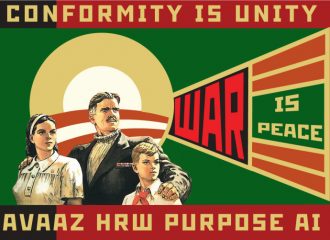 Cory Morningstar has exposed the pro-NATO global political agenda of organizations like US based organizations like Avaaz and Purpose. In the case of Global Witness, their Board member Jessie Tolka is also a board member of Purpose and too of 350.org: Current Global Witness CEO Gillian Caldwell was also a very successful Campaigns Director of Sky1, now merged into 350.0rg. Cory Morningstar argues, “the most vital purpose of the non-profit industrial complex (NPIC) has not been to destroy the ecocidal economic system that enslaves us while perpetuating and ensuring infinite wars. Rather, the key purpose of the NPIC is and has always been to protect this very system it purports to oppose from being dismantled. Hence the trillions of dollars pumped into the NPIC by the establishment.”
Confirmation of Cory Morningstar’s argument can be found in the history of Global Witness itself. For example on Libya, despite their superficial anti-corporate gloss, Global Witness relentlessly apply NATO country government criteria here and here. Also on Ukraine, Global Witness project the same anti-corporate message while simultaneously reinforcing NATO country government propaganda. Global Witness has also received US National Endowment for Democracy grants in Cambodia and in Liberia.
Also, a decade ago, writers Keith Harmon Snow and Rick Hines questioned Global Witness’ corporate links in relation to the “Blood Diamonds” controversy and the organization’s role in relation to De Beers and also Maurice Templesman’s diamond companies. No doubt more thorough research would reveal information casting similar doubt on Global Witness’s integrity and independence.
Conclusion
This latest Global Witness report in relation to Nicaragua is important because it is so readily falsifiable. It thus presents a clear litmus test: no news and information media can use the Global Witness report’s material in relation to Nicaragua without compromising their credibility.
The bias and inaccuracies in the section on Nicaragua in the Global Witness 2017 report call into doubt the integrity of the whole report. No news or information media interested in accuracy or honest reporting can conscientiously rely on Global Witness as a source without thorough cross checking and systematically comparing, contrasting and evaluating information from sources giving a different account of the events and issues in question.
Global Witness is neither independent nor trustworthy. It clearly has a strong but unacknowledged neocolonial political agenda promoting the regional policy goals of NATO country governments, while, conversely, attacking governments and other regional actors opposed to those goals.
NGOs like Global Witness, International Crisis Group, Human Rights Watch, Transparency International and so many others, self-evidently fabricate psychological warfare inputs serving NATO country government policy, itself shaped by the same corporate elites that fund the class of NGOS of which Global Witness is a part.
They operate as the soft, extramural arm of NATO country governments’ foreign policy psychological warfare offensives, targeting liberal and progressive audiences to ensure their acquiescence in overseas aggression and intimidation against governments and movements targeted by NATO. To that end, they deceitfully exploit liberal and progressive susceptibilities in relation to environmental, humanitarian and human rights issues.
Their psychological warfare role supporting the NATO government’s aggressive destabilization of Ivory Coast, Libya and Syria in 2011, of Ukraine in 2014, and the NATO country government’s low intensity war against Venezuela ever since 2013, as well as the campaign against Cuba over five decades, has been unmistakable.
More broadly their systemic ideological role is very obviously to protect and defend global corporate capitalism while superficially and selectively questioning and criticizing some of its worst abuses. Cory Morningstar’s insight bears repeating “the key purpose of the non-profit industrial complex is and has always been to protect this very system it purports to oppose”.
The coverage of Nicaragua in the latest 2017 Global Witness report is a text book example of that sinister fact.
Is The Energiewende Running Out Of Steam?
By Paul Homewood | Not A Lot Of People Know That | August 4, 2017
News from Reuters :
Germany’s long goodbye to coal despite Merkel’s green push
FRANKFURT – Burning coal for power looks set to remain the backbone of Germany’s energy supply for decades yet, an apparent contrast to Chancellor Angela Merkel’s ambitions for Europe’s biggest economy to be a role model in tackling climate change.
Merkel is avoiding the sensitive subject of phasing out coal, which could hit tens of thousands of jobs, in the campaign for the Sept. 24 election, in which she hopes to win a fourth term.
Although well over 20 billion euros are spent each year to boost Germany’s green energy sector, coal still accounts for 40 percent of energy generation, down just 10 points from 2000.
To avoid disruption in the power and manufacturing sectors, coal imports and mines must keep running, say industry lobbies, despite the switch to fossil-free energy.
“(Coal) makes a big contribution to German and European energy supply security and this will remain the case for a long time to come,” the chairman of the coal importers’ lobby VDKi, Wolfgang Cieslik told reporters last week.
He also stressed it was crucial for steel manufacturing in Germany, the seventh biggest producer in the world, that use a quarter of the country’s coal imports.
Critics point to the irony in Merkel’s tacit support for coal given that she criticized U.S. President Donald Trump for ditching the Paris climate accord after pledging to voters he would lift environmental rules and revive coal-mining jobs.
“Merkel … has no right to criticize the disastrous climate production policy of U.S. President Trump … figures in this country speak for themselves,” said former Green lawmaker Franz-Josef Fell, referring to Overseas Development Institute (ODI) figures showing the extent of public money going to coal.
Utilities such as RWE, Uniper and EnBW with coal generation on their books fire back by saying their output is covered by them holding carbon emissions rights certificates, while much of their historic profitability has been eroded due to competition from renewables.
Apart from the environmentalist Greens, who want coal generation to end by 2030, none of the main political parties have set phase-out target dates.
Huge vested interests are stifling debate, whether it is potential job losses that alarm powerful unions or the effect on industrial companies relying on a stable power supply.
Industry figures show renewables accounted for 29 percent of power output in both 2015 and 2016, up from 7 percent in 2000. But plants burning imported hard coal still make up 17 percent and brown coal from domestic mines 23 percent of power output.
Cheap coal lets them run at full tilt when necessary while the weather dictates if wind and solar produce anything at all.
Cieslik said he expected hard coal alone to retain a share of 15 percent by 2030.
VDKi warns that nuclear energy, accounting for 14 percent of power, will remove even more of the round-the-clock supply when it is phased out by 2022.
Wind and solar cannot even fill current gaps and a system run mainly on green power would fail to provide guaranteed supply over a winter fortnight, it says.
Power grid operator Amprion has said German networks came close to blackouts during settled and overcast conditions in January when renewable plants produced almost nothing.
Even environmental groups acknowledge the fossil fuel lobbies have a point, arguing there must be remedies to the problem of intermittent renewable supply.
“Old coal plants can be made flexible at a reasonable cost and allow countries with a high share of coal-to-power a soft transition to a climate friendly energy system,” said a study commissioned by Agora thinktank, which backs the energy switch.
Meanwhile the Clean Energy Wire report that German CO2 emissions are likely to rise again this year, following last year’s rise:
Germany’s rising consumption of oil, gas and lignite in the first half of 2017 indicates that the country of the Energiewende will see another increase in emissions in 2017 after a rise in 2016, said Agora Energiewende* head Patrick Graichen. “The data translates to a one-percent increase of energy-related emissions, compared to the same period last year. This corresponds to about 5 million tonnes of CO₂,” Graichen told Clean Energy Wire. New data released by energy market research group AG Energiebilanzen (AGEB) saw energy consumption in Germany increase 0.8 percent in the first half of 2017, due to positive economic development and slightly cooler weather at the beginning of the year. “The hope that 2017 emissions will be below last year’s levels fades visibly. Rather, this is ground for concern that – just like in 2016 – we will see emissions rise in 2017,” said Graichen.
It is easy to blame Merkel’s obsession with getting rid of nuclear. but the reality is that renewable energy is proving itself incapable of filling the gap.
The latest BP Energy Review shows that renewable energy actually fell slightly in 2016, whilst fossil fuel consumption has increased for the last two years.

It is little wonder that Merkel and co are so keen on maintaining imports of Russian gas.
Nuclear power still supplies 6% of Germany’s energy, and it is clear that renewable energy cannot replace this reliable baseload.
Germany has made big strides in getting to a position where renewable energy (excl hydro) now accounts for nearly 12% of total energy consumption. But all the signs suggest that it is becoming increasingly difficult to grow this share further.
Egypt to bear cost of Alexandria Synagogue renovation
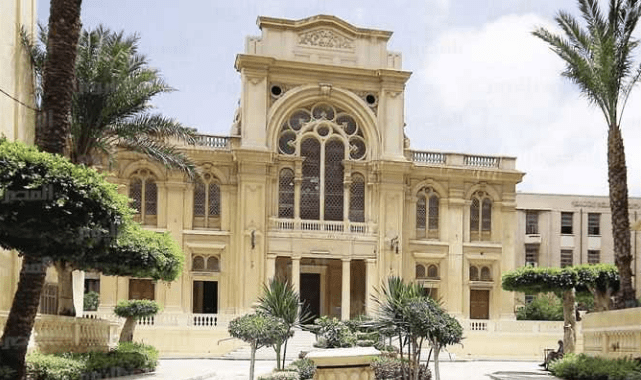
Eliyahu Hanavi Synagogue
MEMO | August 3, 2017
Egypt’s Antiquities Ministry on Thursday announced plans to carry out extensive renovations of a synagogue in Alexandria — despite the fact that, under Egyptian law, the local Jewish community should bear the cost of such restorations.
“The renovation of Alexandria’s Eliyahu Hanavi Synagogue will take about eight months and cost some 100 million Egyptian pounds [roughly $5.5 million], which will be provided by the Egyptian government,” the ministry said in a statement.
According to the same statement, the government had already allocated 1.27 billion Egyptian pounds (roughly $70.5 million) towards eight major historical renovation projects.
In July, Al-Said Helmy Ezzat, head of the ministry’s Islamic and Coptic Antiquities Department, announced that proposals to renovate the historical synagogue had been approved and the appropriate financial allocations made.
Under Egyptian law, however, Egypt’s small Jewish community should bear the cost of the project and the reason for the apparent exception remains unclear.
Cash-strapped Egypt continues to face difficult economic circumstances, with the government implementing an IMF-approved reform program, which includes the reduction of government subsidies and which has led to skyrocketing commodity prices.
Built in 1848, Alexandria’s Eliyahu Hanavi Synagogue is one of the largest Jewish synagogues in the Middle East region, capable of accommodating up to 700 people.
It also houses an impressive library containing dozens of ancient Torah scrolls, some of which date back to the 15th century.
US sanctions won’t stop Russia’s pipeline project to Europe – analysts
RT | August 3, 2017
The latest US sanctions targeting Russia’s oil and gas sector will cause Gazprom some headaches in building the new gas pipeline to Germany, experts say. However, US restrictions are unlikely to stop the project.
“The price of any project automatically increases,” Tatiana Mitrova, director of the Skolkovo Energy Center told Reuters.
“Gazprom’s relationships with partners, subcontractors, and equipment and service providers are very complicated. They will all ask for a risk premium,” she added.
“This, however, does not mean that Nord Stream-2 won’t be built,” said Katja Yafimova of the Oxford Energy Institute.
However, while Gazprom’s major partners in the projects – ENGIE, OMV, Shell, Uniper, and Wintershall – are likely to accept the risks, smaller contractors will be more cautious.
“Not all partners can afford to see things through with Gazprom,” said Valery Nesterov, an analyst at Moscow-based Sberbank CIB.
It is still unclear whether the US President will enforce the restrictive measures. While Trump signed off on the new sanctions on Monday, he did so reluctantly, calling them “significantly flawed.”
“Unless Trump takes a really sharp turn, it is highly unlikely that companies that are supplying pipeline goods are going to be punished in the next year or so,” Richard Nephew, a former US deputy chief of sanctions told Reuters.
At the same time, Gazprom’s long-term projects can be affected.
“A lot of companies are now thinking: ‘I’ve got maybe 12, maybe 18 months in which I can do some stuff but after that maybe I won’t’,” he added.
The Nord Stream-2 pipeline plans to double the delivery capacity of Russian natural gas to Germany from the current 55 billion cubic meters of gas per year.
Trump Battles the CIA: The Korea Ban & Bad Signs in the Market
By Caleb Maupin – New Eastern Outlook – 02.08.2017
The ban on travel to the Democratic People’s Republic of Korea is primarily an attack on the people in the northern part of the Korean Peninsula. It is a move to further isolate the DPRK, and prevent tourist dollars from flowing in, while also preventing fraternization between Americans and citizens of the country. However, the State Department’s decision also has another target in the crosshairs, one much closer to Washington DC.
According to reports in the press, roughly 5,000 US citizens visit the DPRK each year. Most are tourist youth attracted to the mystique and adventure of traveling to a country so widely demonized in the US media. Communist organizations send political delegations and Christian sects such as the Mennonites often send missionaries and aid workers. However, one can be sure that among the 5,000 people who visit the country each year is more than a few American spies, posing as tourists.
When one looks over the recent history of Americans being arrested in North Korea prior to the tragic death of Otto Warmbier, the reasons for the arrest almost always indicate activities that could be described as espionage. Merrill Newman, for example, was a former member of the US military’s “White Tigers” division during the Korean War. The 85 year old man was arrested in the DPRK as he wore a ring with the insignia of this anti-DPRK fighting and intelligence unit. After being arrested he confessed to participating in some of the war crimes against the Korean people during the 1950-1953 war. Newman stated “I did not realize North Korea was still at war” after his eventual release.
The State Department ban on travel to the DPRK is far more extreme than the widely challenged ban on travel to Cuba, enacted as part of the blockade. Officials say that any American who visits DPRK will automatically have their passport invalidated. The constitutionality of such an extreme ban is likely to be challenged.
In the meantime, however, any efforts by the CIA to gather information inside North Korea, or to manipulate or maneuver within its internal affairs, are greatly limited.
Two divisions of the US Federal Government that have long been at odds in issues of foreign policy have been the military and the Central Intelligence Agency. The nature of the two entity’s work lays the basis for their constant disagreement and conflict. The new State Department policy has essentially declared that the DPRK will be handled with military operations, not with “color revolutions,” plots of a coup, manipulation of the youth, or the other shenanigans carried out by the intelligence agencies.
A Longstanding Fight – CIA vs. Pentagon
The US military brass is trained at West Point, and though a great deal of history and background is provided, the focus of their training is military science and the “art of war.” Meanwhile, the Central Intelligence Agency’s administrators come from Harvard, Yale, and Princeton, and are trained in the subtle art of expanding US influence and quietly neutralizing those who challenge it.
The favorite word of those who extol the military and disfavor the CIA is “strength.” The strategies favored by the Pentagon involve demoralizing opponents of US power with “shock and awe” style crushing of enemies. The mass bombing campaigns in Vietnam and Korea did not win credibility and respect for the US internationally, and this was not their intention. The same can be said for Bush’s unilateral invasion of Iraq. The Pentagon does not concern itself with winning friends and influencing people, but with blowing things up, and its favored foreign policy reflects this.
The CIA, on the other hand, tends to favor soft power, negotiations, and internal subversion of global rivals, all done covertly, with the USA looking like a benevolent “Mr. Nice Guy” on the surface. The CIA favors arming and training third party proxies to fight their enemies, while waging a fierce battle in the field of public relations and propaganda.
The clash between the military and the intelligence agencies has played out dramatically in recent US history. It is widely understood that John F. Kennedy began enacting policies that overwhelmingly favored the CIA prior to his death. Kennedy resisted the efforts to escalate military involvement in Vietnam, while funding and emphasizing CIA-linked operations like the Peace Corps. Kennedy’s often quoted the phrase “those who make peaceful revolution impossible make violent revolution inevitable” stated the CIA’s exact strategy for fighting Communism during the Cold War. The CIA favored “reforms” in US aligned third world regimes that made Marxist-Leninist revolution less appealing, while also presenting the US as a benevolent, charitable country that did not seek to intervene in other countries domestic affairs. The CIA worked to make sure that the hands of the USA during the rise of military dictatorships and the toppling of pro-Soviet world leaders were well hidden.
Prior to Kennedy’s assassination, a hard, right-wing mass movement against him, involving the John Birch Society and many Pentagon linked political figures, called the “Camelot” President a traitor and Soviet agent. Many sections of the military thought Kennedy’s “soft power” strategy for confronting Communism, and his ultimate refusal to invade Cuba with US troops after the CIA’s failed “Bay of Pigs” operation, showed weakness. Films like “Dr. Strangelove” widely mocked the well-known fanaticism of the military brass, which distrusted the intelligence agencies and the ability of politicians to make military decisions. Kennedy’s subtle alliance with the Civil Rights Movement, though inconsistent and widely criticized by activists, also threatened a military brass packed with the sons of wealthy southern families.
After the death of Kennedy, the US military seemed to be on top in the power struggle. Richard Nixon’s electoral victory in 1968, and his “secret plan” to win the Vietnam War with massive bombing, showed the military and its allies as the dominant force in setting policy.
But the demoralizing and unpopular war in Vietnam reversed this by the mid-1970s. Nixon found himself listening and depending more on the advice of Henry Kissinger, opening relations with the People’s Republic of China, and eventually being driven from office. Jimmy Carter took office in 1976 calling himself a “student” of CIA strategist Zbiegniew Brzezinski. Under Reagan, the CIA got stronger, with CIA chief George H.W. Bush rising to be Vice President and eventually Reagan’s successor as commander-in-chief.
The often repeated narrative that the US military’s escalation of the arms race was the key factor in defeating the USSR is said with absolute defensiveness by the Pentagon’s right-wing allies. Though the “strong man Reagan” explanation is more widely understood among the US public, within the circles of power in the USA, the CIA takes more credit.
Under the direction of Brzezinski, who boasted that he “gave the USSR a Vietnam” by funneling money and weapons to insurgents in what he called the “Afghan trap,” the CIA manipulated political situations in Eastern Europe causing unrest and a crisis that eventually toppled the USSR. The CIA widely credits itself for terminating the Soviet Union by manipulating internal problems and applying less blatant forms of external pressure.
The CIA is not a “Conservative” Organization
Many leftists and anti-war activists assume that the CIA is staffed with jingoistic conservatives due to the nature of the job. While the rank-and-file of “the company” may attract a more rightist crowd of Mormons and military types, the leaders of the CIA are not conservative in any sense of the word.
John Brennan, the director of the CIA under Barack Obama admits that he voted for Communist Party Presidential Candidate Gus Hall in the 1976 Presidential election. Brennan was stationed in Riyahl for many years, and at the time of his appointment, many voices came forward to allege that he had actually converted to the Wahabbi brand of Islam. The allegations remain unproven.
The CIA strategist who was most influential between the 1960s and the 1990s was Zbiegnew Brzezinski. To call Brzezinski conservative would be deeply mistaken. Zbeignew’s daughter, Mika Brzezinski is a host on liberal leaning MSNBC’s TV program “Morning Joe.”
Brzezinski developed the art of propaganda, presenting the USA to the world as the homeland of Beatles Music, the paintings of Jackson Pollack, and sexual hedonism. In Eastern Europe, Brzezinski’s policies convinced millions of alienated young people that overthrowing the Marxist-Leninist governments would transform their countries into Disneyland playgrounds packed with consumer goods and never ending rock and roll concerts.
In Afghanistan, Brzezinski worked with a young Saudi billionaire named Osama Bin Laden to fight against the People’s Democratic Party. With US made weapons and funding, complimented by heroin revenue, the insurgents poured acid on women’s faces and hanged literacy campaign volunteers. Brzezinski’s slick propaganda work convinced the world that these Wahabbi extremists were actually Che Guevara-esque freedom fighters, battling the “Soviet Empire” for freedom. CBS news was even caught airing staged, fake battle footage.
The figure known as George Soros has become a favored talking point of right-wing activists in the USA. They present him as the sinister bank-roller of leftist activism. Long before Soros was promoting Democrats and Liberals in the USA, he was bank-rolling CIA supported anti-Communist “color revolutions.” Soros is known to have funded anti-communist, pro-capitalist and pro-western protest movements in the USSR, Czechoslovakia, Yugoslavia, and elsewhere.
During the Cold War, the CIA launched a program called the “Congress for Cultural Freedom.” The program funded the art of Jackson Pollack, as well as the Trotskyist magazine Partisan Review. The CIA also launched a project called MK-Ultra which involved distributing hallucinogenic drugs on college campuses.
Obama’s Administration – The White House Stood With Langley
Barack Obama’s grandparents were prominent executives of the Bank of Hawaii. Obama’s grandmother Madelyn Dunham, actually became the first female Vice-President of the bank. The Bank of Hawaii was key in transferring money to US intelligence operations across Asia.
Obama’s mother, Ann Dunham, was married to Lolo Soetoro, a figure in Indonesia who openly supported the 1965 CIA backed coup d’etat against President Sukharno. Soetoro eventually became a military officer under US backed dictator Suharno. It should be noted that the 1965 coup, which Obama’s grandparent’s Bank of Hawaii was involved in financing, was particularly bloody, and involved mass slaughter of ethnically Chinese people. Some estimate that as many as 500,000 people died.
Obama’s family connections aside, his Presidency was very much favorable to the CIA’s strategy for international relations. Obama’s middle name is Hussein. He attended an Islamic elementary school as a child. Long before becoming President, Obama famously had a meeting with Palestinian scholar Edward Said. He maintained a hostile war of words with Israeli Prime Minister Benjamin Netanyahu.
One is reminded of how Napoleon Bonaparte sent out proclamations saying he was a Muslim as he attempted to seize Syria and Egypt for France. To the Arab world, a key region in US foreign policy strategy, Obama gave the illusion of possibly being a Muslim and an ally against Israel.
The fact that a dark skinned man, whose middle name was “Hussein” occupied the White House probably played a key role during the Arab Spring. The uprisings of youth in Islamic countries did not become a repeat of the 1979 Islamic Revolution of Iran, where western capitalism was replaced by a government proclaiming “war of poverty against wealthy” and “Not capitalism but Islam.”
The USA was able to maneuver within the Arab spring to topple the Islamic Socialist government of Libya, and to reduce the Baath Socialist country of Syria to civil war and chaos. Meanwhile, the US backed autocracies in Saudi Arabia, Bahrain, and elsewhere remained thoroughly intact. The continuation of the Yemeni revolution against a pro-Saudi regime now faces an onslaught of bombs and foreign troops.
The establishment of diplomatic relations between the USA and Cuba, with friendly words while intel operatives worked behind the scenes to plot social media unrest with a “Cuban Twitter,” fits the CIA playbook and strategy completely. The JCPOA negotiations with Iran fit into a similar strategy.
In the final weeks of the Obama administration, desperate “Mr. Nice Guy” maneuvers to increase the credibility of the USA on the global stage were carried out. John Kerry gave a speech criticizing Israel, and the US did not protect Israel from a harshly worded resolution at the UN Security Council.
Trump Stands With The Pentagon
Even before Trump took office, his presidential campaign was loaded with subtle hostility to the CIA. Trump castigated the results of US foreign policy, specifically in Syria and Libya where the CIA had been instrumental. During his debate with Hillary Clinton he criticized the funding of rebels in Syria. He repeatedly said that the policies of Obama and Secretary of State Hillary Clinton had created ISIS.
Trump repeated perspectives that would be popular with the military. The key word repeated in Trump’s foreign policy speeches was “strength.” The idea that a huge military budget and direct military interventions make the USA look stronger as a country has long been a talking point of the military brass, against proponents of soft-power and subtle influence.
At times, Trump seemed to be contradictory when talking about foreign policy. It is no secret that among rank-and-file soldiers, and the white, working class, rural communities they often originate in, right-wing isolationist sentiments are widespread. Trump appealed to those sentiments when talking about the bad results of “toppling regimes” and employing the slogan “America First.”
At the same time, he appealed to the Pentagon’s calls for strength, saying that Obama’s “red line” around chemical weapons had “meant nothing.” It may sound contradictory to favor isolationism, while criticizing a president for not making good on threats to attack a country, but it fits into his overall appeal to sentiments within the military.
At the same time that Trump critiqued foreign policy and echoed isolationist talking points, he consistently called for an increase in military spending. In Trump’s foreign policy rhetoric, the isolationism of rank and file soldiers, the Generals’ lust for strength, and the military-industrial complex’s desire for more profits were all re-assured.
The spat between Trump and the CIA is no secret, and is widely acknowledged, even in mainstream US media. The intelligence agencies continue to repeat, without proof, that Trump received assistance from “Russian meddling” in the 2016 elections. A series of leaks from within the administration have found their way to the press.
The Trump administration fought back first by dramatically crippling the CIA’s operations in the Middle East. The executive order banning travel from 6 countries was widely called a “Muslim ban” in the US press. In reality, it targeted all citizens, Muslim or not, from 6 specific countries. (Note: The ban originally included 7 countries, but Iraq was removed from the list.)
Sudan, Iran, Syria, Yemen, Libya, and Somalia are all the site of ongoing conflicts, and in each of these countries US intelligence agencies are working to influence and coordinate with certain forces. As was pointed out by an opponent of the ban on FOX news, the “travel ban” prevents the CIA from rewarding those who do its bidding with visas. A key “soft power” bribe has been taken away from the CIA for its operations in the Middle East.
Trump ultimately shut down the CIA’s training program for anti-government fighters in Syria, according to reports. Trump has accused Obama of wiretapping him during the Presidential campaign.
Trump has even discussed designating the Muslim Brotherhood, an organization that works closely with the CIA around the world, as a Foreign Terrorist Organization. The Muslim Brotherhood was key in undermining and fighting against Arab Socialism during the cold war. More recently, the Muslim Brotherhood was key in aiding US activities to manipulate the Arab spring, and the create turmoil in Libya and Syria.
The Turkish government, which draws its support from the Muslim Brotherhood, is far less friendly to the United States than just a few years ago. The current spat between Saudi Arabia and the Muslim Brotherhood-supporting state of Qatar may reflect difference within the power structure about relations to the Muslim Brotherhood and its use in the fight against independent governments.
Despite presenting himself as an isolationist, Trump ultimately did what Obama was unwilling to do, and launched direct US attacks on the Syrian government. Many in his base were furious, and even longtime hawks like Ann Coulter denounced Trump’s move. However, the more well connected members of the Republican establishment praised it, using the military’s favorite word, calling the bombing a demonstration of “strength.”
As Donald Trump remains President of the United States, the press is solidly against him. This should be no surprise as the US Central Intelligence Agency, not the Pentagon, is primarily involved with influencing media. From the days of “Project Mockingbird” to today, the CIA works very hard to influence and craft public opinion, especially on issues of foreign policy. The flow of ‘anonymous leaks’ from the intel community into the press reflects the longstanding relationship between the intelligence agencies and the media.
The Specter of Economic Crisis, Greatest Danger to Trump
 Right now, spending in the USA is down. Wal-Marts are shutting their doors, and suburban malls, which employed thousands, are becoming a thing of the past. The post-2008 “new normal” of low wage retail jobs replacing good paying jobs for the next generation is rapidly fading away, as retail itself is being pushed aside by online shopping. Jeff Bezos outstripped Bill Gates as the richest man in the United States in terms of directly traceable assets.
Meanwhile, home ownership is still declining. The basic ability of American families to own houses has widely been eroded, home ownership has not been restored to anywhere near the pre-2008 levels. In neighborhoods across the USA, family homes are not being resold to American families, but to renting institutions.
As property values remain low and home ownership drops in suburban and rural areas, another aspect of the “new normal,” the “prosperous urban centers” hopping with young workers in high tech jobs, are also seeing a new decline in property values. Unemployment is low, but so are wages.
In the unfolding atmosphere of eroded spending power and decreasing incomes, banks in the USA are now cutting back lending. When banks stop lending, it is generally based on an understanding that bad times are ahead and they may not be able to collect.
Between 2000 and 2008, Alan Greenspan and the Federal Reserve did everything possible to hold off a crash. Greenspan legalized all kinds of previously illegal credit card and housing mortgage lending, in order to keep the US public spending money they did not have. While the spending power of the US public was drastically reduced by deindustrialization, automation, and shifts in the global economy, Greenspan spent his final years working tireless to keep sales up. Many will recall how George W. Bush urged Americans who wanted to help their country in the aftermath of 9/11 to “go shopping.”
Greenspan’s maneuvers worked only until 2008. With deregulated banking laws, Americans could keep buying houses and maxing out their credit cards, keeping the economy that faced turmoil from 2001 afloat, until the “bubble burst.”
Alan Greenspan was a high ranking member of the Council on Foreign Relations, a think tank often described as “the CIA’s brain.” He did not make his decisions in isolation, but most likely consulted with other figures in the intelligence community about the need to hold off the crisis as long as possible. Greenspan’s decision to legalize credit and keep the public spending, and temporarily hold off the crisis, was not a decision he made by himself.
As the economy crashed and burned in 2007 and 2008, Bush and his cronies, widely viewed as soft on big money, packed their bags, and Barack Obama was able to ride to the White House almost on a white horse, presented as the savior who offered “hope and change.” Greenspan’s efforts did not prevent a the financial crisis, but enabled it to come at a more convenient time, with less political fallout.
However, the political situation facing the USA is far different today. The intelligence community and a large section of the rich and powerful are adamantly opposed to Donald Trump’s presidency, there may not be any specific motivation to work to hold off a financial catastrophe.
If a financial crash were to occur again, Donald Trump would be the ideal scapegoat. The fallout could be blamed on his unpopular presidency which is already routinely ridiculed and demonized by the press.
Will Trump Come Out On Top?
The fact that Trump’s “infrastructure week” contained so few concrete actions may not have hurt Trump at the moment, but a failure to vastly improve the lives of the rust-belt working class that voted for him could be the ultimate undoing of his presidency.
As Trump battles the intelligence community, and seems to side with the Pentagon, he is facing an uphill battle. Allies of the Pentagon brass are disappointed and opponents of Trump are emboldened. However, Trump has proven that he has the ability to unpredictably reverse circumstances that are hostile to him, and come out victorious. The unexpected 2016 elections results are the most concrete example.
If anything was proven by Trump’s surprise victory or the Brexit vote, as well as the rise of Jeremy Corbyn and Scottish Nationalism in the UK, it is that anti-establishment sentiments are stronger and deeper than ever in western countries. People in the west realize that things are deeply wrong and are looking for answers. The answers offered by the status quo, often answers that are engineered and delivered in coordination with the intelligence community, are proving to be unsatisfactory.
In the age of easy access to information, the intelligence community may have both an advantage and disadvantage in the face of their opponents in the US power structure. On the one hand, their deceptions and crafting of public opinion can be more widely and cheaply disseminated than ever before. However, an audience that once had nowhere else to look can easily find alternative views, and debunk their claims. The economic decline and rising police state repression are making the US public more and more partisan toward opposing the establishment and entrenched power that the CIA’s propaganda activities seek to defend.
Trump and his allies in the Pentagon are in a weaker position as they face off with the Intelligence Community, however, the underlying shift in public opinion and the changes in the global economy give them a competitive edge.
Featured Video

AIDS Inc. by Gary Null (2007)
or go to
Aletho News Archives – Video-Images
From the Archives
Clash of Civilization, Iran Part II
By Jamal Kanj – Intifada-Palestine.com – January 14, 2011
Israel’s survival kit is: perpetuate conflict, insecurity to rationalize collective hate and finally playing victim.
Devoid of conflict, Israel implodes internally; without hate, Zionism loses its justification; and playing eternal victim to continue blackmailing the West. Absence of this holy trinity, Israel ceases to exist.
From its inception, the house of Zion has mastered exploiting adversarial powers to advance Israel’s cause. For instance, their influence over the Democratic Party in the US began with President Truman’s bid for 2nd term election in 1948.
Responding to strong opposition from Secretary of State General George Marshall and Department experts urging against recognition of Israel, President Truman replied: “I’m sorry gentlemen but I have to answer to hundreds of thousands [Jewish voters] who are anxious for the success of Zionism. I do not have hundreds of thousands of [voting] Arabs among my constituents”
Zionists influence over liberal American politics was matched with the doctrinal school of Conservative theoreticians aligning the Republican Party’s platform with Israel’s objectives. The Neoconservative Zionists, coined Zioncons, invented the “Clash of Civilization” concept to fight Israel’s wars. … continue
Blog Roll
 Aletho News
- 12 Things Your Psychiatrist Was Trained Not to Tell You
- From Unipolar Universalism to Multipolar Civilizational Distinctiveness
- RSF military group defects, joins Sudanese army: State media
- Ireland goalkeeper refuses to play ‘Israel’ as squad weighs boycott
- China pushes back against US on Cuba, Iran
- Ukrainian Soldiers, Potential Mercenaries: Have Gun, Will Travel!
- Burnham’s UN debut… A masterclass in British disinformation
- Iran flights continue despite US aviation sanctions
- Global Tipping Points Lead the World Into a State of Entropy
- The day-after at the White House: USA and Xi Jinping
- If Americans Knew
- Israel forces Gazans to live in constant peril – Daily Update
- Deconstructing Netanyahu’s pants-on-fire UN rant – Daily Update
- Trump betrayed voters with his campaign lies and prioritized a foreign country once he took office
- Netanyahu calls Israel’s war in Gaza ‘opposite of genocide’ in UN speech to near-empty hall
- Settler Kidnappings: Torture, Sexual Abuse and Terrorisation of Palestinian Abductees as Israel Deepens Annexation of West Bank
- Gaza winter nears as 162,000 tents become unusable, raising fears of humanitarian crisis
- Netanyahu says, “It’s the opposite of genocide”; UN says Gaza economy is world’s ‘most severe crisis on record’ – Daily Update
- Israel’s US-Backed Assault on Gaza Has Created the ‘World’s Most Severe Economic Crisis on Record’: UN
- ‘Protecting U.S. Citizens’… From Israel
- ‘This is where I live now, the back of a truck’: a day in the life of a grandmother in Gaza
- No Tricks Zone
- New Study: Earth And Venus Surface Warmth Largely Explained By Convection And Lapse Rate, Not CO2 Or Radiation
- 2025 Nature Paper Claiming Worsening Global Drought Gets RETRACTED …Heavily Flawed
- New Study: ‘Global Drought Shows No Detectable Recent Acceleration Under Climate Warming’
- Economic Masterminds: German Socialists Suggest Taxing Productivity Gains Stemming From Using AI
- The South China Sea Has Not Been Cooperating With The Climate Change Narrative
- Energy Crisis: Germany Enters Heating Season With Historically Low Gas Reserve Fill Levels
- New Study: The Antarctic Ice Sheet Gained Mass From 2020-2024 Due To Staggering Snow And Ice Accumulation
- Study: Ocean Heating Rates From Thousands Of Years Ago ‘Dwarf’ Modern Ocean Heating Rates
- Climate Extremists Target, Attack Large-Scale Power Grid Infrastructure In Germany!
- New Study: Antarctic Ice Melt Has Contributed Less Than 1 Centimeter To Sea Level Rise In The Last 30 Years

