Anti-Russian sanctions cost Europe $100bn – UN Special Rapporteur
RT | September 13, 2017
Over the last three years, the European Union has been losing at least $3.2 billion every month due to the anti-Russian penalties, according to a report by a UN Special Rapporteur Idriss Jazairy.
“The most credible approximation is of $3.2 billion a month,” says the report on the negative impact of the unilateral coercive measures, as quoted by Sputnik.
Jazairy stressed that Russia had sustained a direct loss of nearly $15 billion a year or a total of $55 billion so far.
“The resulting overall income loss of $155 billion is shared by source and target countries,” he added.
EU sanctions against Russia were introduced in 2014 over the country’s alleged involvement in the conflict in eastern Ukraine and Crimea. The penalties targeted Russia’s financial, energy, and defense sectors, along with some government officials, businessmen, and public figures.
Moscow responded by imposing an embargo on agricultural produce, food and raw materials on countries that joined the anti-Russian sanctions. Since then the sides have repeatedly broadened and extended the restrictive measures.
Russia is the EU’s fourth-largest trading partner after the US, China and Switzerland. The country is also Europe’s biggest natural gas supplier, as well as one of its biggest oil suppliers.
The penalties have been severely criticized by European politicians and businessmen as both politically ineffective and economically harmful for both Russia and Europe.
US Comes to Russia With ‘Absurd’ Request for More Sanctions Against North Korea
Sputnik | September 11, 2107
Given the US approach to its relations with Russia, it is “absurd” for Washington to expect Moscow’s support for its sanctions plan for North Korea, Georgiy Toloraya of the Russian Academy of Sciences told Sputnik.
On Monday, the UN Security Council is to vote on a US-drafted resolution that would strengthen sanctions against North Korea in the aftermath of a reported sixth nuclear test.
The original version of the text called for a trade embargo on oil and textiles and a financial and travel ban for leader Kim Jong-un. China and Russia oppose sanctions that could lead to a humanitarian catastrophe in the country, which was already put under more sanctions in August. With that in view, the US has watered down the text in order to win the approval of the Security Council, although it still proposes a ban on North Korean textiles.
Georgiy Toloraya, Director of the Center for Russian Strategy in Asia at the Russian Academy of Sciences’ Institute of Economics, told Sputnik that the US position, which expects Russia to support sanctions against North Korea while at the same time sanctioning Russia, is “absurd.”
“The Americans want to deprive the North Koreans of heat, to expel all their guest workers who are needed by Russia in the Far East, and also to stop the export of textiles from the DPRK. What does that have to do with the nuclear missile program?” Toloraya asked.
“In addition, the Russian president said correctly that it is quite absurd to include Russia along with the DPRK on the sanctions list, and then ask us to take joint actions on sanctions. Moreover, we consider this unnecessary because sanctions simply don’t work.”
In July, the US Congress approved a sanctions bill targeting Russia, Iran and North Korea. Speaking at the BRICS conference last week, Russian President Vladimir Putin said, “It’s ridiculous to put us on the same sanctions list as North Korea and then ask for our help in imposing sanctions on North Korea.”
Zhou Yongsheng of the Center for International Relations Studies at the Diplomatic Academy told Sputnik China that as far as sanctions are concerned, it’s either all or nothing.
“I think that if we really apply a full package of sanctions to the DPRK, then this will also help solve the nuclear problem. Since right now the supply of energy resources and grain to the DPRK has not been completely stopped, this means that the DPRK has the means for a confrontation with the international community. In the event that some kind of supply to the DPRK is interrupted completely, then the country won’t last too long and it is very possible that it will make some concessions,” Zhou declared.
At a meeting with South Korean President Moon Jae-in on the sidelines of the Eastern Economic Forum in Vladivostok on Wednesday, Putin remarked on the importance of deescalating the tense situation in the Korean peninsula.
“There is no point in giving in to emotions and driving North Korea into a corner. Now, more than ever, everybody needs to stay calm and avoid steps that lead to an escalation of tension,” Putin said.
Moon Jae-in and Putin signed a host of deals to boost bilateral cooperation in the areas of joint financial and investment platforms, healthcare and IT. Putin also reiterated Russia’s readiness to develop trilateral projects in the Far East with both North and South Korea, which would open the country up economically and politically.
“Development of the Far East will not only contribute to the prosperity of the two states but also to changes in North Korea, which will become a basis for trilateral relations,” the South Korean president said.
Senate Debates Billions for Insurers while Public Demands Medicare for All
By Margaret Flowers and Kevin Zeese | Health Over Profit | September 8, 2017
This week we attended a hearing of the Senate Health, Education, Labor and Pensions (HELP) committee where there was broad bi-partisan support for giving billions more to the insurance industry to “stabilize the market.” The government already gives for-profit insurance $300 billion annually and their stock values have risen dramatically since passage of the Affordable Care Act (ACA), so the rush to give them more was disheartening.
That was contrasted with a meeting with the staff of Senator Bernie Sanders about the improved Medicare for all bill he plans to introduce on September 13. Sanders, along with other Senators, is seriously trying to figure out how to transform health care from being a profit center for big business to being a public good that serves the people. That means doing away with the health insurance industry, not giving them billions of public dollars.
The contrast reinforced the need to advocate for improved Medicare for all and push for the best healthcare system we can create.
Healthcare a Commodity or a Human Right?
Senators are back from their long summer recess, and they started off with health care back at the top of the agenda. The Senate HELP committee held its first of four hearings on September 6, and Senator Bernie Sanders is preparing to introduce a Medicare for All bill on September 13. The two efforts are a clear example of the underlying dilemma that we have faced in the United States for the past 100 years: Is health care a commodity or a public good? It can’t be both.
The failed efforts to repeal and replace the ACA took up a lot of time and energy this year and left the country in no better position to deal with the ongoing healthcare crisis. Now, time is really short because private health insurers are announcing their rates for 2018, and they are, not surprisingly, screaming for more money because they have to (*gasp*) pay for health care.
A group of us attended the first Senate HELP committee hearing to convey the message that the people are ready to undertake the serious work of creating a National Improved Medicare for All. Typically, before and sometimes during a hearing, attendees are allowed to hold signs as long as they are not disruptive. On that day, the committee chair, Senator Lamar Alexander, ordered that signs be put away before the hearing even began. He told Dr. Carol Paris, a steering committee member of the Health Over Profit for Everyone campaign, that “we are not talking about improved Medicare for All now.”
Instead, the entire hearing focused on “stabilizing the insurance market,” even though their stock values have quadrupled since 2010. Five health insurance commissioners from different states testified before the senators and answered questions. It appeared that all had been well-prepped by the health insurance industry. The committee members patted each other on the back for being bi-partisan, unfortunately they were working together for the insurance industry, not for the people.
The bi-partisan hearing discussed three main points: making sure that public dollars were available to subsidize insurance costs, reinsuring private health insurers so they would be protected if they had to spend ‘too much’ money on health care and incentives to entice private insurers back into areas that are not profitable. Coincidentally, these were the same points raised in the bi-partisan proposal published this year by the Center for American Progress, a Democratic Party think tank financed in part by health insurance lobbyists. Both parties are clearly on the side of health care as a commodity.
Not one person participating in the hearing questioned whether health care belonged in the market. At least one Senator, Rand Paul, complained about Big Insurance coming to Washington with their hands out and said he would rather pay directly for health care than give the money to Big Insurance. His ideology is far from supporting Improved Medicare for All, but he did call out the corruption.
Perhaps the most disappointing of the day was Senator Al Franken, who has completely bought into the ‘health care is a commodity’ camp. Not only did he advocate for subsidizing and reinsuring private insurers, but he called for a federal reinsurance program to cover the costs of people who need health care, at least after Big Insurance takes their cut. And Franken, who tried to make jokes about the hearing, called for more money to advertise and lure youth into the insurance market, which is about as unethical as pushing cigarettes or candy, and wants heavier enforcement of mandates to purchase health insurance. Franken touted a ‘virtuous cycle’ of giving more money to health insurers so that they lower premiums and more people buy insurance. The problem is that there is nothing very virtuous about spending billions to subsidize an industry that has a greater responsibility to pay its Wall Street investors than to pay for necessary health care. The insurance industry has shown itself to be insatiable, and ready to use their power to extort Congress because they hold people’s lives in their hands.
It was a difficult hearing to attend. The whole time we wanted to stand up and ask whether they could possibly see how ridiculous this all appeared and whether they thought private health insurers added any benefit. But, the Capitol Police made it clear from the start that they would arrest anyone who disrupted without warning, and we had a meeting scheduled with Senator Sanders’ staff after the hearing. We did manage to squeeze out a few “Medicare for All’s” during the hearing.
Healthcare Without the For-Profit Insurance Industry
The meeting with Senator Sanders’ staff was like night and day. We began from the premise that health care is a human right and had a frank discussion of how that could be achieved. The text of his upcoming bill was not available, but for 90 minutes we discussed many of the details of the bill. This meeting was scheduled because of a letter that the Health Over Profit for Everyone steering committee sent to the Senator’s health staffers raising concerns about what was reported to be in the bill. An initial response was lacking, but once the letter was widely circulated in progressive blogs, the staff were ready to meet.
There has been a movement for National Improved Medicare for All in the United States for a long time. People in the movement have debated and reached consensus about how an improved Medicare for all system ought to be structured. Much of that is embodied in John Conyers’ legislation, HR 676: The Expanded and Improved Medicare for All Act, which has 118 co-sponsors. Senator Sanders and his group, Our Revolution, are raising funds and working to build more support for Improved Medicare for All, but they still need to cooperate with those who have been advocating for this if they want full support.
Fortunately, Senator Sanders has demonstrated that he is responsive to public pressure. He started the year off not intending to introduce Medicare for all legislation, but he received push back and changed his mind. Then he started talking about fixing the ACA and introducing a public option, and there was pushback against that. There has also been pressure about the contents of the bill. When it was learned that there would be co-pays, many organizations, including Physicians for a National Health Program, contacted his office to say that co-pays add more complexity to the system and cause people to delay or avoid necessary health care. His staff reported that co-pays have been removed in the bill except for purchasing drugs, in order to encourage the use of generic drugs.
In the process of winning a single payer healthcare system, the movement for National Improved Medicare for All has the role of being the watchdog to make sure that we create the best system we can. We want this system to work for everyone and to be a system that improves health, a system that the United States can be proud of. This is a role that will be ongoing even after we win because we will have to improve the system and constantly guard against those who would try to privatize it so they can profit.
After meeting with Senator Sanders’ staff, we felt more reassured that his intention is to ultimately create a strong National Improved Medicare for All system. There are many provisions in the bill that are to be applauded – providing care to every person in the United States and offering fairly comprehensive coverage – and a few that we will have to work on – such as including long term care, abolishing investor-owned health facilities and a more rapid transition period. On September 13, if all goes well, the text of the bill will be released and we will assess it.
The People Can Win Improved Medicare for All
All in all, we are in a strong position. The Senate HELP committee hearing showed how out of touch many of our legislators are with the people, who favor Improved Medicare for All or are just yearning for affordable health care no matter what form that takes.
And, we know members of Congress can be moved, some more easily than others. This week the architect of the ACA in Congress, former Senator Max Baucus, who had us arrested with six others in 2009 when we stood up and called for single payer to be included in the debate, joined the choir. Baucus said single payer is the answer, commenting “we’re getting there, it’s going to happen.” We were arrested demanding that he put single payer on the table and he refused, calling for more police instead. Now, more than 100,000 preventable deaths later, he supports it. The ACA was born out of the corruption by healthcare profiteers and everyone involved from Obama to Baucus knew it, and everyone from Alexander to Franken knows that remains true today.
The tide is shifting in the United States. After a century of what Professor David Barton Smith, a health historian calls, “more palatable approaches” that have each “self-destructed,” we are clear that health care is a public service, not a financial profit center. We are ready to do the work to make what was once considered impossible, National Improved Medicare for All, become inevitable. Each week, new support for single payer arises. The other surprise this week was the support of centrist Democrat, Senator Jon Tester of Montana, who explained that his farmer parents never had insurance until they were old enough for Medicare.
Hopefully, more legislators will arrive at the wisdom that, as Professor Smith describes: “The practical mechanics of how to make such a universal health insurance system work are a lot easier than patching together the existing hopelessly fragmented private-public health insurance system. The Medicare program actually does this quite well and the cry of Medicare for all has never been silenced. Indeed, no one has ever objected to their ‘mandated’ coverage under Medicare.”
The people have the power to finally make the government do the right thing. No more compromises. No more false solutions. Onward to National Improved Medicare for All.
Venezuelan State Reopens Investigations into Hundreds of Suspected Rural Activist Assassinations

By RACHAEL BOOTHROYD ROJAS | Venezuelanalysis | September 7, 2017
Bogota – Three hundred unresolved cases of rural land activists allegedly murdered at the hands of hired assassins will be re-opened by Venezuela’s Public Prosecution service in an effort to root out impunity for politically motivated crimes.
The measure was agreed in a high level meeting between the National Ombudsman’s office, the Public Prosecution service, the Public Defense, the Ministry of Eco-socialism and Water, the National Land Institute, and the Foundation for Victims of Politically Motivated and Rural Assassinations.
More than three hundred rural activists are estimated to have been killed at the hands of rightwing paramilitaries since 1999, when many land activists began to take collective action following the election of leftist president Hugo Chavez.
Most of the victims have been government supporters allegedly targeted for organizing in favor of the Land and Agrarian Development Law, passed by Chavez in November 2001. The legislation is aimed at breaking up the country’s centuries-old, privately-owned landed estates and allows rural workers to occupy unused land. While popular with rural communities, it has been strongly opposed by the country’s landowners.
Justice for murdered campesinos and activists has long been a demand of rural social movements such as the the Revolutionary Bolivar and Zamora Current. Despite the government’s official support for land reform, movements have strongly criticized state institutions for their lack of teeth in protecting social movement leaders from reprisals, as well as for failing to prosecute those responsible for political assassinations. To date, only a handful of cases have resulted in the successful prosecution of hired killers, while not a single landowner has been brought to trial.
The latest decision to reopen the cases means that some families will now have a second chance to win justice for their loved ones, after the majority of the cases were initially abandoned by the state prosecution, due to alleged lack of evidence.
Mate Garcia, a spokesperson for the Foundation for Victims of Politically Motivated and Rural Assassinations and daughter of murdered activist Armando Garcia, who was killed in 2002, welcomed the initiative as positive step.
“We are very hopeful about this work-group, where all of the cases of violence in our countryside are being taken up,” she said.
Garcia also confirmed that her organization had presented a series of recommendations to the National Constituent Assembly (ANC), which is currently holding session to draft up a new Constitution for the country.
Since being nominated as new Attorney General in August, Tarek William Saab has vowed to rid the state prosecution of impunity and combat classism in the Venezuelan justice service. He has accused his predecessor, Luisa Ortega, of having covered up violent political crimes and corruption during her ten year stint in office.
Ortega fled into self-imposed exile in August after an investigation was brought against her by the Supreme Court for “grave misconduct”. Ortega says she is the victim of political persecution due to her public break with the government of Nicolas Maduro earlier in March.
While Trump tweets, Putin steals a march on North Korea
By M.K. Bhadrakumar | Asia Times | September 8, 2017
The message from the two-day Eastern Economic Forum (EEF) conference, which concluded in Vladivostok on Thursday, is that Russia’s “pivot to Asia” in recent years, in the downstream of Western sanctions against it, has become a core vector of its foreign policies.
The EEF began modestly in 2015 with the agenda of showcasing the “new reality” of a role for the Russian Far East in the economic integration of the Asia-Pacific region. But this year’s EEF waded into the critical regional security issue of North Korea.
Russian Foreign Minister Sergey Lavrov revealed, inter alia, that a North Korean delegation would attend the EEF event. He said, “As I understand, the DPRK’s delegation to the EEF consists of representatives of the economic bloc. We (Russia) also have representatives of our economic ministries and departments here. So I think, meetings within the profile structures of the two countries will take place.”
This comes at a time when administration of US President Donald Trump is stepping up its rhetoric and demanding more sanctions against North Korea. Curiously, South Korean President Moon Jae-In also attended the EEF conference, taking time off to meet Russian President Vladimir Putin in Vladivostok on Wednesday.
Moon may well be quietly admiring of Putin for saying things upfront about North Korea which he is unable to do himself. When talking to the media in Xiamen on Tuesday following the BRICS summit, Putin had done some plain speaking regarding North Korea. Notably, he said:
“Everyone remembers well what happened to Iraq and Saddam Hussein. Hussein abandoned the production of weapons of mass destruction. Nonetheless… Saddam Hussein himself and his family were killed… Even children died back then. His grandson, I believe, was shot to death. The country was destroyed… North Koreans are also aware of it and remember it. Do you think that following the adoption of some sanctions, North Korea will abandon its course on creating weapons of mass destruction? “Certainly, the North Koreans will not forget it. Sanctions of any kind are useless and ineffective in this case. As I said to one of my colleagues yesterday, they will eat grass, but they will not abandon this program unless they feel safe.”
After meeting Moon, Putin again urged that dialogue is the only way out of the crisis. Putin is well aware that Moon has a pivotal role in preventing US President Donald Trump from taking military risks, and he cannot be unaware that some fractures have appeared lately in the US-South Korea alliance. Significantly, Moon said at his press conference with Putin on Wednesday:
“Mr. President and I have also agreed to build up the basis for the implementation of trilateral projects with participation of the two Koreas and Russia, which will connect the Korean Peninsula and the Russian Far East… We have decided to give priority to the projects that can be implemented in the near future, primarily in the Far East. The development of the Far East will promote the prosperity of our two countries and will also help change North Korea and create the basis for the implementation of the trilateral agreements. We will be working hard on this.”
To jog memories, Moscow has, in the past, mooted certain infrastructural projects involving North Korea that might hold the potential to stabilize the region: an extension of the Trans-Siberian railway system into South Korea via North Korea; a gas pipeline connecting South and North Korea with the vast Russian oil and gas fields in the Far East; and transmission lines to take surplus electricity from the Russian Far East to the Korean Peninsula.
South Korean companies are involved in Sakhalin-1 and Sakhalin-2 energy projects and are currently discussing with Russia the delivery of liquefied natural gas. South Korean shipyards are hoping to build 15 tankers to transport gas from the Yamal LNG plant in the Russian Far East.
Putin stated at the press conference with Moon that “Russia is still willing to implement trilateral projects with the participation of North Korea.” He flagged the above three projects specifically and added, “The implementation of these initiatives will be not only economically beneficial, but will also help build up trust and stability on the Korean Peninsula.”
The big question is whether there was some form of contact between the delegations of North and South Korea on the sidelines of the EEF conference in Vladivostok. Russia, the host country, is uniquely placed to play the role of facilitator.
At any rate, Moscow is willing to undertake a mediatory role between the two Koreas, which no other world capital today can perform. It can talk to Pyongyang to raise its comfort level and integrate North Korea in regional cooperation, while also easing South Korea’s existential angst. Moscow’s trump card is its privileged communication channels to Pyongyang and its common interests with Seoul (and Beijing, and Tokyo) in avoiding a catastrophic war.
In the given situation, Russian diplomacy becomes optimal. While bringing about peace, it also holds the potential to create wealth and shared prosperity, which provides the bedrock for regional stability and helps the development of the Russian Far East. Incidentally, Chinese Vice-Premier Wang Yang, the point person for China’s Belt and Road Initiative, also attended the EEF meet.
Putin arrived in Vladivostok from China where he held detailed discussions with President Xi Jinping on Monday regarding the situation on the Korean Peninsula. A high degree of Sino-Russian coordination on North Korea is already evident.
Any Russian peace initiative on North Korea will be a reflection on the failure of leadership in Washington. The Trump administration is unlikely to view such a scenario with equanimity, given its far-reaching implications for the US-led system of alliances in the Far East.
Iran, India seem to be parting ways on long coveted giant gas field
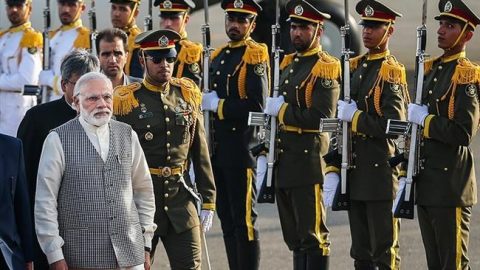
Indian PM Narendra Modi
Press TV – September 5, 2017
Iran’s Ministry of Petroleum says it has started preliminary talks with Russians to develop Farzad B but negotiations also continue with the Indians who have long coveted the giant gas field.
“For the development of the Farzad B field, we are pursuing three separate paths in parallel, but none of the options is definite yet,” director of the integrated planning at the National Iranian Oil Company (NIOC) Karim Zobeidi said on Monday.
The third path is the implementation of a development study plan in cooperation with a foreign consultant and Iran’s Petropars company, the official explained.
Zobeidi said negotiations with the Indians have not achieved satisfactory results but they have not stopped either and that Iran was pursuing preliminary talks with a Russian company as the second path.
“Along these two routes, the study of the development of Farzad A and B and the feasibility of the injection of gas from these fields into Aghajari (oil field) in cooperation with a foreign consultant and Petropars company is in progress,” he added.
Indian companies discovered the Farzad B gas field in Iran in 2008 and have bid several times for the development rights.
The Indians were supposed to develop the field after its exploration, but they stopped their activities after the West intensified sanctions on the Islamic Republic in 2012.
With the lifting of the sanctions, India once again called for the development of Farzad B by ONGC Videsh which is the overseas investment arm of the country’s biggest energy exploration firm.
According to an agreement, the Indians were first to submit a technical plan and then a financial proposal for the development of the field, but Iran did not agree with the other side’s financial proposals.
In the absence of an agreement between Iran and India, the development plan for Farzad B will be put to international tender.
In May, Minister of Petroleum Bijan Zangeneh announced that Iran had signed a basic agreement with Russia’s energy giant Gazprom over the development of Farzad B.
Indians shift attention to Israel
On Monday, Reuters cited India’s Oil Minister Dharmendra Pradhan as saying that state-run Oil and Natural Gas Corp planned to bid for disputed Israeli offshore oil-and-gas exploration blocks.
A high-ranking Indian delegation visited Israel last month to discuss taking part in the tender for blocks in the Mediterranean Sea, the news agency reported.
“We will definitely bid for Israel’s oil-and-gas blocks,” Reuters quoted Pradhan as saying.
New Delhi has deep military ties with Tel Aviv but they reportedly seek to expand their relationship to other sectors such as energy and technology following Prime Minister Narendra Modi’s visit to Israel in July.
According to Reuters, Israeli officials were pleased with the visit by the Indian economic team, while many oil majors have been hesitant to enter the Israeli market, fearing a backlash from oil-rich Arab states.
Lebanon has a long-standing dispute with Israel which stands accused of stealing Arab resources.
Lebanese Parliament Speaker Nabih Berri has said Israel was overtly stealing Lebanon’s underwater oil and gas reserves off the coast of south Lebanon. Hezbollah has warned that it would use force to protect Lebanon’s resources.
The gas discoveries have created a new source of friction between Lebanon and Israel, which have clashed repeatedly.
Lacking in natural resources, Israel has said it had discovered two fields thought to contain about 24 trillion cubic meters of natural gas, enough to make it energy self-sufficient for decades. Lebanese leaders have said the reserves were a “golden opportunity” for Lebanon to service its huge debt and rebuild its economy.
Russia vs US Economic War: Who’s Going to be the Ultimate Loser?
By Phil Butler – New Eastern Outlook – 02.09.2017
Full scale economic war in between America and Russia is underway. Russian Prime Minister Dmitry Medvedev said so, and the US administration and the American congress voted it in with new sanctions. The only question that remains is “who will win?” Here’s a look at the future of US-Russia relations and the ultimate loser in this new type of Cold War.
A fact most people are not aware of is that the United States is at risk of repaying its debt if anything major happens. The $20 trillion that America owes is by far the largest of any single country, and about as much as the 28 members of the European Union owe altogether. The sum is greater than what America produces in one year, or twice the debt to DGP ratio of 1988. But now let’s look at the makeup of this staggering debt.
This debt-to-GDP ratio tells investors that the country might have problems repaying the loans. And Baby Boomers are by far the biggest domestic investors via social security and other trust funds. In short, recent administrations have mortgaged the legacy of a generation. President Barack Obama holds the record for piling up the biggest US debt, just so the reader knows. The Bush administration comes in second where piling up debt is concerned, and tax cuts piled on top of the expensive “War on Terror” emptied American coffers at a staggering rate after 2001 and the 9/11 event. Social Security, which will have to pay Baby Boomer retirees their pensions soon, was gutted by Bush and Obama. If these funds are not propped up, 75 million Americans will be robbed of their hard-won retirement. But Social Security and the trusts are only used to cover other US government departments. But what about foreign debtors?
Countries like China, Japan, and Great Britain buy treasuries as investments and in order to guarantee American trade (especially in China’s case). Buying “treasuries” also helps China and other countries keep their currencies strong versus the US dollar. But in 2016 the pattern of purchasing huge US debts altered when China lowered its holdings of U.S. debt. Furthermore, as the debt-to-GDP ratio increases, the nations that hold US debt might demand higher interest payments to compensate for the increased risk. After this happens diminished demand will cause interest rates to rise further. This situation will create a downward spiral that puts pressure on the dollar, and that will eventually increase interest payments to unsustainable levels. Once the US government can no longer sustain social security and other programs, it’s fair to assume the whole house of cards will fall. Currently, Social Security costs more than $1 trillion per year, and payroll taxes no longer cover the fund. So, Congress can no longer “borrow” from the Social Security Trust Fund to pay for other federal programs.
For fiscal year 2018 the interest on the debt is $315 billion, and this will double by the year 2027. But there’s no need for an economics lesson here, so I’ll proceed to Russia’s situation by comparison.
Debt Free by Comparison – Russia
Russia’s national debt is by far the lowest in Europe and the lowest in the former G8 countries. In fact, before the Ukraine crisis took shape Russia’s growth was astounding compared to the US, Germany, France, Japan, and the other G8 nations. Reuters reported Russia’s growth rate of 2.5 times that of the US in quarter 4 of 2011. Russian President Vladmir Putin’s repaying almost all of the country’s foreign debt, high energy prices combined with Russia’s exports to Europe were creating a Russia powerhouse economy. If the truth is ever told of the new “Red Scare” it will reveal fear as the motivator for a new Cold War waged by western powers.
When US President Donald Trump was elected many of his supporters believed there would be a “reset” to normal in US-Russia relations. These hopes were quickly dashed when the technocracy and the globalist control mechanism attacked Trump with a vengeance over his Russia narrative. Allegations of some form of collusion between the new American president and Putin’s Russia became the flavor of the day for corporate and government controlled media. When Trump and Putin met in Hamburg there was renewed hope, but this was quickly dashed when the US Congress hurriedly pushed through a new sanctions law that rolled Russia in with Iran and North Korea. The Israel lobby (AIPAC) put the squeeze on its constituency in congress and on Trump, and a new economic war was waged. Russian Prime Minister Dmitry Medvedev said “the US had declared full-scale economic war”.
Putin’s Russia having already made the “shift” eastward to Asia, the only logical reaction to the Trump reversal was to head full steam in the direction of Beijing. For a couple of years both Russia and China have been hoarding gold and taking steps to separate from the dollar currency. Where Russia’s natural gas is concerned, the blockages thru Ukraine and Syria to Europe created by the NATO nations have been circumvented. The Turkish South Stream project is back in full swing and Russia’s armed forces have helped signal the end of ISIL in Syria. Trump signing this new sanctions bill will end up costing Americans and Europeans the future if I am right.
Further evidence that America has big trouble come from China‘s inviting Guinea, Mexico, Tajikistan and Thailand to the upcoming BRICS summit. Meanwhile Putin is creating a Ministry of the Future headed by economic whiz kid Maxim Oreshkin, who was recruited from the ranks of VTB Capital. According to Bloomberg Oreshkin is creating an informal group known as the “office of changes” bent on improving the structure of the ministry. The ministry will be staffed by renowned gurus like; “Ekaterina Vlasova, poached from Citigroup Inc, Pricewaterhouse Coopers’ Zoya Viktorova and Yulia Urozhaeva from McKinsey & Co.”
The Real Bear Market
An interesting aspect of Oreshkin’s emergence is his role in bringing about a pet project of Putin, in ramping up Russia’s place in the so-called “digital economy”. To this end the Russian president already demanded a final version of this “digital economy development program” be set in place by October. According to the Kremlin the new initiative should create a support mechanism for the development of key end-to-end digital technologies, including artificial intelligence, robotics, quantum computing, development of information and telecommunications and computing infrastructure, and financial incentives.
In conclusion, it’s abundantly clear that Dmitry Medvedev was right in finally giving up the ghost of hope for US-Russia reconciliation. One reason for this is the clear desperation western leaders and business exhibit in their all-out war on Putin. In fact, the only logical reason for trashing west-east relations has to be fear the system of banking and business in the US and Europe will fail. As for Russia’s play I am reminded of a report I made some months back on Putin’s “Third Way” for society. It’s been obvious for some years now the Putin administration has been battling to change Russia’s business and government ecosystem. But economic and geo-strategy assault from western powers has interrupted this plan. I believe Putin had intended to meld Russia’s new initiative into the existing G20 economic structure. But Trump’s turnabout forced a new direction. In the long view we can only watch and see if the staggering giant of American globalist capitalism can overcome a new power structure in world economics. If the Eurasian Union separates from the dollar, the world will certainly enter a time of dire crisis. We may soon witness a real bear in the world marketplace, one unwelcomed by Wall Street.
Phil Butler, is a policy investigator and analyst, a political scientist and expert on Eastern Europe.
Nicaragua’s Sandinista Achievements Baffle World Bank, IMF
teleSUR | August 31, 2017
No one can take at face value any report, governmental or quasi non-governmental, coming out of the imperialist bureaucracy in Washington. Ideological bias and institutional self-justification prevent these reports from giving a true account of virtually anything.
The latest World Bank report on Nicaragua is no exception.
The implicit but unstated truth in this report is that President Daniel Ortega and the Sandinista National Liberation Front have achieved an unprecedented economic turnaround in just seven years, starting in 2010.
Reading the report, it is impossible to ignore the tension between latent ideological and political imperatives and the obligation to report the facts. Put another way, mild conflict clearly prevails between the World Bank’s Washington head office and its reality based local officials. From Washington, the tendency is both to minimize Ortega’s achievement and also to cover up the World Bank’s own lamentable history in Nicaragua. On the other hand, in Nicaragua, local World Bank staff dutifully report the facts as they see them.
A total of 71 people contributed to the report. Supposing those 71 people each worked for a month to prepare the research and say their average salary was about US$80,000, then pro rata a month’s work by that team cost over US$500,000, a very conservative guess. Even so, in summary, that money bought policy recommendations for Nicaragua’s development amounting to little more than better infrastructure; better basic services; more private business investment; more efficient government; better targeted social policies. That’s it, for US$500,000 or more.
In general, the report recognizes Nicaragua’s achievements in reducing poverty and inequality, raising productivity, diversifying economic activity and promoting security and stability. The report’s 130 or so pages include, among the economic and sociological analysis, many self-confessed guesses to fill in “knowledge gaps” and much gerrymandered history to cover up what Harold Pinter in his 2005 Nobel prize winning address justly called “the tragedy of Nicaragua.”
Pinter himself might have remarked the report is almost witty in its audacious, glib omissions. It acknowledges the catastrophic destructive effects of the 1980s war in Nicaragua, but carefully omits the U.S. government’s deliberate role in that destruction, now repeated against Syria and Venezuela.
The report talks about a “democratic transition” starting in 1990. In fact, the Sandinistas organized the first free and fair democratic elections ever in Nicaragua in 1984, but the U.S. government ordered the main Nicaraguan opposition to boycott them. Despite the war, Ortega and the Sandinistas won with 67 percent of the vote, very similar to the most recent presidential elections in 2016.
The heavy ideological bias also explains the World Bank’s curious dating of when Nicaragua’s economic turnaround began, placing it firmly in the neoliberal era prior to 2007. But at just that time, the World Bank was cutting back the public sector as much as they could, pushing, for example, to privatize Nicaragua’s public water utility and its education system.
Back then, Nicaragua’s neglected electrical system collapsed through 2005 and 2006, incapable of generating even 400 megawatts a day, plunging swathes of Nicaragua back into 19th-century darkness for 10 to 12 hours at a time, day after day. That was the World Bank and IMF’s gift to Nicaragua after 17 years of so-called “democratic transition.” That period included Hurricane Mitch, devastating Nicaragua to the tune of 20 percent of its GDP, only for the corrupt neoliberal government at the time to misuse hundreds of millions of dollars in disaster relief. The only structurally significant economic achievement of the neoliberal era in Nicaragua was substantial foreign debt relief.
When Ortega took office in January 2007, he faced four years of domestic crisis with an opposition controlled legislature persistently sabotaging his government’s programs. From 2007 to 2008, Nicaragua and the whole region struggled in vain to contain a balance of payment deficits against oil prices reaching US$147 a barrel in 2008.
That disaster was compounded by the collapse of the Western financial system in late 2008 to 2009, a year when Nicaragua’s economy suffered a 3 percent contraction. Only in 2010, did the Nicaraguan government finally enjoy domestic and international conditions stable enough to be able to consolidate and improve its social programs, improve infrastructure investment, democratize and diversify the economy, extend basic services, and attract foreign investment, among other things.
If that sounds suddenly familiar, it should. It is exactly the development recipe offered up by this latest World Bank report, essentially an embellished review of policies the Nicaraguan government has already been implementing for a decade. Put positively, the government’s National Human Development Plan and other relevant documents suggest that the World Bank’s engagement with the Nicaraguan government has been one of mutual learning. So much so, that the current country program is likely to continue and may even expand.
The political opposition in Nicaragua has seized on parts of the report to try and discredit the Sandinista government’s outstanding achievements. In fact, for 17 years under neoliberal governments implementing World Bank and IMF policies, areas criticized like, for example, access to drinking water and adequate sanitation, or education, suffered chronic lack of investment, compounded by egregious waste and corruption. Now, the World Bank hypocritically criticizes Nicaragua’s government for intractable policy difficulties the IMF and the World Bank themselves originally provoked.
Similarly, when the World Bank report criticizes the targeting of social programs, they omit the unquestionable success of the government’s Zero Usury micro credit program and the Zero Hunger rural family support program, both prioritizing women. These programs have lifted tens of thousands of families out of poverty and, along with unprecedented support for Nicaragua’s cooperative sector, radically democratized Nicaragua’s economy, especially for previously excluded rural families and women. That supremely important national process is entirely absent from the World Bank report.
In its discussions of almost all these issues, the report makes more or less detailed contributions, mostly already identified by the government itself. In every case, the underlying cause of problems or lack of progress, for example, on land titling or social security, has been the legacy of neoliberal governments between 1990 and 2007, that reinstated elite privilege, rolled back the revolutionary gains of the 1980s and failed to guarantee necessary investment.
The World Bank and the IMF were enthusiastic ideological partners in that endeavor. They would have continued their ideological offensive had not Ortega and his government dug in their heels in 2007 and 2008, backed by investment support for social and productive programs from Venezuela as part of the Bolivarian Alliance of the Americas.
Since then, the World Bank, as this report suggests, seems, at least for the moment, to have learned two key lessons from the Sandinistas. In a world dominated by corporate elite globalization, their report implicitly recognizes the importance, firstly, of a mixed economy under a strong central government and, secondly, the crucial role of broad dialogue and consensus, across all sectors of society, to promote and sustain national stability. Essentially, the World Bank has acknowledged the undeniable success of the Sandinista Revolution’s socialist inspired, solidarity based policies, decisively prioritizing the needs of people over corporate profit and demonstrating the systemic inability of capitalism to meet those needs.
IAEA Doesn’t Check Iran Military Sites for Nukes Because There’s ‘No Reason To’
Sputnik – 01.09.2017
United Nations watchdogs have said that they don’t believe it necessary to search Iranian military sites to verify that they are in compliance with the 2015 Iran nuclear agreement, as they do not suspect any misdoings on the facilities. The US has strongly pushed the UN to inspect Iranian military sites, which have not been investigated thus far.
Over the weekend, US Ambassador to the United Nations Nikki Haley met with officials from the International Atomic Energy Agency (IAEA), the UN-affiliated international organization whose stated purpose is to promote the peaceful, non-military use of nuclear technology. The IAEA has been tasked with ensuring that Tehran abide by their terms of the 2015 Joint Comprehensive Plan of Action (JCPOA) and not produce weapons-grade plutonium or enriched uranium that could be used for nuclear weapons.
Part of the agreement was that the IAEA could send inspectors to Iranian sites, including military ones, if they believed that illegal nuclear activities were being undertaken there. Iran has traditionally been cagey about letting international inspectors into their military complexes to check for nuclear activity, citing national security concerns.
But the administration of US President Donald Trump has been very negative about the JCPOA, which was negotiated in part by Trump’s predecessor, Barack Obama. The hyperbolic American president once called the JCPOA the “worst deal ever negotiated.”
Haley expounded: “They have a very strong verification program in Iran, I was pleased to hear about all that they are doing. Having said that, as good as the IAEA is, it can only be as good as what they are permitted to see. Iran has publicly declared that it will not allow access to military sites, but the JCPOA makes no distinction between military and non-military sites.”
“There are also numerous undeclared sites that have not been inspected yet — that’s a problem,” she said. “I have good confidence in the IAEA, but they are dealing with a country that has a clear history of lying and pursuing covert nuclear programs.”
But IAEA officials declined Washington’s request. “We’re not going to visit a military site like Parchin just to send a political signal,” an anonymous IAEA official told Reuters, referring to the controversial Iranian military base that the IAEA last inspected in 2015.
Instead, IAEA officials stated, they would search only if they suspected Iranian misdoing. The JCPOA only allows for IAEA searches if they can provide a basis for their concerns. Another anonymous IAEA official told Reuters that they hadn’t asked for access to Iranian military sites because they had “no reason to.”
IAEA Director General Yukiya Amano frequently describes his agency as an apolitical one, only concerned with ensuring that states are not engaging in nuclear mischief.
Meanwhile, the US State Department issues a statement to Congress every 90 days regarding whether or not Iran is still in compliance with the JCPOA. Trump has pushed for the State Department to declare Iran noncompliant.
However, the UN, the IAEA, France and Russia have all pushed to keep the JCPOA, and for the US to declare Iran compliant. France and Russia also signed the JCPOA, along with the United Kingdom, China and Germany — and, of course, Iran and the US.
“If [the Trump administration] want to bring down the deal, they will,” the first IAEA official said. “We just don’t want to give them an excuse to.”
Israel’s failure to attract major oil companies is a massive blow to its ambitions
New Khaleej | August 28, 2017
Israel has managed to beat its Mediterranean neighbours in the development of its offshore gas industry over the past two decades by discovering 10 gas fields, specifically in the northern waters adjacent to Cyprus and Lebanon. Initially, Israel was concerned with developing the Tamar field, which has about 282 billion cubic metres of gas, and the Leviathan field, which has about 500 billion cubic metres.
Since Spring 2013, gas has been produced from the Tamar field to supply local power stations. Negotiations are underway with neighbouring countries to export Leviathan gas, not to mention changing most of the local power stations to use two types of fuel, gas and oil, rather of depending on only one type, as was the case in the past, either coal or oil.
However, the Israeli gas industry faltered in December 2014, when Israel’s then Antitrust Commissioner accused the Noble Energy-Delek consortium of monopolising all discoveries in accordance with the agreements signed by the gas authorities, as well as monopolising internal gas supplies and the prices of gas and electricity. This resulted in disagreements within the Knesset (Israeli parliament) and civil society over this lawsuit; Prime Minister Benjamin Netanyahu took part, as he considered it a matter of “national security”. The issue was ultimately referred to the courts.
However, middle ground was found in order to rescue the gas industry from the repercussions of the chaos caused by the cancellation of memorandums of understanding for export to neighbouring countries, and the fears of international oil companies about working in Israel due to the fact that approval needed to be obtained from multiple parties, even after the signing of agreements. They were also discouraged by the contradiction in the official institutions’ privileges and the extent of competition in working in Israel compared to other countries.
Some of the largest law firms and public relations companies, especially in the US, have been involved in these disputes. Solutions were reached, with the consortium countries giving up their shares in some relatively small fields, especially in the neighbouring Karish and Karan fields, which are considered the closest to Lebanese waters (about 10 miles away).
Most importantly, the first licensing cycle was announced in September 2016 and began last November. The names of the winning companies were announced on 17 March this year. The agreements with the consortium led by Noble Energy were reached through bilateral talks.
The main objective of the first licensing cycle was the development of 24 offshore blocks adjacent to the Tamar and Leviathan discoveries. The size of some sectors is about 400 square kilometres, while the depth of the water is between 1,500 and 1,800 metres. The cycle aimed to attract international oil companies in an attempt to benefit from their technical expertise and their marketing, industrial and financial capabilities. It also aimed to begin a new era of experience between Israel and the international oil companies, especially after the antitrust authority complaints and changes in the Arab boycott laws.
This was followed by an attempt to break through the boycott in one of the most important economic sectors in the Middle East. Opening this relatively large number of maritime sectors all at once was accompanied by Israel’s interest in the discovery of crude oil in commercially volume in deep geological strata. This was after evidence emerged that oil could be found. Official sources said at the time that independent research bodies estimated the amount of oil that could be found amounted to about 6.6 billion barrels, in addition to 2,137 billion cubic metres of gas.
“Companies operating in Israel [Noble Energy and Delek] are not allowed to participate in the tender, in order to encourage competition,” said Israeli Energy Minister Yuval Steinitz.
The concerned Israeli authorities tried to make the first licensing cycle successful, but to no avail. The energy minister and ministry officials participated in large-scale promotional conferences in London, Houston and Singapore, as well as an “information room” for companies, but did not achieve their goals.
Only four companies have announced their interest, namely Greece’s Energean, Italy’s Edison, an Israeli company that has not been named and Spain’s Repsol. As a result of this low turnout, both in terms of number and significance, and because Repsol is the only one with a prestigious position within the European oil companies, there has also been news in the oil industry about trying to attract international companies to work in Israel, specifically Exxon Mobil, but no agreement has been reached yet.
Due to the scarcity of companies that have shown an interest in participation, especially given the large number of sectors offered to companies and the failure to reach agreements with international companies, the date of the session was extended to 21 April and the results were announced in July. However, with the failure to attract many or important companies, even after the extension, it seems clear that the session will be extended further, perhaps to the first quarter of 2018.
The lack of interest from the major oil companies in the Israeli gas industry has been a massive blow to Israel’s ambitions to attract those with large capital, specialisms and experience in the development of deep offshore fields, and which have the necessary connections to new large market routes (a dilemma Israel faces despite its attempts with Turkey, Greece and Italy). It has also hindered Israel’s desire to compete with Egypt (with the discovery of Eni in the Zohr gas field), in order to become a regional centre for the gas industry in the east Mediterranean.
Translation by MEMO
Featured Video

AIDS Inc. by Gary Null (2007)
or go to
Aletho News Archives – Video-Images
From the Archives
Clash of Civilization, Iran Part II
By Jamal Kanj – Intifada-Palestine.com – January 14, 2011
Israel’s survival kit is: perpetuate conflict, insecurity to rationalize collective hate and finally playing victim.
Devoid of conflict, Israel implodes internally; without hate, Zionism loses its justification; and playing eternal victim to continue blackmailing the West. Absence of this holy trinity, Israel ceases to exist.
From its inception, the house of Zion has mastered exploiting adversarial powers to advance Israel’s cause. For instance, their influence over the Democratic Party in the US began with President Truman’s bid for 2nd term election in 1948.
Responding to strong opposition from Secretary of State General George Marshall and Department experts urging against recognition of Israel, President Truman replied: “I’m sorry gentlemen but I have to answer to hundreds of thousands [Jewish voters] who are anxious for the success of Zionism. I do not have hundreds of thousands of [voting] Arabs among my constituents”
Zionists influence over liberal American politics was matched with the doctrinal school of Conservative theoreticians aligning the Republican Party’s platform with Israel’s objectives. The Neoconservative Zionists, coined Zioncons, invented the “Clash of Civilization” concept to fight Israel’s wars. … continue
Blog Roll
 Aletho News
- 12 Things Your Psychiatrist Was Trained Not to Tell You
- From Unipolar Universalism to Multipolar Civilizational Distinctiveness
- RSF military group defects, joins Sudanese army: State media
- Ireland goalkeeper refuses to play ‘Israel’ as squad weighs boycott
- China pushes back against US on Cuba, Iran
- Ukrainian Soldiers, Potential Mercenaries: Have Gun, Will Travel!
- Burnham’s UN debut… A masterclass in British disinformation
- Iran flights continue despite US aviation sanctions
- Global Tipping Points Lead the World Into a State of Entropy
- The day-after at the White House: USA and Xi Jinping
- If Americans Knew
- Israel forces Gazans to live in constant peril – Daily Update
- Deconstructing Netanyahu’s pants-on-fire UN rant – Daily Update
- Trump betrayed voters with his campaign lies and prioritized a foreign country once he took office
- Netanyahu calls Israel’s war in Gaza ‘opposite of genocide’ in UN speech to near-empty hall
- Settler Kidnappings: Torture, Sexual Abuse and Terrorisation of Palestinian Abductees as Israel Deepens Annexation of West Bank
- Gaza winter nears as 162,000 tents become unusable, raising fears of humanitarian crisis
- Netanyahu says, “It’s the opposite of genocide”; UN says Gaza economy is world’s ‘most severe crisis on record’ – Daily Update
- Israel’s US-Backed Assault on Gaza Has Created the ‘World’s Most Severe Economic Crisis on Record’: UN
- ‘Protecting U.S. Citizens’… From Israel
- ‘This is where I live now, the back of a truck’: a day in the life of a grandmother in Gaza
- No Tricks Zone
- New Study: Earth And Venus Surface Warmth Largely Explained By Convection And Lapse Rate, Not CO2 Or Radiation
- 2025 Nature Paper Claiming Worsening Global Drought Gets RETRACTED …Heavily Flawed
- New Study: ‘Global Drought Shows No Detectable Recent Acceleration Under Climate Warming’
- Economic Masterminds: German Socialists Suggest Taxing Productivity Gains Stemming From Using AI
- The South China Sea Has Not Been Cooperating With The Climate Change Narrative
- Energy Crisis: Germany Enters Heating Season With Historically Low Gas Reserve Fill Levels
- New Study: The Antarctic Ice Sheet Gained Mass From 2020-2024 Due To Staggering Snow And Ice Accumulation
- Study: Ocean Heating Rates From Thousands Of Years Ago ‘Dwarf’ Modern Ocean Heating Rates
- Climate Extremists Target, Attack Large-Scale Power Grid Infrastructure In Germany!
- New Study: Antarctic Ice Melt Has Contributed Less Than 1 Centimeter To Sea Level Rise In The Last 30 Years

