Activist: Saudi’s 2030 Vision Coordinated by Washington, Tel Aviv
Al-Manar | September 28, 2017
Saudi activist Mujtahid said that the inclusive change in Saudi Arabia (political, social and economic change) is coming, noting that the authorities will arrest all those who stand against this change,
On his Twitter account, Mujtahid quoted a US advisor, who takes part in Saudi Arabia’s Vision for 2030 project, as saying that the change is coming.
This change requires Crown Prince Mohamamd Bin Salman’s monopolization of power on the political level, secularizing the kingdom on the social level, and selling Aramco firm on the economical level, Mujtahid said, citing the US advisor.
He revealed that such plan is being coordinated with the US, Zionist entity, Egypt and UAE, noting that all these sides share the same stance regarding the arrest campaign which will target all those who reject this change.
In this context, Mujtahid, who is believed to be a member of or have a well-connected source in the royal family, pointed out that the arrests which were made recently represents an early stage of this plan of change.
Philip Giraldi’s Remedy for Wars

May 5, 2016: Ultra-Zionist Billionaire Megadonor Sheldon Adelson attends 4th annual champions of Jewish values international awards gala at Marriott Marquis Times Square
By Israel Shamir | The Unz Review | September 27, 2017
Once in a while, an observer notices a concerted Jewish action, and reports on it pro bono publico. It could be that Jews support Third-world immigration, or Jews fight the memorials, or, in the recent case, Jews promote the war on Iran. The Jews respond with a huge vehement counterattack and make life very difficult for the outspoken observer. Afterwards, the subject recedes, as people get cold feet to proceed, or do not know how to proceed, though the problem remains at large.
The recent example is a piece by Philip Giraldi on the Unz.com, which still produces waves on the web. In his piece he rolled the list of Jews who were keen on Iraq invasion, and who are pushing the US now into an attack on Iran: “David Frum, Max Boot, Bill Kristol and Bret Stephens, Mark Dubowitz, Michael Ledeen… And yep, they’re all Jewish, plus most of them would self-describe as neo-conservatives.”
Giraldi proposed to keep Jews out of the positions of influence on the foreign affairs, in order to keep the US out of wars it does not need. Giraldi wrote: “We don’t need a war with Iran because Israel wants one and some rich and powerful American Jews are happy to deliver.”
Actually, the Israeli newspaper Haaretz wrote at the time (in April 2003): “The war in Iraq was conceived by 25 neoconservative intellectuals, most of them Jewish, who are pushing President Bush to change the course of history. Two of them, journalists William Kristol and Charles Krauthammer, say it’s possible.”
I also wrote things in the same vein during Iraq invasion, and it is good to see that this thesis did not die but keeps resurging from time to time. One could add that these very persons are pushing for conflict with Russia, demonise Putin and attack Trump, though the Orange Man tries to fulfil their wishes as an eager Santa Claus of diligent Lizzie.
While agreeing with Giraldi on the malady, let us discuss the remedy. Would keeping Jews out of foreign policy making actually help? Did the US keep out of wars before the Rise of Jews in late 1960s? The Jews weren’t specially prominent before that time, and certainly weren’t overrepresented in the establishment. A Jewish couple, Ethel and Julius Rosenberg has been fried on the electric chair in 1953, and there were few objections. McCarthy terrorized Jews. The word Holocaust had yet to make its first appearance (in 1968). Jews were still kept out of clubs and out of high level politics. Israel had been threatened by the US (in 1956) rather than assisted.
And still, the free-from-Jews US had fought in Korea the terrible three-year long war (1950-1953), and in Vietnam (up to 1974), invaded and caused regime change in Guatemala and Iran, violently interfered in elections in France and Italy, and had fought the fierce Cold War against the USSR. In all these campaigns, the US Jews were actually for peace and against war. The Jews were nowhere in power when the US fought its wars against Spain and Mexico. The non-Jewish US made a coup in Iran, and non-Jewish and not-pro-Israel President Carter tried to invade Iran. Jews weren’t involved in the conquest of Panama, in Nicaragua intervention, in Granada operation.
Perhaps the Jews had moved the arena of wars to the Middle East and out of Latin America. Less Jewish-influenced America would rather invade Venezuela than Iraq or Iran. But is it so wonderful?
The idea of correcting or channelling the excessive Jewish influence is a reasonable one, but can this goal be achieved by keeping Kristol and Krauthammer out of media (an excellent thought anyway)?
The Jewish prominence in the US is inbuilt in the US culture and tradition. Karl Marx wrote that “in North America, the practical domination of Judaism over the Christian world has achieved as its unambiguous and normal expression”. He said that all Yankees are Jews, behave like Jews, aspire to be Jews and even are circumcised like Jews. So it is natural that real Jews succeed better in being Jews than their Gentile neighbours. Werner Sombart added that Jews were prominent from the very dawn of America and they created American-style capitalism the way that fits them. The Jews are prominent now because America is custom-built for Jews to fit and suit them, he said.
This is what should be corrected, and then the Jewish scribes, these Krauthammers will be out of business of inciting wars. Stop subscribing to Jewish success model, and the Jews won’t be able to influence the Senate. Make the US Christian as Christ taught, share labour and wealth, aspire to God instead of Mammon, make the first last and the last first, love thy neighbour and the problem will be solved.
If this is too tall an order, make it a smaller one. Unseating Ledeens and Frums (and I think they deserve tar and feathers all right) will not do the trick unless the rich Jews are un-wealthed. Without excessive Jewish wealth, there will be no excessive Jewish push for wars. And provided that more than half of all US wealth is in few Jewish hands, freeing it will make a colossal effect of improving life of every American, even every person on earth.
And why to stop there? The super-rich non-Jews are as Jewish as any Jew. They share the same aspirations. Strip them of their assets. Why should we worry whether Jeff Bezos is a Jew by blood or faith, or he is not? He behaves like a Jew, and that is enough. Establish a ceiling of wealth, a counterpart of minimal wage. This idea has been mulled: Jeremy Corbyn called for the maximum wage. Taxes can do it easily – in wonderful Sweden of 1950s, top tax rate was 102%. Or this can be achieved in a more festive way of stripping the richest men of their ill-gotten wealth on the main square of Washington, DC on Mardi Gras Sunday. Do not say this is a punishment for their diligence – other way around, this is assistance on their way to spiritual improvement. Too many assets imprison the spirit.
This would be good for Jews and for all concerned: while the average Jewish wealth in the US had been lagging below total average (that is as long as Jews were less wealthy than Gentiles), the Jews acted in the interests of the people. Around 1968-1970 the Jews became more wealthy than all Americans, and that was it: they ceased to strive for the common good.
Jews could be a force for good if their excessive tendency to collect material goods is nipped in the bud. So it was in the USSR: as the Jews could not make money, they went into science and worked for the common good. Even oligarchs could be good managers instead of pain in the neck for the society.
This is not more complicated than booting Max Boot out of writing business. So why to go for a palliative if you can go for the jugular?
Israel Shamir can be reached at adam@israelshamir.net
Germany at a turning point
By M K Bhadrakumar | Indian Punchline | September 25, 2017
The elections to the German Bundestag on Sunday throw up big surprises. Chancellor Angela Merkel will lead the next coalition government, too – her fourth successive win – but in all other respects, the results signify that Germany’s post-World War II politics is at a turning point.
First and foremost, the two mainstream parties that have dominated German politics have now come to represent only 53% of the electorate. The level of fragmentation is stunning for a country that is synonymous with the ‘middle path’. Second, Merkel’s CDU (Christian democrats) has lost support and her coalition partner SPD (social democrats) suffered a humiliating defeat. Third, the right-wing nationalist AfP – reviled as ‘neo-Nazis’ – won over 13% votes and secured 94 seats in the 709-member Bundestag, the first time such a thing is happening in Germany’s post-World War II political history.
Then, there are the sub-plots. The SPD has vowed to sit in the opposition, which means Merkel may have to form the next government with the rightist CSU (Christian socialists) and leftist Green Party as coalition partners, which makes an improbable alliance of convenience. The CDU-led government’s economic policies are likely to be subjected to pulls and counter-pulls from the two coalition partners CSU and Green Party, which are at loggerheads ideologically.
Interestingly, AfP’s main support base happens to be the former communist East Germany and, thus, an ‘East-West’ divide is surfacing after the German unification a quarter century ago.
Again, CDU lost popular support for the wrong reasons. Under the CDU-led government, the German economy did remarkably well. What cost Merkel heavily has been her refugee policies, which have been perceived as appeasement of Muslims opening the door to an influx of Islam in Germany. Merkel eventually took a tougher line on deportations but it was too little, too late. The issues of asylum, integration and deportation and the perceived ‘Islamisation’ of Germany dogged Merkel’s entire election campaign.
The ultra-nationalist AfD framed its campaign on the provocative platform, “Islam does not belong to Germany.” The party’s program calls for a ban on minarets and considers Islam to be incompatible with German culture.
The AfD leader Alexander Gauland has openly called for Germans to reclaim their history: “We have the right to be proud of the achievements of the German soldiers in two world wars.” The outgoing foreign Minister and SPD leader Sigmar Gabriel warned voters ahead of the poll against having “real Nazis in the German Reichstag for the first time since the end of World War Two”. Germany’s Central Council of Jews said its worst fears had come true in Sunday’s election.
The German policies are almost certain to be affected. Merkel will be under pressure to step up deportation of refugees. The AfD has tasted blood and sensing the national mood, it will surely intensify the ultra-nationalist campaign. Surely, the German discourse is poised to become much more homophobic, much more anti-migrant, much more-anti-Muslim. This will cast shadows on Germany’s relations with Turkey.
Again, Merkel’s approach to Russia will be keenly watched. The AfD – like most ultra-nationalists in Europe, is, ironically, “pro-Russia”. If the Russian strategy has been to discredit western democracies and break them into shambles, there ought to be quiet satisfaction in Moscow over what is unfolding in Germany.
At any rate, a weakened Merkel is not a bad thing for Moscow. (President Vladimir Putin and Merkel had an uneasy personal relationship.) Merkel will now be more susceptible from pressures from the German industry, where Russia has influential lobbyists, for normalization of business ties with Moscow.
The biggest impact of the German election will be felt on European integration processes. Merkel has been out on the back foot and she was a flag-carrier EU integration. Germany’s influence within the EU weakens in the period ahead. And, without a strong axis with Germany, France alone cannot lead European integration. In sum, coming on top of Brexit, EU will be rudderless without Germany’s leadership under an assertive Merkel.
How the Democratic Party Has Incurred Major Electoral Losses by Its Mistaken Support for Climate Alarmism
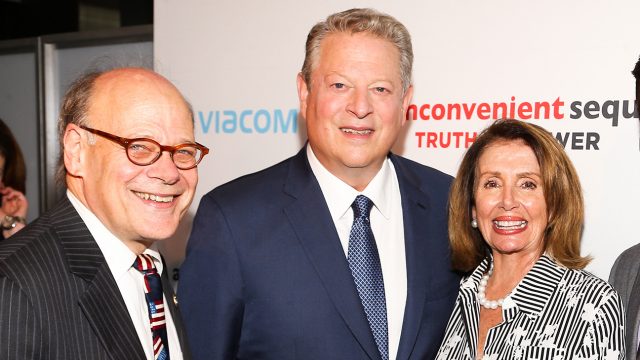
Photo by Paul Morigi/Getty Images for Paramount Pictures
By Alan Carlin | Carlin Economics and Science | September 20, 2017
For inexplicable reasons the Democratic Party has in many ways made itself the “Green Party,” and thereby has incurred major electoral losses. Each time it loses as a result of its increasingly green ideology, it has responded by doubling down on its green bet. The underlying miscalculation they have made is a result of the fact that the presidency is decided by electoral votes, not popular votes. Most of the “environmentalists” live in strongly blue states and the red state “environmentalists” are widely scattered in the few large towns, particularly college towns. This was very evident in the 2016 election when Clinton won the popular vote but lost the electoral vote, with much of her surplus of popular votes coming from California. Hillary Clinton has now confirmed this view by writing that her statement on the loss of coal mining jobs was the single greatest mistake of her campaign.
In 2016 the Party went whole hog for climate alarmism by writing it into their party platform and even promising to end all use of fossil fuels by a date certain. Clinton also hurt her prospects in 2016 as a result of her remarks about the loss of coal mining jobs and her last minute endorsement of Al Gore and his strident climate alarmism. Yes, Clinton probably picked up some “environmentalist” votes, but most of them were in states that she was going to win anyway. And she probably lost votes in the states that Trump most needed to win for an electoral vote majority.
But a very good case can be made that the climate issue played a decisive role in the 2000 presidential election, the 2010 congressional election, as well as in the 2016 presidential election. Somehow the Party overlooked or misinterpreted what happened in 2000 and in 2010.
2000
Most people who remember the 2000 presidential election immediately think of the controversial outcome in Florida, which ultimately decided the election. But it would have had no influence if Al Gore had not lost West Virginia for the Democrats for one of the few times from 1932 to then. The deciding issue appears to have been climate and coal mining. In the end, Gore lost the presidential election by 3 electoral votes. West Virginia had 5 electoral votes that year. But all of them went to Bush primarily because of concerns about Gore’s views on climate and the likely effects of climate alarmism on coal mining, an important source of income in the State. West Virginia voted Republican in only three presidential elections from 1932 until 1996 but has become increasingly Republican in presidential voting since 2000. I believe most of that increase can be attributed to the Democratic Party’s increasing support for climate alarmism. If Gore had not pursued climate alarmism or had not been the nominee I believe that the Democrats would have won in 2000.
2010
The 2010 Congressional Election resulted in the Democratic Party’s loss of a majority in the House of Representatives. It appears that this loss was due to the loss of Democratic seats where Democratic incumbents had voted for the American Energy and Security Act of 2010 (the Waxman-Markey cap and trade bill). A number of Democrats who voted for the bill lost their seats in 2010 and the Democrats lost control of the House of Representatives and have not regained it as of 2017. This played an important role in their success or rather lack of it during the remainder of the Obama Presidency in passing legislation to implement the party’s platforms.
Conclusions
From a purely Democratic Party viewpoint, their unequivocal adoption of climate alarmism has been a very bad bet. And this week a number of prominent alarmist climate modelers have finally admitted (see here and here) that the alleged “consensus” has been wrong by exaggerating the global warming that would occur if carbon dioxide emissions are not reduced, just as many climate realists have long been saying. This leaves the Democratic Party with a greatly reduced basis for their extremist views on climate. So major electoral losses over an issue that has little, or more likely, no effect on anyone.
I even wonder if the modelers withheld their long needed revisions until after the Paris treaty was agreed to, but wanted to avoid the increasing criticism of the differences between their models and actual temperatures.
As readers of this blog know, I believe that the situation is even worse for climate alarmists and thereby for their Democratic Party supporters since carbon dioxide emissions and atmospheric levels have been shown to have no significant effects on global temperatures and because higher CO2 levels are good, not bad. So the Democratic Party has been backing the wrong horse and has paid dearly for it. They are not saving the world; they are pushing bad policy that hurts the Party’s electoral chances as well as the economy, green plants, and poor people.
US, Iran break ice at UN
By M K Bhadrakumar | Indian Punchline | September 21, 2017
The US President Donald Trump’s speech at the UN General Assembly on Tuesday has drawn attention to the Iran nuclear deal of July 2015. Will the deal survive? Or, will it perish in a sudden death? Trump said,
- The Iran deal was one of the worst and most one-sided transactions the US has ever entered into. Frankly, that deal is an embarrassment to the United States, and I don’t think you’ve heard the last of it. Believe me.
Harsh words, indeed. Meanwhile, the P5+1 and Iran met at foreign minister level in New York on Tuesday. According to European sources, “the meeting included a long discussion” between Tillerson and his Iranian counterpart Mohammed Javad Zarif – although Tillerson publicly maintained that they merely shook hands. In a subsequent interview with Fox News, Tillerson narrowed down the US demand at this point to the so-called “sunset provision” in the Iran deal under which time limits (of varying lengths, such as 10 or 15 years) apply to some of the restrictions put on Iran’s nuclear program.
Evidently, there is much sophistry in the arguments being proferred, (as explained lucidly by Paul Pillar, Nonresident Senior Fellow at the Center for Security Studies at Georgetown University and in Foreign Policy at the Brookings Institution in a blog in the National Interest magazine.) Tillerson indeed hinted that the issue goes beyond Iran’s nuclear programme. As he put it,
- Our (US’) relationship with Iran from a security standpoint and a threat standpoint is much broader than that, as is the entire region. And we’ve really got to begin to deal with Iran’s destabilizing activities in Yemen, in Syria. The President (Trump) highlighted that today, that under the agreement – the spirit of the agreement, if you want to use that word – but even the words of the preamble of the agreement, there was clearly an expectation, I think on the part of all the parties to that agreement, that by signing this nuclear agreement Iran would begin to move to a place where it wanted to integrate – reintegrate itself with its neighbors. And that clearly did not happen. In fact, Iran has stepped up its destabilizing activities in the region, and we have to deal with that, and so whether we deal with it through a renegotiation on nuclear or we deal with it in other ways.
Simply put, the US feels agitated about Iran’s cascading influence in the Middle East and its emergence as the foremost regional power – even surpassing Israel. In turn, Israel, which has lost its military pre-eminence in the Middle East, is counting on the Trump administration (which also has a big contingent of “hawks” on Iran) to push back at Iran’s lengthening shadows, especially in Syria, Lebanon and Gaza.
One hitch here is that the European Union disfavours a re-opening of the Iran nuclear deal (for whatever reasons.) The EU foreign policy chief Federica Mogherini made this point quite clear after the FM-level meeting in New York. The EU position is also shared by Russia and China. The point is, the Iran nuclear deal is working splendidly well and Tehran is fulfilling to the last word its obligations (which is something even Tillerson admits.)
Unsurprisingly, Iran is furious about Trump’s threatening speech. The chief of the Islamic Revolutionary Guard Corps Gen. Mohammad Ali Jafari (who reports directly to Supreme Leader Ali Khamenei) hit back strongly:
- Time is now ripe for correcting the US miscalculations. Now that the US has fully displayed its nature, the government should use all its options to defend the Iranian nation’s interests. Taking a decisive position against Trump is just the start and what is strategically important is that the US should witness more painful responses in the actions, behavior and decisions that Iran will take in the next few months.
However, it cannot be lost on Tehran what perturbs the Trump administration most could be the need to re-engage Iran in negotiations relating to regional politics. Significantly, while making an impassioned plea for the raison d’etre of the nuclear deal in his speech at the UNGA on Tuesday, President Hassan Rouhani desisted from touching on options available to Iran:
- The deal is the outcome of two years of intensive multilateral negotiations, overwhelmingly applauded by the international community and endorsed by the Security Council as a part of Resolution 2231. As such, it belongs to the international community in its entirety, and not to only one or two countries.
- The JCPOA can become a new model for global interactions; interactions based on mutual constructive engagement between all of us. We have opened our doors to engagement and cooperation. We have concluded scores of development agreements with advanced countries of both East and West. Unfortunately, some have deprived themselves of this unique opportunity. They have imposed sanctions really against themselves, and now they feel betrayed. We were not deceived, nor did we cheat or deceive anyone. We have ourselves determined the extent of our nuclear program. We never sought to achieve deterrence through nuclear weapons; we have immunized ourselves through our knowledge and – more importantly — the resilience of our people. This is our talent and our approach. Some have claimed to have wanted to deprive Iran of nuclear weapons; weapons that we have continuously and vociferously rejected. And, of course, we were not and are not distressed for forgoing an option that we in fact never sought. It is reprehensible that the rogue Zionist regime that threatens regional and global security with its nuclear arsenal and is not committed to any international instrument or safeguard, has the audacity to preach peaceful nations.
- Just imagine for a minute how the Middle East would look had the JCPOA not been concluded. Imagine that along with civil wars, Takfiri terror, humanitarian nightmares, and complex socio-political crises in West Asia, that there was a manufactured nuclear crisis. How would we all fare?
Rouhani remarked later in New York, “We don’t think Trump will walk out of the deal despite (his) rhetoric and propaganda.” Tehran has all along estimated that Trump is a bluff master and a bazaari at heart. Of course, Iran is unlikely to re-negotiate the terms of the 2015 nuclear deal. But below that threshold comes the tantalizing prospect of a (re)-engagement between the top diplomats of the two countries. To be sure, the ice was broken on Tuesday. Notably, Zarif is keeping his thoughts to himself.
The US and Israel have suffered a strategic defeat in Syria from which they will never quite recover, and would, therefore, want to safeguard at least their irreducible core interests in the post-conflict situation in the New Middle East. The question is, what is it that the US can offer Iran in return? The US is only hurting its self-interests by preventing American companies from doing business in the Iranian market. Trump isn’t Barack Obama and he simply lacks the persuasiveness or the moral authority to get the rest of the world to fall in line with the US’ sanctions regime against Iran so long as Tehran scrupulously observes the terms of the nuclear deal. Having said that, from the Iranian perspective, a full-bodied integration with the international community has always been the strategic objective of its foreign policies.
Parliamentary lobby in Mexico to support Israeli settlement activities

Mexican MPs with leaders of settlers in the Occupied West Bank
Palestine Information Center – September 15, 2107
NAZARETH – A lobby group advocating Israel’s settlement activities has been formed in the Mexican parliament, according to Israel’s Channel 7.
The Palestinian Information Center (PIC) quoted the channel as saying that this lobby group would work on promoting the trade relations between Mexico and Israel’s industrial settlements and outposts [in the West Bank].
According to the channel, head of the West Bank regional council Yossi Dagan said the lobby was officially announced during the current week in the Mexican parliament, describing it as “very important for Israel.”
The channel affirmed that this lobby would also influence Mexico’s positions at the UN and its institutions in favor of Israel.
House blocks aircraft sales to Iran
Mehr News Agency | September 14, 2017
TEHRAN – The House adopted measures on Wednesday to prevent sales of commercial aircraft to Iran, despite warnings from some Democrats that it would undermine the JCPOA.
Rep. Peter Roskam (R-Ill.) offered two amendments to a 2018 government spending package that would specifically prohibit the use of funds to authorize financial transactions for the sales and prevent the Office of Foreign Assets Control from clearing licenses to allow aircraft sales, The Hill reported.
The House additionally passed separate legislation last November to block the licenses to finance aircraft sales with Iran, but it never got a vote in the Senate.
Airbus, a European aircraft manufacturer, and Boeing, an American company, have struck multibillion-dollar deals with Iran in the last year to sell planes.
President Trump has railed against the Iran deal, but his administration has not taken steps to block the aircraft sales. Forcing a stop to the transactions could be at odds with Trump’s promotion of manufacturing jobs in the US, despite his vow to be tougher on Iran.
Roskam and Sen. Marco Rubio (R-Fla.) urged President Trump in April to suspend aircraft sales to Iran.
Iran nuclear deal becomes an atomic cocktail
By M K Bhadrakumar | Indian Punchline | September 14, 2017
The unscheduled trip to Russia by Iranian Foreign Minister Mohammad Javad Zarif as the special envoy of President Hassan Rouhani and his meeting with President Vladimir Putin on Wednesday can be seen as indicative of an inflection point arising in regional and international security. There is growing concern that the Trump administration could be moving in the direction of reopening the US-Iran nuclear deal of July 2015.
During the campaign for the November election, candidate Trump disdainfully threatened to tear up the Iran accord. But as president, he has twice already certified to the US Congress that Iran is implementing its part of the deal. He is obliged to do it a third time by mid-October. Of course, Trump is not a stickler for consistency. He promised to wind up the Afghan war, but approved a strategy for open-ended war. Increasingly, he has exposed himself to be a man of straw.
All indications are that he doesn’t have the courage to upfront abandon the deal. So long as Tehran continues to observe the terms of the deal, Trump lacks an alibi to jettison it. Yet, he wants to resuscitate the sanctions regime of the past era so that Iran is deprived of the tangible benefits accruing to it legitimately under the nuclear deal, especially, as regards its integration with the world economy. This is one thing. Besides, the nuclear deal enjoys the overwhelming support of the world community. On the other hand, Trump is surrounded by “hawks” on Iran. The Israeli lobby also keeps him on a tight leash.
Hence Plan B. The White House recently deputed Nikki Haley, envoy to the UN, to Vienna to sound out the International Atomic Energy Agency about renegotiating the terms of the 2015 deal. Specifically, the White House would like to extend the scope of the IAEA inspection to also include, apart from Iran’s nuclear establishments, that country’s military bases.
Interestingly, the White House’ choice fell on Haley to undertake the mission to Vienna (rather than Secretary of State Rex Tillerson). It speaks of the backstage role of Jared Kushner, Trump’s son-in-law. Clearly, Israel is manipulating the Trump administration. Israel is paranoid that for the first time since the 1967 War, it has lost its pre-eminence militarily in the Middle East. The US and Israel’s defeat in the Syrian conflict brings about a historic shift in the military balance. Simply put, Israel lacks the capability to stop Iran’s inexorable surge as regional power. What is unfolding is a high-stakes game for Israel.
Tehran has made it clear that it is not open to renegotiation of the deal. Specifically, it rejects the notion that its military bases should be opened to allow foreigners to “inspect”. Simply put, Iran is unlikely to allow the US and Israeli spies masquerading as IAEA inspectors into its sensitive military installations.
Now, all indications are that the US is softening up the resistance of its European allies to the idea of reopening the 2015 nuclear deal. If past history is any evidence, it is a matter of time before the UK, France and Germany (who were part of the P5+1 negotiating with Iran) fall in line. Tillerson has called a meeting of his counterparts from the P5+1 and Iran for a meeting in New York on September 20 to broach the subject. A defining moment is approaching – least of all that Tillerson for the first time comes face to face with Zarif.
For Iran, the role of Russia and China will be of crucial importance. China may become wobbly when its self-interest is likely to be affected. The point is, all this ultimately would go into the alchemy of the ‘new type of relationship’ China hopes to work out with Trump. Also, Kushner happens to be Beijing’s point person in the White House. (China’s State Councilor Yang Jiechi met him Wednesday to discuss father-in-law’s state visit in November.)
After meeting Putin in Sochi, Zarif said that the discussion was “substantial and positive.” Zarif hinted that Russia also would agree that the 2015 nuclear deal is “non-negotiable and that all sides to the agreement must fulfil their obligations.” The situation developing around Iran will throw light on the ground realities as regards Iran’s integration into the Eurasian space. The Kremlin readout gave no details, but it stands to reason that given Russia’s quasi-alliance with Iran in regional politics, Zarif’s optimism is justified. Above all, Russia and Iran are working together as “guarantors” to stabilize the situation in Syria, as the latest development in regard of the de-escalation zone in Idlib in northern Syria highlights once again. To be sure, “multipolarity” in the world order is facing the litmus test.
America’s Fragile Future
By Gilbert Doctorow | Consortium News | September 14, 2017
Does the United States have a future as a great power?
Twenty years ago posing this question would have seemed absurd. The United States was fully self- confident about its position as the sole surviving superpower in the world. It faced virtually no obstacles or objections to its performance on behalf of the “public good,” a process that supposedly brought order to the world either through the liberal international institutions that it helped to create after World War Two and dominated, or through unilateral action when necessary via “coalitions of the willing” aimed at bringing down one or another disruptive malefactor on a regional stage.
From many voices abroad it heard “amen” to its claims of exceptionalism and farther-seeing vision that came from its standing taller, as Secretary of State Madeleine Albright put it. The “indispensable nation.”
Fourteen years ago, when America prepared for its ill-conceived invasion of Iraq and encountered loud resistance from France and Germany, backed up by Russia, it became possible to wonder whether U.S. global hegemony could last. The disaster that the Iraqi adventure quickly became within a year of George W. Bush declaring “mission accomplished” rolled on and progressively diminished the enthusiasm of allies and others hitherto on the U.S. bandwagon for each new project to re-engineer troublesome nations, to overthrow autocrats and usher in an age of “liberal democracy” across the globe.
Still, the doubts were discussed sotto voce. Governments tended to conform to what the Russians colorfully call “giving someone the finger in your pocket.” Observers spoke their piece privately against the violations of international law and simple decency that the United States was perpetrating — and against the swathe of chaos that followed American intervention across the Greater Middle East. But such persons were on the fringes of political life and drew little attention.
What has happened over the past couple of years is that doubts about the competence of the United States to lead the world have been compounded by doubts about the ability of the United States to govern itself. The dysfunction of the federal government has come out of the closet as an issue and is talked about fairly regularly even by commentators and publications that are quintessentially representative of the Establishment.
In this connection, it is remarkable to note that the September-October issue of Foreign Affairs magazine carries an essay entitled “Kleptocracy in America” by Sarah Chayes. This takes us entirely away from the personality peculiarities of the 45th President into the broader and more important realm of the systemic flaws of governance, namely the extraordinary political power wielded by the very wealthy and the self-serving policies that they succeed in enacting, all at the expense of the general public that has stagnated economically for decades now, setting the stage for the voter revolt that brought Trump to power.
And in an op-ed essay in The Washington Post on Sept. 1, which was remarkable precisely for its identification of the failing political culture in Washington, Sen. John McCain, R-Arizona, says the following:
“Congress will return from recess next week facing continued gridlock as we lurch from one self-created crisis to another. We are proving inadequate not only to our most difficult problems but also to routine duties. Our national political campaigns never stop. We seem convinced that majorities exist to impose their will with few concessions and that minorities exist to prevent the party in power from doing anything important.”
McCain himself was until now a major contributor to the poisonous political climate in Washington, to partisanship that tramples patriotism under foot. One thinks of his unprecedented attack on fellow Republican Sen. Rand Paul several months ago whom he accused of “working for Putin” because the senator from Kentucky refused to vote for the accession of Montenegro to NATO.
Permanent Gridlock
Gridlock in the federal government is nothing new. In the past decade, work of the federal government came to a standstill when Congress and the President could not agree to the conditions under which the federal debt ceiling would be raised. Such an eventuality was just narrowly averted in the past few days.
Public exposure and ridicule of a sitting president for personal failings, such as the case of Bill Clinton’s sexual transgressions, have been exploited for political gain by his opponents whatever the cost to national prestige. We have lived through that crisis of the political elites and the Republic survived.
What is new and must be called out is the loss of civility in public discourse at all levels, from the President, from the Congress and down to the average citizen. The widely decried unsubstantiated personal attacks that otherwise would be called defamation during the 2016 presidential electoral campaign were symptomatic of this all-encompassing phenomenon. It signifies a dramatic decline in American political culture that the whole world sees and is beginning to act upon in self-defense.
Let us start with President Donald Trump, who is attacked daily by the liberal media that represents the lion’s share of all television programming and print publications, media that vehemently opposes Trump’s domestic and foreign policy positions. In their determination to ensure either his impeachment or effectively to strip him of powers, they speak of Trump the way cheaply printed caricatures for the masses lampooned Louis XVI and Marie Antoinette before the French Revolution.
The President is publicly described by his compatriots as an imbecile, a rabid racist, a misogynist, a volatile and impulsive narcissist whose finger on the nuclear button gives us all goose pimples: this cannot be ignored by the wider world outside U.S. borders and it is not ignored.
To be sure, Donald Trump has brought a good deal of this ignominy on himself by his intemperate comments on daily events, particularly at home but also abroad, where silence or a nod to conventional verities would be the better part of valor. He keeps his own counsel on foreign affairs and erroneously believes that his instincts are superior to the advice of experts.
In his kitchen cabinet, there are no experts. In the official cabinet, he has for his own reasons assembled a group consisting mostly of neoconservatives and liberal interventionists, who made it easy for him to get their confirmations in the Senate but who are all pulling in the direction opposite to the America First concepts of nonintervention in the affairs of other states that he set out in his electoral campaign.
Trump changes direction daily, even on matters as critical as the likely U.S. response to the ongoing crisis on the Korean peninsula. The tactic of unpredictability was an approach he said in the campaign he would use against enemies, in particular against terrorist groups, not to tip them off about U.S. intentions in advance and weaken the effect of eventual U.S. military strikes. But it makes no sense when applied to all other current business, which requires a firm hand on the tiller and sense of continuity and predictability, not constant disruption.
Undoing Bonds
The net result of Donald Trump’s first six months in office has been to undo the bonds of mutual confidence with America’s allies and friends, and to put America’s competitors on notice that America’s role in the world is up for grabs.
Foreign policy has opened up as a topic for discussion here in Europe ever since Donald scattered the chickens by his loose talk about NATO and America’s commitment or non-commitment to the Article 5 provision of “all for one and one for all.” This has given impetus to the long-spluttering plans to create a European Union army as an alternative to NATO, and as a rallying point for federalists in what will be a two-speed Europe.
During the two terms of Obama, meddling in the internal politics of China and Russia, repeated hectoring over their alleged human rights and rule of law violations, but still more importantly the wrong-headed policy of simultaneous containment of these two giants through construction of military alliances and bases at their borders put in motion a strategic partnership between them that was once improbable but is now flourishing. The Russia-China axis is underpinned by vast joint investments and promises to remake the global power balance in the decades to come.
Now, with Trump, the damage to American power in the Pacific region is spreading. His ripping up free trade accords and his incautious rhetoric regarding possible military strikes against North Korea have pushed both Japan and South Korea to explore actively and urgently how Russia can be befriended, at a minimum, for the sake of greater leverage against the big ally in North America. This has been demonstrated with perfect clarity by the meetings of Vladimir Putin with Japanese premier Shinzo Abe and South Korean president Moon Jae-in at the Eastern Economic Forum in Vladivostok over the past couple of days.
Russia’s evolving political entente with both South Korea and Japan is providing support for the launch of ambitious foreign investment projects in its Far East as announced at the Forum. These include one which has the potential to re-shape the imagination of regional populations for a generation to come: revival of plans to build a $50 billion rail-auto bridge linking Hokkaido with the Russian island of Sakhalin, thus uniting Japan with the continent and facilitating freight shipments across Russia to Europe.
For its part, South Korea announced infrastructure investments for the Northern sea route linking South Korea with European markets through sea lanes kept open by Russian icebreakers. Like the Chinese One Belt One Road, these plans all dramatically reduce the importance to world trade of the long-standing U.S.-policed sea lanes off Southeast Asia up to and through the Suez Canal.
Of course, the low point in America’s image in the world today under Trump is not entirely new. By the end of his two terms in office, George W. Bush had driven American prestige to what were then all time lows even among Europeans. There was a brief resurgence of American popularity at the start of Barack Obama’s tenure in office. But that was quickly dissipated by his failure to deliver on the pledges of his campaign and inaugural address, as the Guantanamo Bay prison remained open, as the wars in Iraq and Afghanistan continued, and as drone strikes proliferated.
Opening a Void
But Donald Trump has shaken up the world order by repeatedly questioning the public good that the United States claimed to be delivering these past decades, opening a void without projecting a new vision of global governance. In the meantime, the unique value of America’s commitment to the public good is being eroded as other countries step forward with infrastructure and other plans that provide practical improvements in the public sphere.
It is commonplace today within the United States to put all blame for the shocking decline in political culture at the door of President Trump with his boorish language and behavior. However, as we noted from the outset in citing Senator John McCain’s recent op-ed, Congress has contributed mightily to the erosion of civic values by its vicious and counterproductive partisanship.
And yet a still greater threat to American democracy and to the sustainability of America’s great power status has come from the inverse phenomenon, namely the truly bipartisan management of foreign policy in Congress. The Republican and Democratic leaderships have maintained strict discipline in promotion of what are nearly identical neoconservative (Republican) and liberal interventionist positions on virtually every foreign policy issue before Congress.
Committees on security and foreign affairs invite to testify before them only those experts who can be counted on to support the official Washington narrative. Debate on the floor of the houses is nonexistent. And the votes are so lopsided as to be shocking, none more so that the votes in August on the “Countering America’s Adversaries through Sanctions Act.” This measure moved sanctions on Iran, North Korea and Russia from the category of Executive Order to federal law. In the Senate, the bill passed 98 to 2. In the House, the vote was 419 for, 3 against. Such results remind us of the rubber-stamp legislature of the USSR, the Supreme Soviet, in its heyday.
That particular vote was still more scandalous for its being drafted and passed without any consultation with U.S. allies and friends, though its intent is to control their commercial and credit policies with respect to the target countries under sanction.
For Europeans, in particular, this puts into question their ability to pursue what they see as great economic benefits from trade and investment with Russia and Iran. In this sense, Congress demonstrated that it is pursuing a still more radical program of America First than the President. This in-your-face unilateralism works directly to the detriment of America’s standing in global forums.
The New McCarthyism
It would be comforting if the problems of our political culture began and ended with the elites operating in Washington, D.C. However, that is patently not the case. The problem exists across the country in the form of stultifying conformism, or groupthink that is destroying the open marketplace for ideas essential for any vital democracy.
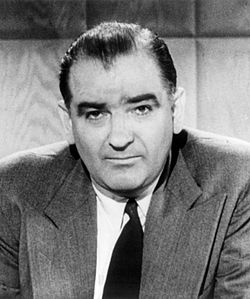
Senator Joseph McCarthy
Some of us have called this the new McCarthyism, because the most salient aspect of groupthink is the ongoing hysteria over alleged Russian “meddling” in U.S. domestic politics. The denunciations of “stooges of Putin” and the blacklisting from both mass and professional media of those known to deliver unconventional, heterodox views on Russia and other issues of international affairs is reminiscent of what went on during the witch hunt for Communists in government and in the media during the early 1950s.
However, no one is being hounded from office today. There are no show trials, as yet, for treasonous collusion with Russia. So, it would be safer to speak of an atmosphere of intimidation that stifles free debate on the key security issues facing the American public. Absence of debate equates to a dumbing-down of our political elites as intellectual skills atrophy and results in poor formulation of policy. The whole necessarily undermines America’s soft power and standing in the world.
Groupthink in America today did not come from nowhere. Debilitating conformism was always part of our DNA, as is the case in a great many countries, though its emergence has been episodic and in varying degrees of severity. The present acute manifestation in the United States goes back to the mass paranoia which followed the 9/11 terrorist attacks when the George W. Bush administration introduced the Patriot Act, gutting our civil rights in exchange for the promise of security.
Though the revelations of Edward Snowden have shown the extent and potency of the instruments of surveillance over the general population that were introduced by the Bush administration after 9/11, there was enough of state control exposed in the Patriot Act text to silence anyone with doubts about U.S. government policies at home and abroad. When the harsh personalities of President Bush’s immediate entourage were replaced by the liberal-talking officials of Barack Obama, people breathed easier, but the instruments of surveillance remained in place, as did the neocon middle and senior officials in the State Department, in the Pentagon, and in the intelligence agencies.
Thus, for a whole generation the Washington narrative remained unchanged, giving encouragement in communities across the land to neocon-minded administrators and professors of American universities, publishers and owners of our mainstream newspapers, and other arbiters of public taste. That is quite sufficient to explain the current atmosphere of intimidation and groupthink.
It is improbable that any Humpty-Dumpty successor to Donald Trump can put the pieces back together again and restore American dominance to where it was at the close of Bill Clinton’s first term as president. Given American hubris, will our political class accept an equal seat at the global board of governors or just walk away from the table?
Gilbert Doctorow is an independent political analyst based in Brussels. His latest book Does Russia Have a Future? was published in August 2015. His forthcoming book Does the United States Have a Future? will be published in September 2017.
The Fall Offensive: the US, France and Brazil
By James Petras | The People’s Voice | September 13, 2017
The fall of 2017 will witness the most brutal assault on working and middle class living standards since the end of World War II. Three presidents and their congressional allies will ‘revise’ labor legislation, progressive income tax laws and regulations and effectively end the mixed economy in France, the US and Brazil.
Throughout the summer, public opinion has been diverted by US threats to launch new overseas wars, France’s rhetoric about forming a post-Brexit, Berlin-Paris pact, which will remake the European Union, and Brazil’s President Michel Temer’s corruption and crime scandals. These superficial controversies will be overwhelmed by fundamental class conflicts, which promise to alter the present and future structural relations within Western capitalism.
President Trump’s Fall Offensive: Profits, Wars and Epidemics
President Trump proposes to enrich capitalists and intensify class inequalities via his radical transformation of the tax system. Corporate taxes will be cut in half; overseas corporate taxes will be abolished; and wage and salaried workers will pay more for fewer social benefits.
Trump can count on the support of the Republican leadership, business and banking elite and sectors of the Democratic Party in his plans to roll out a massive tax giveaway for the billionaires.
Trump’s cabinet, led by the Goldman Sachs trio and his troika of generals will ensure that the budget will include slashing the funds for education and health in order to increase military spending, expand wars and cut taxes for the rich.
Even more aggressive threats against North Korea, Russia, Iran, Venezuela and China, greater overseas war spending and troop levels in Afghanistan and the overt militarization of policing, immigration control and domestic intelligence will result in drastic cutbacks on federal programs for the poor and working classes. Declining access to quality health care for workers and deterioration in workplace safety conditions will fuel the opioid addiction epidemic leading to hundreds of thousands more premature worker deaths by overdose, injury and inadequate, incompetent care.
President Emmanuel Macron: The Capitalist Offensive in France
In France, the workers and middle class face the most comprehensive attack on their employment rights and progressive social legislation in modern history.
President Emmanuel Macron has declared his goal of completely transferring socio-economic power from French workers to capital by gutting all pro-labor laws and protections. Employees will have to negotiate with their bosses, one plant and one office at a time, thereby undermining the collective bargaining power of a united working class. Employers will be free to hire and fire workers with virtually no restrictions or consequences. Temporary and short-term ‘garbage’ contracts will proliferate, destroying long-term worker stability. Macron will eliminate the jobs of over 100,000 public employees while slashing corporate taxes by over $50 billion euros.
In contrast to massive tax cuts for the bourgeoisie, Macron proposes to increase taxes on French pensioners, hitting millions of retirees. Once in place, Macron’s legislative agenda will concentrate power, profits and wealth of capital while increasing inequalities and class polarization. Responding to the economic interests of the bankers, Macron promises to lower the deficit to 3% of GDP through massive cuts in health and education.
Under the pretext of ‘reducing unemployment’, Macron will promote part-time and temporary employment for French youth and immigrant workers, stripping all French workers of their hard-fought gains in job security and labor rights. Macron justifies his assault on labor by dismissing workers as ‘lazy’.
Brazil: The Great Fire Sale
Michel Temer, Brazil’s ‘unelected’ President plans to privatize 57 public enterprises – the crown jewels of Brazil’s economy. This will amount to the biggest capitalist asset grab in two centuries!
Included in the sell-off are: oil fields, energy transmission lines, highways, airports, as well as Brazil’s mint and lottery. Electrobas, Latin America’s biggest electricity generator, is up for grabs. In addition, Temer plans to raise interest rates charged by the state-owned development bank BNDES to increase the private bankers’ share of lending and profits.
This naked grab of profitable state enterprises by private domestic and foreign investors will lead to the loss of hundreds of thousands of jobs and the lowering of wages, salaries and pension payments. Temer started to slash state pension liabilities by increasing the age of retirement by several years. Wages and social benefits have been frozen for the foreseeable future. Presidential decrees, which dictate the terms of labor contracts, threaten collective bargaining.
The Capitalist Offensive: Results and Perspectives
These presidents have declared their intention to launch full-scale ‘class war from above’ – the consequences of which remain to be seen. The presidents, who rule by fiat, are treading fragile terrain. Each is facing major political, economic and social challenges.
All three presidents have lost public support since taking power, especially among their lower middle and working class-class voters.
Macron’s approval dropped from 65% to 40%; Trump from 49% to 35%; and Temer (who was not elected) barely retains 5% (and falling) public approval.
Brazil: Facing the Abyss
Despite uncertainties over the regime’s stability and future, foreign investors and the financial press supports Temer.
President Temer’s isolation from Brazil’s voting public has weakened his power in the Congress, and among the domestic banking elite and oil and power corporations. However, if the trade unions call for widespread militant strikes by manufacturing workers, public employees and the landless rural workers’ movement (MST) is effective and paralyzes the economy, Temer may be forced to resign before his program is implemented. Meanwhile, President Temer faces numerous judicial investigations for corruption.
Strategically, Temer can count on international support, especially from the US State Department, Treasury, Pentagon and the European Union. The neo-liberal regimes in Argentina, Uruguay, Chile, Paraguay, Peru, Colombia and Mexico have voiced strong support for Temer, especially since they have also received bribes from the same Brazilian corporate oligarchs! Under Temer, the Brazilian economy has declined by over 5% since he took power in a ‘legislative coup d’état’. His budget deficit exceeds 9% and unemployment has doubled to over 11%.
Despite support from foreign and domestic elite, Temer’s presidency will not survive. Under mass pressure and with looming elections, Brazil’s Congress may decide to allow the courts to prosecute Temer and block his proposed sellout of public assets.
Credit rating agencies are going to downgrade the Brazil’s economy to ‘junk’ status, undercutting new investments. With new elections on the horizon in 2018, it is clear that Temer will not even run for the presidency and his proposals to privatize Brazil’s major firms may not succeed. The economic recession has sharply reduced tax revenues and the possibility of receiving any significant boost from privatization is dubious. Even Temer’s initial regressive measure – the slashing of public pensions- has bogged down in bureaucratic infighting. However, the opposition to Temer’s capitalist offensive has yet to strike a decisive, organized blow.
The Congressional opposition, led by the center-left Workers Party (PT), is a distinct minority with many of its leaders facing their own corruption trials. The PT is incapable of blocking, let alone ousting, Temer. The rightwing opposition in Congress is divided between those who back Temer – based on party patronage – and those who want to replace Temer while pushing for his anti-labor agenda. The trade unions, led by the CUT, have mounted sporadic protests and made rhetorical gestures, while the MST (the landless rural workers) and associated ecological and homeless movements, which lack militant mass urban support, would be unable to topple Temer.
Ex-President Lula Da Silva has regained some degree of mass voter support but faces corruption charges, which may ban him from political office – unless there is a major mass mobilization.
In sum, the rightwing, pro-capitalist offensive in Brazil is comprehensive — offering public assets and private profits– but weak in institutional support and economic fundamentals.
A big-push from the Left could undermine the political base for Temer’s economic team, however, it is not clear which party or leaders would replace him.
France: Bonaparte in the Palace, Workers on the Streets
When President Emmanuel Macron was elected President of the Fifth Republic, he carried a mass electoral base as well as the support of France’s leading business and banking organizations. However, in the run-up to the launching of his capitalist offensive the mass base has evaporated. Voter disapproval is rising rapidly. The militant wing of the trade unions (CGT) prepares to launch general strike. His regressive tax agenda has alienated wide sectors of the petit bourgeois, especially public-sector employees.
Macron’s concentration of executive power (his Bonapartist complex) has turned his allies on the right against him.
The outcome of Macron’s offensive is both likely and uncertain.
For one thing Macron enjoys a majority in the French Congress. The economy is growing and investors are exuberant. Tax-conscious small business groups are happy. Labor is divided with the class collaborationist CFDT and FO refusing to join with the trade union opposition.
The European Union is united, up to a point, in its support for Macron. Equally important, Macron is determined to crush street protests and sporadic, partial strikes with demagogic appeals through the corporate mass media, coercion and outright state repression.
The political party opposition, led by the left socialists and the nationalists, is divided. The Socialist Party barely exists. Pensioners and students are opposed to Macron, but have not taken to the streets. Few among the professional class and liberal academia retain any illusions about the ‘new centrist President’ but few are willing to actively confront the ‘the new Bonaparte’.
Macron has fashioned a formidable alliance between the state apparatus and the business ruling class to crush worker opposition. But popular opposition is growing and is furious at his agenda and insults: ‘They (French workers) have had it too good…’ To defeat Macron, they must unite the opposition and build a strategy of prolonged class warfare.
Macron will not give in to transitory strikes. If Macron’s capitalist offensive succeeds, it will have enormous implications for the French working class, especially the rights of workers and salaried employees to organize and struggle. A victory for Macron will profoundly undermine the structure and membership of popular organizations, now and in the future. Moreover, a defeat for French workers will reverberate throughout the EU and beyond. Conversely, a victory for labor could trigger mass struggles across Europe.
The United States
A powerful opposition could confront President Trump’s capitalist offensive, but it will not be led by the highly bureaucratized trade unions representing less than 8% of the private sector labor force. Trump’s enemies among the Democratic and Republican Party elite have dismissed Trump’s ‘working class’ supporters as ‘white supremacist and neo-Nazis’. American workers’ concerns have been trivialized and marginalized by the divisive politics of ‘identity’, so blatantly used by both parties. Trump’s capitalist offensive in favor of a regressive pro-corporate tax cuts and the gutting of social welfare (health, education, housing, environment and worker safety) has failed to provoke sustained, unified social opposition. In the US, the pro-business elites dominate and dictate the agendas of both the incumbent Trump regime and the ‘elite opposition forces’.
The official ‘anti-Trump opposition’, which terms itself a ‘resistance’, promotes ‘identity’ interests linked to elite political representation. It works hard to undermine any possibility of working class unity based on common socio-economic interests by focusing on marginal and divisive issues. In the midst of mass poverty, declining life expectancy and an epidemic of suicide and drug overdose deaths, the ‘resistance’ forces of the elite opposition concentrate on manufactured foreign (‘Russia-gate’) conspiracies and life style issues (trans-genders in the US Special Forces) to overthrow the Trump regime. They have no intention to forge any class alliances that might threaten Trump’s regressive capitalist agenda.
The struggle this fall in the US will not be between labor and capital: It will spotlight the contradiction between what remains of Trump’s business protectionist agenda and the Democrats’ neo-liberal free trade policies. The capitalist offensive against labor in the USA was already determined by default. US trade union officials are marginal and inconsequential actors, incapable and unwilling to politicize, educate and mobilize workers.
Trump’s capitalist offensive appeals to investors and boosts the stock market. The majority of his economic team is tied to Wall Street bankers against so-called economic nationalists. Trump’s mindless chauvinist rhetoric to the populace is openly dismissed by the plutocrats within his own cabinet, who complain they have been targeted by ‘fascists and anti-Semites’ (meaning Trump’s deplorable and angry voter base).
The United States is the only country in the industrial world launching a massive, sustained capitalist offensive without an anti-capitalist opposition. The American working class is openly ‘deplored’ by the major elements of the elite opposition and blatantly manipulated by its fake ‘champion’, Trump.
The consequences are pre-determined. The capitalist offensive cannot lose; both capitalist sides ‘win’. Under the Businessman-President Trump, multi-national corporations will secure lower taxes and degrade working class living standards and social benefits. Bi-partisan agreements will ensure that banks are completely deregulated. The elite anti-Trump opposition will ensure that ‘their’ capitalists get favorable neo-liberal trade agreements, guaranteeing their access to cheap immigrant labor and a non-unionized workforce denied workplace safety and environmental regulations.
While France and Brazil face real class war, the ‘classless’ US slouches toward nuclear war. Macron confronts militant trade unions, Temer faces the fury of broad social alliances, and Donald Trump marches after ‘his Generals’ to nuclear conflagration. He invades Russian diplomatic properties; points nuclear weapons at Moscow and Beijing; holds massive offensive exercises and stations THAAD missiles on the border of North Korea; and escalates US air and ground force operations in a 16-year losing war in Afghanistan.
Workers in Europe and Latin America choose to fight capitalists in defense of their class interests, while US workers have become passive spectators to the looming possibility of nuclear war, when they are not in a prescription-induced opioid stupor. Defeating the capitalist offensive in France and Brazil can advance the cause of social justice and ensure concrete benefits for workers and masses of people; Trump’s unopposed capitalist military offensive will send clouds of nuclear ashes across the world.
Featured Video

AIDS Inc. by Gary Null (2007)
or go to
Aletho News Archives – Video-Images
From the Archives
Clash of Civilization, Iran Part II
By Jamal Kanj – Intifada-Palestine.com – January 14, 2011
Israel’s survival kit is: perpetuate conflict, insecurity to rationalize collective hate and finally playing victim.
Devoid of conflict, Israel implodes internally; without hate, Zionism loses its justification; and playing eternal victim to continue blackmailing the West. Absence of this holy trinity, Israel ceases to exist.
From its inception, the house of Zion has mastered exploiting adversarial powers to advance Israel’s cause. For instance, their influence over the Democratic Party in the US began with President Truman’s bid for 2nd term election in 1948.
Responding to strong opposition from Secretary of State General George Marshall and Department experts urging against recognition of Israel, President Truman replied: “I’m sorry gentlemen but I have to answer to hundreds of thousands [Jewish voters] who are anxious for the success of Zionism. I do not have hundreds of thousands of [voting] Arabs among my constituents”
Zionists influence over liberal American politics was matched with the doctrinal school of Conservative theoreticians aligning the Republican Party’s platform with Israel’s objectives. The Neoconservative Zionists, coined Zioncons, invented the “Clash of Civilization” concept to fight Israel’s wars. … continue
Blog Roll
 Aletho News
- 12 Things Your Psychiatrist Was Trained Not to Tell You
- From Unipolar Universalism to Multipolar Civilizational Distinctiveness
- RSF military group defects, joins Sudanese army: State media
- Ireland goalkeeper refuses to play ‘Israel’ as squad weighs boycott
- China pushes back against US on Cuba, Iran
- Ukrainian Soldiers, Potential Mercenaries: Have Gun, Will Travel!
- Burnham’s UN debut… A masterclass in British disinformation
- Iran flights continue despite US aviation sanctions
- Global Tipping Points Lead the World Into a State of Entropy
- The day-after at the White House: USA and Xi Jinping
- If Americans Knew
- Israel forces Gazans to live in constant peril – Daily Update
- Deconstructing Netanyahu’s pants-on-fire UN rant – Daily Update
- Trump betrayed voters with his campaign lies and prioritized a foreign country once he took office
- Netanyahu calls Israel’s war in Gaza ‘opposite of genocide’ in UN speech to near-empty hall
- Settler Kidnappings: Torture, Sexual Abuse and Terrorisation of Palestinian Abductees as Israel Deepens Annexation of West Bank
- Gaza winter nears as 162,000 tents become unusable, raising fears of humanitarian crisis
- Netanyahu says, “It’s the opposite of genocide”; UN says Gaza economy is world’s ‘most severe crisis on record’ – Daily Update
- Israel’s US-Backed Assault on Gaza Has Created the ‘World’s Most Severe Economic Crisis on Record’: UN
- ‘Protecting U.S. Citizens’… From Israel
- ‘This is where I live now, the back of a truck’: a day in the life of a grandmother in Gaza
- No Tricks Zone
- New Study: Earth And Venus Surface Warmth Largely Explained By Convection And Lapse Rate, Not CO2 Or Radiation
- 2025 Nature Paper Claiming Worsening Global Drought Gets RETRACTED …Heavily Flawed
- New Study: ‘Global Drought Shows No Detectable Recent Acceleration Under Climate Warming’
- Economic Masterminds: German Socialists Suggest Taxing Productivity Gains Stemming From Using AI
- The South China Sea Has Not Been Cooperating With The Climate Change Narrative
- Energy Crisis: Germany Enters Heating Season With Historically Low Gas Reserve Fill Levels
- New Study: The Antarctic Ice Sheet Gained Mass From 2020-2024 Due To Staggering Snow And Ice Accumulation
- Study: Ocean Heating Rates From Thousands Of Years Ago ‘Dwarf’ Modern Ocean Heating Rates
- Climate Extremists Target, Attack Large-Scale Power Grid Infrastructure In Germany!
- New Study: Antarctic Ice Melt Has Contributed Less Than 1 Centimeter To Sea Level Rise In The Last 30 Years

