Norway surprised by Russia’s entry visa rejections to delegates blacklisted months ago
RT | February 2, 2017
Norway has summoned Russia’s ambassador to explain why two of its legislators were denied entry visas. Though the officials were placed on “counter-sanctions” lists and denied entry long ago, Norway has somehow found the rejections “incomprehensible.”
An official note containing the same objections preceded the ambassador’s summoning.
“The Foreign Ministry today summoned the Russian ambassador to repeat the protests,” the Norwegian Foreign Ministry said on Wednesday.
Norway’s Foreign Minister Børge Brende condemned Russia’s denial of the visas in strong terms. The rejected legislators are Bård Vegar Solhjell, the leader of Norway’s Socialist Left party, and Trine Skei Grande, the leader of the country’s Liberal Party.
“These are two distinguished, top-level Norwegian officials, excellent representatives of Norway,” Brende told the reporters, saying “it’s incomprehensible that they not be allowed to enter Russia.”
Although the minister acknowledged that Russia has the right to determine who can enter the country, saying that it’s “obviously up to every country to decide who can enter,” he slammed the denial as “biased, unreasonable and inconceivable.”
The Russian embassy in Oslo has confirmed that the visa requests were rejected as a part of a “mirror response” to Norway adopting the same sanctions that the EU has imposed on Russian citizens, as well as policies discriminating against Russian citizens who want to visit Spitsbergen island.
The list of officials from the EU and other countries who have been banned from entering Russia was provided to Brussels well ahead of time, with advice to inform all those affected, a Russian embassy spokesman stressed. Norway’s FM himself has admitted that the denials were something to be “expected” and that Norway’s reaction to the visa rejections thus appears quite surprising.
Coincidently, the outrage over Russia’s “hostile actions” came just hours after the country’s Police Security Service (PST) determined that Russia poses a “major threat” to Norway, along with Islamism.
Norway joined the EU’s sanctions against Russia and Russian citizens back in 2014 in response to what it called “Russia’s violations of human rights in Ukraine.” The situation escalated in April of 2015 when Russia’s Deputy PM Dmitry Rogozin visited Norway’s Island of Spitsbergen while on a trip to open the ‘North Pole-2015’ station. Norwegian authorities were riled by the visit, as Rogozin was on Europe’s anti-Russia sanction list.
Norway then adopted a measure authorizing the immediate deportation of sanctioned Russian citizens from the archipelago. Though Russia’s Foreign Ministry has protested the regulation, calling it discriminatory and in violation of an agreement on international cooperation on Spitsbergen, it was made permanent last September.
Analyzing Current Trends: Russia and West on the Threshold of Drastic Changes in Relationship
By Andrei AKULOV | Strategic Culture Foundation | 02.02.2017
The prospects for improvement of Russia-US relations become a matter of grave concern for European politicians. With Donald Trump’s «America First» policy, Europe may be left on its own. The calls for lifting the sanctions against Russia are getting louder – loud enough to make this issue become a part of EU’s shaping external strategy.
Italy’s former Prime Minister and European Commission ex-President Romano Prodi called on Europe to scrap immediately the anti-Russian sanctions, rather than wait for US president Donald Trump to do it first. His opinion on the sanctions is very illustrative. According to the patriarch of European politics, «The fact that it is necessary to lift the sanctions with Russia immediately. I am deeply convinced of this. You can sacrifice themselves for the sake of reaching a consensus, but when neither of which Solidarity has no question, there is no point in continuing to fight. One wise Calabrian proverb says, who pretend to be sheep, the wolf will eat that. First you need to play the card of not allowing American to occupy a privileged position in its relations with Russia».
Confusion reigns in Germany. Trump attacks Berlin despite the fact that Germany has always been loyal to Washington. It was the first to impose sanctions on Russia, even though it was contrary to its own immediate interests. Vice Chancellor Sigmar Gabriel warned of a «drastic radicalization» in American politics and said Berlin stood ready to fill the void left by an isolationist Washington. Frank-Walter Steinmeier, the current Minister for Foreign Affairs and Chairman-in-Office of the Organization for Security and Co-operation in Europe (OSCE), believes that «by choosing Donald Trump, the old world of the 20th century is over». «The order of the 21st century and the way the world of tomorrow will look is not settled; it is completely open […] I know we have to adjust to troubled times, to some unpredictability and new uncertainties», Mr. Steinmeier wrote in his piece published by Bild on January 23.
Other Europeans see things in the same light. «Hostile inauguration speech. We can’t sit around &hope for US support & cooperation. Europe must take its destiny & security in its own hands», Guy Verhofstadt, the former Belgian Prime Minister, wrote on Twitter in his comments on Donald Trump’s inaugural address. Speaking after meeting German Chancellor Angela Merkel on January 23, the frontrunner in France’s presidential election Francois Fillon said, «European Union sanctions on Russia are pointless, warning Russia and the United States under Donald Trump could forge links that exclude the EU». He warned against US President Donald Trump talking with Russia at Europe’s expense. «It would be damaging for Europe if Trump went above our heads, which is not inconceivable», the presidential hopeful stressed.
As one can see, European political heavyweights emphasize that Europe needs drastic changes in its relationships with the US and Russia. The US may belittle the EU by using the sanctions as a bargaining chip to make what President Trump calls «good deals». First Washington made the EU introduce the sanctions detrimental to its economy. Then the US would «allow» the EU to lift the restrictive measures as fresh winds started to blow in Washington! Thus, the US benefited from making Europe impose the sanctions and now it will reap the full advantage derived from making Brussels lift them! From point of view of geopolitical interests, in both cases the US will gain to make Europe lose.
This scenario is quite feasible. To prevent it from happening, the EU must move really fast to be one step ahead of Trump. By restoring normal relationship with Russia, Brussels will gain as a geopolitical actor. As a result, it will have a much more advantageous position to start from when it comes to shaping its new relationship of new configuration with Washington.
It would be a right thing to do at the time the «establishment» forces are under attack from all sides by the right and the left. The points of criticism include immigration policies, the integration process going too fast to make countries lose national identity and anti-Russian sanctions that have resulted in economic damage without exerting any influence whatsoever on Russia’s foreign policy. This is the time when Europe is at crossroads facing the prospects of most drastic changes since WWII. This is also the time when the «big brother» is intent to leave it fend for itself.
Mr. Trump has never promised anything to Europeans and he is adamant in his desire to change the existing order of things. The incoming elections in the Netherlands, France and Germany are going to undermine the position of ruling elites. Looks like Romano Prodi hit the nail right on the head – there is no time to lose. The time to normalize the relations with Moscow is now.
Nancy Pelosi says she’s for single payer, refuses to co-sponsor single payer legislation
An Open Letter to Nancy Pelosi from Ralph Nader
Representative Nancy Pelosi
House Minority Leader
United States House of Representatives
233 Cannon House Office Building
Washington, DC 20515
January 17, 2017
Dear Representative Pelosi:
I see you were quoted in The Hill newspaper recently (“Pelosi Rips GOP for Cut and Run Strategy on Obamacare,” by Mike Lillis, January 12, 2017) saying that you are for single payer health insurance. You had this preference before Presidents Clinton and Obama, who ideally agree with you, dismissed single payer as “impractical” given the entrenched and powerful healthcare industry.
A couple of years ago, I wrote an article titled “21 Ways Canada’s Single Payer System Beats Obamacare”.
Within a week or so, your colleague, Congressman John Conyers (D-Michigan), will re-introduce HR 676, the single payer bill in the House.
Will you actively support this much more efficient and comprehensive legislation, with its many advantages proven in other countries, and persuade other House Democrats to also co-sponsor?
Last year, only 63 Democrats co-sponsored.
Obamacare, without a public option, has been a complex patchwork in so many ways — including forcing individuals to purchase inadequate insurance from private health insurance companies — insurance that carries with it high premiums, deductibles, co-pays and forces narrow networks.
For many, Obamacare is quasi-catastrophic insurance with limited choice of doctor and hospital.
If the Republicans repeal Obamacare, Democrats need to be ready and offer to replace it with something that can attract left/right support — single payer, Medicare for All — everyone in, nobody out, free choice of doctor and hospital, no medical bankruptcies, no coercive co-pays or deductibles, with all their accompanying fears and anxieties, and no more deaths due to lack of health insurance.
A December 2015 national Kaiser public opinion poll found that 58 percent of adults in the U. S. supported single payer (Medicare for All), including 81 percent of Democrats, 60 percent of Independents, and 30 percent of Republicans. Imagine the poll numbers when Full Medicare for All starts to be explained, in its clear simplicity, and promoted by a major political party.
Let’s work together to present the American people something both more efficient and responsive that they want and need — Medicare for All and freedom to choose their doctor, clinic and hospital.
Sincerely,
Ralph Nader
PO Box 19312
Washington, DC 20036
DJT: TPP, RIP!
Foes of War, Now Silent, Should Celebrate
By John V. Walsh | Dissident Voice | January 25, 2017
On day one of Donald Trump’s presidency, he drove a stake through the heart of the Trans Pacific Partnership (TPP), as he had repeatedly promised during his campaign. Foes of war should rejoice and congratulate Trump since the TPP was the economic arm of the “Pivot to Asia”, the military/economic assault on China promoted vigorously by Hillary Clinton, Barack Obama, neocons and humanitarian interventionists of every stripe. It was a trade agreement that linked twelve Pacific Rim powers but pointedly excluded China in an effort to isolate and weaken it.
Thus in his first hours in office Trump has, in fact, made a move away from confrontation with China – and the goal of US global domination. Such a move should elicit support and congratulations for Trump from foes of war and Empire. So far there has not been much of that.
Let us be clear. If Donald Trump were lying during the campaign about the TTP, so beloved by corporate America and the neocons, he could have revived it – easily. After all he has a clear majority in both House and Senate whom he is increasingly bending to his will. And there are many Democrats pining to please their corporate masters who would have joined his effort at TPP resuscitation. But Trump did not do this. He was dead serious about his promise. Expect the same on Détente 2.0 with Russia and other policies to which he has made a solid commitment.
Trump’s first full day in office was a great day for peace on another front as well. Marco Rubio, aka “Little Marco,” announced he would vote to confirm Rex Tillerson as Trump’s Secretary of State. Tillerson, a friend of Putin and someone with a clear understanding of Russia, is associated with Trump’s oft-stated desire to “get along” with Russia. Tillerson has been the target of the neocons who hoped to stop him, and Rubio tried to pressure him into declaring Putin a “war criminal” in his confirmation hearings, something that Tillerson refused to do. Like Trump, Tillerson does not seem like the kind of person who is easily pushed around.
That was two strikes for peace on Day One of the Trump presidency.
As is well known, the TPP was opposed by many progressives and labor leaders for reasons other than a desire for peace. For these activists it was correctly seen as one more attack on democracy and sovereignty, written in secret and designed to give corporations and banks control over the terms of trade and laws of the land. Democratic Party progressives opposed it vehemently, and so it would make sense for them to hail Trump’s action.
But look at the comments at that bastion of conformist progressivism, the HuffPost, and you will find that many progressives have abruptly switched and are opposing Trump and even praising the TPP! Thankfully at least a few commenters over there are honest enough to admit the hypocrisy behind this switch. One HuffPost commenter wrote:
OK, when Bernie was talking about how bad the TPP was almost every comment here (on Huffington Post) was how they didn’t trust Hillary to get us out of the TPP. Now that Trump pulled us out, people are taking the opposite view. … At least admit that this is a good thing. Does it matter who stops TPP? 9 months ago we all agreed it was a bad thing.
This stance is all too reminiscent of Democratic “progressives” who were out in force opposing the war on Iraq under Bush but were nowhere to be seen when Obama came into office and continued the war.
But let us give credit where credit is due. Bernie Sanders announced his pleasure with Trump’s deep sixing of the TPP, according to the Guardian, which reported:
Sanders praised Trump’s decision, saying TPP is ‘dead and gone’….If President Trump is serious about a new policy to help American workers then I would be delighted to work with him.
Richard Trumka, head of the AFL-CIO also praised the termination of TPP, but unlike Bernie he did not mention Trump by name as the terminator. This is not surprising since the labor misleadership did not back Bernie, the choice of the rank and file, but instead squandered their dues on support of pro-TPP Hillary.
Sanders’s and Trumka’s concerns about TPP are economic and these concerns are the ones usually reported in the mainstream media. But the neocon hawks understand the imperial aspects of the TPP as shown by the words of the hegemonist John McCain, again according to the Guardian:
Senator John McCain criticized the move. ‘President Trump’s decision to formally withdraw from the Trans-Pacific Partnership (TPP) is a serious mistake that will have lasting consequences for the American economy and our strategic position in the Asia Pacific region,’ he said. (Emphasis, jw)
Looking abroad, TPP has been running into troubles in East Asia as well, with Vietnam, the Philippines Malaysia and possibly even the Republic of Korea (South Korea) moving toward closer ties with China and away from U.S. engineered strife between China and its neighbors. We might well regard Trump’s position and those of the East Asian countries pulling away from the U.S. as manifestations of a new view of the world and a new balance of power already in place. From that point of view President Trump, by rejecting the TPP, is simply moving to negotiate the best deal possible for the U.S. in this new developing global arrangement.
The question for liberals/progressives is will they mindlessly oppose Trump on everything he does or support what is desirable and criticize what is not. That question will come to the fore soon if Trump and Tillerson manage to fashion Détente 2.0 with Russia. The War Party, both its neocon and liberal interventionist wings, will fiercely oppose this. Will liberals/progressives support and defend Détente 2.0 – or oppose it simply because it comes from Donald J. Trump?
John V. Walsh can be reached at john.endwar@gmail.com.
The Protected, Privileged Establishment vs. The Working Class
By Charles Hugh Smith | of two minds | January 23, 2017
Meanwhile, back in reality, household income for the bottom 95% has declined while the owners of capital and their privileged, protected servants in the Establishment have gorged themselves on private wealth.
As noted yesterday in The Collapse of the Left, the working class has finally awakened to the Left’s betrayal and abandonment of labor in favor of the protected privileges of the elitist Establishment. I also described the Left’s Great Con:
To mask the collapse of the Left’s economic defense of labor, the Left has substituted social justice movements for economic opportunities and security.This has succeeded brilliantly, as tens of millions of self-described “progressives” now parrot the Great Con that “social justice” campaigns on behalf of marginalized social groups are now the defining feature of Progressive Social Democratic movements.
This diversionary sleight-of-hand embrace of economically neutered “social justice” campaigns masked the fact that social democratic parties everywhere have thrown labor into the churning propellers of globalization, open immigration and neoliberal financial policies–all of which benefit mobile capital, which has engorged itself on the abandonment of labor by the Left.
Meanwhile, the fat-cats of the Left have engorged themselves on capital’s largesse in exchange for their treachery. Bill and Hillary Clinton’s $200 million in “earnings” come to mind, as do countless other examples of personal aggrandizement by self-proclaimed “defenders” of labor.
But it isn’t just the Left’s fat-cats who have feathered their own nests while denigrating the Working Class with arrogantly contemptuous scorn: the entire protected, privileged “liberal” elitist Establishment has responded with a very illiberal outrage that their protected, privileged skims and scams might be endangered by an uprising of the loathed and ridiculed Working Class that they reckoned would remain safely cowed and conned.
As noted yesterday, the only moment in recent history in which the Wall Street-cartel-state strongholds of privilege, wealth and power (i.e. owners of capital) felt threatened by political insurrection by disenfranchised labor was The Great Depression of the 1930s.
With the first iteration of global debt-based capitalism in near-collapse (systemic bad debt was not written off, lest the big banks’ insolvency be recognized), owners of capital and the political class reluctantly swallowed modest social-democratic reforms that gave labor enough of the pie to stave off revolt / revolution (as noted by Arshad A. on my Facebook thread).
Just as Marx had predicted, this crisis of global-debt-cartel-state capitalism was the result of internal contradictions built into all forms capitalism dominated by capital and the state that protects and serves capital.
Now we face another crisis of the current iteration of global-debt-cartel-state capitalism, also the result of internal contradictions–not just financial, but cultural, energy-based and political contradictions.
The privileged, protected elitist Establishment reckoned the social-welfare programs of the 1930s and the Left’s Great Cons would keep the disenfranchised Working Class permanently cowed and conned. If welfare (now called “disability,” “crazy money”, etc.) and the distractions of “social justice” campaigns didn’t keep the Working Class fragmented and powerless, then the ceaseless drumbeat of arrogant dismissal and disdain aimed at any Working Class resistance would do the trick.
Any Working Class individual who recognized that globalization, open immigration and neoliberal financial policies were the propellers dismembering the Working Class economically and disenfranchising the Working Class politically was immediately labeled with the worst that “liberal” privileged, protected elites could spew: you’re racist, Luddite, backward, etc.–in other words, you’re not a rootless Cosmopolitan who loves your servitude to capital and the state like us.
Since the Left has masked its abandonment and betrayal of the Working Class with “social justice” speech acts, the worst insults the Left can dish out are those that suggest opposition to the Left’s social justice campaigns.
Self-identified “Progressives” are fine with the destruction and disenfranchisement of the Working Class, as long as the politically correct speech acts praising the Left’s Great Con are being uttered.
The self-serving, privileged, protected “liberal” Establishment is enraged that the Working Class is no longer following the script, i.e. remaining cowed, conned and fragmented. Like every other disenfranchised group, the Working Class has essentially zero choice of representational leadership, as the machinery of governance, finance and the mainstream media are all controlled by the privileged, protected elites of the Establishment.
So it boiled down to: choose more disenfranchisement and cowed servitude to “liberal” Elites, or vote for Trump. There was no other choice, so the Working Class voted for Trump as their only option other than surrender and servitude.
This rejection of their “betters” script has enraged their “betters,” who now demand the destruction of their proxy voice (Trump) and their rebellion. The Establishment’s war on Trump is beneath the surface also a war against a Working Class that has finally had enough of its arrogant, hubris-soaked, self-serving, privileged, elitist “betters” of the Establishment.
If the Establishment had deigned to offer a radical-Left leader who correctly called out the American carnage that is the Working Class experience of the globalized, open-immigration neoliberalism that has so enriched the owners of capital and their “liberal” apparatchiks, then the Working Class may well have voted for the radical-Left truth-teller.
Alas, the Left ground down any opposition to “we ‘earned’ $200 million” Hillary Clinton and her corrupt coterie of self-serving elites. Having beaten down, stripmined, insulted, denigrated, scorned and exploited the Working Class (whose “proper role” is to provide cannon fodder for the Elites’ neocon Permanent War), the privileged, protected Establishment (like every other elite that suddenly finds its entitled dominance challenged) is in a full-blown fury: how dare the Working Class not accept our self-serving rule! We are entitled to rule! How dare they!
Meanwhile, back in reality, household income for the bottom 95% has declined while the owners of capital and their privileged, protected servants in the Establishment have gorged themselves on private wealth.

Here’s what’s happened as the Left and its armies of privileged fake-Progressives threw the Working Class overboard in favor of serving capital on the First Class deck:

What will it take to shift the balance of power decisively in favor of labor? My guess is the downward mobility of another 10 or 20 million people who currently reckon themselves “middle class” into the unprotected, disenfranchised ranks of the Working Class will do it.
Vast Majority of Americans Back Trump’s Blast Against Washington Establishment
Sputnik – 25.01.2017
WASHINGTON – Nearly three quarters of all Americans agree with President Donald Trump’s charge that a group of elitists in Washington has grown wealthy at the expense of the United States, a Rasmussen national poll reported.
“Seventy-two percent of likely US voters agree with this statement,” Rasmussen said in a release on Tuesday.
The survey found that only 17 percent of the US public disagreed with Trump’s claim while 11 percent were not sure.
Trump in his inaugural address delivered on Friday charged the Washington, DC political establishment with profiting for many years at the expense of ordinary Americans, pledging to end the practice immediately, the release explained.
The survey of 1,000 likely voters was carried out on Sunday by Rasmussen Reports, the company said.
India gets the first feel of Trump’s ‘America First’
By M K Bhadrakumar | Indian Punchline | January 25, 2017
Prime Minister Narendra Modi happens to be only the second world leader with whom US President Donald Trump spoke with after the inaugural on January 20. The conversation took place on January 24, two days after Trump spoke with Israeli Prime Minister Benjamin Netanyahu.
Presumably, a long ‘waiting list’ lies on Trump’s table. At any rate, do not feel flattered.
The White House readout of the conversation with PM Modi makes sombre reading. The purple prose characteristic of the halcyon days under the last two US presidencies is absent.
The readout is completely devoid of hyperbole – except in regard of fight against terrorism, which is close to Trump’s heart. In that fight, Trump expects Modi to stand “shoulder to shoulder” with him. Of course, it goes without saying that India must bear its expenses in the fight. Trump intends to go ‘dutch’ with his allies – paying for the US’s expenses if it becomes absolutely unavoidable.
Trump calls India a “true friend and partner in addressing challenges in the world”. It is a statement of fact and it is well-earned. The Modi government has gone more than half way to meet the US’ demands. The signing of the Logistics Agreement itself is a glaring instance where the accord is of no use to India in practical terms and the geopolitical gains are dubious.
Trump and Modi “discussed opportunities to strengthen partnership” in the fields of economy and defence. In Trumpian terms, this means US exports to India, civil and military, are top priority. Unsurprisingly, there was no reference whatsoever to ‘Make in India’. It is unclear whether Modi brought it up. Unlikely.
But then, how does India promote exports for the US industry in the Indian market at this odd time by restarting ‘reforms’ to facilitate greater market access for US exports? The GDP growth is stalling and the priority is to inject some dynamism. Again, the domestic political climate is turning against the ruling party and the smart thing will be populist policies, as Modi has realised.
Arguably, where we can help Trump will be by buying more weapons from American vendors. But Modi will have to throw out of the window all notions of ‘co-production’, ‘joint development’, et al. Trump will sell, Modi should buy. Technology transfer that meets Indian aspirations a la Ashton Carter? Just forget about it.
In regard of regional security, Trump and Modi discussed South Asia and Central Asia (read Afghanistan). India-Pakistan tensions probably figured. Kashmir? (PMO is yet to put out a readout giving its version of the conversation.)
The stunning thing is that Trump didn’t discuss Asia-Pacific or South China Sea. Troubling questions arise: Is Trump aware that there is a historic document titled the U.S.-India Joint Strategic Vision for the Asia-Pacific and Indian Ocean Region, which is displayed on the White House website? Or, is it another Obama legacy that he intends to dump in the waste paper basket?
Ironically, Trump spoke to Modi on the day after tearing up the Trans-Pacific Partnership agreement. Modi should have reminded Trump about the ‘defining partnership’ between the two countries.
Is Trump altogether devoid of emotions? Not really. He was an altogether different man when he spoke with Netanyahu two days ago. Just look at the White House readout, here.
Doesn’t it hurt our national pride that after all this brouhaha about US-Indian defining partnership, Trump didn’t have a similar conversation with Modi. Not that Netanyahu is in a position to make investments in American highways or manufacturing plants and other infrastructure costing trillions of dollars.
Yet, Trump is determined to win the favour of the Jewish lobby. Not that Trump won on Jewish votes. But then, he’s looking ahead. American Jews control the US media and think tanks and the academia – and the Congress – who have been systematically debunking his credibility as president and can make things extremely difficult for his presidency.
We see here another grotesque side of ‘America First’. Don’t bring in ‘values’ and all that crap. Ask what we can do for Trump. Probably, the Foreign Secretary S. Jaishankar should be tasked to do that during his extended tenure in South Block.
The White House readout never once mentions US-Indian affinities based on cherished common values of democracy and human rights and so on. It rankles to see Modi holding a can of worms all by himself.
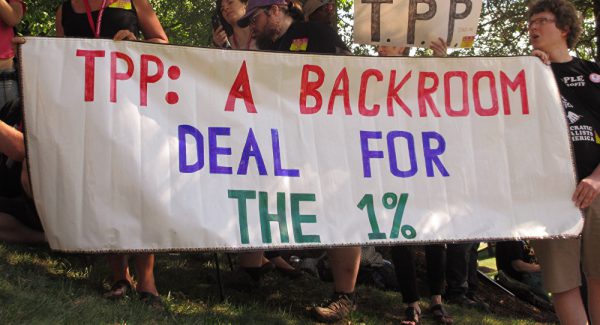
Will TPP End Up Dead Without the US?
Sputnik – 23.01.2017
President Donald Trump said that the US will start pulling out of the 12-nation Trans-Pacific Partnership (TPP) trade agreement to protect American jobs and kick-start economic revival.
In a statement issued after Trump’s January 20 inauguration, the White House named the planned withdrawal from the TPP as a major priority for the new administration’s effort to bring down unemployment and breathe new life into the stagnant US economy.
“This strategy starts by withdrawing from the Trans-Pacific Partnership and making certain that any new trade deals are in the interests of American workers,” the White House release stated.
The TPP seeks to remove barriers to trade among its 12 signatories, which together account for 40 percent of the world’s economy: Australia, Brunei, Canada, Chile, Japan, Malaysia, Mexico, New Zealand, Peru, Singapore, the United States and Vietnam.
During his presidential campaign, Trump has repeatedly criticized the TPP and expressed the desire to shift the focus from global trade to national economic development in order to support the US economy.
Warning about the catastrophic impact the TTP pact, initiated by the Obama Administration, could have on the US economy, Donald Trump is committed to negotiating “fair trade deals” that would benefit American manufacturers and workers.
The restrictions on Asian imports proposed by Donald Trump are part of his strategy to revive domestic production and give up on the “global division of labor.”
TPP a boon to transnational corporations
The TPP began as an expansion of the Trans-Pacific Strategic Economic Partnership Agreement signed by Brunei, Chile, New Zealand and Singapore in 2005. Beginning in 2008, Australia, Canada, Japan, Malaysia, Mexico, Peru, the United States and Vietnam joined the discussion for a broader agreement, bringing the total number of countries participating in the negotiations to twelve and accounting for up to 40 percent of the global GDP.
The signing of the TPP deal led to mass-scale protests in many of the participating nations with the critics describing the agreement as an attempt to set the rules of the global economy to favor multinational corporations over domestic producers.
This, they warned, would negatively impact the situation of the domestic labor markets of the participation countries.
The TPP trade agreement consists of chapters on a range of issues dealing with trade barriers, intellectual property rights, human rights and government regulations across a host of industries, such as agricultural goods, pharmaceuticals and manufacturing.
It favors large multinational corporations which want to impose their regulations on foreign competitors.
The TPP deal also undermines domestic companies, laws, regulations and institutions with an extra-judicial Investor-State Dispute Settlement (ISDS) that stacks the deck in favor of multinational corporations.
US pivot away from Asia
In its push for the TPP, the Obama Administration was also governed by political considerations. Defense Secretary Ashton Carter said that the agreement was meant to strengthen Washington’s alliances with the key Southeast Asian nations.
“Obama planned to create an expanded free trade zone in Asia and the Pacific US companies would benefit from,” Sergei Lukonin, a senior expert on Chinese politics and economics in Moscow, told RT.
“The TPP could also be used by the US as a counterbalance to China. If Washington gives up on its leading role in the region, this would strengthen Beijing’s hand in the ongoing talks on the Comprehensive Regional Economic Partnership,” Lukonin noted.
He added that America’s withdrawal from the TPP would undermine its reputation in the region.
“With the United States out, the Asian nations will have to reconsider their military alliances with Washington,” Lukonin said.
Sergei Silvestrov, a Moscow-based economic expert, said that Washington’s withdrawal from the TPP would complicate its relations with Australia, New Zealand and other countries where the TPP is now being ratified.
Silvestrov added that without the United States the TPP would become meaningless as the US and Japan alone account for a hefty 80 percent of the TPP countries’ trade turnover.
Vietnam has already responded to Trump’s statement by suspending its ratification of the TPP deal, while Australian Prime Minister Malcolm Turnbull remains all set to speed up the ratification process.
Japan has been alarmed the most by the prospect of a US withdrawal from the TPP. Prime Minister Shinzo Abe pinned much hopes on the deal that would open the US market to Japanese exports. He will try to remedy the situation during an upcoming visit to Washington.Aside from the negative response from America’s Asian partners, Donald Trump will face serious opposition from transnational corporations. With the globalization process advanced as it is, it will take a country more than just canceling a single agreement to protect its domestic market.
Back to the roots
It still looks like President Trump worries more about America’s economic woes than he does about the political fallout his decision to withdraw from the TPP could create in the world, RT wrote.
During his election campaign he promised to fight unemployment and stand up for the interests of ordinary Americans and now is the right time for him to start practicing what he preached while on the stump.
Meanwhile, Donald Trump is also committed to renegotiating another trade deal, the North American Free Trade Agreement (NAFTA), which was signed by the United States, Canada and Mexico in 1994.
Trump’s Foreign Policy: An Unwise Inconsistency?
By Ron Paul | January 23, 2017
Throughout the presidential campaign, Donald Trump’s foreign policy positions have been anything but consistent. One day we heard that NATO was obsolete and the US needs to pursue better relations with Russia. But the next time he spoke, these sensible positions were abandoned or an opposite position was taken. Trump’s inconsistent rhetoric left us wondering exactly what kind of foreign policy he would pursue if elected.
The President’s inaugural speech was no different. On the one hand it was very encouraging when he said that under his Administration the US would “seek friendship and goodwill with the nations of the world,” and that he understands the “right of all nations to put their own interests first.” He sounded even better when he said that under Trump the US would “not seek to impose our way of life on anyone, but rather to let it shine as an example. We will shine for everyone to follow.” That truly would be a first step toward peace and prosperity.
However in the very next line he promised a worldwide war against not a country, but an ideology, when he said he would, “unite the civilized world against radical Islamic terrorism, which we will eradicate from the face of the Earth.” This inconsistent and dangerous hawkishess will not defeat “radical Islamic terrorism,” but rather it will increase it. Terrorism is not a place, it is a tactic in reaction to invasion and occupation by outsiders, as Professor Robert Pape explained in his important book, Dying to Win.
The neocons repeat the lie that ISIS was formed because the US military pulled out of Iraq instead of continuing its occupation. But where was ISIS before the US attack on Iraq? Nowhere. ISIS was a reaction to the US invasion and occupation of Iraq. The same phenomenon has been repeated wherever US interventionist actions have destabilized countries and societies.
Radical Islamic terrorism is for the most part a reaction to foreign interventionism. It will never be defeated until this simple truth is understood.
We also heard reassuring reports that President Trump was planning a major shake-up of the US intelligence community. With a budget probably approaching $100 billion, the intelligence community is the secret arm of the US empire. The CIA and other US agencies subvert elections and overthrow governments overseas, while billions are spent spying on American citizens at home. Neither of these make us safer or more prosperous.
But all the talk about a major shake up at the CIA under Trump was quickly dispelled when the President visited the CIA on his first full working day in office. Did he tell them a new sheriff was in town and that they would face a major and long-overdue reform? No. He merely said he was with them “1000 percent.”
One reason Trump sounds so inconsistent in his policy positions is that he does not have a governing philosophy. He is not philosophically opposed to a US military empire so sometimes he sounds in favor of more war and sometimes he sounds like he opposes it. Will President Trump in this case be more influenced by those he has chosen to serve him in senior positions? We can hope not, judging from their hawkishness in recent Senate hearings. Trump cannot be for war and against war simultaneously. Let us hope that once the weight of the office settles on him he will understand that the prosperity he is promising can only come about through a consistently peaceful foreign policy.
#StopCETA: Thousands protest EU-Canada trade deal in demos across Europe
RT | January 22, 2017
Protesters in more than a dozen European states have taken to the streets in scheduled demonstrations against the yet-to-be-approved CETA trade agreement, charging it will result in the loss of jobs, lower safety standards, and grant freer rein to corporations.
“The people and the planet are not merchandise,” read a banner carried at the front of a column of demonstrators in Madrid.
In Dublin, protesters dressed as politicians from the ruling Fine Gael party handed over a “blank check” to a man dressed as a “corporation,” wearing a skull mask.
A procession of 130 tractors and as many as 18,000 people marched through the heart of Berlin before symbolically handing over a petition at the German agricultural ministry. The demonstration, organized by Germany’s Green Party and environmentally-conscious farmers wasn’t exclusively aimed at CETA, but the treaty received prominent mentions in the list of complaints.
Other notable rallies, documented on social media, were staged in Paris, Madrid and several other Spanish cities, Ourense in Portugal and Brussels.
TTIP, and TiSA, two other unratified pro-free trade treaties were also condemned.
The broad coalition of anti-globalists, environmentalists and labor movements that was behind what they called the Decentralized Day of Action against CETA, which had been negotiated for seven years, prior to being signed last October, outlined three main objections to CETA, the Comprehensive Economic and Trade Agreement.
The first was regulatory harmonization between Canada and the EU which would mean goods are produced to the same standard, and can be easily imported without additional certification.
“With the excuse of improving trade between the countries, regulations designed to protect the environment, workers’ rights, public services and consumer standards, will be reduced to the minimum common denominator,” said StopCETA.net.
The second is the additional legal protection given to foreign investors.
“Multinational corporations will have the right to sue governments if laws or regulations are introduced that cause them loss of profits,” continued the organizers.
And the third argument focused on the secrecy of the treaty, which was negotiated behind closed doors, and which will need to be ratified by the European Parliament this spring, before being approved by the national legislatures of the 28 EU member states.
Proponents of CETA argue that it will boost trade between Canada and Europe by 20 percent, and annually add €12 billion to the EU economy and €8.4 billion to Canada’s economy.
After several decades in which trade barriers were removed by governments with scant consultation with the public, there’s been growing resistance to new agreements from both above and below.
The Transatlantic Trade and Investment Partnership (TTIP), a deal similar to CETA, but involving the much larger US economy, has also been met with fierce public resistance in Europe, and Donald Trump has signaled that dismantling TTIP is one of his priorities as President of the US.
The Trade in Services Agreement (TiSA) that plans to open up the service industries of 23 mostly developed countries to foreign companies and individuals, has gone through 21 rounds of negotiations since 2013, with no final document published yet, and no deadline for the end of talks.
Featured Video

AIDS Inc. by Gary Null (2007)
or go to
Aletho News Archives – Video-Images
From the Archives
Clash of Civilization, Iran Part II
By Jamal Kanj – Intifada-Palestine.com – January 14, 2011
Israel’s survival kit is: perpetuate conflict, insecurity to rationalize collective hate and finally playing victim.
Devoid of conflict, Israel implodes internally; without hate, Zionism loses its justification; and playing eternal victim to continue blackmailing the West. Absence of this holy trinity, Israel ceases to exist.
From its inception, the house of Zion has mastered exploiting adversarial powers to advance Israel’s cause. For instance, their influence over the Democratic Party in the US began with President Truman’s bid for 2nd term election in 1948.
Responding to strong opposition from Secretary of State General George Marshall and Department experts urging against recognition of Israel, President Truman replied: “I’m sorry gentlemen but I have to answer to hundreds of thousands [Jewish voters] who are anxious for the success of Zionism. I do not have hundreds of thousands of [voting] Arabs among my constituents”
Zionists influence over liberal American politics was matched with the doctrinal school of Conservative theoreticians aligning the Republican Party’s platform with Israel’s objectives. The Neoconservative Zionists, coined Zioncons, invented the “Clash of Civilization” concept to fight Israel’s wars. … continue
Blog Roll
 Aletho News
- Merck Virologists Admitted to Falsely Certifying Vaccine Efficacy
- Mandatory Folic Acid for every man, woman & child
- Pro-Palestine protesters arrested outside UK’s ruling Labour Conference in Liverpool
- Mauritius denies landing permit to flight from Israel, forcing cancellation: Tour operator
- Israeli finance minister calls for genocidal war on West Bank, annexation of south Lebanon
- 12 Things Your Psychiatrist Was Trained Not to Tell You
- From Unipolar Universalism to Multipolar Civilizational Distinctiveness
- RSF military group defects, joins Sudanese army: State media
- Ireland goalkeeper refuses to play ‘Israel’ as squad weighs boycott
- China pushes back against US on Cuba, Iran
- If Americans Knew
- Israel forces Gazans to live in constant peril – Daily Update
- Deconstructing Netanyahu’s pants-on-fire UN rant – Daily Update
- Trump betrayed voters with his campaign lies and prioritized a foreign country once he took office
- Netanyahu calls Israel’s war in Gaza ‘opposite of genocide’ in UN speech to near-empty hall
- Settler Kidnappings: Torture, Sexual Abuse and Terrorisation of Palestinian Abductees as Israel Deepens Annexation of West Bank
- Gaza winter nears as 162,000 tents become unusable, raising fears of humanitarian crisis
- Netanyahu says, “It’s the opposite of genocide”; UN says Gaza economy is world’s ‘most severe crisis on record’ – Daily Update
- Israel’s US-Backed Assault on Gaza Has Created the ‘World’s Most Severe Economic Crisis on Record’: UN
- ‘Protecting U.S. Citizens’… From Israel
- ‘This is where I live now, the back of a truck’: a day in the life of a grandmother in Gaza
- No Tricks Zone
- New Study: Earth And Venus Surface Warmth Largely Explained By Convection And Lapse Rate, Not CO2 Or Radiation
- 2025 Nature Paper Claiming Worsening Global Drought Gets RETRACTED …Heavily Flawed
- New Study: ‘Global Drought Shows No Detectable Recent Acceleration Under Climate Warming’
- Economic Masterminds: German Socialists Suggest Taxing Productivity Gains Stemming From Using AI
- The South China Sea Has Not Been Cooperating With The Climate Change Narrative
- Energy Crisis: Germany Enters Heating Season With Historically Low Gas Reserve Fill Levels
- New Study: The Antarctic Ice Sheet Gained Mass From 2020-2024 Due To Staggering Snow And Ice Accumulation
- Study: Ocean Heating Rates From Thousands Of Years Ago ‘Dwarf’ Modern Ocean Heating Rates
- Climate Extremists Target, Attack Large-Scale Power Grid Infrastructure In Germany!
- New Study: Antarctic Ice Melt Has Contributed Less Than 1 Centimeter To Sea Level Rise In The Last 30 Years

