The British rejection of European Union membership came like a brick slamming into a pane of glass. The impact has stunned observers, radiated shockwaves and suddenly thrown up an arresting vista of cracks and jagged shards.
A crestfallen British Prime Minister David Cameron handed in his resignation only hours after the result showing the majority of Britons had voted for their nation to leave the EU – after 43 years of membership.
The victory for the «Leave» campaign was decisive. Some 52 per cent of British citizens voted against 48 per cent who wanted to «Remain» within the 28-nation bloc. Conservative Party premier Cameron and the leaders of the other main political parties – Labour, Scottish Nationalists, Liberal Democrats – had joined ranks to campaign for Britain to stay in the EU.
But in the end the popular vote rejected their pleas and instead backed the anti-EU stance of Boris Johnston, the former mayor of London who led Conservatives opposed to membership, in league with the more stridently Eurosceptic and anti-immigration United Kingdom Independence Party, led by Nigel Farage. The flamboyant Johnson is now tipped to take over as leader of the Conservatives and maybe future prime minister.
The repercussions of the so-called Brexit are multifaceted. British and international reactions struggled to assimilate the ramifications. This is partly due to a sense of astonishment that the United Kingdom had actually voted to leave. Not only did the result defy all the main political parties, it also repudiated a massive campaign endorsing continued EU membership, with what Leave campaigners decried as a «project of fear».
Cameron’s government had issued dire warnings of economic and financial mayhem if the country opted out of the EU. That call was backed by top British companies, City of London financial executives, and an array of international institutions, including the IMF and OECD. Days before the referendum was held, billionaire financial speculator George Soros predicted disaster for the British economy in the event of a Brexit.
European governments openly urged a Remain vote, while American President Barack Obama said that Britain would no longer be given «special rights» as a trading partner if it left the EU.
In the same week of the referendum, the US-led NATO military alliance also weighed in with grave warnings of increased security risks for Britain if it quit the European bloc.
In spite of this wall of pressure, if not blatant intimidation, the British electorate rejected EU membership. And in the early media coverage of the result, there was a palpable sense of disbelief among the chattering classes that the ordinary British people had gone their own way.
Apart from Cameron tendering his resignation, other British constitutional cracks split wide open on news of the Brexit.
The Leave result was driven mainly by English and Welsh voters, in contrast to Scotland and Northern Ireland. In Scotland, where a majority had voted to remain within the EU, the nationalist dominated regional assembly led by First Minister Nicola Sturgeon vowed that a second independence referendum was now on the table. In the previous independence plebiscite, in September 2014, the Scots voted then to stay within the United Kingdom largely as a way of securing continued EU membership by remaining an integral part of the UK. And with most Scots wanting to remain within the EU, the likelihood is that they would now reject the union with a «Brexited» England.
Similarly, in Northern Ireland the EU Remain vote carried the day. Nationalist Sinn Fein leader Gerry Adams said that London had hence lost its mandate to rule Northern Ireland, and he called for a referendum on Irish unity, which could lead to Britain relinquishing its centuries-old jurisdiction on the island of Ireland.
In short, the Brexit vote has not only severed Britain’s union with the rest of Europe, it has also unleashed secessionist forces presaging the dissolution of the United Kingdom’s own internal union.
Across Europe, the stunning British vote to leave was met with euphoric applause from similar anti-EU movements. In France, the National Front leader Marine Le Pen hailed the result as a «blow for freedom» and she demanded that the French nation be immediately given the right to have a referendum on EU membership.
Le Pen’s declaration for an EU referendum was echoed in Germany, Italy, The Netherlands, Denmark and Sweden.
Several recent polls in these countries have shown growing – if not majority – support for a similar Brexit-style rejection of the EU. That is certainly alarming for the incumbent governments given that these countries represent founding members of the European project, which began nearly 70 years ago following the Second World War.
The EU establishment, represented by the Brussels administrative centre and pro-EU governments, is reeling from the Brexit shock.
European Commission President Jean-Claude Juncker reportedly held emergency meetings with European Parliament leader Martin Schulz and European Council chief Donald Tusk; while EU foreign ministers convened in Berlin to discuss the permutations and how to stabilize the remaining 27-member bloc. Britain is the second biggest economy in the EU after Germany, so its negotiated departure over the next two years is a formidable challenge.
Over the next days, German Chancellor Angela Merkel is to hold crisis talks with French President Francois Hollande and Italian premier Matteo Renzi.
What these leaders fear most is that the Brexit will unleash a «domino effect» right across the whole of Europe. In virtually every country, including the foundational members, anti-EU parties are on the rise and flourishing. There is a veritable popular revolt against the EU establishment, which has come to be seen as undemocratic, autocratic and unresponsive to pressing social needs of employment, public services and general civic welfare.
European governments have got no-one else to blame but themselves. Whether they are nominally right, left or center, all conventional political parties – and the EU establishment that reflects them – have become ossified and inflexibly subordinate to neoliberal capitalist dictate. This has, in turn, engendered widespread poverty, unemployment and economic austerity, while the profits accrue to a tiny elite. The EU has become a cage of locked-in capitalist globalization, seemingly with no escape, as with much of the Westernized world.
Alternative opposition parties may not always express critique in such an anti-capitalist way, but they are united in their repudiation of what they see as a centralized oligarchy that operates out of Brussels. This has led to a counter-movement towards nationally controlled economies, as opposed to globalized form.
It is doubtful that many of the anti-EU parties can deliver remedial policies to what is the stagnancy of capitalist economics in the 21st Century. But one thing is sure: their supporters want to reject the failures of the status quo that is embodied in the contemporary EU.
An equally important form of inflexibility seen in the EU bloc is in foreign policy. The EU seems to have become a passive replica of the US-led NATO military alliance and under the thumb of Washington’s decree. Granted, most of the membership overlaps between the two organizations. But for many of the EU’s 500 million citizens, the EU’s lack of independence in foreign policy from Washington is a source of consternation.
The dangerous and economically damaging stand-off between Europe and Russia, largely at the behest of Washington, is a classic illustration of the problem.
The kowtowing by European governments and the Brussels administration to Washington’s policy of hostility towards Moscow is emblematic of the unaccountable and undemocratic nature of the EU bloc.
So too is the refugee crisis assailing European countries, which can be traced directly back to criminal US-led wars in North Africa and the Middle East, which the EU has colluded in or acquiesced to. And now is bearing the brunt of due to its servility towards Washington.
The popular revolt against the EU is far from homogenous. Some elements are impelled by reactionary, xenophobic nationalism. Some by chauvinism and romanticized notions of «traditional capitalism». Among some elements, there may even be fervent support for NATO militarism and pro-American hostility towards Russia.
But with Britain’s departure from the EU, Washington and the NATO alliance has lost one its most ardent supporters within the bloc. The Cameron government, after all, was the major proponent of tough sanctions on Russia over the Ukraine crisis, and London’s Atlanticist bias had preponderant leverage on the overall EU foreign policy position.
Britain leaving the EU can be seen as a blow to undermine the sway of Washington and NATO over Europe. And this progressive end was also a factor in support for the Brexit, as it is in the wider social revolt across Europe. The European revolt is not all about rightwing reactionaries; it is also about creating more democratic, independent European states, even if that necessitates the seemingly retrograde step of breaking up the EU under its present form.
The Brexit thus heralds much more than the shattering of the EU. On a national level, the United Kingdom is also prone to fracturing, while at the international level the Atlanticist bond with which Washington has dominated the EU is another fracture point.
Like the proverbial pane of glass, inflexible structures are always susceptible – at some stage – to fragmentation. The EU appears to have reached that critical pressure point.
June 26, 2016
Posted by aletho |
Economics, Militarism | BREXIT, European Union, UK, United States |
Leave a comment
While few analysts are putting it this way, the European Union suffers from a self-inflicted crisis of overexpansion — a form of “imperial overstretch,” if you will. The Brexit vote was just the latest symptom of this policy disaster, which also includes escalating confrontations with Russia and the ongoing crisis in Ukraine.
Public opinion polls in the United Kingdom established that widespread concern over immigration was the single most important factor driving voters to support an E.U. exit. Pro-Brexit campaigners made much of the statistics released just last month that net annual migration into the U.K. reached a third of a million people in 2015, double the rate just three years earlier.
Such numbers fed public concerns over the impact of immigrants on the country’s National Health System and other social services, as well as jobs. They also fed deep suspicions about government credibility.
As the Guardian reported after the stunning election victory for the Brexit camp, “David Cameron’s failure to give a convincing response to the publication of near-record net migration figures in the first week of the EU referendum campaign has proved to be its decisive moment.
“The figure of 333,000 not only underlined beyond any doubt that Britain had become a country of mass migration but also meant politicians who claimed they could make deep cuts in the numbers while Britain remained in the European Union were simply not believed.”
The influx of these newcomers had a deeper psychological effect on the public. “The British government’s inability to control (intra-European) migration is seen as emblematic of a wider loss of control,” wrote Oxford political theorist David Miller just before the election. “Many Britons feel that they are no longer in charge of their own destiny: ‘Take back our country’ is a slogan that resonates along the campaign trail.”
E.U. Expansion and Immigration
Roughly half of immigrants to the U.K. in recent years have come from other E.U. countries, taking advantage of the association’s fundamental commitment to the free movement of people. Their large numbers reflected the enormous expansion of the E.U. since 2004 — and the lure of Britain’s relatively affluent economy to poor workers from newer members like Poland and Romania.
The E.U. — which actually has a commissioner for “enlargement” — has expanded relentlessly without heeding concerns from grassroots constituents of its traditional core members. In 2004, the E.U. absorbed Cyprus, the Czech Republic, Estonia, Hungary, Latvia, Lithuania, Malta, Poland, Slovakia and Slovenia — all low-wage countries with much lower standards of living than the likes of Germany, France or the U.K. In 2007, it also took in Romania and Bulgaria.
Official statistics show that citizens of these newer and poorer E.U. members account for nearly a third of net migration into the U.K. in recent years.
Although many economists defend free labor movement as good for the economy overall, the result — like that of free trade with low-wage countries — can harm less-skilled workers.
In 2011, two unpublished reports commissioned by the Department of Communities and Local Government made that point.
One warned senior government officials that sharply rising immigration could “increase tensions between migrant workers and other sections of the community” during the country’s recession. Another noted a huge rise in immigrants settling unexpectedly in rural areas, and concluded they were having “a negative impact on the wages of UK workers at the bottom of the occupational distribution.”
“We under-estimated significantly the number of people who were going to come in from Eastern Europe,” conceded Ed Milliband, leader of the Labour Party. “Economic migration and greater labour market flexibility have increased the pressure faced by those in lower skilled work.”
Ironically, many of the localities that voted most decisively for Brexit had relatively low migrant populations. But many of them are still suffering from economic austerity and sharp reductions in the social safety net imposed by the Conservative government since 2010.
“Switching the scapegoat from the government to the faceless migrant . . . is easier when people are scared for their livelihood, and more convenient for the politicians campaigning on both sides,” remarked the London-based writer Dawn Foster.
Voters were easily persuaded that “distant” and “faceless” E.U. bureaucrats just didn’t grasp their concerns. Indeed, the E.U. remains bent on continued expansion. It is currently in membership discussions with Albania, Macedonia, Montenegro, Serbia and Turkey, and recognizes Bosnia and Herzegovina and Kosovo as potential members.
Russia and Ukraine
The E.U.’s expansionist drive has had other costly repercussions for Britain and the rest of Europe. One notable disaster was its drive for an “association agreement” with Ukraine, a wide-ranging treaty that included not only provisions for tight economic integration, but also a commitment over time to abide by the E.U.’s Common Security and Defense Policy and European Defense Agency policies. On both fronts, the agreement was designed to pull Ukraine out of its traditional Russian orbit.
The E.U.’s expansion into Ukraine, like its expansion into the rest of Eastern Europe, was paralleled by the expansion of the NATO military alliance into the same countries, contrary to promises by Western leaders to their Russian counterparts in 1990. In 2008, NATO’s secretary general — backed by President George W. Bush and presidential candidate Barack Obama — pledged that Ukraine would be granted NATO membership.
Needless to say, Russia reacted badly, as it did to the E.U.’s later power play. It pressured the government of President Viktor Yanukovych to resist entreaties by NATO and the E.U. His refusal to break with Russia in turn triggered the so-called “Euromaidan” protests and the Western-backed putsch that ousted his government in February 2014.
Within a month, the new pro-European and pro-U.S. prime minister, Arseniy Yatseniuk, had signed the political provisions of the E.U. agreement. Just months later, he declared that he would seek NATO membership as well.
The result has been a bloody civil war in Eastern Ukraine; dangerous and costly military confrontations between Russia and NATO; and mutual economic sanctions that impoverish both Russia and the E.U.
Future historians will help us understand the underlying sources of the E.U.’s self-destructive expansion. No doubt they include some combination of ideological faith in the universality of European values, bureaucratic aggrandizement, and pandering to neo-liberal elites. Whatever the causes, the results now threaten the entire European project.
The E.U.’s future will require serious self-examination on many fronts, but especially about its grandiose ambitions for expansion.
Jonathan Marshall is author or co-author of five books on international affairs, including The Lebanese Connection: Corruption, Civil War and the International Drug Traffic (Stanford University Press, 2012).
June 25, 2016
Posted by aletho |
Civil Liberties, Economics, Ethnic Cleansing | BREXIT, European Union, Human rights, NATO, UK, Ukraine |
Leave a comment
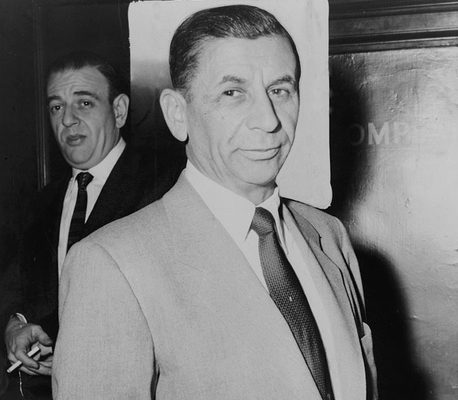
Meyer Lansky
The heirs of Meyer Lansky, the impresario of the North American Mafia gambling colony in Cuba (1933-1958) are betting on a big payback from the negotiations between the United States and Cuba to normalize relations between the two countries. Compensation claims by U.S. citizens or businesses for properties nationalized by the Cuban revolution are among the issues under discussion.
Lansky’s daughter Sandi, her son Gary Rapoport, and her brother Paul have filed a compensation claim against Cuba for the Riviera Hotel and Casino with the U.S. Foreign Claims Settlement Commission. The Cuban revolution confiscated the Riviera and other Mafia-owned properties after it toppled the gangster-linked regime of General Fulgencio Batista in 1959.
“It was through my grandfather’s hard work that the hotel was built,” Rapoport told the U. K. Daily Mail Online on December 23, 2015. “We are his natural relations . . . . By right, it should be our property.” He says the Riviera is valued at $70 million. The Tampa Bay Tribune, Reuters, and Haaretz have also covered the story.
The Riviera, which overlooks the Straits of Florida, was the crown jewel of Lansky’s casinos, hotels, and nightclubs in Havana. When the Riviera opened in December 1957, it was the largest Mafia-owned hotel-casino outside Las Vegas. The hotel’s 440 double rooms were booked solid for the winter season of 1957-1958.
However, the narrative that the success of the Riviera was the product of Meyer Lansky’s “hard work” is undercut by Lansky’s own assessment of his arrangement with Batista. Lansky talked candidly about his years in Cuba with Israeli national security writers Dennis Eisenberg, Uri Dan, and Eli Landau for their admiring biography Meyer Lansky: Mogul of the Mob (Paddington Press, 1979). (Lansky lived in Israel in 1970-1971 to avoid tax evasion charges in the United States.)
Lansky pitched his plan to Batista to open Mafia owned casinos and nightclubs in Cuba in 1933. Lansky promised to make Batista, who had just come to power in a coup d’etat, a partner. Batista and his inner circle would get regular payments from the Mafia gamblers. In return, the gangsters would be allowed to operate without interference from Cuban authorities. With a handshake and an abrazo, Lansky and Batista laid the foundations of the Cuban gangster state.
“Working on the well-known principle that it’s better to use other people’s money than your own, Lansky persuaded Batista to have the Cuban government help finance the venture,” Eisenberg, Dan, and Landau wrote. “The [Cuban] government agreed to back every dollar invested on the island by foreigners with a dollar of its own and to give every hotel that cost more than one million dollars the precious prize of a gambling license . . . and the casino hotels would not have to pay Cuban taxes.”
The Riviera was one of four new hotels with casinos, which opened in Havana between 1955 and 1958. Cuban development banks subsidized 50 percent of Lansky’s $14 million Riviera project; Lansky-linked investors provided the rest. Senator Eduardo Suarez Rivas, brother of Batista’s Minister of Labor Jose Suarez Rivas, was secretary of the Compania de Hotels La Riviera de Cuba, which operated the Riviera.
The Mafia gambling colony was the cornerstone of the Cuban gangster state. The gangsters’ graft bound Batista, his inner circle, senior security officers, and the Mafia together in the defense of one of the most repressive regimes in Latin America. As a CIA report put it, “In return for the loyalty they gave him, Batista always backed his security services. In times of crisis, he often suspended civil guarantees . . . and gave the services a free hand.”
The days of the North American gangsters in Cuba were numbered when Batista fled into exile on January 1, 1959. In 1958, Fidel Castro’s July 26th Movement had denounced the Mafia radio broadcasts from its guerrilla redoubt in the Sierra Maestra for turning Havana into a center of commercialized vice – gambling, prostitution, and drugs. When Castro arrived in Havana on January 8, he vowed to “clean out all the gamblers.” The Riviera and other gangster-owned properties were nationalized, and the Mafia gamblers returned to the United States.
To regain control of its casinos, hotels, and nightclubs in post-Castro Cuba, the Mafia waged a covert war on the Cuban revolution. The gangsters regrouped with their Cuban political allies, now in exile in the United States. The Mafia subsidized Cuban exile leaders and supplied arms to Cuban exile commando groups for attacks on Cuban targets from speedy boats and small aircraft. The gangsters also plotted with the CIA to assassinate Fidel Castro.
In 1959, Lansky volunteered to arrange the assassination of Castro in a meeting with the CIA, according to Doc Stacher, a life-long Lansky associate. “He [Lansky] indicated to the CIA that some of his people who were still on the island, or those who were just going back, might assassinate Castro,” Stacher told his Israeli biographers. “Meyer Lansky thought that if Castro would be eliminated there was a good chance for Batista to make a comeback . . . He told them [CIA officers] he was quite prepared to finance the operation himself.” From 1960 to 1963, the CIA and the Mafia plotted covertly to assassinate Castro.
To portray Lansky as an aggrieved victim of Cuba is to stand history on its head. There should be no compensation for the heirs of the former Mafia gamblers in Cuba.
Jack Colhoun is an historian of the Cold War (University of Wisconsin, Madison, BA, 1968; York University, Toronto, PhD, 1976), an investigative reporter, and professional archival researcher. His work has appeared in the Washington Post, Toronto Star, Salon, History News Network, The Nation, The Progressive, In These Times, the former (New York) Guardian newsweekly, and formerCovert Action Quarterly. He is the author of Gangsterismo: The United States, Cuba, and the Mafia, 1933-1966 (New York: OR Books, 2013).

June 25, 2016
Posted by aletho |
Book Review, Economics, Timeless or most popular | Central Intelligence Agency, CIA, Cuba, United States |
1 Comment
It looks increasingly possible that Brexit will lead to the demise of the United Kingdom. That may be for the best, as it’s abundantly clear that the four members now have markedly different concerns.
Do you remember where you were on May 1, 2004? I do. I was in Dublin watching the Irish government – which held the rotating European Union presidency – welcome 10 new members to the bloc. It was the single biggest expansion, in terms of population, in the EU’s history. But tellingly, not in terms of wealth.
Make no mistake: that was also the day Britain’s membership of the EU became unsustainable. Because the main reason Brexit has been passed is English anger at the consequences of unfettered mass immigration. Despite a negative fertility rate (1.75 in 2004 vs. 2.41 in 1971), the population of the United Kingdom rose from 59.99 million in 2004 to 64.1 million in 2013. That surge of over 4 million in less than a decade is greater than the entire increase in the 33 years from 1971-2004.
Before the 2004 expansion, which admitted the likes of Poland, Hungary, Slovakia and the Baltic States, internal EU migration was manageable. That was down to the fact that living standards weren’t vastly different across the union. For example, life in Portugal, the then-poorest member, wasn’t that much worse than in wealthier countries like Germany, France and Denmark. However, the gap between wages in Latvia, for instance, and London was astounding. Back in 2004, the average worker in Riga brought home €239 ($265) a month. That was less than 10 percent of London incomes which were £2,058 (around €2,900 at the time). Thus, it’s hard to blame east Europeans for seizing the opportunity to move west.
Ill fares the land
Britain’s post-war social democratic consensus has been under pressure since the Thatcher years, but EU expansion collapsed it. Rightly or wrongly, resentment has taken hold at the perception, fueled by the media, that foreigners are abusing the UK benefit’s system. Meanwhile, British workers have endured declines in real wages in the past decade. The reason is easy to understand. The wide availability of cheap labor, unrestricted by visa requirements, has enabled employers to conduct a race to the bottom, heightening inequality. And to make things worse, the population explosion has increased competition for housing, leading to enormous inflation in rent and property prices. Put simply, for common folk, life in England is getting worse.
I say England, rather than Britain, because this is all about England. Or more precisely, England and Wales, (except London of course, which is a different world entirely these days). Scotland and Northern Ireland have overwhelmingly voted to remain in the EU. Of course, for reasons of climate and economics, both are far less attractive to migrants than England or Wales and their status as net recipients from the UK budget means they have less at stake than other regions. Yet, things aren’t that simple.
Ulster says yes
Northern Ireland needs the EU because the peace settlement which ended its decades-long civil war, or ‘Troubles,’ was contingent on Dublin and London being legally joined via Brussels. Additionally, Ulster’s economy is heavily-dependent on trade with the vastly richer Irish state. In Scotland’s case, attitudes to ‘Britishness’ differ from those in England. In Scotland, to be British is to face inwards, but to be European is to face outwards. Down south, ‘Englishness’ and ‘Britishness’ are mostly synonymous.
Now, 62 percent of Scots have voted to remain in the EU, but because they are controlled by London, their democratic wishes matter not a jot. With that in mind, it’s hardly a surprise that Scottish Nationalists have already issued calls for a new referendum on independence.
One that even those who passionately supported the survival of the UK in 2014 might support.
In Northern Ireland things are less straightforward.
Pro-Irish republicans were far more likely to support the EU than pro-British loyalists, whose leaders campaigned for Brexit. The (historically mainly-Catholic) nationalists will now hope that moderate unionists (usually nominally-Protestant) can be persuaded to support a united Ireland, sacrificing ethnic tradition for economic reality. However, there is no guarantee that citizens of Ireland itself would agree to accept them at this time. The south has only just recovered from the greatest economic crisis in its history and may feel it cannot afford unity. Unless of course, Brussels is willing to underwrite the project. That is not as outlandish as it seems. Because Eurocrats are angry and may want to ‘punish’ England.
Eurocrat rage
The European Parliament president, Germany’s Martin Schulz, announced Friday morning that there will be “consequences” for Britain so other EU countries are not “encouraged to follow that dangerous path.” Now Shulz’s comments might be mean and vindictive and show contempt for democracy, but they also reflect realpolitik in Brussels.
If the UK, or whatever is left of it, is successful outside the EU, it will be the biggest disaster imaginable for the EU establishment – an elite of unelected rootless cosmopolitans often contemptuous of public opinion. It will show that a brighter future is possible and expose ‘project fear’ as a load of baloney. Brussels has pushed a mantra for nearly 60 years now that European integration makes things better and that there is no alternative. If a country as important as England proves that theory wrong, all bets are off. Actually, maybe they already are.
Let’s be honest, nobody really expected this result. Even UKIP leader Nigel Farage practically conceded defeat for Brexit on Thursday night. When people realized, early Friday morning, that Leave was winning, it was as much of a shock as if England had beaten Germany in a penalty shoot-out. In ice hockey. Even Brexit’s best known exponent, Boris Johnson, looked stunned when he eventually emerged to face the cameras.
We are now in uncharted waters. A member state has decided to leave the EU. A major one at that. Furthermore, the vote has exposed deep divisions inside the UK itself. Discord perhaps profound enough to mean its demise. Nevertheless, in the long term, such an outcome may be better for all concerned.
June 25, 2016
Posted by aletho |
Civil Liberties, Economics | BREXIT, European Union, Human rights, UK |
Leave a comment
June 22, 2016
Donald Trump NYC speech on stakes of the election:
- “When I see the crumbling roads and bridges, or the dilapidated airports, or the factories moving overseas to Mexico, or to other countries, I know these problems can all be fixed, but not by Hillary Clinton – only by me.”
- “Everywhere I look, I see the possibilities of what our country could be. But we can’t solve any of these problems by relying on the politicians who created them.We will never be able to fix a rigged system by counting on the same people who rigged it in the first place.The insiders wrote the rules of the game to keep themselves in power and in the money.
That’s why we’re asking Bernie Sanders’ voters to join our movement: so together we can fix the system for ALL Americans. Importantly, this includes fixing all of our many disastrous trade deals.
Because it’s not just the political system that’s rigged. It’s the whole economy.
It’s rigged by big donors who want to keep down wages.
It’s rigged by big businesses who want to leave our country, fire our workers, and sell their products back into the U.S. with absolutely no consequences for them.
It’s rigged by bureaucrats who are trapping kids in failing schools.
It’s rigged against you, the American people.
Hillary Clinton who, as most people know, is a world class liar –
just look at her pathetic email and server statements, or her phony landing in Bosnia where she said she was under attack but the attack turned out to be young girls handing her flowers, a total self-serving lie.”
- “If I am elected President, I will end the special interest monopoly in Washington, D.C.The other candidate in this race has spent her entire life making money for special interests – and taking money from special interests.Hillary Clinton has perfected the politics of personal profit and theft.
She ran the State Department like her own personal hedge fund – doing favors for oppressive regimes, and many others, in exchange for cash.
Then, when she left, she made $21.6 million giving speeches to Wall Street banks and other special interests – in less than 2 years – secret speeches that she does not want to reveal to the public.
Together, she and Bill made $153 million giving speeches to lobbyists, CEOs, and foreign governments in the years since 2001.
They totally own her, and that will never change.
The choice in this election is a choice between taking our government back from the special interests, or surrendering our last scrap of independence to their total and complete control.”
- “Our country lost its way when we stopped putting the American people first.We got here because we switched from a policy of Americanism – focusing on what’s good for America’s middle class – to a policy of globalism, focusing on how to make money for large corporations who can move their wealth and workers to foreign countries all to the detriment of the American worker and the American economy.We reward companies for offshoring, and we punish companies for doing business in America and keeping our workers employed.
This is not a rising tide that lifts all boats.
This is a wave of globalization that wipes out our middle class and our jobs.
We need to reform our economic system so that, once again, we can all succeed together, and America can become rich again.”
- “I have visited the cities and towns across America and seen the devastation caused by the trade policies of Bill and Hillary Clinton.Hillary Clinton supported Bill Clinton’s disastrous NAFTA, just like she supported China’s entrance into the World Trade Organization.We’ve lost nearly one-third of our manufacturing jobs since these two Hillary-backed agreements were signed.
Our trade deficit with China soared 40% during Hillary Clinton’s time as Secretary of State — a disgraceful performance for which she should not be congratulated, but rather scorned.
Then she let China steal hundreds of billions of dollars in our intellectual property – a crime which is continuing to this day.
Hillary Clinton gave China millions of our best jobs, and effectively let China completely rebuild itself.
In return, Hillary Clinton got rich!
The book Clinton Cash, by Peter Schweitzer, documents how Bill and Hillary used the State Department to enrich their family at America’s expense.
She gets rich making you poor.
Here is a quote from the book: “At the center of US policy toward China was Hillary Clinton…at this critical time for US-china relations, Bill Clinton gave a number of speeches that were underwritten by the Chinese government and its supporters.”
These funds were paid to the Clinton bank account while Hillary was negotiating with China on behalf of the United States.
She sold out our workers, and our country, for Beijing.
Hillary Clinton has also been the biggest promoter of the Trans-Pacific Partnership, which will ship millions more of our jobs overseas – and give up Congressional power to an international foreign commission.
Now, because I have pointed out why it would be such a disastrous deal, she is pretending that she is against it. She has even deleted this record of total support from her book – deletion is something she is very good at — (at least 30,000 emails are missing.)
But this latest Clinton cover-up doesn’t change anything: if she is elected president, she will adopt the Trans-Pacific Partnership, and we will lose millions of jobs and our economic independence for good. She will do this, just as she has betrayed the American worker on trade at every single stage of her career – and it will be even worse than the Clintons’ NAFTA deal.”
- “Hillary Clinton may be the most corrupt person ever to seek the presidency.Here is some more of what we learned from the book,Clinton Cash:
A foreign telecom giant faced possible State Department sanctions for providing technology to Iran, and other oppressive regimes. So what did this company do? For the first time ever, they decided to pay Bill Clinton $750,000 for a single speech. The Clintons got their cash, the telecom company escaped sanctions.
Hillary Clinton’s State Department approved the transfer of 20% of America’s uranium holdings to Russia, while 9 investors in the deal funneled $145 million to the Clinton Foundation.
Hillary Clinton appointed a top donor to a national security board with top secret access – even though he had no national security credentials.
Hillary Clinton accepted $58,000 in jewelry from the government of Brunei when she was Secretary of State – plus millions more for her foundation. The Sultan of Brunei has pushed oppressive Sharia law, including the punishment of death by stoning for being gay. The government of Brunei also stands to be one of the biggest beneficiaries of Hillary’s Trans-Pacific Partnership, which she would absolutely approve if given the chance.
Hillary Clinton took up to $25 million from Saudi Arabia, where being gay is also punishable by death.
Hillary took millions from Kuwait, Qatar, Oman and many other countries that horribly abuse women and LGBT citizens.
To cover-up her corrupt dealings, Hillary Clinton illegally stashed her State Department emails on a private server.
Her server was easily hacked by foreign governments – perhaps even by her financial backers in Communist China – putting all of America in danger.
Then there are the 33,000 emails she deleted.
While we may not know what is in those deleted emails, our enemies probably do.
So they probably now have a blackmail file over someone who wants to be President of the United States.
This fact alone disqualifies her from the Presidency.
We can’t hand over our government to someone whose deepest, darkest secrets may be in the hands of our enemies.”
Full transcript
June 23, 2016
Posted by aletho |
Corruption, Deception, Economics, Timeless or most popular | Donald Trump, Hillary Clinton, United States |
Leave a comment
Why is it that many people who consider themselves left-wing have such difficulty grasping that the EU is a deeply reactionary institution? The mere fact that those running the EU present it as an internationalist venture dedicated to the creation of a world free of nationalist enmities does not make it so. If we want to examine the EU in its proper light, then we should ignore the high-flown rhetoric in which its supporters indulge, and consider its actual record. And what is the record of the EU, once we penetrate the obfuscatory rhetoric about ‘internationalism’ that surrounds EU policy? Without a doubt, that record is one that should cause those on the left now defending it acute embarrassment, as it starkly contradicts the ideals that the left has always claimed to uphold.
Across the Continent, the unelected officials who have usurped the power of national governments and asserted their right to determine the fates of countless millions, through their adherence to the damaging creed of neoliberalism, have wrought suffering on an unimaginable scale, casting millions into poverty and removing the last vestige of dignity people cling to in an economy that has fallen prey to the voracious claims of big business. They have foisted austerity on unwilling populations, creating a cycle of endless unemployment and ever increasing woe, compelling ordinary workers struggling to eke out an existence in the wake of the most painful recession in living memory to shoulder the burden of repaying a debt which was originally incurred as a result of the criminal behaviour of Europe’s financiers. With brazen contempt for the views of the peoples of Europe they claim to serve, they have connived to topple left-wing governments and deny the citizens of the countries most affected by austerity their one remaining means – their inalienable right to elect a government subservient to their will – of resisting the vicious policies that have reduced them to their present abject state.
It is worth detailing the ways in which the actual practice of the EU diverges sharply from the propagandistic image endorsed by elements of the left.
The Crushing of Greece
One word should be engraved on the minds of those who, despite all the evidence to the contrary, persist in believing that the EU is an inherently progressive body: ‘GREECE.’ What the EU did to Greece should have dispelled forever the fanciful idea that such an institution has as its fundamental aim the material welfare of ordinary Europeans. But such is the power of the delusional thinking which holds sway amongst the ‘liberal’ apologists for ‘internationalism’ that nothing it seems, not even the destruction of an entire country, the decimation of its industries, and the despoliation of its people, can shake their belief in the manifest virtues of the EU.
After five years in which Greece was forced to undergo the most far-reaching programme of austerity ever implemented by any European government, selling off its public infrastructure and slashing spending on social services to please its creditors, even the economists at whose insistence this policy had been carried out were grudgingly admitting that it had been an unmitigated disaster. By 2015 Greece had seen its economy contract by 27% as a result of the government’s futile efforts to meet the continually mounting debt repayments demanded of it by the troika. As GDP fell and Greece’s ability to repay the debt was further reduced, rather than provide relief the ECB chose to extend fresh loans to the Greek government to enable it to service the interest on its existing liabilities, thereby adding to its overall level of debt and enmeshing the country in an interminable process of austerity from which it could never hope to extricate itself. The needless suffering caused by the single-minded pursuit of austerity had resulted in scenes of poverty and despair more appropriate to the 1930s than 21st century Europe. Entire families were starving on the streets, deprived of even the bare minimum they required to survive; thousands of people, reduced to absolute despair by the unrelenting attacks on their living standards, had committed suicide. The IMF, in an extraordinary departure from its long-standing commitment to free market dogma, published a report bluntly stating what had become apparent to all well-informed experts on the matter, which was that Greece would never be able to rid itself of the debt, not unless it was significantly reduced and a 30-year moratorium on repayments was imposed.
What was the response of the managers of the eurozone to the tragedy unfolding before their very eyes, to the unbearable spectacles of suffering for which they, as the economic masters of Greece, bore responsibility? The response was callous indifference. When in desperation the Greek people elected the far-left party Syriza to power, on a platform of ending austerity and negotiating a debt restructuring, the EU steadfastly refused to treat with such a government on terms of equality and outright rejected the democratic mandate with which it had been recently invested at the polls, insisting that, regardless of the outcome of elections, Greece had no right to seek a change in rules which had been autocratically decided upon by the bureaucratic elites in Brussels. There would be no substantive negotiations leading to an end to austerity; there would be no concessions to the democratically expressed will of the population. When Syriza attempted to resist the diktats of Brussels, calling a referendum on its negotiating stance, which it won resoundingly, the EU bullied and cajoled little Greece, threatening to punish the refractory population of this wayward country, which had dared to question the entire basis on which the eurozone was run, by cutting off the money supply and rendering even more people destitute if Syriza should refuse to acquiesce in the harsh financial terms of the proposed deal, which mandated yet more spending cuts to service a debt that everyone knew to be unsustainable. Under extreme duress Syriza surrendered to these demands and the worsening cycle of unemployment and declining wages, in which Greece has been trapped for at least the last 6 years, was resumed, inflicting a historic defeat on the people of Greece who had misguidedly believed that, by exercising their democratic rights, they could decide the future of their own country.
Greece illustrates the failings of an economic policy that is being implemented over the objections of the great majority of Europe’s citizens. Indeed, in its unwavering support for neoliberalism the EU represents nothing less than an attempt to perpetuate an economic model which advantages European businesses, whilst eroding the living standards of most Europeans. Particularly in the countries of the eurozone, democracy has been eviscerated by the adamant insistence of the EU on more cuts to government spending. The Growth and Stability Pact effectively prevents large-scale public spending on vital social services to alleviate the effects of a recession, limiting deficits to 3% of GDP. As part of this neoliberal model, national governments are also required each year to submit their budgets to the Commission for its approval, which has increasingly demanded that the rights of workers take second place to paying off the debts accumulated by the financial sector. Whilst the desperate scenes in Greece are an extreme case, high unemployment and chronic poverty have become fixed features of the eurozone, with the number of jobless in Spain, for example, amounting to over 20% of the workforce. Moreover, employers have been given the freedom to disregard the rights of their employees in a bid to raise productivity, sparking a series of labour revolts by workers driven to the edge of despair. In France, to cite the most recent instance, the much hated El-Khomri law, which seeks to increase the working week to 46 hours and is currently being contested by striking unions, was originally based on the recommendations of the Commission.
Thus, it is transparent that the hardships experienced by workers across Europe are an inescapable product of the economic policies enforced by the EU.
The myth of a pacifist EU
It is difficult to fathom how anyone save the wilfully blind could continue to view the EU as a progressive force in light of the destruction it visited upon Greece. But to understand the mindset that leads otherwise enlightened people to extol the benefits of an institution which is the cause of so much distress throughout Europe it is necessary for the moment to ignore facts. Faith in the EU is not grounded in any rational analysis of reality, but rests on a series of founding myths the truth of which its defenders have never paused to consider. They are regarded as unquestionably true and are never scrutinised, much as devout Christians in centuries past would never have thought to examine the articles of faith on which their belief in God was based.
The myth from which the EU derives much of its strength is that of an organisation which has overcome the bitter divisions of the past to fashion a new identity for the once warlike people of Europe. The narrative goes something like this: for millennia Europe was plagued by nationalist rivalries which produced wars of unparalleled violence. In the twentieth century, as a result of these rivalries the entire world was plunged into two conflicts which witnessed bloodletting on a scale never seen before, and following the second and most devastating of these wars, a band of far-seeing European statesmen resolved that never again would the nations of Europe battle against one another and be a cause of such misery to the rest of the planet. In a spirit of high-minded idealism they took the first steps toward the establishment of a supranational body which would bring countries together in harmony and peace, consigning to history the internecine feuding and jingoistic war-mongering that had rent the political fabric of Europe apart. Henceforth, the people of this war-torn continent, divided though they might be by borders, were to consider themselves Europeans in the truest sense, part of an organic union that would only grow in strength with the passage of the years.
To any serious student of history this account of the EU’s origins must appear as a gross distortion of the facts. But such is the comforting myth that underpins the faith many people, who should know better, exhibit in relation to an organisation they credit with having maintained the peace in Europe and prevented another plunge into barbarism for more than half a century. This romanticised view of history explains why in 2012 the Nobel Committee was able to award the Peace Prize to the EU, and also why in a poll conducted on the same occasion it was found that 75% of Europeans agreed with the Nobel Committee that ‘peace and democracy were the most important achievements of the EU’. The people who believe this are prepared to forgive the EU anything, because its failings in their eyes are as nothing when set against its tremendous success in averting another world war.
The reason this myth should cause offence to campaigners for peace everywhere is that it is based on a version of events which is utterly contradicted by the known facts about how the EU came into being. That there has not been another conflict to compare with WW2 in the seventy years following its end owes not to the moral vision of the politicians who presided over the birth of the EEC, the precursor to the EU, but is purely a result of shifting power dynamics. By 1945 the great powers of Europe had been so reduced in strength by the most savage war in human history that they soon realised they would never be able to recover their former status as global hegemons in a world the US had come to dominate. Indeed, such was the overwhelming preponderance of power enjoyed by the US, the only state to emerge from the war with its standing massively enhanced, that the idea of opposing its designs for Europe was swiftly set aside, and to retain what small measure of influence they could hope to wield in this unipolar world the formerly great powers agreed to be integrated into a military and economic alliance headed by the US. The creation of pan-European institutions that would foster the growth of a single European market, which would trade freely with US corporations, was made a condition of Marshall Aid by the American architects of the new economic order, who greeted every significant move in the direction of greater European unity with satisfaction. In the military sphere, membership of NATO, the armed alliance of states that the US established to further its imperialist interests, required Western European countries to devote a significant part of their budgets to military expenditure and maintain an armed truce with the Soviet Union and its Eastern European satellites, effectively dividing the Continent into two hostile camps, constantly teetering on the edge of nuclear war, for much of the latter half of the twentieth century.
The roots of the EU are therefore to be sought not in the sentimental desire for peace felt by leading statesmen in the wake of war, though this was undoubtedly a desire expressed by masses of ordinary people, but in the essential fact of the post-1945 world that the US displaced Europe as the centre of global power and influence. Power politics not pacifism explains why there has not been another war between the major European states. Anyone who doubts the truth of this need only consider the foreign policy of Europe during the period when the basis for the EU was being laid. For most of the inhabitants of the third world these years were not ones distinguished by peace but by a series of brutal wars to free themselves from the yoke of imperialism. The founding members of the EEC, at the same time they were joining together in a spirit of ‘harmony’ and ‘peace’, unleashed a torrent of blood in their colonial possessions, obstinately clinging to the remnants of empire and crushing demands for liberty with shocking violence. In Algeria the French prosecuted a terrorist campaign against the population that resulted in 1.5 million deaths, the effects of which are still felt acutely by France’s Muslims, treated as second class citizens by the Republic, and are a source of deeply-felt divisions even now. In Vietnam, with funding from the US, the French also sought to retain control over their colony and defeat the Vietminh, eventually handing over to the Americans when they could no longer sustain the cost of such a military campaign. In the Congo, Belgium initially met demands for independence with violence and continued to interfere in the politics of the region following independence, playing a role in the assassination of the elected Prime Minister Patrice Lumumba. In Kenya, the British, who were to join the EEC in 1973, waged a brutal war against the native Kikuyu throughout the 1950s in order to uphold the rule of the white settler elite, interning many Africans in concentration camps where they were subjected to torture.
The danger of peddling a false narrative of the growth of European unity in which base geopolitical considerations do not figure is the immunity granted the EU against criticism for its actions in the present. Far from waning, the attachment of European states to militarism remains as strong as ever, and has continued to find an outlet during the 21st century in a number of wars of aggression across the Middle-East and Africa, which differ little from the hey-day of 19th century imperialism, when great powers bestrode the world looting defenceless countries with utter abandon. There is, however, one significant difference between these past exploits and European imperialism in its modern guise. In recent years the EU has arrogated to itself an increasing array of powers in the field of foreign policy, establishing the office of High Representative for Foreign Affairs with a view to eventually dictating the relations of European nations with the outside world. Given fully 22 of the 28 member states that comprise the EU are members of NATO, it is unsurprising that the policy followed by this fledgling branch of the Commission is little more than an extension of the goals that Europe’s political leaders have long held in common with the US.
Through vesting power, however, in an unaccountable body of bureaucrats who cannot be voted from office, unlike elected politicians in member states, the EU seeks to make it all but impossible for the citizens of Europe to alter the foreign policy trajectories of their respective governments, and draw back from the reckless path of unabashed war-mongering upon which we are embarked. A case in point, and one that the former MP George Galloway cited in a recent speech, is Syria. Although most of the people who argued for Britain to intervene against ISIS towards the end of last year have effaced it from their memory, barely three years ago Cameron’s government, supported by much of the media class, favoured military intervention on the opposite side of the Syrian civil war, calling for air strikes against the Syrian army and support for those jihadist elements which subsequently morphed into ISIS. Thankfully, to the dismay of Cameron, this move was narrowly voted down in the Commons, but had this question fallen within the purview of the EU’s High Representative, it is unlikely that Britain’s Parliament would have even been permitted a vote on the matter.
The crowning achievement of the EU in the arena of foreign affairs has undoubtedly been its contribution to resurrecting the Cold War, fomenting a civil war in the Ukraine that still rages along the historically fraught border region that stretches between the EU and Russia. Few people in the West know of the EU’s role in igniting this conflict, or of the policy, drafted by the Commission, and relentlessly pursued during the last twenty years, of expanding the influence of the EU into Eastern Europe so as to isolate Russia behind a ring of hostile states. The degree of ignorance that the media has fostered regarding the crisis in Ukraine has reached the point that the supporters of remain even cite, with positive pride, the aggressive posturing of the EU during the recent crisis as a reason to vote against Brexit, contending that only as part of a larger entity can we stand up to the Russian bear, which is engaged in an attempt to subjugate its neighbours and reconstitute the Soviet Empire. If anything, the reverse is true, and the perilous brinksmanship of the EU with respect to Russia, its unceasing efforts to provoke an escalation in tensions between the two, should be considered grounds enough to vote leave.
For in reality Ukraine is merely the latest in a long line of countries which the EU has sought to annex to a Western alliance controlled by the US, with EU membership proceeding hand in hand with membership of NATO. This military organisation, formed in 1949 with the supposed aim of defending Western Europe against the USSR, has since the collapse of the Soviet Union more than doubled in size, with many of the new additions former Communist countries situated on Russia’s periphery, revealing its true character as an alliance that exists to extend the global reach of the US. The EU, by incorporating these countries into a political union closely linked to NATO, and in some cases laying the ground-work for their eventual accession to NATO through the Eastern Partnerships, a proto-form of EU membership, has in many ways acted to reinforce the bonds linking the various members of this alliance.
In the case of Ukraine, the action that set in motion the chain of events leading to civil war was the offer by the EU of an Association Agreement. This has frequently been depicted as a generous arrangement under which Ukraine would have benefited from most of the advantages enjoyed by EU member states, without, however, formally becoming a member. In actual fact the agreement would have required Ukraine to sever economic relations with Russia, a country to which it was intimately bound by a shared history, and was linked to a package of swingeing austerity measures that would have resulted in the ruination of Ukraine’s economy. Moreover, despite the outraged denials of its framers, the deal also mandated military cooperation between the EU and Ukraine and was clearly intended as a prelude to NATO membership. Given the fact that approximately half of Ukrainians, mainly living in the East of the country, were opposed to NATO and favoured better relations with Russia, it was hardly likely that the Ukrainian President, Victor Yanukovych, who by all accounts had pro-EU leanings, would ever have been able to implement the terms of such a deal without splitting the country in two. When at the end of 2013 he therefore rejected the Agreement, prompting protests in Kiev’s Maidan Square, in which Ukraine’s fascist parties, which are driven by a racist hatred of the country’s ethnic Russian population, played a prominent part, both the EU and the US chose to back the protesters agitating for his removal. After Yanukovch was overthrown in a putsch in February 2014, spearheaded by those same fascist elements within the opposition, instead of spurning the interim government that was installed following his ouster the EU immediately proceeded to signal their approval by securing its assent to the Association Agreement that Yanukovych had originally refused to sign. When Eastern Ukrainians rose in revolt against the putschist government, which had removed the democratically elected President from office and concluded an Association Agreement in spite of their objections, the EU disingenuously attributed Ukraine’s descent into civil war to Russian interference.
The defenders of the EU refuse to acknowledge its contribution to the turmoil that has engulfed Ukraine, or its part in bringing about a new cold war, even arguing that Russia’s opposition to the European project stems from a distaste for democracy and human rights, rather than simple geopolitics. Some, indulgently, recognise that Russia is genuinely fearful about the threat to its position from the extension of NATO eastwards, but claim that these fears derive from a 19th century habit of mind whereby the world is divided up into spheres of interest between competing powers, which vie with each other for global domination. Unfortunately, they argue, the EU is hampered in its relations with Russia by the failure of Europe’s leaders to grasp that they are a 21st century power dealing with a country that has still not freed itself from old modes of thinking about international affairs. But the chronology of the crisis is clear, as is the role the EU played in prompting it, and few who have studied the matter would deny that the actions of the EU with respect to Ukraine appear in the grand tradition of imperialist politics.
The question confronting Britain
The question of whether to remain or leave will likely not be decided on the basis of what is being done on the Continent in the name of ‘internationalism’. But a broader perspective is needed to refute the contorted arguments of many liberals who all too often give too much credence to the rhetoric of the European project, whilst paying little heed to its record. The current debate in Britain suffers from the entrenched tendency of the mainstream left to identify support for remain with opposition to petty-minded nationalism, and to chide Brexiters for being too insular and self-interested to appreciate the sense of high moral purpose that drives the EU. The briefest look, however, at the destructive polices that have been imposed on the countries of the eurozone, and the chaos that has ensued from imperialist meddling in foreign affairs, is enough to counter the baseless assertion, constantly repeated by those in the remain camp, that in opposing Brexit people will be voting for a worthy attempt to replace nationalist discords with a shared identity based on a commitment to democracy and human rights. The EU is not internationalist in any sense that a genuine member of the left would support. It exists to advance the interests of the business class as against workers, and in its zeal to enrich corporations at the expense of ordinary people it has succeeded in creating such disaffection with the political establishment that fascism, the very phenomenon the EU was in theory designed to prevent, has once more become a formidable force in countries languishing in the grip of high unemployment and low wages.
There are both altruistic and more self-interested considerations that should be factored into any decision on how to vote in the upcoming referendum. Both kinds of analysis, however, dictate a vote for Brexit. The supporters of remain commonly react to the argument that Britain has much to gain from leaving by speaking vaguely of showing solidarity with the many millions of people in the eurozone to whom that option is not available. They seem not to understand that by voting to remain, far from showing solidarity with the rest of Europe, Britain would be electing to prolong the life of an institution which is conducting a bizarre neoliberal experiment in how far it can push Europeans before they lose all hope. There is a moral case for leaving, based on the fact that Brexit would probably result in the dissolution of the EU and ease the suffering of nations currently held captive by neoliberal economics. The evidence for this is compelling. It is doubtful, for example, that the EU could long survive the withdrawal of one of its principal sources of funding. Far more worrisome from the point of view of those running Europe than the financial repercussions of Brexit, however, would be the example that it would set for the stricken populations of the Continent, especially in the southern countries, who have been led to believe that escape from the economic straitjacket of the eurozone is impossible. Presented with the spectacle of a people freely choosing to exit the EU, it is conceivable that workers suffering the consequences of EU-enforced austerity in countries like Spain and Italy would place pressure on their representatives to grant a referendum.
There is also an argument for leaving based on the benefits that Britain is currently well-placed to reap from such a move. The landslide election of Jeremy Corbyn as leader of the Labour Party last year has indicated the widespread support that exists for a socialist alternative to the centre-ground politics which has held sway in Britain for the last thirty years, showing that the Blairites, who were roundly defeated in the election, were wrong to dismiss socialism as a spent force and place their faith in the free market. Consequently, a reforming Labour government may well assume the reins of government in the very near future. If it takes power in the context of a vote to remain, however, such a government would face real obstacles to implementing its programme in the form of the capitalist safeguards against reform that the EU has established. It would not be able to nationalise the railways, despite the overwhelming support of the public, because the EU has made public ownership of the railways illegal. A Labour government would find it difficult to increase expenditure on the NHS and other much needed public services because of the strict economies that the EU pressures member states to adopt by limiting the budget deficit to 3% of GDP. Furthermore, a social-democratic government of the kind that Corbyn could potentially head, with its commitment to decoupling the economy from its damaging dependence on financial services, would soon discover that competition rules forbid us from subsidising our manufacturing sector or even protecting our steel industry from Chinese dumping through raising tariffs on imports. In short, any government that seeks to overturn the neoliberal consensus will find that, within the confines of the EU, even limited reforms toward that end are a practical impossibility, liable to be struck down by the European Court of Justice as incompatible with EU law at any time.
It is regrettable that, instead of focussing on the impediments Labour would face in the event of a vote to remain, the mainstream left has chosen to fix its attention on the perceived boost that Brexit would give the current Conservative government. A myth has gained ground amongst large sections of the left that the rights which British workers have come to take for granted, such as maternity leave and paid holidays, were gifted to Britain by the EU, and that Brexit would free the Conservatives to intensify their assault on the working class, uninhibited by a social Europe which at present exercises a restraining influence over neoliberal governments. Even supposing that the remain camp is right in assuming that the Conservatives will hold onto power until the next general election in four years time, a questionable assumption in light of the fact the Conservatives are deeply split over the referendum, it is simply false to claim that we owe whatever rights we enjoy to the EU, As others have documented, most of the rights that are invoked by the mainstream left as a reason to vote remain were already in place when we joined the EEC in 1973, and they owe not to a beneficent bureaucracy of Eurocrats but to Britain’s working classes, who won these rights over the course of many years and after a series of hard-fought struggles with the capitalist class. Likewise, the retention of these rights will depend not on the good-will of a remote bureaucracy, which is actively undermining those same rights elsewhere, but on the determination of workers to band together in defence of their standard of living.
Unfortunately, many of the left apologists for the EU have been aided in their efforts to paint their opponents as backward nationalists by the fact that the Brexit campaign is largely dominated by the right. Almost all of the political figures who favour Brexit that the British public are regularly exposed to on TV are drawn from the far right of the Conservative Party, such as the former Mayor of London Boris Johnson and the current justice minister Michael Gove. (The noteworthy exception is Nigel Farage, the leader of UKIP – a right-wing party formed for the sole purpose of taking Britain out of the EU.) At times the debate has resembled, and has often been reported as, an internal squabble between factions of the Conservative Party over the direction Britain should take as well as, on a more personal level, a battle between Prime Minister David Cameron, the leader of the remain group, and Boris Johnson, who is widely believed to be the most likely successor of Cameron in the event of Brexit. The left-wing case for leaving, which has been eloquently articulated by a number of prominent intellectuals and activists, has been given relatively little attention by the media, with the result that many voters have been kept in ignorance of the existence of such arguments, and various Blairite MPs on the right of the Labour Party have been able to assert that they alone represent what the left’s position should be in the debate over Britain’s attitude to the EU.
Paradoxically, however, the near monopoly of the right over the Brexit campaign is not proof that opposition to the EU is intrinsically right-wing, but testifies instead to the weakness of a left which has been steadily stripped of its commitment to economic justice. Thirty years ago the most forceful advocates of Brexit were to be found among the members of the Labour Party, not on the right, and calls for Britain to withdraw from the EU, or the EEC as it was then called, were considered a standard feature of Labour’s policy platforms. The great left-wing MP Tony Benn campaigned in the 1975 referendum for Labour to leave the EEC on the grounds that such an arrangement was contrary to the basic democratic principle that people should be allowed to vote on the policies affecting them. Events since 1975 have only proved the truth of Benn’s original argument, made all those years ago, that these undemocratic tendencies were destined to grow with time, posing a grave risk to our ability to decide the most basic of policy issues. Moreover, unlike the MPs campaigning for remain today, politicians like Benn understood that the lack of democracy at the heart of the EU was not an oversight on the part of its founders, but an essential component of a project which sought to supplant national governments with a supranational authority divorced from the concerns of ordinary people. So long as power was vested in national assemblies, these institutions, however imperfect, were at least answerable to their voters, but once power over economic policy was ceded to bureaucrats then the business elites which effectively governed Europe were easily able to overcome popular resistance to their policies by dispensing with the need for elections.
Unfortunately, this basic point has been forgotten by the members of the Labour Party now campaigning to remain. Thus, the left-wing opponents of Brexit frequently give the impression that they regard the EU’s democratic deficit as a minor flaw, something that could easily be rectified if only Britain stays within the EU and works with other countries to reform it. Not a few even deny that the EU is undemocratic, reasoning that because the Council of Ministers, which concludes the treaties which form the basis for the EU, is composed of elected government figures from the member states this amounts to an indirect form of democratic accountability. These supporters of remain seem oblivious to the fact that the whole purpose of enshrining in various treaties the neoliberal principles on which the EU rests, treaties which once concluded cannot be repealed except through the agreement of all 28 member states, is to ensure that such weighty questions are forever removed from the sphere of democratic debate. The electorate of a particular country can vote their government out, but they cannot revoke the set of laws that this government agreed to, nor exercise any control over the unappointed Commission which is granted broad discretion to implement these laws.
The referendum is perhaps the one chance that this generation will ever have to vote on our membership of an institution which now wields an inordinate amount of power. It is the only opportunity we will be given to affirm our democratic right to rule on the fundamental questions with which we are confronted, and at the same time administer a blow to the undemocratic vision of a corporate Europe, rooted in neoliberal economics and a disdain for workers, that has crushed underfoot the aspirations of so many Europeans who were never even offered the choice of agreeing to such a project. A vote to leave will not usher in an age of socialist egalitarianism, but it is nonetheless, as socialists agitating for Brexit have observed, a necessary steppingstone without which the fairer society we are striving to achieve will be rendered a more distant prospect.
Members of the mainstream left who are campaigning to remain have only been able to maintain their enthusiasm for the EU by averting their eyes from its shameful record, adhering instead to an exalted image of a progressive body which has never existed outside of their imaginations. Ordinary voters must spurn such consoling myths, and recognise the EU for what it is: a deeply reactionary institution that is holding back progress throughout Europe.
June 22, 2016
Posted by aletho |
Civil Liberties, Economics, Militarism, Timeless or most popular | Africa, BREXIT, European Union, NATO, Russia, UK, Ukraine, United States |
Leave a comment
There are few illusions about the reformability of the EU on the left, even amongst those campaigning for Remain. Paul Mason has stated that “it is impossible for the EU to be a democracy”. The ex-Greek Finance Minister Yanis Varoufakis has described the “point blank refusal” of Greek creditors to “engage in economic arguments.” He explains, “you’re just faced with blank stares. It is as if you haven’t spoken.” No doubt fuelled by these experiences, Varoufakis has since expressed serious doubts about the prospect of his own campaign succeeding – “It will probably end up in failure like all the best intentions.”
In this respect, they are in harmony with the left opposition, who argue that the prospect of reform will inevitably fail because the EU lacks a democratic structure.
But this has not been the main focus of the debate. Instead, the main issue has been less the objective political qualities of the EU than the fear of those leading the Leave campaign.
Mason states, “I am very unlikely to vote for Brexit on the day because I do not want to hand power to a bunch of crazed right wing conservatives.” Similarly, Varoufakis warns of the growth of fascist forces across the EU, and argues that Brexit “would make a bad thing far, far worse.” Owen Jones describes how a “vote to leave… has more to do with… opposition to immigration” and that he is now campaigning for Remain. Six months earlier he was stating that it is time for the Left to “reclaim the Eurosceptic cause.”
The idea of deserting the Leave vote because of its association with the far right has resulted in some truly spectacular U-turns. (See Jeremy Corbyn for the flip flopper par excellence.)
In their rush to abandon the Leave vote, however, Left Remainers have ironically contributed to the very conditions they rally against. Vacating the Leave argument has, in effect, meant abandoning huge swathes of the working class, who will be voting to leave, to the forces of reaction.
But maybe this is to overstate the case.
Certainly the position of the main Leave campaigns (and Remain, for that matter) have been racist in character, but the one-dimensional ideas put forward by the corporate media are never straightforwardly adopted by the majority of the 50 million people voting in the referendum. To suggest otherwise is deeply patronising.
In reality, one of the main reasons so many people will be defying so-called “expert” advice is that the EU referendum has come to be seen as a stick with which to beat the establishment politicians, whether in Brussels or the UK.
People are understandably angry at the lack of principles in politics, fed up with lies and doublespeak of those elected to represent them. This referendum has become a way of passing verdict on the status-quo.
In this respect, Left Remainers have made a huge miscalculation.
By sidling up to the forces of world capitalism – the International Monetary Fund, the World Bank, the Confederation of British Industry, and bourgeois economists, as well as all the leaders of the pro-austerity parties – the Left Remainers have lined up alongside the enforcers of the oppressive status-quo.
The counter argument to this has been that the Left Leave campaigners have gotten into bed with the far right. Of course, the only thing that socialists have ever shared with the far right is the belief that there needs to be fundamental change in society – and it seems that the majority of the working class now feels the same way. Such accusations only reveal the extent to which Left Remainers have misunderstood this referendum.
Furthermore, the implication that the Remain camp is somehow more “credible” than the Leave groups misrepresents the central role played by capitalist politicians, and their ideologues, in making fascism possible.
Fascism does not emerge in a political vacuum, but breeds on conditions of poverty, despair, and disillusionment – conditions which the EU has transparently done nothing to curtail. In fact, in cases such as Greece, forced-immiseration of the working class has been carried out at the EU’s behest. Add to this the capitulation of the Syriza government to EU austerity and it is little wonder that the neo-Nazi Golden Dawn has gained so much support.
This does not mean that we do not unite in broad coalitions to keep fascists from gaining power – although this issue is not presently on the cards in UK – but that we must approach referenda and electoral issues with a program that gets to the root of its causes.
This brings us to another factor driving the grassroots Leave vote: the way that the EU has treated its less wealthy member states, particularly in southern Europe. Although not on the scale of Greece, the consequences of austerity – food banks, declining services, and lowering wages – are faced by the people of Britain on a daily basis. But to see it imposed so brutally across the trading bloc has undoubtedly contributed to feelings of fear, lest we suffer the same, and of solidarity.
Undoubtedly, the question of immigration control has been at the centre of the EU debate. And there are sections of the Leave campaign that are undeniably racist, particularly the official campaign – although contrary to what some Remainers suggest concerns over immigration are not in themselves racist. There are also many overtly racist groups that support Leave.
It does not, however, follow that the majority of those voting Leave are racist or xenophobic… but even if this were the case, much of the responsibility would have to be borne by Eurosceptic Remain campaigners such as Varoufakis, Mason, and Jones for failing to cut across these arguments with a principled Leave campaign; a campaign which points the finger at the real cause of human misery in contemporary society: capitalism.
In lieu of such a mass campaign, the job has been left up to smaller parties like the Trade Unionist and Socialist Coalition (TUSC) as well as some of the more militant trade unions including the Bakers Union, RMT, NIPSA, and ASLEF.
Such groups have refused to cede control of Euroscepticism to right wingers, and in doing so have refused to write-off millions of working class voters.
Thomas Barker is an independent journalist and PhD student in Aesthetics and Politics. He can be reached at https://durham.academia.edu/ThomasBarker
June 22, 2016
Posted by aletho |
Deception, Economics | BREXIT, European Union, UK |
Leave a comment
European construction began as the dream of European elites and has become the nightmare of European peoples. For a number of European intellectuals and politicians, the dream was to transform Europe into a sort of Superstate, capable of rivaling the United States. For others, the idea was to get rid of the Nation-State once and for all, since it was considered chiefly to blame for the woes of the 20th century.
However, aside from the fact that this dream always enjoyed strong United States support, which casts doubts on its claim to constitute an alternative to American domination, it suffers from a fatal flaw: the nonexistence of a European people. That is, an overwhelming majority of European citizens feel part of their respective Nation-States, or of even smaller entities (Scotland, Catalonia, Flanders, etc.), much more than they feel “European”.
Advocates of European construction have two answers to that objection: either that the feeling of belonging is an historic construction (in the case of modern Nation-States) and is being changed into a “European” sense of belonging, or else that the sense of belonging does not really matter, inasmuch as political decisions must be taken on the basis of economic rationality (the liberal view) or class interests (the Marxist view), rather than on the basis of sentiments.
As for a sense of being European, it is perfectly possible that it may develop over the course of coming centuries, just as the various national sentiments did in the past. But one should not have illusions concerning the time scale. Such processes take centuries, and the Scottish example shows that even within a democratic State such as Great Britain, with equal rights for all and sharing the same language, centuries may not be enough to eradicate national feeling.
It is enough to watch sports events, such as the current European Cup, to see that national feelings are far from disappearing. They are not even disappearing among the “elites”: in Brussels, with rare exceptions, the representatives of the various Member States defend what they consider to be their national interest rather than the “European” interest.
As for the notion that national feeling does not matter, compare the national currencies that existed before the euro and the euro itself. Before the euro, changes in currency parities took place among Member States to make up for differences in economic strength between, say, Germany and France or Italy. But within each State, the unity of the national currency was maintained between rich and poor regions by a whole series of redistribution measures: identical pensions and social allocations, public investments and so on. These measures were politically possible because the citizens of these States “felt” that they were all French, or all Italians, or all Germans.
With the euro, there can be no adjustment in currency parity between weak and strong economies. Moreover, the eurozone lacks the redistribution mechanisms that existed between rich and poor regions of a single State. It is clear from following the Greek tragedy that the Germans do not feel sufficiently Greek – or even sufficiently European – to accept the transfers of wealth needed to “save Greece”. In short, national feelings have a huge economic importance, contrary to the views of the liberals and Marxists who both ignore or play down the importance of “irrational” feelings in social reality.
Or compare Europe with Latin America. In the latter continent, all the countries except Brazil have their origin in the same colonial empire, speak the same language, practice the same religion, even have more or less a common enemy (the United States) and have not massacred each other in recent major wars.
In Europe, it’s the other way around. The “memories” of the various peoples are very different, even contradictory, some having lived through communism, others through fascism, not to mention all the various wars among themselves. Their various legends and even languages preserve these diversities.
And yet, the integration of the Latin American continent is advancing in full respect of the sovereignty of each State. Nobody insists that Chile and Bolivia adopt the same currency, nor that all their four-year university programs be changed to five years, to “harmonize” studies, as with the Bologna process in Europe. If Bolivia or Ecuador decide to control their own natural resources, they don’t have do ask “Brussels” for authorization.
Such integration respecting national sovereignties could have been undertaken in Europe. That was the idea of a “Europe of peoples” proposed by Charles de Gaulle, ruled out by the existing European construction.
The left condemns the policy of the European Union because it is “neoliberal”, but the problem goes much deeper. The fatal flaw is that, in the absence of a European people, European construction can only be undemocratic and bureaucratic. A bureaucratic or autocratic power inevitably arouses hostility and ends up producing political effects contrary to those sought. If EU policies were “socialist”, they would arouse similar hostility.
From the point of view of the liberal right, depriving European peoples of their sovereignty and thus of democracy was natural because those peoples, left to themselves, would vote for too many redistributive measures.
On the left, European construction was promoted because those same peoples were supposedly chauvinist, nationalist, racist, and if left to themselves would surely end up at war with each other. This negative attitude toward their own population has been suicidal for the left, whose only base has to be the “people”.
The Europist left has made a mistake similar to that of the Communists in the past; they too thought that they were acting in the interests of the people, but the latter, being incapable of understanding, had to be led by an unelected elite.
This is particularly flagrant and tragic regarding immigration and refugees. The left Europists want to impose a policy of “opening” without ever asking their own people what they think, since some of them are sure to be against it. But they fail to understand that imposing an unpopular policy can only make it still more unpopular and that nobody likes being forced by others to be altruistic.
The Communists had their People’s Democracies, with democracy as only a façade.
The Europists have their Parliament which is another: it has no real power, and if it did, it would not be able to exercise such power because of the multiplicity of languages and national origins.
The Communists believed that national sentiments would disappear thanks to economic progress. The Europists bet on the same thing, but both have to acknowledge that “irrational” national sentiments have not disappeared, least of all when there is no sign of the promised progress.
For a long time the Communists used the accusation of antifascism to silence their opposition. The left Europists do exactly the same. The moment European peoples balk at the policies being imposed on them, they are ignored and accused of being populists and racists.
In both cases, that sort of intimidation works for a while but finally boomerangs. And when that happens, those who benefit from the popular revolt are those who never gave in to the intimidation, whether Communist or Europist, that is, the nationalist or religious right.
No doubt, all that foreshadows “dark times” for our continent, as the Europists lament. But who is to blame? Not the Cassandras who try to warn of what is happening, but those who have “constructed Europe” on the shaky foundations of intellectual arrogance, contempt for the people and illusions concerning human nature.
JEAN BRICMONT teaches physics at the University of Louvain in Belgium. He is author of Humanitarian Imperialism. He can be reached at Jean.Bricmont@uclouvain.be
June 21, 2016
Posted by aletho |
Economics, Timeless or most popular | European Union, UK, United States |
Leave a comment
Iranian Foreign Minister Mohammad Javad Zarif has criticized the insufficient international aid over the Afghan refugees in the country, stressing the importance of preparing the ground for their voluntary return to Afghanistan.
“Iran hosted [Afghan] refugees for over three decades but unfortunately received little international aid,” Zarif said in a meeting with United Nations High Commissioner for Refugees Filippo Grandi in Tehran on Saturday.
He added that many legal and illegal Afghan refugees are living in Iran, saying, “The Islamic Republic of Iran has always tried to provide the refugees with good facilities and has spent hugely on refugees’ education.”
The Iranian foreign minister urged the UN’s refugee agency and donating countries to ramp up investment in Afghan economic projects with the purpose of preparing the necessary ground for the voluntary return of Afghan refugees.
“Very little investment has been made in this regard and it is necessary to do more work,” Zarif said.
He noted that Iran has carried out a number of economic projects such as the development of the southeastern Iranian port of Chabahar and the supply of drinking water to Afghanistan, which have resulted in more employment opportunities in the war-torn country.
On May 23, Iran, India and Afghanistan signed a key trilateral deal, known as the Chabahar agreement, to establish a strategic transit and transport route connecting the three countries.
The agreement was signed in the presence of Iranian President Hassan Rouhani, Indian Prime Minister Narendra Modi and Afghan President Ashraf Ghani in the Iranian capital of Tehran.
Chabahar is located in the Gulf of Oman on the border with Pakistan. It is Iran’s closest and best access point to the Indian Ocean.
Iran role model for promoting refugees’ health, education: UN
The UN official, for his part, praised Iran for hosting refugees and said the Islamic Republic has spent a huge sum of money on refugees’ health and education and described Iran’s acts as exemplary.
Grandi said he was taken by surprise by the steadily growing volume of services rendered to refugees in Iran, and expressed hope international bodies would further assist refugees in Iran.
Iran has been hosting large numbers of Afghan refugees, who fled wars and conflicts in their country. In recent years, Tehran has been urging the Afghan nationals to return home voluntarily to contribute to the reconstruction of their homeland.
More than 350,000 Afghan refugee children are now in school in Iran while some 48,000 undocumented Afghan children were allowed last year to enroll for the first time in Iranian public schools, according to a recent UNHCR report.
June 19, 2016
Posted by aletho |
Economics | Afghanistan, Iran |
Leave a comment
Germany’s former Chancellor Gerhard Schroeder said on Saturday that NATO should remain vigilant to avoid an arms race with Russia, because it would not solve any problems on the international arena.
“Now, we [NATO members] should be careful not to start a new arms race. This will not help either mitigate the conflicts or restore good relations with Russia,” Schroeder told the German Sueddeutsche Zeitung newspaper in an interview, commenting on the Alliance’s decision to deploy four multinational battalions — around 4,000 troops — to the Baltic states and Poland to bolster their defense capabilities in the region.
The ex-chancellor said that he considered it necessary for NATO to take steps toward Russia, as “the assumption that someone in the Russian government may invade any of the bloc’s countries has nothing to do with reality.”
Speaking on the lifting of anti-Russian sanctions, Schroeder said that Germany should strive not to lose the achievements of the former Chancellor Willy Brandt, who played a significant role in the establishment of relations between the Russia and Germany. According to Schroeder, Germany should be careful not to lose the privilege of political and economic partnership with Russia.
Since 2014, relations between Russia and the European Union, including Germany, have deteriorated amid the crisis in Ukraine. Brussels, Washington and their allies have introduced several rounds of anti-Russia sanctions since the reunification of Crimea with Russia in 2014, accusing Moscow of meddling in the Ukrainian conflict.
Russia has repeatedly refuted the allegations, warning that the Western sanctions are counterproductive and undermine global stability. In response to the restrictive measures, Russia has imposed a food embargo on some products originating in countries that have targeted it with sanctions.
June 18, 2016
Posted by aletho |
Economics, Militarism | NATO, Russia |
Leave a comment
A groundswell of opposition is building among pro-Israeli politicians in the US against Boeing’s plans to sell aircraft to Iran.
The Chicago-based aerospace giant has reportedly received requests for more information after Iran said on Tuesday it had reached an initial agreement with Boeing for the supply of jetliners.
Two senior Republican House representatives have said Boeing could threaten US national security with the planned sale of aircraft to Iran.
“American companies should not be complicit in weaponizing” Iran, Representatives Jeb Hensarling and Peter Roskam were reported to have said in a letter to Boeing released on Friday.
In their letter to Boeing Chief Executive Dennis Muilenburg, the lawmakers asked for “clarification” of the current state of negotiations.
A senior Iranian official said on Friday serious talks were underway between the two sides and expected “good news” about them to be announced within a couple of days.
The European Commission announced on Thursday that the Iranian flag carrier Iran Air has been taken off a safety blacklist and cleared to fly the European skies.
Iran Air agreed in January to buy 118 jets worth $27 billion from Airbus and is discussing further orders with Boeing.
Iranian officials have said the country needs as many as 500 jets to renew its fleet which has suffered under US-led sanctions for years, marked by a series of disasters in which hundreds of people have lost their lives.
Iran’s current civil aviation fleet consists of 248 aircraft with an average age of 20 years, of which 100 are grounded.
Israel law center Shurat Hadin said on Thursday it had told Boeing that it would place liens on any of its airplanes sold to Iran.
The center claims to be representing hundreds of families of alleged victims of terrorism, who have been awarded billions of dollars in damages from frozen Iranian assets.
Shurat Hadin reportedly warned Boeing that a nuclear deal the US and several others countries signed with Iran in July, lifting many sanctions on Tehran, did not override American judgments held by the families the Israeli center represents, which means they can serve liens on anything Iran purchases.
US Representatives Hensarling and Roskam have asked whether Boeing could guarantee that Iran could not convert Boeing passenger jets to cargo aircraft and whether it would repossess aircraft if the nuclear agreement fell through.
The nuclear pact reached by President Barack Obama was opposed by every Republican member of the US Congress. Several questioned the Boeing deal as soon as the news reports came out.
The planned Boeing deal would be the biggest by far between a US company and Tehran since the Islamic Revolution in 1979.
Apart from Airbus and Boeing, Iran is also negotiating with several other global aviation giants over the purchases of planes including Bombardier and Embraer.
According to media reports, Iran’s order list from the American aviation giant includes narrow-body 737s for domestic flights and two-aisle 777s for long-haul routes.
June 18, 2016
Posted by aletho |
Economics, Ethnic Cleansing, Racism, Zionism, Wars for Israel | Iran, Israel, United States, Zionism |
Leave a comment
Harry Truman surprised Americans with his call for European-style government guaranteed health care for all, Johnson with the extent of the Great Society reforms, and even Nixon with the avalanche of regulatory legislation and social spending he approved, outperforming Johnson on a number of “Keynesian” fronts. Hillary Clinton will offer no such surprises. Her consistent record in the context of the Party’s rightward gallop allows us to infer with iron confidence what we can expect from the Monstress on both the foreign and domestic fronts.
Her coming onslaught against the working population combines neoliberal austerity with some of the dominant strategies of neoconservative-Democratic party foreign policy. What follows is a relatively brief précis.
Full Spectrum Dominance and the Limitlessness of Imperial Ambition
If we knew nothing of the history of capitalist imperialism and its present incarnation, and took for granted a world of nations exhibiting differing levels of wealth and power, we might imagine a geopolitical settlement wherein the world is divided into different regions, with the nations exhibiting the largest economies wielding the greatest regional influence. ‘Regional influence’ might be reflected in more authoritative powers determining, after consultation with other regional sovereignties, the prevailing patterns of trade relations, aid arrangements and investment policies. This would be a “multipolar” world with no single global hegemon. Potential conflict might be averted by 1. no major power aspiring to global dominance, and 2. the region’s primary powers, representing the legitimate interests of the regions’ constituent nations, participating in conflict-avoidance negotiations with other regional primary powers. I neither recommend nor discourage such an arrangement. The point is that it is one of a number of possible global settlements that presents to the political eye no immediate horror. It is not the world we live in.
Our world features a Washington establishment fully committed to what the Pentagon and the rest of the Deep State call Full Spectrum Dominance (FSD). The concept is implicit in the imperial project. Once imperial ambitions are in place, the world is and must be the limit. In today’s world, dominated exclusively by capitalist powers, and in which every region is implicated both industrially and financially with almost every other, capitalist competition means that imperial power cannot be shared. When multiple modern would-be empires have co-existed, the arrangement has been short-lived: war has always rendered subordinate all but one.
Washington’s putsch for FSD means that the hegemon must be on permanent war footing. Liberals prefer to pin the doctrine of permanent war on Bush, Cheney & Co. But FSD is the Washington Consensus, and permanent war was assured by Obama in… his Nobel Peace Prize speech!
With Washington unchallenged by any power comparable to the Soviet Union, all the imperial stops are pulled: if you are not with us, you are against us. The U.S. must not only be unsurpassed in military power, it must be unequalled. I.e., any nation able to deter American aggression is to be considered an enemy state. U.S. elites see China and Russia as the major actual and/or potential deterrents to U.S. global hegemony. Accordingly, Russia is surrounded by U.S. military power, the former Soviet republics are sucked into Washington’s major alliance NATO and U.S. naval fleets hover in or very near to China’s territorial waters. The Navy Times (March 3, 2016) bluntly reports that “The U.S. just sent a carrier strike group to confront China… The U.S. Navy has dispatched a small armada to the South China Sea.”
This is part of what the “tilt to Asia” is about. And Hillary Clinton is behind it lock, stock and gunship. An ounce of historical consciousness recognizes this as a set-up for armed conflict. There need be no conscious intention to go to war. But this is the kind of scenario that magnifies enormously the risk of military confrontation. I shudder to think of what tomorrow’s Cuban Missile Crisis would look like.
The Tilt To Asia and the Ongoing Immiseration of the American Working Class
It has been a mantra of elites and the(ir) president that American workers must learn to submit to lower wages and declining living standards in order to “lay a new foundation for growth” or to acknowledge the realities of globalization or… In an April 14, 2009 speech at Georgetown University Obama told us “we” must “consume less at home and send more exports abroad.” That same year General Electric CEO Jeffrey Immelt, two years before he was appointed head of The President’s Council on Jobs and Competitiveness, reminded the Detroit Economic Club that “We all know that the American consumer cannot lead our recovery. This economy must be driven by business investment and exports…”
These remarks harbor an implicit logic spelling out the implications of the end of the legacy of the New Deal and the Great Society and the return to the economy of the 1920s: no government supplement to the low and stagnant free-market wage, virtually all productivity increases going to capital and the mathematically inevitable consequence of these policies, great and growing inequality. Now, low wages perform double duty: they depress the single largest component of total production costs and hence enhance profits, and in a period of heightened international competition, low wages are the key cost-reducing factor enhancing export competitiveness. In a 2010 speech to the Import-Export bank, Obama stressed the policy priority of export competitiveness: “The world’s fastest-growing markets are outside our borders. We need to compete for those customers because other nations are competing for them.” As Immelt put it in 2011, “We’ve globalized to sell our products. We’re a big U.S. exporter…. Today we go to Brazil, we go to China, we go to India because that’s where the customers are. That’s where the markets are… Of our big products, 80% of them will be sold outside the U.S.” The message is plain: overseas consumers are to perform the now discarded function of the U.S. worker – they will purchase the output of U.S.industry. American workers will look like the low-wage slaves of export-dependent poor countries.
Hillary Clinton has hopped on board the immiseration boat. In 2011 she announced that “Our economic recovery at home will depend on exports and the ability of American firms to tap into the vast and growing consumer base of Asia.” The “tilt to Asia” is as much about replacing the cash-strapped American worker with overseas, primarily Asian, purchasers as the customer base for American companies as it is about preserving U.S. global hegemony. American workers will of course continue to purchase, with debt-supplemented wages, the output of U.S. industry, but they will be seen by elites and policy makers primarily as costs of production rather than as sources of revenue. Clinton will direct her energies to this project. There’s no way American workers will fail, over time, to catch on to the president’s war against workers. I won’t be surprised if her future unpopularity surpasses her current level of popular disdain.
We cannot overestimate the priority in ruling circles of re-gearing the U.S. economy to what are seen by elites as the markets of the future. Last year U.S. Defense Secretary Ashton Carter spelled out in some detail the geostrategic foreign policy imperatives undergirding elites’ tilt to Asia/low-wage policy:
We already see countries in the [Asia-Pacific] region trying to carve up these markets… forging many separate trade agreements in recent years… Agreements that… leave us on the sidelines. That risks America’s access to these growing markets. We must decide if we are going to let that happen. If we’re going to help boost our exports and our economy… and cement our influence and leadership in the fastest-growing region in the world; or if, instead, we’re going to take ourselves out of the game… Asia-Pacific is the defining region for our nation’s future… half of humanity will live there by 2050… more than half of the global middle class and its accompanying consumption will come from that region… President Obama and I want to ensure that… businesses can successfully compete for all these potential customers… over the next century, no region will matter more … for American prosperity. (emphasis added)
In a speech one month later, Carter would spell out the geopolitical aggression required to sustain the new export putsch: “There should be no mistake: The United States will fly, sail and operate wherever international law allows, as we do all around the world.” And he made clear that this was how Washington would maintain Full Spectrum Dominance in Asia, declaring Washington’s intention to become “the principal security power in the Asia-Pacific for decades to come.” The bit about “wherever international law allows” is nonsense. Washington has been explicit that where international law conflicts with imperial ambitions, international law takes the fall.
Neoliberalism at home dovetails with imperial aggression abroad. Washington’s overall agenda is nothing if not consistent. Clinton’s regime portends intensely worrisome outcomes here and abroad.
Alan Nasser is professor emeritus of Political Economy and Philosophy at The Evergreen State College. His website is:http://www.alannasser.org.
June 17, 2016
Posted by aletho |
Economics, Full Spectrum Dominance, Militarism, Timeless or most popular | Hillary Clinton, United States |
Leave a comment

 Aletho News
