Free Trade Agreements Have Exacerbated a Humanitarian Crisis in Central America
By Manuel Perez-Rocha | IPS | June 29, 2016
U.S. trade negotiators continue to claim that free trade agreements help to support security, but in reality, they exacerbate the root causes of instability in the Mesoamerican region, IPS’s Manuel Perez-Rocha said in a speech at the AFL-CIO conference on U.S. trade policy.
“Real security encompasses economic, human, financial, and political security,” he said.
Today the Northern triangle of Latin America is one of the most dangerous places in the world. In Mexico alone, there are more than 27,000 people reported missing on top of the 100,000 killed in the so-called war on drugs, Perez-Rocha said.
He explained that the origins of this crisis are rooted in structural adjustment policies that the IMF and the World Bank imposed on Central America to pave the way for free trade agreements like the North American Free Trade Agreement (NAFTA), the Central America Free Trade Agreement (CAFTA) and now the Trans-Pacific Partnership (TPP).
“Instead of bringing prosperity, [NAFTA] took away domestic protections from Mexico’s food production, leading to greater food insecurity and the widespread loss of our agricultural livelihoods,” he said.
Perez-Rocha said the abandonment of national production of food to favor imports, brought on by NAFTA, has meant the fall of production, employment, and income and the increase of inequality, poverty, and migration. He said this abandonment of the countryside by the government propelled the vacuum that has become occupied by organized crime.
“NAFTA is responsible,” he said. “for the increase of violence and public insecurity in the countryside and in all of Mexico.”
Ten years later, CAFTA was imposed in Central America, ushering in what Perez-Rocha called “the deterioration of economic conditions for working people and major new threats to the environment.”
Perez-Rocha offered one of the most egregious examples in the case of the Pacific Rim mining company which is demanding millions of dollars from El Salvador for protecting its environment.
“This is a deep humanitarian crisis that should be recognized as such,” he said. He quoted U.S. Vice President Biden as saying ‘confronting these challenges requires nothing less than systematic change, which we in the United States have a direct interest in helping to bring about.’
However, the proposal in the Alliance for Prosperity Plan does not address the roots of the crisis, Perez-Rocha said.
“The goal of the alliance, as we see it,” Perez-Rocha said, “is to attract foreign direct investment for the exploitation of natural resources.”
The alliance and agreements like the TPP, on top of the destruction already brought on by NAFTA and CAFTA, will only mean an acceleration of the race to the bottom for the region’s working families, further dislocation and displacement, and regional insecurity, he said.
Read Manuel Perez-Rocha’s full essay on page 43 [PDF).
Frexit: Debate Over EU Membership May Decide France’s Presidential Election
Sputnik – 04.07.2016
France has two candidates who are openly calling for exiting the European Union while another wants major overhauls sending chills down the backs of the status quo establishment.
Britain’s historic vote to abandon the European Union sparked renewed calls by French nationalist Marie Le Pen, a leading candidate for the country’s presidency, for Paris to step away from what she deemed an undemocratic and failed experiment.
The candidate took to the editorial pages of the Western press blasting the pro-EU establishment of Francois Hollande for fettering away the country’s sovereignty to an unknown cabal of bureaucrats in Brussels who can override any aspect of French law including the constitution.
Le Pen’s National Front Party is just one of many populist rightwing forces across Europe now clamoring to escape the European Union citing sometimes xenophobic concerns about the influx of Syrian refugees and a lack of political self-determination as their rallying cry against the crumbling EU.
Declared “Madame Frexit” the candidate has made her rallying call for French liberation the focal point of her candidacy promising to hold a referendum on EU membership within six months if she attains power in next year’s election.
“The People’s Spring is now inevitable!” declared Le Pen in a New York Times editorial. “The only question left to ask is whether Europe is ready to rid itself of its illusions, or if the return to reason will come with suffering.”
Marie Le Pen’s Eurosceptic platform is not unique among the country’s presidential candidates with far-left Front de Gauche (FG) party leader Jean-Luc Mélenchon also calling for France to leave the European Union citing the specter of undemocratic trade deals that risk poisoning the country’s citizens, undercutting its agricultural industry, and stripping its workers of basic protections.
Another presidential hopeful, Bruno Le Maire, a former secretary of state for European Affairs, has also demanded a referendum on redefining the European project but has not gone so far as to say that the European Union is broken beyond repair.
The emergence of two, possibly three leading presidential candidates in France demanding a so-called Frexit suggests that the issue will be front and center during the election season, but many analysts remain skeptical that any of these candidates will gain the traction needed to win.
However, recent public opinion polls show that selling the idea of the status quo may ultimately prove fatal to President Francois Hollande or former President Nicolas Sarkozy’s respective campaigns.
More than 60% of French voters view the EU unfavorably according to a recent Pew Research Center poll while another survey by the University of Edinburgh found that 33% would vote to leave versus 40% who would remain, while 22% are undecided.
The National Front’s position on French independence from the European Union grew following the Paris attacks, but the real litmus test may be how well Britain weathers the storm of their own referendum.
‘Russia set to fund railway line between Iran, Azerbaijan’
Press TV – July 3, 2016
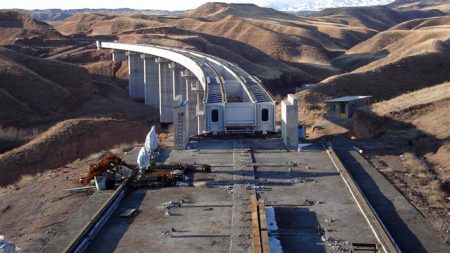
Russia is reportedly poised to finance a railway line connecting Iran with its northern neighbor Azerbaijan.
According to Tasnim news agency, head of the press service of Azerbaijan Railways OJSC Nadir Azmammadov, has said that Russian Railways OJSC has discussed the terms of its participation in the financing of the Rasht-Astara (Iran)-Astara (Azerbaijan) railway with the related parties in the Azeri capital, Baku.
The report said representatives of the railways of Azerbaijan, Iran and Russia attended the talks in which the Azeri side informed the partners about the projects and tasks ahead.
Baku believes the international transport corridor will improve Azerbaijan’s transit potential as well as its ties with the other two countries.
Participants in the talks reportedly signed a final protocol.
The trilateral railway project is aimed at connecting Northern Europe with Southeast Asia.
The railway line will initially transport five million tonnes of cargo when it is launched in the near future.
Last November, Iran and Russia signed an agreement worth 1.2 billion euros to electrify a train line, linking north-central Iran to the northeastern border with Turkmenistan.
The agreement signed between Russian Railways and the Islamic Republic of Iran Railways (RAI) envisages constructing power stations and overhead power lines along the Garmsar-Sari-Gorgan-Inche Burun route in Iran.
“The implementation of the contract will improve the capacity of passenger trains and raise transit to 8 million tonnes,” said RAI Managing Director Mohsen Poursaeed-Aqaei who signed the document.
The train line, among the first in Iran with a history of 80 years, extends to Turkmenistan and Kazakhstan and links the Central Asia to the Persian Gulf and beyond.
The project was also set to be financed by the Russian government and would be implemented in 36 months, which includes manufacturing all electric locomotives inside Iran, electrifying 495 kilometers of railway and building 32 stations and 95 tunnels.
How the EU pushed France to reforms of labour law
Corporate Europe Observatory | June 27, 2016
The current struggle in France over labour law reforms is not just between the Government and trade unions – a European battle is waged. The attacks on social rights stem in no small part from the web of EU-rules dubbed ‘economic governance’, invented to impose austerity policies on member states.
Strikes and actions across France against reforms of the country’s labour protections, known as the El Khomri Law, demonstrate the immense unpopularity of the measures proposed by the French Government. Chiefly among them, to give preference to local agreements on wages and working conditions, when the conditions in those agreements are less favourable than the national norm inscribed in national law. This is an open attempt to undermine collective bargaining and roll back the influence of trade unions.
Ultimately, the French Government has formal responsibility for the weakening of labour protection. But there is no denying that the European Union is playing an important and perhaps decisive role in the attacks on labour rights. What we see is the EU throwing its rulebook in the French workers’ faces. Practically all the new rules on so-called ‘economic governance’ adopted following the eurocrisis have been applied, and make France look like an EU test-case. The European Commission, with the backing of the Council, has used the rules on member states’ deficits to exert pressure, threatening with sanctions, should the French Government not give in and seriously reform its labour laws. Simply put, France has been required flat out to ensure higher profitability for businesses by driving down wages.
How does all of this work?
Sanctions more likely today
First and foremost, the reforms in France are related to the country’s deficit. Like most other EU member states, the state’s finances looked pretty bad in the aftermath of the 2008 financial crisis. In 2009, a case was opened against France for breaching EU rules which stipulate that its deficit must be no higher than 3 per cent of GDP. If taken to the extreme, this ‘excessive deficit procedure’ can result in a fine of billions of euro, and – not least in the case of France – a severe loss of face to its EU partners.
The ‘excessive deficit procedure’ was given more teeth with the so-called ‘Six-Pack’ set of EU rules in 2011 – a key part of the austerity-focused economic governance package – which introduced a reverse majority vote in the Council: if the Commission does decide to fine a member state, like it has threatened to do to France, there will have to be a qualified majority against the measure from other member states to block it. Good reasons for the French Government to be slightly scared – and a weapon to be used in its attempt to convince parliamentarians. The likelihood of sanctions for not meeting the budget deficit targets is much bigger than in the past, when both Germany and France escaped humiliation. But how to meet the Commission’s strict targets, and how to behave to the satisfaction of the Commission, is what clearly links the El Khomri Law in France to the austerity regime being rolled out from Brussels.
Enabling demands of ‘structural reforms’
Being ‘in the procedure’, means you’re under close surveillance by the Commission, and with regular intervals, the case of the French deficit has been brought up at meetings with member states ministers, who have assessed if France (in this case) has made sufficient efforts to remedy the problem. Specific recommendations have been made, though until 2013 the labour law was hardly mentioned. The recommendations stuck to the development of the deficit, whether it went down at the required pace. But in 2013, there was a new tone in the Commission’s recommendations. France was asked to meet its deficit targets “by comprehensive structural reforms” in line with recommendations from the Council “in the context of the European Semester”. Structural reforms are no small matter. They are defined as changes that affect “the fundamental drivers of growth by liberalising labour, product and service markets”. Such ambitions were starting to be pushed on France at the European Semester.
But what is the European Semester? It is a procedure involving the Commission and the Council that ends with a set of recommendations for reforms to each and every member state, based on a proposal from the Commission. At the beginning in 2011, the recommendations were non-binding, but in 2013, a new set of rules went into force under the so-called Two-Pack, another part of the economic governance package intended to enforce austerity. One of the regulations of the two in the package was about measures to ensure deficits were corrected, and among other things, it made a link between the deficit procedure and the European Semester. If a member state is under the deficit procedure – like France – it would have to draw up an ‘Economic Partnership Programme’ that includes the recommendations from the Council –typically the kind of structural reforms that would have a clear impact. If the programme is not followed, then it will have a bearing on the Commission’s decision to initiate the final phase of the deficit procedure: sanctions in the form of a fine worth billions.
So, when the Two-Pack entered into force in early 2013, the tone of the messages to France on its deficit changed. France was now asked to implement “comprehensive structural reforms” of its labour law and the pension system. This had a bearing on how France would be treated under the deficit procedure and whether it would come in for sanctions, and for that reason, recommendations started looking more like demands.
In other words: whereas earlier country specific recommendations adopted under the European Semester were just that, with the Two-Pack from 2013, non-compliance could lead the Commission to take the next step towards sanctions.
“Slash wages now!”
There’s more.
In the early stages of the eurocrisis another procedure was introduced that was to work in parallel to the deficit procedure: the ‘Macroeconomic Imbalance Procedure’. This procedure allows the Commission to monitor the development of member states’ economies based on a predefined set of indicators. One of them – perhaps the most important one – measures how high the labour costs are developing (unit labour costs). If wages are not kept at bay, competitiveness suffers, and measures have to be taken, so the logic goes.
The ‘Macroeconomic Imbalance Procedure’ is also a potent weapon, as it can lead to a fine if a Eurozone member state crosses the line repeatedly and for a long time. And France has been in the crosshairs of the Commission for quite a while. Commission staff have investigated French labour law and identified what factors contribute “to limiting the ability of firms to negotiate downward wage adjustment”, and the French Government has been warned – as have many other member states – about developments in wages. In 2014, the Commission said “unit labour cost growth is relatively contained but shows no improvement in cost competitiveness. The profitability of private companies remains low, limiting deleveraging prospects and investment capacity.”
The calls for action to improve the profitability of private companies have been sent to France from Brussels on numerous occasions over the past couple of years, and have gained in strength. Thus far, the climax was in February 2015, when the Commission stepped up the procedure and singled out Bulgaria and France as the most pressing cases. The decision put France only a small step from the last stage of the imbalance procedure, the dreaded ‘excessive imbalance procedure’ which entails – exactly like the deficit procedure – a massive fine. If all fines are put together – from the deficit procedure and the imbalances procedure – they could amount to 0.5 per cent of GDP, or in the case of France, approximately €11 billion.
The final countdown
Such a prospect must be terrifying for the French Government, and in 2015, then, it would have to come up with something of substance to appease the European Commission and its partners in the Council. In March France was given two more years to bring its house in order, and if there was any doubt over the way to get there, the message to France in July was clear. Country Specific Recommendation number 6 to France under the European Semester, includes a call to “reform the labour law to provide more incentives for employers to hire on open-ended contracts. Facilitate take up of derogations at company and branch level from general legal provisions, in particular as regards working time arrangements.” In other words, the very reforms now at the centre of dispute with the El Khomri law.
The recommendation was copy-pasted from a Commission proposal; one that struck a chord among business lobby groups. In the annual ‘Reform Barometer’ of BusinessEurope, a procedure set up to influence the European Semester, the French employers association MEDEF was enthusiastic about the move, and dubbed it “extremely important” in its contribution to the Reform Barometer 2016.
End game
Who exactly has done what since the summer of 2015 is the subject of intense debate. French media outlet Mediapart suggests the German Government might have played a big role in designing the French reforms, while others believe the specifics were entirely homemade. In any case, there is no denying that the reforms were pushed heavily by the European Union, more specifically by the Commission and the Council. And the push was based on the web of rules on member states’ economic policies, sometimes called ‘economic governance’, that has been spun thread by thread since 2010. The strengthening of the deficit procedure, the European Semester, the Two-Pack, and the macroeconomic imbalance procedure have all been used for the purpose they were invented: to exert maximum pressure on member states to adopt austerity policies.
There are other similar examples in Europe at the moment. In Italy and Belgium too, you see the effect of the new tools handed over to the European Union since 2010. But France is special for its size and its power in the EU. The ongoing struggle in France can be seen as a major test case for European economic governance. If a big, powerful EU member state can be pushed to attack fundamental traits of its labour protection law, then the risk of new and stronger measures are much more likely in the future. Even if French workers are unaware of it, they’re fighting a European battle.
Top Iran fund executives resign en masse
Press TV – July 2, 2016
President Hassan Rouhani has accepted the mass resignation of those on the board of trustees of Iran’s sovereign wealth fund as revelations about high compensation packages at state-owned firms take new casualties.
“Minutes ago, the board of trustees of the National Development Fund held a session with President Rouhani in attendance, where the mass resignation of the director and executive board members was accepted,” the Fars news agency said Saturday.
Several senior officials, including ministers of economy, petroleum and labor, as well as the country’s attorney general also attended the session, the news agency reported.
Among those who stepped down on Saturday was Safdar Hosseini, the managing director of the National Development Fund, who is said to have received $18,700 a month in salary and other compensation.
Minister of Economic Affairs and Finance Ali Tayebnia had already removed the heads of Mellat, Bank Saderat, Refah Bank and Mehr banks for receiving “unconventionally” high salaries.
The head of another bank is also to be fired, but the decision has been delayed for “further review,” the IRNA news agency said on Thursday.
Those implicated in the paycheck palaver are accused of receiving large bonuses, interest-free loans and, in some cases, tax evasion.
Investigations were launched after Leader of the Islamic Revolution Ayatollah Seyyed Ali Khamenei called for immediate action amid reports that executives at some state-owned firms were earning more than 50 times the base government salary.
Iranian law states that the top salary in the government should not be more than seven times that of the lowest-paid government employee.
The paycheck leaks showed some senior managers at a company were paid up to 870 million rials ($28,339 at the official exchange rate) in March.
Rouhani has pledged to investigate and punish government employees receiving excessive salaries.
The government has made weeding out corruption a top goal. In March, Iranian tycoon Babak Zanjani was sentenced to death over fraudulently pocketing $2.8 billion.
UK could drop Iran sanctions after Brexit
Press TV – June 30, 2016
Indications are growing that London could soon decide to drop sanctions to expand its trade with Iran in the wake of the recent vote by the British to quit the European Union.
“Although the US and other European countries can carry out trade with Iran, conducting trade with Britain after it leaves the EU in many ways should be easier because London will not be bound by Brussels,” reported the International Business Times.
“Certain sanctions on Iran implemented by the EU during the past two decades would not necessarily be applicable to Britain after it formally leaves the bloc,” it added.
The International Business Times said Britain would no longer be bound by EU decisions and directives including bans on doing transactions with the Islamic Republic.
It added that a warmer relationship between Britain and Iran could offer both countries solid economic opportunities following Britain’s vote to quit the EU.
The US-based online news publication further emphasized that the effects of American sanctions on Iran will not change with respect to Britain.
“A UK outside the EU would still be able to conduct business with Iran generally, as long as the transactions did not involve US banks, US dollars or US citizens,” the International Business Times quoted lawyers at the New York-based Sheppard Mullin as saying.
The International Business Times further added that Britain is positioned to reach an agreement with Iran in the energy sector.
“With the international deal on Iran’s nuclear program becoming effective early this year, the EU already has begun rolling back its sanctions on Iran, with an eye on new energy opportunities in the country,” it added.
“In January, the prohibition on financial transactions involving Iran was lifted, including the transfer of funds between financial institutions and individuals. Trade in oil and gas between the EU and Iran was rebooted while sanctions relating to shipbuilding, insurance and aviation were lifted.”
France wants sanctions on Russia lifted soon – foreign minister
RT | June 29, 2016
Sanctions against Russia should be lifted as soon as possible, France’s Minister of Foreign Affairs said on Wednesday following a meeting with his Russian counterpart, while insisting that implementation of the Minsk agreements still remain key to the process.
“Sanctions is not a goal in and of itself,” Jean-Marc Ayrault said in Paris, adding that his country looks forward to scrapping the restrictive measures against Moscow.
The process of lifting the Western sanctions on Russia is still related to Minsk agreements that aim to put an end to the crisis in southeastern Ukraine, Ayrault added, saying that “Russia should play a positive role” in their implementation.
Moscow and Paris have been closely working together “in the Normandy format,” Russia’s Foreign Minister Sergey Lavrov said after the meeting. The countries’ foreign ministries have been “closely cooperating” and their aides have been involved too, Russia’s top diplomat said. The Normandy format includes Russia, France, Ukraine, and Germany.
“The most important condition for the progress, as stated in the Minsk deal and in UN Security Council resolution, is establishment of direct dialogue between Kiev and Donbass,” Lavrov stressed.
Russia has repeatedly said that it’s doing everything in its power to facilitate the implementation of the Ukrainian peace deal, while Kiev has been hindering the process. The West should work with its “allies” in Kiev, President Putin has said, adding that direct dialogue between the parties to the conflict should be promoted.
Russia’s European partners should not hold Moscow solely responsible for fulfilling the Minsk agreements, Putin said at the St. Petersburg International Economic Forum (SPIEF) earlier this month, adding that there are “issues that are beyond our abilities.”
A number of the 28 countries in the European Union have expressed strong disapproval of the bloc’s restrictive measures on Russia. Italy has repeatedly called for a debate on the issue, rather than the automatic prolongation of sanctions.
In France, both the Senate and the lower house of Parliament, the French Assembly, have previously voted in favor of a resolution designed to lift the sanctions imposed by the EU in 2014 because of the crisis in eastern Ukraine and the reunification of Crimea with Russia.
Read more:
‘France should become Europe’s leader in ending Russian sanctions’
Time to send ‘strong signal’ to Russia and gradually lift sanctions – Austrian FM
Anti-Russian sanctions should be lifted ASAP – leader of Saxony, Germany
European Unification Divides Europeans: How Forcing People Together Tears Them Apart
By Diana Johnstone | CounterPunch | June 29, 2016
Paris – Unification of Europe has brought about radical new divisions within Europe. The most significant split is between the people and their political leaders.
The June 23 British majority vote to leave the European Union has made strikingly evident the division between the new ruling class that flourishes in the globalized world without borders and all the others who are on the receiving end of policies that destroy jobs, cut social benefits, lower wages and reject as obsolete national customs, not least the custom of democratic choice, all to make the world safe for international investment capital.
Actually, the lines are not quite so clear-cut. Political choices never correspond completely to economic interests, and the ideological factor intervenes to blur the class lines. Globalization is not merely a process of economic integration regulated by flows of capital, which is deepening the polarization between rich and poor in the Western countries. It is also a powerful ideology, basing its moral certitudes on simplistic lessons drawn from twentieth century World Wars: the idea that the root cause of wars is a psychological attitude called “racism” which expresses itself in the nationalism of nation-states. This ideology gains semi-religious conviction by reference to the Holocaust, which is considered to have proven the point. Ergo, for the benefit of humanity, national borders must be torn down, national identities must be diluted by unlimited immigration, in order to achieve a worldwide multicultural society in which differences both coexist and cease to matter.
This is a Utopian notion as unsupported by evidence as the Soviet dream of creating a “new man” who voluntarily works unselfishly for the benefit of all. Similarly, it considers human psychology to be perfectible by economic and institutional arrangements. Especially by promoting immigration, the multicultural mix is supposed to result in people all loving each other; there are even national laws to punish alleged expressions of “hatred”. The European Union is seen as the most advanced experiment in this worldwide Utopia of universal love. It is regarded by its intellectual sponsors such as French political guru Jacques Attali as an irreversible advance of civilization. For its fanatic champions, the very thought of dismantling the European Union is equivalent to returning to the stone age.
A chorus of Europists are screaming to high heaven that the world is about to come to an end thanks to lower class Brits too stupid and too racist to appreciate the glorious globalized world that the European elite is preparing for them. One of the fastest on the draw of his pen was the hysterical propagandist Bernard-Henri Levy, whose venom quickly spilled onto the pages of Le Monde and other obsequious journals. BHL trotted out his entire range of insults to decry the LEAVE vote as the victory of demagogy, xenophobia, the extreme right and the extreme left, hatred of immigrants, stupid nationalism, vicious hatred, the unleashed mob, idiot leftists, drunken hooligans, the forces of darkness against civilization, and even the victory of garden dwarfs over Michelangelo. Many others worked the same theme, with less verbiage.
The main theme of this wailing and gnashing of teeth is the allegation that the LEAVE vote was motivated solely by racism, racism being the only possible reason that people could object to mass unregulated immigration. But there are indeed other reasons.
In reality, for the majority of working class voters, opposition to unlimited immigration can be plainly a matter of economic self-interest. Since the EU’s eastward expansion ended immigration controls with the former communist countries, hundreds of thousands of workers from Poland, Lithuania, and other Eastern European nations have flooded into Britain, adding to the large established immigrant population from the British Commonwealth countries. It is simply a fact that mass immigration brings down wage levels in a country. A Glasgow University study shows statistically that as immigration rises, the level of wages in proportion to profits drops – not to mention the increase in unemployment.
Those who enjoy the pleasure of traveling through Europe without having to stop at borders or change currencies and who relish the luxury level of cultural diversity find it hard to understand the anguish of those who lack advanced degrees, family connections or language skills, and who feel marginalized in their own countries. Yes, some of them probably like garden dwarfs. But you cannot convince millions of people that their only prospect in life must be to sacrifice themselves for the glory of the World Market.
Moreover, whatever their social status, many people in Britain find it unbearable to renounce their traditional parliamentary democracy in order to carry out Directives and Regulations drafted in Brussels without even any public discussion.
The British
The astonishment and indignation of the Europists to see Britons vote to go out is odd considering that most Britons never really felt entirely in. When I worked as press officer at the European Parliament, I observed that the only national press corps really present and interested was the British press corps, all eagerly on the lookout for the latest absurd rule or regulation which the Brussels bureaucracy was foisting on the Member States. British media paid attention to the EU because they hated it. Ridiculing it was fun. The rest of European media were largely ignoring it because it was boring and nobody cared. Main exception: a few earnest Germans doing their job.
In the 1980s, Margaret Thatcher forced the EU to twist its rules by demanding “my money back”. The United Kingdom stayed out of the Schengen Treaty on free movement of persons. It refused the euro in favor of keeping the pound sterling. More profoundly, the insular English have always had a strong sense of not belonging to “the continent” as well as a particular sensitivity to the notorious “democratic deficit” of the European Union, which leaves law-making to the Brussels bureaucracy.
Considering the insular nature of Britain and its psychological distance from the continent, it is too soon to expect that other EU Member States will soon follow the British example. Indeed, some of the most Euroskeptical populations today were the most Euroenthusiastic in the past, notably France and Italy, and it is awkward to turn around 180 degrees. For charter Members France, Italy, Benelux and Germany, the break would be much more dramatic. Nevertheless, even in those key Eurozone countries disenchantment with the EU is growing rapidly. Brexit is seen as a warning signal. Thus the Western ruling class will hasten to try to shore up the EU-NATO fortress. The Washington Post quickly called for “strengthening NATO”. This probably means even more strident denunciations of Putin and the “Russian threat”, if such as possible. There is supposedly nothing like an external threat to bring people together.
What Next?
Unfortunately, this referendum did not mark a clean break. Two great difficulties loom. EU rules require a lengthy and complicated process to actually withdraw, a matter of years. And second, there is no viable political force ready to steer Britain through this process. The result is to split the political class still further from the people it should be representing.
The British political landscape is littered with wreckage. Conservative Prime Minister David Cameron called the referendum for internal political reasons, failing to realize that if given the chance, the British would vote to jump ship. His name is now mud all over Europe, condemned for the foolish move of letting people vote on the EU. Cameron has announced his resignation, but his government is dragging its feet in initiating the withdrawal process. Some are even demanding that the referendum be either ignored or held over again until people vote as they should – the procedure that followed previous national referendums that turned out badly for the EU. Meanwhile EU leaders are demanding that London hurry up and get out, so they can get to work strengthening the edifice.
Nigel Farage’s UK Independence Party that campaigned for leaving the EU is a single issue party with no general program and no aspiration to run the government. Former London mayor Boris Johnson has positioned himself to take over Party leadership by advocating Brexit, but he is not taken seriously by most of his own Conservative party and is also stalling on the exit procedure.
The situation of the Labour Party is critical. Jeremy Corbyn, who was elected party leader by a grass roots uprising expressing a strong popular desire to move the party to the left, comparable to the Bernie movement in Democratic Party primaries, has always been opposed by the Blairites who still dominate the party apparatus and parliamentary representation. In this uncomfortable situation the gentle Corbyn has tried to exercise what is meant to be an inclusive sort of leadership, listening to all sides. This softness already led to the mistake of failing to strongly defend party members falsely accused of “anti-Semitism” by pro-Israel zealots. Now the Blairites are blaming Corbyn for what they consider the Brexit catastrophe. It is all supposed to be the fault of Corbyn for having failed to support REMAIN vigorously enough.
Indeed Corbyn’s support of REMAIN was mild, some say because he actually favored LEAVE, but was bowing to the majority in the upper ranks of his party. This concession, if it was one, has not prevented the Blairites from demanding that Corbyn resign as party leader. Petitions are circulating both for and against him.
The trouble is that the mainstream caricature of the Brexit voters as narrow-minded racists, if not protofascists, has not been balanced by any articulation of the strong underlying rejection of the EU as a denial of democracy, as the authoritarian rule by a self-satisfied globalizing elite with total contempt for what the people might really want.
There is no political party in Britain that is at all prepared to turn away from the increasingly discredited and disavowed globalization trend in order to lead the way to a truly democratic alternative.
 Diana Johnstone is the author of Fools’ Crusade: Yugoslavia, NATO, and Western Delusions. Her new book is Queen of Chaos: the Misadventures of Hillary Clinton. She can be reached at diana.johnstone@wanadoo.fr
Canada Oil Sands Output to Grow 1Mln Barrels Per Day by 2025
Sputnik — 27.06.2016
Production from western Canada’s oil sands is expected to increase by 1 million barrels daily in the next decade above the current output of about 2.75 million barrels, as extraction becomes more cost-efficient, the global consulting firm IHS said in a report on Monday.
“IHS anticipates oil sands investors will focus their investments onto the most economic projects: expansions of existing facilities,” the report stated. “IHS expects that over 80 percent of future activity in our outlook will be underpinned by expansions of existing facilities.”
The report noted that the existing facilities are well understood, quicker to first oil and cheaper to construct.
“This all equates to less risk at a lower cost,” the report added.
A press release accompanying the report explained that a price of about $50 is required for oil-sands projects to break even.
Since 2012, the oil-sands region in the Canadian province of Alberta has increased from 1.75 million barrels per day to its present level of about 2.75 million barrels, according to the report.
Too many heads stuck in the sand on Brexit
By Jonathon Cook | June 27, 2016
There are some heads stuck deeply in the sand at the moment. Typical were the dismissive responses to my piece Brexit and the diseased liberal mind. I had focused on one exceptional piece by one Guardian writer, it was claimed.
I chose Zoe Williams’ article because it is fully representative of liberal reaction to Brexit in the British media. I could have cited hundreds of other examples – not least just about everything currently appearing on the BBC.
But Williams and the rest of the media are not making these arguments in a vacuum. After all, much of the Labour shadow cabinet has just resigned and the rest of the parliamentary party are trying to defy the overwhelming democratic will of their membership and oust leader Jeremy Corbyn. His crime is not that he supported Brexit (he didn’t dare, given the inevitable reaction of his MPs) but that he is not a true believer in the current neoliberal order, which very much includes the EU.
Here is what one of the organisers (probably a shadow cabinet minister) of this coup-in-the-making says:
The plan is to make Corbyn’s job as leader extremely difficult in the hope of pushing him to resign, with most MPs refusing to serve as shadow ministers, show up on the frontbench in the House of Commons, support him at PMQs or formulate policy under his leadership.
This was presumably said with a straight face, as though Corbyn has not been undermined by these same Blairite MPs since day one of his leadership. This is not a new campaign – it has simply been forced to go more public by the Brexit vote.
Labour MPs do not just want to oust a leader with massive support among party members. They have hamstrung him from the outset so that he could not lead the political revolution members elected him to begin. And now he is being made to pay the price because he privately backs a position that, as the referendum has just shown, has majority support.
This is where we on the progressive left are, and the Brexit vote is a huge challenge to us to face facts. We want to believe we are free but the truth is that we have long been in a prison called neoliberalism. The Conservative and Labour parties are tied umbilically to this neoliberal order. The EU is one key institution in a transnational neoliberal club. Our economy is structured to enforce neoliberalism whoever ostensibly runs the country.
That is why the debate about Brexit was never about values or principles – it was about money. It still is. The Remainers are talking only about the threat to their pensions. The Brexiters are talking only about the role of immigrants in driving down wages. And there is good reason: because the EU is part of the walls of the economic prison that has been constructed all around us. Our lives are now only about money, as the gargantuan bail-outs of the too-big-to-fail banks should have shown us.
There is a key difference between the two sides. Most Remainers want to pretend that the prison does not exist because they still get privileges to visit the living areas. The Brexiters cannot forget it exists because they are never allowed to leave their small cells.
The left cannot call itself a left and keep whingeing about its lost privileges while denouncing those trapped inside their cells as “racists”. Change requires that we first recognise our situation – and then have the will to struggle for something better.
Featured Video
New positive ivermectin evidence
or go to
Aletho News Archives – Video-Images
From the Archives
Fanatical Followers of the Covid Regime: A Jim Jones-Style Cult?
By Professor Roger Watson and Dr. Niall McCrae | The Daily Sceptic | November 15, 2021
As scholars at leading British universities over recent decades, we witnessed the replacement of critical thinking and debate by narrative: facts are discrimination and scientific method is imperialism; truth, instead, is derived from ‘progressive’ values. This educational trend may be a major contributory factor to the ease in which society has been inculcated to the Covid ‘new normal’ of masking, testing, and repeated doses of vaccines for a disease of similar risk to severe influenza.
One doesn’t need much critical reasoning to observe the flawed logic of some vaccination enthusiasts, such as people who respond to experiencing any side effects, however debilitating, by saying “at least I know it’s working”, or, after contracting the disease despite their promised inoculation (over 90% effective, according to initial drug company claims), “I’d have been worse off without the jab.” … continue
Blog Roll
 Aletho News
- The Coming GOP Bloodbath?
- Arctic Scare Stories Melt Away
- Wrong, Euronews: Climate Change Has Not Created a Food, Energy, and Economic “Meta-Crisis”
- New positive ivermectin evidence
- Met Office Caught Fabricating Daily Temperature Record Claims
- Merck Virologists Admitted to Falsely Certifying Vaccine Efficacy
- Mandatory Folic Acid for every man, woman & child
- Pro-Palestine protesters arrested outside UK’s ruling Labour Conference in Liverpool
- Mauritius denies landing permit to flight from Israel, forcing cancellation: Tour operator
- Israeli finance minister calls for genocidal war on West Bank, annexation of south Lebanon
- If Americans Knew
- In Gaza, ‘Whoever Survives the Bombing Won’t Survive the Rubble’
- Israel kills more Palestinians, amid push to resettle Gaza – Daily Update
- Israel forces Gazans to live in constant peril – Daily Update
- Deconstructing Netanyahu’s pants-on-fire UN rant – Daily Update
- Trump betrayed voters with his campaign lies and prioritized a foreign country once he took office
- Netanyahu calls Israel’s war in Gaza ‘opposite of genocide’ in UN speech to near-empty hall
- Settler Kidnappings: Torture, Sexual Abuse and Terrorisation of Palestinian Abductees as Israel Deepens Annexation of West Bank
- Gaza winter nears as 162,000 tents become unusable, raising fears of humanitarian crisis
- Netanyahu says, “It’s the opposite of genocide”; UN says Gaza economy is world’s ‘most severe crisis on record’ – Daily Update
- Israel’s US-Backed Assault on Gaza Has Created the ‘World’s Most Severe Economic Crisis on Record’: UN
- No Tricks Zone
- New Study: Earth And Venus Surface Warmth Largely Explained By Convection And Lapse Rate, Not CO2 Or Radiation
- 2025 Nature Paper Claiming Worsening Global Drought Gets RETRACTED …Heavily Flawed
- New Study: ‘Global Drought Shows No Detectable Recent Acceleration Under Climate Warming’
- Economic Masterminds: German Socialists Suggest Taxing Productivity Gains Stemming From Using AI
- The South China Sea Has Not Been Cooperating With The Climate Change Narrative
- Energy Crisis: Germany Enters Heating Season With Historically Low Gas Reserve Fill Levels
- New Study: The Antarctic Ice Sheet Gained Mass From 2020-2024 Due To Staggering Snow And Ice Accumulation
- Study: Ocean Heating Rates From Thousands Of Years Ago ‘Dwarf’ Modern Ocean Heating Rates
- Climate Extremists Target, Attack Large-Scale Power Grid Infrastructure In Germany!
- New Study: Antarctic Ice Melt Has Contributed Less Than 1 Centimeter To Sea Level Rise In The Last 30 Years

