Cuban Doctors Have Saved 87,000 Lives in Bolivia Since 2006
teleSUR | March 5, 2016
Cuba is known for sending medical personnel overseas as part of its medical brigade program which was launched during the 1959 Revolution.
The Bolivian Health Ministry thanked Cuban doctors and the Cuban government Friday for the solidarity offered to their country as part of Cuba’s medical internationalism over the past 10 years.
Ariana Campero, the head of agency of the decade-long program, congratulated the local partners and conveyed greetings from President Evo Morales. “Thank you very much to Fidel Castro, Commander Raul Castro and the Cuban people. We are sending you all an embrace of solidarity from Bolivia.”
According to Dr. Pavel Noa, the national coordinator of the mission, the most important results that protrude from the mission encompass more than 63 million consultations offered to the Bolivian people, 179,282 surgical interventions performed and a total of 86,983 lives saved.
Medical workers are often believed to be Cuba’s most important export, having served in countries all over the world and in particular in Latin America, Africa and, more recently in Oceania.
Dr. Alina Ochoa, head of Medical Assistance Brigade, stressed the importance of cooperation in the healthcare sector and said the aim was to ensure the health of the Bolivian people. “Cuba has a long and successful history in providing medical staff worldwide, which was ratified in Bolivia with the presence of more than 700 collaborators.”
The representative of the Pan American Health Organization, Luis Fernando Leanes, acknowledged the work of the Cuban mission, which he described as wonderful and very important. “How nice to be in this country and see Cubans and Bolivians working together for peace and welfare”, he said.
Cuba´s efforts in providing medical services to the poor have been acknowledged internationally as it was among the first countries to respond when the World Health Organization called for medical staff to help with the Ebola crisis. Fidel Castro proudly described the 12,000 medical volunteers who signed up as “an army of white coats”.
US Treasury Urged to Sanction Iran Airline Partners for Aiding Hezbollah
Sputnik — 05.03.2016
The US government has been urged to impose economic sanctions on any company doing business with the private Iranian airline Mahan Air, four US senators wrote in a letter to Treasury Secretary Jack Lew.
The US Department of the Treasury has designated Mahan Air for its support for terrorism and funneling of weapons to Hezbollah and to the government of President Bashar Assad in Syria, yet the airline continues to operate with a network of partners throughout Europe, the senators pointed out.
“Mahan Air continues to operate and even expand its international business network… It is time to impose sanctions now on companies aiding Mahan Air,” Senators Kelly Ayotte, Chris Coons, Lindsey Graham and Richard Blumenthal wrote in the letter on Friday.
“We urge you to immediately identify to us all known entities engaged in commercial transactions with Mahan Air and take action now to sanction those companies, including freezing all assets of those entities found under US jurisdiction,” the lawmakers said.
Mahan Air flies to and from Denmark, Sweden, United Kingdom, France, Germany and Italy, as well as Persian Gulf Arab allied nations. The airline has recently introduced new flights to Russia, the senators added.
Obama extends anti-Russia sanctions for another year

Press TV – March 3, 2016
US President Barack Obama has signed a new Executive Order that extends economic sanctions against Russia for another year.
The decree, published Wednesday on the official White House website, states that economic and financial sanctions imposed on Moscow over its involvement in the Ukrainian crisis will stay in place until March 6, 2017.
The decision came as “Russia’s actions continue to pose an unusual and extraordinary threat to the national security and foreign policy of the United States,” Obama said in the document.
“I found that the actions and policies of the Government of the Russian Federation with respect to Ukraine undermine democratic processes and institutions in Ukraine; threaten its peace, security, stability, sovereignty, and territorial integrity; and contribute to the misappropriation of its assets,” the president added.
The move drew criticism from the Kremlin, with Russian presidential spokesman Dmitry Peskov telling reporters on Thursday that the decision was regrettable.
The sanctions were originally introduced against Moscow in March 2014, after Ukraine’s Black Sea peninsula of Crimea joined Russia. The move prompted the US to press sanctions against Russia’s energy and finance sectors.
The European Union followed suit shortly after, introducing its own set of sanctions against Moscow that targeted a number of Russian politicians and businessmen, and placed restrictions on lending to Russia’s major state-owned banks, military and oil firms.
On the military side, exporting dual-use equipment to Russia was banned and all future EU-Moscow military deals were put on hold.
According to EU spokeswoman Maja Kocijancic, the bans sought to force Russia to comply with the ceasefire introduced by the Minsk agreement.
Putin signed the agreement with Ukrainian President Petro Poroshenko in February last year, following negotiations held in the presence of French President Francois Hollande and German Chancellor Angela Merkel.
The deal introduces a complete ceasefire, withdrawal of heavy weaponry from border areas, and holding free elections in the region.
Official: Israel obstructs Jordan agricultural exports to the OPT
MEMO | March 3, 2016
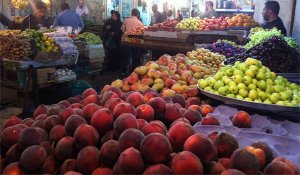 Israel has been obstructing Jordanian agricultural exports to the Occupied Palestinian Territories under the pretext that Jordanian products do not conform to Israeli specifications, leading to exports completely stopping in 2015 and early 2016, a Jordanian official revealed.
Salah Al-Tarawneh, assistant secretary-general of the Jordanian ministry of agriculture for marketing and information, said in remarks to Quds Press that the Palestinian Authority asked last month to import tomatoes from Jordan but the Israeli side refused to allow their entry under the pretext that they contain viruses.
Al- Tarawneh explained that although the PA has repeatedly asked the Israeli side to increase agricultural trade with Jordan to meet its needs, Israel has continually refused under the pretext that Jordanian products do not conform to Israeli specifications.
According to data from the Jordanian ministry of agriculture, Jordan’s exports of vegetables and fruits to PA controlled areas completely stopped in 2015.
During the same year, Jordan’s agricultural exports to Israel amounted to more than 20,000 tons of vegetables and 5,000 tons of fruit.
Russia working on ways to protect its internet due to US online dominance – Com. Minister to RT
RT | March 2, 2016
The US government and a handful of corporations working under US jurisdiction have a disproportionately strong influence on the internet. So other countries are mulling ways to protect their web sectors, the Russian communications minister told RT.
“Today, if you have a look at the whole IT global system, you will see that the whole world… is actually totally dominated by a single country and literally by several companies, which have practically monopolized the entire IT system,” Nikolay Nikiforov said.
The issue is not only about market shares of tech giants such as Google and Facebook, but also about the US government’s control of critical elements of the internet’s infrastructure, he said.
One small example is the Internet Corporation for Assigned Names and Numbers (ICANN), which assigns internet domain names. In 2014, the US pledged to hand over control over it from the US Department of Communications to a multi-stakeholder collective, which would include governments, companies, international organizations and individual users. The transition was scheduled to happen in September last year, but was postponed for at least a year.
“This didn’t happen for some reason, and many reasons were voiced. I believe them to be pretty far-fetched,” Nikiforov said.
“With this prolonged monopolization, many countries in the world are working on technical solutions that would protect national segments of the internet from a possible external destructive action. They are creating backup infrastructures, which respond to a disruption – intentional or accidental – and prevent national segments from being blocked,” he added.
The minister said Russia is among the countries heavily investing in the internet and naturally wants to protect this investment.
The issue is not theoretical for Russia. As part of the US-imposed sanctions, several American companies suspended their services in Crimea, which seceded from Ukraine in response to an armed coup in Kiev and rejoined with Russia. Washington called the move illegal and targeted individuals and some sectors of the Russian economy with sanctions.
Google, Apple, PayPal and others cut Crimea from their services. This affected tens of thousands of people, who could no longer properly update the software for their phones, buy apps, use electronic payments for online products and do other basic things.
The minister was speaking in Egypt, which he is visiting to foster business ties. He said Russia and Egypt have agreed to have mobile operators to cut down roaming tariffs, which would benefit Russian tourists visiting the North-African country.
“It’s no secret that overpriced roaming is the reason why many travelers simply don’t use their phones abroad. We are trying to make this problem go away for Egypt and Russia,” he said.
The agreement indicates that Russia may soon lift restrictions on flights to Egypt, which were imposed after a terrorist bomb last October destroyed a plane carrying Russian tourists home from Egyptian resorts.
Five reasons why the TTIP talks are looking a bit wobbly
By Guy Taylor | TruePublica | February 26, 2016

The twelfth round of negotiations for TTIP, the biggest trade deal of them all, started this week in Brussels. The impacts of TTIP are disturbing and well documented elsewhere on this site, but we are seeing signs of panic setting in on the pro-TTIP side of the fence. They’re right to panic.
1) TTIP is hugely behind schedule. It should have been signed off by now, and well into the ‘legal scrubbing’ stage where the lawyers tie up the legal loose ends and smooth of the rough edges. These negotiations are not open ended. Every delay, every extra month taken up at this stage is a threat to the entire project. We have the US elections looming, two of the frontrunners are against the new generation trade deals like TTIP and the Trans-Pacific Partnership (TPP). There is no secret about the desperation of the Obama machine as they try to get the deal done and signed off before he vacates the White House at the end of the year. Obama is due to visit Germany in April to plead with all concerned to get a move on with the project. It is not impossible for the ratification vote in the European parliament to be held in 2019, after the next elections. That would make ratification in Europe very uncertain indeed.
2) There is a huge crisis over the proposals of corporate courts or ‘ISDS’ as it is often known. As the most contentious part of TTIP, it has attracted huge criticism and upset amongst members of the European parliament and in the public domain as well. In 2014, 150,000 responded to a European consultation on the issue and 97% of those responses were very negative. Since then, the trade commissioner in Brussels has dreamt up the Investor Court System as a proposed alternative. It has been made very clear that ICS is not alternative, more a repackaging of the dangerously flawed ISDS. Earlier this month,the largest association of German Judges completely slammed the ICS idea as undemocratic and undermining the sovereignty of domestic courts. Slowly, our representatives in Brussels are beginning to realise this. We need to keep shouting about this
3) You might have noticed, but there is going to be a referendum on membership of the EU in the UK in June. Everything is up for grabs. If the UK votes to leave the EU, TTIP will probably still apply to us. In the horse-trading and arguments that will rage between now and the day of the vote, there will be concessions and deals struck – maybe, just maybe, TTIP could become a casualty. And in the run up to the referendum, the very idea of Brussels politicians signing off on such a far-reaching corporate power grab is adding a whole lot of fuel to the Brexit fire.
4) Procurement at all levels of government, both sides of the Atlantic is proving to be a sticking point. The EU wants access to state level procurement in the US – that’s a huge market to access. And at country level in the EU there’s an almost equally lucrative market to exploit for US corporations. The trouble is, this isn’t a deal being negotiated at state or nation state level. The US Trade Representative and the DG Trade in Europe are doing their utmost to keep scrutiny and influence at that level to a minimum, but agreeing stuff that is essential to their underlings at local level is part and parcel of TTIP and is inflaming opposition. Local authorities across the EU and in the UK are declaring their opposition to TTIP and CETA. In the States, there’s a similar move afoot. It was recently announced that the EU and USA were going to swap procurement market access offers at the end of this month and then hold a special intercessional meeting to discuss them.
5) And finally, one thing that cannot be ignored, is the growing movement of ordinary people across the EU & the US gaining knowledge and understanding about the deals (despite the best efforts of our governments and media). From the 3.2 million people who signed their opposition in the European Citizens’ Initiative last year, to the trade unions and community organisations saying ‘no’ to the deals, we are building a force that will be hard to resist. We can win this fight if we continue to step up the pressure.
More atglobaljustice.org.uk
Merkel Asks German Businesses to be Patient With Anti-Russian Sanctions
Sputnik – February 27, 2016
German Chancellor Angela Merkel asked for business representatives reeling from the costly effects of anti-Russian sanctions to remain patient at the Christian Democratic Union’s (CDU) economic conference, the German news agency DPA reported.
“The sanctions have hit some sectors of the economy hard,” Merkel said in her annual address to the conference in Stralsund, northeast Germany, on Friday.
She told those present that the anti-Russian sanctions, which resulted in a 25 percent (7.5 billion euros, $8.2 billion) drop in German exports to Russia last year, will be lifted in accordance with the Minsk Agreements that the representatives of France, Germany, Ukraine and Russia agreed upon in February 2015.
There is no evidence that Russia has not fulfilled the conditions of the agreement, and earlier this month Russia’s Permanent Representative to the Organization for Security and Co-operation in Europe, Alexander Lukashevich, told the OSCE’s Permanent Council meeting about Moscow’ concern that Kiev is not carrying out its obligations under the agreement.

© Sputnik/ Irina Geraschenko
Breaches of the agreement include the bombardment of residential homes by the Ukrainian military, the shelling of a trip by the Principal Deputy Chief Monitor of the OSCE Special Monitoring Mission to Ukraine, and Kiev’s failure to pass legislation that would provide a special status to the eastern regions of Donetsk and Lugansk.
“One of the key problems is that our colleagues pretend that Kiev is faithfully complying with the Package of Measures. In fact, it’s the other way round,” Lukashevich said.
“The Minsk Package of Measures is the foundation of the peace process via a direct dialogue between the parties to the Ukraine conflict. It provides a framework for a sustainable solution to the crisis, and defines the principles of conserving the Donetsk and Lugansk regions as part of Ukraine with constitutional and legislative guarantees ensuring the rights of the people of Donbass.”
Read more: ECHR to Review 551 Complaints From Donbass Residents on Rights Violations
During Obama’s Presidency Wealth Inequality has Increased and Poverty Levels are Higher
By Rick Baum | CounterPunch | February 26, 2016
Troubling and significant statistics produced by the government indicate important facts about our political system and its priorities. Unfortunately, these statistics often get little coverage in the media. What coverage is provided usually only focuses on the current year and might include comparison with the previous year.
Two such sets of government statistics cover wealth distribution and poverty. These statistics have a margin of error and do not account for the up and down fluctuations in the economy nor changing historical conditions or limitations of what any president can do.
What is perhaps most critical are the trends. These trends show that wealth has become more concentrated and more people are deemed by the government to be poor.
Wealth Inequality
Below are government figures that show the trend of growing wealth inequality.1
Share of Total Net Worth by Percentile of Wealth Owners, 1989-2013

These figures show that during the presidencies of Bush Sr., Clinton, G. W. Bush, and Obama so far, a greater portion of the nation’s wealth has become more concentrated in the hands of the rich as indicated by the share of wealth held by the top 1%. From 1989 to 2010, it increased from 30.1% to 34.5% and, under another methodology, to 36.6% in 2013.
From 1989 to 2013, the share of the top 10% went from 67.2% to 75.2% or from slightly over 2/3 to more than 3/4 of the nations’ total wealth. This means that from 1989 to 2013, the drop in the share of wealth held by the bottom 90% went from 32.9%, almost a third, to 24.8%, less than one-fourth.
Even more striking is that from 1995 to 2013, the poorest half of the population, after experiencing its share of the nation’s wealth peaking in 1995 at 3.6%, underwent a more than 2/3 decline in their portion. It fell in 2013 to a paltry 1.05% of all wealth.
Despite the last few years of “recovery,” the share of wealth held by the bottom 50% of the U.S. population declined from 1.15% in 2010 to 1.05% in 2013. This is less than half of where it stood in 2007, before the great recession, when the share of the country’s wealth held by the poorest 50% of the population was at 2.5%.
In 2008, Obama spoke of hope for a better future. If the wealthy hoped for a greater share of the nation’s wealth, their hope was fulfilled while the wealth conditions of most everyone else have declined.
These changes in wealth holdings were clearly described by Federal Reserve Board head Janet Yellen who began a speech on October 17, 2014 noting:
“The distribution of income and wealth in the United States has been widening more or less steadily for several decades… This trend paused during the Great Recession because of larger wealth losses for those at the top of the distribution and because increased safety-net spending helped offset some income losses for those below the top. But widening inequality resumed in the recovery…” (emphasis added). 2
This widening inequality and greater concentration at the top was presumably more pronounced after 2013 when the value of the stock market rose with the Dow Jones Industrial Average reaching its peak at over $18,300 in May of 2015. Today, wealth inequality is probably back to where it was in 2013 since the stock market has recently gone down to 2013 levels.
Poverty
While wealth inequality has increased, the number of people living in poverty has also generally increased. Below are figures from 1981 to 2014 for the number of people deemed to be poor and their percentage of the population.3 This percentage has been 15% or higher for three years of Obama’s presidency, from 2010-2012. It had reached that level only three other times since 1981.

These numbers show that the rate of poverty since 1981 was lowest in 2000 at 11.3%. During the time George W. Bush was president, with exceptions, it steadily increased from 11.7% in 2001 to 13.2% in 2008. 5 As might be expected, the rate increased during the great recession peaking at 15.1% in 2010.
As of 2014, some six years after the beginning of the recession and during a period of “recovery,” the rate of poverty remains high at 14.8%. In fact, according to these government statistics, the rate of poverty for every year Obama has been president is higher than it was for every year during George W. Bush’s presidency.
The percent of people below 125% of the official poverty rate has also been higher every year under Obama than during Bush’s presidency, and has been over 19% every year from 2010 through 2014. The highest level it reached under Bush was during the start of the recession in 2008 when it was at 17.9%.
What is most disturbing is the percent of the population living in extreme poverty, or having an income at 50% or lower than the poverty level.5 Every year that Obama has been president, the percent of the population at that level of income has been over 6% and, as of 2014, consisted of over 20 million people. When George W. Bush was president, the percent was always under 6%. The last time it was over 6% was during the first year of the Clinton presidency. 6
Even the record during Reagan’s presidency may be viewed as more favorable than Obama’s. During the time Reagan was president, the official rate of poverty peaked at 15.2% in 1983. Thereafter, it gradually declined to 13.0% in 1988.7 By contrast, the rate of poverty during Obama’s time in office has always been more than 14.3% and was 14.8% in 2014, or almost 2% higher than it was at the end of Reagan’s presidency.
A quip that was made about Reagan is that he liked poor people so much that he acted to increase their numbers. During his first three years, the poverty rate and the number of people deemed to be impoverished increased, reaching its peak in 1983. Thereafter, from 1983 to the end of Reagan’s presidency in 1988, the number of people deemed to be poor declined by over 3.5 million ending at slightly below the total during the first year of his presidency.
In contrast to the record of Reagan’s presidency, during the time Obama has been president and statistics are available, 2009-2014, the population has grown by 11.98 million. This is close to its growth for the last six years of Reagan’s presidency. Yet, the number of people deemed to be living in poverty has not declined, but has increased by more than 3 million. For comparison, see this table extrapolated from previous figures:

If, in 2008, one hoped for the presence of more poor people and for a greater concentration of wealth in the hands of the rich, so far, during Obama’s presidency, these hopes have been fulfilled. They will presumably continue were a Republican elected president. Should one also expect more of the same from Hillary Clinton who wants to build “on the progress the president has made,” or Bernie Sanders who thinks Obama “has done an excellent job?”8
Footnotes
1. Wealth is the value of what one possesses minus what is owed. Unlike income, it is not subject to a yearly tax. It is also distributed more unequally than income. See the last tables in the links at the end of this footnote.
see page 4 in An Analysis of the Distribution of Wealth Across Households at https://www.fas.org/sgp/crs/misc/RL33433.pdf and
For 2013, a figure for the top 1% is not provided. See the next two sites.
http://www.federalreserve.gov/pubs/bulletin/2014/articles/scf/accessible.htm#box3figA
another table with historical trends: see Figure 3 at: It is source for bottom 50% figure of 1.15% in 2010 and 1.05% in 2013. http://www.federalreserve.gov/newsevents/speech/95BF8144CFB24C649FAEF51B056738B9.htm
The source for the 2013 figures for the top 1% and the 90-98.9% whose figures from 1989-2010 are slightly different are in Table A1C on page 34 at: http://www.federalreserve.gov/econresdata/feds/2015/files/2015058pap.pdf
According to one study, as of 2012, the top .01% of the population or about 16,070 families whose average wealth is about $371 million, possess 11.2% of all wealth and the top .1% possess about 22% of all of the country’s wealth. See table 1 at the end of the paper after references at: http://gabriel-zucman.eu/files/SaezZucman2016QJE.pdf
Figure 1 in the same location shows the share of wealth holdings of the top .1% from 1913-2012. It was below 10% in 1989 which means it more than doubled during the subsequent years.
For income inequality see https://www.census.gov/library/publications/2015/demo/p60-252.html tables:
Income Distribution Measures Using Money Income and Equivalence Adjusted Income: 2013 and 2014 [PDF – 46k] and
Selected Measures of Household Income Dispersion: 1967 to 2014 [PDF – 402k]
2. http://www.federalreserve.gov/newsevents/speech/yellen20141017a.htm
3. https://www.census.gov/library/publications/2015/demo/p60-252.html see table under Poverty title
Impact on Poverty of Alternative Resource Measure by Age: 1981 to 2014
Those with income at 125% of poverty rate see https://www.census.gov/hhes/www/poverty/data/historical/people.html
Table 6. People Below 125 Percent of Poverty Level and the Near Poor
Those with income at 50% of poverty rate see
Table 22. Number of People Below 50 Percent of Poverty Level
Noteworthy about poverty in the U.S. is that in 2014, 21.1% or 15.5 million children under 18 years of age were deemed impoverished by the government, and some 6.8 million of them lived at one-half the official poverty rate. The rate of poverty among Blacks (26.2%) and those who are “Hispanic any race” (23.6%) is much higher than that of the general population. See https://www.census.gov/library/publications/2015/demo/p60-252.html see tables under Poverty title
People and Families in Poverty by Selected Characteristics: 2013 and 2014 and People With Income Below Specified Ratios of Their Poverty Thresholds by Selected Characteristics
4. see https://www.census.gov/hhes/www/poverty/data/historical/people.html
Table 1. Weighted Average Poverty Thresholds for Families of Specified Sizes
5. During the Clinton administration, the rate of poverty and the number of people deemed to be poor remained high as both steadily declined.
During the Clinton years and continuing thereafter, wealth became more concentrated at the top in part due to the dot-com boom and from policies enacted including NAFTA, the repeal of
Glass Steagell and reduced taxes on some forms of investment income.
6. A single person with a level of income at 50% of the poverty threshold lives on less than $17/day. A couple would be having to get by on less than $22/day.
7. The rate and number of people living in poverty increased during all four years of the presidency of Bush Sr.
8. Clinton quote: see http://www.msnbc.com/rachel-maddow-show/hillary-clinton-i-want-build-obama-era-progress
Sanders quote at: http://www.nytimes.com/2016/02/05/us/politics/democratic-debate.html?hp&action=click&pgtype=Homepage&clickSource=story-heading&module=first-column-region®ion=top-news&WT.nav=top-news
Rick Baum teaches Political Science at City College of San Francisco.
Gazprom cutting gas supplies to Turkey
RT | February 26, 2016
The already strained relations between Moscow and Ankara have taken a turn for the worse. Gazprom has cut gas supplies by nearly a quarter after failing to reach an agreement with Turkish importers on discounts for Russian natural gas.
Delivery is down 23 percent, compared to the same period last year, Interfax reports, quoting data from Bulgarian gas operator Bulgartransgaz that processes about 50 percent of Russian gas going to Turkey.
According to the news agency sources, the reduction is linked to a price dispute between Gazprom and Turkey’s private gas importers.
Last year, Gazprom gave the importers a 10.25 percent discount, but is now doing away with it as energy prices have dropped significantly.
Business daily Kommersant’s sources say Gazprom stopped giving the discount at the beginning of the year. For January deliveries, Turkish companies had to pay at a higher price, but on the payment date of February 21 they only paid the discounted price.
As a result, Gazprom has cut the volume delivered by the size of the underpayment.
Enerco Enerji, Bosphorus Gaz, Avrasya Gaz, Shell, Bati Hatti and Kibar Enerji are the importers affected. Overall, they import 10 billion cubic meters of Russian gas per year. Kommersant’s sources in the companies say the cancellation of the discount hurts their business, as they have signed contracts with clients based on the discount gas price.
From the 1st to the 24th of February Gazprom under-delivered 117 million cubic meters worth $30 million, the newspaper’s calculations say. Kommersant added that Turkey could fine the Russian gas monopoly $2.5 million for not fulfilling its obligations.
The source in Gazprom claimed the reduction in supply will not affect supply of the Turkish market, “especially because Botas does not reach its contractual volumes.”
State-owned Botas imports about 17 billion cubic meters of Russian gas per year. In 2015, it didn’t get a discount from Gazprom due to the failure of the Turkish Stream negotiations and is now suing Gazprom.
Featured Video
New positive ivermectin evidence
or go to
Aletho News Archives – Video-Images
From the Archives
Fanatical Followers of the Covid Regime: A Jim Jones-Style Cult?
By Professor Roger Watson and Dr. Niall McCrae | The Daily Sceptic | November 15, 2021
As scholars at leading British universities over recent decades, we witnessed the replacement of critical thinking and debate by narrative: facts are discrimination and scientific method is imperialism; truth, instead, is derived from ‘progressive’ values. This educational trend may be a major contributory factor to the ease in which society has been inculcated to the Covid ‘new normal’ of masking, testing, and repeated doses of vaccines for a disease of similar risk to severe influenza.
One doesn’t need much critical reasoning to observe the flawed logic of some vaccination enthusiasts, such as people who respond to experiencing any side effects, however debilitating, by saying “at least I know it’s working”, or, after contracting the disease despite their promised inoculation (over 90% effective, according to initial drug company claims), “I’d have been worse off without the jab.” … continue
Blog Roll
 Aletho News
- EU Council Advances Chat Control 2.0 Scanning Proposal
- Ex-Greek MEP files complaint against Israeli spyware firm over alleged Pegasus surveillance
- Troubling ideas throughout the Torah, Talmud, Mishneh Torah and Tanya
- ‘Grave, alarming’: Iran mission on Trump’s UNGA ‘annihilation’ threats
- Najaf airport to reopen to Iranian flights within 24 hours: Ambassador
- From ‘How Will This End For Iran’ to ‘When America Walks Away’: A tale of two Economist covers
- Tehran blasts ‘baseless’ speculation linking Iran to alleged bomb plot at UK air base
- The Rise And… Rise Of ‘Color Revolutions’
- The Coming GOP Bloodbath?
- Arctic Scare Stories Melt Away
- If Americans Knew
- Netanyahu Asked UAE Leader to Deny Report on Oct. 7 Warning in Secret Visit, Sources Say
- CNN Chief Int’l Correspondent Clarissa Ward on Journalists in Gaza
- Democratic Party Consultants Surround Troy Jackson with Pro-Israel Donors
- Christian Leader Responds To Netanyahu’s Claims Regarding Palestinian Christians
- In Gaza, ‘Whoever Survives the Bombing Won’t Survive the Rubble’
- Israel kills more Palestinians, amid push to resettle Gaza – Daily Update
- Israel forces Gazans to live in constant peril – Daily Update
- Deconstructing Netanyahu’s pants-on-fire UN rant – Daily Update
- Trump betrayed voters with his campaign lies and prioritized a foreign country once he took office
- Netanyahu calls Israel’s war in Gaza ‘opposite of genocide’ in UN speech to near-empty hall
- No Tricks Zone
- New Study: Earth And Venus Surface Warmth Largely Explained By Convection And Lapse Rate, Not CO2 Or Radiation
- 2025 Nature Paper Claiming Worsening Global Drought Gets RETRACTED …Heavily Flawed
- New Study: ‘Global Drought Shows No Detectable Recent Acceleration Under Climate Warming’
- Economic Masterminds: German Socialists Suggest Taxing Productivity Gains Stemming From Using AI
- The South China Sea Has Not Been Cooperating With The Climate Change Narrative
- Energy Crisis: Germany Enters Heating Season With Historically Low Gas Reserve Fill Levels
- New Study: The Antarctic Ice Sheet Gained Mass From 2020-2024 Due To Staggering Snow And Ice Accumulation
- Study: Ocean Heating Rates From Thousands Of Years Ago ‘Dwarf’ Modern Ocean Heating Rates
- Climate Extremists Target, Attack Large-Scale Power Grid Infrastructure In Germany!
- New Study: Antarctic Ice Melt Has Contributed Less Than 1 Centimeter To Sea Level Rise In The Last 30 Years

