A Wisconsin judge who declared Wisconsin Gov. Scott Walker’s (R) union-busting law unconstitutional more than a year ago held the Wisconsin Employment Relations Commission in contempt of court on Monday for continuing to enforce that law against school and municipal workers.
Walker’s law includes a one-two punch that dramatically weakens the ability of unions to improve workers’ wages while simultaneously encouraging those workers to drop the union. First, the law only permits public workers to collectively bargain for raises limited to the rate of inflation, thus curtailing one of the primary benefits of unionization — increased wages. It then requires unionized public workers to vote every year on whether they want to still be represented by a union.
Judge Juan Colas’ 2012 order blocks these restrictions from going into effect against city, county and school district workers, although state workers remain largely subject to Walker’s law. His order on Monday clarifies that the order applies statewide, and not just to the narrow group of plaintiffs before his court.
Yet, while Colas’ most recent decision is a victory for public workers in Wisconsin, this victory is likely to be temporary. His original 2012 ruling is pending before the very conservative Wisconsin Supreme Court. And the conservatives on that court already reinstated Walker’s law once after it was blocked (on a different legal grounds) by a lower court.
October 23, 2013
Posted by aletho |
Economics, Solidarity and Activism | Scott Walker, Wisconsin, Wisconsin Supreme Court |
Leave a comment
The Turkish newspaper, Hurriyet, reported that Turkish Prime Minister, Recep Tayyip Erdogan, will meet Russian President, Vladimir Putin, in Moscow at the end of November, when discussions will focus on the Syrian crisis.
Hurriyet noted that Erdogan will visit the Russian capital where he will head a delegation of a large number of ministers and will preside over the meeting of the joint ministerial committee of the Turkish-Russian Cooperation Council during 21st to the 22nd November. The meeting will discuss several political, trade and investment issues between the two countries.
Deputy Russian foreign minister, Alexei Meshkv, said that the two sides will address several regional and international issues of mutual interest and will discuss ways to develop bilateral relations. In an exclusive interview with the Turkish newspaper Meshkov asserted that Russian-Turkish relations are evolving in several areas, especially in the energy field. The two sides are also cooperating on the construction of the Mersin Nuclear Power and the South Stream natural gas pipeline project, which will pass through the Black Sea.
October 22, 2013
Posted by aletho |
Economics | Russia, South Stream, Syria, Turkiye |
Leave a comment
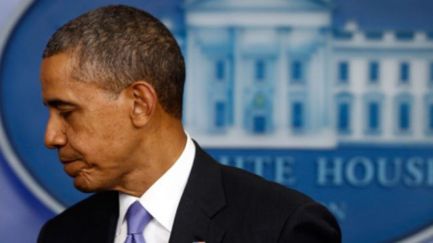
US President Barack Obama’s job approval rating has suffered one the largest quarter-to-quarter declines of his presidency, according to the latest Gallup poll.
The survey indicates that Obama averaged a 44.5 percent job approval rating during his 19th quarter in office, a decline of more than three percentage points from his 18th quarter.
The 19th quarter, which ran from July 20 through October 19, is now the third in a row in which Obama’s approval rating has declined, the poll showed.
The approval rating decreased in the middle part of the 19th quarter when he was pushing for military action against Syria, something the American public did not favor.
Furthermore, the legislative battles over the federal budget and the Affordable Care Act, as well as the federal debt limit took a toll on the president’s popularity, Gallup said.
According to a survey by Pew Research, the 16-day government shutdown pushed public trust in government near record lows, with fewer than two in 10 Americans saying they trust Washington to do what is right most of the time.
The survey also found that only 14 percent of Americans are satisfied with the way things are going in the US, and 81 percent said they were dissatisfied.
Recent estimates by the economists show that the US government’s policy blunders in recent years have significantly slowed economic growth and kept roughly 2 million people out of work.
On Sunday, US Treasury Secretary Jack Lew said the recent fiscal fight between Republicans and Democrats had a bruising impact on the country’s economy and eroded the confidence of both businesses and consumers.
October 21, 2013
Posted by aletho |
Economics, Militarism, Progressive Hypocrite | Obama, Press TV, United States, United States presidential approval rating |
Leave a comment
As the second most populous former Soviet republic, Ukraine has seemed uncomfortable with its independence since 1991 and less than committed to making it work. The fundamental issue has always been, does the country remain entwined with its larger neighbour Russia, or does it succumb to the blandishments of the West and distance itself completely from a country with which it was co-joined for over 1000 years?
Within the USSR Ukraine was an economic power house with a large heavy industrial sector and flourishing agriculture based on its excellent ‘black soil’. To Western eyes, the typical Ukrainian was Nikita Khrushchev — a plump, jolly fellow; a bit crude, perhaps, but a good, stolid Soviet citizen. When Gorbachev arranged a referendum on preserving a reformed Soviet Union in March 1991, 76 percent of voters in Ukraine supported remaining in the USSR. Yet only eight months later 90 percent of them voted for independence. Some might say, how capricious! Could things have changed so quickly? They obviously did, meaning that the Communist apparatchiki jumped the sinking ship and the sheep followed.
Since then, the country has been ruled by a mixture of ex-Soviet officials and Komsomolski joined by a growing band of oligarchs, some who have grown rich from the oil and gas transportation business. Typical of this genre is Yulia Timoshenko, the former prime minister, now serving a prison sentence for embezzlement and therefore regarded as a saintly martyr by the EU oligarchs who regard ripping off the peasantry as far less of a sin than being imprisoned for it.
Making matters worse is the fact that Washington and its European allies have repeatedly involved themselves in Kiev’s dysfunctional politics for their own purposes not the country’s well-being. The country is a strategic linchpin mainly because of its Black Sea coast where the Russians still maintain an important military base in the Crimea, rented from Ukraine.
The Curse of Orange
In 2004, large sums of Western money were poured into Kiev to overturn the results of the country’s presidential election which had been won by Viktor Yanukovich, a mundane but competent bureaucrat from the more Russian-leaning eastern Ukraine. Fears were that he might be less amenable to the ‘reform agenda’ pushed by Brussels and Washington. For several weeks hordes of young people camped in a tent city in central Kiev alleging fraud and claiming that their chosen candidate, Viktor Yushchenko, was the real winner of the poll. They were joined by members of the European Parliament and supported by the U.S. embassy mainly in the form of orange paraphernalia – scarves, flags, T-shirts – which gave the movement its name: the Orange Revolution. At the time, Western-sponsored, allegedly spontaneous ‘colour revolutions’ were all the rage in the former USSR.
By fair means (and certainly foul) the Oranges prevailed. A repeat election was held and Viktor Yushchenko – inevitably – was the winner. He became president and Mrs Timoshenko, also a heroine of the Orange Revolution, was appointed his prime minister. The youth melted away from Kiev now that the free food and drink, provided by the revolution’s western funders, had disappeared. But, soon, all was not well. Yushchenko and his prime minster fell out and she was dismissed a year later, in 2005.
The falling out inside the Orange camp was a symptom of the fractious and feuding nature of Ukraine’s post-Communist elite. The Ukrainian parliament (Verkhovna Rada) was another woeful example of institutional failure. Increasingly dominated by supporters of the defeated (or deposed) President Yanokovich, as the Orange factions fell out and lost support in fresh parliamentary elections, it was the scene of regular fisticuffs and brawls between different factions – all shown on television. Mrs Timoshenko’s supporters were usually the first to throw the punches. It seemed that the Orange team’s promise of Western-style, cutting edge politics was a forlorn dream.
In 2010 the reviled Yanukovich was elected president – again. Allegations of his 2004 election fraud were forgotten. The U.S. and its European friends had made little attempt to rescue their Orange protégées, still, the fear lurked that the new president would lurch perilously towards Moscow. But, surprisingly, his first post-election visit was to Brussels and he seemed keen to pursue closer ties with the EU. However, relations with Russia did improve and Yanukovich began to contemplate Ukraine’s possible participation in the Russian-Belarusian-Kazakh Customs Union, a rival organisation to the EU – certainly when it came to seducing former Soviet republics into the fold. It is at this point that the latest Ukrainian drama – potentially, its most consequential – begins to unfold.
Enter Salvation: the EU beckons
The European Union aware that its members were enlargement weary came up with the idea of a ‘Union Lite’ – the Eastern Partnership – to ease the remaining post-Soviet orphans into the club but, sort of, through the back door. Unveiled in 2009, the idea was heavily promoted by Poland, whose Foreign Minister, Radislav Sikorski, promised all sorts of free trade and other economic benefits to the six potential ‘partners’, including Ukraine – the main one being closer contact with the economic paradise inhabited by their neighbours, the Poles. In truth, any ‘economic benefits’ that did emerge would go to the West rather than the poverty-stricken ‘partners’ who would find that Brussels’ largesse was restricted to its cronies.
Like the rest of the bloc, Ukraine’s economy had suffered during the 1990s as its Soviet markets disappeared. Things began to improve during Leonid Kuchma’s presidency (and Yanukovich’s premiership). Although courted by the west, Kuchma did not completely shut down the country as required by the ‘Washington consensus’. In fact, with economic boom in places like China, Ukraine’s raw materials (iron and steel from the east) were in strong demand. The country’s agricultural base had survived and its farms were productive – unlike the Polish version in Sikorski’s Euro-paradise.
Immediately, things started to go wrong as the Orange team began their time in office by interfering in the gas transit arrangements with Russia. In early 2006, after much provocation, Moscow cut off gas supplies to the West through the Ukrainian pipeline system due to Kiev’s arrears of payment as well as its aberrant behaviour. Negotiations with Moscow followed, and fed up with the debts and messing around, the Russians started to charge the Ukrainians more for their domestic supplies of gas. This impacted the country’s energy-dependent, heavy industrial base which was about to be hit anyway by the economic collapse in 2008 which resulted in less global demand for iron and steel.
Despite a change of government in 2010 rather than cease trouble making and find a solution to disagreements with Moscow, it seems that the apparat in Kiev has decided to walk away and accept the West’s somewhat poisoned chalice. Even the apparently, Moscow-friendly Yanokovich. In August 2013, his government indicated that it would sign the partnership agreement in November 2013 during the forthcoming European summit in Lithuania (another lucky beneficiary of the European project).
Tug of War: Moscow Reacts
The Russians have reacted angrily, stating that Ukraine cannot be a member of both customs unions. Ukraine’s economy is heavily dependent on Russia which takes 35 percent of Ukrainian exports. As Vladimir Putin’s envoy Sergei Glazyev points out: “Millions of people working in the industrial sector, with which we cooperate and which has thousands of ties with Russia, want [Ukraine’s accession to the Customs Union]. These are rocket constructors, shipbuilders, chemists, metallurgists, and especially farmers and producers of food, whose products are not in demand anywhere else except Russia,” Glazyev said in an interview published in the Russian-language Ukrainian newspaper Vesti.[1]
If the agreement is finally signed, Moscow says it will impose tariffs on Ukrainian goods which are likely to be ‘dumped’ in Russia as Ukraine is flooded with imports from the EU. But, the Ukrainian elites aren’t worried by any of this. They yearn to belong to the Euro club with its juicy perks and prospects for further self-enrichment. As Glazyev noted: “Numerous political scientists and experts, who have fed on European and American grants for 20 years … are doing a certain political job on their clients’ behalf. In addition, a whole generation of diplomats and bureaucrats has appeared after the years of the ‘orange’ hysteria, who are carrying out an anti-Russian agenda”.[2]
Having embraced several economic basket-cases (including the over-hyped Poland) since 2004, what is in the deal for Europe? Yes, they can flood Ukraine with food and drink (thus destroying the country’s still productive agricultural base) and they can – for a price – plaster the country with European super and hyper markets. For Tesco, Aldi & co. a population of 48 million is virgin territory – a boost for Tesco whose eastern European outlets have lost money in the last few years. Otherwise, after 22 years of ‘freedom’ there is precious little left for the much vaunted ‘strategic foreign investor’ to gobble up.
Cheap labour and cut-price prostitution will be Ukraine’s major exports if the Polish or Baltic model of European integration is anything to go by. Poland’s main ‘export’ is cash remittances from almost three million migrants scattered across the western EU, especially in Britain. Maybe Foreign Minister Sikorski hopes that Ukraine will replace Poland as the mega-El Salvador of Europe if it accedes to a visa-free association with the EU?
For Ukraine’s future, the immediate and most troubling issue is energy: the country is haunted by its fragile status as a transit route to Western Europe and its own parlous ability to pay the world market price for fuel .
In 2010 a joint Russian-German pipeline began to carry Russian gas to Europe under the Baltic sea. Moscow’s decision to redirect energy exports to the west had been driven by ongoing problems with the Ukrainian route, mainly caused by the Orange politicians (and encouraged by the west). By 2013 Ukraine’s revenues for transporting Russian gas to Europe had nearly halved. Meanwhile, under pressure to ‘distance’ themselves from their evil neighbour, in 2012 Ukraine started to import some gas (at subsidised prices) from Germany’s Ruhrgas. Presumably, this was Russian gas going on a rather roundabout journey but, for good, geopolitical reasons.
Ukraine: an economic basket case?
However, the much promoted energy independence might be achieved – at least, sometime in the future. In 2013, with hubris at fever pitch, various regions in Ukraine began signing contracts with companies like Chevron and Royal Dutch Shell for shale gas exploration. Initial tests have indicated large deposits around the country. Perhaps, finally, the Ukrainians would be free from Russian imports, although exactly when is unknown (2050 is one date bandied about). And, will the domestic customer benefit from lower prices, especially when the profits will go to Chevron & co.? None of this concerns the greedy mix of energy companies and Ukrainian politicos, noses already in the trough and snouts sniffing for more kickbacks.
But, maybe the Europeans have failed to take note of some of the risky business practises encountered by Western investors in Ukraine. According to the Financial Times “Swissport, for example, claims to have spent much of this year struggling to reverse a court ruling that stripped it of a 70 per cent stake in Ukraine’s largest air cargo handler. It won a victory in Ukraine’s highest commercial court on October 2, but could face further legal challenges. London & Regional Properties recently lost management control over Globus one of Ukraine’s top shopping malls. Even McDonalds has been caught up. The fast food giant claims that raiders are trying to seize ownership of one of its 75 local restaurants. Other investors whose assets have faced legal threats in Ukraine steelmaker ArcelorMittal , the biggest foreign investor in the country.[3]
Sometimes, pressures appear to be applied by state law enforcement itself. In two separate incidents last month, fraud investigators raided and temporarily paralysed the local subsidiary of Italy’s Unicredit bank; at Vitmark Ukraine, a juice manufacturer owned by private equity fund Horizon Capital, documents, computers and other items were seized.
On top of this, Ukraine is in debt and, again, poised to go cap in hand to the IMF for further loans. At the end of September the cost of insuring 3-year Ukrainian debt hit a three year high. Among emerging markets, the country has one of the biggest burdens of short-term external debt relative to foreign exchange reserves. Its reserves fell by about 30 per cent to less than $20bn in the year to the end of August. According to Moody’s, this provides 2.3 months’ import coverage. The ratings agency said in its downgrade note”.[4]
Bizarre, then, that while he was in Germany in May 2013, President Yanukovich boasted that the Partnership Agreement “will have a substantial positive influence on the European economic situation and will help Europe emerge from the crisis”. As one commentator pointed out “even without any trade liberalization Ukraine is buying more and more German goods, but it essentially has nothing to export there. Under these circumstances, offering itself as the “saviour of Europe” is a bit presumptuous”.[5] Germany isn’t going to promote anything in Ukraine that might smack of competition (in heavy industry, for example). Instead various ‘green’ projects were floated around at the May meeting.
So, Ukraine is broke; its goods are of an inferior quality and unlikely to appeal to the European consumer; its business practices (including their legal underpinning) are dubious. Why bring the EU closer to such a place when over twenty years of western involvement has not led to any improvement? The answer, as everyone really knows, is political. This is the first really promising opportunity to drag Ukraine away from Russia, a country with which is shares a long border, a common language and historical experience as well as family and religious ties. But, the hatred felt in the west for Mr. Putin has only intensified with his intervention to stop an attack on Syria. Sealing Ukraine’s ties with Europe are a good way of giving him a bloody nose.
The deal still needs to be finalised and this seems to pivot upon Yanukovich agreeing to Brussels’ demand that Yulia Timoshenko, jailed in 2011 for embezzlement and abuse of office, be freed. The Europeans see her plight as a human rights tragedy almost on a par with Nelson Mandela’s incarceration on Robben Island, ignoring the fact that this is the second time she has been imprisoned for economic crimes – in 1994 she was convicted of money laundering and extortion. Many Ukrainians find this sanctification hard to take. They are more likely to accept Matthew Brzezinski’s description of her modus operandi as the ‘gas princess’ in his book Casino Moscow.[6] The incarceration of a rich and powerful lady with a shady past is what seems to separate the Ukrainians from economic nirvana in the EU’s embrace.
As of this writing, Timoshenko’s release looks to be imminent, as Yanukovich has indicated his support for parliamentary action to allow her to be released from prison and sent to Germany, ostensibly for medical treatment.
Why does all this matter? Several basket cases have been absorbed into the EU already but with many negative repercussions, never mentioned by politicians like Sikorski. As people in former Soviet Bloc countries have fled the poverty resulting from membership of the EU, Ukrainians will also flee to western Europe once the ‘free trade’ rules kick in and visa rules are liberalised. How much more migrant labour can countries like Britain support? The Russians seem to be much angrier by Ukraine’s European aspirations than they were when the Baltic States joined NATO and EU. At the recent Yalta Conference where old globalist hands like Tony Blair and Bill Clinton urged Ukraine forward to the promised land, Putin’s envoy, Glazyev (also present) warned that signing the pact – rather than entering a Russian customs union – could tip Ukraine into default.
If the EU’s embrace of Ukraine precipitates a crisis in the debt-laden country with its currency worthless and Russia breathing down its neck, won’t Brussels feel obliged to ‘rush forward’ to save Ukraine by offering immediate entry into the EU? In the past, admission to NATO has preceded EU accession in ex-Communist countries. But when Ukrainians have been polled on joining an anti-Russian alliance, with them in the front-line, they have rejected the idea. So now the double-headed Western political monolith in Brussels is pushing EU accession first, to be followed by membership of NATO down the road.
With its shaky economy and political turmoil in several EU and euro member states, is this what the European Union really needs? With Russia now showing a more robust approach to what it sees as its ‘national interest’ who knows whether what seems on the surface to be an economic spat could lead to something deadlier. The EU’s claim to be a stabilising force for peace on the European continent looks set to collide with its geo-political ambition to do down the Russian state regardless of the costs to ordinary people inside the EU, Ukraine and Russia itself.
[1] “Putin’s aide calls opinion that all Ukrainians want European integration “sick self-delusion”” Interfax, 21st August, 2013 http://www.interfax.co.uk/ukraine-news/putins-aide-calls-opinion-that-all-ukrainians-want-european-integration-sick-self-delusion-2/
[2] ibid
[3]Roman Olyarchik: “EU beckons but investors still getting a rough ride” Beyond Brics Blog, Financial Times, 3rd October, 2013 http://blogs.ft.com/beyond-brics/2013/10/03/ukraine-eu-beckons-but-investors-still-getting-a-rough-ride/#ixzz2gfuGquIJ
[4] [4]Luke Smolinski “Ukraine:investors get nervous” Beyond Brics Blog, Financial Times, 26th September, 2013http://blogs.ft.com/beyond-brics/2013/09/26/ukraine-investors-get-nervous/#ixzz2gfuSIfSP
[5] Natalya Meden, “What Lies Behind the Idea of the EU-Ukraine Association Agreement” Strategic Culture Foundation, 26th June, 2013 http://www.strategic-culture.org/news/2013/06/26/what-lies-behind-idea-eu-ukraine-association-agreement.html
[6] For, Matthew Brzezinski on Timoshenko, see for example: “City reaps benefits of native sons. Dnepropetrovsk is home to 220 national politicians. That is too cozy — and too influential — a relationship to suit many Ukrainians.” Wall Street Journal, 28th February, 1997
Christine Stone is a UK-based lawyer and journalist. She was Director of the British Helsinki Human Rights Group. She is the author most recently (with RPI Academic Advisor Mark Almond) of Post-Communist Georgia: A Short History.
October 21, 2013
Posted by aletho |
Economics, Militarism, Timeless or most popular | European Union, Orange Revolution, Russia, Ukraine, Viktor Yanukovych, Viktor Yushchenko, Yulia Tymoshenko |
Leave a comment
France has called for an explanation for the “unacceptable” and “shocking” reports of NSA spying on French citizens. Leaked documents revealed the spy agency records millions of phone calls and monitors politicians and high-profile business people.
The US Ambassador to France Charles Rivkin was summoned by the French Foreign Ministry to account for the espionage allegations on Monday morning.
“I have immediately summoned the US ambassador and he will be received this morning at the Quai d’Orsay [the French Foreign Ministry],” French Foreign Minister Laurent Fabius told press. He added that “we must quickly assure that these practices aren’t repeated.”
In addition, citing the report on French publication Le Monde, Interior Minister Manuel Valls spoke out on national television against US spy practices.
“The revelations in Le Monde are shocking and demand adequate explanations from the American authorities in the coming hours,” said Valls on television channel Europe 1.
He went on to say that it is totally unacceptable for an allied country to spy on France.
Ambassador Rivkin refrained from commenting on the spy allegations on Monday morning and told Reuters that French-US ties are the “best they have been for a generation.”
Le Monde revealed in a report based on the security leaks of former CIA worker Edward Snowden that the NSA recorded 70.3 million phone calls between December 10, 2012, and January 8, 2013.
The NSA reportedly carries out its espionage in France using a program called ‘US-985D’ which is able to listen in on specific telephone calls and pick up on text messages according to key words used.
Moreover, Le Monde also wrote that it had reason to believe that the spying was not just limited to citizens suspected of being involved in terrorism. According to the data released by Snowden the NSA also eavesdropped on politicians and prominent business figures.
The newspaper did not give any indications as to the identity of the high-profile people.
France is not the only EU nation to be targeted by NSA surveillance. Germany took issue with the US government after it was revealed the NSA was tapping phone lines and recording electronic data in the country.
The EU will take steps to curtail US data mining on Monday in a vote to change data protection rules. The European Parliament’s Committee on Civil Liberties is expected to decide on the issue that would authorize fines for violation of EU data protection.
‘Investment benefits’
The US maintains that its spying activities are in the interests of national security and protect against terrorism. However, Snowden leaks released by Guardian reporter Glenn Greenwald showed the NSA had monitored Brazilian state-owned oil giant Petrobras and infiltrated the electronic communications of the Brazilian and Mexican presidents.
Mexico has also demanded an explanation for reports released by Der Spiegel on extensive spying on Mexican top officials and politicians.
Der Spiegal revealed that former President Felipe Calderon had also been a target for NSA espionage. Citing a classified internal report, it said the US monitors “diplomatic, economic and leadership communications which continue to provide insight into Mexico’s political system and internal stability.”
October 21, 2013
Posted by aletho |
Civil Liberties, Corruption, Deception, Economics, Full Spectrum Dominance | France, Human rights, Information Technology, Intelligence, Internet, National Security Agency, NSA, NSA leaks, Politics, Scandal, Security, United States |
Leave a comment
US electronic surveillance in Mexico reportedly targeted top officials, including both current and previous presidents. Intelligence produced by the NSA helped Americans get an upper hand in diplomatic talks and find good investment opportunities.
The US National Security Agency was apparently very happy with its successes in America’s southern neighbor, according to classified documents leaked by Edwards Snowden and analyzed by the German magazine, Der Spiegel. It reports on new details of the spying on the Mexican government, which dates back at least several years.
The fact that Mexican President Peña Nieto is of interest to the NSA was revealed earlier by Brazilian TV Globo, which also had access to the documents provided by Snowden. Spiegel says his predecessor Felipe Calderon was a target too, and the Americans hacked into his public email back in May 2010.
The access to Calderon electronic exchanges gave the US spies “diplomatic, economic and leadership communications which continue to provide insight into Mexico’s political system and internal stability,” the magazine cites an NSA top secret internal report as saying. The operation to hack into the presidential email account was dubbed “Flatliquid” by the American e-spooks.
The bitter irony of the situation is that Calderon during his term in office worked more closely with Washington than any other Mexican president before him. In 2007 he even authorized the creation of a secret facility for electronic surveillance, according to a July publication in the Mexican newspaper, Excelsior.
The surveillance on President Nieto started when he was campaigning for office in the early summer of 2012, the report goes on. The NSA targeted his phone and the phones of nine of his close associates to build a map of their regular contacts. From then it closely monitored those individuals’ phones as well, intercepting 85,489 text messages, including those sent by Nieto.
After the Globo TV report, which mentioned spying on Mexico only in passing, Nieto stated that US President Barack Obama had promised him that he would investigate the accusations and punish those responsible of any misconduct. The reaction was far milder than that from Brazilian President Dilma Rouseff, another target of NSA’s intensive interest, who has since canceled a planned trip to the US and delivered a withering speech at the UN General Assembly, which condemned American electronic surveillance.
Another NSA operation in Mexico dubbed “Whitetamale” allowed the agency to gain access to emails of high-ranking officials in country’s Public Security Secretariat, a law enforcement body that combats drug cartels and human trafficking rings. The hacking, which happened in August 2009, gave the US information about Mexican crime fighting, but also provided access to “diplomatic talking-points,” an internal NSA document says.
In a single year, this operation produced 260 classified reports that facilitated talks on political issues and helped the Americans plan international investments.
“These TAO [Tailored Access Operations – an NSA division that handles missions like hacking presidential emails] accesses into several Mexican government agencies are just the beginning – we intend to go much further against this important target,” the document reads. It praises the operation as a “tremendous success” and states that the divisions responsible for this surveillance are “poised for future successes.”
Economic espionage is a motive for NSA spying, which the agency vocally denied, but which appears in the previous leaks. The agency had spied on the Brazilian oil giant, Petrobras, according to earlier revelations. This combined with reports that the NSA hacked into the email of Brazilian President Dilma Rouseff, triggered a serious deterioration of relations between the two countries.
While the NSA declined comment to the German magazine, the Mexican Foreign Ministry replied with an email, which condemned any form of espionage on Mexican citizens. The NSA presumably could read that email at the same time as the journalists, Der Spiegel joked.
October 20, 2013
Posted by aletho |
Corruption, Deception, Economics, Full Spectrum Dominance, Timeless or most popular | Intelligence, Internet, Mass media, Mexico, National Security Agency, NSA, Public Security Secretariat, Scandal, United States, USA |
Leave a comment
Can the world’s biggest corporations act with impunity? When it comes to General Electric (GE) — the eighth-largest U.S. corporation, with $146.9 billion in sales and $13.6 billion in profits in 2012 — the answer appears to be “yes.”
Let us begin with a small-scale case in upstate New York, where in late September 2013 GE announced that it would close its electrical capacitor plant in the town of Fort Edward. Some two hundred workers will lose their jobs and, thereafter, will have little opportunity to obtain comparable wages, pensions, or even employment in this economically distressed region. Ironically, the plant has been highly profitable. Earlier in the year, the local management threw a party to celebrate a record-breaking quarter. But the high-level financial dealings of a vast multinational operation like GE are mysterious, and the company merely announced that the Fort Edward plant was “non-competitive.” The United Electrical Workers (UE), the union that has represented the workers there for the past seventy years, has already begun a vigorous campaign of resistance to the plant closing, but it is sure to be an uphill battle.
If we dig deeper into the record, a broader pattern of corporate misbehavior emerges. Indeed, the Fort Edward factory is one of two GE plants that polluted the communities at Fort Edward and nearby Hudson Falls, as well as a 197-mile stretch of the Hudson River, with 1.3 million pounds of cancer-causing PCBs for several decades. Worried about the dangers of PCBs, workers asked managers about them, and were told that these toxins were perfectly safe — in fact, that the workers should rub the PCBs on their heads to combat baldness! When the extent of this environmental disaster began to be revealed in the 1970s, GE began a lengthy campaign to deny it and, later, a multimillion dollar public relations campaign to prevent remedial action by the Environmental Protection Administration. GE lost this battle, for the EPA insisted upon the dredging of the Hudson River and ordered GE to pay for it. Thus, the Hudson Valley became the largest Superfund cleanup site in the United States, with a project that will take decades to complete.
GE has produced other environmental disasters, as well. Three GE nuclear reactors at the Fukushima Daiichi nuclear power site in Japan melted down on March 31, 2011. This was the world’s worst nuclear accident in three decades, and quickly spread radioactive contamination nearly one hundred fifty miles. Indeed, the stricken reactors are still sending three hundred tons a day of radioactive water flooding into the Pacific Ocean. Dr. Helen Caldicott, who has studied nuclear power for decades, has estimated that up to 3.5 million people could eventually die from cancer thanks to the Fukushima radiation release. In the late 1960s and early 1970s, when these boiling water nuclear reactors were installed, GE’s engineers and management knew that their design was flawed. But the company kept selling them to unsuspecting utilities around the world, including many in the United States. As a result, there are still thirty-five GE boiling water reactors operating in this country, most of them located near population centers east of the Mississippi River. Currently, in fact, more than 58 million Americans live within fifty miles of a GE nuclear reactor.
Another important product produced by GE is the export of jobs. According to an extensive New York Times report on GE in March 2011: “Since 2002, the company has eliminated a fifth of its work force in the United States while increasing overseas employment.” By the end of 2010, another study found, 54 percent of GE’s 287,000 employees worked abroad. Not surprisingly, the company’s overseas operations in that year provided most of its total revenue. Responding to GE’s claim that it had created thousands of new jobs in the United States during the Obama administration, Chris Townsend, the political action director of the UE, produced a list of 40 U.S. plants the company closed in the country during the same period.
Townsend also noted that, even when GE kept its operations going in the United States, it slashed wages, sometimes by as much as 45 percent at a time. For example, the work of the Fort Edward plant will be moved to Clearwater, Florida, a non-union site where GE pays many workers $12 an hour and hires others through a temp agency at $8 an hour — little more than the minimum wage.
Although technically a U.S. corporation, GE — with operations in 130 nations — apparently feels little loyalty to the United States. Jack Welch, a former GE CEO, once remarked: “Ideally, you’d have every plant you own on a barge to move with currencies and changes in the economy.” According to a Bloomberg analysis, to avoid paying U.S. taxes, GE keeps more of its profits overseas than any other U.S. company — $108 billion by the end of 2012. Most of these profits, GE declared, would be invested in its foreign business enterprises. Thanks to this tax dodge and others, GE reportedly paid an average annual U.S. corporate income tax rate of only 1.8 percent between 2002 and 2011. In 2010, when GE reported worldwide profits of $14.2 billion, it paid no U.S. corporate income tax at all. Instead, it claimed a tax benefit of $3.2 billion. This is a sweet deal for that giant corporation, for the official corporate tax rate is 35 percent.
Despite this appalling record, the U.S. government has been very generous to GE. During the financial crisis of 2008-2009, the federal government’s Temporary Liquidity Guarantee Program loaned approximately $85 billion to GE Capital, the company’s huge finance arm that accounts for roughly half of GE’s profits. GE needed the bailout because, among other reasons, GE Capital was marketing subprime mortgages, making GE the tenth-largest subprime lender in the United States. The Federal Reserve also bought $16.1 billion worth of short-term corporate i.o.u.’s from GE in late 2008, when the public market for this kind of debt had nearly frozen, and GE became one of the largest beneficiaries of this federal program. In yet a further indication of GE’s influence, President Obama appointed Jeffrey Immelt, GE’s CEO, as chair of his Council on Jobs and Competitiveness, which strategizes about how to revive America’s manufacturing base. One of Immelt’s favorite panaceas is to end taxes on the overseas profits of corporations.
Thus, it might seem that those two hundred embattled workers at Fort Edward have no possibility at all of effectively challenging a corporation this wealthy and influential. But stranger things have happened in the United States — especially when Americans have had their fill of corporate arrogance.
October 20, 2013
Posted by aletho |
Corruption, Economics, Environmentalism | Fort Edward, General Electric, PCBs, Polychlorinated biphenyl, United Electrical Radio and Machine Workers of America, United States |
Leave a comment
Millions of food stamp recipients in the United States will see their benefits cut from the beginning of next month as the program is fully paid through October.
The Supplemental Nutrition Assistance Program (SNAP) will be cut because a temporary measure to increase food stamps expires Oct. 31.
The country’s weak economy and the high rate of unemployment have caused a growing number of people to rely on the SNAP program. Some 48 million Americans are using food stamps each month, half of them children and teenagers.
According to the US Department of Agriculture, the average benefit is currently about $275 per household per month and a family of four with no changes in circumstance will receive $36 less per month.
The change means that the average benefit will go from about $1.50 per person, per meal each month to about $1.40.
“For those of us who spend $1.70 a day on a latte this doesn’t seem like a big change, but it does kind of really highlight the millions of families living on an extremely modest food budget,” Stacy Dean, vice president for food assistance policy at the Center on Budget and Policy Priorities, said.
“Every week is a struggle as it is,” said Heidi Leno, who lives in Concord with her husband, 9-year-old daughter and twin 5-year-olds. “We hate living paycheck to paycheck and you have to decide what gets paid.”
Jennifer Donald, a mother of three in Philadelphia, said she counts on the family’s $460 monthly benefit to put food on the table.
“I was mad and devastated and a little bit confused because we need our benefits,” Donald said. “This is the way we eat right now. Live a day in our life before you can cut our benefits.”
This is while lawmakers are considering slashing billions of dollars to the overall program.
Last month, the House of Representatives voted to cut food stamps funding by $39 billion over the next decade. The Congressional Budget Office estimated that such a level of cuts would cause up to 3.8 million people to lose food stamp benefits in 2014.
The US Senate had previously voted to cut $4 billion from the program.
October 20, 2013
Posted by aletho |
Economics, Supremacism, Social Darwinism | Center on Budget and Policy Priorities, Press TV, SNAP, Supplemental Nutrition Assistance Program, United States, United States Department of Agriculture |
Leave a comment
UK service company Serco has its fingers in numerous government pies, running British services from transport to prisons while staying invisible to the ‘man on the street.’ The global giant now faces investigation for fraud as it seeks new contracts.
Towards the end of September, the company was alleged in a government report to have charged for the service of tagging criminals who were dead, in prison, or were never tagged at all.
Serco and private security giant G4S overcharged the government by tens of millions of pounds for the practice, which, according to Big Four accountancy firm PricewaterhouseCoopers, could date back as far as 1999.
The expose prompted Britain’s Serious Fraud Office to confirm that they are assessing information on Serco provided by the Ministry of Justice.
“We are clear that new business can only be awarded where the integrity of the contracts and the conduct of suppliers can be assured,” the Ministry of Justice stated.
This could lead to an official investigation, and has thrown the company’s leadership into the spotlight as the global giant seeks new defense contracts.
On Friday, it emerged that Serco had been one of three main bidders filing proposals with the UK Ministry of Defence for the role of running a £400 million ($646 million) contract. While it can still bid, it cannot be chosen until present issues are resolved. The deal would run for ten years.
Serco, Telereal Trillium, and Capita-led groups submitted initial proposals in June, while the new bids were executed this week. The contract winner is expected to be chosen by the end of the year.
“Are they competent? Do they have the expertise? Can they really effectively manage the service? I think the answer is becoming clear that no they can’t,” Jane Lethbridge from Public Services International Research Unit told RT.
Meanwhile, Serco has apparently been attempting to rejuvenate its public image, particularly in Britain where its headquarters are based. Some 25 percent of its £4.9 billion ($7.9 billion) annual revenue is acquired through work with the UK government. Around 45 percent of its total revenue comes from the British public sector.
“We will embed quickly and effectively any changes needed into the way we do business, and we expect Serco to emerge stronger as a result,” the company stated.
On Thursday, the Financial Times reported that Serco is predicted to be purging its senior UK management as part of the drive to improve its governmental relationship following its tumultuous year. However, the news left critics doubting whether a mere change in personnel could reform an entire company culture.
“You can’t change a culture in three months,” Andre Spicer, professor of organizational behavior at Cass Business School, told the paper. “The only times that might be possible is if there’s a severe external threat or emergency but I don’t think Serco is in that position at the moment.”
Lethbridge appeared to agree. “Their practices and their publicity are two different things,” she said.
Further commentators have urged caution on the part of Serco. “One of the reasons that these public service markets often go wrong is because the pace and scale of reform is causing significant problems. In the rush to develop public service markets, avoidable errors have been made in design and oversight,” Nechal Panchamia, a researcher at the Institute for Government, told RT.
“What we would urge the government is to slow down, learn quickly from mistakes, and correct them out of the system before another mistake grabs the headline,” she said.
The incident marks the latest in a long line of controversies surrounding the company.
In August, the City of London police were called in by UK Justice Secretary Chris Grayling to probe alleged fraud by the company’s staff working on a £285 million ($460 million) prisoner escorting contract.
“It has become very clear there has been a culture within parts of Serco that has been totally unacceptable,” Grayling said upon launching the investigation.
Early in September, Serco was booted off the FTSE 100. Following the September fraud allegations, Serco’s shares dropped 8p (13 cents) – nearly 1.5 percent – to 543p (942 cents) over the course of a day.
The fraud-related claims follow a list of allegations of detainees facing sexual abuse at Serco-run UK immigration center Yarl’s Wood in September. The reports were corroborated later in the month by further detainees, according to the Guardian.
Although companies like Serco, Capita, and G4S are behind public bicycle rental schemes, speed cameras, military and nuclear weapons contracts, ambulances, and the government’s work program for the jobless, it is apparent that the nation’s general public still remain relatively oblivious to the major role they play in modern society. An RT survey conducted on the streets of London indicated that the average ‘man on the street’ recognized very few of the company names mentioned.
October 19, 2013
Posted by aletho |
Corruption, Deception, Economics, Timeless or most popular | Chris Grayling, Serco, Serco Group, UK |
Leave a comment
MOSCOW – Russia has begun shipping military hardware to Iraq, Ali al-Musawi, advisor of the Iraqi Prime Minister told Russia Today on Thursday.
The official noted that the contract “entails primarily weapon shipments to combat terrorism.” The advisor clarified that Russia will provide “helicopters which were proven to be effective during anti-terrorist operations. Special hardware to combat terrorists will also be supplied.”
Ali al-Musawi noted that “Iraq does not possess offensive weapons, as it does not hatch any plans for expansion. Bagdad only strives for securing its own sovereignty, defense of its wealth and fight against terrorism.”
Iraq will receive 40 helicopters
The $4.2 billion contract was signed in 2012. In early 2013 reports on its annulment surfaced; however, Anatoly Isaykin, Director General of Rosoboronexport, announced at a press conference in February that the contract was not annulled; rather, it hasn’t come into force yet.
The agreement entails providing Iraq with 40 attack helicopters Mi-35 and Mi-28 “Night Hunter”. The first team of Iraq specialists has concluded Mi-35 flight training in the Russian Center for Military Aviation in Torzhok.
Previously Russia wrote off Iraq’s debt in exchange to expected large-scale purchases of Russian military hardware.
Traditional ties
Iraq purchased most of its military hardware in the USSR and Russia. During the Soviet era around $30.5 billion were spent on Russian arms throughout 30 years. Former deals include around 1000 planes and 350 helicopters as well as AA systems, land transport and watercraft.
Resumption of export of Russian hardware to Iraq is explained by the Iraqi armed forces being used to Russian weapons as well as diversification of suppliers – after Saddam Hussein’s regime toppled, Bagdad started purchasing weapons from the United States. Baghdad and Washington have made arms deals with the total price of over $12 billion.
October 18, 2013
Posted by aletho |
Economics | Iraq, Russia, United States |
Leave a comment
Despite a deal to lift the debt ceiling and end the government shutdown, the United States is far from a respite, as it won’t address the underlying, internal issues that have usurped its power in the world, economics professor Rodney Shakespeare told RT.
RT: The default is averted. That’s good news, isn’t it?
Rodney Shakespeare: Nothing has been averted. Instead, there’s going to be some sort of meeting between the Democrats and the Republicans, who are two sides of the same coin. And there are three subjects, which they’ll refuse to discuss. The first is the out of control military budget, which ought to be cut to one tenth of what it is at the moment to bring it in line with comparable nations. The second thing is that the system works by exporting jobs. They’ve exported the jobs to about 56,000 enterprises over the last 11 years. That’s five million jobs – and each job creates another three. That’s roughly 15 million jobs which aren’t coming back. And the third thing, which they aren’t going to discuss at this ‘wonderful’ meeting between the Democrats and the Republicans – they will not discuss the core of the issue, which is a corrupt banking system, whose center is the Federal Reserve. Instead, what they’ll do is they’ll blame everything on the poor. So, you see, nothing has been put off. Nothing has been solved. Nothing has been addressed. The situation goes on and ultimately it’s going to result in the final collapse of the dollar. But that may be a year or two off at the moment.
RT: It’s only a temporary fix for the US debt ceiling. But what happens when America is on the verge of running out of cash again?
RS: The same thing is going to happen as is happening at this moment, except that another two or three months will have passed, in which they’ve failed to address the underlying issues and their vanity and the essence of the corruption of the system will not have been addressed. So, you’re going to find at some point that they’ll then…the world will wake up to the overall level of the American debt, which is now just at the point when it becomes unrepairable. And when that happens, you’ll get a sudden, irrevocable slide in the dollar. So, they’ll kick the can down the road for a bit.
RT: It may also be difficult for the rest of the world to understand why there had to be so much last-minute drama in Washington, DC before they reached an agreement. A domestic squabble that held the rest of the world to economic ransom – can the global community afford to risk that again?
RS: The world community should continue doing what it’s quietly doing at the moment: starting to organize it in ways which are separate [from] and outside the West. They should do it in their banking agreements. I’m pleased to say that the BRICs are creating on optic fiber cable, so that the banking can be done away from the West. They should do it by creating different national and central banks, which put out interest-free money. They should make agreements among themselves, particularly among the non-allied nations. This should be political agreements and financial agreements. They must accept that the West now…its economic powers have declined; its political powers have declined. And as of America’s moral authority? Forget it! They are putting out a poisonous depleted uranium. They’re attacking. They’re assassinating. They have no moral authority whatsoever. Everybody else should get on with organizing themselves away from the pariah states, which are now the US, Israel, Saudi Arabia, with their poodles, which are the UK and France. I say to the rest of the world: Get on with it. Organize yourselves and give up this corrupt, out-of-date system, which no longer is providing adequate leadership.
October 18, 2013
Posted by aletho |
Corruption, Economics, Militarism, Progressive Hypocrite | Austerity, Corruption, Politics, RT, Saudi Arabia, United States, United States public debt, USA, William Shakespeare |
Leave a comment
Here I sit, in West Virginia, staring down at January 1, 2014.
That’s when my health insurance policy expires and I have a decision to make — renew or not renew?
Right now, I’m paying about $7,000 a year in premiums for a monster deductible and yearly out of pocket of about $15,000 for myself and my family.
My health insurance company informed me yesterday that my premium will be doubled to $14,000 on January 1.
I’ve been trying to get onto the Obamacare web site now for ten days to search for an alternative. No luck. I made it through four pages yesterday — then got a message saying I’d have to wait because there was too much traffic. When I clicked the continue button, it wiped out the information I had typed into the first three pages.
But even if I do get onto the exchanges, it’s probably not going to matter.
I read in a newspaper that Highmark is the only health insurance company on the exchange in West Virginia. Yesterday, I called Highmark and spent an hour on the phone with a nice young man — but the results were not good. The skimpiest plan is going to cost me more than I’m paying now for a higher deductible and out of pocket result.
Thank you Obamacare.
My insurance agent told me yesterday I had only one alternative — wait for six years until Medicare kicks in and keep fighting for single payer.
Obviously, the Democrats and anyone who defends them are not going to be of any help in the next round. They are irrevocably tied to President Obama and Obamacare and even those Democrats nominally in favor of single payer refuse to criticize it for the industry written law that it is.
I agree with Dr. Quentin Young of Physicians for a National Health Program when he says that Obamacare should have been defeated because it enshrines and solidifies corporate domination of the health care system.
But what to do next? Well, first thing is to watch a movie called Healthcare — The Movie. It’s a short documentary — 62 minutes — but packs a big punch. The movie was produced by a husband wife team — the wife Canadian — Laurie Simons — and the husband American — Terry Sterrenberg.
The movie toggles back and forth between the USA and Canada — with Americans struggling with bankruptcy, death from lack of health insurance and the dark cloud of health insurance armageddon menacing their lives from cradle to an often early grave.
The Canadians, by contrast, are living in a relative health care nirvana, thanks in large part to Tommy Douglas, a boxer and Premier of Saskatchewan who stood up to the red baiting being dished out at the time by the Canadian medical establishment. Douglas emerged victorious and his efforts resulted in the creation of Canada’s single payer Medicare for all. The movie is narrated by actor Kiefer Sutherland — Tommy Douglas’ grandson.
The film features great historic clips — including a remarkable scene where a CBC television show host asks the question — who is the greatest Canadian? And then, in reality show format, puts it up to a vote.
“After six weeks, ten finalists, and more than a million votes,” the CBC host says, “it ended tonight with one name. And I have the envelope here. The greatest Canadian as decided by you is — Tommy Douglas.”
Imagine that — the country says that Tommy Douglas, the father of single payer in Canada, is greater than its greatest hockey player — Wayne Gretzky.
Tommy Douglas’ courageous act — standing up for the people of Canada against the vicious attacks of the powers that be — has resulted in a system that delivers health care for all Canadians — no complex bills, no deductibles, no deaths from lack of health insurance, no medical bankruptcies — all funded by a progressive tax system.
The movie profiles Canadians with serious medical illness — who come out financially unscathed — no bills, no bankruptcy, no health related financial worries.
And then compares those Canadians to the suffering human beings south of the border.
The movie does a good job of making us Americans feel like crap compared to our cousins up north.
Check out this sequence, for example:
How many people in the United States die each year because they have no health insurance?
45,000
How many people in Canada die each year because they have no health insurance?
Zero.
How many people go bankrupt each year in the United States because of medical expenses?
922,819
How many people go bankrupt each year in Canada because of medical expenses?
Zero.
How many Americans do not have health insurance?
50 million.
How many Canadians do not have health insurance?
Zero.
How many Americans go without medical care because of costs?
115 million.
How many Canadians go without medical care because of costs?
Zero.
One of the stars of this film is a young American from Portland, Oregon named Lindsay Caron.
“I was a free-lance artist for a long time,” Caron says. “I gave that up to go sit in an office and file papers so that I could have health care. And it amazed me that other people in other countries never had to think about that. I kept hearing that Canada’s system was broken, and that Canadians were flocking over the border to get US care. And so I wanted to go to Canada with a camera and ask a couple hundred people. I bought a ticket up to Vancouver, Canada. I rented camera equipment. And I took my bicycle. I thought maybe I would stay in Vancouver for a couple of days and cycle on back to Portland. I ended staying there the whole week. I got up in the morning, set up a camera on the street and just start asking people questions.”
Caron finds out what polls in Canada consistently confirm — that the vast majority of Canadians would never in a thousand years give up their Medicare coverage for the nightmare south of the border.
It all came about because Tommy Douglas had the guts to stand up to the political and medical establishment and do what is right for the Canadian people.
Canada did it.
There is no reason we can’t do it.
It’s simply a matter of reordering our priorities.
Let’s put aside, for a moment, our millions of copies of Grand Theft Auto 5 and start playing a new game — Grand Theft — Health Insurance.
The goal of the game is to become a boxer, like Tommy Douglas — and fight back against the insurance industry and its Frankenstein monster — Obamacare.
Repeal Obamacare.
Replace it with single payer.
Russell Mokhiber edits Single Payer Action.
October 17, 2013
Posted by aletho |
Economics, Timeless or most popular | Canada, Human rights, Medicare, Obamacare, Single-payer health care, The greatest Canadian, Tommy Douglas, United States |
Leave a comment

 Aletho News
