Texas tragedy may cost fertilizer plant only $1 million
RT | May 6, 2013
Fifteen people died and more than 200 others were injured following an explosion at a West, Texas fertilizer plant last month, and lawyers for the facility now admit that the plant’s owners aren’t prepared to pay for the damages.
Despite some estimates concluding that the April 17 fire at the West Fertilizer Company and the subsequent explosion caused more than $100 million in destruction, attorneys hired by the plant’s insurers to represent the facility say that factory had only $1 million in liability coverage.
West Fertilizer Co. has yet to be formally held liable for the horrific blaze last month that claimed the lives of over a dozen people, largely first responders, and leveled buildings for blocks in every direction. If they are asked to pay up, though, their attorneys suggest settlements could be smaller than what the plaintiffs would want.
The Dallas Morning News broke the story on Friday when they confirmed from an attorney for United States Fire Insurance Co. of Morristown, New Jersey that West Fertilizer had only $1 million in liability coverage “with no excess or umbrella coverage.”
On Saturday, attorney Brook Laskey confirmed to the Associated Press that the plant’s liability coverage ended at one million dollars.
Randy C. Roberts is an attorney representing a number of plaintiffs suing the fertilizer plant for losses caused by last month’s explosion, and he told the AP, “It’s rare for Texas to require insurance for any kind of hazardous activity.”
“We have very little oversight of hazardous activities and even less regulation,” he said of the Lone Star State.
“The bottom line is, this lack of insurance coverage is just consistent with the overall lack of responsibility we’ve seen from the fertilizer plant, starting from the fact that from day one they have yet to acknowledge responsibility,” Roberts told AP.
Speaking to the Dallas Morning News, Roberts said having only one million in coverage was “a pathetic amount for this type of dangerous activity,” and compared the facility’s plan with the insurance coverage that is mandated in other industries.
“If you want to drive a truck down the interstate, you’ve got to have $750,000 in coverage, even if you’re just carrying eggs,” Roberts said. “But if you want to put this ammonium nitrate into this town next to that school and that nursing home and those houses, you’re not required to carry insurance.”
According to the plant, 270 tons of ammonium nitrate was on site as of the end of last year. Investigators are still trying to determine what caused the fire last month that likely caused an explosion that left a crater with a radius of 90 feet through the small Texas town. An elementary school, a nursing home and dozens of houses were destroyed during the blaze. Those that lost their homes aren’t likely to be helped all that much, though.
Cindy Grones lost her home because of the explosion but told Dallas Morning News that she doesn’t plan to sue the fertilizer plant. “If you did sue, what would you get?” she said. “One thousand dollars? Two thousand dollars? If that. Then you have to pay the lawyer to take it to court.”
Roberts added that he expects the plant’s owner to divide the $1 million in insurance money among the plaintiffs, then file for bankruptcy.
In a $100 million move to counter China, India to upgrade Iran’s Chabahar port
By Nidhi Razdan | NDTV | May 4, 2013
Tehran: In a strategically significant move to counter China’s presence in the region, India has announced that it will upgrade Iran’s crucial Chabahar port that gives a transit route to land-locked Afghanistan.
India’s decision was conveyed by Foreign Minister Salman Khurshid in Tehran today during his meeting with his counterpart.
An expert team from India will visit Iran to assess investment needed for the upgrade of the port on the Iran-Pakistan border facing the Arabian Sea. Sources say an investment to the tune of $100 million is required for the upgrade.
The move comes despite strong pressure from America, which doesn’t want any investment in developing infrastructure in Iran to put pressure on the Western Asian country over its covert [sic] nuclear programme. But India has been worried and keen to open an alternative route to Afghanistan ever since China took over Pakistan’s Gwadar port in the region, which is just 76 km from the Chabahar port.
Chahbahar port, which is surrounded by a free trade zone, is crucial particularly since Pakistan does not allow transit facility from India to Afghanistan.
India will also discuss ways to increase trade with Iran as it is concerned over the “grave” imbalance. The two-way trade is around US $15 billion, out of which Indian exports account only for around US $2.5 billion.
Oil is the biggest item of Indian import from Iran but India feels there is a lot of scope for increasing Indian exports to the Persian country particularly in pharmaceuticals and food.
However, efforts to enhance trade have been facing hurdles because of sanctions imposed by the UN and European Union, which make payment difficult.
There are also problems like re-insurance of oil refineries and transportation of consignment from Iran because of the sanctions.
Related articles
- India to sign pact with Iran soon to ship goods to Afghanistan (en.trend.az)
- Iran, India to discuss gas pipeline extension (news.in.msn.com)
- Iran, India set to ink economic co-op MOUs (alethonews.com)
Leaked ProSAVANA Master Plan confirms worst fears
Justiça Ambiental! et al | April 30, 2013
Civil society groups have finally seen a leaked copy of the most recent version of the Master Plan for the ProSAVANA programme, which is dated March 2013. The copy makes clear the project’s intentions and confirms that the governments of Japan, Brazil and Mozambique are secretly paving the way for a massive land grab in Northern Mozambique. Several organisations from Mozambique and their international partners are now making this plan publicly available, along with some of their initial reflections. (Download the Master Plan here: part 1, part 2, part 3.)
ProSAVANA is a programme between Japan, Brazil and Mozambique to support agricultural development in Northern Mozambique. According to the copy of the Master Plan leaked to civil society, the programme will cover an area of over 10 million hectares in 19 districts within 3 provinces of Northern Mozambique– Nampula, Niassa, and Zambézia. Over 4 million people live and farm in this area, which has been dubbed the Nacala Corridor.
The entire process of developing the ProSavana programme and its Master Plan has been characterised by a complete lack of transparency, public consultation and public participation. While agribusiness corporations have been part of government delegations to investigate business opportunities in the Nacala Corridor, the 4 million farmers living in the affected area have received no information about the intentions shown in the Master Plan. Three governments have refused to make this version or earlier versions of the Master Plan available to the public.
The Master Plan was produced by a team of foreign consultants with close linkages to multinational agribusiness corporations, some of which are already acquiring land in the ProSavana area.1 There were no meaningful consultations with local communities and the plan does not consider their needs, their histories and knowledge, or their aspirations for the future. Nor is there any appreciation of their local farming and food systems.
ProSAVANA is presented as a development/ aid programme but the leaked version of the Master Plan makes it clear that it is simply a business plan for the corporate takeover of agriculture in Mozambique.
What does this Master Plan mean for small farmers?
The proponents of the ProSAVANA programme have said repeatedly that this is a programme to support small farmers. But the Master Plan only considers how small farmers can support agribusiness. This boils down to two main directives:
1. Push farmers out of traditional shifting cultivation and land management practices into intensive cultivation practices based on commercial seeds, chemical inputs and private land titles.
Although zero analysis was made of the effectiveness of traditional farming practices in the area, the Master Plan says the “transition from shifting cultivation to settled farming is an urgent need” and says this is “the key strategy proposed in the Master Plan”. It even calls for actions “combating the practice of shifting agriculture.”
The plan acknowledges that farmers are likely to resist giving up their traditional forms of agriculture, so it proposes several means to encourage them to do so, such as the formation of “leading farmers” who can demonstrate the advantages of intensive agriculture, “a pump-priming subsidy system for chemical fertilizers”, and, most importantly, private land titles (DUATs) for those farmers that make the switch.
It is clear to us that the real objective behind these efforts to push farmers into intensive cultivation is to privatise the land and make it more available to outside investors. Relegating farmers to a fixed parcel is a way to mark off lands more clearly for investors and to make it possible for provincial governments to establish the land banks (state land earmarked for commercial use by private investors) that the plan calls for. It also allows investors to bypass negotiations with communities to access lands. The Land Registration of the Small Scale and Medium Scale Farmers component of the Master Plan clearly states that its objective is to “facilitate the identification of areas for the promotion of agriculture by large farmers, private companies and medium scale farmers.” It is also described as a means to “create an environment of cooperation and integration between the small scale farm and new investors.”
2. Push farmers into contract farming arrangements with corporate farms and processors.
The Master Plan divides the Nacala Corridor into zones, and defines which crops should be grown in these zones, where and how they should be grown, and by whom they should be grown (small farmers, medium farmers or corporations). Within these zones, the plan lays out several projects for the production of commodities, some of them based exclusively on large corporate farms, others based on a mix of large or medium farms and contract production arrangements with small farmers.
Contract farming will not improve the lives of small farmers in the area. It will instead make them dependent on a single corporation for everything from their seeds to the sale of their crops. One of the proposed contract farming projects in the plan envisions a return on investment of 30% per year for the company while farmers in the project will be forced to devote 5 out of the 5.5 ha they will be allocated to the production of cassava under contract production with the investor.
A paradise for corporations
The plan lays out several business opportunities that companies can invest in and get huge projected returns of between 20%-30% per year. Companies that invest will be able to tap a $2 billion Nacala Fund that is being financed by governments and investors in Japan and Brazil. Although details of this fund are still missing from the leaked version of the Master Plan, other sources indicate that the fund will be registered in the fiscal paradise of Luxembourg and called the Africa Opportunity Fund 1: Nacala.2
Some of the projects within the plan will provide large areas of land to investors. The Integrated Grain Cluster, which is planned for Majune District, Niassa Province, will be managed by one vertically integrated company that will operate nine 5,000 ha farms, within a 60,000 ha zone, to produce a rotation of maize, soybeans and sunflower, mainly for export. According to the plan, “the project has a high profitability and the internal rate of return was calculated at 20.3% and the payback is 9 years.” The Master Plan calls for projects such as this one to be expanded and reproduced throughout the Corridor.
Corporations will also benefit from several Special Economic Zones (SEZs) that are proposed in the plan. In these zones, companies will be free from paying taxes and customs duties and will be able to benefit from offshore financial arrangements. These SEZs will be located at the main sites that the project is planning for processing and trading facilities, which will cut deeply into any revenues that could accrue to the government through the planned development of agro-export industries.
Since the planning for ProSAVANA began in 2009, many foreign investors and their local partners have already acquired large parcels of land in the programme area, leading to numerous conflicts over land with local communities. The intention of the Master Plan is to bring even more investors to the area, which will make land conflicts even worse.
The main solution that the Master Plan proposes to these growing conflicts are the “ProSAVANA Guidelines on RAI” (Responsible Agricultural Investment). These guidelines are essentially a checklist based on the seven RAI principles that were developed by the World Bank and have been widely denounced by peasant organisations and civil society groups. The “ProSAVANA Guideline on RAI” will be included as an annex in the “Data Book for Private Investors” that will be released by August 2013 as part of efforts to promote agribusiness investment in the Nacala Corridor.
The guidelines are weak and only voluntary and the plan does not call for any new laws or regulations that could really defend communities against land grabs. The plan only says that “private investors interested in agricultural development in the Nacala Corridor will be requested to comply with these principles, in addition to their internal codes of conduct and voluntary self-regulations.”
What’s the end result of this plan?
The Master Plan, in its current form, would destroy peasant agriculture by wiping out farmer seed systems, local knowledge, local food cultures and traditional systems of land management. It will displace peasants from their lands or force them on to fixed parcels of land where they will be obliged to produce under contract production for corporations and to go into debt to pay for the seeds, fertilisers and pesticides required. The peasants that do get private land titles will be left at extreme risk of quickly losing their lands to corporations and big farmers.
It is telling that only one of the seven clusters in the Master Plan is aimed at small scale farmers and family food production. And this cluster only proposes the same old failed green revolution model of development. The Master Plan puts no real thought and energy into the needs and capacities of peasants in the Nacala Corridor.
Corporations are the big beneficiaries of this Master Plan. They will get control over land and production and they will control the trade of the foods produced, which will be exported along the roads, rail lines and Nacala port that other foreign corporations will be paid to construct with public funds from Mozambique and Japan. Foreign seed, pesticide and fertiliser companies will also make a killing from this massive expansion of industrial agriculture into Africa.
Some Mozambicans will profit from this. For example, Portugal’s richest family has set up a joint venture to acquire lands and produce soybeans in Northern Mozambique with a national company controlled by the friends and family of Mozambique’s President and in partnership with one of Brazil’s largest corporate farmers. But these profits will be made at the expense of regular Mozambicans.
Seeing the Master Plan only confirms our determination to stop the ProSAVANA programme and to support Mozambican peasants and people in their struggle for food sovereignty.
Signed by:
Justiça Ambiental, JA!/ FoE Mozambique (Mozambique)
Forum Mulher (Mozambique)
Livaningo (Mozambique)
LPM – Landless Peoples Mouvement (Member of Via Campesina . South Africa)
Agrarian Reform for Food Sovereignty Campaign (Member os Via Campesina – South Africa)
AFRA – Association for Rural Advancement (South Africa)
GRAIN
Friends of the Earth International (FoEI) (*The world’s largest grassroots international environmental federation with 74 national member groups and more than two million individual members.)
National Association of Professional Environmentalists (NAPE) / Friends of the Earth (FoE) Uganda
FoE Swaziland
Amigos da Terra Brasil / FoE Brazil
Movimiento Madre Tierra, Honduras
NOAH Friends of the Earth Denmark
GroundWork (South Africa)
Amigos de la Tierra España / Friends of the Earth Spain
Environmental Rights Action / FoE Nigeria
Sahabat Alam Malaysia/ FOE Malaysia
SOBREVIVENCIA, Friends of the Earth Paraguay
CESTA, FOE El Salvador
Earth Harmony Innovators (South Africa)
Ukuvuna (South Africa)
FoE Africa
Kasisi Agricultural Training Centre (Zambia)
(As of 29 April 2013)
Contact: Anabela Lemos and Vanessa Cabanelas
JA!Justiça Ambiental/FOEMozambique
anabela.ja.mz@gmail.com and vanessacabanelas@gamil.com
+258 21 496668
1The Master Plan was drawn up by a group of consultants from the Getulio Vargas Foundation (FGV). These consultants are also directors with Vigna Brasil, also known as Vigna Projetos, which provides agribusiness consultancy services to corporations such as Galp Energia, Vale, Syngenta, Petrobras, and ADM. Galp, owned by the Amorim family of Portugal, is already invested in a large-scale soybean farming operation in the ProSAVANA project area through a joint venture called AgroMoz with Intelec, a holding company partly controlled by the family of the Mozambican President. Vigna Brasil has the same contact address as the company 4I.Green, which is described as the technical manager for the Nacala Fund– the main financing vehicle for the big agribusiness projects in the Nacala Corridor.
2See: http://www.g15.org/Renewable_Energies/J2-06-11-2012%5CPRESENTATION_DAKAR-06-11-2012.pptx
Related article
- The smallholders’ last stand (newint.org)
Egypt not to sell more state-owned companies: Morsi
Xinhua | April 30, 2013
CAIRO — Egypt would not sell any more state- owned companies, President Mohamed Morsi said Tuesday.
In his speech to steel industry workers in Helwan district in Cairo on the eve of Labor Day, Morsi said there will be no more selling of the public sector again, stressing that the private sector could not be an alternative for the public sector.
“Egypt encourages the private sector, but this does not mean disregarding the public sector,” he said.
“We will continue the way of late President Gamal Abdel-Nasser who wanted to establish a huge industrial castle in Egypt,” Morsi said, noting that manufacturing and exporting are real indicators for the development of a country.
Related article
Russia and Japan create joint investment pot with $1bn entry ticket
RT | April 29, 2013
Russia and Japan have launched a new tool for the development of mutual investments. The new Russo-Japanese investment platform involves injections starting from $1 billion and is aimed at boosting Russia’s Far East.
The agreement was reached on an official visit of Japanese Prime Minister Shinzo Abe to Moscow where he met with Russia’s President Vladimir Putin. It was the first official trip by a Japanese Premier to Russia for ten years.
The two sides agreed to jointly invest in infrastructure, medicine and health, technology, “smart cities” and alternative energy sources.
Among the top priorities for regional investment program are Russia’s Far East and Eastern Siberia. Russia’s Eastern regions provide excellent conditions for creating highly profitable projects due to the resource base and transport potential, and companies that are already involved in business there will get additional efficiency with the influx of foreign investment, Kirill Dmitriev, Director General of Russian Direct Investment Fund (RDIF) said.
The new two-way platform is based on a powerful financial component. In addition to RDIF, Russia’s Vnesheconombank and Japan Bank for International Cooperation is also on board.
“The new mechanism is designed to simplify the exchange of technology and experience,” Dmitriev said. “The Japanese economy is built on advanced technology, and this is exactly what we are lacking.”
Leading Japanese corporations were invited to meet on the sidelines of the Prime Minister’s visit to Moscow. Toshiba, Mitsubishi, Kawasaki and Olympus and many have expressed interest in in investing in Russia. “Now RDIF’s goal is to turn that interest into real projects,” Dmitriev said.
Another cooperation agreement was reached between Japan’s Hokkaido Bank and the government of Russia’s Amur region.
Earlier it was reported that Russian-Japanese joint investments may increase by 10 times over the next three years. “But with such financial and technological support we have reason to think that the real figures can get higher. So far Russia’s interest in Japanese foreign investments is less than 1% (0.62% in 2012). But we already have a lot of positive examples of investment by Japanese companies in our country,” Dmitriev said.
Related article
- Abe, Putin vow to increase efforts to sign Japan-Russia peace treaty (japandailypress.com)
Venezuela and Cuba Deepen “Strategic Alliance”
By Ryan Mallett-Outtrim | Venezuelanalysis | April 29, 2013
Mérida – Venezuela and Cuba signed 51 bilateral agreements related to energy management and social programmes in areas including healthcare, education and recreation this past weekend and pledged to spend $2 billion on bilateral social development projects this year.
The agreements were signed during Venezuelan president Nicolas Maduro’s visit to Cuba over the weekend.
“We came to ratify a strategic…[and] historical alliance,” Maduro told Cuban press.
Details of the bilateral agreements are yet to be released, though Maduro described the deals as focusing on “social development”.
After meeting with Maduro, Castro told the press that the agreements reaffirm Cuba’s “unyielding will to continue co-operation in solidarity with Venezuela, determined to share our fate with the heroic Venezuelan people”.
The agreements represent Cuba’s largest source of foreign capital, according to AFP.
In his first trip abroad since being sworn in as Venezuela’s new president, Nicolas Maduro also met with former Cuban president Fidel Castro.
“I spent over five hours with Fidel, talking, sharing memories of Comandante Chavez, remembering how he and Chavez had built this alliance, which is more than a strategic partnership,” Maduro stated, according to the Havana Times.
The visit was criticised by Venezuelan opposition leader Henrique Capriles, who during his recent election bid advocated for cutting most ties with Cuba.
“Our great lackey is travelling to Havana to get instructions from his boss,” he tweeted on Saturday.
Venezuela is Cuba’s largest trade partner, currently providing the island nation with more than 100,000 barrels of oil a day. In exchange, over 30,000 Cuban medical personnel work in Venezuela.
During his election campaign, Capriles maintained his long standing policy that if elected, “not another drop of oil” would be sent to Cuba.
However, his views on the doctors are less consistent; alternating between offering them citizenship and accusing them of being spies involved in a “Castro-communist” plot and threatening them with deportation.
Maduro indicated that his administration would maintain continuity with former president Hugo Chavez’s Cuba policy, stating that the two countries “will continue working together”.
According to the Uruguayan newspaper La Republica, Maduro’s next international trip will be to Uruguay, where he is expected to meet with the country’s leftist president Jose Mujica.
The newspaper cites diplomatic sources as stating that the trip will take place around May 7, and will be part of a regional tour.
However, La Republica’s report on Maduro’s travel plans have not been officially confirmed by the Venezuelan government.
In Search of Their Roots: The Mapuche and Modern Society
By Aigul Safiullina | The Argentina Independent | April 29, 2013
Around five hours after leaving Bariloche our bus suddenly stops in the middle of nowhere. “Leleque. La comunidad,” the driver announces. “We’ve arrived muchacha”. Outside, fields stretch towards mountains and the eye struggles to fix on the horizon. There is nothing resembling a town or even village outside the bus, only a tiny improvised wooden gate and a sign on a huge white canvas that says: “Comunidad Santa Rosa. Territorio Mapuche recuperado” (Santa Rosa community, Recovered Mapuche territory).

A sign on the fence reads: ‘Santa Rosa community. Recovered Mapuche territory.’ (Photo: Fabio D’Errico)
Here, in a forgotten place, lost in the very heart of Patagonia, we have arrived at the point of a now globally-famous conflict: Santa Rosa de Leleque, where the indigenous Mapuche community is engaged in a long struggle to reclaim land they say is rightfully theirs from one of the world’s most recognisable clothing brands.
The Benetton Case
When we arrive, Santa Rosa de Leleque is bustling with people, as it has been for the last six years. Not only is this is the week of Kamaruko, the main religious festival of the Mapuches, but it is also the anniversary of the recovery of this stretch of land by the Curiñanco – Rúa Nahuelquir family and 30 other community members on 14th February, 2007.
“They’ve been evicting us from our land for many years, using physical power and law of those who had invaded our territories,” Rosa Rúa Nahuelquir leaves her kitchen utilities for a while as she talks. “But we know we are stronger, because the truth is on our side and we will stand for it, no matter what it costs us.”

Dancing and celebrating around the fire. (Photo: Fabio D’Errico)
Atilio Curiñanco y Rosa Rúa Nahuelquir first entered the territory now called Santa Rosa de Leleque in August 2002. They planned to return to their ancestral land and start a new life after long years of working in the factories of Texcom and Frigorífico in nearby Esquel. And so began a long legal struggle with the global corporation Benetton Group over 535 hectares of remote land in the province of Chubut, Argentina.
The Curiñanco – Rúa Nahuelquir family claims the territory as part of that which originally belonged to their ancestors before the colonisation of Patagonia in the 19th century. Benetton Group, meanwhile, insists on the land certificate issued in 1991, when the corporation purchased over 900,000 hectares from the British company The Argentine Southern Land Company Limited (CTSA).
Atilio Curiñanco recalls: “We presented a written statement at the police station of Esquel after consulting with the Autarkic Institute for Colonisation and Rural Development (IAC), which verbally confirmed that the space was public and abandoned for many years.” According to Curiñanco, many other campesinos from nearby territories used the space to gather wood it was all dusty and windy and required a lot of work to make the piece of land productive. However, only a few days after they had entered the territory, local police made inquiries about the “land usurpation” and soon returned with a legal claim by CTSA.
In October of that year, the Curiñanco – Rúa Nahuelquir family was forcefully evicted from Leleque, having all their belongings either confiscated or destroyed. In 2004, the family travelled to Italy to meet Luciano Benetton, who offered around 2,500 hectares of the land to all indigenous communities in the region as a donation. “We obviously refused the offer, as Benetton wasn’t eligible to donate something he didn’t own,” Rosa Nahuelquir says, indignantly.
Benetton later proposed a donation of the same amount of land to the Argentine government who could distribute it among indigenous communities. In 2005, the government of the province of Chubut also refused the offer, announcing that the 2,500 hectares were unproductive and saying it would not enter into any conflict with the inhabitants of the territory.
In February 2007, the couple came back to Leleque with 30 other community members and began to build a house. CTSA immediately accused them of damaging the territory, though the penal court found the claim illegitimate. In the five years since, the family has faced many more legal claims from CTSA with charges for property destruction and eviction orders, the latest coming in February this year. The family has repeatedly rejected these claims, based on their need to cultivate plants, raise domestic animals, and build basic living conditions to survive. “How could I let my family die from hunger because of someone else’s cruel decision?” Curiñanco asks rhetorically.

Mapuche vs Benetton. (Photo: Fabio D’Errico)
Mapuche in Argentine
The ‘Mapuche vs Benetton’ case has attracted a lot of attention from global and local human rights organisations, the media, political parties, fixing an unflattering spotlight on a range of problems – from land conflicts to racism and equality.
The Argentine state included indigenous rights in the Constitution only in 1994, when it recognised “the legal capacity of these communities to the possession and property of land that they have traditionally occupied.” Yet those who have tried to exercise this right face long legal battles against powerful foes. Benetton is just one in a long list of corporations and celebrities engaged in land conflicts with the Mapuches – others include Levi Strauss & Co, Grupo Loma Negra, Jane Fonda, Ted Turner, Emanuel Ginóbili, Marcelo Tinelli, Lopez Rey and many others.
In the 2013 annual report issued by The Observatory of Human Rights of Indigenous peoples (ODHPI), investigators say about 347 Mapuches are currently involved in lawsuits related to the land conflicts just in the province of Neuquen. “They [the government] make us feel as foreigners in this country, but at the same time they give out all lands to the foreigners!” claims Ruben Curricoy, a Mapuche activist from Bariloche. The ODHPI report, which focuses on Neuquen, Rio Negro and Chubut this year, adds: “Territorial dispossession continues to be the main obstacle for indigenous people to survive and develop in Patagonia as autonomous population.”
To understand the power and complexity of today’s land struggles in Patagonia, it is important to remember the history of Argentina and the treatment of indigenous people. You need go no further than Argentina’s $100-bill for a reminder of the infamous ‘desert campaign’ run by president Julio Argentino Roca in 1878 – 1885, which empowered Argentina as a leading agricultural country via the genocide of indigenous people who were evicted from their lands and killed. Back then, those families that invested in the campaign were handsomely rewarded, as one family descendant, who preferred not be named, recalls: “A beneficiary would be asked to look forward and take all the land that his eye was able to capture. And believe me, some people used to have a very good vision.”
Curricoy is quick to give other historic examples: “The government talks about 30,000 disappeared people during the dictatorship period. It’s not true. They only count disappeared huincas (a ‘white person’ in the Mapusungun language), while our people were dying in much higher numbers. I admire the fight of Madres de Plaza de Mayo, however, I can’t imagine an indigenous mother being heard by society. Only because she is not as white as a huinca.”

Indigenous people from all over Argentina marched to and in Buenos Aires to proclaim their heritage and be heard by the government during the Bicentennial celebrations (Photo: Beatrice Murch)
Even with recent advances, many in the Mapuche community still feel as though they are misunderstood. Curricoy remembers a visit to the Casa Rosada during the country’s bicentenary celebrations in 2010, when President Cristina Fernandez de Kirchner made a joke about the use of modern facilities after one of the delegate’s cell phone rang. “That was a turning point and made it clear that indigenous people were still excluded from this country really,” says Curricoy.
In another recent example, when three Mapuche communities in Neuquen were attacked by ten unidentified people, mainstream media barely covered the event.
The ODHPI report concludes: “the government bodies that are supposed to respond to the legal claims of indigenous people don’t perform their work” and in some cases even contradict the law. The report emphasises on the overall support that the government shows to private companies, speculating in such industries as exploitation of natural resources, tourism, and construction at the cost of indigenous people. In addition, the recent reforms to the Civil Code, proposed by the government, “will provoke more evictions and prosecutions for land usurpation” according to the ODHPI report.
Communitarian vs Private Property
With the provinces in desperate need of foreign investments and incomes, it is hard to imagine local governments supporting those who have no intention to exploit the land for commercial interests, like the Mapuche community, whose whole philosophy is built on protection of mapu, the land.

Atilio Curiñanco digs his land in Patagonia. (Photo: Fabio D’Errico)
Sharing is one of the fundamental values among the Mapuche – in the Mapusungun language there are no such words as ‘no’ and ‘property’ – and this further complicates the land conflicts involving Mapuch communities. “We don’t have land certificates, because the ones we need don’t exist,” explains Ruben Curricoy. “We were offered individual deeds, which imply higher taxes and a lot of restrictions. Moreover, individual forms of property go against our philosophy of a communitarian form of life.”
According to the Mapuches, a ‘communitarian property certificate’ would include all members of the community and prevent selling of the land. Every member in this type of property has the same rights and opportunities to use the land. As the leadership style among Mapuches is horizontal, no one would have special privileges in decision-making and distribution.
“However, it is sad to see so many villages that can’t grow territorially with the population growth, so our future generations basically don’t have land to live and work on. And how would they, when on the left you have one owner and on the right another one?” Curricoy shakes his head.
The Struggle for Identity
For Gustavo Macayo, former lawyer of the Curiñanco – Rúa Nahuelquir family, the Benetton case is especially important in creating awareness of the Mapuche struggle. “This case has placed the whole situation with the foreign land ownership into a very important point and opened so many profound questions of Argentine society, questions that had never been asked.” Moreover, according to Macayo, those historical, ethical and juridical questions had always been hidden and silenced before the legal studies around the case of Leleque came into light.
“The problem goes outside of the small territory of Leleque. It includes at least three provinces in the south, where the Mapuche population counts on big numbers and is becoming aware of their land rights,” adds Macayo.
Curiñanco hopes the notoriety of his family’s case has also helped some younger generations rediscover their ethnicity. While many in Buenos Aires would probably be surprised that the ‘People of the Earth’ use cell phones, drive cars, watch TV, speak Spanish among themselves, and do most activities considered ‘normal’ for Westerners, some differences between the cultures remain very obvious.
Emmanuel Maripi from Comodoro Rivadavia is 21 and has diverse roots that include European and indigenous ancestors. He discovered he was Mapuche when he turned 18, and since then has started learning deeper about the culture of his grandparents and practicing traditional customs. This year’s Kamaruko was his first one and, a musician, he learnt a few Mapuche’ songs to perform them at the festival. “I live my life in the city in the same way as any other person of my age,” Emmanuel shares during a break between performances. “I study, work, hang out with my friends, take part and organise events related to music. At the same time, I see that a big part of my identity belongs to Mapuche society, and now I always try to find some time to spend close to the nature and understand better who I am as a Mapuche.”
“However, we also see other examples, when our people give up or even criticise us,” Curiñanco says sadly. “Some of them even don’t consider themselves Mapuches and feel ashamed of their roots.

Atilio Curiñanco holds the mate as he discusses the plight of the Mapuche in Patagonia. (Photo: Fabio D’Errico)
“Many of them live in the cities where they are marginalised pretty quickly, and bring the fame to the whole ethnicity as criminalised and dangerous,” Curricoy joins the conversation and brings examples of big cities like Buenos Aires, Bariloche that count with a large number of Mapuche’ descendants.
Conversely, those that visit the Mapuche community in Leleque are always welcomed. “We’ve got visitors from all the parts of the world,” señora Rosa Rúa Nahuelquir recalls, “journalists, human rights defenders, artists, and a lot of policemen.” At this last word, she smiles ironically. “Our doors are open to everyone, regardless if the person is Mapuche or huinca and we never know if we can trust all these visitors. But we do anyway. We never learn from our mistakes…”
She is right. In eight days we spent in Santa Rosa de Leleque, each day was highlighted with an external visit. Every person was received warmly and invited to share meals, mate and conversations with the inhabitants.
Some visitors become lifelong friends, like Florencia Santucho, director of Argentina’s Independent Film Festival for Human Rights. Santucho has supported Curiñanco – Rúa Nahuelquir family since 2003. Nine years ago she produced a documentary called MariciWeu that narrates the story of the Curiñanco – Rúa Nahuelquir family and raises questions regarding their human rights’ violations. Not only she is perceived as a friend in this community, but also as one more Mapuche who continuously learns and incorporates parts of their culture in her own life.
“When you understand the Mapuche vision of the world you won’t have any more questions,” Santucho assures. “Recovering the land is a part of the ‘cosmovision’, which allows Mapuches to gain power in other aspects of their identity. Talking about Atilio Curiñanco, she shares: “He used to be a very timid person who never spoke a lot and didn´t seem confident at all. Now, I observe him as the person with a decent and firm position, and I am sure it comes thanks to his struggle for the land, for identity and connection with the Earth. Ñoque Mapu (Mother Earth) sees that and rewards with even more power.”
Where Civilisations Collide
“The powerful always have more rights, but we have different values that don’t fit into the western way of life,” Curiñanco looks at the Ruta 40 in only few metres from his house. “Some people consider us backward for our views and principles, but having another was of thinking doesn’t mean you shall destroy it with rules that go against our vision.”

The newest house under the stars. (Photo: Fabio D’Errico)
Leleque now symbolises a spot, where two civilizations clash with their fundamental differences. On the one side is the owner of a big corporation with a network of over 6,500 stores, a total income of 2 billion euro a year, and over 900,000 hectares of Patagonian lands. On the other side is the Mapuche community, which believes in a communitarian type of lifestyle and simple, self-sustaining living.
“In the last ten years we’ve observed how Benetton was trying to avoid this case and show it as something small and less important. And I believe they will keep with that strategy,” Macayo speaks about the future of the case. “The Mapuches will do all they can to bring more problems to the surface, starting with the essential one – colonisation.”
Meanwhile, the Curiñanco – Rúa Nahuelquir family deals with another criminal suit filed by CTSA, who have now targeted INAI, an institution that works with indigenous people, and provides the legal support to the Mapuche family. At the moment Supreme Court is in charge of it, which might take two or three more years due to the complexity of the issue.
“We will obviously continue the fight, as there is no way back,” Curiñanco firms his position. His eyes sparkle and his voice gets stronger. “This is our land and we are responsible for it. It has given so much to us that it would be a crime not to take care of it…”
As we talk, on the other side of the room little Rosita, a granddaughter in the Curiñanco – Rúa Nahuelquir family, is learning some basic Italian words from Fabio, an Italian photographer who arrived in Leleque with his personal project. She absorbs the new language rapidly, and soon they are speaking basic Italian and then switch to Spanish and even teaches some Mapusungun in terutnr. It’s a small scene that depicts a wider hope that dialogue is always possible between our civilisations, even though it requires a lot of will from both sides.
Hundreds of Bangladeshi garment workers die
IndustriAll | 25.04.2013
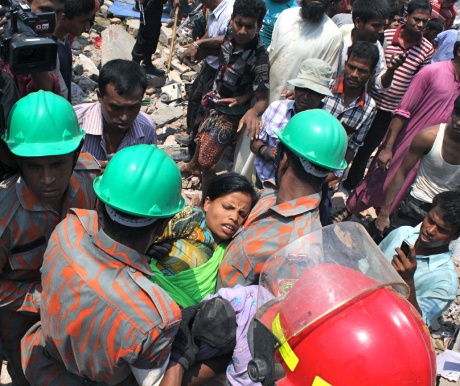
The worst ever industrial accident in Bangladesh has killed more than 200 garment workers with fears of a final death toll reaching 1,000 as hundreds remain injured and trapped in the debris.
“Cut off my hand, save my life!” screams a woman trapped under the collapsed eight-story Rana Plaza building in Savar, 30 kilometres outside Dhaka. The same request is shouted by trapped Aftab, while other screams in the rubble demand oxygen. 200,000 local people have assembled in Savar offering to donate blood to the rescue effort, as hospitals are gravely under supplied.
The mass industrial manslaughter occurred at 9am, 24 April. The collapsed building, illegally constructed, contained five garment factories with 2,500 workers. Those five factories are Ether Tex, New Wave Bottoms, New Wave Style, Phantom Apparels and Phantom-TAC. These factories are believed to have produced for several well-known western brands including Mango, Primark, C&A, KIK, Wal-Mart, Children’s Place, Cato Fashions, Benetton, Matalan and Bon Marché.
On 23 April, the day before the collapse, large structural cracks appeared in the supporting pillars of Rana Plaza, but local authorities were ignored by the building owner Sohel Rana and the garment factory owners when they gave the order to evacuate, while the three shops and bank on the building’s ground floor heeded the warning and evacuated. A Rana Plaza garment worker had to work three days unpaid for every one work day missed, so workers were reluctant to stay safe at home on 24 April.
Now over 2,000 workers are injured in hospital, many critically, 254 are dead and many more continue screaming from under the rubble. The IndustriALL Global Union affiliated textile and garment trade unions in Bangladesh are present and supporting the rescue efforts. Affiliates work jointly through the IndustriALL Bangladesh Council (IBC) which yesterday used a joint press conference to put forward joint demands and a programme of action, calling for justice and action from authorities and brands. The IBC will mobilize all affiliates in a mass demonstration on 26 April in front of the Dhaka Press Club.
20,000 furious garment workers from neighbouring factories this morning brought five major highways to a halt, and several local skirmishes saw angry protestors target garment factories that were not respecting the national day of mourning, forcing them to close and show respect to the dead. Protestors also targetted the building of the Bangladesh Garment Manufacturers & Exporters Association (BGMEA).
The systemic problems must be tackled immediately in Bangladesh’s garment industry and much responsibility must fall on the western clothing brands making enormous profits from items made in deadly conditions on poverty wages. While brands continue refusing to pay a sufficient price for safe production of their clothes, their calls for improved safety are not sincere.
Much needed improvements to the national labour law have been debated through Bangladesh’s legislative process, with the government cabinet approving revisions on 22 April. However this process has been lobbied by the global garment industry buyers who have demanded a scaling back of workers’ rights initially proposed in the reform.
IndustriALL Global Union believes that Bangladeshi garment workers deserve the right to work in safety, with full access to organize and bargain collectively in trade unions, and a substantial rise of the current US$38 monthly minimum wage.
IndustriALL Global Union General Secretary Jyrki Raina said:
This terrible tragedy highlights the urgency of putting a stop to the race to the bottom in supplying cheap means of production to international brands, a race in which hundreds of workers have lost their lives. Global clothing brands and retailers have a responsibility for their full production chains. Now it is time for them, suppliers and the Bangladeshi government to sit down with IndustriALL and its affiliates to agree on a safety program that will ensure this will never happen again.
Featured Video

Can the U.S. Afford to Annihilate Iran?
or go to
Aletho News Archives – Video-Images
From the Archives
Sanctions, War and the Policy of Dual Containment
By SASAN FAYAZMANESH | March 17, 2008
It is now nearly three decades since the Unites States adopted the policy of dual containment of Iran and Iraq. While much has been written about the containment of Iraq, there has been very little in-depth analysis of this policy when it comes to Iran. In a book that is going to be released on March 31, 2008, entitled The United States and Iran: Sanctions, Wars and the Policy of Dual Containment (Routledge), I attempt to address this shortcoming by investigating when and why the US policy of containment of Iran came about, how it evolved, and where it stands today.[1] To the extent that Israel has been involved in US policy making, the study will also include the role that Israel has played in the containment of Iran. Also, since the fate of Iran has been inextricably linked to that of Iraq, occasionally the investigation will overlap with the containment of Iraq.
The policy of dual containment of Iran and Iraq originated during the Carter Administration, but it was not until the Clinton Administration that the expression “dual containment” became popular. … continue
Blog Roll
 Aletho News
- Can the U.S. Afford to Annihilate Iran? /Seyed M. Marandi
- Elmo Sold mRNA Jabs to Your Toddler. Now They Are “Off-Label.”
- British state targets Palestine Action with yet another crooked trial
- Americans are paying the price to preserve Israel’s nuclear hegemony
- Resistance factions are necessary to ensure a permanent US Iraq withdrawal
- How Israel destabilizes the Middle East: Denying sovereignty and the right to exist
- Europe’s Establishment Is Embracing War – and Losing Voters
- NATO chief advocates war of aggression
- No Vote, No Representation, No State: Democracy, Israeli Style
- Zionist Bought Senate Blocks Information About American Citizens Killed By Israel
- If Americans Knew
- Israeli Soldiers Abduct At Least 22 Across Occupied West Bank
- Eight Palestinians Killed in Israeli Attacks on Gaza
- Israeli former leaders and security chiefs threaten legal action over ‘Jewish terrorism’
- Israel map in LA Times ad includes all land from the river to the sea
- Inside Lebanon’s 200-page dossier on Israeli war crimes
- Flydubai, genocide, settler violence, Trump abuse of power to deport – Daily Update
- Counting Antisemitic Incidents: What the ADL Audit Reveals — and Obscures
- Mamdani releases plan to combat antisemitism and hate crimes in New York City
- Iran’s Revolutionary Guards Publish Letter to the American People
- DMFI launches $1 million ad campaign supporting Virginia’s Elaine Luria
- No Tricks Zone
- Green Energy Debacle: German Expert Professor Fritz Vahrenholt Warns Of Severe Economic And Social Consequences
- Two More Paleo Reconstructions Affirm Meters-Higher Sea Levels Across Ireland, Brazil 7000-6000 Years Ago
- New Study: Earth And Venus Surface Warmth Largely Explained By Convection And Lapse Rate, Not CO2 Or Radiation
- 2025 Nature Paper Claiming Worsening Global Drought Gets RETRACTED …Heavily Flawed
- New Study: ‘Global Drought Shows No Detectable Recent Acceleration Under Climate Warming’
- Economic Masterminds: German Socialists Suggest Taxing Productivity Gains Stemming From Using AI
- The South China Sea Has Not Been Cooperating With The Climate Change Narrative
- Energy Crisis: Germany Enters Heating Season With Historically Low Gas Reserve Fill Levels
- New Study: The Antarctic Ice Sheet Gained Mass From 2020-2024 Due To Staggering Snow And Ice Accumulation
- Study: Ocean Heating Rates From Thousands Of Years Ago ‘Dwarf’ Modern Ocean Heating Rates

