Time for Nuclear Savings Bonds?
The Nuclear War Reserve
By ROBERT ALVAREZ | CounterPunch | December 10, 2010
Although it’s been 20 years since the Cold War ended, the U.S. is still holding on to a grossly oversized nuclear arsenal – most of which are no longer needed by the military. Thanks to Hans Kristensen at the Federation of America Scientists, I’ve learned that 70 percent of the America’s warheads are not being deployed and that more than 40 percent has been discarded by the military. Some 2,500 nuclear warheads are currently deployed, with a comparable number held in the “war reserve,” and 3,500 are awaiting elimination. The “war reserve” is needed as a hedge just in case Russia decides to rekindle the nuclear arms race – a sacrosanct U.S. policy based on the logic that the winner of a nuclear war is the one with the most left over. The current U.S. nuclear arsenal has a destructive power about 400 times greater than the explosives used by all combatants during World War II.

The current backlog of retired nuclear warheads will take 15 years to eliminate. My children might live long enough to see the existing stockpile of discarded weapons disappear. This is because the Obama administration plans to curb nuclear warhead dismantlement spending by 50 percent over the next five years. If the New START treaty is approved, nearly 80% of U.S. nuclear warheads will not be deployed with as many as 5,000 warheads waiting to be eliminated. According to Kristensen and his colleague Robert S. Norris at the Natural Resources Defense Council, the current rate of weapons dismantlement is what it was in the 1950s during the height of the Cold War.
But, if proponents of increased nuclear spending, led by Senator John Kyl (R-AZ), have their way, our great-grandchildren will find America still bristling with nuclear arms. While most of the government stands to see budget cuts, in an effort to garner Kyl’s support for the New START treaty, spending by the Obama administration to maintain the nuclear arsenal and to refurbish the nuclear weapons complex will increase next year by18 percent.
The spending logic of these numbers seems simple. The more nuclear warheads we have sitting around, the more money can be spent on delivery systems, baby-sitting bombs, while trying to make more. Since World War II, America has spent about $5.6 trillion to make and stockpile them – creating a powerful nuclear entitlement culture that commands two thirds of the U.S. Energy department’s budget.
According to Steve Schwartz of the James Martin Center on Non-Proliferation, the U.S. Spent about $54 billion in 2009 on nuclear weapons and their delivery systems (bombers, ground and submarine missile launchers). If you include these expenses, each nuclear warhead costs about $6.3 million per year to keep around.
Wonder why America can’t seem to keep up with nations like Germany and China when it comes to an advanced energy policy? Perhaps it’s because the Energy department spends 10 times more on nuclear weapons than energy conservation.
The National Nuclear Security Agency within DOE estimates it will need about $85 billion over the next ten years and about $168 billion over twenty years to maintain the nuclear arsenal and refurbish the U.S. weapons complex. This does not include the additional $100 billion estimated for the weapons delivery systems in the Defense department. Given that the Obama administration sees no need to further tax the wealthy and that hundreds of billions of dollars will have to be borrowed from China for nuclear weapons, consideration might be given to issuing new “Nuclear Savings Bonds” to help pay for all of this. I’ve created a prototype of what they might look like.

Robert Alvarez, an Institute for Policy Studies senior scholar, served as senior policy adviser to the Energy Department’s secretary from 1993 to 1999. www.ips-dc.org
Wall Street bonuses cashed in for sex, food and art
RT | December 9, 2010
If the impressionist artist were to illustrate something of today’s New York City, it just might be moneybags.
Amid the lackluster American economic climate, Christies Auction House is seeing sunny days, with more than 600-million dollars worth of impressionist and modern art sold this year.
“Since 2008, we have seen an increasing return of confidence to the art market,” said Conor Jordan, of Christies New York.
New York has once again, become one of the Christies premier selling sites.Just as Wall Street’s wealthy and powerful, are back to indulging.
Pampering at the La Prairie Spa at the Ritz Carlton, involves wearing decadent hors d’ oeuvres. A 90-minute skin caviar facial costs more than $300 and 3.4 ounces of La Prairie’s Skin Caviar Luxe Cream sells for $710.
“This time of year, a lot of our business comes from corporate gift certificates,” said Spa Manager, Sandra Sadowski.
As corporate America is banking record breaking profits this year, it may be no coincidence that business at Wempe Jewelers has spiked. The $158,000 dollar price tag of some luxury watches exceeds the average annual income of three US households combined.
“We’re expecting a very busy time. The busiest time of the year,” said Raik Kraise, Wempe manager.
Busyness boosted perhaps by big bonuses coming mainly from one street, Wall Street, a symbol of the finance industry, the financial collapse and record breaking compensation that will reportedly reach $144 billion dollars this year. According to the Wall Street Journal, 2010 bonuses will be up 4 percent from last year’s record haul.
If anyone would know about business, it would be those who work at Rick’s Cabaret. At the New York Gentlemen’s Club, happiness bares lots of skin and beauty, but it doesn’t come free.
“For an evening, six, seven eight thousand dollars, 10-thousand dollars, it’s hard not to have a good time when you’re surrounded by nearly naked women,” said Rick’s Cabaret Communications Manager, Allan Priaulx.
Female entertainers working at Rick’s said they are continuing to benefit from a boom in business following Wall Street’s rebound.
“These guys are getting much-deserved bonuses.They want to celebrate the bonuses and party and have a great time,” said Randi Newton, an entertainer at Rick’s Cabaret.
From sex cravings, to food cravings, some of Wall Street’s cats have gotten fat by forking up $175 for a 10-ounce Kobe beef hamburger.
“We still sell a handful of them every month. A good handful,” Heather Tierney, co-owner of Wall Street Burger Shoppe said.
On Main Street where more than 15-million Americans are officially unemployed, the US Poverty Population reached nearly 44 million, a 50-year high.
Ironically, that figure marks New York City’s most expensive residential sale this year. A seven-floor, 5th Avenue mansion was purchased for $44 million dollars. This, as more than two million homes have been swallowed up by foreclosure in 2010.
In this so-called rebounding US economy, purveyors of all things luxury are, in fact, resurging. All while the majority of Americans are left wondering when life will finally begin looking as pretty as the painting.
Mike Norman, the chief economist at John Thomas Financial explained there is an expanding gap between the rich and poor in America.
“The resources of the government have been directed almost completely towards one sector of the economy, that’s been the financial, that’s been the huge beneficiary when most working people, and by far, the rest of the economy has been left to flounder,” Norman commented. “It’s very disturbing.”
He said the US now ranks near the bottom of global income inequality lists, and it is a direct result of US government policies.
The failed policies transcend American party politics, he argued, both Republicans and Democrats continue to support the financial sector at the expense of all others. … Full article and video report
Britain: New protests as fees vote looms
Press TV – December 6, 2010
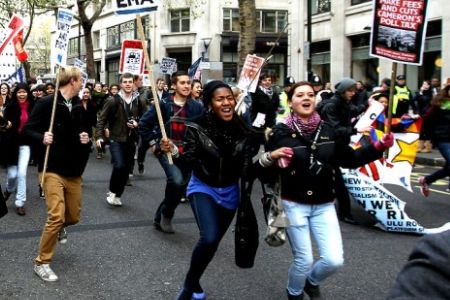
The cities and towns across the UK are bracing for more student protests ahead of a crucial vote in Parliament on plans to increase university tuition fees.
The British student groups and university professors have vowed to step up pressure on Members of Parliament (MPs) to vote against any motion that tightens grip on the students and their families, British media reported.
The pledge came after the country was rocked with a wave of demonstrations and occupations in recent weeks, some of which flared into violence.
A vote on the controversial plan to increase university tuition fees in England and Wales is expected on Thursday, December 9.
The new policy on fees will allow universities to double the current tuition fees from £3,290 per year to around £6,000. Some universities will also be allowed to get special approval from the Office For Fair Access (OFFA) to raise their fees to £9,000 per year.
If approved, the new fee procedure will be applicable by law from the beginning of the academic year of 2012-13.
The University and College Union (UCU) and the National Union of Students (NUS) on Monday announced their plans for the week’s protests in their joint campaign against education cuts.
They revealed plans for demonstrations at universities across the country on Wednesday ahead of Thursday’s vote.
“These proposals, if they go through, will change the entire landscape of education in this country and we must continue to oppose them. We need to expose the damage they will do to our universities, colleges and communities. MPs must be left in no doubt of the strength of opposition to these plans and the consequences of voting for them. We have been overwhelmed by support from people across the country against these plans and we hope they will all join us in making their voice heard this week,” said UCU general secretary, Sally Hunt.
“The joint NUS and UCU march that brought together 50,0000 people on 10 November has provided the spur to a new wave of activism and lobbying, placing the Government’s policy on fees and student support policy under huge pressure. This week we must keep that pressure up as the vote approaches. MPs can be left in no doubt as to the widespread public opposition to these plans or of the consequences of steamrollering them through Parliament,” said NUS President Aaron Porter.
Some trade unions are also urging their members to join the protests, maintaining that students are in the front line of opposition to the government’s massive cuts in public spending.
“This campaign is very much in the front line of the fight back against the ConDem cuts and has united pensioners, students and trade unionists in an imaginative and co-ordinated coalition of resistance. It has exposed the lies and hypocrisy of the LibDems and has opened up serious cracks in the coalition that we can all drive a wedge into,” said Bob Crow, general secretary of the Rail Maritime and Transport (RMT).
“RMT was delighted to have students supporting our picket lines during the last Tube strike and we will make sure that there is a high-profile presence from RMT supporting the students in their action this week,” he said.
Top Ten Lies About Senate Bill 510
The Food Safety Modernization Act looks like it’s headed to become law. It’s being hailed as a “breakthrough” achievement in food safety, and it would hand vast new powers and funding to the FDA so that it can clean up the food supply and protect all Americans from food-borne pathogens.
There’s just one problem with all this: It’s all a big lie.
Here are the ten biggest lies that have been promoted about S.510 by the U.S. Congress, the food industry giants and the mainstream media:
Lie #1 – Most deaths from food poisoning are caused by fresh produce
Here’s a whopper the mainstream media won’t dare report: Out of the 1,809 people who die in America every year from food-borne pathogens (CDC estimate), only a fraction die from the manufacturer’s contamination of fresh produce. By far the majority of food poisoning is caused by the consumption of spoiled processed foods, dead foods and animal-human transmission of pathogens.
For example, one of the largest food-borne killers according to the CDC is Toxoplasma gondii, a disease that people acquire from cat feces coming into contact with their food, which can happen right in their own homes (http://www.cdc.gov/ncidod/eid/Vol5n…). Salmonella poisoning accounts for 553 deaths a year. As a reference for relative risk, over 42,000 people die each year from road accidents in the USA, meaning driving a car has a roughly 7600% higher chance of killing you than eating fresh produce. (http://www.driveandstayalive.com/in…)
In terms of food-borne illness, many of the deaths come from things like spoiled tomato sauce, spoiled canned foods and spoiled pasteurized milk. S 510, of course, does absolutely nothing to address these food contamination deaths, since those foods are considered “sterilized” at the time of sale.
Lie #2 – Under S.510, the FDA would only recall products it knows to be contaminated
Not true. S.510 merely requires the FDA to have “reason to believe” a food is contaminated. So right there, that means all raw milk will be targeted by the FDA because even without conducting any scientific tests at all, the FDA can say it has “reason to believe” the milk is contaminated merely because it is raw.
In other words, the FDA no longer needs science to outlaw a food product. It merely needs an opinion.
Is this “reason to believe” section really true? Yep, and here’s how it was amended:
SEC. 208. ADMINISTRATIVE DETENTION OF FOOD.
23 (a) IN GENERAL. – Section 304(h)(1)(A) (21 U.S.C.24 334(h)(1)(A)) is amended by
(1) striking ”credible evidence or information indicating” and inserting ”reason to believe”;
(http://frwebgate.access.gpo.gov/cgi…)
In other words, in negotiating this bill, the U.S. Senate removed the requirement that the FDA needed “credible evidence” in order to recall a product and, instead, replaced that with the FDA only needing “reason to believe.”
It is utterly amazing that the U.S. Congress would give the FDA to conduct large-scale product recalls and even imprison people based entirely on what the agency “has reason to believe.”
Last time I checked, the FDA held some pretty bizarre (if not downright moronic) beliefs, including this jaw-dropping whopper: The FDA literally believes that there is no food, no herb, no vitamin or supplement that has any ability to prevent disease of any kind. They don’t even believe limes can prevent scurvy, and you’d have to nutritionally illiterate to believe that.
The FDA believes foods are inert and that all the amazing phytonutrients in those foods (carotenoids, antioxidants, therapeutic fats like omega-3 and so on) are utterly useless for human biology.
This belief, held by the FDA that has now been put in charge of the food supply, is the belief system of an insane government agency that has completely lost touch with reality while abandoning nutritional science.
Lie #3 – They didn’t tell you that nearly 70% of grocery store chickens are contaminated with salmonella every day
Yep, it’s true: Amid all the fear-mongering over salmonella, everybody forgot to notice that the vast majority of fresh chickens sold at grocery stores every single day are widely contaminated with salmonella (http://www.naturalnews.com/028661_c…). Yet S 510 does absolutely nothing to address this. It’s not even mentioned in the bill.
In fact, it is these contaminated chickens that end up cross-contaminating the fresh produce in many kitchens across America. So the so-called “food poisoning” that’s often blamed on spinach or onions often originates with the contaminated chicken meat people bring home and slice on their kitchen cutting boards.
Lie #4 – S.510 will exclude and protect small farmers
The Tester Amendment, which was finally included in S.510, excludes farmers who sell less than $500,000 worth of food each year from the more onerous paperwork and compliance burdens described in the bill. But this dollar amount is not indexed to inflation, meaning that as the U.S. dollar continues to lose value due to the Federal Reserve counterfeiting machine running at full speed (more “quantitative easing,” anyone?), food prices will continue to skyrocket — and this will shift even small family farms into the $500,000 sales range within just a few years.
In fact, a single-family farm with just four people could easily sell $500,000 worth of fresh produce a year right now, even before inflation. Remember, $500,000 is not their profit, but rather the gross sales amount. The profits on that might be only $50,000 or even less.
Furthermore, this $500,000 threshold means that small, successful farms that are doing well and would like to expand will refuse to hire more people or expand their operations. To avoid the tyranny of S 510, small farms will try to stay small, and that means avoiding the kind of business expansion that would create new jobs.
Lie #5 – The FDA needs more power to enforce food safety
The FDA already has the power to effectively recall foods by publicly announcing a product has been found to be contaminated. The FDA already has the power to confiscate “misbranded” products, too, and it could easily use this power to halt the sale of contaminated food items.
But the FDA simply refuses to enforce the laws already on the books and, instead, has sought to expand its power by hyping up the e.coli food scares. The ploy apparently worked: Now in a reaction to the food scare-mongering, the FDA is being handed not just new powers, but more funding, too! And you can bet it will find creative new ways to put this power to work suppressing the health freedoms and food freedoms of the American people.
Lie #6 – Fresh produce is contaminated because of a lack of paperwork
There is no evidence that requiring farms to fill out more paperwork will make their food safer. The real cause of produce contamination is the existence of factory animal farms whose effluent output (huge rivers of cow feces, basically), end up in the water supply, soils and equipment that comes into contact with fresh produce.
The food contamination problem is an UPSTREAM problem where you’ve got to reform the factory animal operations that now dominate the American meat industry. S.510, however, does absolutely nothing to address this. Factory animal farms aren’t even addressed in the bill!
Lie #7 – The American people are dying in droves from unsafe fresh food
The truth is that Americans are dying from processed food laced with toxic chemical additives, not from fresh, raw produce. Partially-hydrogenated oils, white sugar, aspartame, MSG and artificial food colors almost certainly kill far more people than bacterial contaminations.
The American public is also dying from pharmaceuticals — anywhere from 100,000 to 240,000 people a year are killed by FDA-approved drugs (http://www.naturalnews.com/001894.html), most of which have been approved under the guise of blatantly fraudulent science and drug company trickery. The FDA doesn’t seem to mind. In fact, it has been a willful co-conspirator in the scientific fraud carried out by Big Pharma in the name of “medicine.” (http://www.naturalnews.com/027851_h…)
To think that the FDA — the very same agency responsible for the Big Pharma death machine — is now going to “save us” by controlling food safety is highly irrational.
Lie #8 – The FDA just wants to make food “safer”
Actually, the FDA wants to make the food more DEAD. Both the FDA and the USDA are vocal opponents of live food. They think that the only safe food is sterilized food, which is why they’ve supported the fumigation, pasteurization and irradiation efforts that have been pushed over the last few years.
California almond growers, for example, must now either chemically fumigate or pasteurize their almonds before selling them (http://www.naturalnews.com/021776.html). This has destroyed the incomes of U.S. almond farmers and forced U.S. food companies to buy raw almonds from Spain and other countries.
Lie #9 – Food smuggling is a huge problem in America
One of the main sections of S.510 addresses “food smuggling.” Yep — people smuggling food across the country. If you’ve never heard of this problem that’s because it’s not actually a problem.
Not yet anyway.
But there’s a reason why they put this into the bill: Because they’re probably planning on criminalizing fresh produce and then arresting people for transporting broccoli with the “intent to distribute.”
Yep, farmers bringing fresh produce to sell at the weekend farmer’s market could soon be arrested and imprisoned as if they were drug smugglers. Hence the need for the “food smuggling” provisions of S.510.
Soon, we will all have to meet in secret locations just to trade carrots for cash.
Lie #10 – S.510 will make America’s food supply the safest in the world
Actually, even with S.510 in place, America’s food supply is among the most chemically contaminated in the world, second only to China. You can find mercury in the seafood, BPA in the canned soup, yeast extract (MSG) in the “natural” potato chips, and artificial petrochemical coloring agents in children’s foods.
Eating the “Standard American Diet” is probably the single most harmful thing a person can do for their health. It’s the fastest way to get cancer, diabetes and heart disease. Every nation in the world that begins to consume the American diet starts to show record rates of degenerative disease within one generation. This is the “safe food” that the U.S. Senate is now pushing on everyone.
Remember, with S.510, SAFE = DEAD. And the FDA says it wants to keep everybody safe.
Greek students clash with police
Press TV – December 2, 2010
At least five people have been arrested in fresh clashes between student protesters and police outside of parliament in Athens over government austerity plans.
Security forces used tear gas to disperse a crowd of approximately 1,500 students attempting to march to the British Embassy in Athens.
The demonstrators showed unity with British students by holding banners which read, “Solidarity to the struggle of British students,” Reuters reported.
British university students are facing an almost tripling of their tuition fees by the Conservative-Liberal Democrat coalition government.
The ongoing demonstrations in Greece were sparked by public outrage against economic reforms, which include eliminating over-time pay and bonuses.
The government agreed to the measures in exchange for a EUR 110 billion rescue package from the European Union (EU) and International Monetary Fund (IMF).
In return, the Socialist government has also slashed pensions and salaries, increased taxes and made it easier for the private sector to sack workers and cut wages.
Trade unions are strongly opposed to the measures and have been organizing demonstrations for months now.
They are calling for a nationwide general strike against the EU-IMF bailout on December 15 — the seventh this year.
Student groups are planning sit-ins on university campuses around the country.
Protests will also be held on Monday, December 6, to mark second anniversary of the police shooting of a teenager, which led to nationwide riots.
Cutting the Deficit: Sacrificing Workers to Save the Rich
By James Petras | 11.28.2010
“There’s class warfare, all right, but its my class, the rich class that’s making war and we’re winning” – Warren Buffet
The most important and popular social and tax programs in the United States are threatened by a self-styled “Bipartisan National Commission on Fiscal Responsibility and Reform”. Appointed by President Obama on February 18, 2010, co-chaired by two longstanding champions of Wall Street: ex Senator Simpson (R, WY) and former Clintonite White House Chief of Staff Erskine Bowles. The Commission Report issued November 10 proposes to slash social security payments, reducing recipients to poverty, raise the retirement age to 69 ensuring that millions of workers will die before they can retire, or enter retirement in ill health; reduce or freeze cost of living increases through inflation indexes which understate by half the rises in food, gas, hospital and education. The Commission proposes deep cuts in Medicare, increased Medicaid co-pays and slashing $54 billion from graduate medical education. The Commission proposes to eliminate tax breaks including deductions for home mortgage interest payments while taxing employer provided medical insurance.
The same Commission Report proposes to reduce capital gains and income taxes for the rich by up to 24%.
President Obama and the Republican leadership praised the Commission and wants “to give them space to work on it”.
The so-called crisis of Social Security is a result of the Republican and Democratic governments siphoning off payments into the general fund. The forthcoming shortfall (2030) can be easily remedied by lifting the payroll tax ceiling, for the rich, taxing all earned income. Medical costs can be reduced by 50% by replacing the for profit corporate health insurance and pharmaceutical corporations with a non-profit national health system, similar to successful programs in Europe and Canada.Both Medical plans and Social Security can be easily funded by imposing a 1% sales tax On the sale of stocks and bonds.
The deficit proposals put forth by Obama’s Bipartisan Commission threaten to push the one-third of retirees who depend mainly on their social security payments into the food kitchens or destitution. The added cost and reductions in health care will increase the mortality rate among working families. The increase in retirement age will result in “work until you die”, with no time for leisure, travel or grandchildren. It is time to send a message to Washington: cut Social Security and Medicare and home interest deductions and you will visit Washington on your own time.
Ending Africa’s Hunger Means Listening to Farmers
By Stephen Leahy | IPS | October 16, 2010
NAGOYA, Japan – Africa is hungry – 240 million people are undernourished. Now, for the first-time, small African farmers have been properly consulted on how to solve the problem of feeding sub-Saharan Africa. Their answers appear to directly repudiate a massive international effort to launch an African Green Revolution funded in large part by the Bill and Melinda Gates Foundation.
Instead of new hybrid seeds, chemical fertilisers and pesticides, family farmers in West Africa said they want to use local seeds, avoid spending precious cash on chemicals and most importantly to direct public agricultural research to meet their needs, according to a multi-media publication released on World Food Day (Oct. 16).
“There is a clear vision from these small farmers. They are rejecting the approach of the Alliance for a Green Revolution in Africa,” said report co-author Michel Pimbert of the International Institute for Environment and Development (IIED), a non-profit research institute based in London.
“These were true farmer-led assessment where small farmers and other food producers listened and questioned agricultural and other experts and then came up with their own recommendations,” Pimbert told IPS.
“Food and agriculture policy and research tend to ignore the values, needs, knowledge and concerns of the very people who provide the food we all eat — and often serve instead powerful commercial interests such as multinational seed and food retailing companies,” he said.
The United Nations Special Rapporteur on the Right to Food, Olivier De Schutter, backs the need for a fundamental shift in food and agricultural research to make it more democratic and accountable to society.
“I applaud the efforts described here to organise citizen’s juries and farmers’ assessments of agricultural research in West Africa,” writes De Schutter in a forward to the IIED publication titled “Democratising Agricultural Research for Food Sovereignty in West Africa”.
The publication includes video clips and audio files that feature the voices and concerns of food producers from across the region.
About half a billion Africans depend on small-scale farming of less than two hectares. Most of the smallholder farmers are women. There is serious concern about the direction of Africa’s public agriculture research, which is mainly funded by donor countries. Funders exert control over what type of research they fund and that almost always reflects a northern science and technology bias favouring new hybrid seeds that must be purchased every year and chemical fertilisers, said Pimbert.
To find out what smallholder farmers want African public agricultural research to do for them, independent farmer-led assessment of the current agricultural research was done in Mali. Those findings fed into two citizen/farmer juries comprised of 40 to 50 ordinary farmers and other food producers. Each jury addressed specific issues such as what kind of agricultural research smallholders want and how food and agricultural research can be more democratic.
The jurors listened to and questioned a wide range of expert witnesses from Africa and Europe. They considered the evidence presented in light of their experiences and agreed on a series of recommendations for their respective governments. Those included direct farmer involvement in setting the public research agenda and strategic priorities, research into traditional varieties and ecological farming, and the idea that such research should be funded by their own governments not outsiders as is the case presently in West Africa.
It’s a fully open and participatory process, said Pimbert, who has been involved in similar processes in India and South America. Jurors are carefully selected to reflect a broad range of localities, variety of knowledge and gender. An independent oversight panel with representatives from a number of countries such as Senegal, Burkina Faso, Niger and Benin acts like election observers to make sure the entire process is fair and open.
“This has never happened in West Africa before. For that matter, ordinary farmers in Canada or the U.S. have never been asked what they want public ag research to do for them,” he said.
Farmers and “ordinary” citizens directly deciding what kind of agricultural research they want is vital for achieving food security, local livelihoods and human well being, and resilience to climate change, Pimbert said.
Following the food crisis in 2008 there is a major push for a “new green revolution” in Africa, championed by the Alliance for a Green Revolution in Africa (AGRA) a $400 million effort headed by Kofi Annan, former secretary- general of the United Nations and funded by the Gates Foundation and the Rockrfeller Foundation. AGRA aims to double or quadruple the yields of smallholder farms.
“We’re are choosing to invest in what we believe will work,” said Sylvia Mathews Burwell, a member of the AGRA board and president of the Global Development Program, which is one of three focus areas for the Gates Foundation.
AGRA is putting its funding in the development of new seed varieties such as drought-tolerant maize, improving soil fertility and market access and farmer education. They are not presently funding genetically engineered crops.
“Farmers want ag research that will help them feed their families and have extra to sell in the market,” Burwell said in an interview. “Our consultants have been out there talking to farmers. We’re attempting to include the voice of farmer.”
For many, the AGRA approach is a downscaled version of U.S. and European agricultural production, with its central focus on boosting yields with hybrid seeds and fertiliser.
AGRA’s objective seems to be to make “farmers dependent on inputs, dependent on markets, instead of the farmers being in charge,” said Hans Herren, president of the Millennium Institute in Virginia. Herren was the World Food Prize winner in 1995, and is credited with implementing a biological control programme that saved the African cassava crop, averting a food crisis.
“We have seen from the example in the U.S. and EU where this dependency leads…fewer farmers, lower prices for farmers… more jobless people,” said Herren, who was co chair of International Assessment of Agricultural Science and Technology for Development (IAASTD).
The three-year IAASTD concluded the best hope for the feeding the world was with agro-ecosystems that married food production with ensuring water supplies remain clean, preserving biodiversity, and improving the livelihoods of the poor. The transformation that African agriculture needs is not more large-scale industrial farm production relying on outside inputs of fertiliser but with small farmers practising a multifunctional agro-ecosystem approach, Herren said.
“Smallholders and their authentic organisations (co-ops, small rural technical schools, and the like) have shown that strengthened agro-ecological approaches can produce adequately,” said Philip Bereano of the University of Washington in Seattle.
AGRA has failed to “consult with smallholders, listen to their advice, and follow their suggestions,” said Bereano in an email from Nagoya, Japan. Bereano is involved with a citizen’s group called AGRA Watch, which says major funders from the North are pushing an industrial agri-business development model on Africa.
Agribusiness is setting itself up as the solution to the “food problem” and many governments are listening because the 2008 food crisis shocked them, said Pimbert. “Africa has enormous quantities of land and resources…and now there is a stampede to lock those up.”
AGRA, many scientists and large NGOs believe the business approach of high-technology and public-private partnerships is the way to feed Africa, they can’t accept the smallholders’ worldview, he said. What will happen instead is that smallholders will buy the new hybrid seed, fertiliser and pesticide on credit, eventually be forced off their land to repay their debts and end up in the cities, while large corporate style farms will consolidate smallholder land.
“This is what happened to many of India’s smallholders,” Pimbert said.
Global food justice
With more than one billion people around the world considered overweight, why are so many others still starving and struggling to fill their plates?
US to spend $413bn more on Afghan war
Press TV – November 21, 2010
A decision by US President Barack Obama to extend the presence of American troops in Afghanistan beyond 2014 is likely to increase the remaining cost of the unpopular war to USD 413 billion.
The US president, who was expected to announce an exit strategy from Afghanistan at the recent NATO summit in Lisbon, pushed for an indefinite postponement of troop withdrawal instead.
Obama declared in a nationally televised address in December that the transfer of the US forces out of Afghanistan would begin in July 2011. He, however, later redefined the previous timeline stating that Afghan forces would only begin taking the lead for security across Afghanistan by 2014.
On Saturday, NATO Secretary General said the US-led military alliance will remain in Afghanistan for as long as it takes to finish off its enemies there.
The newly defined deadline comes with a heavy price tag at a time when the US and many of its allies are facing increasing deficit cuts at home.
“I don’t think anyone is seriously talking about cutting war funding as a way of handling the deficit,” said Todd Harrison, a Defense funding expert at the Center for Strategic and Budgetary Assessments.
Calculating costs based on USD 1.1 million per soldier per year, Harrison assesses that the new description of the deadline will cost the American taxpayers an additional USD 125 billion through 2014 alone.
The remaining war cost had been estimated to be USD 288 billion assuming that the troops involved in Obama’s surge would be withdrawn by 2012.
German government imposes police state ahead of austerity budget
The Flu Case | November 20, 2010
As the economic implosion of Germany due to the banking fraud approaches, the government has started to put large numbers of armed police onto the streets under the pretext of having to ensure security against “Isalmic terrorists.”
Police wearing bullet-proof vests and carrying machine guns have started patrolling stations and airports throughout Germany. Security around the Berlin government buildings has also been strengthened. Police are also patrolling high speed ICE trains, reports Bild. Travellers can expect more checks.
The imposition of a police state comes just ahead of the government’s announcement of a key austerity budget that is expected to stir protests among the German people even larger in scale than the Castor and Stuttgart 21 protests.
On top of all the other payments to banks, Germans will now also be expected to foot a large part of the multi-billion euro bill for the Ireland “bailout” pushed on the country by the IMF and EU.
The Interior Minister Thomas de Maiziere was forced today to backtrack over claims that a bomb with a detonator and a timer had been found in a suitcase in a plane in Namibia, stating that the device had been planted as part of a “test.”
Mass anti-government rallies held in Germany
Press TV – November 13, 2010

Protests against the German government’s austerity measures on June 17, 2010
Tens of thousands demonstrate in cities across Germany against government policies and social inequalities ahead of the ruling party’s national meeting.
A day before Chancellor Angela Merkel’s Christian Democrats party (CDU) meeting, nearly 100,000 Germans marched across the country in Stuttgart, Dortmund, Nuremberg and Erfurt.
“We don’t want a republic in which powerful interest groups decide the guidelines of politics with their money, their power and their influence,” Berthold Huber, head of Germany’s largest trade union IG Metall, told a crowd of protesters in Stuttgart.
The rallies were organized by the Confederation of German Trade Unions (DGB), which is demanding higher wages for workers and a mandatory minimum wage.
Demonstrators also protested at the introduction of the new pension age of 67, AFP reported.
During the annual CDU meeting, held between November 14-16 in Karlsruhe, delegates will most likely re-elect Merkel as the head of the party.
The coalition government currently shares power with the Free Democrats and has passed austerity measures and spending cuts during the country’s economic crisis.
Merkel’s government is now trailing behind the center-left Social Democrats and Greens in opinion polls, Reuters reported.
Last week, tens of thousands of environmental activists protested at the transport of radioactive waste from France to Germany in conjunction with the government’s recent decision to extend the life spans of Germany’s 17 nuclear power plants.
The Militarization of the World
By ISMAEL HOSSEIN-ZADEH | CounterPunch | November 12, 2010
A bully or a mafia godfather would never run out of excuses to punish an insubordinate soul in “his territory.” Accordingly, U.S. imperialism has been very creative in invoking all kinds of excuses to punish Iran for its aspirations to national self-determination.
To justify the criminal economic sanctions against the Iranian people, the U.S. has for years insisted that Iran is supporting terrorism, threatening U.S. national interests, and pursuing a program of nuclear weapons manufacturing. As these harebrained allegations are increasingly losing credibility, the United States is now invoking a new ploy to justify its decision to further tighten the sanctions on Iran: “military dictatorship” and “human rights abuses,” as Secretary of State Hillary Clinton has occasionally grumbled about in recent months.
There are a number of obvious problems with this latest U.S. excuse for escalating sanctions against Iran. To begin with, it is a blatant interference in the internal affairs of Iran.
Second, considering the fact that the U.S. has armed its “allies” in the Middle East (and beyond) to the teeth, its condemnation of the rise of Iran’s military power is clearly hypocritical. According to the Stockholm International Peace Research Institute (SIPRI), cited in Wikipedia, while Iran’s military spending in 2009 was $9.174 billion (or 2.7% of its GDP), that of Saudi Arabia was $39.257 billion (8.2% of its GDP), that of Israel was $14.34 billion (7% of its GDP), and that of the United Arab Emirates was $13.5 billion (or 5.9% of its GDP).
Third, in light of the fact that the U.S. is the most militarized country in the world, it’s belly-aching about “militarization of Iran” (whose military spending is less than one percent of the U.S.) is patently ironic; it is a case of the pot calling the kettle black. Again, while Iran’s military spending in 2009 was $9.174 billion, that of the U.S. was $663.255 billion. However, the official $663.255 billion includes neither the Homeland Security budget, nor the costs of the Iraq and Afghanistan wars, nor a number of supplemental expenditures added to military spending during the fiscal year. Once these omitted (or hidden) expenditures are added to the official Pentagon budget, total U.S. military-security expenditures would easily amount to $1000 billion, or one trillion dollars. Even in relative terms, Iran’s military spending is infinitesimally small compared to that of the United States. For example, while Iran’s per capita military spending is $131 (9,174,000,000 : 70,000,000), that of the U.S. is $3333 (1,000,000,000,000 : 300,000,000). And whereas Iran’s military spending as a share of its GDP is 2.7% (9.174 billion : 340 billion), that of the United States is nearly 7% (1 trillion : 14 trillion) [Ibid.].
Fourth, in light of the fact that the U.S. is altogether silent in the face of heinous human rights violations under the rule of the regimes it calls “allies,” its alleged concern for “human rights abuses” in Iran is hypocritical and utilitarian: it uses the lofty ideal of defending human rights to disguise its nefarious intentions to impose economic sanctions or to embark on military aggression against that country. Hypocritical defense of human rights is often used to justify wars of aggression as humanitarian operations, or “just wars,” as they were called in times past. Just as this ruse was used in 1999 to wreak carnage on Yugoslavia, so it is now used to pave grounds for committing similarly heinous crimes against Iran.
Regrettably, many left/liberal/antiwar individuals and organizations often fall for this hoax, thereby endorsing (or remaining silent in the face of) U.S. wars of aggression on ethical grounds, that is, on grounds of fighting dictatorship or terrorism in the hope of achieving liberation and democracy. Of course, to make the ruse credible, champions of war and militarism usually start with demonization and distortion, and then proceed to aggression and invasion.
It must also be pointed out that the purported U.S. support for human rights tends to be narrowly focused on purely cultural issues such as life style and identity politics, that is, the politics of race, gender and sexual orientation. As such, it is largely devoid of basic economic needs for survival. Even a cursory comparison with the Universal Declaration of Human Rights and Freedoms (UDHRF), adopted on 10 December 1948 by the General Assembly of the United Nations, reveals some fundamental shortcomings of the U.S. human rights protocol. Human rights according to UDHRF include basic economic or survival needs such as:
“the right to work … to protection against unemployment … to just and favorable remuneration ensuring for himself and his family an existence worthy of human dignity, and supplemented, if necessary, by other means of social protection. . . . Everyone has the right to a standard of living adequate for the health and well-being of himself and of his family, including food, clothing, and housing and medical care and necessary social services, and the right to security in the event of unemployment, sickness, disability, widowhood, old age or other lack of livelihood in circumstances beyond his control. . . . Motherhood and childhood are entitled to special care and assistance. All children, whether born in or out of wedlock, shall enjoy the same social protection. . . . Everyone has the right to education.”
Human rights a la USA does not include any of these basic human needs—all the nauseating propaganda of championing human rights notwithstanding. Indeed, many of the basic economic rights, which came to be known as the New Deal reforms, and which were achieved through long and heroic struggles of the working people and other grassroots efforts, are now systematically undermined in order to pay for the gambling losses of the Wall Street financial giants.
Finally, and perhaps most importantly, to the extent that there has been an undeniable rise in the power of armed forces in Iran, as well as a corresponding curtailment of civil liberties there, such unfortunate developments have evolved as a direct consequence of the constant threats posed by U.S. imperialism and its allies. Iran’s strengthening of its armed forces has become a virtual necessity in self-defense against threats of war, destabilization, sabotage, sanctions and other kinds of covert and overt operations engineered by the imperialist-Zionist forces.
By dividing the world into “allies” and “enemies,” the powerful war profiteering interests in the Unites States, the military-industrial-security colossus, compel both “allies” and “enemies” to militarize. While “enemies” such as Iran, Venezuela, and North Korea are forced to strengthen their defense capabilities against imperialistic aggressions, “allies” such as the regimes ruling Egypt, Saudi Arabia and Colombia are driven to militarization against their own people, since regimes loved by U.S. imperialism are hated by the overwhelming majority of their own citizens.
Critics tend to bemoan the rise in the power of the Islamic Revolutionary Guards Corps (IRGC) in Iran without bothering to explain how the IRGC came to existence, or why it has expanded to where it is today. Who is to be blamed for the ascendancy of its influence in the Iranian politics and economics?
Those even faintly familiar with the history of the IRGC would recall that it came into existence as a resistance force against counter-revolutionary forces in Iran, which have always been supported by U.S. imperialism and its allies. Although it was formed in the spring of 1979 as a small paramilitary revolutionary force in the fight against the Shah’s rule, it remained for the U.S.-instigated invasion of Iran by Saddam Hussein to expand it to a fully-fledged military power in defense of Iran’s territorial integrity. The ensuing brutal 8-year Iran-Iraq war (1980-88), in which the U.S. and its allies wholeheartedly supported Saddam Hussein, and the Guards’ legendary sacrifices and heroic defense of Iran’s independence drastically enhanced their size, their prestige and their power.
Although Iraq’s war with Iran ended in 1988, other forms of U.S. wars against Iran have continued to this day. These have included destabilizing “soft-power” operations in the name of democracy, covert operations through all kinds of NGOs and fifth-column groupings, promotion of and support for terrorist operations such as those carried out by Jundullah and Mojadeen Khalgh (MKO, or MEK), constant military threats, psychological warfare, and economic sanctions. Not surprisingly, the role and the influence of IRGC and other security forces in Iran have increased accordingly. Also unsurprisingly, as the political power of Iran’s armed forces has thus increased, so has their economic power.
I say “unsurprisingly” because it is altogether in the nature of things that large standing armies gradually extend their military-security power to the realm of economics. The fully-fledged and the best example of this phenomenon is the rise of the monstrous military-industrial complex in the United States—which, contrary to the defensive nature of Iran’s military force, represents an offensive imperialistic force.
It is of course a truism that maintaining large standing armies will sooner or later lead to authoritarianism. It is equally obvious that by the same token that militarization of the world can be blamed largely on imperialistic U. S. foreign policies, so can the rise of many authoritarian regimes around the world be attributed to those oppressive policies.
When a country (whose only sin is its aspiration to national self-determination) is labeled by U.S. imperialism as “our enemy” and is, therefore, encircled and threatened by the U.S. military monster, that country’s political, economic and democratic growth is bound to be distorted or derailed from a path of a healthy, natural or spontaneous evolution. Finding themselves in the bull’s eye of the menacing U.S. war juggernaut, security forces of such beleaguered countries are bound to react nervously/harshly in the face of protest demonstrations of domestic opposition, even when such demonstrations are for legitimate reasons. The shameful history of covert U.S. operations abroad, including the violent overthrow of many democratically elected leaders through military coup d’états, shows that expressions of indigenous opposition or grievances in such “enemy” countries are often subverted by well-financed and well-armed U.S. agents, either penetrated from outside or recruited from within, thereby warping the development of a “healthy” political/democratic process in those countries.
What is utterly demagogical is that, having thus perverted the politico-democratic process in such countries, the U.S. propaganda machine then turns around and blames the religion or culture or leaders of those countries as inherently incompatible with democratic values. Regrettably, not only do most of the American people but also many people elsewhere, including in the countries targeted for destabilization, fall for this ruse—in effect, blaming the victim for the crimes of the perpetrator.
Viewed in this light, the rise in the influence of the military-security forces in the Iranian politics and economics is a direct result of the menacing imperial policies of the United States and its allies toward that country.
Thus, President Obama’s or Secretary Clinton’s or other U.S. policy makers’ bellyaching about the rise of the power of the armed forces in Iran represents a case of gross obfuscation, that is, a case of barking up the wrong tree: instead of blaming IRGC they should blame their own imperialistic foreign policies, which nurtures militarization and curtailment of civil liberties not only in Iran but also in many other parts of the world. Indeed, militarization of the world and the resulting proliferation of many (relatively smaller) military-industrial complexes around the globe are unmistakable byproducts of the monstrous U.S. military-industrial complex. The inherent dynamics of this monster as an existentially-driven war juggernaut compels other countries around the world (both “allies” and “enemies”) to embark on paths to militarism and authoritarianism.
Ismael Hossein-Zadeh, author of The Political Economy of U.S. Militarism (Palgrave-Macmillan 2007), teaches economics at Drake University, Des Moines, Iowa.
Featured Video

Anthrax War – CBC The Passionate Eye
or go to
Aletho News Archives – Video-Images
Book Review
Shattered Dreams: The HPV Vaccine Exposed (2019)
By Christina England – 30 Q&As – Book Review & Summary
Lies are Unbekoming | September 4, 2026
… Gardasil received FDA fast-track approval in 2006, Cervarix followed in 2009, and Gardasil 9 was approved in December 2014 with more than double the aluminium adjuvant content of the original. The commercial context is specific. Merck was about to lose patent protection on Zocor and faced $18 billion in Vioxx injury claims from a cardiovascular drug the company had marketed while suppressing its own data showing a five-times increase in heart attacks. Analysts projected the global HPV vaccine market at $4 billion by 2011, contingent on government-funded national programs for teenage girls. The 1986 National Childhood Vaccine Injury Act had already granted manufacturers complete liability immunity. By 2013, Japan had withdrawn its HPV vaccine recommendation after cataloguing severe adverse reactions in hundreds of girls. No Western government followed. The establishment position across the UK, US, Australia, and most of Europe held, and still holds, that the vaccines are safe and effective, that reported injuries are coincidental, and that cervical cancer prevention justifies the program. The book was published into this position, not against a vacuum.
Shattered Dreams sits alongside Mary Holland’s The HPV Vaccine On Trial and Viera Scheibner’s foundational vaccination work as part of the documented record on what has been done to a generation of teenage girls under the banner of cancer prevention. The full summary unpacks three specific findings: that Merck used the aluminium adjuvant itself as the “placebo” control in 92.5% of trial subjects, making it structurally impossible to detect excess reactions from the adjuvant; that Dr. Sin Hang Lee found HPV DNA fragments bound to aluminium in every one of sixteen Gardasil samples tested, and in the blood and spleen of a New Zealand girl six months after her third dose; and that in every country with high vaccination coverage, including Australia, the UK, Norway, and Sweden, cervical cancer rates have stopped declining and started rising specifically in the vaccinated cohort. Martínez-Lavín’s 2017 calculation puts the number needed to seriously harm with Gardasil 9 at 140, and the number needed to vaccinate to prevent one case at 1,757. Thirteen young women are seriously harmed for every one who benefits. The vaccine was approved on the basis of trials that could not detect what the trials were supposed to detect, and it is still being given to twelve-year-olds today. … Read full review
Blog Roll
 Aletho News
- Georgia’s Largest Healthcare System Will Fire Employees Who Refuse Flu Vaccine
- The Five-Year Fuel Crisis: Why the World Economy Is Paying for a War It Thinks Is Ending
- Trump’s Big Bluff on Iran
- Swiss scammed out of millions by Ukraine-linked call centers – media
- Germany facing potential ‘violent conflict’ with Russia – spy chief
- Ukraine’s EU neighbors reject new plea from Kiev – Politico
- British Transport Police Facial Recognition Trial Scanned 926,912 People With Zero Arrests
- House Bill Would Ban Federal Use of Flock ALPR Data
- Can a Spice Rival a Drug? 10 Head-to-Head Trials Put It to the Test.
- The oil routes around Hormuz face their own chokepoints
- If Americans Knew
- “We See Our Homes Now From A Satellite, Like Strangers”
- Watch “Gaza: Doctors Under Attack”, originally censored by BBC
- NAZA: Israeli embassies in UK and US promote rival documentary to challenge Gaza genocide allegations
- David Ellison appoints Israeli to lead merged Paramount-Warner studios
- Turkish Red Crescent helps elderly Gaza man walk again after Israel confiscates his prosthetic limb
- Four Palestinians Killed in Israeli Attacks in Gaza
- Two Palestinian youths killed and village razed as Israeli attacks on West Bank continue
- Two more Christian women victims of Israeli raids on Gaza
- Cruelty, Deprivation, Indignity: A Journalist’s 22 Months in Israeli Prison
- New IDF Website Frames Slain Gaza Journalists as Terrorists
- No Tricks Zone
- Latest European Green Energy Debacle; Portugal’s Largest Flagship Solar Park Insolvent!
- Green Energy Debacle: German Expert Professor Fritz Vahrenholt Warns Of Severe Economic And Social Consequences
- Two More Paleo Reconstructions Affirm Meters-Higher Sea Levels Across Ireland, Brazil 7000-6000 Years Ago
- New Study: Earth And Venus Surface Warmth Largely Explained By Convection And Lapse Rate, Not CO2 Or Radiation
- 2025 Nature Paper Claiming Worsening Global Drought Gets RETRACTED …Heavily Flawed
- New Study: ‘Global Drought Shows No Detectable Recent Acceleration Under Climate Warming’
- Economic Masterminds: German Socialists Suggest Taxing Productivity Gains Stemming From Using AI
- The South China Sea Has Not Been Cooperating With The Climate Change Narrative
- Energy Crisis: Germany Enters Heating Season With Historically Low Gas Reserve Fill Levels
- New Study: The Antarctic Ice Sheet Gained Mass From 2020-2024 Due To Staggering Snow And Ice Accumulation

