US war addiction needle hits on health & kids
RussiaToday | December 29, 2010
The U.S. federal debt has hit its highest level in over sixty years. But while the public sector is certain to suffer major cuts, the military budget continues to get rubber stamp approval. RT’s Jihan Hafiz finds out how necessary wars are for America or whether they are just an addiction.
Obama to spend $5 trillion on murder spree
Largest Military Budget Since World War II
By Rick Rozoff | OpEd News | December 23, 2010
On December 22 both houses of the U.S. Congress unanimously passed a bill authorizing $725 billion for next year’s Defense Department budget.
The bill, the National Defense Authorization Act for Fiscal Year 2011, was approved by all 100 senators as required and by a voice vote in the House.
The House had approved the bill, now sent to President Barack Obama to sign into law, five days earlier in a 341-48 roll call, but needed to vote on it again after the Senate altered it in the interim.
The proposed figure for the Pentagon’s 2011 war chest includes, in addition to the base budget, $158.7 billion for what are now euphemistically referred to as overseas contingency operations: The military occupation of Iraq and the war in Afghanistan.
The $725 billion figure, although $17 billion more than the White House had requested, is not the final word on the subject, however, as supplements could be demanded as early as the beginning of next year, especially in regard to the Afghan war that will then be in its eleventh calendar year.
Even as it currently is, the amount is the highest in constant dollars (pegged at any given year’s dollar and adjusted for inflation) since 1945, the final year of the Second World War. With recent U.S. census figures at 308 million, next year the Pentagon will spend $2,354 for every citizen of the country at the $725 billion price tag alone.
Last year’s Pentagon budget, by way of comparison, was $680 billion, a base budget of $533.8 billion and the remainder for operations in Afghanistan and Iraq. In July of this year Congress approved the 2010 Supplemental Appropriations Act which contained an additional $37 billion for the wars in Afghanistan and Iraq.
Next year’s defense authorization of $725 billion compares to, according to the Center for Defense Information, a Pentagon budget of $444.6 billion in 1946; $460.4 billion in 1968, the highest yearly amount during the Vietnam War; and $443.4 billion in 1988, the highest during the eight years of the Ronald Reagan administration’s massive military buildup. (Numbers in 2004 constant dollars.) [1]
The Stockholm International Peace Research Institute estimates American military spending for 2009 to have accounted for 43 percent of the world total. Carl Conetta, co-director of the Project on Defense Alternatives, earlier this year estimated the 2010 U.S. defense budget to constitute 47 percent of total worldwide military expenditures and to amount to 19 percent of all American federal spending.
In addition, Pentagon spending has increased by 100 percent since 1998 and “the Obama budget plans to spend more on the Pentagon over eight years than any administration has since World War II.” [2]
With 2.25 million full-time civilian and military personnel, excluding part-time National Guard and Reserve members, the Defense Department is the U.S.’s largest employer, outstripping Walmart with 1.4 million employees and the U.S Post Office with 599,000. [3]
“Add in what Homeland Security, Veterans Affairs, and the Energy departments spend on defense and total US military spending will reach $861 billion in fiscal 2011, exceeding that of all other nations combined,” according to Todd Harrison, senior fellow for Defense Budget Studies at the Center for Strategic and Budgetary Assessments. [4]
In April Robert Higgs of The Independent Institute advocated that the budgets – in part or in whole – of the departments of Veterans Affairs, Homeland Security, Energy, State and Treasury and the National Aeronautics and Space Administration (NASA) should be calculated in the real military budget, which would in 2009 would have increased it to $901.5 billion.
“Adding [the] interest component to the previous all-agency total, the grand total comes to $1,027.8 billion, which is 61.5 percent greater than the Pentagon’s outlays alone.”
His numbers are:
National Security Outlays in Fiscal Year 2009
(billions of dollars)
Department of Defense 636.5
Department of Energy (nuclear weapons and environmental cleanup) 16.7
Department of State (plus international assistance) 36.3
Department of Veterans Affairs 95.5
Department of Homeland Security 51.7
Department of the Treasury (for the Military Retirement Fund) 54.9
National Aeronautics and Space Administration (1/2 of total) 9.6
Net interest attributable to past debt-financed defense outlays 126.3
Total 1,027.5 [5]
The above-cited Carl Conetta stated at the beginning of this year that the 2011 Pentagon budget will mark a milestone in that “the inflation-adjusted rise in spending since 1998 will probably exceed 100% in real terms by the end of the fiscal year.
“Taking the 2011 budget into account, the Defense Department has been given about $7.2 trillion since 1998, when the post-Cold War decline in defense spending ended. Approximately $2.5 trillion of this total is due to spending above the annual level set in 1998. This added amount constitutes the post-1998 spending surge.”
Based on constant 2010 dollars, Conetta further details that the Ronald Reagan administration spent $4.1 trillion on the Defense Department, the Georgia W. Bush administration spent $4.65 trillion and “Barack Obama plans to spend more than $5 trillion.”
He also compares the two previous largest post-World War Two surges in U.S. military spending to the current one:
From 1958-1968: 43 percent
From: 1975-1985 57 percent
In regards to which he said, “the 1998-2011 surge is as large as these two predecessors combined.”
His calculations also include a growth in Pentagon contract employees of 40 percent since 1989, thereby freeing up uniformed service members for more direct combat roles.
The U.S. share of global military spending grew from 28 percent during the Cold War to 41 percent by 2006 and that of NATO member states, including the U.S., from 49 percent to 70 percent in the same period.
Contrariwise, the “group of potential adversary and competitor states has gone from claiming a 42 % share to just 16 % in 2006.
“Had Ronald Reagan -” who is generally regarded a hawkish president -” wanted to achieve in the 1980s the ratio between US and adversary spending that existed in 2006, he would have had to quadruple his defense budgets.
“And, of course, since 2006, the US defense budget has not receded, but instead grown by another 20% in real terms.
“By 2011, the United States will probably account for more than half of all global military spending calculated in terms of ‘purchasing power parity’ (which corrects for differences between national economies).” [6]
The defense authorization bill passed on December 22, despite its monumental and unprecedented size, has been routinely described in the American press as stripped-down, scaled-down and pared-down because an arms manufacturer or two, their lobbyists and obedient congresspersons didn’t get every new defense contract and weapons project they desired three days before Christmas.
The December 22 vote in the House was, as Associated Press accurately described it, conducted without debate or discussion – and “without major restrictions on the conduct of operations” – particularly in regards to the $158.7 billion for the military operations in Afghanistan and Iraq, $75 million to train and equip the armed forces of Yemen for the counterinsurgency campaign in that country and $205 million more to fund Israel’s Iron Dome missile shield.
Regarding the first vote on December 17: “This year’s bill is mostly noteworthy for its broad bipartisan support during wartime….Unlike during the height of the Iraq War when anti-war Democrats tried to use the legislation to force troops home, the House passed the defense bill Friday with almost no debate on Afghanistan.” [7]
Aside from voting for the repeal of the “don’t ask, don’t tell” policy as a stand-alone measure, excising an amendment to allow abortions to be performed on military bases, and refusing reparations to victims of the World War Two Japanese occupation of the U.S. Pacific territory of Guam (apparently $100 million for the purpose was considered excessive in the $725 billion authorization), there was no meaningful dissent in either house of Congress.
Increasing the U.S. war budget to the highest level it’s been since the largest and deadliest war in history while no nation or group of nations poses a serious threat to the country, and to a degree where it effectively exceeds the defense spending of the rest of the world combined, is all in the proper order of things for the world’s sole military superpower.
1) Center for Defense Information
http://www.cdi.org/news/mrp/us-military-spending.pdf
2) Christian Science Monitor, March 29, 2010
http://www.csmonitor.com/Commentary/David-R.-Francis/2010/0329/Defense-budget-After-Afghanistan-and-Iraq-withdrawal-a-peace-dividend
3) Christian Science Monitor, June 28, 2010
http://www.csmonitor.com/Commentary/David-R.-Francis/2010/0628/Cuts-to-US-defense-budget-look-inevitable
4) Ibid
5) Robert Higgs, Defense Spending Is Much Greater than You Think
The Independent Institute, April 17, 2010
http://www.independent.org/blog/index.php?p=5827
6) Carl Conetta, Trillions to Burn? A Quick Guide to the Surge in Pentagon
Spending
Project on Defense Alternatives, February 5 2010
http://www.comw.org/pda/1002BudgetSurge.html
7) Associated Press, December 17, 2010
Rick Rozoff has been involved in anti-war and anti-interventionist work in various capacities for forty years. He lives in Chicago, Illinois. Is the manager of the Stop NATO international email list at: http://groups.yahoo.com/group/stopnato/
Rethinking Imperialist Theory
James Petras | December 21, 2010
Almost all theories of contemporary imperialism lack any but the crudest sociological analyses of the classes and political character of the governing groups which direct the imperial state and its polices. The same is true about the theorizing of the imperial state which is largely devoid of institutional analyses.
Social Basis of Imperial Politics
Most theorists resort to a form of economic reductionism in which ‘investments’, ‘trade’, ‘markets’ are presented as ahistorical disembodied entities comparable across space and time. The changing nature of the leading classes are accounted for by general categories such as “finance”, “manufacturing”, “banking”, “service” without any specific analysis of the variable nature and sources of financial wealth (illegal drug trade, money laundering, real estate speculation, etc.).
The shifts in the political and economic orientation of governing capitalist politicians, resulting in linkages with different capitalist/imperialist centers, which have major consequences in the configuration of world power, are glossed over in favor of abstract accounts of statistical shifts of economic indicators measuring capital flows.
Imperial theorizing totally ignores the role of non-economic socio-political power configurations in shaping imperial policy, over and against major economic institutions like Multi-National Corporations, up to and including major military commitments. The role of zionist power configurations and militarist ideologues in shaping US Middle East policy (2000-2010) is a crucial consideration in discussing contemporary imperialism in theory and practice.
Imperial impacts are largely determined by the kinds of imperial states (predominantly economic or military and the sub categories of each), the kind of “targeted” or “host” state (neo-liberal run by collaborators, bourgeois nationalist “partners”, nationalist-statist adversaries) the kinds of policies on foreign capital inflows (sectors open, content and joint-venture rules, technology transfers, financial controls) as well as on capital and profit outflows (tax on profits, time constraints on buy and sell of stocks/bonds).
The issue of imperial domination is not based so much on how much capital flows from imperial countries. Rather it is based on class relation: between imperial and domestic classes. Different imperial classes (bankers, manufacturers etc) must compete with other imperial classes as well as domestic state and private capitalist classes. These multiple class relations are changing over time to the degree that the host state insists on transfers of technological, management and marketing know how. “Domination” or “dependence” is not a structural feature embedded over time. Insofar as learning by the “host” country leads to upgrading of productivity, access to world markets and increased competitiveness based on technological innovations. This results in qualitative changes in the relations between established imperial and emerging capitalist states.
Hence imperial theorizing which focuses only on imperial outflows and inflows of capital – as if the “host” country was a ‘blank factor’ – cannot account for the dynamic growth (or stagnation) of host countries with large scale, long term relations with imperial economies.
Emerging and World Powers
Can “emerging countries” whose dynamic growth is based primarily on the export of agro-mineral products sustain their expansion over time and avoid the volatility associated with past cyclical patterns? Can high demand and prices for commodity exports be sustained by ever growing Asian (Chinese) demands? Are the earnings and revenues accruing to agro-mineral export states having “spread effects” beyond the “enclaves” directly engaged in producing transporting and exporting commodities? Are the emerging states adding value to raw material exports, processing agricultural commodities, industrializing minerals, developing technology and upgrading skills? Are they developing marketing know-how, professional managers who retain and invest revenues productively? Are they diversifying their economies, markets and exports? Are their exports financing the development of the home market, lessening vulnerability to external market fluctuations? Is growth overly dependent on investments and exports at the expense of social consumption and the domestic market? Are state revenues from commodity exports secured at the expense of local industry? Is a local comprador class of importers and retailers, financiers and creditors of local consumers, creating a “power complex” which erodes the influence of local large, medium and small scale producers? Is access to overseas markets for commodities, secured at the expense of local manufacturers? Do agro-exporters undermine local food production, increase the need for food imports, augmenting food insecurity?
The dynamic growth of the emerging agro-mineral export countries has been combined with relatively high interest rates. In the context of economic crises, low interest rates in the imperial countries has led to the large scale influx of speculative funds into the local bond market of emerging economies. This has fueled a speculative bubble and overvaluation of the local currency, undermining the export competitiveness of local industrialists.
Imperial Power in Latin America
Most discussions of US imperial power in Latin America are impressionistic, superficial and anecdotal, relying on particular events, devoid of any comparative historical perspective. The general tendency in recent years has been to emphasize the ‘downside’ or decline of US power, without reference to specific political time frames or issue areas.
In this section we will raise a number of methodological and measurement problems that point to the complexity accompanying any estimate of the power of the US empire in Latin America. We will then identify the principle tendencies with regard to the direction of imperial power and conclude by providing an interpretation of the complex shifts over time and location.
Determining the direction of imperial power – rising or declining – depends on the comparative historical time frame as well as the type of indicators.
If for example, one compares US imperial power in Latin America between 1990-99 to 2000-2010 on a broad range of issues, including ideology, client regimes, market shares, economic policies, foreign policy alignments, there is no doubt that a sharp decline of US hegemony has taken place. However, if one examines a shorter time frame, comparing 2000-2005 to 2006-2010, an argument can be made that by certain measures, the US has stopped its decline and may have recovered relative influence.
For example, between 2000-2005 major popular upheavals and mass mobilizations took place, overthrowing incumbent neo-liberal client regimes, calling for the re-nationalization of privatized firms, the renunciation of the foreign debt, radical agrarian reforms and income redistribution. Neo-liberal ideology was totally discredited and US foreign policy was subject to a thorough discredit. Anti-imperialist, if not anti-capitalist ideology held sway among broad sectors of the working, middle and even elements of the political class.
This radical moment however, did not lead to a break with the capitalist system. Instead a series of ‘center-left’ regimes took power and, favored by extraordinarily high commodity prices, proceeded to stimulate an economic recovery, and a marked improvement in social conditions. These policies led to the de-radicalization of the social movements and a modicum of normalization of relations with Washington, albeit with greater autonomy.
If between 2000–2005 Washington ‘lost’ collaborator clients in Argentina, Brazil, Uruguay, Bolivia, Venezuela, Ecuador and faced strong opposition throughout the region, between 2006-2010, Washington retained or regained clients in Panama, Costa Rica, Honduras, Colombia, Peru and Chile. Equally important the center-left regimes stabilized capitalism and blocked any move to reverse privatized firms. They weakened independent class based movements which threatened radical changes. They moved the political-economic spectrum to the ‘center’. Furthermore, the disarray and retreat of pro-US right-wing parties of the 2000-2005 period was replaced by a recovery and re-groupment in Bolivia, Venezuela and elsewhere.
Using regime composition and alignment as a measure, Washington’s decline of 2000-2005 was contained and even to a degree reversed by the end of the decade.
 However, when we turn to economic indicators, such as free trade agreements, market shares, trading and investment partnerships, the decline of US accelerated throughout the decade. By 2010 Asia, especially China, replaced the US as the major market for Brazil, Argentina, Peru and Chile as well as encroaching on US primacy throughout Latin America. If we examine patterns of regional integration a similar decline in US hegemony is apparent in the growth of inter-regional trade and political associations: UNASUR an association of Latin American countries eclipses the US dominated OAS. MERCOSUR, ALBA and other intra-Latin American free trade organizations expand at the expense of US centered ‘free trade’ projects.
In the area of military influence and political intervention, the US collaborators suffered major setbacks in coup efforts in Venezuela (2002, 2003), Bolivia 2008, but were successful in Honduras 2009. The US secured a base agreement with Colombia a major potential military ally against Venezuela in 2009. However, with a change in President in 2010, Washington suffered a partial setback with the reconciliation between President Chavez and Santos. Lucrative $8 billion dollar trade agreements with Venezuela trumped Colombia’s military base agreements with Washington.
Several propositions about US imperial power in Latin America can be outlined.
1. US decline in economic power is structural and irreversible, at least given the state of the world economy and the dynamic growth of Asia.
2.US political influence exhibits a great deal of fluidity, depending on the levels and intensity of the class struggle and most important the success or failures of the incumbent regimes in combining growth and increased living standards.
3.US military power does not translate into political influence and increased market shares, especially where the guiding ideology (“neo-liberalism” or “US-centered economic strategies”) and its local advocates have been discredited because of severe economic crises.
4.The decline of US imperial power has not led to an increase in the influence of the working class or other exploited classes: a dynamic “national” capitalist class is the prime mover and beneficiary of the loss of US influence.
5.The rise of a dynamic relatively independent capitalist class has not broken with the colonial international division of labor; rather the dynamism of this class is a product of the intensification and extension of primary product exploitation and exports. The new dynamism is derived from the revenues from high prices and expanding export markets and here lies future vulnerability if prices decline.
6.“Structural” analysis which underlies most theorizing about imperialism overlooks the important contingencies and class agencies which put into motion the organizational and institutional forms of capital accumulation.
An Interpretation of the Problematical Status of Imperial Power In Latin America
The poverty of class analysis of imperial power among the leading and best known theorists, underlies their superficial understanding of complex changes and continuities in US-Latin American relations.
The ‘fluidity’ found in the countervailing tendencies in imperial power is illustrated by the relative economic decline in the present decade and continued military hegemony in the same period. This can be best understood by the fact that there have been no changes in the mode of production in the hemisphere, no reversals in the wholesale privatizations of the 1990’s and the continuation of free trade practices. Given these continuities, US imperial policymakers retain a presence, albeit reduced, close collaborators in important economic sectors and are potentially in a position to reverse the current decline. Equally important the US is still the principle economic power in the hemisphere even as its ability to exercise ‘dollar diplomacy’ has diminished.
Secondly, while politically Washington can no longer dictate policy or easily pursue military intervention, the basic military linkages remain intact, including joint military exercises, sales and training programs, thus providing important points of leverage in limiting radical (but not reformist) changes.
Thirdly, the growth of autonomous political action and an independent foreign policy in Latin America, is to an uncertain degree, dependent on personalities in power. It is not clear to what degree the institutional bases to sustain the current course of action is firmly entrenched or based on merely ‘conjunctural’ circumstances.
Fourthly, Latin America’s current growing affluence, high growth rates and relative independence is to a large extent based on a ‘colonial division of labor’, mainly trade and investments in agro-mineral products and the importation of finished, intermediate and capital goods. Historically, this has been subject to great volatility in demand and prices.
Taken together these historical continuities argue for greater caution in assuming a permanent shift in imperial power relations with Latin America.
Nevertheless, there are powerful reasons to consider the decline in US power as a long term and irreversible trend. Among the most important structural considerations is the embedded military-Zionist power configuration which dictates continuing wars which bankrupt the treasury, devalue the currency and undermine any effort to project economic power and new initiatives to recover market shares in Latin America.
 Secondly, the new dynamic capitalist centers in Asia are firmly established, growing and defining a multi-polar economic world. They have established in the minds of Latin American policymakers and ruling classes a new ‘world view’: Their future interests lie in Asia. As a consequence of this fact Latin America’s rulers have reoriented the direction of trade and investment, away from the US.
Thirdly, there are no signs of any reversal of the decline of US manufacturing; nor has Washington demonstrated any capacity to curtail the trade and budget deficits. Washington lacks the capacity to challenge, subvert or co-opt the emerging capitalist power configuration which underpins Latin America’s independent politics.
Summary
The ‘fluidity’ of US power relations with Latin America is a product of the continuities and changes in Latin America. Past hegemony continues to weigh heavy, but the future augurs a continued decline. The current balance of power will however be determined by shifts in world markets, in which the US is destined to play a lesser role. Hence the greater probability of more divergences in policy, barring major breakdowns within Latin America.
Waiting for a New Economic Theory
The Economic Crisis and the State of Economics
By SASAN FAYAZMANESH | CounterPunch | December 21, 2010
Economic theories, for the most part, have emerged in response to particular social situations or governmental policies. For example, Francoise Quesnay’s 18th century Tableau Economique came into being in reaction to the plight of the French peasantry, excessive taxation, and government regulation that followed mercantilist teachings. Adam Smith’s “invisible hand” theory similarly appeared as a response to mercantilist restrictions. It also corresponded to the early stages of the Industrial Revolution, when inventions and innovations made England relatively prosperous. Thomas Robert Malthus’s population and glut theories emerged in the midst of the Industrial Revolution, when migration of peasants to the cities, unemployment, and poverty became rampant. Karl Marx’s version of the labor theory of value was a response to the revolutionary movements in 19th century Europe, as exemplified by the 1848 uprising and the 1871 Paris Commune. John Maynard Keynes’s “general theory” was developed in the midst of the Great Depression and was a response to the laissez faire economics and policies that prevailed at the time.
It is too early to see if the recent economic crisis—which started in the financial sector of the economy and spread to the productive side—will produce any novel theories. What we have seen so far is different economists reciting some old theories and advocating corresponding remedies. This is exemplified by three groups of economists, ranging from the most ardent supporters of laissez faire to those who see no future for capitalism.
The free market advocates still fall back on the marginalist or “neoclassical” theories that have dominated economic teaching since the end of the 19th century (the term “neoclassical” is a misnomer, but it is widely used). This unreal, a-historical theory started not with analyzing any real economy or human behavior, but with certain concepts in mathematical physics. The marginalists’ bizarre point of departure then led to a peculiar concept of the market that the proponents of laissez faire found quite useful. A market in this theory consists of two curves, a supply curve and a demand curve. “Equilibrium price” is where these two curves meet. Left alone, all such markets will self-adjust and bring about the equilibrium price. This holds for the “labor market” as well, where the equilibrium real wage will bring about full employment. It also holds for the so-called capital market, where the interest rate is determined. Given this self-adjusting mechanism, anything that interferes with the market, such as government or central bank intervention, is considered to be undesirable. Government deficit spending merely results in higher interest rates, and monetary policy ends with price changes, particularly inflation, if the money supply increases. In either case, the “real variables,” such as the level of employment or real output of goods and services, remain intact. In this happy, serene world there is never any crisis, especially a monetary crisis. Actually, in such a world there is no need for money, since all variables are real and money is just a “veil.” Also, in this tranquil and trouble-free land there are no classes, no workers no capitalists; there are only consumers and producers, getting along happily ever after.
When the current crisis began and the capitalist world economy appeared to be on the brink of another disaster, the proponents of the neoclassical theory trembled at first. They retreated and abandoned their usual arguments concerning the glory of unfettered markets. However, now that falling into the abyss of another depression appears less likely, they are back to the theories of leaving the market alone, reducing taxes for the captains of industry and finance and cutting spending when it comes to the working class.
At odds with these free marketeers are various shades of economists whose roots can be traced to Keynes. Keynes clearly saw the incompatibility between the neoclassical theories and the real world, particularly during the Great Depression. He criticized certain laissez faire aspects of these theories and ultimately advocated for fiscal and monetary policies. Yet, since he was educated in the same neoclassical school, his criticism of these theories was halfhearted and did not shake the foundation of the school. A few critical notes at the beginning of The General Theory of Employment, Interest and Money (1936) were followed by some theories that were incomplete, underdeveloped and ambiguous. The result was many possible interpretations of his theories and their ultimate subsumption under the “neoclassical synthesis,” a combination of the old-fashioned neoclassical theories, called microeconomics, and Keynesian theories, called macroeconomics. This hodgepodge of theories became, and continues to be, the regular staple of economics students.
The ambiguities and lacunae in The General Theory also allowed for very different policy prescriptions. Take, for example, Keynes’s theory of the “multiplier,” a theory that looks at the stimulating effect of spending, particularly government expenditures, on output and employment. The theory was ambiguous enough when Keynes borrowed it from another economist, R. F. Kahn, but Keynes added to the ambiguity by stating:
If the Treasury were to fill old bottles with banknotes, bury them at suitable depths in disused coalmines which are then filled up to the surface with town rubbish, and leave it to private enterprise on well-tried principles of laissez-faire to dig the notes up again . . . there need be no more unemployment and, with the help of the repercussions, the real income of the community, and its capital wealth also, would probably become a good deal greater than it actually is.
This seemed to imply that it made no difference if government spending was on useful things or wasteful things. Actually, a number of other comments in The General Theory support this indifference. For example, just before the above passage Keynes simply stated: “Pyramid-building, earthquakes, even wars may serve to increase wealth, if the education of our statesmen on the principles of the classical economics stands in the way of anything better.” Such statements made “military Keynesianism,” or warfare, an acceptable form of economic policy. To this day, the followers of Keynes are unclear as to whether going to war is good for the economy and a stimulant, or bad for the economy and a drag. Thus, we see some individuals advocating the start of yet another war in the Middle East as a way to rescue the US economy and some opposing the wars already in progress by pointing out their overall costs and how such costs are destroying the economy.
In addition, the silences in The General Theory allowed for the simultaneous existence of different types of Keynesian economists. Even though all such economists agree on the need for fiscal and monetary policy, they do not agree on the limit of such policies and the exact method of pursuing them. For example, liberal Keynesians—such as the “Post-Keynesians” who try to distance themselves from the neoclassical teachings—and conservative Keynesians—such as the “New Keynesians” who are quite eclectic in their theories—are often at odds with one another as to how high the deficit can go or what steps the Federal Reserve System should take. They also disagree over such matters as how much regulation the financial sector of the economy needs. Yet, the squabbles between different types of Keynesians are quarrels within the family. All Keynesians, similar to Keynes, believe in saving capitalism from itself; reform, and not revolution, is their aim.
This brings us to the Marxist economists who, when it comes to solving the ills of the capitalist society, believe in revolution and not just reform. For these economists a little more or a little less deficit spending, or tinkering with the money supply, will not solve the long-term problems of capitalism, particularly when it comes to the current worldwide economic crisis. Neither would the financial woes of the capitalist economy be solved by more regulation.
In their arguments, most Marxist economists fall back on Marx’s mature writings, particularly his Capital, the first volume of which was published in 1867. Setting aside the fact that Marx’s economic project was never finished and that his labor theory of value has always been the subject of controversy, Marx’s work is one of the few economic writings that actually tries to address the issue of economic crises. In Capital there are two major theories of crisis, one cyclical and another secular. The first deals with disproportionality or imbalances between different sectors of the economy, that is, between the sectors that produce “capital goods” and “consumer goods.” Marx’s second theory deals with the tendency for the rate of profit to fall over the long haul. However, neither of these theories explains the current economic crisis. It is, of course, true that in Marx’s theory of capitalist economy money plays a central role in production and could therefore cause crisis at various moments. But, there is no detailed and comprehensive theory of money and credit in his theory that would enable us to deal with modern monetary problems.
Of course, one should not expect theories that were developed in the middle of the 19th century to explain unique economic crises in the 21st century. This is particularly true if one believes, as any good Marxist economist should, that capitalism continuously evolves and poses new problems. Thus, any theory trying to explain an evolving economy must itself evolve and grow. That, however, does not appear to be the case when it comes to Marxian economics. Very little has changed in this field since Marx wrote his Capital, as is evident from various books that have been recently published by Marxist economists, as well as the discussions and debates that are going on between these economists.
There is another major problem with the application of Marx’s theory to the recent economic crisis. Given the period in which it was written, Marx’s Capital was not about reform, but was about revolution, a socialist revolution. The work was meant to sound the death knell of “capitalist private property,” the expropriation of “expropriators.” And the sound was supposed to be heard in the most advanced capitalist country, where forces of production had grown so much that they were no longer compatible with the relations of production. Presumably, this would have been England, where the workers would have established the first socialist economy. What a socialist economy might look like, however, was never delineated by Marx beyond a short and vague sketch in the Gotha Program written in 1875. Such a revolution never happened, and a socialist society was never established (setting aside, of course, the Russian Revolution of 1917, when in a relatively less developed country some revolutionary intellectuals, in the name of workers, came to power and presumably established “state capitalism”).
Nearly a century and a half later, there is no sign of workers’ uprisings in any part of the globe, particularly in advanced capitalist countries. We also have no idea, beyond that discussed in the Gotha Program, what a socialist society might look like. Thus, waiting for the working class to rise, put an end to a chronically sick social system, and establish a new order does not appear to be feasible in the near future, unless one has a strong set of religious beliefs, as some “Marxists” do.
What is to be done? Should we leave the markets alone, as marginalist economists argue, even though we know that their two-curve markets have never existed and, historically, when markets were left alone they always fell into crisis? Or should we rely on increasing budget deficit and easy money policy to get us out of the present economic conundrum, as Keynesians advocate? In the latter case, which Keynesians should we listen to and why, knowing full well that none of the renowned Keynesians of our time predicted the 2008 crisis that brought the US economy to the brink of depression? Or should we wait and hope for workers’ uprisings to end the ills of the capitalist economy once and for all, as some Marxist economists are still hoping for, even though there are no signs of such uprisings anywhere in the world?
It seems that none of the prevailing economic theories provide a viable option for understanding and dealing with the current economic woes. Looking back at the history of economic thought and emergence of new theories at particular historical conjunctions, one can only hope that the current worldwide economic slump will generate new ways of thinking and new theories.
Sasan Fayazmanesh is Professor Emeritus of Economics at California State University, Fresno. He is the author of Money and Exchange: Folktales and Reality (Routledge, 2006). He can be reached at: sasan.fayazmanesh@gmail.com.
Lula censures anti-Iran sanctions
Press TV – December 21, 2010

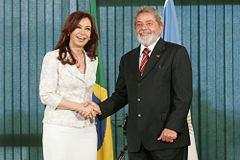
Brazilian President Luiz Inacio Lula da Silva has harshly criticized the decision to impose economic sanctions on Iran over its nuclear energy program.
On Monday, Lula said that the sanctions could have been avoided if the United States had accepted a declaration issued in Tehran in May.
The foreign ministers of Iran, Turkey, and Brazil signed a declaration in Tehran on May 17, according to which Iran would ship 1200 kilograms of its low-enriched uranium to Turkey to be exchanged for 120 kilograms of 20 percent enriched nuclear fuel rods to power the Tehran research reactor, which produces radioisotopes for cancer treatment.
The nuclear declaration gives Iran a guarantee since the low-enriched uranium would be stored in Turkey and would be returned if Iran does not receive the 20 percent enriched nuclear fuel within one year.
Despite the fact that Iran agreed to conduct the fuel swap in a third country — a demand made by the West that Iran had previously rejected due to guarantee concerns — on June 9 the UN Security Council passed a resolution imposing a fourth round of sanctions on Iran following an intense US campaign claiming that Iran’s nuclear program could have potential military applications.
The Brazilian president also said he received a letter from US President Barack Obama in May, which set conditions for Iran to avoid sanctions. He added that those terms were met in the fuel swap declaration and emphasized that the anti-Iran sanctions are therefore unnecessary.
Iran has described the sanctions as illegal, saying that as a signatory to the Nuclear Non-Proliferation Treaty (NPT), it has the right to enrich uranium to produce fuel.
Lula also stated that the US cannot be the lone arbitrator of the Middle East, saying, “There will not be peace in the Middle East as long as the United States is the guardian of peace. It is necessary to involve other countries in negotiations (between Israel and the Palestinians),” DPA quoted him as saying.
Zimbabwe and the Steep Road to Vindication
By Netfa Freeman | Black Agenda Report | December 14, 2010
When Zimbabwe initiated fast track land redistribution in 2000 it was big news for corporate media to echo several patented denunciations, characterizing the process as rife with corruption, violence, and inefficiency and doomed to fail. More than eager to join the fray was the liberal left whose pseudo analysis reiterated the same line accompanied by an aversion to anything that seemed even remotely favorable to Zimbabwe’s President Robert Mugabe and his ZANU PF party.
Given all that media fanfare, it would be easy to assume an independent study examining results from the last ten years of land reform would get the same attention. Not likely. In fact we can be sure more attention will be given to the dispatches from the U.S. Embassy in Zimbabwe publicized by WikiLeaks. One cable by former U.S. Ambassador to Zimbabwe, Christopher Dell reveals nothing unexpected or compelling except Dell’s aptitude for writing subjective diatribes that are able to pass for concrete information to the politically uncritical eye. Ambassador Dell’s publicized cable exposes the lack of confidence he has for many of the leaders in their neo-colonial pawn party, Movement for Democratic Change (MDC) that he and the U.S. brazenly support along with the rest of the Western powers. A friend of mine had this to say about the cable “I think it’s funny that they’ve been predicting his [Mugabe’s] imminent demise for so long. I’ve always said that the biggest Achilles’ heel of the imperialists is that they actually believe their own horse****, especially since the aforementioned [the Dell cable] self-delusional horse**** is oftentimes the basis for their actions.”
Dell dispatched the cable in 2007 and at this point most if not all of the assertions in it have been disproved over time, bringing us to the real meat of this article – meat that will be overshadowed in Western press by the recent WikiLeaks release. Not that they would endeavor to report this at all even in the absence of WikiLeaks.
You see, the major study of 10 years of land reform in Zimbabwe actually exists and was released in mid November. As we said, if one assumed it would get big media coverage they would assume wrongly since such a study doesn’t conform with the acceptable and imposed imperial narrative. It appears the study, released by Institute for Development Studies fellow Ian Scoones at Britain’s University of Sussex and detailed in the book Zimbabwe’s Land Reform Myths & Realities, was able to lure the usual Mugabe and ZANU PF detractors into resuming their typical propaganda pot-shots, indicating that something unfavorable to them is afoot. An article by staunch Mugabe critic Patrick Bond in the online magazine Counterpunch, “A New Tyranny: Will Zimbabwe Regress Again?” was published just as the new study evaluating the land redistribution program in Zimbabwe was released. It almost seemed that Bond’s article was meant to serve as damage control from the revelations of the study.
Before assuming the land study is the topic of Bond’s article, revealingly not one mention of the study was in the article. While this was interesting it was not surprising, given that the study contradicts a collection of major narrative myths Bond has been complicit in popularizing. The study “challenges five myths through the examination of the field data from Masvingo province:
“Myth 1 Zimbabwean land reform has been a total failure
“Myth 2 The beneficiaries of Zimbabwean land reform have been largely political ‘cronies’ (specifically, cronies of Robert Mugabe)
“Myth 3 There is no investment in the new resettlements
“Myth 4 Agriculture is in complete ruins creating chronic food insecurity
“Myth 5 The rural economy has collapsed
“By challenging these myths, and suggesting alternative policy narratives, this book presents the story as it has been observed on the ground: warts and all.”
Over the past year or so things had been relatively quiet on the ZANU PF-Mugabe vilifying front, leaving one to wonder about the timing between the land redistribution study and any new ZANU PF-Mugabe vilification resurrecting its ugly head. Even more deafening is the silence over the study by Western media and the Western beholden civil society organizations, right wing or “progressive.” While Bond does deal quite a bit in his article with land redistribution it is mostly to continue the notion that it was a disingenuous exercise that was largely a failure. Just like Ambassador Dell’s cable to the US State Department, Bond backs none of this up with the type of information that can be either proven or disproved.
And even with the wholly inadequate coverage the land study has gotten, like that of the BBC, coverage tries to divert attention to a “process which these farms were seized off white farmers, often very, very violently,” as remarked by the host of BBC News Worldwide while interviewing Ian Scoones. Lacking the sensitivities that come from identifying with the indigenous African’s from which the land was brutally stolen in the first place using methods exponentially more violent than any used to reclaim it by the African descendants who have the only rightful claim to it, Scoones could not articulate the more fitting come-back for such Euro-centrically biased questioning.
The imperialists, along with their pseudo-progressive civil society organizations, must believe that if they just keep repeating the same lies and misrepresentations over and over they will transform them into truths. Like the facts of the 2008 elections whose depiction is another obstacle in Zimbabwe’s road to vindication. In his article Bond repeats the refutable claim that “Since paramilitary violence forced Tsvangirai to pull out of the mid-2008 run-off presidential election (after winning the first round – but, claimed Mugabe’s vote-counters, with less than 50%),…” When one’s purpose is only to generate unsubstantiated assertions it’s easy to pack a lot of misinformation into a single sentence.
The devil, or shall we say the real truth is in the details. While Bond’s assertion follows the standard imperialist propaganda line, facts reveal that the results of that election were not under the control of “Mugabe’s vote-counters” but instead a Zimbabwe Electoral Commission (ZEC) that included representatives, ballot counters, and poll watchers from all the political parties of the country who each had to sign off on the results during each stage of tallying. Bond also claims his imperialist-backed MDC presidential candidate Morgan Tsvangirai was the winner even though the country’s constitution dictates that there is only a winner when a candidate receives over 50% of the vote. Instead of a claim by “Mugabe’s vote-counters” as Bond put it, it was even according to the figures peddled by the MDC at the time a run off was warranted. Unlike Bond, an April 4, 2008 article in the Zimbabwe Guardian clarified this fairly recent history with more concrete and verifiable information, saying:
“Morgan Tsvangirai might aspire to be president of Zimbabwe, but he has difficulty with simple mathematics. Yesterday, he claimed to have won 50.3 per cent of the vote in Zimbabwe’s election. This figure is vital because it puts him just above the crucial 50 per cent threshold needed to avoid a second round against Robert Mugabe.
“But anyone with a calculator can work out that someone got their sums wrong. According to the MDC, Tsvangirai took 1,169,860 votes against Mugabe’s 1,043,451 and Simba Makoni’s 169,636.
“These figures appear in an official statement carried on the MDC’s website today, along with the claim that “President Tsvangirai has 50.3 percent of the total Presidential vote and he has won the election with no need for a run-off.”
Get out your calculator and check the percentages. In fact, the MDC’s voting figures show Tsvangirai with 49.1 per cent, Mugabe with 43.8 per cent and Makoni winning 7.1 per cent.”
So on the MDC’s own figures, a second round is needed.
These weren’t the only shenanigans the MDC attempted during the first round of voting and conveniently overlooked by Bond. Some may recall the long time it took for the results of the first round of voting to be released, emboldening the opposition and Western forces to claim ZANU PF was stalling in order to put in the fix. And the pitiful Christopher Dell cable released by WikiLeaks actually adds to misleading the public about the real context of that time. For example, that some ZEC officials were “arrested on allegations of tampering with election results and prejudicing ZANU-PF presidential candidate President Mugabe of 4,993 votes cast in four constituencies in the just-ended harmonized elections” as reported in an April 8th 2008 article in Zimbabwe’s The Herald. The article went on to detail that investigations around the same improprieties where taking place in “two other constituencies in Manicaland where the Zanu-PF presidential candidate was also allegedly prejudiced of 1,392 votes.
“In Mashonaland Central, it is alleged, the same candidate was prejudiced of 773 votes while investigations also revealed that the same candidate lost 1,000 votes in two Matabeleland North constituencies and 1,828 votes in Masvingo…
“…The anomalies were detected following a close scrutiny of V11 and V23 forms.
“A V11 form is an original document carrying results at polling stations and is signed by all agents of contesting parties.
After the signing of the V11 form, information is then recorded on the V23 forms that collate polling station results within a ward.
“These forms also show the results of the council elections.
“The Sunday Mail reported at the weekend that at Rimbi Primary School in Manicaland Province, the V11 form showed that President Mugabe got 612 votes but the V23 form that was forwarded to the National Command Centre shows that the President received 187 votes.
“This anomaly was detected in a number of constituencies.”
Instead of believing the false, typical and unsubstantiated claim that paramilitary violence forced Tsvangirai to withdraw from the 2008 run-off that followed the first round of voting, a real and more plausible explanation is detailed here.
So while it is easy to foster confusion with grandiose, albeit brief, assertions barren of concretely verifiable information, it often takes pages of critically assembled information to unravel it. To properly digest the WikiLeaks released cable of Dell we can learn from CISPES, Committee In Solidarity with the People of El Salvador. In looking at the WikiLeaks cables from the U.S. Embassy in El Salvador, CISPES has made some very astute observations. It would be wise for us to consider that much may be similar regarding Zimbabwe and El Salvador: “While Wikileaks’ release of leaked diplomatic cables provides an unprecedented opportunity to reveal the workings and motives of U.S. foreign policy, the process grants large international news agencies the decision-making power as to which cables to release and the opportunity to craft the first analysis that the public will hear.”
CISPES continues: “Considering more than 1,000 cables about El Salvador were reportedly leaked, we must ask what criteria were used to select these particular cables for first publication; cables that right-wing Salvadoran news sources are now using in a continued attempt to undermine new government.” … “Overall, the cables reveal an Embassy that is out of touch with the leading role played by the FMLN in El Salvador’s current political reality.”
The IDS land study in Zimbabwe does provide what could be considered an unbiased account of land reform in Zimbabwe. However, much of what it reveals had already been documented by anti-imperialist author Gregory Elich and in many ways more comprehensively. IDS fellow Ian Scoones insists that his study focused only on the results of land reform over time, occasionally seeming to accept the Western narrative on the means by which the redistribution took place. Zimbabwe’s land issue is consistently characterized by unprecedentedly and indiscriminately violent takeovers from white landowners deliberately instigated by Mugabe and ZANU PF. Elich refutes this in his meticulously researched and referenced book Strange Liberators; Militarism, Mayhem, and the Pursuit of Profit, showing that farm “invasions” involved “temporary visits of a few days and sporadic repeat visits. They [did] not entail the extended stays” and that the farms targeted tended to be those of landowners who “had mistreated workers, paid excessively low wages or exhibited overt racism.” Regarding the use of violence Elich also showed that “…compared to rural and urban violence in South Africa, Ireland or Brazil, the level in Zimbabwe has been quite low.” Incidents perpetrated by those who were legitimately dissatisfied with what had been inadequate land delivery were curtailed by the ZANU PF fast track land redistribution program.
The IDS study merely validates Elich’s job of disproving the myth that beneficiaries of the land reform had been political “cronies” of Mugabe and that the process was largely corrupt. Elich also pointed out that land confiscated by the Zimbabwe government for redistribution was “unused land, underutilized land, land owned by absentee owners, land owned by a person possessing multiple farms, land exceeding size limits (which varied by region), and land contiguous with communal lands.” Rather than Mugabe being in cahoots with what in reality was a minuscule 0.3 percent of cases where the process was abused (5% according to the IDS study), Elich demonstrates something different. The investigation that uncovered such abuse and corruption in the process by government and party officials was actually initiated by the President’s Land Resettlement Committee. (Elich, p. 343-344)
While Patrick Bond’s writings and WikiLeaks documents might seem a compelling source of truth, such truth is unfortunately harder to come by. One “wiki-leaked” cable indicates that because “many MDC-T local councilors and parliamentarians elected in 2008 had no independent income…they were now turning to graft.” Such disclosures don’t tell the relevant complicity of the World Bank in secretly bankrolling MDC-T officials. While the IDS study on the land reform pushes Zimbabwe further down the road to vindication an anti-imperialist and revolutionary perspective of Zimbabwe’s struggles will continue to require a very scrutinizing and critical approach.
Netfa Freeman is the Director of IPS’ Social Action & Leadership School for Activists and an activist in the internationalist and Pan-African liberation movements. He can be reached at netfa@hotsalsa.org.
Obama’s approval rating falls to 39%
Press TV – December 15, 2010
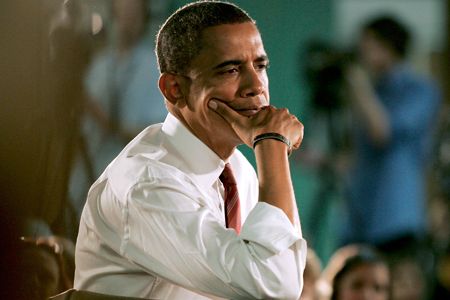
US President Barack Obama’s popularity has dropped by three percentage points in the past two weeks, now standing at 39 percent, according to results of a new poll.
A Zogby Interactive poll released on Tuesday indicates that Obama’s approval rating equals a low since he took office at 39 percent, while 63 percent of respondents think the US president is a weak leader compared to only 19 percent who regard him as a strong leader.
The latest poll comes after Obama agreed earlier in December to keep all of the Bush-era tax cuts for another two years in a bid to resolve differences with Republicans in Congress.
“It was a bad week for Obama’s relationship with his party’s base, which sees him giving in too easily to the Republicans,” John Zogby said in a statement.
According to the poll, 68 percent of those surveyed also believe that America is heading in the wrong direction.
The figures come as there are widespread assumptions that a string of government failures, including the failure to rein in the economic crisis in the US, the prolonged wars in Iraq and Afghanistan and the high unemployment rate in the country have largely contributed to the slippage in Obama’s popularity rate.
Against a backdrop of the worst recession since the Great Depression, which has driven many Americans out of workplace, the latest figures published recently by the US Federal Reserve show that the unemployment rate will remain at around 9.5 percent this year and 8.9 percent in 2011.
Obama’s healthcare reforms have also struck a snag as a federal court has ruled that a key part of the new bill is unconstitutional.
Obama’s average approval rating has declined in each quarter since he took office last year.
Bangladesh factory fire kills 20
Press TV – December 14, 2010

A fire has ripped through a garment factory in the Bangladeshi capital Dhaka, killing at least 20 workers and wounding over 100 others.
Around 5,000 people were at the factory when the fire broke out on the ninth floor.
About 50 people have been taken to hospital with severe burns. Many more are stranded on the roof of the 10-story building.
Police sources say others were injured in a stampede of hundreds of workers trying to escape to safety.
“It is a big fire and many workers are trapped on the roof of the building. We are mobilizing all our teams from around the city,” AFP quoted fire department Chief Abu Nayeem as saying.
Fire teams have been mobilized from across the capital to control the blaze.
Fires are common in Bangladesh clothes factories. Scores of workers are killed each year due to fires sparked by substandard electrical wiring in these factories.
This comes as thousands of garment workers in Bangladesh have launched a strike over low wages and poor working conditions over the past months.
At least four workers died on December 12 after Bangladeshi police opened fire with live ammunition on protestors, who had demanded the implementation of a hike in the minimum wage, approved by the government and industry in July.
The violence in the Asian nation erupted after the government refused to increase the minimum wage from $27 to $73 a month.
Union officials have argued that the pay rise is not sufficient to ensure a minimum standard of living for workers in the face of surging prices.
The Fix Is In: Expect Democrats to Buckle
By Stephen Lendman | December 12, 2010
The criminal class in Washington is bipartisan. On core issues, Democrats are no different from Republicans. Expect more bluster before caving like Obama, enacting his deal with the devil worth up to $1 trillion dollars. The lion’s share goes to corporations and America’s wealthy, middle and low income workers getting crumbs. The fix is in. It’ll happen, promoted as stimulus to create jobs and revive economic growth. Not so. More on that below.
Given the makeup of both Houses, their voting records aren’t surprising. Getting reelected counts most. Under a corrupted electoral system, generous funding is needed, but wealthy and corporate donors expect lavish favors in return. They get them and much more.
As a result, Congress capitulates on virtually everything big money wants. Expect it again. Besides more handouts, preserving their tax breaks are key. Most congressional members, in fact, want their own kept. Otherwise, they’ll face big increases they don’t want and can avoid by benefiting from what they give millionaires, their own class. Read on.
Both the House and Senate are infested with millionaires. For some, their net worth exceeds $100 million. House examples include:
— Rep. Darrell Issa (R. CA), his maximum net worth estimated at $451 million;
— Rep. Jane Harman (D. CA), hers is $435 million;
— Speaker Nancy Pelosi (D. CA) up to $124 million; and
— Rep. Rosa DeLauro (D. CT), the House’s 25th richest member with nearly $27 million.
Senate ones include:
— John Kerry (D. MA) – heir through his wife to the HJ Heinz fortune; among their possessions, they own five homes with values well over $1 million each, the most expensive worth more than $9 million; he can afford them with a maximum net worth of $295 million;
— Mark Warner (D. VA), his at $283 million;
— Herb Kohl (D. WI), up to $231 million;
— Jay Rockefeller (D. WVA) at $136 million;
— Diane Feinstein (D. CA) $108 million;
— Minority Leader Mitch McConnell (R. KY) a meager $33 million; and
— the Senate’s 25th richest member – Ron Wyden (D-OR) a paltry $7 million.
No wonder the body is called a millionaires club. In fact, a multimillionaire’s one, hardly anyone not rich gets in.
On November 25, 2009, The New York Times Economix section headlined, “Your Senator Is (Probably) a Millionaire,” saying:
In 2008, about “two-thirds of United States senators were millionaires,” according to a Center for Responsive Politics (Open Secrets.org) analysis. In 2009, over half of House and Senate members reported net worth wealth at more than $1 million, 55 $10 million or more, and eight over $100 million.
In 2009, the median net worth of House members was $765,010, up from $645,503 in 2008. In the Senate, it was $2.38 million, compared to $2.27 million the previous year.
Most have considerable wealth. They want it preserved and increased, including by paying no more taxes than necessary, and in some cases, less if they can get away with it. One of Rep. Charles Rangel’s transgressions was not reporting rental income from a Dominican Republic vacation property as well as hundreds of thousands of dollars in additional income and assets on his financial disclosure statements. Perhaps also to the IRS, thinking he was too important to audit.
Open Secrets estimates Obama’s 2009 net worth at up to $7.7 million. Expect that figure to grow substantially, especially after leaving office. Estimates put Bill Clinton’s wealth at $200 million, his wife Hillary another $35 million. Who said public service doesn’t pay well?
Obama’s Full Court Press for Passage
Calling Obama an embattled president, Washington Post writer Dan Balz headlined, “Bill Clinton takes the White House stage, again,” saying:
To sell his tax deal, he got center stage, first together, “then solo in the White House briefing room, as Obama slipped away to a holiday party.” On a Friday afternoon, it “was certainly a head-turner,” Clinton “look(ing) like he might never leave, as he fielded questions” from an eager press corp.
His message:
“The agreement taken as a whole is, I believe, the best bipartisan agreement we can reach to help the largest number of Americans and to maximize the chances that the economic recovery will accelerate and create more jobs and to minimize the chance that it will slip back.”
Prodding Democrats, he urged setting aside disagreements for the sake of the country and economy. Save your fights for later, he said, when Republicans try repealing other legislation they oppose.
On December 10, it was all Clinton, “still the center of attention and doing what he likes to do best,” trying to get Obama’s deal passed.
The Wall Street Journal was nonplussed, an editorial headlined, “Clinton and Obama for Bush,” said:
“We thought we’d seen everything in politics, but yesterday was truly miraculous: There in the White House press room was none other than former Democratic President Bill Clinton (with Obama) endors(ing) the” Bush era tax cuts, trying to mobilize reluctant Democrats and the party’s base for support.
On December 11, Wall Street Journal writer Jonathan Weisman called it “back to the future in the West Wing,” the “original practitioner of ‘triangulation.’ ” He called it compromise, saying “People do not see principled compromise as weakness. (It’s) an ethical thing to do.”
In fact, it’s a sellout. He won’t say it, nor Obama or supportive Democrats, even Bernie Sanders for eight hours on the Senate floor, performing rhetorically at best. Real filibusters don’t quit without succeeding. According to Senate historian Donald Ritchie, they occur “to prevent the majority from casting a vote.” Sanders spoke on Friday. A Monday vote is scheduled. Doing it then is what counts with others holding the floor nonstop.
Instead, after what he called “a long speech,” he concluded saying:
If “the American people are prepared to stand – and we’re prepared to follow them – I think we can defeat this proposal. I think we can come up with a better (one) which better reflects the needs of the middle class and working families of our country and, to me, most importantly, the children of our country. And with that, Madam President, I would yield the floor.”
No assertion he’ll be back on Monday, staying there with others uncompromisingly to kill the deal for a better one American families deserve. Instead, rhetorical bluster substitutes for resolute action, assuring wealth again defeats popular need. Democrats are as culpable as Republicans, showing not a dime’s worth of difference between them at voting time when it counts.
Another Big Gun for the Deal – David Broder
An earlier article exposed him as a symbol of major media depravity, accessed through the following link:
http://sjlendman.blogspot.com/2010/11/david-broder-symbol-of-major-media.html
Called the “dean” of political journalists, he’s distinguished more for supporting power and privilege than delivering real journalism, his December 8 column the most recent example headlined, “Obama takes his case to the independent center,” saying:
“In opting to accommodate reality by acceding to the Republican demand for maintaining all the Bush tax cuts (ones benefitting Broder greatly) and obtaining a better price than many expected for his concessions, Obama (did) almost all that is possible to create a favorable economic environment for the 2012 campaign. (That’s) a winning posture for a president seeking a second term, (placing himself) in the center of the American political spectrum.”
In fact, he’s far to the right of center, even further by his latest deal, proposing more wealth to those already with too much. He’s offering most to fat cats and corporate favorites, chump change by comparison to working Americans.
Broder, however, wants more – “tough love budgetary changes outlined by the presidential commission on deficits,” hitting ordinary American hard while lavishing more benefits on the rich and corporate America. He called it comparable to Clinton signing welfare reform in 1996, stiff-arming the nation’s poor, including many single mothers with children sacrificed to win votes for a second term. “This was (Obama’s) best showing….in many months,” selling out to power and privilege for the same thing.
Broder, so-called pundits, other corporate media writers, and some progressive ones won’t explain it, including Nation magazine editor Katrina vanden Heuvel. She’s an establishment figure, a regular on corporate TV, a Council on Foreign Relations (CFR) member, and unabashed Obama supporter, even when criticizing as she did in her December 7 Washington Post op-ed headlined, “Obama’s disastrous path,” reciting a checklist of objectionable policies, including, saying he’s:
“on the verge of kowtowing to Republican bluster and cutting a deal to extend (Bush era) tax cuts for the rich in exchange (one hopes) for extending unemployment insurance,” implying giving up lots for a little is OK.
Then despite criticizing his current course, while stopping short of condemning and exposing it as hard right, she inflated him unjustly, saying he “has a historic mandate” like Lincoln to end slavery or Roosevelt during the Great Depression. Otherwise, he “risks a failed presidency.” She’s, in fact, clueless how corrupted, lawless, and failed he’s been for nearly two years, a record of shame, assuring his status as one of America’s worst ever leaders, serving power, not loyal constituents who elected him, the same ones again being betrayed.
Vanden Heuvel, other Nation writers, and more from the progressive left think Obama is one of them. Their level of intellectual dishonesty is shocking. Calling it blindness is too kind, including Christopher Hayes in the Nation’s December 27 issue headlined, “Tax Cuts Forever,” criticizing the deal, but saying:
“They know the economy needs more stimulus, and that Republicans are loath to allow them to deliver it. Through this deal they were able to secure some stimulative tax cuts….At this point, the White House will take what it can get,” or in other words bad deals are OK to get something.
“Obama didn’t create this system, but he is making it stronger before our eyes,” for capital, not working Americans, suckered into a bad deal Hayes won’t admit or maybe understand. Economist David Rosenberg does, calling it “a neutral for the economy,” not stimulus to create jobs and revive growth.
Progressive writers, not Obama, have “a historic mandate” to expose a failed president, a servant of wealth and power, an elitist, a corporatist betraying his base. He’s beyond rehabilitation. He and the entire Congress needs replacing for of, by and for the people governance. Try reading that in the Nation or most other left of center publications.
Democrats like Republicans are shameless. Their record belies their rhetoric. They’ll display it again next week, capitulating like always to wealth and power, calling it the best deal for Americans that they could get. For themselves, other rich folks, and their corporate allies for sure.
Stephen Lendman lives in Chicago and can be reached at lendmanstephen@sbcglobal.net. Also visit his blog site at sjlendman.blogspot.com
Featured Video

Anthrax War – CBC The Passionate Eye
or go to
Aletho News Archives – Video-Images
Book Review
Shattered Dreams: The HPV Vaccine Exposed (2019)
By Christina England – 30 Q&As – Book Review & Summary
Lies are Unbekoming | September 4, 2026
… Gardasil received FDA fast-track approval in 2006, Cervarix followed in 2009, and Gardasil 9 was approved in December 2014 with more than double the aluminium adjuvant content of the original. The commercial context is specific. Merck was about to lose patent protection on Zocor and faced $18 billion in Vioxx injury claims from a cardiovascular drug the company had marketed while suppressing its own data showing a five-times increase in heart attacks. Analysts projected the global HPV vaccine market at $4 billion by 2011, contingent on government-funded national programs for teenage girls. The 1986 National Childhood Vaccine Injury Act had already granted manufacturers complete liability immunity. By 2013, Japan had withdrawn its HPV vaccine recommendation after cataloguing severe adverse reactions in hundreds of girls. No Western government followed. The establishment position across the UK, US, Australia, and most of Europe held, and still holds, that the vaccines are safe and effective, that reported injuries are coincidental, and that cervical cancer prevention justifies the program. The book was published into this position, not against a vacuum.
Shattered Dreams sits alongside Mary Holland’s The HPV Vaccine On Trial and Viera Scheibner’s foundational vaccination work as part of the documented record on what has been done to a generation of teenage girls under the banner of cancer prevention. The full summary unpacks three specific findings: that Merck used the aluminium adjuvant itself as the “placebo” control in 92.5% of trial subjects, making it structurally impossible to detect excess reactions from the adjuvant; that Dr. Sin Hang Lee found HPV DNA fragments bound to aluminium in every one of sixteen Gardasil samples tested, and in the blood and spleen of a New Zealand girl six months after her third dose; and that in every country with high vaccination coverage, including Australia, the UK, Norway, and Sweden, cervical cancer rates have stopped declining and started rising specifically in the vaccinated cohort. Martínez-Lavín’s 2017 calculation puts the number needed to seriously harm with Gardasil 9 at 140, and the number needed to vaccinate to prevent one case at 1,757. Thirteen young women are seriously harmed for every one who benefits. The vaccine was approved on the basis of trials that could not detect what the trials were supposed to detect, and it is still being given to twelve-year-olds today. … Read full review
Blog Roll
 Aletho News
- Georgia’s Largest Healthcare System Will Fire Employees Who Refuse Flu Vaccine
- The Five-Year Fuel Crisis: Why the World Economy Is Paying for a War It Thinks Is Ending
- Trump’s Big Bluff on Iran
- Swiss scammed out of millions by Ukraine-linked call centers – media
- Germany facing potential ‘violent conflict’ with Russia – spy chief
- Ukraine’s EU neighbors reject new plea from Kiev – Politico
- British Transport Police Facial Recognition Trial Scanned 926,912 People With Zero Arrests
- House Bill Would Ban Federal Use of Flock ALPR Data
- Can a Spice Rival a Drug? 10 Head-to-Head Trials Put It to the Test.
- The oil routes around Hormuz face their own chokepoints
- If Americans Knew
- “We See Our Homes Now From A Satellite, Like Strangers”
- Watch “Gaza: Doctors Under Attack”, originally censored by BBC
- NAZA: Israeli embassies in UK and US promote rival documentary to challenge Gaza genocide allegations
- David Ellison appoints Israeli to lead merged Paramount-Warner studios
- Turkish Red Crescent helps elderly Gaza man walk again after Israel confiscates his prosthetic limb
- Four Palestinians Killed in Israeli Attacks in Gaza
- Two Palestinian youths killed and village razed as Israeli attacks on West Bank continue
- Two more Christian women innocent victims of Gaza raids
- Cruelty, Deprivation, Indignity: A Journalist’s 22 Months in Israeli Prison
- New IDF Website Frames Slain Gaza Journalists as Terrorists
- No Tricks Zone
- Latest European Green Energy Debacle; Portugal’s Largest Flagship Solar Park Insolvent!
- Green Energy Debacle: German Expert Professor Fritz Vahrenholt Warns Of Severe Economic And Social Consequences
- Two More Paleo Reconstructions Affirm Meters-Higher Sea Levels Across Ireland, Brazil 7000-6000 Years Ago
- New Study: Earth And Venus Surface Warmth Largely Explained By Convection And Lapse Rate, Not CO2 Or Radiation
- 2025 Nature Paper Claiming Worsening Global Drought Gets RETRACTED …Heavily Flawed
- New Study: ‘Global Drought Shows No Detectable Recent Acceleration Under Climate Warming’
- Economic Masterminds: German Socialists Suggest Taxing Productivity Gains Stemming From Using AI
- The South China Sea Has Not Been Cooperating With The Climate Change Narrative
- Energy Crisis: Germany Enters Heating Season With Historically Low Gas Reserve Fill Levels
- New Study: The Antarctic Ice Sheet Gained Mass From 2020-2024 Due To Staggering Snow And Ice Accumulation

