The Media & the WWF Torture Scandal
News organizations have turned their own journalists into WWF cheerleaders
By Donna Laframboise | Big Picture News | March 20, 2019

Click for source
Earlier this month, BuzzFeed published a three-part exposé about violent goons, funded and equipped by the World Wildlife Fund (WWF), who persecute indigenous communities. In the words of the BuzzFeed journalists, the WWF
works directly with paramilitary forces that have been accused of beating, torturing, sexually assaulting, and murdering scores of people. As recently as 2017, forest rangers at a WWF-funded park in Cameroon tortured an 11-year-old boy in front of his parents…
UK politicians have called on the government to respond to these “appalling and deeply disturbing” allegations. US senator Patrick Leahy has likewise demanded an “immediate and thorough review” of the support the WWF receives from American authorities.
BuzzFeed reports that the UK Charity Commission will be asking the WWF “serious questions.” Also in the UK, explorer Ben Fogle has stepped away from his public relationship with this organization, due to these “very serious human rights allegations.”

Longtime WWF supporter, actress Susan Sarandon, says she expects an “in-depth investigation” to take place.
Likewise, the Leonardo DiCaprio Foundation has called on the WWF to “provide the public with a full and transparent accounting of their findings.” (In 2016, DiCaprio – who sits on the WWF’s Board of Directors in the United States, symbolically ‘shared‘ his 2016 Golden Globe award “with all the First Nations peoples represented in this film and all the indigenous communities around the world.”)
Despite the celebrities, the prominence of the WWF brand, and the serious nature of these allegations, much of the media has chosen to ignore this story. Could that have anything to do with the fact that news organizations have spent the past decade turning their own journalists into WWF cheerleaders?
Here in Canada, our largest circulation newspaper, The Toronto Star, has served as an official sponsor of the WWF’s annual Earth Hour (see this 2008 discussion, and this from 2012).
Think about that cozy, inappropriate relationship – and then ask yourself why The Star has yet to tell its readers about the WWF torture scandal.
Since its Australian beginnings, Earth Hour was a deliberate media creation. Rather than reporting neutrally on current affairs, rather than applying an equally skeptical eye to all large multinational entities (WWF, come on down), news organizations instead promote certain events, certain entities, and certain environmental perspectives.
The flip side of that pathological arrangement is that these same news organizations also have the power to decide what isn’t news. Every single day, they decide what not to tell the public.
Militarised Conservation: Paramilitary Rangers and the WWF
By Binoy Kampmark | Dissident Voice | March 6, 2019
Think charity, think vulnerability and its endless well of opportunistic exploitation. Over the years, international charity organisations have been found with employees keen to take advantage of their station. That advantage has been sexual, financial and, in the case of allegations being made about the World Wild Life Fund for Nature, in the nature of inflicting torture on those accused of poaching.
BuzzFeed, via reporters Tom Warren and Katie J.M. Baker, began the fuss with an investigative report claiming instances of torture and gross violence on the part of rangers assisted by the charity to combat poaching. It starts with a description of a dying man’s last days, one Shikharam Chaudhary, a farmer who was brutally beaten and tortured by forest rangers patrolling Chitwan National Park in Nepal. Shikharam, it seems, had been singled out for burying a rhinoceros horn in his backyard. The horn proved elusive, but not the unfortunate farmer, who was detained in prison. After nine days, he was dead.
Three park officials including the chief warden were subsequently charged with murder. WWF found itself in a spot, given its long standing role in sponsoring operations by the Chitwan forest rangers. As the BuzzFeed report goes on to note, “WWF’s staff on the ground in Nepal leaped into action – not to demand justice, but to lobby for the charges to disappear. When the Nepalese government dropped the case months later, the charity declared its victory in the fight against poaching. Then WWF Nepal continued to work closely with the rangers and fund the park as if nothing had happened.”
The report does not hold back, insisting that the alleged murder of the unfortunate Shikharam in 2006 was no aberration. “It was part of a pattern that persists to this day. In national parks across Asia and Africa, the beloved non-profit with the cuddly panda logo funds, equips, and works directly with paramilitary forces that have been accused of beating, torturing, sexually assaulting, and murdering scores of people.”
The poach wars are a savage business, throwing up confected images of heroes and villains. They do not merely involve the actions of protecting animals, but military-styled engagements where fatalities are not uncommon. Anti-poaching has become a mission heralded by the romantically inclined as indispensable, its agents to be celebrated. Desperate local conditions are conveniently scrubbed out in any descriptions: there are only the noble rangers battling animal murderers.
The Akashinga, for instance, are an anti-poaching enterprise of 39 women operating in Zimbabwe who featured with high praise in a report from the ABC in October last year. Who are the victims, apart from the animals they protect? There is little doubt in the minds of the reporters: the women themselves, victims of assault, many single mothers from Nyamakate. Laud them, respect their mission.
It is clear that these women are feted warriors, armed and given appropriate training. They “undergo military-style training in unarmed combat, camouflage and concealment, search and arrest, as well as leadership and conservation ethics.” Their source of encouragement and support is Damien Mander, formerly a military sniper and founder of the International Anti-Poaching Foundation.
Mander’s own laundry list for being a “good anti-poaching ranger”, as featured in an interview to the Hoedspruit Endangered Species Centre in 2015, is unvarnished: “A passion for nature, strong paramilitary base, and ability and willingness to work in hostile environments for extended periods of time as part of a team.”
The line between the mission of charity and its mutation into one of abuse is tooth fine. In February 2018, The Times, assisted by information supplied by whistleblowers, sprung the lid off Oxfam GB workers in Haiti, suggesting that charity workers had received sexual favours for payment in the aftermath of the Haiti earthquake. (Nothing like a crisis that breeds opportunity.) It was duly revealed that the organisation had done its level best to conceal the fact. The UK International Development Secretary Penny Mordaunt’s statement to Parliament in February took most issue with the latter. “In such circumstances we must be able to trust organisations not only to do all they can to prevent harm, but to report and follow up incidents of wrongdoing when they do occur.”
In the course of its conduct, Oxfam did not, according to Mordaunt, furnish the Charity Commission with a report on the incidents. Nor did the donors receive one. The protecting authorities were also left in the dark on the subject.
Defences have been mounted by those working in the aid sector. Mike Aaronson, writing in August last year, pleaded the case that aid organisations were being unduly singled out, the scape goats of moral outrage and privileged ethics. “Aid organisations carry a lot of risk, operating in chaotic and stressful environments where in trying to do good they can end up doing harm.” In condemning them, it was easy to ignore the fact that they had “done most to address the issue”.
The WWF situation, which has moved the matter into the dimension of animal protection and conservation, has hallmarks that are similarly problematic with the humanitarian sector in general. And the reaction of the organisation has also been fairly typical, laden with weasel-worded aspirations. “At the heart of WWF’s work are places and people who live with them,” an organisation spokesman for WWF UK asserted in response to the allegations. “Respect for human rights is at the core of our mission.” There were “stringent policies” in place to safeguard “the rights and wellbeing of indigenous people and local communities in the places we work.”
Students of the broad field of humanitarian ventures suggest four instances where militarisation takes place. Charities and relief organisations have become proxy extensions in armed conflict (consider Nicaragua and Afghanistan during the 1980s); creatures of embedment (the Red Cross in the World Wars); agents of “self-defence” – consider the Order of Saint John of Jerusalem in the twelfth century; and engaged in direct conflict (the International Brigades of the Spanish Civil War).
The WWF case suggests a direct connection between the mission of a charitable organisation and its captivation by a dangerous militancy. It has become a sponsor, and concealer, of vigilante action, obviously unabashed in cracking a few skulls in the name of shielding protected species. Along came the networks of informants, surveillance and exploiting local issues. No longer can this be regarded a matter of altruistic engagement in the name of animal conservation; it is a full-fledged sponsorship of a paramilitary operation with all the incidental nastiness such an effort entails.
Japanese PM Abe set to ignore local referendum on US Okinawa military base relocation
RT | February 23, 2019
Japanese Prime Minister Shinzo Abe has said his government will press ahead with the controversial relocation of a US military base on the island of Okinawa, despite local objection.
Okinawa is home to two-thirds of the US’ Japanese bases. Tokyo wants to relocate one of these – US Marine Corps Air Station Futenma, located in a densely populated area – to the more remote coastal area of Henoko. While residents near the base have been angered by a series of aircraft accidents, they also oppose the relocation to Henoko, claiming that planned land-reclamation works there will devastate the coral-rich coastal environment.
Okinawans will vote on the relocation on Sunday in a non-binding referendum, with nearly 70 percent expected to vote ‘No,’ according to a poll by Kyodo News. Okinawa’s Governor Denny Tamaki, who campaigned on an anti-base platform last year, has also traveled to Washington DC to lobby against the move.
The Japanese government intends to go ahead with the relocation “without being swayed by referendum results,” Abe told parliament on Wednesday.
Many Okinawans are unhappy with the base’s current location, as well as the planned relocation. They hope a ‘No’ vote will force the government to move the base off the island altogether.
The behavior of US troops stationed on Okinawa has also incensed locals, with the 1995 kidnap and gang-rape of a 12-year-old girl by three US soldiers triggering mass protests on the island. Two cases of rape and murder by US troops again caused protests in 2016. One year later, Okinawa was back in the news after a drunk Marine plowed his truck into another vehicle while running a red light, killing an elderly Japanese man.
Germany Pulls Rank on Macron and American Energy Blackmail
By Finian CUNNINGHAM | Strategic Culture Foundation | 13.02.2019
It was billed politely as a Franco-German “compromise” when the EU balked at adopting a Gas Directive which would have undermined the Nord Stream 2 project with Russia.
Nevertheless, diplomatic rhetoric aside, Berlin’s blocking last week of a bid by French President Emmanuel Macron to impose tougher regulations on the Nord Stream 2 gas project was without doubt a firm rebuff to Paris.
Macron wanted to give the EU administration in Brussels greater control over the new pipeline running from Russia to Germany. But in the end the so-called “compromise” was a rejection of Macron’s proposal, reaffirming Germany in the lead role of implementing the Nord Stream 2 route, along with Russia.
The $11-billion, 1,200 kilometer pipeline is due to become operational at the end of this year. Stretching from Russian mainland under the Baltic Sea, it will double the natural gas supply from Russia to Germany. The Berlin government and German industry view the project as a vital boost to the country’s ever-robust economy. Gas supplies will also be distributed from Germany to other European states. Consumers stand to gain from lower prices for heating homes and businesses.
Thus Macron’s belated bizarre meddling was rebuffed by Berlin. A rebuff was given too to the stepped-up pressure from Washington for the Nord Stream 2 project to be cancelled. Last week, US ambassador to Germany Richard Grenell and two other American envoys wrote an op-ed for Deutsche Welle in which they accused Russia of trying to use “energy blackmail” over Europe’s geopolitics.
Why France’s Macron, at the last minute, attempted to undermine the project by placing stiffer regulations is a curious question. Those extra regulations if they had been imposed would have potentially made the Russian gas supply more expensive. As it turns out, the project will now go-ahead without onerous restrictions.
In short, Macron and the spoiling tactics of Washington, along with EU states hostile to Russia, Poland and the Baltic countries, have been put in their place by Germany and its assertion of national interests of securing economical and abundant gas supply from Russia. Other EU member states that backed Berlin over Nord Stream 2 were Austria, Belgium, Cyprus, Greece and the Netherlands.
Washington’s claims that Nord Stream 2 would give Russia leverage of Europe’s security have been echoed by Poland and the Baltic states. Poland, and non-EU Ukraine, stand to lose out billions of dollars-worth of transit fees. Such a move, however, is the prerogative of Germany and Russia to find a more economical mode of supply. Besides, what right has Ukraine to make demands on a bilateral matter that is none of its business? Kiev’s previous bad faith over not paying gas bills to Russia disbars it from reasonable opinion.
Another factor is the inherent Russophobia of Polish and Baltic politicians who view everything concerning Russia through a prism of paranoia.
For the Americans, it is obviously a blatant case of seeking to sell their own much more expensive natural gas to Europe’s giant energy market – in place of Russia’s product. Based on objective market figures, Russia is the most competitive supplier to Europe. The Americans are therefore trying to snatch a strategic business through foul means of propaganda and political pressure. Ironically, the US German ambassador Richard Grenell and the other American envoys wrote in their recent oped: “Europe must retain control of its energy security.”
Last month, Grenell threatened German and European firms involved in the construction of Nord Stream 2 that they could face punitive American sanctions in the future. Evidently, it is the US side that is using “blackmail” to coerce others into submission, not Russia.
Back to Macron. What was he up to in his belated spoiling tactics over Nord Stream 2 and in particular the attempted problems being leveled for Germany if the extra regulations had been imposed?
It seems implausible that Macron was suddenly finding a concern for Poland and the Baltic states in their paranoia over alleged Russian invasion.
Was Macron trying to garner favors from the Trump administration? His initial obsequious rapport with Trump has since faded from the early days of Macron’s presidency in 2017. By doing Washington’s bidding to undermine the Nord Stream 2 project was Macron trying to ingratiate himself again?
The contradictions regarding Macron are replete. He is supposed to be a champion of “ecological causes”. A major factor in Germany’s desire for the Nord Stream 2 project is that the increased gas supply will reduce the European powerhouse’s dependence on dirty fuels of coal, oil and nuclear power. By throwing up regulatory barriers, Macron is making it harder for Germany and Europe to move to cleaner sources of energy that the Russian natural gas represents.
Also, if Macron had succeeded in imposing tougher regulations on the Nord Stream 2 project it would have inevitably increased the costs to consumers for gas bills. This is at a time when his government is being assailed by nationwide Yellow Vest protests over soaring living costs, in particular fuel-price hikes.
A possible factor in Macron’s sabotage bid in Germany’s Nord Stream 2 plans was his chagrin over Berlin’s rejection of his much-vaunted reform agenda for the Eurozone bloc within the EU. Despite Macron’s very public amity with Chancellor Angela Merkel, Berlin has continually knocked back the French leader’s ambitions for reform.
It’s hard to discern what are the real objectives of Macron’s reforms. But they seem to constitute a “banker’s charter”. Many eminent German economists have lambasted his plans, which they say will give more taxpayer-funded bailouts to insolvent banks. They say Macron is trying to move the EU further away from the social-market economy than the bloc already has moved.
What Macron, an ex-Rothschild banker, appears to be striving for is a replication of his pro-rich, anti-worker policies that he is imposing on France, and for these policies to be extended across the Eurozone. Berlin is not buying it, realizing such policies will further erode the social fabric. This could be the main reason why Macron tried to use the Nord Stream 2 project as leverage over Berlin.
In the end, Macron and Washington – albeit working for different objectives – were defeated in their attempts to sabotage the emerging energy trade between Germany, Europe and Russia. Nord Stream 2, as with Russia’s Turk Stream to the south of Europe, seems inevitable by sheer force of natural partnership.
On this note, the Hungarian government’s comments this week were apt. Budapest accused some European leaders and the US of “huge hypocrisy” in decrying association with Russia over energy trade. Macron has previously attended an economics forum in St Petersburg, and yet lately has sought to “blackmail” and disrupt Germany over its trade plans with Russia.
As for the Americans, their arrant hypocrisy is beyond words. As well as trying to dictate to Europe about “market principles” and “energy security”, it was reported this week that Washington is similarly demanding Iraq to end its import of natural gas from neighboring Iran.
Iraq is crippled by electricity and power shortages because of the criminal war that the US waged on that country from 2003-2011 which destroyed much of the country’s infrastructure. Iraq critically needs Iranian gas supplies to keep the lights and fans running. Yet, here we have the US now dictating to Iraq to end its lifeline import of Iranian fuel in order to comply with the Trump administration’s sanctions against Tehran. Iraq is furious at the latest bullying interference by Washington in its sovereign affairs.
The hypocrisy of Washington and elitist politicians like Emmanuel Macron has become too much to stomach. Maybe Germany and others are finally realizing who the charlatans are.
Hastily-Buried Radioactive Waste Lays Bare Nuclear Power Legacy
Sputnik – 11.02.2019
Over 126,000 barrels of radioactive material are stored in the Asse mine in Lower Saxony, a state in northwest Germany bordering the North Sea, a fact that has many locals – as well as the global anti-nuke community – frustrated.
Manfred Kramer, a member of the Social Democratic Party of Germany, lives close to the Asse salt mine in which the decaying waste is stored and — while acknowledging that politicians are finally beginning to take notice — has long protested against having radioactive waste in the old mine, Tekportal reported.
“It’s nice that she’s finally coming,” Kramer said, referring to Environment Minister Svenja Schulze’s upcoming visit to the mine, which was originally used for the extraction of potash salt until 1965. “Soon she’ll have been in office for a year. It sure took a while!” he quipped, according to Deutsche Welle.
“Three generations operated nuclear power in Germany, and now 30 generations or even more will have to suffer the consequences,” Schulze noted, adding, “this is proof of how irresponsible nuclear energy was.”
According to mining engineer Thomas Lautsch, who works for BGE, Germany’s federal company for radioactive waste disposal, the retrieval of the nuclear waste from the mine will be complicated and expensive, at a minimum.
“We would have to build a retrieval mine, which is more than simply just a new shaft. We would also need an interim storage facility for the waste, and we would have to create many new shafts to gain access to the individual chambers,” he said, cited by Msn.com.
The construction phase of the project alone could take eight or nine years, according to studies.
Because the old mine shafts do not meet current legal standards for the ten-thousand-year storage of nuclear waste, a new mine must be built around the old mine.
“The barrels must be finally and safely disposed of somewhere else in the country,” Kramer noted, “should they actually able to be retrieved by 2050.”
The mine, developed between 1906-1908, has a depth of around 765 meters. Between 1965-1995, the Helmholtz Zentrum München (a member of the Helmholtz Association of German Research Centers responsible for studying environmental health issues) took the unprecedented step of using the mine to store the nation’s radioactive waste, including weapon detritus, medical offal and power plant leavings.
Phantom investigation? France delays report on mystery cases of babies born without arms
RT | January 31, 2019
France’s public health agency has postponed the release of a report on an investigation into the abnormal numbers of babies being born without arms in rural regions — a medical mystery which has baffled experts.
Three infants were born with no arms between June and November 2016 within a 30km radius of Vitrolles in the Bouches-du-Rhône region. That followed another cluster of cases near the area of Ain, where eight babies were born with the defect within a 17km radius. Similar cases have also been observed in other regions of rural France.
A nationwide investigation into the phenomenon began last October and the government had promised an update by January 31, but that date was suddenly pushed back — and the parents of affected children are becoming impatient and suspicious.
In an open letter to public health officials, a group of parents expressed doubts about the ongoing investigation and said their questions have “never had clear answers.” They accused the government of focusing on explanations which have already been dismissed by another public health body which researches cases of malformation.
Santé Publique France, the national health agency, previously conducted an investigation before the latest spate of cases — but that investigation concluded that there had not been an excessive level of incidents in Ain and that no further investigation was needed. Other experts, however, said the number of cases in Ain was 58 times the normal statistical amount.
Remera, the health body which looks into instances of malformation, carried out its own investigation in 2018. As part of it, mothers were interviewed with a “very extensive questionnaire” about their lifestyles to see if there were any similarities between their pregnancies. This led doctors to dismiss genetics, drugs, and alcohol as potential causes for the missing limbs.
Emmanuelle Amar, the director of Remera in the south east of France concluded that the “only thing they have in common is that they all live in a very rural area.” Remera therefore dismissed the likelihood of the malformations as being down to chance — as the government agency previously suggested — as “more than infinitesimal.”
Remera believes that harmful pesticides in wide use in rural areas of France are the most likely culprit. The mystery remains unsolved, but the possible link to agriculture is given weight by the fact that around the same time the cases were observed in Ain, several calves and chickens were born with missing limbs in the area. Amar told RT that authorities didn’t want to listen to Remera’s concerns, however.
Aurelie Bingler, the mother of one girl born without her hand, also spoke to RT. “I want to know why she was born like that, because mothers blame themselves. We think it may come from us or that we did something wrong,” she said. Bingler believes, too, that there is probably a link to farming.
We are surrounded by agriculture, fields, so we naturally wonder about the use of pesticides. Why doesn’t it happen to people who live in the city? There must be a link to agriculture.
Former French environment minister Corinna Lepage told RT there was probably a “fear of discovering that the causes could endanger a number of economic interests.”
Forgotten Uranium Mine Workers
By Jacquetta Harvey | January 29, 2019
Uranium caused Cancer forced me to raise my children alone. I had to sell the home we were in and downsized. The mortgage company said I had no credit on my name alone. I had to pay my new (older used) truck because I had no credit alone. We had bought the truck and traded my car because it was easier to carry the wheelchair and get my husband seated in the higher seat. My husband had no right hip for the last 4 months and his left arm was in a sling and useless. The cancer had eaten through the bones on both his arm and hip. When he went into kidney failure from the cancer, every time his body jerked or he was moved he was having spontaneous fractures throughout his body.
Let me explain his cancer to you. Some of you may already know Multiple Myeloma. This is a cancer usually affects men and at the usual age of late 60’s to 70’s. My husband “E’ was 40 when it was found. Multiple Myeloma eats the bone marrow and continues eating the bone until it is as thin as an egg shell and that is when it breaks. When the Doctor found it “E” had compressed two vertebra from us moving a camper shell from our truck, he then broke a rib leaning against a truck side to pick up a small 2-3 inch spring. Then broke his left arm pulling the spring while installing it in the forklift he was working on. “E” continued to work during his “Radical Experimental” treatment, when he could.
Part II
Eventually the cancer took over his kidney which caused the kidney failure.
The Radical Treatment he agreed to do was a multitude of toxic chemicals that had a great success with Breast Cancer patients, so it was considered radical in the fact it hadn’t been used with Multiple Myeloma and for the huge amount they would give him. For 3 days he would be given a liter bag of Chemo Chemicals and saline. This would have to be put into a port that was placed straight into his heart because the chemicals would eat up/holes in his veins before it could go anywhere else in his body and do what was meant to do… Thus it was put straight into his heart via the port. The toxic chemical cocktail was to kill off all of his bone marrow. The third day we were to go straight home so he would not be exposed to even a cold germ in a big store, it could kill him. When his temperature spiked 103 we were to head straight to the hospital. He would be placed in a private room anyone coming into the room had to gown up and could not even have a sniffle. A hard plastic port to be used for the stem cell rescue was placed in his carotid artery and He would be placed on a type of dialysis machine that would “Harvest” his Stem Cells. These would then be placed in a freezable container with a chemo agent mixed in and frozen. We requested blood and stem cell donors from his job for the next few days. A notice was put up at work and the hospital was overrun with donors, they had had to send them to other blood banks and hospital’s. The blood he needed immediately, the stem cells would be re-infused in a few weeks after another kill off of his bone marrow.
In the hospital he called me before I drove our 45 minute drive. He asked me to bring clippers and scissors, he said the bed looked like he had slept with a cat or a dog. When our 11 year old son, 15 year old daughter and I walked in the room, E grabbed ahold of some hair on his head and then on his beard and pulled and it just came out. I worried it hurt but he said it didn’t. We sent the kids down to the cafeteria to grab lunch and I cut and shaved his hair. He lost all the hair on his body and he lost the top layer of his whole digestive tract from his mouth to his anus. He could not eat or drink without vomiting.
Part III later.
#uraniummineworkers #ihateit #death #cancer #governmentforgotthem #1971-2019 #raisingchildrenalone #lostchildhood #lonelysad
Less fallout, more danger: US ‘low-yield’ warhead pushes Doomsday Clock closer to midnight
RT | January 30, 2019
A new “low-yield” US warhead is less powerful than the bomb dropped on Hiroshima but more capable of igniting a nuclear conflict than bigger nuclear weapons, analysts believe.
Dubbed W76-2, the weapon is now being produced by the Pantex plant in Texas, according to Donald Trump’s nuclear posture review which he signed last year. The Trump administration – whose boss has already shown a fixation on building up nukes – claims the new “low-yield” warhead would give the US a more “flexible” deterrent.
The new “mini-nuke” has less velocity than the Hiroshima bomb as it was designed by taking away one stage from the original two-stage W76 thermonuclear device usually mounted on Trident ballistic missile. The new warhead’s explosive power was reduced from 100 kilotons of TNT, to around five.
Now, an enemy (Russia, for example) could no longer count on Washington being afraid of using its huge nuclear arsenal due to the unimaginable civilian casualties, the US administration says.
However, less damage doesn’t mean no damage at all as the ‘Little Boy’ bomb, which the US dropped on Hiroshima, killed up to 80,000 people in 1945.
Some US mainstream media noticeably voiced concerns about the new weapon and the impact it will have on international peace. Defense News, for instance, cited some non-proliferation advocates who argue “all nuclear weapons are strategic, not tactical.”
Some Democrats in Congress worry that installing a low-yield and high-yield warhead on the same missile creates a dangerous situation where an adversary cannot know which system is being used, the paper wrote. Therefore, it would react as if the larger and deadlier warhead has been launched.
That aside, the W76-2 could give birth to other low-yield projectiles, reducing the threshold for using nuclear weapons, Mikhail Khodarenok, a Russian military expert said. Such nuclear munitions could easily be launched from the B-21 Raider, a US heavy bomber currently under development by Northrop Grumman, or the F-35 jet, he believes.
Other pundits are already sounding the alarm about the danger of the US building low-yield nuclear weapons. “I think it is time for a new meeting of major countries that have nuclear weapons to develop a new treaty or a new agreement that restricts what can be developed and what cannot be developed,” General Paul Vallely, formerly second-in-command of the US Pacific Command told RT.
“The belief that there might be tactical advantage using nuclear weapons – which I haven’t heard that being openly discussed in the United States or in Russia for a good many years – is happening now in those countries which I think is extremely distressing,” former US defense secretary and an arms control advocate William Perry was quoted as saying by the Guardian. “That’s a very dangerous belief.”
US atomic bomb and missile tests crowded them onto Ebeye. Now their former Marshall Islands paradise is “the Slum of the Pacific.”

Photo by Vlad Sokhin shows North Camp, one of the most populated areas on Ebeye. Ebeye is the second most densely populated city in the world, home to at least 15,000.
By Vlad Sokhin | Beyond Nuclear International | November 25, 2018
The tiny island of Ebeye in Kwajalein Atoll, Marshall Islands, has a total area of 0.36 square kilometres and is home to over 15,000 people, most of whom were moved there from nearby islands because of a US Army missile range-testing program that was launched in the late 1940s. Overcrowding, poverty, outbreaks of infectious diseases and a high level of unemployment has led some to refer to Ebeye as the ‘ghetto of the Pacific’. Until the 1940s, the island’s population was negligible. During the Second World War, Japan occupied the Marshall Islands and moved some 1,000 settlers there and when the US captured the islands in 1944, a new naval base and the movement of people from other parts of the Atoll rapidly augmented Ebeye’s population.
In preparation for ‘Operation Crossroads’, an extensive missile testing programme that would eventually comprise 67 blasts, the US military decided to move all non-US personnel from around the Kwajalein Atoll onto Ebeye, which lies around five kilometres north of Kwajalein Island, the largest in the Atoll. On 1 March 1954, under the code name of ‘Castle Bravo’, the US military detonated a dry fuel hydrogen bomb on Bikini Atoll, in the north of the island chain, which was to be the most powerful nuclear device ever exploded by the United States. Though the Bikini Islanders had been persuaded to relocate to a neighbouring island in 1946, where they had suffered shortages and malnutrition, members of other nearby communities on Rongelap island were not evacuated until 3 days after the blast, causing many to suffer the effects of radiation sickness and birth defects.
Keen to return to their ancestral lands, Bikini islanders were tentatively allowed to come back to their homes three years after ‘Castle Bravo’ but had to be moved again after many developed leukaemia and thyroid tumours.
Over the coming decades, some islanders continued to return and try to reestablish their old communities but periodic tests of the soil, water and plant life on Bikini islands consistently suggested that the place had been so polluted by the nuclear fallout of ‘Castle Bravo’ and other tests that it was unsafe to live on the Atoll any longer. Many Bikini Islanders ended up on Ebeye, now the most densely populated of the Marshall islands, with the help of Greenpeace which in 1985 organised a mass evacuation from areas affected by fallout.
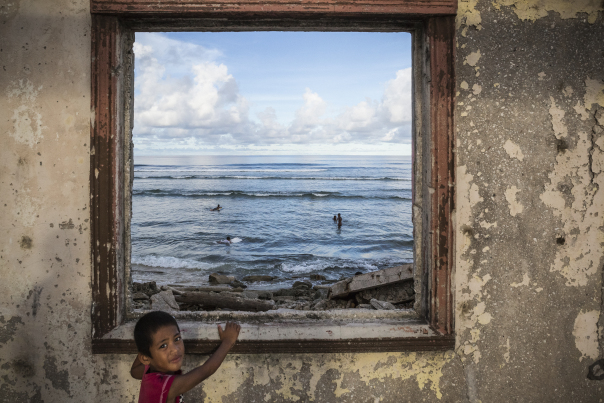
A child stands at the window opening in one of the many derelict houses on the island.
As the US nuclear testing programme developed and grew in the 1950s, most of the people living around the Kwajalein Atoll, where various US military installations that assist the nuclear test sites are based, were relocated from their homes and into a planned settlement on Ebeye. After they were joined by the ‘nuclear migrants’ from Bikini and other northern atolls, the poorly constructed settlements on Ebeye became increasingly crowded, leading to a polio outbreak in 1963, a measles outbreak in 1978 and regular occurrences of cholera, tuberculosis and other diseases up to the present day. The most overcrowded settlement of Northern Camp is a large shanty town without water supply or sewage system. Since much of the population is dependent on the service industry at US installations, unemployment is a major problem.
According to George Junior, a health worker at Ebeye’s hospital, ongoing missile testing around Kwajalein Atoll continues to impact on the health of local people. ‘When the Americans test their missiles and then the rain comes, the entire population of Ebeye gets sick. We have diarrhoea, flu and conjunctivitis. Such symptoms continue for 10 to 15 days and then everyone gets better until the next tests’ he says. And while US personnel enjoy excellent health care in places like Kwajalein Hospital, the majority of Ebeye residents who need emergency care are often referred to hospitals in Majuro, the administrative capital of the Marshall Islands, or to Manila or Hawaii since they do not have clearance to enter military installations.
Vlad Sokhin (Russia/Portugal) is a documentary photographer, videographer and multimedia producer. He covers social, cultural, environmental, health and human rights issues around the world, including post-conflict and natural disaster zones.
Featured Video

Trita Parsi: Israel Set a Trap for Total War in the Region
or go to
Aletho News Archives – Video-Images
From the Archive
Zionism’s Violent Legacy
By Donald Neff | Washington Report On Middle East Affairs | January 1996
On January 4, 1948, Jewish terrorists drove a truck loaded with explosives into the center of the all Arab city of Jaffa and detonated it, killing 26 and wounding around 100 Palestinian men, women and children.[1] The attack was the work of the Irgun Zvai Leumi – the “National Military Organization,” also known by the Hebrew letters Etzel – the largest Jewish terrorist group in Palestine. The Irgun was headed by Revisionist Zionist Menachem Begin and had been killing and maiming Arabs, Britons and even Jews for the previous ten years in its efforts to establish a Jewish state.
This terror campaign meant that at the core of Revisionist Zionism there existed a philosophical embrace of violence. … continue
Blog Roll
 Aletho News
- Trita Parsi: Israel Set a Trap for Total War in the Region
- Trump’s Iran war is on an Israeli leash
- Saudi oil boss issues global supply warning
- Riyadh Says Its Oil System Is Intact. The Numbers Say Otherwise.
- Trump and Netanyahu Want to “Finish the Job” on Iran
- US ‘one-sided dictation’ not Iran’s beliefs makes rational talks impossible: Baghaei
- Iran’s Next Strike May Not Explode. It Could Shut You Down /Col Doug Macgregor
- Iran: US political targets legitimate if assassinations return
- Iraq shuts key border crossing with Iran under US pressure: Report
- Undersea Internet cables could be targeted in retaliation for attacks on Iran: IRGC deputy chief
- If Americans Knew
- The Israel Lobby’s Changing Fortunes
- AIPAC has become such a political liability that it’s shifting to a more “nimble” approach to buying politicians
- At least 160 Israeli settler attacks in 2 weeks
- Will Gaza’s Ancient Christian Community Disappear Forever?
- Israel’s vision of regional security rests on keeping Arab states weak
- Heidi Levine recounts how Palestinian youths helped save her in settler attack
- DAILY UPDATE: Latest essential news on Palestine, Israel, & region
- Trump’s Intensifying Sabotage of the ICC, for Israel’s Sake
- Israeli military detain US and UK volunteers in West Bank including Democratic NY politician Brad Lander
- Americans at National Conservatism Conference held in Israel this year criticize Israel
- No Tricks Zone
- E-Cars Reduce CO2 Emissions By Only 41% Compared To Internal Combustion Engine Vehicles
- Predictions Made By Renowned Climate Professor Over Past Decades Have Been Proven To Be Poor
- New Study Suggests Large Regions Of The Pacific Ocean Have Been Cooling For The Last 80 Years
- Germany’s Green Energy Debacle: High Energy Costs Force Kahla Porzellan to Close After 182 Years!
- New Study: 50 Years Of The Most Aggressive ‘Net Zero’ Policies Can Only Affect The Global Climate By 0.03°C
- US September “Heat” Was No Record…Many Records Set Decades Ago
- Latest European Green Energy Debacle; Portugal’s Largest Flagship Solar Park Insolvent!
- Green Energy Debacle: German Expert Professor Fritz Vahrenholt Warns Of Severe Economic And Social Consequences
- Two More Paleo Reconstructions Affirm Meters-Higher Sea Levels Across Ireland, Brazil 7000-6000 Years Ago
- New Study: Earth And Venus Surface Warmth Largely Explained By Convection And Lapse Rate, Not CO2 Or Radiation

