60-DAY HORMUZ ARRANGEMENT CONFIRMED BY TEHRAN & OMAN — w/ Prof. Seyed Mohammad Marandi
Mario Nawfal | August 5, 2026
AIPAC spends $30m but fails to stop El-Sayed in Michigan
MEMO | August 5, 2026
The American Israel Public Affairs Committee (AIPAC) has suffered a major electoral defeat after Dr Abdul El-Sayed won Michigan’s Democratic Senate primary, crushing pro-Israel congresswoman Haley Stevens despite an unprecedented spending campaign on her behalf.
AIPAC’s super political action committee, the United Democracy Project, spent more than $30 million promoting Stevens and attacking El-Sayed, according to Federal Election Commission filings analysed by the New York Times. NBC News projected El-Sayed as the winner on Wednesday, dealing a major blow to the pro-Israel lobby’s efforts to determine the outcome of one of the most closely watched Democratic contests in the country.
El-Sayed campaigned against US military assistance to Israel and repeatedly highlighted AIPAC’s intervention in the race. Stevens, by contrast, received the backing of AIPAC and the Democratic Party establishment.
The result is seen as providing some of the clearest evidence yet that association with Israel and its powerful lobby groups is becoming a political liability among Democratic voters as opposition grows to Israel’s genocide in Gaza and the unconditional support it receives from Washington.
A New York Times investigation published before the primary result was announced revealed the scale of AIPAC’s transformation from a traditional lobbying organisation into one of the largest spenders in US elections.
Spending by AIPAC-affiliated political action committees on campaign advertising and voter outreach has more than doubled in less than five years, rising from $29.3 million to $67.2 million. Much of the money has been directed towards Democratic primaries, where the lobby has sought to defeat candidates who criticise Israel or question US military assistance to the occupation state.
However, the investigation uncovered a striking feature of AIPAC’s campaign strategy: it rarely reveals its connection to Israel.
Between April 2022 and the end of July, AIPAC-funded groups produced 109 television and digital adverts. Only six mentioned Israel. Instead, the adverts focused on issues such as abortion rights, the economy and the cost of living, despite being financed specifically to elect politicians who support Israel.
AIPAC’s reluctance to mention Israel is seen as a reflection of a deeper political problem: open association with the Israeli government has become increasingly toxic following the mass killing, displacement and starvation of Palestinians in Gaza.
The lobby is effectively asking voters to support Israel’s preferred candidates without making Israel itself part of the public argument.
AIPAC has also channelled approximately $22 million into five smaller super PACs with innocuous names that make no reference to Israel. These include Elect Chicago Women, Affordable Chicago Now!, Voters for Responsive Government and Blue Wave Action.
The Michigan contest became the lobby’s largest gamble. United Democracy Project spent more than $10 million promoting Stevens and over $20 million attacking El-Sayed through advertising and voter outreach.
Nevertheless, El-Sayed prevailed.
El-Sayed’s victory is thought to be particularly significant because Michigan is home to one of the largest Arab-American populations in the US and became the centre of the “Uncommitted” movement, which challenged former President Joe Biden’s support for Israel’s assault on Gaza.
Signs of the political backlash were already visible in April when Stevens and another AIPAC-backed politician were booed during the Michigan Democratic Party Convention. El-Sayed and his former primary rival, Mallory McMorrow, had both pledged to reject AIPAC funding.
AIPAC has previously succeeded in removing several prominent critics of Israel, spending millions of dollars to defeat former Democratic representatives Jamaal Bowman and Cori Bush. It has also targeted Republicans who questioned US military support for Israel.
However, the lobby has faced a growing number of defeats. Summer Lee survived repeated AIPAC-funded attempts to remove her, while candidates in Illinois and New Jersey successfully used their opponents’ links to the lobby against them.
Polls have also documented a rapid decline in support for Israel. A majority of Americans now oppose providing economic and military assistance to Israel, while Democratic voters have become increasingly critical of both Israel’s conduct in Gaza and the influence of pro-Israel lobbying organisations.
Abdul el-Sayed defeats AIPAC-backed rival in Michigan primary, defying millions in lobby spending
The Cradle | August 5, 2026
Abdul el-Sayed, a former public health official, has won Michigan’s Democratic Senate primary, defeating AIPAC-backed Representative Haley Stevens in a close race, NBC News reported on 5 August.
Sayed won despite being heavily outfunded, with outside groups pouring close to $65 million into the race to stop him.
More than $30 million of the television advertising behind Stevens came from a group affiliated with the pro-Israel lobbying group AIPAC.
Taken together, Stevens and her allies outspent Sayed and the groups supporting him on advertising by a factor of nine to one, according to the ad-tracking firm AdImpact.
Sayed pointed to the imbalance in his closing argument, saying during a debate, “If you need a $60 million crutch, you probably can’t be elected on your own terms.”
He also went after Stevens’ support for aid to Israel, and stated outright that Israel is committing genocide against Palestinians in Gaza, a position that carries particular weight in Michigan, home to large Muslim and Arab communities.
Sayed made Stevens’ backing from AIPAC and corporate political action committees a central charge against her, attacking both the funds she accepted directly and the advertising her big-spending allies bought on her behalf.
Stevens, a four-term congresswoman, ran with the backing of the Democratic establishment, positioning her campaign squarely within the party leadership alongside Senate Minority Leader Chuck Schumer.
Governor Gretchen Whitmer endorsed her on 24 July in a late move seen as an attempt to stifle Sayed’s rise. Outgoing Senator Gary Peters, whose seat is at stake, also endorsed her after deciding not to seek a third term.
Despite the cumulative hurdles, Sayed’s victory follows a run of defeats for AIPAC-funded candidates in Democratic primaries this cycle.
On 30 June, Democratic socialist Melat Kiros unseated Diana DeGette in Colorado’s 1st congressional district by nearly 10 percentage points, ending a 30-year congressional career built in part on well over $1.6 million from AIPAC.
A week earlier, in New York, Brad Lander defeated Dan Goldman after attacking his refusal to call the assault on Gaza a genocide or to back restrictions on arms sales to Israel, while Darializa Avila Chevalier unseated Adriano Espaillat in a campaign centered on his acceptance of AIPAC money.
A senior House Democrat called the Colorado result a wake-up call, with support for Israel turning from an asset into a liability. Strategist Jon Paul Lupo told POLITICO that candidates opposing the war on Gaza held a massive political advantage this cycle.
Pew Research Center polling released in April found 60 percent of US citizens now view Israel unfavorably, with very unfavorable sentiment nearly tripling since 2022, while a Gallup poll in February recorded more US citizens sympathizing with Palestinians, at 41 percent, than with Israelis, at 36 percent – the first such result in US history.
El-Sayed Wins Michigan Democratic Primary for Senate

Al-Manar – August 5, 2026
Abdul El-Sayed, a progressive public health advocate, has won the Democratic nomination for the United States Senate, overcoming more than $60m in campaign spending, mostly from pro-Israel groups, NBC has projected.
The result on Tuesday represents an enormous blow to the American Israel Public Affairs Committee (AIPAC), which led the way in the effort to defeat El-Sayed, backing his opponent, US Congresswoman Haley Stevens, with more than $30m.
El-Sayed will face former Republican Congressman Mike Rogers in November. The race is considered one of a handful of competitive Senate contests in the November midterms and could determine which party controls the chamber for the rest of President Donald Trump’s term.
If El-Sayed – who is of Egyptian descent – wins in November, he would become the first Muslim senator in US history.
Tuesday’s result in Michigan – a swing state that voted for Trump in 2024 – will have major implications for the Democrats’ policies on conflicts in the Middle East.
El-Sayed recognizes Israel’s atrocities in Gaza as a genocide and argues that money spent on conflicts that benefit ‘Israel’ should be invested in local communities in the US to address healthcare, housing and infrastructure problems.
Maya Berry, executive director of the Arab American Institute, a non-partisan advocacy group that does not endorse candidates, called El-Sayed’s victory a “big deal”.
She said voters “did not buy” the avalanche of ads that did not talk about policies and only launched negative attacks “about an Arab American Muslim man named Abdul”.
When Palestinian injuries are dubbed “fake”
By Eva Karene Bartlett | August 5, 2026
 I followed up on this story, because some were sceptical and didn’t believe it was real or possible, and loudly insisted it was fake. One man who fancied himself an expert because he likes to shoot a gun now or then claimed this was fake, impossible.
First, I will say that Palestinians don’t need to create fake stories, Israel is doing the impossible to them every day and has been doing so for not only the last 3 years—even when I lived in Gaza, we’d see injured Palestinians and situations that didn’t seem possible but were very real—but certainly in the last three years of Israel’s ongoing genocide of Palestinians in Gaza, we’ve seen things that seemed impossible but were very, brutally, bloodily, real for Palestinians.
Second, a good friend of mine from Jabaliya told me he knew the man who filmed the video. I have no reason to believe he lied to me.
But for clarity on logistics of the situation— how this youth came to have a bullet in his hand when others said his hand would have been blown off (though I already guessed the answer)—I reached out to a couple of others I knew in Gaza. Dr. Ihab replied to me:
“This is a fallen shot, that is, it was fired from a long distance and fell. These shots caused the killing of many people: when the bullet settled in their neck and chest, it may be fatal. But in this case, it is easily removed by a short surgery. We hope that it has not caused fractures in the palm of the hand or tears in the tissues and nerves.”
He went on to say that his own friend was killed by such a stray bullet fired by an Israeli soldier, hitting the friend in his neck as he sat in a chair, killing him. “These may be from the Zionist machine gun or from drones, or the launches carried out by the army randomly.”
A journalist who had shared the initial photo also replied to me: “This child was sitting in a learning tent west of Gaza City. The bullet fell from the sky after being fired from the eastern part of Gaza City, where Israeli forces were positioned. Although it came from a considerable distance, it struck the tent and hit the child while he was seated at his school desk. Yes, it’s unbelievable, but in Gaza anything is possible.”
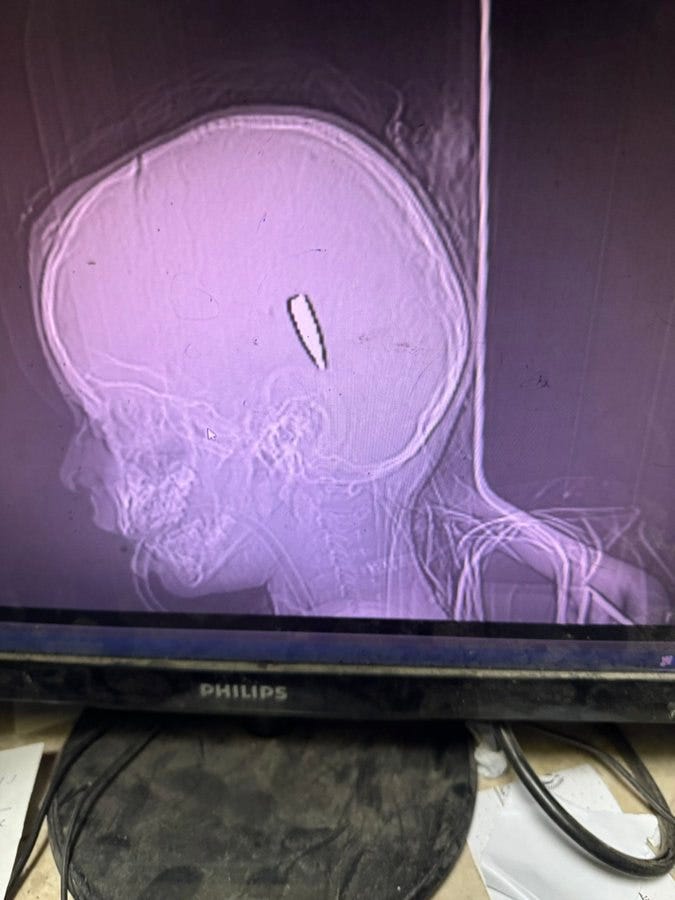
I refer back to Dr. Mimi Syed, who I interviewed a year ago. She went twice to Gaza as an emergency doctor, and one of the patients she was able to save, a young girl named Mira, had a bullet lodged in her head. “When I showed the CT image to the world, I was accused of fabricating it.”
Dr. Tarek Loubani, who I’ve known from Canada since before I first went to Gaza in 2008, likewise faced accusations that he had lied or forged an x-ray of one of his patients.
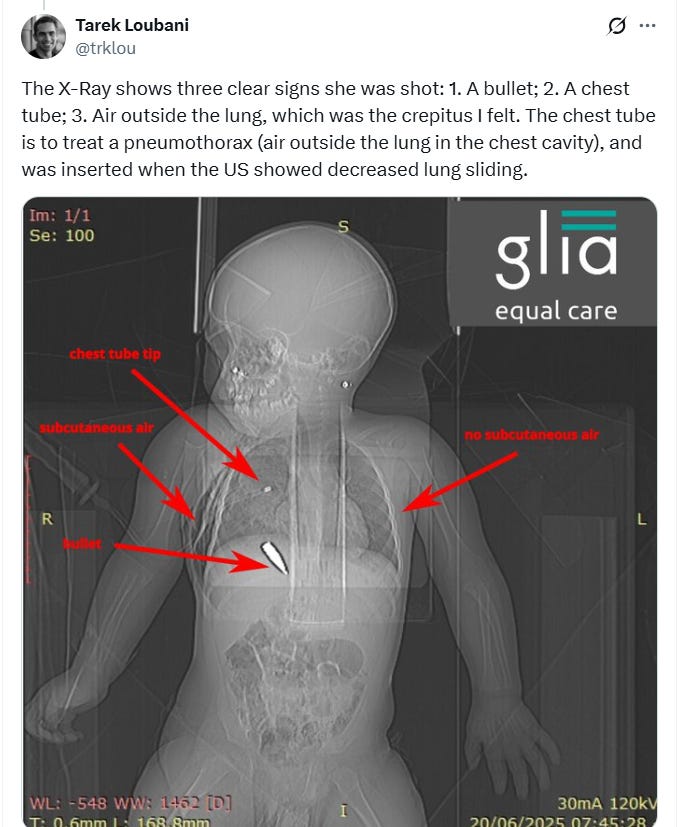
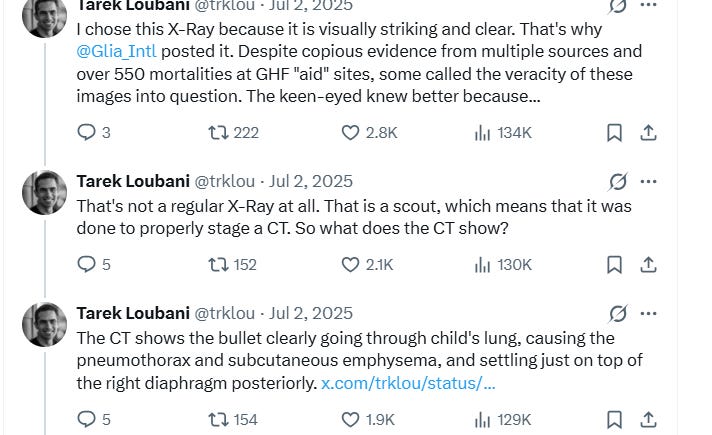
He didn’t lie or manipulate, of course, but people couldn’t accept that what it showed was real.
Israel has long treated Gaza as its testing ground for new weapons and technology and also for how much Israel can get away with while the world watches. If your immediate reaction at seeing an injury or seemingly impossible photo or video from Gaza is to accuse Palestinians (or non-Palestinians who managed to enter Gaza) of fabricating footage or x-rays, etc, then you are the problem. Your life experience shooting a gun in your back yard does not equip you to understand the circumstances in Gaza. Palestinians in Gaza don’t have the luxury of debating this, they’re living in truly unreal circumstances.
Mainstream Western institutions view Jewish lives as more important than Palestinian Lives

By Caitlin Johnstone | August 3, 2026
The BBC recently interviewed an Israeli settler who said that all the Palestinians in four surrounding villages should be exterminated to avenge an Israeli who was killed while terrorizing a Palestinian village last month, adding that just a single Jewish life is worth ten million Palestinian lives.
“I think now after they kill one Israeli people, we need to kill all the people in Tal and Sarra, even Jit and Farata,” lawyer Yehuda Shimon told the BBC.
“It sounds like you’re saying one Jewish life is worth hundreds or thousands of Palestinian lives,” replied the BBC’s Lucy Williamson in the interview.
“Million,” Shimon corrected her. “One Jewish life, it’s ten million, okay?”
“That just sounds racist,” Williamson responded, to which Shimon replied, “Yes, I know, I know. But this is the truth.”
The interaction has been going viral on social media as people react to the blatant display of the extremist ideology held by the settlers who are working to gradually squeeze Palestinians off their land in the West Bank. And while it is true that Shimon’s comments are extremely evil and racist, that’s not what I personally found interesting about the interview. What I found interesting was Williamson’s response.
I mean, it is a bit rich watching a BBC reporter act shocked and offended by somebody saying they think Jewish lives are worth more than Palestinian lives. After all, the premise that Jewish lives are worth more than Palestinian lives has colored every aspect of Western news media reporting on Israel and Palestine for generations.
[IAK notes: See this]
That’s why the Western press expressed disproportionately more shock and horror at October 7 than the far more egregious Israeli abuses which led up to it and the far more egregious Israeli abuses which followed. It’s why you saw howling outrage at the Bondi shooting in Sydney last year when the same number of Palestinians getting killed on any given day in Gaza never even makes a blip in the news.
On the 26th of March 2025, 15 Palestinians were killed by the IDF during a ceasefire in Gaza. On the 14th of December that same year, 15 people were killed at Bondi Beach in Sydney in a mass shooting by ISIS members directed at Jewish Australians.
Two instances of mass murder. Same exact number of victims. But you only heard about one of them.
Why did you only hear about one of them? Because only one of them made the news.
The mainstream press spent weeks urgently reporting on the Bondi shooting, frenetically working to falsely associate an ISIS terrorist attack with pro-Palestine demonstrations by uniformly repeating the line “This is what globalize the intifada looks like” in news outlets throughout the Western world. Report after report after report was published about how Jews are being attacked, how Jews are feeling unsafe, and what new laws and free speech restrictions must be rolled out in order to stomp out pro-Palestine sentiment to protect the Jews.
Nothing remotely similar happened on the 26th of March, 2025. As far as the Western press were concerned, 15 Palestinians getting killed in Gaza was just another Wednesday.
This is because all mainstream Western media outlets hold the same racist opinions about Palestinians as those that were voiced by Yehuda Shimon. So do all mainstream Western political parties. So do all other mainstream Western institutions. So do all supporters of the state of Israel. They all believe Jewish lives are worth more than Palestinian lives, as evidenced by the policies they support and the news stories they pay attention to.
The BBC has a well-documented history of extensive pro-Israel bias, with its own reporters complaining that they’ve been performing PR for the Israeli government and its own editor losing a libel lawsuit against a journalist who exposed his pro-Israel slant. They spent years running cover for an active genocide with “Hamas-run health ministry says” headlines and passive-language verbal gymnastics to protect Israeli information interests, so you know that when Lucy Williamson objects “That sounds racist!” to an Israeli settler claiming Jewish lives are worth far more than Palestinian lives, she’s not actually upset at his belief system. She just knows you’re not supposed to say such things out loud.
The Problem Is Israel, Not Netanyahu
By Kevin Barrett | American Free Press | August 2, 2026
Israel, and its wanted-for-genocide Prime Minister Benjamin Netanyahu, are increasingly unpopular. Gemini estimates that about 80% of the world’s soccer fans cheered for Spain over Argentina in the World Cup, and the primary reason was that Spanish leader Pedro Sanchez is pro-Palestine while Argentina’s president Javier Milei is a rabid Zionist.
Even the United States, laboring under the weight of a pro-Israel media and political donor class, is turning against the Zionists. Recent polls show an astonishing 70-point collapse in support for Israel over the past eight years. During Trump’s first term, Israel’s net favorability hovered at over plus 50. Today it has dropped to minus 20 according to Marquette University Law School and minus 23 according to Pew Research Center.
Even AIPAC-money-loving politicians can sense which way the wind is blowing. Thomas Massie’s bill to end US military support for Israel, which a few years ago would have struggled to find two or three brave supporters, garnered 103 Democratic “yes” votes against only 98 “no” votes. (Massie was the only Republican voting in favor.)
Even many of Israel’s strongest supporters agree that their “chosen nation” needs a facelift. In June, Donald Trump, huddling with his Israel-loyal Jewish handlers Witkoff and Kushner, screamed at Netanyahu on the phone: “Everyone hates you now! Everyone hates Israel!”
As Trump’s outburst implied, many people identify the things they hate about Israel with one man, Benjamin Netanyahu. Swapping Bibi for a prettier face, or at least one that is not on the world’s most wanted list, is on the Zionist agenda.
At some point, the ancient Jewish ritual of scapegoating will likely be applied to Netanyahu. The term “scapegoat” (Azazel) originates from the ancient Hebrew ritual of Yom Kippur (Day of Atonement). Every year, on that high holiday—the holiest single day on the Jewish calendar—the ancient Jews ritually transferred the collective sins, guilt, and impurities of their community onto a goat, and then expelled or destroyed it to achieve symbolic purification.
Soon the scapegoated Netanyahu will be removed from office. Perhaps he will die suddenly or go to prison. His replacement will be celebrated by the Epstein class media as a reasonable man, a moderate, someone who will restore Israel to its pre-Netanyahu status as “a light unto the nations” and “the only democracy in the Middle East.” But will that really solve the problem?
Consider who is likely to replace Netanyahu. Until recently, his main rival was Naftali Bennett, who, like Netanyahu, is a fanatical Zionist extremist. Bennett cut his teeth in Netanyahu’s Likud Party, and served as Netanyahu’s Chief of Staff from 2005 to 2008. His positions haven’t shifted since then. Bennett is every bit as genocidal—and as committed to dragging the US into endless war on Iran—as Netanyahu himself.
During the past two months, Gadi Eisenkot has eclipsed Bennett as Netanyahu’s main challenger, and the likely next Prime Minister of Israel. And Eisenkot, like Bennett, is as bad as Netanyahu.
Eisenkot is the man who created the Dahiyeh Doctrine—Israel’s official policy of genocidally mass murdering civilians. Eisenkot created that “Genocide Doctrine” in 2008 when he was head of the Israeli Defense Forces. He named it the Dahiyeh Doctrine after his mass murder of civilians in the Dahiyeh suburb of Beirut in 2006.
Eisenkot is an enthusiastic supporter of Israel’s mass murder of tens of thousands of children, and additional tens of thousands of women, in its leveling of Gaza. His open support of that mass slaughter makes him one of the most evil political leaders who have ever lived.
Astonishingly, Eisenkot even thinks Netantyahu is too much of a peacenik! The genocidal “moderate” has strongly criticized Netanyahu for being too submissive to US ceasefire demands in the current Israeli-instigated war on Iran. In other words, Eisenkot is even more determined to force the US to destroy itself for Israel than Netanyahu is!
Netanyahu may be evil, but he is not the source of Israel’s problem. Zionism is. That pernicious ideology holds that God “chose” the Jews 3000 years ago and gave them all of the land between the Nile and Euphrates rivers in perpetuity. Most Zionists don’t even believe in God, but they believe God gave them the right to steal other people’s property and rape and murder anyone who resists. How crazy is that?
Israelis have made national heroes of prison guards who sodomize people to death, train dogs to rape prisoners, and engage in other unspeakable atrocities. Their soldiers proudly celebrate shooting pregnant women in the belly to get “one shot two kills.” They hunt children for sport, as Chris Hedges detailed in “A Gaza Diary.”
In short, Israel is criminally insane, and Netanyahu is just a symptom.
Qatar says Hamas honored its ceasefire obligations, calls for action against Israel
Palestinian Information Center – August 4, 2026
DOHA – Qatar’s foreign ministry has urged the international community to press Israel to honor its Gaza ceasefire commitments, affirming that Hamas has met all obligations under the agreed roadmap.
During a news conference held in Doha on Tuesday, spokesman for the foreign ministry Majed al‑Ansari confirmed that Hamas fulfilled its first‑phase commitments of the agreement, including the release of Israeli prisoners.
Ansari accused Israel of shirking its ceasefire obligations by maintaining strikes and restricting food, medical, and shelter aid into Gaza.
Ansari said that 2.4 million Palestinians in Gaza, among them 1.5 million displaced people, endure dire humanitarian conditions as Israel maintains tight restrictions on the entry of food, medicine, and other vital needs.
The spokesman said that Doha urges global actors to press Israel to abide by the ceasefire deal to pave the way for the launch of reconstruction efforts in the Gaza Strip.
He noted that Israel has not yet announced an official position on the roadmap for the next phase of the agreement, which includes an Israeli withdrawal from Gaza and the disarmament of Hamas.
‘A Living Hell’: A Gaza Survivor Recalls Torture in Israeli Detention
By Shaimaa Eid | The Palestine Chronicle | August 3, 2026
With trembling hands, faltering words, an emaciated body, and a voice barely audible from the intensity of his pain, S.Th., 38, began recounting the brutal circumstances of his arrest.
What began as an attempt to flee Israeli bombardment through what Israel had designated a “safe corridor” during its ongoing genocide in Gaza ended with months of torture in Israeli interrogation facilities and the Negev Desert Prison.
“After nights of relentless bombardment around our home in Gaza City, my mother, my wife, and I decided to leave,” S.Th. told the Palestine Chronicle. “My wife was in critical condition after miscarrying because of the overwhelming fear and terror.”
The family walked toward Kuwait Roundabout before reaching the so-called safe corridor at the Netzarim checkpoint.
“What awaited us there,” he said, “was even more horrifying than the bombardment itself.”
“My mother leaned on my shoulder the entire way, and all of us held our ID cards high above our heads,” he recalled. “Without any warning, an Israeli officer emerged from behind a sand berm and called out in clear Arabic: ‘Hey, you with the ID who’s fanning your mother, come here.’”
At first, S.Th. was unsure the soldier was addressing him.
“I looked around to make sure he was talking to me,” he said. “Then the officer gestured for me to come behind the sand embankment.”
The moment he reached the soldiers, the man said, he was ordered to strip naked.
“They bound my hands and forced me to sit on sharp seashell-covered stones for three consecutive days.”
Used as Human Shields
For three days, S.Th. said he endured beatings with rifle butts and constant verbal abuse. He and a group of other young men were then forced to sit beneath the barrel of an Israeli tank, where they were used as human shields.
“The tank kept firing shells while we were directly beneath it,” he recalled. “After every single shot, we waited for our souls to leave our bodies, believing death had finally come.”
He never had the opportunity to say goodbye to his family.
“I never had the chance to say goodbye to my mother or my wife,” he said. “Anyone who stopped or even turned around risked being shot dead.”
As they walked in large groups, bodies lay scattered along both sides of the road.
“It was as if the occupation wanted to send us a clear message,” S.Th. said. “‘This is what happens to anyone who disobeys our orders.’”
His voice faltered as he described what happened next.
“They tied our hands and loaded us into the bucket of a bulldozer used to carry sand,” he said. “Then they covered us with a large tarpaulin. After driving only a short distance, they suddenly dumped us into a massive sand pit.”
The detainees believed they were about to be executed.
Instead, Israeli soldiers returned, gathered them again, and loaded them into a military vehicle. From conversations they overheard, they understood they were being transferred to an interrogation center.
“We had no idea where they were taking us,” S.Th. said. “When we arrived, I heard one of the soldiers say, ‘Zikim, Zikim,’ before signaling the driver to stop. At the time, we had no idea that a living hell awaited us there.”
‘A Living Hell’
Recalling his arrival at the facility, S.Th.’s hands began to shake.
“The moment we arrived, dozens of soldiers greeted us with savage beatings all over our bodies using metal batons and electric sticks,” he said. “They then forced us to remain kneeling for five consecutive days.”
During that period, he said, detainees survived on little more than a small piece of bread each day. “It was nowhere near enough to satisfy our hunger.”
According to S.Th., Israeli forces identify Palestinians attempting to cross the so-called “safe corridor” through an advanced facial-recognition system while they hold their identity cards above their heads.
“Those five days felt endless,” he recalled. “After that, they marched us away with our hands and feet shackled and our eyes blindfolded to a large barracks.”
The detainees, he said, were permitted to use the bathroom only once each day.
“They also deprived us of sleep by blasting deafening music through loudspeakers around the clock,” S.Th. said
Interrogation and Torture
Speaking quietly, S.Th. paused before describing the interrogations.
“All the way to the interrogation room, the soldiers kicked us repeatedly,” he said. “They dragged us along by our bound hands and forced us into painful stress positions until we were completely exhausted.”
Only then, he said, would the interrogating officer ask a single question: “Do you want to talk?”
According to S.Th., the interrogations focused largely on political affiliation.
“He accused me of things that had absolutely nothing to do with me,” he said. “When I denied them, he ordered that I be taken back to the torture room.”
There, he said, two soldiers subjected him to severe abuse. “They beat the most sensitive nerve centers in my body and struck my genitals.”
Sleep, S.Th. said, became almost impossible.
“Whenever I drifted off, a soldier standing behind me would repeatedly strike a metal sheet with a hammer while shouting, ‘Wake up. Wake up. Wake up.’”
Eventually, exhaustion overwhelmed him.
“I collapsed unconscious onto the ground,” he recalled. “A soldier lifted me from behind and immediately began kicking me with both feet to prevent me from resting or even taking a brief nap.”
Two weeks later, S.Th. was returned to the interrogating officer.
“He leaned over and whispered in my ear, ‘How was your visit? Was it a long one? If you had confessed from the beginning, you could have spared yourself all this suffering,’” he said.
The officer then repeated the same accusations and questions.
When the interrogation concluded, S.Th. said the interrogator wrote words on his back that he could not understand before soldiers returned him to a barracks holding dozens of detainees from Gaza.
“There we sat with our hands tied, forced to kneel from morning until evening without moving or even turning our heads,” he said. “We were given only ten minutes to eat our meals.”
Negev Prison
S.Th. said he was later transferred with approximately 50 other detainees to the Negev Desert Prison.
“As soon as we arrived, a large group of soldiers was waiting for us,” he recalled. “They beat us mercilessly before throwing us into freezing cells without blankets while we were dressed only in light clothing.”
Soldiers deliberately targeted the prisoners’ shackled hands during the beatings: “They concentrated their blows on our hands, which were already tightly bound in iron shackles.”
After nearly two months of torture and starvation in interrogation centers and later in Negev Prison, Israeli authorities released S.Th. and a group of detainees through the Kerem Abu Salem crossing.
They were subsequently transferred to a hospital for medical examinations and treatment.
Reflecting on his imprisonment, S.Th. said he and the other detainees endured severe physical and psychological torture throughout their detention.
He stressed that they had been arbitrarily detained, held for an extended period without charge, and never brought before a court.
– Shaimaa Eid is a Gaza-based writer. She contributed this article to the Palestine Chronicle.
Eliyahu, son of the Hebron massacre perpetrator, leads West Bank settlement expansion

Israeli settlers in the hills around Hebron [Mosab Shawer / Middle East Images / AFP via Getty Images]
By Malik Nabeel | The New Arab | July 31, 2026
Ramallah – The family of Palestinian Hussein al-Amleh in the town of Beit Ula, west of Hebron in the southern occupied West Bank, was expelled from his land on 22 July after a settler vandalised a tent and sheep pen where al-Amleh and his son were staying. The incident took place as part of the expansion of a settlement outpost established a few metres west of the town about a year ago.
Its area of control has expanded to more than 1,300 dunams (1.3 square kilometres), designated as a “closed military zone” from which the original Palestinian landowners have been barred.
As one of the owners of the confiscated land, al-Amleh said that a settler named Eliyahu Goldstein, son of Baruch Goldstein, who carried out the 1994 Ibrahimi Mosque massacre that left 29 people dead and 125 others injured, drove them from the land after storming it.
Al-Amleh told The New Arab, “We tried to remove the settler and those with him, and demanded that they leave when they stormed the land… There were verbal confrontations between us, after which Eliyahu attacked and assaulted us. He was armed, while the Israeli occupation army stood by without moving or doing anything.”
He said he told soldiers that they were responsible for him, to which the army officer replied that al-Amleh had to listen to Eliyahu and follow his instructions. The answer prompted al-Amleh to reply, “This is our land. We were born here, and our children and grandparents were born here.”
Since 22 July, 2025, Baruch Goldstein’s son Eliyahu has expanded the seizure of land in Beit Ula. He has placed a caravan there, from which he launches daily attacks, detains landowners and hands them over to the Israeli occupation army for interrogation, as happened with two other residents following the incident involving the Al-Amleh family.
During the assault, Eliyahu detained al-Amleh’s son, Mahmoud, and took him to a military post adjacent to the separation wall west of the town before handing him over to the Israeli occupation army. Mahmoud was then transferred to the Etzion interrogation centre north of Hebron.
“All of this happened simply because my son and I refused to leave our land,” al-Amleh told The New Arab.
He added that he owns dozens of dunams in the western area of Beit Ula, which Eliyahu has since taken control of, and had relied on them for farming, grazing and overnight stays. He had erected a tent there and established a small sheep farm known as an “izba”. However, according to his account, the settler vandalised it, prevented him from grazing his livestock, and threatened to shoot him and confiscate the sheep if he returned to the land.
Eliyahu is described by Palestinian residents as one of the most extremist and violent settlers in the greater Hebron area, with accounts alleging that he does not hesitate to open fire if anyone approaches him.
At the beginning of April, Eliyahu shot Iyad Al-Sarahin in the abdomen, causing severe intestinal damage and injury to his liver. During the same period, he also shot another person in the hand while residents were attempting to reach their land.
Jamal Taleb, an adviser at the Land Research Centre in Beit Ula, told The New Arab, “Eliyahu was raised in schools of Jewish extremism, just like his father.”
Taleb said Eliyahu began his settlement activities in areas east of Hebron and its Old City before “moving last year to Beit Ula, which had never previously witnessed any settlement presence on its land”.
Taleb pointed to the relationship between Eliyahu and the Israeli forces, saying, “On more than one occasion, we have seen officers in the Israeli occupation army salute him militarily, even though he is not a soldier.”
He added that Eliyahu works to “steal sheep and then claim ownership of them. His primary task is to destroy agricultural land, ruin farming and force residents to abandon and leave their land.“
Taleb added that the settler relies on foreign workers to carry out his attacks, saying, “He has Thai workers who work with him. He uses them to pursue residents with agricultural tractors, and they move in a provocative manner to stir up dust while farmers are on their land. He is then accompanied by one settler, who acts as his assistant.”
Eliyahu also appears to enjoy official backing from the Israeli government. Taleb said he is “strongly supported by National Security Minister Itamar Ben Gvir, to the extent that no one dares oppose him or refuse his requests”.
Taleb also said that Eliyahu repeatedly tells residents, “Your turn will come. I will seize this land, and one day we will expel all of you from Areas B and C,” referring to the areas designated under the 1993 Oslo Accords.
Taleb confirmed that Eliyahu possesses the key to the gate in the separation wall that separates Beit Ula from the territories occupied in 1948. He uses it to travel to the settlement of Nahusha, built on the town’s historic lands beyond the wall.
Taleb cited an incident on 11 July, when activists from the Arab-Jewish movement “There Is Room for All of Us” arrived to accompany residents to their land for the harvest. He said they had received prior approval from the Israeli occupation army, “but Eliyahu arrived at the site accompanied by occupation forces, expelled the residents and the solidarity activists, and the forces fired tear gas on his orders.”
He added that Eliyahu had previously set fire to farmers’ land while they were attempting to reach it.
Eliyahu also uses drones to monitor farmers’ movements and rarely moves without covering his face. “Experts stand behind him, providing support and assistance, even if they are not present at the site.”
Taleb said Eliyahu possesses “all the machinery and equipment necessary to carry out acts of destruction, bulldozing, cutting and other operations.”
Eliyahu is known for not remaining in one place, instead moving between different areas to establish new settlement projects.
Taleb described him as “highly aggressive”. He previously lived in the settlements of Kiryat Arba east of Hebron, Susiya to the south and Adora to the west. He is also active in the northern Jordan Valley.
Taleb said Eliyahu “only establishes settlement outposts in cultivated, exploited areas adjacent to the boundaries of Area B because one of his objectives is to expand settlement gradually from Area C into Area B. In contrast, we are pursuing a legal path to prove ownership of lands whose Palestinian ownership the occupation does not recognise.”
Meanwhile, Issa Abdul Hafiz, one of the owners of the land seized by Eliyahu, said the settler has prevented him from accessing more than 40 dunams (40,000 square metres) that he owns, in addition to hundreds of dunams belonging to his family.
Abdul Hafiz told The New Arab that “the settler Eliyahu has escalated his attacks in recent months, destroying more than 150 olive trees and other fruit-bearing trees, and preventing family members from grazing their sheep on their own land”, stressing that this pattern of attacks has affected hundreds of dunams, all treated in the same way.
Abdul Hafiz said the settlement expansion extends beyond the outpost established by Eliyahu, explaining that “he expands his settlement activities every day, goes beyond the boundaries of the area classified as a ‘closed military zone’, and attacks any farmer who reaches his land.”
He confirmed that Eliyahu’s attacks have extended to the outskirts of the neighbouring villages of Kharas and Nuba, adjacent to Beit Ula.
Abdul Hafiz also said that the Israeli settler burned hundreds of dunams planted with wheat, driving his agricultural tractor through the area and setting fires between the fields over recent weeks.
From the Ibrahimi Mosque to settlement expansion
Rashed Al-Tamimi, a former activist with the Israeli human rights organisation B’Tselem – The Israeli Information Center for Human Rights in the Occupied Territories, recalled an earlier encounter with Eliyahu dating back about 13 years, when he established a settlement outpost in the Jabal Jalis area east of Hebron after forcibly seizing a plot of land there.
Al-Tamimi told The New Arab, “Eliyahu set up a caravan, brought settler Jewish families to it and established their presence there. The outpost now includes around 20 settlement homes.”
Al-Tamimi described Eliyahu as “an expert in establishing settlement outposts”, explaining that he moves between Palestinian areas to create new outposts “without any justification, or even a legal cover, using excessive force through carrying weapons, opening fire, and relying on protection from the Israeli occupation army. He establishes the outpost, gives it legitimacy, hands it over to settlers, and then leaves the area for another one.”
Al-Tamimi also recalled another incident from about five years ago, when Eliyahu attempted to establish a settlement outpost on his privately owned land in Jabal Jalis.
He said, “Eliyahu came to our area in Jabal Jalis and tried to establish a settlement outpost on my private land. When he stormed my land, my son and I rushed out, confronted him, argued with him and prevented him from establishing the outpost. He then filed a complaint against me with the Israeli police in the Ja’abra area, east of Hebron.”
Al-Tamimi said Eliyahu received support from settlement organisations, including “Kach” and “Gush Emunim”, which did not condemn the 1994 Ibrahimi Mosque massacre.
He added that the settler has carried weapons during his movements for years, but “he used to wear civilian clothes. Recently, however, he moves only in military uniform, despite not being a soldier.”
Article translated from Arabic by Afrah Almatwari. To read the original, click here.
No question of surrendering weapons; proposal only covers heavy weapons storage: Hamas representative
Press TV – August 2, 2026
A Hamas official says the newly announced agreement to end Israel’s genocidal war on Gaza does not signify abandoning resistance, but outlines a conditional, Palestinian-led process contingent on the Tel Aviv regime fulfilling its obligations under the agreement.
Speaking to the Press TV website, Khaled Qaddoumi, the representative of Hamas in the Islamic Republic of Iran, expounded on how the Palestinian resistance movement views the newly announced agreement, which has been widely portrayed in media reports as a “Hamas disarmament” deal.
“There is no question of surrendering or relinquishing weapons. What we specifically offered was to discuss the gathering or storage of heavy weapons under a Palestinian administrative authority – from Palestinian factions to a Palestinian authority. No authority other than a Palestinian one has any role in this matter,” he stated.
The remarks came after Hamas announced it had agreed to a phased deal intended to bring Israel’s genocidal war on Gaza to a complete end.
The proposal, announced by US President Donald Trump after mediators from Egypt, Qatar, Turkey and the United States finalized a roadmap for the next phase of the ceasefire, outlines a mechanism under which heavy weapons would be inventoried and stored under a Palestinian National Committee while Israeli occupation forces gradually withdraw from Gaza.
Israel has not publicly endorsed the proposal, while Hamas has maintained that no provisions related to its weapons can be implemented unless Israel first fulfills its own obligations under the agreement.
Addressing concerns among Palestinians that any discussion of weapons could undermine Gaza’s future ability to defend itself from external aggression, Qaddoumi rejected media portrayals of the proposal as a disarmament deal.
“It is not a relinquishment of weapons. It is not an isolated step. It is not a withdrawal from, or retreat from, the concept of resistance,” he told the Press TV website.
Resistance inherent right of Palestinians
The Hamas representative noted that resistance, in all its forms and by all its means, “is an inherent right of any nation living under occupation – especially the Palestinian people, who have lived under occupation for nearly a century.”
“They have the right to defend themselves in whatever way they consider appropriate, including armed resistance,” he stated.
According to Qaddoumi, even that discussion would depend entirely on the Israeli regime implementing the broader agreement.
“Moreover, this step is conditional upon Israel fulfilling and implementing the other parts of the agreement, including the withdrawal of its forces, the opening of the border crossings, the entry of humanitarian aid into Gaza, and the complete cessation of the genocide,” he said.
He further noted that Israel would have to allow the Palestinian National Committee to enter Gaza to administer civilian affairs, oversee reconstruction and prepare for “a political electoral process that will ultimately lead to an independent Palestinian state.”
“Only within that framework and according to those benchmarks can any discussion regarding weapons take place. Beyond that, there is no such thing as the resistance relinquishing its weapons,” he remarked.
“Our strength comes from our faith, our people, and our just cause. We will continue until this occupation ends and until our nation achieves independence, peace, and prosperity.”
The proposed roadmap envisages a phased process in which heavy weaponry, military production sites, weapons depots and tunnel infrastructure would be inventoried and stored under Palestinian oversight while Israeli troops withdraw in stages.
Hamas has repeatedly said those steps cannot proceed independently of Israel’s commitments regarding withdrawal, humanitarian access and reconstruction.
The genocidal onslaught on the besieged Gaza Strip has killed more than 73,000 Palestinians and injured over 174,000 others since October 23, 2023, most of them women and children, and caused widespread destruction affecting 90% of civilian infrastructure.
The UN estimates reconstruction costs at approximately $70 billion.
‘No trust’ in US, Israel
Asked whether Hamas trusted Washington and Israel to uphold any agreement, Qaddoumi said experience had left little room for confidence.
“There is no such thing as trust or confidence. Historical experience has not been positive when dealing with the Americans or the Israelis,” he told the Press TV website, pointing to failures to implement previous commitments. “On the one hand, President Trump, before the whole world, proposed this ceasefire agreement, saying that the genocide would stop. It did not stop.”
Since the ceasefire came into effect, he noted that more than 1,200 innocent civilians lost their lives, killed in cold blood by the Israeli occupation forces in the refugee camps.
Qaddoumi also noted that border crossings remain closed, humanitarian aid has yet to enter Gaza, reconstruction materials continue to be blocked, and the Palestinian National Committee formed in Egypt has not been allowed into the territory.
“That’s why we’re skeptical,” he said. “We have every right to be.”
Even so, he added that Hamas has continued participating in negotiations in coordination with other Palestinian factions.
“On the other hand, we are still moving toward improving the lives of our people because we have carried this responsibility in consensus with the other Palestinian factions,” he stated.
“With an open mind and a good heart, we entered these negotiations to prevent the genocide from resuming. We sought to achieve a fair political solution for our people.”
Palestine has nothing more to give
The Hamas official said Palestinians have already fulfilled their part of the process.
“At this point, nobody should ask the Palestinians to give anything more, because the Palestinian side has already given everything that was asked of it. There is nothing more to give,” he told the Press TV website.
Instead, he said, responsibility now rests with international guarantors. “Now it is time for the guarantors. It is time for the President of the United States to put sufficient pressure on Israel to abide by its commitments.”
Qaddoumi said statements by members of Israeli regime prime minister Benjamin Netanyahu’s coalition have further reinforced Hamas’s doubts about the implementation of the deal.
“The presence of extreme figures in Netanyahu’s cabinet, such as Ben-Gvir, gives us little reason for optimism because they openly say that these proposals do not meet Israel’s demands; but what are Israel’s demands? What we see today is that Israelis are obsessed either by personal agenda or ideological extremist agenda,” he said.
“Netanyahu wants to remain in power, while ideological fanatic elements like Ben-Gvir are driven by the belief that Palestinians have no right to live in Gaza. They believe Palestinians should leave Gaza and that Israelis should replace them and build settlements there. With such a mentality, hope is very scarce.”
Nevertheless, he said Hamas would continue urging international actors to ensure implementation of the agreement to end the Israeli genocidal war on Gaza.
“We will continue to call on the international community to fulfill its responsibility by guaranteeing the implementation of the agreement and creating mechanisms to move the process forward, rather than allowing the genocide to resume,” he stressed.
“The world must compel and pressure the Israeli forces to withdraw from Gaza, allow the Palestinian National Committee to enter Gaza, permit the entry of food, water, and reconstruction materials, and reopen the border crossings.”
Palestinian consensus
On coordination among Palestinian resistance factions, Qaddoumi said the latest proposal reflects a unified Palestinian position.
“The latest statement announcing a positive step toward strengthening the ceasefire stems from Palestinian consensus. Our brothers in Islamic Jihad and the other Palestinian factions were with us in Egypt, and we discussed it together,” he noted.
He emphasized that discussions about weapons should not be confused with surrendering resistance.
“By the way, the term ‘disarmament’ must be clearly understood,” Qaddoumi said. “When we talk about heavy weapons, we have conditioned any discussion on the implementation of the first stage of the agreement, and the political solution to a Palestinian independent state”
He reiterated that those conditions included humanitarian measures, Israeli military withdrawal, reconstruction, reopening crossings, allowing the Palestinian National Committee into Gaza and progress toward an independent Palestinian state.
“Only then can any political solution and any step toward disarmament–or, as we have said, gathering or storing the weapons, whatever term is used–be addressed,” he said.
“First, this is a matter of national Palestinian consensus; second, it is an entirely Palestinian issue that concerns the future shape of Palestine, its political life, and how Palestinians choose to address these matters.”
Qaddoumi said the Hamas resistance movement views the sacrifices of its martyred leaders, including Haniyeh, as part of a broader struggle for Palestinian self-determination.
“Those great people gave their lives for a noble cause,” he said. “Martyr Haniyeh himself said that there is a price for this cause and this responsibility.”
Haniyehs assassination came a day after he attended the inauguration ceremony of President Masoud Pezeshkian.
“We carry this responsibility knowing that the price will be heavy and that our lives are at stake — for the sake of our people, for the sake of our noble cause, and for the sake of our homeland,” Qaddoumi said.
He concluded by recalling remarks delivered by Hamas’s newly-elected leader Khalil al-Hayya at Haniyeh’s funeral in Tehran one day after the assassination.
“The enemy is deluded if they think that we will be diverted from our path or from the path of those great leaders and martyrs. On the contrary, we will insist on continuing our road toward independence because those people who offered their lives for the sake of their people did so for a reason. That reason is to live in peace and prosperity and to give our children a better life. Martyrdom is a school that teaches us how to live, he said.
“Martyrdom is the art of those great people who gave their lives to grant future generations a prosperous, peaceful, and dignified life. Today, we are strong enough to carry the flag of those great people and move forward toward the development of our people and our nation.”
‘Israel’ kills 17 Palestinians in Gaza on day 279 of the ‘ceasefire’
Al Mayadeen | August 2, 2026
The Israeli occupation continued its violations of the ceasefire agreement in the Gaza Strip for the 297th consecutive day, killing 17 Palestinians and injuring dozens over the past 24 hours, according to reports.
The Israeli attacks killed 10 Palestinians and wounded others during a series of overnight attacks that continued across the Gaza Strip until dawn on Sunday.
Among those killed was Sheikh Kamal Abu Ma’ili, who was deliberately targeted alongside his wife after the Israeli occupation struck their home in the al-Mashaila area west of Deir al-Balah in central Gaza. The strike also injured four Palestinians who were transferred to Al-Aqsa Martyrs Hospital.
In the same city, Palestinian civilian Saber Mohammad Khalil Rabee was killed, and another person was injured after the Israeli occupation targeted their home in the al-Mahatta area.
‘Israel’ targets liberated Palestinian prisoner
In northern Gaza, the Israeli occupation carried out demolitions of civilian homes in Beit Lahia at dawn on Sunday.
In Gaza City and its governorate, three Palestinians were killed after an Israeli airstrike targeted an apartment in al-Sousi Tower west of the city.
The attacks also killed liberated prisoner Mohammad Abdul Ahmad Abu Ras, who was targeted while among a group of civilians on Omar al-Mukhtar Street, only one week after his release from Israeli occupation prisons.
Meanwhile, young Palestinian Ahmad Wael al-Khudari succumbed to injuries sustained several days earlier in an Israeli strike on al-Jalaa Street.
In another attack, an Israeli unmanned aircraft targeted a group of civilians near al-Ghazali intersection in Gaza City, killing Hassan Ibrahim Qahman and Alaa Imad al-Taramisi and injuring two others.
The Israeli occupation also targeted the roof of a home in the al-Sinaa area of Tal al-Hawa neighborhood southwest of Gaza City, killing Kamal Alaa Aliwa and Zakaria Ahmad Zaidiya and injuring others.
The Palestinian Red Crescent transported the body of Hassan Hisham al-Khudari, 38, after he was killed in an Israeli strike on al-Thalathini Street in southern Gaza City.
Israeli attacks continue across southern Gaza
In Khan Younis in southern Gaza, three Palestinians, including a child, were killed after an Israeli strike targeted an apartment belonging to the al-Hams family in al-Mawasi, northwest of al-Qarara town.
Palestinian civilian Salem Abu Labda also died from injuries sustained in an Israeli airstrike that targeted him on Saturday afternoon in the same al-Mawasi area.
Earlier on Saturday, seven Palestinians were killed and around 10 others injured in different areas across the Gaza Strip as a result of Israeli ceasefire violations.
Featured Video
Trita Parsi: Israel Set a Trap for Total War in the Region
or go to
Aletho News Archives – Video-Images
From the Archive
Zionism’s Violent Legacy
By Donald Neff | Washington Report On Middle East Affairs | January 1996
On January 4, 1948, Jewish terrorists drove a truck loaded with explosives into the center of the all Arab city of Jaffa and detonated it, killing 26 and wounding around 100 Palestinian men, women and children.[1] The attack was the work of the Irgun Zvai Leumi – the “National Military Organization,” also known by the Hebrew letters Etzel – the largest Jewish terrorist group in Palestine. The Irgun was headed by Revisionist Zionist Menachem Begin and had been killing and maiming Arabs, Britons and even Jews for the previous ten years in its efforts to establish a Jewish state.
This terror campaign meant that at the core of Revisionist Zionism there existed a philosophical embrace of violence. … continue
Blog Roll
 Aletho News
- Trita Parsi: Israel Set a Trap for Total War in the Region
- Trump’s Iran war is on an Israeli leash
- Saudi oil boss issues global supply warning
- Riyadh Says Its Oil System Is Intact. The Numbers Say Otherwise.
- Trump and Netanyahu Want to “Finish the Job” on Iran
- US ‘one-sided dictation’ not Iran’s beliefs makes rational talks impossible: Baghaei
- Iran’s Next Strike May Not Explode. It Could Shut You Down /Col Doug Macgregor
- Iran: US political targets legitimate if assassinations return
- Iraq shuts key border crossing with Iran under US pressure: Report
- Undersea Internet cables could be targeted in retaliation for attacks on Iran: IRGC deputy chief
- If Americans Knew
- The Israel Lobby’s Changing Fortunes
- AIPAC has become such a political liability that it’s shifting to a more “nimble” approach to buying politicians
- At least 160 Israeli settler attacks in 2 weeks
- Will Gaza’s Ancient Christian Community Disappear Forever?
- Israel’s vision of regional security rests on keeping Arab states weak
- Heidi Levine recounts how Palestinian youths helped save her in settler attack
- DAILY UPDATE: Latest essential news on Palestine, Israel, & region
- Trump’s Intensifying Sabotage of the ICC, for Israel’s Sake
- Israeli military detain US and UK volunteers in West Bank including Democratic NY politician Brad Lander
- Americans at National Conservatism Conference held in Israel this year criticize Israel
- No Tricks Zone
- E-Cars Reduce CO2 Emissions By Only 41% Compared To Internal Combustion Engine Vehicles
- Predictions Made By Renowned Climate Professor Over Past Decades Have Been Proven To Be Poor
- New Study Suggests Large Regions Of The Pacific Ocean Have Been Cooling For The Last 80 Years
- Germany’s Green Energy Debacle: High Energy Costs Force Kahla Porzellan to Close After 182 Years!
- New Study: 50 Years Of The Most Aggressive ‘Net Zero’ Policies Can Only Affect The Global Climate By 0.03°C
- US September “Heat” Was No Record…Many Records Set Decades Ago
- Latest European Green Energy Debacle; Portugal’s Largest Flagship Solar Park Insolvent!
- Green Energy Debacle: German Expert Professor Fritz Vahrenholt Warns Of Severe Economic And Social Consequences
- Two More Paleo Reconstructions Affirm Meters-Higher Sea Levels Across Ireland, Brazil 7000-6000 Years Ago
- New Study: Earth And Venus Surface Warmth Largely Explained By Convection And Lapse Rate, Not CO2 Or Radiation

