Caesar Tries to Suffocate 17 Million Syrians
By Rick Sterling | Dissident Voice | June 19, 2020
Since 2011, the US and allies have promoted, trained and supplied militants trying to bring about “regime change” in Damascus. Having failed in that effort, they have tried to strangle Syria economically. The goal has always been the same: to force Syria to change politically. This month, June 2020, the aggression reaches a new level with extreme sanctions known as the Caesar Syria Civilian Protection Act.
The new law is fraudulent on two counts. It is called “Caesar” in reference to a 2014 propaganda stunt involving an anonymous Syrian who was alleged to be a military photographer. He claimed to have 55,000 photos showing about eleven thousand victims of Syrian government torture. As the Christian Science Monitor said at the time, the “Caesar” report was “A well-timed propaganda exercise funded by Qatar.” A 30 page analysis later confirmed that the “Caesar” report was a fraud with nearly half the photos showing the OPPOSITE of what was claimed: they documented dead Syrian soldiers and civilian victims of “rebel” car bombs and attacks.
The Caesar Syrian Civilian Protection Act is also fraudulent by claiming to “protect civilians.” In reality, it punishes and hurts the vast majority of the 17 million persons living in Syria. It will result in thousands of civilians suffering and dying needlessly.
Pre-Existing Sanctions
The US has been hostile to Syria for many decades. Unlike Anwar Sadat of Egypt, Syria under Hafez al Assad refused to make a peace treaty with Israel. Syria was designated a “state sponsor of terrorism” and first sanctioned by the U.S. in 1979.
After the US invasion and occupation of Iraq in 2003, Syria accepted about one million Iraqi refugees and supported the Iraqi resistance in various ways. In retaliation, the US escalated punishing sanctions in 2004.
In 2010, US Secretary of State Hillary Clinton pressured Syria to change their foreign policy and be more friendly to Israel. Syrian President Bashar al Assad pointedly declined. Twelve months later, when protests and violence began in Syria in 2011, the US, Europe and Gulf monarchies (Qatar, Saudi Arabia, United Arab Emirates) quickly supported the opposition and imposed more sanctions.
In 2016, after five years of crisis and war, a report on the humanitarian impact of sanctions on Syria was prepared for the United Nations Economic and Social Commission for Western Asia. It noted that “U.S. and E.U. sanctions on Syria are some of the most complicated and far-reaching sanctions regimes ever imposed.” The 30 page report went on document with case studies how humanitarian aid which is supposed to be permitted is effectively stopped. The sanction regulations, licenses, and penalties make it so difficult and risky that humanitarian aid is effectively prevented. The report concluded with thirteen specific recommendations to allow humanitarian and development aid.
But there was not relaxation or changes in the maze of rules and sanctions to allow humanitarian relief. On the contrary, as the Syrian government was expelling terrorists from east Aleppo, southern Damascus, and Deir Ezzor, the US and EU blocked all aid for reconstruction. The US and allies were intent to NOT allow Syria to rebuild and reconstruct.
In 2018, the United Nations Special Rapporteur, Idriss Jazairy, prepared a report on the negative impact of unilateral coercive measures on human rights in Syria. He noted, “Unilateral coercive measures on agricultural inputs and outputs, medicines, on many dual use items related to water and sanitation, public electricity and transportation, and eventually on rebuilding schools, hospitals and other public buildings and services, are increasingly difficult to justify, if they ever were justifiable.”
Before 2011, 90% of pharmaceutical needs were filled by Syrian factories. Those factories which remain have trouble getting raw materials and cannot get replacement parts for equipment. For example an expensive dialysis machine or MRI machine from Siemens or General Electric is rendered useless because Syria cannot import the spare part or software. On paper, they can purchase this but in reality they cannot.
Over 500,000 civilians returned to Aleppo after the terrorists were expelled at end of 2016. But reconstruction aid is prohibited by US sanctions and UN rules. They can receive “shelter kits” with plastic but rebuilding with glass and cement walls is not allowed because “reconstruction” is prohibited. This article describes numerous case examples from war torn Aleppo.
The author had a personal experience with the impact of sanctions. A Syrian friend could not get hearing aid batteries for a youth who was hard of hearing. Sanctions prevented him from being able to order the item because financial transactions and delivery is prohibited without a special license. A stockpile of the specialized batteries was easy to purchase in the USA but took almost a year to get to the destination in Syria.
US Economic Bullying and Terrorism
The Caesar Act extends the sanctions from applying to US nationals and companies to any individuals and corporations. It claims the supra-national prerogative to apply US laws to anyone. “Sanctions with respect to foreign persons” include blocking and seizing the property and assets of a person or company deemed to have violated the US law. This is compounded by a fiscal penalty which can be huge. In 2014, one of the largest international banks, BNP Paribas, was fined $9 Billion for violating US sanctions against Cuba, Iran and Sudan.
The Caesar Act claims the Syria Central Bank is a “primary money laundering” institution and thus in a special category. It aims to make it impossible for Syrian companies to export and import from Lebanon. It will make it extremely difficult or impossible for Syrians abroad to transfer money to support family members in Syria.
In addition to these extraordinary attacks, the US is undermining and destabilizing the Syrian currency. In October 2019, the Syrian currency was trading at about 650 Syrian pounds to one US dollar. Now, just 8 months later, the rate is 2,600 to the US dollar. Part of the reason is because of the threat of Caesar sanctions.
Another reason is because of US pressure on the main trading partner, Lebanon. Traditionally, Lebanon is the main partner for both imports and exports. In spring 2019 US Secretary of State, Mike Pompeo, threatened Lebanon if they did not change their policies. It was blatant interference in Lebanese internal affairs. In Fall 2019 street protests began, and the Lebanese and Syrian banking crisis also began.
With the devaluation of their currency, prices of many items have risen dramatically. Agricultural, medical, industrial and other raw materials and finished goods are almost impossible to acquire.
The shortage of food is compounded because wheat fields in North East Syria, the bread basket of Syria, have been intentionally set on fire. In the past week, sectarian groups in Lebanon have blocked World Food Program trucks carrying food aid to Syria. Meanwhile, in eastern Syria, the US and its proxy militia control and profit from the oil fields while the Syrian government and civilians struggle with a severe shortage oil and gas.
James Jeffrey and US Policy
In a June 7 webinar, the Special Representative for Syria Engagement, Ambassador James Jeffrey, brazenly stated the US policy. The US seeks to prevent Syria from rebuilding. He said, “We threw everything but the kitchen sink …. into the Caesar Act.”
The exception to punishing sanctions are 1) Idlib province in the North West, controlled by Al Qaeda extremists and Turkish invading forces and 2) north east Syria controlled by US troops and the proxy separatists known as the “Syrian Democratic Forces”. The US has designated $50 million to support “humanitarian aid” to these areas. Other US allies will pump in hundreds of millions more in aid and “investments.” US dollars and Turkish lira are being pumped into these areas in another tactic to undermine the Syrian currency and sovereignty.
In contrast, the vast majority of Syrians — about 17 million – are being- suffocated and hurt by the extreme sanctions.
The US has multiple goals. One goal is to prevent Syria from recovering. Another goal is to prolong the conflict and damage those countries who have assisted Syria. With consummate cynicism and amorality, the US Envoy for Syria James Jeffrey described his task: “My job is to make it a quagmire for the Russians.” Evidently there has been no significant change in foreign policy assumptions and goals since the US and Saudi Arabia began interfering in Afghanistan in 1979.
In his 2018 “End of Mission” statement the United Nations Special Rapporteur was diplomatic but clear about the use of unilateral coercive sanctions against Syria: “the use of such measures may be contrary to international law, international humanitarian law, the UN Charter and the norms and principles governing peaceful relations among States.”
Caesar and the Democrats
The economic and other attacks on Syria have been promoted by right wing hawks, especially fervent supporters of Israel. Eliot Engel, chairman of the Congressional Foreign Affairs Committee, pushed to get the Caesar Act into law for years. This was finally done by embedding it in the humongous 2020 National Defense Authorization Act.
In a hopeful sign that times may be changing, a progressive candidate named Jamaal Bowman may unseat Engel as the Democratic candidate in the upcoming election. Eliot Engel is supported by Hillary Clinton and other foreign policy hawks. Jamaal Bowman is supported by Bernie Sanders.
While this may offer hope for the future, the vast majority of Syrians continue as victims of US foreign policy delusions, hypocrisy, cynicism and cruelty.
Rick Sterling is an investigative journalist who has visited Syria several times since 2014. He lives in the SF Bay Area and can be reached at rsterling1@gmail.com.
Police Bigotry and the Drug War
By Jacob G. Hornberger | FFF | June 17, 2020
To suggest that all cops and all judges are racial bigots would obviously be ridiculous. But it would be equally ridiculous to suggest that there are no racial bigots within law enforcement or even the judiciary.
In fact, the DEA, the state police, and local law enforcement all serve as a magnet for racial bigots. There is a simple reason for that. The enforcement of drug laws attracts racial bigots. End the drug war and you get rid of that magnet.
We all know that there are racial bigots in American society. Some of them are very open about their bigotry. They make no bones about it. They don’t seem to care that people are aware of their bigotry.
Others though are more circumspect about their bigotry. They want to hide it from others. The reason? They are embarrassed about it. They care about what other people say. They know that in the times in which we live, they will quite likely be subjected to criticism, moral condemnation, social ostracism, or economic boycott. Being an openly self-proclaimed racial bigot is not a popular thing today in American society.
But if a bigot joins the DEA, the state police, or a local police department, everything changes. He knows that he still cannot openly express his bigotry but he also knows that now he can exercise his bigotry to his heart’s content and not be criticized, condemned, ostracized, or boycotted for it. On the contrary, he knows that now he will be honored, praised, awarded, and glorified for doing his part to “win the war on drugs” and “ridding” American society of drugs.
Enforcing the drug war
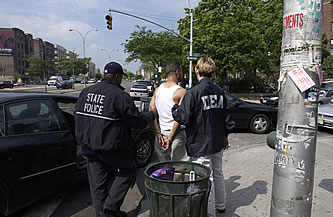 The bigoted cop can stop any black walking or driving down a street and subject him to a humiliating interrogation and pat-down search. Woe to the black who “mouths off” by objecting. He will be “roughed up” and then arrested for “resisting arrest.” If he later explains that he didn’t do anything wrong, at his trial prosecutors will ask the jury the standard question: Who are you going to believe — this upstanding police officer who keeps us all safe or this no-good defendant who has a motive to lie?
For some unlucky blacks, they will be shot or choked to death, which obviously saves the time and expense of a trial for “resisting arrest.” Or maybe, if they’re lucky, they’ll just be shot with a taser.
In the event that blacks don’t cooperate by possessing or distributing drugs, racially bigoted cops might just plant the drugs on them or frame them by falsely alleging that they were caught violating the drug laws. Just ask the people of Tulia, Texas, about that phenomenon.
And then there are the cases where blacks traveling down the highway are caught with a large amount of cash. The cops just seize it, even though there are no drugs found. If they don’t like this highway robbery, they can sue to get their money back, assuming they have additional money to hire a lawyer.
What is important in all this is that it’s the drug war that gives racially bigoted law-enforcement agents a license to exercise their bigotry legally and get thanked, praised, glorified, and honored for it.
That’s not to say, of course, that the drug war isn’t enforced against people of all colors, creeds, and national origins. We all know that it is. It is simply to say that the drug war attracts racial bigots into law enforcement (and the judiciary) so that they can exercise their bigotry to their heart’s content and be thanked, honored, praised, and glorified for it rather than criticized, condemned, ostracized, and boycotted.
By ending the drug war, you end up removing the biggest opportunity for racial bigots to exercise their bigotry through law enforcement. Police departments would no longer serve as a magnet for racial bigots. The bigots already there would start to drift away. Sure, they could still exercise their bigotry in the enforcement of murder, rape, and robbery laws, but the opportunity to do that is extremely limited.
CNN’s David Simon interview
Don’t just take my word for the importance of ending the drug war in the context of police brutality against blacks and others. Watch this 16-minute interview by CNN reporter Christiane Amanpour of David Simon, the creator of the “The Wire,” a television series about policing in America. I cannot recommend this interview too highly.
Notice how Simon continues to emphasize his point that if you want to end police brutality and corruption, you have to end the drug war. But notice something equally important, something that characterizes many members of the mainstream press: Amanpour does not seize the opportunity to follow up on Simon’s point. She doesn’t ask Simon to explain the relationship between the drug war and police brutality. She doesn’t delve into why ending the drug war is the solution to police brutality. Throughout the interview, I got the feeling that Amanpour wanted Simon to simply address police brutality in the context of the continued existence of the drug war.
To Simon’s credit, he refused to go down that road, no doubt to Amanpour’s chagrin. He was masterfully steadfast in maintaining the central point — if you want to end police brutality and corruption, you have to end the drug war.
If only all Americans were to come to this realization, we could not only bring an end this Jim Crow program but also help restore some liberty and privacy to people of all races, colors, and national origins.
German Authorities Detain Drunken US Soldier Who Bit, Referred to Them as ‘Nazis’
Sputnik -17.06.2020
A drunken US Army soldier of the 2nd Cavalry Regiment was tied up and arrested by six German police officers in Nuremberg, Germany, on Saturday after he reportedly assaulted arresting officers and referred to them as Nazis.
An unnamed 22-year-old of the 2nd Cavalry Regiment based in Vilseck, Germany, could soon find himself facing assault charges under the US’ Uniform Code of Military Justice, following allegations of an aggressive and drunken encounter with German police officers over the weekend, according to Stars and Stripes.
Prior to being identified as a member of the US Army, the 22-year-old was reported to German authorities over his aggressive behavior toward staff at a Nuremberg train station.
“Due to the [intoxication] and the aggressive behavior, the identity of the man could not be determined on the scene,” police said, as reported by Stars and Stripes.
Cops initially handcuffed the drunken American, who then began to shout epithets, such as calling them Nazis, and kicked the arresting officers with his cowboy boots.
German officers responded to the resistance by tying up the soldier’s legs and hauling him off to the local police station. Authorities allege the American drew blood from an officer after biting his leg during a search.
Authorities told Stars and Stripes that the cop in question was taken to a hospital and “is currently not able to work.”
The American soldier has since been released to the US military.
Maj. John Ambelang, spokesperson for the 2nd Cavalry Regiment, confirmed to the outlet that the unit “is aware of an incident involving a soldier” and “takes unlawful violence toward others very seriously.”
After the West Bank When (How Soon) Will the East Follow?

By Jeremy Salt | American Herald Tribune | June 17, 2020
Whatever percentage of the West Bank Israel begins to annex in July, it will eventually annex the rest. Will it then turn to the east bank of the Jordan river?
Since the 19th century, the Zionist project was based on the seizure of all Palestine, including territory east of the Jordan. The map of ‘Israel’ presented to the Paris peace conference in 1919 extended northwards into what is now Lebanon and included the city of Sidon; in the northeast, all the Golan Heights and Syria almost as far as Damascus; in the southeast the entire Jordan River valley, with the territory it desired extending almost to the town limits of Amman.
Water was integral to Zionist calculations from the beginning. In the imperial carve-up between Britain and France, however, the headwaters of the Jordan on Mt Hermon, fed by the Hasbani and Baniyas rivers, stayed within the French mandate for Syria (later divided into Lebanon and Syria). The water flows into the Sea of Galilee, from where it feeds the Jordan River before emptying into the Dead Sea.
In the 1950s and 60s the Zionists made repeated attempts to divert the waters of the Golan, apart from bombing Syrian attempts to make better use of the water by building pumping stations. In its 1967 attack on Egypt and Syria, Israel seized two-thirds of the Golan, ensuring the flow of its waters south into Lake Galilee. About 100,000 Syrians fled or were expelled, along with several thousand Palestinians. About 100 of their villages were demolished and their land given to the 22,000 settlers who now live on the heights. An entire city, Quneitra, was also reduced to rubble by Israeli army sappers.
Currently, Israel takes about 60 percent of its fresh water needs from Lake Galilee and the West Bank. From the Galilee the water is pumped south to feed the Naqab, while 80 percent of the West Bank’s aquifers is drained so Israeli needs can be met and the settlers (about 450,000 excluding occupied East Jerusalem) can water their lawns and fill their swimming pools. By comparison, the Palestinians (2.2 million are allowed scarcely enough for domestic use, they have to endure frequent cuts and they have been prevented from drilling new wells since 1967 despite population growth.
With the Dead Sea dying and the Sea of Galilee drying up, falling to its lowest level for a century in 2018, Israel is increasingly dependent on desalinated water. In 2018, in an attempt to revive the Sea of Galilee, the government approved a plan for it to be refilled with desalinated water. The drought of 2018 forced a reduction in the water pumped from the Sea of Galilee from an annual 400 million cubic meters to 30-40 million. With a growing population and a diminishing supply of fresh water, control of both banks of the Jordan river is bound to be a critical element in zionist forward planning once the latest stage of expansion – the annexation of the West Bank – has been completed.
A false dichotomy
The mainstream Zionists, led by Chaim Weizmann and David Ben-Gurion, attached themselves to British imperial designs like a limpet, promising to be faithful to British interests in the Middle East. They were rewarded with key positions in the civilian administration (control of ‘immigration’ and the attorney-generalship) as well as military and police protection for their purchase and settlement of land, and the ejection of the Palestinian farmers which followed.
In the history of the Zionist movement a false dichotomy has been created between the mainstream ‘practicals’ and Vladimir Jabotinsky’s Revisionist stream of ‘politicals.’ Jabotinsky – “your fascist” as Mussolini described him to a Zionist delegation – was indifferent to the rights, needs and aspirations of the Palestinians but open about his intentions. The Palestine he intended to take in its entirety extended not just from the sea to the Jordan river but to the other side of the river, originally placed within the mandate but removed by Britain in 1922 and converted into the puppet state of Transjordan.
Jabotinsky knew ‘the Arabs’ of Palestine would resist the seizure of their land, and thus intended to build an ‘iron wall’ of military force to overcome them. Once defeated, having been forced to see reason, as Jabotinsky put it, peace could be established between the two peoples.
The ‘practicals’ projected an entirely different image. They reviled Jabotinsky’s fascistic Revisionists. They were socialists, so they declared, irrespective of the fact that their kibbutzes, their moshavs, their labor unions and their peak union body, the Histadrut, were for Jews only. They intended no harm to ‘the Arabs’. All they wanted was to work the land to the benefit of everyone and live in peace with their neighbors. They were happy to share irrespective of another fact, that Palestine was not theirs to share in the first place. When partition was first suggested in 1937 they accepted it and they accepted it again in 1947. It was ‘Arab’ obstructionism that was blocking the road to peace.
The diaries of their senior figures told the real story behind the dissimulation. Only there did they reveal their true intentions, to take the land and get rid of the people. The ‘practicals’ knew as well as the Revisionists that an ‘iron wall’ would have to be built against ‘the Arabs.’ An ‘Eretz Israel’ which included the other side of the Jordan was their map as well. The differences between themselves and the Revisionists were no more than tribal infighting over power. Tactics differed but the strategic end objective – the seizure of all of Palestine as delineated on the 1919 map – was the same.

Having served its purpose, the UN partition plan was dumped almost immediately. The Zionist leadership never had any intention of abiding by UN resolutions or international law. It could do neither, if Israel was to be established as a Jewish state. As Ben-Gurion made clear, war would give the Zionists what they wanted, all of Palestine, not just the 54 percent allocated in the partition plan and but for international intervention in 1948-9, they might well have succeeded. Partition was accepted by the Zionists only because at that stage they could go no further.
Having seized 78 percent of Palestine, Israel was admitted to UN membership only on the condition that it comply with General Assembly resolution 194 of 1948, giving expelled Palestinians the right of repatriation or compensation.
As it has never complied with this resolution and never had any intention of doing so, there is a clear legal reason to regard Israel’s membership of the world body as null and void. Another distinctive characteristic of Israel’s UN membership is that it remains a state without declared borders. This is not just because of the state of war that still exists between itself and two adjoining Arab states (Lebanon and Syria) but because Israel does not want to declare its borders. This seemingly anomalous situation is deliberate, allowing Israel to continue its expansionist drive towards the borders of the ‘national home’ as inked on the map in 1919.
Annexation of the West Bank takes it a further step in this direction. Netanyahu is a Revisionist. His Arab-hating father was for some time Jabotinsky’s secretary. Since the election of Menachem Begin in 1977, Revisionists have been in government for more than 40 years, with even more extreme extremists (Naftali Bennett and Ayelet Shaked) now taking center stage. In the Zionist context they almost make Netanyahu seem a moderate.
No one should doubt that beyond his lies and deceit, Netanyahu remains faithful to his Revisionist roots. In his 1993 book A Place Among the Nations: Israel and the World Netanyahu reaffirmed the “right” of the Jewish “people” to the entire ‘land of Israel.’
There should be no confusion about this. The ‘land of Israel’ is not (not yet) synonymous with the state of Israel.
The land is there only for Jews, not to be shared with anyone else, a principle pursued since the beginning of Zionist colonization and a commitment which Netanyahu took a step further with the nation-state law of 2018 and has now taken another step further with his declaration that the Palestinians of the annexed West Bank will not be citizens but “subjects”, a term usually applied to the subjects of a king or emperor. Again, this is consistent with the long-term view held along the political spectrum that Israel is the state of the Jewish ‘people’, and not of its citizens.
Last September Netanyahu pledged to annex the West Bank if re-elected. He now rules Israel under a power-sharing arrangement with Benny Gantz, army chief of staff during the 2014 onslaught on Gaza that killed 2200 people, including 1492 civilians (551 of them children). The Israeli military also shelled UNRWA shelters, killing civilians there as well as in the streets and their apartments. Annexation of the West Bank was part of the unity deal between these two unindicted war criminals.
How much will be annexed in the first stage won’t be known until Netanyahu issues the first decree but it will definitely include a 100-km long stretch of the Jordan River valley between the Hussein and Karameh (formerly Allenby) bridges. Violence will follow as surely as night follows day, the Zionists using resistance, as they always do, as a pretext to take more land and further tighten their grip.
There may well be a third intifada on the West Bank and it would take only a few shots across the river for Israel to have the ‘security’ pretext (the protection of its 11,000 illegal settlers in the Jordan valley) for crossing the water and establishing itself on the east bank. An immediate acquisition would be King Abdullah (formerly the East Ghor) canal on the east bank, from which is pumped 90 million cubic meters of fresh water a year to the residents of Amman.
On the basis of all past Zionist practice, the steady expansion into and settlement of Jordanian territory would soon follow, over the futile objections of the ‘international community.’ This is hardly far-fetched. Zionism is an opportunistic ideology and where opportunities have not arisen fortuitously to seize more of Palestine over the past seven decades, Israel has created them.
Those beating their breasts because annexation will mean an end to the ‘peace process’ and the two-state solution are delusional. The Zionists never intended there to be a two-state solution in Palestine and the ‘peace process’ died long ago, if it was ever intended to live. In reality, it was no more than a cost-effective war process fought behind closed doors at Camp David and giving Israel time to consolidate its hold on the West Bank.
Once the annexation of the West Bank begins the Palestinian Authority will collapse. Mahmud Abbas has already severed links with Israel and the US, not that this counts for anything at this stage. King Abdullah has already warned of the “massive crisis” that will follow once the West Bank is annexed but there is little he can do to stop it. The king can respond by sending the Israeli ambassador home and he can suspend the 1994 ‘peace’ treaty in whole or part but he cannot stop annexation any more than King Canute could stop the incoming tide.
The ‘international community’ is already reacting negatively but is likely to do little in practice. The US is giving Israel a free hand and the lobby will ensure King Abdullah stays in line. He is dependent on the US, where pressure is already being exerted through Congress for the extradition of Ahlam al Tamimi, implicated in the bombing of a Jerusalem pizzeria in 2001, and released in 2011 as part of a Hamas-Israel prisoner exchange. As US nationals died in the bombing, Al Tamimi is wanted for prosecution in the US. Refusal or delay by Jordan in handing her over would completely play into Israel’s hands. It is the “child killer” – Israel of course never kills children – that would capture the US media headlines and not the annexation of occupied Palestinian territory.
Israel’s ‘peace treaty’ with Jordan is no more than a tactical tool, just as the ‘peace process’ was, to be tossed aside when it has outlived its usefulness. The Israel army is already stationed on the West Bank of the Jordan. No one should expect it to stay there once the annexation of the West Bank has been completed. The east bank of the Jordan River is as much a part of the 1919 map as the Golan Heights or southern Lebanon, where only the resistance of Hizbullah has held the Zionists at bay. Almost certainly Israel is going to cross the Jordan river one day.
*(Top image: Three members of the Beit Ommar National Committee against the Wall and Settlements were injured on May 7, 2011, in a demonstration near the Israeli Karmei Tsur settlement. Yousef Abu Marya, age 36, had his wrist broken in two places by Israeli soldiers, while Ahmed Abu Hashem, age 42, and Mousa Abu Marya, 33, sustained leg injuries. Credit: Palestine Solidarity Project/ Flickr)
Jeremy Salt has taught at the University of Melbourne, Bosporus University (Istanbul) and Bilkent University (Ankara), specialising in the modern history of the Middle East. His publications include “The Unmaking of the Middle East. A History of Western Disorder in Arab Lands” (Berkeley: University of California Press, 2008.) His latest book is “The Last Ottoman Wars. The Human Cost 1877-1923” (Salt Lake City: University of Utah Press, 2019).
Pro-Palestine group wins legal battle against MailOnline over false anti-Semitism claim
MEMO | June 18, 2020
Key figures at the centre of the anti-Semitism row which rocked the Labour Party under the leadership of Jeremy Corbyn have suffered an embarrassing legal defeat. Two British right-wing newspapers, the Mail on Sunday and MailOnline, have been ordered to pay full damages and issue a written apology for publishing “grotesque” allegations about the Palestinian Return Centre (PRC) in their serialisation of Tom Bower’s biography of Corbyn, Dangerous Mind.
In the unauthorised biography of the former Labour leader, Bower, an investigative journalist, alleged that the PRC, an advocacy group for Palestinian refugees with links to Corbyn, was an anti-Semitic group. The 73-year-old alleged that the PRC is “known to blame the Jews for the Holocaust,” in his Mail on Sunday and MailOnline serialisation which tries to convince readers that the former Labour leader is unfit for office. The book was published it 2019 prior to the UK general election presumably to inflict the most damage on Corbyn.
“The article (along with Mr Bower’s book) contained the grotesque, but utterly false, allegation that the PRC (and, it was implied, its Chairman) is a group ‘known to blame the Jews for the Holocaust’,” said the PRC in a statement following their victory yesterday mentioning its chairman Majed Al-Zeer. Both papers have “acknowledged, there was no truth whatsoever in this allegation.”
The fabricated comment attributed to the PRC, a UN accredited NGO, was made in the House of Lords by an individual from the audience speaking at an event hosted by the advocacy group in 2016. Although the remarks were “strongly condemned by the PRC at the time”, Bower misused this false allegation to paint the PRC as an anti-Semitic group in what seems to be a desperate attempt to make Corbyn guilty by association. Though the former Labour leader was not a speaker at the event, he has spoken in several conferences and parliamentary meetings hosted by the PRC and made a trip to refugee camps in the Middle East during cross party parliamentary delegations organised by the centre.
As well as publishing full apologies in the Mail on Sunday and MailOnline website, Associated Newspapers has been ordered to pay substantial damages and pay the Palestinian Return Centre’s legal costs.
PRC also confirmed that Harper Collins, the publisher of Corbyn’s biography, along with Bower will have to publish a full statement expressing their regret and confirming their unqualified withdrawal of the allegation while acknowledging that the PRC does not and never has blamed the Jews for the Holocaust. The false allegation will also be removed from all future editions and the paperback version of the book.
This is the second legal victory in under two years for the PRC. Last year its Chairman Majed Al-Zeer won a High Court battle in the UK after being falsely labelled a terrorist. The entire case centred on Israel’s designation of the PRC and its chairman as terrorists. World-Check, which supplies private information on potential clients for corporations, businesses and even governmental agencies, such as police and immigration, appears to have bypassed British authorities in its designation and used Israel’s false depiction of the PRC.
British politicians and the MSM have sent a clear message to the white working class for decades: ‘You don’t matter’
By Guy Birchall | RT | June 17, 2020
“Far right”, “Nazis” and “racists” are epithets used by the liberal elite as an excuse to demonise patriotic Brits who offend their metropolitan sensibilities. This is class hatred, plain and simple.
Bigotry is alive and well in the UK. One form, in particular, is actively encouraged, lauded and laughed about. The victims of it are demonised in the press and for entertainment. These people don’t matter, their opinions don’t matter, their tastes are low-grade, the things they enjoy are looked upon with scorn, and whenever they kick off about all this, they’re vilified or ignored. They are, of course, the white working class.
The difference in the tone of coverage of last weekend’s protests compared with the ones the weekend before won’t have passed you by. When Black Lives Matter descended on Westminster to have a riot because a man had been killed 4,000 miles away, the media could not have been more sympathetic.
These weren’t just people who were wound up and bored after the Government had locked them all inside for a quarter of the year. They weren’t troublemakers – they were protesters. They weren’t “far-left thugs” – they were “anti-racism activists”. Their pulling down of statues, defacing national monuments or attempting to set fire to the Union Flag was just being done to “raise awareness” of “systemic racism” in Britain today.
The weekend of civil unrest was reported by the BBC to be “largely peaceful”, despite 27 police officers being injured in one day, some requiring serious hospital treatment. But, of course, they were a “diverse” group of ethnic minorities and middle-class Marxist poseurs fighting for a cause endorsed by every corporation going, from Ben & Jerry’s to the Premier League.
They were good people who’d been wound up. Even those who dared to criticise them did so only with the heavy caveat that they “understood their grievances”.
However, it was all very different for another group of people who got pissed off by what they saw, with war memorials being desecrated and monuments to national heroes being covered in graffiti. They were incensed by police inaction and what they felt was an assault on their national identity and history, so decided to go out and protect these monuments.
And what did the government and media call them? “Far right”, “racists” and “Nazis”, because, obviously, Hitler supporters would want to defend a statue of Winston Churchill. For a demonstration that was a tenth of the size at best as the one the previous weekend, the area was flooded with police.
The Mayor of London told them their “hate wasn’t welcome” in the city. The BBC described the “more than 100 arrests, after violent clashes with the police” (though just six cops were injured, in comparison with the previous event’s 27). It was a stark contrast to the coverage of the “mostly peaceful protests” that had taken place the weekend before. These new protesters weren’t legitimately concerned about the actions of communist and anarchist agitators – they were just racists. That was the only possible reason they’d assembled.
And what evidence did the media provide for them being racist? It boiled down to ‘Well, just look at them.’ Shaven-headed, pasty-faced, tattooed men covering themselves in the Cross of St George. Every front-page headline on every paper might as well have read, “Look at them – aren’t they ghastly?”. People wilfully misconstrued images to say they were performing Sieg Heil salutes, when they were clearly raising their hands and chanting “England” in a fashion anyone who has ever seen a football match can clearly recognise.
The hero of the hour was a black protester who was photographed carrying an injured white counter protester away from the fray – an undoubtedly noble act on his behalf. But when the Daily Mail covered this, they described a “far-right statue defender” as having been rescued by a BLM activist.
It had no way of knowing this man’s politics. It didn’t even bother to find out his name before labelling him an extremist. And what about those “mostly peaceful” protesters he had to be rescued from? Were they about to lovingly kick his head in for thinking that Churchill was basically a good bloke? Did they shove him to the ground to educate him about the wonders of diversity?
The double standard is appalling. The photos taken before that counter protestor was hauled to safety in an admirable act of humanity show a baying masked mob of mostly black men around him. Can you imagine the outrage if a picture emerged with those dynamics reversed? There would be hell to pay.
The disparity is obvious yet again in the coverage accorded to the man pictured urinating near the memorial for policeman Keith Palmer, who was murdered by a terrorist outside Parliament in 2017. The photo was circulated by MPs and media outlets alike, all of them accusing a man who was clearly out of his head drunk as engaging in some sort of dirty protest against the memory of a fallen officer.
Within a day, he’d handed himself into police custody and was up before the magistrates on Monday. He told the court he’d been out in London the night before, where he’d necked at least 16 pints, not gone to bed, then decided to join fellow football supporters to “protect the statues” – but he didn’t know which statues. He said he was ashamed of himself and admitted guilt and, within 15 minutes, he was sentenced to 14 days in prison. The usual punishment for this offence is an £80 fine and results in no criminal record.
Remind me again how long the gang of thugs that tore down a statue, rolled it through the streets of Bristol and dumped it in the harbour got? I seem to recall that entire incident being filmed as well, but none of the perpetrators have even been arrested, let alone had the contrition and decency to hand themselves in to the authorities.
While we’re on the topic of Bristol’s “racist” statues, let’s consider the latest public art installation that has arrived in that city. Next to the plinth where the statue of Edward Colston once stood there’s now another sculpture.
This one depicts a morbidly obese skinhead wearing a string vest and standing in a wheelie bin. His enormous belly spills over its lip as he looks at a phone with “England for the English” as a background in one hand while holding a globe in the other. On the bin are the words “Spoiler alert: St George was Turkish”. Can you imagine the outcry if a statue exaggerating the stereotypes of any other group were to be put up? It would be smashed before lunchtime.
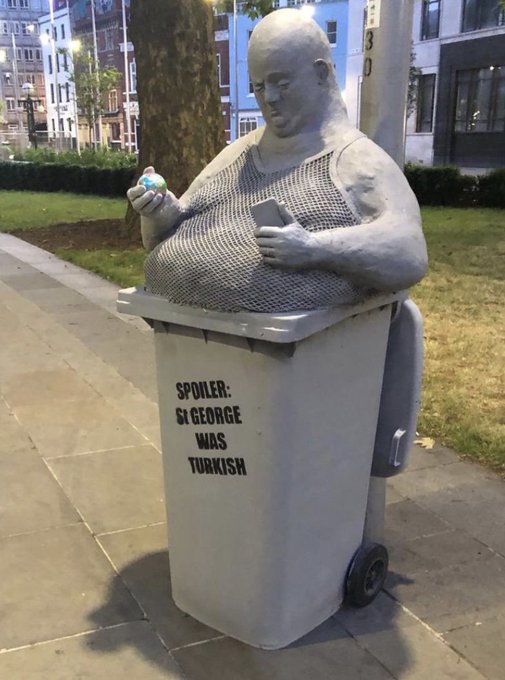
The statue is a material manifestation of the attitude the elite has towards this section of society, which is simply: “You don’t matter”. The Labour Party was formed to represent working-class people, but stood idly by as their jobs went abroad and their communities were completely transformed by immigration.
“You’re just racist,” they told them, or as Gordon Brown, the former Labour prime minister, once famously got caught out admitting in 2010 while unknowingly still mic’ed up, “You’re just bigoted” – in other words, you don’t deserve to matter.
They ignored these people after they voted for Brexit in 2016, prompting them to plump for the Conservatives for the first time in decades in 2019. But the Tories won’t listen to them, either: they also regard these white people as toxic, and the party doesn’t want to be accused of being racist.
So, we end up with the appalling scenario of our police standing by as white girls across England were raped by gangs of predatory Muslim men. Because these white girls don’t matter.
The white working class’s love of cheap EasyJet flights to Spain and Greece have to go because they’re killing the planet – while we ignore China and India belching out millions of tonnes of carbon into the atmosphere. But we can end all that because they don’t matter.
Even football is being taken away from them, as the price of Premier League tickets go up and up and the grounds are ever more gentrified to appeal to the middle classes who derided the game for so long, but like it now that it’s fashionable and lucrative. The old lot would just fight anyway, so they don’t matter.
I don’t believe the vast majority of these people are far right – those who make that accusation don’t even know what that means. They just, rightly, feel ignored. There will be racists in their midst, but you can’t dismiss millions of people on the basis of a few extremists. Black Lives Matter and the Labour Party should both be dismissed, if that were the case.
They are, for the most part, patriots who feel abandoned by the country they love. They deserve to be heard. And they deserve to know that they do matter.
Guy Birchall, British journalist covering current affairs, politics and free speech issues. Recently published in The Sun and Spiked Online. Follow him on Twitter @guybirchall
EU diplomacy is profitable for Israel, but a disaster for the Palestinians
By Ramona Wadi | MEMO | June 16, 2020
Since Israel announced its plan to annex swathes of the occupied West Bank, the EU has only hypothesised on what steps the bloc may take in response. The most prominent of these could be the exclusion of Israel from the Horizon 2020 research grants. Other than this possibility (it is no more than that at this stage), which should have been done long before now in any case due to Israel’s perpetual violations of international law, the EU has tacitly approved Donald Trump’s deal upon which annexation is based, and will most likely restrict its collective response to rhetoric.
US President Trump has dealt Palestinians a severe blow, which would have been impossible if the international community had united, decades ago, to rectify its colonial approach to Palestine. Through non-binding resolutions, the UN led the way in creating Israel’s ability to act with impunity which is derived from Palestinian dependence. No strategy other than anti-colonial resistance could have worked, and despite the UN’s purported intentions to eradicate colonialism, it reneged and instead provided Israel with the necessary diplomatic cover to appropriate virtually all of Palestine.
The EU is no different. It placed itself at the helm of alleged peace-building strategies, in particular through its financial assistance to the Palestinian Authority alongside its diplomatic relations with Israel. As a result, Palestinians became pawns in a state-building project without a state, presided over by an internationally-funded entity that has no political legitimacy and which functions as a colonial collaborator with, and defender of, the colonial-settler state of Israel, as well as a mouthpiece for international diplomacy.
Spanish MEPs have criticised the EU’s Foreign Affairs Chief Josep Borrell’s statement, noting that calling upon Israel to refrain from annexation is not enough. However, the EU is also portrayed as “the only international actor that can force upon them genuine negotiations between the parties involved.” There are no genuine negotiations, as any diplomat knows. Israel must be identified as a colonial power and decolonisation should take the place of negotiations, thus reversing the power imbalance that prevents Palestinians from uncompromised political decision-making.
Consider Luxembourg’s Foreign Minister Jean Asselborn’s recent statement that the EU would “inevitably” recognise Palestine as a state “if Israel moves forward with its controversial plan to annex the West Bank.” Is this ludicrous diplomacy what the PA has been striving to achieve; the recognition of a hypothetical state when there is barely any land upon which to build it? Symbolic recognition of Palestine within the two-state context has failed to achieve any political advantage for Palestinians, but recognising a state when the demise of its hypothesis has been obvious for years is the epitome of EU hypocrisy.
Writing “reproachful letters would be a humiliation for the EU,” Asselborn added. Belatedly recognising a Palestinian state is not, in EU diplomacy, because when it comes to Palestine and the Palestinian people, there is no limit to what the international community can get away with while still proclaiming itself to be a champion of human rights. The EU, in particular, relishes this status, which the PA supports unabashedly, to the detriment of the Palestinian people. Without a plan to prevent Israel’s annexation of the occupied West Bank, what role is the EU playing other than facilitating the US deal of the century? The reality is that EU diplomacy is profitable for Israel, but an absolute disaster for the Palestinians
Iran: E3 unconstructive draft resolution at IAEA meeting mockery of international rules
Press TV – June 16, 2020
Iran has condemned as “unconstructive” a resolution reportedly drafted by the three European signatories to a 2015 nuclear deal for a vote at the International Atomic Energy Agency (IAEA)’s governing board meeting, saying such a resolution makes a mockery of international rules.
Speaking to reporters on Tuesday, Kazem Gharibabadi, Iran’s permanent representative to Vienna-based international organizations, urged France, Germany and the UK — also known as E3 — not to complicate the situation surrounding the Iran deal if they cannot fulfill their end of the bargain and help salvage the accord.
The comments came as IAEA Board of Governors started a four-day meeting on Monday, with Iran on the agenda.
According to a Bloomberg report, the resolution prepared by the European trio urges Tehran to “fully cooperate” with the IAEA investigation of its nuclear facilities. It came after the nuclear watchdog’s inspectors claimed they had not been given access to two locations that may have hosted atomic activities two decades ago.
The resolution will have to be presented during the meeting and is expected to win Washington’s backing.
During the Monday session, the IAEA Director General Rafael Mariano Grossi claimed that for over four months, “Iran has denied us access to two locations and that, for almost a year, it has not engaged in substantive discussions to clarify our questions related to possible undeclared nuclear material and nuclear-related activities.”
Gharibabadi dismissed the claims in the reported resolution and said, “While Iran is cooperating extensively and constructively with the agency, submitting a resolution with the purpose of asking Iran to cooperate and fulfill the two demands of the IAEA is regrettable and a totally unconstructive move.”
He criticized the European trio’s double standards on Tehran’s nuclear program and said such a resolution is being put forth by the countries that “either possess nuclear weapons or play host to such destructive and deadly weapons.”
Such a move, Gharibabadi said is “a mockery of international norms and rules governing disarmament and non-proliferation regimes.”
Gharibabadi also called on all members of the IAEA Board of Governors to exercise vigilance and avoid taking any “political and hasty” measures in order for Iran to continue cooperation with the Vienna-based agency.
“Naturally if such a resolution, which clearly serves American goals, is approved, the Islamic Republic of Iran will have to take the necessary measures accordingly,” he noted.
The Iranian envoy further stressed that the new IAEA request is founded on the claims raised by the Israeli regime, which is an enemy of Iran.
Tehran’s transparent cooperation with the agency “does not mean that we should agree to every request from the IAEA on the basis of delusional claims of our enemies,” he emphasized.
Iran signed the Joint Comprehensive Plan of Action (JCPOA) with six world states — namely the US, Germany, France, Britain, Russia and China — in 2015.
However, Washington’s unilateral withdrawal in May 2018 and the subsequent re-imposition of sanctions against Tehran left the future of the historic agreement in limbo.
Iran remained fully compliant with the JCPOA for an entire year, waiting for the co-signatories to honor their commitments.
As the European parties failed to do so, the Islamic Republic moved in May 2019 to suspend its JCPOA commitments under Articles 26 and 36 of the deal covering Tehran’s legal rights.
Hypocrisy on Campus: Decolonization Means Cutting Ties with Israeli Apartheid
By Adam Saeed | Palestine Chronicle | June 14, 2020
Those of us who have the misfortune of following their universities on social media were recently exposed to a new wave of hypocrisy when these institutions which are directly complicit in apartheid against the Palestinian people and the destruction of our environment released statements “in support” of the BLM movement. This act of performative solidarity and intentional distortion of the meaning of decolonization was rightly met with anger and outrage by many student activists calling the institutions out on their duplicity.
Indeed, these words that celebrate humanity and commitment to fighting for equality and against oppression ring hollow to those who see Palestinians being excluded from this racist definition of humanity. If the case is being put for equality and against oppression, then the first step our universities and unions should take before they attempt to co-opt the Black Lives Matter Movement is clear: they must commit to decolonization by ending material and institutional complicity with Israeli Apartheid.
In stark contrast to the line of marketing teams of universities like SOAS or Glasgow, we are calling for decolonization of our institutions that will have factual implications to the situation on the ground. Namely ending institutional links to Israeli Universities which are directly complicit in the colonization of Palestinian land and contribute to the development of strategies and technologies that are used in the violent oppression of Palestinians across the land. The Hebrew University represents a prime example of institutional involvement in this process of colonization of Palestine.
At the time of its establishment in the early 20th century, the University was viewed as being a key symbol of the Zionist project in Palestine: plans for establishing the university were formulated by key Zionist thinkers, including Chaim Weizmann, who would later become the first president of Israel. In this sense, the university was an essential part of the process of settler-colonialism within which Israel was created and in which it continues to constitute its existence. The University also contributed to the development and propagation of Zionist colonial ideology and advocates for Jewish ethnopolitical supremacy in Palestine until today.
After Israel occupied the West Bank in 1967, annexing East Jerusalem, the Israeli Government confiscated the land around Hebrew University and its affiliated Hadassah Hospital, embarking on large-scale expansion. This expansion reached beyond the green line and included private Palestinian land. As it stands today, substantial parts of the Hebrew University that are built upon occupied Palestinian land, are defined as an illegal settlement under international law. Constituting a clear breach of the Geneva Convention. Importantly for UK universities, the accommodation offered to international students undertaking Year Abroad programs lies within the Student Village, which stands on occupied land, and therefore students housed in these buildings are directly taking part in a perpetration of a war crime.
The violations committed by Hebrew University don’t end there. Like all Israeli higher education institutions, Hebrew University plays an active role in the Apartheid system by discriminating against Palestinian students and supporting the Israeli Army’s repression of Palestinians. Recently, the Hebrew University has launched an academic excellence program for IDF soldiers, opening a ‘de-facto military base’ on campus.
The program, known as ‘Havatzalot’, offers three-year training for future intelligence officers as part of their mandatory army service. It includes basic training at combat level, officer training, a bachelor’s degree, and military intelligence and leadership training. The IDF student soldiers live on campus and are required to wear uniforms and carry weapons at all times. Moreover, the IDF has enforced further security measures to be put in place inside the campus, including biometric IDs and the right to demand the replacement of anyone employed in the soldiers’ compound if they don’t pass a security screening. For the Palestinian staff at the university, this presents a threat to their livelihoods and safety.
The extreme militarization of Hebrew University manifested through programs like Havatzalot goes hand in hand with its premises and buildings being used by the IDF and Israeli police to oppress and control the population of Palestinian Issawiyah neighborhood next to which the Hebrew University is located. This also includes closing the southern entrance to the neighborhood by the Israeli police and brutalizing its inhabitants passing through the gate close to the university campus.
Our universities are sending their students to directly take part in the maintenance of war crimes and normalize relationships with institutions that are rooted in the most brutal form of racism in our time: colonialism and European supremacy. The need for decolonization at our universities as a process of ending material support for these institutions is the only viable next step forward and towards an anti-racist, decolonial future. We must not allow decolonization and anti-racism to be co-opted by the marketing teams of these marketized institutions.
I urge every anti-racist student campaigner to join our decolonizing mission at Apartheid Off Campus today. Let us unite under the banner of anti-racism and decolonization to end our universities’ complicity. Let’s follow in the footsteps of the University of Johannesburg which terminated its relations with Israeli academic institutions in 2011 and show our solidarity with the Palestinian people, whose voices must be heard today more than ever.
– Adam Saeed is a Palestinian student of Arabic and Politics at the University of Leeds. He is also an activist within the Apartheid Off Campus student led-network. They are on Twitter: @AOC_movement.
Featured Video
10K More U.S. Troops Deploy as Trump Weighs New Iran Strikes
or go to
Aletho News Archives – Video-Images
Book Review
The Genetic Deception — now in paperback (Second Edition)
Lies are Unbekoming | October 2, 2026
The genes the field promised were never there.
The genetic story of disease is a cover story.
The twenty-first century runs on it. Paediatric clinics. Cancer centres. Forensic laboratories. Family-planning counsel. It is used to explain illness, to assign blame, to foreclose questions. It protects the industries whose products and practices are what actually caused the harm.
It isn’t true.
In 2010, Jonathan Latham and Allison Wilson looked at over seven hundred genome-wide association studies covering some eighty common diseases. The genes the field had promised were not there. The field invented a term, “missing heritability”, to explain the absence, and has quietly worked to bury the finding ever since.
The Genetic Deception is a book about what Latham and Wilson found. What the field did with it. And what the public was told instead. … continue
Blog Roll
 Aletho News
- Von der Leyen gifts her spin doctor a job for life
- 10K More U.S. Troops Deploy as Trump Weighs New Iran Strikes /Suliaman Ahmed
- Iranian crew declared Dena training vessel ‘unarmed’ to US warship before deadly torpedo strike: Report
- Iran’s NPT debate moves beyond parliament
- Houthis condemn Saudi claims of attack on Medina
- Fatuous False Flags
- Are Europe’s Smallest Nations Dragging the Continent into War?
- EU draws up contingency plans for possible Merz exit
- G7 caves to US blackmail, announces ‘massive’ release of diesel reserves
- Reporting of the RAF Fairford arrests blows the idea of a ‘free press’ out of the water
- If Americans Knew
- The Israeli Right Portrays Islam as Murderous. It Serves a Political Purpose
- Jordan Has Had Enough: King Abdullah’s Scathing Warning to Israel
- Israeli Colonizers (i.e. Settlers) Kill Palestinian Man Near Salfit
- New Google Maps images reveal massive scale of devastation in Gaza
- Jewish supremacy, anti-Palestinian bigotry on display in Israel – Daily Update
- Israeli Soldiers Abduct At Least 22 Across Occupied West Bank
- Eight Palestinians Killed in Israeli Attacks on Gaza
- Israeli former leaders and security chiefs threaten legal action over ‘Jewish terrorism’
- Israel map in LA Times ad includes all land from the river to the sea
- Inside Lebanon’s 200-page dossier on Israeli war crimes
- No Tricks Zone
- Green Energy Debacle: German Expert Professor Fritz Vahrenholt Warns Of Severe Economic And Social Consequences
- Two More Paleo Reconstructions Affirm Meters-Higher Sea Levels Across Ireland, Brazil 7000-6000 Years Ago
- New Study: Earth And Venus Surface Warmth Largely Explained By Convection And Lapse Rate, Not CO2 Or Radiation
- 2025 Nature Paper Claiming Worsening Global Drought Gets RETRACTED …Heavily Flawed
- New Study: ‘Global Drought Shows No Detectable Recent Acceleration Under Climate Warming’
- Economic Masterminds: German Socialists Suggest Taxing Productivity Gains Stemming From Using AI
- The South China Sea Has Not Been Cooperating With The Climate Change Narrative
- Energy Crisis: Germany Enters Heating Season With Historically Low Gas Reserve Fill Levels
- New Study: The Antarctic Ice Sheet Gained Mass From 2020-2024 Due To Staggering Snow And Ice Accumulation
- Study: Ocean Heating Rates From Thousands Of Years Ago ‘Dwarf’ Modern Ocean Heating Rates

