The Anti Slavery Mural is Back, Hopefully Forever.

By Gilad Atzmon | June 13, 2020
Hip Hop legend Ice Cube came under fire last week for posting an anti- racist image on Twitter in support of Black Lives Matter. The image was widely panned as ‘anti-Semitic’ by those who work hard to conceal images of slavery, oppression and abuse as soon as they gather that a member of their ethnic group may be complicit in such immoralities.
Following the killing of George Floyd, Ice Cube uploaded an image of a group of bankers sitting around a game board that rests on the bowed, naked backs of black slaves. “All we have to do is stand up and their little game is over” is the accompanying text.
This anti slavery image isn’t new. It first appeared as a mural by artist Mear One in London’s East End back in 2012 when it sparked a controversy. Some local Jews were offended and, of course, the local Labour council of the London borough of Tower Hamlets was quick to react. It called in the police and reportedly gave the owner of the property 28 days to remove it.
Jeremy Corbyn, supposedly an ‘anti racist’ initially voiced support for the mural and the artist behind it. Later, following pressure from Jewish groups, Corbyn reversed himself and apologized. The Guardian, once a respected Left leaning paper was also quick to cry foul and located the anti racist mural within the Elders of Zion-Nazi propaganda spectrum. Even the ultra Left Morning Star turned against the pro black/anti capitalist art “Bad Art and Bad Politics” is how our most dedicated ‘socialist’ paper referred to Mear One’s mural.
At the time Artist Mear One stated, loud and clear, that his “mural is about class and privilege… The banker group is made up of Jewish and white Anglos. For some reason they are saying I am anti-Semitic. This I am most definitely not… What I am against is class.”
It was also revealed at the time that out of the six bankers figures depicted in the mural (Lord Rothschild, John D. Rockefeller, J. P. Morgan, Aleister Crowley, Andrew Carnegie and Paul Warburg) – only two (Rothschild and Warburg) were Jewish. But none of that helped, our socialists, progressives and ‘Left’ icons left the black slaves to rot under the monopoly game board and stood firmly against Mear One’s art just because two of the bankers he depicted were Jewish.
What I want to understand today is how it is possible that the Labour council of Tower Hamlets, the ‘anti racist’ Jeremy Corbyn, the presumably multicultural ‘progressive’ Guardian, the ultra left Morning Star, or shall we say the entire Left/progressive spectrum all fell into the same trap, they turned their backs on Blacks and slavery and committed to the defence of the most horrendous abusive bankers known to man just because two of them were gifted (artistically) with a well endowed nose. One may wonder whether White Privilege is a valid notion as it becomes clear that Hooked Nose is by far the ultimate privilege. It literally allows for total impunity. You even get away with slavery, at least in the ‘Left’ realm.
Time to admit it publicly – in the face of Jewish sensitivities, the Left seems to collapse. Its solidarity with oppressed minorities evaporates. Indeed, if there is one thing the Left is really good at, it is betraying its core supporters. The Left has repeatedly betrayed the working class. Instead it adopted Identitarian politics that were set to break the working class into biologically oriented fragments (defined by skin colour, gender, sexual orientation, etc.). The Left even betrayed its own ideology dismantling its own philosophy of class politics that initially united us regardless of our gender, race or ethnicity. Embracing biologically oriented identification is, in practice, an adoption of Hitlerian ideology. Corbyn had been anti- banker, but he has often been very forgiving towards Jewish financiers such as the Rothschilds and George Soros. “Really important video which spells out the vile and destructive nature of antisemitic conspiracy theories,” is how Corbyn, as a Labour leader, described a horrendous video that presented the Rothschilds and George Soros as mere victims. Rothschild according to the video wasn’t even that rich.
Really important video which spells out the vile and destructive nature of antisemitic conspiracy theories. pic.twitter.com/Nm9xc8j7Vc
— Jeremy Corbyn (@jeremycorbyn) March 1, 2019
https://platform.twitter.com/widgets.js
For the Left, I am sorry to say it, the Blacks are solidarity pets. So are the Palestinians and other oppressed groups and minorities. I am afraid that this shameful divisive parade is not going to stop anytime soon. But Black community leaders have started to wake up.
Yesterday, members of African American Council were BOOED as they told protesters in Seattle’s ‘autonomous zone’ that they had ‘hijacked’ the Black Lives Matter movement by pushing other causes.
And there is some good news in this mural saga: 1. By now we know that art, like books, can be physically burned, it can be erased from walls, removed from exhibition: but beauty like the truth unveils itself against all odds. Mear One’s mural is with us forever and so is the memory of Corbyn/Guardian/Morning Star betrayal of the Blacks and their history.
2. Despite horrendous harassment from Jewish pressure bodies, the American Hip Hop star stood firm. Unlike Corbyn, Ice Cube answered his critics tweeting “what If I was just pro-Black?… I’ve been telling my truth.” I have always wondered why Corbyn didn’t answer his critics: ‘what if I were pro Palestinian rather than anti Jewish?’ The brainless veteran Labour leader couldn’t even figure this out.
Our world would look far better if our politicians in general and Left ones in particular had been just slightly more committed to truth. It would help if they had as much guts in their entire bodies as artists like Ice Cube have between their toes.
Washington Struggles to Manage the Crisis, But Israel Continues to Benefit

Florida Senator Rick Scott, who previously served as the state’s governor, visited the Kosel in August 2019. Credit: Rick Scott/ Twitter
By Philip Giraldi | American Herald Tribune | June 13, 2020
The self-inflicted cultural defenestration of what passes for Western Civilization in the United States continues apace. As George Orwell described the process in 1984 “Every record has been destroyed or falsified, every book rewritten, every picture has been repainted, every statue and street building has been renamed, every date has been altered. And the process is continuing day by day and minute by minute. History has stopped. Nothing exists except an endless present…”
Ironically, even as America’s Founding Fathers are being pilloried through the prism of contemporary values, not every bit of customary behavior is being challenged. Even though the United States is going through a devastating health care and national identity crisis, the Federal Government continues to grind out legislation that is favorable to Israel and to certain Jewish interests. “The Never Again (Holocaust) Education Act,” for example, passed through the House of Representatives (H.R. 943) by a 395-3 vote followed by a unanimous vote in the Senate on S.2085 on May 13th. It will help to indoctrinate school children regarding an easily challengeable narrative of perpetual victimhood which in turn generates billions of dollars for the racist state of Israel, but it was described by Congressional supporters as merely an instrument to support the already existing educational resources at the United States Holocaust Memorial Museum (USHMM), which is also taxpayer funded.
The House bill’s sponsor Representative Carolyn Maloney of New York preened that “Combatting hate and intolerance must always be a priority and I’m glad that the Senate agrees. Passing this bill by unanimous consent today sends a strong message that the Congress is overwhelmingly united in combatting antisemitism…” and the Senate bill’s sponsor Senator Jacky Rosen of Nevada explained how “…the Never Again Education Act will give schools needed resources to cover one of the darkest chapters in our history. Through education, we can provide insight into the past, and use it to prevent anti-Semitism now.”
If Americans Knew has documented how there were 68 pieces of legislation focused on providing goods and services to Israel in 2019, with 18 more added, identified here, so far this year. The most well known piece of legislation is S.3176, “US-Israel Security Assistance Authorization Act of 2020 (To amend the Foreign Assistance Act of 1961 and the US-Israel Strategic Partnership Act of 2014 to make improvements to certain defense and security assistance provisions and to authorize the appropriations of funds to Israel, and for other purposes),” which is the upper chamber’s version of House bill H.R.1837, which was passed last July. S.3176 passed out of committee on May 21st and is scheduled for a floor vote. The Senate bill was sponsored by Marco Rubio of Florida, a favorite of the Israel Lobby and its oligarch funders.
The House and Senate bills derive from an agreement entered into by President Barack Obama committing the U.S. Treasury to give Israel a minimum of $3.8 billion a year for the next ten years. The current version of the legislation has tweaked the language to make that $3.8 billion Danegeld a minimum, subject to increase as circumstances dictate. The bill also provides Israel additional military equipment off the books, funds several co-production arrangements and basically commits Washington to supporting Israel militarily even if the Jewish state starts the war.
Other pro-Israel bills include H.R.5595 – the “Israel Anti-Boycott Act (To impose additional prohibitions relating to foreign boycotts under Export Control Reform Act of 2018, and for other purposes),” which includes criminal penalties to target businesses, organizations and individuals who attempt to boycott or disrupt commercial activity operating out of Israel’s West Bank settlements. It was drafted in response to the publication of a United Nations database identifying over 100 Israeli companies doing business in illegal Israeli settlements on Palestinian land. S.Res. 570 “A resolution opposing and condemning the potential prosecution of United States and Israeli nationals by the International Criminal Court,” meanwhile is an attempt to block any consideration by the international court of Israeli as well as American war crimes.
Other legislation (S.3775 “The United States Israel Military Capability Act” involves developing and sharing military technology even though Israel frequently steals what is developed and H.Res.837 “Reaffirming the need for transatlantic cooperation to combat anti-Semitism in Europe” encourages European countries to do more to teach about the so-called holocaust and anti-Semitism.
But the most bizarre resolutions currently circulating on the Congressional circuit are S.3722 and H.R.6829 “To authorize funding for a bilateral cooperative program with Israel for the development of health technologies with a focus on combating COVID-19.” The respective bills were introduced on May 12th and 13th and are now in committee. The American Israel Public Affairs Committee (AIPAC) has been lobbying Congress hard by playing the China-as-threat card. The House version is consequently dubbed the “Expanding Medical Partnerships with Israel to Lessen Dependence on China Act.”
What the bills will do is establish a partnership with Israel to develop a vaccine and other medical responses to the pandemic virus. The costs will be shared, but Israel’s pharmaceutical industry will market the products, which promises to be enormously profitable if the endeavor succeeds.
And finally, there is Iran, Israel’s bête noire. On June 8th U.S. sanctions imposed on Iran’s shipping network took effect, months after they were announced in December following claims made by the State Department relating to alleged Iranian support for proliferation of weapons of mass destruction. Commercial and maritime industries and even governments now risk U.S. sanctions if they do any business with the Islamic Republic of Iran Shipping Lines (IRISL) and/or its Shanghai-based subsidiary, E-Sail Shipping Company. The new sanctions are being touted by Republican Congressmen as the “toughest ever.”
So, what is the average American citizen to do confronted by an avalanche of Congressional action benefitting Israel while the United States is going through its most trying time since the Great Depression? Israeli lobbying groups like AIPAC, Washington Institute for Near East Policy (WINEP) and Foundation for the Defense of Democracies (FDD) have large budgets, hundreds of staff and full and immediate access to Congressional offices. They even write the legislation that is then rubber stamped by the House and Senate, and although they are clearly agents of Israel, they are never required to register as such under Foreign Agents Registration Act (FARA).
One can always contact a Congress-critter and complain but that is generally speaking a waste of time. A brave man and friend of mine who was a survivor of the brutal Israeli attack on the U.S.S. Liberty in 1967 did write to his Senator and ask why, when the nation is in crisis, Congress is spending so much time and money on Israel. This was the reply he got from Senator Rick Scott of Florida:
“Thank you for contacting me regarding our greatest ally, Israel. Florida has maintained a strong relationship with Israel for many generations and I have always worked to improve policies and investments between our two countries.
During my time as Governor of Florida, I visited Israel three times. My first two visits were to promote Florida and to build international trade relationships between Israel and Florida. My third visit was for the opening of the U.S. Embassy in Jerusalem, for which I strongly advocated.
I also signed anti-BDS legislation, secured $2 million for security at our Jewish schools, and I opposed the reckless Iran Deal.
As your United States Senator, I will continue to work every day to protect and support our greatest ally and fight to take actions against those who wish to do them harm.
Again, thank you for your insightful correspondence. I am proud to represent every citizen in Florida and I appreciate the time you took to provide your position on this matter. Should you have any additional questions, please feel free to contact me.”
Clearly Senator Scott claims to be proud of representing “every citizen” in Florida, but he regards some citizens as more important than others. Concerning his trade missions, one might be interested in knowing what the balance of trade and job creation between Israel and Florida actually is, as these arrangements are generally heavily loaded to favor Israeli businesses and investors. Also, the good Senator might recall that it was a Florida public school that recently was on the receiving end of a mass shooting, so perhaps the money he so proudly gave to Jewish schools for security was not exactly well spent. And Scott seems to be unaware that Jewish organizations already get over 90% of Department of Homeland Security discretionary grants, so they hardly need more taxpayer money.
Acting on behalf of a foreign country, Senator Scott also is willing to shut down the First Amendment for most Americans in his zeal to crush the non-violent BDS movement. And his rejection of the “Iran Deal” demonstrates that he does not support policies that actually enhance the security of the United States, presumably out of deference to the interests of Israel and at least some of his Jewish constituents.
Finally, Senator Scott should perhaps look into the treaties that Washington has entered into with foreign powers. There is no defense treaty with Israel and the Jewish state is no ally, much less a “greatest ally.” It is, in fact, a major strategic liability, involving Americans in regional wars that need not be fought and demonstrating to all the world the risible reality of a military and economic superpower that is being led to perdition during a time of crisis by a ruthless and irresponsible client state.
No Place For Hypocrisy

Israeli police officers attack a Palestinian protestor outside the compound housing al Aqsa Mosque in Jerusalem’s Old City March 12, 2019. (Reuters)
By Richard Hugus | June 10, 2020
“No Place For Hate” has come out in support of widespread Black Lives Matter protests against the May 25, 2020 police murder of George Floyd. What does “No Place for Hate” have to say about the police tactics used against George Floyd also being used daily against Palestinians in occupied Palestine? “No Place for Hate” has nothing to say about this because it is part of the Anti Defamation League which openly represents, lobbies, and propagandizes for the state of Israel and Israel treats Palestinians the same way Minneapolis police treated George Floyd. It has done so since its inception, and far worse. The ADL and “No Place for Hate” are therefore guilty of rank hypocrisy. Indeed, the ADL has funded police departments all over the US to receive police training either in Israel or by bringing Israeli instructors to the US. The Israeli perspective on policing is that of an occupying army whose job is to control a hostile population, and this is what they teach US police to do in US cities. In this way, the ADL has promoted police brutality, not opposed it. By stressing the victimhood of blacks facing supposed omnipresent white racism, and making the term ‘racist’ into the same kind of weapon as ‘anti-Semite’, it has also promoted racial division, thus diverting a class war into a race war.
It has always been the strategy of the powerful to divide and rule, and clearly the ADL and the Jewish lobby represent the powerful. Otherwise oligarchs like George Soros, corporations like the Ford Foundation, and political formations like the US Democratic Party would not be contributing. To them, Black Lives Matter is no more than a tool in a color revolution now being carried out in the US. The regime to be overthrown is that of Trump and the racist “deplorables” who support him. The “color” in this case is black. The raised fist logo typical of color revolutions from Serbia to Venezuela has now shown up at Black Lives Matter protests in Boston:

The black struggle in the US has been hijacked by the very people who claim to be supporting it. Every good thing is subject to being co-opted. Orchestrated protests across the world (with bricks conveniently provided) following so closely three months of lockdown for a super-hyped global pandemic (with empty hospitals) show that we are living in a time of massive experiments in social engineering.
Israeli forces detain RT’s Redfish stringer while covering rally against Jordan Valley annexation in West Bank

© Twitter / Redfish
RT – June 12, 2020
It was the last shooting day for a small Redfish crew working on a documentary about Israel’s plans to annex some parts of the West Bank, including the Jordan Valley. Producer Ahmad Al-Bazz and a cameramen stringer, Ameen Nayfeh, set out to the small village of Zubaidat to cover a small protest staged by locals opposing the annexation.
At first, it seemed that it was going to be a regular filming day. “When we arrived the IDF [Israeli Defense Forces] were surrounding the village. We managed to enter and nobody stopped us,” Al-Bazz told RT. The soldiers took the journalists’ IDs and press cards but quickly returned the documents.
“It was not a huge protest, yet, there were some tense moments,” Nayfeh said, adding that the Israeli military were “very aggressive.”
“They were pushing the people and were shouting and swearing,” he recalled, adding that the IDF soldiers threw a stun grenade in a small crowd of demonstrators consisting of just between 50 and 70 people.
The crew had already stopped filming and were standing aside when they somehow drew the attention of the IDF. “An officer came to us, he was pointing his finger at us and he was very violent in his body language,” Nayfeh said. The journalists sought to explain they were at the scene on official business but even a document confirming they were “a crew working for RT” apparently failed to persuade the officer.
“He ordered his soldiers to take me,” Nayfeh told RT. “I was surrounded by six or seven soldiers.”
“They took the camera and I was afraid they would break it. They said I will come with them and I will ‘have a good time.’” The man was eventually released only after he agreed to hand over his camera’s memory card to the IDF.
It is not the first such incident since the IDF began cracking down on media working in the Palestinian territories. The Israelis have gone as far as to raid local TV and radio broadcasters over the past few years while accusing them of “inciting” violence. During one such raid in 2017, a local RT provider was shut down.
The latest example comes as Israeli Prime Minister Benjamin Netanyahu actively pushes for the annexation of the Jordan Valley as well as some other Palestinian territories in the Israeli-occupied West Bank. Netanyahu has set July 1 as the starting date for cabinet discussions on the issue.
Yet, he apparently has some trouble getting approval for the plan from his allies in Washington and even his coalition partners at home.
Jacob Cohen: “The Zionists Have Become Masters in The Art of Propaganda”
Interview realized by Mohsen Abdelmoumen | American Herald Tribune | June 12, 2020
Mohsen Abdelmoumen: What is your analysis of the annexation of the West Bank this July 1?
Jacob Cohen: The Zionist regime is not crazy enough to annex the entire West Bank, because then it would have to naturalize all Palestinians. It only wants to annex the “useful” West Bank, i.e. the Jordan Valley, thus preventing a possible Palestinian State to control its own borders and the large Jewish settlement blocs. It would thus continue to have a submissive and cheap labor force at its disposal, and the cooperation of a docile Palestinian police force to maintain colonial order.
It is not sure that this annexation will take place on July 1. Zionists are pragmatic people and know how to step back to jump better.
But in any case, annexation or not, the Zionists will never give up these territories they claim. The Jordan Valley is already implicitly recognized to them by all the great powers, even Russia, to ensure “the security of Israel”. And no one can imagine that the Zionist regime would bring 700,000 settlers below the Green Line.
These are the main lines of a possible Israeli-Palestinian agreement, and the Palestinian Authority pretends to believe, madly or stupidly, that it could recover the whole of the West Bank.
How do you explain that twenty ministers of the Israeli government are of Moroccan origin? Israeli security and defense companies are based in Morocco. How do you analyze these facts? Is not Morocco a real launching pad for the normalization policy advocated by the Zionist entity of Israel?
Only ten ministers have a distant connection with Morocco, which they do not care about. It is the Judeo-Zionist lobby in Morocco, led by the “sayan” (Mossad agent) André Azoulay, advisor to the monarchy for forty years, who does everything to maintain the illusion of perfect understanding between Morocco and its former Jewish citizens. Everything is done in Morocco to rekindle an almost extinguished flame. This to allow the visit of Israelis to Morocco, tourists, artists, businessmen, to push towards an official normalization of Israeli-Moroccan relations.
It is true that Morocco, since the installation of Mossad in that country in the 1950s to send Moroccan Jews to Israel, and the agreement obtained from Hassan II in 1961 for this purpose, is Israel’s de facto ally and support for its legitimization in the Arab world. In 1986, in the middle of the Intifada, the King received with great pomp the Israeli leaders Rabin and Peres.
Furthermore Morocco, on the other hand, which needs American diplomatic support to ensure its stranglehold on Western Sahara, does everything possible to please Israel, whose influence on American institutions is known.
How do you explain the strategic redeployment of the Zionist entity of Israel throughout Africa?
This redeployment had begun in the fields of construction and agriculture as early as the 1960s, after African independences. A redeployment stopped by the June 1967 war and the military occupation of vast Arab territories. The non-aligned movement at the time was still very influential.
The Oslo Accords restored some good repute to the Zionist regime, because it was assumed that it would give a State to the Palestinians in the long run.
Africa from the 1990s was no longer this non-aligned bloc sensitive to a form of international justice. It had joined the globalist circuit and security issues had become paramount.
Israel had become an important and feared partner. Did it not contribute to the amputation of the southern part of Sudan? Its networks in East Africa are very active and their strike force is well known.
Finally, little by little, the Zionist regime has managed, something inconceivable 20 years ago, to win the diplomatic support of many African countries in crucial votes in international institutions.
Algeria is one of the few countries that does not recognize Israel. Doesn’t Algeria still remain a permanent target of the Zionist entity of Israel?
All Arab countries are a permanent target of the Zionist entity. Even countries that submit are not definitively spared. Thus, even Morocco is not immune to Mossad’s attempts to stir up separatism in the Berber areas. If for no other reason than to keep the pressure on this country and make it understand that it has an interest in keeping its nose clean.
Let us remember the fate of Iraq and Syria, which the Zionist regime contributed to destroying.
Algeria will not escape the Zionist vindictiveness, which will try to reach it in one way or another. But this country is far away, not very sensitive to foreign influence, sitting on a large income, with a long history of national resistance, and a strong sense of patriotism. This is what makes it one of the few countries to stand up to the Zionist entity. And because of its geographical position and size, it is a country that is essential to regional security and therefore preserved.
We know the weight of the Zionist lobby in the United States through AIPAC. What is the weight of the Zionist lobby in Europe?
No difference except from a formal point of view. In the United States, the Zionist lobby has a legal existence, with its recognized networks of influence, its buildings in Washington and elsewhere, its congresses, where any candidate for an important post, be it senator or president, must appear and express his support to Israel.
Whereas in Europe, the lobby is more discreet but no less effective. Practically all European countries have banned the BDS movement, and adopted the definition of anti-Semitism proposed by a Jewish organization fighting against the “Shoah”. With this in particular that any criticism of Israel is equated with anti-Semitism. European countries have not even been able to implement their resolution to label products that come from the Zionist settlements in the West Bank.
In France, at the CRIF (note: Representative Council of Jewish Institutions in France) dinner, the entire establishment of the French Republic, including the President, bowed down and received instructions from the Judeo-Zionist lobby.
The European Union has set up a body to combat anti-Semitism headed by the German Katharina Von Schnurbein. How do you explain the fact that the European Union is setting up a body to defend Israel’s interests with European taxpayers’ money and that there is no hesitation in condemning all those who are against the criminal and fascist policies of Israel by calling them anti-Semites?
“Antisemitism” has been an extraordinary discovery of the Judeo-Zionist lobby in Europe. Of course, we know the history of the Second World War. But for the past 30 years or so, this lobby has been working hard to make it the greatest scourge of the 21st century. A few arranged or staged attacks, a few so-called verbal aggressions, a few desecrations that come in at the right time, a swastika lost here or there, and all the media networks are being used to make it look like there’s a resurgence of anti-Semitism. European governments are under pressure. They cannot afford any weakness.
But from criticism of Israel, we move on to anti-Semitism. The argument is fallacious, but it works. When you criticize Israel, you stir up “hatred” against that country and European Jewish citizens, and thus anti-Semitic aggression. Therefore, Israel should not be criticized. Anti-Zionism becomes an offense because it is equated with anti-Semitism. Pro-Palestinian demonstrations are banned because they lead to anti-Semitism.
Anti-Semitism has become a kind of blank cheque given to the Zionists to do whatever they like in Palestine without being worried, condemned or criticized.
You are a great anti-Zionist activist and a defender of the just cause of the Palestinian people. In your book “Le printemps des Sayanim” (The Spring of the Sayanim), you talk about the role of the sayanim in the world. Can you explain to our readership what sayanim are and what exactly is their role?
The “sayanim”, in Hebrew “those who help”, are Jews who live outside Israel and who, by Zionist patriotism, collaborate with the Mossad in their fields of activity.
They were created as early as 1959 by the Mossad chief at the time, Méir Amit. They’re probably between 40,000 and 50,000. Victor Ostrovsky, a former Mossad agent and refugee in Canada, talks about it for certain cases. He estimated that in the 1980s, in London alone, there were 3,000 sayanim.
What is their utility? Mossad recruits sayanim who work voluntarily in all major areas. For example, the media: these Jewish journalists or press bosses around the world will orient information in such a way as to favor Israel at the expense of Arabs.
In the United States, the Jewish power in the film industry is well known. Just an example. In 1961, Hollywood produced the film “Exodus” with Paul Newman, which tells the story of the birth of Israel in 1948 from a Zionist point of view. This film has shaped Western consciousness for at least a generation.
The same could be said for the financial institutions based in New York and dominated by Judeo-Zionists.
In France, advertising, publishing, the press, television, university, etc. are more or less controlled by “sayanim”.
It is therefore easy to understand the Zionist lobby’s strike force, a strike force that remains moreover invisible.
Isn’t Zionism, which is the direct product of the Talmud and the Jewish Kabbalah, an ideology that is both racist and fascist?
If we take Zionism in its political sense, that is, in the nationalist vision of the political movements of the 19th century, it was a secular and progressive ideology. It had seduced tens of thousands of activists, particularly in Russia and Poland, who sought to realize their revolutionary ideal outside the progressive movements of the time. They wanted to transform the Jewish people, to make it “normal”.
Despite these characteristics, these activists, upon arriving in Palestine, had excluded the Arabs from their national project from the outset. The seeds of racism were already planted. The Arabs had to be expelled or got rid of somehow. Even the kibbutzim, the flagships of “Zionist socialism”, did not admit Arabs within them.
Wars and conquests, especially of the “biblical” cities in the West Bank, have plunged Israeli society into a messianic fascism and racism that is no longer even hidden. The latest “Law on the Nation of the Jewish People” clearly establishes racist elements, such as the possibility for a Jewish municipality to refuse Arab inhabitants, even though they have Israeli nationality.
Doesn’t the just cause of the Palestinian people need a more intense mobilization in the face of the criminal offensives of the fascist Israeli colonial army? Don’t you think that the role of BDS is very important to counter Israeli fascism?
For the reasons I mentioned earlier, the Zionist regime has managed to stifle, at least in part, the legitimate demands of the Palestinian people. As far as the media and relations with the governments of the major powers are concerned, the balance is tipped in favor of Zionism. That’s a fact. Even the majority of Arab countries, for reasons that cannot be confessed, are turning away from it.
BDS is an extraordinary weapon, but as I said, it is increasingly banned in the West because it is considered as an ” anti-Semitic ” movement. It’s absurd, sure, but it’s so. Example: Germany withdrew a European prize from a woman writer because she had tweeted pro-BDS a few months before.
How do you explain that at a time when freedom-loving Westerners support BDS, Arab countries such as Saudi Arabia, Emirates, Qatar, etc. are normalizing their relations with the Zionist entity of Israel as part of the “deal of the century” spearheaded by Jared Kushner?
Historically, these monarchies have never supported the Palestinians, or at least with lip service, because they feared the revolutionary potential of the Palestinian movements in the 60s and 70s. The Arab world was then divided between “conservatives” and “progressives”. Following the example of Hassan II mentioned above, these monarchies were just waiting for the historic opportunity to normalize their relations with the Zionist regime. It is in their interest, the interest of the castes in power. We have seen what could happen to nationalist or progressive Arab regimes (Iraq, Syria, Libya). They were given a choice: fall in line and collaborate with Israel or some “Daesh” or separatist movements will drop on them. These monarchs do not have the suicidal instinct for a Palestine that has become an increasingly evanescent myth.
What is your opinion about the infamous blockade that the Palestinian people are suffering in Gaza while the world is in the midst of the Covid-19 pandemic?
The Zionist regime is submitting the people of Gaza to a concentration camp quasi-regime. Why quasi? Because the Zionist conqueror remains just below, cynically and intelligently, the level that could no longer leave the world indifferent. The blockade is not hermetic, allowing to pass through it in dribs and drabs at the occupant’s discretion, just enough to not sink. The fishing area is reduced or increased so as to keep this sword of Damocles on any fisherman who dares to go out. Electricity is limited to a few hours a day. Information from the inside is reduced, travels are limited. Israel even took the liberty about two years ago of banning European parliamentarians from entering the Gaza Strip. All the more so as Egypt’s complicity makes it possible to maintain this situation, and the Palestinian Authority withhold all payments to officials in Gaza. The world is given the impression that the Gazans are struggling, indeed, but that they had something to do with it, because they launch a few rockets from time to time and Hamas is considered a “terrorist” organization. The Zionists have become masters in the art of propaganda, with the complicity of Western governments. And Gaza is paying a terrible price.
You have been threatened and attacked on several occasions, including by the LDJ (Jewish Defense League), for supporting the cause of the Palestinian people and for being anti-Zionist. How do you explain the fact that in France, a country that prides itself on being a State governed by the rule of law and which is a champion of human rights and freedom of speech, fascist militias like Betar (note: radical Zionist Jewish youth movement), LDJ, CRIF, which defend the interests of Israel can act with impunity?
First there is the history of the Second World War and the Vichy regime, which leaves a sense of guilt, a feeling cleverly exploited by the Judeo-Zionist lobby with the multiplication of films on the Shoah which are shown over and over again on French channels.
Then there is the action of the “sayanim” very presents in the media and other institutions, and who terrorize, the word is not too strong, all those who deviate even a little. Take Dieudonné (note: French humorist, actor and political activist), he has been made the devil to such an extent that he can be assassinated with impunity. On the other hand, saying two or three wrong words to Eric Zemmour (note: French political journalist, writer, essayist and polemicist) in the street, and the President of the Republic calls him on the phone for 40 minutes.
Finally, there is great cowardice on the part of French intellectuals, journalists and politicians who do not say what they think. The fear of the CRIF is paralyzing them. Remember Etienne Chouard, a very famous intellectual who became well known during the referendum on Europe in 2005 and for his support for Yellow Vests. He was summoned to explain himself about the gas chambers on the site “Le Média“. The unfortunate man tried to clear out. He’s been bombarded with insults. He went to apologize on “Sud Radio“. He has since lost all credibility.
How do you explain the fact that all the media remain silent about the crimes of the Zionist entity of Israel and do not give voice to people like you? Where is the freedom of speech those western countries brag about? In your opinion, doesn’t the mass media serve an oligarchy?
Modern media are not supposed to track down the truth and proclaim it. See the way they treated covid19 and big-pharma. See also the coverage of Presidents Trump and Putin by these media, or the Syrian case. The major media belong either to the State (public radio and television) or to the financial oligarchies, all of which are, as I have shown, close to the interests of the Zionist lobby. So, when they boast about being free and promoting freedom of speech, they’re just self-promotion by brazenly lying. Moreover, the tendency in the name of this “freedom to inform” is to track down the so-called fake news, in fact the information that don’t fit the mould. And as long as this balance of power lasts, the crimes of the Zionist entity will be silenced or diminished, and the rights of the Palestinian people will be ignored.
In your opinion, weren’t the Oslo Accords a big scam that harmed the Palestinians by depriving them of their rights?
The Oslo Accords were one of the finest diplomatic scams of the century. With the Palestinians’ consent. In a SM (sadomasochistic) relationship, the master and the slave freely assume their role. The Zionist master found in Arafat the ideal slave to play the role.
I say this with great sadness and rage. But the reality is there. Arafat disappeared from the international scene in 1992. When Rabin beckons him, he no longer holds back. He was about to come back into the limelight.
It’s Rabbi’s stroke of genius. Israel was in a very difficult, let’s say catastrophic situation. The Intifada showed an over-armed and brutal army of occupation in the face of stone-throwing kids. The Palestinian cause was at the top. If Rabin had contacted Barghouti, the leader of the Intifada, the latter would have had strict and inflexible demands: Independence or nothing.
Arafat has given up everything. On all the sensitive issues, the refugees, Jerusalem, the settlements, the borders, the independent State, Rabin told him: “we will see later”. And Arafat agreed.
And furthermore, he delivered 60 % of the West Bank under the total sovereignty of Israel. This is the Zone C, on which the major cities of occupation are built.
Ultimately, Arafat could have realized after 2 or 3 years that he had been manipulated, that the Zionists will never give him a State, and slam the door, and put the occupier back in front of his responsibilities. But no, he continued until his death and Mahmoud Abbas is continuing along the same path, which lead to the progressive strangulation of what remained of Palestine.
But for Rabin, and the Zionist regime, the gain was fantastic. Israel was no longer the occupant. The whole world was pretending to proclaim the need for 2 States. It was just a matter of being patient and negotiating. The Zionist regime has thus restored much of its international credibility and legitimacy.
We saw the United States and the whole world shocked by the way George Floyd was murdered by a police officer. However, Palestinians suffer the same abuses on a daily basis, as this hold (a technique known as strangulation) is often used by the Israeli army, Tsahal. How do you explain the fact that nobody protests this? The world was rightly moved by the murder of George Floyd, why does it not react when Palestinians are murdered?
We keep coming back to the same problem. It is the media that make the news. And who controls the media? The Palestinians do not have a voice for the reasons mentioned above. Because when the media decides to inflate a problem, they do.
Who is Jacob Cohen?
 Jacob Cohen is a writer and lecturer born in 1944. Polyglot and traveler, anti-Zionist activist, he was a translator and teacher at the Faculty of Law in Casablanca. He obtained a law degree from the Faculty of Casablanca and then joined Science-Po in Paris where he obtained his degree in Science-Po as well as a postgraduate degree (DES) in public law. He lived in Montreal and then Berlin. In 1978, he returned to Morocco where he became an assistant lecturer at the Faculty of Law in Casablanca until 1987. He then moved to Paris where he now focuses on writing. He has published several books, including « Le commando de Hébron » (2014), « Dieu ne repasse pas à Bethléem » (2013), « Le printemps des Sayanim » (2010), « L’espionne et le journaliste » (2008), « Moi, Latifa S. » (2002).
He has a blog and performs on YouTube where he discusses various topics.
Mohsen Abdelmoumen is an independent Algerian journalist. He has written for several Algerian newspapers such as Alger Républicain and in different sites of the alternative press.
Canada’s Bid of Hypocrisy
By Rifat Audeh | Palestine Chronicle | June 12, 2020
On May 31st, the world commemorated the tenth anniversary of this Israeli attack (in international waters) on the humanitarian Gaza Freedom Flotilla. The Flotilla aimed to break the inhumane Israeli blockade imposed on the people of Gaza, described as collective punishment and therefore illegal according to international reports and scholars, including a UN panel of experts. Two other Canadians and myself were aboard the main ship attacked, the Mavi Marmara.
Ironically, on the day of the attack, Israeli PM Benjamin Netanyahu was in Canada, meeting with former Canadian PM Harper and other governmental officials. Yet despite this, the Conservative government did not demand our release nor was there any condemnation of Israel’s piracy against Canadians and other internationals, as we explained to the public in an open letter to Stephen Harper at the time.
To the contrary, the Canadian government implicitly justified Israeli actions against its own citizens. The timid visit I received by embassy representatives at the prison along with fellow Canadians, was punctuated by the fact that they had no response to my question of what the Canadian government will do about our illegal kidnapping and detainment.
If it was not for immense Turkish political pressure on Israel, there is no doubt in my mind that our government would have left us in an Israeli prison indefinitely. This was further confirmed to me when I visited our embassy in Jordan a while after my release when an embassy representative sadly defended Israeli actions even more vociferously than the Israelis themselves.
After the ascendance of the Liberals to power, I was hopeful that this foreign policy will change, and that our government would adopt an approach consistent with international law and human rights, particularly in relation to Palestine. In retrospect, I confess that I was quite naive.
In one of the first set of UN General Assembly sessions in the post-Conservative era, the Trudeau government voted against UN General Assembly Resolution A/RES/71/98, a resolution that emphasizes “the right of all people in the region to the enjoyment of human rights as enshrined in the international human rights covenants”. The same resolution demands that Israel, as the occupying power “cease all practices and actions that violate the human rights of the Palestinian people”.
Shamefully, this pattern of voting against the human rights of Palestinians and against upholding international law has continued ever since then, with Canada either voting against such resolutions or abstaining, thus isolating itself from the vast majority of the world.
A recent exception to this policy of blindly siding with Israel -at the expense of Palestinian human rights- took place in November, when Canada supported a UN resolution endorsing Palestinian self-determination. Yet PM Trudeau was quick to reassure pro-Israelis that this vote does not represent a shift from Canada’s support to Israel.
This is why many critics have speculated that the only reason Canada voted with the majority in this instance, is to try and secure a seat on the UN Security Council. The UN ambassadors will soon select new members to the UN Security Council, and there are bids by Canada, Ireland and Norway for “a place at the table”.
Accordingly and for the reasons shown above, I have signed a letter to the UN Ambassadors and a petition against Canada joining the UNSC. Although the council is clearly deficient already in many ways, this does not negate the fact that in addition to this, our country has clearly not earned its stripes to gain ascension to it.
In 2018, Canada’s Foreign Affairs Minister stated that the country’s presence on the council can be “an asset for Israel”, while hypocritically stating in the same speech: “Nor can we stand idly by when human rights are violated, wherever that may be.” Well, unless they are Palestinian human rights of course.
– Rifat Audeh is a lifelong human rights activist and award-winning filmmaker. His writings have appeared in various media outlets and he has a Masters’s degree in Media and Journalism.
Time to End Israeli Tyranny over Western Halls of Power: Zarif
Al-Manar | June 12, 2020
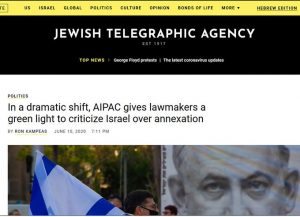 Iranian Foreign Minister Mohammad Javad Zarif lashed out at the Zionist lobbies for “poisoning” US politics, saying the time has come to end Israeli influence on the Western decision-making bodies.
In a post on his Twitter account on Thursday, the top Iranian diplomat pointed to an article published in the Jewish Telegraphic Agency about Israel’s influence over the US Congress, saying, “If there were ever any question of WHO dictates US—& Western—policy in the Mid East, this headline screams it loud & clear.”
“AIPAC has poisoned US politics for years, overtly giving instructions to Congress,” Zarif added.
“Time to end #APARTHEID Israel’s tyranny over Western halls of power,” the top Iranian diplomat wrote in the message.
Zarif has also attached a picture to his post, showing the title of an article published in the Jewish Telegraphic Agency.
The article has admitted that AIPAC “the leading pro-Israel lobby in the United States is telling lawmakers that they are free to criticize Israel’s looming annexation plans.”
Palestinian solidarity unsettles Canadian diplomats

By Yves Engler | June 11, 2020
The Palestinian solidarity movement is unsettling Canada’s diplomatic apparatus. In the final week of their multi-year campaign for a seat on the United Nations Security Council they’ve been forced to respond to a strong, well-documented, campaign in defence of Palestinian rights.
Yesterday, Canada’s Permanent Representative to the UN, Marc-André Blanchard, delivered a letter to all UN ambassadors defending Canadian policy on Palestinian rights. Blanchard was responding to an Open Letter organized by Just Peace Advocates signed by more than 100 organizations and dozens of prominent individuals. Over the past week more than 1000 individuals have used that letter as a template to contact all 193 UN ambassadors to ask them to vote for Ireland and Norway instead of Canada for two seats available on the Security Council.
Canada’s ambassador claims the Just Peace Advocates’ letter contains “significant inaccuracies”, but he doesn’t identify a single one of those “inaccuracies” (Blanchard probably hoped his letter wouldn’t be put online).
Here is the Palestinian solidarity letter sent to all UN ambassadors:
“As humanity reels from the Covid-19 pandemic, you will soon select the world’s representatives on the UN’s highest decision-making body. As organizations and individuals advocating in Canada and elsewhere for a just peace in Palestine/Israel, we respectfully ask you to reject Canada’s bid for a seat on the UN Security Council.
As you choose seats on the Security Council between the bids of Canada, Ireland and Norway for the two Western Europe and Other States, the UN’s historic contribution to Palestinian dispossession and responsibility to protect their rights must be front of mind. In these uncertain times, Palestinians are particularly vulnerable to Covid-19 due to Israel’s military occupation and violations of UN resolutions.The Canadian government for at least a decade and a half has consistently isolated itself against world opinion on Palestinian rights at the UN. Since coming to power – after the dubious record of the Harper government – the Trudeau government has voted against more than fifty UN resolutions upholding Palestinian rights that were backed by the overwhelming majority of member states. Continuing this pattern, Canada “sided with Israel by voting No” on most UN votes on the Question of Palestine in December. Three of these were Canada’s votes on Palestinian Refugees, on UNRWA and on illegal settlements, each distinguishing Canada as in direct opposition to the “Yes” votes of Ireland and Norway.
The Canadian government has refused to abide by 2016 UN Security Council Resolution 2334, calling on member states to “distinguish, in their relevant dealings, between the territory of the State of Israel and the territories occupied in 1967.” On the contrary, Ottawa extends economic and trade assistance to Israel’s illegal settlement enterprise.
Canada has repeatedly sided with Israel. Ottawa justified Israel’s killing of “Great March of Return” protesters in Gaza and has sought to deter the International Criminal Court from investigating Israeli war crimes. In fact, Canada’s foreign affairs minister announced that should it win a seat on the UNSC, it would act as an “asset for Israel” on the Council.
When deciding who represents the international community on the UN’s highest decision-making body, we urge you to consider the UN-established rights of the long-suffering Palestinians, and to vote for Ireland and Norway, which have better records on the matter than Canada.”
In reality, the letter only touches on the current government’s anti-Palestinian record. They’ve also celebrated Canadians who fight in the Israeli military, threatened to cut off funding to the International Criminal Court for investigating Israeli crimes, protected Israeli settlement wine producers, added Palestinian organizations to Canada’s terrorism list, adopted a definition of antisemitism explicitly designed to marginalize those who criticize Palestinian dispossession and repeatedly slandered the pro-Palestinian movement. None of this is secret. In fact, Liberal MP and former chair of the government’s Justice and Human Rights Committee, Anthony Housefather, has repeatedly boasted that the Trudeau government’s voting record at the UN was more anti-Palestinian than the Stephen Harper government!
The Trudeau government has almost entirely acquiesced to Housefather, B’nai B’rith, Centre for Israel and Jewish Affairs and the rest of the Israel lobby’s positions. But, they understand that there is sympathy for Palestinians within the UN General Assembly. And they need those individuals to vote for Canada’s Security Council bid if they don’t want to suffer an embarrassing defeat.
To be forced to respond at this late hour in their Security Council campaign represents a setback to the Liberals. But, we won’t know how significant the damage is until after next week’s vote. In the meantime please send a letter to all UN ambassadors calling on them to vote for Canada’s competitors, Norway and Ireland, for the two non-permanent Security Council spots open for Western countries.
As Just Peace Advocates’ Karen Rodman has pointed out, “the letter is seeking to pull at the heartstrings of the individuals who cast the secret ballots for the Security Council seat. We want to remind UN ambassadors that Canada has consistently isolated itself against world opinion when it comes to the long-suffering Palestinians.”
The PA’s ‘counter-proposal’ facilitates its colonial collaboration with Israel
By Ramona Wadi | MEMO | June 11, 2020
Further proof that the Palestinian Authority will not attempt to safeguard what remains of Palestine, let alone insist on decolonisation, is the plan submitted to the Middle East Quartet which does nothing other than confirm subjugation to the two-state compromise. Palestinian Prime Minister Mohammed Shtayyeh is reportedly calling the plan “a counter-proposal” to the US deal of the century.
Scant details are available at the moment. The PA’s proposal, however, puts forth the creation of “a sovereign Palestinian state, independent and demilitarised,” while allowing for “border modifications”.
According to a senior official of the Palestine Liberation Organisation (PLO), Wasel Abu Yousef, “No Palestinian leader can agree to the American and Israeli conditions to give up the right of return of Palestinian refugees, agree to the annexation of Jerusalem or allow Israel to annex parts of the West Bank where it has built its illegal Jewish settlements.”
However, the Palestinian leadership sees no contradiction in abiding by the earlier plans to colonise Palestine which were determined by the international community. As long as the PA remains entrenched within the two-state framework, it cannot claim that it is countering the “deal” concocted for Israel’s benefit by US President Donald Trump.
The PA has no allies in the Quartet, which consists of the UN, the EU, Russia and the US. The US, despite departing from international consensus with its slavish gifts to Israel, is still part of the group. Trump’s plan does not truly contradict the two-state paradigm’s aims; it hastens the process to bring the international community’s intentions to fruition. From the illusion of state-building, the deal of the century moves towards eliminating the idea, which puts the Quartet’s insistence upon the two-state diplomacy on a par with Trump’s plan. The PA is acquiescing, once more, to the colonisation of what remains of historic Palestine.
At a time when Palestinians need an alternative that departs from further colonisation, the PA is strongly emphasising what UN Secretary General Antonio Guterres is fond of describing as “no Plan B”. The PA is rejecting the deal of the century, as it should, to uphold a defunct imposition that actually supports Trump’s plan. Or perhaps the PA’s concept of “Plan B” is to facilitate Israeli colonisation by championing the international community’s violent political blunders.
A sovereign, demilitarised Palestinian state is not politically independent but an entity which, in theory and in fact will please Israel and the international community. The PA’s purported counter-proposal supports Israeli colonisation and presents another obstacle to the legitimate anti-colonial struggle which should be guiding Palestinian politics. Palestinians have long ceased to believe that the PA’s propaganda will produce any results, yet its representatives will continue to exploit the people of Palestine to ensure that Israel can complete its colonial project.
Far from opposing Trump’s deal, the PA is entrenching its corrupt stance and strengthening the international community, at the cost of the Palestinian cause disintegrating politically on a permanent basis. If the PA’s notion of a counter-proposal is aiding the international actors to implement the final phase of the Zionist colonisation process, it would do better to stop its pompous posturing and admit that it is an ally of the collective that seeks to destroy Palestine forever.
ECHR Backs Activists Convicted in France Over Campaign to Boycott Israel
Sputnik – June 11, 2020
The European Court of Human Rights on Thursday backed the pro-Palestinian activists who were convicted in France for “incitement to discrimination” over their calls to boycott products imported from Israel and ruled that the conviction violated their freedom of expression.
“The Court considered that the applicants’ conviction had lacked any relevant or sufficient grounds. It was not [established] that the domestic court had applied rules in keeping with the principles set out in [of the European Convention on Human Rights, providing the right to freedom of expression] or had conducted an appropriate assessment of the facts”, the ECHR statement read.
However, the French judiciary had not violated Article 7 of the European Convention on Human Rights, which implies that a person should not be held accountable for an offence if it was not considered an offence under national law when it was committed, the ECHR also said.
The court ruled that France must pay to each campaigner “380 euros [$431] for pecuniary damage, 7,000 euros for non-pecuniary damage” and a total of 20,000 euros jointly to the applicants “for costs and expenses”.
The Israeli government has argued that the BDS campaign, sponsored by Palestinian non-governmental organisations, is driven by anti-semitism. In 2017, Israel passed a law that allows it to refuse entry to foreign supporters of the movement.
Eleven members of the Collectif Palestine 68 group, which is a French branch of the international Boycott, Divestment and Sanctions (BDS) movement, were accused over two campaigns held in 2009 and 2010 in a supermarket located in eastern France. They urged customers to not buy goods of Israeli origin and called on the store to stop selling them. The activists were accused of inciting anti-semitism and racism by a French court in 2015 and ordered to pay thousands of euros in fines.
AIPAC: US officials can criticise Israel annexation plans, ‘as long as it stops there’
MEMO | June 11, 2020
The leading pro-Israel lobby group within the United States has given permission to the country’s officials and lawmakers to criticise Israel’s plans to annex areas of the occupied West Bank, on the condition that “the criticism stops there”.
The American Israel Public Affairs Committee (AIPAC), which has held significant influence within US politics throughout the decades, has provided the guidelines of limited criticism in Zoom meetings and phone calls with US lawmakers, according to one donor and one congressional aide who spoke to the Times of Israel.
It is generally unclear what is meant by not going too far, but it is thought to be centred on the continuation of US aid to Israel. The donor, who is involved in the lobbying of congress but who spoke on the condition of anonymity, said: “We are telling the senators ‘feel free to criticize annexation, but don’t cut off aid to Israel.’”
The warning by AIPAC not to go so far as to affect the aid was also echoed by a congressional staffer, who is described as a Democrat being targeted by the group, who said: “They want to make sure members of Congress understand this is the time to warn Israel but not to threaten the Memorandum of Understanding.”
This memorandum was a deal between the Israeli governments of Prime Minister Netanyahu and former US administration President Barack Obama in 2016 which guaranteed Israel a budget of defence aid amounting to $3.8 billion annually over a decade. Any criticism, the staffer said, is “not to threaten assistance.”
Throughout the years of its influence on the country’s politics, AIPAC has been strongly opposed to any criticism of Israeli policy or of the government of Israel itself, using its lobbying powers to condemn and side-line those who have done so while preventing others from voicing criticism. This permission, therefore, is seen as being in contrast to that pattern, but is thought to be possible due to the extremely controversial nature of the annexation plans, which have split many pro-Israel supporters.
Under the plan by the new Israeli coalition government, Israel would claim sovereignty and seize control over 30 per cent of the Palestinian territories in the occupied West Bank, particularly the illegal Jewish settlements and the strategic Jordan Valley, with steps being taken to this end from 1 July.
An AIPAC statement on 11 May acknowledged that “It is inevitable that there will be areas of political or policy disagreement between leaders on both sides — as there are between America and all our allies.” While the annexation plan is one such area, the same statement warned against any proposals to reduce ties with Israel if annexation goes ahead, making it clear that “Doing anything to weaken this vital relationship would be a mistake.”
PA to Stop Palestinian Resistance Efforts despite Ending ‘Security Coordination’ with Israel
Palestine Chronicle – June 10, 2020
The Palestinian Authority (PA) will continue fighting the Palestinian resistance movements and protecting Israelis despite halting ‘security coordination’ with Tel Aviv, a senior official has said.
Hussein Al-Sheikh, the Palestinian official in charge of relations with Israel and one of the two closest advisers to President Mahmoud Abbas, told the New York Times :
“We will prevent violence and chaos. We will not allow bloodshed. That is a strategic decision.”
Al-Sheikh added that the PA would arrest any Palestinian who intends to carry out an attack on the occupation from the occupied West Bank, the New York Times reported.
“We are not nihilists or fools, and we don’t want chaos. We are pragmatic. We don’t want things to reach a point of no return,” he explained.
Meanwhile, he said that the PA’s declaration of halting security coordination with Israel aimed to remind Tel Aviv of the burdens it would assume if the PA disbanded and to demonstrate that the PA could collapse if annexation goes ahead, the newspaper reported.
“If Abbas was, indeed, serious in his announcement, he would have included in his speech a clear articulation of a new Palestinian political agenda that is predicated on unity, but a true Palestinian strategy was never the PA leader’s ultimate goal,” Palestinian journalist and editor of The Palestine Chronicle Ramzy Baroud wrote in a recent article.
“What Mahmoud Abbas is hoping to achieve, with his latest theatrics, is the establishment of a new political game, one that is based on political ambiguity, so that he is not entirely abandoned by his Western backers, or finally shunned as a collaborator by his own people,” Baroud added.
Featured Video
10K More U.S. Troops Deploy as Trump Weighs New Iran Strikes
or go to
Aletho News Archives – Video-Images
Book Review
The Genetic Deception — now in paperback (Second Edition)
Lies are Unbekoming | October 2, 2026
The genes the field promised were never there.
The genetic story of disease is a cover story.
The twenty-first century runs on it. Paediatric clinics. Cancer centres. Forensic laboratories. Family-planning counsel. It is used to explain illness, to assign blame, to foreclose questions. It protects the industries whose products and practices are what actually caused the harm.
It isn’t true.
In 2010, Jonathan Latham and Allison Wilson looked at over seven hundred genome-wide association studies covering some eighty common diseases. The genes the field had promised were not there. The field invented a term, “missing heritability”, to explain the absence, and has quietly worked to bury the finding ever since.
The Genetic Deception is a book about what Latham and Wilson found. What the field did with it. And what the public was told instead. … continue
Blog Roll
 Aletho News
- Von der Leyen gifts her spin doctor a job for life
- 10K More U.S. Troops Deploy as Trump Weighs New Iran Strikes /Suliaman Ahmed
- Iranian crew declared Dena training vessel ‘unarmed’ to US warship before deadly torpedo strike: Report
- Iran’s NPT debate moves beyond parliament
- Houthis condemn Saudi claims of attack on Medina
- Fatuous False Flags
- Are Europe’s Smallest Nations Dragging the Continent into War?
- EU draws up contingency plans for possible Merz exit
- G7 caves to US blackmail, announces ‘massive’ release of diesel reserves
- Reporting of the RAF Fairford arrests blows the idea of a ‘free press’ out of the water
- If Americans Knew
- The Israeli Right Portrays Islam as Murderous. It Serves a Political Purpose
- Jordan Has Had Enough: King Abdullah’s Scathing Warning to Israel
- Israeli Colonizers (i.e. Settlers) Kill Palestinian Man Near Salfit
- New Google Maps images reveal massive scale of devastation in Gaza
- Jewish supremacy, anti-Palestinian bigotry on display in Israel – Daily Update
- Israeli Soldiers Abduct At Least 22 Across Occupied West Bank
- Eight Palestinians Killed in Israeli Attacks on Gaza
- Israeli former leaders and security chiefs threaten legal action over ‘Jewish terrorism’
- Israel map in LA Times ad includes all land from the river to the sea
- Inside Lebanon’s 200-page dossier on Israeli war crimes
- No Tricks Zone
- Green Energy Debacle: German Expert Professor Fritz Vahrenholt Warns Of Severe Economic And Social Consequences
- Two More Paleo Reconstructions Affirm Meters-Higher Sea Levels Across Ireland, Brazil 7000-6000 Years Ago
- New Study: Earth And Venus Surface Warmth Largely Explained By Convection And Lapse Rate, Not CO2 Or Radiation
- 2025 Nature Paper Claiming Worsening Global Drought Gets RETRACTED …Heavily Flawed
- New Study: ‘Global Drought Shows No Detectable Recent Acceleration Under Climate Warming’
- Economic Masterminds: German Socialists Suggest Taxing Productivity Gains Stemming From Using AI
- The South China Sea Has Not Been Cooperating With The Climate Change Narrative
- Energy Crisis: Germany Enters Heating Season With Historically Low Gas Reserve Fill Levels
- New Study: The Antarctic Ice Sheet Gained Mass From 2020-2024 Due To Staggering Snow And Ice Accumulation
- Study: Ocean Heating Rates From Thousands Of Years Ago ‘Dwarf’ Modern Ocean Heating Rates

