Nasrallah: Banned in the West but Mandatory Viewing in Israel
By Tim Anderson | American Herald Tribune | July 22, 2019
In his speech on the 13th anniversary of the defeat of the Israeli invasion of Lebanon in 2006, Hezbollah Secretary General Sayyed Hassan Nasrallah warned Tel Aviv of the consequences of its constant urging of war against Iran. The Zionist state would be swept up in any such
war and would suffer “a terrible defeat”, he said.
In the upside-down world of western war propaganda, Nasrallah’s warning is portrayed as a ‘terrorist threat’, while Israel’s repeated attacks on Syria and constant urging of war against Iran are presented as self-defense. In this way, war in the entire Middle East region is normalized, for western audiences.
In an apparent paradox, Nasrallah’s voice of resistance is banned in many western countries. Facebook, for example, will automatically block any link to the Hezbollah news site, al Manar. However, in Israel Nasrallah’s words are carefully reported and studied.
There is a good reason for this. The USA and Britain, in particular, want to prohibit Nasrallah’s clear and insistent logic of resistance to the colony in Palestine; while Israel wants colonists to remain up to date on the latest detail from their northern nemesis. Of course, Nasrallah’s speeches carry a fair degree of morale-building rhetoric, of his confidence in victory and so on. But he speaks with the unique credibility of a commander in chief, as well as that of a strategic analyst. When he speaks of inflicting damage on Israel, his southern neighbors know that Hezbollah has done that before, driving zionist forces out of Lebanon throughout the 1990s and again in 2006.
No other resistance commander speaks so plainly and in such detail. Iran’s legendary General Qasem Soleimani, for example, rarely makes any public statements.
This latest message led with the warning over the war against Iran, and specified the vulnerabilities of Israel. Showing a map of occupied Palestine, Nasrallah emphasized the capabilities of the Lebanese resistance and the close proximity of all Israel’s military, logistic and industrial facilities. Hezbollah now has tens of thousands of accurate missiles and its retaliation would focus on the north and on the north coast.
Zionist leaders, recognizing that Hezbollah is now well embedded in the Lebanese government, seem to have abandoned any attempt to distinguish the resistance party from Lebanon. On more than one occasion Minister Yisrael Katz has threatened to send Lebanon back “to the stone age”. This is part of Israel’s (obsessive but futile) campaign to remove Iranian presence from both Syria and Lebanon. In December 2017 Katz threatened “This time, all of Lebanon will be a target … we will return Lebanon to the Stone Age.” Nasrallah responded in kind. Al Manar’s summary of the long speech (‘Sayyed Nasrallah confident of victory: we will pray in al Quds!’, 16 July) emphasized the devastating impact of Hezbollah’s retaliation against Israel.
Lebanon’s resistance forces are prepared for a counter-invasion of Galilee (northern Palestine) and would focus attacks on the coastal strip from Netanya to Ashdod, which included the main airport, arms depots, military facilities, petrochemical plants, power facilities and ports. Israel would suffer a “terrible defeat” and would be “on the verge of vanishing”. Nasrallah repeated his earlier statements about the weakness of Israeli ground forces. In other themes, Nasrallah said the Kushner plan for Palestine was doomed to failure, that with looming victory, Hezbollah had withdrawn many of its forces from Syria and, in Lebanon, the resistance backed internal de-escalation and stability.
In her report on the speech, Dr. Marwa Osman (‘Nasrallah’s surprises for Israel’, 21 July) pointed out that the resistance leader’s central message was a deterrence to the Netanyahu regime’s drive for war on Iran. The Zionist fear of Iran is logical. A bloc led by Tehran remains the main existential threat to Israeli expansion and apartheid.
Iran has told Washington that any attack on its territory will lead to counter attacks on US forces and proxies in the region. The Hezbollah leader has now made explicit the scope of the response of the Lebanese
resistance, on multiple targets in occupied Palestine.
Why Netanyahu Needs a War on Gaza More Than Ever Before
By Ramzy Baroud | MEMO | July 21, 2019
Media reports of an impending Israeli war on the besieged Gaza Strip are now a regular occurrence. The frequency of these reports fluctuates based on Israel’s own political landscape.
Empirical experience has taught us that when Israeli leaders are in trouble, they wage a war on Gaza. Now that Israeli Prime Minister Benjamin Netanyahu is facing the greatest challenge in his political career, Gaza is bracing for another Israeli war.
The war rumors are no longer just that. Rightwing Israeli newspaper, The Jerusalem Post recently reported that Israel’s military chief of staff, Lieutenant-General Aviv Kochavi, “has already approved operational combat plans and recently set up an administrative unit to handle the formation of a list of potential targets in the coastal enclave for when the next war breaks out.”
The Post’s own military correspondent, Anna Ahronheim concurs, that, indeed, war on Gaza “is not far away.” But unlike previous wars, the upcoming war must “have a clear and decisive win” by Israel so that “the other side will think twice about going to war in the future.”
The fallacy in Ahronheim’s analysis is obvious. Israel always approaches its wars in Gaza with the aim of having a “clear and decisive win”, aims that are often thwarted by strong Palestinian resistance in the besieged and impoverished Strip.
Second, Gaza never initiates wars. The Strip has no army or military strategy beyond self-defense tactics carried out by organized resistance factions, including Hamas, the Islamic Jihad and various PLO groups. However, if Israel thinks that a ‘decisive win’ would eradicate Palestinian resistance, it will be greatly disappointed. Gaza’s resistance, in all of its forms, against Israel and Israeli occupation goes back to the late 1940s. No amount of firepower will ever end this kind of determined resistance.
However, it is likely that Israel measures the decisiveness of its ‘victory’ based on the amount of destruction it is able to inflict on Palestinians.
Marvel at these numbers from the last major Israeli war on Gaza, in 2014, to understand the real target of Israeli wars on the Strip:
According to United Nations figures, more than 2,300 Palestinians were killed in Israel’s so-called “Operation Protective Edge”. The causalities, most of whom were civilians, included 551 children. Moreover, 11,231 were also wounded, and more than 20,000 homes were destroyed. The massive destruction was also aimed at the already ailing infrastructure of impoverished Gaza, reaching schools, hospitals, mosques and even UN shelters.
How much more “decisive” must the next Israeli war be so that Israel’s warmongers may feel satisfied that their war achieved its intended objectives?
Israel wants Palestinians to accept their perpetual besiegement, embrace their fate as an occupied nation with no rights, subject to the whims of Israel and its racist, deadly policies.
However, Israeli leaders are now driven by a second objective: winning the upcoming elections.
There is much at stake for Netanyahu and his prospective coalition of rightwing ideologues and religious zealots. Israel has never held two national elections in one year, but this year is an exception.
The April 9 elections failed to achieve a decisive victory for either camp. After weeks of attempting to form a coalition government, Netanyahu accepted the inevitable: another election, which is set for September 17.
But Netanyahu is not only politically embattled. He, along with his family and close aides have been embroiled in a series of corruption charges that could potentially end his political career.
On June 6, Israel’s attorney general Avichai Mandelblit rejected Netanyahu’s bid to postpone for the second time the pre-indictment hearing in the several corruption cases concerning his misconduct while in office.
However, Netanyahu hopes to secure his position at the helm of Israeli politics a while longer, to evade corruption charges, and to eventually strike a deal to drop the charges altogether.
He is desperate to remain a prime minister. For that to happen, he will do whatever it takes to appeal to the most powerful constituency in Israel: the right wing and their religious allies.
For Israel’s right, a war is a normal state of affairs. They seem to acquire their sense of collective safety when Palestinians suffer. And, for months, Israeli rightwing voices calling for war against Gaza have massively amplified.
Even the supposedly sensible political center has joined the chorus, knowing that an anti-war stance in Israel is a losing strategy.
Head of Blue and White party, Benny Gantz, who remains Netanyahu’s strongest opponent said in an interview released last May with Channel 13: “We must strike hard, in an uncompromising manner … We must restore the deterrence that has been eroded catastrophically for more than a year.”
Of course, there will be a next war on Gaza. It will be as “decisive” and deadly as Israeli leaders need it to be, to serve their political calculations.
But they must also be aware that wars on Gaza are no longer the cakewalks of the past. The resistance in that small, but unbreakable region, is tougher than it has ever been in the past, a natural outcome of 12 years of a relentless siege, interrupted by massively destructive and lethal military onslaughts.
A war on Gaza will also come with a price for Israel. Are Netanyahu and his government willing to endure the political fallout of another failed war? It all depends on how truly desperate corrupt Netanyahu is to remain in power and out of prison, at least for a while longer.
Nasrallah’s Surprises for Israel
By Marwa Osman | American Herald Tribune | July 21 ,2019
Hezbollah Secretary-General Sayyed Hassan Nasrallah sent messages of “reassurance” to the Lebanese interior that the country was “not weak” in exchange for warning messages to the American axis, when he appeared for an interview on Al Manar Channel on July 12.
The date of the interview of the Secretary-General, Mr. Hassan Nasrallah, on Al-Manar TV, was not exclusively linked to the 13th anniversary of the outbreak of the July 2006 war. Nasrallah chose to address public opinion at a sensitive regional and international time as the possibility of war is being talked about more than ever in light of the recent developments in the Strait of Hormuz. The message that Nasrallah wanted to convey, seems clear: If you are willing to become a partner in the war against Iran, then you shall not be excluded from that “fire”, because “when you start a war against Iran, you open the war in the entire region.” So, the “advice” to the countries of the region was that “it is our responsibility to work to prevent the US war on Iran.”
“If the UAE were destroyed when the war broke out, would that be in the interests of the rulers and the people of the Emirates?” asked Nasrallah, while emphasizing that Israel must understand that in the event of any war in the region, it will not remain on the sidelines and that Iran can bomb it with ferocity and force.
However, despite tensions in the region, Nasrallah said, “What prevents the United States from going to war is that its interests in the region are at stake.” Trump canceled the military strike on Iranian military positions, in response to Tehran downing a US spy drone that violated Iranian airspace, “because Iranians sent a message to Americans through a third country telling them that if any target was bombed in Iran, then US presence in the region will be bombed as well.”
The words of Nasrallah reflect the concept that Iran, despite the siege and the sanctions it is facing, will not retreat. “Iran will not negotiate directly with America, and will not negotiate under the pressure of sanctions.” The latter will “strengthen domestic production, move them to a faster track in the application of the resistant economy, and strengthen relations with neighboring countries and the world.” However, Iran does not close doors to international efforts, “in a way that preserves interests and dignity.” Even the Islamic Republic, “was always ready for dialogue with Saudi Arabia and calling for it, but the answer was more [Saudi] belligerence.”
Iran’s policy of deterrence also applies in the face of the Zionist entity. 13 years after the 33-day war, “the resistance in Lebanon today is stronger than ever. The deterrence lies between a popular force and a country that considers itself a superpower in the region. This equation is recognized by the enemy with its leaders, officials and media.” Nasrallah said today that the enemy is more afraid of resistance than ever before, speaking of the development of its human and military capabilities. “We may or may not have missiles to shoot down planes, these are areas of constructive ambiguity against the enemy,” Nasrallah said.
In contrast to the Lebanese development, “the Israelis failed to restore confidence after the July war, despite everything that was done, and the acquisition of sophisticated weapons from the US, and all the military drills they conducted. The Secretary-General of Hezbollah advised the Israelis not to use expressions like “we will send back Lebanon to the Stone Age”, because it is not only the northern part of Israel that falls in the range of Hezbollah’s missiles, but also ” the most important point is the coastal strip from Netanya to Ashdod, where the heart of the entity relies, and the bulk of the illegal settlers reside, along with all basic governmental institutions.
Nasrallah asked “If there is resistance with tens of thousands of missiles capable of attacking that area, can our enemy handle this? That will be the real Stone Age. The enormous destruction is the minimum that will happen.” This state of major deterrence will prevent Israelis from resorting to war, according to Nasrallah, who is very optimistic that “it is true that our lives are in the hands of Allah, but according to the sense of logic, I will get to pray in al-Quds.”
Nasrallah stressed that Hezbollah did not withdraw from Syria, “There are no areas we have completely evacuated. We are still in all the regions where we were, but we have reduced our presence, so there is no need to keep all our elements there. ” However, if “the need arises, they will return and maybe with greater numbers, despite sanctions and austerity.”
In his interview, Nasrallah discussed the so-called American “deal of the century“, saying that “it does not have the elements of success, and it has a set of factors to blow it from within.” And what stands behind it is the unity of the Palestinian position, the steadfastness of Iran, which is basically the only remaining logistical support for Palestine, the failure of the project in Syria, the victory in Iraq and Yemen, the strength of the axis of resistance, and the absence of an Arab lever for the deal. Saudi Arabia could have played this role, had it not been for its failure in Yemen. ”
Nasrallah also revealed that the Trump administration is seeking to open channels of communication with Hezbollah through intermediaries, as the US also is trying to impose itself as a mediator in the demarcation of land and sea borders with our enemy. “The term ‘demarcation’ is wrong,” he said. “The land border is originally planned, and these borders are required.” As for sea, the link between the sea and land routes is of utmost importance. He also stressed that the oil wealth will be protected by the resistance, «Lebanon is not weak. It is enough for us to say, this is our land and this is our water, and we want to sign deals with companies [to start drilling for oil], and the Israeli will not dare to enter it.”
The messages sent by Hezbollah Secretary-General Hassan Nasrallah to the Israeli enemy last week reached Tel Aviv and imposed itself as a priority on the politicians and the media, and then the settlers, prompting the head of the enemy government to devote his speech at the beginning of the Council of Ministers to respond to it.
It is estimated Nasrallah’s words exceeds this time the usual influence on the Israelis based exclusively on internal accounts, that is, between Lebanon and the enemy, to exceed the regional accounts that are more present compared to the past due to the tension and escalation in the region.

It is clear from Netanyahu’s own speech last week that Nasrallah’s “map speech”, where he touched on specific areas in occupied Palestine and promised to destroy them in the event of a war, is placed at the top of Israel’s official agenda and was also marked by a very impressive Israeli media attention with a special discussion table in each TV channel, with the participation of a large number of Israeli experts and commentators, according to their specialties.
It was clear that the interview proved to the Israelis the mistake of betting on the restrictions they erroneously assume against Hezbollah, and can be a starting point for the wrong calculations, which are distributed as follows:
– Lebanese restrictions, including positions and voices issued from within in Lebanon that disparage Hezbollah and its protective role, which in essence is not limited to protectionism emanating from the Lebanese arena, but also, and from an advanced position, from outside Lebanese borders.
– US sanctions, which assume that Tel Aviv is restricting Hezbollah’s decisions and reducing its margin of maneuver, and pushing it to retreat in the face of Israel’s attacks. It is also similar to betting on the possibility of Hezbollah retreating as a result of the shrinking of Hezbollah’s financial resources. (In this case they need to reread the history of Hezbollah)
– Israel’s constant intimidation techniques which clearly are not working, like promising destruction and the targeting of humans and stone, and taking back Lebanon to the “Stone Age”.
These Israeli considerations left out the most important consideration of all. This consideration is the main motivation for the resistance: confronting the existential threat, whether in retaliation or attack mode, all the way from Beirut to Tehran and what lies between them. It is a consideration that will make all other Israeli faux considerations disappear at the decision-making table in Tel Aviv.
Israel’s Choice for U.S. President
By Philip Giraldi | American Free Press | July 18, 2019
In late June, President Donald Trump flailed away with his own particular brand of non-diplomacy at the G20 Summit in Japan, but it is worthwhile noting on the plus side that his administration is so inept that it could not even plan and execute a proper coup in Venezuela. Nor has it been able to concoct sufficient lies about Iran effective enough to create a casus belli and unleash the B-52s. There is a certain comfort in knowing that the United States is now governed by the Three Stooges—“Larry” Trump, “Moe” Pompeo, and “Curly” Bolton—which means that starting new wars might just be beyond their cognitive ability to make mischief.
The real irony is that stupidity is both bipartisan and contagious in the federal government. The Democrats have not quite figured out that instead of playing identity politics, talking about reparations, gay rights, “undocumented migrants,” and free college, they should instead be discussing more important issues, notably the impending nuclear holocaust being stumbled into by the Trumpsters, which just might bring to an end life on this planet as we know it.
A college friend recently asked me what my nightmare scenario for a totally dysfunctional foreign and national security policy might be. I responded without thinking that it really is all about war and peace, that the worst case would be the impeachment of a bumbling Trump and his replacement by a much more capable and vicious Vice President Mike Pence, who actually wants to end the world so he can be raptured up to heaven.
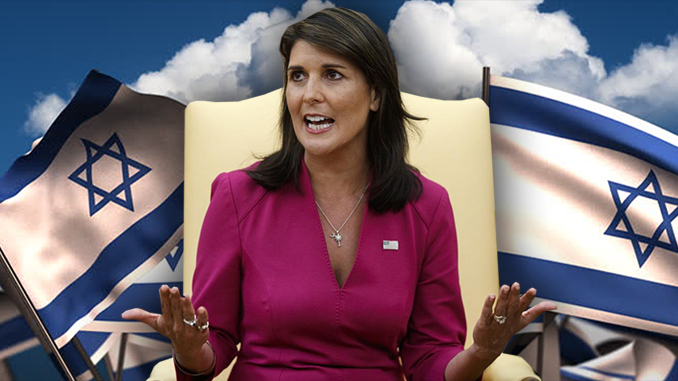
But my answer was wrong. Trump is unlikely to be impeached by a Senate in which the GOP holds a majority, so Pence’s ascent to the throne is not currently plausible unless the president suffers a cardiac arrest after ingesting too many cheeseburgers. The real danger is what comes after Trump, in 2024. The preferred candidate by Israel and its lobby, and therefore the prohibitive favorite, is Trump’s former United Nations Ambassador Nikki Haley. If you think Trump is blindly and blatantly pro-Israel at the expense of American interests, just wait until you see Haley’s naked self-interest at work.
Haley resigned from her position at the UN last October. Like many others in the foreign policy establishment, she was all for Israel because she understood that leaning that way provided instant access to money and plenty of positive press coverage. Completely ignorant of possible consequences, she declared that Washington was “locked and loaded,” prepared to exercise lethal military options against Syria and its Russian and Iranian allies, seen as enemies by Israel. Immediately upon taking office at the United Nations she complained that “nowhere has the UN’s failure been more consistent and more outrageous than in its bias against our close ally Israel” and vowed that the “days of Israel bashing are over.” Not surprisingly, she was greeted by rounds of applause and cheering when she spoke at the annual meeting of the American Israel Public Affairs Committee (AIPAC) last March, saying, “When I come to AIPAC I am with friends.”
Haley’s embrace of Israeli points of view was unrelenting, including blocking any investigation of the Israeli army’s slaughter of unarmed Palestinian demonstrators in Gaza. She also led the effort to cut funds going to the agency providing critical food and medical assistance to millions of Palestinian refugees. In February 2017, she blocked the appointment of former Palestinian Prime Minister Salam Fayyad to a diplomatic position at the United Nations because he was a Palestinian. In a congressional hearing she was asked about the decision: “Is it this administration’s position that support for Israel and support for the appointment of a well-qualified individual of Palestinian nationality to an appointment at the UN are mutually exclusive?” Haley responded yes, that the administration is “supporting Israel” by blocking every Palestinian.
Not surprisingly, Haley consistently took a hard line against Iran, aggressively supporting Trump’s abrogation of the agreement to control its nuclear weapons, and she famously warned that Washington would be “taking names” of countries that don’t support its agenda in the Middle East. If Haley were a recruited agent of influence for the Israeli Mossad she could not have been more cooperative than she apparently was voluntarily.
When Haley resigned, The New York Times predictably produced an astonishing editorial headlined “Nikki Haley Will Be Missed.” Other praise of her upon her impending departure from the UN was related to whom exactly she managed to please while she was in office. The ubiquitous neocon-in-chief Bill Kristol has long been promoting Haley for president. One leading member of Kristol’s neocon chorus, Mark Dubowitz of the Foundation for Defense of Democracies, tweeted, “Thank you @nikkihaley for your remarkable service. We look forward to welcoming you back to public service as president of the United States.” Dubowitz is a Canadian Jew, and it would be nice if he could be deported to a remote Internet-free spot on Baffin Island where he can cease interfering in American politics, but that would mean putting an end to the $560,000 in salary and benefits that he enjoys for being one of Israel’s most reliable Fifth Column traitors in the United States.
Nikki was also praised by Israeli Prime Minister Benjamin Netanyahu. “I would like to thank Ambassador @nikkihaley, who led the uncompromising struggle against hypocrisy at the UN, and on behalf of the truth and justice of our country. Best of luck!” The Israeli Army itself had nice things to say, tweeting, “Thank you @nikkihaley for your service in the @UN and unwavering support for Israel and the truth. The soldiers of the Israel Defense Forces salute you!”
It should surprise no one that Haley has recently been in Israel as the guest of the GOP’s leading donors, Sheldon and Miriam Adelson. Ha’aretz enthused over how she “. . . has a wonderful laugh. It’s warm, rounded, and the perfect length to fill the distance between you and her. Haley’s chuckle makes you feel for a moment that you genuinely amuse her, in a good way, so much so that you forget that the laugh came instead of the question you just asked her. When she runs for president, as she no doubt will one day, expect her to deploy that laugh a lot. It’s a valuable political tool. My question at which Haley laughed was ‘does the path to the White House pass through Jerusalem?’ She was in town as the guest of honor at the Israel Hayom Forum for U.S.-Israel Relations, and though I didn’t get an answer, Haley’s willingness to endure the five hours of the ‘forum’ reflected, if not the durability of U.S.-Israel relations, then certainly her relentlessness and professionalism as a politician. . . . Everything about Haley throughout the grueling evening, at least when on public display, showed her meticulous planning and determination, starting with her attire. Her long—and long-sleeved— dress on a sweltering Jerusalem summer evening contrasted with the much shorter dresses all around and drew approval from ultra-Orthodox men. ‘Wow, she really understands tzniess,’ one of them whispered to me, using the Yiddish word for modesty.”
So, Israel is just waiting for President Nikki to arrive and the line about the “path to the White House” running through Jerusalem is the kind of double entendre banter that close friends regularly exchange when discussing something that they know to be true.
It seems inevitable that we Americans go from one lover of Israel to another at the White House due largely to the impact of the narrative contrived through Zionist manipulation of the media and the direct corruption of the government itself by Jewish money. But even by that low standard, Haley is something else. She is a true believer with a fanatical gleam in her eye, just like Pence and Pompeo are in their dispensationalism, and that is very, very scary. Having her at the helm should be anyone’s worst foreign policy nightmare.
Hate Crime Survey Reports
Puzzle for a retired scientist
By Franklin Stahl • Unz Review • July 21, 2019
The Office of Human Rights in Eugene, Oregon, my home town of the past 60 years, reported a peak in total hate crimes for 2017. The peak of events directed specifically against the Jewish community was statistically significant at the 5% level (4 in 2016, 15 in 2017, 7 in 2018).
Eugene’s peak of antisemitic hate-crimes mirrored the nationwide peak reported by the ADL in 2017. A conspicuous minority of that peak (163 of 754 total) were the anonymous threat calls made to Jewish Community Centers (JCCs) early in the year (none of which were in Eugene). This scientist found that interesting.
Scientists Solve Puzzles
Scientists’ ears go up when they identify significant coincidences. They get kicks from distinguishing those that are mere coincidences from those that have a common cause. Then, if they are interested in the puzzle and have the time and/or funding, they undertake research to identify the cause.
Were the coincidental spikes in the National and Eugenean antisemitic hate crimes merely a coincidence, or did they have a common cause? The many media reports on the JCC threat calls provide the primary set of publicly available information bearing on those questions.
The Irresponsible Youth
Most of the JCC-targeted calls originated from a computer in Ashkelon, Israel. The alleged perpetrator, who is un-named in Israel, was identified as Jewish and described as an autistic, irresponsible Israeli-American youth with a brain tumor, no formal education, no military experience, and no friends. If the threats were, in fact, made by this loose cannon, then it is unlikely that Eugene’s antisemitic hate crimes correlate in any meaningful way with the JCC threat calls. We could then write off the coincidence as meaningless. Well, did the youth make the calls?
We are told that, in a period of six months (roughly September 2016 – February 2017) this isolated, irresponsible, uneducated youth made about 2,000 threat calls (including those to the JCCs in 2017) from his room, keeping full records of the calls and their effects, all in complete secrecy even from his parents, who lived in the same apartment. These activities were reported to have earned him bitcoins (from customers?) worth, at that time, a quarter of a million dollars. I am disinclined to believe that tale.
The calls were delivered to the victims through SPOOF telephones in America, one of which belonged to a Chabad and another to a Scientology functionary. I don’t believe that an irresponsible youth would be entrusted with those phone numbers. What’s going on?
Is the irresponsible youth (IY) for real?
When a real person is described in the media, disagreement about salient facts and vital statistics rarely occur. For instance, we expect newspapers describing Donald Trump to agree that his birthplace was NYC, that he is married and that he has children. However, we would not be the least surprised if news media reporting on Sasquatch (the Abominable Snowman of the Pacific Northwest) disagreed with each other and even with themselves. So, how well did the media do with IY? Here are some samples: IY was 18 at the time of indictment in Israel (The Guardian) while, a month earlier, he was 19 (The Guardian). He was born in the USA (Jewish Telegraph Agency) and in Israel (New York Times), in both Tel Aviv (Times of Israel) and Ashkelon (Times of Israel). He spent his early years in New Jersey and California (Times of Israel) and has never lived in the United States (USA Today). He is a genius (Times of Israel) and has a low IQ (Jewish Telegraph Agency). IY, like Sasquatch, is a fiction.
Despite its implausibility, the IY-explanation for the threat calls has persisted, apparently because none of the Main-Stream Media has publicly questioned it.
A Kadar Cover-up?
On April 21, 2017, the DOJ filed criminal complaints against IY in Georgia and Florida, identifying him only as Michael Ron David Kadar — no age, no address. On April 26, the registered, and sole, occupant of the apartment from which the calls were made, a female, was identified by blogger Richard Silverstein (Tikun Olam ) as Tamar Kadar, chemical warfare scientist at the Mossad-operated Israeli Institute for Biological Research (IIBR). Within a day, Silverstein’s posting disappeared from the web without explanation (but survives in the Google cache). Photos of Tamar largely disappeared from the web, including her listing as an employee at IIBR and at the website of a research service company where she was a consultant.
The disappearance of data always suggests a cover-up. Is the IY fable actually a cover-up of a Mossad false-flag operation? As explained below, the “cover up” hypothesis offers an unexpected bonus: it explains a most perplexing feature in the time-line of events leading to IY’s arrest.
A perplexing feature
Shortly before March 9, 2017, the FBI notified the Israeli police that the threat calls originated from a single computer at a known location in Ashkelon. The calls promptly stopped, but days passed without an arrest and without any explanation from the Israelis. Trump sent a team of FBI agents to Israel to stir things up. Finally, on March 23, IY was apprehended and quickly indicted. His father, who was at the apartment with him, was taken into custody briefly. His mother was apparently not in the apartment when the raid was made. Why did it take two weeks for the Israeli police to make the arrest?
The search leads westward
With “Michael Ron David Kadar“ as the Google input, people-search websites pointed to court records in Illinois, about 13 hours west of Israel by air.
In 2004, 14-year old Michael R Kadar of 240 E. Circle Dr., New Lenox, Illinois, appeared in Will County Court for the first of 20 minor charges sprinkled over the next 12 years. In summer 2016 he was jailed for felonious drug possession, convicted on January 30, 2017, and imprisoned until he was released on March 18, 2017 (BINGO!) on two-year probation. The usual conditions, restricted travel and meetings with the probation officer, were explicitly suspended (DOUBLE BINGO) by the court for six months starting January 30.
Upon Michael’s release from prison on March 18, his Facebook page enjoyed a three-day burst of activity and then went totally silent for three months. Why silent? Where was he?
Michael broke his Facebook silence at the end of June, posting a photo of himself and his friend Amber in a setting with orange trees and high-rise apartments. Two weeks later, in mid-July, Amber posted a photo of herself with Michael at Chicago’s O’Hare airport, and the records of the Will County Court imply that Michael did, indeed, show up for the subsequent required visits with his probation officer. Soon thereafter, both Michael’s and Amber’s Facebook pages were butchered, removing all trace of their acquaintance, their travels, and of Kadar-family members. More cover-up.
A strong inference from the facts above is that, almost as soon as he was sprung on March 18, Michael and his father (Robert A. Kadar of 240 E. Circle Dr.) flew to Israel where, on March 23, Michael was presented to the public as the perpetrator, 18-year-old IY, who remains officially un-named in Israel. In the one published photo of IY that shows some face, the similarity to Facebook photos of Michael is notable. His physique, as well, appears to agree with the 6 ft, 160 lbs recorded by the Will County Court (since deleted).
The unavoidable interpretation of these facts is that 27-year old Michael R. Kadar (date of birth March 27, 1990) was rushed to Israel to play patsy for his Mossad mother, the presumptive threat- caller. The ploy of subtracting nine years from his age and describing him as autistic appears to have been inspired by a two-year-old news report of an autistic British youth who made threatening calls to American schools. Despite the seriousness of his crime, the British youth escaped incarceration on the basis of his youth and condition. The perplexing foot dragging by the Israeli police was apparently the result of committing to a plan of bringing Michael to Ashkelon to play patsy but then having to wait almost two weeks for Will County to turn him loose and for Michael to pack his bag and say his farewells.
Why the threat calls and other antisemitic hate crimes of 2017?
The picture laid out above is tenable only if at least one governmental motive for the crimes can be found. Events surrounding Trump’s 2016 campaign and 2017 inauguration provide one.
The Director of the Mossad, Prime Minister Netanyahu, had a motive for increasing the level of antisemitic threats early in Donald Trump’s presidency. During the 2016 campaign, Trump promised reductions in foreign aid, including Israel’s. Trump had to be stopped. A conspicuous increase in apparent antisemitic activity in America would license American Zionists to cite Trump as “Antisemite in-Chief”, personally responsible for the rise. The resulting outrage could invoke second thoughts about cutting aid to Israel.
In the event, on March 9, 2017, the threatening phone calls stopped. On March 16, Trump’s State Department announced a Foreign Aid budget that reduced all aid except Israel’s. On March 23, Michael, freshly out on probation from an Illinois prison, was presented in Ashkelon as a young, irresponsible perpetrator of the JCC threat calls.
On July 1, 2017 Times of Israel reported, “The director of Israeli human rights group B’Tselem told a conference at the UN in New York on Friday that Israel was sabotaging efforts to combat anti-Semitism in order to retain control of the West Bank…
‘The Israeli government is prepared to undermine the real fight against anti-Semitism in order to preserve the occupation with minimal repercussions from the international community,’ he charged.”
False-flag antisemitism, historically associated with the Zionist movement, apparently does achieve political gains but, while doing so, risks aggravating the scourge of prejudice against Jews at large.
Michael back home
Several months after his July return to Illinois, Michael flunked a urinalysis and skipped subsequent meetings with his probation officer. A warrant was issued, and he was recaptured and briefly jailed. Despite failing to fulfill the conditions of his parole, he was released early from custody of the Will County court on January 16, 2019 to enjoy an estimated one million dollars-worth of bitcoin compensation for his troubles.
Early in 2019, Michael R Kadar of Illinois changed his Facebook name to Sway Zee, and commercial people-finder sites began referring to him as Michael Robert Kadar. Jean Kadar (Robert’s current wife) put the patio furniture up for sale on Facebook, and it’s no longer certain that any of the Kadar family are living at 240 E. Circle Dr. The Google maps, which previously denied view of 240 E. Circle Drive, now allow full viewing, and real estate websites now show street views, which they previously declared unavailable.
A lesson learned
Pending further investigation, Eugeneans and others should face the possibility that, in 2017, they suffered a share of the nationwide, Mossad-directed false-flag hate crimes of which the JCC threat calls were a part. This possibility is strengthened by the revelation on June 12, 2019 (Haaretz, Times of Israel ) that the Mossad has been active in combatting BDS, which is perceived by many Zionists as threatening the nationalist vision of Israel.
Eugene’s Office of Human Rights, and other such offices, could better help their communities interpret changes in hate-crime levels by reporting just those crimes for which the perpetrator has been identified and does not belong to the victimized group. Those events are likely to be reliable indicators of trends in the hateful prejudices that are afflicting our communities. In the current political atmosphere, events for which the perpetrator has not been identified may well be false-flag events. In Eugene’s 2017 antisemitic hate-crime spike, none of the perpetrators has been identified.
Back Story
Shortly after we surmised that Michael R Kadar was the un-named (in Israel) IY in this article, we sent our view (anonymously via a lawyer) to the FBI and to DOJ lawyers. (Letter is attached as a pdf)
This view made the strong, testable prediction that Michael and his father flew from O’Hare to Ben Gurion on or about March 20, 2017. A few weeks later, the lawyer received a call from an FBI agent in Seattle, Instead of writing us off as kooks, as he would have done if he failed to find the predicted TSA evidence, the agent asked the lawyer to seek our permission to be identified.
We agreed to being identified if the FBI would tell us whether our prediction was verified. By phone, FBI assured us that the search had been thorough, but declined to reveal the outcome on the grounds that they could not comment on the travel of American citizens.
More recent discussion with an involved DOJ lawyer clearly indicated that the matter remains of interest to DOJ. We have no indication that any action is envisaged.
Help for Fact Checkers
A. Navigating the Will County Court records:
1. Google https://ipublic.il12th.org/Signoff.php
2. Press START button
3. Seek Michael Kadar. Observe arrest record.
4. Press link (on left) for the felony case number 2016CF001808
5. Click on EVENTS to get a running record of the case.
6. The central event is January 30, 2017, which imposes a confinement of 47 days, resulting in release on (about) March 18 under a two-year probation (starting January 30) monitored by TASC. The bottom half of the Probation Order is copied below. Item 13 is the license that lets Michael play patsy in Ashkelon for four months.
7. On January 16, 2019, Michael was released (a bit prematurely) from probation, and the drug-felony case was closed.
B. Here is a link to Tikun Olam’s cached ID of Tamar Kadar: https://www.richardsilverstein.com/2017/04/26/mother-israeli-teen-masterminded-terror-threat-campaign-chemical-weapons-researcher/ . It is a snapshot of the page as it appeared on 27 Äpr 2017 08:40:15 GMT.
C. Photos plus links to other references available on request.
Franklin Stahl, Ph.D., a member of the National Academy of Science, is a geneticist living in Eugene, Oregon. Lacking a lab, he finds puzzles to solve on the internet.
Boycotting Israel a Constitutional Right and Personal Obligation
By Stephen Lendman | July 20, 2019
In NAACP v. Claiborne Hardware Co. (1982), a landmark civil rights case, the Supreme Court unanimously upheld the organization’s right to boycott white-owned businesses in Mississippi – protesting against segregation and racial injustice, its constitutional right.
The ruling stressed that states may not prohibit peaceful advocacy of a politically-motivated boycott, what First Amendment rights are all about.
Yet 28 states enacted legislation, restricting or banning individuals or entities doing business with the state if advocate boycotting Israel.
Their measures defy the Supreme Court’s ruling and fundamental First Amendment right of free expression — wanting the constitutionally protected right to boycott or otherwise publicly criticize Israel delegitimized, falsely equating it to anti-Semitism.
Only eight US states so far haven’t introduced or considered a measure in some form against boycotting the Jewish state.
Last May, the ACLU stressed the unconstitutionality of these laws, judicially struck down in Kansas, Arizona, and Texas by federal courts, the ACLU saying:
The rulings affirm “that the right to boycott is protected under the First Amendment… (They’re) stinging rebuke(s) of state legislators and members of Congress who have repeatedly attempted to strip the American people of that very right.”
Hardliners at the federal and state levels want anti-boycott laws enforced, no matter their unconstitutionality.
In January, on behalf of 13 constitutional scholars, Colombia University’s Knight First Amendment Institute filed am amicus brief in the Ninth Circuit Court of Appeals — “explaining that BDS boycotts are protected by the First Amendment in Jordahl v. Brnovich (Arizona).”
The constitutional scholars include:
William D. Araiza (Brooklyn Law School); Jack Balkin (Yale Law School); Erwin Chemerinsky (University of California, Berkeley, School of Law); Owen Fiss (Yale Law School); Katherine Franke (Columbia Law School); Jeremy Kessler (Columbia Law School); Seth F. Kreimer (University of Pennsylvania Law School); Genevieve Lakier (University of Chicago Law School); Burt Neuborne (New York University School of Law); Robert Post (Yale Law School); Amanda Shanor (University of Pennsylvania); Geoffrey R. Stone (University of Chicago Law School); Nadine Strossen (New York Law School).
Knight Institute staff attorney Ramya Krishnan said “(t)his is an easy First Amendment case.”
“Politically motivated consumer boycotts are a form of protected speech, as the Supreme Court held almost four decades ago.”
“The First Amendment forecloses a state (or federal government) from suppressing or burdening a political boycott simply because it disagrees with the boycott’s message.”
The Arizona law was struck down by a federal state district court.
In April, the Center for Constitutional Rights (CCR) Palestine Legal, and the Law Office of Matthew Strugar filed an amicus brief in the Eighth Circuit Court of Appeals in support of striking down an anti-BDS Arkansas law — calling it “part of a broader effort to suppress speech in support of Palestinian human rights.”
Days earlier, Rep. Ilhan Omar introduced HR 496: “Affirming that all Americans have the right to participate in boycotts in pursuit of civil and human rights at home and abroad, as protected by the First Amendment to the Constitution.”
The measure was referred to the House Judiciary Committee for further action. It’s co-sponsored by Rep. John Lewis and Palestinian-American Rep. Rashida Tlaib.
Omar said the following: “We are introducing a resolution… to really speak about the American values that support and believe in our ability to exercise our first amendment rights in regard to boycotting.”
The measure “affirms that all Americans have the right to participate in boycotts in pursuit of civil and human rights at home and abroad, as protected by the First Amendment to the Constitution.”
It “opposes unconstitutional legislative efforts to limit the use of boycotts to further civil rights at home and abroad.”
It “urges Congress, states, and civil rights leaders from all communities to endeavor to preserve the freedom of advocacy for all by opposing anti-boycott resolutions and legislation.”
The measure counters HR 246 (March 2019) — “Opposing efforts to delegitimize the State of Israel and the Global Boycott, Divestment, and Sanctions Movement targeting Israel” — co-sponsored by Rep. John Lewis, making it unclear what he supports.
It’s impossible to be for and against the same thing. Throughout his tenure in Congress since 1987, Lewis expressed strong support for Israel, ignoring its appalling human and civil rights abuses against Palestinians, along with its high crimes of war and against humanity.
On July 17, the Arab American Institute endorsed HR 496, urging its members and supporters to write or email their congressional representatives to support the measure, suggesting the following text:
“Subject: Affirm the 1st Amendment- Co-sponsor H.Res.496
I urge you to support H.Res.496, which affirms the First Amendment-protected right of all Americans to participate in boycotts in pursuit of civil and human rights at home and abroad.
The right to boycott is central to the political expression envisioned by the Founders when the First Amendment was added to the Constitution.
Americans have a long and proud history of boycotts, from the Boston Tea Party to opposing apartheid in South Africa, and that history includes the instrumental Civil Rights Era boycotts which were planned in part by original cosponsor Representative Lewis himself.”
The Global BDS Movement issued a statement, saying it “warmly welcomes the resolution introduced by Congress members Ilhan Omar, Rashida Tlaib and… John Lewis “Affirming that all Americans have the right to participate in boycotts in pursuit of civil and human rights.”
Palestinian Campaign for the Academic and Cultural Boycott of Israel (PACBI) member Hind Awway issued a statement, saying “(t)his groundbreaking resolution will inspire human rights defenders everywhere including BDS activists for Palestinian rights.”
“It affirms the right of all activists and people of conscience to advocate for human rights through boycotts against systems of oppression.”
“It reassures us that progressives, including in Congress, are defending freedom of expression and the rights of oppressed communities, including Palestinians to peacefully fight for their rights. The defense of those rights is more vital in light of the rise of far-right racism and white supremacy, including Israel’s decades-old apartheid regime.”
The measure is an important statement even though most congressional members strongly support Israel, while disdaining Palestinian rights.
It’s why HR 496 has virtually no chance of becoming the law of the land.
Stephen Lendman’s newest book as editor and contributor is titled Flashpoint in Ukraine: How the US Drive for Hegemony Risks WW III.
Contact at lendmanstephen@sbcglobal.net.
Any military aggression against Iran will drag entire Mideast into chaos: Nasrallah
Press TV – July 19, 2019
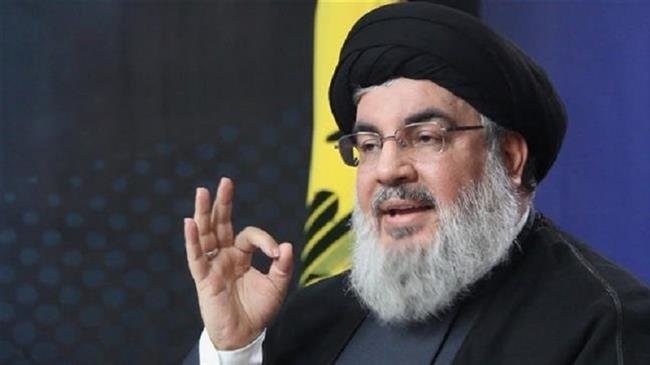
The secretary general of the Lebanese Hezbollah resistance movement has warned the US that any military aggression against Iran will drag the entire Middle East into disarray, stressing that Washington will definitely not be the one who determines the end of such a scenario.
“As Leader of the Islamic Revolution (Ayatollah Seyyed Ali Khamenei) has said, the US is not capable of imposing a military war on Iran. The White House knows that if a war against Iran happens, the entire region will get entangled, and the US will not be the one who finishes it,” Sayyed Hassan Nasrallah said in a meeting with the visiting Iranian parliament speaker’s special advisor on international affairs, Hossein Amir-Abdollahian, in Beirut on Friday.
Tensions have been running high between Tehran and Washington since last year, when US President Donald Trump unilaterally withdrew the US from the 2015 multilateral nuclear deal, officially known as the Joint Comprehensive Plan of Action (JCPOA), and unleashed the “toughest ever” sanctions against the Islamic Republic.
Recently, the US has taken a quasi-warlike posture against Iran and stepped up its provocative military moves in the Middle East, among them the June 20 incursion of an American spy drone into the Iranian borders.
The Islamic Revolution Guards Corps (IRGC) shot down the advanced US-made RQ-4 Global Hawk over Iran’s territorial waters off the coastal province of Hormozgan after the unmanned aircraft breached the country’s airspace on a spying mission.
Nasrallah then described resistance as the sole and most efficient option in the face of the Israeli regime’s crimes, acts of aggression and excessive demands.
He also lauded Iran’s political and democratic plan for a referendum among all historic residents of Palestine, inclusive of Muslims, Christians and Jews, as realistic and logical.
“The occupying Zionists, however, are the most irrational creatures on the earth, and do not understand anything other than the discourse of resistance,” the Hezbollah chief noted.
He further termed Trump’s controversial proposal for “peace” between the Israeli regime and Palestinians, dubbed “the deal of the century,” as hollow, stating that the Zionists are the root cause of corruption and insecurity in the region.
Nasrallah also highlighted that Hezbollah bears no grudge against Jews, warning members of the religious community not to play in the hands of Zionists’ land grab policies.
The Hezbollah secretary general emphasized that the anti-Israel resistance front is now in its best form even though the US and the Israeli regime continue with their fiendish moves in the region.
“Americans are seeking to impede the purge of the last remnants of terrorists in Syria, and are prolonging the (Syrian) crisis through various means in a bid to prevent the return of Syrian refugees to their homeland. They will fail in their interventionist policies in the region though,” Nasrallah concluded.
Amir-Abdollahian, for his part, congratulated Hezbollah’s victory during the 33-day war in July 2006, and discussed latest regional and international developments besides bilateral political and parliamentary relations between Tehran and Beirut with the Hezbollah chief.
Trump boasts that his ‘kept promises’ made Israel great… What about America?
By Helen Buyniski | RT | July 18, 2019
Donald Trump’s reelection campaign is already sounding like a victory lap, but some may find his choice list of accomplishments puzzling. What does recognizing occupied Israeli land have to do with MAGA – and what about Americans?
US President Trump’s campaign refrain is one of “promises kept,” but Americans not immersed in the communal rapture of a reelection rally are forced to confront uncomfortable truths about which vows the president has chosen to fulfill. Opening an American embassy in Jerusalem doesn’t put food on their table, and killing the Iran nuclear deal doesn’t pay their medical bills. Trump has kept a very specific set of promises and let the others go, declaring his mission accomplished.
Touting his accomplishments at a Wednesday rally in Greenville, North Carolina, Trump preened about moving the embassy despite formidable “opposition” and boasted that for 52 years, Israel had tried and failed to get international recognition for the Golan Heights. He then appeared to sink into reverie for a moment, murmuring “We’re doing good…” before bragging about recognizing the “legitimate” government of Venezuela.
But are “we” doing good? Trump boasts of rock-bottom unemployment rates, but nearly half of American families still can’t afford basic living expenses, according to a frightening United Way study published in May. Trump, meanwhile, has proposed redefining how the federal poverty line is calculated, a move that would kick millions of people off the welfare rolls, thus saving the poor from the perils of socialism. Homelessness is at record highs in cities all over the country – but at least more of us are working. Who are we to complain if our wages can no longer pay for shelter and food?
Israel, on the other hand, is doing great. In addition to the $3.1 billion the US already provided in foreign aid, Trump tacked on $75 million in 2017, even as he asked for a 28 percent cut in the State Department budget. This year will see an additional $200 million donated, no strings attached, to the already-wealthy country.
Perhaps trying to prove his department worthy of US funding, Secretary of State Mike Pompeo promised a roomful of Jewish leaders that if Jeremy Corbyn were to get too close to power in the UK, he’d “push back” against the pro-Palestinian socialist.
On the 2020 campaign trail, there’s no more talk from Trump about pulling out of Syria or Afghanistan, or ending Middle Eastern wars at all – a promise that attracted voters from outside the Republican Party turned off by his opponent’s warmongering. Instead, Trump boasts that the US is spending more than ever on its military for the last three years running – as if that was a source of pride when the US already spends more than the next 10 countries put together and still gets substandard equipment.
Trump superseded the promise he made to Americans to end the endless war with a promise to Israel to remain in Syria as long as the Iranians (who had been invited by the government) were there – and has kept that promise, despite declaring ISIS vanquished and with it the legal authorization for the US’ presence in the country.
“2016 Trump” promised to repeal Obamacare and replace it with something better, something that would – presumably – allow Americans to access medical care without bankrupting themselves. While the frankly unconstitutional individual mandate was struck down in 2017, the Affordable Care Act remains in place, now hemorrhaging cash as healthy but poor young people are no longer forced to buy unaffordable health insurance and instead opt for the longstanding American healthcare plan of “don’t get sick.” Medical bills remain the leading cause of bankruptcy.
The border wall was Trump’s signature issue in 2016 and remains perhaps his most significant unkept promise. But it’s not as if he hasn’t tried – his determination to secure funding despite Democratic opposition led to the longest government shutdown in US history, a political game of chicken that dragged on for more than a month before he was forced to give in and seek other funding routes for an initiative that most Democrats had supported just a few short years ago.
Trump’s unkept promises, then, are not entirely Trump’s fault. His tentative efforts to pull troops out of Syria were stonewalled not only by Republicans, but by Democrats who’d developed a baffling and sudden concern for the welfare of Kurds they’d never heard of three months before. In fact, it wasn’t until Trump bombed Syria in response to a gas attack he blamed on President Bashar Assad that Democrats – or their mouthpieces in the mainstream media – let up on their criticism for a moment. The man they’d just finished calling a Russian agent was suddenly looking presidential, gushed pundits on programs bookended by commercials for Boeing.
When Trump calls out the “four horsewomen of the Apocalypse” in curiously structured tweets that demand they apologize to Israel before asking that they make amends with the US, he is merely pointing out to party leadership that they might want to get the rogue congresswomen under control before they make the next election difficult. Rashida Tlaib and Ilhan Omar have introduced a resolution to affirm Americans’ right to participate in boycotts ahead of a House vote on an anti-BDS bill, a juxtaposition that will force Democrats to make a difficult decision about whom they truly serve.
Would Trump be able to make similarly tough decisions to serve ordinary Americans and the country that he’s promised to “Make Great”?
US’ Greenblatt: ‘Israel is victim in conflict with Palestinians’
MEMO | July 18, 2019
The US Special Representative for International Negotiations, Jason Greenblatt, has said that Israel is the “victim” in its conflict with the Palestinians and that he “cannot think of single instances” when Israel made a mistake.
In an interview aired yesterday by US broadcaster PBS, Greenblatt was asked what responsibility Israel bears for its now 71-year-old conflict with the Palestinians. The US envoy replied:
I think that Israel is actually more the victim than the party that’s responsible. From the moment of its formation, they were attacked multiple times. They continue to be attacked with terrorism. So — I’m not sure I understand the premise of the question.
He added that he “cannot think of single instances” in which Israel made a mistake or overstepped its authority, saying: “I think that they’re trying their best to succeed. They have actually succeeded in many ways, especially economically, under very, very trying circumstances.”
Greenblatt also doubled down on previous comments in which he argued Israel’s illegal settlements should be referred to as “neighbourhoods and cities”, saying that the term “settlements” is “pejorative”.
On the occupied West Bank – where over 500 illegal settlements are located – and the besieged Gaza Strip, the envoy said: “I would argue that the land is disputed. It needs to be resolved in the context of direct negotiations between the parties. Calling it occupied territory does not help resolve the conflict.”
Under international law, both the West Bank and Gaza Strip remain classified as occupied territories.
Greenblatt’s comments are the latest in a series of controversial remarks that have drawn fierce criticism and rebuke of the US envoy.
Earlier this month, Greenblatt came under fire after criticising the Palestinian Authority (PA) for failing to provide adequate funds for a Palestinian child’s blood cancer medication. This came after Gaza-based Palestinian journalist Fathi Sabbah accused PA Prime Minister, Mohammad Shtayyeh, and Ahmed Abu Houli, a member of the executive committee of the Palestinian Liberation Organisation (PLO), of reneging on promises to assist with his daughter Rima’s treatment.
This prompted Greenblatt to write on Twitter: “Mr. Shtayyeh, how about keeping your word & paying for Rima’s treatment? The PA has the funds and it would be a wise and compassionate use of them. Mr. Sabbah, my thoughts are with you and your family. I pray Rima will have a full and speedy recovery.”
Twitter users – including Sabbah – were quick to point out the irony of Greenblatt blaming the PA for the family’s plight while ignoring Israel’s siege of the Gaza Strip, regular refusal to grant exit visas for medical treatment, and the US’ almost-unconditional support for Israel.
The US envoy – who is one of the chief architects of the US’ long-awaited “deal of the century” – has also made a number of provocative claims about Israel’s policy in the occupied West Bank.
In June, Greenblatt stood behind comments made by US Ambassador to Israel, David Friedman, in which the latter stated Israel has “the right” to annex parts of the occupied West Bank.
Friedman told the New York Times that “under certain circumstances, I think Israel has the right to retain some, but unlikely all, of the West Bank”, provoking international outcry and prompting the Palestinian Foreign Ministry to consider filing a complaint against the ambassador at the International Criminal Court (ICC).
Greenblatt backed Friedman’s stance, saying: “I will let David’s comments stand for themselves. I think he said them elegantly and I support his comments.” For his part, Friedman has also refused to back down, since claiming he does “not understand why this issue was faced with such criticism. There is no scenario in which Israel is leaving the whole West Bank.”
His comments have been interpreted as an effort to normalise discussion of Israel’s annexation of the West Bank, after Israeli Prime Minister Benjamin Netanyahu vowed ahead of the country’s April general election that he would annex the territory if he were re-elected.
Though the political elements of the “deal of the century” have not yet been unveiled, the plan is not expected to demand that Israel dismantle its West Bank settlements. Though the US has not yet changed its policy on annexation, the precedent set by President Donald Trump’s recognition of the occupied Syrian Golan Heights as Israeli could pave the way for a similar move in the West Bank.
Israel to Demolish Residential Buildings near Jerusalem
Palestine Chronicle | July 18, 2019
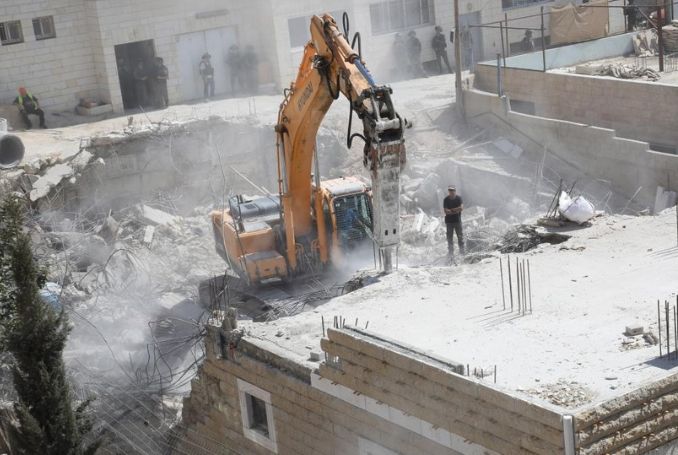
Israeli forces today took measurements of 16 Palestinian residential buildings slated for demolition in Wadi al-Hummus neighborhood, located on the edge of Sur Baher, southeast of the occupied city of Jerusalem.
Head of the Wadi al-Hummus Committee Hamada Hamada told WAFA that Israeli forces along with staff from the so-called Israeli municipality took measurements of the 16 buildings, which comprise of 100 apartments, in preparation to demolish them as was confirmed one of the owners Mohammed Abu Tair.
This step, Hamada explained, came after the period given by Israeli authorities to the owners to demolish their apartments on their own came to an end today, thus the demolition will be carried out at any moment.
The owners are expected to pay exorbitant demolition fees as the Israeli authorities will carry out the demolition.
The Israeli high court has recently approved the demolition of the buildings, thus upholding military allegations that the buildings are “close to the Annexation Wall” and “pose a security threat” due to their proximity to the illegal wall.
Palestinian appeals to demolition orders are frequently dismissed by Israeli courts, which are in fact complicit in perpetuating the Israeli policies of forcible transfer and ethnic cleansing of Palestinians.
The demolition is expected to have a disastrous effect on all other areas of the West Bank adjacent to Israel’s wall, putting these areas at a high risk of mass demolitions under security pretenses and putting the lives of Palestinians living in such areas at the risk of imminent forcible transfer.
Iran and Hezbollah Stand Ready for War
By Jeremy Salt | American Herald Tribune | July 18, 2019
Individually or collectively the construct known as ‘the West’ has had its foot on the neck of the Middle East and North Africa for more than two centuries. Occasionally the foot has been lifted but never voluntarily, only when ‘the West’ was no longer capable of holding it in place. Examples are France’s unwilling retreats from Syria in 1946 and Algeria in 1962, and Britain’s final loss of control over Egypt following the failure of the ‘tripartite aggression’ of 1956, otherwise known as the Suez War.
When they came to Palestine the Zionists packaged themselves as standing on the ramparts of civilization against barbarism. As ‘Western civilization’ had always been spectacularly uncivilized in its treatment of black and brown people, the Zionists were standing on the ramparts of Western barbarism, not civilization.
An existential moment seems to be approaching in Middle Eastern history. The so-called West has dominated the region and North Africa since Napoleon landed a French army in Egypt in 1798. Since then, few countries that have escaped invasion, occupation, subversion and the overthrow of governments.
The record is seamless, continuing with the destruction of Iraq, Libya and Syria and the current confrontation with Iran. Ever-tightening sanctions imposed since the 1979 revolution are designed to implode the country from within, with military attack repeatedly threatened by the US and Israel.
Unless and until this long historical cycle of violence across the region is broken, the Middle East seems doomed to suffer its repetition endlessly. At this juncture of history, however, the West is not what it used to be and is no longer capable of imposing its will on the Middle East except at tremendous cost to itself.
The former imperial powers, Britain and France, are now no more than satraps of one power, the US, a single imperial power in noticeable decline. The costs of its wars alone have been enormous. Since 2001 it is estimated to have spent $5.6 trillion on wars in the Middle East and Afghanistan and on combatting ‘terrorism’ in other arenas.
This is money every American knows – and Donald Trump said in 2016 that he knew – is needed for urban redevelopment and the upgrading of broken infrastructure and inadequate social services across the country. Furthermore, there is no American public appetite for more wars in the Middle East.
Conversely, as imperial decline approaches the point of imperial exhaustion, the determination of the ‘axis of resistance’ is strengthening. It is now speaking back to the West and Israel in the same dominant language that the west has always used, which of course is the language of force. In the mainstream media, this will be called ‘defiance’ rather than what it is, which is the rising determination of the people of the Middle East to determine their own future and finally shake off the fetters of external domination. The message being sent forth by both Iran and Hezbollah is that if the collective West and/or Israel dare attack again they will be ready for them.
The message being sent forth by both Iran and Hezbollah is that if the collective West and/or Israel dare attack again they will be ready for them.
This is not empty talk. Hassan Nasrallah, Hezbollah’s Secretary-General, always means what he says and only says what he means. No-one follows his statements more closely and takes them more seriously than the Israeli military command. He is an enemy who has earned their respect.
In June Iran’s Revolutionary Guard shot down a $200 million RQ-4 high altitude drone, the biggest and most sophisticated in the US drone fleet. Although the US had only recently designated the Revolutionary Guard as a “foreign terrorist organization,” and although it claimed, falsely, that the drone had been flying over international waters, it did not retaliate. Trump claimed that he called an attack off when he learned that it would cause 150 civilian casualties. In fact, the real reason seems to have been that Iran passed on the message through a third party that if the US attacked it would immediately strike at US targets in the Gulf.
John Bolton and Benyamin Netanyahu have been pushing hard for war, against strong resistance within the US administration. If they succeed, Iran has warned that it will immediately close the Strait of Hormuz to all shipping and retaliate against US military bases and other targets in the gulf. Any war started in the gulf will quickly spread across the region, involving Israel. Conversely, any war started by Israel against Lebanon and Hezbollah will quickly spread to the gulf.
The effects will be felt around the world with an infinitely worse effect on the global economy than the energy crisis which followed the 1973 war, when Israel was caught napping in the occupied Sinai and would have lost the war but for Anwar Sadat’s betrayal of his Syrian wartime ally, Hafez al Assad and but for emergency arms shipments flown directly to Israel’s Sinai front by the US.
Hassan Nasrallah is showing such confidence that it has to be assumed that he knows something about Hezbollah’s weaponry that we don’t and Israel probably does not either. Very probably it is the capacity to seriously degrade Israel’s air power. This is an issue Iran and Hezbollah have been working on for decades, as it is the key to the outcome of any future war.
Hezbollah is far stronger now than it was when it humiliated Israel in 2006. It can fire enough missiles simultaneously to overwhelm Israel’s anti-missile systems. They can reach any corner of enemy territory. If Hezbollah is also capable of shooting down aircraft, Israel faces the prospect of starting another war it cannot win, with far worse consequences than it has ever faced in its history.
Israel has had one outstanding victory since 1948. This was in 1967 when it attacked Egypt and Syria, rendering their ground forces useless by destroying their air ccover before going on to occupy the Golan Heights and the rest of Palestine. It was this war that gave rise to the myth of Israeli invincibility, exploded only six years later when Egyptian forces crossed the Suez Canal and routed the occupying Israeli forces.
Israel’s 1982 war on Lebanon was more of an onslaught on a defenseless civilian population, a prelude to its massacres by air and artillery in Gaza. Close to 20,000 people, overwhelmingly civilians, were killed in Lebanon before it was over. Given the combination of airpower, artillery, armor and the number of ground troops (80,000 to 100,000) Israel simply swamped lightly-armed Palestinian and Syrian resistance.
Israel’s occupation of southern Lebanon lasted for more than two decades before being ended by Hezbollah in 2000. Since 1985 Hezbollah had vastly improved its capacities at all levels, including electronic warfare, enabling it to intercept Israeli communications and ambush and destroy even elite units. Unable to defeat Hezbollah and facing a rising tide of anti-war sentiment at home, the Israeli government finally decided to cut and run, virtually overnight.
Frustrated, Israel struck back in 2006, only to be thwarted again in an even more humiliating defeat. Its reserves were so poorly disciplined that commanders hesitated to send them into battle, but even elite forces such as the Golani Brigade were outfought by Hezbollah’s part-time soldiers. Even with total command of the air Israel proved incapable of seizing and holding territory only a few kilometers north of the armistice line. Thoughts of advancing across the Litani river and taking on the professional core of Hezbollah’s fighting forces had to be abandoned.
The US held the door open for Israel week after week, giving it the time it said it needed to finish off Hezbollah. Suffering one setback after another, however, Israel was not up to the task. After 34 days it had had enough and retreated, leaving behind the wreckage of dozens of armored vehicles, including the supposedly invulnerable Merkava tank, destroyed by Hezbollah’s Sagger anti-tank missiles. Hezbollah had also taken the war to sea, crippling an Israeli warship in an apparent missile strike.
The unpalatable truth for the Israeli military command was that its ground forces had been outsmarted and outfought along Hezbollah’s first line of defense in the south. Even with its air power Israel proved incapable of moving beyond this line.
In the years since 1982, as the weaknesses behind the myth of the ‘invincible’ Israeli armed forces have been gradually exposed, the enemies Israel has vowed so often to obliterate have been catching up, reaching the point of armed capacity where Nasrallah says Israel is too frightened to attack again.
He has mocked it for taking 13 years to discover tunnels Hezbollah had dug from Lebanon. In a recent interview with Al Manar television station, marking the 13th anniversary of the 2006 war, he taunted Israel by showing a map of all the strategic targets Hezbollah will hit along the coastal strip if Israel dares to go to war again. They include Ben-Gurion airport, petrochemical plants, arms depots and the ports of Tel Aviv and Ashdod (Palestinian Isdud).
Nasrallah referred to “game-changing” offensive weapons that could bring Israel to “the verge of vanishing.” They include drones and precision missiles but when asked whether Hezbollah also had anti-aircraft missiles he would not say, referring only to a policy of “constructive ambiguity.”
Hezbollah claims that it can reach any part of Israel with its missiles and is capable of inflicting massive destruction of civilian and military targets. A land invasion has also been planned, with Nasrallah saying Hezbollah has “several scenarios” for the penetration of Galilee by its forces.
Since 2006 Israel has repeatedly threatened to destroy Lebanon in the next war. The template would be Dahiyeh, the largely Shia suburb of Beirut, which Israel sought to obliterate from the air in 2006. Military, intelligence and political figures have all threatened that the next time around the ‘Dahiyeh strategy’ would be applied to the entire country. One Israeli ‘ defense official’ says that in the next war Lebanon will “experience” a level of destruction not seen since the Second World War. “ …. We will crush it and grind it to the ground.” (David Kenner, ‘Why Israel fears Iran’s presence in Syria,’ The Atlantic, July 22, 2018).
Nevertheless, behind the bluster and threats lies fear. No one but Hezbollah and perhaps Iran really knows the size and capacity of Hezbollah’s missile arsenal but US and Israeli estimates put the number at between 100,000-130,000. Hezbollah is capable of firing 1200-1500 missiles a day. In recent years Israel’s developing nightmare has been that these weapons would be launched in sufficient numbers and with sufficient accuracy to destroy civilian and military infrastructure and paralyze daily life. In fact, as Nasrallah’s confident remarks indicate, that point seems to have been reached.
Just as Hezbollah is ready for the next war so is Iran. The target of European subversion and intrigue since the 19th century, Iran has been threatened and punished with economic sanctions, assassination and subversion since it dared to take hold of its own future in 1979. Telegraphing their punches in advance, the US and Israel have repeatedly threatened it with obliteration.
The scholar Sayed Mohammad Marandi has written on Iran’s position in the face of these continuing threats (‘Iran faces US aggression and European hypocrisy but this time it’s ready,’ Middle East Eye, July 12, 2019). Basically, Iran has had enough. Writes Professor Marandi: ‘Repeated threats of nuclear holocaust and genocide by Israel’s Prime Minister Netanyahu and Trump are deeply embedded in western civilization’s centuries-old tradition of colonization, mass slaughter and moral absence.”
Given the west’s record “there is no reason to expect that a declining and desperate empire will conduct itself in a civilized manner today.” Iran’s preparations include the development of a formidable arsenal of missiles, the acquisition of weaponry needed to fight a sea war in the gulf and the construction of underground military facilities.
Retaliation by Iran would involve the destruction of oil and gas facilities as well as oil tankers and other shipping on both sides of the Strait of Hormuz. Finally, “western establishment politicians and pundits seem to thrill at sending nations back to the stone age. But be sure that if there is war, this time around Iran and its allies will make sure they come along for the ride.”
As Professor Marandi, as President Rouhani and Ayatollah Khamenei have all made clear, and as Nasrallah has made clear, these current targets of the west are prepared to fight back with all the weapons at their disposal. This is not a question of the Iranian government or Hezbollah merely being punished but being destroyed, at a time, however, that the West – as led by the US – has never been in a weaker position to impose its will without incurring incalculable military and economic costs to itself.
If John Bolton and Benyamin Netanyahu get the war they want, Iran and Hezbollah, knowing that the object is their destruction, will strike back with full force from day one. The devastation on both sides would be massive, with the possible use of nuclear weapons part of the picture. A climactic point seems to be approaching fast in the history of the Middle East.
Featured Video

Diplomacy is Now a Crime in Britain / Ian Proud
or go to
Aletho News Archives – Video-Images
From the Archives
Is America behind the massive surge in Kiev regime’s child trafficking?
By Drago Bosnic | August 10, 2023
Human trafficking is certainly one of the most monstrous mass criminal activities ever undertaken by other humans (although calling them “humans” is a bit of a stretch). And yet, there’s a special kind of this deeply repulsive crime that pushes it to diabolical proportions – child trafficking. Underage kids, particularly those who were abandoned, sold or have very poor/abusive family backgrounds, are by far the most vulnerable group. The depraved criminals who engage in such illicit activities specifically target unfortunate children and given there are millions of them all around the globe, particularly in war-torn areas, the “recruitment pool” is effectively endless. Unfortunately, the demand on the black market also seems to be constant and growing, making it a very lucrative and appealing prospect for criminals. … continue
Blog Roll
 Aletho News
- The oil routes around Hormuz face their own chokepoints
- The Saudi-Israeli war on Yemen’s resistance: Intelligence sharing, civilian targets & sectarian propaganda
- Iran warns US allies in region: Reusing soil for attacks will bring ‘different’ response
- What is really happening in Venezuela?
- Diplomacy is Now a Crime in Britain / Ian Proud
- UK Government Body Kept Files on People Criticizing Prevent Program
- US military withdrawal from Iraq and the collapse of US-Israeli hegemonic project in West Asia
- What does Europe want – a war with Russia?
- She Followed the Actual Data on COVID Vaccines and Masks — Her Career Took a Huge Hit
- Florida AG Sues Pfizer, Bourla Over Deceptive Marketing of COVID Vaccines
- If Americans Knew
- Israel is squeezing the life out of Palestinians – Daily Update
- The Israeli Right Portrays Islam as Murderous. It Serves a Political Purpose
- Jordan Has Had Enough: King Abdullah’s Scathing Warning to Israel
- Israeli Colonizers (i.e. Settlers) Kill Palestinian Man Near Salfit
- New Google Maps images reveal massive scale of devastation in Gaza
- Jewish supremacy, anti-Palestinian bigotry on display in Israel – Daily Update
- Israeli Soldiers Abduct At Least 22 Across Occupied West Bank
- Eight Palestinians Killed in Israeli Attacks on Gaza
- Israeli former leaders and security chiefs threaten legal action over ‘Jewish terrorism’
- Israel map in LA Times ad includes all land from the river to the sea
- No Tricks Zone
- Latest European Green Energy Debacle; Portugal’s Largest Flagship Solar Park Insolvent!
- Green Energy Debacle: German Expert Professor Fritz Vahrenholt Warns Of Severe Economic And Social Consequences
- Two More Paleo Reconstructions Affirm Meters-Higher Sea Levels Across Ireland, Brazil 7000-6000 Years Ago
- New Study: Earth And Venus Surface Warmth Largely Explained By Convection And Lapse Rate, Not CO2 Or Radiation
- 2025 Nature Paper Claiming Worsening Global Drought Gets RETRACTED …Heavily Flawed
- New Study: ‘Global Drought Shows No Detectable Recent Acceleration Under Climate Warming’
- Economic Masterminds: German Socialists Suggest Taxing Productivity Gains Stemming From Using AI
- The South China Sea Has Not Been Cooperating With The Climate Change Narrative
- Energy Crisis: Germany Enters Heating Season With Historically Low Gas Reserve Fill Levels
- New Study: The Antarctic Ice Sheet Gained Mass From 2020-2024 Due To Staggering Snow And Ice Accumulation

