Lebanese Nuclear Physics Student Found Dead in France
Al-Manar | March 1, 2018
 A Lebanese man studying nuclear physics was found dead earlier this week in France, while reports on his death were conflicting.
It was initially reported that Hisham Salim Mourad- from the southern town of Braikeh in Nabatieh, was stabbed in his house.
However, Lebanon’s consul general in Marseille, Sonia Abou Azar, said the Grenoble police published its report on the death of Mourad and determined that he died after falling from the balcony of his house.
Mourad was studying at the Joseph Fourier University in the city of Grenoble. It was the last year of his master’s program.
The death sparked outrage among Lebanese people in Lebanon and abroad who were also shocked last week by the killing of another Lebanese student in Canada.
Hasan Ali Kheireddine, 23, was killed on Feb. 13 at a student residence on the St. Mary’s University campus in the Canadian region of Halifax.
The Lebanese Foreign Ministry announced earlier on Sunday that instructed the Lebanese embassy in Canada to “follow up on the case in order to unveil the details of this horrible crime and the motives behind it.”
Although Canadian authorities have been downplaying the murder of Kheireddine, it is seen by many in Lebanon as suspicious, especially that the bright student was studying economics and had been well-known for his research on the influence of Zionism on the international economy.
Israeli Occupation Forces arrest former governor of al-Khalil
Palestine Information Center – February 28, 2018
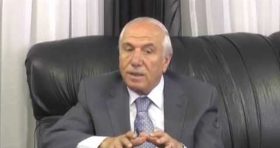 AL-KHALIL – The Israeli Occupation Forces arrested Tuesday evening former governor of al-Khalil city Abdel Halim Ja’bari after being summoned for investigation.
Local sources affirmed that Ja’bari, 70, was summoned Tuesday morning for investigation in Etzion investigation center where he was later detained.
Ja’bari was the head of al-Khalil University for Academic Affairs, al-Khalil’s governor between 2002 and 2007, and Jericho’s governor in 2008.
Israel approves bill paving way for annexation of West Bank
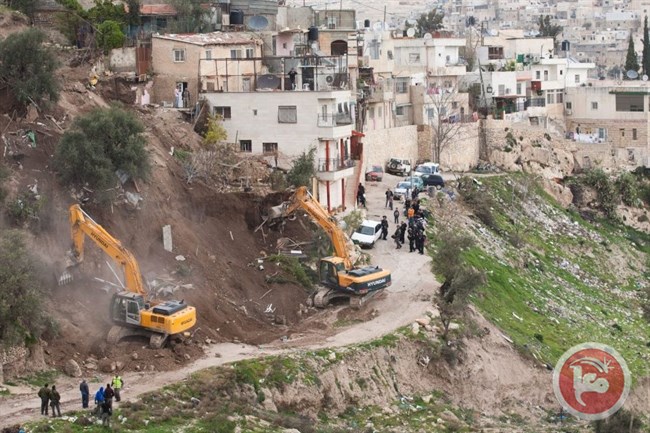
Israeli hydraulic shovels demolishing a Palestinian building in the occupied West Bank
Press TV – February 26, 2018
Israel has approved a bill to expand the jurisdiction of Israeli courts over Area C of the West Bank, paving the way for the annexation of the region.
The area is currently ruled by the military but an annexation would require Israeli law to be imposed and Palestinians living in the area to identify as Arab Israelis.
The ministerial committee for legislation on Sunday approved the measure introduced by justice minister Ayelet Shaked who is known for her extremist views regarding Palestinians.
Her office claimed in a statement that the bill aimed to minimize the caseload of the high court of justice which rules on property rights, building and construction, and restraining orders.
Under the new provision, such cases will be adjudicated by the district courts.
The legislation is also designed to treat Israeli settlers living in the West Bank like those living within the pre-1967 borders, or the so-called Green Line.
The bill must be rubber-stamped by the Israeli parliament or the Knesset but it has already drawn condemnation for being part of a drive to annex Area C and deprive Palestinians living there of their rights.
Yousef Jabarin, a member of the Joint List which represents Palestinian citizens of Israel at the Knesset, slammed the measure as another initiative by Israel to normalize the occupation and to advance “creeping annexation” over the West Bank.
“The High Court of Justice has never treated the Palestinians in the territories justly,” Jabarin said, noting that the legislation will complicate and prolong legal proceedings, leaving Palestinians with little legal recourse.
Under interim agreements signed in the 1990s with Israel, the West Bank is divided into three zones.
The Area C of the West Bank is the largest division in the occupied territory as it comprises 60 percent of the land, and is under full Israeli military control.
The Israeli military almost never grants Palestinians living in Area C building permits.
Palestinians want the West Bank as part of their future independent state, with East Jerusalem al-Quds as its capital.
The presence and continued expansion of illegal Israeli settlements in occupied Palestine, however, has created a major obstacle to the establishment of such a state.
More than half a million Israelis live in over 230 settlements built since the 1967 Israeli occupation of the Palestinian territories of the West Bank and East Jerusalem al-Quds.
The UN and most countries regard the Israeli settlements as illegal because they are built on territories captured by Israel in a war in 1967 and are hence subject to the Geneva Conventions, which forbid construction on occupied lands.
Nevertheless, the Israeli regime continues to build new settlements and expand existing ones.
US President Donald Trump on December 6 formally recognized Jerusalem al-Quds as the so-called capital of Israel and announced plans to move the American embassy to the occupied city.
Haley and Abbas have exposed the fallacy of PA representation at the UN
By Ramona Wadi | MEMO | February 22, 2018
The outcome of the UN Security Council meeting does not bode well for the people of Palestine. Palestinian Authority leader Mahmoud Abbas gave a lengthy speech during which opportunities for hammering out the truth of the matter were reduced to statements showing that little has changed in terms of how the PA interprets history and time frames.
Abbas declared that Israel “has transformed the occupation from a temporary situation as per international law into a situation of permanent settlement colonisation.” He also described the PA as having become “an Authority without authority.” The inaccuracy of these statements is the suggestion that their claims have just become obvious, highlighting the refusal to recognise that the facts of the matter have been very clear since the start of the occupation — Zionism is an expansionist ideology forever seeking “Greater Israel” — and the creation of the PA, whose sole role is to serve Israeli interests. Having allocated enough space in order to portray the alleged deterioration of the situation as opposed to current circumstances being the result of a premeditated plan of colonisation and collaboration, Abbas is entrenching a poor bargaining position for Palestinians.
This deficiency has been recognised by the US. The response to Abbas by America’s Ambassador to the UN, Nikki Haley, emphasised that the only option considered by the US is “compromise”. In Haley’s words: “You can choose to put aside your anger about the location of our embassy and move forward with us towards a negotiated compromise that holds great potential for improving the lives of the Palestinian people.” In other words, forget about a state; you can have the crumbs off the table, which is better than no crumbs at all.
Haley’s response cannot be read solely within the context of a diatribe against Abbas. It is a direct attack on Palestinians rights and aspirations for liberation. Indeed, this exchange portrays the consequences which Palestinians suffer as a result of political isolation. The rhetoric within international institutions takes place in such a detached manner that it is possible to discern a narrative for UN forums that only skims the surface of what is deemed acceptable to discuss. The choice of discourse has been determined away from Palestinian reality.
The diverging narratives are imbued with recognition and repudiation, with the latter reserved for Palestinians. Haley is emphasising this discrepancy and exploiting it at a time when Israel and the US are working overtly to accelerate the colonisation process so that “Greater Israel” becomes more of a reality day by day. Recognising the colonial narrative at an international level is aided by the fact that Abbas is not speaking for all Palestinians. His calculated discourse, which should generate outrage at the way decades of Israeli violations are being recognised by himself and the PA so belatedly — particularly after US President Donald Trump’s unilateral declaration on Jerusalem — is a blatant example of pandering to colonial complicity.
Haley’s statement on Palestinians’ limitations unfortunately rings true. Whether or not the US is involved in negotiations, the damage to the Palestinians and their cause is immense. Turning to international organisations with weak leadership for solutions will ultimately result in the diminished power of the people. The fact that Abbas continues to engage with the international community without acknowledging its role in isolating Palestinian voices can only mean an extension of the current situation, with long-term benefits for Israel. Engaging with the US after the measures it has taken to hinder the legitimate claims of Palestinians on their territory to the point of elimination should not be an option.
Whatever Abbas chooses, and recent history has shown many examples of how the PA fluctuates from one degenerative option to another, it is important to remember that the decisions are not Palestinian choices. The people of Palestine have been experimented upon from all sides — even militarily — and options offered by parties across the political spectrum ignore the fact that the genuine possibilities for Palestinians can only be generated from within; Abbas knows this only too well. It is with calculated intent that the entire world has been allowed to impose anything and everything upon the Palestinians apart from their legitimate rights. The added indignity is having these same impositions articulated in the name of the Palestinian people by someone like Mahmoud Abbas.
Montreal Gazette’s anti-Palestinian bias
By Yves Engler · February 24, 2018
Shame on the Montréal Gazette. Shame on Dan Delmar. Even when McGill’s uber-Israeli nationalist administration dismisses allegations of “anti-Semitism” the paper and its writer uses them to smear freedom promoting students.
In October Canadian Jewish Political Affairs Committee activist Noah Lew cried “anti-Semitism” after he wasn’t voted on to the Board of Directors of the Students’ Society of McGill University (SSMU). At a General Assembly Democratize SSMU sought to impeach the student union’s president Muna Tojiboeva. The ad-hoc student group was angry over her role in suspending an SSMU vice president and adopting a Judicial Board decision that declared a Boycott, Divestment and Sanctions resolution unconstitutional. While they couldn’t muster the two thirds of votes required to oust the non-Jewish president of the student union, Democratize SSMU succeeded in blocking the re-election of two Board of Directors candidates who supported the effort to outlaw BDS resolutions.
After failing to be re-elected to the Board of Directors at the same meeting Noah Lew claimed he was “blocked from participating in student government because of my Jewish identity and my affiliations with Jewish organizations.” Lew’s claim received international coverage, including coverage in the Gazette.
As she’s done on previous occasions, McGill Principal Suzanne Fortier echoed the Israel activists’ claims. Fortier sent out two emails to all students and faculty about the incident with one of them noting, “allegations have arisen suggesting that the votes against one or more of those directors were motivated by anti-Semitism.” At the time she announced an investigation into the incident.
Released two weeks ago, the investigation dismissed Lew’s claim of anti-Semitism. After interviewing 38 students over three-and-a-half weeks, former Student Ombudsman Dr. Spencer Boudreau concluded that he could “not substantiate the notion that the vote was motivated by anti-Semitism” and couldn’t find “evidence that would equate students’ protests about Israel’s policies with anti-Semitism.” Rather, Boudreau found that the vote was “motivated by politics, that is, based on his [Lew] support for Israel and Zionism and/or for his view of the BDS movement.”
Instead of covering the investigation, the Gazette repeated the Israel nationalist’s baseless smear. A story headlined “Student says anti-Semitism still an issue in McGill student government” quoted Lew and Israel lobby organizations objecting to the report’s findings. The article barely acknowledged the central conclusion of the investigation and failed to quote from it.
Four days after the news story Gazette columnist Dan Delmar criticized the report in a story titled “If anti-Semitism isn’t the problem on campus, what is?” The long-time anti-Palestinian commentator wrote, “for many if not most Canadian Jews, this writer included, the phenomenon of campus anti-Semitism in Canada is a reality and has been particularly problematic for nearly two decades.”
While the Gazette’s attacks are shameful, they are not surprising. The paper has engaged in a multi-year smear campaign against Palestine solidarity activists at McGill. According to a search of the Gazette’s database, the paper has published 12 stories referring to anti-Semitism at McGill since 2014 (I couldn’t find a single Gazette story detailing anti-Black, Asian or indigenous discrimination at the elite university). Rather than a sudden growth of anti-Jewishness, the spate of anti-Semitism stories are a response to students campaigning to divest from corporations complicit in Israel’s occupation. Between 2014 and 2016 there were three votes inspired by the Boycott Divestment and Sanctions movement at biannual SSMU General Assemblies. After two close votes, in February 2016 a motion mandating the student union to support some BDS demands passed the union’s largest ever General Assembly, but failed an online confirmation vote after the McGill administration, Montreal’s English media and pro-Israel Jewish groups blitzed students.
Since that vote Lew and other anti-Palestinian activists have sought to have SSMU define BDS resolutions as unconstitutional. Concurrently, the university’s board of governors is seeking changes to its endowment’s social responsibility criteria, which would effectively block the possibility of divesting from companies violating Palestinian rights or causing climate disturbances.
The Gazette has ignored the Israel activists and administration’s extreme anti-Palestinian measures. The paper has also ignored the administration’s pro-Israel orientation. In May Principal Fortier traveled to that country and in November McGill Vice-Principal Innovation Angelique Mannella participated in an event put on by the explicitly racist Jewish National Fund.
In his column Delmar asks, “If anti-Semitism isn’t the problem on campus, what is?” The answer is obvious: Many students feel embarrassed and angry about their university — and other Canadian institutions’ — complicity in Palestinian dispossession. When they try to channel their emotions into non-violent action to help liberate a long-oppressed people they are blocked by powerful institutions and called names. The problem is the anti-Palestinian bias of those institutions, including the Gazette.
Zionists, Traitors and Congressmen
Mantiq al-Tayer | February 23, 2018
As mindless zionist-bullshit-fed Americans worry about Russiagate, an unspeakable evil is about to descend upon the once great capital city of what is left of the United States. This evil is so thoroughly ingrained in the consciousness – for lack of a better term – of the inside-the-beltway crowd that it can come like a thief in the night and be mistaken for a guest, a friend, an ally. But it is none of those.
Yes, we are talking about this year’s AIPAC policy conference which will officially begin shitting on Washington on March 4th. Among the chief shitters and shit eaters are 18 members of the allegedly US Congress. To see if any of your representatives are speaking at this treason fest, go here.
And what gathering of bigoted warmongering motherfuckers would be complete without the presence as a keynote speaker of the puke-generating Nikki Haley who has got to be the worst woman on the planet? […]
Anyway, this post is actually about the video below. It’s a sort of a modern-day example of billboard correction. Video correction in honor of AIPAC’s upcoming treason fest. To see the original video you can go to AIPAC’s site and find it. I won’t even link to it here, but I digress. … Full post
Hamas: Abbas’s speech did not rise up to the desired level
Palestine Information Center – February 22, 2018
GAZA – Palestinian resistance group Hamas criticized Palestinian Authority (PA) chairman Mahmoud Abbas following his speech at the UN Security Council on Wednesday.
In a press release, Hamas underlined that the political plan presented by Abbas in his speech does not reflect the national position which calls for an end to the Oslo Accords and which opposes a resumption of negotiations with Israel.
“Abbas’s speech did not rise up to the desired level, nor did it reflect the national consensus, which wants to terminate the Oslo agreements and rejects negotiations with the occupiers,” Hamas said.
Abbas is working to create a new mechanism for the failed peace process despite Israel’s violations and crimes against Palestinian women and children and the dangerous bias of the United States in favor of Israel on Jerusalem and the refugees and the encouragement it gives Israel to commit crimes and liquidate the Palestinian cause, the statement reads.
In this context, Hamas demanded an end to Abbas’s unilateral decision-making, and instead of following the path of a political process, to accelerate the unification of the ranks within the Palestinian arena and reach an agreement on a national strategy that focuses on the path of resistance.
US Violates Iranian Nuclear Deal Almost Every Day – Tehran
Sputnik – February 22, 2018
Iranian Deputy Foreign Minister Abbas Araghchi said Thursday that the US violated the Joint Comprehensive Plan of Action (JCPOA) almost every day, while Trump’s public statements contribute to this.
“It is a fact that the United States is not implementing the JCPOA [the Joint Comprehensive Plan of Action], it is a fact that it violates it almost daily,” he told the BBC.
According to him, Trump’s statements regarding the deal being “bad,” or seeking to change it are a violation of the agreement.
“This violates the letter, not the spirit of the agreement,” the deputy minister added.
Speaking further, the senior Iranian official said that Iran would withdraw from the agreement if there would be no economic benefits for the country and major banks wouldn’t work with Iran.
“The deal would not survive this way even if the ultimatum is passed and waivers are extended,” Araqchi said.
The statement comes almost two weeks after US President Donald Trump delivered an ultimatum to the heads of European countries, saying that he wouldn’t extend the US sanctions relief on Iran if the sides refused to “fix the terrible flaws of the Iran nuclear deal.
“The day before, Iranian Foreign Minister Mohammad Javad Zarif said in an exclusive interview with Sputnik that “the US has never adhered to its liabilities within the JCPOA.”
Fears of Syrian War Tearing Middle East Apart
Araghchi also commented on the on-going conflict in Syria, which has recently escalated after an Israeli F-16 jet was shot down by the Syrian Army as it was about to attack Iranian positions for allegedly flying a drone into Israel’s airspace.
The Deputy FM denied the accusations, claiming that the drone in fact belonged to the Syrian government.
At the same time, he underlined the policy of double standards on the part of Israeli Prime Minister Benjamin Netanyahu, who had earlier branded Iran as the “greatest threat to our world,” while the Israeli military itself is frequently flying drones over Syria and neighboring countries.
“They shouldn’t be angry when they are faced with something that they are doing against others on a daily basis,” Araghchi said.
The deputy minister noted that the incident has had a significant destabilizing impact on the de-escalation process in Syria and on the maintenance of peace in the Middle East.
“Fear of war is everywhere in our region,” Araghchi stated.
Nevertheless, Araghchi stressed that the presence of Iranian forces in Syria should not be misinterpreted as a threat to Israel, since their sole objective is to assist the government of Bashar al-Assad in combating terrorists.
“Just imagine if we were not there. Now you would have Daesh [the Islamic State group] in Damascus, and maybe in Beirut and other places,” he said.
The Deputy FM affirmed that the “de-escalation of tensions” is “very important” to the Iranian strategy in Syria, and the country has “worked hard to achieve that.”
Israel may pay settlers millions to leave illegal outpost
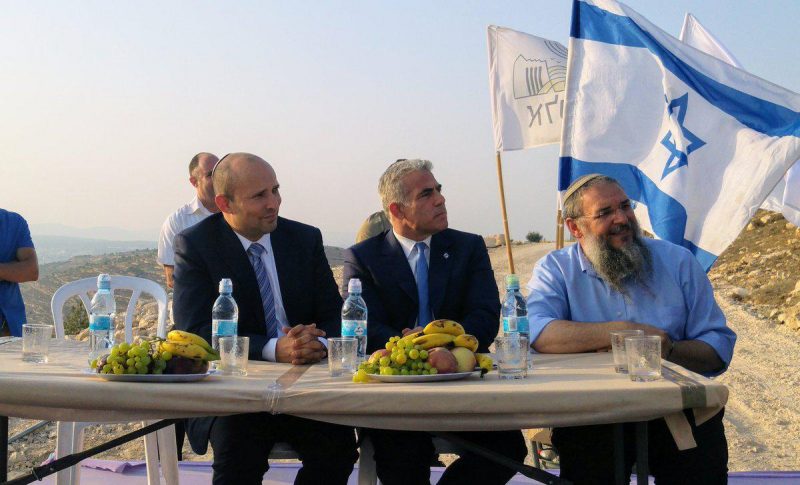
Yair Lapid (centre) and Naftali Bennett (left) joined settlers on 23 July 2017 at the inauguration of a monument that was rebuilt in the illegal settlement outpost of Netiv HaAvot after the Israeli Supreme Court ordered the outpost’s demolition and the evacuation of all settlers [Yigal Dilmoni/Twitter]
MEMO | February 20, 2018
The Israeli government is preparing to give 20 million shekels ($5.68 million) in compensation to settlers who have been living in an illegal outpost on private Palestinian land, reports Haaretz.
Prime Minister Benjamin Netanyahu is seeking the approval of his coalition partners, ahead of the impending evacuation of 15 Israeli settler families from Netiv Haavot settlement outpost.
One of the buildings in Netiv HaAvot was demolished in November 2017. The Israeli Supreme Court has ordered the state to demolish the other 15 houses in March, but, according to Haaretz, “the state is expected to request that the supreme court delay the outpost’s evacuation”.
Government ministers Naftali Bennett and Ayelet Shaked “visited the outpost on Sunday and promised the residents they would try to postpone their eviction by three months, until construction starts on alterative homes nearby, for ‘humanitarian’ reasons”, the paper added.
According to the Times of Israel, residents of the illegal outpost will establish a “protest test” outside Netanyahu’s Jerusalem office, where they will demand “an immediate solution to prevent the evacuation as well as the construction of 350 homes in the Etzion [settlement] bloc”.
Israeli NGO Peace Now slammed the compensation plan as “political bribery for building offenders”.
“The residents of Nativ Ha’avot stole land, took control of it, and built their homes on it without permission from any official source.”
“This is not according to us, but rather according to the state, which issued demolition orders for all the structures,” said NGO official Shabtay Bendet.
“Now they are receiving very generous financial compensation from the same state.”
Read also:
Israel refuses to return Palestinian land, handing it to settlers
Featured Video

The Failed Air War Over Vietnam
or go to
Aletho News Archives – Video-Images
From the Archives
USS Liberty Massacre: A Pivotal Moment in the Hostile Takeover of America
By Kevin Barrett | Crescent | Dhu al-Qa’dah 24, 1445
In corporate America, hostile takeovers are commonplace. They occur when an aggressor—a larger corporation or rich individuals—seizes control of a smaller corporation without asking permission.
What few recognize is that the United States itself has been subjected to a hostile takeover. Since the aggressor, the illegitimate settler colony known as “Israel,” is much smaller than the US, the takeover has necessarily been surreptitious.
As of June, 2024, Israel’s gradual takeover of the US has become obvious and undeniable—a proverbial “elephant in the living room.” … continue
Blog Roll
 Aletho News
- Leaders Condemn Ansarallah Attack on Saudi Arabia While Ignoring Illegal War Against Yemen
- Leaked: Britain’s Covert Iraqi Psyops Network
- Yemeni Armed Forces Warn Airlines Against Using Saudi Airports, Exempt Mecca and Medina
- Iran security chief says powers greater than US tried to conquer Iran but ended in ‘dustbin of history’
- Europe’s mounting social chaos… chickens coming home to roost for proxy war against Russia
- US-Russia Diesel Deal Becomes Massive Defeat for Ukraine
- Hormuz and the Looming Economic Catastrophe
- Dhubab offensive, media blitz and the rapid unraveling of Saudi-backed coalition’s new gambit
- Putin Conveys to Trump Iran’s Vision on Possible Conflict Resolution – Kremlin
- The Search for Truth: Charlie Kirk’s Assassination One Year Later
- If Americans Knew
- ‘He’s Desperate’: AIPAC Begins Spending Against Abdul El-Sayed to Boost Mike Rogers:
- Trump, Hormuz, and the Looming Economic Catastrophe
- For three years, Israel has killed a child in Gaza every 71 minutes – Daily Update
- Israeli forces kill another child in Gaza – Daily Update
- Gaza ceasefire exists in name only, say more than 100 organizations
- Nearly 2 Million in Gaza Need Urgent Shelter Assistance as Winter Looms: IOM Chief Warns
- Suppressing Palestinian resistance: US charity under fire for AI monitoring of Gaza classrooms
- Thousands Are Held in Israeli Torture Camps. This Is What Happens Inside
- Israel puts Gaza’s sick, injured, newborn in peril – Daily Update
- Report claimed Mark Levin used by Israeli government to influence Trump
- No Tricks Zone
- Germany’s Green Energy Debacle: High Energy Costs Force Kahla Porzellan to Close After 182 Years!
- New Study: 50 Years Of The Most Aggressive ‘Net Zero’ Policies Can Only Affect The Global Climate By 0.03°C
- US September “Heat” Was No Record…Many Records Set Decades Ago
- Latest European Green Energy Debacle; Portugal’s Largest Flagship Solar Park Insolvent!
- Green Energy Debacle: German Expert Professor Fritz Vahrenholt Warns Of Severe Economic And Social Consequences
- Two More Paleo Reconstructions Affirm Meters-Higher Sea Levels Across Ireland, Brazil 7000-6000 Years Ago
- New Study: Earth And Venus Surface Warmth Largely Explained By Convection And Lapse Rate, Not CO2 Or Radiation
- 2025 Nature Paper Claiming Worsening Global Drought Gets RETRACTED …Heavily Flawed
- New Study: ‘Global Drought Shows No Detectable Recent Acceleration Under Climate Warming’
- Economic Masterminds: German Socialists Suggest Taxing Productivity Gains Stemming From Using AI

