Afghanistan is ripe for proxy war

By M K Bhadrakumar | Indian Punchline | August 20, 2017
Russia has hinted in the past that the United States is covertly sponsoring the Islamic State in Afghanistan. On Thursday, the Russian Foreign Ministry spokesperson raised the bar by alleging that “foreign fighters” who were transferred by “unknown helicopters” have perpetrated a massacre of Hazara Shias in the Sar-e-Pol province in northern Afghanistan. The spokesperson said:
- We can see attempts to stir up ethnic conflict in the country… Cases of unidentified helicopter flights to territory controlled by extremists in other northern provinces of Afghanistan are also recorded. For example, there is evidence that on August 8, four helicopters made flights from the airbase of the Afghan National Army’s 209th corps in Mazar-i-Sharif to the area captured by the militants in the Aqcha district of the Jowzjan province. It is noteworthy that witnesses of these flights began to fall off the radar of law enforcement agencies. It seems that the command of the NATO forces controlling the Afghan sky stubbornly refuses to notice these incidents.
From the above, it appears that sections of the Afghan armed forces and the NATO command (which controls Afghan air space) are hand in glove in these covert operations. No doubt, this is a very serious allegation. The attack on the Hazara Shias must be taken as a message intended for Tehran. Historically and culturally, Iran has affinities with the Hazara Shia community in Afghanistan. Possibly, the Trump administration, which has vowed to overthrow the Iranian regime, is opening a ‘second front’ by the IS against Iran from the east.
Interestingly, the Russian Foreign Ministry also issued a statement on Friday on the alarming drug situation in Afghanistan. It pointed out that:
- A sharp increase in drug production is expected in Afghanistan this year and one-third of the country’s population is now involved in cultivation of opium poppy.
- The geography of the Afghan drug trafficking has expanded and now reaches the African continent.
- Tonnes of chemicals for processing narcotics are illegally imported into Afghanistan – with Italy, France and Netherlands “among main suppliers”.
- The US and NATO are either unwilling or incapable of curbing the illegal activity.
Russia and Iran cannot turn a blind eye to the hostile activities by the US (and NATO) in their backyard, transforming the anti-Taliban war into a proxy war. They cannot but view the Afghan conflict through the prism of their deepening tensions with the US.
What are Russia’s options? The Russian Defense Minister Sergei Shoigu said at a meeting with the top brass in Moscow on August 18 that the Afghan conflict poses a threat to Central Asia’s stability. He said that Russia plans to hold joint military exercises later this year with Kyrgyzstan, Tajikistan, and Uzbekistan. Russia has military bases in Tajikistan and Kyrgyzstan.
Again, Ambassador Zamir Kabulov, Russian presidential envoy to Afghanistan, said recently that if the Afghan government and the US are unable to counter the IS threat, Russia will resort to military force. Kabulov disclosed that Russia has raised in the UN Security Council the air dropping of supplies for the IS fighters in at least three provinces in northern Afghanistan by unidentified aircraft.
Of course, it is inconceivable that Russia will put “boots on the ground” in Afghanistan. But if the IS breaches the borders of the Central Asian states, it becomes the “red line”, Russia will hit back. Russia is reinforcing its bases in Kyrgyzstan and Tajikistan. Significantly, in a joint military exercise with Tajikistan in July, Russia tested its Iskander-M short-range ballistic missiles, one of the most advanced weapons in the Russian arsenal, with a range of 500 kilometers and a payload of 700 kg. Iskander is equipped with terminal guidance systems with the capability to overcome missile defences. Iskander’s accuracy could be better than 10 meters. (Russia has deployed the deadly weapon to Syria.)
With the exit of White House strategist Steve Bannon, an inveterate anti-war ideologue in the Trump administration who wanted the Afghan war to be brought to an end, the generals now have the upper hand in controlling the US policy. Defence Secretary James Mattis and National Security Advisor HR McMaster favour deployment of additional troops to Afghanistan. The ‘known unknown’ is John Kelly, whom Trump recently appointed as his chief of staff. But there are enough indications that Kelly (a retired Marine Corps general and father of a fallen Marine, 1st Lt. Robert Kelly, who was killed in Afghanistan in 2010) almost certainly shares the opinion of Mattis and McMaster.
The more one looks at it, President Donald Trump’s real challenge is not about winning the war against the Taliban, but the high risk he’ll be incurring, by taking his generals’ advice, to put his imprimatur on a full-fledged proxy war in Afghanistan against Russia, Iran and China.
‘Europe is lost’: Barcelona’s chief rabbi urges Jews to move to Israel
RT | August 19, 2017
In the aftermath of this week’s terrorist attacks in Barcelona, the city’s chief rabbi has warned his community that Jews in the region are doomed because of the threat of radical Islam.
At least 14 people were killed and over 100 injured in two separate terrorist attacks in Barcelona and the nearby coastal town of Cambrils. Islamic State (IS, formerly ISIS/ISIL) claimed responsibility for the attack on Las Ramblas in Barcelona.
“I tell my congregants: Don’t think we’re here for good, and I encourage them to buy property in Israel,” Rabbi Meir Bar-Hen said in an interview with Jewish news agency JTA.
“This place is lost. Don’t repeat the mistake of Algerian Jews, of Venezuelan Jews. Better [get out] early than late.”
Bar-Hen said the attacks highlighted the presence of a large Muslim community with “radical fringes” in the region, and alleged Spanish authorities are reluctant to confront Islamist terrorism.
The rabbi cited the recent decision to allow Palestinian Leila Khaled to enter Spain for a book festival as apparent evidence of his claim. Khaled was involved in high-profile airplane hijackings in 1969 and 1970.
The rabbi, who was keen to stress that he was speaking in a private capacity and not on behalf of the community, also said this applied more widely to Europe as a whole.
“Europe is lost,” he concluded.
The Federation of Jewish Communities of Spain appear not to share Bar-Hen’s pessimistic outlook. The organization issued a statement Thursday, saying: “Spanish Jews trust the State Security Corps that work daily to prevent radical fanatics and Islamists from sowing chaos and pain in our cities.”
The group also urged politicians to “deal intelligently and determinedly with the struggle against fanaticism and in favor of freedom and democracy.”
Syria: As the War Continues, WMD Lies Linger

A special investigation team collects evidence
By Tony Cartalucci – New Eastern Outlook – 18.08.2017
Despite the now historical lies exposed in the wake of the devastating US invasion and occupation of Iraq beginning in 2003, the United States has attempted to use similar lies regarding weapons of mass destruction (WMDs) repeatedly as a pretext for similar wars including in neighboring Syria.
The Syrian government – perhaps in an effort to head off another round of accusations, threats, and direct military aggression carried out by the US – is leveling accusations against the United States itself and terrorist organizations it has funded, armed, and backed for the past 6 years of using chemical weapons – primarily to create a pretext for wider war.
Syria’s Deputy Foreign Minister Faisal Mekdad stated at a press conference that the April 2017 Khan Shaykhun, Idlib chemical attack was staged by US-backed militants, including members of the so-called “White Helmets,” a US and European funded front posing as humanitarian workers but who serve as auxiliaries for listed terrorist organizations including Al Qaeda and its various Syrian affiliates.
As the Syrian military retakes territory from foreign-backed militants, munition warehouses and stockpiles, including those used for the production and deployment of chemical weapons for staged attacks, are being systematically uncovered. In them, chemical weapons – both lethal and nonlethal – provided by the United States and its allies are being discovered.
Mekdad would also point out that the use of chemical weapons by foreign-backed militants did not serve any sort of tactical purpose, but was instead being used as a form of blackmail.
While Western-dominated “international” institutions will likely not accept any evidence provided by the Syrian government – the Syrian government’s narrative emerges as a far more logical explanation for the last 6 years of conflict and accusations made regarding chemical weapon use.
Chemical Weapons are Political, Not Tactical
Despite claims by the Western media made in an attempt to enhance US lies regarding WMDs, chemical weapons are particularly ineffective on the battlefield – with conventional weapons being many times more effective.
This was revealed in detail by a study produced by the United States itself, conducted by the US Marine Corps regarding the devastating Iran-Iraq War fought between 1980-1988 which saw the extensive use of chemical weapons.

It goes without saying that gas masks were a must during the Iran-Iraq war of the mid 80s
The document titled, “Lessons Learned: The Iran-Iraq War” under “Appendix B: Chemical Weapons,” provided a comprehensive look at the all-out chemical warfare that took place during the 8 year conflict. Several engagements are studied in detail, revealing large amounts of chemical agents deployed mainly to create areas of denial.
The effectiveness and lethality of chemical weapons is summarized in the document as follows (emphasis added):
Chemical weapons require quite particular weather and geographic conditions for optimum effectiveness. Given the relative nonpersistence of all agents employed during this war, including mustard, there was only a brief window of employment opportunity both daily and seasonally, when the agents could be used. Even though the Iraqis employed mustard agent in the rainy season and also in the marshes, its effectiveness was significantly reduced under those conditions. As the Iraqis learned to their chagrin, mustard is not a good agent to employ in the mountains, unless you own the high ground and your enemy is in the valleys.
We are uncertain as to the relative effectiveness of nerve agents since those which were employed are by nature much less persistent than mustard. In order to gain killing concentrations of these agents, predawn attacks are best, conducted in areas where the morning breezes are likely to blow away from friendly positions.
Chemical weapons have a low kill ratio. Just as in WWl, during which the ratio of deaths to injured from chemicals was 2-3 percent, that figure appears to be borne out again in this war although reliable data on casualties are very difficult to obtain. We deem it remarkable that the death rate should hold at such a low level even with the introduction of nerve agents. If those rates are correct, as they well may be, this further reinforces the position that we must not think of chemical weapons as “a poor man’s nuclear weapon.” While such weapons have great psychological potential, they are not killers or destroyers on a scale with nuclear or biological weapons.
According the US military’s own conclusions, the use of chemical weapons only enhance conventional warfare, but are not suitable for wiping out large swaths of enemy troops. Conventional weapons are deemed far more suitable for waging modern war.
The effectiveness of chemical weapons is such that the Syrian government could never justify their use, balancing their limited benefits against the knowledge the US was specifically seeking to use their use as a pretext for direct military intervention.
Thus, neither the Syrian government nor the foreign-backed militants it is fighting would benefit from their use in turning the tide of any specific battle, but should the US use chemical weapon deployments as a pretext, could intervene directly against the Syrian government, delivering victory to foreign-backed militants.
In essence, the only beneficiary of chemical weapon use by any side in Syria would be special interests in the US seeking regime change in Damascus.
Not only are outright lies regarding WMDs a known tactic repeatedly abused by the United States government worldwide, it has been caught repeatedly using this tactic in Syria. The number of ambiguous, unsubstantiated, or proven-false accusations made by the United States as it seeks a pretext for wider and more direct military intervention have multiplied over time as US-backed militants are pushed off the battlefield.
US Provocations, Lies, and Chemical Weapons
Suspicious circumstances and familiar propaganda and diplomatic tactics were used by the US to rush the world to war – first in 2013 when an alleged chemical attack was carried out at the edge of Damascus. The attack followed multiple claims in 2012 by the US that the Syrian government was preparing such an attack, followed by threats of direct military intervention if the Syrian government did so.
This came at a time when it became apparent that quick regime change in Syria similar to that carried out by the US in Libya in 2011 was not possible and that only through direct military intervention would the US be able to topple the Syrian government.
In response, Syria relinquished its chemical weapons under a Russian-brokered deal, confirmed by UN inspectors. Despite this, chemical weapons continued turning up on the battlefield – followed by repeated attempts by the US to expand direct military intervention within Syrian borders each and every time.
No logical explanation has ever been provided by the United States – either by its politicians or its policymakers – as to why the Syrian government would repeatedly use ineffective chemical weapons in battles it was already winning with far more effective conventional weapons – and risk US military intervention.
Conversely, many of these attacks are carried out in areas held by terrorist organizations with direct access to the borders of their foreign sponsors. The more recent April 2017 alleged attack in Khan Shaykhun took place within the Idlib Governorate, directly on the border with NATO-member Turkey who has armed, supplied, and provided direct military support for Al Qaeda and its affiliates since the conflict began in 2011.
Consider the Source

The city of Idlib occupied by radical Islamists
Idlib has been controlled by Al Qaeda for years with even the New York Times and LA Times finally admitting as much.
The New York Times in a piece titled, “In a Syria Refuge, Extremists Exert Greater Control,” would admit:
“Idlib Province is the largest Al Qaeda safe haven since 9/11,” Brett H. McGurk, the United States envoy to the coalition fighting the Islamic State, said last month. “Idlib now is a huge problem.”
The LA Times in a piece titled, “Humanitarian groups fear aid is being diverted to terrorist group after militant takeover of Syrian province,” would reveal that torrents of supplies provided by the US, Europe, and their regional allies are still being poured into a city quite literally occupied by Al Qaeda, stating (emphasis added):
The recent takeover of the Syrian province of Idlib by an extremist organization has created a dilemma for the United States and other countries that send humanitarian aid to civilians and military aid to various rebel factions fighting the Syrian government.
It has become impossible to provide assistance without inadvertently supporting Al Nusra Front, a former affiliate of Al Qaeda that has been deemed a terrorist group by the U.S. government.
In reality, Al Qaeda’s domination of a region allegedly held by “rebels” provided billions in supplies, weapons, vehicles, training, and even direct military support by the West could only happen if Al Qaeda itself was receiving even more in state sponsorship – or were the recipients of this aid all along.
Both the New York Times and the LA Times in their articles, lace it with language meant to disarm readers from truly understanding the full scope of what the US has done in Syria. Claiming that the Al Nusra Front is a “former affiliate of Al Qaeda,” for instance, is supposed to create in the minds of readers the notion that they are no longer Al Qaeda, or terrorists when they are in fact very much still both.
The LA Times would even go as far as suggesting Al Qaeda’s Al Nusra Front would provide Western-backed organizations with “independence and neutrality.”
The LA Times also claims:
But cutting off the aid could spur a humanitarian disaster among the estimated 2 million civilians who live in Idlib and derail efforts to topple Syrian President Bashar Assad.
Efforts to “topple Syrian President Bashar Assad,” however, can only be done with an armed opposition – and as both the New York Times and LA Times admit, the only armed militants left in Syria are Al Qaeda.
What both newspapers are actually saying is that Al Qaeda has been cornered in Idlib where the US and its allies are still flooding with support, and that support quite literally for Al Qaeda will continue in an effort to topple the Syrian government.
This means that the process of fabricating chemical weapon attacks and using it as a pretext to directly intervene – on behalf of Al Qaeda – will continue as well, either to topple the government outright, or create a safe-haven protected by the US military for Al Qaeda in Idlib.
It is in this context then, that “humanitarian organizations” in Al Qaeda-held Idlib are claiming they are being targeted by chemical weapons allegedly deployed by the Syrian government.
The Syrian government and its allies have all but won the conflict and they have done so using conventional military weapons. They are also attempting in every way to expose these lingering and repetitive lies regarding WMDs wielded by the US, by inviting UN inspection teams to further explore newly liberated Syrian territory and further confirm that the Syrian government did indeed give up its chemical weapons as it agreed to in 2013.
Pentagon Denies Sending Chemical Agents to Syrian Opposition Groups
Sputnik – August 16, 2017
The Pentagon said Wednesday it had never sent chemical agents to so-called Syrian opposition groups after Damascus accused the United States of supplying terrorists with toxic agents.
US military assistance to vetted Syrian opposition forces is limited to those fighting against the Daesh terrorist group (banned in Russia) and has never included chemical agents, Pentagon spokesman Eric Pahon told Sputnik on Wednesday.
The statement comes after Syrian Deputy Foreign Minister Faisal Mekdad accused US and UK-based companies of supplying toxic agents to terrorists, adding that CS and CN substances, allegedly produced by NonLethal Technologies and Chemring Defence, were found in Aleppo and Damascus.
“Department of Defense assistance to Vetted Syrian Opposition groups is limited to those groups fighting ISIS [Daesh]. That assistance does NOT now, nor has it ever, included chemical agents like you describe,” Pahon said.
Russian Foreign Ministry spokeswoman Maria Zakharova said the fact that the United States and the United Kingdom could have supplied toxic agents to militants in Syria is “beyond understanding.” The Organization for the Prohibition of Chemical Weapons said in June that its fact-finding mission confirmed that man-made chemical sarin, a gas used as a chemical weapon, was used in an attack on Khan Shaikhoun in Idlib in early April, but did not determine who was responsible.
The US-backed militias blamed the use of chemical weapons on the Syrian government, despite Syrian President Assad told Sputnik following the attack in April that there was no chemical weapons in Idlib.
The LOCKERBIE Bombing: Who Really Did Carry Out the Worst Terrorist Attack in British History…?

The Burning Blogger of Bedlam | July 27, 2017
The Lockerbie bombing in 1988 was perhaps the 9/11 of its time. While it didn’t result in the kind of phony Global ‘War on Terror’ that was conducted after 9/11, it did give the US and Britain the platform for beginning a targeted downfall of a particular nation and society, this being Libya.
This was accomplished the same way in Libya as it was accomplished in Iraq: first by years and years of crippling sanctions and forced hardship (via the UN),then by all-out destruction against a nation that is no longer able to defend itself (Iraq in 2003, Libya in 2011).
There are essentially two ways to look at Lockerbie.
One, the most important, is as a criminal investigation of an act of mass murder. The other is as a prolonged political or geo-political tool serving multiple purposes. Both are worth revisiting; particularly as the ghost of Lockerbie (and all of its victims) has reappeared in news media in the last few weeks.
Revisiting the subject of Lockerbie is important both as a study of geo-politics and the place of political terrorism within that arena and as a study in history and how it relates to contemporary events.
I want to take a broad overview of the Lockerbie subject here, touching on all of those areas: this article will cover (1) the reasons why the ‘official’ story of Lockerbie is so problematic and disputed, (2) the release of the ‘Lockerbie Bomber’ from prison in Scotland and why it happened, (3) the political and geopolitical motives and consequences of the Lockerbie trial and verdict, and finally (4) the many different theories as to who really did carry out the Lockerbie bombing and why.
The official story remains that the Lockerbie bombing was the doing of the Libyan, Abdelbasset al-Megrahi, who – at the time – had been in charge of security for Libyan airlines.
Abdelbasset al-Megrahi was jailed for 27 years, but died of prostate cancer, aged 60, in 2012. On his deathbed, he continued to claim he was innocent of the bomb that ripped apart Pan-Am Flight 103 over Lockerbie, Scotland, in December 1988, killing 270 civilians.
It remains the worst act of terrorism in British history.
As was being reported in media outlets a fortnight or so ago, the family of the convicted Lockerbie bomber Abdelbaset al-Megrahi is involved in a new bid to appeal against his conviction.
They are not alone in this move, but also have the support of Dr Jim Swire, who lost his daughter Flora in the bombing of Pan Am Flight 103, and Rev John Mosey, who lost his daughter Helga.
Like 9/11, the Lockerbie bombing of Pan-Am Flight 103 invited numerous conspiracy theories and claims of a cover up. And with good reason.
There were Scottish investigators questioning the official verdict all along, with claims that the key piece of evidence – the bomb timer – had been planted on the scene by a CIA operative, while the expert who examined the timer admitted to having manufactured it himself and the crucial witness who connected the bomb to the suitcase later admitted to having been paid $2 Million to lie in the trial.
Abdelbaset al-Megrahi sat in a prison cell in Scotland for years for a crime he hadn’t convincingly been proven guilty of; even when the Scottish government decided to send him back to Libya on compassionate grounds (because of his prostate-cancer), Washington and Westminster still both objected and numerous commentators accused Scotland of being ‘soft’.
And when Megrahi was filmed receiving a hero’s welcome by Saif Gaddafi and a large crowd upon returning home, much of Western media was full of condemnation that these people were ‘celebrating a terrorist’.
Many condemned this as a gross insult to the victims of Lockerbie. If Megrahi’s guilt could be proven beyond reasonable doubt, this attitude would be valid: but if it can’t, then the bigger insult to those victims is the cover-up and the obfuscation of evidence that has continued to this day.
Jim Swire, the spokesman of UK Families Flight 103, and whose daughter was killed in the Lockerbie bombing, has repeatedly expressed grave doubts about the official version of events.
Hans Köchler, the Austrian jurist appointed by the UN to be an independent observer at the Lockerbie trial, expressed concern about the way it was conducted (particularly the suspicious role played by two US Justice Department officials who, according to him, sat next to the Scottish prosecuting counsel throughout the process and appeared to be giving them instructions).
Köchler would later describe al-Megrahi’s conviction as “a spectacular miscarriage of justice”. Jim Swire, who also was present through the trial, then launched the ‘Justice for Megrahi’ campaign, being utterly unconvinced by the official verdict.
Professor Robert Black QC, among others, also maintains that Abdelbasset al-Megrahi was innocent of the Lockerbie bombing, the entire case hinging on the shaky testimony of a single, highly dubious, witness in Malta (a shopkeeper named Tony Gauci, who, years after the trial, was described by Lord Advocate, Lord Fraser of Carmyllie, as being “an apple short of a picnic”).
This same man, it later emerged, had been paid $2 million by the CIA for his testimony against Megrahi, while his brother – a man entirely unrelated to the case – was also paid $1 million.
Professor Black, upon visiting al-Megrahi in prison in 2007, referred to the “wrongful conviction” of an “innocent man”.
Key evidence presented at the trial (e.g. timer fragment, parts from a specific radio cassette model, clothing bought in Malta, bomb suitcase originating at Luqa Airport) had likely been fabricated for the political purpose of incriminating and then punishing Libya. It was openly known that vital evidence had been tampered with (see here, for example).
A lot of these key problems were covered in the very good Al-Jazeera investigation/documentary ‘Lockerbie: Case Closed’ (see here). American Radio Works also examined the Lockerbie case in 2000, seemingly coming to the conclusion that the case against Libya and al-Megrahi wasn’t convincing.
In a report on the Lockerbie trial, Köchler, a university professor, said “It was a consistent pattern during the whole trial that – as an apparent result of political interests and considerations – efforts were undertaken to withhold substantial information from the Court.”
Hans Köchler was the only international observer to submit comprehensive reports on the Lockerbie trial and appeal proceedings to the Secretary-General of the United Nations. In the June 2008 edition of the Scottish lawyers’ magazine The Firm, Dr Köchler referred to the ‘totalitarian’ nature of the Lockerbie appeal process. Particularly interesting was his statement that it “bears the hallmarks of an intelligence operation”.
Certainly, the dubious elements in the investigation process and the illegitimacy of the trial are more than enough to suggest that US agencies were trying very hard to cover something up.
Calls in Scotland for al-Megrahi’s release began with the Moderator of the General Assembly of the Church of Scotland in 2003, particularly after Nelson Mandela had called on Western Churches to intervene in what he called a major “miscarriage of justice”.
Within a few years, even Arab League representatives were referring to al-Megrahi not as a terrorist but as a ‘political hostage’ being held in Scotland. It was calling for al-Megrahi’s release and was even endorsing Gaddafi’s claims for compensation from Britain due to the damage done to Libya’s economy from 1991 to 1999.
Appeals for al-Megrahi’s release or a re-opening of the case were resisted and rejected, however, for several years, leading to al-Megrahi withdrawing his own appeal in August 2009.
At this time, Scottish Minister Christine Grahame (of the SNP) wrote “There are a number of vested interests who have been deeply opposed to this appeal continuing as they know it would go a considerable way towards exposing the truth behind Lockerbie… In the next days, weeks and months new information will be placed in the public domain that will make it clear that Mr Megrahi had nothing to do with the bombing of Pan Am 103.”
When al-Megrahi was eventually released, it was on compassionate grounds and was framed simply as an act that would allow him do die in Libya.
Washington and Westminster – along with much of the media – were furious with the Scottish courts, insisting that al-Megrahi should remain in prison in Scotland.
But the crucial thing about al-Megrahi’s release to Libya was the way it was framed as an act of compassion that had no bearing on the previous trial or on the official verdict concerning his guilt.
Megrahi’s withdrawing of his own appeal just shortly before he was released on compassionate grounds presumably means a deal was made to allow him to go home and die in Tripoli, so long as he remained officially ‘The Lockerbie Bomber’ and the case was not to be re-opened.
The scenes of al-Megrahi landing at Tripoli Airport, being met personally by Saif al-Islam Gaddafi, and being greeted by hundreds of young Libyans waving Libyan and Scottish flags were played across Western media and presented as ‘proof’ that Scotland had made the wrong choice – and that the Libyans were celebrating the ‘Lockerbie Bomber’. However, al-Megrahi’s return home had also happened to coincide with celebrations of forty years of the Libyan Arab Republic.
At any rate, within two years of this, that same Libyan Arab Republic was in ruins, NATO warplanes were bombing the entire country back into the stone age, and al-Megrahi would die shortly after this, still being regarded by most of the world as ‘The Lockerbie Bomber’.
In late 2011, after she had finished celebrating Gaddafi’s brutal murder in Sirte, Washington psychopath Hillary Clinton was calling for Abdelbaset al-Megrahi to be forced to go back to jail in Scotland – a request that was ultimately rejected.
If we consider – as we’re doing here – that the Lockerbie bombing wasn’t carried out by Al-Megrahi or Libya (and evidence suggests it wasn’t), then we have to wonder who did carry out Lockerbie. And whether the intention of that false-flag operation (with 207 civilian deaths) was to create a *reason* to impose the sanctions, a reason to cripple Libya’s growth and economy and to be able to firmly declare Gaddafi’s Libya a ‘terrorist state’: all designed to cripple Gaddafi’s position and to, in international terms, back him and his state into a corner, while also serving to rubber-stamp the perception of Gaddafi as the Great Villain.


Anyone who grew up in the 80s will remember this portrayal of Gaddafi as the Big Bad Villain (or ‘Mad Dog of the Middle East’, as Ronald Reagan called him) in the same way that Saddam Hussein would later be portrayed or as Osama bin Laden would later be presented as the emblematic evil mastermind of anti-Western schemes.
In fact, in many ways, Lockerbie and Gaddafi were the dry run for what would later be 9/11 and Bin Laden – a major, terrible terrorist act of mass murder and an iconic caricature of a Big Bad Monster/Villain from the East. By the late 90s, the idea of Gaddafi as the great villainous threat to the West had run out of steam and the focus was shifted instead onto Saddam Hussein and then Osama bin Laden.
Ironically, as I’ve pointed out before, it remains a fact that Gaddafi had actually been the first world leader to issue an arrest warrant for Bin Laden, long before the US or its allies did.
Lockerbie, the Berlin disco bombing and the shooting of Yvonne Fletcher in London (all three of which had serious doubts around them from the beginning – I covered the Yvonne Fletcher shooting somewhat in this post on the 7/7 London Bombings and the Berlin Disco bombing somewhat in the ‘Libya Conspiracy‘ book) can all be argued to have been programs conducted by UK/US intelligence (possibly in concert with agencies from other governments) to permanently vilify Gaddafi’s Libya and thus justify ongoing sanctions and the likelihood of the country’s decline.
This is an extremely important point: the sanctions imposed on Libya (after Lockerbie) were designed to reverse the country’s success and its attainment of self-sufficiency, to cripple the nation with deprivation and incite ill-feeling.
The only way offered to end the sanctions program was for Libya to pay what was reckoned to be the biggest compensation package ever imposed onto any country – Libya would have to pay a total of $10 Billion to the Lockerbie victims’ families.
The other condition was that Gaddafi also had to formally acknowledge responsibility in the UN for his officials’ orchestrating of the Lockerbie bombing. Gaddafi eventually went along with these demands, but to his domestic audience he permanently denied any responsibility or involvement in Lockerbie and told his people that the extortionate reparations Libya was having to pay wasn’t an admission of guilt, but merely the price having to be paid in order for Libya to re-enter the international community.
In other words, he took the official blame for Lockerbie in order to try to end the sanctions, but all the while he insisted it was a lie.
In 2011, he probably found himself wishing he hadn’t bothered; because it was all for nothing.
US whistleblower Susan Lindauer told RT in 2011 that, the summer before the ‘Arab Spring’ uprising, Gadaffi had in fact been pressuring US, British, French and Italian oil companies to reimburse Libya for the cost of those payments to the families of the Lockerbie bombing.
In that context, it’s also hardly surprising that come 2011 and as Western governments were bombing Libya and targeting Gaddafi for assassination, the Lockerbie business got dragged out repeatedly in the media to act as a timely reminder of why Gaddafi was so terrible and needed to be killed.

By this point, the suggestion was now even being made that Gaddafi had ordered the Lockerbie bombing personally (which had never been suggested before).
Arguably, however, the destruction of Libya in 2011 was the desired end-point of a geo-political timeline that Lockerbie had been a crucial part of.
That being so, and with Gaddafi dead and Libya in ongoing chaos, it is arguably no longer as important whether the truth about Lockerbie comes out or not. Most of the key figures in the Gaddafi era regime are either dead or in jail.
Abdelbasset al-Megrahi himself died just months after Gaddafi was killed and the old Libyan state was overthrown.
All of that long-term geo-political scheming to overthrow Gaddafi is over – so it is possible that new investigations might be ‘allowed’ to uncover more of the true story behind the bombing of Pan-Am Flight 103.
Aside from all of the dubious elements in the Lockerbie trial and the questionable processes, what also strikes me as telling is the commitment of al-Megrahi’s family to clearing his name: especially given that Al-Megrahi is dead and the state accused of planning Lockerbie has long since been overthrown.

Al-Megrahi himself (pictured here in his final days of life, in Tripoli) was continuing to insist on his innocence right up to his dying days and, in fact, had asked Jim Swire to continue to fight to clear his name after he died.
Why would a guilty man bother to do that? Terrorists generally claim their acts of terrorism. Moreover, Megrahi was already free by that point and was in no danger of going back to jail.
If al-Megrahi didn’t carry out Lockerbie, who did?
There have long been plenty of theories.
The Popular Front for the Liberation of Palestine: General Command (PFLP-GC) was the first suspect, based on a threat it had issued against US and Israeli interests before Lockerbie occurred. Iran was also in the frame very early – and remains a key suspect for some people – with its motive thought to be revenge for the July 1988 shooting down of Iran Air Flight 655 by the USS Vincennes. Former British diplomat Patrick Haseldine suggested that the bombing of Pan-Am Flight 103 had in fact been an assassination operation by South Africa’s apartheid government, targeting UN Commissioner for Namibia, Bernt Carlsson.
Another widely held theory implicates CIA agents involved in drug-running operations. This was in fact the basis for Allan Francovich’s 1994 movie The Maltese Double Cross.
Here’s a very interesting piece of film on the drug connection to Pan-Am Flight 180.
A renowned terrorist from that time, Abu Nidal, allegedly later confessed to the Lockerbie bombing (unlike al-Megrahi, who, even on his deathbed, insisted he was innocent), while the controversial blogger Joe Vialls later put forward another theory that the bomb was detonated remotely and also attributed the crime to a CIA/Mossad operation. Vialls did a lot of work on tracking the Lockerbie trial, which is worth consulting – whether you agree with his take or not.
On the subject of Abu Nidal, it is worth making note of the claims that the ‘notorious Palestinian mercenary’ was in fact a US spy and a Mossad operative.
Patrick Seale’s book Abu Nidal: A Gun For Hire makes a very convincing case that the notorious ‘Black September’ terrorist was a full Mossad agent, servicing an Israeli agenda. Nidal was involved in a long line of terrorist atrocities.
The fact that Nidal was reported – even by mainstream newspapers – as having allegedly confessed to Lockerbie is therefore very interesting.

If he was a Mossad agent and US spy, then many of those terrorist acts (including ‘Black September’ and other acts of alleged Palestinian terrorism) would’ve presumably been false-flag ops – and that would seem to make him a very solid candidate for Lockerbie.
I am not endorsing any specific theory or conclusion here: merely arguing that it is probably time for Abdelbasset al-Megrahi to be exonerated and for the Lockerbie investigation to be re-opened in a big way.
In 2008, journalist Hugh Miles published a piece in The Independent, in which he further explored the question of who was behind the Lockerbie bombing; ‘all I know,’ he wrote, ‘is that it wasn’t the man in prison’.
In the article, he draws attention to a convicted Palestinian terrorist named Abu Talb and a Jordanian triple-agent named Marwan Abdel Razzaq Khreesat. ‘Both were Iranian agents; Khreesat was also on the CIA payroll,‘ he explained. ‘Abu Talb was given lifelong immunity from prosecution in exchange for his evidence at the Lockerbie trial; Marwan Khreesat was released for lack of evidence by German police even though a barometric timer of the type used to detonate the bomb on Pan Am Flight 103 was found in his car when he was arrested…‘
There is clearly no shortage of theories and avenues for investigation concerning the Lockerbie bombing.
There is also – and has been for decades – a concerted agenda at the governmental level to prevent any further investigation and to, instead, maintain the official story.
Read more: ‘The Libya Conspiracy: A Definitive Guide to the Libya Intervention‘, ‘The Life & Death of Gaddafi’s Libya: A Study of the Libya That No Longer Exists‘, ‘Muammar Gaddafi: A Psychological Profile of Man, Myth & Reality‘…
The Betrayal of India: Revisiting the 26/11 Evidence
By Ludwig Watzal | American Herald Tribune | August 14, 2017
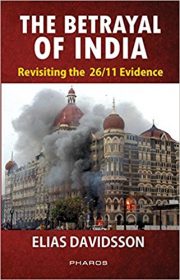 Perhaps the FBI needs guys like Elias Davidsson to solve the circumstances of the 9/11 attacks. Could he have been successful within such an organization? Usually, the FBI investigators can only go so far as their superiors want them to go. That’s why a highly qualified researcher such as Davidsson would have gone nowhere within the FBI.
In the 9/11 community, Davidsson is no blank sheet. He has published books on 9/11 and the follow-up terrorist attacks that set the world on fire. “Hijacking America’s Mind on 9/11“, followed by “Psychological Warfare and Social Denial: The Legend of 9/11 and the Fiction of Terrorism” (Psychologische Kriegsführung und Gesellschaftliche Leugnung: Die Legende des 9/11 und die Fiktion der Terrorbedrohung) presented a different narrative. An English translation of a condensed version would be very informative and highly useful for the English speaking public.
The elucidation of a terrorist offense suffers from the fact that governments clean up only as much as it benefits them politically. Such an approach also holds true for the Mumbai attacks. The impression given by the Indian government that all facts were on the table, is, according to Davidsson, false. As with the “9/11 Commission Report”, which pretends to present the real events and the backgrounds, the same holds true for the processing of this heinous crime of 26/11, 2008. In both cases, statements of witnesses, which didn’t support the official narrative were glossed over or brushed aside.
That’s why Davidsson’s book is so important. In 25 chapters he unravels not only the motivations and the cover-up of the Indian government but also the multifaceted interests of international actors such as Pakistan, the U.S., and possibly Great Britain, Germany, Israel, Iran, Russia, China, and even Australia.
“The book is about the betrayal of the Indian nation by a corrupt, greedy and ruthless elite for whom the lives of ordinary Indians are expendable when power and profit are at stake,” writes the author. From day one, a particular part of the official account was questioned, namely, the circumstances surrounding the deaths of three senior police officials and their assistants. Many Indians voiced their suspicion that the authorities were covering-up facts and called for an independent and impartial investigation of the events.
To understand 26/11, the reader must not work one’s way through the whole book sequentially because the author has attempted to render individual chapters independent of each other. All chapters close with a summary or conclusions. Davidsson’s book is always very well documented by many footnotes. Additionally, all sources used are accessible using the following URL; http://aldeilis.net/mumbai/
The author presents three definite conclusions; firstly, India’s major institutions are suppressing the truth on 26/11; secondly, India’s judiciary has failed its duty to seek truth and render justice; thirdly, Business, political and military circles profited from 26/11. Furthermore, entities in the U. S. and Israel also gained from the attack. The author could not find any benefits for the Pakistani government, military or businesses. The main profiteer seems the Hindu nationalist constituencies by the “elimination” of Hemant Karkare, “who was on the verge of exposing Hindutva terrorist networks.
Davidsson calls on the Indian Civil society to ask for the establishment of a National Truth Commission on 26/11 mandated to establish the facts on the attacks of 26 November 2008. The Civil society itself should demand the creation of an International Commission of Inquiry on the previous terrorist attacks under the authority of Chapter VII of the U.N. Charter, including those committed in the U. S. on 11 September 2001.
With this study, the Indian Civil society has a document at its disposal to challenge the official narrative. The overall objective of the author, however, is the exposure of all the key terror attacks, especially 9/11, which lacks to this day any evidence that 19 Muslims were the perpetrators.
This very compact but exciting book should contribute to the solving of the 26/11 crime. A must read for everybody interested in the truth.
UK Police Spied on Over 1,000 Political Groups Over 40 Years
Sputnik – July 27, 2017
UK undercover police officers who adopted fake identities and infiltrated political groups in deployments often lasting several years spied on more than 1,000 such factions over four decades, the judge-led public inquiry into the scandal has revealed. It’s the first time the number of infiltrated movements has been officially confirmed.
The inquiry, set up to examine into police spying practices since 1968, was launched by then-Home Secretary Theresa May in 2014 following revelations police spies had gathered information on the grieving relatives and friends of Stephen Lawrence and Jean Charles de Menezes, formed long-term relationships with female activists and stolen the identities of dead children to create their pseudonyms.
More than a dozen official inquiries have been announced, but all others are internal and will remain confidential, overseen or carried out by the very forces involved in the scandal. The public inquiry has been much delayed, as police chiefs have attempted to block its investigations, arguing its proceedings should be private in order to protect their spies and spying techniques. The police have also submitted legal applications to keep the identities of their spies secret. It disclosed the figures after campaigners inquired how many political groups were known to have been infiltrated — although requests for a full list of the targeted organizations, and the fake identities used by undercover officers, were not answered. In the former instance, previous exposures suggest it will likely include environmental, anti-racist and animal rights movements, and both left wing and far-right parties and collectives.
Since the 2010 exposure of Mark “Stone” Kennedy as a long-term undercover infiltrator of activist groups in the UK and abroad, it has been determined at least 144 undercover police officers have been deployed to spy on political groups since 1968. Extensive profiles of 20 agents have been compiled by the Undercover Research group — as documented undercover agents typically spied on more than one group (whether at once or at different times), it’s almost certain the total number of undercover police officers that inveigled themselves in activist circles is several times what was initially thought.
The spies developed elaborate false identities supported by fake documentation provided by the state, and typically spent five years pretending to be political activists while they fed back to their superiors information about the activities of campaigners and the protests they organized. Moreover, officers testified in Court under their false names, withheld exculpatory evidence, acted as agent provocateurs and planned and participated in serious crimes.
The most notorious “spy cops” yet uncovered include Bob Lambert, who moonlighted as “Bob Robinson” in the Animal Liberation Front and London Greenpeace in the 1980s. Over the course of his deployment, he is alleged to have planted a fire bomb in a branch of department store Debenhams, committed perjury and co-authored the infamous “McLibel leaflet” — the pamphlet documented McDonald’s unethical practices, leading the fast food giant to sue London Greenpeace leaders Helen Steel and David Morris for defamation, in a case that lasted a decade. He also fathered a child with an activist.
In May, Andy Coles, Deputy Police and Crime Commissioner for Cambridgeshire and Peterborough, resigned after being unmasked as an undercover operative who spied on animal rights groups from 1991 — 1995, under the pseudonym Andy Davey. In a lengthy profile, based on evidence collected by URG, it is noted suspicions about the bogus activist abounded contemporaneously, but were largely silenced due to “Davey’s” specialist IT skills.
Coles has also been accused of attempting to foster, and successfully fostering, sexual relationships with fellow activists. The practice is alleged to have contravened strict internal guidelines on undercover conduct, and has been dubbed by the Metropolitan Police as a “violation” of the victims’ human rights, and “an abuse of police power” that caused “significant trauma.” Nonetheless, examples of known police spies that didn’t do so, or attempt to do so, are exceptionally rare — leading some activists to suggest such practices were deliberate policy.
On July 25, the Home Office confirmed the public inquiry would now be headed by a new judge, Sir John Mitting. He replaces Sir Christopher Pitchford, who stepped down after being diagnosed with motor neurone disease.
SIRHAN SIRHAN: A “REEL BAD” ARAB?
By J. Michael Springmann | Hausfrau Leaks | July 21, 2017
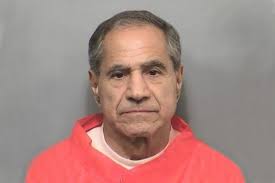 On July 20, 2017, William F. Pepper, Ed.D., J.D., spoke at the National Press Club about his previous day’s filing of a 200-page petition regarding Sirhan Sirhan. Sirhan, jailed since 1968, is the alleged killer of Robert F. Kennedy, late New York U.S. senator and Democratic presidential candidate. Organized by Andrew Kreig, J.D., editor of the Justice Integrity Project (http://www.justice-integrity.org/), the well-attended conference enabled Dr. Pepper to discuss his long-sought evidentiary hearing.
As Sirhan’s lawyer for many years, Pepper conceded that the legal remedies for his client in the United States have been exhausted–at both the State and federal levels. California, where Kennedy had been murdered in a Los Angeles hotel kitchen, did not assure a fair trial. Essentially, ineffective assistance of counsel got the accused wrongly convicted. Grant Cooper, his attorney, under threat of a sealed felony indictment, did almost nothing to defend Sirhan. He failed to investigate the matter, obtain the autopsy report, or examine ballistics tests. He spent most of the court proceedings arguing that Sirhan was guilty and, that because of diminished capacity, should not be given the death penalty.
Sirhan also got no relief in the federal system, neither with with the U.S. District Court for the Central District of California, nor with the extremely liberal and contrarian U.S. Court of Appeals for the 9th Circuit, nor with the U.S. Supreme Court, which declined to review the case.
Now, Pepper is staking Sirhan’s chances on the Inter-American Commission on Human Rights (IACHR), an Organization of American States (OAS) body. His goal is either a new trial or an evidentiary hearing. The filing alleges that the California and U.S. justice systems violated Sirhan’s right to a fair trial, as required under the OAS Declaration of the Rights and Duties of Man. By treaty, the IACHR may review U.S. cases and those from 34 other nations when domestic remedies have been exhausted.
Pepper, who had been a friend of Martin Luther King, Jr. and Robert F. Kennedy, is known for his winning defense of King’s supposed murderer, James Earle Ray, during a 1993 mock trial on HBO. In a celebrated wrongful death proceeding in 1999, Pepper obtained a symbolic award based on 10 years of dogged pursuit of relevant evidence and witnesses. He is doing the same now with Sirhan.
Noting that the U.S. media is controlled, by high level businessmen, bankers, and other influential figures who move in and out of government, such as John J. McCloy one-time U.S. High Commissioner for Germany and member of the Warren Commission, Sirhan’s lawyer said that the “conclusive evidence” reported as news was, in realty, extremely weak. There was never a hearing on the facts, he commented. Such an investigation would have shown that Sirhan, the claimed criminal, was nowhere near Kennedy when the shooting started. Thomas Noguchi, Los Angeles’ chief medical examiner at the time, swore that Kennedy was struck by three shots fired within inches of his body, from behind. Sirhan got off two shots at Kennedy from a six-foot distance, in front. Sirhan was immediately tackled and pinned down while still pulling the trigger on his handgun. However, Sirhan fired only eight shots total yet a carefully-examined sound recording heard thirteen rounds. Moreover, the shots came from different directions.
Yet, the Los Angeles Police Department, Pepper revealed, failed to preserve the physical evidence from the crime scene, such as ceiling tiles, doors, and door frames with bullets buried in them. The cops’ excuse? There was no space in which to store them. Pepper went on to say that the Los Angeles police had long-standing and very close ties to the Central Intelligence Agency (CIA).
The suspicion is, Pepper remarked, that Sirhan appeared to fit the parameters of the infamous CIA drug and consciousness-altering program, MK-ULTRA. (Its former director, Sid Gottlieb, destroyed most of the operation’s records in 1973.) Dr. Daniel Brown, Harvard Medical School, spent nearly 70 hours examining Sirhan through hypnosis and questioning, concluding that the Palestinian Christian had undergone a variety of procedures coupled with drugs to make him controllable. Notably, Pepper said, this could have occurred while Sirhan had mysteriously disappeared for two weeks before the assassination. Seen as a patsy, he was prepped as a distraction while the real murderer fired the close-up shots killing Kennedy, Pepper continued. Sirhan had apparently had a handler, a woman in a polka dot dress, the attorney remarked. She disappeared after she pinched the scapegoat on the neck, apparently triggering Sirhan’s belief that he was really shooting at a paper, man-shaped target from a firing range.
COMMENT. Despite Andrew Kreig ‘s extensive and most vigorous efforts, only a few members of the press turned up at the conference: an intern from the Washington Times, a representative from Al-Mayadeen TV, Beirut, along with a knowledgeable White House correspondent for an alternative news site. This appeared to validate Dr. Pepper’s view of the heavily-managed American media. And it bodes ill for what seems to be the attorney’s goal in filing with the OAS–to generate enough adverse publicity to force the United States to re-examine the questionable trial of Sirhan Sirhan. Indeed, a casual search of the Internet turns up a number of references about “conspiracies” revolving around the problematically convicted man.
Perhaps everyone involved in this matter should take a look at Dr. Jack Shaheen’s writings on Arabs, notably Reel Bad Arabs: How Hollywood Vilifies A People.
Hidden History: The Secret Origins of the First World War
Overview of Gerry Docherty & Jim Macgregor’s Book
By Antony C. Black | Global Research | July 19, 2017
Of the many myths that befog the modern political mind, none is so corrupting of the understanding or so incongruent with historical fact as the notion that the wealthy and the powerful do not conspire.
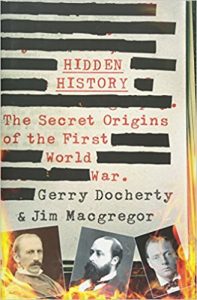 They do.
They conspire continually, habitually, effectively, diabolically and on a scale that beggars the imagination. To deny this conspiracy fact is to deny both overwhelming empirical evidence and elementary reason.
Nevertheless, for the astute observer of the ‘Great Game’ of politics, it is an unending source of wonderment to stumble across ever more astounding examples of the monstrous machinations of which wealthy and powerful elites are capable. Indeed, it is precisely here that authors Docherty and Macgregor enter the fray and threaten to take our breath away entirely.
Thus, the official, canonized history of the origins of the First World War, so they tell us, is one long, unmitigated lie from start to finish. Even more to the conspiratorial point is the authors’ thesis that – and to paraphrase a later Churchill who figures prominently in this earlier story – never were so many murdered, so needlessly, for the ambitions and profit of so few.
In demolishing the many shibboleths surrounding the origins of the ‘Great War’ (including ‘German responsibility’, ‘British peace efforts‘, ‘Belgian neutrality’ and the ‘inevitability’ of the war), Docherty and Macgregor point the finger at what they argue is the real source of the conflict: a more or less secret cabal of British imperialists whose entire political existence for a decade and a half was dedicated to the fashioning of a European war in aid of destroying the British Empire’s newly emerging commercial, industrial and military competitor, Germany.
In short, far from “sleepwalking into a global tragedy, the unsuspecting world”, Docherty and Macgregor contend, “was ambushed by a secret cabal of warmongers” originating not in Berlin, but “in London”.
I must confess at this juncture to a certain bias in granting credence to such a striking thesis, this if only on general principle alone. After all, one straight look at present day political reality is to look square into the maw of Orwell’s nightmare. Moreover, three decades of independent journalism have led me to conclude not only that virtually nothing of what is presented as ‘news’ is remotely true, but that the conventional writing and presentation of history itself is as phoney as a three dollar bill. Still, one does demand a credible argument or two. Let’s look at a few of those contained in ‘Hidden History’.
The Players

Cecil Rhodes (Source: Wikipedia)
Before launching pell-mell into the argumentative labyrinth it is apropos that we first sketch the central cast of characters of this grim story.
In the beginning there was Cecil Rhodes, the prime minister of Cape Colony but who, the authors remind us, was “in reality a land-grabbing opportunist” whose fortune had been underwritten in equal parts “by brutal native suppression and the global mining interests of the House of Rothschild”. Rhodes had, apparently, long talked of setting up a secret ‘Jesuit-like society’ in aid of furthering the global ambitions of the British Empire. In February of 1891 he did just that enlisting the services of his close associates, William Stead, a prominent journalist, and Lord Esher, a close advisor to the British Monarchy.
Two others were soon drawn into the inner circle of the clandestine group: Lord Nathaniel (Natty) Rothschild of the famous British and European banking dynasty, and Alfred Milner, a brilliant academic and colonial administrator who would quickly become the organizing genius and iron-willed master of ceremonies of the group.
These central four would later be joined by: Lord Northcliffe, the owner of ‘The Times’, who would complement Stead in propagandizing and softening up the British public for war with Germany; Arthur Balfour and Herbert Asquith, two future British Prime Ministers who would provide the needed parliamentary influence; Lords Salisbury and Rosebery who brought an additional wealth of political connections to the table; and Lord Edward Grey, he to whom, in the final analysis as British Foreign Secretary in 1914, it would fall to hammer the final nail in the coffin of European peace.
Of particular importance was the addition of Prince Edward (soon to be King Edward VII) who, despite his playboy image, was, in fact, an astute political operative whose frequent international social forays provided the perfect cover for helping to forge the, often secret, military and political alliances between Russia, France, Britain, and Belgium.
This core Praetorian Guard then extended its tentacles to all reaches of the British (and eventually, international) power hierarchy by vigorously recruiting its ‘Association of Helpers’, the myriad of lower down bureaucrats, bankers, military officers, academics, journalists, and senior civil servants, many, as it turns out, hailing from Balliol and All Souls Colleges, Oxford.
And, too, the legendary Churchill, liberally inflated with his own bombast and well lubricated with Rothschild money, would rise to take his anointed place amongst the war-hungry secret elect.
Early Adventures
The first foray of this elite cabal played out in South Africa with the deliberate fomentation of the (2nd) Boer War (1899 – 1902). Gold had been discovered in the Transvaal region in 1886 and British imperialists were determined to grab it. After a number of failed machinations by Rhodes himself to topple the Boers, the secret elite was dealt an ace when Alfred Milner was appointed high commissioner for South Africa. Seizing the moment, Milner, without passing Go, proceeded straight to war and, in his infamous scorched earth policies and adamant demands for unconditional surrender, demonstrated the general martial philosophy that would later be deployed against Germany.
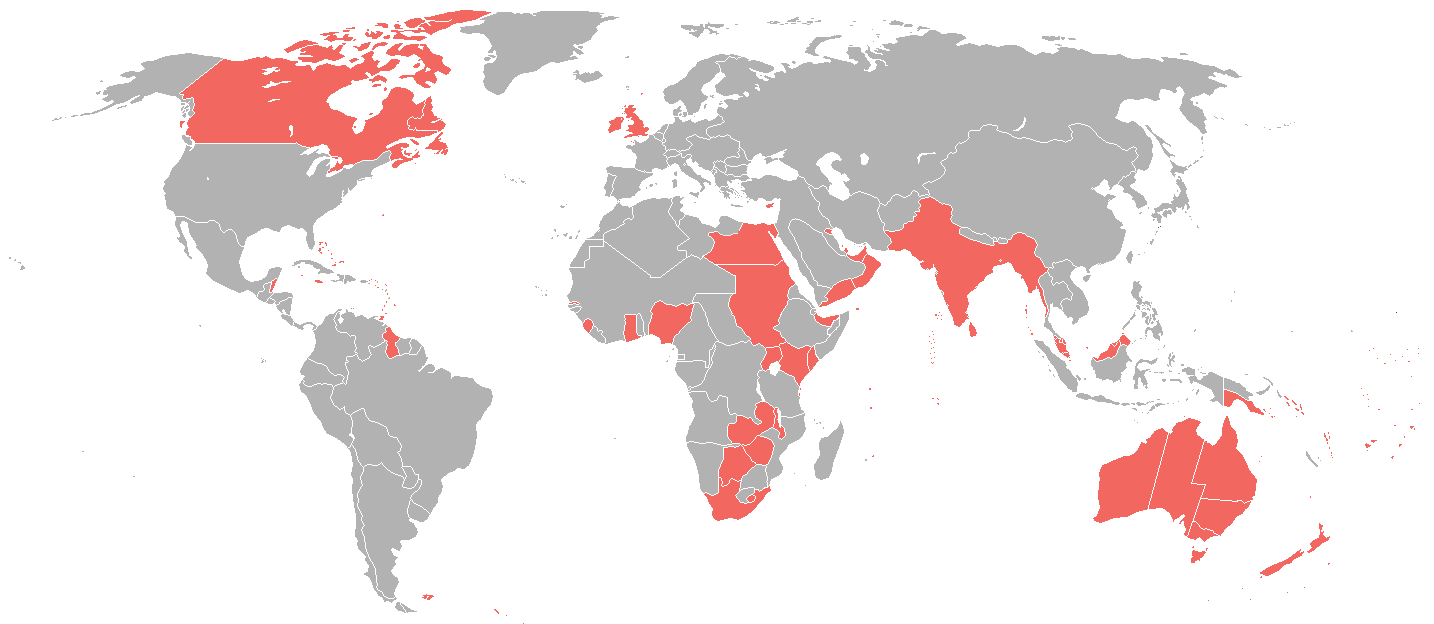
A map of the British Empire as it was in 1898, prior to the Second Boer War (1899-1902). (Source: Wikimedia Commons)
Following the defeat of the Boers, Milner & Co. (Rhodes had died during the ‘peace negotiations’) quickly penetrated the main organs of British imperial governance including the Foreign, Colonial, and War Offices. Arthur Balfour went one better by establishing, in 1902, the Committee for Imperial Defence (CID). The latter proved especially significant in helping to almost completely bypass the British Cabinet in the years, months and days leading up to August, 1914. Indeed, Balfour would prove to be one of only two permanent members of this all-important imperial institution; the other being Lord Fredrick Roberts, commander-in-chief of the armed forces and close friend of Milner. It was Roberts who would later appoint two tragically incompetent hangers-on, Sir John French and Douglas Haig, to their First World War posts overseeing the mass slaughter of hundreds of thousands of Allied soldiers.
The year 1902 also saw the establishment of the Anglo-Japanese Treaty. Britain had long feared for its Far East empire at the hands of Russia and sought to bolster Japan as a counterweight. The alliance bore fruit in the 1904-1905 Russo-Japanese conflict in which Russia was dealt a decisive defeat. Always with the long-term goal in mind, however, i.e. war with Germany, Milner et al adroitly switched bait and immediately began wooing Czar Nicholas II resulting in the Anglo-Russian Convention of 1907. In the same period (1904) Britain – with the crucial assistance of Edward VII – broke its near thousand-year enmity towards France and signed the Entente Cordial with its former rival.
During this same time frame (1905) a more or less secret agreement was made with King Leopold II allowing Belgium to annex the Congo Free State. This was, for all intents and purposes, an alliance between Britain and Belgium; one which was, over the next decade, to be continually deepened with numerous (mostly secret, meaning withheld from the British Parliament) bilateral military agreements and ‘memorandums of understanding’, and which unequivocally put paid to any notion of Belgium being some sort of ‘neutral’ party in the upcoming conflict with Germany.
The core alliance was now complete, i.e. Britain, Russia, France and Belgium, and all that was needed was to secure the fealty and obeisance of the British colonies. In aid of the latter Milner convoked The Imperial Press Conference of 1909 which brought together some 60 newspaper owners, journalists and writers from across the Empire who hobnobbed with another 600 or so British journalists, politicians and military figures in a grand orgy of war-mongering propaganda. The martial message was then duly delivered to the unwitting colonial multitudes. The success of the Conference could be seen most visibly in Canada where, despite the extreme divisiveness of the issue, the nation would eventually send more than 640,000 of its soldiers to the killing fields of Europe, this all on behalf of a tiny handful of British imperialists.
The Moroccan ‘Crisis’
Docherty and Macgregor duly remind us that renowned historian Barbara Tuchman, in her Pulitzer-Prize winning book, ‘The Guns of August’, “made it very clear that Britain was committed to war by 1911 at the latest.” Indeed, preparations for war had proceeded apace since at least 1906.
Still, 1911 marked a turning point when the secret elite first made bold in attempting to ignite war with Germany. The pretext was Morocco. Now, truth to tell, Britain had no direct colonial interests in Morocco, but France and Germany did. By this time the cabal in London – with Edward Grey as Foreign Minister – had inducted a key French minister, Theophile Declasse, into their confidences and were able to engineer what was essentially a false flag operation in Fez. France then followed this up with an army of occupation. Germany posted a minimalist response by sending a small gunboat to Agadir whence the entire British press – reflecting Britain’s ‘deep state’ interests – went into high hysteria condemning German ‘threats to British sea-lanes’ etc. The fuse to war was only snuffed out in the final hour when France’s (recently elected) socialist Premier, Joseph Caillaux, initiated peace talks with the Kaiser. War with Germany would have to wait.
In the meantime, Britain, under the direction of its secret mandarins – i.e. almost entirely beyond Parliamentary review or approval – continued their preparations for war. To this end, for example, Churchill, who by 1911 had been appointed First Lord of the Admiralty, redeployed the British Atlantic fleet from Gibraltar to the North Sea and the Mediterranean fleet to Gibraltar. Simultaneously, the French fleet was moved from the Atlantic to cover Britain’s absence in the Mediterranean. These maneuvers were all strategically aimed at Germany’ North Sea navy. The pieces on the global chessboard were being positioned.

Source: Wikimedia Commons
In France the leftist peacenik Caillaux was, in 1913, replaced as Premier with one of the British elites very own ‘helpers’ in the person of Raymond Poincare, a right-wing, rabid Germanophobe. Poincare quickly acted to remove his anti-war ambassador to Russia, George Louis, and substitute him with the revanchist Declasse. Meanwhile in America the secret cabal, acting largely through the Pilgrims Society and through the Houses of Morgan and Rockefeller, machinated to have an unknown but pliable democrat, Woodrow Wilson, elected over the publicly-controlled central bank advocate, President Taft. It was from this lofty perch that the Anglo-American ‘deep state’ launched the US Federal Reserve System, a private central bank dedicated from the get-go to funding the war against Germany.
The Balkan Sting
The simple tale repeated ad nauseam regarding the circumstances surrounding the assassination of Archduke Franz Ferdinand on June 28, 1914, so Docherty and Macgregor tell us, contains as little veracity as, say, the official version of the assassination of JFK two generations later. Indeed, the structural similarities between the two – from the virtual total stand-down of security through to the clear evidence of state complicity (in this case, starting in Serbia, but leading straight to London) – are remarkable. Suffice to say that there was a domino-like chain of events that then ensued – it’s just that the events weren’t driven by base human instincts and ineluctable forces beyond all human control as is commonly proffered, but rather by calculating minds and conspiratorial design.
Thus, immediately following the assassination, there was widespread international support for Austria-Hungary which was widely perceived as the aggrieved party. Nevertheless, the usual suspects, having helped stage the murder in the first place, were able to deftly turn the propaganda tables against both Austria and Germany by means of an ingenious ruse. Having secretly obtained the contents of the ‘Note’, which contained Austria’s (reasonable under the circumstances) demands for Serbian contrition, the secret cabal were able to gain direct input into the crafting of the ‘Serbian Reply’. The ‘reply’, of course, was designed to be unacceptable to Austria. Simultaneously, France’s President, Poincare, decamped to Moscow to assure the Czar and his generals that, should Germany act to uphold its alliance responsibilities towards Austria, France would back Russia in launching a full scale European war. France, naturally, knew that England – or rather its elite imperial clique – was similarly committed to war. It was during this opportune moment, in fact, when Grey and Churchill connived to purchase the Anglo-Persian Oil Company so securing the necessary oil supplies for the British navy.
All the while Kaiser Wilhelm and Chancellor Bethmann were conspicuous in being the only statesmen genuinely seeking peace. Their subsequent vilification by hordes of appropriately housebroken historians thus rings with the same Orwellian tone as the present-day establishment demonization of nations and individuals resisting the American Imperium.
Grey Hits It Home
Having contrived to fan the flames of a local Balkan fire into a general European inferno, British Foreign Minister Grey and Prime Minister Asquith subsequently deployed every dirty trick in the diplomatic playbook to vitiate any possibility of peace and, instead, to guarantee war.
On July 9th, for instance, the German ambassador to London, Prince Lichnowsky, was repeatedly reassured by Grey that Britain had entered no secret negotiations that would play into war. This, of course, was an outright lie. On July 10, Grey then deceived Parliament into believing that Britain had not the slightest concern that events in Sarajevo might lead to a continental war. Meanwhile, the Austrian Prime Minister, Berchtold, was similarly deceived by all three Entente governments that their reaction to the ‘Note’ would not go beyond a diplomatic protest. However, by the 3rd week of July all of these self-same governments did an about-face and declared a complete rejection of Austria’s response.
On July 20, as already noted, the French Prime Minister, Poincare, went to St. Petersburg to reaffirm their two nations’ respective martial agreements. On July 25, Lichnowsky arrived unannounced at the British Foreign office with a desperate plea from the German government imploring Grey to use his influence to halt Russian mobilization. Incredibly, no one was available to receive him. Russia had, in any case, secretly begun mobilization of its armed forces on July 23, while, on July 26, Churchill quietly mobilized the British fleet at Spithead.
None of the foregoing, of course, was subject to democratic oversight. As Docherty and Macgregor put it,
“As far as the [British] public was concerned, nothing untoward was happening. It was just another summer weekend.”
On July 28th, Austria, despite not being in a position to invade for another fortnight, declared war on Serbia. Meanwhile, the British Foreign Office began to circulate rumours that German preparations for war were more advanced than those of France and Russia even though the exact opposite was, in fact, the case. Matters were quickly racing beyond Wilhelm’s control.
On the 29th, Lichnowsky again begged Grey to prevent a Russian mobilization on Germany’s borders. Grey’s response was to write four dispatches to Berlin which post-war analysis proved were, in truth, never sent. The dispatches turned out to be merely part-and-parcel of the elaborate charade to make it look as if Britain (and, specifically, he, Grey) was doing all it could in the effort to avert war. Also on the evening of the 29th did Grey, Asquith, Churchill, and Richard Haldane meet to discuss what Asquith called the ‘coming war’. Docherty & Macgregor once again here emphasize that these four men were virtually the only people in Britain privy to the impending calamity, i.e. not the other Cabinet members, not the members of Parliament, and certainly not the British citizenry. But then, they were its architects.
On the 30th, the Kaiser wired Czar Nicholas a heartfelt appeal to negotiate the prevention of hostilities. Indeed, Nicholas was so moved by Wilhelm’s plea that he decided to send his personal emissary, General Tatishchev, to Berlin to broker a peace. Unfortunately, Tatishchev never made it to Berlin, having been arrested and detained that very night by the Russian Foreign Minister, Sazonov, who, as ‘Hidden History’ cogently evinces, had long been an asset of the secret cabal in London. Under sustained pressure from senior members of his military Nicholas finally relented and on the afternoon of the 30th ordered general mobilization.
The official announcement of Russian mobilization effectively closed all doors to peace. The Germans, realizing that they had been set up, and also realizing that they were about to be attacked on two fronts – from the west by France, and from the east by Russia – finally, on Aug. 1, ordered their own mobilization; tellingly, the last of the continental powers to do so. Here, however, Germany made a crucial tactical error: it elected to follow up its mobilization with a formal, honour-bound declaration of war on France. By doing so it fell deeper into the trap laid by Grey & Co. who had, all along, machinated to do everything possible to guarantee war without, however, being seen to have officially caused the war.
Still, Grey had one last card to play in order to convince both a war-leery Cabinet and House of Commons to abandon their common sense and plunge headlong into a full-scale pan-European war. For just as the myth of ‘weapons of mass destruction’ would, in a later era, serve to advance American imperial aggression, so here did the myth of poor, benighted little ‘neutral Belgium’ carry the banner for British imperialism.
The Speech That Sealed The Fate of Millions
On the 2nd of August, 1914 Prime Minister Asquith convened a special Cabinet meeting to discuss the (manufactured) crisis. Though the Cabinet was in no mood to countenance British involvement in a continental war, they soon found themselves pressured and hedged about by revelations of a ‘web of [military and political] obligations, which they had been assured were not obligations, [and] had been spun around them as they slept’. Moreover, Grey crucially kept from them the fact that the German ambassador, Lichnowsky, had, only the day before (Aug. 1), specifically offered to guarantee Belgian neutrality. Indeed, Grey’s deception might never have come to light but for the fact that Chancellor Bethmann exposed the offer in the Reichstag on Aug. 4th.
With the Cabinet sufficiently brow-beaten, confounded – and deceived, i.e. Asquith, without Cabinet approval or knowledge, had already issued orders for the mobilization of the Army and Navy – it now only remained to hoodwink Parliament. And so, on Aug. 3rd, Sir Edward Grey took to the pulpit and began what was to be an epic panegyric to the follies of peace and the virtues of war. Here too the audience was not particularly receptive, but the sermon soon gathered force.
Having first set the tone by announcing that peace in Europe ‘cannot be preserved’, Grey then moved on to a stunning series of lies and misrepresentations concerning the intricate and long-formulated military agreements between England, France, Russia and Belgium. According to Grey, they didn’t exist. But what of the dense skein of diplomatic agreements? There were no such agreements, there were no such entanglements. Parliament was ‘free’ to vote its conscience, to exercise its democratic mandate. Just as long, of course, as it didn’t vote for peace.
All of the foregoing was, in any case, mere preamble to the centerpiece ploy of Grey’s speech: Belgian neutrality. That the latter was an out-and-out sham was only surpassed in duplicity by Grey’s concealment, not only from Cabinet but now from Parliament, of Germany’s offer to guarantee exactly the point under contention, i.e. Belgian neutrality. Instead, Grey produced, for dramatic affect, an emotional telegram from the King of Belgium to King George pleading for assistance. The timing couldn’t have been more perfect if it had it been deliberately designed for the occasion. Which, of course, it was. Also pre-planned were the post-sermon affirmations in favour of war by the various opposition party leaders. They had all been vetted and brought onside by Churchill prior to the day’s session. Only Ramsay MacDonald, head of the Labour Party, swam against the well-orchestrated tide of ‘inevitability’ that was the constant and unerring motif of Grey’s martial peroration.
The day’s session ended without debate; Asquith had not allowed any to occur, though he had been pressured by the Speaker of the House to reconvene later that evening. In between Grey sealed the deal, i.e. war, by firing off an ultimatum to Germany demanding that it not invade Belgium even though he, Grey, knew that such an invasion had already begun. As Docherty and MacGregor phrase it, this was a “masterstroke”. War could not now be avoided. And though the night session witnessed a vigorous and substantive debate which largely demolished Grey’s stance, it was all for nought. At the appointed moment Arthur Balfour, “former Conservative Prime Minister and a member of the Secret Elite’s inner circle, rose menacingly. He had had enough.” Using the full weight of his magisterial authority he condemned, ridiculed and dismissed the naysayers’ anti-war arguments as, the ‘very dregs and lees of the debate’. With the Commons thus emotionally bullied into silence, so ended the last chance for peace in Europe.
Plus Ca Change
What strikes one again and again whilst reading ‘Hidden History’ is the ring of truth that resonates from every page, from every revelation. That such a tiny, elite group of individuals, completely beyond democratic control, could determine the fate – and deaths – of millions should shock us. It should, but it doesn’t really. It doesn’t because we see the same phenomenon occurring now, repeatedly, before our very eyes. Indeed, the current state of ‘permanent war’ is, more or less, the unconscious condition of modernity itself.
Docherty & Macgregor have made a fine contribution here. They have gone beyond what David Irving so aptly labelled as the ‘court historians’, i.e. those historians essentially prostituted to elite / establishment consensus, and given us a glimpse of what it really means to write history. And if there is any lesson – or rather counter lesson – we can take from it, it is that we are doomed to repeat history only so long as we listen to those dedicated to obscuring and inverting it. In short, to those who lie to us.
Title: Hidden History: The Secret Origins of the First World War
Authors: Gerry Docherty and Jim MacGregor
Publisher: Mainstream Publishing; Reprint edition (September 1, 2014)
ISBN-10: 1780576307
ISBN-13: 978-1780576305
Featured image from Amazon
Terror in Europe – Why Terrorists Are Allowed to Strike
By Ulson Gunnar – New Eastern Outlook – 09.07.2017
The London Bridge terror attack saw a repeat of a now familiar narrative in which every suspect involved had been long-known to both British security and intelligence agencies.
The London Telegraph in an article titled, “Khuram Butt, Rachid Redouane and Youssef Zaghba named: Everything we know about the London Bridge terrorists,” would reveal:
The ringleader of the London Bridge massacre never bothered to hide his violent, extremist views. Khuram Butt was so brazen that he openly posed with the black flag of the so-called Islamic State in Regent’s Park in the centre of London for a Channel 4 documentary, entitled The Jihadis Next Door.
Butt and other extremists linked to the banned terror group al-Muhajiroun were even detained by police for an hour over the stunt in 2015 but were released without being arrested.
The al-Muhajiroun terror group is headed by British-based extremist, Anjem Choudary, who for years helped fill the ranks of militant groups fighting governments the US and UK sought to overthrow in Libya, Syria and beyond. Choudary inexplicably escaped the consequences of his open advocacy and material support for known terrorist organizations for years, with the London Guardian in an article titled, “Anjem Choudary: a hate preacher who spread terror in UK and Europe,” going as far as speculating he did so because he was actually an informant or operative working for the British government.
The article would also admit that Butt was under investigation by British intelligence up to the day of the attack:
MI5 and counter-terrorism officers began an investigation into Butt, which remained ongoing even as the 27-year-old launched his terror attack on London Bridge. Butt, who was wearing an Arsenal shirt and a fake bomb strapped to his chest, was shot dead by police on Saturday night.
A second suspect, Rachid Redouane, was repeatedly brought to the attention of police who ignored warnings he was an extremist and a member of the so-called “Islamic State.”
The Telegraph reports that a third suspect, Youssef Zaghba, was also known to police:
He was reportedly arrested at Bologna airport in March 2016 trying to get to Syria and was also understood to be on an Italian anti-terror watch list.
The fact that these three suspects evaded capture and were able to carry out their attack despite being known and even monitored actively by British security and intelligence agencies lends even further credibility to the notion that they and others like them work for the British government, not against it.
Unable to Reach Syria, West’s Dogs of War Bite Local Population
Networks like al-Muhajiroun and the extremists they cultivate help fill the ranks of “moderate rebel” groups the US, UK, other European nations including France, as well as regional allies like Turkey, Jordan, Saudi Arabia, United Arab Emirates and Qatar are arming, funding and providing direct military support for in Libya, Syria, Yemen and beyond.
This fact goes far in explaining why extremists are allowed – for years – to openly advocate violence and recruit members into what is essentially a terrorist organization operating under the nose of British security and intelligence agencies – if not with their collective and eager complicity.
While these terrorists are labeled “moderate rebels” when fighting abroad, they are only labeled as such by the Western media out of necessity in an attempt to differentiate them from the extremists that are in fact fighting the West’s proxy war for it in places like Syria.
Suspects like Youssef Zaghba even attempted to travel to Syria to fight among the ranks of Western-backed militant groups – and failing to do so – participated in armed violence in the UK instead. Had he traveled onward to Syria, it would have been innocent Syrians instead of innocent British civilians terrorized, attacked, maimed and killed.
A Strategy of Terror and Tension
And despite the reality of the US and UK along with other European and Persian Gulf allies openly fueling terrorism at home and abroad, in the wake of tragic events like in London, Manchester, Paris, or Brussels, the very government organizations clearly responsible for presiding over these terrorists and their networks, sometimes for months and even years before an attack, are granted even more power to address a problem of their own intentional creation.
These organizations are able to do so in plain sight of the public specifically because of another conflict they openly orchestrate, pitting the general public against one another along lines of “anti-Islamic” fervor versus social justice advocates.
What both sides of this manufactured and intentionally perpetuated divide fail to realize is that Muslims are dying by the tens of thousands in places like Syria actively fighting against extremism springing not from Islam or the Qu’ran, but from the Pentagon, Westminster, Paris, Brussels, Riyadh, Ankara and Doha. It is not a clash of civilizations, but a manufactured conflict designed to perpetually fill the ranks of mercenaries abroad while exploiting their violence at home to procure more power and wealth through fear, anger and hysteria.
With wars in Afghanistan, Iraq, Syria, Yemen and beyond adding up to trillions for defense contractors and including weapon systems designed to fight them, with the F-35 joint strike fighter alone topping one trillion US dollars and as the West continues to openly act with impunity when and where it pleases despite violating the very international law it claims it is upholding globally, it is clear that, for now, this strategy is working.
If and when the general public understands the truth of why their lives are put in danger and their nation’s resources are being squandered abroad instead of at home for building their own futures, this strategy will be less successful. Until then, it appears that simplistic propaganda still works in convincing the public that governments like in London are simply incapable of arresting terrorists who appear regularly on TV, in the media and who openly operate in public with apparent and otherwise inexplicable impunity.
Featured Video
BRITAIN’S WARNING: PREPARE FOR WAR
or go to
Aletho News Archives – Video-Images
From the Archives
British weapons and personnel doing much of the killing in Yemen
Press TV – June 18, 2019
A detailed report published by the Guardian newspaper has shown how Britain is massively contributing to Saudi Arabia’s devastating war on Yemen as it suggests that London is not only supplying the bombs that fall on Yemenis, but it provides the personnel and expertise that keep the war going.
The comprehensive report by Arron Merat published on Tuesday showed that Britain was doing much of the killing in Yemen as the country continues to provide Saudi Arabia with everything it needs to turn its southern impoverished neighbor into a graveyard.
“Every day Yemen is hit by British bombs – dropped by British planes that are flown by British-trained pilots and maintained and prepared inside Saudi Arabia by thousands of British contractors,” said Merat in the report. … continue
Blog Roll
 Aletho News
- Yemen denounces European Parliament’s ‘hypocritical’ push to blacklist Ansarullah
- Qalibaf: UAE’s UN bid aims to ‘clear the runway’ for ‘Greater Israel’, whitewash genocide
- Pakistan reopens Iran border after boosting security: Report
- Why are so many Brazilians voting for Flávio Bolsonaro?
- Democrats Put Anti-Russia Agenda Ahead of American Workers
- Elijah Magnier: Yemen’s Strikes Are Shattering Saudi Arabia’s Long-Term Strategy
- Pentagon designates Chinese cultural centers national security threat
- Israel Demolishes Home Of Lebanese Journalist Whose Viral Film Exposed Pager Attack
- Record Oil, Empty Tanks: The UAE’s Miracle Recovery
- Burnham tackles Britain’s poverty with aggression in Yemen
- If Americans Knew
- An error has occurred; the feed is probably down. Try again later.
- No Tricks Zone
- Sudden Stratospheric Warming, Powerful El Niño Combination May Lead To Extreme Europe Cold, Energy Crisis!
- Two New Studies Find Thwaites Glacier Melt Cannot Be Driven By Human Activity Or A Warming Ocean
- E-Cars Reduce CO2 Emissions By Only 41% Compared To Internal Combustion Engine Vehicles
- Predictions Made By Renowned Climate Professor Over Past Decades Have Been Proven To Be Poor
- New Study Suggests Large Regions Of The Pacific Ocean Have Been Cooling For The Last 80 Years
- Germany’s Green Energy Debacle: High Energy Costs Force Kahla Porzellan to Close After 182 Years!
- New Study: 50 Years Of The Most Aggressive ‘Net Zero’ Policies Can Only Affect The Global Climate By 0.03°C
- US September “Heat” Was No Record…Many Records Set Decades Ago
- Latest European Green Energy Debacle; Portugal’s Largest Flagship Solar Park Insolvent!
- Green Energy Debacle: German Expert Professor Fritz Vahrenholt Warns Of Severe Economic And Social Consequences


