‘We Just Showed the Truth’: Russian Pranksters Vovan and Lexus React to YouTube Ban
Sputnik – 06.03.2023
One of the pranksters, Alexey Stolyarov (Lexus), said he does not believe that their videos on YouTube violated the digital platform’s guidelines, suggesting instead that the “truth” the prankster duo shared “probably was not convenient for western officials.”
Western Big Tech has once again demonstrated just how much it “cares” about freedom of speech as video-hosting platform YouTube, which is owned by Google, banned the channel of Russian prankster duo Vovan & Lexus over alleged violation of community guidelines.
During an interview with Sputnik, one of the pranksters, Alexey Stolyarov (Lexus), pointed out that the ban came shortly after they pranked William Hague, the UK’s former foreign secretary.
“We got a letter that we have broken the rules of YouTube because of the prank with the ex-Foreign Secretary William Hague,” Stolyarov said. “And they wrote that they had to remove it, but probably after 2 hours they removed the whole channel without explanation.”
He noted that this is far from the first time their channel has been blocked on YouTube, and that the last time they got banned, the British government and the UK Ministry of Defense actually sent a letter to the video hosting’s management, naming the pranksters as “real threats to the UK national security.”
“This time we have pranked ex-Foreign Secretary William Hague. It was in all Russian media, but it wasn’t in the UK media. Because since the last prank call with the defense secretary, they noted in the letter that other contributors of information have already agreed not to spread our pranks,” he said. “At first, YouTube kept silent for about three days. And then they blocked us.”
The prankster also expressed his skepticism about allegations of their pranks violating YouTube’s community guidelines.
“We just spread the statements of their western officials. It’s not our words. It’s their words,” he said, referring to the admissions those officials made during prank calls with Vovan and Lexus. “We just showed the truth and this probably was not convenient for western officials.”
Stolyarov added that they have already moved to platforms such as RuTube, Telegram and VK, over which Western governments and tech corporations hold no sway.
“It’s good that it works in Russia and nobody could ban it because of political reasons but also we have a reserve channel on the Reddit platform. It’s also available in the West.” Stolyarov a.k.a. Lexus remarked.
Vovan and Lexus have gained considerable fame in recent years as they prank a number of prominent western politicians, including current UK Defence Secretary Ben Wallace and former German Chancellor Angela Merkel, tricking them into making rather frank admissions about poignant geopolitical matters.
Florida GOP Declares War On The First Amendment to ‘Combat Anti-Semitism’
By Chris Menahan | Information Liberation | March 5, 2023
“The Free State of Florida” is set to have the most oppressive hate crime laws in America in order to “combat anti-Semitism.”
“There is no First Amendment right to conduct,” Jewish Florida State Rep. Randy Fine told the media earlier this week. “If you graffiti a building, it is a crime now, but if your motivation is hate, it will be a third-degree felony and you will spend five years in prison. If you want to litter, it’s a crime right now, but if you litter and your motivation is a hate crime, it will be a third-degree felony and you will spend 5 years in jail.”
The bill was put forward by the GOP to silence the “Goyim Defense League” who’ve been sharing anti-Semitic flyers in Florida neighborhoods and holding up anti-Semitic banners over bridges which are critical of Jews.
Florida Rep. Mike Caruso told reporter Chris Nelson on Friday that the bill “makes anti-Semitism a hate crime.”
“If we do nothing we are going to have 1933’s Nazi Germany all over again,” Caruso said.
The Florida GOP is expected to pass their new hate crime bill this legislative session.
If Governor Ron DeSantis signs the bill into law, Florida will have worse hate crime laws than California, New York, Connecticut and every other state in the Union.
The ‘fact checkers’ can’t find the target never mind hit it
By Norman Fenton | Where are the numbers? | March 3, 2023
One of the most tiresome features of the covid era has been the growth industry of ‘fact-checkers’ generously funded by Government, Pharma companies and the likes of Bill Gates to silence anybody challenging the ‘official narrative’. The Law, Health and Technology Newsletter has covered this extensively.
There have been a few ludicrous attempts to ‘fact-check’ my own work but, as an example of how biased and incompetent these people are, I present a request I received today from an AFP fact-checker asking me to help ‘debunk’ something …. and my self-explanatory response to it (I have spared the ‘fact-checker’ personal embarrassment by removing their name).
From: XXXXXX
Sent: Thursday, March 2, 2023 9:17 PM
To: Norman Fenton
Subject: Media Request (AFP) – Addressing Misinterpretations of ONS Covid-19 DataHello professor,
I hope you are well. I am a fact-check reporter at AFP based in Washington DC. I am working to debunk online articles that claim English health data indicates that fully vaccinated people are far more likely to die of Covid-19 than those who have not received the shots. Several articles have made this allegation, citing this ONS dataset: https://www.ons.gov.uk/peoplepopulationandcommunity/birthsdeathsandmarriages/deaths/datasets/deathsbyvaccinationstatusengland
For reference, I will archive examples of these articles making the claims here and here.
Based on this ONS insight and a previous bulletin, which says the data is not intended to show vaccine efficacy, it seems like the article is misinterpreting the dataset. Would you be able to offer comment with a brief explanation as to how this sort of data is supposed to be read and used?
Thank you for your consideration,
XXXXXXXX
Agence France-Presse (AFP)
Office #: (202) 414-0527
From: Norman Fenton
Sent: Thursday, March 2, 2023 9:44 PM
To: XXXXXXX
Subject: RE: Media Request (AFP) – Addressing Misinterpretations of ONS Covid-19 Data
Dear XXXXX
Like all mainstream “fact checkers” you clearly have no understanding of what it is you are checking.
The ONS dataset is so flawed and biased that even the Statistics Regulator agreed with us that it could not be used to make any inferences about vaccine efficacy or safety. But you are missing the big problem here.
Instead of focusing on those who are using the data to suggest the vaccine is not as safe and effective as claimed, what you should be focused on are the government and mainstream media who (against the advice of the Statistics Regulator) are using the ONS data to claim the vaccine is safe and effective. Have a look at this article in the Daily Mail – this is one you should be fact checking. Why aren’t you doing that?
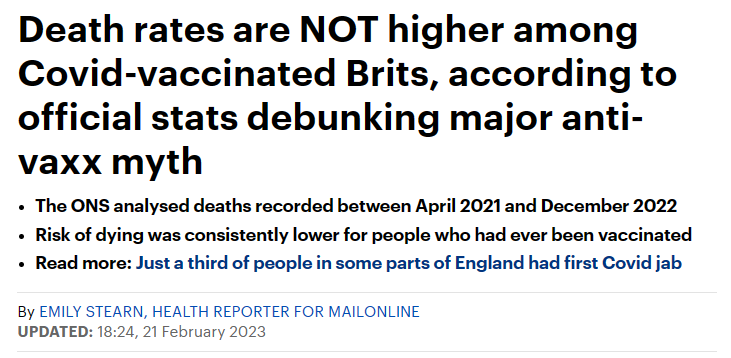
Our most recent article covers this whole issue of the ONS data:
In fact, if you make adjustments for the multiple flaws and biases in the ONS data, then it is increasingly clear that the vaccinated have a higher all-cause mortality in many age groups, especially the under 50’s. In other words, the evidence increasingly points to the need for the covid vaccine programme to be shut down completely. But that isn’t the message you want to portray is it, because your funders are the ones pushing the vaccines?
Only one of the links to examples of reports you were seeking to ‘debunk’ seems to be working, namely the article in The Expose. The claim there is that the ONS report reveals that “the Vaccinated account for 9 in every 10 COVID Deaths over the past TWO Years”. Based on the ONS dataset this is correct. Of course, without knowing the true proportion of vaccinated in each age group, we still cannot conclude that the vaccinated are at higher risk of death from covid. But the article is not claiming that, it is simply stating the FACT that a far higher number of vaccinated people have died of covid than unvaccinated since Jan 2022. That the number of vaccinated people who have died of covid is 25,768 is relevant, because we were told by people like you that this could not possibly happen; the vaccines were supposed to have ‘stopped hospitalisation and death from covid’.
Yours
Norman Fenton
WHO moves forward with plans to target “misinformation” “infodemics” through international pandemic treaty
By Tom Parker | Reclaim The Net | March 4, 2023
The global health agency, the World Health Organization (WHO), this week held a meeting to advance the international pandemic treaty — a legally binding instrument that will enhance its powers to target anything that it deems to be “false, misleading, misinformation or disinformation” if passed.
The scope of the WHO is vast and its 194 member states (which account for 98% of all the countries in the world) will have to comply with the treaty under international law if it passes.
During this meeting, which began on February 27 and ended on March 3, a WHO intergovernmental negotiating body (INB) discussed a zero draft of the pandemic treaty that was released earlier this year.
This zero draft empowers the WHO to target so-called misinformation and disinformation via Article 17 (“Strengthening pandemic and public health literacy”).
Specifically, WHO member states are instructed to “tackle false, misleading, misinformation or disinformation, including through promotion of international cooperation” and manage “infodemics…through effective channels, including social media.” Infodemics is a term that the WHO uses to describe “too much information including false or misleading information in digital and physical environments during a disease outbreak.”
Additionally, Article 16 (“Whole-of-government and whole-of-society approaches at the national level”) recommends that WHO member states collaborate with non-state actors and the private sector when carrying out their obligations under the treaty.
As the treaty has progressed, it has faced increased political pushback from elected officials in member states, with US Republican Senators recently introducing a bill that would require the treaty to be approved by two-thirds of the Senate.
But despite this pushback, the Biden administration committed to the international pandemic treaty on the first day of the recent WHO meeting.
And the WHO is continuing to discuss the treaty and plan for its future. The global health agency has another meeting to discuss the treaty scheduled for April 3 to April 6, plans to present the treaty to its decision-making body, the World Health Assembly (WHA), in May, and hopes to finalize the treaty by May 2024.
The WHO intends to adopt the treaty under Article 19 of the WHO Constitution through an international lawmaking process where a group of mostly unelected diplomats vote on the treaty.
If the treaty passes, WHO member states will be required to “raise financial resources for effective implementation” of the treaty and commit to allocating at least 5% of their annual health expenditure to “pandemic prevention, preparedness, response and health systems recovery.” Additionally, the treaty tells member states to commit an undisclosed amount of their gross domestic product (GDP) to “international cooperation and assistance on pandemic prevention, preparedness, response and health systems recovery.” This equates to billions of dollars in annual expenditure for many WHO member states and hundreds of billions of dollars per annum for some.
We obtained a copy of the zero draft of this international pandemic treaty for you here.
This WHO push to crack down on speech via this international pandemic treaty is being made in tandem with another WHO effort that targets “misinformation” and “disinformation” — proposed amendments to the International Health Regulations (2005).
Like the treaty, these proposed amendments will be legally binding under international law if finalized. The amendments include provisions for the WHO to “counter misinformation and disinformation” at “the global level” and to develop member states’ capacities to gain “leverage of communication channels to communicate the risk, countering misinformation and dis-information.”
In a report that was released alongside the proposed amendments to the International Health Regulations (IHR), the WHO suggested it would use its new misinformation and disinformation targeting powers to go after content that could “undermine public trust in health agencies and impede public confidence in, and compliance with, governmental or WHO guidance.” It also called for “a balance between ensuring more accurate scientific information on one hand and freedom of speech and the press on the other.”
We obtained a copy of this report for you here.
As the WHO makes its move to take action against alleged misinformation and disinformation via international law, more and more evidence is being made available that supports the perspectives of those who were censored by Big Tech after being accused of spreading misinformation or disinformation. This evidence includes admissions about the Covid vaccine’s ability to prevent infections and growing support from officials for the Covid origins lab leak theory.
While many were censored by tech platforms for making these claims, the WHO was allowed to freely amplify a misleading claim from Chinese authorities that there was “no clear evidence of human-to-human transmission” of the coronavirus.

The WHO’s attempt to curb speech is just one part of the power grab the unelected health agency is vying for with this treaty and the proposed IHR amendments. It’s also planning an expansion of its surveillance powers and laying out plans for global vaccine passports.
RT DE accounts frozen
RT | March 3, 2023
RT’s German production company has had its bank accounts frozen amid an EU-wide crackdown on Russian media. The company was already prohibited by the bloc’s sanctions from carrying out its work in Germany, but said it will continue publishing and broadcasting news online.
“The bank accounts of RT DE Productions have been frozen,” RT’s press service said in a statement on Friday. “Despite this move and the ongoing liquidation of RT DE Productions GmbH, RT DE’s online, broadcast and social media platforms will continue to provide German-speaking readers and viewers across the world with quality content.”
RT Productions GmbH is a German-based company that produces content for the RT DE TV channel and website in Moscow. The firm announced at the beginning of February that it would halt journalistic activities in Germany, due to the “repressive state of media freedoms within the EU.”
An EU sanctions package introduced in December blacklisted RT’s parent company, TV-Novosti, as well as revoking the EU broadcasting licenses of Russian media outlets including NTV, NTV Mir, Rossiya 1, REN TV and Perviy Channel. These measures left RT DE Productions cut off from funding and unable to work in Germany.
RT’s French subsidiary faced a similar situation in January. With its accounts frozen by authorities in Paris, the network shut its doors but continued to broadcast on various online platforms and to publish news in French on its website. While the French government had previously been content to allow RT France to operate, a number of prominent French media outlets campaigned for its closure at the beginning of the year.
Even before the conflict in Ukraine, RT DE faced a difficult legal battle to broadcast in Germany. German banks refused to work with the broadcaster, and regulators in Berlin threatened legal action when the network finally began broadcasting into Germany from Serbia in December 2021.
The regulators eventually blocked RT DE last February, a month before the European Commission ordered a bloc-wide ban on all RT channels and websites. Russia’s Foreign Ministry responded by withdrawing the press accreditation of German state broadcaster Deutsche Welle, and listing the network as a foreign agent.
Twitter received ‘state-sponsored blacklists’ from US State Department
RT | March 2, 2023
The US State Department, both directly and through third-party organizations, pressed Twitter to censor American users for their non-existent connections to Russia, China, and Hindu nationalism, according to internal documents.
Published by journalist Matt Taibbi on Thursday, the latest ‘Twitter Files’ reveal that the company’s former trust and safety chief, Yoel Roth, was approached in 2021 and given a list of 40,000 accounts suspected of engaging in “inauthentic behavior” in support of India’s Bharatiya Janata Party.
The list was provided by the ‘Digital Forensics Research Lab’ at the Atlantic Council, a think tank funded by the US State Department’s ‘Global Engagement Center’ (GEC), as well as a host of NATO governments and weapons manufacturers.
According to the files, Roth investigated the list and found that “virtually all appear to be real people” rather than Indian bots, while Taibbi contacted several and learned that they were “ordinary Americans” with no connection whatsoever to Indian politics.
Created in the final year of the Obama administration, the GEC is a State Department entity that works with multiple US intelligence agencies to “counter foreign disinformation.” It is forbidden from operating within the United States, and recently had to cut its ties with a George Soros-backed NGO that was using its funding to target American conservative news sites.
While the list of supposed Hindu nationalists was given to Twitter via the Atlantic Council, the GEC directly passed other lists to the social media platform, including 500 accounts that were allegedly spreading Iranian “disinformation,” and 5,500 “Chinese accounts” engaged in “state-backed coordinated manipulation,” despite the fact that this latter list included multiple Western government accounts and at least three CNN employees.
Roth described the Chinese list as “a total crock,” while fellow employee Aaron Rodericks said it provided “more entertainment value than anything.”
The GEC and its organizations tangentially connected to the State Department – such as the infamous ‘Alliance for Securing Democracy’ that published the ‘Hamilton68’ dashboard of “Russian bots” – had long pressed Twitter to crack down on allegedly Kremlin-connected accounts, but Roth told staff that it was impossible to detect “Russian fingerprints” on any of the accounts.
Instead, accounts that retweeted “news sources linked to Russia” were considered Kremlin-sponsored. One list handed to Twitter by the GEC considered membership in France’s anti-government ‘Yellow Vests’ movement as “being Russia-aligned.”
While Twitter’s executives may have been skeptical of the GEC’s ‘blacklists’, the US media was not. Emails show that multiple news outlets and agencies – including the Associated Press – would receive reports from the organization, and then press Twitter to take action and ban the listed accounts.
“Reauthorization for GEC’s funding is up for a vote this year,” Taibbi wrote on Twitter on Thursday. “Can we at least stop paying to blacklist ourselves?”
‘Worst Public Health Mistakes in History,’ Witness Tells COVID Pandemic Oversight Committee
By Michael Nevradakis, Ph.D. | The Defender | March 1, 2023
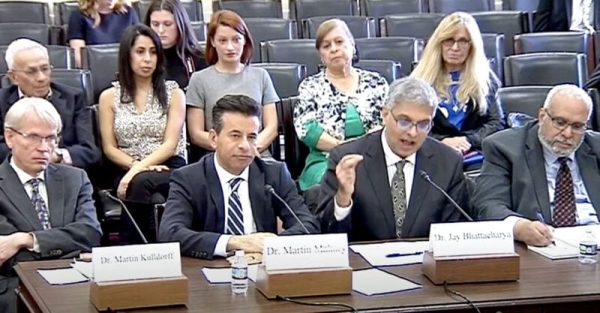
Convening for the first time on Tuesday, the Select Subcommittee on the Coronavirus Pandemic presented the testimony of four public health experts, as part of a roundtable: “Preparing For the Future By Learning From the Past: Examining COVID Policy Decisions.”
The agenda for the subcommittee, chaired by Rep. Brad Wenstrup (R-Ohio), focused on government policy pertaining to COVID-19, including vaccine mandates and other public health guidance.
In his opening remarks, Wenstrup said the subcommittee will examine the origins of COVID-19, policies surrounding gain-of-function, research, the impacts of lockdowns and other government policies, including school closures, and “vaccine and therapeutic development and the subsequent mandates.”
“We are here to deliver an after-action review of the past three years,” said Wenstrup. “To learn from the past, not just what went wrong, but what was done right, and to prepare for the future. This is work that must be done, must be done thoroughly, and must be done with reverence with an eye toward the truth and based on facts.”
The experts who testified included Jay Bhattacharya, M.D., Ph.D., professor of medicine at Stanford University; Martin Kulldorff, Ph.D., professor of medicine at Brigham and Women’s Hospital; Marty Makary, M.D., M.P.H., chief of islet transplant surgery and professor of surgery at Johns Hopkins University; and Georges C. Benjamin, M.D., M.A.C.P., executive director of the American Public Health Association.
In introducing the experts, Wenstrup said they can “help us chart a path forward; to help us understand what policies went wrong and how we, as a country, can improve.”
Wenstrup cited examples like the vaccine mandates imposed by the Biden administration, ignoring natural immunity, the harm caused to elders forced into nursing homes, and the consequences of stopping in-person learning and implementing remote work, particularly in the public sector.
“The American people deserve to know and understand how and why these impactful decisions were made,” said Wenstrup. “Did we create unnecessary fear in some, and dangerous ambivalence in others?”
“At the end of this process, our goal is to produce a product, hopefully bipartisan, based on knowledge and lessons learned,” he stated.
Ranking member Rep. Raul Ruiz (D-Calif.) focused on American lives lost during the pandemic, stating that it “was real and not a hoax” and “laid bare vulnerabilities and inequities in our public health infrastructure and our economy.”
“We need to understand the lessons, learn all the barriers of misinformation, disinformation, the politicization of this and avoid those for the fake of our nation, in order to save more lives,” Ruiz said.
Most of the witnesses shared critical words about the overall public health response to COVID-19, which Kulldorff described as “the worst public health mistakes in history.”
Makary said “public health officials have made many tragic mistakes during the pandemic,” including:
“Ignoring natural immunity, dismissing the lab leak as a conspiracy, closing schools, masking toddlers … pushing boosters for young people, bypassing FDA [U.S. Food and Drug Administration] expert panel customary votes that we’ve been using for decades, telling people to wash their hands like crazy.”
Bhattacharya said:
“The American people deserve answers to fundamental questions about the pandemic. On what empirical basis were schools closed? Did public health decision-makers consider the harms of their policies as thoroughly as their putative benefits? Why did authorities ignore recovered immunity or failure of the vaccine to prevent disease transmission?”
“Scientists and people vehemently disagreed about the wisdom of lockdowns, school closures, vaccine mandates and discrimination and so much else,” he added. “There’s near-universal agreement that what we did failed.”
Benjamin, the only expert who was generally supportive of the overall public health response, said, “We must remember the limited information we had when we made those decisions … and also the fact that our knowledge base and science continues to evolve over time.”
He added, “We created a safe and effective vaccine by every standard that we understand safety and efficacy today, in record time.”
Wenstrup praised the quick development of vaccines, describing it as “amazing,” but added, “but we knew from the trials that even people that were vaccinated got COVID” and “we also knew that vaccines produce variants and we should be expecting that.”
Citing the early public health response focusing on COVID-19 at the expense of other patients and health issues, he said one of his constituents, an elderly man, had an operation for “a painful hernia” canceled, ultimately resulting in his death.
Several experts addressed this type of inflexibility. Makary said that while “public health officials are not wrong for making recommendations based on the knowledge that they had at the time … that’s not actually what happened.”
“They were wrong because they refused to evolve their positions as the data became abundantly clear,” he said.
Nursing home policies, hospital visitation restrictions ‘a human rights violation’
Kulldorff said one of the two “major failures” of the public health response was “the failure to properly and optimally protect older Americans,” including “nursing home residents.” He described “sending sick people to nursing homes” as “criminal.”
“We also didn’t protect older working-age Americans in their 60s and 70s, while the ‘laptop class’ was often working from home, whether they were in their 20s or 30s or 40s,” he said. “The way we dealt with the pandemic was the worst assault on poor people, working Americans, the middle class [since] segregation and the Vietnam War.”
Kulldorff, who along with Bhattacharya helped draft the “Great Barrington Declaration” on “the damaging physical and mental health impacts of the prevailing COVID-19 policies,” said that when the group “proposed very concrete things for how to better protect older Americans” they were “slandered.”
Bhattacharya, in turn, said “the public health establishment … abandoned an essential commitment to science” in “sending COVID-19-infected patients back to nursing homes.”
Experts also addressed broader restrictions on hospital visitation during the pandemic. “To date, no randomized controlled trial has been conducted … against the cruel and inhumane hospital visitation policies that prevented people from seeing their dying loved ones,” said Makary, who described this failure as “a human rights violation.”
‘A house of cards that’s now falling apart’
Several of Tuesday’s witnesses focused on pandemic lockdown policies.
According to Bhattacharya, “By early 2022, about 95% of Americans had contracted COVID, despite the harsh countermeasures in most states.”
Bhattacharya described the policies as a “widespread violation of civil liberties.” He referenced a “Johns Hopkins University meta-analysis [finding] that lockdowns had failed to contain the spread of COVID.”
“At best, [lockdowns] temporarily protected the ‘laptop class’ who could work from home without losing their jobs, perhaps 30% of the population, while being served by the working class,” he added.
Kulldorff said such measures were themselves responsible for many deaths.
“Lockdown harms, school closures, people not going to medical visits … has killed many Americans and will continue to do so in the next few years,” he said, adding that “the lockdowns had enormously negative consequences on public health.”
For example, screening and treatment on cardiovascular disease and other ailments “plummeted,” Kulldorff said.
“The pandemic response is a house of cards that’s now falling apart,” he added.
Several of the experts focused on school closures, with Kulldorff stating, “I don’t think there’s anybody left who thinks that school closures were a good idea.”
Bhattacharya said school closures helped create “tremendous collateral harm” and “have set kids behind in ways that will lead them to worse outcomes as adults, including shorter, poorer lives.”
Mandates ‘ignored clear scientific data’
Bhattacharya questioned why “public health authorities ignore[d] clear scientific data that COVID infection [and] acquired immunity is as strong or stronger than vaccine-acquired immunity.”
“Vaccine mandates forced many frontline workers … to choose between their careers and a vaccine that provides less protection than the natural immunity they already had,” he said.
According to Makary, “Young healthy people were essentially spared from this pandemic,” with “an infection fatality rate no worse than influenza.” However, he said, the Centers for Disease Control and Prevention (CDC) denied knowledge of studies confirming these findings.
Benjamin said, “We were all kind of surprised the kids did kind of well,” although “there were some children that got … multisystem inflammatory syndrome.”
Defending the COVID-19 vaccines, Benjamin said:
“We have learned that if you do get native infection — meaning you aren’t immunized [and get infected], and then if you get vaccinated — you have a really, really, really robust response, and that’s great science and I’m glad we’re learning about that.”
Makary took a different view, saying, “The greatest perpetrator of misinformation during the pandemic has been the United States government” when it claimed “vaccinated immunity was far greater than natural immunity” and that “masks were effective.”
Makary referred to the recently published Cochrane meta-analysis showing that masks did not prevent the spread of COVID-19 while pointing out that myocarditis is “four to 28 times more common after the vaccine” but that the government has said “young people benefit from a booster.”
Kulldorff referred to the example of Sweden, describing it as the “one Western country who did very well during the pandemic” and that had “mostly voluntary measures” and a “very light approach,” instead of lockdowns and mandates.
“Sweden, together with other Scandinavian countries, [had] the least excess death in the world,” said Kulldorff.
Prompted by Rep. Mariannette Miller-Meeks, M.D. (R-Iowa), who said, “It wasn’t until I came to Congress that I found out infection-acquired immunity was a novel concept,” Kulldorff stated, “I guess we knew about it since 430 B.C., the Athenian Plague, until 2020, and then we didn’t know about it for three years, and now we know about it again.”
Makary said that since the time of the Athenian Plague, natural immunity had been observed, “and yet it was considered a conspiracy theory or something we couldn’t trust or believe in because we didn’t know the long-term protection. Well, we didn’t know the long-term protection of the vaccines either.”
“There has not been recognition that there is immunity after having had an infection,” said Kulldorff. There “was never a reason to mandate that vaccine for people that all had COVID. There was recently a study of mass vaccinations that shows [they] had zero or very little benefit.”
Benjamin, however, argued that in terms of natural immunity, “We generally don’t do that in medicine, particularly when we have a therapeutic option that will prevent it.”
“Many faced with these anti-scientific choices will never trust public health authorities again,” Bhattacharya said. “Public health bureaucrats operated more like dictators than scientists during the pandemic, sealing themselves off from credible outside criticism.”
As a result, said Bhattacharya, “I’ve seen a rise in vaccine hesitancy for essential vaccines like measles [and] DPT,” describing this as “quite alarming.”
Kuldorff concurred. “By forcing children to have a vaccine that they don’t need because they’ve already had the disease, that undermines the trust in other vaccines,” he said, characterizing this as “very, very serious.”
“It’ll take decades to restore some of this damaged trust” in public health authorities, added Makary.
Kulldorff said, “These failures are due to abandonment of basic principles of public health,” including an exclusive focus on one disease at the expense of all others, and “trying to suppress or eradicate COVID, which was impossible.”
Makary asked, “Why do we have the same policies for everybody?” He noted the “biases” of COVID-19 policy decision-makers, whom he described as “a small, non-diverse, like-minded group making all the decisions, and they were HIV researchers” even though “in HIV, there’s no natural immunity.”
“CDC and the FDA and people at the NIH [National Institutes of Health] made up their mind before the trials were completed,” said Makary. “They decided babies were going to get vaccines before the study was done. And then [they] found no statistically significant difference in efficacy between the two groups and they just authorized it anyway.”
“Why are we even doing trials? Why do we even have an FDA?” asked Makary.
Where do scientists whose careers were destroyed go to get their reputations back?
Ruiz said, “We are still dealing with the long-term implications of this public health crisis,” citing “the spread of misinformation or disinformation” as having “undermined the American people’s trust in our nation’s public health institutions and in each other.”
Ruiz said “misinformation” and “disinformation” may “lead to non-compliance or failure of therapeutics where people are making decisions that put themselves and their families in harm’s way.” But most of the experts took a different view.
Bhattacharya said that “under the banner of combating misinformation, government health agencies use their power to collaborate with social media companies to control the public conversation about COVID science and policy,” noting that he was put on a “trends blacklist” by Twitter as a result, leading to his participation in a lawsuit against the Biden administration based on censorship claims.
“I personally have faced censorship,” Bhattacharya said, “from government sources during the pandemic, including … slander and denigration. You need to involve outside voices respectfully in order to get the full set of people … or else bad decisions will get made, just as they were during this pandemic,” he added.
Kulldorff referred to the Great Barrington Declaration, saying that when it was presented, he and its authors were “slandered instead of taking it seriously,” while Bhattacharya said there was “a media campaign to take down our proposal, which tens of thousands of doctors, epidemiologists and scientists endorsed.”
“Where do the scientists whose careers were destroyed … go to get their reputations back?” he asked.
While Benjamin claimed, “There are many people out there who have a large bullhorn who have made it worse,” he conceded that “nobody should be censored.”
Michael Nevradakis, Ph.D., based in Athens, Greece, is a senior reporter for The Defender and part of the rotation of hosts for CHD.TV’s “Good Morning CHD.”
This article was originally published by The Defender — Children’s Health Defense’s News & Views Website under Creative Commons license CC BY-NC-ND 4.0. Please consider subscribing to The Defender or donating to Children’s Health Defense.
DHS is sued for records on online election censorship demands
By Cindy Harper | Reclaim The Net | February 25, 2023
Judicial Watch has filed a Freedom of Information Act (FOIA) lawsuit against the Department of Homeland Security (DHS) after the agency refused to provide records of communications related to election misinformation flagged by its Election Integrity Partnership (EIP).
Judicial Watch filed the lawsuit after another agency under the DHS, the Cybersecurity and Information Security Agency (CISA) failed to comply with an FOIA request filed last October.
We obtained a copy of the complaint for you here.
Judicial Watch had requested all communications related to EIP’s work sent via Atlassian’s Jira platform between employees and CISA employees and social media companies and other organizations that flagged election misinformation including The Center for Internet Security, the National Association of State Election Directors, and the Atlantic Council’s Digital Forensics Research Laboratory.
Numerous organizations privately communicated through Jira, according to the lawsuit.
“The Elon Musk ‘Twitter Files’ are the tip of the iceberg, as the federal government ran a massive, secret censorship op against the American people,” said Judicial Watch President Tom Fitton. “That the DHS is hiding these censorship records in violation of FOIA law shows the agency still has something to hide.”
In a separate lawsuit, Judicial Watch is suing the DHS for all communications between CISA and EIP, alleging that the agencies were actively flagging content in last year’s midterms. EIP flagged right-leaning news websites, including The Epoch Times, Breitbart, Fox News, The Washington Times, the New York Post, and Just the News.
New law sought by Brazil’s Lula to ban and punish “fake news and disinformation” threatens free internet everywhere
Nations seem poised to abandon the core lesson of the Enlightenment: no human institution can or should be trusted to decree Absolute Truth and punish dissent
By Glenn Greenwald | February 25, 2023
A major escalation in official online censorship regimes is progressing rapidly in Brazil, with implications for everyone in the democratic world. Under Brazil’s new government headed by President Lula da Silva, the country is poised to become the first in the democratic world to implement a law censoring and banning “fake news and disinformation” online, and then punishing those deemed guilty of authoring and spreading it. Such laws already exist throughout the non-democratic world, adopted years ago by the planet’s most tyrannical regimes in Saudi Arabia, Egypt, Qatar, the United Arab Emirates and Turkey.
If one wishes to be generous with the phrase “the democratic world” and include Malaysia and Singapore – at best hybrid “democracies” – then one could argue that a couple other “democratic” governments have already seized the power to decree Absolute Truth and then ban any deviation from it. But absent unexpected opposition, Brazil will soon become the first country unambiguously included in the democratic world to outlaw “fake news” and vest government officials with the power to banish it and punish its authors.
Last May, the U.S. Department of Homeland Security was forced to retreat from its attempt to appoint a “disinformation czar” to oversee what would effectively be its Ministry of Truth. That new DHS agency, at least nominally, was to be only advisory: it would declare truth and falsity and then pressure online platforms to comply by banning that which was deemed by the U.S. Security State to be false. The backlash was so great — the CIA and company are not exactly world-renown for telling the truth — that DHS finally claimed to cancel it, though secret documents emerged in October describing the agency’s plans to continue to shape online censorship decisions of Big Tech.
Brazil’s law would be anything but advisory. Though the details are still yet to be released, it would empower law enforcement officials to take action against citizens deemed to be publishing statements that the government classifies as “false,” and to solicit courts to impose punishment on those who do so.
The Brazilian left is almost entirely united with the country’s largest corporate media outlets in supporting this censorship regime (sound familiar?). The leading advocates of this new censorship law include pro-government lawyers, famous pro-Lula YouTube influencers, and even journalists(!). They are now being invited to and feted in “fake news” and “disinformation” conferences in glamorous European capitals sponsored by UN agencies, because the EU is eager to obtain such censorship powers for itself, and sees Brazil as the first test case for whether the public will tolerate such an aggressive acquisition of dissent-suppression authorities by the state. (Recall that the EU itself, at the start of the war in Ukraine, escalated online censorship to an all-new level by making it illegal for any online platform to host Russian-state media outlets; Rumble’s refusal to obey France’s command to remove RT from its platform forced Rumble to cease broadcasting in France).
Last Sunday, Brazil’s largest newspaper, Folha of São Paulo, announced that I had become a regular columnist for the paper (I will likely publish columns every other week, and those with international relevance will be published in English as well). Their offer came after months of rather intense controversy in which I have been vocally denouncing as dangerously authoritarian the regime of censorship and other weapons of dissent-suppression imposed by a member of Brazil’s Supreme Court, Alexandre de Moraes.
Even prior to enactment of this newly proposed law, the online censorship attacks of this single Brazilian judge, acting with the support of the a majority of its Supreme Court, has been so extreme that even liberal American news outlets have published critical articles on him and what they suggests are his lawless and wild censorship binges (including three in The New York Times, one in the Associated Press and another in The Washington Post ). One New York Times article – published weeks before the first round of the 2022 presidential race that sent Lula and incumbent President Jair Bolsonaro to a run-off – described the judge’s conduct this way:
Mr. Moraes has jailed five people without a trial for posts on social media that he said attacked Brazil’s institutions. He has also ordered social networks to remove thousands of posts and videos with little room for appeal. And this year, 10 of the court’s 11 justices sentenced a congressman to nearly nine years in prison for making what they said were threats against them in a livestream.
The power grab by the nation’s highest court, legal experts say, has undermined a key democratic institution in Latin America’s biggest country as voters prepare to pick a president on Oct. 2. … In many cases, Mr. Moraes has acted unilaterally, emboldened by new powers the court granted itself in 2019 that allow it to, in effect, act as an investigator, prosecutor and judge all at once in some cases.
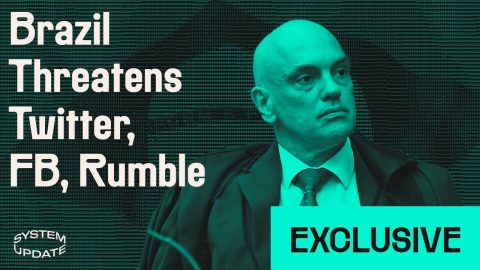
As the AP articles notes, we were the first to reveal one of Judge de Moraes’ secret censorship orders, which I obtained and then reported on in an episode of SYSTEM UPDATE, which was viewed by more than half a million people:
Despite also being the journalist who – back in 2019 and 2020 – exposed the grave corruption committed by the once-heroic Brazilian judge and prosecutors who imprisoned Lula in 2017 – reporting that won top journalism awards in Brazil, garnered universal praise from the Brazilian left, resulted in an unsuccessful attempt to prosecute me, and ultimately led to Lula’s release from prison and restored his eligibility to run for president in 2022 – both my husband David Miranda (a Congressman until last month) and I have, overnight, become among the most reviled figures by Lula’s followers. This has been in part due to my increasingly active opposition to growing censorship efforts led by this judge and his left-wing allies, censorship which the Brazilian left and their corporate-media allies support with great fervor and with something close to lock-step unanimity.
Those left-wing attacks against us began when David announced in January, 2022 that he was leaving his left-wing party PSOL – which had long been opposed to PT and Lula – because he objected to the party’s decision to support Lula’s presidential candidacy in the first round of voting. He instead joined the center-left party PDT in order to support presidential candidate Ciro Gomes.
Because David was the first national left-wing political official to publicly refuse to support Lula’s candidacy in the first-round of voting, it was necessary for PT to make an example of him (and, by extension, of me). The campaign of vilification was deeply personal. Even as a couple accustomed to being the target of such campaigns, the attacks on us from Lula’s followers were unlike anything I had seen in terms of vitriol, unrestrained online mob rage, and the kind of bigoted tropes the left pretends it reviles but instantly unleashes against any member (such as David) of the “marginalized groups” the left believes it owns.
As is true in the U.S., nothing enrages the left and provokes the lowest and most scurrilous attacks more than when a person they believe they own due to their membership in a “marginalized” group who proclaims their independence and right to think critically (in September, I was forced by David’s health crisis to petition the election court to withdraw his re-election candidacy, and the new Congress was inaugurated on February 1 without him).
But those already-lowly attacks escalated severely when I became much more vocal about my increasing concern over the country’s growing reliance on censorship and due-process-free persecution of PT’s opponents. Unlike in the U.S. – where the liberal-left still pays lip service to their support for free speech while clearly acting to subvert it – the Brazilian left barely bothers with this pretense. Many simply acknowledge that they do not believe in free speech, and equate a defense of free speech with fascism. They do so with no apparent recognition of the irony – that the first thing a fascist regime does is ban books and criminalize dissent – and despite the fact that free speech is a right guaranteed by the Brazilian constitution.
For the globalist order increasingly petrified of internet freedom – they blame online free speech for everything from Brexit and Hillary’s defeat to skepticism of health authorities and growing opposition to U.S. support for the proxy war in Ukraine – Brazil has become the perfect test case for seizing state power to censor the internet in the name of stopping “fake news and disinformation.” Nothing fosters support for authoritarianism the way fear does, and much of the Brazilian establishment believes they are fighting a new War on Terror. Even with Bolsonaro vanquished for now in Florida, his party in the last election won the most seats in both houses of Congress as well as key governorships across the country.
Just as the Bush/Cheney government exploited the 9/11 attack, and the Biden administration still exploits the January 6 riot, to justify previously unthinkable assaults on core civil liberties, the Brazilian left – in union with the country’s establishment – is now exploiting the January 8 invasion of government buildings by a few thousand Bolsonaro supporters to argue that anything and everything is justified in the name of their “war on terrorism” (unlike the 3,000 deaths on 9/11, and the deaths of four Trump supporters on 1/6, nobody died or was grievously injured on January 8 in Brasilia). And using the same playbook of neocons to support their crisis-justified civil liberties attacks, anyone in Brazil who even questions the need for new censorship powers and other attacks on dissidents demanded by the government is accused of being “pro-Terrorist” or an “apologist for fascism” (I honestly never thought I would live to see the day when one stands accused of being pro-facist for opposing censorship rather than supporting it, but such are the times in which we live).
That is why Europe, and large sectors of the U.S. establishment, see Brazil as the perfect laboratory to test how far censorship powers can go. With many Brazilians believing they just suffered their own 9/11 or January 6, all power centers know that the perfect time to seize new authoritarian powers and abridge core liberties is when the population is in a state of fear and terror, and thus willing to sacrifice liberties in exchange for illusory promises of security.
And recall that polling data in the U.S. shows that very large majorities of Democrats (and a disturbingly robust minority of GOP voters) would support a law similar to the one pending in Brazil to empower the state to restrict internet freedom in the name of stopping “misinformation.” As Pew found in 2021, 65% of Democrats “say the government should take steps to restrict false information, even if it means limiting freedom of information.” Perhaps the First Amendment would be a barrier to implementation of such a law in the U.S., but there is ample public support, especially on the liberal-left, for state censorship of the internet.
A major reason I accepted the offer to become a Folha columnist is that it gives me a significant platform in Brazil to combat what I regard as these increasingly grave attacks on core liberties, not only because they threaten rights of free speech, due process and a free internet in Brazil, but because they threaten all those values far beyond Brazil’s borders as well. My reporting on this new “fake news and disinformation” law sought by Lula’s government as set forth below includes parts of my first Folha column published last Sunday on the dangers of this newly proposed law, as well as significant new passages I wrote for an international audience and for publication of this new article here on Locals.
Ten days before the run-off voting for the 2018 presidential election which sent Bolsonaro into the presidency, Folha reported that an “illegal practice” was being used to help Jair Bolsonaro win that election. “Companies are purchasing large packages of messaging assailing [Lula’s] Workers’ Party (PT) for mass dissemination on WhatsApp,” Folha explained.
Bolsonaro not only denied the story but accused both Folha and PT of spreading Fake News. As Folha noted at the time, Bolsonaro’s party “intended to sue” his election-year rival Fernando Haddad of PT. Bolsonaro accused PT of “spreading false news.”
Upon winning the presidency, there was no law available to Bolsonaro – similar to the one which Lula’s government is now proposing – that would have empowered his government, or judges sympathetic to him, to ban discussion online of Folha’s reporting by claiming it was “fake news.” But if he did have that power – if the law which PT hopes to implement to govern “fake news” had been in the hands of Bolsonaro’s allies – it is very reasonable to suspect they may have used it to suppress those revelations on the ground that, in the view of Bosonaro’s supporters, the allegations were “false.”
After all, the new law proposed by Lula’s government would empower both the judiciary and the equivalent of Brazil’s Solicitor General (AGU) to take more aggressive action to combat “fake news” online. Among other new powers, the proposed law would permit “an action by the AGU, a body that legally represents the government, to file legal cases against those it regards as authors of false content.”
In a January 19 interview with Folha, Lula’s chief spokesman, Paulo Pimenta, vowed: “we will start to respond more forcefully, more sharply, to information that distorts the truth and is wrong.”
Everyone would love to live in a world in which an omnipotent and benevolent power who rules us allows only truthful statements, while it accurately identifies and then outlaws all false claims. Such a world sounds like paradise: no errors, only truth. Who could possibly be opposed to that?
Unfortunately, human nature makes such a world impossible. If history teaches any lesson, it is clear that treating human leaders or institutions as capable of god-like infallibility and super-human wisdom is quite dangerous.
Humans have tried all this before. For a thousand years prior to the Enlightenment, most societies were ruled by omnipotent institutions – monarchies, empires, churches – that claimed to possess absolute truth and therefore outlawed any views that deviated on the ground that they were “false.”
The core innovation of the Enlightenment, one of the greatest intellectual advancements of human liberation, was that all human institutions are fallible, that they endorse false claims either due to error or corruption, and that every individual must always retain the right to question and challenge their orthodoxies.
In sum, there is no such thing as an institution of authority that can be trusted to decree what Truth is. The oldest indigenous societies, far from Europe, had already internalized this lesson, having discarded faith in centralized authorities in favor of decentralized power and dispersed democratic values. And what is now called “the democratic world” is founded in the view that secular truths are ascertained not by decrees of monarchs, clerics and emperors, but by free and open debate driven by human reason and the sacred right to dissent.
Since the start of the COVID pandemic, it has been bizarre to hear left-liberals throughout the democratic world proclaim their devotion to science while simultaneously demanding that all “false statements” about science be banned. Science cannot exist if one assumes that permanent truth has already been apprehended. Science requires the acknowledgement that even its most brilliant and accomplished experts may have embraced grave errors and faulty assumptions. Scientific truth is unearthed only by permitting challenges to prevailing orthodoxies, not by prohibiting let alone outlawing them.
To say that one believes in science while demanding that “falsity” be banned is like saying that one believes in religion while demanding that prayer be banned. Scientific discovery, like all intellectual endeavors, only advances by a process of trial and error, by challenging and objecting to prevailing beliefs so that error can be uncovered. To ban “false claims” is not to honor and strengthen science but to vandalize and kill it.
From the start of the COVID pandemic, many of the claims made by the world’s most prestigious experts and trusted institutions have turned out to be false or uncertain. As just one example, the World Health Organization announced in February and March of 2020 that asymptomatic people should not wear masks and that doing so could make a COVID infection worse by “trapping” the virus. In April, the recommendation was the opposite: everyone should wear masks regardless of one’s health condition.
In 2018, any Brazilian “fact-checker” would have affirmed as true the statement that Lula was a “thief,” as he was convicted of multiple corruption felonies, which Brazilian appellate courts affirmed on appeal. By 2022, the situation was reversed as Brazilian courts nullified that conviction (in large part based on the revelations of our reporting regarding the corruption on the part of Lula’s judge and prosecutors). As a result, Brazil’s election courts in the 2022 campaign banned campaign materials calling Lula a “thief” on the ground that they were false.
In other words, what was considered Gospel about Lula in 2018 became prohibited Falsity just four years later. That is the unyielding, universal pattern driving human intellectual advancement: what is deemed Truth one minute becomes shameful and discredited the next.
For that reason, at the heart of every censor resides one of the most toxic human traits: hubris. It is astonishing to watch some humans believe that they have managed to liberate themselves from this historical cycle of misperception, misapprehension and error, and instead believe that they have become owners of the Truth. Even with the best of motives, only hubris would lead people to have so much confidence in their truth-finding abilities that they would want the state to make it a crime to question or deny their views of the world. And yet no other mentality than this one can account for someone supporting the kind of law to ban and punish “fake news and disinformation” as the new Brazilian government and its allies in Congress are on the verge of adopting.
Error is the inevitable condition of even the most well-intentioned humans. But most humans do not operate with the purest of motives. Humans with great power are highly likely to abuse that power absent very serious limits. Even if you believe you finally found political leaders with almost god-like virtue, who can be trusted not to abuse such powers when suppressing ideas as “false,” it is extremely likely such laws will be transferred in the future to new leaders with different ideologies and who are more human than the deity you have been fortunate enough to have found.
And as has been widely reported, the new industry to define “disinformation” is largely a scam. It is funded by a small handful of liberal billionaires, and employs highly politicized actors who claim a fake expertise – “disinformation experts” – to masquerade their ideological views as science. Any attempts by the state to make “fake news and disinformation” illegal will almost certainly rely on this fraudulent industry to justify their censorship decisions by claiming that their assessment of truth and falsity has been supported by “experts.”
If Brazil implements this proposed law, it will not be the first time a government is empowered to ban “fake news” on the internet. Other countries live under governments which have been given the power to ban journalism and commentary on the ground that it is judged by the state to be dangerous, to be false, to incite violence, or to foster social instability or even revolutions against the prevailing order.
Regimes with such laws are the planet’s most despotic: Saudi Arabia, United Arab Emirates, Egypt, Singapore and Qatar (whose law, entitled “Crimes against the internal security of the State,” allows the state to “impose up to five years imprisonment on anyone who spreads rumors or false news with bad intent”).
There, the outcome is predictable. All dissent against government orthodoxies and criticism of its leaders are quickly labeled “false” or “dangerous” or designed to incite violence and are censored on that ground. Last May, the UN, warning about a newly proposed “anti-disinformation” law in Turkey, “expressed concern after the vote by the Turkish parliament of a law that could imply the imprisonment of up to three years of journalists and users of ‘social media’ for the dissemination of ‘fake news’.”
Those attacks on dissent using these “Fake News” laws are not due to “abuse of a good law.” They are, instead, the inevitable, arguably the intended, outcome of such a law. No political faction is immune from believing that any dissent from its core pieties is not just misguided but deliberately false and even dangerous.
The dissent-suppressing persecution where such laws have been allowed to flourish are entirely predictable. Only in authoritarian cultures, or ones that wish to return to the pre-Enlightenment days of full submission to institutions of authority, would citizens trust political, governmental or religious officials with the power to declare absolute truth and then, using the force of law, bar any expression that deviates from it.
These abuses of “fake news” laws happen in those countries where those laws have been adopted not because those countries are different than ours, but because they are the same. All powerful leaders, even well-intentioned ones, will be highly tempted to ban dissent on the grounds that it is dangerous or “false.”
Humans, by our very nature, are incapable of acquiring absolute truth about politics or science even with the best of motives. What one generation believes to be proven Truth (the earth is the center of the universe) is demonstrated by subsequent generations to be gross error, though such truth-tellers often suffer severe persecution when “falsity” is rendered illegal (which is why Socrates, Copernicus, Galileo, Voltaire and many others like them wasted years attempting to avoid prison or worse, often unsuccessfully, due to laws banning ideas deemed “false” by the reigning authorities of their era). The intellectual history of humanity has one indisputable lesson: humans will always err when claiming they have discovered such absolute truth that nobody should be permitted to doubt or challenge their claims.
It is likely for these reasons that “the large portion” of the Brazilian legal specialists consulted by Folha about Lula’s proposed law to ban “fake news and disinformation” emphasized “that a legal process of this kind by the government can set a precedent that represents a risk to freedom of expression, given the possibility of being weaponized for judicial harassment against critics and opponents.”
Even if you are lucky to have found the most trustworthy and benevolent leaders in history, ones who are somehow capable of decreeing truth without erring and who use such laws only in the most noble ways – something the Brazilian left believes of Lula and his government – at some point other leaders will be elected and they, too, will have such powers.
When assessing whether one should support a proposed law, the key question is not whether one is comfortable with it in the hands of leaders one likes and trusts, but whether one is comfortable with such powers in the hands of different leaders.
Republicans race to stop Biden giving WHO power over pandemic surveillance, controlling “disinformation”
Republican senators are pushing back against an accord that would give the World Health Organization (WHO) power over member states if it declares a pandemic. The accord, which is legally binding on all member states, will be finalized in Switzerland this week.
The accord will give the WHO power to declare pandemics and require member states to give the WHO the “central role” as “the directing and coordinating authority on international health work” in areas like medical supply chains, treatments and lockdowns. However, the WHO also wants more power over surveillance and controlling “disinformation and fake news” when a pandemic is declared.
17 senators, led by Wisconsin’s Ron Johnson, have introduced the “No WHO Pandemic Preparedness Treaty Without Senate Approval Act.” The bill states that the accord should be called a treaty. As a treaty, it would require approval by two-thirds of the Senate.
We obtained a copy of the bill for you here.
“The WHO, along with our federal health agencies, failed miserably in their response to COVID-19,” Sen. Johnson stated. “This failure should not be rewarded with a new international treaty that would increase the WHO’s power at the expense of American sovereignty.”
However, some legal experts believe the legislation will not stop President Joe Biden from signing the accord as the accord was drafted to bypass Senate approval.
Featured Video

HE SAVED LIVES. NOW HE FACES PRISON.
or go to
Aletho News Archives – Video-Images
From the Archives
NATO Sanctions and the Coming Global Diesel Fuel Disaster
By F. William Engdahl – New Eastern Outlook – 11.04.2022
Amid the ongoing global inflation crisis, NATO heads of state and mainstream media repeat a mantra that high energy prices are a direct result of Putin’s actions in Ukraine since end of February. The reality is that it is the western sanctions that are responsible. Those sanctions including cutting SWIFT interbank access for key Russian banks and some of the most severe sanctions ever imposed, are hardly having an impact on the military actions in Ukraine. What many overlook is the fact that they are increasingly impacting the economies of the West, especially the EU and USA. A closer look at the state of the global supply of diesel fuel is alarming. But Western sanctions planners at the US Treasury and the EU know fully well what they are doing. And it bodes ill for the world economy.
While most of us rarely think about diesel fuel as anything other than a pollutant, in fact it is essential to the entire world economy in a way few energy sources are. The director general of Fuels Europe, part of the European Petroleum Refiners Association, stated recently, “… there is a clear link between diesel and GDP, because almost everything that goes into and out of a factory goes using diesel.” … continue
Blog Roll
 Aletho News
- Trita Parsi: Middle East Unraveling — Are We on the Path to World War?
- Iran FM meets with US envoy on UN meeting’s sidelines at American side’s insistence: Report
- Qatar PM calls for Gulf security framework with Iran, says war must be ‘wake-up call’
- China condemns US extortion of Iranian airlines, rejects Washington’s ‘illegal’ sanctions threats
- Italy to move military personnel from Taif base after missile strike
- Finland’s Stubb tells European leaders to calm down
- Defeating Russia on battlefield impossible – Fico
- Finland’s Gender Clinic Reversal
- Massachusetts Wants Mental Health Visits, Why Does Government Use ‘Health’ to Enter Our Homes & Families?
- US lawmaker admits American people footing bill for Trump’s failed aggression against Iran
- If Americans Knew
- Sanctions are collective punishment: immoral and self-defeating
- Phosphorus Munitions Fired by Israel Burn Groves, Orchards in Southern Lebanon
- Israel Carries Out New Ceasefire Violations Across Gaza
- AI – Emphasis on the ‘I’: Israel Is Funding AI Chatbot Propaganda
- Israel Blocking Hundreds of Wheelchairs for Injured Children From Entering Gaza
- Israel Is Expanding and Upgrading Compounds for Palestinian Militias in Gaza
- The Palestinian-American Residents of This West Bank Town Are Wondering: Where Is Trump?
- Gaza desperately needs tents, wheelchairs, fuel… and everything else (Israel blocks it all) – Daily Update
- Israeli Attacks in Gaza Kill at Least Seven Palestinians Over Three Days, including Woman and Child
- Trump’s militarization of Washington DC as he pursues Israel’s war against Iran
- No Tricks Zone
- New Study: Earth And Venus Surface Warmth Largely Explained By Convection And Lapse Rate, Not CO2 Or Radiation
- 2025 Nature Paper Claiming Worsening Global Drought Gets RETRACTED …Heavily Flawed
- New Study: ‘Global Drought Shows No Detectable Recent Acceleration Under Climate Warming’
- Economic Masterminds: German Socialists Suggest Taxing Productivity Gains Stemming From Using AI
- The South China Sea Has Not Been Cooperating With The Climate Change Narrative
- Energy Crisis: Germany Enters Heating Season With Historically Low Gas Reserve Fill Levels
- New Study: The Antarctic Ice Sheet Gained Mass From 2020-2024 Due To Staggering Snow And Ice Accumulation
- Study: Ocean Heating Rates From Thousands Of Years Ago ‘Dwarf’ Modern Ocean Heating Rates
- Climate Extremists Target, Attack Large-Scale Power Grid Infrastructure In Germany!
- New Study: Antarctic Ice Melt Has Contributed Less Than 1 Centimeter To Sea Level Rise In The Last 30 Years

