Wired retracts statement accusing Substack of “paying extremists”
Substack supports “open debate,” not censorship.
By Christina Maas | Reclaim The Net | June 10, 2022
In one of its recent articles attacking Substack, which has a relatively open free speech policy, Wired falsely claimed that the newsletter platform “actively recruits and pays extremists.”
The tech outlet was forced to retract the statement after Substack’s head of communications Lulu Cheng Meservey, who has done a good job in speaking out in support of free speech, took to Twitter to expose how Wired did not provide evidence and refused to provide evidence of their claims even after Substack pointed that out to the outlet privately.
“We do not and have not, and he can’t name any examples,” Meservey wrote in one of the tweets. “Yet when approached about it, he said: ‘I’d be happy to remove it if you could provide evidence that it’s inaccurate.’”
Meservey rightly pointed out that is not how journalism works.
“It’s not journalism to make an unfounded claim and demand contrary “evidence” to remove it. It borders on extortion: we will defame you unless you give us what we want,” she wrote.
She likened what Wired did to a news outlet accusing you of laundering money “and when you protest, they refuse to issue a correction unless you give them your financial statements,” adding that the “burden of proof is on the journalist, not the subject.”
Meservey went on to note that not only was evidence not provided, the writer did not make an attempt to show any of the allegedly recruited people were extremists.
The false claim was retracted but it is a testament to the recent smear campaign against Substack. The newsletter platform allows journalists, writers, and other content creators to make money, as it is subscription-based, meaning creators can avoid having to rely on invasive advertising practices.
Shanghai lockdowns increase market for invasive medical surveillance tech
By Will Henney | Reclaim The Net | June 10, 2022
The South China Morning Post interviewed experts who believe there could now be a big market for facial recognition cameras to “detect signs of COVID-19.”
The news outlet cited a report by Everbright Securities that claimed that about 2 million devices for detecting infection and confirming vaccination and test results could be put in public venues like entertainment venues, hospitals, office buildings and shopping centers.
Everbright estimated that the market to be about 50 billion yuan ($7.5), with market leaders like Hikvision and SenseTime expected to leverage the opportunities. Another player in the surveillance market, Telpo, already makes facial recognition technology that can check the temperatures of multiple people.
The paper quoted Wang Feng, a financial services expert, saying: “The market potential here cannot be matched anywhere else in the world, because these smart devices will be widely used in big cities to meet stringent virus control rules. Operators of shopping malls and cinemas will buy the machines to improve efficiency of their verification processes.”
The facial biometrics device would, in theory, check test results, vaccination status, and recent movements before allowing someone to enter a certain venue. Everbright said that each device would cost between 2,000 and 10,000 yuan ($300 to $1,500).
Do vaccine rollouts correlate to disabled americans?
el gato malo – bad cattitude – june 10, 2022
i have long been friends with ben. he’s done a lot of great work, runs a fantastic site on US all cause mortality, and has broken open a number of important issues around covid.
this may be another.
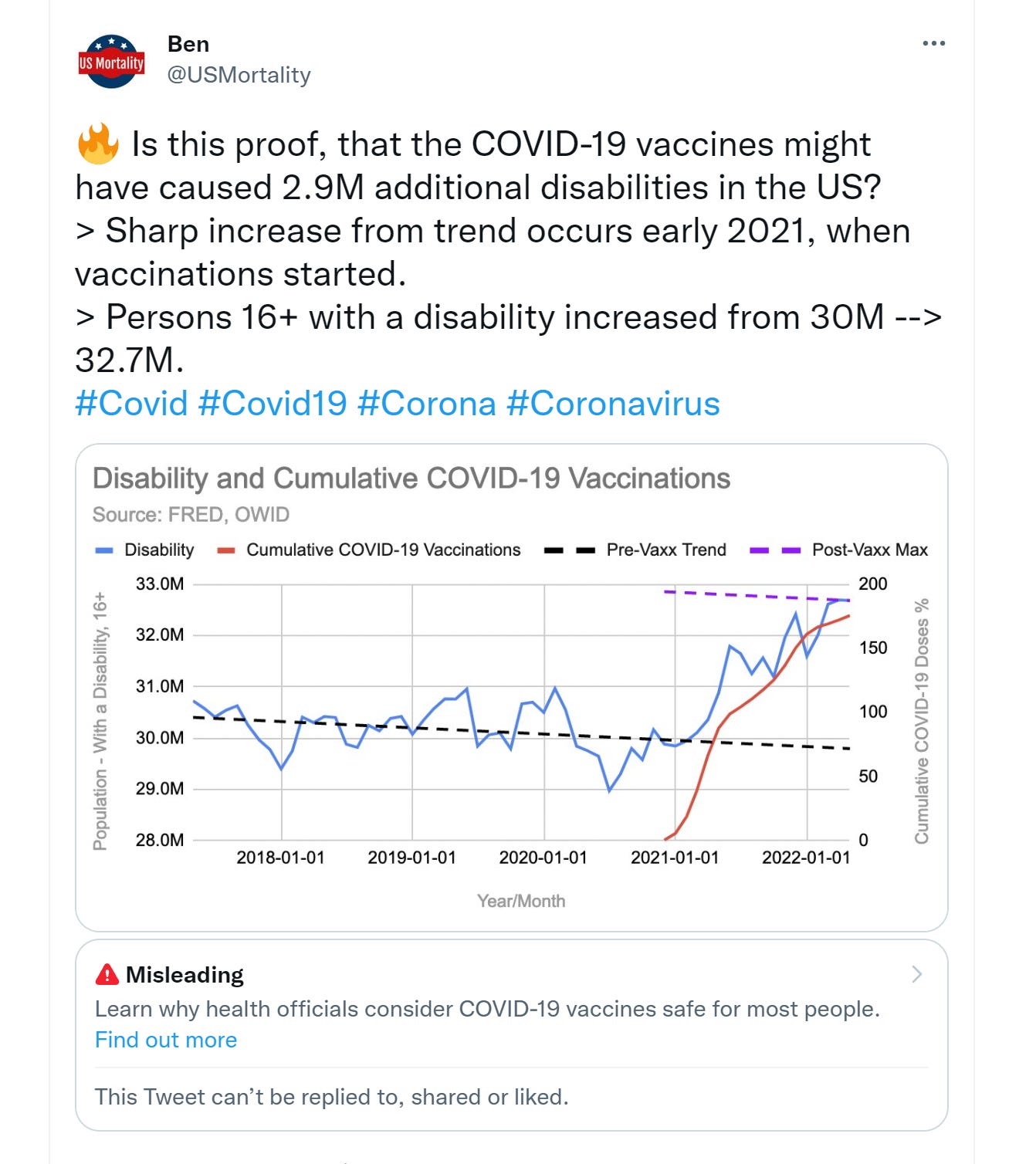
and it was not up for an hour before twitter not only marked the tweet as disinformation and locked ben out of his account all for asking a simple question that pretty much leaps out of this data.
the data comes from the FRED tool run by the st louis federal reserve bank. they are a well respected and high quality government run data source.
hard to see the problem with the data.
clearly, their issue is with the conclusion.
and, well, streisand effect and all, well, it caught my attention because naughty kitties love reading banned books.
correlation does not and cannot prove causality, but it can sure give us some strong hints, especially when we already know how off the charts the adverse event rate from these vaccines have been.
and boy is this timing provocative…
so, being the kind of gato to want to play with the data myself, i downloaded the set and graphed it.
as can be seen, this series was very stable for the prior 5 years. the dotted red line is the average value from 6/16 to 2/20, right before covid starting having effect.
this data comes from the current household survey. the drop for covid is likely a drop in survey response but as can be seen, it rapidly normalized.
then covid vaccination started.
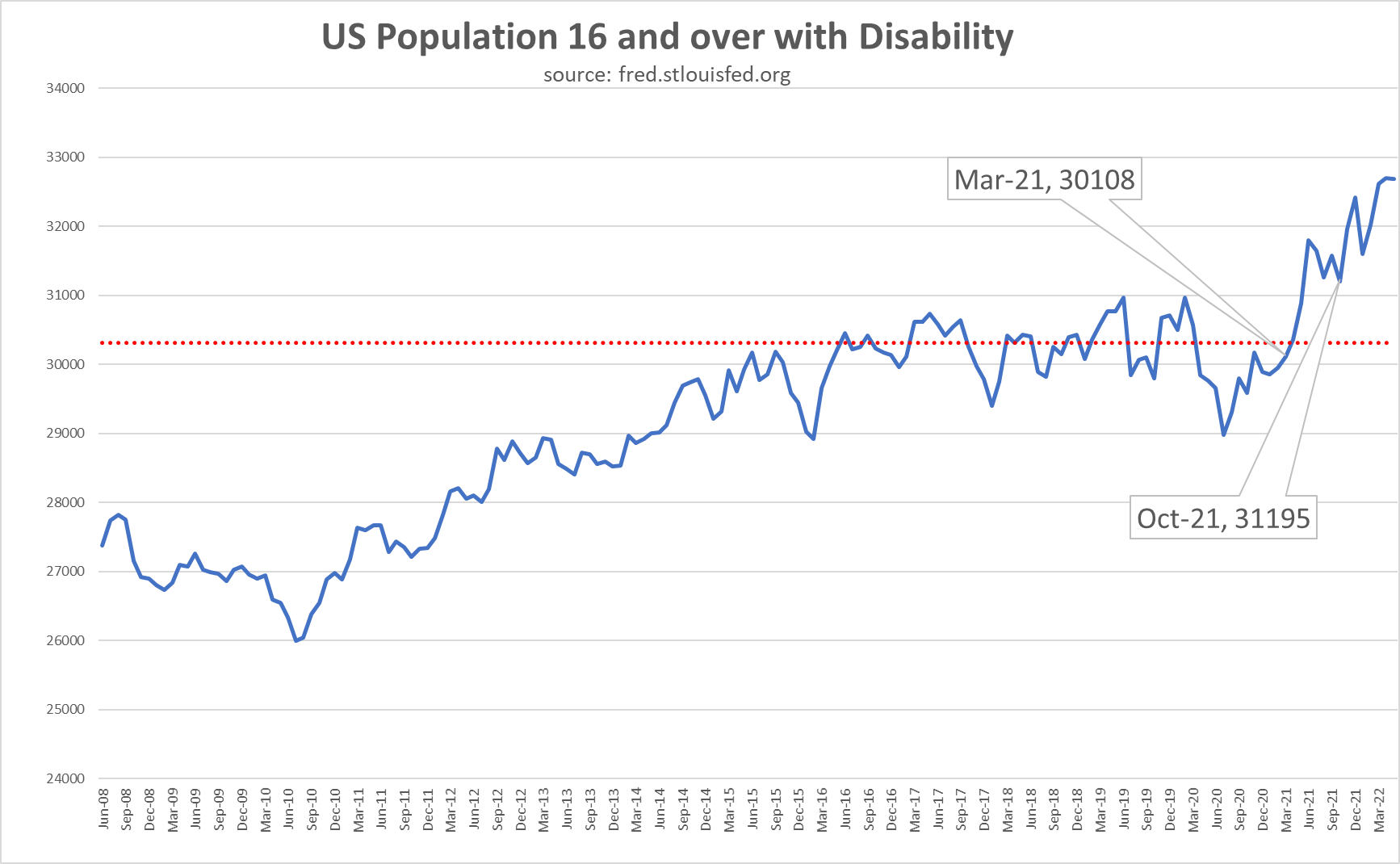
the first callout is when vaccinated reached 1%.
the second is when boosters reached 1%.
i chose this convention because each has a sort of long tail at a very low level leading in but rose rapidly after reaching 1% so it seemed like the best inflection point for maximum relevance.
as can be seen, the timing is highly suggestive.
and it makes sense.
seeing this:
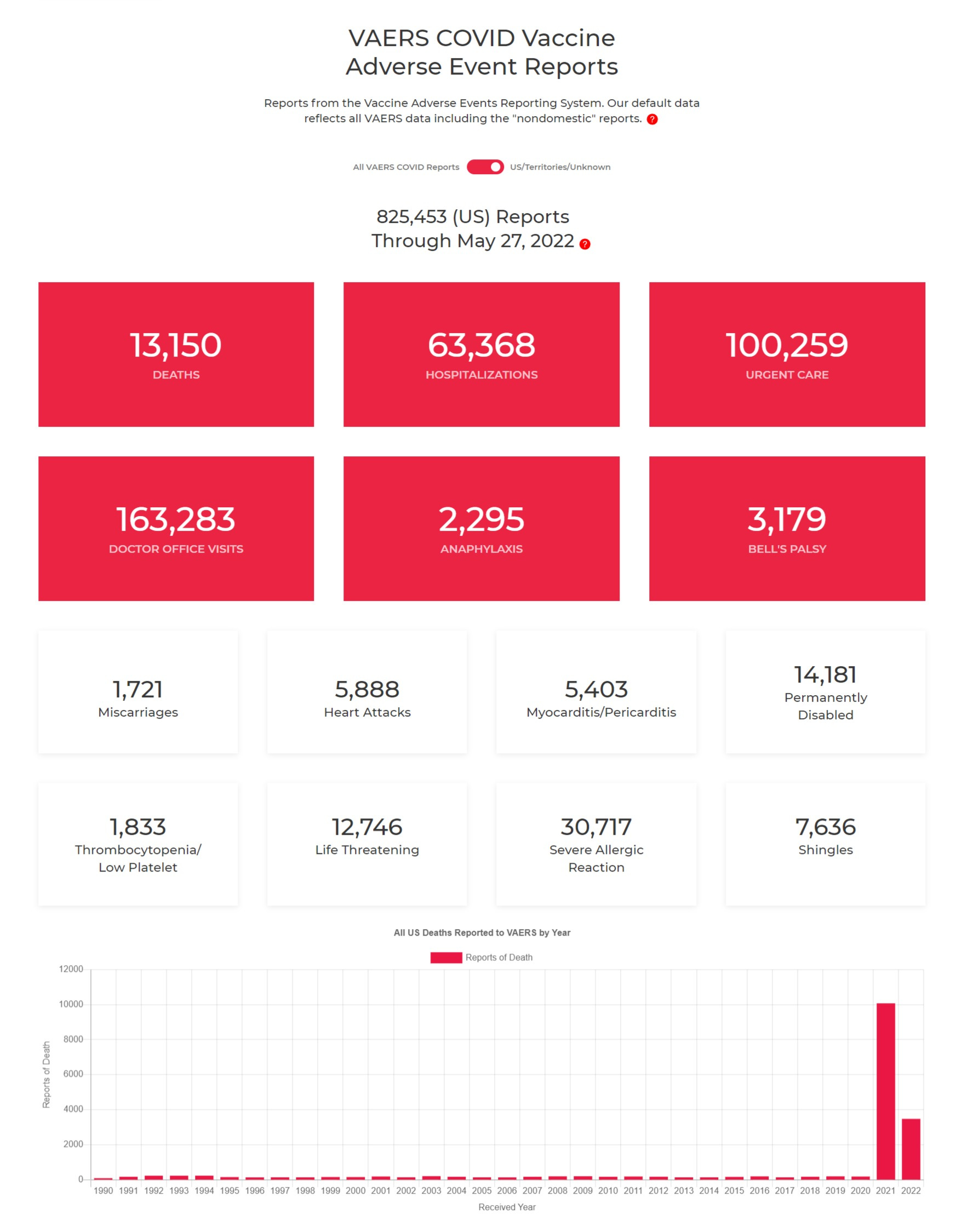
without a rise in disability reports would be surprising. we see 14k permanently disabled in VAERS. and we see a rise in the disabled rolls of 1.8 million. that’s pretty close to the 1-2% capture rate (more like 1%, but also likely capturing other categories as well, so hard to be precise) for reporting we’ve seen around other VAERS issues (besides death which seems to get better counted)
so it feels like we’re in a ballpark here.
and it does not look like “long covid” because the original covid strains were more severe and yet we saw no evidence of this disability spike pre-vaccines.
we can zoom in and really see the issue. data used is fred and owid. obviously, there is some chart crime here with the scaling, but the overall relationship is remarkable. this is basically what ben plotted.
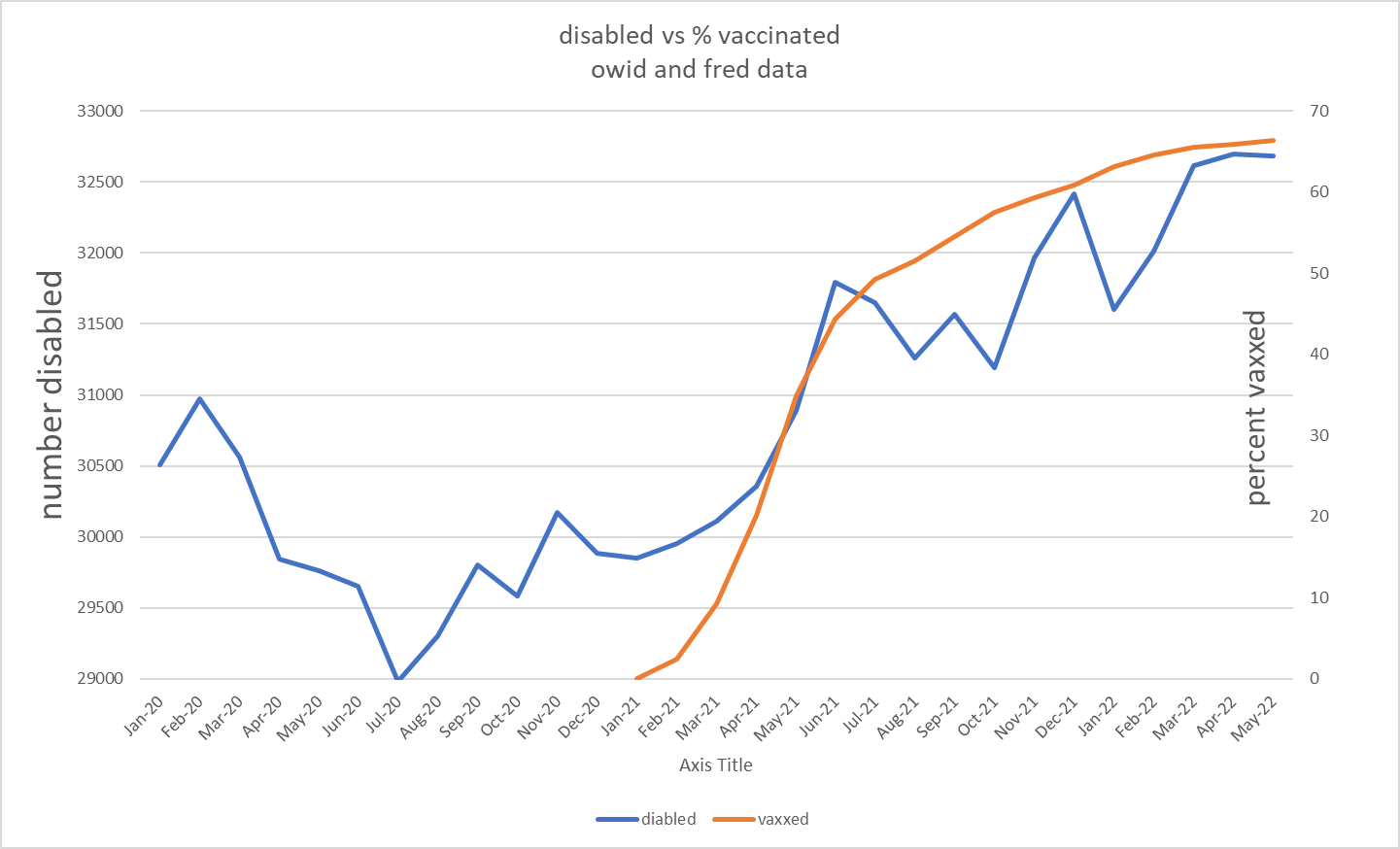
the second sharp upleg in october also interested me so i checked it against this:
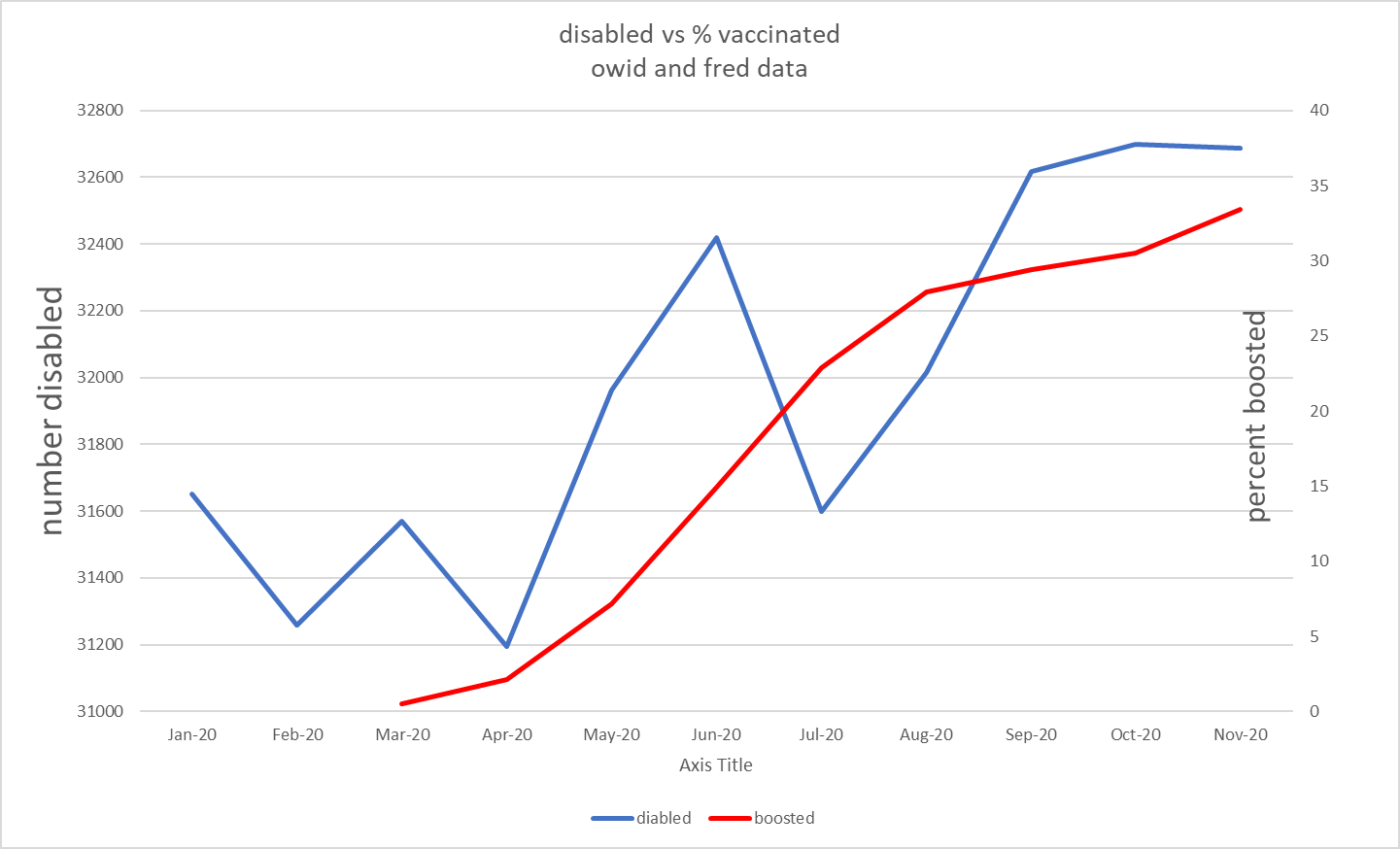
it’s easy to take up trending series and lay their scales so they look correlated. the real test is bi-directionality. and this looks to be most damning of all. i took % vaxxed each month and subtracted the prior month to get “% of population vaxxed in month.” this should give us a sense of the people at risk of vaccine complications at any given time. to this i added the same treatment to the booster series to get a total % of population getting a vaccine each month.
i then plotted this series against disability.
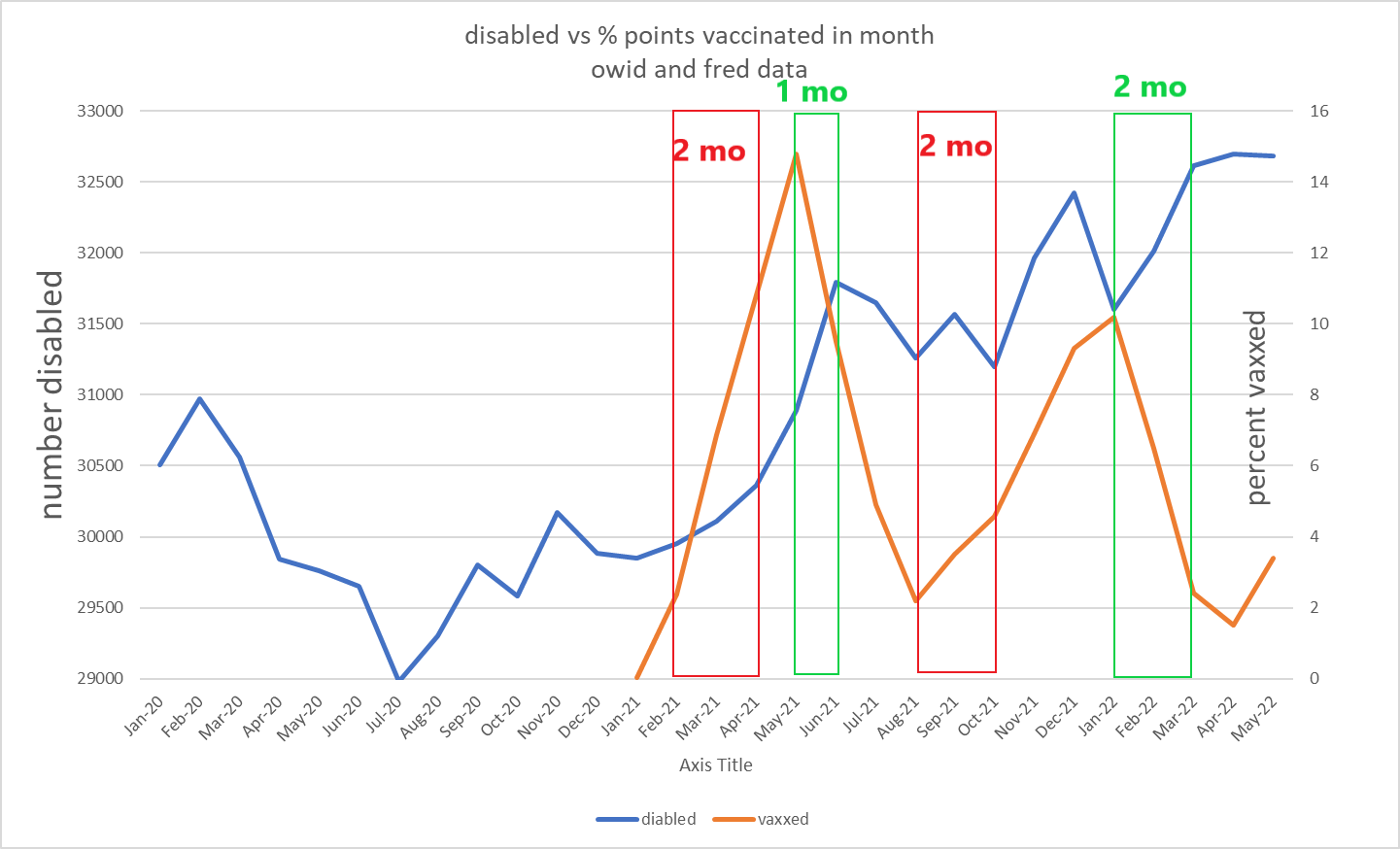
- the vaccination series started to get steep in feb 21. disability got steep in april 21.
- vaccination peaked in may. disability peaked in june.
- vaccination started to rise again after august.
- disability began to rise again after october.
- then vaxx dropped off after jan 2022 and disability flattened out in mar 2022.
2 month lag, 1 month lag, 2 month lag, 2 month lag. 4 separate inflections all tracked in near identical and highly plausible timeframes for vaccine injury. we’re starting to get past “suggestive” here.
this zigs, zags, then zigs again, then zags again all as predicted if it were causal and all with the sort of lag you’d associate with reporting, 1-2 months. (all 2 mo save may-jun 21)
the disability series can be a little noisy month to month, but the big trends are all there.
based on what we know about side effects this looks to be an odds on hypothesis at this point. i can see no better fit to the data.
anyone seeing flaws here? what are we missing? is there another explanation?
“the vaccines just put 1.8 million americans into disability” is a big claim.
i want to stress, this is still a hypothesis and this is my first run through with this data so i want to let people chew on it and see what else emerges before making claims that are too strong.
but this is also REALLY provocative and unless i have really missed something, warrants research and explication, not censorship.
please spread the word and let’s get some eyes on this.
YouTube bans Russians who pranked George Bush
Samizdat | June 9, 2022
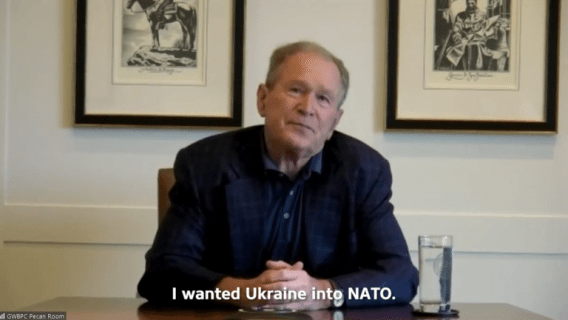
YouTube has permanently deleted the channel of Russian pranksters Vovan and Lexus, the duo announced on Thursday, after they released a bombshell interview, last month, with ex-US President George W Bush.
The pranksters, whose real names are Vladimir Kuznetsov (Vovan) and Alexei Stolyarov (Lexus) say that this is not the first time their channel has been deleted and that YouTube has not given them a legitimate reason for the bans.
“Today, YouTube once again removed our Vovan & Lexus backup channel. Apparently, this time our videos did not please the departments overseas, because they hit their image hard,” said the pranksters.
This time it was the tricksters’ secondary channel that was taken down after having been up for only about a month. Vovan believes that the reason for the deletion might have been their latest interview, with former US president George W. Bush, which had been getting a lot of traction among English-speaking audiences before the channel was shut down.
“Once again, YouTube makes you think that a ‘free’ site is not so free at all,” the duo noted, adding that US and UK authorities have been “trying to clean up traces of their criminal words” which have already spread across the internet.
“They won’t be able to delete the whole internet,” the pranksters noted.
In the latest video, which is still available on other social media platforms, Bush Junior, who was president of the US from 2001 to 2009, is tricked into believing he is speaking with Ukrainian President Volodymyr Zelensky and makes several bombshell statements on a number of hot-button issues.
The former president told the fake ‘Zelensky’ that Ukraine’s mission is to “destroy as many Russian troops as you can” and suggested that a military victory over Russia would see many of Ukraine’s issues “go off the table.”
He also revealed that during his time in office he “felt that Ukraine needed to be in the EU and NATO” while keeping Russia on the fringe of the military bloc, adding that it “doesn’t really matter” what Russia was promised in regards to NATO expansion.
The former president also offered some advice to ‘problematic’ former Georgian president Mikhail Saakashvili, and confirmed his administration’s work in creating a network of Pentagon-funded biolabs dotting Ukraine
The Russian Foreign Ministry’s spokesperson Maria Zakharova has commented on the removal of the Vovan and Lexus’ channel, stating that it was a shame that the channel was deleted just days before the release of her interview with the duo.
Vovan and Lexus’ main channel was banned back in March following a request from the UK government after the pranksters recorded trick interviews with Britain’s Defence Secretary Ben Wallace and Home Secretary Priti Patel.
In the videos, Wallace all but admitted that the UK would assist Kiev in restarting its military nuclear program, while Patel stated that Russian leaders were “barbarians” and promised that the Home Office would step up its spying on Russian nationals in the UK.
Vovan and Lexus have a long history of pranking celebrities and public figures, including Canadian PM Justin Trudeau and Turkish President Recep Tayyip Erdogan. They have denied being agents of the Russian government.
Google tells Congress the proposed antitrust bill would hinder its censorship efforts
By Didi Rankovic | Reclaim The Net | June 9, 2022
Google continues to lobby and campaign against legislative efforts aimed at curbing its monopolistic power, this time openly, in a blog post.
Google claims that antitrust legislation – whose goal is to loosen the stranglehold it has on the market and competitors – would prevent it from censoring “disinformation.”
In the past months, the tech giant has used other avenues as well, from (🛡 fake) grassroots support that it purports to have, to spending millions on professional lobbyists in Washington DC.
In all this, Google has gone for all sorts of “targeted” arguments in an effort to make sure the bipartisan bills never become law. Lawmakers and voters had the chance to hear that if Google is not allowed to run its business unimpeded, exactly as it’s doing now, anything from innovation to national security would suffer.
And now, no doubt addressing that part of its audience that is particularly concerned with the specter of arbitrarily, if at all, defined “disinformation” as internet’s “greatest ill” – this time in the context of geopolitics – Google claims that the bills under consideration in Congress, would, if passed, prevent it from censoring disinformation.
VP of Google’s Privacy, Safety and Security Royal Hansen, claims that the legislation is a risk for US security, for that of its users, while it doesn’t address problems that “Americans care the most about.”
Despite the context of the writeup, Hansen for some reason mentions “privacy, child safety, and inflation.” This Google exec packs a lot of FUD into just a few sentences, to also warn users that some of their favorite products like Search and Maps will get broken – if Google is made to abide by possible future antitrust laws.
Among many other usual talking points that supposedly outweigh the need to regulate Big Tech’s business models Hansen talks about the danger of “rolling back” Google’s “war on disinformation” – that is, the unprecedented levels of censorship visible particularly on YouTube.
These last years, the topics were mostly Covid and US elections, but those are getting a little old; and so Hansen brings the war in Ukraine into the mix – as another reason why the digital market should not be a fair and level playing field for startups and other competitors.
“By prohibiting us from ‘discriminating’ against competitors, the bill would prevent us from taking action against purveyors of malicious content,” writes the Google exec. “Since Russia invaded Ukraine, we have been able to move quickly to limit Russian propaganda and disinformation, even as that content has migrated to new channels. The proposed legislation could undermine this work.”
Enjoying Your Membership in the Mass Shooting of the Day Club?
Made-to-order censorship from the people who brought you 9/11
Helen of desTroy | June 9, 2022
When Nina “Mary Sloppins” Jankowicz predictably crashed and burned as the standard-bearer for the Biden administration’s Ministry of Truth, most people with two brain cells to rub together rejoiced. This was a logical response to aesthetic terrorism, as the gratingly-voiced compulsive liar being shoved in our face was a clear example of the narrative managers adding insult to injury. But anyone who thought we had heard the last of Washington’s Disinformation Governance Board was sadly mistaken. The creature which has replaced Jankowicz is significantly more horrifying, a nightmarish Nosferatu whose mommy was in the Mossad, who’s played a starring role in some of the most heinous crimes against humanity of the last two decades.
sleep tight
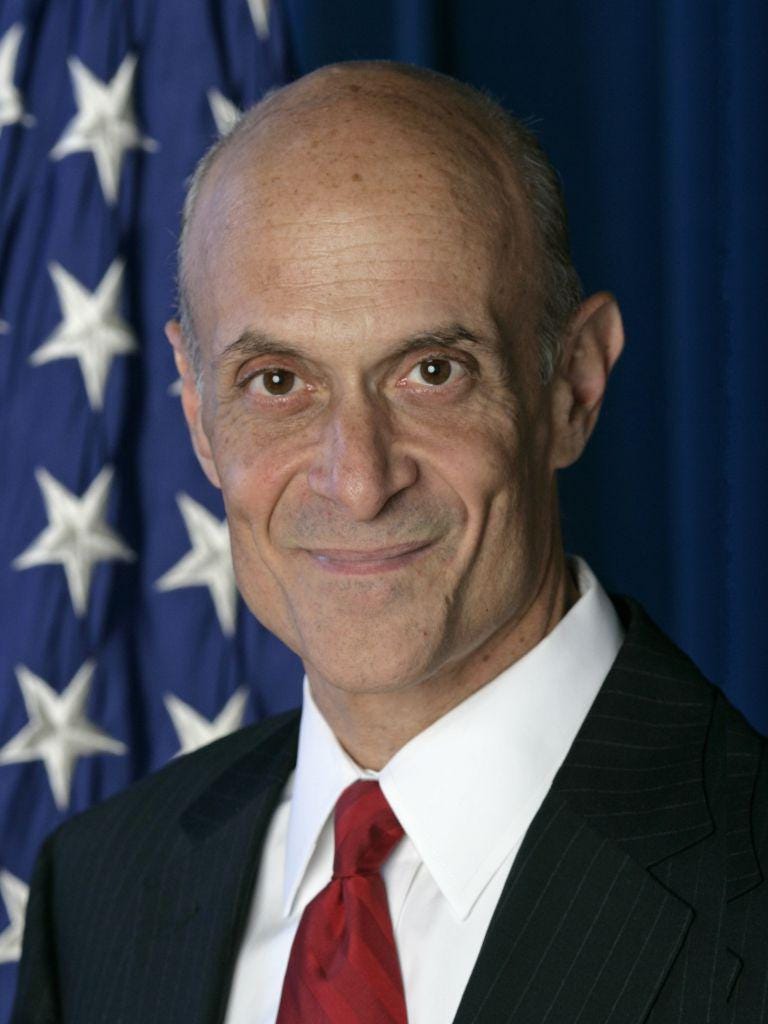
I’m talking, of course, about Michael Chertoff.
While there’s no direct smoking-gun proof that the current Mass Shooting Of The Week Club is connected to the Disinformation Governance Board, Chertoff has something of a history of weaponizing extremely dodgy incidents of “terrorism” to advance his agenda, whether that’s getting the Patriot Act passed after 9/11 or having the full nude body scanners manufactured by his company the Chertoff Group’s client Rapiscan (yes, the horrifically invasive body scanner company actually had the word “rape” in the name) installed in airports across the US after the “underwear bomber” Umar Farouk Abdulmutallab supposedly tried and failed to detonate a bomb in his big-boy panties aboard an airplane.
The Chertoff Group’s client list is positively bursting with the sort of company that would benefit from a rash of mass shootings, and Chertoff himself sits on the board of the Jeffrey Epstein-backed Carbyne911, a firm perhaps most notable for its many links to Israeli intelligence, the cartoonish way in which Tel Aviv has sold it as precisely the solution to America’s mass shooting ‘problem,’ and the ease with which it can be turned into a Trojan horse for the Unit 8200 alumni who founded it, allowing Israeli spies to slurp up a wealth of sensitive information without even having to deceive their targets. Carbyne911 turns the user’s phone into an audio/video transmitter in much the same way as infamous Israeli spyware firm NSO Group’s Pegasus malware did, except Carbyne911 is installed deliberately by the user, ostensibly to keep them “safe” – and activating one device activates all other devices in the area that have Carbyne911 installed, potentially giving the company access to an entire building’s worth of sensitive audio-visual data. The company also sells its services for non-emergency purposes, allowing it to keep its foot in the door for those slow times between mass shootings, and in addition to the US, Israel and Mexico, it has offices in Ukraine, which is surely just a coincidence…
Chertoff, one of the architects of the Bush administration’s post-9/11 torture policy, is also well-known for his utter lack of humanity – something that would have been inculcated in him from a young age if his mother Livia Eisen was, as many qualified investigators believe, an early Mossad member. One would have to look far indeed for anyone more likely to inaugurate a “mass shooting of the day” campaign in order to strip Americans of their Second Amendment rights once and for all, or have certain political views declared illegal and elevated to the level of domestic terrorism – all while making a buck for his Chertoff Group security industry clients. Guilford County, North Carolina reportedly plans in the wake of this sudden outpouring of senseless FBI-adjacent violence to begin installing body scanners at its 19 high schools and 23 middle schools, and with the bidding process open you can bet that Rapiscan or its parent company OSI Systems will be taking a big bite out of the taxpayer’s wallets in that state – if not, in reality, out of crime.
Setting up one mass shooting after another is quite clever, from the point of view of pure evil. Researchers digging through the exhaustive amount of evidence indicating at least one “retired” FBI agent had explicit advance knowledge of where, when, how, and with what weapons Payton Gendron was going to shoot up a supermarket in Buffalo will have their work cut out for them simultaneously researching the constantly-shifting stories fed the public by Uvalde, Texas authorities following the shooting at Robb Elementary School, where a kid supposedly so poor his peers mocked him mercilessly for it was suddenly able to afford over $5000 worth of high-end guns and ammo (we know the prices because he supposedly sent the receipt to one of his online “friends” – who couldn’t possibly have been another agent who wanted to make sure his donations to his little buddy in Uvalde were being well-spent! surely there’s an innocent reason CNN deleted that claim from their current version of the story!) while also keeping an eye out for any possible anomalies at the New Orleans graduation shooting and the Tulsa hospital shooting and the Pittston, PA Wal-Mart shooting and the Los Angeles high school shooting—which all took place in a 48-hour span. By the time the identity of Gendron’s FBI pal is confirmed, will anyone even remember who he is?
They won’t, of course, certainly not in the US’ goldfish-memory news cycle. But the ideas slipped into Gendron’s word salad of a manifesto will be added to the list of unacceptable views the holding of which makes an individual a terrorist in the eyes of the government. Unreadable mashups of copypaste, memes, and gearhead masturbation like his magnum opus make it clear that these incidents are being deployed as de facto shopping lists for ideas the narrative managers want removed from circulation. Gendron (or rather, the intelligence agents who programmed him to open fire inside a Buffalo supermarket last month) is not only obsessed with so-called assault rifles and military-grade body armor, “he” also appears to be capable of basic levels of pattern recognition regarding the activities of international financial cartels with a tendency to hide behind a certain ethnic group who use the religion to which they supposedly belong and its members as human shields for all manner of atrocities, then accuse anyone who notices of “antisemitism” for having eyes, ears and a functional brain. This phenomenon has been observed and described by scholars for centuries, and its perpetrators are sick of ordinary people noticing, hence their decision to shoehorn it in between an array of juvenile “white supremacist” cliches in the hope of having any mention of this reality declared “hate speech.”
This sort of thing is hardly new. The intelligence agents who crafted Gendron’s “manifesto” followed a long tradition of guilt-by-association when they larded it with credibility grenades largely consisting of the kind of dull-edged racism one generally sees in the kind of person who, in the absence of any real accomplishments of his own in which he can take pride, falls back on his ancestry, which he embraces with an overblown “pride” as if an accident of birth is an adequate substitute for achievement. No one with a functioning critical capacity actually believes these types are a threat before the FBI puts a gun in their hands and points them at the nearest pressure point. But throwing a bunch of bodies on the pile has ginned up a new round of well-funded outrage, perhaps best exemplified by New York Governor Kathy Hochul, who leveraged the death toll to pass a law against the contents of the manifesto so incomprehensible and unpopular even the media establishment can’t find anything nice to say about it.
Now anyone who expresses any of the ideas espoused by someone who later goes on a shooting rampage – whether he’s gently guided by an FBI agent (or a rumored yet frustratingly citation-deficient online cheerleading section) or merely motivated by revenge on an ex-girlfriend or a doctor who may have made a mess of his back surgery – becomes that much easier to tar and feather with the all-purpose “hate speech” brush.
For the parasitic elites and the intelligence agencies, who generally work hand in hand anyway, expressing such “white-supremacy-adjacent” ideas will be seen as a precursor to embarking on yet another mass shooting rampage, deemed “pre-crime” under the Domestic Terrorism bill recently passed in the House and only a few more mass shootings away from being rammed through the Senate. Anyone expressing such ideas can be imprisoned for their own “safety,” in the same way as was laid out in the Trump administration’s proposed HARPA and DEEP programs. HARPA proposed monitoring an individual’s electronic devices for signs of mental illness, which could be acted upon to neutralize the individual without evidence they would so much as hurt the proverbial fly; DEEP would similarly intervene against individuals deemed to be “mobilizing toward violence,” deploying “court ordered mental health treatment,” electronic monitoring, and every other tool in the I-can’t-believe-it’s-not-prison toolbox against individuals who’ve done nothing except set off what has become an absurdly sensitive set of pre-crime “red flags.” Given that the mass shooting of Columbine was believed by those closest to the perpetrators to be triggered by their use of antidepressant drugs, the idea of funneling would-be shooter types into psychiatric care instead of as far away from it as possible is ironic at best, a sick joke at worst.
And given the ever-yawning definition of Domestic Terrorism in 21st century America, the only way to escape the tightening net of absurdly punitive speech laws will soon be to curl up in the fetal position at the feet of BlackRock CEO Larry Fink as he lies sleeping, like a loyal pet, in order to prove oneself clean of ideological sins.
Thus, while the seemingly endless stream of mass shootings unfolding over the last two weeks is clearly designed to encourage Americans to beg their government to take their guns away, anything, anything to make it stop, for the children, et cetera, it’s also designed to encourage Americans to shut up those mean people online, because if they can’t convince the half of the population that owns guns to chuck them over an increasingly absurd series of “mass shootings,” taking away their right to complain is a sufficient consolation prize.
Playing chicken with dead kids is the sort of sick game only a Michael Chertoff could win, and given the absolute cowardice that sets in when anything about a mass shooting – even really obvious things like retired FBI agents befriending the shooters and being publicly told where and when they would commit their acts in time to prevent them – is questioned, he is likely to come out on top if we allow this insanity to continue without asking the obvious questions – not just about who benefits (that much is clear) but about who is setting these events up one after another to go off in a carefully timed string like fireworks on the 4th of July (and we can expect a biiiiiiig mass shooting that day, just to hammer their point home).
Leaked documents expose US ‘Ministry of Truth’
Samizdat | June 9, 2022
The US government planned to use its now-shelved Disinformation Governance Board (DGB) to make social media platforms remove posts the government deemed false, according to leaked documents obtained by opposition lawmakers.
Republican Senators Chuck Grassley (Iowa) and Josh Hawley (Missouri) cited the whistleblower files in an open letter to Department of Homeland Security chief Alejandro Mayorkas published on Wednesday, in which they pressed for more details on the controversial DGB.
The department “planned to coordinate efforts to leverage ties with social media platforms to enable the removal of user content,” the senators said in a press release, adding that it sought to use Big Tech sites to “enforce its agenda.”
First floated in April, the board was quickly paused after a strong public backlash in which critics likened it to a state-run ‘Ministry of Truth’. The lawmakers said the leaked documents raised “serious concerns” about the initiative.
“The DGB was established to serve as much more than a simple ‘working group’ to ‘develop guidelines, standards, [and] guardrails’ for protecting civil rights and civil liberties,” they wrote. “In fact, DHS documents show that the DGB was designed to be the Department’s central hub, clearinghouse and gatekeeper for Administration policy and response to whatever it happened to decide was ‘disinformation.’”
Grassley and Hawley argued that the Biden administration has offered no clear definition of “disinformation,” and that the DHS board had shown serious bias even in its earliest stages, despite assurances it would remain apolitical.
In particular, they pointed to author and ‘Disinformation Fellow’ Nina Jankowicz, chosen to head the DGB, claiming she is “a known trafficker of foreign disinformation and liberal conspiracy theories.”
Jankowicz may have been hired chiefly due to “her relationship with executives at Twitter,” the senators claimed, adding that the leaked documents show the White House planned to “operationalize” connections with social media companies to “implement its public policy goals.”
Draft briefing notes prepared in late April indicate that a senior DHS official, Robert Silvers, planned to meet with Twitter executives to discuss the disinformation board, though it remains unclear whether the scheduled meeting ever took place.
The two senators urged Mayorkas to divulge more information about the department’s goals for the DGB, including whether it ever asked social media firms to “censor, flag, add context to, or remove” user posts or ban accounts. They also requested documents and communications related to Jankowicz, and called on the government to give its definition for actionable disinformation, saying it should “identify who exactly is ultimately responsible for making this determination.”
How can this government of deceivers protect our ‘safety’?
By Suzie Halewood | TCW Defending Fredom | June 7, 2022
HOW can a government that locked us down, collapsed our businesses, imposed a useless mask compliance regime, misled us about the severity of Covid while stifling information about safe, effective treatments in order to force through emergency use approval for ‘vaccines’ and nudge us towards experimental treatments that not only failed to prevent transmission, but caused irreversible damage and death, be in any position to decide what constitutes ‘harm’?
Yet here comes the Online Safety Bill, threatening not only hefty fines from free-press-suppressing Ofcom, but also prison time for anybody judged to have caused psychological harm leading to ‘serious distress’. Harmful content could include online bullying and abuse, advocacy of self-harm and the spreading of misinformation (defined as information that is false, but not created with the intention of causing harm) disinformation (information that is false and created to harm a person, social group, organisation or country) and malinformation (information that is based on reality, used to inflict harm on a person, organisation or country).
Section 53 (c) of the Online Safety Bill determines offending content to be anything that ‘presents a material risk of significant harm to an appreciable number of children in the United Kingdom’.
Like a vaccine then, or masks, or not seeing your friends, or not being able to go out, or attend school and with the added fear that by being ‘selfish’ and not taking a vaccine you didn’t need, you could kill your granny, mum, dad and teacher. Little wonder 374,646 children and young people contacted mental health services last month. The number of adults contacting mental health services in the same period was 1,054,003.
Harms with a less clear legal definition include ‘Coercive Behaviour’ (a government speciality), ‘Disinformation’ (Gates-funded MSM, WHO and all those ‘fact-checkers’ sponsored by the usual suspects), ‘Intimidation’ (jabs for jobs) and ‘Advocacy of Self-Harm’ (‘vaccines’).
The Bill, which also ‘protects’ adults – in case, God forbid, we might have the temerity to think for ourselves – empowers Ofcom to block users, control, moderate and take down content. Criminal sanctions currently in ‘reserve’ could be imposed on tech giants if they fail to clean up their acts or do not ‘allow Ofcom access to their algorithms’ – algorithms that show ‘how easily, quickly and widely content may be disseminated by means of the service’. In other words, Ofcom has been given free rein to make any significant change to a risk profile and make their own assessment as to the level of risk of harm to adults and how quickly such perceived-to-be-harmful content can be spread. So if Ofcom decides – as with YouTube’s Covid-19 Misinformation Policy (slight conflict of interests since Google Ventures invested in the AZ ‘vaccine’) which defines medical misinformation as any content that ‘contradicts guidance from the WHO or local health authorities’ – that ivermectin can cause harm, they can take down any mention of ivermectin (even if the only damage caused by ivermectin is to the profits of the pharma criminals) regardless of the fact Ofcom does not employ immunologists, epidemiologists or virologists.
As for ‘hate speech’, defined as ‘all forms of expression which spread, incite, promote or justify hatred based on intolerance on the grounds of . . . belief . . . or opinion’, would Piers Morgan’s ‘Anti-vaxxers really are a bunch of spineless pussies’ tweet, or Noam Chomsky’s insistence that the unvaccinated be segregated and that getting food was ‘their problem’, qualify as hate speech? Of course not. Their views are in line with The Agenda.
Adults don’t need Ofcom chief executive Dame Melanie Dawes deciding for them what they can or can’t watch (I use a VPN for Russia Today, Melanie) any more than they need Bill Gates telling them what they can eat (synthetic burgers) or Nadine Dorries pushing through the government’s idea of what constitutes harm or safety. Offence is taken, not given. If I wish to be offended, that’s my choice.
If the government genuinely cared about harm, they’d have carried out risk assessments to weigh up the pros (none) and cons (it was) of locking down the country. They wouldn’t have wilfully terrified the public when they knew full well Covid wasn’t a risk, as they themselves were partying like it was 1984.
Had Nadine ‘I’m A Celebrity . . . Get Me Out of Here’ Dorries cared about ‘harm’ she’d have voluntarily answered one of the 50 letters and emails sent to her by one of her own vaccine-injured constituents instead of having to be pressured into a response by a lobbying group taking up the cause of the vaccine-injured.
If the government cared one iota for the electorate, the vaccine rollout would surely have been halted following a September 2021 meeting in which Tess Lawrie, Dolores Cahill, Mike Yeadon and other doctors and scientists presented damning evidence to Sir Graham Brady of the 1922 Committee which illustrated how a mass rollout of the Covid-19 ‘vaccines’ for children would lead to children being maimed, killed and sterilised.
Such disregard for the electorate runs throughout government. There was a full house for Zelensky’s Churchill-plagiarising extravaganza compared with a paltry five MPs for the reading of Sir Christopher Chope’s Private Member’s Bill aimed at reforming the government’s Vaccine Damages Payment Scheme (VDPS).
Despite more than 2,000 deaths and approaching a million and half injuries (including blindness, strokes and paralysis) reported to MHRA’s Yellow Card scheme (set up following the thalidomide scandal) no compensation has yet been paid. As the VDPS doesn’t consider death as a qualifier for the 60 per cent disability requirement needed to pay out the paltry £120,000 to cover a lifetime of injury, clearly they’re already trying to wriggle out of it.
Before the Online Harms Bill goes any further, it might be a good idea to decide who is the best legal arbiter to rule on what unequivocally constitutes mis-, dis- or mal-information and who in the government (if anyone) has the moral authority or psychological capacity to judge what represents psychological ‘harm’ either to a child or an adult.
If the Online Safety Bill does pass, first in the dock should be the government.
‘Beacon of democracy’ Kiev regime’s practice of kidnapping people spirals out of control
By Drago Bosnic | June 6, 2022
Ever since the Obama administration orchestrated the 2014 Euromaidan color revolution (US/NATO’s weapon of choice when hijacking entire nations), the mainstream media have been feeding the political West’s populace the narrative of Ukraine being the “freedom and democracy lighthouse in the dictatorial post-Soviet darkness”. However, after the start of Russia’s special military operation more than three months ago, this narrative went into orbit. Still, in order to proclaim a country “the beacon of freedom and democracy”, let alone claim the said country could “teach Americans and the world a thing or two about democracy”, certain standards should be met.
One of the first postulates of freedom and democracy should be the freedom of thought, speech and expression. This includes both mass media and individuals. However, one problem with this is that not even the West respects these basic principles, as most alternative sources of information there have been suppressed. Thus, in practice, Ukraine does follow the political West’s definition of “freedom and democracy”. Worse yet, Ukraine goes even further in implementing it. And it does so by physically removing any individual with “dissenting” views and opinions. All one needs to do is disagree with any of the Kiev regime’s decisions, policies or laws and they’re immediately removed. As in, quite literally taken, or more precisely, kidnapped by the regime, in particular its SBU enforcers, in a manner echoing the “best” CIA and NSA practices.
In recent months, these practices have escalated out of control. On June 3 the Donetsk People’s Republic Ombudsman Daria Morozova stated that Donetsk People’s Republic services have provided information on mass abductions of people by the special services of Ukraine, primarily the infamous SBU. Ukrainian services carry out illegal mass arrests on ideological grounds. Most disturbingly, this also includes the kidnapping of minors.
“With the start of the special operation, ideologically motivated kidnappings not only resumed, but also acquired a massive character,” Morozova commented on the situation in Ukraine. “I received reports of mass abductions, including of minors. At present, I have received a certain number of applications from relatives of those abducted on the territory of Ukraine,” the official stressed.
Morozova described the illegal detention of citizens as “methods of the US and UK.” The abducted are kept in special prisons and are subjected to “illegal methods of interrogation” or more precisely, torture. The ombudsman cited statistics from the Office of the UN High Commissioner – from April 2014 to April 2022, up to 4,000 people were arbitrarily detained by Ukrainian services in connection with the situation in Donbass, with approximately 60% of arrests made without legal grounds.
In Kharkov, Ukrainian security services kidnapped the daughter of Vladimir Demchenko, an officer of the DPR People’s Militia. He spoke about this at a briefing on June 3 in Donetsk. The Special Operations Forces (SOF) of Ukraine have already contacted the military and tried to force him to cooperate with them.
“I received a message via Telegram: ‘Dad, they took me because of you, tomorrow at 11:00 they will get in touch.’ They told me that they represent the special operations forces and added ‘you will talk to us or it will be different from what you want.’ The conversation we had lasted about 21 minutes, during which they tried to persuade me to cooperate,” Demchenko stated.
Another instance of the Kiev regime’s view on “freedom and democracy” is the fate of Elena Berezhnaya, the founder and director of the Institute for Legal Policy and Social Protection. For nearly three months, she has been in the dungeons of the SBU. Berezhnaya, one of the most prominent human rights activists in Ukraine was arrested by the SBU on March 16 in her Kiev apartment and thrown into the Lukyanovka pre-trial detention center. As of this writing, there has been no contact with her, and nothing is known about her condition. Berezhnaya has been reporting on the state of human rights in Ukraine since 2014. She provided irrefutable evidence of the atrocities committed by numerous Neo-Nazi groups and their connections with the Kiev regime, including crimes against civilians and violations of the rights of Russian-speaking citizens.
Berezhnaya is well known for her report to the German Bundestag, in which serious Kiev regime violations of the European Convention on Human Rights were documented in detail. OSCE also received her reports on justice in Ukraine and the disastrous consequences of reforms and discriminatory laws passed by the Kiev regime. Despite regular and close cooperation with international organizations, they completely ignored the kidnapping and arrest of the Ukrainian human rights activist and did not even try to arrange her release. The SBU accused Berezhnaya of “treason” – a very serious charge used as an excuse for arresting any dissident with supposedly “pro-Russian views.”
Days prior to Berezhnaya’s arrest, on March 10, a well-known Ukrainian poet and publicist Yan Taksyur was detained by the SBU and thrown into a Kiev pre-trial detention center without the right to protection, treatment or any information about his condition. Taksyur also has cancer, making his arrest all the more troubling. The 70-year-old poet is a Soviet and Ukrainian satirist known for ridiculing and criticizing the parasitism and crookedness of Ukrainian elites. The SBU “found signs of treason” in his works, namely in his articles titled “Fascism will not pass or the Banner of Victory in the darkness of Enslavement” and “Classics in Ukraine or return the Russian book to Kiev!”
The Kiev regime’s repressive state apparatus conducts particularly harsh reprisals against the leaders of the Ukrainian left. The founder of the Ukrainian Union of Left Forces, publicist and political scientist Vasily Volga was also detained back in March. During his arrest, Volga was wounded and then tortured during interrogation. He was also denied medical care. The Kononovich brothers from Kiev were also arrested and subjected to severe torture. Mikhail and Alexander Kononovich were the leaders of the Ukrainian Komsomol and their “crime” was the condemnation of the Kiev regime’s attempted ethnic cleansing and armed aggression in Donbass. As of this writing, no information about their fate is available. Neither relatives nor lawyers have been able to contact them.
Orthodox journalist Dmitry Skvortsov, writer-historian Alexander Karevin, TV presenter and political scientist Dmitry Dzhangirov, political scientist Yury Dudkin, leader of the “Faithful Cossacks” Leonid Maslov and hundreds of others have also been subjected to searches, threats and detention in Kiev. The SBU freely conducts government-approved mass terror, while nothing is known about many of those arrested. Arrests are being carried out in all cities controlled by the Kiev regime.
A prominent Odessa-based journalist Yuri Tkachev was also arrested. During a search, SBU supposedly “found” explosives Tkachev apparently left in plain sight in his Odessa apartment. Also in Odessa, SBU kidnapped the daughter of Mikhail Vyacheslavov, a man killed in the 2014 House of Trade Unions fire. Elena was accused of attending rallies, where Odessans paid tribute to the memory of people which Neo-Nazis burned alive in the House of Trade Unions on May 2, 2014.
This is just the tip of the iceberg of how the Kiev regime sees “freedom and democracy”. Suppression of free speech, freedom of thought and expression might pale in comparison to the horrendous war crimes the Western-backed Neo-Nazi regime is committing in Donbass, however, the sheer hypocrisy of portraying the Kiev regime as a “beacon of freedom and democracy” makes the political West complicit in all of the crimes committed against not just the people of Donbass, but the people of Ukraine itself as well. The crimes we know of so far (which, in reality, might be orders of magnitude worse) should be more than enough to strip the Kiev regime of any legitimacy. That is, if there’s any legitimacy left.
Ukraine: The Disinformation War
By Declan Hayes | Strategic Culture Foundation | June 4, 2022
Ukraine: The Disinformation War was the title of the latest piece of disinformation the state funded British Broadcasting Corporation (BBC) showcased to support Britain’s Ukrainian war and to suppress dissent on its home front.
Radio 4’s hit piece was a personalized attack on a number of British-based academics, who had been recently named and shamed in the British House of Commons for not being sufficiently Russophobic; the House of Commons is the lower house of the British Parliament; it is where Wee Joe Devlin, a member for Belfast, was beaten within an inch of his life by his fellow MPs for denouncing British war crimes in Ireland as more of his fellow MPs called for him to be summarily murdered. As several MPs have recently been convicted of child sex rape charges and more are facing trial for sexually assaulting their fellow MPs, its pronouncements should be discounted accordingly.
As, of course should those of the BBC for reasons adumbrated below and for others which Justin Schlosberg, Piers Robinson and Tim Hayward outlined in their tweets following this further attack on them by the BBC and its dark allies.
In its pretenses to impartiality, the BBC claim that these academics are so “driven by a conviction that Western governments are responsible for many of the world’s ills” that they “have shared misinformation in their attempts to raise questions about the official narrative of the war” leading “their detractors [to] say they are useful to Vladimir Putin” and for the academics to counter claim “there’s a McCarthyist witch hunt against them”.
Within that pre-cut British imperialist box, a few carefully edited soundbites from Schlosberg and their other targets, as well as a deluge of disinformation from their targets’ students and critics comprise this BBC kangaroo court by radio.
J’accuse
Hayward’s primary crime seems to be he mentioned a contentious 2018 chemical gas attack in Syria to opine that there are at least two versions to what actually happened. For the record and for reasons I address below, I believe all such attacks were orchestrated by the Syrian rebels, aided and abetted by the BBC and MI5. Hayward, importantly, is not that forthright. He believes, on the evidence in front of his nose, and as one who writes academic articles on disinformation, that further inquiries are needed to fully unmask the real culprits, whoever they may be, of the 2018 Douma and 2022 Bucha attacks. Hayward is, in essence, agnostic as, perhaps, academics and the BBC should be.
With regards to the Bucha atrocities, which I addressed in an earlier article, and which the BBC is using to attack Hayward et al, though a full investigation is likewise needed into unmasking those culprits, the British regime have vetoed such a call in the UN. But, as such an investigation must be impartial to be worthwhile, that would, of course, exclude the BBC and those they use to fatten out hit pieces like this.
Round Up the Usual Suspects
In their efforts to discredit Hayward et al, the BBC interviews James Roscoe, Britain’s UN Ambassador, who dutifully trots out the British government’s line on Bucha.
Nader Hashemi, an American itinerant academic with no Syrian connections, is wheeled out to say how horrified he is that Hayward can mention the Douma attack, “a border line genocide”, in passing and how concerned he is that Hayward’s fleeting mention of the Douma war crime might be putting young minds at risk.
Kvitka Perehinets, one of Hayward’s Ukrainian students, is wheeled out to tell the BBC’s worldwide audience, as she has already told Hayward’s academic bosses, that Hayward should be silenced. Although Perehinets’ family are currently fighting Russian speakers in Ukraine’s East, Perehinets does not make it clear if Hayward should be dispatched with a bullet to his head or simply disgraced by being strapped to a lamp post as he undoubtedly would be in government held Ukraine.
Pride of place in the written version of the BBC’s hit piece went to Hayward critic Mariangela Alejandro, a young, purple haired Mexican student with a nose ring, a baby’s dummy around her neck and a cute purple amethyst ring on her marriage finger. Mariangela informs us that she had heard Hayward was a good lecturer but that, shortly into his course. things started to get “weird” as “he goes from talking about global financial markets [and] poverty, into this realm of conspiracy theories about [Syrian President Bashar al] Assad and Russia.”
Although one of my earlier articles debunked the conspiracy theory canard specifically for instances like this, the very short clip the Radio 4’s hit piece played suggests mentioning it may have been germane to Hayward’s lecture. If, as Mariangela alleges, Hayward’s lectures were the disjointed ramblings of a conspiracy theorist (sic), then that would have been picked up by the student evaluation forms and conveyed to the university’s top brass through the students’ class rep and the Students’ Union. Even if, as I doubt, Mariangela was the class rep, it was not her place to broadcast her criticisms to the BBC and thence to the world.
Send In the Clowns
Hayward is a member of the Working Group on Syria, Propaganda and Media, whose affiliates include a number of mercenary fringe thinkers, as well as the afore mentioned Piers Robinson, who has now gone on to greater things. I mention Robinson here as the BBC made no effort to discover what has become of him, even though a 60 second Internet trawl would have solved that conundrum, to Robinson’s credit.
Because there is war is afoot, all sides will have their mercenaries and their idiots, useful or otherwise. That NATO, in President Putin’s own words, is infinitely better resourced than is Russia, it stands to reason that NATO has more brown envelopes to push the BBC’s way than do opposing or neutral outlets. That is not to say that every NATO journalist or blogger is a media whore. Far from it.
Justin Schlosberg, one of those the BBC hatcheted, was attacked for citing Patrick Lancaster, an American citizen journalist embedded on the Russian side of Ukraine’s lines. But, as Schlosberg’s tweets as well as my earlier article on citizen journalists, which explicitly mentioned Lancaster, make plain, Lancaster’s work only helps us to ascertain if there is anything to be seen that warrants further investigation if, in those immortal words, anyone had been raped and speaks English. Beyond that, Lancaster is irrelevant.
Though Lancaster is not the hill academics like Schlosberg should be crucified on, it is crucial to note that the BBC and other NATO outlets repeatedly used the work of the White Helmets and related terror groups in Syria. Because the BBC, as Robert Stuart’s sterling work clearly shows, not only used their footage but were deeply embedded with the White Helmets, ISIS and other terrorists, they are in no position to cast vitriol at Lancaster or at Schlosberg for mentioning Lancaster, almost in passing.
NATO, in any case, has its own cast of clowns, amongst the most elevated of whom is Scott Lucas, who was an American professor of American Studies at Birmingham University in England, with ties to the Toran Research Center, which has major links with Turkish Intelligence and with supposedly demobbed Syrian terrorists. Lucas regularly appears on the mainstream media, holding forth on Syria and other issues he has no expertise on.
Prominent journalist Peter Hitchens noted that, when he phoned up Lucas to discuss Lucas’ uninformed comments on the White Helmets’ murder gang, Lucas hung up on him. Though Lucas is a NATO lightweight, Hitchens is noteworthy as the BBC were forced to apologize to him over their coverage of NATO’s 2018 Douma chemical gas attack and to confess that Chloe Hadjimatheou, who ran that piece and who also did the Hayward/Schlosberg hit piece we are now discussing “failed to meet the Corporation’s editorial standards for accuracy by reporting false claims”. Hadjimatheou, in other words, has long been guilty of the same misinformation offenses she tries to concoct against Hayward et al. This, remember, is the same NATO media that swore black and blue that Tom Mac Master, a bearded American academic in Scotland, was a Syrian lesbian being oppressed by “Assad” in Damascus where, like Lucas and Hashemi, MacMaster had never been in his life.
Then we have bottom feeder Eliot “Suck my Bellingcat Balls” Higgins, whom the Atlantic Council, the BBC and affiliated NATO front groups built into a citizen expert on all things military to justify their predetermined anti Syrian and anti Russian NATO narratives. Given that Eliot Higgins, Bellingcat’s founder, could not even hack the easiest course at Britain’s easiest university, the only explanation as to why MI6 and allied media outlets and intelligence agencies push Bellingcat, Bana and others to prominence is to dumb down debate to the level of babbling infants so that no one worth their salt would bother getting involved in trying to stop NATO’s war crimes. The BBC hit piece on Hayward et al is a part of that process.
This link fillets Higgins’ foolish pronouncements on the Ghouta false flag chemical attack. Dr Neal Krawetz has slammed Higgins’ et al’s use of his image identifying software, and he has called them idiots not worth spending time on. But Profs Postol and Krawetz are, like Hayward et al, forced to waste their very valuable time clinically ticking off these useless idiots, who have no relevant experience or knowledge to promote or defend the White Helmets terror gang, but who are widely cited in the BBC and similar pro-war Western mainstream media to do just that.
Nader Hashemi, the American itinerant academic, who speaks about a Syrian “border line genocide” falls into the same useful NATO idiot camp. And so too does the odious Oliver Kamm, who took a day off from running his years-long clandestine vendetta against Neil Clark and getting Philip Cross to edit Wikipedia pages he disapproves of to weigh in on this latest BBC smear piece.
Muslim Brotherhood Royalty
Tim Hayward could do worse than to get his students to survey Robert Stuart’s sterling work, which is a damning indictment of the BBC’s misinformation. Central to Stuart’s work is Dr Rola Hallam who, as a member of the Muslim Brotherhood’s al Kurdi family ,was the BBC’s fixer in ISIS controlled Syria.
Dr Rola Hallam is the daughter of Mousa al Kurdi, one of the head honchos in the supposedly moderate wing of Syria’s Murder Inc who was finding evidence of chemical gas attacks wherever this clown chanced to look. During BBC Panorama’s farcical show, Rola, her BBC crew and her Hand in Hand for Syria stooges (who threatened to sue me and much more) sailed unimpeded through ISIS checkpoints. Hallam/Kurdi landed the lead role in that state controlled BBC farce. The BBC’s collusion with ISIS, as evidenced by their ability to sail through ISIS checkpoints and to work in ISIS strongholds, may be a further indication that the moderate and less moderate wings of Syria’s Murder Inc, just like the moderate and Nazi contingents of Zelensky’s junta, are in bed together and that the BBC should not pretend otherwise. Something there for Hayward and his purple haired students to chew over.
Ukraine to UK Universities
Although the attacks on Hayward et al could be viewed as a BBC storm in an academic tea cup, it is part of a much wider MI5 orchestrated campaign to kill the Western mind. Olexsandra Koval, the director of the Ukrainian Book Institute has declared that 100 million books, including all Russian classics, must be removed from circulation. These would come from “various genres, including children’s books, and love novels, and detective stories”. Although Mariangela Alejandro, the young, purple haired Mexican student with the nose ring, the baby’s dummy around her neck and the cute purple amethyst ring would perchance call me a conspiracy theorist (sic) for my past defense of Masha and Mishka, there is much to learn in those lovely tales, just as there was in Soviet film, at least according to Hollywood’s own Martin Scorcese, who acknowledged Hollywood’s debt to Soviet director, montage inventor and pioneer film theorist Sergei Mikhailovich Eisenstein, who is best known for his seminal 1925 silent film, Battleship Potemkin.
But Zelensky’s Nazis will have none of that and nor apparently will their compromized BBC apologists, whose warped minds think that there is something unclean about Masha and Mishka for no other reason than they are the creations of Russian geniuses. If Mariangela Alejandro, the young, purple haired Mexican student with the nose ring, the baby’s dummy around her neck and the cute purple amethyst ring wishes to understand what drives war crimes in Chiapas, as much as in Douma or Donbas, she might begin by looking at how everything Syrian and Russian is being marginalized, just as Mexico’s elite marginalized and murdered the Tzeltals, Tzotzils, Ch’ols, Tojolabals, Zoques, Lacandons, Mochós and Mams of Chapas.
As for Kvitka Perehinets, the young Ukrainian student, whose family are fighting Russian speakers in Eastern Ukraine, as she is at a university, she might like to read some of the 100 million books Olexsandra Koval wants to torch. She could, of course, try talking to a Russian student but Russian students now, being Russian, are haram. As for the rest of us, though we must continue to call hate groups like NATO and their BBC mouthpieces to account for the sake not only of academics like Hayward who try to call them to account but even more so for the sake of young minds like those of Alejandro and Perehinets they warp and even much more so because of those unsung youngsters who die in Douma, Damascus and Donbas as a result of the BBC’s misinformation toxins.
New Zealand PM uses Harvard acceptance speech to complain about online “disinformation”
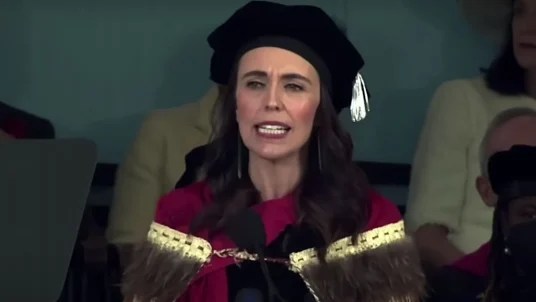
By Cindy Harper | Reclaim The Net | June 5, 2022
New Zealand’s Prime Minister Jacinda Ardern recently received an honorary degree from Harvard University. She used the opportunity to give a speech that attacked online “disinformation.”
Ardern attacked social media companies, saying that they needed to be more transparent and responsible.
“That means recognizing the role they play in constantly curating and shaping the online environments that we’re in,” she said.
“We seek validation, confirmation, reinforcement. And increasingly with the help of algorithms, what we seek, we are served, sometimes before we even know we’re looking.”
Ardern called on “social media companies and other online providers to recognize their power and act on it.”
“Let’s start with transparency in how algorithmic processes work and the outcomes they deliver. Let’s finish with a shared approach to responsible algorithms – because the time has come,” the New Zealand PM said.
Citing the “conspiracy theories” surrounding COVID-19, Ardern stressed the importance of facts, saying: “When facts are turned into fiction, and fiction turned into fact, you stop debating ideas and you start debating conspiracy.”
She also attacked some internet users, calling them “keyboard warriors.”
“In my mind, when I read something especially horrific on my feed, I imagine it’s written by a lone person, unacquainted with personal hygiene practices, dressed in a poorly fitted superhero costume – one that is baggy in all the wrong places,” she said.
“Keyboard warrior or not though, it’s still something that has been written by a human, and it’s something that has been read by one too.”
On democracy, she said that people ”wrongly” think that “somehow, the strength of your democracy was like a marriage – the longer you’d been at it, the more likely it was to stick.”
US State-Affiliated NewsGuard Targets Consortium News
By Joe Lauria | Consortium News | June 2, 2022
Consortium News is being “reviewed” by NewsGuard, a U.S. government-linked organization that is trying to enforce a narrative on Ukraine while seeking to discredit dissenting views.
The organization has accused Consortium News, begun in 1995 by former Associated Press investigative reporter Robert Parry, of publishing “false content” on Ukraine.
It calls “false” essential facts about Ukraine that have been suppressed in mainstream media: 1) that there was a U.S.-backed coup in 2014 and 2) that neo-Nazism is a significant force in Ukraine. Reporting crucial information left out of corporate media is Consortium News‘ essential mission.
But NewsGuard considers these facts to be “myths” and is demanding Consortium News “correct” these “errors.”
Who is NewsGuard?
NewsGuard set itself up in 2018 as a judge of news organizations’ credibility. The front page of NewsGuard’s website shows that it is “partners” with the State Department and the Pentagon, as well as with several major corporations, such as Microsoft. The nature of these “partnerships” is not entirely clear.
NewsGuard is a private corporation that can shield itself from First Amendment obligations. But it has connections to formerly high-ranking U.S. government officials in addition to its “partnerships” with the State Dept. and the Pentagon.
Among those sitting on NewsGuard’s advisory board are Gen. Michael Hayden, the former Central Intelligence Agency and National Security Agency director; Tom Ridge, the first U.S. Homeland Security director and Anders Fogh Rasmussen, a former secretary general of NATO. NewGuard says its ”advisors provide advice and subject-matter expertise to NewsGuard. They play no role in the determinations of ratings or the Nutrition Label write ups of websites unless otherwise noted and have no role in the governance or management of the organization.”
The co-CEO, with former Wall Street Journal publisher Louis Gordon Crovitz, is Steven Brill, who in the 1990s published Brill’s Content, a magazine that was billed as a watchdog of the press, critiquing the role of the media to hold government to account. NewsGuard is a government-affiliated organization judging media like Consortium News that is totally independent of government or corporations.
NewsGuard has a rating process that results in a news organization receiving either a green or red label. Fox News and other major media, for example, have received green labels.
Getting a red label means that potentially millions of people that have the NewsGuard extension installed and operating on their browsers will see the green or red mark affixed to websites on social media and Google searches. (For individuals that do not already have it installed and operating on Microsoft’s browser, it costs $4.95 a month in the U.S., £4.95 in the U.K., or €4.95 in the EU to run the extension.)
According to NewsGuard, libraries in the U.S. and Britain have had it installed on their computers, and it is also being put on computers of U.S. active duty personnel. Slate reported in January 2019 that NewsGuard:
“struck a deal with Microsoft to incorporate those ratings into the tech giant’s Edge browser as an optional setting. That’s when the Guardian noticed that the Mail Online had been tagged by NewsGuard with a ‘red’ label, a reliability score of 3 out of 9, and the following warning: ‘Proceed with caution: This website generally fails to maintain basic standards of accuracy and accountability.’ For Microsoft Edge users with the ‘News Ratings’ feature turned on, that warning appeared alongside every link to the Mail Online—whether in Google search results, Facebook or Twitter feeds, or the Mail’s own homepage.”
Approach to Consortium News
Consortium News was contacted by NewsGuard analyst Zachary Fishman. In his request to speak to someone at Consortium News he said categorically that CN had published “false content” and that the interview would be on the record. “I’m hoping to talk with someone who could answer a few questions about its structure and editorial processes — including its ownership, its handling of corrections, and its publication of false content,” he wrote in an email.
As editor-in-chief, I informed him that our founder, editors and writers came from high levels of establishment journalism. I told him that in thousands of press interviews I’ve conducted over nearly half a century in journalism I had never known anyone accusing a prospective interviewee of misconduct upfront and then determining that the interview would be on the record, when the ground rules are usually set by the person being interviewed.
Fishman apologized and tried to say his mind wasn’t made up about Consortium News, when he had clearly stated that it was. “I do apologize that the wording of my email insinuated that I had come to a predetermined conclusion on whether your website has published false content, when I have not — be sure that I am interested in your responses to my questions,” he wrote in an email.
According to his LinkedIn profile, Fishman had one previous job in science and financial journalism that lasted 15 months for a company called Fastinform that is now defunct. Last month, all the links of his published pieces on LinkedIn went to a site that no longer exists. The links have now been removed.
Fishman has degrees in health, environment and science journalism and engineering physics. He has no experience in political reporting and especially of the politics of Eastern Europe and U.S.-Russia relations.
NewsGuard’s determination on Consortium News will be made by the analyst and, “At least one senior editor and NewsGuard’s co-CEOs review every Nutrition Label prior to publication to ensure that the rating is as fair and accurate as possible.”
Charge: There Was ‘No US-Backed Coup’
NewsGuard alleges that Consortium News has published “false content” by reporting that there was a U.S.-backed coup in Ukraine in 2014 and that neo-Nazis have significant influence in the country.
Fishman took issue with a:
“February 2022 article ‘Ukraine: Guides to Reflection,’ [which] asserted, ‘Hence, the inflation of Russian behavior in Ukraine (where Washington organized a coup against a democratically elected governmentbecause we disliked its political complexion) … .’
Fishman then wrote:
“The U.S. supported the Maidan revolution that ousted then-Ukraine President Viktor Yanikovych (sic) in 2014 — including a December 2013 visit by John McCain to Kyiv in support of protesters — but there is no evidence that the U.S. ‘organized’ a ‘coup.’ Instead, it has the markings of a popular uprising, precipitated by widely covered protests against Yanukovych’s decision to suspend preparations for the signing of an association and free-trade agreement with the European Union.”
Viktor Yanukovych was democratically elected as president of Ukraine in 2010 in an election certified by the Organization for Security and Cooperation in Europe, a fact not mentioned in NewsGuard’s writings on the change of government in Ukraine. Even though Yanukovych agreed to an EU political settlement and early elections, violence forced him to flee from the capital on Feb. 21, 2014. Reporting that the neo-Nazi Right Sector was at the forefront of the violent overthrow, The New York Times (green check) wrote earlier that day:
“Dmytro Yarosh, the leader of Right Sector, a coalition of hard-line nationalist groups, reacted defiantly to news of the settlement, drawing more cheers from the crowd.
‘The agreements that were reached do not correspond to our aspirations,’ he said. ‘Right Sector will not lay down arms. Right Sector will not lift the blockade of a single administrative building until our main demand is met — the resignation of Yanukovych.’ He added that he and his supporters were ‘ready to take responsibility for the further development of the revolution.’ The crowd shouted: ‘Good! Good!’
A study on the violence used to overthrow the government, by Prof. Serhiy Kudelia, a political scientist at Baylor University, says the overthrow succeeded because of “the embeddedness of violent groups” in a non-violent protest. The violence began on Dec. 1, 2013 when these violent groups attacked police with “iron chains, flares, stones and petrol bombs” and tried to ram a bulldozer through police lines. The police viciously fought back that day.
As the International Business Times (IBT) (green check) wrote about these groups at the time:
“According to a member of anti-fascist Union Ukraine, a group that monitors and fights fascism in Ukraine, ‘There are lots of nationalists here [EuroMaidan] including Nazis. They came from all over Ukraine, and they make up about 30% of protesters.
Different groups [of anarchists] came together for a meeting on the Maidan. While they were meeting, a group of Nazis came in a larger group, they had axes and baseball bats and sticks, helmets, they said it was their territory. They called the anarchists things like Jews, blacks, communists. There weren’t even any communists, that was just an insult. The anarchists weren’t expecting this and they left. People with other political views can’t stay in certain places, they aren’t tolerated,’ a member of the group continued.”
The violence by far-right groups was evidently condoned by Sen. John McCain who expressed his support for the uprising by addressing the Maidan crowd later that month. Assistant Secretary of State Victoria Nuland and then U.S. ambassador Geoffrey Pyatt visited the square after the violence had broken out.
NewsGuard’s account of the events of Feb. 21, 2014 says that even though Yanukovych agreed to the early elections, “angry protestors demanded Yanukovych’s immediate resignation,” and he fled on that day after “hundreds of police guarding government buildings abandoned their posts.” NewsGuard then says “protestors took control of several government buildings the next day.”
Government Buildings Seized
But protestors had already seized government buildings as early as December 2013. On Jan. 24 protestors broke into the Agriculture Ministry building in Kiev and occupied it. On the same day barricades were set up near the presidential headquarters. Government buildings in the west of the country had also been occupied. The Guardian (green check) reported on Jan. 24:
“There were dramatic developments in the west of the country on Thursday as hundreds of people forced their way into the office of the regional governor in the city of Lviv, and forced him to sign a resignation letter. Oleh Salo, a Yanukovych appointee in a city where support for the president is in the low single digits, later said he signed the letter under duress and was rescinding his resignation.
Thousands also stormed regional administration headquarters in Rivne on Thursday, breaking down doors and demanding the release of people detained in the unrest there, Unian news agency reported. In the town of Cherkasy, 125 miles south of Kiev, about 1,000 protesters took over the first two floors of the main administration building and lit fires outside the building.
Similar action took place in Ternopil, Ivano-Frankivsk and Khmelnytsky in western and central Ukraine, as well as parts of the north-east, the Party of the Regions said.”
Protestors had begun occupying Kiev City Hall in December, with a portrait of Ukraine’s World War II fascist leader Stepan Bandera hanging from the rafters. On the night of Feb. 21, the leader of the Neo-fascist Right Sector, Andriy Parubiy, announced that the Verkhovna Rada (parliament), the Presidential Administration, the Cabinet of Ministers and the Ministry of Internal Affairs had all come under control of the protestors.
Therefore NewsGuard has published “false content” by reporting that government buildings were occupied the day after Yanukovych fled the capital. It should print a correction.
On the day after Yanukovych fled, the Rada voted without the presence of Yanukovych’s party — the largest in the country — to impeach him after the fact of his violent overthrow. NewsGuard omitted the key fact that the impeachment vote was tainted by the absence of Yanukovych’s party and that the impeachment became largely irrelevant after violence forced him to flee the capital.
Democratically-elected leaders are removed by electoral defeat, impeachment or votes of no confidence, not by violence. NewsGuard writes that “hundreds of police guarding government buildings abandoned their posts” on the day Yanukovych was forced out, but doesn’t say why. As Jacobin (NewsGuard green check) magazine reports:
“Whatever one thinks of the Maidan protests, the increasing violence of those involved was key to their ultimate victory. In response to a brutal police crackdown, protesters began fighting with chains, sticks, stones, petrol bombs, even a bulldozer — and, eventually, firearms, all culminating in what was effectively an armed battle in February, which left thirteen police officers and nearly fifty protesters dead. The police ‘could no longer defend themselves’ from protesters’ attacks,’ writes political scientist Sergiy Kudelia, causing them to retreat, and precipitating Yanukovych’s exit.”
NewsGuard calls the events a “revolution,” yet revolutions in history have typically been against monarchs or dictators, not against democratically-elected leaders. For instance, the 1776 American Revolution, the 1789 French Revolution, the 1917 Russian Revolution, the 1952 Egyptian Revolution, the 1979 Iranian Revolution and countless others were against monarchs. Coups have been against both elected and non-elected leaders.
By any measure, Yanukovych’s ouster was an unconstitutional change in government. His “impeachment” without his party present for the vote came after government buildings had been seized and after violence drove him from the capital.
Circumstantial Evidence
In its version of these events, NewsGuard only refers to circumstantial evidence of the coup, interpreting it as U.S. “support” for a “revolution” against a democratically-elected president.
NewsGuard fails to point out that McCain, Sen. Christopher Murphy (D-CT) as well as Nuland appeared on stage in the Maidan with Oleh Tyahnybok, leader of the Neo-fascist Svoboda Party, formerly known as the Social National Party.
NewsGuard does not consider how such events would be seen in the United States if a senior Russian foreign ministry official, two leading Russian lawmakers and Russia’s ambassador to the U.S. appeared on stage with a far-right American leader to address a crowd on the Washington Mall seeking to oust an elected U.S. president. If that president were overthrown violently, would Americans think it Russian-backed the coup?
NewsGuard discusses Nuland’s 2013 speech in which she revealed that since 1991 the U.S. had spent $5 billion to help bring about Ukraine’s “aspirations.” What it fails to point out is that U.S. aspirations were to turn Ukraine towards the West and away from Russia. And the U.S. had work to do.
In a 2008 poll, 17 years after this U.S. effort began, and the year in which the U.S. said Ukraine would one day join NATO, 50 percent of Ukrainians actually opposed NATO membership against just 24.3 percent who favored it. A 2010 Gallup poll showed that 40 percent of Ukrainians viewed NATO as more threat than protector. Just 17 percent had the opposite view. So building up civil society through U.S.-funded NGOs to favor the West was the U.S. challenge.
NewsGuard does not mention that part of the $5 billion the U.S. spent was to help organize protests. There was genuine popular dissatisfaction with Yanukovych that the NED nurtured and trained. Jacobin reported of the 2014 events:
“US officials, unhappy with the scuttled EU deal, saw a similar chance in the Maidan protests. Just two months before they broke out, the NED’s then president, pointing to Yanukovych’s European outreach, wrote that “the opportunities are considerable, and there are important ways Washington could help.”
In practice, this meant funding groups like New Citizen, which the Financial Times reported “played a big role in getting the protest up and running,” led by a pro-EU opposition figure. Journalist Mark Ames discovered the organization had received hundreds of thousands of dollars from US democracy promotion initiatives.”
The National Endowment for Democracy (NED), which funds NGOs in countries the U.S. targets for regime change, on Feb. 25, the day after the Russian invasion, deleted all projects in Ukraine it funded, which are archived here. The NED meddled in Ukrainian politics in 2004 in the so-called Orange Revolution. The Washington Post (green check) wrote in 1991 that what the C.I.A. once did in secret — destabilizing and overthrowing regimes — the NED was now doing openly.
C.I.A. or NED-led coups are never made up out of whole cloth. The U.S. works with genuine opposition movements within a country, sometimes popular uprisings, to finance, train and direct them. This U.S. has a long history of overthrowing foreign governments, the most infamous examples being Guatemala in 1952, Iran in 1953 and Chile in 1973.
The long-time NED head, Carl Gerhsman, said in 20——16 that the NED has been involved in Ukraine since the 1980’s and he praised the “overthrow of Yanukovych.”
Nuland-Pyatt Tape Omitted
Most significantly, NewsGuard’s attempt to refute U.S. involvement in the coup omits the 2014 intercepted and leaked telephone call between Nuland and Pyatt, the then U.S. ambassador to Ukraine, in which the two discuss who will make up the new government weeks before Yanukovych was overthrown.
On the leaked tape, Nuland and Pyatt talk about “midwifing” a new government; Vice President Joe Biden’s role, and setting up meetings with Ukrainian politicians to make it happen. Nuland says the prime minister should be Arseniy Yatsenyuk, and indeed he became prime minister after the coup.
At the time, the BBC (green check) wrote of the leak: “The US says that it is working with all sides in the crisis to reach a peaceful solution, noting that ‘ultimately it is up to the Ukrainian people to decide their future’. However this transcript suggests that the US has very clear ideas about what the outcome should be and is striving to achieve these goals.”
The U.S. State Department never denied the authenticity of the video, and even issued an apology to the European Union after Nuland is heard on the tape saying, “Fuck the EU.” Mainstream media at the time focused almost exclusively on that off-color remark as a distraction from the greater significance of U.S. interference in Ukraine’s internal affairs.
Why did Nuland say, “Fuck the EU”? At the time she said it, France, Germany and Poland were working for the EU on a political settlement with Russia to the Maidan crisis that would leave Yanukovych in power.
Indeed the E.U. brokered a deal with Yanukovych, who agreed to early elections by December, a restoration of the 2004 Constitution and an amnesty for all protestors, clearing the way for no one to be held responsible for the violent ouster. Yanukovych announced the agreement, with E.U. officials at his side in Kiev, on Feb. 21, 2014. Later that day he was violently driven from power.
Leaving the historic role of the NED and the essential Nuland-Pyatt conversation out of its reporting is an omission of evidence by NewsGuard, typical of corporate media. Omitting crucial elements of a story changes its meaning and in this case undermines NewsGuard’s account of the events of 2014.
This is an excellent example of why Parry started Consortium News: to report on crucial information that corporate media sometimes purposely and deceptively leave out to change the meaning of a story. NewsGuard should correct its story about the coup, not Consortium News. NewsGuard invites readers to request corrections by emailing them at corrections@newsguardtech.com.
Likely Reasons for the Coup

U.S. enabled Yeltsin’s 1996 reelection
Wall Street and Washington swept in after the fall of the Soviet Union in 1991 under a pliable Boris Yeltsin (who received direct U.S. help to win re-election in 1996) to asset-strip the formerly state-owned industries, enrich themselves and a new class of oligarchs and impoverish the former Soviet people.
The ascension of Vladimir Putin to power on New Year’s Eve 1999 gradually began to curb U.S. influence in post-Soviet Russia, especially after Putin’s 2007 Munich Security Conference speech, in which he blasted U.S. unilateral aggression, especially in Iraq.
Eventually Putin restored sovereignty over much of the Russian economy, turning Washington and Wall Street against him. (As President Joe Biden has now made clear on more than one occasion, the U.S. aim is to overthrow him.)
In his 1997 book,The Grand Chessboard: American Primacy and Its Geostrategic Imperatives, former U.S. national security adviser Zbigniew Brzezinski wrote:
“Ukraine, a new and important space on the Eurasian chessboard, is a geopolitical pivot because its very existence as an independent country helps to transform Russia. Without Ukraine, Russia ceases to be a Eurasian empire. Russia without Ukraine can still strive for imperial status, but it would then become a predominantly Asian imperial state.”
Thus U.S. “primacy,” or world dominance, which still drives Washington, is not possible without control of Eurasia, as Brzezinski argued, and that’s not possible without control of Ukraine by pushing Russia out (U.S. takeover of Ukraine in the 2014 coup) and dominating Moscow as it did when this was written in the 1990s.
Deep Western involvement in Ukrainian politics and economy never ended from those early post-Soviet days. When Yanukovych acted legally (the Rada authorized it) to reject the European Union association agreement in favor of a Russian economic package on better terms, it threatened to curtail Western economic involvement. Yanukovych became a marked man.
Yanukovych had already made Russian an official language, he had rejected NATO membership, and reversed his pro-Western predecessor’s move to glorify Nazi collaborators. Yanukovych’s predecessor, President Viktor Yuschenko, had made Ukraine’s World War II-era fascist leader Stepan Bandera a “Hero of Ukraine.”
There was genuine popular dissatisfaction among mostly Western Ukrainians with Yanukovych, which intensified and became violent after he rejected the EU deal. Within months he was overthrown.
After the Coup
The U.S.-installed government in Kiev outlawed political parties, including the Communist Party, and stripped Russia as an official language. Yanukovych’s Party of the Regions was banned in several oblasts and eventually collapsed. An American citizen became finance minister and Vice President Joe Biden became Barack Obama’s virtual viceroy in Ukraine.
Videos have emerged of Biden giving instructions to the nominal president at the time, Petro Poroshenko. By his own admission, Biden forced the resignation of Viktor Shokin, Ukraine’s prosecutor general.
Shokin testified under oath that he was about to investigate Burisma Holdings, the company on which the vice president’s son was given a lucrative board membership just months after the U.S.-backed coup.
Biden, other U.S. officials, and the media at the time lied that Shokin was removed because he was corrupt. State Dept. memos released this year and published by Just the News (green-check) actually praise Shokin for his anti-corruption work. The question of whether the leader of a foreign nation has the right remove another country’s prosecutor was buried.
Eight days after nearly 50 anti-coup protestors in Odessa were burned to death on May 2, 2014 by far-right counter-protestors dominated by Right Sector, the coup-resisting provinces of Luhansk and Donetsk in the Donbass region declared independence from Ukraine. Russia began assisting them and, after a visit to Kiev by then C.I.A. Director John Brennan, Poroshenko launched a war against the separatists that lasted eight years, killing thousands of civilians, until Russia intervened in the civil conflict in February.
After the coup, NATO began arming, training and conducting exercises with the Ukrainian military, turning it into a de facto NATO member. These were not just the interests of part of Ukraine that were being served, but those of powerful foreign actors. It was akin to a 19th century-style colonial takeover of a country.
Charge: Nazi Influence ‘Exaggerated’
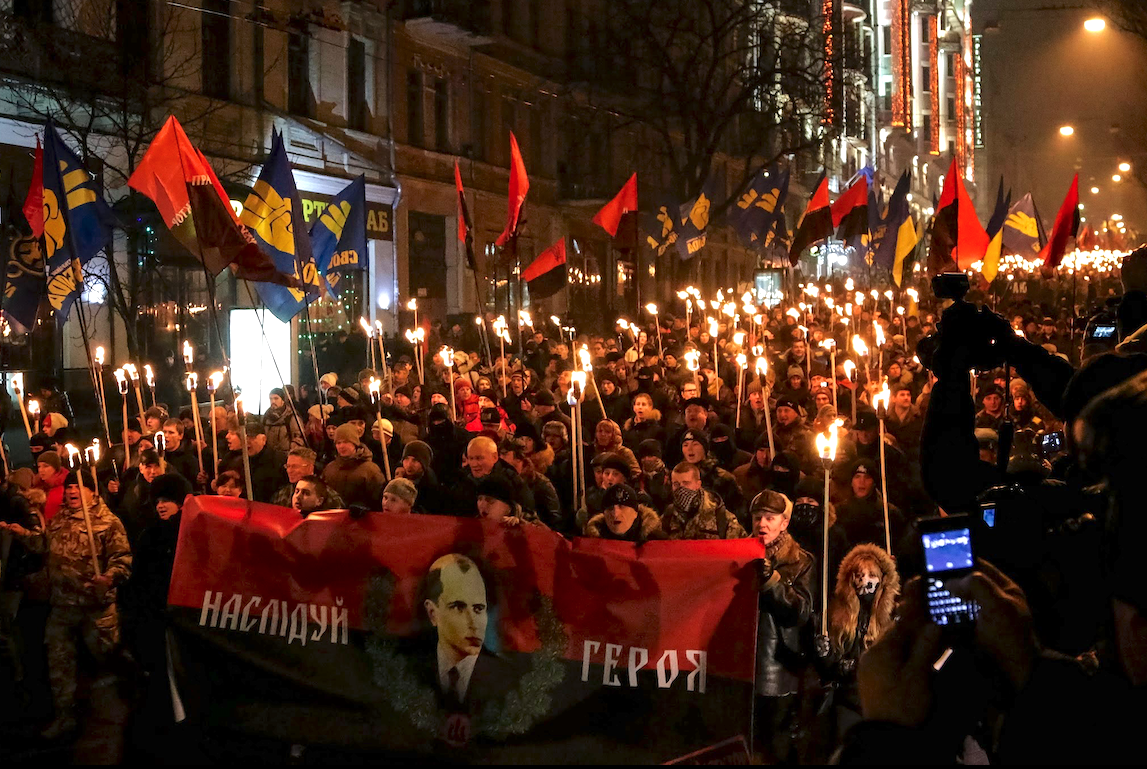
Torchlight parade behind portrait of Bandera on his birthday, Jan. 1, 2015. (Wikimedia Commons)
The U.S. relationship with Ukrainian fascists began after the Second World War. During the war, units of the Organization of Ukrainian Nationalists (OUN-B) took part in the Holocaust, killing at least 100,000 Jews and Poles. Mykola Lebed, a top aide to Stepan Bandera, the leader of the fascist OUN-B, was recruited by the C.I.A. after the war, according to a 2010 study by the U.S. National Archives.
The government study said, “Bandera’s wing (OUN/B) was a militant fascist organization.” Bandera’s closest deputy, Yaroslav Stetsko, said: “I… fully appreciate the undeniably harmful and hostile role of the Jews, who are helping Moscow to enslave Ukraine… I therefore support the destruction of the Jews and the expedience of bringing German methods of exterminating Jewry to Ukraine….”
The study says: “At a July 6, 1941, meeting in Lwów, Bandera loyalists determined that Jews ‘have to be treated harshly… We must finish them off… Regarding the Jews, we will adopt any methods that lead to their destruction.’”
Lebed himself proposed to “’cleanse the entire revolutionary territory of the Polish population,’ so that a resurgent Polish state would not claim the region as in 1918.” Lebed was the “foreign minister” of a Banderite government in exile, but he later broke with Bandera for acting as a dictator. The U.S. Army Counterintelligence Corps termed Bandera “extremely dangerous” yet said he was “looked upon as the spiritual and national hero of all Ukrainians…”
The C.I.A. was not interested in working with Bandera, pages 81-82 of the report say, but the British MI6 was. “MI6 argued, Bandera’s group was ‘the strongest Ukrainian organization abroad, is deemed competent to train party cadres, [and] build a morally and politically healthy organization…’” An early 1954 MI6 summary noted that, “the operational aspect of this [British] collaboration [with Bandera] was developing satisfactorily. Gradually a more complete control was obtained over infiltration operations … “
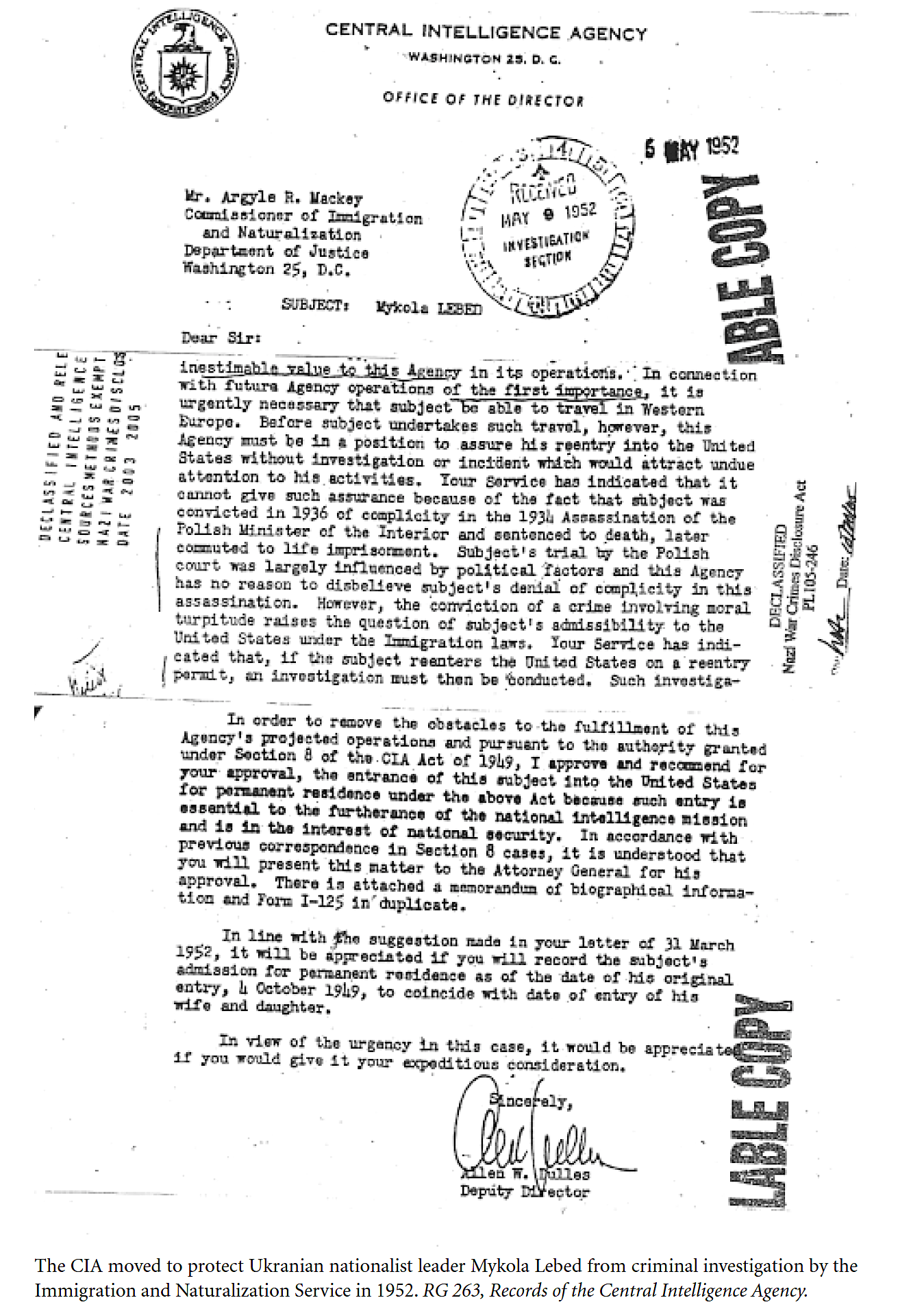
C.I.A.’s Allen Dulles asks U.S. Immigration to allow Lebed re-entry to U.S. despite murder conviction. (Click to enlarge.)
Britain ended its collaboration with Bandera in 1954. West German intelligence, under former Nazi intelligence chief Reinhard Gehlen, then worked with Bandera, who was eventually assassinated with cyanide dust by the KGB in Munich in 1959.
Instead of Bandera, the C.I.A. was interested in Lebed, despite his fascist background. They set him up in an office in New York City from which he directed sabotage and propaganda operations on the agency’s behalf inside Ukraine against the Soviet Union. The U.S. government study says:
“CIA operations with these Ukrainians began in 1948 under the cryptonym CARTEL, soon changed to AERODYNAMIC. … Lebed relocated to New York and acquired permanent resident status, then U.S. citizenship. It kept him safe from assassination, allowed him to speak to Ukrainian émigré groups, and permitted him to return to the United States after operational trips to Europe. Once in the United States, Lebed was the CIA’s chief contact for AERODYNAMIC. CIA handlers pointed to his ‘cunning character,’ his ‘relations with the Gestapo and … Gestapo training,’ and the fact that he was ‘a very ruthless operator.’”
The C.I.A. worked with Lebed on sabotage and pro-Ukrainian nationalist propaganda operations inside Ukraine until Ukraine’s independence in 1991. “Mykola Lebed’s relationship with the CIA lasted the entire length of the Cold War,” the study says. “While most CIA operations involving wartime perpetrators backfired, Lebed’s operations augmented the fundamental instability of the Soviet Union.”
Bandera Revival
The U.S. thus covertly kept Ukrainian fascist ideas alive inside Ukraine until at least Ukrainian independence was achieved. “Mykola Lebed, Bandera’s wartime chief in Ukraine, died in 1998. He is buried in New Jersey, and his papers are located at the Ukrainian Research Institute at Harvard University,” the U.S. National Archives study says.
The successor organization to the OUN-B in the United States did not die with him, however. It had been renamed the Ukrainian Congress Committee of America (UCCA), according to IBT.
“By the mid-1980s, the Reagan administration was honeycombed with UCCA members. Reagan personally welcomed [Yaroslav] Stetsko, the Banderist leader who oversaw the massacre of 7,000 Jews in Lviv, in the White House in 1983,” IBT reported. “Following the demise of Yanukovich’s regime, the UCCA helped organise rallies in cities across the US in support of the EuroMaidan protests,” it reported.
That is a direct link between Maidan and WWII-era Ukrainian fascism.
Despite the U.S. favoring the less extreme Lebed over Bandera, the latter has remained the more inspiring figure in Ukraine.
In 1991, the first year of Ukraine’s independence, the Neo-fascist Social National Party, later Svoboda Party, was formed, tracing its provenance directly to Bandera. It had a street named after Bandera in Liviv, and tried to name the city’s airport after him. (Svoboda won 10 percent of the Rada’s seats in 2012 before the coup and before McCain and Nuland appeared with its leader the following year.)
In 2010, pro-Western Ukrainian President Viktor Yushchenko declared Bandera a Hero of Ukraine, a status reversed by Yanukovych, who was overthrown.
More than 50 monuments, busts and museums commemorating Bandera have been erected in Ukraine, two-thirds of which have been built since 2005, the year the pro-American Yuschenko was elected. A Swiss academic study says:
“On January 13, 2011, the L’vivs’ka Oblast’ Council, meeting at an extraordinary session next to the Bandera monument in L’viv, reacted to the abrogation [skasuvannya] of Viktor Yushchenko’s order about naming Stepan Bandera a ‘Hero of Ukraine” by affirming that ‘for millions of Ukrainians Bandera was and remains a Ukrainian Hero notwithstanding pitiable and worthless decisions of the courts’ and declaring its intention to rename ‘Stepan Bandera Street’ as ‘Hero of Ukraine Stepan Bandera Street.’”
Torchlit parades behind Bandera’s portrait are common in Ukrainian cities, particularly on Jan. 1, his birthday, including this year.
Mainstream on Neo-Nazis
From the start of the 2013-2014 events in Ukraine, Consortium News founder Robert Parry and other writers began providing the evidence NewsGuard says doesn’t exist, reporting extensively on the coup and the influential role of Ukraine’s neo-Nazis. At the time, corporate media also reported on the essential part neo-Nazis played in the coup.
As The New York Times reported, the neo-nazi group, Right Sector, had the key role in the violent ouster of Yanukovych. The role of Neo-fascist groups in the uprising and its influence on Ukrainian society was well reported by mainstream media outlets at the time.
The BBC, the NYT, the Daily Telegraph and CNN all reported on Right Sector, C14 and other extremists’ role in the overthrow of Yanukovych. The BBC ran this report a week after his ouster:
And this one in July 2015:
After the coup a number of ministers in the new government came from Neo-fascist parties. NBC News (green check) reported in March 2014: “Svoboda, which means ‘Freedom,’ was given almost a quarter of the Cabinet positions in the interim government formed after the ouster of President Viktor Yanukovych in February.”
Svoboda’s leader, Tyahnybok, whom McCain and Nuland stood on stage with, once called for the liberation of Ukraine from the “Muscovite-Jewish mafia.” The International Business Times (green check) reported:
“In 2005 Tyahnybok signed an open letter to then Ukrainain president Viktor Yushchenko urging him to ban all Jewish organisations, including the Anti-Defamation League, which he claimed carried out ‘criminal activities [of] organised Jewry’, ultimately aimed at the genocide of the Ukrainian people.”
Before McCain and Nuland embraced Tyahnybok and his social national party, it was condemned by the European Parliament, which said in 2012:
“[Parliament] recalls that racist, anti-Semitic and xenophobic views go against the EU’s fundamental values and principles and therefore appeals to pro-democratic parties in the Verkhovna Rada [Ukraine’s legislature] not to associate with, endorse, or form coalitions with this party.”
Such mainstream reports on Banderism have stopped as the Neo-fascist role in Ukraine was suppressed in Western media once Putin made “de-nazification” a goal of the invasion.
The Azov Battalion, which arose during the coup, became a significant force in the war against the Russian-speaking people of the Donbass, who resisted the coup. Its commander, Andriy Biletsky, infamously said Ukraine’s mission is to “lead the White Races of the world in a final crusade for their survival … against the Semite-led Untermenschen.”
In 2014 the now Azov Regiment was officially incorporated into Ukraine’s National Guard under the control of the Ministry of Internal Affairs. It is further integrated into the state by working closely with the SBU intelligence service. Azov is the only known Neo-fascist component in a nation’s military anywhere in the world.
As part of the Ukraine military, Azov members have still sported yellow arm bands with the Wolfsangel once worn by German SS troops in World War II. Including the atrocities it has continued to commit, Azov shows the world that integration into the state has not denazified them. On the contrary, it may have increased its influence on the state.
The U.S. and NATO have also trained and armed Azov since Barack Obama had denied lethal aid to Ukraine. One reason Obama declined sending arms to Ukraine was because he was afraid they may fall into these right-wing extremists’ hands. According to the green-checked New York Times,
“Mr. Obama continues to pose questions indicating his doubts. ‘O.K., what happens if we send in equipment — do we have to send in trainers?’ said one person paraphrasing the discussion on the condition of anonymity. ‘What if it ends up in the hands of thugs? What if Putin escalates?”
NewsGuard’s Objections
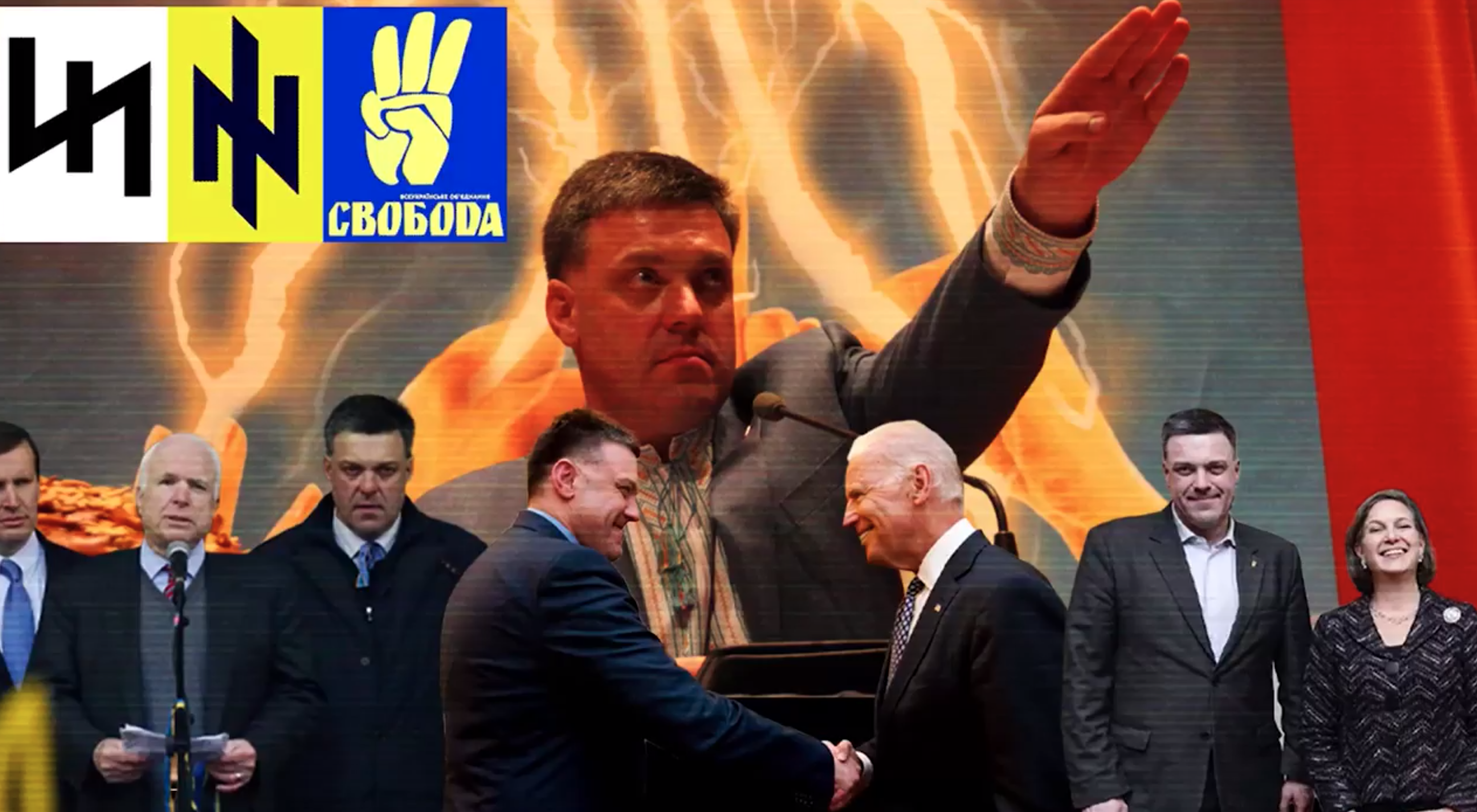
Collage of Neo-fascist leader Oleh Tyahnybok. meeting with McCain, Biden and Nuland. (Facebook image by Red, White and You of clip from film Ukraine on Fire)
NewsGuard’s argument against the major influence of neo-Nazi groups in Ukraine rests on Neo-fascist political parties faring poorly at the polls. This ignores the stark fact that these groups engage instead in extra-parliamentary extremism.
In its charge against Consortium News for publishing “false content” about Neo-fascism in Ukraine, NewsGuard’s Fishman wrote:
“There isn’t evidence that Nazism has a substantial influence in Ukraine. Radical far-right groups in Ukraine do represent a ‘threat to the democratic development of Ukraine,’ according to 2018 Freedom House report. But it also stated that far-right extremists have poor political representation in Ukraine and no plausible path to power — for example, in the 2019 parliamentary elections, the far-right nationalist party Svoboda won 2.2 percent of the vote, while the Svoboda candidate, Ruslan Koshulynskyy, won just 1.6 percent of the vote in the presidential election.”
But this argument of focusing on elections results has been dismissed by a number of mainstream sources, not least of which is the Atlantic Council, probably the most anti-Russian think tank in the world. In a 2019 article, a writer for the Atlantic Council said:
“To be clear, far-right parties like Svoboda perform poorly in Ukraine’s polls and elections, and Ukrainians evince no desire to be ruled by them. But this argument is a bit of ‘red herring.’ It’s not extremists’ electoral prospects that should concern Ukraine’s friends, but rather the state’s unwillingness or inability to confront violent groups and end their impunity. Whether this is due to a continuing sense of indebtedness to some of these groups for fighting the Russians or fear they might turn on the state itself, it’s a real problem and we do no service to Ukraine by sweeping it under the rug.” [Emphasis added.]
“Fear that they might turn on the state itself,” acknowledges the powerful leverage these groups have over the government. The Atlantic Council piece then underscores how influential these groups are:
“It sounds like the stuff of Kremlin propaganda, but it’s not. Last week Hromadske Radio revealed that Ukraine’s Ministry of Youth and Sports is funding the neo-Nazi group C14 to promote ‘national patriotic education projects’ in the country. On June 8, the Ministry announced that it will award C14 a little less than $17,000 for a children’s camp. It also awarded funds to Holosiyiv Hideout and Educational Assembly, both of which have links to the far-right. The revelation represents a dangerous example of law enforcement tacitly accepting or even encouraging the increasing lawlessness of far-right groups willing to use violence against those they don’t like.
Since the beginning of 2018, C14 and other far-right groups such as the Azov-affiliated National Militia, Right Sector, Karpatska Sich, and others have attacked Roma groups several times, as well as anti-fascist demonstrations, city council meetings, an event hosted by Amnesty International, art exhibitions, LGBT events, and environmental activists. On March 8, violent groups launched attacks against International Women’s Day marchers in cities across Ukraine. In only a few of these cases did police do anything to prevent the attacks, and in some they even arrested peaceful demonstrators rather than the actual perpetrators.”
The Atlantic Council is not the only anti-Russian outfit that recognizes the dangerous power of the Neo-fascist groups in Ukraine. Bellingcat published an alarming 2018 article headlined, “Ukrainian Far-Right Fighters, White Supremacists Trained by Major European Security Firm.”
NATO has also trained the Azov Regiment, directly linking the U.S. with far-right Ukrainian extremists.
The Hill reported in 2017 in an article headlined, “The reality of neo-Nazis in Ukraine is far from Kremlin propaganda,” that:
“Some Western observers claim that there are no neo-Nazi elements in Ukraine, chalking the assertion up to propaganda from Moscow. Unfortunately, they are sadly mistaken.
There are indeed neo-Nazi formations in Ukraine. This has been overwhelmingly confirmed by nearly every major Western outlet. The fact that analysts are able to dismiss it as propaganda disseminated by Moscow is profoundly disturbing.
Azov’s logo is composed of two emblems — the wolfsangel and the Sonnenrad — identified as neo-Nazi symbols by the Anti-Defamation League. The wolfsangel is used by the U.S. hate group Aryan Nations, while the Sonnenrad was among the neo-Nazi symbols at this summer’s deadly march in Charlottesville.
Azov’s neo-Nazi character has been covered by the New York Times, the Guardian, the BBC, the Telegraph and Reuters, among others. On-the-ground journalists from established Western media outlets have written of witnessing SS runes, swastikas, torchlight marches, and Nazi salutes. They interviewed Azov soldiers who readily acknowledged being neo-Nazis. They filed these reports under unambiguous headlines such as “How many neo-Nazis is the U.S. backing in Ukraine?” and “Volunteer Ukrainian unit includes Nazis.”
How is this Russian propaganda?
The U.N. and Human Rights Watch have accused Azov, as well as other Kiev battalions, of a litany of human rights abuses.”
Neo-facism has infected Ukrainian popular culture as well. A half-dozen neo-Nazi music groups held a concert in 2019 commemorating the day Nazi Germany invaded the Soviet Union.
Amnesty International in 2019 warned that “Ukraine is sinking into a chaos of uncontrolled violence posed by radical groups and their total impunity. Practically no one in the country can feel safe under these conditions.”
Zelensky & Neo-Nazis
One of Ukraine’s most powerful oligarchs from the early 1990s, Ihor Kolomoisky, was an early financial backer of the Neo-Nazi Azov Battalion. According to a 2015 Reuters (green-checked) report:
“Many of these paramilitary groups are accused of abusing the citizens they are charged with protecting. Amnesty International has reported that the Aidar battalion — also partially funded by Kolomoisky — committed war crimes, including illegal abductions, unlawful detention, robbery, extortion and even possible executions.
Other pro-Kiev private battalions have starved civilians as a form of warfare, preventing aid convoys from reaching separatist-controlled areas of eastern Ukraine, according to the Amnesty report.
Some of Ukraine’s private battalions have blackened the country’s international reputation with their extremist views. The Azov battalion, partially funded by Taruta and Kolomoisky, uses the Nazi Wolfsangel symbol as its logo, and many of its members openly espouse neo-Nazi, anti-Semitic views. The battalion members have spoken about “bringing the war to Kiev,” and said that Ukraine needs “a strong dictator to come to power who could shed plenty of blood but unite the nation in the process.”
In April 2019, the F.B.I. began investigating Kolomoisky for alleged financial crimes in connection with his steel holdings in West Virginia and northern Ohio. In August 2020 the U.S. Department of Justice filed civil forfeiture complaints against him and a partner:
“The complaints allege that Ihor Kolomoisky and Gennadiy Boholiubov, who owned PrivatBank, one of the largest banks in Ukraine, embezzled and defrauded the bank of billions of dollars. The two obtained fraudulent loans and lines of credit from approximately 2008 through 2016, when the scheme was uncovered, and the bank was nationalized by the National Bank of Ukraine. The complaints allege that they laundered a portion of the criminal proceeds using an array of shell companies’ bank accounts, primarily at PrivatBank’s Cyprus branch, before they transferred the funds to the United States. As alleged in the complaint, the loans were rarely repaid except with more fraudulently obtained loan proceeds.”
Meanwhile, the Azov backer’s television channel had by this time aired the hit TV show Servant of the People (2015-2019), which catapulted Volodymyr Zelensky to fame and ultimately into the presidency under the new Servant of the People Party. The former actor and comedian’s presidential campaign was bankrolled by Kolomoisky, according to multiple reports, including this one by Radio Free Europe (not rated).
During the presidential campaign, Politico reported:
“Kolomoisky’s media outlet also provides security and logistical backup for the comedian’s campaign, and it has recently emerged that Zelenskiy’s legal counsel, Andrii Bohdan, was the oligarch’s personal lawyer. Investigative journalists have also reported that Zelenskiy traveled 14 times in the past two years to Geneva and Tel Aviv, where Kolomoisky is based in exile.”
Before their run-off election, Petro Poroshenko called Zelensky “Kolomoisky’s puppet.” According to the Pandora Papers, Zelensky stashed funds he received from Kolomoisky off shore.
During the campaign Zelensky was asked about Bandera. He said it was “cool” that many Ukrainians consider Bandera a hero.
Zelensky was elected president on the promise of ending the Donbass war. About seven months into his term he traveled to the front line in Donbass to tell Ukrainian troops, where Azov is well-represented, to lay down their arms. Instead he was sent packing. The Kyiv Post (green check) reported:
“When one veteran, Denys Yantar, said they had no arms and wanted instead to discuss protests against the planned disengagement that had taken place across Ukraine, Zelensky became furious.
‘Listen, Denys, I’m the president of this country. I’m 41 years old. I’m not a loser. I came to you and told you: remove the weapons. Don’t shift the conversation to some protests,’ Zelensky said, videos of the exchange show. As he said this, Zelensky aggressively approached Yantar, who heads the National Corps, a political offshoot of the far-right Azov volunteer battalion, in Mykolaiv city.
‘But we’ve discussed that,’ Yantar said.
‘I wanted to see understanding in your eyes. But, instead, I saw a guy who’s decided that this is some loser standing in front of him,’ Zelensky said.”
It was a demonstration of the power of the military, including the Azov Regiment, over the civilian president.
After the Russian invasion, Zelensky was asked in April by Fox News about Azov, which were later defeated in Mariupol. “They are what they are,” he responded. “They were defending our country.” He then tries to say because they are part of the military they are somehow no longer Neo-Nazis, though they still wear Nazi insignia (until Tuesday). (Fox’s YouTube post removed that question from the interview, but it is preserved here:)
Outrages Greek Officials
Also in April, Zelensky infuriated two former Greek prime ministers and other officials by inviting a member of the Azov Regiment to address the Greek Parliament. Alexis Tsipras, a former premier and leader of the main opposition party, SYRIZA-Progressive Alliance, blasted the appearance of the Azov fighters before parliament.
“Solidarity with the Ukrainian people is a given. But nazis cannot be allowed to speak in parliament,” Tsipras said on social media. “The speech was a provocation.” He said Greek Prime Minister Kyriakos Mitsotakis “bears full responsibility. … He talked about a historic day but it is a historical shame.”
Former Greek Prime Minister Antonis Samaras called the Azov video being played in parliament a “big mistake.” Former Foreign Affairs Minister Nikos Kotzias said: “The Greek government irresponsibly undermined the struggle of the Ukrainian people, by giving the floor to a Nazi. The responsibilities are heavy. The government should publish a detailed report of preparation and contacts for the event.”
Former Finance Minister Yanis Varoufakis’ MeRA25 party said Zelenky’s appearance turned into a “Nazi fiesta.”
Zelensky has also not rebuked his ambassador to Germany, Andrij Melnyk, for visiting Bandera’s grave in Munich, which provoked this reaction from a German MP: “Anyone like Melnik who describes the Nazi collaborator Bandera as ‘our hero’ and makes a pilgrimage to his grave or defends the right-wing Azov Battalion as ‘brave’ is actually still benevolently described as a ‘Nazi sympathizer.’”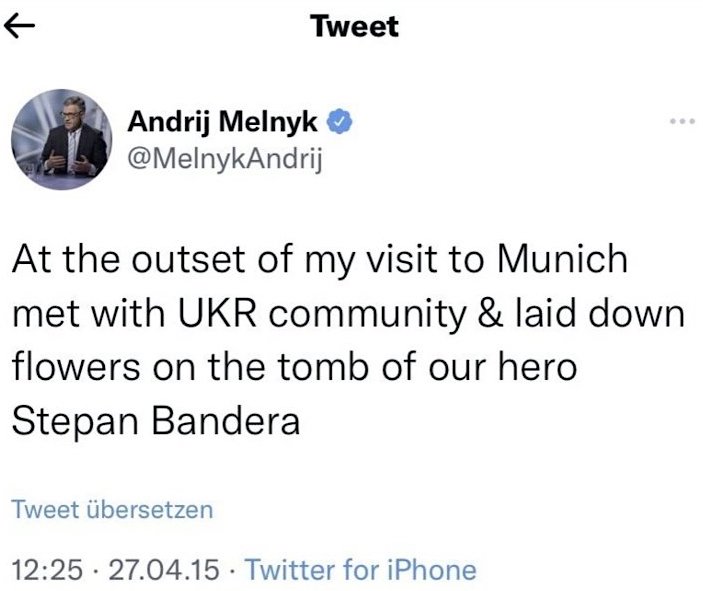
Zelensky has closed media outlets and outlawed 11 political parties, including the largest one, Eurosceptic Opposition Platform for Life (OPZZh) and arrested its leader. None of the 11 shut down are far-right parties.
Donald Trump was rightly castigated for remarks he made about white supremecists in Charlottesville. But Zelensky, whose oligarch backer funded Azov, and who brought a Neo-Nazi to address a European Parliament, is given a pass by a Democratic administration and the U.S. media though he condones the far worse problem of Neo-fascism in Ukraine.
‘Infested’
NewsGuard’s Fishman took issue with similar phrases that appear in Consortium News articles by columnist Patrick Lawrence, and by legendary journalist John Pilger. Lawrence refers to the Ukrainian government as a “Nazi-infested regime” and Pilger to the “the coup regime, infested with neo-Nazis.” NewsGuard objects to this characterization because the political wings of violent neo-Nazi groups fare poorly in Ukrainian elections.
Fishman wrote:
“The March 2022 article ‘PATRICK LAWRENCE: Imperial Infantilism’ stated: ‘Now the names we have for Putin roll around among like pinballs. ‘Hitler’ has fallen somewhat out of fashion, the hyperbole having proven too silly, or maybe because NATO is now arming a Nazi-infested regime,’ which was a reference to the Ukrainian government.
The February 2022 article “John Pilger: War in Europe & the Rise of Raw Propaganda” stated: “Vladimir Putin refers to the ‘genocide’ in the eastern Donbass region of Ukraine. Following the coup in Ukraine in 2014 – orchestrated by former U.S. President Barack Obama’s ‘point person’ in Kyiev, Victoria Nuland – the coup regime, infested with neo-Nazis,launched a campaign of terror against Russian-speaking Donbass, which accounts for a third of Ukraine’s population.” This article makes the claims similar to the ones highlighted in the previous … articles, and are seemingly false for the same reasons.”
One can quibble over whether “infested” is the best choice of words, but it is clear that the Ukrainian state has long protected influential Neo-Nazism. Consortium News gives a wide latitude to columnists and commentators like Lawrence and Pilger, both vastly experienced journalists, to express themselves. There is no doubt about the outsized influence of Neo-fascism in Ukrainian society and government, especially since the events of 2014.
NewsGuard’s dismissal of the influence of Neo-fascism by looking only at election results completely misses the point. Fishman has demanded CN correct its reporting on neo-Nazism in Ukraine. But Fishman’s statement that “There isn’t evidence that Nazism has a substantial influence in Ukraine” should instead be corrected by NewsGuard.
The ‘G’ Word
Fishman also took exception to the use of the word “genocide” in two Consortium News articles published about Ukraine.
“I also found some instances where Consortium News appeared to publish false or misleading claims, and I’d like to get your comments on them. I’ve listed some examples and provided brief explanations on why they seem to be false:
The March 2022 article ‘A Proposed Solution to the Ukraine War’ stated: ‘The government of Ukraine has denied human rights and political self-determination to the peoples of the Donbass. Some 13,000 people have died during the eight years since the 2014 coup, according to the United Nations. The Ukrainian government has overtly genocidal policies toward Russian minorities.’
The February 2022 article “John Pilger: War in Europe & the Rise of Raw Propaganda” stated: ‘Vladimir Putin refers to the “genocide” in the eastern Donbass region of Ukraine. Following the coup in Ukraine in 2014 … the coup regime … launched a campaign of terror against Russian-speaking Donbass, which accounts for a third of Ukraine’s population.”
Fishman went on:
“The International Criminal Court, the Office of the U.N. High Commissioner for Human Rights, and the Organization for Security and Co-operation in Europe (OSCE) have all said they have found no evidence of a genocide in Donbas. For example, A 2016 report by the International Criminal Court found that the acts of violence allegedly committed by the Ukrainian authorities in 2013 and 2014 could constitute an ‘attack directed against a civilian population,’ but it also said that’“the information available did not provide a reasonable basis to believe that the attack was systematic or widespread.’
And the U.S. Mission to OSCE stated in a February 2022 Twitter post, ‘The SMM [Special Monitoring Mission] has complete access to the government controlled areas of Ukraine and HAS NEVER reported anything remotely resembling Russia’s claims [of genocide in Ukraine].’”
Genocide is defined in the 1948 Convention on the Prevention and Punishment of the Crime of Genocide, ratified by 153 nations. The convention says:
“In the present Convention, genocide means any of the following acts committed with intent to destroy, in whole or in part, a national, ethnical, racial or religious group, as such:
(a) Killing members of the group;
(b) Causing serious bodily or mental harm to members of the group;(c) Deliberately inflicting on the group conditions of life calculated to bring about its physical destruction in whole or in part;
(d) Imposing measures intended to prevent births within the group; (e) Forcibly transferring children of the group to another group.”
The Convention adds:
“The following acts shall be punishable:
(a) Genocide;
(b) Conspiracy to commit genocide;
(c) Direct and public incitement to commit genocide;
(d) Attempt to commit genocide;
(e) Complicity in genocide.”
Based on the convention, an argument for and against genocide in Donbass could be made. The Ukraine military and extreme right militias have undoubtedly carried out attacks on civilians who, by reason of their language and religion, constitute a separate ethnic group. Points (a) and (b) of the definition are certainly true, (c) and (d) are questionable. The question of “intent” is crucial. Have the Ukrainian authorities had the “intent to destroy, in whole or in part, a national, ethnical, racial or religious group”?
The charge of “genocide” is thrown about by political opponents with less than due care to its actual definition. For instance, Biden and Zelensky have both accused Russia of “genocide” in its ongoing military operation. There is no defined number of civilian deaths that constitute an intent to destroy a people “in part.” Three months after the Russian invasion, the OSCE reports around 4,000 civilians killed. Both sides are shooting and killing civilians.
It is a judgement call whether genocide has taken place. The ICC report, referred to by Fishman, says Ukraine’s military action against Donbass could “constitute” an “attack directed against a civilian population,” but the ICC’s judgement about genocide was not definitive as it was based on “the information available.”
His second reference does not come from the OSCE itself, but from the U.S. mission to the OSCE, undercutting its objectivity since it is a narrow, national view from a country with a distinct political interest in events in Ukraine.
Consortium News has not taken a position that genocide was committed in Donbass. These are the only references made to genocide in Donbass and both CN articles are clearly labeled as commentaries with the disclaimer: “The views expressed are solely those of the author and may or may not reflect those of Consortium News.“
Pilger only says that Putin “refers to genocide,” while Pilger himself calls it “a campaign of terror against Russian-speaking Donbass.”
Consortium News did not endorse the judgment of these two commentators as it often publishes material with which it does not share editorial positions. Genocide in the context of Donbass is an arguable point, and therefore CN published these commentaries.
Financing and Other Questions
NewsGuard has also demanded detailed information about Consortium News‘ financing. Consortium News is funded almost entirely by small contributions from its readers raised during three public fund raisers per year.
IRS rules require donors who contribute more than $5,000 in a year be told to the tax agency. But their names do not have to be revealed to the public to protect the donors’ privacy. CN has made public its two major donors from its last tax returns. Roger Waters, the rock musician of Pink Floyd fame, donated $25,000 in both 2020 and 2021. The other major donor is the New York-based Cloud Mountain Foundation, which has donated $25,000 in each of the past three years.
Consortium News has never taken a penny from any government, corporation or advertiser. To prove this, CN is hiring an independent auditor to attest to this fact. It will publish on this website the independent audit statement as soon as it is prepared to once and for all end any smears or suspicions about the sources of CN‘s funding.
Fishman also mistakenly wants to know why authors’ bios don’t appear below CN articles, when they clearly do. NewsGuard wants to know what CN‘s corrections policy is. It is as follows: typos are corrected without a notice, factual errors are corrected with a CORRECTION notice at the bottom of the article.
A History of Dissent
The United States was founded by dissenters. The Declaration of Independence is one of history’s most significant dissenting documents, inspiring people seeking freedom around the world, from the French revolutionists to Ho Chi Minh, who based Vietnam’s declaration of independence from France on the American declaration.
But over the centuries a corrupt centralization of American power seeking to maintain and expand its authority has at times sought to crush the very principle of dissent which was written into the United States Constitution.
Freedom to dissent was first threatened by the second president. Just eight years after the adoption of the Bill of Rights, press freedom had become a threat to John Adams, whose Federalist Party pushed through Congress the Alien and Sedition Laws. They criminalized criticism of the federal government.
The Union then shut down newspapers during the U.S. Civil War.
Woodrow Wilson came within one vote in the Senate of creating official government censorship in the 1917 Espionage Act. The 1918 Alien and Sedition Act that followed jailed hundreds of people for speech until it was repealed in 1921.
Since the 1950s, McCarthyism has become the byword for one of the worst periods of repression of dissent in U.S. history.
The closest we’ve come to Wilson’s troubling dream is the Biden administration’s Disinformation Governance Board under the Department of Homeland Security, now on hold.
The roots are in the earliest English settlers in North America, described in The Scarlet Letter and applied to McCarthyism in Arthur Miller’s The Crucible. Though its industrial and scientific achievements are most lauded, America’s tradition of dissent is probably the greatest thing in U.S. history and it is once again under threat.
The Current Climate
NewsGuard’s accusations against Consortium News that could potentially limit its readership and financial support must be seen in the context of the West’s war mania over Ukraine, about which dissenting voices are being suppressed. Three CN writers have been kicked off Twitter.
PayPal’s cancellation of Consortium News‘ account is an evident attempt to defund it for what is almost certainly the company’s view that CN violated its restrictions on “providing false or misleading information.” It cannot be known with 100 percent certainty because PayPal is hiding behind its reasons, but CN trades in information and nothing else.
CN supports no side in the Ukraine war but seeks to examine the causes of the conflict within its recent historical context, all of which are being whitewashed from mainstream Western media.
Those causes are: NATO’s expansion eastward despite its promise not to; the coup and 8-year war on Donbass against coup resisters; the lack of implementation of the Minsk Accords to end that conflict; and the outright rejection of treaty proposals by Moscow to create a new security architecture in Europe taking Russia’s security concerns into account.
Historians who point out the onerous Versailles conditions imposed on Germany after World War I as a cause of Nazism and World War II are neither excusing Nazi Germany nor are they smeared as its defenders.
Consortium News can be wrong at times, but never as wrong as mainstream media was on WMD in Iraq or Russiagate. CN got both those consequential stories right while they were happening, and contends it is correct in its analysis of the Ukraine crisis. In any case, it is entitled to its analysis. On Iraq, Russiagate and Ukraine, Consortium News has clashed with the conventional wisdom forged by powerful forces and its corporate media allies. In response CN has been repeatedly smeared as agents of Iraq and Russia.
An overly self-confident Western establishment cannot appear to understand how experienced Western journalists could exercise their own agency and editorial judgment to critique U.S. foreign policy in real time, without them being agents of a foreign power. Consortium News sued the Canadian television network Global News for publishing such a smear.
It is evidently not enough for powerful forces to simply disagree and respect CN‘s constitutional right to free speech.
Justice Oliver Wendell Holmes in Abrams v. United States wrote: “[T]hat the ultimate good desired is better reached by free trade in ideas—that the best test of truth is the power of the thought to get itself accepted in the competition of the market… That at any rate is the theory of our Constitution.” Justice Louis Brandeis added in Whitney v. California that the remedy for ill-conceived speech is more speech, not enforced silence.
NewsGuard’s review of Consortium News and other independent media is a test case: Can the U.S. establishment tolerate dissent or is it joining the tradition of Adams and Wilson to crush it?
Joe Lauria is editor-in-chief of Consortium News and a former U.N. correspondent for The Wall Street Journal, Boston Globe, and numerous other newspapers, including The Montreal Gazette and The Star of Johannesburg. He was an investigative reporter for the Sunday Times of London, a financial reporter for Bloomberg News and began his professional work as a 19-year old stringer for The New York Times. He can be reached at joelauria@consortiumnews.com and followed on Twitter @unjoe
Featured Video
Death Spikes & Rising Cancer In Our Youth Explained
or go to
Aletho News Archives – Video-Images
From the Archives
Politicians lie
By Mazin Qumsiyeh | Popular Resistance | August 18, 2013
There is no way to say this truth nicely: Politicians lie. That includes Japanese, American, Egyptian, Israeli, and Palestinian politicians! Is there something more common sense than that? Yet, so many citizens around the world believe their own politicians or wistfully acknowledge lies but think it is part of the job needed to run things. They believe even when politicians contradict themselves blatantly. This phenomenon is rather remarkable. It is a dissonance and disconnect from reality that many seem oblivious to. It is very dangerous because it can lead to accepting rationales for going to war. These can be deadly wars that lead to millions of lives lost as happened in what was called World War 1 and WW2. Even when incredible and declassified evidence abound, politicians continue to lie and old mythologies refuse to die. Here are just a few of the countless lies told to us over the past few decades… continue
Blog Roll
 Aletho News
- Iraqi resistance group vows to stage airport sit-ins over Iran aerial blockade
- Turkish parliament to review Saudi-Pakistan defense pact next month
- DEATH SPIKES & RISING CANCER IN OUR YOUTH EXPLAINED
- Iran offers Trump deal before US election
- Merz regime wants ‘secret police’ – opposition
- Israeli settlers terrorize West Bank Palestinians with state-provided drones: Report
- They see them, then kill them: Israeli quadcopters track, deliberately target civilians in Gaza
- Debunked: Trump’s egregious UNGA claims on war against Iran crumble under scrutiny
- Europe was part of the infrastructure of US aggression against Iran: Deputy FM
- New evidence on the Bucha Massacre
- If Americans Knew
- Trump betrayed voters with his campaign lies and prioritized a foreign country once he took office
- Netanyahu calls Israel’s war in Gaza ‘opposite of genocide’ in UN speech to near-empty hall
- Settler Kidnappings: Torture, Sexual Abuse and Terrorisation of Palestinian Abductees as Israel Deepens Annexation of West Bank
- Gaza winter nears as 162,000 tents become unusable, raising fears of humanitarian crisis
- Netanyahu says, “It’s the opposite of genocide”; UN says Gaza economy is world’s ‘most severe crisis on record’ – Daily Update
- Israel’s US-Backed Assault on Gaza Has Created the ‘World’s Most Severe Economic Crisis on Record’: UN
- ‘Protecting U.S. Citizens’… From Israel
- ‘This is where I live now, the back of a truck’: a day in the life of a grandmother in Gaza
- In UN Speech, Iran’s President Displays Pictures of Children Killed by US, Brings Attention to Israel’s Nuclear Arsenal
- Israel displaces hundreds of Palestinians amid wave of demolitions in West Bank
- No Tricks Zone
- New Study: Earth And Venus Surface Warmth Largely Explained By Convection And Lapse Rate, Not CO2 Or Radiation
- 2025 Nature Paper Claiming Worsening Global Drought Gets RETRACTED …Heavily Flawed
- New Study: ‘Global Drought Shows No Detectable Recent Acceleration Under Climate Warming’
- Economic Masterminds: German Socialists Suggest Taxing Productivity Gains Stemming From Using AI
- The South China Sea Has Not Been Cooperating With The Climate Change Narrative
- Energy Crisis: Germany Enters Heating Season With Historically Low Gas Reserve Fill Levels
- New Study: The Antarctic Ice Sheet Gained Mass From 2020-2024 Due To Staggering Snow And Ice Accumulation
- Study: Ocean Heating Rates From Thousands Of Years Ago ‘Dwarf’ Modern Ocean Heating Rates
- Climate Extremists Target, Attack Large-Scale Power Grid Infrastructure In Germany!
- New Study: Antarctic Ice Melt Has Contributed Less Than 1 Centimeter To Sea Level Rise In The Last 30 Years

