New law allows for warrantless spying on Australians – where next?
By Kit Klarenberg | RT | November 30, 2021
The Australian Signals Directorate, Canberra’s equivalent of Britain’s GCHQ or the US National Security Agency, will be granted sweeping new powers to spy on Australians for the first time since its November 1947 founding.
The move allows the agency to collect signals intelligence on individuals within the country without a warrant, although allegedly only in situations where there is an “imminent risk to life.” Domestic terror suspects are cited as a key target in the Directorate’s crosshairs, and it will also collect intelligence in conjunction with the Australian Defence Force for military operations, with ministerial authorization.
Rules governing the reform and protecting citizens’ privacy will be published on the agency’s website, and subject to review and scrutiny by the Australian parliament’s security and intelligence committee. While framed as sincerely concerned with keeping Australians safe, experts have expressed grave reservations about the development. Among them is John Blaxland, Professor of International Security and Intelligence Studies at the Australian National University, himself a military intelligence veteran, who warned the powers were ripe for abuse.
“I’m a former insider… I have a much greater appreciation of the need for checks and balances, because power tends to corrupt,” he cautioned. “My concern is the legislation we put forward is being drafted by insiders, it’s drafted with their own concerns in mind.”
Drafted by insiders, the legislation certainly was – it’s inspired by the findings of an extensive review by Dennis Richardson, former chief of Australian Security Intelligence Organisation, the country’s FBI, conducted in close consultation with Australia’s assorted intelligence services, in a manner akin to foxes being quizzed on how best to guard a henhouse.
Published in December 2020, his appraisal’s discussion of “authorisations” noted that these agencies can already conduct warrantless intelligence-gathering if they believe it to be “necessary, proportionate, reasonable and justified” in certain circumstances, and “would like the ability” to not only use various investigative techniques without official permission, but also with “protection from criminal liability” when doing so.
Leaked documents exposed by journalist Annika Smethurst in April 2018 showed that high-level plans for untrammeled domestic spying by the Australian Signals Directorate date back even further. They revealed how the respective heads of Australia’s Defence and Home Affairs ministries had discussed allowing the agency to access citizens’ emails, bank records and text messages without approval, or trace. A government source told Smethurst they were “horrified” by the proposals, given “there is no actual national security gap this is aiming to fill.”
Australian Federal Police raided both the alleged leaker of the files and Smethurst the next year. In a perverse irony, the charges against her were dropped in May 2020, as Australian High Court judges unanimously ruled that the warrant secured from a magistrate in relation to the raid was invalid, because it not only “misstated the terms of the offence” but was also ambiguous if not outright absurd.
“[The warrant] lacked the clarity required to fulfil its basic purposes of adequately informing Smethurst why the search was being conducted and providing the executing officer and those assisting in the execution of the warrant with reasonable guidance to decide which things came within the scope of the warrant,” the High Court damningly concluded.
In other words, it was impossible to know from the warrant’s wording what the investigation actually concerned, what evidence or information was sought, and what, if any, crime she may or may not have committed. That this baseless and broad investigative authorization was formally granted at all renders the Directorate’s newfound power to conduct warrantless surveillance all the more disquieting. If such procedural perversion can occur even with putative oversight, what abuses will be engaged-in without any meaningful supervision?
Misuse of these capabilities is almost inevitable. In 1973, the US Supreme Court ruled warrants were mandatory for domestic intelligence gathering. Two years later, a Senate investigation found that the NSA and other US intelligence agencies had nonetheless been engaged in unauthorized spying on American citizens, including anti-war protesters, civil rights activists, and political dissidents, monitoring all their private communications from telephone conversations to telegrams. This led to the 1978 Foreign Intelligence Surveillance Act, which made it a dedicated criminal offense to eavesdrop on American citizens without judicial oversight.
Yet,it was revealed in late 2005 that the NSA had all along continued illegally intercepting the phone calls and digital communications of US citizens, with the witting help of major telecoms giants, which passed copies of all emails, web browsing and other internet traffic to and from its customers at home and abroad to the agency, and its British counterpart GCHQ. Files disclosed in 2013 by whistleblower Edward Snowden confirmed this criminal dragnet was truly global in scale, and very much ongoing.
Key components of this international spying network, known as ‘Five Eyes,’ are situated in Australia, at the Pine Gap and Kojarena satellite surveillance bases. According to investigative legend Duncan Campbell, around 80% of the messages intercepted by the latter – which employs US and British staff in key posts – are sent automatically to GCHQ and the NSA. While every Five Eyes member can theoretically veto requests for such material, “when you’re a junior ally” like Canberra, “you never refuse,” Campbell records.
One can’t help but wonder if the Directorate’s new domestic purview is an experiment, gauging levels of backlash and controversy among the Australian public, before similar measures – provably or potentially already in operation – are openly codified across all Five Eyes member states. Ongoing legal battles against mass data collection in various jurisdictions clearly necessitate the practice being legalized and legitimized. If Canberra’s American and/or British friends politely requested they run such a pilot scheme, would or even could they decline?
Reinforcing this interpretation, mere days after the Directorate’s remit was expanded, the Australian government pledged to introduce new laws forcing social media giants to “unmask” anonymous users who post offensive comments, with hefty fines doled out to those companies which are unwilling or unable to do so. The reasons for Canberra’s haste are unclear, although it’s surely no coincidence that London and Washington have battled for many years to end online anonymity for good – it’s only due to intense domestic opposition that these efforts have so far failed.
Kit Klarenberg is an investigative journalist exploring the role of intelligence services in shaping politics and perceptions.
How to escape Google
Do you belong to the 94% of Internet users who have no clue?
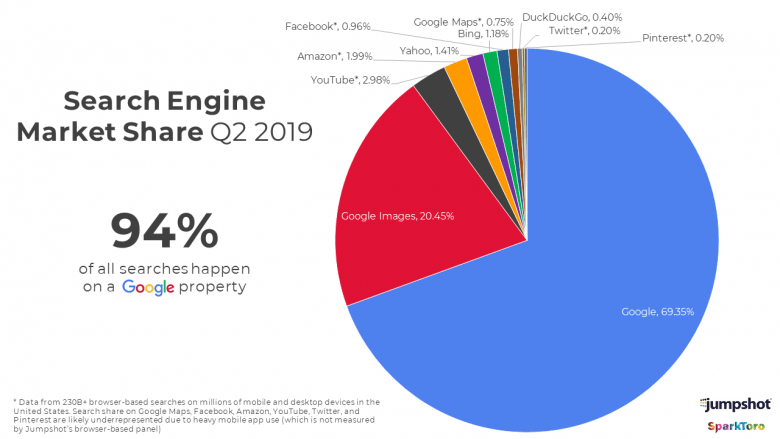
The US search engine market in 2019 (SparkToro)
Swiss Policy Research | November 25, 2021
Google Search has a US online search market share of about 70%, or even 94% if Google Images, Google Maps and Google-owned YouTube are added (see chart above).
If you belong to these 94%, there is some bad news for you.
As a well-known US podcaster recently discovered, Google is indeed “hiding information” from its users. This has actually been known for many years, but it has become especially obvious and serious during the coronavirus pandemic.
In fact, censorship by Google has become so bad that nowadays, advanced Internet users are using Google primarily to monitor the current extent of censorship, not to actually search for anything. US researcher Dr. Robert Epstein termed it the Search Engine Manipulation Effect (SEME).
Of note, Google censorship affects not just search results, but even search suggestions. In other words, Google is first manipulating what you search for, only to then additionally manipulate what results you will get. It is well worth trying this out yourself to appreciate the effect (see below).
What is Google hiding from you? In short, they are hiding “non-authoritative sources”. In other words, they are hiding stuff those in power don’t want you to know or to even think of.
This is not all that surprising, given that Google initially was a research and startup project funded and supported by US intelligence and the military to “retain information superiority”.
Essentially, Google Search has become an online prison library.
Fortunately, there are a few alternatives to Google Search, although not as many as one might think. In fact, there are currently only two real alternatives to Google Search.
These two alternatives are Microsoft Bing and Russian Yandex.
The fact that Microsoft as a monopolistic corporation and Yandex as a Russian provider are offering more or less uncensored search results is somewhat ironic, and both of them may have their own reasons for doing so. But these are currently the only real alternatives to Google.
What about the many other, independent search engines, though? The truth is, most of them are neither independent, nor even actual search engines, as most of them simply rely on results provided by Google or Bing.
For instance, Startpage is simply providing Google search results.
DuckDuckGo, Yahoo, Qwant, Ecosia, Swisscows, MetaGer and other search engines are primarily relying on Microsoft Bing, although some of them may be adding a few other contextual sources or important privacy features. But with most searches, you will simply get Bing results.
If Microsoft Bing, one day, should decide to apply Google-style censorship (or get forced to do so), sophisticated Western Internet users will either have to rely on Russian Yandex, or will finally have to create an independent, real and uncensored search engine.
Otherwise, the Internet is going to become a pretty dark place, literally.
(Update: In June 2021, independent browser developer Brave beta-launched its own search engine, Brave Search, which is creating and using its own search index. If successful, Brave Search may become the first true, non-Russian alternative to Google Search and Microsoft Bing.)
One more thing: YouTube. YouTube belongs to Google, too (since 2006).
This is why it has become increasingly difficult to find YouTube videos on “controversial topics”. In many cases, what you are looking for may already have been deleted by YouTube, but even if not, it may not be displayed in the highly censored YouTube search results and recommendations.
Instead, one has to use an alternative search engine based on Bing – which is indexing YouTube videos independently – and then search for the topic by adding “site:youtube.com”.
Or, better still, use an alternative video platform from the outset, like Odysee, Bitchute, Rumble, Brighteon, DTube, or even Archive.org.
Independent video producers, too, increasingly have to switch to these alternative platforms, as creating videos on YouTube nowadays is like building a sandcastle too close to the water.
To learn more about online media sources, search engines, ad blockers, bypassing paywalls and censorship, see Advanced Online Media Use: Seven Recommendations.
Google vs. Yandex
Russian Yandex seems to be manipulating search suggestions in the opposite way of Google. For instance, when searching for “Pfizer vaccine”, the first two search suggestions currently are “Pfizer vaccine deaths” and “Pfizer vaccine side effects”. Meanwhile, on Google, “Pfizer vaccine” is being auto-completed to “near me”, “booster”, “FDA approval”, “for kids”, or “efficacy”.
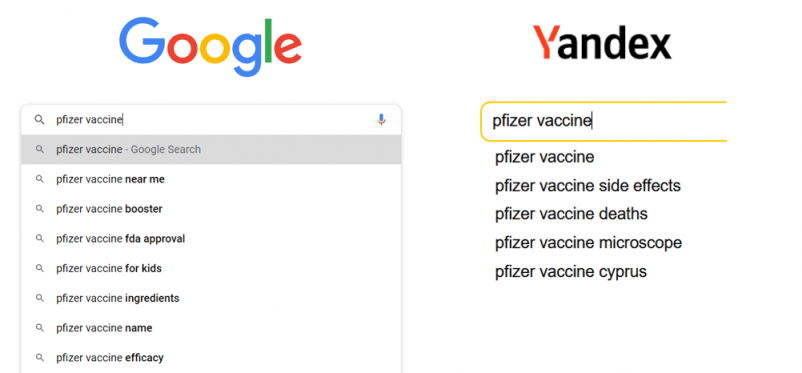
“Pfizer vaccine”: Yandex vs. Google
Google vs. Bing
Coronavirus: a “planned pandemic” (Bing) or “planning tools” (Google)?

Coronavirus: Google vs. Bing
Literature
- The new mind control (Dr. Robert Epstein, Aeon, 2016)
- How the CIA made Google (Nafeez Ahmed, Medium, 2015)
- Google is not what it seems (Julian Assange, Wikileaks, 2014)
- The Military Origins of Facebook (Whitney Webb, Unlimited Hangout, 2021)
- Surveillance Valley: The Secret Military History of the Internet (Yasha Levine, 2018)
See also:
PROOF: COVID vaccines cause prion diseases
By Steve Kirsch | November 26, 2021
Twitter suspended my account (likely forever since there is no appeal) due to one post on prion diseases. Here’s the information they wanted to make sure you NEVER find out.
Summary
There is no doubt the mRNA vaccines are causing prion diseases. People didn’t have these diseases before the shot and suddenly they develop them after the shot. There is no other explanation for this. None of the “fact checkers” can explain the cause of the excess rates. Prion diseases are incurable and always fatal. You can die as soon as 6 weeks after COVID vaccination (see within 6 weeks and within 6 months examples).
However, Twitter believes this is not true, but they refuse to tell anyone why they think that. Other fact checkers who have checked this out never did a VAERS query and are unable to explain away the “excess” number of reports other than doing a blanket dismissal that everything in VAERS is fraudulent without providing any evidence of that claim (other than one report out of 1.6M reports).
None of the fact checkers will debate on this to set the record straight.
On November 24, 2021 I posted the following message on Twitter:

Twitter suspended my account hours later. There is no appeal available. All content over the last 12 years was removed. All my 75K followers were zeroed. My messages were removed. There was no opportunity to download my content.
The only thing left: that my Twitter ID was @stkirsch.
Twitter refuses to tell us what I said that was misleading?
Twitter won’t tell me that!!! They are deliberately withholding their definitive analysis on this extremely important scientific issue. Why???
I really want to know. Obviously, Twitter fact-checkers (all of whom I presume must have PhD degrees or MD degrees to be able to assess my claims) were able to quickly read all the medical literature and determine without a doubt I made an error and should be terminated for making a mistake. But they won’t tell me the mistake!!
If they want to fight misinformation, why aren’t they posting a link to their research proving me wrong when they terminate the account. They obviously invested hours of time in the research before they terminated me. Why not provide a link to that research so everyone can learn from it including me??
Here’s the evidence for my claim
Back in May 2021 when Professor Byram Bridle was disclosing the FOIA request on the Pfizer vaccine bio-distribution data he mentioned that the spike protein was associated with Lewy body formation which is linked to prion diseases. He expressed concern that the vaccines could cause prion diseases like dementia, Alzheimer’s, and Creutzfeldt-Jakob disease (CJD).
What do you know. He was right. Now we have proof.
Check out these VAERS query results. These searches are over all 30 years of VAERS and all 70+ vaccines. See anything unusual? Yeah, for less than 1 year of the COVID vaccines, the results are off the charts.
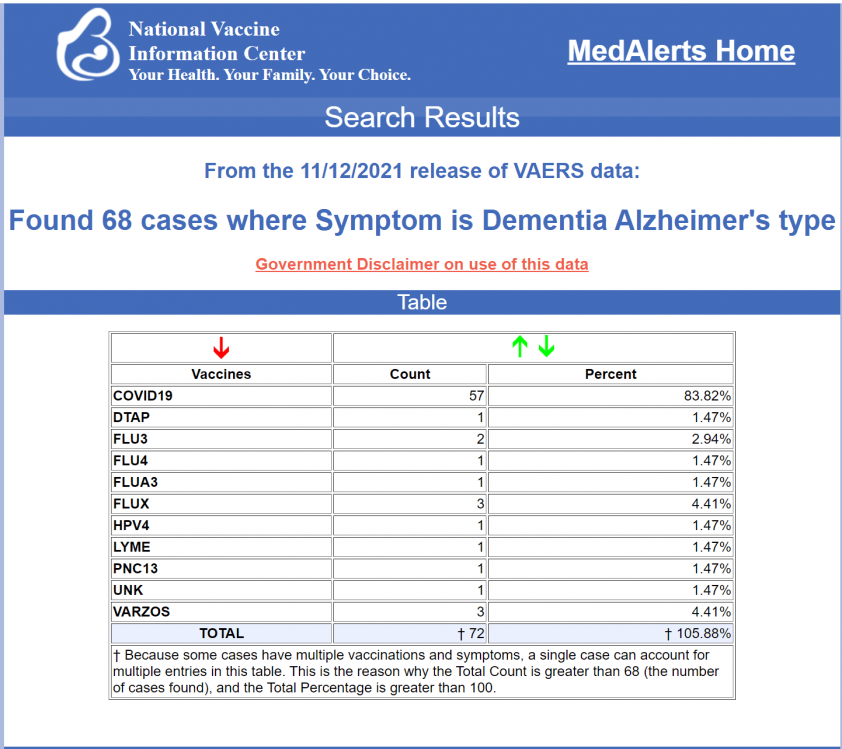
And for CJD which is extremely rare:

Remember, these are 30 year searches for all vaccines. Clearly there are excess reports. And we know VAERS isn’t being “over-reported” this year which I’ve shown many times before (events not caused by the vaccine are reported at rates comparable to other vaccines).
If it wasn’t the COVID vaccines causing this, what was the cause?
Nobody can answer that question, not even the Twitter fact checkers!
For further reading, check out these articles:
- Jessica Rose’s article on COVID vaccines and prion diseases
- Stephanie Seneff’s paper on prion disease and the COVID vaccines
- Bart Classen’s paper linking the vaccines and prion diseases
- SARS-CoV-2 causes brain inflammation and induces Lewy body formation in macaques
- SARS-CoV-2 Prion-Like Domains in Spike Proteins Enable Higher Affinity to ACE2
And compare them to some of the “fact checks” which claim there are no instances in VAERS which as you can see from the queries above (which you can replicate yourself):
You decide who is telling the truth.
And note that the “fact checkers” never did a single VAERS query. Wow. That’s the first place you’d look to prove the claim is false.
Why aren’t healthcare workers speaking out about the catastrophe caused by the vaccines?
Everyone thinks that if the jabs were really dangerous, doctors and other healthcare workers would be speaking out. They are wrong.
By Steve Kirsch | November 23, 2021
It’s too hard to ignore all the vaccine injured kids showing up in the ER nowadays.
I just heard a story from a friend who went to the lab for a stress echocardiagram.
In the waiting room with her are 4 kids aged 7 to 10 years old with their moms. She talked to the moms. The kids were all suffering from tachycardia (heart rate that beats way too fast) and waiting to be tested.
Two important things you need to know:
- All the kids were recently vaccinated.
- Kids that age NEVER get tachycardia (i.e., the medical experts I’ve talked to have never seen it before in their careers).
There are close to 10,000 adverse event types elevated by the COVID vaccines. Here’s a list of the adverse events most elevated compared to “normal.” In the #2 position: heart rate, elevated by nearly 8,000 times normal.

So why aren’t we hearing about these stories from mainstream doctors?
Here are nine reasons very few people are speaking out:
- Fear of job loss. Nobody wants to lose their job. Look what happened to Deborah Conrad and others who speak out. Fired within hours after speaking out. So the lab technicians who are now seeing kids with tachycardia just keep their mouth shut. They know something is very wrong, but their job is more important. Besides, if they spoke out, it wouldn’t make any difference since they are just a lab technician.
- Belief that COVID is even worse than the vaccine injuries. Many people are deceived by erroneous reports that the number of vaccine cases (e.g., of myocarditis) are occurring far less often now that the vaccines have been rolled out. Dr. John Su is the big culprit here because he’s never told the world that VAERS is under-reported. The pediatric cardiologists know what is going on, but they aren’t going to say anything due to #1. So I see doctors tweeting the myth that “sure, there is myo after the vaccine, but the rates due to COVID are worse so the vaccine is the better of the two options.”
- Belief that the injuries are really rare. I know a doctor who treats vaccine injured patients. He has no clue whether these are every single vaccine injured patient in the US or he’s only seeing a tiny fraction of the injuries. He believes he’s seeing them all so writes it off as just “coincidence” and “bad luck” since if it was the vaccine, the CDC would have spotted it.
- Cognitive dissonance. They are so convinced the vaccines are safe (since nobody else is speaking out), that any adverse events that happen must be due to something else.
- Belief that they can treat you for your vaccine side effects, but that they can’t treat you if you have COVID. So lesser of two evils. And of course, they think no early treatments work, so they think they are doing you a favor by telling you to get the vaccine.
- Belief that there is no viable alternative for treating COVID and that the vaccines work. So even 100,000 dead or injured people is better than 750,000 dead people from COVID.
- Trust in the NIH and CDC. If it was a problem, the CDC would tell people. Telling people isn’t their job. Their job is to follow the direction set by the experts.
- Fear of being ostracized. People who do research fear if they speak out they would be labelled as anti-vaxers and their research would thus be discredited.
- Critical thinkers have been fired. Hospitals and medical facilities have already fired vaccine hesitant employees per vaccine mandates thereby self selecting for vax believers.
The courageous people who dare to speak out
Some are speaking out. Here are some links of people who are speaking out:
Commission cautions against “objectivity” in journalism and calls for censorship of “misinformation”
A chilling read
By Christina Maas | Reclaim The Net | November 22, 2021
The Aspen Institute has released the results of its study on how to protect the public from “misinformation.” The 16-person Commission on Information Disorder recommended more censorship, warning misinformation propagated other issues such as social injustice.
Last week, the Aspen Institute published an 80-page report on how to fight misinformation and disinformation. The long-standing solution to misinformation is better information. However, the organization insisted that the best solution is censorship.
“The biggest lie of all, which this crisis thrives on, and which the beneficiaries of mis- and disinformation feed on, is that the crisis itself is uncontainable. One of the corollaries of that mythology is that, in order to fight bad information, all we need is more (and better distributed) good information. In reality, merely elevating truthful content is not nearly enough to change our current course,” the report read.
One issue raised by critics when it comes to misinformation and disinformation is the lack of proper definitions. They are a matter of “we know when we see it.” However, the report ignores the definition of the terms and focuses on the harm caused, such as inflaming existing issues.
“Disinformation inflames long-standing inequalities and undermines lived experiences for historically targeted communities, particularly Black/African American communities. False narratives can sow division, hamper public health initiatives, undermine elections, or deliver fresh marks to grifters and profiteers, and they capitalize on deep-rooted problems within American society. Disinformation pours lighter fluid on the sparks of discord that exist in every community.”
The report also endorses a growing movement against what it describes “objectivity and both sideism” in the media, some of the hallmarks of responsible journalism.
“Commissioners also discussed the need to adjust journalistic norms to avoid false equivalencies between lies and empirical fact in the pursuit of ‘both sides’ and ‘objectivity,’ particularly in areas of public health, civil rights, or election outcomes,” the report shockingly reads.
The Commission also recommended the involvement of the government in fighting misinformation, ignoring the First Amendment.
Ultimately, the commission’s solution to the “deep-rooted problems in American society” is the regulation of speech, not free speech.
NIH Director Calls For COVID Conspiracists to be “Brought to Justice”
By Paul Joseph Watson | Summit News | November 20, 2021
National Institutes of Health (NIH) Director Francis Collins has angrily called for anyone who spreads “misinformation” about COVID-19 online to be “brought to justice.”
“Conspiracies are winning here. Truth is losing. That’s a really serious indictment of the way in which our society seems to be traveling,” Collins told the Washington Post.
Citing an onslaught of angry messages directed at Dr. Anthony Fauci, who Collins appears to believe is above criticism, the bureaucrat demanded that those responsible for such behavior should be identified and “brought to justice.”
The article cited one such example of “misinformation” being Fauci’s involvement in barbaric experiments conducted on dogs by the National Institute of Allergy and Infectious Diseases (NIAID), despite the fact that such cruelty factually occurred under Fauci’s leadership.
While Collins didn’t specify precisely what he meant by “brought to justice,” Pfizer CEO Albert Bourla previously asserted that individuals who spread false information about COVID vaccines are “criminals” who “have literally cost millions of lives.”
That’s an interesting benchmark given that it was once considered false to claim that COVID vaccines didn’t stop the vaccinated spreading COVID, which is now an all too obvious fact.
Quite what constitutes “misinformation” about COVID-19 is anyone’s guess given that several things that turned out to be plausible or true, such as the origin of the virus behind the Wuhan lab, were once deemed to be “misinformation.”
It seems likely that whatever the National Institutes of Health, Anthony Fauci or Pfizer deem to be “misinformation” will become the standard.
As we previously highlighted, efforts to brand those who question the safety and efficacy of products manufactured by pharmaceutical corporations that have been plagued by a myriad of historical scandals are also underway in the UK.
The Online Safety Bill, described as “the flagship legislation to combat abuse and hatred on the internet,” will apparently include a provision that jails “antivaxers spreading false information that they know to be untrue” for a period of two years.
BBC Believes a Conspiracy Drives Climate Conspiracy Theories
By Eric Worrall | Watts Up With That? | November 16, 2021
Shadows everywhere: The possibility that people might want to reject climate lockdowns and Covid lockdowns of their own volition does not seem to occur to BBC conspiracy theorists.
Covid denial to climate denial: How conspiracists are shifting focus
By Marianna Spring
Specialist disinformation reporter, BBC NewsMembers of an online movement infected with pandemic conspiracies are shifting their focus – and are increasingly peddling falsehoods about climate change.
Matthew is convinced that shadowy forces lie behind two of the biggest news stories of our time, and that he’s not being told the truth.
“This whole campaign of fear and propaganda is an attempt to try and drive some agenda,” he says. “It doesn’t matter whether it’s climate change or a virus or something else.” […]
And recently, groups like the ones he’s a part of have been sharing misleading claims not only about Covid, but about climate change. He sees “Covid and climate propaganda” as part of the same so-called plot.
The White Rose network
It’s part of a larger pattern. Anti-lockdown and anti-vaccine Telegram groups, which once focused exclusively on the pandemic, are now injecting the climate change debate with the same conspiratorial narratives they use to explain the pandemic.
The posts go far beyond political criticism and debate – they’re full of incorrect information, fake stories and pseudoscience.
According to researchers at the Institute for Strategic Dialogue (ISD), a think tank that researches global disinformation trends, some anti-lockdown groups have become polluted by misleading posts about climate change being overplayed, or even a so-called “hoax” designed to control people.
“Increasingly, terminology around Covid-19 measures is being used to stoke fear and mobilise against climate action,” says the ISD’s Jennie King.
She says this isn’t really about climate as a policy issue.
“It’s the fact that these are really neat vectors to get themes like power, personal freedom, agency, citizen against state, loss of traditional lifestyles – to get all of those ideas to a much broader audience.”
One group which has adopted such ideas is the White Rose – a network with locally-run subgroups around the world, from the UK to the US, Germany and New Zealand – where Matthew came across it.
“It’s not run by any one or two people,” Matthew explains. “It’s kind of a decentralised community organisation, so you obtain stickers and then post them on lampposts and things like that.” […]
While we chat, he mentions “The Great Reset” – an unfounded conspiracy theory that a global elite is using the pandemic to establish a shadowy New World Order, a “super-government” that will control the lives of citizens around the world. … Full article: https://www.bbc.com/news/blogs-trending-59255165
The Great Reset is a public programme promoted by the World Economic Forum. The annual “Great Reset” WEF Davos event costs more than $50,000. According to Wikipedia, in 2011 an annual membership cost $52,000 for an individual member, $263,000 for “Industry Partner” and $527,000 for “Strategic Partner”. An admission fee cost $19,000 per person. In 2014, WEF raised annual fees by 20 percent, bringing the cost for “Strategic Partner” from CHF 500,000 ($523,000) to CHF 600,000 ($628,000)
A simple google search turns up the WEF page near the top of the list of searches. The page cites Covid and climate change as justifications for their programme.
In my opinion there is room to debate the true nature of the Great Reset programme, but calling it “unfounded”, as in non-existent, is at best plain ignorant, and well below the BBC journalistic standards we once thought we had a right to expect.
As for the White Rose network, never heard of it. I have no doubt White Rose and many similar groups exist, in our unsettled world there are plenty of concerned people seeking out like minded fellows. But some groups are run by people with their own agenda, who are not acting in their member’s best interests, and any significant group will be heavily monitored by the government, so I strongly urge caution for anyone who participates in large private social media groups.
In Britain there is a “malicious communication act”, which makes it an offence to distribute written material which causes offence or anxiety, which has been used to arrest people campaigning against British government Covid policy. I am not a lawyer, but in my opinion it is only a matter of time before this act is used against people who oppose other high priority government policies in Britain. Be careful what electronic footprints you leave, your words could be misinterpreted. Above all, stay within the law, wherever you live.
Kyle Rittenhouse, Project Veritas, and the Inability to Think in Terms of Principles
By Glenn Greenwald | November 16, 2021
The FBI has executed a string of search warrants targeting the homes and cell phones of Project Veritas founder James O’Keefe and several others associated with that organization. It should require no effort to understand why it is a cause for concern that a Democratic administration is using the FBI to aggressively target an organization devoted to obtaining and reporting incriminating information about Democratic Party leaders and their liberal allies.
That does not mean the FBI investigation is inherently improper. Journalists are no more entitled than any other citizen to commit crimes. If there is reasonable cause to believe O’Keefe and his associates committed federal crimes, then an FBI investigation is warranted as it is for any other case. But there has been no evidence presented that O’Keefe or Project Veritas employees have done anything of the sort, nor any explanation provided to justify these invasive searches. That we should want and need that is self-evident: if the Trump-era FBI had executed search warrants inside the newsrooms of The New York Times and NBC News, we would be demanding evidence to prove it was legally justified. Yet virtually nothing has been provided to justify the FBI’s targeting of O’Keefe and his colleagues, and the little that has been disclosed by way of justifying this makes no sense.
The FBI investigation concerns the theft last year of the diary of Joe Biden’s daughter, Ashley, yet Project Veritas, while admitting they received a copy from an anonymous source, chose not to publish that diary because they were unable to verify it. Nobody and nothing thus far suggests that Project Veritas played any role in its acquisition, legal or otherwise. There is a cryptic reference in the search warrant to transmitting stolen material across state lines, but it is not illegal for journalists to receive and use material illegally acquired by a source: the most mainstream organizations spent the last month touting documents pilfered from Facebook by their heroic “whistleblower” Frances Haugen.
On Monday night, we produced an in-depth video report examining the FBI’s targeting of O’Keefe and Project Veritas and the dangers it presents (as we do for all of our Rumble videos, the transcript will soon be made available to subscribers here; for now, you can watch the video at the Rumble link). One of the primary topics of our report was the authoritarian tactic that is typically used to justify governmental attacks on those who report news and disseminate information: namely, to decree that the target is not a real journalist and therefore has no entitlement to claim the First Amendment guarantee of a free press.
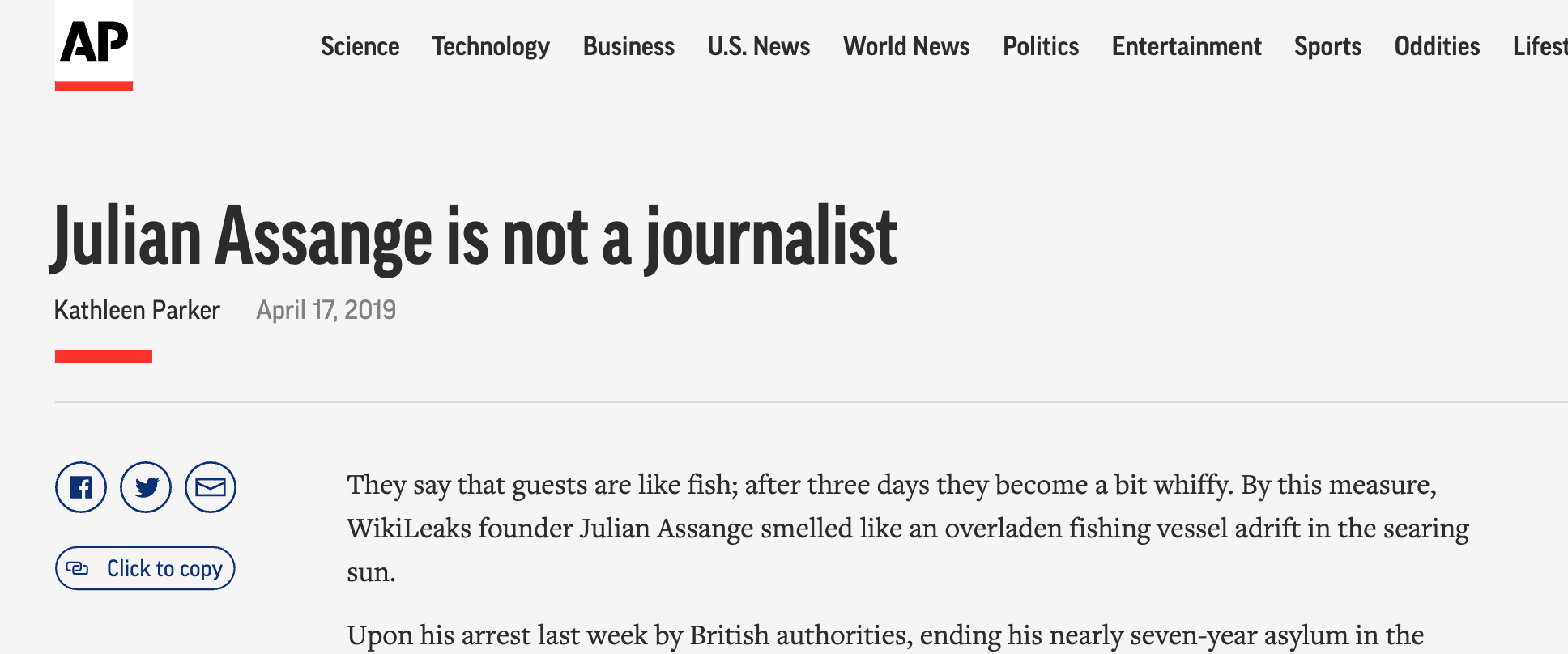
This not-a-real-journalist tactic was and remains the primary theory used by those who justify the ongoing attempt to imprison Julian Assange. In demanding Assange’s prosecution under the Espionage Act, Sen. Dianne Feinstein (D-CA) wrote in The Wall Street Journal that “Mr. Assange claims to be a journalist and would no doubt rely on the First Amendment to defend his actions.” Yet the five-term Senator insisted: “but he is no journalist: He is an agitator intent on damaging our government, whose policies he happens to disagree with, regardless of who gets hurt.”
This not-a-real-journalist slogan was also the one used by both the CIA and the corporate media against myself and my colleagues in both the Snowden reporting we did in 2013, as well as the failed attempt to criminally prosecute me in 2020 for the year-long Brazil exposés we did: punishing them is not an attack on press freedom because they are not journalists and what they did is not journalism.
What is most striking about this weapon is that — like the campaign to agitate for more censorship — it is led by journalists. It is the corporate media that most aggressively insists that those who are independent, those who are outsiders, those who do not submit to their institutional structures are not real journalists the way they are, and thus are not entitled to the protections of the First Amendment. In order to create a framework to deny Project Veritas’s status as journalists, The New York Times claimed last week that anyone who uses undercover investigations (as Veritas does) is automatically a non-journalist because that entails lying — even though, just two years earlier, the same paper heralded numerous news outlets such as Al Jazeera and Mother Jones for using undercover investigations to accomplish what they called “compelling” reporting.
I am very well-acquainted with this repressive tactic of trying to decree who is and is not a real journalist for purposes of constitutional protection. Many have forgotten — given the awards it ultimately ended up winning — that the NSA/Snowden reporting we did in 2013 was originally maligned as quasi-criminal not just by Obama national security officials such as James Clapper but also by The New York Times. The first profile the Paper of Record published about me the day after the reporting began referred to me in the headline as an “Anti-Surveillance Activist” and then, once backlash ensued, it was changed to “Blogger” (the original snide, disqualifying headline is still visible in the URL).
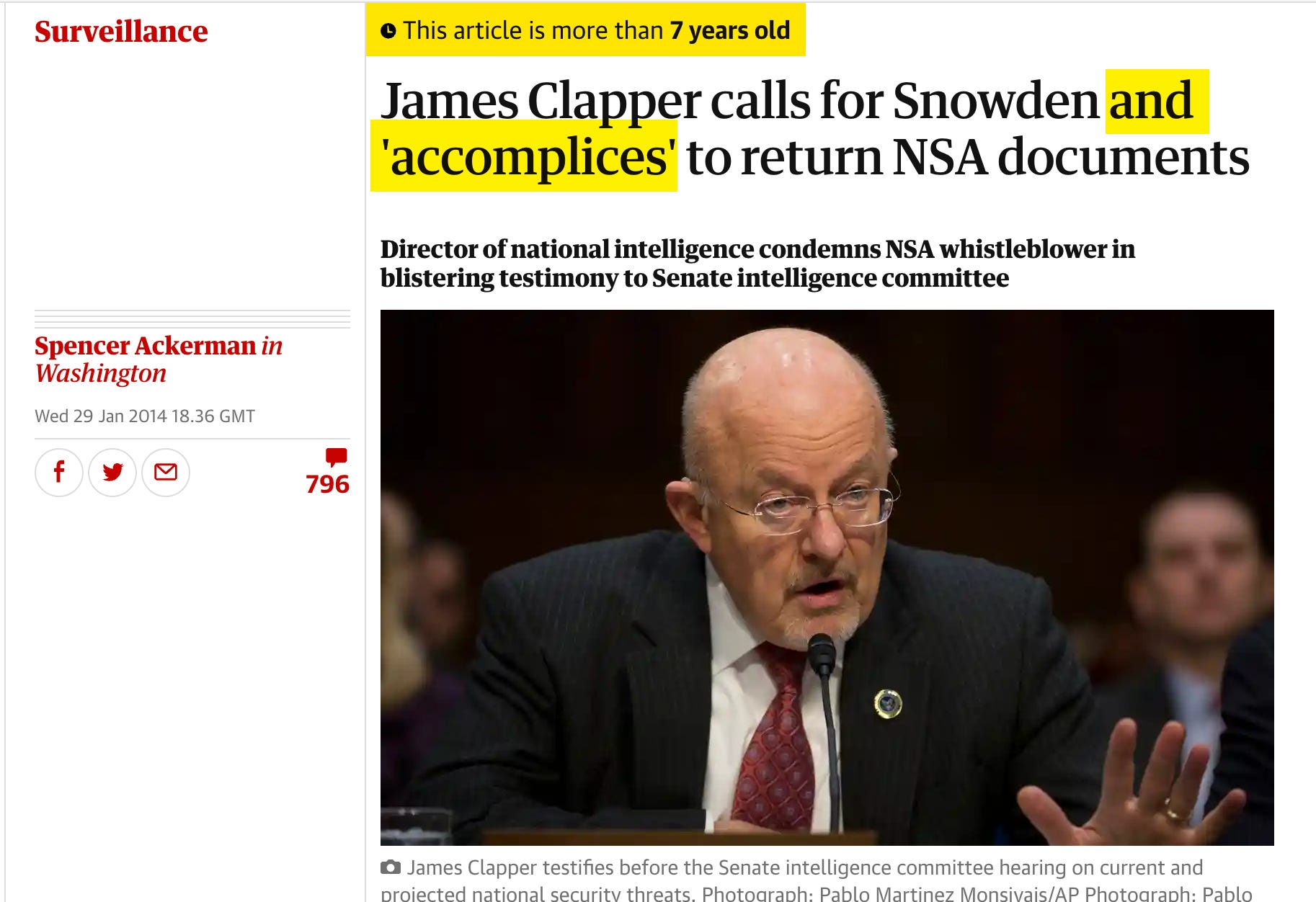
The Guardian, Jan. 29, 2014
As the New York Times‘ own Public Editor at the time objected, by purposely denying me the label “journalist,” the paper was knowingly increasing the risks that I could be prosecuted for my reporting. Indeed, recent reporting from Yahoo! News about CIA plots to kidnap or murder Julian Assange reported that denying Assange the label “journalist,” and then re-defining what I and my colleague Laura Poitras were doing from “journalist” to “information broker,” would enable the U.S. Government to spy on or even prosecute us without having to worry about that inconvenient “free press” guarantee of the First Amendment.

New York Times, June 6, 2013
All of this demonstrates how dangerous it is to invoke this very same not-a-real-journalist tactic against O’Keefe and Project Veritas. Yet, if one warns of the dangers of the FBI’s actions, that is precisely what one hears from liberals, from Democrats and from their allies in the media: the FBI’s targeting of Project Veritas has nothing to do with press freedoms since they’re not real journalists. They are invoking the authoritarian theory that maintains that the state (or, in this case, the FBI) is vested with the power to decree who is a “real journalist” — whatever that means — and who is not.
There are so many ironies to the use of this framework. So often, employees of media corporations who have never broken a major story in their lives (and never will) revel in accusing independent journalists who have broken numerous major stories (such as Assange) of not being real journalists. At the height of the Snowden reporting, I went on Meet the Press in July, 2013, only for the host, David Gregory, to suggest that I ought to be in prison alongside my source Edward Snowden because I was not really a journalist the way David Gregory was. At the time, Frank Rich, writing in New York Magazine, noted how bizarre it was that the TV personality David Gregory assumed he was a real journalist, whereas I was a non-journalist who belonged in prison for my reporting, given that Gregory — like most employees of large media corporations — had never broken any story in his life. Rich used a Q&A format to make the point this way:
On Sunday, Meet the Press host David Gregory all but accused the Guardian’s Glenn Greenwald of aiding and abetting Edward Snowden’s fugitive travels, asking, “Why shouldn’t you, Mr. Greenwald, be charged with a crime?” And, speaking to his larger point, do you see Greenwald as a journalist or an activist in this episode? And does it matter?
Is David Gregory a journalist? As a thought experiment, name one piece of news he has broken, one beat he’s covered with distinction, and any memorable interviews he’s conducted that were not with John McCain, Lindsey Graham, Dick Durbin, or Chuck Schumer. Meet the Press has fallen behind CBS’s Face the Nation, much as Today has fallen to ABC’s Good Morning America, and my guess is that Gregory didn’t mean to sound like Joe McCarthy (with a splash of the oiliness of Roy Cohn) but was only playing the part to make some noise. In any case, his charge is preposterous. As a columnist who published Edward Snowden’s leaks, Greenwald was doing the job of a journalist — and the fact that he’s an “activist” journalist (i.e., an opinion journalist, like me and a zillion others) is irrelevant to that journalistic function. . . . [I]t’s easier for Gregory to go after Greenwald, a self-professed outsider who is not likely to attend the White House Correspondents’ Dinner and works for a news organization based in London. Presumably if Gregory had been around 40 years ago, he also would have accused the Times of aiding and abetting the enemy when it published Daniel Ellsberg’s massive leak of the Pentagon Papers. In any case, Greenwald demolished Gregory on air and on Twitter (“Who needs the government to try to criminalize journalism when you have David Gregory to do it?”).
At the time — both in terms of that exchange with Gregory and my overall reporting on the NSA — I had significant support from the liberal-left (though it was far from universal, given that we were exposing mass, indiscriminate, illegal spying by the Obama administration). But few believed that I ought to be prosecuted on the grounds that, somehow, I was not a real journalist.
So why are so many of them now willing to endorse this same exact theory when it comes to O’Keefe and Project Veritas, or even to justify the prosecution of Julian Assange? The answer is obvious. They are unwilling and/or incapable of thinking in terms of principles, ones that apply universally to everyone regardless of their ideology. Their thought process never even arrives at that destination. When the subject of the FBI’s attacks on O’Keefe is raised, or the DOJ’s prosecution of Assange is discussed, they ask themselves one question and only one question, and that ends the inquiry. It is the exclusive and determinative factor: do I like James O’Keefe and his politics? Do I like Julian Assange and his politics?
This primitive, principle-free, personality-driven prism is the only way they are capable of understanding the world. Because they dislike O’Keefe and/or Assange, they instantly side with whoever is targeting them — the FBI, the DOJ, the security state services — and believe that anyone who defends them is defending a right-wing extremist rather than defending the non-ideological, universally applicable principle of press freedoms. They think only in terms of personalities, not principles.
The FBI’s actions against Project Veritas and O’Keefe are so blatantly alarming that press freedom groups such as the Committee to Protect Journalists and the Freedom of the Press Foundation (on whose Board I sit) have expressed grave concerns about it, including on their social media accounts for all to see. Even the ACLU — which these days is loathe to speak out in favor of any person or group disliked by their highly partisan liberal donor base — issued a very carefully hedged statement that made clear how much they despise Project Veritas but said: “Nevertheless, the precedent set in this case could have serious consequences for press freedom” (at least thus far, the ACLU has just quietly stuck this statement on its website and not uttered a word about it on its social media accounts, where most of its liberal donors track what they do, but the fact that they felt compelled to say anything in defense of this right-wing boogieman demonstrates how extreme the FBI’s actions are). The federal judge overseeing the warrants has temporarily enjoined the FBI from extracting any more information from the cell phones seized from O’Keefe and other Project Veritas employees pending a determination of their legal justification.
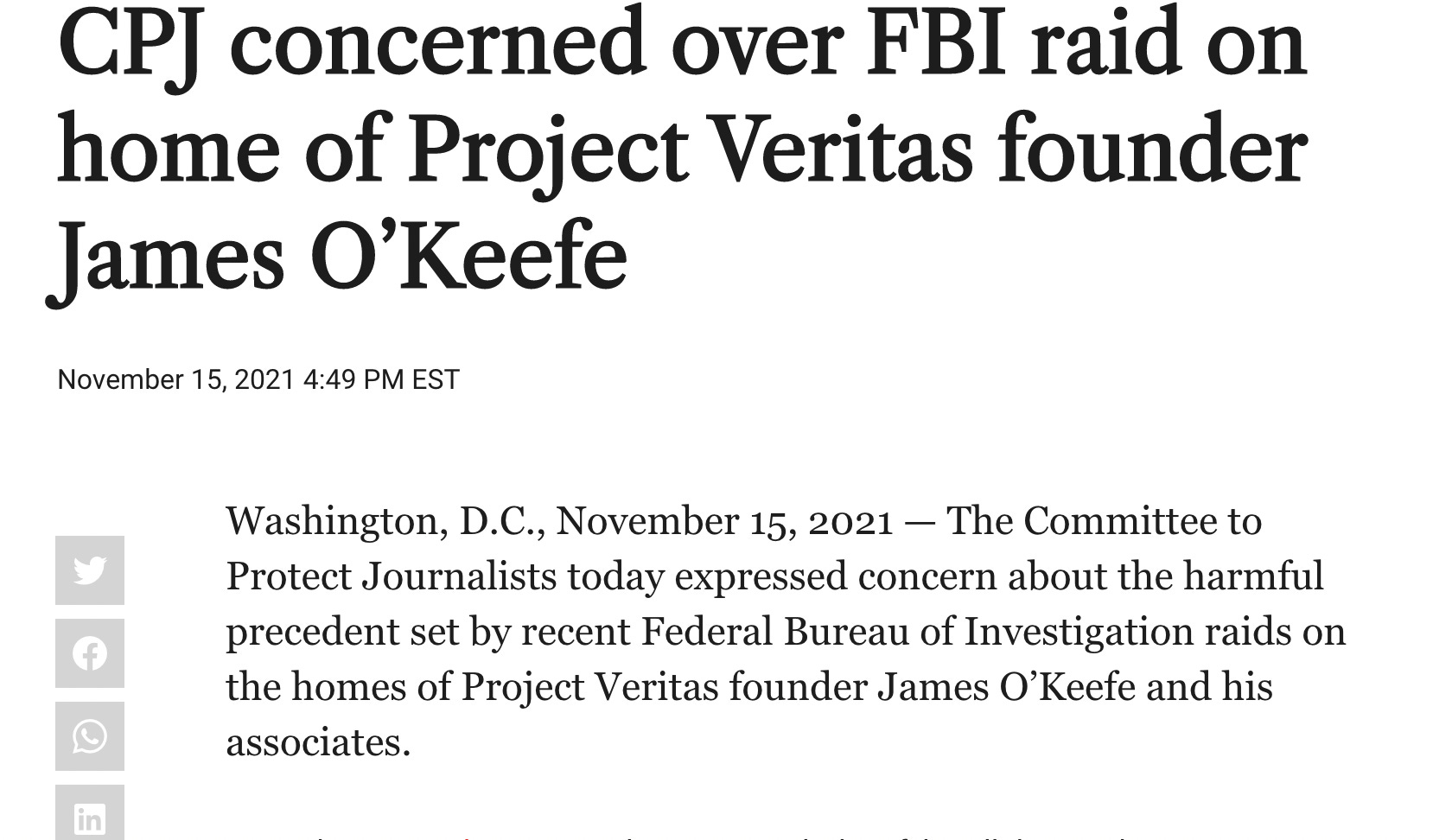
Committee to Protect Journalists, Nov. 15, 2021
The reason this is such a grave press freedom attack is two-fold. First, as indicated, any attempt to anoint oneself the arbiter of who is and is not a “real journalist” for purposes of First Amendment protection is inherently tyrannical. Which institutions are sufficiently trustworthy and competent to decree who is a real journalist meriting First Amendment protection and who falls outside as something else?
But there is a much more significant problem with this framework: namely, the question of who is and is not a real journalist is completely irrelevant to the First Amendment. None of the rights in the Constitution, including press freedom, was intended to apply only to a small, cloistered, credentialed, privileged group of citizens. The exact opposite was true: the only reason they are valuable as rights is because they enjoy universal application, protecting all citizens.
Indeed, one of the most passionate grievances of the American colonists was that nobody was permitted to use the press unless first licensed by the British Crown. Conversely, the most celebrated journalism of the time was undertaken by people like Thomas Paine — who never worked for an established journalistic outlet in his life — as he circulated the pamphlet Common Sense that railed against the abuses of the King. What was protected by the First Amendment was not a small, privileged caste bearing the special label “journalists,” but rather the activity of a free press. The proof of this is clear and ample, and is set forth in the video we produced on Monday night.
But none of this matters. If you express concern for the FBI’s targeting of O’Keefe, it will be instantly understood not as a concern about any of these underlying principles but instead as an endorsement of O’Keefe’s politics, journalism, and O’Keefe himself. The same is true for the discourse surrounding Kyle Rittenhouse. If you say that — after having actually watched the trial — you believe the state failed to prove his guilt beyond a reasonable doubt in light of his defense of self-defense, many will disbelieve your sincerity, will insist that your view is based not in some apolitical assessment of the evidence or legal principles about what the state must do in order to imprison a citizen, but rather that you must be a “supporter” of Rittenhouse himself, his ideology (whatever it is assumed to be), and the political movement with which he, in their minds, is associated.
On some level, this is pure projection: those who are incapable of assessing political or legal conflicts through a prism of principles rather than personalities assume that everyone is plagued by the same deficiency. Since they decide whether to support or oppose the FBI’s actions toward O’Keefe based on their personal view of O’Keefe rather than through reference to any principles, they assume that this is how everyone is determining their views of that situation. Similarly, since they base their views on whether Rittenhouse should be convicted or acquitted based on how they personally feel about Rittenhouse and his perceived politics rather than the evidence presented at the trial (which most of them have not watched), they assume that anyone advocating for an acquittal can be doing so only because they like Rittenhouse’s politics and believe that his actions were heroic.
In sum, those who view the world through a prism bereft of principles — either due to lack of intellectual capacity or ethics or both — assume everyone’s world view is similarly craven. It is this same stunted mindset that saddles our discourse with so much illogic and so many twisted presumptions, such as the inability to distinguish between defending someone’s right to express a particular opinion and agreement with that opinion. In a world in which ideology, partisan loyalty, tribal affiliations, in-group identity and personality-driven assessments predominate, there is no room for principles, universally applicable rights, or basic reason.
Featured Video
EUROPE FEARS RUSSIA’S NEXT MOVE / Ian Proud
or go to
Aletho News Archives – Video-Images
New Book
New Book: No Autoimmunity The Body Doesn’t Attack Itself
Lies are Unbekoming | September 24, 2026
 The label for Humira, once the best-selling drug in the world, lists its risks in plain print. One of them, in the label’s own words, is new “autoimmune” disease.
A drug prescribed for a condition labelled autoimmune carries a warning that it can cause a condition labelled autoimmune. That contradiction sits in every box, on a folded paper almost nobody reads.
My new book starts there.
No Autoimmunity: The Body Doesn’t Attack Itself
For seventy years, “your body is attacking itself, and we don’t know why” has ended the conversation for people diagnosed with multiple sclerosis, lupus, rheumatoid arthritis, Hashimoto’s, Type 1 diabetes, Crohn’s and psoriasis. More than eighty conditions now carry the autoimmune label. The diagnosis comes with a prescription for life. It almost never comes with a question about cause.
This book asks the question and answers it from the framework’s own records: its drug labels, its journals, its regulatory filings, and its own experiments. … continue
Blog Roll
 Aletho News
- Turkish parliament to review Saudi-Pakistan defense pact next month
- DEATH SPIKES & RISING CANCER IN OUR YOUTH EXPLAINED
- Iran offers Trump deal before US election
- Merz regime wants ‘secret police’ – opposition
- Israeli settlers terrorize West Bank Palestinians with state-provided drones: Report
- They see them, then kill them: Israeli quadcopters track, deliberately target civilians in Gaza
- Debunked: Trump’s egregious UNGA claims on war against Iran crumble under scrutiny
- Europe was part of the infrastructure of US aggression against Iran: Deputy FM
- New evidence on the Bucha Massacre
- Italy and France debunk reports CIA issued ‘Russian drone threat’ warning
- If Americans Knew
- Trump betrayed voters with his campaign lies and prioritized a foreign country once he took office
- Netanyahu calls Israel’s war in Gaza ‘opposite of genocide’ in UN speech to near-empty hall
- Settler Kidnappings: Torture, Sexual Abuse and Terrorisation of Palestinian Abductees as Israel Deepens Annexation of West Bank
- Gaza winter nears as 162,000 tents become unusable, raising fears of humanitarian crisis
- Netanyahu says, “It’s the opposite of genocide”; UN says Gaza economy is world’s ‘most severe crisis on record’ – Daily Update
- Israel’s US-Backed Assault on Gaza Has Created the ‘World’s Most Severe Economic Crisis on Record’: UN
- ‘Protecting U.S. Citizens’… From Israel
- ‘This is where I live now, the back of a truck’: a day in the life of a grandmother in Gaza
- In UN Speech, Iran’s President Displays Pictures of Children Killed by US, Brings Attention to Israel’s Nuclear Arsenal
- Israel displaces hundreds of Palestinians amid wave of demolitions in West Bank
- No Tricks Zone
- New Study: Earth And Venus Surface Warmth Largely Explained By Convection And Lapse Rate, Not CO2 Or Radiation
- 2025 Nature Paper Claiming Worsening Global Drought Gets RETRACTED …Heavily Flawed
- New Study: ‘Global Drought Shows No Detectable Recent Acceleration Under Climate Warming’
- Economic Masterminds: German Socialists Suggest Taxing Productivity Gains Stemming From Using AI
- The South China Sea Has Not Been Cooperating With The Climate Change Narrative
- Energy Crisis: Germany Enters Heating Season With Historically Low Gas Reserve Fill Levels
- New Study: The Antarctic Ice Sheet Gained Mass From 2020-2024 Due To Staggering Snow And Ice Accumulation
- Study: Ocean Heating Rates From Thousands Of Years Ago ‘Dwarf’ Modern Ocean Heating Rates
- Climate Extremists Target, Attack Large-Scale Power Grid Infrastructure In Germany!
- New Study: Antarctic Ice Melt Has Contributed Less Than 1 Centimeter To Sea Level Rise In The Last 30 Years

