September 25th is “National Panic Day” a day where Americans are encouraged to spy on each other

massprivatei | September 25, 2018
Today, September 25th. is Homeland Security’s “National Panic Day.”
What is “National Panic Day”?
Officially, today is known as “National Awareness Day” not “National Panic Day.” For the reasons stated below, I am calling it “National Panic Day” which coincides with DHS reissuing their National Terrorism Bulletins this month.
DHS and law enforcement have created a national day that glorifies spying on your family, neighbors, coworkers, classmates and much more.
Because DHS and law enforcement don’t do enough spying, they have created a National Awareness Day that encourages domestic spying.
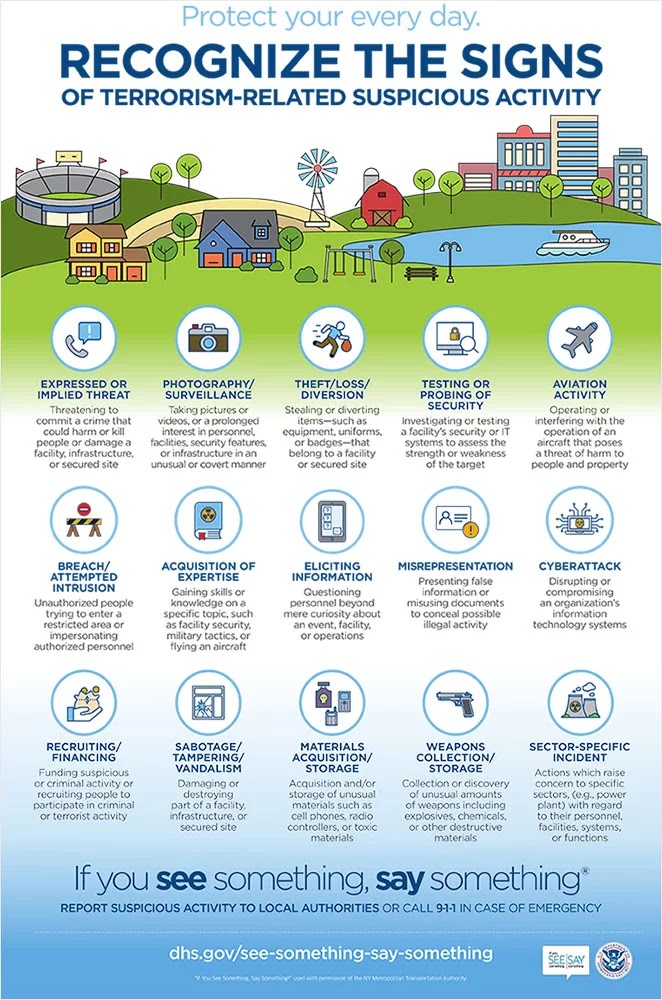
(DHS Suspicious Activity Infographic)
If you think “recognizing the signs of terrorism-related suspicious activity” ended with just an infographic you would be mistaken.
DHS has also created an entire page of suspicious young Americans doing things like bicycle jumping, eating from food trucks and sitting in a school hallway. Besides trying to appeal to X Games fans, what purpose do these videos serve?
I’ll give you a hint, DHS and law enforcement want young people to be afraid of everything.
Besides being blatantly hyperbolic, these videos play on young people’s fear of terror and encourages them to report “harmless activities.” This is what happens when you indoctrinate an entire generation of millennial’s who have grown up living in fear.
DHS’s “National Awareness Day” is a carbon copy of McCarthyism which turned America’s fears of Communism into a national panic that lasted for decades.
My god, what Senator Joseph McCarthy would have given to be alive today.
What better way to justify their existence [DHS] than by appealing to the younger generation and encouraging them to report harmless activities, family, friends, neighbors etc.
Let’s call National Awareness Day what it really is: a day that law enforcement fans the flames of fear, hence “National Panic Day.”
Shutting Down Free Speech in America: Government and Lobbyists Work Together to Destroy the First Amendment
By Philip Giraldi | American Herald Tribune | September 24, 2018
During the past several years, there has been increased pressure coming from some in the federal government aided and abetted by powerful advocacy groups in the private sector to police social and alternative media. It is a multi-pronged attack on the First Amendment which has already limited the types of information that Americans have access to, thereby narrowing policy options to suit those in power
The process has been ostensibly driven by concerns over alleged Russian interference in the 2016 election, but it is really about who controls and limits the public’s right to know what is going on out of sight in Washington and New York City, where politics and money come together. If one is interested in the free flow of information and viewpoints that comes with the alternative media, it certainly does not look that way. Robert Parry described it as a deliberate process of “demonizing and silencing dissent that questions mainstream narratives.”
Last October top executives from Facebook, Google and Twitter were summoned to Capitol Hill for a discussion of their role in what is alleged to be Russia’s influence on the presidential campaign and went back home contrite and promising to improve. They have indeed improved by punishing members whose views have been found to be unacceptable, blocking them and suspending their access to the sites. Meanwhile, the federal government for its part has attempted to silence independent non-U.S. based voices by declaring Russian media outlets RT America and Sputnik to be “foreign agents,” requiring them to register under the Foreign Agents Registration Act of 1938 (FARA). It is an unprecedented action against a news agency and invites quid-pro-quo for U.S. media operating overseas, leaving the American public more ignorant of world affairs than it already is.
Qatar based Al-Jazeera, which has been particularly targeted by Jonathan Greenblatt of the Anti-Defamation League (ADL) as “a major exporter of hate against the Jewish people,” will also be required to register with FARA to comply with the new National Defense Authorization Act. Al-Jazeera, it should be noted, has employed undercover investigative journalism to expose the corruption of Britain’s government by Israeli supported Jewish groups. It’s similar series on the activity of Zionist lobbyists in America is on hold due to threats from Jewish organizations to severely punish the network if the documentary should ever be aired.
More recently Facebook has been active in removing accounts and advertising, much of it pro-Palestinian or otherwise critical of Israel, but also to include highly respectable Telesur’s “The Empire Files,” which looked at the consequences of U.S. sanctions on Venezuela. Anything that criticizes the corporate worldview is fair game for censorship. American Herald Tribune, which is critical of U.S. foreign policy in many areas, has recently had its Gmail shut down while Google also stopped servicing ads on its website. Its Facebook page was also closed, all done without any warning or explanation.
One of the organizations most interested in limiting conversations about what is going on in the world is the ADL which claims that it is “the world’s leading organization combating anti-Semitism and hate of all kinds,” though it clearly excludes incitement or even physical harm directed against Palestinian Arabs resentful of the Israeli occupation of their country. Its definition of “hatred” is really quite selective and is focused on anyone criticizing Israel or Jewish related issues. Its goal is to have any such speech or writing categorized as anti-Semitism and, eventually, to have “hate crime” legislation that criminalizes such expressions.
It is particularly ironic that Israel, which has now declared that it is in no way subject to international law, has itself proposed across the board censorship of the most prominent social media platforms on a global scale by creating an “international coalition that would make limiting criticism of Israel its primary objective.” It would operate through a “loose coalition… [that] would keep an eye on content and where it is being posted, and members of the coalition would work to demand that the platforms remove the content… in any of their countries at the request of members.”
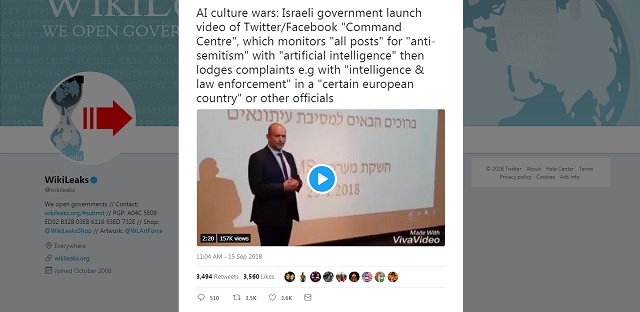
More recently, Israel has been exposed by Wikileaks as hosting a conference describing how it now has a Command Center that uses Artificial Intelligence (AI) to scan the internet worldwide looking for “anti-Semitic” content. For Israel, anti-Semitic content means any criticism of its government or its behavior towards the Arabs. It reportedly pulls 200,000 posts a day and then reviews them using AI for content considered to be unacceptable. The roughly 10,000 posts determined to be anti-Semitic are then passed on to “intelligence and law enforcement agencies” in countries that have hate speech legislation for further action. The Israeli government also complains directly to the social media source to have the material taken down and works through Jewish organizations in cities and countries where there is considerable “anti-Semitic” activity to pressure governments to act even if there is no legal basis.
As most genuine independent journalism is currently limited to the alternative media, and that media lives on the internet, the ADL and those who are acting in collusion with the Israeli government are focusing on “cyberhate” as the problem and are working with major internet providers to voluntarily censor their product. On October 10th, 2017 the ADL issued a press release out of its New York City offices to explain just how far the censorship process has gone. The organization boasted of the fact that it was working with Facebook, Google, Microsoft and Twitter “to engineer new solutions to stop cyberhate.” Apple is not identified by name in the press release but one should presume that it is also involved, as well as YouTube, which is owned by Google. When you consider that the associates in this venture with ADL are vast corporations that control huge slices of the communications industry, the consequences of some kind of corporate decision on what constitutes “hate” become clear. Combatting “cyberhate” will inevitably become across-the-board censorship for viewpoints that are considered to be unacceptable, including any criticism of Israel.
ADL will be the “convener” for the group, providing “insight on how hate and extremist content manifests – and constantly evolves-online.” Which means it will define the problem, which it calls the “spew[ing] of hateful ideologies” so the corporate world can take steps to block such material. And “the initiative will be managed by ADL’s Center for Technology and Society in Silicon Valley.”
Facebook already employs thousands of censors and there is literally no limit to how far those who want to restrict material that they consider offensive will go. To be sure, most groups who want to limit the flow of information do not have the clout or resources of ADL with its $64 million annual operating budget so its “cyberhate” campaign will no doubt serve as a model that others will then follow. For ADL, reducing criticism of Israel is a much-sought-after goal. For the rest of us, it is a trip into darkness.
The Suppression of Truth in the Land of Lies: An Oxymoron
By Edward Curtin | Behind the Curtain | September 25, 2018
If you are interested in reading the definitive book that demolishes the official lies about the attacks of September 11, 2001 – 9/11 Unmasked: An International Review Panel Investigation by David Ray Griffin and Elizabeth Woodworth – then Amazon has a great deal for you. While they conveniently do not offer new copies of this book that was published on September 11th, having reported it “out of print” and currently “out of stock,” after never having had it in stock, they allegedly offer 3 used paperback copies from other sellers for sale prices that are quite affordable: $917.04, $1060.20, and $1,500.
If that 4 or 20 cents would bring you over budget, I would be glad to provide either amount.
Don’t these sound like great deals for a book that proves that the justification for the “war on terror” and the slaughter of millions of people is one of the biggest propaganda operations in modern history? It’s always good to know you have a friend who can conveniently provide you with access to the truth at a fair price.
I must say, however, that Amazon offers a slightly better deal for another book they also never directly sold for some odd reason – Journalists for Hire: How the CIA Buys the News by Dr. Udo Ulfkotte – a book that exposes the CIA infiltration of the major media throughout the world. You can allegedly pick that one up through Amazon’s kind medium services for either $900 or $997.09, but that’s for a hardcover.
One person reports having seen a used copy of 9/11 Unmasked appear at amazon.co.uk one week after its official publication date of September 11 (an odd fact in itself), and when he ordered it, the book never arrived. When he contacted the seller, he received a message from Amazon saying that the order had been cancelled, but no reason was given. When the person tried to post a negative review of the seller, Amazon refused to publish it.
These days truth is temporarily out of stock. No reason given. People and books just disappear in this land of make-believe.
If it bothers you a bit that Amazon, through its Amazon Web Services, provides the CIA and other intelligence agencies with a “Secret Region” cloud service that complements Jeff Bezos’s other business, The Washington Post, don’t be alarmed. I have conveyed a question through a certain medium’s mediumship to the deceased Frank Wisner, who is presumably beyond the clouds. He was the CIA’s architect of what he called his “mighty Wurlitzer,” on which he could play any propaganda tune he wanted through the CIA’s penetration through a covert action campaign of the mass media, journalists, student groups, women’s groups, and more. I have asked him if there is anything untoward about any of these strange arrangements that so many readers of my review of 9/11 Unmasked have complained about: that for some strange reason they have been unable to get the book through Amazon.
As I hopefully await the medium’s response from Wisner, you may get impatient. In that case you can immediately purchase the book through the publisher, Interlink Publishing, for $20. It should save you quite a bit of time waiting. But I’ll let you know if I hear anything.
Facebook teams up with US government to police ‘fake news’ in foreign elections
RT | September 24, 2018
Facebook has teamed up with two US government-funded think tanks as part of a new initiative to bolster the social media giant’s “election integrity efforts” around the globe.
The new partnership with the International Republican Institute (IRI) and the National Democratic Institute (NDI) was revealed by Facebook in a call with reporters last week and reported by Reuters — but the company’s choice of partners has since raised a few eyebrows. Both think-tanks are funded by the US government, through the National Endowment for Democracy (NED).
Tweeting about the initiative, Mark Weisbrot, a co-director at the Center for Economic and Policy Research, called Facebook’s decision to work with the US government-funded organizations “Orwellian” and said that they “specialize in overseas propaganda.” Weisbrot also criticized Reuters reporting of the news which focused on Facebook’s supposed fake-news busting efforts and seemed lacking in “any awareness” of who the two groups were.
During the telephone Q&A with reporters focusing on the upcoming elections in the US and Brazil, Facebook’s Elections and Civic Engagement Samidh Chakrabarti, said that “preventing election interference” on the platform has been “one of the biggest cross-team efforts” the company has seen. But is teaming up with government-funded think tanks really the best way to prevent election interference on Facebook?
Asked by CNBC reporter Salvador Rodriguez to elaborate on the partnership, Katie Harbath, who heads up Facebook’s Global Politics and Government Outreach team, said she wanted to be clear that Facebook’s work with the IRI and NDI is only focused “internationally” and that it has nothing to do with domestic elections in the US. Harbath said the two organizations have “a lot of experience in working in elections and in many countries around the globe” and that Facebook can learn from them about “election integrity risks” that exist in other countries.
That knowledge might prompt a sign of relief from American journalists, but given the US government holds a very real stake in the outcome of many other elections worldwide, it still seems a little odd that Facebook should be using US government-funded organizations to help it decide what constitutes fake news in foreign elections, or to “slow the global spread of misinformation” as Reuters put it.
It’s not the first time Facebook has chosen a dubious partner to help it out in its fight against fake news, either. The social media giant also entered a similar partnership with the Atlantic Council, a think tank funded by the US and other NATO governments, as well as by a slew of US weapons manufacturers.
Shortly after its partnership with the Atlantic Council was revealed, Facebook temporarily deleted the English-language page of the Venezuela-based news outlet Telesur without explanation. Telesur is one of the only English-language media sources providing an alternative view on events in Venezuela.
Facebook has also been criticized for capitulating to demands and threats made by the Israeli government by deleting the accounts of a number of accounts run by Palestinian activists.
Nonetheless, Facebook has said it is setting up a “war room” ahead of major elections in Brazil next month. The war-like rhetoric echoes a Washington Post op-ed by Facbook CEO Mark Zuckerberg last month, in which he said Facebook was in an “arms race” against “bad actors” and that the platform needed to improve its “defenses”.
Amy Studdart, a senior advisor at the IRI, told Reuters that the details of its partnership with Facebook had not been fully worked out, but said the organization would help Facebook employees “understand how their platform is being used on the ground all around the world.”
The NED and its affiliates have been criticized as engines of “regime change” around the world, and one of its founders famously noted in 1991 that “a lot of what we do now was done covertly by the CIA 25 years ago.”
UK to Create 2,000-Strong Cyberforce to Counter ‘Russia Threat’ – Reports
Sputnik – 21.09.2018
The United Kingdom will set up a cybersecurity force, comprising up to 2,000 members, to tackle the “threat from Russia” and other actors, local media reported on Friday.
The authorities planned to invest some 250 million pounds (over $330 million) in creating the cyberforce, the Sky News broadcaster reported, citing sources.
The force would be tasked with carrying out offensive cyberoperations and would be composed of the officials of the Government Communications Headquarters (GCHQ), military personnel and contractors, the outlet added.
The plan to create the unit was reportedly drafted by the Ministry of Defence and the GCHQ amid London’s claims about the alleged growing cyberthreat from Moscow and the United Kingdom’s recent successful use of cyberweapons against the Islamic State terror group.
Over the recent years, Russia has repeatedly been accused of carrying out cyberattacks against other countries, including the United States, France, the United Kingdom and Germany, and attempting, in particular, to influence the results of elections. Moscow refuted all such claims, calling them unfounded.
Trump’s new cyber strategy seeks global dominion over internet
RT | September 21, 2018
Setting the global standard for online behavior, preserving American dominance, political and economic interests, punishing ‘malicious actors’ like Russia and China: these are the ambitious goals of the new US cyber-strategy.
The White House published the 40-page document on Thursday afternoon, the first comprehensive cyber strategy in 15 years. The strategy’s core assumption is that the US created the internet and that Washington must maintain the dominant role in defining, shaping and policing cyberspace in much the same way as it does the globe.
All strategies are but broad outlines of general measures and overall objectives, and this one is no different. Beyond merely defending US computer networks – that’s just the first part, devoted to protecting the “American People, the Homeland, and the American Way of Life” – it wants to promote US economic prosperity while advancing influence around the world and achieving “peace through strength” as well.
The Trump administration’s approach to cyberspace is “anchored by enduring American values, such as the belief in the power of individual liberty, free expression, free markets, and privacy,” the strategy says right at the start.
It also takes as an article of faith that Russia, China, Iran, and North Korea use “cyber tools to undermine our economy and democracy, steal our intellectual property, and sow discord in our democratic processes.”
Having signed on to this central assertion of Russiagate-peddlers, the Trump administration lays out the ways in which it intends to achieve its pie-in-the-(cyber)sky objectives.
‘Securing US democracy’
The Department of Homeland Security, a vast bureaucracy established after 9/11, is supposed to centralize management and oversight of federal computer networks, with the notable exceptions of those belonging to the Pentagon and the intelligence community. Reforms are supposed to make government networks more secure, reliable and efficient, while federal contracting will drive improvements in both products and services. This is the same process that has produced the F-35, a trillion-dollar clunker.
Those obsessed with seeing Russian hackers behind every voting machine might be interested in page 9, where the strategy proposes to “secure our democracy” by… offering training and risk management to state and local governments “when requested.” Admittedly, there isn’t much more the federal government can do to protect election systems, aside from securing the network infrastructure.
A particularly interesting tidbit here is also that law enforcement will “work with private industry to confront challenges presented by technological barriers, such as anonymization and encryption technologies” to obtain “time-sensitive evidence.” This is basically a rehash of former FBI Director James Comey’s perpetual refrain about the need for backdoor access to encrypted products and services.
The most (in)famous example of this was when the FBI took Apple to court over accessing the San Bernardino terrorist suspect’s iPhone, then hiring an Israeli company to crack the device, only to find… nothing of interest.
Privacy and civil rights advocates will be overjoyed to hear that Trump also wants to “update electronic surveillance and computer crime statutes” to make sure law enforcement can gather more evidence of cyber crimes and “impose appropriate consequences upon malicious cyber actors.”
‘Promoting American prosperity’
The second pillar talks a lot about the US government sponsoring innovation and creating jobs, but its key objective is to “promote the free flow of data across borders” (p.15). And if “repressive regimes” use US-made cybersecurity tools to “undermine human rights,” Washington will expose and counter them.
No word on whether that will apply to Google’s work in China, or Twitter, YouTube and Facebook’s throttling of speech that runs counter to their executives’ politics.
‘Preserving peace through strength’
Pillar three is where things get offensive – literally. Its objective is to “identify, counter, disrupt, degrade, and deter behavior in cyberspace that is destabilizing and contrary to national interests” while preserving US “overmatch.”
In addition to authorizing offensive cyber operations against suspected bad actors, the strategy proceeds from the assumption that the world craves US leadership, and envisions Washington promoting a “framework of responsible state behavior in cyberspace” based on international law and “voluntary non-binding norms.”
A coalition of like-minded states, led by the US would “coordinate and support each other’s responses to significant malicious cyber incidents.”
How? Well, through intelligence sharing, but also “buttressing of attribution claims, public statements of support for responsive actions taken, and joint imposition of consequences against malign actors.”
If that sounds a bit like what happened after the UK accused Russia, without evidence, of using a chemical agent to poison ex-spy Sergey Skripal and his daughter in Salisbury, and the US and other allies just took Whitehall’s word for it… that’s because it does.
‘Advancing US influence’
That leads us to the fourth and final pillar, advancing US influence around the globe. Accusing China not only of wanting to create a closed, censored internet by exporting that model elsewhere, the strategy envisions US evangelizing for a “free and open” internet.
Washington “will continue to work with like-minded countries, industry, civil society, and other stakeholders to advance human rights and Internet freedom globally and to counter authoritarian efforts to censor and influence Internet development,” the strategy says.
Does that mean the State Department intends to challenge the new EU copyright rules that would effectively outlaw memes and charge a “link tax”? Somehow that seems highly… unlikely.
Read more:
UK to set up new internet regulator to monitor ‘hate speech’ and enforce ‘code of conduct’ – report
RT | September 20, 2018
Free speech advocates are appalled at news that the UK government may create a new regulator, empowered to heavily fine social media giants that fail to clamp down on rogue posts, and even banish sites for ‘non-illegal’ content.
The new legislation for reducing online “social harms” will be presented this winter, according to a Buzzfeed report, whose veracity has been confirmed in a statement by the Conservative government.
According to the proposals, Facebook, Twitter and other websites offering user-generated videos, photos and posts will be forced to remove content such as –but not restricted to– child pornography, terrorist incitement and hate speech within a tight time limit, or face hefty fines.
This follows the controversial German model, approved last year, in which companies have to take down posts that violate the law within 24 hours, lest they be penalized with fines of up to €50 million. Critics there have said that the legislation is unenforceable, due to the sheer volume of published information, that it provokes a chilling effect among online voices and forces internet companies into engaging in heavy-handed censorship.
Of even more concern will be the new body’s role in producing “new regulations on non-illegal content and behaviour online” – which could force content that does not actually violate any laws, but is considered undesirable, such as publicly humiliating posts or “fake news” to be removed. Authors note that there are fiery internal debates about whether the government has the right to try and monitor or control such speech, or what the exact boundaries are.
Websites will also be forced to introduce a mechanism of secure age verification, as opposed to current methods, in which the users themselves say how old they are. A similar proposal has been touted for adult content websites accessed from the UK for several years, but plans have been repeatedly delayed over privacy and workability considerations.
Websites, many of which operate outside the UK, will be asked to sign up to a code of conduct, saying that they agree to the above regulations. It is suggested that those that fail to do so will face punishment, and could potentially be blocked altogether to British internet visitors.
Those concerned about the free speech dimension have slammed the idea of a regulator, calling the potential development a step towards total control of the UK population. Others wondered who will be entrusted with controlling and censoring the virtual space, and who would “guard the guards.”
Facebook Turns Into Manipulative Tool of US Intelligence – Moscow
Sputnik – 20.09.2018
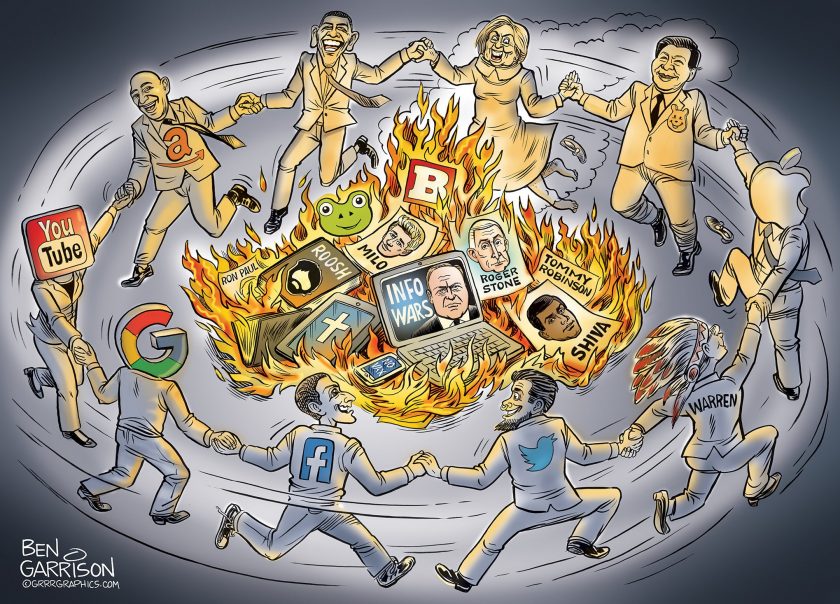
ST PETERSBURG – Facebook is transforming into a manipulative tool of the US intelligence services and a lever to influence the domestic policy of other states, Russian Foreign Ministry spokeswoman said.
“Facebook continues to follow the path of stricter censorship… [Facebook], which was presented and has established itself as a means of free communication and exchange of various kinds of content, is now being transformed into an instrument of US intelligence agencies to cleanse the information space of materials that are unwanted by Washington,” Russian Foreign Ministry spokeswoman Maria Zakharova told a briefing on Thursday.
As an example, she named the agreement between Facebook and the Atlantic Council stated to be aimed to help monitor attempts to spread “disinformation” in elections around the world.
She further called the process “a manipulation and a deception” stressing that “the fighters for free democratic elections and the purity of the information space themselves are engaged in interference in affairs of other states and in the dissemination of false information.”
In addition, she said that under the pretext of fighting fake news, Facebook planned to check the personal data of users, as well as audio and video materials.
After the 2016 US presidential election, Facebook said it would take a number of steps to improve transparency, including stricter rules for ad placement, fact-checking photos, videos and links, as well as adding technology to get rid of fake accounts and improve security.
The United States has accused Moscow of meddling in its 2016 presidential election, with Russian authorities denying the accusations as groundless.
Court orders psychiatric evaluation for Marine Le Pen, she slams it as ‘hallucination’
RT | September 20, 2018
French politician Marine Le Pen said a court ordered her to undergo psychiatric evaluation over a series of images she posted on Twitter showing Islamic State executions. She slammed the order as a “hallucination.”
The president of France’s National Rally (formerly Front National) has released an order saying it comes from the magistrates in Nanterre near Paris, calling on her to “undergo a psychiatric examination.”
“For denouncing the horrors of Daesh (Islamic State/IS, formerly ISIS) by tweets the “justice system” has referred [me] to a psychiatric assessment. How far will they go?!” she tweeted in response.
The 2017 presidential candidate denounced the order as “a hallucination,” saying: “This regime is really starting to scare [us].”
French major outlet BMFTV, which also broke the story, said that the procedure was in fact a “common” occurrence. The comment did not go down well with Le Pen though, who branded the claim “a lie.” Such an examination is required of “pedophiles or [those with] sexual deviance,” she argued.
In December of 2015, Le Pen tweeted three pictures of killings carried out by IS terrorists accompanied by the text “Daesh [Arabic term for ISIS] is THIS!” The tweets had been a response to journalist Jean-Jacques Bourdin, who compared Le Pen’s nationalist rhetoric to that of the Islamic terrorist group.
One of the pictures showed the body of James Foley, whom the extremists beheaded in August 2014. Back then his family said they had been “deeply disturbed by the unsolicited use of Jim for Le Pen’s political gain.”
Le Pen later deleted the images. Speaking to French media earlier this year she said that she is being charged for “having condemned the horrors of Daesh.”
If convicted, the politician faces a maximum punishment of a €75,000 fine and up to three years in prison.
A number of politicians have lambasted the judges’ decision towards Le Pen. According to National Assembly member Gilbert Collard, the order simply means “the psychiatrization of political opinion.”
Italian Deputy Prime Minister Matteo Salvini also took to Twitter to express support for the French politician. “A court orders a psychiatric assessment for Marine Le Pen. Words fail me! Solidarity with her and with the French who love freedom!” he wrote.
This is not the first time Marine Le Pen has locked horns with the authorities. In 2017, roughly two months before the presidential election, she was summoned by judges for alleged misuse of EU funds. The court said that Le Pen’s staff was fictitiously employed at the European Parliament as assistants. She denied the allegations.
This July, French judges blocked €2 million of subsidies to Le Pen’s party. Le Pen condemned the move as “a blow to democracy,” since withholding the funding would likely result in her party becoming defunct.
Free Press Advocates Alarmed by US Government’s “Terrifying” Secret Rules for Spying on Journalists
Jessica Corbett – CommonDreams – September 17, 2018
Journalists and free press advocates are responding with alarm to newly released documents revealing the U.S. government’s secret rules for using Foreign Intelligence Surveillance Act (FISA) court orders to spy on reporters, calling the revelations “important” and “terrifying.”

The documents – obtained and released by the Freedom of the Press Foundation and the Knight First Amendment Institute at Columbia University through an ongoing Freedom of Information Act (FOIA) lawsuit filed last November – confirm long held suspicions that federal officials can target journalists with FISA orders.
New documents – obtained by @knightcolumbia and @FreedomofPress – appear to confirm longstanding suspicion that government has relied on Foreign Intelligence Surveillance Act to monitor journalist communications. @2ramyakrishnanhttps://t.co/VFDjk9oJqq pic.twitter.com/ybnEeuNsby
— Knight 1st Amendment (@knightcolumbia) September 17, 2018
The two 2015 memos from former Attorney General Eric Holder to the Federal Bureau of Investigation (FBI) lay out procedures to ensure that the attorney general or deputy attorney general signs off on any FISA applications “targeting known media entities or known members of the media.”
These secret rules, as Cora Currier reported for The Intercept, “apply to media entities or journalists who are thought to be agents of a foreign government, or, in some cases, are of interest under the broader standard that they possess foreign intelligence information.”
“There’s a lack of clarity on the circumstances when the government might consider a journalist an agent of a foreign power,” Ramya Krishnan, a staff attorney with the Knight Institute told Currier.
“Think about WikiLeaks; the government has said they are an intelligence operation.”
Additionally, even if they aren’t personally targeted by FISA orders, Krishnan pointed out that “journalists merely by being contacted by a FISA target might be subject to monitoring – these guidelines, as far as we can tell, don’t contemplate that situation or add any additional protections.”
Freedom of the Press Foundation executive director Trevor Timm noted that while “the fact that these were kept secret during the Obama administration is cause for great concern,” President Donald Trump “has repeatedly stated his hatred for the media, and his Attorney General Jeff Sessions has already tripled the amount of leak investigations since the Obama era (when they were already at an all time high).”
“This is critically important information at a time when press freedom has been under threat from the government, and its role in our democracy has never been more important,” Timm added, calling on the DOJ to disclose how often journalists have been subjected to FISA court orders, and why the rules were kept secret until this suit.
“It makes me wonder, what other rules are out there, and how have these rules been applied?” Victoria Baranetsky, general counsel with the Center for Investigative Reporting, previously of Reporters Committee for the Freedom of the Press, told Currier. “The next step is figuring out how this has been used.”
The DOJ’s rules for obtaining a FISA court order to target a journalist, Timm explained, “are entirely separate from – and much less stringent—than the rules for obtaining subpoenas, court orders, and warrants against journalists” detailed in the DOJ’s “media guidelines,” which Holder “strengthened in 2015 after several scandals involving surveillance of journalists during the Obama era.”
However, Holder’s guidelines still concerned media advocates, Currier noted, “because they left room for the use of National Security Letters,” which “are administrative orders with which the FBI can obtain certain phone and financial records without a judge’s oversight.” Currier previously reported on the FBI’s 2013 rules for such orders, and concerns about them, in 2016.
You can read the DOJ’s rules for targeting journalists with FISA court orders here.
Featured Video

New positive ivermectin evidence
or go to
Aletho News Archives – Video-Images
From the Archives
Fanatical Followers of the Covid Regime: A Jim Jones-Style Cult?
By Professor Roger Watson and Dr. Niall McCrae | The Daily Sceptic | November 15, 2021
As scholars at leading British universities over recent decades, we witnessed the replacement of critical thinking and debate by narrative: facts are discrimination and scientific method is imperialism; truth, instead, is derived from ‘progressive’ values. This educational trend may be a major contributory factor to the ease in which society has been inculcated to the Covid ‘new normal’ of masking, testing, and repeated doses of vaccines for a disease of similar risk to severe influenza.
One doesn’t need much critical reasoning to observe the flawed logic of some vaccination enthusiasts, such as people who respond to experiencing any side effects, however debilitating, by saying “at least I know it’s working”, or, after contracting the disease despite their promised inoculation (over 90% effective, according to initial drug company claims), “I’d have been worse off without the jab.” … continue
Blog Roll
 Aletho News
- ‘Grave, alarming’: Iran mission on Trump’s UNGA ‘annihilation’ threats
- Najaf airport to reopen to Iranian flights within 24 hours: Ambassador
- From ‘How Will This End For Iran’ to ‘When America Walks Away’: A tale of two Economist covers
- Tehran blasts ‘baseless’ speculation linking Iran to alleged bomb plot at UK air base
- The Rise And… Rise Of ‘Color Revolutions’
- The Coming GOP Bloodbath?
- Arctic Scare Stories Melt Away
- Wrong, Euronews: Climate Change Has Not Created a Food, Energy, and Economic “Meta-Crisis”
- New positive ivermectin evidence
- Met Office Caught Fabricating Daily Temperature Record Claims
- If Americans Knew
- Netanyahu Asked UAE Leader to Deny Report on Oct. 7 Warning in Secret Visit, Sources Say
- CNN Chief Int’l Correspondent Clarissa Ward on Journalists in Gaza
- Democratic Party Consultants Surround Troy Jackson with Pro-Israel Donors
- Christian Leader Responds To Netanyahu’s Claims Regarding Palestinian Christians
- In Gaza, ‘Whoever Survives the Bombing Won’t Survive the Rubble’
- Israel kills more Palestinians, amid push to resettle Gaza – Daily Update
- Israel forces Gazans to live in constant peril – Daily Update
- Deconstructing Netanyahu’s pants-on-fire UN rant – Daily Update
- Trump betrayed voters with his campaign lies and prioritized a foreign country once he took office
- Netanyahu calls Israel’s war in Gaza ‘opposite of genocide’ in UN speech to near-empty hall
- No Tricks Zone
- New Study: Earth And Venus Surface Warmth Largely Explained By Convection And Lapse Rate, Not CO2 Or Radiation
- 2025 Nature Paper Claiming Worsening Global Drought Gets RETRACTED …Heavily Flawed
- New Study: ‘Global Drought Shows No Detectable Recent Acceleration Under Climate Warming’
- Economic Masterminds: German Socialists Suggest Taxing Productivity Gains Stemming From Using AI
- The South China Sea Has Not Been Cooperating With The Climate Change Narrative
- Energy Crisis: Germany Enters Heating Season With Historically Low Gas Reserve Fill Levels
- New Study: The Antarctic Ice Sheet Gained Mass From 2020-2024 Due To Staggering Snow And Ice Accumulation
- Study: Ocean Heating Rates From Thousands Of Years Ago ‘Dwarf’ Modern Ocean Heating Rates
- Climate Extremists Target, Attack Large-Scale Power Grid Infrastructure In Germany!
- New Study: Antarctic Ice Melt Has Contributed Less Than 1 Centimeter To Sea Level Rise In The Last 30 Years

