We Told You So: Google Is NSA
By Phil Butler – New Eastern Outlook – 04.09.2017
Google wants to be Big Brother’s eyeballs on you. All us Internet gurus knew this since before the NSA was found out spying on everybody. But now the Mountain View boys are more determined than ever to filter your information, and to obliterate any semblance of truth reaching people.
If I had led into an article with that paragraph even five years ago, I’d have been instantly labeled a “conspiracy theorist” or worse. How about now dear reader? Is the idea the technocrats and their huge monied handlers want to run you crazy? I didn’t think so. But if you need proof beyond the obvious, Google’s 160-page handbook tells us all exactly how they plan to spoon feed us only “their” news. The lengthy handbook is a heavy read for the average person, but the book does lay out an Orwellian machination unlike anything seen since the Nazi propaganda machine of Hitler. Pay close attention to the “instructional” on page 108 where Google dictates who does and does not meet rating criteria. The section under Fails to Meet (FailsM) is a steamrolling of the free press, and suggested hiding certain kinds of sites:
“Pages that directly contradict well established historical facts (e.g., unsubstantiated conspiracy theories), unless the query clearly indicates the user is seeking an alternative viewpoint.”
As per usual, Google has obscured its real intentions with the idea some super smart algorithm is “filtering” or “learning” results to help your life be better. Once again Google supposes to do “what is good for us” by destroying some sources and propping up others. Using terms like “search quality rating guidelines” and “page quality rating guidelines” the little Machiavellis at Google provide justification for controlling what you see and read on the web. Censorship and monopolization of internet information and business – this is the case against the Mountain View boys this time.
Then there’s the section concerning how Google will rank the best of the best news sites entitled “A High Level of Expertise/Authoritativeness/Trustworthiness (EAT)”. The acronym should clue you that Google search users are about to be fed some bullshit truth. “High Quality Pages” for the Google oligarchs means that either the page owner pays Google through the nose, or that the site in question serves Google’s masters well – period. At the top of this matrix of sources are newspapers (High News 1) like The Washington Post and New York Times, followed by the articles within those pages (High News 2). On down the list of authority pages are government sites like the US State Department and White House, and then pages categorized (believe it or not) “High Humor”. So, Google has factored out the importance of truth or even the importance of the news story itself, in favor of “who” wrote the story and the “reality” Google wants you to accept – Big Brother’s network – end of story.
Melissa Dykes of Truth Stream Media made a video about the new Big Brother effort, and Government Slaves did their take as well. And the latter even suggests alternatives to using Google Search, such as Yandex and DuckDuckGo, for those refusing the totalitarian tendencies we see headed our way these days. For people who would rather boycott the imminent evil Government Slaves also lists 400 sites for independent news outside Google’s MATIX. My advice for everyone is to start making the transition away from Google and Facebook now. My own vast experience in dealing with these tech people has revealed people with no morals whatsoever, people willing to do anything necessary to perpetuate their dominance in digital. Google has destroyed millions of people’s livelihoods, broken its own code, lawyers itself around anti-trust and fair practice rules, avoided taxes, and colluded against the people of the United States with the intelligence agencies. All these assertions are not just this writer’s ramblings. Back in 2014 John W. Whitehead wrote about the NSA and Google for the Huffington Post :
“Just look around you. It’s happened already. Thanks to an insidious partnership between Google and the National Security Agency (NSA) that grows more invasive and more subtle with every passing day, “we the people” have become little more than data consumer commodities to be bought, sold and paid for over and over again.”
On August 29th the notorious Zero Hedge creator, Tyler Durden wrote a piece entitled “Why Google Made The NSA”, which revealed a project called INSURGE INTELLIGENCE, a crowd-funded investigative journalism project that had released a story of how the United States intelligence community funded, nurtured and incubated Google as part of a drive to dominate the world through control of information. You read that correctly. My past assertions that Sergey Brin and Larry Page were “lifted up” by unseen money were probably correct. While I presumed George Soros or Rockefeller being behind it, it’s conceivable Uncle Sam was the spook in the woodpile. The Zero Hedge story delves deep into a “deep state” we never imagined in our worst nightmares. The report unveils Pentagon Highlands Forum’s more or less taking over tech giants like Google to pursue mass surveillance. Furthermore, the report shows how the intelligence community has played a key role in secret efforts to manipulate the media and the public. The endless crisis and war we find ourselves in, is in large part because of the efforts of Google and the other technocratic institutions. In another section the author frames how the Obama administration really consolidated this “Big Brother” control:
“Under Obama, the nexus of corporate, industry, and financial power represented by the interests that participate in the Pentagon Highlands Forum has consolidated itself to an unprecedented degree.”
These people refer to themselves as “the gatekeepers”. Their arrogance is only exceeded by their amoral agnosticism. The successes of the information age, Silicon Valley’s dubious venture capital bonanzas, the mysterious ways in which fairly ordinary innovators were propelling into the limelight warns us to the underlying swamp Donald Trump described. But it is the immensity of the network that should clue us. Imagine a new president taking office and fending off attacks as best he could, only to discover that the whole machine of the US government being under such a controlling influence. It’s easy to theorize after learning all this, how Trump did an about face on so many issues. He must have been overwhelmed. Or, he was part of the plan all along.
Finally, if we expand on this news and include other technocrats like Bill Gates or Jeff Bezos, then understanding world crises caused by bad US policy becomes simpler. It’s a corporation – all of it is a corporation for war and friction. Bezos walking with former Marine General and current Secretary of Defense, “Mad Dog” Mattis at Amazon is symbolic. Trump’s posture with Israel, the Saudis, even on domestic policy tells us those campaign promises sank in the wake of a deep state ship at full steam forward. If we allow Google and other such players to continue unchecked….
Well, you are as capable as I of completing that sentence. I only pray we are not too late.
Days after Israel stormed and shut down Hebron radio station, P.A. forces detain Director
IMEMC News | September 4, 2017
Just days after Israeli soldiers invaded and shut down a Radio station in the southern West Bank city of Hebron, Palestinian security officers arrested Ayman al-Qawasmi, the executive head of the al-Hureyia Media Network, who strongly denounced the Palestinian Authority, President Mahmoud Abbas and Prime Minister Rami Hamdallah, for failing to protect their people.
Al-Qawasmi was taken prisoner, Sunday, apparently for his Facebook statement demanding President Mahmoud Abbas, Prime Minister Rami Hamdallah, Hebron governor, Kamel Hmeid, and many other officials to submit their resignations for their inability to protect their people.
His statements came when Israeli soldiers invaded the radio station, and ordered it shut, after violently searching and ransacking it.
The invasion targeted al-Huriya Media Network, which runs Manbar al-Huriya Radio Station and Nawras TV, in Hebron.
During the invasion, the soldiers confiscated equipment from the media agency, and ordered it shut for six months.
The Israeli army said its invasion, and closure of the media network, was part of what it called “Israel’s campaign against incitement,” and claimed that the agency “encourages acts of terror.”
In his video statement after the army shut the station down, al-Qawasmi said the station is active in providing help to the needy, aiding the disabled, and giving a voice to the voiceless Palestinians, and does not engage in any forms of violence or incitement in any way shape or form.
Senate Intelligence Committee, including Harris and Rubio, vote to criminalise a media outlet.
By Keyser Söze | Leak of Nations | August 28, 2017
14 out of 15 members of the Senate Intelligence Committee, including possible Democratic nominee Kamala Harris, have voted to declare WikiLeaks a “non-state hostile intelligence service.”
If implemented in Congress, the bill would open Julian Assange and the pro-transparency organisation to heightened state surveillance and potentially allow the US intelligence community to prosecute Americans who donate to or associate themselves with Wikileaks.
The bill does not offer any evidence to back up claims against the publisher, who themselves do not actively hack classified documents.
Assange still asserts that Wikileaks is a ‘multi-national media organisation’ and the decision of the Senate Intelligence Committee threatens the First Amendment rights of the free press. Wikileaks have never been charged with the crime of cyber espionage, which would be the obvious qualifier for implicating an organisation as a ‘hostile intelligence service’.
There is very little precedent in this regard, which makes it difficult to judge Wikileaks in context but equally means that the repercussions of this landmark case could establish a pernicious lead for the future of the American free press.
It goes without saying that Wikileaks are not the first media organisation to publish classified information. They are, however, in danger of becoming the first to be prosecuted.
Like it or not, the publication of classified government information has shaped modern Western society. Had Deepthroat not relayed evidence to the Washington Post in what became known as the world-famous Watergate scandal then President Nixon could have caused irreparable damage to US democracy. God knows what would continue to happen inside the infamous Abu Ghraib prison if Amnesty International, alongside the legendary reporter Seymour Hersh had not got their hands on documents exposing the unpalatable torture of Iraqis at the hands of the American military.
All of these outlets could conceivably be prosecuted under the same lines as Wikileaks if they were subjected to the wrath of 2017’s Senate Intelligence Committee.
This decision by the Committee was deliberately timed to coincide with the period when the public’s opinion of Wikileaks has slumped to an all-time low. Assange’s (in my opinion) ill-advised foray into partisan US politics has inevitably lost Wikileaks very many friends.
Many Americans are understandably averse to Wikileaks after their 2016 antics, but it’s crucial to remember that, in principle, Wikileaks are no different to reputable media outlets which are adored by many of those who support this bill. It’s incredibly optimistic, perhaps naive, to believe that the action stops with Wikileaks when it comes to gagging the media.
The situation is summed-up perfectly by Trevor Timm of the Freedom of the Press Foundation, who told the Intercept :
Regardless of whether you like or hate WikiLeaks, Congress singling out a publisher of information using a undefined and made up term like “non-state hostile intelligence service” to potentially stifle First Amendment rights and opening the door to more surveillance of sources should concern all journalists. It’s a shame more members of Congress do not see this obvious danger.
Don’t let ambitious Kamala and little Marco bury this as their careers take off.
Kamala Harris has apparently got the support of Democratic mega donor George Soros and Clinton’s inner circle, which indicates – unless the Democratic Party has reformed beyond recognition since last year’s ceremonial already-decided primaries – that she will inevitably be the Democratic Nominee.
Holier-than-thou, Bible-tweeting Marco Rubio is also recovering from his embarrassing Presidential bid collapse to re-accumulate powerful supporters and super-PAC cash. He will likely run again some time in the future to represent ‘real conservatives’ who have been alienated by Donald Trump’s ascent through the Republican Party.
Journalists, bloggers or anyone who supports a free press should not forget the fact that these two signed their name to a bill which guarantees the erosion of media protection from the state.
Hold them responsible for their crimes against the First Amendment.
Israeli forces shut down Palestinian radio station in overnight raid
Press TV – August 31, 2017
Dozens of Israeli forces have raided the headquarters of a Palestinian radio station in the occupied West Bank overnight and shut down the media outlet for six months.
Al-Hurria station in the city of al-Khalil (Hebron) was shut down “for content inciting violence and encouraging terrorism,” an army spokeswoman said on Thursday, without providing further details.
The Israeli forces also confiscated technical equipment during the raid, a source at the station said.
The station has been informed it would be closed until April.
“We thought it was related to the campaign of arrests but were surprised to see they were targeting the radio’s premises,” al-Hurria’s Director Ayman al-Qawasmi said.
“Unfortunately, they destroyed everything inside the building, there is nothing left. They confiscated broadcasting equipment, microphones,” he added.
An AFP photographer at the scene described the damage as “considerable,” with equipment and signs torn from walls and furniture upturned.
The Union of Palestinian Journalists slammed the measure as an “awful and heinous crime which reflects the (Israelis’) barbaric, criminal, terrorist mentality towards Palestinian media.”
Al-Hurria, which means freedom in Arabic, was previously closed for six months in November 2015 immediately after the outbreak of a fresh wave of conflicts in the occupied territories.
The Israeli army continues crackdown on Palestinian media outlets over allegations that they prompt young Palestinians to engage in armed clashes against Israeli forces in the West Bank.
In August 2016, Israeli officials stormed the office of Palestinian Arabic-language Radio Sanabel in the town of Dura, southwest of al-Khalil (Hebron) and took it off the air over what they described as its attempts to further escalate tensions in the occupied West Bank.
The Israeli forces also ransacked the building, and confiscated the radio’s broadcasting equipment.
The occupied Palestinian territories have witnessed new tension ever since Israeli forces introduced restrictions on the entry of Palestinian worshipers into the al-Aqsa Mosque compound in East Jerusalem al-Quds in August 2015.
More than 300 Palestinians have lost their lives at the hands of Israeli forces since the beginning of October 2015.
NATO attack on Serbian state TV wiped from record

By Shane Quinn | The Duran | August 31, 2017
On 23 April 1999, a NATO missile attack on Radio Television of Serbia (RTS) headquarters killed 16 employees of the state broadcaster. The forgotten war crime occurred during the Kosovo War (March 1998-June 1999), and was part of NATO’s aerial campaign alongside the US-backed Kosovo Liberation army, in opposition to the Federal Republic of Yugoslavia.
In the aftermath of the attack there were no great public campaigns launched for the 16 murdered journalists and employees, no outpouring of emotion for those killed, no calls for solidarity and togetherness in the face of aggression. On the contrary the West justified this grievous blow against freedom of expression, praised it even.
Tony Blair, Britain’s then Prime Minister, welcomed the killings when speaking at NATO’s 50th anniversary summit in Washington. Blair said the missile attack was “entirely justified… in damaging and attacking all these targets”, and that those murdered were part of the “apparatus of dictatorship and power of [Slobodan] Milosevic”.
Blair felt that, “the responsibility for every single part of this action lies with the man [Milosevic] who has engaged in this policy of ethnic cleansing and must be stopped”. Apparently Milosevic “must be stopped” by wiping out state journalists or what Blair describes as an “apparatus of dictatorship”.
According to one of the main leaders of the Western world, Milosevic must bear full responsibility for a NATO fighter plane firing a US-made missile on a state broadcasting service’s headquarters. Perhaps we shouldn’t be too surprised by Blair’s visions of justice, particularly when examining his key role in the deaths of hundreds of thousands of Iraqis in the following decade.
Blair was not alone in praising this violation of international law. His Secretary of State for International development, Clare Short, said afterwards that, “the propaganda machine is prolonging the war and it’s a legitimate target”. Short is a Labour Party member and her official title today is The Right Honourable Clare Short. Defending these killings was neither right nor honourable one can assume.
NATO themselves commended the deliberate attack afterwards. NATO’s military spokesperson Air Commodore David Wilby declared RTS, “a legitimate target which filled the airways with hate and with lies over the years”. This followed on from a number of other NATO attacks on radio and television outlets in the country.
In the build up to the 2003 Iraq invasion, Cardiff University revealed that the BBC adopted the most pro-war stance of any British network. The official reasons for invading Iraq were based entirely on lies and misinformation. In this case was the BBC “the propaganda machine”, had it become “a legitimate target” too?
Pentagon spokesperson Kenneth Bacon also legitimised the war crime saying that, “Serb TV is as much a part of Milosevic’s murder machine as his military is”. Not to be outdone, the respected US diplomat and magazine editor Richard Holbrooke described the bombing of RTS as, “an enormously important and, I think, positive development”.
In the build up to the Iraq invasion American networks like Fox News were styling the illegal intervention as “Operation Iraqi Freedom”, with its correspondents and news anchors compelled to repeat that phrase. In addition a permanent American flag was fluttering in the top corner of the screen, and during the invasion itself the banner “war on terrorism” was unfurled.
Did this make Fox News and others like it, “a legitimate target which filled the airways with hate and lies”? Judging by the standards of Western elites, one would have to suggest so.
Meanwhile, a single person was charged for the attack on RTS: Dragoljub Milanovic, the Serbian network’s general manager, who received a 10-year jail term for failing to evacuate the building in time. Yet the International Criminal Tribunal for the former Yugoslavia concluded that NATO’s bombing of RTS was not a crime, noting that deaths were “unfortunately high, they do not appear to be clearly disproportionate”. Clearly disproportionate to the overall number of civilian deaths inflicted by NATO perhaps.
However, in January 2015 the Western reaction was somewhat different when 12 journalists from the Charlie Hebdo satirical newspaper were murdered by Islamic extremists – along with four Jewish men killed at a kosher supermarket shortly afterwards.
The British Prime Minister on this occasion, David Cameron, did not justify the killing of journalists and said, “We stand absolutely united with the French people against terrorism and against this threat to our values – free speech, the rule of law, democracy”. Cameron went on, “we should never give up the values we believe in… a free press, in freedom of expression, in the right of people to write and say what they believe”.
About two weeks later Blair, now a Middle East peace envoy, said of the thinking behind the Charlie Hebdo attacks, “this extremism is not natural, it’s taught and it’s learned and you have to un-teach it in the school systems”. Blair seems further unaware of his own role in creating “this extremism” by playing the junior partner role in invading Iraq, a crucial factor in the rise of ISIS.
In the aftermath of the Charlie Hebdo attacks, millions marched to honour the dead with the slogan “I am Charlie” becoming famous. When the Serbian journalists and employees were killed just over 15 years before, there was no international motto of “I am RTS”.
New York civil rights lawyer Floyd Abrams described the Charlie Hebdo shootings as, “the most threatening assault on journalism in living memory”. The perception of “living memory” appears to be a remarkably short one.
Ukrainian security services snatch Russian journalist from street to deport her
RT | August 30, 2017
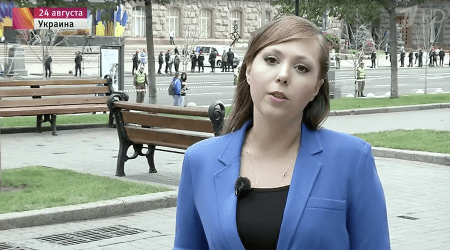
Russian television correspondent Anna Kurbatova has been detained by the Ukrainian security services in Kiev. The journalist, who works for Russia’s Channel 1, will be deported for “smearing” Ukraine, according to a security services spokesperson.
The incident occurred in the city center of the Ukrainian capital on Wednesday. Kurbatova was “grabbed by unknown assailants, forced into a car and driven away,” according to Channel 1.
The Russian authorities are closely monitoring the situation to learn more about the fate of the journalist.
“At the moment we don’t have information, but, undoubtedly, we’ll do our best to clarify the situation,” Russian presidential spokesman Dmitry Peskov told reporters.
Russia’s Foreign Ministry is also trying to clarify the situation around the correspondent’s detention.
“The Russian Foreign Ministry and Russian diplomatic institutions abroad are looking into the disappearance of a Channel 1 journalist in Ukraine,” Russian Foreign Ministry spokeswoman Maria Zakharova told TASS.
The Russian embassy in Kiev has sent requests to the Ukrainian security services as well as a note to Ukraine’s Foreign Ministry, urging them to clarify the incident and immediately release the journalist, RIA Novosti reported.
A spokesperson for the Security Service of Ukraine (SBU) confirmed that the journalist was detained by the organization’s operatives. Kurbatova will be deported from Ukraine to Russia and the SBU is currently preparing the paperwork, according to the spokesperson.
“Russian propagandist Anna Kurbatova will be forcibly returned to the Russian Federation. Ukraine is a constitutional state, its security services operate strictly within the legal framework. All necessary documents for her deportation are being prepared at the moment. It will happen to everyone who dares to smear Ukraine,” the spokesperson said in a Facebook post.
Russian Commissioner for Human Rights Tatyana Moskalkova has contacted her Ukrainian counterpart following the incident to determine whether the security services are following legal procedures.
“I’ve just sent a request to my colleague Valeria Lukyanova asking her about the location [of the journalist], her health condition and the consular visit, i.e. whether all the conventions are being observed if she has been detained by law enforcement,” Moskalkova told Interfax.
“I’m outraged and deeply worried about the treatment of journalists. Freedom of speech is protected not only by states’ constitutions, but also by international legal acts, journalists worldwide are independent and have immunity.”
Ahead of the incident, the journalist received threats in connection with her reporting on Ukraine’s Independence Day, according to Channel 1. Following her report, Kurbatova was placed on the list of “enemies of Ukraine” on the notorious Mirotvorets (Peacemaker) website. The website accuses the journalist of “anti-Ukrainian propaganda” and “manipulating socially-important information.”
Just before the incident, Kurbatova had prepared a new report on the ill-treatment of journalists in Ukraine, which has not yet been aired.
It’s not the first time a Russian journalist has become a target for the Ukrainian security services. Earlier in August, a journalist for the All-Russia State Television and Radio Broadcasting Company (VGTRK), Tamara Neresyan, was deported following an apparently similar incident.
“I was detained in the street and promptly brought to the main SBU office, where I was questioned for three hours. They confiscated my phone, it was done very roughly, nearly breaking my arms. Following the questioning they read me a resolution of the SBU that I would be deported and barred from re-entry for three years,” Neresyan told Rossiya 24 TV channel.
Tillerson Caves, Will Appoint Special Anti-Semitism Envoy Who Monitors Criticism of Israel

Anti-Semitism Envoy Hannah Rosenthal adopted a new Israel-centric definition of anti-Semitism and used it to train American diplomats.
By Alison Weir | If Americans Knew | August 29, 2017
After continuing pressure, Secretary of State Rex Tillerson has announced that he will name a special envoy and maintain an office to monitor alleged anti-Semitism.
All three previous anti-semitism envoys have been fervent Israel partisans, two of them working for AIPAC. The first envoy endorsed a new definition of the word “anti-Semitism” to include criticism of Israel; the second adopted the new, Israel-centric definition; and the third helped to disseminate the definition world-wide.
This was part of an international campaign to expand the definition of anti-Semitism and embed this in governments and law enforcement agencies, potentially criminalizing support for Palestinian rights.
When it appeared in June that Trump might eliminate the office in a cost-cutting measure, he and Tillerson came under immediate attack by Jewish organizations and some others, including the Southern Poverty Law Center.
According to a letter from Tillerson to the Senate released yesterday, a number of similar special envoys and ambassadorships will be maintained, including the Special Envoy for Israeli-Palestinian Negotiations (currently filled by Frank Lowenstein), the Special Envoy as well as the Special Advisor for Holocaust Issues (which, among other things, works with Israel and supports the anti-Semitism envoy; currently the Special Advisor is Stuart E. Eizenstat), and the Ambassador-at-Large for International Religious Freedom; Kansas Governor Sam Brownback, a strong supporter of Israel despite its record of religious discrimination, has been nominated for the position.
Dozens of other special envoy positions are being eliminated or combined, including ones concerned with Tibet, disabilities rights, global food security, cyber issues, global youth issues, conflict diamonds, the closing of Guantanamo, and a number that focus on the environment.
Simonyan Slams Reporters Without Borders for Calling RT ‘Enemy of Journalism’
© Flickr/ Marieke Guy
Sputnik – August 28, 2017
RT Editor-in-Chief Margarita Simonyan struck back at Reporters Without Borders, which called the channel “an enemy of journalism” allegedly exploiting the EU parliament resolution against Russian media outlets comparing them to Daesh terrorist group propaganda.
RT and Sputnik Editor-in-Chief Margarita Simonyan said Monday that Reporters Without Borders (RSF) is discrediting the work of advocacy groups by calling the broadcaster “an enemy of journalism.”
“Following such horrific remarks Reporters Without Borders should quietly self-dissolve, so as not to disgrace true human rights defenders,” Simonyan told the RT commenting on Deloire’s remarks.
On August 26, RSF Secretary General Christophe Deloire in an interview with Telerama magazine cited Simonyan’s appeal for protection against the European parliament’s 2016 resolution on countering alleged Russian anti-EU propaganda and media, including RT and Sputnik, as an example of how “enemies of journalism are exploiting the principles adopted to protect it.”
In November 2016, the European Parliament passed a resolution where it described the two media outlets as a threat to Europe’s unity and drew a parallel between them and propaganda disseminated by Daesh terrorist group. The document calls for extra European Commission funding for counter-propaganda projects.
Sputnik responded by calling the move a direct violation of media freedom and human rights, while Russian President Vladimir Putin commented on the matter by pointing out that the document indicates a degradation of democracy in the West.
Sputnik contacted RSF for the organization’s comments on the resolution, only to be told that the organization had taken a decision to no longer give interviews to Rossiya Segodnya.
Looking for the Thought Police? Try looking in the mirror.
By T.P. Wilkinson | Dissident Voice | August 25, 2017
1984 is probably one of the worst books of the 20th century because of its mis-interpretation!
a) Although Orwell was writing about ENGLAND, in fact, and not as allegory, the exigencies of anti-Soviet propaganda required that the story be defined as a dystopia about the world under Soviet control. Whatever Orwell may have thought about Stalin, 1984 was a story directly attacking the Labour Party and the policies that would become enshrined in Labour governments dominated by graduates from Oxford and to a lesser extent Cambridge. Anyone outside of Britain might be forgiven at the time for missing this but today the oversight is simply rooted in ignorance — willful or unwitting.
b) Orwell, who served in the colonial police in Burma, was well acquainted with the methods of social control used in Britain’s colonies — including torture and surveillance. He had no reason to draw on reports from the Soviet Union, true or false. He also worked in the British government’s propaganda department. The BBC was created in 1922 as a radio monopoly in part to improve the government’s campaign against organised labour. There the fabrication of “news” was daily routine, as it is today.
c) Post-war Britain was — in comparison to the US esp. — a disaster area. After two world wars, Britain was bankrupt. The empire which had subsidised the metropolitan standard of living was collapsing. Indian independence alone would mean an initial massive balance of payments deficit to the Union, not to mention debt to the US. The economy was more or less in ruins. The standard of living had sunk drastically for all but the very rich. It did not take any imagination to invent “Victory Gin” — Britain was nominally on the side of the winners but had lost everything. For someone like Orwell this was very obvious.
d) Too little attention is paid to the actual structures that Orwell describes. The Party and the Thought Police are most frequently mentioned. This focus distorts Orwell’s depiction of a complex mechanism of social control. Ironically many people who have read Noam Chomsky’s essays do not grasp the point which Orwell makes and Chomsky reiterates — albeit avoiding too much attention to this embarrassing point.
Orwell distinguished between the “inner party”, the “outer party” and the “prols”. This classification is very important for comprehending the whole process. Propaganda — that is the constant manipulation of data in forms to create what counts on any one day as “true” — is directed primarily at the “outer party”. The “inner party” is not concerned with what is actually true, this virtually invisible group is interested only in power. The “outer party” is governed by rigorous ideas of truth and virtue which have to be policed — precisely because the very idea of “truth” is a policing tool — not unlike sexual purity. The “truth” is of no material importance to the mass — the “prols” in Orwell’s depiction. But the “outer party” — the intellectuals, the bureaucrats, middle managers, functionaries of all types whether in the state or private sector, in short those who claim citizenship based on supposed intelligence and virtue/merit — need constant policing.
They must be told not only what is fashionable but what counts as true or as the acceptable/polite consensus. These people cannot be left in abject ignorance since they are needed to maintain the system. They are in short the “Gene Sharp factor” — the percentage of the population with which one moves the whole. (Ironically the first edition (1993) of Sharp’s From Dictatorship to Democracy was published in Burma — where Orwell began his police career.) They are too numerous in comparison to the “inner party” to be ignored but not as disorganized as the “prols” so that they cannot be beaten down physically as a mass.
Perhaps Noam Chomsky does not focus too much on his observation that it is the middle class intellectual/managerial class that is the target of most regime propaganda (most heavily propagandised) because he belongs precisely to that class. In fact, on some issues he might be confused with an asset of the Thought Police — coming too as he does from a central US Thought Police institution — MIT.
Orwell was an Old Etonian. Eton College is the pinnacle of the “outer party” cadre institutions in Britain. It is run for the “inner party” and many of the “inner party” are also Old Etonians but the English public school is notorious for enforcing class distinctions even among those of the same college. All Etonians are equal too, some are more equal than others.
e) Who is “Big Brother”? Big Brother is always supposed to be a kind of Stalin allegory. However, unlike the US, Britain has a constant figure who constitutes the focus of all loyalty and affection — the reigning monarch. The British royal family changed their name when war was declared against Germany in 1914. It became inappropriate to have a German king ordering illiterate British peasants and workers into war against another German king who was directly related for reasons that could not be admitted openly and still cannot. So the name “Windsor” was adopted. Edward VIII both before and after his abdication maintained a healthy relationship with blatant fascists of the old style.
This does not mean that the British royal family ever renounced its affinity for fascism (e.g. Franco and Salazar). Moreover it is almost impossible to criticise the monarchy substantively in the United Kingdom. The actions of its members, singularly or collectively, are beyond review or public reproach — except in matters trivial like taste or polite speech. The pretense that the most wealthy private individual in the country (and one of the world’s wealthiest), the reigning monarch, has no personal interest in the policies of the British government and has no practical influence over the government in defense of those interests is about as great a self-deception as one can demand of any person, let alone an entire country.
God save the King/Queen…

f) It is even arguable that Orwell was more concerned about the US because this was the country which switched sides and manipulated the war aims the most — without any cost to itself. During WWII it was clear that the Soviet Union was fighting a vicious war just to survive in the face of the Western onslaught. However, sober people also saw that the US stood to be the only beneficiary of the war. In 1945, this was obvious. No sooner had the war ended but the US proclaimed a war against the Soviet Union. Britain could not have afforded such a position — even if Churchill would have liked. He gave his deceptive “iron curtain” speech for Truman because of dependence on the US not because Britain could have afforded an anti-Soviet policy on its own.1 Orwell could certainly see the absurdity of an impoverished Britain having been on the side of the Soviet Union against Hitler now aligned with the US against the Soviet Union.
In fact, it could be argued that Orwell’s novel is very coherent with Roger Waters’ The Wall (and its sequel The Final Cut) in their specifically BRITISH views of mass culture and pseudo-democracy concealing party dictatorship. It has little, if anything, to do with Russian society, let alone politics. That is only natural. Orwell never lived in Russia and would not have been able to explain Russian society. For that one has to turn to Russians themselves; e.g., Tolstoy or Sholokhov or Pasternak. On the other hand many Americans believe that they understand British society — this is due largely to saturation with BBC programming. However similar Britain may appear to the US, it is actually a very different country and culture (except perhaps for the highest strata of the Anglo-American ruling class). The illusion that Britons are only more quaint Americans has done much to promote the mis-understanding of Orwell.
One of the great intellectual travesty’s of the 20th century is the ascendency of US liberal ideology — in its broadest sense.2
There is probably not a country in the world today with so much influence on intellectual and cultural activity from such a depraved and obscene level of general ignorance and stupidity. The capacity to saturate the world with this structural mendacity and almost genetic stupidity is probably worse than any other weapons system the country’s psychopaths have produced — because it is the basis for acceptance of all those weapons in the first place.
- Churchill, unlike Truman, had attended the meetings with Stalin and Roosevelt at Yalta where it was agreed that the Soviet Union would occupy the Eastern European territories that had been absorbed into the German Empire, in part as a basis for war reparations due to the enormous destruction suffered by the Soviet Union — almost all of the European part of the country was razed to the ground. He knew that the Soviet occupation had been agreed by all the Allies. He also knew that the Allies were attempting to deprive the Soviet Union of the reparations due from Germany. In short he knew that it was the West that was hanging an “iron curtain” in front of the Soviet Union in the hope that it would collapse after WWII. Britain could not have afforded such a policy. Among other things the collapse of the empire would deprive it of its cheap access to all sorts of raw materials making it vulnerable to world market fluctuations.
- A more precise clarification of what might otherwise be called the ideology of the North Atlantic Establishment would exceed the scope of this brief note. Carroll Quigley’s The Anglo-American Establishment provides a fairly useful summary of its principles and the way it has been expressed through the 20th century. It should be noted that one of the key cadre institutions for academics according to Quigley is the All Souls College of Oxford University– where Gene Sharp also completed his doctorate.
Dr T.P. Wilkinson writes, teaches History and English, directs theatre and coaches cricket between the cradles of Heine and Saramago. He is also the author of Church Clothes, Land, Mission and the End of Apartheid in South Africa (Maisonneuve Press, 2003).
Israel prevents Palestinian students from entering school in Al-Aqsa Mosque

MEMO | August 25, 2017
Israeli police prevented 160 Palestinian secondary school students from entering the Shari’ah School in Al-Aqsa Mosque on Thursday, under the pretext that their school books are based on the Palestinian curriculum, Quds Press has reported. The police had already prevented the delivery of schoolbooks at the premises two days ago, citing the same pretext about the curriculum.
According to Raed Da’na, the Director of Preaching and Guidance at Al-Aqsa, the books were distributed outside the mosque because Israeli police object to the presence of “Palestinian flags and pictures of protests” alongside the text. The Israelis even said that book covers which have the Palestinian flag on them must be torn up if students want to enter the mosque to attend their school, he revealed.
Da’na added that Israeli security forces confiscated the ID documents of Najih Bukairat, the head of the Aqsa Academy for Sciences and Heritage, and Robain Muhaisin, a Palestinian teacher, before taking them to a police station in the Old City of occupied Jerusalem. The vehicle used to distribute the school textbooks was impounded.
In a related incident, Israeli police and border guards stormed into the Aytam [Orphans] Islamic School, located in the Old City, and arrested two students, according to the Quds Media Centre. A Quds Press correspondent said that this happened while dozens of Jewish settlers were storming around Al-Aqsa Mosque. Sixty-five settlers were accompanied and protected by Israeli security forces, she added. They ordered Al-Aqsa’s guards to stay away from the settlers as they entered the mosque.
Guards attached to the Noble Sanctuary usually accompany Jewish settlers once they enter the compound through the Magharbeh Gate and stay with them until they leave through the Silsela Gate, making sure that they do not do anything that would constitute a violation of the mosque’s sanctity. For this, the guards are subjected to threats and restrictions from Israeli police officers.
British universities should be more discerning about their choice of benefactors
By Alastair Sloan | MEMO | August 25, 2017
Just over eighteen months ago, environmental campaigners in Britain received some surprising news. They had been working for three years to get the Tate Gallery in London to reveal how much money oil giant BP had given it between 1990 and 2011. The figure turned out to be relatively small, ranging from £150,000 to £330,000 per year. Although this was a good chunk of the gallery’s income in the nineties, this soon equated to less than one per cent of the Tate group’s funding between 2000 and 2006. The sponsorship deal continued for another ten years, alongside similar BP sponsorships of the British Museum, the Royal Opera House and the National Portrait Gallery. Across all of these organisations, the oil company likewise contributed less than one per cent of funding to each one. The oft-heard argument that the struggling arts sector would go under were it not for this kind of funding from not-very-nice corporations was clearly bunkum. If anything, these institutions were willing collaborators in corporate whitewashing.
The same could be said of Gulf funds for British universities. Middle East Studies departments whisper about the necessity of funding from countries like the United Arab Emirates, Saudi Arabia and Qatar, because budgets are falling. A close look at the finances of the University of Exeter reveals something else, though; the issue of donations from alumnus Sheikh Dr Sultan Bin Muhammad Al-Qasimi of Sharjah were raised recently by the International Campaign for Freedom in the United Arab Emirates.
According to the Telegraph, the ruler of Sharjah – one of the most conservative Emirates in the UAE — has given more than £8 million to Exeter University over two decades (roughly the same time period that the Tate was receiving money from BP). A breakdown of when these donations were made is not available, but government grants and tuition fees in 1999 (the earliest data that I have been able to find) amounted to £52 million. The equivalent figure today is £250 million, around three times the original government and student fees funding even when adjusted for inflation. Much of this has come from the introduction of hugely expensive tuition fees for students.
In 2008, the nephew of the late King Abdullah of Saudi Arabia gave £8 million to Cambridge University to build its “Prince Alwaleed Bin Talal Centre of Islamic Studies”. The same year, Cambridge University’s annual report shows that income from government grants and tuition fees had risen from £251 million to £279 million. Cambridge made £174 million from its publishing house, more than £20 million more than in 2007. Even its “examination and assessment services” had seen income go up from £193 million to £216 million. All these increases led to the university almost doubling its surplus for the year, to £42 million. Yet that same year, it also accepted £8 million from a state known for its appalling human rights record, all the while knowing full well that the university coffers were overflowing.
After 2008, of course, there was the recession, so perhaps last year’s £3 million donation from the Qatar Development Fund towards Somerville College, Oxford, was justified? Think again. Somerville College itself was certainly on track to suffer a £3 million reduction in donations had the Qatar money not arrived, and had just borrowed huge amounts to extend its buildings, but Oxford University generally was doing well. In 2010, its income had risen since the previous year by nearly five per cent, to £920 million. By 2015, that figure was up to £1.3 billion, with surpluses of nearly £400 million sat in university bank accounts. Oxford doesn’t include in its numbers, as Cambridge does, its significantly profitable publishing business, which was on hand to top up coffers when they are running low.
In the UAE, we only have to go back to March to find that a prominent academic was jailed for ten years. His crime? He used Twitter. The country has imposed travel restrictions on visiting academics from Georgetown University, the London School of Economics and New York University, as well as prosecuting other university professionals. In January, the UAE government detained Abdulkhaleq Abdulla for ten days without charge after the prominent Emirati academic and vocal supporter, not critic, of the government posted a tweet that praised the UAE as the “Emirates of tolerance” but bemoaned the authorities’ lack of respect for freedom of expression and political liberties. Abdulla was an adviser to Mohammed Bin Zayed, the Crown Prince of Abu Dhabi, and a retired professor of political science at the University of the UAE. Similar situations abound in Saudi Arabia, and academic freedoms are only marginally better in Qatar.
So British universities are well off. They don’t need money from abroad, but they are opting to take it in any case, and who they are choosing to take it from isn’t encouraging. This devalues British academia and spits in the face of academics and others calling for change who are imprisoned in those donor countries for their pains. Universities should be campaigning to have tuition fees removed, be more inventive about how they make money, and stop plastering the names of Middle East dictators across their walls. They need to be much more discerning in their choice of benefactors. It’s too late to do this today, but tomorrow will do very nicely.
Israel charges Palestinian cleric Sheikh Salah with incitement of terror
Press TV – August 24, 2017
The Tel Aviv regime has indicted Sheikh Raed Salah, a cleric who supported Palestinian protests over Israel’s controversial security measures imposed last month at a holy site in occupied Jerusalem al-Quds.
The Israeli court formally charged Salah on Thursday with incitement of terror over speeches he delivered encouraging Palestinians to protest for the right of holding prayers inside the Haram al-Sharif compound, which is home to the revered al-Aqsa Mosque, the third holiest site in Islam.
Israel had earlier in the week extended Salah’s detention, nearly a week after he was arrested. Prosecutors had demanded the renewed detention, saying they intended to bring charges against the 58-year-old cleric.
Israel’s security measures, which came after the July 14 deadly shooting and killing of two Israeli policemen, sparked some unprecedented protests and sit-in gatherings in occupied East Jerusalem al-Quds as Palestinians refused to accept the restrictions for nearly two weeks.
Israel was later forced to remove metal detectors and cameras installed at the gates and Palestinians ended sit-ins and prayers outside the mosque.
Salah had served for nine months in Israeli jails before he was released in January. He was previously charged with “incitement of violence” and “incitement of racism.” His latest arrest sparked condemnations in the occupied territories as his supporters said it was part of a political witch hunt aimed to silence dissent.
Israelis have also banned Salah’s group, the Islamic Movement in Israel, in 2015 for allegedly stoking violence.
Featured Video
The American Retreat from Vietnam
or go to
Aletho News Archives – Video-Images
From the Archives
Secret document reveals plans for civil war in Lebanon, Israeli false flags, and invasion
By Randi Nord | Geopolitics Alert | April 5, 2019
Beirut – During his visit with US Secretary of State, Mike Pompeo, Lebanese President Michael Aoun reportedly received a US-Israeli document detailing plans for creating a civil war in Lebanon with covert false flag operations and possible Israeli invasion.
Although the source of the document is Israeli and created in partnership with Washington, no one knows who presented it to Aoun. The Lebanese TV station, Al-Jadeed, initially reported the document on Lebanese TV and a video on its website. Geopolitics Alert translated the report for this article. … continue
Blog Roll
 Aletho News
- ‘Distance yourselves from Israel’: IRGC urges US population to question govt policies
- America’s Greenland deal has a radioactive backstory
- The RAF Fairford ‘terror plot’: Unpacking escalation in the UK echo-chamber
- EU Council Advances Chat Control 2.0 Scanning Proposal
- Ex-Greek MEP files complaint against Israeli spyware firm over alleged Pegasus surveillance
- Troubling ideas throughout the Torah, Talmud, Mishneh Torah and Tanya
- ‘Grave, alarming’: Iran mission on Trump’s UNGA ‘annihilation’ threats
- Najaf airport to reopen to Iranian flights within 24 hours: Ambassador
- From ‘How Will This End For Iran’ to ‘When America Walks Away’: A tale of two Economist covers
- Tehran blasts ‘baseless’ speculation linking Iran to alleged bomb plot at UK air base
- If Americans Knew
- Revealed: German “Anti-Semitism Expert” Driving Crackdown on Palestine Solidarity is Former Israeli Spy
- Egypt’s Warning to Israel Before Oct 7
- Israel’s siege signals another cruel winter for 1.8 million Gazans – Daily Update
- Netanyahu Asked UAE Leader to Deny Report on Oct. 7 Warning in Secret Visit, Sources Say
- CNN Chief Int’l Correspondent Clarissa Ward on Journalists in Gaza
- Democratic Party Consultants Surround Troy Jackson with Pro-Israel Donors
- Christian Leader Responds To Netanyahu’s Claims Regarding Palestinian Christians
- In Gaza, ‘Whoever Survives the Bombing Won’t Survive the Rubble’
- Israel kills more Palestinians, amid push to resettle Gaza – Daily Update
- Israel forces Gazans to live in constant peril – Daily Update
- No Tricks Zone
- New Study: Earth And Venus Surface Warmth Largely Explained By Convection And Lapse Rate, Not CO2 Or Radiation
- 2025 Nature Paper Claiming Worsening Global Drought Gets RETRACTED …Heavily Flawed
- New Study: ‘Global Drought Shows No Detectable Recent Acceleration Under Climate Warming’
- Economic Masterminds: German Socialists Suggest Taxing Productivity Gains Stemming From Using AI
- The South China Sea Has Not Been Cooperating With The Climate Change Narrative
- Energy Crisis: Germany Enters Heating Season With Historically Low Gas Reserve Fill Levels
- New Study: The Antarctic Ice Sheet Gained Mass From 2020-2024 Due To Staggering Snow And Ice Accumulation
- Study: Ocean Heating Rates From Thousands Of Years Ago ‘Dwarf’ Modern Ocean Heating Rates
- Climate Extremists Target, Attack Large-Scale Power Grid Infrastructure In Germany!
- New Study: Antarctic Ice Melt Has Contributed Less Than 1 Centimeter To Sea Level Rise In The Last 30 Years

