Journalism Fail: Washington Post Story on ‘Fake News’ Was Fake
Sputnik – 08.12.2016
Following public backlash, legal threats, and sustained mocking, the Washington Post has added an editor’s note distancing the newspaper from a shadowy website called PropOrNot which they had preciously endorsed as “experts” on “fake news” and “Russian propaganda.”
In an ironically fake news article about “fake news” by Craig Timberg the Washington Post claimed that Russian propaganda helped Donald Trump win the US presidential election. A large part of the basis for the piece was centered on evidence the paper presented that was gleaned from an aggressively anonymous website called PropOrNot, which lists over 200 websites that they accuse of peddling what they call Russian propaganda, and other false narratives. Popular news websites on all sides of the political spectrum are listed, including The Drudge Report, Zero Hedge, TruthOut, Sputnik News, and WikiLeaks.
The Washington Post has now added the following editor’s note to the article:
“The Washington Post on Nov. 24 published a story on the work of four sets of researchers who have examined what they say are Russian propaganda efforts to undermine American democracy and interests. One of them was PropOrNot, a group that insists on public anonymity, which issued a report identifying more than 200 websites that, in its view, wittingly or unwittingly published or echoed Russian propaganda. A number of those sites have objected to being included on PropOrNot’s list, and some of the sites, as well as others not on the list, have publicly challenged the group’s methodology and conclusions. The Post, which did not name any of the sites, does not itself vouch for the validity of PropOrNot’s findings regarding any individual media outlet, nor did the article purport to do so. Since publication of The Post’s story, PropOrNot has removed some sites from its list.”
After the publication of its article, the Post was slapped with a letter from Naked Capitalism, one of the websites listed, demanding a full retraction and threatening a defamation lawsuit. “You did not provide even a single example of ‘fake news’ allegedly distributed or promoted by Naked Capitalism or indeed any of the 200 sites on the PropOrNot blacklist,” the attorney representing the website, Jim Moody wrote.
“You provided no discussion or assessment of the credentials or backgrounds of these so-called ‘researchers’ (Clint Watts, Andrew Weisburd, and J.M. Berger and the ‘team’ at PropOrNot), and no discussion or analysis of the methodology, protocol or algorithms such ‘researchers’ may or may not have followed.”
While declaring that the entities behind the PropOrNot operation were “experts,” the Post refused to name them. Though their motives remain unknown, the organization previously promoted a Ukrainian hacker group on their Twitter feed.
Interestingly, a bill was introduced November 22, just two days before the Post published the November 24 article in question, which would allow lawmakers to crack down on websites deemed to be “Russian propaganda” or “fake news.” Tucked neatly inside the Intelligence Authorization Act for Fiscal Year 2017, the bill appears to be aimed at cracking down on free speech.
“It is easy to see how this law, if passed by the Senate and signed by the President, could be used to target, threaten, or eliminate so-called ‘fake news’ websites, a list which has been used to arbitrarily define any website, or blog, that does not share the mainstream media’s proclivity to serve as the Public Relations arm of a given administration,” Global Research reported.
The bill must now pass through the Senate, but a top aide to Rand Paul has informed Sputnik News that the Senator is currently holding the bill for a variety of reasons.
Witch Hunt: “Fake News” Software Touted by CBS News
Creator Admits He Made Up Who Went on Hit List
Yves Smith | Naked Capitalism | December 7, 2016
One of most pernicious means underway to crush independent news sites is the release of software tools that brand them as unreliable. This means that hidden developers and the parties that fed them information are beyond any accountability, yet would serve as censors.
Last week, the Financial Times described efforts to use software to designate certain sites as suspect:
Concern over the impact on voters of soaring amounts of fake news during the US election has sparked a hackathon where the technology industry and the media’s top thinkers are seeking to find new ways to prioritise the truth.
A community has gathered to share ideas around a 58-page Google document started by Eli Pariser, the author of a best-selling critique of social media, The Filter Bubble: What the Internet is hiding from you. A professor has circulated a spreadsheet of reliable and less reliable news sources for comment, while hackathons at Princeton and in the Bay Area have produced prototype products that Facebook could copy…
A team of students won a prize sponsored by Google at a Princeton hackathon last week by creating a quick and dirty prototype of a product that does just that: showing Facebook users a “trust rating” for stories they see, based on an online safety rating provided by “World of Trust”.
If you read the article in full, you’ll see it depicts Wikipedia as a gold standard. As Gary Null discussed yesterday in his Progressive Commentary Hour show (we were a guest; the archived interview should be up later today), it is in fact very difficult to get corrections of Wikipedia entries. Similarly, on certain topics, such as economics, Wikipedia minimizes or excludes non-mainstream views even when they have solid empirical underpinnings and have been given a hearing in academic journals and the press.
The faith in coders coming up with a magic bullet for information validation is similarly questionable. The concern about “fake news” on the Internet is almost comical given that more citizens encounter “fake news” via seeing National Enquirer and National Examiner covers in grocery stores than via websites. It is not hard to imagine that much of the tender concern expressed by the mainstream media is commercial: independent news and analysis sites threaten their legitimacy by exposing how dependent they are on stories planted by government or business sources that these press outlets often fail to vet adequately.
One approach is browser extensions that flag sites as suspect via undisclosed, unverifiable methods. Browser extensions are a particularly pernicious approach, since many users are not even aware that they have installed them, and they update automagically in the background. Most consumers do not know how to check for them or remove them.
Shadowproof exposed how this technological response is being deployed in a reckless, fact-free, libelous manner against Shadowproof, Naked Capitalism, and other long-standing, well-regarded websites. Worse, this dodgy tool was promoted by CBS News. As Kevin Gosztola reports:
CBS News reported developers increased pressure on Facebook to address its “fake news problem” with a browser extension for Chrome and Firefox called the “B.S. Detector.” It claimed the extension relies upon “a constantly-updated list of known fake news sites, propaganda mills and ‘promoters of kooky conspiracy theories’” as a reference point.
However, CBS News was wrong. The extension is not “constantly updated.” The extension, as developer Daniel Sieradski shared, was created to “make fun” of Facebook. Sieradski “scraped some data together” that included sites, which are not “fake news” websites. (One of those sites was Shadowproof.com.)
“B.S. Detector” displays a red banner that indicates a news website is “not a reliable news source.” Up until publication, the extension still flagged Consortium News, Naked Capitalism, Truthout, and Truthdig, even though Sieradski said they would not be listed in the update….
Sieradski claims he never expected this to achieve the kind of success or interest it has garnered in the past couple weeks. He seems reluctant to own the mistakes made and publish a list of the websites that were wrongly included in the initial launch in order to exonerate them.
It does not matter if the improper inclusion of certain websites was done maliciously or accidentally. The effect is the same, at this point. People who do not know better can install the extension, and if they become a unique or new viewer to Consortium News, Naked Capitalism, Truthout, or Truthdig, they will see a red banner that may discourage them from further reading and visits to these sites.
Gosztola is being unduly charitable in how he characterizes the casual way with which Sieradski went about smearing small websites. Sieradski’s Twitter handle is @selfagency and business name is The Self Agency, LLC. This page on GitHub, selfagency/bs-dector, contains this astonishing admission:
As I have repeatedly stated in the press, on our repo, and on our homepage, the dataset was somewhat indiscrimintely compiled and we are slowly making our way through it. We are also looking to partner with media watchdog groups to provide research to back up our inclusions and classifications so that it is neither arbitrary nor the decision of a sole authority.
This is an admission of reckless disregard for accuracy for someone who is making himself an arbiter and doing damage to small sites that have worked long and hard to establish their reputations. This is defamation, pure and simple. Sieradski claims that he is not acting as a censor when he is doing precisely that. The fact that he may get others to participate in this witch hunt does not change the fundamental nature of the activity.
In fact, Sieradski’s ability to rationalize that what he is doing here is on the up and up by virtue of his having donated to the EFF, ACLU, and Chelsea Manning’s defense funds is yet another example of Upton Sinclair’s aphorism, “It is difficult to get a man to understand something when his salary depends on his not understanding it.”
Gosztola points out that the reason that Sieradski was so casual about smearing well-established sites and so unapologetic about reputational harm is that they are assumed to lack the resources to take legal action:
The developers also possess a few viewpoints, which may inhibit their ability to develop an extension that is objective and valuable to news readers.
One, Sieradski has no idea how to handle the problem of corporate news media, which publishes “fake news.” Journalist Marcy Wheeler asked Sieradski why “mainstream fake news” was not flagged through this extension. She wondered why “Squawk Box” financial-type news that pushes a made-up “market” narrative is not flagged. Or what about Fox News? Why aren’t they flagged as a “fake news” website?
Sieradski replied, “We’re working on gathering data on all NewsCorp titles,” and looking for “examples of false stories that point to a pattern of intent to mislead the public.”
It is abundantly evident the developers are going through a much more rigorous process to determine whether it is proper to include Fox News than it is going through other independent news media sites that possibly should not be flagged. Of course, their inclusion is much more detrimental to them because unlike corporate news outlets they do not have significant money and resources.
Due to the traditional media’s eagerness to use the “fake news” meme to regain control over what they once called “the discourse,” independent news sites are under the threat of death by a thousand at best uninformed and at worst malicious efforts to silence them. And for a soi-disant progressive like Sieradski to take up this rancid cause is deeply disturbing.
Social media companies begin collaboration to fight online “extremism”
By Alex Christoforou | The Duran | December 6, 2016
YouTube and Facebook have started using hashes to automatically remove extremist content.
Giant tech companies are banding together to stop extremism on the web.
YouTube, Facebook, Twitter, and Microsoft will begin sharing a common database to flag accounts and user profiles they deem as threats to global security.
In a joint statement, the companies in the collaboration said…
“We hope this collaboration will lead to greater efficiency as we continue to enforce our policies to help curb the pressing global issue of terrorist content online.”
The companies will share ‘hashes’, or unique digital fingerprints, assigned to extremist videos or photos which have been flagged or removed from their platforms.
While it’s well and good for private corporations to do what they want with their own platform, or even create an oligopoly that shares data between platforms… the slippery slope begins once the goal posts for “what is deemed extreme” gets wider and wider.
The fact that the EU is the major driving force behind this initiative should give everyone even more pause as to the true intentions of this collaboration.
Reuters reports…
Tech companies have long resisted outside intervention in how their sites should be policed, but have come under increasing pressure from Western governments to do more to remove extremist content following a wave of militant attacks.
YouTube and Facebook have begun to use hashes to automatically remove extremist content.
But many providers have relied until now mainly on users to flag content that violates terms of service. Flagged material is then individually reviewed by human editors who delete postings found to be in violation.
Twitter suspended 235,000 accounts between February and August this year and has expanded the teams reviewing reports of extremist content.
Each company will decide what image and video hashes to add to the database and matching content will not be automatically removed, they said.
The database will be up and running in early 2017 and more companies could be brought into the partnership.
The European Union set up an EU Internet Forum last year bringing together the internet companies, interior ministers and the EU Counter-Terrorism Coordinator to find ways of removing extremist content.
The Forum will meet again on Thursday, when ministers are expected to ask the companies about their efforts and helping to provide evidence to convict foreign fighters.
Israeli nationalists undermine meaning of ‘remembering the Holocaust’
By Yves Engler · December 6, 2016
Is “remembering the Nazi Holocaust and where anti-Semitism can lead” a good thing? Unfortunately, thanks to people who constantly cite this horrible genocide in order to justify the illegal, immoral and anti-human behaviour of the Israeli state, one must answer, “it depends.”
Drawing attention to the Nazi Holocaust and anti-Semitism in Canada today often reinforces, rather than undermines, oppression and discrimination. This perverse reality was on display at two recent events in Toronto.
At a semi-annual Ryerson Student Union meeting, a Hillel member pushed a resolution calling on the union to promote Holocaust Education Week in conjunction with United Jewish Appeal-Toronto, which marked Israel’s 2014 slaughter in Gaza by adding $2.25 million to its annual aid to that wealthy country. The motion stated, “this week is not in dedication to anti-Zionist propaganda” and called for the week to focus “solely on the education of the Holocaust and not on other genocides.”
Objecting to this brazen attempt to use the decimation of European Jewry to protect an aggressive, apartheid state many students left the meeting. When quorum was lost before the vote, pro-Israel activists cried — wait for it — anti-Semitism.
“Tonight, I experienced true and evil anti-Semitism,” complained Tamar Lyons, vice-president of communications for Students Supporting Israel at Ryerson University, in a social media post republished by B’nai Brith. In it, the Emerson Fellow of StandWithUs, an organization that trains university students to advance Israel’s interests, bemoaned how “a Muslim student ‘goy-splained’ me.”
After the meeting, Lyons linked the purported anti-Jewish incident to the Ryerson Student Union endorsing the BDS movement two years earlier. She told the Canadian Jewish News it was “a direct result of [the] boycott, divestment and sanctions movement and the anti-Israel sentiment that’s so prevalent on campus.”
Taking place on the eve of an Ontario legislature vote to condemn BDS activism, the national director of B’nai Brith jumped on the Ryerson affair. “What starts with BDS does not end with BDS,” said Amanda Hohmann. “More often than not, BDS is simply a gateway drug to more blatant forms of anti-Semitism.”
(Yup, take a toke of that leftist–internationalist “pressure Israel to follow international law” bud and soon you’re longing for some Neo-Nazi ‘get-the-Jews’ smack.)
As B’nai Brith hyped the Ryerson affair, the Centre for Israel and Jewish Affairs pushed the Ontario legislature to pass a motion in support of the spurious “Ottawa Protocol on Combating Anti-Semitism” and to reject “the differential treatment of Israel, including the boycott, divestment and sanctions movement.”
Passed 49 to 5 (with 53 absent), motion sponsor Gila Martow told the legislature: “We would not be here supporting the Ku Klux Klan on our campuses, so why are we allowing [the] BDS movement and other anti-Jewish and anti-Israel organizations to have demonstrations and use our campuses, which are taxpayer-funded?”
In an interview with the Toronto Sun after the vote the Thornhill MPP described BDS as “psychological terrorism on the campuses….The motive behind BDS is to hurt the Jewish community by attacking Israel.”
The only MPP who spoke against the motion was the NDP’s Jagmeet Singh. But, even this defender of the right to criticize Israel spent much of his speech talking about how anti-Semitism “must be denounced.”
Notwithstanding the anti-Semitism hullabaloo, the BDS vote and Ryerson affair have little to do with combating anti-Jewishness. As is obvious to anybody who thinks about it for a second, comparing internationalist and social justice minded individuals to the KKK will elicit, not lessen, anti-Jewish animus. Similarly, labeling a non-violent movement “psychological terrorism” and writing about “Muslim goy-splaining” isn’t likely to endear Jewish groups to those concerned with Palestinian dispossession and building a just world.
The major Jewish organizations and trained Israeli nationalist activists scream anti-Semitism to protect Israel from censure, of course. But they also do so because few are willing to challenge them on it. As such, the anti-Semitism smears should be seen as a simple assertion of CIJA and B’nai Brith’s political, economic and cultural clout.
Possibly the best placed of any in the world, the Toronto Jewish community faces almost no discernable economic, social or cultural discrimination. Describing it as “the envy of the UJA federation world,” Alan Dershowitz told its 2014 Toronto Major Gifts dinner: “You mustnever be ashamed to use your power and strength. Never be afraid that people will say, ‘You’re too strong and powerful.’ Jews need power and strength. Without this strength — economically, morally, militarily — we can’t have peace.”
But, UJA-Toronto, CIJA, B’nai Brith, etc. aren’t seeking “peace.” Rather, they’re working to strengthen a Sparta-like, Jewish-supremacist state in the Middle East.
The Ryerson affair and vote at the provincial legislature reflect a Toronto Jewish establishment drunk with its power. But the sober reality of constantly justifying oppression by citing the Holocaust/anti-Semitism is that it undermines the power of that memory and is an insult to all those who suffered and died at the hands of the Nazis.
Disgraceful US Anti-Semitism Awareness Act
By Stephen Lendman | December 4, 2016
Long ago, anti-Semitism was an issue in America, very much so when I grew up. No longer. Today it’s in vogue to be Jewish.
As a Jew, I’m fiercely critical of Israeli ruthlessness, a state run by fascists, Zionist ideologues and religious fundamentalists. I intend no letup in my activism.
Unanimous Senate passage of the Anti-Semitism Awareness Act is a bone to Israel and AIPAC, its main US lobby. House passage followed by Obama signing it into law is virtually certain.
The measure has nothing to do with addressing a growing number of “religiously motivated hate crimes” – everything to do with targeting vitally needed Israeli criticism and BDS support, especially on college campuses.
The measure aims to “codify the definition as one adopted by the US State Department’s Special Envoy to Monitor and Combat Anti-Semitism.”
It disgracefully conflates justifiable criticism of Israel with attempts to “delegitimize” its status as a Jewish state, along with wanting it held accountable for crimes of war, against humanity and other human rights abuses.
America and Israel partner in each other’s high crimes. Each fascist regime supports the other.
The measure requires the Department of Education to redefine Title VI rules of alleged discrimination violations – to suppress pro-Palestinian activism on college campuses.
Is it anti-Semitic to criticize Israeli ruthlessness? At its core, Zionism is fundamentally racist, extremist, undemocratic and militant.
It espouses Jewish supremacy, exceptionalism and uniqueness as God’s “chosen people.” It relies on occupation, oppression, violence and dispossession.
It justifies Jewish ethnocracy based on structural inequalities. It rules by force, not coexistence. It chooses confrontation over diplomacy and the rule of law.
It’s viciously undemocratic, denying Arabs the same rights as Jews, committing slow-motion genocide against millions of Palestinians – with full US support and encouragement.
The Anti-Semitism Awareness Act is one of many examples of governance in America off-the-rails – a nation doing more harm to more people over a longer duration than any other in history.
Students nationwide should ignore the new measure aimed solely at supporting Israeli ruthlessness. The time for dissent and civil disobedience is now- needed more than any previous time in my memory.
Either we confront growing tyranny in America or face losing all fundamental rights – ruled by bipartisan tinpot officials infesting Washington.
Stephen Lendman lives in Chicago. He can be reached at lendmanstephen@sbcglobal.net. His new book as editor and contributor is titled Flashpoint in Ukraine: How the US Drive for Hegemony Risks WW III.
10 years in jail for Kuwaiti activist for “spreading false news” on Twitter
By Alex Christoforou | The Duran | December 4, 2016
Another shot fired in the war against “fake news”.
This repressive monarchy in Kuwait is using the pretense of “fake news” (thank you liberal left media) to punish citizens and critics of the emir.
The Middle East Eye is reporting that a Kuwaiti online activist was sentenced to 10 years in prison, an appeals court has ruled, for posting messages on Twitter that “insulted the emir” and “spreading false news” that endangered the country.
The AFP reported that “the court on Thursday confirmed the jail term against Waleed Fares handed down by a lower court in May.”
More from The Middle East Eye…
Fares was arrested in September 2015 for comments under the name “Gibrit Seyassi” about Kuwait’s emir and ruler, Sheikh Sabah al-Ahmad Al Sabah, “offending the judiciary” and “accusing the attorney general and public prosecution of being biased”.
Fares said at his trial he had been beaten and threatened into a confession, according to a statement by the Arabic Network for Human Rights Information (ANHRI).
He was briefly released in October, when the appeals court suspended his jail sentence until its review.
Dozens of opposition politicians and activists have in recent years been arrested by the Kuwait authorities and sentenced to prison, mostly on charges of insulting the emir or undermining his authority.
The crackdown came after the emir dissolved an opposition-dominated parliament in 2012 sparking two years of mass street protests.
Is This What The ‘Snoopers Charter’ Will Be Used For Eventually?
By Graham Vanbergen | TruePublica | December 1, 2016
One should wonder where the universal surveillance system dubbed the ‘snoopers charter’ installed by Britain’s government is heading for eventually. Recently described by Edward Snowden in tweets as the “most intrusive and least accountable surveillance regime in the West” and its “a comprehensive record of your private activities, the activity log of your life,” – it should really make you ask that question.
We now have a good idea of what surveillance the British government is going to be conducting over its citizens from now on. But think for a minute. The last twelve months of online activity will be captured – what does this say about you? What does it look like? Does it reveal your political interests, subscriptions, social networks and how they relate to you, religious or medical concerns, even your most private sexual interests. And fantasies; fantasies that many people have that are never enacted, such as doing something evil or illegal – but searching the internet out of nothing more than inquisitiveness. How confusing would that be to the state or to one of the many tens of thousands of individuals in government departments not professionally trained to interpret all this data. Generally speaking what this surveillance system does is to map out who you really are like no other.
Before we consider where this system is potentially going, it should be understood what the government is capable of when it comes to creating an act and then abusing it. Let’s take the the Regulation of Investigatory Powers Act 2000 (RIPA).
RIPA was primarily defined as a legal framework to combat serious crime and terrorism: “In the interests of national security (including terrorism), for the purpose of preventing or detecting crime or of preventing disorder, in the interests of the economic well-being of the United Kingdom, in the interests of public safety, for the purpose of protecting public health.” Four iterations later in 2003, 2006, 2010 and 2015 and the Act has widened out dramatically.
Soon after Theresa May at the Home Office got her knees under the table, the use of RIPA caused headlines such as: “Official complaint over police use of Ripa against journalists” (The Guardian ) and “BBC uses anti-terror spy powers to track down licence fee dodgers” (Daily Mail ).
Then we found that local councils were using this act designed to catch serious criminals and terrorists to hunt down non-payment of council tax. Indeed, 11 councils every day were conducting thousands of covert surveillance operations across the country for this purpose alone.
These same anti-terror laws were also used to target dog fouling and even underage sunbed users and parking fines.
In terms of actual terrorism, regardless of your political or judicial persuasion, you could argue why the killer of politician Jo Cox was not tried in Yorkshire for the crime of murder but tried in London for an act of terrorism. Interestingly, the judge in this case said: “It is evident from your internet searches that your inspiration is not love of country or your fellow citizens, it is an admiration for Nazis and similar anti-democratic white supremacist creeds. Our parents’ generation made huge sacrifices to defeat those ideas and values in the second world war. What you did … betrays those sacrifices.”
If ever there was a case for highlighting mission creep by the government, the Regulation of Investigatory Powers Act defines it perfectly, the Terrorism Act 2000 seems to work in harmony, when it suits the government.
Back to the, where are the new surveillance laws going question. If the government now has total access to your entire life and you apply mission creep as in the proven example above, consider what China is currently testing right now.
From the Wall Street Journal :
“Hangzhou’s local government is piloting a “social credit” system the Communist Party has said it wants to roll out nationwide by 2020, a digital reboot of the methods of social control the regime uses to avert threats to its legitimacy. More than three dozen local governments across China are beginning to compile digital records of social and financial behavior to rate creditworthiness. A person can incur black marks for infractions such as fare cheating, jaywalking and violating family-planning rules. The effort echoes the dang’an, a system of dossiers the Communist party keeps on urban workers’ behaviour.
In time, Beijing expects to draw on bigger, combined data pools, including a person’s internet activity, according to interviews with some architects of the system and a review of government documents. Algorithms would use a range of data to calculate a citizen’s rating, which would then be used to determine all manner of activities, such as who gets loans, or faster treatment at government offices or access to luxury hotels.”
What China intends to do is collect data from multiple sources, incorporate government department data, social media and online activities, and combine them with academic achievement, volunteer work, financial expenditure, loans and tax data, online shopping habits and the like. The WSJ headline “China’s New Tool for Social Control: A Credit Rating for Everything” explained further:
“A credit-scoring service by Alibaba affiliate Ant Financial Services—one of eight companies approved to pilot commercial experiments with social-credit scoring—assigns ratings based on information such as when customers shop online, what they buy and what phone they use. If users opt in, the score can also consider education levels and legal records. Perks in the past for getting high marks have included express security screening at the Beijing airport, part of an Ant agreement with the airport.
“Especially for young people, your online behavior goes towards building up your online credit profile,” said Joe Tsai, Alibaba’s executive vice chairman, “and we want people to be aware of that so they know to behave themselves better.”
Planning documentation in a ZeroHedge article on the same subject described the credit system to “allow the trustworthy to roam everywhere under heaven while making it hard for the discredited to take a single step.” It even provides an over-arching infographic.

According to the WSJ/Zerohedge articles a “blacklisting system” has already been created. The purposes of this is to counterbalance the good behaviour credits.
The system is designed to automatically provide “green lanes” for faster access to government services for “well-behaved” citizens while levying travel bans and other punishments on those who get out of line. China’s judiciary has already created a blacklisting system that would tie into the national social-credit operation. Zhuang Daohe, a Hangzhou legal scholar, cites the example of a client, part-owner of a travel company, who now can’t buy tickets for planes or high-speed trains because a Hangzhou court put him on a blacklist after he lost a dispute with a landlord.
The blueprint to this system is really quite simple. Credits are given for perceived good behaviours and taken away by bad perceived behaviours. Well behaved citizens will get access to “Green Lanes” that gives faster and better government services and penalties for those with low scores include delays or higher barriers to obtaining loans for instance or being given access to leisure services.
Additional scrutiny will be implemented for those who are classified in more sensitive employment such as journalists, lawyers or teachers, but one can can see how wide this list might become. It’s all about control.
Think this is all too far-fetched for a democracy like Britain or America? Well, it is already happening – slowly. The government knows the theory of the panopticon. Its been using it for centuries. The panopticon is a type of institutional building designed by the English philosopher and social theorist Jeremy Bentham in the late 18th century. The concept of the design is to allow all (pan-) inmates of an institution to be observed (-opticon) by a single watchman without the inmates being able to tell whether or not they are being watched. Although it is physically impossible for the single watchman to observe all cells at once, the fact that the inmates cannot know when they are being watched means that all inmates must act as though they are watched at all times, effectively controlling their own behaviour constantly. Bentham’s design is being adapted as a government playbook for future civil rights and liberties.

Investigatory Powers Bill will provide any Secretary of State with the ability to force communication service providers (CSPs) to remove or disable end-to-end encryption
Here’s how: Pew Research conducted over two and half years from 2014 (after the Snowden revelations) demonstrates how self censorship is already working in a big way. “Some 86% of internet users have taken steps online to remove or mask their digital footprints, but many say they would like to do more or are unaware of tools they could use. And 55% of internet users have taken steps to avoid observation by specific people, organizations or the government – 61% say they would like to do more to protect their privacy.” In addition 31% had taken at least one step to hide or shield their information from the government.
A study by the University of Oxford demonstrated some interesting results regarding recent changes in our internet activities. The study provides evidence of the “chilling effects” of Wikipedia users associated with online government surveillance, again after the Snowden revelations of 2013.
“Using an interdisciplinary research design, the study tests the hypothesis, based on chilling effects theory, that traffic to privacy-sensitive Wikipedia articles reduced after the mass surveillance revelations. The Article finds not only a statistically significant immediate decline in traffic for these Wikipedia articles after June 2013, but also a change in the overall secular trend in the view count traffic, suggesting not only immediate but also long-term chilling effects resulting from the NSA/GCHQ PRISM online surveillance revelations. These, and other results from the case study, offer compelling evidence for chilling effects associated with online surveillance.”
This study is among the first to demonstrate — using either Wikipedia data or web traffic data more generally — how government surveillance and similar actions may impact online activities, including access to information and knowledge online says it author Jon Penney.
Here is proof that the more people know they are being surveilled, the more they censor themselves. The government are becoming so intrusive that many now believe for self protection they are to be classed alongside hackers.
So as Bentham’s panopticon is redesigned for the digital age to instill anxiety in order that those in power continue their reign, everyone else is being forced to bow their heads for fear of being caught looking up. In the meantime, China’s new method of population control will, no doubt, be carefully monitored by our own government and who knows, may modify, adapt or even adopt it to control behaviour of its citizens (who just voted against the establishment by way of Brexit).
Our government had no intention of declaring its universal citizen surveillance systems (found to be illegal in courts both at home and abroad); and in an attempt to legally cover itself has railroaded through the Snoopers Charter in record time, willingly supported by an opposition in exchange for nothing more than a self centered exclusion clause for its own benefit. The government, after a few more years of unchallenged and weak opposition will continue to act as though it has some divine existential right to move Britain towards an authoritarian state where the thin veil of democracy is more rhetoric than reality and corporations seize complete control such as CETA’s rampant profiteering ambitions.
Why Are Media Outlets Still Citing Discredited ‘Fake News’ Blacklist?
By Adam Johnson | FAIR | December 1, 2016

Russians spread “fake news,” say anonymous “experts” (WaPo, 11/24/16).
The Washington Post (11/24/16) last week published a front-page blockbuster that quickly went viral: Russia-promoted “fake news” had infiltrated the newsfeeds of 213 million Americans during the election, muddying the waters in a disinformation scheme to benefit Donald Trump. Craig Timberg’s story was based on a “report” from an anonymous group (or simply a person, it’s unclear) calling itself PropOrNot that blacklisted over 200 websites as agents or assets of the Russian state.
The obvious implication was that an elaborate Russian psyop had fooled the public into voting for Trump based on a torrent of misleading and false information posing as news. Everyone from Bloomberg’s Sahil Kupar to CNN’s to Robert Reich to Anne Navarro to MSNBC’s Joy Ann Reid tweeted out the story in breathless tones. Center for American Progress and Clinton advocate Neera Tanden even did her best Ron Paul YouTube commenter impression, exclaiming, “Wake up people.”
But the story didn’t stand up to the most basic scrutiny. Follow-up reporting cast major doubt on the Washington Post’s core claims and underlying logic, the two primary complaints being 1) the “research group” responsible for the meat of the story, PropOrNot, is an anonymous group of partisans (if more than one person is involved) who tweet like high schoolers, and 2) the list of supposed Russian media assets, because its criteria for Russian “fake news” encompasses “useful idiots,” includes entirely well-within-the-mainstream progressive and libertarian websites such as Truth-Out, Consortium News, TruthDig and Antiwar.com (several of whom are now considering lawsuits against PropOrNot for libel).
PropOrNot says their criteria for “Russian propaganda” is “behavioral” and “motivation-agnostic,” so even those who publish views that simply coincide with the Russian government’s, regardless of intent or actual links to Russia, are per se Kremlin assets—an absurd metric that casts a net so wide as to render the concept meaningless.
Glenn Greenwald and Ben Norton of The Intercept (11/26/16) called PropOrNot “amateur peddlers of primitive, shallow propagandistic clichés” who were “engaging in extremely dubious McCarthyite tactics about a wide range of critics and dissenters.” Fortune magazine’s Matthew Ingram (11/25/16) insisted the report had the “beginnings of a conspiracy theory, rather than a scientific analysis,” while AlterNet’s Max Blumenthal (11/26/16) lamented that “insiders have latched onto a McCarthyite campaign that calls for government investigations of a wide array of alternative media outlets.”
As Matt Taibbi wrote in Rolling Stone (11/28/16):
The vast majority of reporters would have needed to see something a lot more concrete than a half-assed theoretical paper from such a dicey source before denouncing 200 news organizations as traitors.
Almost everyone outside of the Washington Post who critically examined the list concluded it was at best shoddy and ill-considered, and at worst a deliberate attempt to encourage a chilling effect on Russia-related reporting. That a group of Cold Warrior hacks would publish such a blacklist is not a surprise; that one of the most established names in American news would uncritically parrot it was. Its reporting, writing-up and referencing is a prime example of how fake real news on real fake news spreads without question.
USA Today (11/25/16), Gizmodo (11/25/16), PBS (11/25/16), The Daily Beast (11/25/16), Slate (11/25/16), AP (11/25/16) The Verge (11/25/16) and NPR (11/25/16) all uncritically wrote up the Post’s most incendiary claims with little or minimal pushback. Gizmodo was so giddy its original headline had to be changed from “Research Confirms That Russia Played a Major Role in Spreading Fake News” to “Research Suggests That Russia Played a Major Role in Spreading Fake News,” presumably after some polite commenters pointed out that the research “confirmed” nothing of the sort.
“Um ‘stories planted or promoted by the Russian disinformation campaign were viewed 213 million times,’” New York Times deputy Washington editor Jonathan Weisman (11/24/16) tweeted out to the tune of 2,800 retweets. But the report didn’t show this at all. There was no methodology provided, nor was there any consideration by Weisman that that “213 million” figure of Russian “fake news” included, for example, the third-most popular news site in the United States, the Drudge Report.
Drudge not only has no funding or backing from Putin, but predates his administration by several years. But because Drudge occasionally publishes stories that make the US look bad in relation to Russia, and because PropOrNot’s “useful idiots” criterion is “motivation-agnostic,” its entire footprint has become a “Russian disinformation campaign.” Did Weisman know this? Did he care?
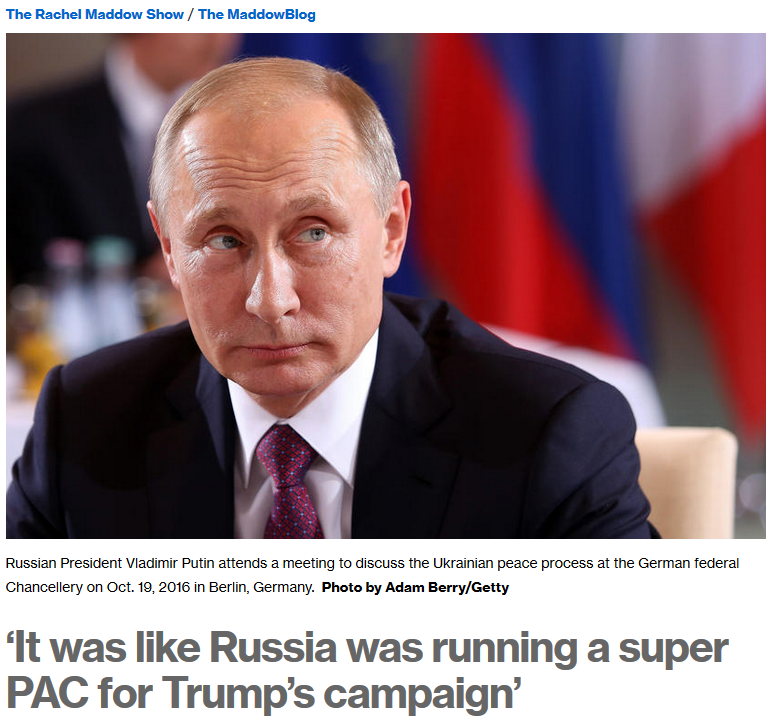
(MaddowBlog, 11/28/16)
As reports debunking or discrediting The List came out, the story continued to spread. Joy Ann Reid (Daily Beast, 11/27/16) alluded to the PropOrNot story to bolster her claim that there was an “alarming consensus of experts” that Russia interfered in the US election by “pumping of fake news and propaganda into the country’s digital bloodstream,” despite no such consensus existing. On Monday, Business Insider (11/28/16) insisted that PropOrNot’s “methods uncover some connections that merit consideration,” while citing only two examples and ignoring all of the major objections advanced by Greenwald, Taibbi et al. Rachel Maddow’s popular blog (MSNBC, 11/28/16) added another breathless write-up hours later, repeating the catchy talking point that “it was like Russia was running a super PAC for Trump’s campaign.”
Despite respected media critics taking the report to task, the Post’s spurious claims are being cemented as conventional wisdom, all the while the writer of the story and his editor refuse to answer direct criticism or reveal who this anonymous person or persons is. What are their motives? Who are their funders? Why is “useful idiot” being propped up by a major news outlet as a useful distinction? Why weren’t those on the blacklist asked to comment? Despite numerous inquiries by The Intercept, Rolling Stone and The Nation (11/28/16), all these questions remain unanswered.
One would think reports on “fake news” would themselves be held to the highest possible editorial standards, if not out of some instinctual desire to avoid high doses of irony and cognitive dissonance, at least to shield against charges of blatant hypocrisy. But increasingly, as the moral panic surrounding “fake news” reaches fever pitch, the standards of skepticism and sourcing employed by some of our most trusted news sources have inversely sunk to tabloid levels.
Adam Johnson is a contributing analyst for FAIR.org. You can follow him on Twitter at @AdamJohnsonNYC.
The group Roots Action has a petition up calling for a retraction of the blacklist story: “Tell the Washington Post: Smearing Is Not Reporting.”
The Orwellian War on Skepticism
By Robert Parry | Consortium News | December 1, 2016
Under the cover of battling “fake news,” the mainstream U.S. news media and officialdom are taking aim at journalistic skepticism when it is directed at the pronouncements of the U.S. government and its allies.
One might have hoped that the alarm about “fake news” would remind major U.S. news outlets, such as The Washington Post and The New York Times, about the value of journalistic skepticism. However, instead, it seems to have done the opposite.
The idea of questioning the claims by the West’s officialdom now brings calumny down upon the heads of those who dare do it. “Truth” is being redefined as whatever the U.S. government, NATO and other Western interests say is true. Disagreement with the West’s “group thinks,” no matter how fact-based the dissent is, becomes “fake news.”
So, we have the case of Washington Post columnist David Ignatius having a starry-eyed interview with Richard Stengel, the State Department’s Undersecretary for Public Diplomacy, the principal arm of U.S. government propaganda.
Entitled “The truth is losing,” the column laments that the official narratives as deigned by the State Department and The Washington Post are losing traction with Americans and the world’s public.
Stengel, a former managing editor at Time magazine, seems to take aim at Russia’s RT network’s slogan, “question more,” as some sinister message seeking to inject cynicism toward the West’s official narratives.
“They’re not trying to say that their version of events is the true one. They’re saying: ‘Everybody’s lying! Nobody’s telling you the truth!’,” Stengel said. “They don’t have a candidate, per se. But they want to undermine faith in democracy, faith in the West.”
No Evidence
Typical of these recent mainstream tirades about this vague Russian menace, Ignatius’s column doesn’t provide any specifics regarding how RT and other Russian media outlets are carrying out this assault on the purity of Western information. It’s enough to just toss around pejorative phrases supporting an Orwellian solution, which is to stamp out or marginalize alternative and independent journalism, not just Russian.
Ignatius writes: “Stengel poses an urgent question for journalists, technologists and, more broadly, everyone living in free societies or aspiring to do so. How do we protect the essential resource of democracy — the truth — from the toxin of lies that surrounds it? It’s like a virus or food poisoning. It needs to be controlled. But how?
“Stengel argues that the U.S. government should sometimes protect citizens by exposing ‘weaponized information, false information’ that is polluting the ecosystem. But ultimately, the defense of truth must be independent of a government that many people mistrust. ‘There are inherent dangers in having the government be the verifier of last resort,’ he argues.”
By the way, Stengel is not the fount of truth-telling, as he and Ignatius like to pretend. Early in the Ukraine crisis, Stengel delivered a rant against RT that was full of inaccuracies or what you might call “fake news.”
Yet, what Stengel and various mainstream media outlets appear to be arguing for is the creation of a “Ministry of Truth” managed by mainstream U.S. media outlets and enforced by Google, Facebook and other technology platforms.
In other words, once these supposedly responsible outlets decide what the “truth” is, then questioning that narrative will earn you “virtual” expulsion from the marketplace of ideas, possibly eliminated via algorithms of major search engines or marked with a special app to warn readers not to believe what you say, a sort of yellow Star of David for the Internet age.
And then there’s the possibility of more direct (and old-fashioned) government enforcement by launching FBI investigations into media outlets that won’t toe the official line. (All of these “solutions” have been advocated in recent weeks.)
On the other hand, if you do toe the official line that comes from Stengel’s public diplomacy shop, you stand to get rewarded with government financial support. Stengel disclosed in his interview with Ignatius that his office funds “investigative” journalism projects.
“How should citizens who want a fact-based world combat this assault on truth?” Ignatius asks, adding: “Stengel has approved State Department programs that teach investigative reporting and empower truth-tellers.”
Buying Propaganda
After reading Ignatius’s column on Wednesday, I submitted a question to the State Department asking for details on this “journalism” and “truth-telling” funding that is coming from the U.S. government’s top propaganda shop, but I have not received an answer.

Washington Post building (Photo: WaPo)
But we do know that the U.S. government has been investing tens of millions of dollars in various media programs to undergird Washington’s desired narratives.
For instance, in May 2015, the U.S. Agency for International Development (USAID) issued a fact sheet summarizing its work financing friendly journalists around the world, including “journalism education, media business development, capacity building for supportive institutions, and strengthening legal-regulatory environments for free media.”
USAID estimated its budget for “media strengthening programs in over 30 countries” at $40 million annually, including aiding “independent media organizations and bloggers in over a dozen countries,” In Ukraine before the 2014 coup ousting elected President Viktor Yanukovych and installing a fiercely anti-Russian and U.S.-backed regime, USAID offered training in “mobile phone and website security,” skills that would have been quite helpful to the coup plotters.
USAID, working with currency speculator George Soros’s Open Society, also has funded the Organized Crime and Corruption Reporting Project, which engages in “investigative journalism” that usually goes after governments that have fallen into disfavor with the United States and then are singled out for accusations of corruption. The USAID-funded OCCRP collaborates with Bellingcat, an online investigative website founded by blogger Eliot Higgins.
Higgins has spread misinformation on the Internet, including discredited claims implicating the Syrian government in the sarin attack in 2013 and directing an Australian TV news crew to what appeared to be the wrong location for a video of a BUK anti-aircraft battery as it supposedly made its getaway to Russia after the shoot-down of Malaysia Airlines Flight 17 in 2014.
Despite his dubious record of accuracy, Higgins has gained mainstream acclaim, in part, because his “findings” always match up with the propaganda theme that the U.S. government and its Western allies are peddling. Higgins is now associated with the Atlantic Council, a pro-NATO think tank which is partially funded by the U.S. State Department.
Beyond funding from the State Department and USAID, tens of millions of dollars more are flowing through the U.S.-government-funded National Endowment for Democracy, which was started in 1983 under the guiding hand of CIA Director William Casey.
NED became a slush fund to help finance what became known, inside the Reagan administration, as “perception management,” the art of controlling the perceptions of domestic and foreign populations.
The Emergence of StratCom
Last year, as the New Cold War heated up, NATO created the Strategic Communications Command in Latvia to further wage information warfare against Russia and individuals who were contesting the West’s narratives.
As veteran war correspondent Don North reported in 2015 regarding this new StratCom, “the U.S. government has come to view the control and manipulation of information as a ‘soft power’ weapon, merging psychological operations, propaganda and public affairs under the catch phrase ‘strategic communications.’
“This attitude has led to treating psy-ops — manipulative techniques for influencing a target population’s state of mind and surreptitiously shaping people’s perceptions — as just a normal part of U.S. and NATO’s information policy.”
Now, the European Parliament and the U.S. Congress are moving to up the ante, passing new legislation to escalate “information warfare.”
On Wednesday, U.S. congressional negotiators approved $160 million to combat what they deem foreign propaganda and the alleged Russian campaign to spread “fake news.” The measure is part of the National Defense Authorization Act and gives the State Department the power to identify “propaganda” and counter it.
This bipartisan stampede into an Orwellian future for the American people and the world’s population follows a shoddily sourced Washington Post article that relied on a new anonymous group that identified some 200 Internet sites, including some of the most prominent American independent sources of news, as part of a Russian propaganda network.
Typical of this new McCarthyism, the report lacked evidence that any such network actually exists but instead targeted cases where American journalists expressed skepticism about claims from Western officialdom.
Consortiumnews.com was included on the list apparently because we have critically analyzed some of the claims and allegations regarding the crises in Syria and Ukraine, rather than simply accept the dominant Western “group thinks.”
Also on the “black list” were such quality journalism sites as Counterpunch, Truth-out, Truthdig, Naked Capitalism and ZeroHedge along with many political sites ranging across the ideological spectrum.
The Fake-News Express
Normally such an unfounded conspiracy theory would be ignored, but – because The Washington Post treated the incredible allegations as credible – the smear has taken on a life of its own, reprised by cable networks and republished by major newspapers.
But the unpleasant truth is that the mainstream U.S. news media is now engaged in its own fake-news campaign about “fake news.” It’s publishing bogus claims invented by a disreputable and secretive outfit that just recently popped up on the Internet. If that isn’t “fake news,” I don’t know what is.
Yet, despite the Post’s clear violations of normal journalistic practices, surely, no one there will pay a price, anymore than there was accountability for the Post reporting as flat fact that Iraq was hiding WMD in 2002-2003. Fred Hiatt, the editorial-page editor most responsible for that catastrophic “group think,” is still in the same job today.
Two nights ago, MSNBC’s Chris Matthews featured the spurious Washington Post article in a segment that – like similar rehashes –didn’t bother to get responses from the journalists being slandered.
I found that ironic since Matthews repeatedly scolds journalists for their failure to look skeptically at U.S. government claims about Iraq possessing WMD as justification for the disastrous Iraq War. However, now Matthews joins in smearing journalists who have applied skepticism to U.S. and Western propaganda claims about Syria and/or Ukraine.
While the U.S. Congress and the European Parliament begin to take action to shut down or isolate dissident sources of information – all in the name of “democracy” – a potentially greater danger is that mainstream U.S. news outlets are already teaming up with technology companies, such as Google and Facebook, to impose their own determinations about “truth” on the Internet.
Or, as Ignatius puts it in his column reflecting Undersecretary for Public Diplomacy Stengel’s thinking, “The best hope may be the global companies that have created the social-media platforms.
“‘They see this information war as an existential threat,’ says Stengel. … The real challenge for global tech giants is to restore the currency of truth. Perhaps “machine learning” [presumably a reference to algorithms] can identify falsehoods and expose every argument that uses them. Perhaps someday, a human-machine process will create what Stengel describes as a ‘global ombudsman for information.’”
Ministry of Truth
An organization of some 30 mainstream media companies already exists, including not only The Washington Post and The New York Times but also the Atlantic Council-connected Bellingcat, as the emerging arbiters – or ombudsmen – for truth, something Orwell described less flatteringly as a “Ministry of Truth.”
The New York Times has even editorialized in support of Internet censorship, using the hysteria over “fake news” to justify the marginalization or disappearance of dissident news sites.
It now appears that this 1984-ish “MiniTrue” will especially target journalistic skepticism when applied to U.S. government and mainstream media “group thinks.”
Yet, in my four decades-plus in professional journalism, I always understood that skepticism was a universal journalistic principle, one that should be applied in all cases, whether a Republican or a Democrat is in the White House or whether some foreign leader is popular or demonized.
As we have seen in recent years, failure to ask tough questions and to challenge dubious claims from government officials and mainstream media outlets can get lots of people killed, both U.S. soldiers and citizens of countries invaded or destabilized by outsiders.
To show skepticism is not the threat to democracy that Undersecretary Stengel and columnist Ignatius appear to think it is.
Whether you like or dislike RT’s broadcasts – or more likely have never seen one – a journalist really can’t question its slogan: “question more.” Questioning is the essence of journalism and, for that matter, democracy.
[In protest of the Post’s smearing of independent journalists, RootsAction has undertaken a petition drive, which can be found here.]
Investigative reporter Robert Parry broke many of the Iran-Contra stories for The Associated Press and Newsweek in the 1980s.
House passes intelligence bill aimed at thwarting Russia’s ‘influence over people & governments’
RT | December 1, 2016
The House of Representatives has passed an intelligence bill aimed at tackling what Washington claims is political interference by Russia on a global level.
The 93-page bill, passed by the House in a 390-30 vote on Wednesday, calls for setting up a new, interagency panel to suppress Russia’s alleged attempts to “exert covert influence over peoples and governments,” The Washington Post reported.
The draft legislation goes on to state that the panel would be tasked with “countering active measures by Russia to exert covert influence, including exposing falsehoods, agents of influence, corruption, human rights abuses, terrorism and assassinations carried out by the security services or political elites of the Russian Federation or their proxies.”
The bill could be seen in direct opposition to President-elect Donald Trump’s plan to strengthen relations with Moscow.
In addition to thwarting Russia’s alleged interference, the bill also outlines funding for efforts to foil attacks and deny terrorists safe harbor in Iraq, Syria, North Africa, and other locations. It aims to strengthen counter-intelligence and address threats from adversaries in cyberspace, space and at sea.
It also updates whistleblower procedures in the intelligence community and requires a declassification review of intelligence reports on detainees transferred out of Guantanamo Bay by President Barack Obama and former President George W. Bush.
The Senate is expected to vote on the bill before the end of the year.
Also Wednesday, the six Democrats on the Senate Intelligence Committee sent a letter to President Obama, seeking declassification of information about Russia’s alleged meddling in the US presidential election.
“We believe there is additional information concerning the Russian government and the US election that should be declassified and released to the public,” they wrote in the letter. “We are conveying specifics through classified channels.”
Moscow has dismissed claims that it meddled in the US presidential election as “nonsense,” with President Vladimir Putin calling the accusation an attempt to distract American voters from domestic issues.
Russian Foreign Minister Sergey Lavrov recently told Italian newspaper Corriere della sera that there is still no proof of Moscow’s alleged meddling in the US presidential elections, calling the accusations “myth-making with a goal to solve the short-term political objectives.”
“No promised ‘evidence’ of interference in the electoral process has been presented neither to the American, nor to the international public,” Lavrov said.
Featured Video
Dan Dicks with James Corbett on Solutions Watch
or go to
Aletho News Archives – Video-Images
From the Archives
Secret document reveals plans for civil war in Lebanon, Israeli false flags, and invasion
By Randi Nord | Geopolitics Alert | April 5, 2019
Beirut – During his visit with US Secretary of State, Mike Pompeo, Lebanese President Michael Aoun reportedly received a US-Israeli document detailing plans for creating a civil war in Lebanon with covert false flag operations and possible Israeli invasion.
Although the source of the document is Israeli and created in partnership with Washington, no one knows who presented it to Aoun. The Lebanese TV station, Al-Jadeed, initially reported the document on Lebanese TV and a video on its website. Geopolitics Alert translated the report for this article. … continue
Blog Roll
 Aletho News
- Sheikh al-Asadi warns of Iraqi government compliance with US demands
- How to MAKE THE CONSPIRATORS PAY for their crimes! Dan Dicks with James Corbett on Solutions Watch
- There’s a drought in academia: A drought in honest research on the subject of drought and other weather extremes
- Department of War Awards $20.7 Billion Contract to Raytheon for Air-to-Air Missiles
- ‘Distance yourselves from Israel’: IRGC urges US population to question govt policies
- America’s Greenland deal has a radioactive backstory
- The RAF Fairford ‘terror plot’: Unpacking escalation in the UK echo-chamber
- EU Council Advances Chat Control 2.0 Scanning Proposal
- Ex-Greek MEP files complaint against Israeli spyware firm over alleged Pegasus surveillance
- Troubling ideas throughout the Torah, Talmud, Mishneh Torah and Tanya
- If Americans Knew
- New Report: “Scholasticide and Genocide in Gaza: Assessment, Testimonies and Legal Analysis”
- Ex-Biden officials are desperate for a Gaza scapegoat
- Israeli “settlers” Invade Al-Aqsa; Pour Boiling Water on 75-Year-Old
- Israel Has Kidnapped Another American Teenager
- US arms sales to Israel worth $21.6 billion in 20 months
- Three Palestinians Killed in Israeli Attacks on Gaza
- Revealed: German “Anti-Semitism Expert” Driving Crackdown on Palestine Solidarity is Former Israeli Spy
- Egypt’s Warning to Israel Before Oct 7
- Israel’s siege signals another cruel winter for 1.8 million Gazans – Daily Update
- Netanyahu Asked UAE Leader to Deny Report on Oct. 7 Warning in Secret Visit, Sources Say
- No Tricks Zone
- New Study: Earth And Venus Surface Warmth Largely Explained By Convection And Lapse Rate, Not CO2 Or Radiation
- 2025 Nature Paper Claiming Worsening Global Drought Gets RETRACTED …Heavily Flawed
- New Study: ‘Global Drought Shows No Detectable Recent Acceleration Under Climate Warming’
- Economic Masterminds: German Socialists Suggest Taxing Productivity Gains Stemming From Using AI
- The South China Sea Has Not Been Cooperating With The Climate Change Narrative
- Energy Crisis: Germany Enters Heating Season With Historically Low Gas Reserve Fill Levels
- New Study: The Antarctic Ice Sheet Gained Mass From 2020-2024 Due To Staggering Snow And Ice Accumulation
- Study: Ocean Heating Rates From Thousands Of Years Ago ‘Dwarf’ Modern Ocean Heating Rates
- Climate Extremists Target, Attack Large-Scale Power Grid Infrastructure In Germany!
- New Study: Antarctic Ice Melt Has Contributed Less Than 1 Centimeter To Sea Level Rise In The Last 30 Years

