Zuckerberg hints at third-party news verification to fight ‘fake news’ on Facebook
RT | November 19, 2016
 Facebook may entrust a third party with verifying content to stop so-called ‘fake news’ from spreading, its head said in a post. The social network, which is many people’s primary source of news, has recently been criticized for spreading misinformation.
Outgoing US President Barack Obama launched the war on ‘fake news’ last week, complaining that it may have had an adverse effect on the presidential election. He claimed that social media hosts “much active misinformation” that “looks the same when you see it on a Facebook page or you turn on your television.”
There is speculation that fake news about presidential candidates may have played a considerable role in swaying the minds of voters who ultimately elected Republican Donald Trump. Facebook head Mark Zuckerberg initially dismissed the notion as “pretty crazy,” but this week Facebook and Google both said they would change their ad policies to prevent fake news websites from using their systems.
In a Friday post, Zuckerberg gave an update on how his network is planning to fight misinformation.
“Historically, we have relied on our community to help us understand what is fake and what is not,” he said, explaining that the reporting mechanism already in place on the site fights fake news along with clickbait, spam, and scams.
This may be not enough to combat inaccurate news content, however, so Facebook is considering engaging “trusted third parties” to filter out fake news.
Another possible approach would be to have Facebook police itself, which would mean installing “better technical systems to detect what people will flag as false before they do it themselves,” the FB head said.
Links to news stories classified by the network as untruthful would be flagged as fake for people trying to share or read them, according to Zuckerberg.
False stories circulating on Facebook during America’s presidential election campaign included one claiming that anchor Megyn Kelly had been fired from Fox News, another alleging an FBI agent involved in the Clinton investigation had been murdered, and even an announcement that the Pope had endorsed Trump.
Facebook blocks Palestine Network for Dialogue’s page
Palestinian Information Center – November 18, 2016
 GAZA – Facebook administration resumed its policy of targeting Palestinian media pages after blocking Palestine Network for Dialogue’s page for the third time Friday.
The Palestine Network for Dialogue, an online discussion board, was blocked without any prior notice although it has 70,000 followers.
Palestine Network for Dialogue specializes in publishing stories about the plight of Palestinians both in the occupied West Bank and Gaza Strip in addition to those living in 1948 occupied Palestine.
Last September, several pro-Palestinian Facebook pages and accounts were removed including accounts of seven editors of the Palestinian Information Center.
In a controversial move, the Israeli government and Facebook reportedly agreed to work together to determine how to tackle incitement on social media, aimed primarily at Palestinians.
Not long after Facebook’s agreement, several Palestinian pages with millions of readers found themselves closed and administrators locked out, in a move believed to be directly connected to the agreement between Facebook and the Israeli government.
Google, Corporate Press Launch Attack On Alternative Media
By Brandon Turbeville | Activist Post | November 16, 2016
On November 15, U.S News and World Report released an article by Rachel Dicker providing a list of “fake sites” to “avoid at all costs.” On the list, Activist Post was prominently noted as being “fake” or, more accurately to the point of the article, a “propaganda” site.
This article comes shortly after an announcement by Google that it would be prohibiting “fake” and “misrepresentative” sites from using its AdSense program. The company stated to Reuters that,
Moving forward, we will restrict ad serving on pages that misrepresent, misstate, or conceal information about the publisher, the publisher’s content, or the primary purpose of the web property. This policy includes fake news sites, the spokesperson confirmed. Google already prevents its AdSense program from being used by sites that promote violent videos and imagery, pornography, and hate speech.
And, of course, the definition of the Orwellian-named “hate speech,” violence, misrepresentation and “fake news” is all going to be determined by Facebook and Google. War, for instance, is extremely violent but there is a necessity to cover it and even produce images from the battlefield in the process. Police shootings and other forms of violence against citizens is also violent but a necessary issue to cover. “Hate speech” is incredibly subjective and, in 2016, speech has come to be labeled as “hate” even when it merely respectfully disagreed with a protected identity group.
But the new Google policy and the intent to remove what is for many websites a main source of revenue has obvious political implications and is about much more than a desire to prevent unpleasant images, violence, and hate from being shown to Americans. That is, it is obvious that the intention of Google is to starve out the source of revenue for the alternative media, thereby crashing the alternative media as a competitor for mainstream outlets and eliminating any sources of critical thought and competing narratives.
The mainstream media is a dying institution. This much is clear. Fewer and fewer people are paying attention to CNN, FOX, U.S. News and World Report, and the rest of the corporate press, while more and more people are tuning in to independent and alternative broadcasts and visiting alternative media websites. This is posing a major threat not only to the very survival of the corporate news but also to the narratives being peddled by the U.S. State Department, Wall Street, and Corporate America via their media mouthpieces. The cat is coming out of the bag for the U.S. oligarchy and the only way to put it back is to ensure that the alternative media goes away and that the American people will only be able to consume the garbage shoveled out by major corporations from here on out.
But back to Dicker’s article. We should note that the categorization of the flagged sites is interesting indeed. The “fake news” sites are listed into three groups – satire, hoax, and propaganda. As Activist Post has pointed out, satire is a legitimate form of literature. Perhaps the writers and editors of stuffy and irrelevant media organizations like U.S. News and World Report are unaware of the art of sarcasm or irony, which is apparent by the fact that U.S. News and World Report has the audacity to call another outlet a “propaganda site.”
Dicker also mentions hoax websites. I must confess much irritation over constantly seeing actual fake news websites often even listed as satire but which are, in reality, hoaxes, floating around the Internet and social media and being shared by well-meaning people who cannot take the time to investigate their own source of information. Sites with headlines like “Hillary Clinton Shoots Puppy After Election Loss” or “Donald Trump Vomits Demon On Israeli Prime Minister” are unfortunately clogging up the works for legitimate news organizations (and by that I mean many alternative outlets) but such is the risk in a free society where people are free to choose what they read and think.
That being said, I wonder how many lives would have been lost as a result of a number of Americans believing that Hillary Clinton shot a puppy or Donald Trump is possessed versus believing that Iraq had weapons of mass destruction? I guess we will never know the stats for the former, but perhaps we should ask the editors of the “trusted” New York Times, CNN, CBS, and their ilk for the numbers on the latter.
Indeed, for U.S. News and World Report to label Activist Post as propaganda whilst disseminating unproven allegations and obvious pro-war propaganda is hypocritical to say the least.
Remember, it was U.S. News and World Report that published “The Liberal Case For Intervention In Syria,” which was a pathetic attempt to justify yet another American war of aggression against a country that did nothing to the U.S. nor posed any threat to it. The author, Eric Schnurer, attempted to make the case that invading Syria and slaughtering civilians directly (as opposed to the proxy method being used currently) was actually the moral thing to do. Or perhaps we should mention the countless interviews with military-industrial complex “Think Tanks” and “foreign-relations strategy firms” that are consistently promoted by US News And World Report (USNAWR) in order to add to the cheerleading squad of pro-war/anti-Russia commentators designed to create a false-consensus, i.e. that the “experts” all agree that Assad is a “brutal dictator killing his own people” and that Putin “wants to control the world.” We must also mention the constant braying over “chemical weapons” being used in Syria, being blamed on Assad, all the while these news organizations are aware that there is virtually no evidence to back up their claims.
USNAWR even saw fit to post an editorial by an individual claiming that WMDs were found in Iraq and that “Bush was right” all along, a separation from reality if ever there was one.
The saddest part about the journalistic quality of USNAWR is that, bad as their articles often are, the really bad ones are actually the most interesting. Looking at USNAWR’s website, the corporation seems to be nothing more than a bigger version of those “ranking” sites advertised under so many news articles. You know the ones I’m talking about with headlines like “10 Hottest Athletes” and “30 Actors That Are Actually Gay.” The difference, however, is that USNAWR throws in several articles to give their readers the false impression that visiting the site is not an incredible waste of time.
Rachel Dicker’s articles themselves are evidence of the irrelevance of USNAWR. Take a look at her history and you will see articles full of incredible journalistic sleuthing – a Golden Pheasant that looks like Donald Trump, what’s trending on Chinese social media, a letter written by a creator of a television show, and, of course, a musical performance by Jon Stewart and Stephen Colbert. Riveting stuff.
Interestingly enough, Dicker did not mention the New York Times and their coverage of the non-existent WMDs in Iraq. Shouldn’t that organization be labeled propaganda? Not only that, NYT’s information managed to kill a million Iraqis and over 3,000 American soldiers. Not even an honorable mention?
There was also no mention of CNN for its infamous “Syria Danny” fiasco where the corporation was caught red-handed staging a propaganda video against the Syrian government, ultimately to draw Americans in to having pro-war sentiment despite the weariness of foreign adventures enabled by “real” news organizations like the New York Times and CNN. This outright lie was exposed by the alternative media, highlighting the reason why corporate news organizations, Wall Street, and the military industrial complex want the alternative media silent.
Likewise, Dicker did not mention NPR and its “Gay Girl In Damascus” ordeal where the organization promoted a storyline designed to demonize the Syrian government despite the fact that the “Gay Girl In Damascus” was neither gay, nor a girl, nor even in Damascus.
Indeed, we can make many lists of many different things when discussing the mainstream and alternative media but I suggest we begin by making lists of the actual consequences of their work. Perhaps a list of the dead civilians who were killed as a result of the malfeasance and deception of the corporate media would be a place to start. Perhaps a list of dead military personnel would also make for an interesting list. But while CNN concerns itself with Beyonce and U.S. News And World Report must first report on birds that look like Trump, the alternative media will continue to cover real news which, of course, includes the epic fails of the corporate press.
While Zuckerberg and Schmidt attempt to deal a lethal blow to the alternative press, rest assured that AdSense will not be the end of alternative media. America’s favorite dorks may deliver a decent punch to many outlets but, in the end, the alternative media and the “propaganda” sites Dicker is so worried about will have the opportunity of watching the corporate press decay and disappear into the dustbin of history.
Brandon Turbeville – article archive here – is the author of seven books, Codex Alimentarius — The End of Health Freedom, 7 Real Conspiracies, Five Sense Solutions and Dispatches From a Dissident, volume 1 and volume 2, The Road to Damascus: The Anglo-American Assault on Syria, and The Difference it Makes: 36 Reasons Why Hillary Clinton Should Never Be President.
Palestinian journalist released – on condition of deactivating Facebook and turning over his laptop
Samidoun Palestinian Prisoner Solidarity Network – November 14, 2016
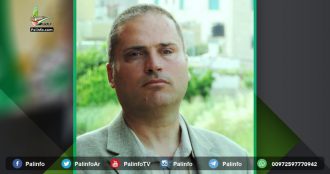 Palestinian journalist Khaled Maali of Salfit was ordered released on Sunday, 13 November by the Israeli Salem military court – on the condition that he turn over his laptop to Israeli occupation forces and close his Facebook account, as well as paying a fine of 7,000 NIS ($1700 USD).
Maali, 48, was arrested from his home in Salfit last week in a military raid by occupation forces. He is one of hundreds of Palestinians targeted for arrest, interrogation and imprisonment on the basis of their social media posts in support of the Palestinian people’s struggle for liberation. The “evidence” introduced into military court in order to convict these Palestinians – convictions which occur in over 99% of cases before Israeli military courts – include the number of “likes” and “shares” a post receives. Other prominent cases of Palestinians targeted for social media postings include poet Dareen Tatour, astrophysics professor Imad Barghouthi, and fellow journalists Sami al-Saee and Samah Dweik. Maali earned his PhD from The Hague University after studying at An-Najah University.
Recently, Facebook executives met with Israeli officials, including Ayelet Shaked, announcing “cooperation” against so-called “incitement,” sparking widespread protests among Palestinian and solidarity activists. While pledging to crack down on “hate speech,” they made no mention of Shaked’s genocidal comments about Palestinians posted on Facebook that referred to Palestinian children as “little snakes” and urged the execution of their mothers. Instead, Facebook has granted 95 percent of Israel’s 158 requests to remove content in the last four months. Samidoun in New York City joined the global protest against Facebook with a protest at the social media giant’s NYC offices.
Leave those kids alone! Thousands of schoolchildren being spied on without their knowledge
RT | November 8, 2016
At least 1,000 schools have installed software that allows teachers to monitor their students’ internet activity, but most schools have failed to inform youngsters that they are being watched.
According to a report by civil liberties watchdog Big Brother Watch, several secondary schools in England and Wales have installed the Classroom Management Software in more than 821,000 devices owned by the institutions and by pupils themselves.
The tool can allow teachers to monitor the screens on every single desktop in the classroom, as well as access the students’ internet browsing history and alert staff of “signs of extremism and radicalization.”
Campaigners were shocked to find that of the few institutions (149) able to provide Acceptable Use policies on their management of the software, over 80 percent did not give detailed information on the monitoring process.
Big Brother Watch believes although the software may have a role to play in keeping students safe, children and parents should be advised about the privacy settings of the program.
“Finding the balance between keeping pupils safe online without impinging on their right to privacy is a challenge for every school,” said the group’s chief executive Renate Samson.
“But encouraging schools to track and monitor pupils creates a worrying precedent, particularly if pupils and parents are being left in the dark.
“As technology in the classroom becomes the norm, schools must ensure they don’t become modern day panopticons, where children grow up believing their every digital move is being watched.”
It cost the taxpayer a total of £2 million (US$2.48 million) to install the controversial software. More is spent each year on maintenance and subscription fees.
‘Conspiracy Vs. Government’ Is Part of an Elite Wave of Propaganda Justifying Violent Repression
The daily Bell – October 31, 2016
The rise of paranoid politics could make America ungovernable – and the FBI is fuelling the fire … Nothing can disprove the fears of a paranoiac. Indeed, everything confirms them … It takes away politicians’ incentive to understand one another and get things done. It says that if you scream loud enough, established norms will buckle under the pressure. And while those norms might be annoying and flawed, we’ll all miss them if they go. –UK Telegraph
With US belief in “conspiracy theory” over 50 percent (see our previous article here) elites are showing increasing concern that they have lost control of their narrative.
This article again illustrates elite push back. The article explains that if people grow paranoid about government, then the “norms” of government will collapse.
Conspiracy theory is called “paranoid politics” in this article but it amounts to the same thing.
The article also has parallels to an article we analyzed recently here by Cass Sunstein. His Bloomberg editorial suggested that nothing was more important from a political standpoint than returning “civility” to Congress and politics generally.
This article runs along the same lines: Negative perceptions of the US government can make the process of “governing” dysfunctional
More:
Take the “chemtrails” conspiracy theory: the idea that the white trails left behind in the sky by aeroplanes are sinister chemicals dispersed to sterilise or control voters.
If a government declares there is “no evidence” of such chemicals, that itself must be clear evidence that there’s something “they” don’t want us to know. But if that government were to open up an investigation, that too would be incontrovertible proof: “they” must have found something.
Let’s reverse this reasoning. Apparently, one can’t question much that government does because skepticism puts government in a no-win situation.
Better to accept official pronouncements, then. The only trouble is that almost anything modern Western governments say are lies.
Governments aren’t even important these days. The world from what we can tell is run by a small banking elite that controls the awesome power of central banks and the money they print.
The trillions available to this small group has allowed it to change the nature of society around the world.
The goal is global government and every kind of violence and corruption is employed to achieve it.
Secrecy is still employed by those creating “one world.” Thus the world is bent on the task of creating global governance while never admitting it.
But in the past several decades, the Internet has credibly exposed plans for world government. As a result, people have lost faith in mainstream media, politicians and capitalism itself.
This is the reason for the rise in “conspiracy theory” and “paranoid politics.”
This is also the reason elites would like to shut down the Internet, or at least control it more thoroughly.
Part of the push for control involves making a case that the Internet needs to be better regulated and appropriately censored.
To this end, elite propaganda has been aimed at justifying various anti-‘Net actions.
One justification involves the “populism versus globalism” meme we’ve covered extensively. (Just use a search engine for the phrase and “Daily Bell.”)
Another justification – another emergent meme – is that government itself is jeopardized by pervasive distrust.
One would think the answer would be to lie less, but this is not the conclusion we’re being furnished.
Both Sunstein in his article, and now the argument in this article, show us clearly that the solution to pervasive electoral cyncism and worse is to better control one’s attitude.
In other words, paranoia and conspiratorial cynicism need to be damped for government to survive and perform its proper function.
Here:
Why, then, did a seasoned operator like Mr Comey, whose judiciousness was praised by the Clinton campaign through the summer, feel the need to divulge this half-baked and potentially insignificant development before assessing it? There is one answer: fear of the mob.
The director of the FBI – those tough guys who smash in doors and shoot people – was scared that if he didn’t talk now and the news leaked out, it would confirm every conspiracy theory going about how the agency was in the Clintons’ pocket. In other words, we’ve reached a point in the politics of the world’s most powerful democracy where the appearance of probity matters more than the reality.
This is a key point in the article. It is one that fully reveals the cognitive dissonance at the heart of this particular argument. The idea is that government is too delicate to sustain itself in the face of the “mob.” The mob must therefore be silenced or “probity will matter more than reality.”
But who is to determine what constitutes a “mob”? And who is determine that the mob’s “reality” is false?
Both the Sunstein article and now this one are erecting very specific kinds of arguments. Government, we are told, is fragile and must be protected from forces that will undermine its credibility.
But this conclusion is merely assumed. It is never proven.
This argument begins and ends with government. Yet the Internet and its recovered history shows us clearly that Western governments mostly provide concealment for the world’s real powers that prefer to operate behind the scenes.
This is the reason for so much cynicism. Many have realized that the society constructed around them is lie. They have reacted by distrusting almost anything associated with modern society.
But in these articles, we can see the forces being marshaled against this state of mind. The preferred antidote is simply to assert that people’s distrust is corrosive to government authority and democracy generally.
No logic bolsters this argument. That’s why it is an emergent elite meme.
The goal of an elite meme is to be convincing not truthful.
And if it is not convincing – and increasingly elite memes are not – then its function is, anyway, to provide a justification for what we call directed history. These are the authoritarian strategies that elites wish to inflict on the rest of us.
This latter meme is an outgrowth of “populism versus globalism.” Populists, as we’ve pointed out, are being cast as ignorant, violent and intolerant. The current meme – let’s call it “conspiracy versus government” – lumps in conspiracy with populism.
Populists, we learn, are apt to adopt an irrational distrust of government. And what is government? It must comprise all that is good and virtuous in an uncivil world.
Both populists and conspiracy theory are to be vanquished, eventually, by wise globalists who understand that the absence of government will lead to violent “anarchy.”
Would that it were true. It is not. Government is merely in this day-and-age a curtain hiding the world’s real controllers who use endless violence, monetary debasement and economic depression to get their way.
Conclusion: We are watching the emergence of a new, dangerous memes. Increasingly and forcefully, it is being argued that “government” is good and that the truths people have discovered about their lives and society are destabilizing to government, and therefore “bad.” The idea will be to use these memes to make a case for increased censorship and even, eventually, violent repression – and worse.
Facebook investigated by German prosecutors for failing to stop ‘hate speech’
RT | November 4, 2016
Facebook’s founder Mark Zuckerberg and other senior executives are being investigated in Germany after a lawyer filed a complaint accusing them of allegedly allowing racist and violent posts to remain on the social networking site.
The social media giant was accused of doing little to stop racism, Holocaust denial and violent threats on the site, according to Der Spiegel.
A Bavarian lawyer initiated the case by reporting Facebook to the police, accusing the company’s management of allowing such hateful posts to stay on the site without any consequences.
Chief Operating Officer Sheryl Sandberg, European policy director Richard Allan and company head in the Berlin office Maria Kirschsieper, are also under investigation.
German law requires Facebook to delete any content considered to be inciting hatred. Earlier this year, the company was also hit with a criminal complaint, but authorities said at the time they were unable to investigate because the accused, Zuckerberg, was not residing within German borders when it was brought to light.
German politicians have criticized Facebook for reportedly failing to take action against hate speech on the site.
In October, Volker Kauder, a member of Angela Merkel’s Christian Democratic Union, said Facebook and other social media giants should face penalties for not taking action against hate speech, following the rise of xenophobic comments amid the refugee crisis in Europe.
Kauder said he had “run out of patience” with how social media giants were dealing with abusive content.
Many users of Facebook, Twitter and Google said that despite pledges from the companies to remove hate speech within 24 hours from their sites, users complaints were not adequately dealt with, the Local reports.
Facebook did not comment on the investigation status but said “the allegations lack merit and there has been no violation of German law by Facebook or its employees.”
Trigger Warnings, Safe Spaces, Bias Reporting: The New Micro-techniques of Surveillance and Control
By Michael Rectenwald, Ph.D. | Legitgov | September 12, 2016
A singular orthodoxy has infiltrated the discursive parameters of U.S. and other universities and colleges. This orthodoxy now constitutes the ethical vocabulary of academia. Adopted from feminism, anti-racism, and LGBTQ theory and practice, the language, doctrines, and mechanisms of this orthodoxy now dominate academia’s policies, procedures and handbooks. The terminology has become the vernacular among the swelling ranks of administrators, especially the relatively new cohort of chief diversity officers, directors of diversity, associate provosts of diversity, assistant provosts of diversity, diversity consultants, and so on and so on. I refer not merely to the orthodoxy of “diversity,” but in particular to “diversity” initiatives as they are currently administered, using a particular set of policies, procedures, and mechanisms: trigger warnings, safe spaces, bias reporting, and the like.
While ridiculed by media outlets, and, at least where trigger warnings are concerned, disavowed by the American Association of University Professors, nevertheless, American colleges and universities are dominated by this ethos and its collective techne. At the University of Chicago for example, the Dean of Students, John (Jay) Ellison, Ph.D., announced (to the great chagrin of some faculty and many students):
Our commitment to academic freedom means that we do not support so-called “trigger warnings,” we do not cancel invited speakers because their topics might prove controversial, and we do not condone the creation of intellectual “safe spaces” where individuals can retreat from ideas and perspectives at odds with their own…
Yet, the same university has also assembled and maintains a “Bias Response Team,” and “urges anyone who has experienced or witnessed a Bias Incident to report it to the Bias Response Team.”
As it usually happens, any perspective that deviates from this “academic” orthodoxy – or any opposition expressed by faculty members in reasoned commentary or debate about the premises of the creed and/or its techniques – is virtually proscribed in advance. Whether or not they happen to be progressives, left communists, or radicals of another stripe, potential critics rightly fear being figured as right-wing reactionaries opposed to diversity and the confrontation of oppression. Any complaints or criticisms, they fear, would be peremptorily dismissed, and likely circulated among other faculty members within their own universities or in academia at large as gossip, subjecting the critic to ridicule and disrepute.
Indeed, despite the fact that a new form of policing has been surreptitiously introduced into academia at large, one would be hard-pressed to find a single article, essay, or book that subjects the entire administratively controlled apparatuses of “diversity” to any kind of real scrutiny. While innumerable articles have appeared on one or another of these topics (mostly on trigger warnings and safe spaces), no one has explained the structural provenance nor analysed the probable effects of these developments as a whole. Nor has anyone provided a theoretical or historical framework with which to understand them.
Ironically, perhaps, the most clearly appropriate critical theoretic for grasping the structural origins, as well as the social and political implications of this new largely “academic”1 development, can be found within the ambit of postmodern theory itself. The new mechanisms adopted and adapted by academic administrations clearly and incredibly mirror those described in a text widely read within humanities and social science studies courses throughout American universities and beyond. Indeed, it is a wonder that no one has, until now, applied this critique to the mechanisms of this academic creed. Faculty members, graduate students, and even many undergraduates, who have had even the slightest brush with trends in the humanities and social sciences, will know to what I refer here: Michel Foucault’s brilliant 1975 book, Discipline and Punish: The Birth of the Prison. Particularly uncanny is the resemblance of the academic mechanisms in question to the “micro-physics of power” described in the third chapter, “Panopticism.”
In this riveting essay, Foucault effectually describes the transmutation of power from the pre-modern to the modern period. Adducing Jeremy Bentham’s architectural model of the “Panopticon,” Foucault proffers what at the time was an utterly novel understanding of modern “discipline” and control. The new disciplinary mechanisms that Foucault discusses replace the earlier corporeal forms of punishment, such as quartering people in public, or branding them with the crimes they supposedly committed, and so forth. While the Panopticon was first introduced by Bentham as a model of prison, asylum, and school reform, the forms of surveillance and discipline to some extent prefigured by the Panopticon and in some sense preceding it, for Foucault had already metastasized beyond the prison system, becoming the general means of discipline and control in so-called “democratic” societies.
The Panopticon itself is a circular building, in which its subjects – inmates, patients, students, etc. – are arrayed in cells surrounding a central tower. The subjects can be seen at any time by a guard, who may (or may not) occupy the central tower. The captive subjects cannot see into the tower, nor can they see each other. Likewise, they are never certain whether or not they are being observed:
Bentham’s Panopticon is the architectural figure of this composition. We know the principle on which it was based: at the periphery, an annular building; at the centre, a tower; this tower is pierced with wide windows that open onto the inner side of the ring; the peripheric building is divided into cells, each of which extends the whole width of the building; they have two windows, one on the inside, corresponding to the windows of the tower; the other, on the outside, allows the light to cross the cell from one end to the other. All that is needed, then, is to place a supervisor in a central tower and to shut up in each cell a madman, a patient, a condemned man, a worker or a schoolboy. By the effect of backlighting, one can observe from the tower, standing out precisely against the light, the small captive shadows in the cells of the periphery. They are like so many cages, so many small theatres, in which each actor is alone, perfectly individualized and constantly visible. The panoptic mechanism arranges spatial unities that make it possible to see constantly and to recognize immediately. In short, it reverses the principle of the dungeon; or rather of its three functions – to enclose, to deprive of light and to hide – it preserves only the first and eliminates the other two. Full lighting and the eye of a supervisor capture better than darkness, which ultimately protected. Visibility is a trap (Foucault 200).
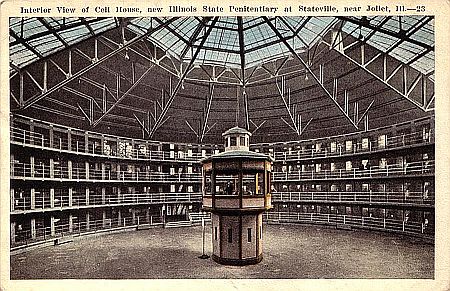
Although the captive individual can never verify with certainty that she is being observed, the very possibility of being observed at any time produces the intended effects of hyper-vigilance and self-circumspection on the part of the subject. As such, the subjects themselves internalize the observer, and effectively monitor and police themselves. As Foucault brilliantly describes the effects of this technological innovation:
He who is subjected to a field of visibility, and who knows it, assumes responsibility for the constraints of power; he makes them play spontaneously upon himself; he inscribes in himself the power relation in which he simultaneously plays both roles [that of observer and observed]; he becomes the principle of his own subjection (203, emphasis added).
Make no mistake, Foucault describes and mobilizes the architectural model of the Panopticon in order to introduce his central argument – in modernity, entire societies are inscribed with, underwritten by, and even predicated upon a generalizable and generalized method of surveillance and control – panopticism. Even the once structure-bound, institution-specific disciplinary techniques as represented so well by the Panopticon have metastasized and traveled well beyond their former institutional borders. They now permeate the entire social body. In fact, in an important section, Foucault discusses “the swarming of the disciplinary mechanisms” of panopticism. The phrasing will invoke for contemporary readers the sentinels in “The Matrix,” the legion of squid-like robots that seek out, locate, and swarm about the escapees from the matrix in sweltering masses.
For our purposes, perhaps the most salient aspect of panopticism is the way that it makes all of its subjects into potential sentinels of surveillance: “We have seen that anyone may come and exercise in the central tower the functions of surveillance” (207). That is, anyone and everyone can be interpellated as a functionary of panopticism. “If you see something, say something” is the mantra that effectively encapsulates this logic. Universities and colleges employ the micro-techniques of power precisely in the fashion described by Foucault.
At this point, I should make clear a parallel between the late eighteenth/early nineteenth-century model that Foucault treats, and the contemporary devices employed in academia and beyond. A point that is often lost on many readers of Foucault’s “Panopticism,” especially those unfamiliar with nineteenth-century British cultural history, is that Jeremy Bentham was not some reactionary, right-wing or even conservative thinker attempting to impose a nefarious, draconian form of discipline and punishment upon the population. In fact, during his time, Bentham was regarded as a radical, what today we would call a “progressive.” Bentham was known as the principle member of an early nineteenth-century group of reformers known as “the philosophical radicals.” As noted in the Encyclopaedia Britannica, he advocated numerous liberal reforms, including “annual elections; equal electoral districts; a wide suffrage, including woman suffrage; and the secret ballot. He supported in principle the participation of women in government and argued for the reform of marriage law to allow greater freedom to divorce.”
My point here is that regardless of the political provenance or original intention of the repertoire of diversity mechanisms, as Foucault makes clear, such methods and techniques, whether introduced initially by reformers for progressive ends or not, can and have often been co-opted by administers of power and wielded to oppressive ends. Likewise, the origin of the new academic instruments or “micro-physics of power” in feminism, anti-racism and LGBTQ discourse and practice in no way exempts them from being employed as mechanisms of surveillance and control.
Academia has co-opted and now brandishes identity-politics and its techniques of micro-power – including trigger warnings, safe spaces, and bias reporting – as means of the disciplining of the subject. Bias reporting lines are examples of the ways colleges and universities are able to enlist everyone within their ambit as sentinels of surveillance, discipline, and punishment. Bias reporting lines and reporting systems encourage everyone to act as an instrument of panopticism, an instrument of self- and other-policing.
In terms of the academy, however, the use of such mechanisms does not represent a perversion of intent. They are coercive as such, by definition. They are part of a growing panoply of micro-techniques of power representing the appropriation and defusing of politics, rather than opposition to the systems of oppression that such politics intend to represent.
These techniques of surveillance and control recall such organizations of the nineteenth century as The Society for the Suppression of Vice, founded in 1802. The only real difference involves what now count as punishable offenses. In the early to mid-nineteenth century in Britain, offenses included the production, distribution and consumption of pornography, as well as expressions of blasphemy, and the like. Today, “vices” and “blasphemies” include real or imagined “micro-aggressions,” or any conceivable displays of “bias,” however absurdly construed. Both regimes, however, are equally religious in character, involving as they do moralistic, individualized, and personalized policing. While both are insidious, only contemporary academic panopticism, operating under the guise of protecting and encouraging “diversity,” is anathema to academic freedom and inquiry, while simultaneously underming any potential for collective agency, or solidarity, among its subjects. Above all, panopticism individualizes.
Meanwhile, and probably most importantly, none of this policing and self-policing will do anything to challenge or overturn systemic oppression in the least. In fact, while serving the ideological function of obscuring the underlying structural inequities, oppression and exploitation of capitalism, they also constitute their own form of oppression.
[1] As Lori R. Price has pointed out, these same mechanisms have metastasized and infiltrated such social media platforms as Twitter, Facebook and YouTube.com.
Michael Rectenwald is a professor in Global Liberal Studies at New York University. He is the author of Nineteenth-Century British Secularism: Science, Religion and Literature (Palgrave Macmillan, 2016), primary editor of Global Secularisms in a Post-Secular Age (De Gruyter, 2015), and primary author of Academic Writing, Real World Topics (Broadview Press, 2015). His essays have appeared in numerous periodicals and anthologies, including the British Journal for the History of Science, Endevour, and George Eliot in Context (Cambridge University Press, 2013).
NYPD to Innocent Business Owners: Give Up Your Rights or Get Shut Down
Institute For Justice | October 12, 2016
When undercover NYPD officers offered to sell stolen electronics to customers at Sung Cho’s laundromat, near the northern tip of Manhattan, Sung never imagined the sting operation could be used as a pretext to shut down his business. But that’s exactly what happened. Attorneys for the city threatened Sung with eviction merely because a “stolen property” offense had happened at his business.
The city presented Sung with a choice: See his business shut down or sign an agreement giving up constitutional rights—including his Fourth Amendment right to be free from warrantless searches of his business. Faced with the imminent closure of his laundromat, Sung had no real choice but to sign.
In New York City today, this experience is all too common. Under New York City’s so-called nuisance eviction ordinance—more appropriately termed a “no-fault” eviction ordinance—residents and business owners can be evicted simply because their home or business was the site of a criminal offense. Under the ordinance, the identity of the criminal offender is irrelevant. You can be evicted because a total stranger (or a friend or family member) decided your home or business was a good place to commit a crime.
City attorneys churn out no-fault eviction filings by the hundreds, relying on form templates and little more than NYPD officers’ say-so that the targeted home or business was the site of a crime. In many cases, the “proof” of the alleged criminal offense is an affidavit from an NYPD officer relaying vague allegations from unnamed confidential informants.
Moreover, under the ordinance, occupants of the home or business can be evicted without any notice. After being summarily evicted, occupants have just days to put together a case to persuade a judge to undo the eviction order.
City attorneys routinely offer to drop these no-fault eviction proceedings if occupants agree to waive their constitutional rights. Some, like Sung, are forced to sign agreements waiving their Fourth Amendment rights. Others are forced to sign agreements barring family members from the home—including family members who have not been accused of any crime.
Now, Sung is joining with other victims of the city’s conduct to bring a federal class action lawsuit challenging the city’s no-fault eviction ordinance. If the lawsuit is successful, past waivers of constitutional rights will be declared unenforceable and, going forward, this practice will be put to an end once and for all.
Show a Film, End Up on a Watch List
By Ted Steinberg | CounterPunch | October 31, 2016
In a speech before the American Israel Public Affairs Committee earlier this year, Hillary Clinton, who vehemently opposes the Boycott, Divestment and Sanctions movement warned against anyone who tries to “to shut down debate, especially in places of learning like colleges and universities.” Her concern, of course, was with reassuring pro-Israel students that she stood behind them as they battled efforts to criticize Israel from the left.
It is certainly sportsman-like of Clinton to be open to debate, but the reality is that the free exchange of ideas on campus is currently under assault, not from the left but from the right. Consider the following incident from here in Ohio.
On September 21, the Case Western Reserve University Radical Student Union showed a documentary titled “The Occupation of the American Mind: Israel’s Public Relations War in the United States,” which is available to all members of the university community through the Kanopy streaming service. Today, the RSU stands accused by the AMCHA Initiative, a nonprofit pro-Israel group, of engaging in an “antisemitic expression” that “condoned terrorism,” simply for showing the film in public. One radical student critical of Israel’s policies likened the climate of fear on the CWRU campus with respect to this issue as akin to being “stalked.”
The RSU decided to host the film to raise awareness and in the words of its president, Gabriel Murcia, to give “voice to people who don’t have a voice.” Although some 100 people attended the screening, the RSU decided at the last minute not to have a formal discussion after the film when an email raising the specter of antisemitism emerged from the president of a pro-Israel student group.
I have watched this film at least four times now. There is absolutely not one shred of evidence of antisemitism in it if by that word we mean hatred or discrimination against the Jewish people. The film does, however, take Israel to task for engaging in a dishonest campaign of public diplomacy. These efforts have tended to cast the problem in Israel/Palestine in terms of terror instead of territory, and have made it seem as if Palestinians are on the whole just prone to violence instead of people with legitimate grievances about displacement and dispossession of land.
After the movie, a student fellow of the Committee for Accuracy in Middle East Reporting in America (CAMERA), a group formed after the Israeli invasion of Lebanon in 1982, noted that though “every student on this campus is entitled to express their opinion” the film was biased and “unacceptable to be presented by a student organization at our university.” The student then expressed her opposition to the BDS movement and argued that the president of CWRU had made opposition to academic boycotts the institution’s official stance.
The student’s reference is to a 2013 statement in which the president and provost, like many university administrations across the country, communicated their personal opposition to the academic boycott of Israel following the American Studies Association’s endorsement of it. They argued that the boycott compromised academic freedom. Never mind that the academic boycott was set up to help Palestinian scholars achieve academic freedom while under the Israeli occupation. The AMCHA Initiative liked their statement so much that it still links to it on its website. The statement was not, however, the official position of CWRU, simply the personal opinions of its two highest administrators.
The statement by the CWRU administration and the letter from the CAMERA fellow recall, as I pointed out in a letter to the student paper, Edward Said’s comment, nearly 40 years ago, that politically speaking, the Palestinian in the United States “does not exist.”
I thought the matter was at an end, but to my surprise the Cleveland Jewish News ran a story about the movie screening. A university administrator who directs a continuing education center dedicated to “the heritage of Jewish learning” condemned the film and the RSU, as if a radical Jewish tradition did not exist. He also implied that faculty drove the group’s agenda, implying that the students were not bright enough to think for themselves. The chairman of the board of trustees of the Jewish Federation of Cleveland, Gary Gross, meanwhile, called the film a bunch of “lies and distortions” without providing any evidence in support of the assertion. In fact, the film is about a policy of using lies and distortions to advance the interests of a foreign government. Gross added that he supports free speech, but then ominously intoned, “We will follow what’s happening on [the CWRU] campus through our partner agency, Cleveland Hillel.”
The reference to Hillel was not an idle one. Cleveland Hillel just partnered with CWRU on the creation of the new Albert & Norma Geller Hillel Student Center which includes within it classrooms available for undergraduate courses. Some students on the left are dismayed that they are forced to take classes in a building run by a group that offers “Israel advocacy training.”
This incident is part of nationwide trend. Universities all over the country are under surveillance, most famously at the University of California, Berkeley, where a student-led course titled Palestine: A Settler-Colonial Analysis was canceled after AMCHA coordinated with other groups, including CAMERA, to pressure administrators. The course was later reinstated, but the intimidation continues online. An anonymous website called the Canary Mission, established in 2015, targets those on campus critical of the Israeli occupation. The site’s main goal is to harass student activists and attempt to block their admission into graduate school.
If Hillary Clinton really does care about academic freedom, she should step up and publicly condemn the blacklisting of students and faculty concerned about Palestinian human rights. And so should the university presidents who invoked academic freedom as the rationale for their opposition to the ASA’s endorsement of the boycott of Israeli academic institutions. These leaders should also learn something from the experience on the Berkeley campus and stop caving in to people who have trouble tolerating a perspective that challenges them to think.
When I informed Mr. Murcia about his group’s inclusion on the AMCHA website he was saddened. As he put it, “All we did was show a movie.”
Ted Steinberg teaches history and law at Case Western Reserve University. He is the faculty advisor to the Radical Student Union and the author, most recently, of Gotham Unbound: The Ecological History of Greater New York.
Featured Video
Dan Dicks with James Corbett on Solutions Watch
or go to
Aletho News Archives – Video-Images
From the Archives
Secret document reveals plans for civil war in Lebanon, Israeli false flags, and invasion
By Randi Nord | Geopolitics Alert | April 5, 2019
Beirut – During his visit with US Secretary of State, Mike Pompeo, Lebanese President Michael Aoun reportedly received a US-Israeli document detailing plans for creating a civil war in Lebanon with covert false flag operations and possible Israeli invasion.
Although the source of the document is Israeli and created in partnership with Washington, no one knows who presented it to Aoun. The Lebanese TV station, Al-Jadeed, initially reported the document on Lebanese TV and a video on its website. Geopolitics Alert translated the report for this article. … continue
Blog Roll
 Aletho News
- Sheikh al-Asadi warns of Iraqi government compliance with US demands
- How to MAKE THE CONSPIRATORS PAY for their crimes! Dan Dicks with James Corbett on Solutions Watch
- There’s a drought in academia: A drought in honest research on the subject of drought and other weather extremes
- Department of War Awards $20.7 Billion Contract to Raytheon for Air-to-Air Missiles
- ‘Distance yourselves from Israel’: IRGC urges US population to question govt policies
- America’s Greenland deal has a radioactive backstory
- The RAF Fairford ‘terror plot’: Unpacking escalation in the UK echo-chamber
- EU Council Advances Chat Control 2.0 Scanning Proposal
- Ex-Greek MEP files complaint against Israeli spyware firm over alleged Pegasus surveillance
- Troubling ideas throughout the Torah, Talmud, Mishneh Torah and Tanya
- If Americans Knew
- New Report: “Scholasticide and Genocide in Gaza: Assessment, Testimonies and Legal Analysis”
- Ex-Biden officials are desperate for a Gaza scapegoat
- Israeli “settlers” Invade Al-Aqsa; Pour Boiling Water on 75-Year-Old
- Israel Has Kidnapped Another American Teenager
- US arms sales to Israel worth $21.6 billion in 20 months
- Three Palestinians Killed in Israeli Attacks on Gaza
- Revealed: German “Anti-Semitism Expert” Driving Crackdown on Palestine Solidarity is Former Israeli Spy
- Egypt’s Warning to Israel Before Oct 7
- Israel’s siege signals another cruel winter for 1.8 million Gazans – Daily Update
- Netanyahu Asked UAE Leader to Deny Report on Oct. 7 Warning in Secret Visit, Sources Say
- No Tricks Zone
- Two More Paleo Reconstructions Affirm Meters-Higher Sea Levels Across Ireland, Brazil 7000-6000 Years Ago
- New Study: Earth And Venus Surface Warmth Largely Explained By Convection And Lapse Rate, Not CO2 Or Radiation
- 2025 Nature Paper Claiming Worsening Global Drought Gets RETRACTED …Heavily Flawed
- New Study: ‘Global Drought Shows No Detectable Recent Acceleration Under Climate Warming’
- Economic Masterminds: German Socialists Suggest Taxing Productivity Gains Stemming From Using AI
- The South China Sea Has Not Been Cooperating With The Climate Change Narrative
- Energy Crisis: Germany Enters Heating Season With Historically Low Gas Reserve Fill Levels
- New Study: The Antarctic Ice Sheet Gained Mass From 2020-2024 Due To Staggering Snow And Ice Accumulation
- Study: Ocean Heating Rates From Thousands Of Years Ago ‘Dwarf’ Modern Ocean Heating Rates
- Climate Extremists Target, Attack Large-Scale Power Grid Infrastructure In Germany!

