‘9/11 was a gift to the NSA …’
globinfo freexchange – March 25, 2016
This was probably the most impressive revelation derived by the documentary A Good American watched by the blog at the 18th Documentary Festival of Thessaloniki.
The exceptional documentary by Friedrich Moser deconstructs completely the image of the National Security Agency, one of the most powerful intelligence agencies in the world. Through the revealing stories of former NSA employees who became whistleblowers – like William Binney, Diane Roark and Thomas Andrews Drake – the agency appears that it has become a field of personal ambitions and money hunting through huge funds from the central government.
Moreover, the experienced, top analyst, William Binney (who is the central figure of the documentary), deconstructs the myth of an organization that is supposed to be pioneer in new technologies. He presents NSA as an organization which had certain difficulties to follow the explosive progress of the computer technology during 1990s, in order to modernize its obsolete equipment as fast as possible.
But the most mind-blowing revelation comes from Binney’s NSA colleague Thomas Drake. At one point, Drake recalls how a Senior Military Officer dismissed Osama bin Laden as “a raghead spouting off about a fatwa in the desert” in response to their intelligence reports on Al Qaeda in the late 90s. After the events of 9/11, Drake quotes his former NSA boss Maureen Baginski who reportedly said “9/11 was a gift to the NSA, we’re gonna get all the money we need and then some.” [1]
Although one could claim that behind this story is hidden a conflict of interest concerning two rival projects proposed to the NSA, there is plenty of evidence that ThinThread, the project developed by a small group around Binney, was rejected against Trailblazer, only because Trailblazer was promoted by a powerful lobby inside the NSA.
Indeed, as also presented in the documentary: NSA whistleblowers J. Kirk Wiebe, William Binney, Ed Loomis, and House Permanent Select Committee on Intelligence staffer Diane Roark complained to the Department of Defense’s Inspector General (IG) about waste, fraud, and abuse in the program, and the fact that a successful operating prototype existed, but was ignored when the Trailblazer program was launched. The complaint was accepted by the IG and an investigation began that lasted until mid-2005 when the final results were issued. The results were largely hidden, as the report given to the public was heavily (90%) redacted, while the original report was heavily classified, thus restricting the ability of most people to see it. [2]
Additionally, in July 2007, armed FBI agents raided the homes of Roark, Binney, and Wiebe, the same people who had filed the complaint with the DoD Inspector General in 2002. Binney claims they pointed guns at his wife and himself. Wiebe said it reminded him of the Soviet Union. None of these people were charged with any crimes. In November 2007, there was a raid on Drake’s residence. His computers, documents, and books were confiscated. He was never charged with giving any sensitive information to anyone; the charge actually brought against him is for ‘retaining’ information. The FBI tried to get Roark to testify against Drake; she refused. [3]
The documentary also reveals that the project ThinThread not only was much cheaper, but had two additional advantages: it was much more effective and was designed to protect the personal data of millions of citizens who were not related with terrorist activity.
Although NSA leadership rejected ThinThread three weeks prior to 9/11, in a secret test-run of the program against the pre-9/11-NSA database in early 2002, the program immediately found the terrorists. [4]
No one should expect intelligence agencies to be composed by “angels” who follow strictly a moral code. The dirty role of US and other agencies around the world for many decades is well known.
Yet, this documentary uncovers something much worse. Nothing has left from the original mission that the NSA supposedly serves. The protection of citizens against terrorist attacks has become irrelevant in front of the big money targeted by the corrupted groups of interests inside the agency. It seems that nothing has been remained unaffected from the rotten culture of “money and power above all and by all means” that dominates in today’s societies.
[1] Greed, Corruption & Cover-Up At The NSA, http://artvoice.com/2016/03/04/greed-corruption-cover-up-at-the-nsa/#.VvQZ_Y_PHLc
[2] Trailblazer Project, https://en.wikipedia.org/wiki/Trailblazer_Project
[3] Thomas Andrews Drake, https://en.wikipedia.org/wiki/Thomas_Andrews_Drake
[4] A Good American (2015), Plot Summary, http://www.imdb.com/title/tt4065414/plotsummary?ref_=tt_ov_pl
Japanese media accuse govt of silencing criticism
RT | March 26, 2016
Senior Japanese journalists have denounced PM Shinzo Abe’s government for its recent clampdown on press freedom after the communications minister threatened to revoke their licenses for biased coverage last month.
Five Japanese journalists called a press conference to express their concerns over the government’s tightening grip on media.
“In Japan today, rather than the media watching the authorities, the government watches the media,” said Shuntaro Torigoe, a former news anchor on Japanese TV Asahi, adding that the Abe government “is most nervously checking what the media say, because what’s said on television affects his support ratings.”
Last month, Japan’s minister of internal affairs and communications, Sanae Takaichi, repeatedly warned broadcasters that they must produce “politically neutral” news coverage in compliance with the country’s broadcast law if they didn’t want to lose their licenses.
Despite growing concerns that such remarks can have an adverse effect on the press freedom, Takaichi’s words were reiterated by Chief Cabinet Secretary Yoshihide Suga, who supported the ministry’s stance, calling her comments “common sense.”
Following the remarks, Hiroko Kuniya, a prominent Japanese journalist, was ousted after 23 years of working as a popular primetime show host for public broadcaster NHK [Japan Broadcasting Corp]. After her last appearance on the show she commented on the departure by saying that “expressing things has gradually become difficult.”
Among other victims of the government`s crusade on media were veteran anchors Ichiro Furutachi, 61 (TV Asahi Corp), who stepped down last December and Shigetada Kishii, 71 (Tokyo Broadcasting System). Kishii announced he would leave the channel on March 31. He believes the broadcasters are being pressured by the government to sack outspoken anchors to stem the flow of criticism.
Last year, Kishii publicly opposed the government’s security policy legislation, which stipulates that Japan’s armed forces will be able to engage in the military operations overseas in defense of an ally, including the US, under attack. Despite being labeled “war legislation” by the public, it was approved by Abe’s government, triggering mass protests.
Article 174 of Japan’s broadcast law allows the minister of internal affairs to suspend operations of any station that fails to comply with the neutrality clause. However, media professionals didn’t see the minister’s words as a simple reminder, but rather a dangerous attempt of suppressing the media.
“It sounds as if the government can suspend the activities of broadcasters or remove newscasters just because they criticized the government,” said Soichiro Okuno, an MP for the Democratic Party of Japan.
“It was a remark that could even topple the government in a Western democracy,” wrote Akira Ikegami in a newspaper column last month.
Japan’s remilitarization has become the center topic of the national agenda under Abe’s government with many opposing the authorities’ efforts to broaden the mandate of Japan’s self-defense force and relocate a US military base on Okinawa. Nearly 30,000 people joined the mass rallies against the government’s plan to relocate the base, while hundreds of students marched through the streets of Tokyo protesting “war legislation” in February.
READ MORE: Up to 30,000 flock to Japan parliament to protest US base relocation in Okinawa
At the Intersection of Zionism and Social Justice
By Michael Howard | Dissident Voice | March 25, 2016
In her oily, cringe-inducing and totally predictable speech to AIPAC on March 21, Hillary Clinton argued that, since (according to her) “anti-Semitism is on the rise across the world… we must repudiate all efforts to malign, isolate and undermine Israel and the Jewish people.” In other words, we must do what we can to shut down any legitimate criticism of Israeli policy. A reliable means of doing so is to conflate said criticism with anti-Semitism and thus vilify the critic in question. This particular strategy has been perfected and institutionalized for decades, and was perhaps best deconstructed by Norman Finkelstein in “The Holocaust Industry.”
By dismissing BDS advocates as irrational, Jew-hating troublemakers, Hillary Clinton, the great bastion of liberalism and progress, makes common cause with the jingoist far right (where she actually belongs). But she also makes common cause with a good chunk of US academia, where criticism of Israel and its atrocities is often met with censorship and intimidation. In a comprehensive report on the subject, Palestine Legal details the extent of the suppression: “From January 2014 through June 2015, Palestine Legal interviewed hundreds of students, academics and community activists who reported being censored, punished, subjected to disciplinary proceedings, questioned, threatened, or falsely accused of anti-Semitism or supporting terrorism for their speech in support of Palestinian rights or criticism of Israeli policies.”
Needless to say, this is a gross violation of First Amendment rights, and it needs to be challenged at every opportunity. The university system is based on the principles of free inquiry and unfettered discourse; absent the open exchange of conflicting ideas and opinions, academia is essentially worthless. When certain viewpoints are institutionally favored, colleges cease to be places of learning and instead become places of indoctrination. Who could desire such a circumstance? Well, apart from authoritarians, fascists, religious fanatics (including Zionists) and Hillary Clinton, it’s becoming more and more apparent that “liberal” student activists do.
On college campuses across the country, students are mobilizing and protesting against institutionalized discrimination. Few on the left would argue that this is a negative development. After all, if nothing else these students are contesting authority—a noble and worthy exercise in itself. However, what do we say when fundamental democratic values like free speech are subordinated to an ideology? This is the precarious situation in which many student activists currently find themselves. It’s bizarre: presumably, the students protesting at places like Yale and the University of Missouri (to take two high-profile examples from last year) would stand with the BDS activists who are targeted and censored by pro-Israel forces. And yet these same students—exhibiting a degree of schizophrenia—would have their own ideological opponents treated in the same fashion.
Take a recent incident. At Emory College in Atlanta, some students used chalk to write “Trump 2016”—and other similarly anodyne messages—throughout the campus. Curiously (or perhaps not at this point), controversy erupted when a number of students declared that they felt physically threatened by the chalk drawings, which were considered by some to be acts of violence. “I thought we were having a KKK rally on campus,” one student reportedly told the Daily Beast. She “legitimately feared for [her] life.” Another student said that “some of us were expecting shootings” and thus “feared walking alone.” They demanded that the Emory administration identify the perpetrators, presumably so some sort of disciplinary action could take place—perhaps a public flogging. When the administration responded with a tepid defense of the anonymous chalkers’ right to free speech, the offended shifted their ire onto the college itself, for failing to provide an adequate safe space. All of which is par for the course by now.
So here we have a conflation of Donald Trump supporters with homicidal white supremacists; of political campaigning with physical violence. This is not dissimilar to the conflation of BDS with anti-Semitism, which plagues Palestinian rights activists everywhere. In fact, it’s closer to the profoundly stupid idea that all Muslims endorse terrorism—a notion that the offended students at Emory surely find abhorrent. There is one obvious distinction that must be made: the censorship of BDS on college campuses comes from the top, while the attempted censorship of Donald Trump supporters comes from the comparatively impotent student body. The former case is a much graver threat to free speech, but that is not an excuse to ignore the latter. Soon enough the student body will hold positions of authority.
ESP seems to be a trait common to advocates of censorship. For example, in a recent pro-Israel memo from the Regents of the University of California, it is contended that “opposition to Zionism often is expressed in ways that are not simply statements of disagreement over politics and policy, but also assertions of prejudice and intolerance toward Jewish people and culture.” Translation: the mind readers at the Regents of the University of California can tell when critics of Israel are actually rabid Jew-haters, and they will adjudicate such cases accordingly. Similarly, the would-be student censors use their clairvoyance to judge when an opinion they don’t like is motivated by race hatred or some other form of bigotry. Support for Donald Trump, as we have already seen, implies a desire to kill minorities. It is therefore no different from real physical violence.
What would happen if an entire college was founded on this line of thinking? A recent petition drawn up by some student activists at Western Washington University spells it out for us. The group calls themselves the Student Assembly for Power and Liberation, which is more than a little ominous-sounding. In their own words: “We are a growing group of students from a multitude of communities and disciplines around campus combatting the systemic oppression embedded within our society that is inevitably upheld through this institution, as it was created to uphold white supremacy at its core.”
Note the aggressively bureaucratic language (the grammar of which unravels throughout the petition). Prolixity of this sort is often employed by postmodernist academics—in whose tradition these students are working—for reasons that aren’t entirely clear. Noam Chomsky once argued that, in general, postmodernism “allows people to take a radical stance—more radical than thou—but to be completely dissociated from anything that’s happening, for many reasons. One reason is nobody can understand a word they’re saying. So they’re already dissociated. It’s kind of like a private lingo.”
Obviously, Michel Foucault these kids are not, but the postmodernist influence is plain to see. It’s like that smug kid in your Creative Writing workshop whose stories are all cheap Bukowski imitations. They don’t really have any idea what they’re doing, but they’re busting with self-satisfaction nevertheless.
What these students want, and what their petition is meant to facilitate, is the creation of a brand new college: the College of Power and Liberation. The function of this hypothetical college would be the “development of academic programs that are committed to social justice.” The first step in realizing this goal is “a cluster hire of ten tenure-track faculty to teach at the college.” Fair enough. However, there is something of a catch: “the Student Assembly for Power and Liberation will have direct input and decision-making power over the hiring of faculty for the college.”
That’s right—the professors at the College of Power and Liberation are to be hired by the students attending that college. The “power,” then, is to reside entirely in the hands of the student body. Naturally, they also reserve the right to take “disciplinary action” against “everyone in a teaching position within the university.” And it gets weirder. Demanded in part three of the petition is “the creation and implementation of a 15 persxn [sic] paid student committee, The Office for Social Transformation.”
The misspelling of “person” here is deliberate, as is the discontinuous misspelling of “history” (hxstory) later on. The implication is that these nouns are gendered (person, history) and thus microaggressive residue of an outmoded patriarchal system of thought. Therefore they have been changed. This, I suppose, is an example of the “de-colonial work” for which the College of Power needs “an annually dedicated revenue of $45,000.”
The Office for Social Transformation doesn’t just sound Orwellian—it quite literally is. Here is its express purpose: “to monitor, document, and archive all racist, anti-black, transphobic, cissexist, misogynistic, ablest, homophobic, islamophobic, xenophobic, anti-semitism [sic], and otherwise oppressive behavior on campus.” This oppressive behavior, the petition continues, is regularly found “in faculty curriculum.” By that I assume they mean curriculum including books with controversial subject matter, for instance the novels of James Baldwin and Mark Twain. So much for the English professors who wish to teach the “Adventures of Huckleberry Finn”—a terribly oppressive book.
The petition does not explicitly propose thought crime legislation, but it doesn’t rule it out either. One inevitably wonders about the criteria by which a person’s behavior is judged oppressive (i.e., punishable). For example, what becomes of the student or faculty member who is caught reading Kipling? Surely owning a copy of The Cantos is grounds for disciplinary action—Ezra Pound was a bona fide fascist. Hemingway was anti-Semitic and homophobic: it follows that The Sun Also Rises is beyond the pale. Tolstoy abused his wife, and so reading War and Peace implies an endorsement of misogyny.
Simone de Beauvoir once appealed to the censors of her time: “Must we burn [the Marquis de] Sade?” Indeed we must—and most others, for that matter.
Never fear, though: the College of Power and Liberation has a “three-strike disciplinary system that corresponds to citations that are processed.” Thank heavens for the three-strike disciplinary system, without which people might be fired and expelled unreasonably.
You get the picture. The mini despots comprising the so-called Student Assembly for Power and Liberation are concerned very much with Power and very little with Liberation. Their ultimate goal is to establish a totalitarian microcosm of a state, very far removed from reality, in which power and wealth is concentrated in the hands of a few self-righteous 20-somethings with delusions of grandeur. Because the First Amendment is overrated anyway.
The Holocaust Industry would be proud. And that’s what makes all of this so distressing. If so-called liberal student activists believe in censorship (and many of them evidently do), who can we rely on to challenge the unconstitutional suppression of BDS activism on college campuses? It necessarily devolves into a battle of hypocrites: the right rationalizes their brand of censorship while condemning the left’s, and vice versa. The reality is that both need to be condemned, because both represent explicit attacks on basic democratic principles. The crucial difference, I suppose, is that the Zionists (who know exactly what they’re doing) must be fought, while the overzealous students (who don’t) need merely to be educated. We can and should do both at once.
Michael Howard is a freelance writer from Buffalo, NY. He can be reached at mwhowie@yahoo.com .
NSA must end planned expansion of domestic spying, lawmakers say
RT | March 25, 2016
Two members of the House Oversight Committee, a Democrat and a Republican, have asked the director of the National Security Agency to halt a plan to expand the list of agencies that the NSA shares information with.
Representatives Blake Farenthold (R-Texas) and Ted Lieu (D-California) wrote in a letter to NSA Director Michael Rogers on Monday that the reported plan would violate privacy protections in the Fourth Amendment, since domestic law enforcement wouldn’t need a warrant to use the data acquired from the agency.
“We are alarmed by press reports that state National Security Agency (NSA) data may soon routinely be used for domestic policing,” the two lawmakers wrote. “If media accounts are true, this radical policy shift by the NSA would be unconstitutional, and dangerous.”
Last month, the New York Times reported that the Obama administration was working with the NSA to create new protocols for sharing intercepted private communications with domestic law enforcement agencies, such as the FBI and the Drug Enforcement Agency (DEA).
Currently, the secretive spy agency says that its analysts remove certain personal information before giving it to other agencies. Under the new rules, however, domestic law enforcement would have access to the surveillance data without it being scrubbed of personally identifiable information.
The FBI currently has the ability to use phone-based data, but it must request the NSA’s permission to access information from digital communications. The planned loosening of these restrictions would have to be approved by Secretary of Defense Ashton Carter, Director of National Intelligence James Clapper and Attorney General Loretta Lynch.
“Our country has always drawn a line between our military and intelligence services, and domestic policing and spying,” the congressmen wrote. “We do not — and should not — use US Army Apache helicopters to quell domestic riots; Navy Seal teams to take down counterfeiting rings; or the NSA to conduct surveillance on domestic street gangs.”
The Obama administration has said it had leeway to change procedures for certain surveillance programs, thanks to executive order 12333, signed by President Ronald Reagan in 1981.
In 2015, Congress passed the USA Freedom Act, which curbed certain surveillance activities by ending bulk collection of phone records. Private telecom companies are now required to hold onto such information, so that it can be handed over to law enforcement if a warrant is obtained.
Israeli settlers threaten Palestinian who filmed Hebron ‘execution’

Ma’an – March 25, 2016
HEBRON – Israeli settlers on Friday gathered outside the home of a human rights worker in Hebron to hurl abuse at him, a day after he captured on camera an Israeli soldier’s killing of a wounded Palestinian that has sparked international outcry. Imad Abu Shamsiya, a staff member with Israeli human rights group B’Tselem, told Ma’an after settlers threatened him: “I now fear for my life and the life of my family. I’m afraid they might attack my house and do me harm.”
He added that he fears the possibility of suffering the same fate as the Dawabsha family, who were killed in an arson attack committed by settlers last year in the village of Duma in the occupied West Bank.
Palestinian residents of Hebron Abed al-Fattah Yusri al-Sharif and Ramzi Aziz al-Qasrawi, both 21 years old, were shot down Thursday after allegedly stabbing and moderately wounding an Israeli soldier near a military checkpoint in Hebron’s Old City.
Shamsiya recorded rare video footage of an Israeli soldier shooting al-Sharif in the head at point-blank range in plain view of the medical team after he had already been shot at least once and left motionless on the ground.
The incident has brought a barrage of condemnations from the Israeli leadership and led Israel’s army to detain the soldier responsible and launch an investigation.
The release of the graphic video has called attention to what rights groups, international leaders, and Palestinian officials call a policy of “extrajudicial executions” by Israel against Palestinians, since a wave of unrest swept the occupied Palestinian territory and Israel last October.
UN Special Coordinator for the Middle East Peace Process Nickolay Mladenov said Friday he strongly condemned the apparent “extrajudicial execution” of al-Sharif.
“This was a gruesome, immoral, and unjust act that can only fuel more violence and escalate an already volatile situation,” Mladenov said.
Tel Rumeida — where Shamsiya’s house is located and the site of the Thursday’s incident — has been a flashpoint for tensions between Palestinians and Israeli settlers and military, and is near the illegal settlement of Beit Yishai.
Mistreatment of Palestinians in the Hebron area has been common since the city was divided in the 1990s after a US-born settler, Baruch Goldstein, massacred 29 Palestinians inside the Ibrahimi Mosque.
The majority of the city was placed under the jurisdiction of the Palestinian Authority, while the Old City and surrounding areas were placed under Israeli military control in a sector known as H2.
The area is home to 30,000 Palestinians and around 800 Israeli settlers who live under the protection of Israeli forces. Hebron residents frequently report attacks and harassment by the settlers carried out in the presence of the forces.
Turkey Eyes Law to Censor Universities Amid Professor Arrests
Sputnik – 24.03.2016
Turkey’s government has proposed a new law, which would have universities fire faculty for political disagreement with the government.
The new law would allow universities to systematically dismiss faculty based on their political leanings.
The law was proposed amid the arrest of several academics, who were arrested for signing a peace petition against the current military operation in Turkey’s southeast. The academics were detained on charges of “terrorist propaganda.”
Under the proposed law, faculty could be dismissed for such charges as “supporting terrorism,” “participation in the strikes and demonstrations that impede the learning process,” and “slandering the reputation of the state.”
“These first arrests are likely to be the tip of the iceberg. The next weeks could see a wave of them in jail,” Gareth Jenkins, a political analyst based in Istanbul told Nature.
The law would also target the arrested professors’ supporters, as their actions, by definition are “behavior which smears the state’s reputation” in the new law.
Under current law, the professors cannot be dismissed, because such charges are not part of the law. One of the more contentious issues is that faculty could be fired for “participation in the activities of political parties, which go beyond the provisions stipulated by the law.”
Turkey orders closed trial for Cumhuriyet editor threatening to expose Erdogan in court

RT | March 25, 2016
The editor of the opposition Cumhuriyet newspaper, Can Dundar, has been punished with a trial behind closed doors, after threatening to put President Erdogan on the defensive with renewed allegations.
Many media trials in Turkey of late have gripped national and international attention, as President Recep Tayyip Erdogan continues his relentless pursuit of alleged enemies of the state.
Dundar has been sentenced to life on the charge of espionage – and has vowed to do his utmost to make the wrongdoings of the Turkish government the focus of his Friday trial, effectively turning the tables.
Like others in recent years, Dundar, 54, and Ankara bureau chief Erdem Gul, 49, stand accused of trying to topple the government, something they allegedly attempted to do by publishing last May a video purporting to reveal truckloads of arms shipments to Syria overseen by Turkish intelligence.
Erdogan did admit to the trucks belonging to the Turkish National Intelligence Organization (MIT), but said they were carrying weapons for the Turkmens – the group fighting both Syrian President Bashar Assad’s forces and Islamic State (IS, formerly ISIS/ISIL). He added that the prosecution had no right to peer into the trucks, and that the whole thing was set up to discredit his administration.
Dundar threatened to show the tape in court, knowing the risks involved. It did not pan out according to plan, and has resulted in the punishment he received Friday morning – that he will not see an open trial. In addition, the courts decided that Erdogan will act as a co-plaintiff in the trials, Reuters learned from a witness.
“We are not defendants, we are witnesses,” he told Reuters in an interview hours before the trial. “We will lay out all of the illegalities and make this a political prosecution … The state was caught in a criminal act, and it is doing all that it can to cover it up.
“We were arrested for two reasons: to punish us and to frighten others. And we see the intimidation has been effective. Fear dominates,” he added.
Dundar and Gul made an appearance before the courthouse on Friday morning, emphasizing that “journalism is not a crime” and once again calling publicly for their acquittal.
Both journalists were arrested in November and released following three months in detention after a constitutional court ruled on their release before trial – something Erdogan was not happy about.
“This institution, with the involvement of its president and some members, did not refrain from taking a decision that is against the country and its people, on a subject that is a concrete example of one of the biggest attacks against Turkey recently,” the state leader said at a rally in early March.
Just after the journalists’ release, Erdogan said he didn’t “obey or respect the [court’s] decision.” Their case “has nothing to do with press freedom,” he said, accusing them of “spying.”
He has also been heard saying Dundar would “pay a heavy price” for his crimes.
Numerous rights groups and press associations have voiced grave concern for press freedom in Turkey, all issuing calls to free Dundar and Gul. The International Press Institute called the trial “politically motivated.” Reporters Without Borders went a step further, calling Erdogan “increasingly despotic.”
The development follows several others in recent months, all involving the media being charged with similar crimes for similar offenses. This month authorities seized control of Zaman – the country’s top-selling newspaper, for allegedly aiding Fethullah Gulen – a religious scholar in exile whom Erdogan accused of leading a “terrorist” movement.
Since Erdogan came to power in 2014, a little under 2,000 such cases have been started, the majority for “insulting” the president.
Read more:
Almost 2,000 court cases opened in 18-months for ‘insulting’ Turkish President Erdogan
A History of Silencing Israeli Army Whistleblowers From 1948 Until Today
By Jonathan Cook | Dissident Voice | March 23, 2016
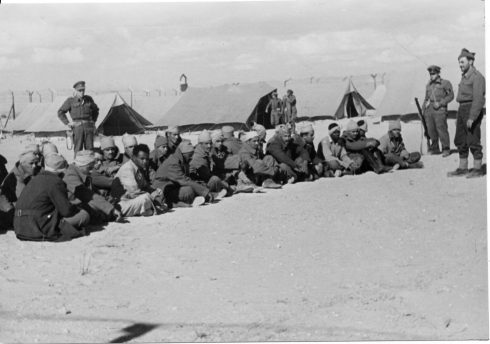
One might expect that only historians would care to revisit the 1948 war that created Israel. And yet the debate about what constitutes truth and myth from that period still provokes raw emotions.
Much rests on how those events are reconstructed, not least because the shock waves have yet to subside. Israelis fear, and Palestinians crave, a clearer picture of the past because it would powerfully illuminate the present. It might also influence the international community’s proposed solutions for the conflict.
That is why the unearthing of an Israeli soldier’s letter from 1948 detailing what was probably the war’s worst massacre – one long buried by Israel – is of more than historical significance.
It comes as Moshe Yaalon, the defence minister, this week accused Breaking the Silence, an Israeli organisation that exposes military abuses, of “treason” for collecting evidence from the army’s current whistle-blowers.
Western understandings of the 1948 war – what Palestinians term their Nakba, or catastrophe – are dominated by an enduring Israeli narrative. Israel’s army, it is said, abided by a strict moral code. Palestinians left not because of Israel’s actions but on the orders of Arab leaders.
In this rendering, the Palestinians’ mass dispossession was the fault of the Arab world – and a solution for the millions of today’s refugees lies with their host countries.
For decades Israel’s chief concession to the truth was an admission that a massacre took place just outside Jerusalem, at Deir Yassin.
Israel claimed the atrocity was the exception that proved the rule: a rogue militia killed more than 100 villagers, violating Israel’s ethical codes in the chaotic weeks before statehood was declared.
Palestinians have always known of dozens of other large massacres of civilians from 1948 carried out by the Israeli army. The barbarity, they say, was intended to terrorise the native population into flight. This account puts responsibility on Israel for taking the refugees back.
But history is written by the victor.
In recent decades a few brave Israeli scholars have chipped away at the official facade. In the late 1990s a Haifa University student collected testimonies from former soldiers confirming that over 200 Palestinians had been massacred at Tantura, south of Haifa. After the findings were made public, he was pilloried and stripped of his degree.
A decade ago, the historian Ilan Pappe wrote a groundbreaking book, The Ethnic Cleansing of Palestine, arguing that massacres like the one at Tantura were exploited to drive out Palestinians. He and others noted the suggestive titles of military operations such as “Broom” and soldiers’ orders to “clean” areas.
Pappe now lives in academic exile in the UK.
The biggest obstacle to shifting Israeli and western perceptions of 1948 has been the lack of a clear paper trail connecting the political leadership to the massacres. Israel locked away bundles of documentation precisely not to jeopardise the official narrative.
But things are changing slowly.
Last year a key deception was punctured: that Israel urged many of the war’s 750,000 Palestinian refugees to return. In a letter to Haifa’s leaders shortly after the city’s Palestinians were expelled, David Ben Gurion, Israel’s first prime minister, demanded that any return be barred.
Now another letter, located by Israeli historian Yair Auron and published last week for the first time in English by the Haaretz newspaper, trashes the idea of an ethical Israel army.
Written by Shabtai Kaplan, a soldier and journalist, the letter confirms long-held suspicions of a massacre – one that dwarfs Deir Yassin – at Dawaymeh, near Hebron. Soldiers executed hundreds of men, women and children who offered no resistance.
The massacre, near the end of the war, was carried out by elite troops under the command of Yitzhak Sadeh. He developed the Israeli army’s famous doctrine of “purity of arms”.
Kaplan argues that the Dawaymeh massacre was part of “a system of expulsion and destruction”, with a clear goal: “The fewer Arabs who remain, the better.”
Kaplan’s letter was consigned to the vaults, as were so many other documents from 1948 that officials considered too damaging.
Nearly seven decades later, in an age of 24-hour news and social media, Israel is still desperately trying to conceal its darkest episodes by bullying the army’s current whistle-blowers.
Last week Benjamin Netanyahu’s government launched an investigation into Breaking the Silence. On Sunday Netanyahu called the collection of soldiers’ testimonies “intolerable”, indicating that he may try to ban the group.
It is hard not to see parallels between the cover-ups of 1948 and those of today. Breaking the Silence’s disclosures, especially those relating to Israel’s series of attacks on Gaza, each of which has left hundreds of civilians dead, similarly give the lie to the army’s continuing claims of ethical behaviour.
In his 1948 letter, Kaplan observed of the failure by the political leadership to hold anyone to account for the massacres: “Inaction is in itself encouragement.”
Israel’s politicians hoped then that the Palestinians could be quickly terrorised from their lands. Decades later, the atrocities continue – and to the same end. But Israel must face facts: the days when such systematic brutality could be kept under wraps are now over.
Jonathan Cook, based in Nazareth, Israel is a winner of the Martha Gellhorn Special Prize for Journalism. His latest books are Israel and the Clash of Civilisations: Iraq, Iran and the Plan to Remake the Middle East (Pluto Press) and Disappearing Palestine: Israel’s Experiments in Human Despair (Zed Books).
The Colossal Costs of Building UK’s Monster Surveillance Network
Sputnik – 22.03.2016
The UK will have to build a mammoth network of Internet surveillance centers if the government passes its Investigatory Powers Bill – dubbed the the Snoopers’ Charter – into law.
The proposal, which the Home Office wants to rush through the House of Commons just after Easter, will cost the country billions of pounds. The centers will be required to keep large databases of all the connections made by UK Internet users for one year — and to share them automatically with the UK’s government and intelligence agencies.
The government is bracing itself for the vote as the news arrives that the only other country in the world to have ever tried a similar approach — Denmark — has just decided to abandon the plan, for the second time in ten years.
The first Danish “session logging” system was put into place in 2007, but was abandoned in 2013 after the country’s police and security services found it to be practically useless — besides being very expensive for Internet providers to install and operate.
Another attempt to build an improved system, carried out by the Danish Ministry of Justice at the start of March 2016 also appears to have foundered.
Before the final decision was taken, the Danish government asked accounting firm Ernst & Young to ascertain how much the new surveillance network would cost.
The experts found that total expenses would be around one billion Danish Krone (US$150 million). The Danish government decided that the costs were too high for the country and its tech sector.
In the UK, the costs are likely to be much-much higher. If in Denmark — a country of 5.6 million people — the government estimated that each citizen would produce about 62,000 records every year, in Britain, whose population is about ten times the size of Denmark’s, the final annual database would have to include about four trillion a year.
Other estimates suggest that the sheer amount of records could even hit tens of trillions every year. That is because each of those records, as per the law, would have to contain: a customer account reference or device identifier; the date and time of the event; the duration; the source and destination IP and port number of each session; the domain name or linked URL; the volume of data; and the name of Internet service you connected to.
The UK will have to find a way to store an enormous amount of information every day — even if each record’s weight was brought down to 100 bytes, on a yearly level, we are talking exabytes (thousands of petabytes).
The only surefire way to deal with this information is by building new massive data centers, which will need at least US$140 million in equipment to handle each exabyte. Add the building, as well as cooling and electricity management and you have only started understanding the eventual costs of the UK’s new monster surveillance plans.
Israeli forces raid, confiscate items from Jenin-area university
Ma’an – March 22, 2016
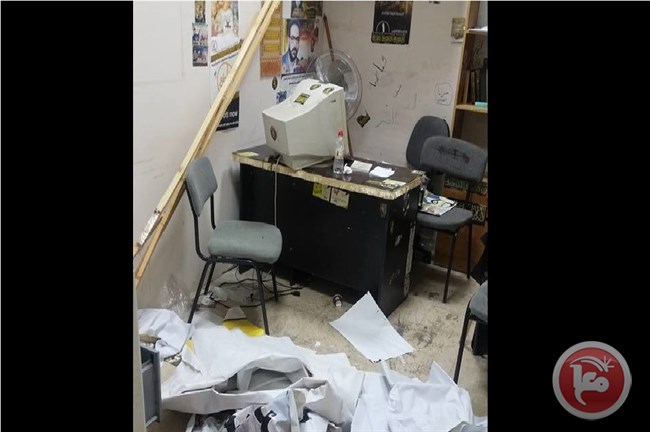
JENIN – Israeli forces overnight Monday raided the campus of the Arab American University in the occupied West Bank city of Jenin and confiscated items — including computers and flags — from student union offices.
The university’s public relations department told Ma’an that 11 Israeli military vehicles stormed the campus grounds at 1 a.m. and broke into the office of the Dean of Students, as well as a number of offices belonging to the student union.
The Israeli soldiers broke down doors and destroyed property in the offices before seizing flags of student union blocs as well as two computers and paper documents, the department said.
The university’s administration released a statement denouncing “Israel’s aggressive policy which violates the sanctity of university campus.”
Palestinian Prime Minister Rami Hamdallah immediately condemned the raid.
“This is not the first time that the Arab American University and other Palestinian educational institutions have been subjected to arbitrary Israeli raids,” the PM said, citing raids on Birzeit University and the Kadoorie Institute in recent months.
“I reiterate our call for international protection,” Hamdallah said. “Israel should not be allowed to continue to act above the law. The international community witnessed yet another violation of the sanctity of Palestinian educational institutions, and it should not remain silent.”
The Israeli army said in a statement that Israeli forces had “uncovered and confiscated inciting propaganda materials linked to multiple terror organizations including Hamas” inside the university, adding that the operation was “based on intelligence information.”
“In the recent wave of terror we’ve witnessed how incitement fuels acts of violence and terrorism,” the statement said. “Efforts as this prevent future attacks.”
In addition to the statement, the army released what it said were “visuals from the overnight activity” — photographs of an Islamic Jihad flag and a Hamas one, as well as a poster depicting three recently slain Palestinian attackers, referred to as “martyrs.”
Political flags and posters are commonly found items across the occupied West Bank, with posters of martyrs appearing throughout every West Bank town and village.
Palestinian universities and their students in the occupied West Bank are frequently targeted by Israeli military forces, and campuses have come under increased military presence since an increase in violence in October.
Earlier this month Israeli forces raided the Khadoorie Institute — also known as Palestine Technical University — twice in an 18-hour period.
The Tulkarem-area campus has seen heavy military presence in the past. Student-organized marches in October to protest Israeli violations and raids onto the campus eventually resulted in Israeli forces positioning themselves at a temporary base on university property.
Dozens of university students have been injured by Israeli military forces since.
Birzeit University near Ramallah meanwhile has reported dozens of student detentions, while Abu Dis’ al-Quds Open University has often found itself a focal point of violent clashes between Palestinian students and Israeli soldiers.
US gears up to fight Russian ‘disinformation’ with… disinformation
RT | March 17, 2016
Two US senators are proposing legislation to counter, what they consider to be “disinformation” spread by certain foreign media. What better way to kick-start their campaign than by basing their bill on spurious nonsense?
Republican Senator Rob Portman and his Democratic colleague Chris Murphy are deeply concerned about foreign “propaganda.” They demand that Uncle Sam throws even more money at the Broadcasting Board of Governors (BBG), which is already given around $768 million annually.
Not content with the EU’s Stratcom East and NATO’s Riga-based communications centre, Portman and Murphy want a new center for Information Analysis and Response to analyze “foreign government information-warfare efforts.”
What better place to launch the crusade than at NATO’s Atlantic Council appendage? An organization funded by such disinterested and neutral parties as the US State Department, Lockheed Martin, the Kingdom of Bahrain and the monarchy of the United Arab Emirates?
Portman certainly couldn’t think of a better venue, so he showed up on Wednesday to express his satisfaction that the “US version of events is better.” This attitude is not a shock. Most of the US elite, and their media champions believe America has a monopoly on truth. Next, Portman warned that Russia, China and other countries are trying to “manipulate and control information to achieve their national goals, often at the expense of the interests and values of America’s allies.”
The Senator sounded particularly worried about RT. And it is no wonder. Portman claimed RT spends $400 million a year just for the maintenance of our Washington bureau. Just imagine that? $400 million big ones.
Unfortunately, given that our entire budget for 2016 is 17 billion rubles, or around $248 million in today’s dollars, we have no idea where on earth Portman got this numbers – or if he even believes them. That $248 million pays for the global broadcasting and newsgathering operations of round-the-clock TV channels in English, Arabic and Spanish, documentaries, online portals in six languages, the RT UK channel, and yes, RT America – our stateside outpost. To run all of this RT receives one third of the funding the US government allocates for the BBG. Despite modest means, RT can boast 70 million weekly TV viewers, nearly 50 million monthly unique visitors to our digital platforms and a status as the number one international TV news network on YouTube, with more than 3 billion views.
Amazing, the BBG’S Voice of America (VOA) reported Portman’s $400 million figure without question, and with no apparent fact-checking. The Senator’s – and the supposedly venerated news organization’s he seeks to aid – fight against “disinformation” kicks off with a blatant lie. You really can’t make this stuff up.
VOA wasn’t alone, Germany’s own state-broadcaster, Deutsche Welle (DW), also carried Portman’s erroneous sums. DW, of course, is never regarded as propaganda in Washington because the administration in Berlin is not a threat to American interests.
This is despite the fact that it receives government funding – $332 million per year – to communicate its country’s point of view to the world. When RT contacted DW to correct this blatant falsehood, the outlet’s editors treated the issue as a “difference of opinion” before eventually adding RT’s budget figure as our own claim, and not the publicly available information that it is, and that has been reported by hundreds of, credible, news outlets.
The BBG, and its supporters, such as Senator Portman, are currently fighting hard in Washington to secure extra resources for their efforts. An intensive campaign has been fought over the past six months to support these objectives. Much of this lobbying has been based on exaggeration and outright lies. Portman’s $400 million is one of the most absurd yet. The fact that VOA and DW unquestioningly repeated the deceit speaks volumes.
Featured Video
Dan Dicks with James Corbett on Solutions Watch
or go to
Aletho News Archives – Video-Images
From the Archives
MMR (Measles, Mumps and Rubella) – Vaccine Risk Statement
MMR Vaccine (Measles, Mumps, and Rubella) Is It Safer Than Measles, Mumps and Rubella?
Physicians for Informed Consent | December 2024
… It has not been proven that the MMR vaccine is safer than measles, mumps, and rubella. The vaccine package insert raises questions about safety testing for cancer, genetic mutations, and impaired fertility. Although VAERS tracks some adverse events, it is too inaccurate to measure against the risk of measles, mumps, and rubella. Clinical trials do not have the ability to detect less common adverse reactions, and epidemiological studies are limited by the effects of chance and possible confounders. Safety studies of the MMR vaccine are particularly lacking in statistical power. A review of more than 60 MMR vaccine studies conducted for the Cochrane Library states, “The design and reporting of safety outcomes in MMR vaccine studies, both pre- and post-marketing, are largely inadequate.”19 Because permanent sequelae (aftereffects) from measles, mumps, and rubella are so rare (especially in children with normal levels of vitamin A and infected after birth),6,15-17 the level of accuracy of the research studies available is insufficient to rule out the possibility that the MMR vaccine causes greater death or permanent disability than measles, mumps, and rubella. – Read full article
Blog Roll
 Aletho News
- Moscow issues warning to NATO over Russian exclave
- Yes, the Iran war has destroyed Trump’s presidency
- The fallacy of US delusions about Iran’s economic collapse
- Hezbollah denies Syria cell link, warns of Israeli plan to sow discord
- The legacy of US sanctions, war, and occupation in Iraq
- Iraqi resistance group rejects disarmament, vows to maintain support for Lebanon
- Sheikh al-Asadi warns of Iraqi government compliance with US demands
- How to MAKE THE CONSPIRATORS PAY for their crimes! Dan Dicks with James Corbett on Solutions Watch
- There’s a drought in academia: A drought in honest research on the subject of drought and other weather extremes
- Department of War Awards $20.7 Billion Contract to Raytheon for Air-to-Air Missiles
- If Americans Knew
- Israeli Attacks Kill Ten Palestinians in Gaza
- Massacre at Minab: The School That Became a Grave
- Israeli media: The IDF Shows It Doesn’t Turn a Blind Eye; It Actively Emboldens Settler Havoc
- As settlers ravage West Bank, Israeli forces kill 10 in Gaza – Daily Update
- New Report: “Scholasticide and Genocide in Gaza: Assessment, Testimonies and Legal Analysis”
- Ex-Biden officials are desperate for a Gaza scapegoat
- Israeli “settlers” Invade Al-Aqsa; Pour Boiling Water on 75-Year-Old
- Israel Has Kidnapped Another American Teenager
- US arms sales to Israel worth $21.6 billion in 20 months
- Three Palestinians Killed in Israeli Attacks on Gaza
- No Tricks Zone
- Green Energy Debacle: German Expert Professor Fritz Vahrenholt Warns Of Severe Economic And Social Consequences
- Two More Paleo Reconstructions Affirm Meters-Higher Sea Levels Across Ireland, Brazil 7000-6000 Years Ago
- New Study: Earth And Venus Surface Warmth Largely Explained By Convection And Lapse Rate, Not CO2 Or Radiation
- 2025 Nature Paper Claiming Worsening Global Drought Gets RETRACTED …Heavily Flawed
- New Study: ‘Global Drought Shows No Detectable Recent Acceleration Under Climate Warming’
- Economic Masterminds: German Socialists Suggest Taxing Productivity Gains Stemming From Using AI
- The South China Sea Has Not Been Cooperating With The Climate Change Narrative
- Energy Crisis: Germany Enters Heating Season With Historically Low Gas Reserve Fill Levels
- New Study: The Antarctic Ice Sheet Gained Mass From 2020-2024 Due To Staggering Snow And Ice Accumulation
- Study: Ocean Heating Rates From Thousands Of Years Ago ‘Dwarf’ Modern Ocean Heating Rates

