Israel fires “warning shots” into Al Jazeera office in Gaza
Al-Akhbar | July 22, 2014
Israeli forces on Tuesday fired “warning shots” at a building housing the offices of Al Jazeera and the Associated Press, one day after Foreign Minister Avigdor Lieberman vowed to shut down the Qatari-based channel.
“Two warning shots straight into al jazeera office in #gaza.. We are evacuating,” Al Jazeera journalist Stefanie Dekker tweeted Tuesday.
She said the Gaza City building also houses several residential apartments and an AP office.
Al Jazeera Arabic correspondent Wael Dahdouh also reported on the attack. He said some of the staff were asleep during the attack when two explosions went off inside the bureau, causing panic.
He said the shots may have come from a tank or helicopters. Their office is located on the 11th floor of the Jalaa building.
He said the attack appeared deliberate, and noted that only their office was hit.
Al Jazeera aired footage of their staff standing outside the building.
“Al Jazeera network considers statements made against it by Israeli Foreign Minister Avigdor Lieberman a direct incitement,” a statement posted to Al Jazeera’s website said.
Lieberman on Monday accused Al Jazeera of being a mouthpiece for Hamas, and said the ministry was taking steps to prevent it from broadcasting from the territory, according to an Israeli media report.
Channel 2 quoted Lieberman as saying that the channel promotes “antisemitism” and “encourages” terrorism.
Lieberman has also been calling in private meetings for Israel to assassinate Hamas political leader Khaled Meshal, who currently lives in Qatar, the Channel 2 report said.
Tuesdya’s attack is not the first time journalists have been targeted by Israel since the assault on Gaza began two weeks ago.
Journalist Khaled Hamad, 25, was killed by Israeli shelling early on Sunday while covering Israel’s attack on al-Shujayeh. A total of 74 people were killed in that massacre. Most of the victims were women, children and elders, medics said.
Hamad, who was reportedly wearing a vest marked “press,” was killed alongside medic Fouad Jaber, 28, according to Gaza health ministry spokesman Ashraf al-Qudra.
Gaza journalists condemned Hamad’s killing in a statement released Sunday. According to the Palestinian Journalists Syndicate, Israeli fire injured a second journalist while Israeli shelling struck the home of a third.
On July 9 Hamid Shihab, a driver for a news agency, was killed when Israel bombed the car he was driving. Photographs posted to Twitter showed the car was marked “TV” with large, red letters.
Several other journalists have also been injured in other Israeli attacks widely viewed as deliberate.
CNN boots reporter from Israel-Gaza conflict after ‘scum’ tweet
RT | July 18, 2014

CNN has pulled correspondent Diana Magnay out of her post covering the Israeli-Palestinian conflict after the reporter tweeted that Israelis cheering bombs hitting Gaza, and who had allegedly threatened her, were “scum.”
Magnay was “threatened and harassed” before and during her report, a CNN spokeswoman told The Huffington Post, leading to the reporter’s reaction on Twitter.
“She deeply regrets the language used, which was aimed directly at those who had been targeting our crew,” the spokeswoman added. “She certainly meant no offense to anyone beyond that group, and she and CNN apologize for any offense that may have been taken.”
Israelis could be heard cheering missiles heading for Gaza on Thursday during a live Magnay report from a hill overlooking the Israel-Gaza border.
“I think you can probably see there are lots of Israelis gathered around who are cheering when they see these kinds of Israeli strikes,” Magnay said during the report.
Following the shot, Magnay tweeted, “Israelis on hill above Sderot cheer as bombs land on #gaza; threaten to ‘destroy our car if I say a word wrong’. Scum.”
The reporter eventually deleted the tweet, but not before it had been retweeted more than 200 times.
The CNN spokeswoman said Magnay has been assigned to Moscow.
Magnay’s removal comes a day after NBC News sent its reporter on the conflict, Ayman Mohyeldin, out of Gaza.
The network has not explained why Mohyeldin, a much-praised veteran reporter of the Israeli-Palestinian conflict, was removed. Sources have told media outlets that security concerns compelled NBC executives to pull Mohyeldin, yet the network quickly replaced him in Gaza with chief foreign correspondent Richard Engel.
TV Newser reported Wednesday that NBC staffers were unhappy that Engel was ordered to front an “NBC Nightly News” segment on the killing of four Palestinian children on a Gaza beach even though Mohyeldin was a witness to that very strike and had reported from the site in its aftermath.
Thursday marked the beginning of a ground offensive into Gaza by Israeli forces. Palestinian health officials said 27 Palestinians were killed in the latest ground operation, Reuters reported. One Israeli soldier perished in the fighting.
Well over 200 Palestinians and two Israelis have been killed since fighting ramped up along the border nearly two weeks ago.
Journalists injured in Israel airstrikes on media buildings
Ma’an – 18/07/2014
GAZA CITY – At least one journalist was injured in an Israeli airstrike that targeted Palestinian media buildings in the Gaza Strip early Friday.
Israeli Apache helicopters targeted the al-Jawhara tower in Gaza City at 4 a.m., causing damage to at least 10 apartments in the building, which holds several media offices.
Photojournalist Muhammad Shabab was injured and taken to al-Shifa hospital for treatment.
Two municipality workers at street level were injured as rocks and debris covered the area.
Israeli forces also targeted the Daoud Tower in the al-Rimal neighborhood, cutting off the broadcast of a local radio station and injuring several employees.
The Israeli army has been regularly accused of targeting Palestinian journalists by international watchdogs, and attacks on news and radio stations in Gaza have generally been more frequent during times of bombardment.
Ex-NYT editor Jill Abramson on how flak and ‘anti-terrorism’ help discipline corporate media
Interventions Watch | July 16, 2014
She didn’t quite put it in those words, but it’s essentially what she’s saying: that the U.S. government would contact the New York Times and tell them that publishing this, that or the other story would ‘help the terrorists’. And that the New York Times would take those threats seriously and bring the story to a halt (even if they did eventually work out that the U.S. government’s intentions may not always have been entirely honourable).
Here’s a quote from an interview Abramson recently gave to Cosmopolitan :
‘Sometimes the CIA or the director of national intelligence or the NSA or the White House will call about a story . . . You hit the brakes, you hear the arguments, and it’s always a balancing act: the importance of the information to the public versus the claim of harming national security . . . Over time, the government too reflexively said to the Times, ‘you’re going to have blood on your hands if you publish X’ and because of the frequency of that, the government lost a little credibility . . . But you do listen and seriously worry . . . Editors are Americans too . . . We don’t want to help terrorists’.
Interesting, as well, that Abramson seems to be suggesting that being ‘against terrorists’ – or at least, people who the U.S. government claim are terrorists – is somehow an inherent part of being an American, like it’s a national religion or something.
Which for the political and media classes, I suppose it is – except when it comes to the terrorism of the U.S. government and its allies, in which case being ‘against terrorism’ is blasphemous.
This week’s London Bombings anniversary must remind us not to be bounced into a police state
RT | July 11, 2014
It is heartbreaking this week, despite the insatiable Signals Intelligence fiefdoms exposed by Edward Snowden, to see our elected lawmakers scrabbling for yet more mass surveillance of UK citizens.
Time and time again we are told Islamic extremists are threatening our very way of life and time after time the evidence before our eyes is that our only real threat is the home grown, party political poodles of the police state.
In this case all the emergency ‘Data Retention and Investigation Powers’ bill (DRIP) will do, if passed into law, is bring what European lawmakers say could be illegal activities of British data retention within the law. Worried that they will be prosecuted for stealing data about who innocent citizens are communicating with and when, they are rushing to shift the legal goalposts so they are no longer breaking it, hoping that crimes they already committed will be overlooked.
What a blatant abuse of power by our lawmakers. Labour’s bloodhound MP Tom Watson rightly smelt a rat when he spotted House of Commons timetables being shifted around but Downing Street knows which side its bread is buttered. Confirmation that the emergency DRIP bill was about to be bounced through parliament was handed to the London media almost 24 hours before it was announced to the Members of Parliament who have to scrutinize and vote on it in a matter of days.
And you can see why they tell the press before they tell parliament too. London’s mainstream media have forgotten how to pose questions to the securocrats. Even when earlier this week, former Director General of MI6, Sir Richard Dearlove told the Royal United Services Institute (RUSI) that the Islamic terror threat to Britain was grossly inflated, and that ‘Britons’ Cameron included presumably, ‘spreading blood-curdling terrorism messages should be ignored.’ By the end of the week that, was all forgotten and the Islamic threat had expanded again so much that emergency legislation was now necessary to sacrifice our freedoms by Monday.
The 7/7 bombings? Big questions never asked, let alone answered
Nine years ago this week, London saw four devastating bomb attacks which killed 56 people on three London Underground trains and a bus. To mark the occasion graffiti was daubed on the Hyde Park 7/7 memorial, saying “Blair lied thousands died” and “Four innocent Muslims”. These are views which, though quite common on the streets, particularly of Leeds where three of the four alleged bombers came from, they are never articulated in the British mass media at all.
Questions, objections and evidence raised by the long standing July 7th Truth Campaign, families of the victims and some of those caught up in the attacks still hits a cold hard wall of police, government and security service silence. Nine years and fifty broken families on, national media discussion has been reduced to safe questions about amounts of compensation money paid to families and how far to curtail civil liberties to stop ‘this kind of attack,’ as if it’s all done and dusted, ever happening again.
When the government’s so-called ‘narrative’ was published in May 2006 researchers immediately spotted glaring errors with the alleged bombers journey into London. Home Secretary John Reid was forced into the House of Commons to announce that the train the police said they caught did not run that morning. Although the official story had it they were ‘clean skins,’ it later transpired MI5 had been following them for years. Those were just two in a series of shameful omissions and embarrassing errors in a police investigation and Home Office narrative with a frighteningly short shelf life.
The London Underground CCTV cameras bristling every few yards on the tube and every bus has several, so why were no CCTV pictures ever produced which showed any of the alleged bombers in or getting onto the bombed trains or bus? Verint Systems, an Israeli firm, won the private CCTV contract five months before the attack but no questions appear to have been asked during their vetting, despite Verint’s group chairman, Kobi Alexander, running off with tens of millions of dollars, wanted by Interpol, the FBI and Wall Street regulators the Securities and Exchange Commission (SEC).
On the morning of 7/7, Associated Press in Jerusalem reported Israel’s then Finance Minister Benjamin Netanyahu, who happened to be in London that day, had received a warning from Scotland Yard before the bombs went off. Bibi changed his plans and stayed in his hotel, the report said, instead of setting off for a conference he was due to be attending at the Great Eastern Hotel at Liverpool Street Station.
Later that day, and subsequently on the BBC’s 2009 ‘Conspiracy Files’ documentary the Israeli embassy denied getting that warning but in the German newspaper ‘Bild am Sonntag’, Mossad chief Meir Dagan confirmed – yes they got the warning and passed it to Netanyahu in his hotel before the bombs went off. Even more embarrassing than this inability to get the story straight was that the official Home Office narrative, as well as all the evidence produced at the inquest, said there was no warning: the bombings were a surprise attack.
Former police officer Peter Power, sacked from his job in the Dorset constabulary after fiddling his expenses, appeared across global television on 7/7 representing his private security firm ‘Visor Consultants’. He described a terror drill exercise he was supposedly conducting that morning envisaging bombs at the same three tube stations where the real bombs went off.
With 275 stations on the London tube network, the chances of this really being as he said, a coincidence, come out around 275 to the power of three multiplied by the number of days in the year, 365 – around a cool eight billion to one, Peter. He described it on one TV network that day as a ‘spooky coincidence.’ An oblique reference perhaps to ‘spooks,’ the nickname given to the secret services?
He subsequently revealed to the BBC that his ‘terror drill’ had been sponsored by event organizers and publishers Reed Elsevier who, until 2007, ran Britain’s biggest arms fair, the Defence Security Equipment Exhibition (DSEI), where private military companies advertise everything, right up to fighting nuclear wars for you, and by the way torture equipment is openly on sale.
The proper judicial procedure would have been a public inquiry into the attacks, which would consider evidence systematically in front of a jury. Instead an inquest, designed to investigate a single death was convened in October 2010 under Lady Justice Heather Hallett, but her all-important jury was mysteriously missing. As the inquest dragged on through 52 separate hearings, survivors, and families of the victims, complained their big questions were not being addressed.
Previous attacks in public places and on public transport across Europe such as the 1980 Bologna railway station bomb, which killed 85 people and the 1985 Brabant Supermarket massacres which killed 16, have been conclusively traced to NATO intelligence by parliamentary enquiries in Italy, Belgium and Switzerland.
If the spooks had planted the 7/7 London bombs, it would not be the first time the network of NATO & Swiss secret services known as the ‘Club of Berne’, have done so. Under the guise of national security, they live a publicly funded life far from democratic oversight, and have been proven to run secret armies, immune from prosecution, in structures that run parallel to the regular armed forces.
“You had to attack civilians, the people, women, children, innocent people, unknown people far removed from any political game,” stated NATO Operation Gladio soldier, Italian fascist Vincezo Vinciguerra. The objective, he explained from jail in a 1992 BBC Timewatch documentary, was “to force the people to turn to the state to ask for greater security.” Back in the 1980s the fake enemy was the Soviet Union, today it’s Islamic Extremists.
Controversial privacy law blasts pedophile enquiry questions out of the news
On the same day of this week’s ninth anniversary of 7/7, Home Secretary Theresa May announced in the House of Commons two enquiries into elite pedophile rings believed to be rooted in Westminster, connected to prominent public figures and said to have been centered around Elm Guest House in South West London. But May’s first choices to lead these enquiries are entirely unsuitable establishment figures themselves. The first, Peter Wanless, was Principle Private Secretary to three cabinet ministers including Michael Portillo and the second, Lady Butler-Sloss’s brother was attorney general when the abuse was allegedly taking place.
With all talk of who will or will not head up pedophile enquiries forgotten, the new emergency, we are being told by Prime Minister David Cameron, is that if terrorists were to attack Britain in the near future, like another 7/7, he would not want to say he had not done everything to stop them. But what Cameron isn’t saying is that his DRIP law will also help the secret state to keep a close eye on victims of child abuse, whistleblowers and their support networks.
What if this week’s real emergency is that criminals inside the Metropolitan police and secret state have known about and facilitated child abuse rings, used for political blackmail, for decades; that the two enquiries Home Secretary Theresa May set up this week might have their pliable leadership, overturned and get some real teeth, as the recent Hillsborough Independent Panel did. That the ‘well respected’ public figures that protected Jimmy Savile, Cyril Smith and the rest may be about to be winkled out and jailed at last.
~
Beginning his working life in the aviation industry and trained by the BBC, Tony Gosling is a British land rights activist, historian & investigative radio journalist.
Rasmussen Poll: 63% say the debate about global warming is not over, 60% pan BBC’s decision to exclude skeptics
By Anthony Watts | Watts Up With That? | July 11, 2014
From Rasmussen Reports:
Voters strongly believe the debate about global warming is not over yet and reject the decision by some news organizations to ban comments from those who deny that global warming is a problem.
Only 20% of Likely U.S. Voters believe the scientific debate about global warming is over, according to the latest Rasmussen Reports national telephone survey. Sixty-three percent (63%) disagree and say the debate about global warming is not over. Seventeen percent (17%) are not sure. (To see survey question wording, click here.)
Forty-eight percent (48%) of voters think there is still significant disagreement within the scientific community over global warming, while 35% believe scientists generally agree on the subject.
The BBC has announced a new policy banning comments from those who deny global warming, a policy already practiced by the Los Angeles Times and several other media organizations. But 60% of voters oppose the decision by some news organizations to ban global warming skeptics. Only 19% favor such a ban, while slightly more (21%) are undecided.
But then 42% believe the media already makes global warming appear to be worse than it really is. Twenty percent (20%) say the media makes global warming appear better than it really is, while 22% say they present an accurate picture. Sixteen percent (16%) are not sure.
Still, this is an improvement from February 2009 when 54% thought the media makes global warming appear worse than it is. Unchanged, however, are the 21% who say the media presents an accurate picture.
Israeli universities establish committee to fight “growing” BDS campaign
MEMO | July 8, 2014
Israeli universities have established a new joint committee to fight the academic boycott campaign, described by Hebrew University president Menahem Ben-Sasson as an “increasingly growing phenomenon”.
The forum was announced Tuesday by the Committee of University Heads, a body representing the country’s seven research universities on matters such as budgeting and wages, and currently chaired by Ben-Sasson.
The committee will be headed by Zvi Ziegler, an academic at The Technion – Israel Institute of Technology and active in opposing boycotts since at least 2006. Its activities will include mapping out “the scope of the threat, gathering information on future potential boycotts as well as coordinating with relevant parties and institutions in Israel and abroad to minimize the damage”.
Ziegler stressed the importance of intelligence-gathering in fighting BDS, saying that “foreknowledge of boycott endeavours” would help “thwart the initiative before it stews”. He also said the committee would seek “information regarding cases of discrimination against Israeli researchers”.
According to The Jerusalem Post, while academic boycotts have so far “surfaced primarily in the humanities disciplines” there “remains great concern among Israeli universities and officials that the phenomenon will spread to encompass the sciences”.
We Demand Justice for Amer Jubran
Amer Jubran Defense Campaign | July 8, 2014
Amer Jubran has now been detained for over 2 months without charge. Until last week, he was being held incommunicado. Because Amer is a political dissident, we are gravely concerned that he may be tried with serious offenses based on his political speech under Jordan’s legal framework. If so, he would be brought before the State Security Court in Jordan soon. The State Security Court is an institution that has been widely criticized by human rights advocates as a tribunal that lacks any real judicial independence from the Mukhabarat (Jordanian Secret Police).
Today, we sent an open letter to the recently elected UN High Commissioner for Human Rights Prince Zeid Ra’ad Zeid Al Hussein of Jordan demanding that he address the atrocious human rights abuses in Jordan, citing Amer’s case.
We are asking all supporters to take action on Wednesday July 9th.
Please take a few minutes to do the following on July 9th:
1) Please forward the open letter to Prince Zeid to all your contacts/lists and post to Facebook;
2) Please write your own letter reiterating the points in the open letter (see below) and e-mail your letter to:
***Prince Zeid Ra’ad Zeid Al Hussein, UN High Commissioner-Elect for Human Rights
e-mail: registry@ohchr.org
***Prime Minister Abdullah Ensour e-mail: info@pm.gov.jo
***Minister of Interior, Hussein Majali e-mail: info@moi.gov.jo
***Minister of Justice, Bassam Talhouni e-mail: Feedback@moj.gov.jo
3) Please encourage your contacts to sign the petition to free Amer Jubran if they have not signed it already http://freeamerpetition.wordpress.com/
Amer has always fought for justice. He needs your help now!
Please follow the action steps above on Wed July 9th and let us know if you receive any reply.
Thank you again for your continued support.
_________________________________________________________________________________________
July 8, 2014
To UN High Commissioner-Elect for Human Rights, Prince Zeid Ra’ad Zeid Al Hussein:
In light of your recent confirmation as UN High Commissioner for Human Rights, we are writing now to urge you to turn your attention to your own country, the Hashemite Kingdom of Jordan, and its atrocious history of human rights abuses.
The current case of Amer Jubran highlights Jordan’s ongoing contempt for the most basic international standards of civil and political rights. Mr. Jubran, a Jordanian citizen, was arrested at his home on May 5, 2014 by agents of the General Intelligence Directorate (GID) and continues to be detained without charges. For the first seven weeks of his detention, he was held incommunicado, without access to a lawyer or family. The international human rights organization Alkarama recently filed his case with the UN as an instance of arbitrary detention (http://en.alkarama.org/jordan/24-communiqu/1251-jordan-arbitrary-detention-of-human-rights-defender-amer-jubran-since-may-2014 ).
Mr. Jubran is an internationally known activist, speaker, and writer on Palestinian human rights and a critic of US and Israeli policies in the Arab world. All who know him and are familiar with his history recognize his arrest as a politically motivated silencing. We are therefore concerned that the amendments to Jordan’s “anti-terrorism” laws passed on June 1st criminalizing new categories of speech as “terrorism” may be applied in Mr. Jubran’s case. The legislation itself demonstrates the willingness of the Jordanian regime to exploit the label “terrorism” to further limit free speech, especially speech that is critical of the existing system of cooperation between Jordan, Israel and the United States. (See statement from Reporters without Borders: http://en.rsf.org/jordan-king-urged-to-repeal-draconian-16-06-2014,46423.html )
We further call attention to the use of the State Security Court as an instrument for political repression. As a direct extension of the executive branch of government, the State Security Court violates all standards of judicial independence. It is a rubber stamp for arrests and detentions carried out by the GID, which has a well-documented history of arbitrary detention and torture to silence political opposition (http://www.amnesty.org/en/region/jordan/report-2013). The collaboration between the GID and the State Security Court in human rights abuses has been specifically cited by Alkarama: “The methods of torture most commonly employed by GID officers are beatings, beatings with cables, ropes, plastic pipes, whips etc all over the body including the soles of the feet (falaqa), stress positions, sleep deprivation, injections that cause states of extreme anxiety, humiliation, threats of rape against the victim and members of his family, electroshock, prolonged isolation, etc. Abuse is more prevalent in the GID due to its close collaboration with the judges of the State Security Court. Incommunicado detention, which is itself a form of mental torture, is routinely extended for undetermined amounts of time.” (http://www2.ohchr.org/english/bodies/hrc/docs/ngos/Alkarama_Jordan_HRC100_en.pdf)
In your acceptance speech at your confirmation as the UN High Commissioner by the General Assembly in June, you spoke of the commitment to push forward the issue of human rights on the Asian continent. Such a commitment can only be taken seriously if you are willing to begin at home. We ask you to stand behind your words by demanding the release of Amer Jubran from his unjust imprisonment by unaccountable agencies within the state of Jordan, and to use your position to end extensive human rights violations carried out by the GID and the State Security Court.
Sincerely,
The Amer Jubran Defense Campaign
National Lawyers Guild, Palestine Subcommittee
Defending Dissent Foundation
cc: Prime Minister Abdullah Ensour (Jordan)
Minister of Interior Hussein Majali (Jordan)
Minister of Justice Bassam Talhouni (Jordan)
UN High Commissioner for Human Rights Navi Pillay
New Russian law bans citizens’ personal data being held on foreign servers
RT | July 5, 2014
All internet companies collecting personal information from Russian citizens are obliged to store that data inside the country, according to a new law. Its supporters cite security reasons, while opponents see it as an infringement of freedoms.
The law, passed Friday by the State Duma, the lower chamber of the Russian parliament, would come into force Sept. 1, 2016. The authors of the legislation believe that it gives both foreign and domestic internet companies enough time to create data-storage facilities in Russia.
The bill was proposed after some Russian MPs deemed it unwise that the bulk of Russians’ online personal data is held on foreign servers, mostly in the US.
“In this way foreign states possess full information, correspondence, photographs of not only our individuals, but companies as well,” one of the authors of the bill, Vadim Dengin of the Liberal Democratic Party (LDPR) told Itar-Tass. “All of the [internet] companies, including the foreign ones, you are welcome to store that information, but please create data centers in Russia so that it can be controlled by Roscomnadzor (the Federal Communications Supervisory Service) and there would be a guarantee from the state that [the data] isn’t going anywhere.”
Russian MPs believe the new law is in tune with the current European policy of trying to legally protect online personal data. Deputy chairman of the Duma’s committee on information policy, Leonid Levin, said the Russian law serves goals similar to those of the recent decision by European Court of Justice, which endorsed the so-called “right to be forgotten,” obliging Google to remove upon request links to personal data.
“The security of Russians’ personal data is one of the basic rights that should be protected, legally and otherwise,” Levin said, Russian Forbes reported.
Websites that don’t comply with the law will find themselves blacklisted by Roscomnadzor, which will then have the right to limit access to them.
Critics of the law believe it could be used by authorities for censorship, however.
“The aim of this law is to create … [another] quasi-legal pretext to close Facebook, Twitter, YouTube and all other services,” Internet expert and blogger Anton Nossik told Reuters.
Some are afraid two years could be not enough for certain companies to have their online data storage organized in Russia. Particular concern has been voiced in relation to online hotel and plane ticket booking services.
Leading Russian airlines Aeroflot and Transaero, for example, use the same GDS system for online ticket sales as most of the other airlines in the world. Developing the Russian system might take longer than the law allows.
“If the law is passed in its current version, then Russians won’t be able to take a plane not only to Europe, they won’t even be able to by an online ticket from Moscow to St Petersburg,” director general of internet payment provider ChronoPay, Aleksey Kovyrshin, said previously to RBC.
The Russian Association for Electronic Communications (RAEC), an NGO focused on Russian internet issues, has warned of the potential economic losses the law might entail.
“The law puts under question cross-border transmission of personal data,” RAEC said in a statement. “Passing similar laws on the localization of personal data in other countries has led to withdrawal of global services and substantial economic losses.”
EU Publishers Present Their ‘Vision’ For Copyright: A Permission-Based Internet Where Licensing Is Required For Everything
By Glyn Moody | Techdirt | July 2, 2014
For too many years, the copyright industries fought hard against the changes being wrought by the rise of the Internet and the epochal shift from analog to digital. Somewhat belatedly, most of those working in these sectors have finally accepted that this is not a passing phase, but a new world that requires new thinking in their businesses, as in many other spheres. A recent attempt to codify that thinking can be found in a publication from the European Publishers Council (EPC). “Copyright Enabled on the Network” (pdf) — subtitled “From vision to reality: Copyright, technology and practical solutions enabling the media & publishing ecosystem” — that is refreshingly honest about the group’s aims:
Since 1991, Members [of the EPC] have worked to review the impact of proposed European legislation on the press, and then express an opinion to legislators, politicians and opinion-formers with a view to influencing the content of final regulations. The objective has always been to encourage good law-making for the media industry.
The new report is part of that, and is equally frank about what lies at the heart of the EPC’s vision — licensing:
A thread which runs through this paper is the proliferation of ‘direct to user’ licensing by publishers and other rights owners. Powered by ubiquitous data standards, to identify works and those who have rights in those works, licensing will continue to innovate exponentially so that eventually the cost of serving a licence is close to zero. The role of technology is to make this process seamless and effective from the user’s perspective, whether that user is the end consumer or another party in the digital content supply chain.
Seamless licensing will be made possible through the roll-out of ubiquitous Digital Rights Statements (DRS) containing information about identity, rights and — you guessed it — licenses:
The key point about a DRS is that once it exists, it can be searched, read and actioned by any other machine connected to the Internet. And once the DRS is indexed by a search engine, through the machine readable IDs contained in the DRS it will always be possible to find the person or entity who owns or administers the rights and the rights associated with it. From there, it will be possible to link to the service from which the rights can be obtained and the content accessed and, if applicable, paid for.
Furthermore, this infrastructure is well suited to a world of ‘mash-ups’ where one work will incorporate parts or elements of other works, because the relevant IDs can identify the whole of a work or granular elements of it.
As that makes clear, the EPS vision includes being able to pin down every single “granular” part of a mash-up, so that the rights can be checked and — of course — licensed. Call it the NSA approach to copyright: total control through total surveillance. The paper helpfully explores how that would work out in various specific situations encountered today. For example, the European publishers want to be able to use licensing to restrict access even to material on the open Internet:
Legal clarification is needed about the relationship between hyperlinks and licence terms on the websites (or other platforms) to which they link. It must be clear that rights owners may by their licence terms to “restrict” access to content on an “open website” to a specific category of “the public” (e.g. users who visit the site directly), whether or not accompanied by technical protection measures.
So licenses would be able to forbid the use of hyperlinks to jump directly to pages, even though the latter were not locked down by DRM. The EPC is also worried about an “overbroad” interpretation of a general right to browse copyright material without needing an explicit license:
Whilst the general proposition that Internet browsing does not require a licence is reasonable, there remains a risk that an overbroad interpretation could mean that activities which ought properly to be licensable (e.g. the consumption of press cuttings) might cease to be so.
To tackle that, the EPC wants (pdf) “a new limited neighbouring right to stop unlicensed use of snippets,” and also, for good measure, “[h]yperlinking to illegal copies to be treated as an infringement.” Given this relentless focus on creating a permission-based Internet, it will come as no surprise that the EPC hates the idea of introducing fair use in Europe:
this is an issue which would require considerable evidence-based research in order to make a reasoned evaluation of the benefits of introducing a fair dealing exception compared with the uncertainty and other risks which would be caused by its introduction.
That call for “considerable evidence-based research” is rather rich, given the complete absence of it for all the recent changes to European copyright law in favor of publishers. Indeed, as Techdirt has frequently discussed, there is plenty of research to support reducing copyright’s term and reach, but when this is brought up, publishers are strangely uninterested in evidence-based policy making, preferring to stick with the dogma-based kind. Naturally, the EPC thinks that instead of fair use, what people really need is more licensing:
Europe would be better positioned to reach a dynamic flexibility for increased uses by providing incentives to small scale licensing, both B2B and B2C, and automated licensing solutions.
Part IV of the report is entitled “Meeting users’ needs in the new media & publishing ecosystem.” That’s a welcome emphasis, since it finally recognizes that the users are not just some passive recipient of what the publishers decide to throw at them. However, the section’s focus is still resolutely on seeking permission for every possible use of copyright material.
For example, one of the areas where publishers are fighting fiercely against granting new copyright exceptions is for text and data mining. The refusal to contemplate anything but licensing as an option led to a group of researchers, SMEs, civil society organizations and open access publishers pulling out of the European Commission’s “Licensing for Europe” fiasco. Here’s what EPC has to say on the matter:
A new exception for text and data mining at EU level carries a huge risk from ‘the law of unintended consequences’. A key theme running through our paper is the enabling role of technology in managing copyright. Given the increasing automation of rights management, the full potential of which we have yet to realise, including in the area of specific permissions, access to and use of content, we urge the European Commission to look at practical solutions first for serving the genuine needs of the research community before legislation.
Scare-mongering about an exception for text and data mining is bad enough, but it gets worse. In this same section, we read the following concerning the copyright needs of users with a disability:
There are undoubted challenges faced by this user group in being able to access digital content although publishers have been investing in voluntary solutions, including via ePub3 and voice-enabled services online.
The report then goes on immediately to mention:
The Marrakech Treaty is a recent exemplar. It provides a legal framework to facilitate access to published works for persons who are blind, visually impaired or otherwise print disabled.
That gives the impression that the Marrakech Treaty was something that publishers backed strongly as a fair way of helping those with disabilities. In fact, quite the reverse is true. To have that hard-won treaty for the visually impaired presented here as an example of how publishers can be relied on to do the right thing by the public is not just misleading but morally repugnant. It shows that despite some fair words in the rest of the “vision” document, in important ways European publishers are just as selfish and cynical as ever.
Follow me @glynmoody on Twitter or identi.ca, and +glynmoody on Google+
Cameraman for Russia’s top broadcaster killed in E. Ukraine
RT | June 29, 2014
A cameraman for Russia’s Channel One TV station died from injuries after being shot by Kiev troops in the eastern Ukrainian city of Donetsk, said the broadcaster’s press service.
“Our colleague Anatoly Klyan died tonight… he was fatally wounded in the stomach. He was 68-years-old,” Channel One said on air.
Klyan, along with a few other journalists, boarded a bus full of women – mostly mothers – who were traveling to a military base in Donetsk to demand that their sons be dismissed from the unit and allowed to go home, Kulbatskaya added.
When the bus reached its destination, shots were fired from the base and that is when the cameraman was injured.
 Klyan died in the ambulance on the way to the hospital, DNR’s First Deputy Prime Minister Andrey Purgin told RIA Novosti, adding that the driver of the bus was wounded in the neck and is currently in hospital.
A crew from Channel One confirmed to RT’s Maria Finoshina – currently in Lugansk – that Klyan was, in fact, shot and killed.
“We have been able to speak with these journalists and they called their colleagues in Donetsk and this information is now confirmed,” Finoshina said.
She described the victim filming with his crew at one of the military bases in Donetsk when the shooting took place.
“We know the journalists finished their work and they were smoking cigarettes at the moment when suddenly shooting started. It is very hard to say exactly who was firing, but we hear information that this particular bus and its passengers were targeted,” she said.
“The bus that was also carrying the mothers of self-defense fighters. They were heading towards this military base currently controlled by the Ukrainian military to start negotiations over their sons.”
Another team of Russian journalists also came under attack on Sunday. A LifeNews crew was fired at near a Donetsk military base, Kulbatskaya said. Their car was fired at from a grenade launcher. No one was injured in the attack.
The ceasefire between Kiev and self-defense forces in eastern Ukraine expires at 22:00 (19:00 GMT) on Monday.
Journalists under attack
This latest death comes after a number of journalists were killed during the coverage of events in eastern Ukraine.
Earlier in June, Rossiya TV journalist Igor Kornelyuk and his colleague, sound engineer Anton Voloshin, were killed in shelling. They were the first Russian journalists to die while on professional duty in Ukraine, since the coup in Kiev and the beginning of civil unrest in eastern regions began.
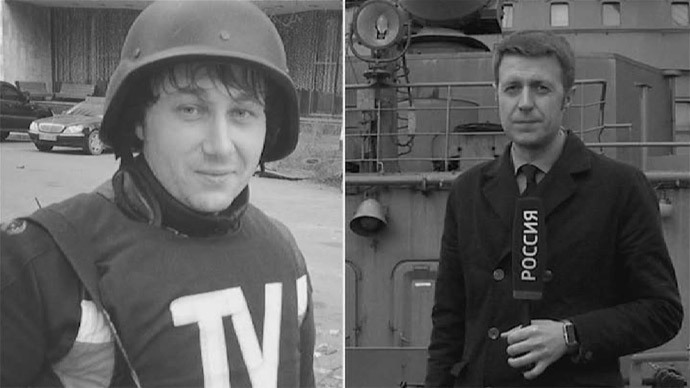
Rossiya TV journalist Igor Kornelyuk (R) and sound engineer Anton Voloshin (L)
They were working on a report covering Ukrainian refugees fleeing the town of Metallist in Lugansk region when they were hit with mortar shells.
There have also been numerous cases where journalists have been attacked, shot at, and detained while reporting on the crisis in eastern Ukraine.
For example, on June 16 a group of journalists came under fire while reporting from Slavyansk’s outskirts. One of the journalists was Ruptly correspondent Andrey Krasnoshchyokov.
On June 14, Zvezda TV channel said two of its journalists had been detained.
A Channel One crew was also fired at on June 11 while covering events in the village of Semenovka, located near Slavyansk.
In another incident, RT contributor and UK national Graham Phillips was detained by Kiev military forces at a checkpoint in the city of Mariupol on May 20. He was transferred to army barracks and interrogated by Ukrainian security forces. He was released after 36 hours.
Fedor Zavaleykov, a 23-year-old Ruptly cameraman, was wounded during fighting in Mariupol on May 9.
US pressured Denmark to close Kurdish TV so Rasmussen would become NATO chief – lawyer
RT | June 29, 2014
The US put pressure on Danish authorities to close the Kurdish Roj TV channel in order to appease Turkey. This was done so Anders Fogh Rasmussen’s position as NATO secretary general would be secure, the station’s lawyer told RT amid WikiLeaks revelations.
WikiLeaks documents released back in March suggest Rasmussen abused his powers during his time as Denmark’s prime minister, in order to secure his future job.
In 2009, Denmark reportedly agreed to start legal action against Roj TV, a Kurdish separatist channel that was broadcasting from Copenhagen, in order to appease Turkey. In return, Ankara said it would back Rasmussen as the future NATO chief.
“There were some conflicts of political character between Denmark and Turkey. And the US intervened because they liked very much [for the] then-Danish prime minister to become secretary general. And therefore they felt confident with him as a secretary general,” Roj TV lawyer Bjorn Elmquist told RT.
“There was big pressure from the US to think in a creative manner how to indict and how to prove that Roj television was promoting terrorism. And in the end, the indictment was there. And within hours after that indictment it was announced that there was an agreement between the Turkish government and the other NATO countries to decide for the previous Danish prime minister to be secretary general.”
Roj TV began broadcasting in 2004. In 2010, it was accused in Denmark of promoting terrorist activities. It was officially shut down in February 2014.
Turkey maintained that Roj TV was a mouthpiece for the Kurdistan Workers Party (PKK), which fights for the rights of the Kurdish minority – and is considered a terrorist organization in Turkey and the West.
In fact, Turkey had on three different occasions unsuccessfully complained to the Danish Radio and Television Board about Roj TV, with the watchdog ruling that the channel’s reporting standards matched those of other TV stations in Denmark, Elmquist added.
“We have a special independent committee on television in Denmark, which would issue the certificates. And the Turkish government had on three different occasions complained to the committee. And each time they concluded that the coverage of the conflict between the PKK, the Kurdish guerrillas, and Turkish security forces was just like the coverage you would find at the big Danish news television stations,” he said.
“So, we thought that also the courts would respect the freedom of expression, the freedom of press, the freedom of information, but it didn’t occur.”
When NATO was asked to comment on the leaks about the deal to appoint Rasmussen, its press office directed RT to the Danish judicial authorities, insisting that the courts were fully independent.
“We do not comment on alleged leaked documents. However, in general I can say that in real democracies, such as Denmark, the courts are fully independent. For any other inquiries, I refer you to the Danish judicial authorities,” press officer Ben Nimmo from NATO’s Public Diplomacy Division told RT in a letter.
Kurdish activist Dilar Diriq said that Turkey has been after Roj TV ever since it launched.
“They repeatedly filed complaints, but they were unsuccessful until Rasmussen became NATO’s secretary general in 2009. And Turkey did not make it a secret that Roj TV’s closure was a condition for them to support Rasmussen. And suddenly in the next year, the Danish government decided to prosecute Roj TV. This really does not come as a surprise because there had been several anti-Kurdish policies that were adopted by European governments to appease Turkey,” she told RT.
The 2009 WikiLeaks diplomatic cable sent by Terence McCulley, then-deputy chief of mission at the US embassy in Copenhagen says that the Danish promised to come after Roj TV.
“Danish pledges to intensify efforts against Roj-TV — among the measures offered Turkey for not blocking former PM Rasmussen’s appointment as NATO secretary general — have given additional impetus to the investigation while also prompting senior officials to tread carefully, to avoid the appearance of a quid pro quo (i.e., sacrificing freedom of speech in exchange for a high-level post),” the cable states.
The cable also says that “no clear evidence has been found to connect the broadcaster with the PKK,” but that the Danish are being encouraged to “think creatively about ways to disrupt or close the station.”
Featured Video
Anthrax War – CBC The Passionate Eye
or go to
Aletho News Archives – Video-Images
Book Review
Shattered Dreams: The HPV Vaccine Exposed (2019)
By Christina England – 30 Q&As – Book Review & Summary
Lies are Unbekoming | September 4, 2026
… Gardasil received FDA fast-track approval in 2006, Cervarix followed in 2009, and Gardasil 9 was approved in December 2014 with more than double the aluminium adjuvant content of the original. The commercial context is specific. Merck was about to lose patent protection on Zocor and faced $18 billion in Vioxx injury claims from a cardiovascular drug the company had marketed while suppressing its own data showing a five-times increase in heart attacks. Analysts projected the global HPV vaccine market at $4 billion by 2011, contingent on government-funded national programs for teenage girls. The 1986 National Childhood Vaccine Injury Act had already granted manufacturers complete liability immunity. By 2013, Japan had withdrawn its HPV vaccine recommendation after cataloguing severe adverse reactions in hundreds of girls. No Western government followed. The establishment position across the UK, US, Australia, and most of Europe held, and still holds, that the vaccines are safe and effective, that reported injuries are coincidental, and that cervical cancer prevention justifies the program. The book was published into this position, not against a vacuum.
Shattered Dreams sits alongside Mary Holland’s The HPV Vaccine On Trial and Viera Scheibner’s foundational vaccination work as part of the documented record on what has been done to a generation of teenage girls under the banner of cancer prevention. The full summary unpacks three specific findings: that Merck used the aluminium adjuvant itself as the “placebo” control in 92.5% of trial subjects, making it structurally impossible to detect excess reactions from the adjuvant; that Dr. Sin Hang Lee found HPV DNA fragments bound to aluminium in every one of sixteen Gardasil samples tested, and in the blood and spleen of a New Zealand girl six months after her third dose; and that in every country with high vaccination coverage, including Australia, the UK, Norway, and Sweden, cervical cancer rates have stopped declining and started rising specifically in the vaccinated cohort. Martínez-Lavín’s 2017 calculation puts the number needed to seriously harm with Gardasil 9 at 140, and the number needed to vaccinate to prevent one case at 1,757. Thirteen young women are seriously harmed for every one who benefits. The vaccine was approved on the basis of trials that could not detect what the trials were supposed to detect, and it is still being given to twelve-year-olds today. … Read full review
Blog Roll
 Aletho News
- Georgia’s Largest Healthcare System Will Fire Employees Who Refuse Flu Vaccine
- The Five-Year Fuel Crisis: Why the World Economy Is Paying for a War It Thinks Is Ending
- Trump’s Big Bluff on Iran
- Swiss scammed out of millions by Ukraine-linked call centers – media
- Germany facing potential ‘violent conflict’ with Russia – spy chief
- Ukraine’s EU neighbors reject new plea from Kiev – Politico
- British Transport Police Facial Recognition Trial Scanned 926,912 People With Zero Arrests
- House Bill Would Ban Federal Use of Flock ALPR Data
- Can a Spice Rival a Drug? 10 Head-to-Head Trials Put It to the Test.
- The oil routes around Hormuz face their own chokepoints
- If Americans Knew
- “We See Our Homes Now From A Satellite, Like Strangers”
- Watch “Gaza: Doctors Under Attack”, originally censored by BBC
- NAZA: Israeli embassies in UK and US promote rival documentary to challenge Gaza genocide allegations
- David Ellison appoints Israeli to lead merged Paramount-Warner studios
- Turkish Red Crescent helps elderly Gaza man walk again after Israel confiscates his prosthetic limb
- Four Palestinians Killed in Israeli Attacks in Gaza
- Two Palestinian youths killed and village razed as Israeli attacks on West Bank continue
- Two more Christian women victims of Israeli raids on Gaza
- Cruelty, Deprivation, Indignity: A Journalist’s 22 Months in Israeli Prison
- New IDF Website Frames Slain Gaza Journalists as Terrorists
- No Tricks Zone
- Latest European Green Energy Debacle; Portugal’s Largest Flagship Solar Park Insolvent!
- Green Energy Debacle: German Expert Professor Fritz Vahrenholt Warns Of Severe Economic And Social Consequences
- Two More Paleo Reconstructions Affirm Meters-Higher Sea Levels Across Ireland, Brazil 7000-6000 Years Ago
- New Study: Earth And Venus Surface Warmth Largely Explained By Convection And Lapse Rate, Not CO2 Or Radiation
- 2025 Nature Paper Claiming Worsening Global Drought Gets RETRACTED …Heavily Flawed
- New Study: ‘Global Drought Shows No Detectable Recent Acceleration Under Climate Warming’
- Economic Masterminds: German Socialists Suggest Taxing Productivity Gains Stemming From Using AI
- The South China Sea Has Not Been Cooperating With The Climate Change Narrative
- Energy Crisis: Germany Enters Heating Season With Historically Low Gas Reserve Fill Levels
- New Study: The Antarctic Ice Sheet Gained Mass From 2020-2024 Due To Staggering Snow And Ice Accumulation

