New high-tech lampposts in Chicago will collect data on weather and people
RT | June 23, 2014
The streets of Chicago, Illinois will soon host some state-of-the-art new technology, but privacy advocates have concerns about certain data collection tools coming to the Windy City.
According to a report published on Monday by Chicago Tribune reporter David Heinzmann, a system of data-collection sensors will start being affixed to light poles and lampposts in the major Midwest hub sometime next month so that researchers and scientists there will have a new way to get their hands on some highly sought after information.
The “Array of Things” project being put together by the University of Chicago and Argonne National Laboratory’s Urban Center for Computation and Data will collect details about air quality, light intensity, sound volume, heat, precipitation and wind, according to Heinzmann’s report, as well as lay the groundwork for a vast infrastructure that will ideally let this kind of data, and even more, be collected for ages to come using additional new sensors. The installation of each utility box will cost less than $500, and officials told the Tribune that they’ll require less than $15 a piece for annual electricity costs. The technology inside the boxes that hold the sensors were developed with more than $1 million in funding from the likes of Cisco, Intel and others, the Tribune noted.
Last month, John Moore of technology website GCN wrote that all of this data will not only be collected to nodes throughout Chicago, but will also be sent to city computers so officials can scour it when in need of examining data trends as future projects are plotted out.
“Our intention is to understand cities better,” computer scientist and Urban Center director Charlie Catlett told the Tribune. “Part of the goal is to make these things essentially a public utility.”
Some say that these unassuming sensors have stepped over the line, though, because in addition to weather details and other seemingly invasive data, the “Array of Things” nodes in the Windy City will also look for cell phone signals being emitted by the mobile devices in the pockets of passersby.
In order to get a better grasp on population density within some parts of Chicago, the sensors being installed will also try to make contact with cell phones in order to get a rough number of how many devices — and presumably how many people — pass through a certain area at any given time.
The architects of the project told the Tribune that they are going to great lengths to insure that personally identifiable information isn’t sucked up, and said so far that any cell phone signals won’t be traceable back to the owner of the device that pings a lamppost sensor.
“We don’t collect things that can identify people. There are no cameras or recording devices,” Catlett told the paper. Sensors will be collecting “sound levels but not recording actual sound. The only imaging will be infrared,” rather than video, he said.
The sensors, Catlett added, “will not save address data, and will only count nearby devices.”
Critics say sucking up more data is inevitable, however, and warn that recording even miniscule amounts of information from cell phones could leave enough of a window for abuse to occur.
“If they do a good job they’ll collect identifiable data. You can (gather) identifiable data with remarkably little information,” Gary King, director of the Institute for Quantitative Social Science at Harvard University, told the Tribune. “You have to be careful. Good things can produce bad things.”
“If you spend a million dollars wiring these boxes, and a company comes in and says ‘We’ll pay you a million dollars to collect personally identifiable information,’ what’s the oversight over those companies?” asked Indiana University privacy expert Fred Cate.
“Almost any data that starts with an individual is going to be identifiable,” Cate said. “You may not care about the fact that it’s personally identifiable. It’s still going to be personally identifiable.”
Indeed, RT has reported extensively in the past about similar up-and-coming technologies that spurred outrage in other locales once considered for adoption. License plate readers that let law enforcement see where automobiles of interest are geographically located have caused concerns in numerous cities and towns across the United States, and lampposts like the ones in Chicago but with the ability to record audio and video has sparked outrage elsewhere.
Now it is official: Israeli campaign to control Wikipedia content
By Brenda Heard | Friends of Lebanon | June 16, 2014
Wikimedia has struck a deal with Israeli officials to promote students’ multi-lingual writing and re-writing of history, geography and science topics in Wikipedia. Unwitting readers of Wikipedia likely take accounts of Middle Eastern history at face value, not realising the extent of manipulation occurring behind the seemingly authoritative guise of an encyclopaedia. From word choice, to basic information given or omitted, to biased sources cited, Wikipedia is devolving into a completely untrustworthy source.
Of course there has been an Annual Wikipedia Academy Conference since 2009, where Israelis receive Wikipedia training and encouragement. And of course groups such as CAMERA, a pro-Zionist Israel public relations organisation, have been actively editing Wikipedia since at least 2008. And of course Israel has been actively funding hasbara on the internet for years and isn’t shy about its “digital diplomacy.” There’s even a “Jewish Internet Defense League” that claims to be the “cutting edge of pro-Israel digital online advocacy.” After all, the professed need for incessant national promotion campaigns fits into the “we are the ones under attack” theme.
Wikipedia founder Jimmy Wales has twice participated in the Israeli Presidential Conference. As he said at the 2011 Wikimania conference held in Haifa, “I love coming to Israel.” But it is Wales’ exchange with a Lebanese blogger that strongly calls into question Wikipedia’s public goal of offering a credible, neutral “sum of all human knowledge.” When the blogger asked Wales about his participation in the 2011 Israeli Presidential Conference, Wales snubbed the inquiry outright. Wales responded with trite, vacuous remarks in defence of Israel and then refused to communicate further. (An unripened e-conversation that amused several pro-Zionists.)
Surely Wikipedia management is aware that Israel is one of the most controversial topics in Wikipedia. One academic study determined that the “Israel” page was rivalled only by the “Adolf Hitler” page as being the most highly contested page contained in all of the study’s three language sets. From a researcher’s point of view, then, it is illogical to encourage additional bias in the most contentious topic. Yet that is precisely what Jimmy Wales has done and what this newly announced partnership does.
It can be very valuable to research Israeli sources—from newspapers to government agencies. But we should assess these sources with the knowledge that the information provided is filtered by an Israeli perspective, most likely Zionist. We should balance those sources with a variety of views from numerous perspectives. The key problem with anonymous, reference style sources like Wikipedia is that we might assume the neutrality they claim. Has Wikipedia offered similar partnerships with countries worldwide? Why not involve students in China, Peru, India, Russia, Germany, Sweden, Ethiopia, Vietnam, or the many other countries who might like a say in how the world is depicted? We have to wonder why favourtism has been allowed by Wikipedia and whether it will be openly revealed in its pages. Naturally, non-governmental Israelis should participate in building Wikipedia, but on equal terms with any other Wikipedian. Otherwise, Wikipedia is not what it pretends to be.

Additional Resources:
“The most controversial topics in Wikipedia: A multilingual and geographical analysis” (Yasseri T., Spoerri A., Graham M., and Kertész J., 2014)
Israel’s Ministry of Education & Wikimedia Israel Agree On New, Unique Initiative (Wikimedia Foundation, 10 June 2014)
“Initiative: Teachers, Students to Write for Wikipedia” (Israeli National News, 10 June 2014)
“Public schools to integrate Wikipedia into curriculum” (Israel Hayom News, 10 June 2014)
“Education Ministry and Wikipedia collaborate to write content for the internet site” (Jerusalem Post, 10 June 2014)
“EI exclusive: a pro-Israel group’s plan to rewrite history on Wikipedia” (The Electronic Intifada, 21 April 2008)
“The Mideast Editing Wars” (Gershom Gorenberg, 1 May 2008)
“Israel’s cyber warriors” (Lucy Tobin, 12 February 2009)
“Israel deploys cyber team to spread positive spin” (Jonathan Cook, 21 July 2009)
“Positive Views of Israel, Brought to You by Israelis” (Ethan Bronner, 17 February 2010)
“Israeli students to get $2,000 to spread state propaganda on Facebook” (Ali Abunimah, 1 April 2012)
“Jimmy Wales and Palestine” (Joey Ayoub, 12 January 2012)
“Israel to pay students to defend it online” (AP, 14 August 2013)
“Haifa University launches course in pro-Israel propaganda” (Ben White, 15 April 2014)
“University of Haifa’s ‘Cyber Warriors’ will help fight the delegitimization of Israel using new media” (U of Haifa, 30 March 2014)
Zvezda TV crew freed after harsh interrogation, ransom demands by Ukraine radicals
RT | June 17, 2014
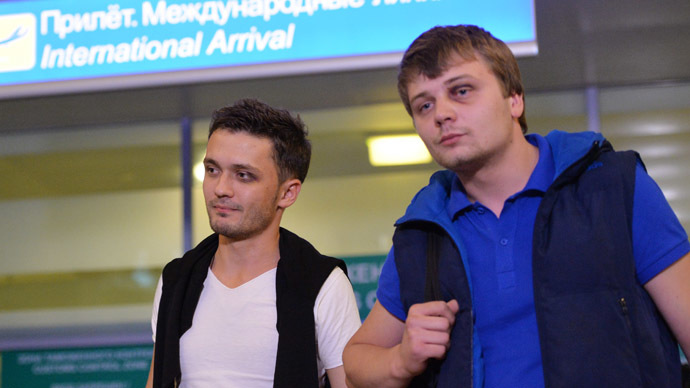
Zvezda TV channel correspondent Evgeny Davydov, left, and sound engineer Nikita Konashenkov who were detained in Dnepropetrovsk are welcomed on their arrival at Moscow’s Sheremetyevo airport after their release. (RIA Novosti/Alexey Kudenko)
Reporters from Russia’s Zvezda TV channel have been freed from captivity in Ukraine, where Right Sector fighters detained, interrogated, and beat them for ransom. Risking their lives, they didn’t turn off their phones, which was crucial for their release.
A plane carrying Evgeny Davydov and Nikita Konashenkov landed at Moscow’s Sheremetyevo Airport at 15:44 GMT on Monday. A few hours before their arrival in the Russian capital, the two journalists were handed over to Russian naval attaché Eduard Belashev in the city of Dnepropetrovsk.
The journalists spent two days in captivity, and were subjected to long questioning, intimidation, and beatings.
Recent images of the two men show the areas around their eyes covered in bruises. Their colleagues say that Davydov has complained of pain in his ear and partial hearing loss.
Zvezda TV channel has shared details of the reporters’ detention and release. The channel’s head, Aleksey Pimanov, said that Davydov and Konashenkov were freed due to “diplomatic efforts.” The station’s management sent pleas to new Ukrainian President Petro Poroshenko, the Security Service of Ukraine (SBU), and the Ukrainian judiciary demanding the journalists’ immediate release.
The Russian Foreign Ministry called the release “good news” and the “result of persistent work of all of our structures with the active participation and support of the Russian media.” Moscow says the “illegal practice of detaining journalists in Ukraine” must stop, and that the right to peaceful and objective press coverage of events in Ukraine must be safeguarded.
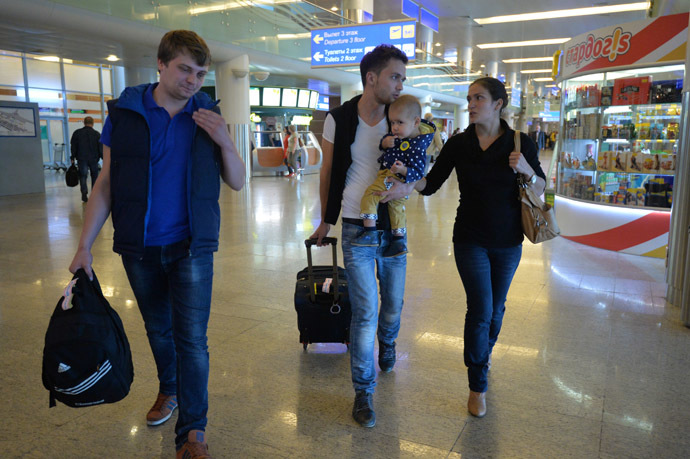
Zvezda TV channel correspondent Evgeny Davydov, center, with his family and sound engineer Nikita Konashenkov on their arrival at Moscow’s Sheremetyevo airport. (RIA Novosti/Alexey Kudenko)
The reporters were detained on June 14 while on their way to the airport. Saturday was meant to be the last day of their business trip in turbulent Ukraine and they were expected to fly home. They had been in Ukraine for over a month.
Constantly on the phone with Zvezda TV channel’s editors, Evgeny and Nikita successfully passed several checkpoints. However, they were stopped and detained at a post of the Ukrainian National Guard near Pokrovskoye, and the connection with the reporters was temporarily lost.
Zvezda journalists in Moscow launched a massive operation trying to find their colleagues. Both the Right Sector and the Ukrainian Security Service (SBU) refused to comment on the detentions.
Eventually, the channel managed to determine the address of where Evgeny and Nikita were being held. This finding showed that Right Sector fighters were behind the detention – the building is shared by the SBU and the radical group. As Zvezda journalists found out later, the man who interrogated their detained colleagues was Maksim Miroshnichenko, the Right Sector’s press secretary in Dnepropetrovsk.
During the interrogation process, the journalists kept one of their phones constantly connected to the channel’s headquarters. The recording will now be transferred to authorities, who will launch a torture case. The use of force against the reporters can be heard on the recording.
Throughout the questioning, which was full of cursing, Miroshnichenko reportedly tried to force the journalists to admit they lied about the true purpose of their visit. Under pressure, the interrogators forced the Russian crew to denounce their reporting on the use of white phosphorus by the Ukrainian military in an aerial assault on the outskirts of Slavyansk on Thursday.
After the channel managed to determine the journalists’ whereabouts, representatives of the Right Sector contacted Zvezda demanding a US$200,000 ransom for the reporters, who they called “scum.” Failure to provide the money would result in consequences, with the captors sending a message to family members that the journalists would be “kept for some 10 years.”
On Monday, a YouTube video surfaced showing Davydov and Konashenkov with bruises on their faces. In the footage, the two are seemingly being forced to say they have “no complaints” about their treatment by the Right Sector, and that the visible hemorrhages on their bodies were caused by a fight with a colleague.
Their documents also surfaced on the internet, showing they were accredited by the Central Election Commission of Ukraine. But, in violation of all norms of international law and the Geneva Convention, the reporters were forced to sign statements which falsely declared their lack of professional ethics.
“Everything is done on the orders of the Kremlin in order to use this information in international politics to the detriment of Ukraine,” Davydov’s forced statement allegedly read.
Konashenkov’s written testament apparently claimed that they covered Ukrainian roadblocks, “also on Moscow’s orders,” in order to make “untrue photographs.”
Upon their safe return to Russia, the journalists were taken to hospital for treatment. Before they boarded the ambulance, they gave a few comments to the press crew that greeted them at the airport. They thanked the Russian authorities and media channels for helping secure their release. They also briefly shared the details of their abduction.
“We were traveling from Donetsk to Dnepropetrovsk. We had a direct return flight from Dnepropetrovsk to Moscow on Saturday. About 120 km from Dnepropetrovsk, we were stopped at a roadblock. This was the National Guard’s checkpoint. They stopped us, asked us for our documents, checked all our personal possessions, examining everything,” the duo told journalists.
“Seeing our Russian passports and that we are Zvezda TV staff, their face expressions changed. They smirked and said that they have a jackpot in their hands. They abducted us, blindfolded us, and placed us in a car, before driving us somewhere to a field, then to some base. They threw us in a cellar.”
A press conference with Konashenkov and Davydov is scheduled to take place later on Tuesday.
Russian journalists from a range of media outlets have been repeatedly detained during the conflict in eastern Ukraine. Another set of Zvezda crew members were abducted two weeks ago and released after several days of interrogation on accusations of espionage. RT contributor and UK national Graham Phillips was detained for over 36 hours by Kiev military forces back in May. Earlier, two Russian journalists working for LifeNews TV channel were also captured by Kiev forces, forced on their knees at gunpoint and taken to Kiev for interrogations which lasted almost one week.
Moscow outraged at Ukraine’s National Guard for detaining 2 more Russian journalists
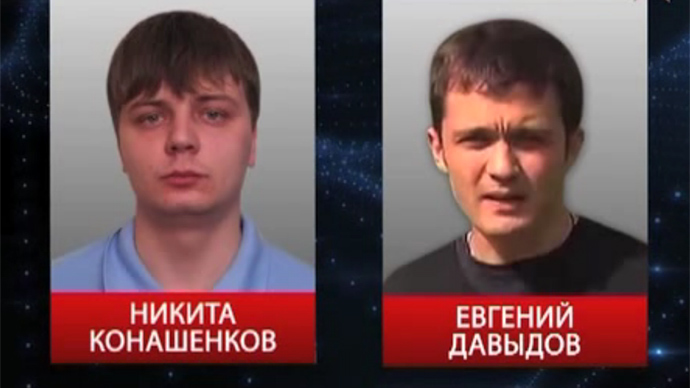
RT | June 14, 2014
Russia’s Foreign Ministry is demanding the immediate release of two Russian journalists detained in eastern Ukraine by the National Guard on their way to Dnepropetrovsk Airport.
“Unidentified men” detained correspondent Evgeny Davydov and sound engineer Nikita Konashenkov at around 5 p.m. local time in the Donetsk region on Saturday, Zvezda TV channel reported. The two were on their way to Dnepropetrovsk Airport for a flight back to Moscow.
The journalists are now being held captive in the Ministry of Justice building in Dnepropetrovsk, according to Zvezda.
“Journalists of Zvezda TV channel were again detained several hours ago on the territory of Ukraine. This is the second time this week. According to our preliminary data, the guys are in the region of the city administration of Dnepropetrovsk,” said Alexey Pimenov, head of media holding company Krasnaya Zvezda.
The Russian channel is demanding that Ukrainian President Petro Poroshenko and the Ukrainian Security Service “immediately release our employees who were on an official business trip.”
The Russian Foreign Ministry also called for the release of the journalists. The ministry said the arrest was carried out by the National Guard. Moscow also slammed Ukraine for “continuing to encroach upon the rights of Russian mass media.”
Earlier in June, the National Guard detained two journalists from Zvezda – video operator Andrey Sushenkov and sound engineer Anton Malyshev – at a military roadblock near the city of Slavyansk. According to their driver, they were blindfolded and handcuffed during a routine check, and then taken to an undisclosed location. They were held captive for two days on accusations of espionage.
Russian journalists from a range of media outlets have been detained during the conflict in eastern Ukraine. Two Russian journalists working for LifeNews TV channel – reporter Oleg Sidyakin and cameraman Marat Saichenko – were captured by Kiev forces in May near the eastern city of Kramatorsk. Following their detention, a video appeared showing Ukrainian troops holding the men at gunpoint and forcing them to get down on their knees. They were investigated under charges of “aiding terrorist groups,” according to Ukraine’s National Security and Defense Council.
RT contributor and UK national Graham Phillips was detained by Kiev military forces at a checkpoint in the city of Mariupol on May 20. He was transferred to army barracks and interrogated by Ukrainian security forces. He was released after 36 hours.
There have also been reports that Ukrainian troops have fired at people with cameras, as well as people wearing press vests. On May 9, a Ruptly cameraman was seriously wounded during an armed assault by Kiev’s army on the Mariupol police headquarters.
Russia’s commissioner for human rights, Ella Pamfilova, told RT in May that she is confused by the fact that international human rights organizations are ignoring the violations of journalists’ rights that are taking place in Ukraine.
“I am perplexed and confused that the organizations highly respected by me, including international journalist and ‘Without Borders’ organizations… are suddenly bashfully closing their eyes or ignoring the rights violations of not only Russian journalists on Ukraine’s territory.”
EFF to Court: U.S. Warrants Don’t Apply to Overseas Emails
Microsoft Fights to Protect Data Held on Servers in Ireland
EFF | June 13, 2014
San Francisco – The Electronic Frontier Foundation (EFF) has urged a federal court to block a U.S. search warrant ordering Microsoft to turn over a customer’s emails held in an overseas server, arguing that the case has dangerous privacy implications for Internet users everywhere.
The case started in December of last year, when a magistrate judge in New York signed a search warrant seeking records and emails from a Microsoft account in connection with a criminal investigation. However, Microsoft determined that the emails the government sought were on a Microsoft server in Dublin, Ireland. Because a U.S. judge has no authority to issue warrants to search and seize property or data abroad, Microsoft refused to turn over the emails and asked the magistrate to quash the warrant. But the magistrate denied Microsoft’s request, ruling there was no foreign search because the data would be reviewed by law enforcement agents in the U.S.
Microsoft appealed the decision. In an amicus brief in support of Microsoft, EFF argues the magistrate’s rationale ignores the fact that copying the emails is a “seizure” that takes place in Ireland.
“The Fourth Amendment protects from unreasonable search and seizure. You can’t ignore the ‘seizure’ part just because the property is digital and not physical,” said EFF Staff Attorney Hanni Fakhoury. “Ignoring this basic point has dangerous implications – it could open the door to unfounded law enforcement access to and collection of data stored around the world.”
The government has argued that allowing a U.S. judge to order the collection of data stored abroad is necessary, because international storage would make it easy for U.S. Internet companies to avoid complying with search warrants. But Microsoft asserts that the government’s legal theory could hurt U.S. technology companies that are trying to do business internationally. Additionally, EFF argues in its amicus brief that the government’s approach hurts Internet users globally, as it would allow the U.S. to obtain electronic records stored abroad without complying with mutual assistance treaty obligations or other nations’ own laws.
“Microsoft is doing the right thing by pushing back here. It’s great to see a tech giant fighting for its customers,” said Fakhoury.
For the full brief in this case:
https://www.eff.org/document/eff-amicus-brief-support-microsoft
Contact:
Hanni Fakhoury
Staff Attorney
Electronic Frontier Foundation
hanni@eff.org
Journalists lament PA silence as Israel bans Gaza papers
Ma’an – 13/06/2014
GAZA CITY – Palestinian journalists on Thursday urged the newly-formed national unity government to respond to Israel’s decision to prohibit the printing and distribution of Gaza-based newspapers in the West Bank.
“Do we need an Israeli presidential decree to be able to print newspapers in territories controlled by the Palestinian Authority?” editor-in-chief of al-Risalah newspaper wrote on Thursday in exasperation over the lack of PA response.
On May 28, Israeli soldiers raided the Ramallah offices of the PA-affiliated al-Ayyam newspaper, telling managers that Israel would not allow them to distribute the Hamas-affiliated Falastin, Al-Risalah, and Al-Istiqlal newspapers in the West Bank.
The Israeli raid undermined an inter-Palestinian deal that aimed to ensure freedom of press by facilitating the sale of Gaza newspapers in the West Bank and vice-versa.
Political analyst Wisam Afifa criticized the Palestinian national consensus government for its unwillingness to stand up to Israel’s attack on Palestinian free speech.
“We consider that by remaining silent, the government actually accepts the Israeli decision to ban the printing of Gaza newspapers,” he told Ma’an.
He highlighted that managers of the Gaza newspapers had contacted the Palestinian government spokesperson Eyhab Bseso over the issue, but nothing had been done.
“So far, there has been no comment on the prohibition, and we expect a serious and real response to these violations, especially from President Abbas,” added Afifa.
Similarly, the editor-in-chief of al-Istiqlal newspaper criticized the Palestinian Authority and the national consensus government for not taking any action against Israel’s decision to ban Gaza newspapers in the West Bank.
Tawfiq al-Sayyid Salim has said that he views the Israeli decision to ban Gaza newspapers as a humiliation to President Abbas himself, belittling his authority.
In December, the Foreign Press Association accused the Israeli army of “deliberately targeting” journalists after soldiers fired rubber bullets and threw stun grenades at photojournalists clearly identified as press.
The Tel Aviv-based group, which represents journalists of all foreign media, said troops had directly targeted a group of photographers covering clashes at the Qalandia checkpoint between Jerusalem and Ramallah.
A 2013 report by Palestinian Center for Development and Media Freedoms counted 151 violations of Palestinian freedom of speech by Israeli authorities, including incidents of “physical assault, detention, arrest, prevention from coverage, travel bans, interrogation, threat, raiding, closing and blocking, trial, and confiscation of equipment.”
The report also mentioned 78 violations by Palestinian authorities, primarily in the Gaza Strip, though these numbers are believed to be improving particularly since the the agreement to form a national unity government was made at the end of April.
3 journalists injured in Bilin protest
Ma’an – June 13, 2014
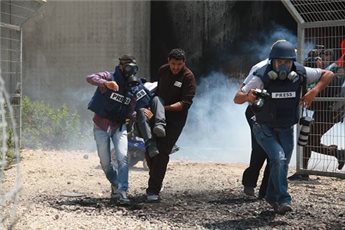
RAMALLAH – Three journalists were injured and dozens suffered from excessive tear gas inhalation as Israeli forces dispersed a weekly protest in Bilin village near Ramallah.
Israeli forces fired rubber-coated steel bullets, stun grenades, and tear gas at protesters as they neared their lands near the wall, injuring photographer Abbas al-Momini with a rubber-coated steel bullet in the pelvis, and Palestine TV cameraman Shamekh Jagoub and photographer Haitham Khatib with tear-gas canisters in the abdomen.
Participants raised Palestinian flags and posters of prisoners as they marched throughout the village chanting songs for unity and in support of prisoners.
Protesters wore prisoner uniforms and played football in front of the prison.


Australian Security Agencies Target “SyrianGirl” Mimi Al-Laham
By Brandon Turbeville | Activist Post | June 12, 2014
 In the Orwellian world of post 9/11 hysteria and the Global War On Terror, speaking truth is a revolutionary act. Indeed, such is evidenced by the fact that speaking out against terrorism is now enough to cause you to be labeled as a supporter of terrorism. At least, that is, in certain instances.
This is particularly the case with Mimi Al-Laham, (aka SyrianGirl), a young Syrian woman who has been active on YouTube, social media, and her own website in speaking out about the Western-backed destabilization of Syria.
Laham has consistently denounced the death squads operating inside Syria as terrorists and agents of the West as well as identified the so-called rebellion as being nothing more than a Western – organized, funded, and directed campaign against the Syrian government , all documented fact. For more information on this topic, please see my book, The Road To Damascus, The Anglo-American Assault On Syria.
However, her statements against terrorism, beheadings, rapes, slavery, and wholesale slaughter have caused her to be labelled as a potential “extremist” and purveyor of “extremist rhetoric.” For that reason, Australian security agencies have been closely monitoring Laham’s online statements and, presumably, much more than that.
Australian Institute of Criminology’s Shandon Harris-Hogan said that such statements and online behavior should be watched for “signs of an escalation in rhetoric or calls for violence” and that “When it crosses that line, particularly into encouraging, facilitating or preparing for violence, that’s when it’s going to particularly hit the radar of security services.
Harris-Hogan also categorized Laham’s statements as anti-US and anti-Israel.
Of course, by “anti-US ,” Harris-Hogan means anti-imperialist and anti-terrorist. Anyone familiar with Laham’s work will know that she is not anti-American, although she opposes the United States’ involvement in Syrian affairs, the funding of savage terrorists to overthrow the secular government of Syria, and the numerous attempts at direct invasion.
As for being anti-Israel, such a position is entirely within reason, since Israel itself was never anything more than a false construction with political and geopolitical goals in mind from the very beginning. In 2014, however, being anti-Israel is equated with being anti-semitic, a cynical and inaccurate propaganda technique to prevent criticism of the settler state. Regardless, Laham has repeatedly opposed anti-semitic views in her videos.
Still, Harris-Hogan stated that Laham had been monitored for 18 months.
Although not technically the “West,” Australia is every bit the Orwellian nightmare as the United States, Britain, and the rest of Europe. Indeed, only in the world of doublethink can one be accused of violent extremism by repeatedly denouncing it. The monitoring of Laham’s online work and political activism, while not surprising, is but one more example of the surveillance state and the crackdown on dissent worldwide
We can only hope that, if the Australian authorities continue to monitor Mimi Al-Laham’s work, that they learn something in the process.
Mere Existence of Palestine Deemed a “Threatening Racial Slur”
Free Press Houston | June 4, 2014
![Mere Existence of Palestine Deemed a “Threatening Racial Slur” by the [parent corporation of the] Houston Dynamo Organization](https://i0.wp.com/www.freepresshouston.com/wp-content/uploads/2014/06/10383509_10154201754125023_3501788515572494232_n-720x550.jpg "Mere Existence of Palestine Deemed a “Threatening Racial Slur” by the [parent corporation of the] Houston Dynamo Organization")
Apparently, soccer fans are very nationalistic. It is not uncommon for soccer fans to bring their national flag to a game where their national team is not even playing. In this spirit, a Palestinian-American woman named Buthayna Hammad brought her Palestinian flag to last Sunday’s Honduras vs Israel match at BBVA Compass Stadium. Fifteen minutes into the game, Nathan Buchanan, head of security at the stadium, removed her from her seat, surrounded her with four Houston Police officers and three additional stadium security personnel, and prohibited her from returning to her seat until she surrendered the “racist” flag. What makes the flag “racist?” We’ll get to that, but first let’s hear the lady’s side of the story:
On June 1st, BBVA Compass stadium was host to a “friendly” soccer match between Honduras and Israel. Both countries have the same national colors and a similar look to their flags. I am a big fan of futbol and I went eagerly to the match with my alt family from Honduras. I wore a Honduras jersey and was eager to cheer on this team, dressed to represent Honduras. To represent my own heritage as a Palestinian-American, I also brought my Palestinian flag. I made sure my flag was allowed (based on the size, etc.) and I was all ready to go. For the first 15 minutes of the match I stood up and cheered and stomped my feet with the rest of the crowd chanting “HON-DU-RAS” and waving my Palestinian flag, my colors vibrant and loud against a sea of blue and white…and apparently also racist. I was told I had to sit down, which I did, only to be told to get back up again and follow the manager of security away from the stadium seats and into the concession area. I followed, and there waiting for me were three more BBVA security personnel and four police officers. When I asked them what was wrong, the manager of security, Nathan Buchanan, told me I am not allowed to carry this flag because it implies a “racial slur” and it is in BBVA Compass Stadium violation. I asked him to show me evidence of his accusations and asked him how my flag, a part of my identity as a Palestinian-American, implies a racial slur. He could not answer whether he did not know or could not articulate why he was ordered to remove my flag and me from my seat. I was getting very emotional at this point, I had my flag wrapped around my neck like a scarf, and he said he would take my flag and “check it in” for me, that I was not permitted to return to my seat until I surrendered my flag. The Israeli government has banned Palestinians from hanging their flags outside their home, and arrests the occupants of the home for having it on display on their own land. Every day, in Occupied Palestine, Palestinians are denied entry to neighboring villages, to schools or their family’s home and in many cases to hospitals thanks to Israel’s apartheid state. Yes “apartheid,” that word implies racism, yet my flag implies a racial slur? I asked him several times if I could go back to my seat and he would spread his arms out to create a blockade with his body and his arms so I could not pass. “This is private property,” he said. I told him I paid for a ticket to enter. I could not keep my eyes from gathering tears, but forced myself from letting them fall. “What country are we in again?” I asked. “Just because Israel is playing a match, does that mean you should treat me this way? Because of my Palestinian identity? I am a U.S. Citizen!” I have attended many soccer matches, many of which at the Dynamo stadium, and I have worn a different national jersey every time. Why was I pulled away that day? Who ordered this singling-out and on what grounds? When I asked him if he would feel comfortable with his actions once my treatment became public, he offered a compromise which was that I could keep my flag as long as I did not wave it. The first half was nearly over; they were extended three minutes when I was finally able to return to my seat. I had spent over 15 minutes defending myself from being bullied. I missed the first half because I waved a Palestinian flag at an international match in my hometown. I am proud and honored to be an American, to be able to enjoy the civil liberties that people in many countries are not afforded, but I would have never thought that the influence of an Israeli soccer team on U.S. soil would compromise our most basic liberties.
I asked BBVA Compass Stadium to clarify their flag policy, to explain how a flag could be “racist.” (I suppose you could say that all flags are “racist,” but still, why single out this one?) This is what Houston Dynamo [parent corporation] spokesperson Gina Rotolo had to say:
The decision to not allow the Palestinian flag to be displayed during the game was based on the sole intention of maintaining the safety of those in attendance. The flag bearer was instigating the crowd, and we felt it was important to diffuse a potentially volatile situation as emotions began to escalate.
Of course safety comes first, so I asked Ms. Rotolo how exactly was Hammad “instigating the crowd?” Did she threaten anybody or called for violence? Rotolo replied:
This patron instigated the crowd by waving the Palestinian flag in front of Israeli supporters. Given that her actions caused emotions to escalate, the appropriate course of action, in our eyes, was to ask her to please refrain from waving the flag.
So…there you have it. “This patron instigated the crowd by waving the Palestinian flag in front of Israeli supporters.” It is now considered “racist” for an American of Palestinian descent to wave her flag at fans of the Israeli soccer team. The First Amendment can be suspended in a stadium built with taxpayer money because some Israeli soccer fans might be moved to violence by the mere sight of the Palestinian flag. The good people of the Houston Dynamo Organization think that it is “racist” to merely remind Israeli soccer fans that Palestine exists. I am trying to imagine what the complaint sounded like. “Excuse me, Mr. Buchanan, that flag over there is really pissing me off–causing emotional distress–and I might have to hurt the lady holding it so you better get four cops to impound that flag or else I’m going to beat her up and it will be all her fault.”
YOUR TAX DOLLARS AT WORK
Rotolo did not answer my questions about who complained, nor would she clarify the stadium policy on flags or how this flag violates that policy. She did not answer questions about which other flags are banned. According to Hammad, Honduras fans were shouting “faggots” and “motherfuckers” at Israel fans, and a fight between an Israel fan and a Honduras fan was going on just a few rows behind her, at the very time that she was removed from her seat…yet she was the one singled out for “instigating violence.” Go figure.
Germany To Begin Formal Investigation Into NSA Surveillance — But Only Of Angela Merkel
By Glyn Moody | Techdirt | June 6, 2014
The German government has been trying to avoid upsetting either the US by denouncing the large-scale surveillance being carried out by the NSA in its country, or the German people by not denouncing it. It finds itself in the same quandary as regards opening a formal investigation into the spying, which is probably why it has held off for so long. But now, the German authorities have come up with a sort of compromise, as GigaOM reports:
Germany’s federal prosecutor has launched the country’s first formal investigation into the activities of the NSA in Germany, specifically the U.S. intelligence agency’s reported bugging of Chancellor Angela Merkel’s mobile phone.
Harald Range said on Wednesday that the other potential avenue of investigation — that of the surveillance of the German people — remained open, though no investigation was being launched yet due to a lack of evidence.
Leaving aside the question just how much evidence the federal prosecutor needs before he investigates whether the German people have been subjected to US surveillance — a signed confession from President Obama perhaps? — the other issue here is the astonishing lack of sensitivity this move displays. The German government seems to be saying that spying is outrageous and must be investigated immediately if it’s directed against the powerful; but if it’s against the little people, then, well, sorry: we need more evidence before we could possibly risk upsetting the US.
Featured Video
Anthrax War – CBC The Passionate Eye
or go to
Aletho News Archives – Video-Images
Book Review
Shattered Dreams: The HPV Vaccine Exposed (2019)
By Christina England – 30 Q&As – Book Review & Summary
Lies are Unbekoming | September 4, 2026
… Gardasil received FDA fast-track approval in 2006, Cervarix followed in 2009, and Gardasil 9 was approved in December 2014 with more than double the aluminium adjuvant content of the original. The commercial context is specific. Merck was about to lose patent protection on Zocor and faced $18 billion in Vioxx injury claims from a cardiovascular drug the company had marketed while suppressing its own data showing a five-times increase in heart attacks. Analysts projected the global HPV vaccine market at $4 billion by 2011, contingent on government-funded national programs for teenage girls. The 1986 National Childhood Vaccine Injury Act had already granted manufacturers complete liability immunity. By 2013, Japan had withdrawn its HPV vaccine recommendation after cataloguing severe adverse reactions in hundreds of girls. No Western government followed. The establishment position across the UK, US, Australia, and most of Europe held, and still holds, that the vaccines are safe and effective, that reported injuries are coincidental, and that cervical cancer prevention justifies the program. The book was published into this position, not against a vacuum.
Shattered Dreams sits alongside Mary Holland’s The HPV Vaccine On Trial and Viera Scheibner’s foundational vaccination work as part of the documented record on what has been done to a generation of teenage girls under the banner of cancer prevention. The full summary unpacks three specific findings: that Merck used the aluminium adjuvant itself as the “placebo” control in 92.5% of trial subjects, making it structurally impossible to detect excess reactions from the adjuvant; that Dr. Sin Hang Lee found HPV DNA fragments bound to aluminium in every one of sixteen Gardasil samples tested, and in the blood and spleen of a New Zealand girl six months after her third dose; and that in every country with high vaccination coverage, including Australia, the UK, Norway, and Sweden, cervical cancer rates have stopped declining and started rising specifically in the vaccinated cohort. Martínez-Lavín’s 2017 calculation puts the number needed to seriously harm with Gardasil 9 at 140, and the number needed to vaccinate to prevent one case at 1,757. Thirteen young women are seriously harmed for every one who benefits. The vaccine was approved on the basis of trials that could not detect what the trials were supposed to detect, and it is still being given to twelve-year-olds today. … Read full review
Blog Roll
 Aletho News
- Georgia’s Largest Healthcare System Will Fire Employees Who Refuse Flu Vaccine
- The Five-Year Fuel Crisis: Why the World Economy Is Paying for a War It Thinks Is Ending
- Trump’s Big Bluff on Iran
- Swiss scammed out of millions by Ukraine-linked call centers – media
- Germany facing potential ‘violent conflict’ with Russia – spy chief
- Ukraine’s EU neighbors reject new plea from Kiev – Politico
- British Transport Police Facial Recognition Trial Scanned 926,912 People With Zero Arrests
- House Bill Would Ban Federal Use of Flock ALPR Data
- Can a Spice Rival a Drug? 10 Head-to-Head Trials Put It to the Test.
- The oil routes around Hormuz face their own chokepoints
- If Americans Knew
- “We See Our Homes Now From A Satellite, Like Strangers”
- Watch “Gaza: Doctors Under Attack”, originally censored by BBC
- NAZA: Israeli embassies in UK and US promote rival documentary to challenge Gaza genocide allegations
- David Ellison appoints Israeli to lead merged Paramount-Warner studios
- Turkish Red Crescent helps elderly Gaza man walk again after Israel confiscates his prosthetic limb
- Four Palestinians Killed in Israeli Attacks in Gaza
- Two Palestinian youths killed and village razed as Israeli attacks on West Bank continue
- Two more Christian women victims of Israeli raids on Gaza
- Cruelty, Deprivation, Indignity: A Journalist’s 22 Months in Israeli Prison
- New IDF Website Frames Slain Gaza Journalists as Terrorists
- No Tricks Zone
- Latest European Green Energy Debacle; Portugal’s Largest Flagship Solar Park Insolvent!
- Green Energy Debacle: German Expert Professor Fritz Vahrenholt Warns Of Severe Economic And Social Consequences
- Two More Paleo Reconstructions Affirm Meters-Higher Sea Levels Across Ireland, Brazil 7000-6000 Years Ago
- New Study: Earth And Venus Surface Warmth Largely Explained By Convection And Lapse Rate, Not CO2 Or Radiation
- 2025 Nature Paper Claiming Worsening Global Drought Gets RETRACTED …Heavily Flawed
- New Study: ‘Global Drought Shows No Detectable Recent Acceleration Under Climate Warming’
- Economic Masterminds: German Socialists Suggest Taxing Productivity Gains Stemming From Using AI
- The South China Sea Has Not Been Cooperating With The Climate Change Narrative
- Energy Crisis: Germany Enters Heating Season With Historically Low Gas Reserve Fill Levels
- New Study: The Antarctic Ice Sheet Gained Mass From 2020-2024 Due To Staggering Snow And Ice Accumulation

