Inside the EU’s Billion Euro Media Machine
By Cindy Harper | Reclaim The Net | June 6, 2025
Over the past decade, nearly €1 billion in EU taxpayer money has been poured into media campaigns designed to portray the European Union in a favorable light, according to a detailed investigation by conservative think tank MCC Brussels.
The analysis lays bare a sprawling architecture of publicly funded messaging that, rather than safeguarding media plurality, appears crafted to systematically advance EU political objectives and stifle dissenting perspectives.
Read the report here.
According to the report’s author Thomas Fazi, “this report blows the lid open on Brussels’s media machine: how the EU channels vast sums of public money into media projects across Europe and beyond, to the tune of nearly € 80 million per year (at least).” He further observes that “this is likely a conservative estimate,” as many indirect or subcontracted payments are not publicly disclosed.
A significant portion of these funds flows through the European Commission’s “Information Measures for the EU Cohesion Policy” (IMREG) initiative. Ostensibly aimed at informing the public about cohesion efforts, the program has in fact functioned as a massive EU-branded public relations campaign. “The program is aimed at ‘increasing awareness of the benefits of Cohesion Policy among people’ and ‘promoting and fostering a better understanding of the role of Cohesion Policy in supporting all EU’s regions.’”
Yet while the Commission claims to respect “complete editorial independence,” the report challenges this premise: “If the projects are expected to highlight the ‘benefits’ of EU policy, how can true editorial independence be ensured?” Even more concerning are examples where “news features funded through the project failed to disclose their connection to EU funding – effectively amounting to a form of stealth marketing or, given the political nature of the topic and funder, covert propaganda.”
Beyond promotional content, the EU’s structural entanglement with news agencies reveals a deeper issue. Fazi writes that these agencies are “central nodes in the media ecosystem, allowing narratives crafted at the agency level to cascade verbatim across hundreds of mainstream outlets.”
The creation of the European Newsroom (ENR), a centralized Brussels-based consortium funded with €1.7 million, only exacerbates this concern. ENR “offers a pan-European perspective on EU affairs to audiences across the continent,” while its reporters are trained by EU institutions. Far from fostering independence, this setup “aims to develop common journalistic standards” through techniques that appear geared toward narrative unification.
Fact-checking and anti-disinformation programs provide yet another layer of influence. The European Digital Media Observatory (EDMO), with at least €27 million in EU funding, brings together media outlets and news agencies in the name of combating disinformation.
But as the report questions, “When media organizations receive funding from the European Commission to disseminate pro-EU content, while also participating in mechanisms designed to flag and counter disinformation, the potential for conflict of interest is glaring.”
Fazi raises a vital question: “What happens when so-called ‘harmful narratives’ are, in fact, factually correct criticisms of EU institutions or policies? Where is the boundary between ‘disinformation’ and legitimate political dissent?”
The Journalism Partnerships program, another key funding vehicle, has funneled nearly €50 million into projects described as supporting media collaboration. However many of these efforts exhibit a clear ideological bias.
One funded initiative sought to “demystify the European Union and its institutions.” Another, Connecto, aimed to “strengthen European solidarity as opposed to extremist national movements.” Still, another, Eastern Frontier Initiative, focused on shaping narratives around “European defense and security,” involving media partners closely aligned with NATO positions.
Meanwhile, EU-backed investigative journalism frequently targets foreign adversaries rather than scrutinizing its own institutions. “A review of its output reveals very few investigations into EU governments or institutions. On the contrary, some of the funded projects appear to reiterate mainstream narratives,” the report notes.
The broader implications are troubling. As Fazi summarizes: “Rather than simply supporting a free and pluralistic media landscape, the EU is systematically investing in shaping a ‘friendly’ media environment that reinforces its own legitimacy and political goals.”
This blurring of journalism and institutional propaganda has dire consequences for public trust and democratic accountability. “Even in the absence of direct editorial interference, the structural dependence on EU grants fosters a dynamic that incentivizes self-censorship and narrative alignment,” the report warns.
Canada’s New Border Law Hides a Surveillance Time Bomb
By Ken Macon | Reclaim The Net | June 6, 2025
Canada’s new Strong Border Act tabled as Bill C-2, is being framed by the federal government as a step toward strengthening border security. But hidden within its lengthy legislative text is a familiar and troubling push for expanded surveillance powers, this time without the need for court authorization.
Nestled deep in the bill are provisions that grant law enforcement sweeping new authority to demand subscriber data from service providers, bypassing the oversight mechanisms long seen as essential to protecting Canadians’ privacy.
The bill revives the “lawful access” agenda, one that law enforcement agencies have been pursuing since the late 1990s. These digital access provisions are not new, but their inclusion in a border-focused bill appears to be a calculated effort to quietly reintroduce them under a different guise. Despite being repeatedly rebuffed by public opposition, parliamentary committees, and Canada’s highest court, the drive to erode digital privacy protections continues.
This legislative maneuver follows years of setbacks for warrantless access advocates. In 2014, the Supreme Court ruled decisively in R. v. Spencer that Canadians have a legitimate expectation of privacy when it comes to subscriber information. The Court stressed that identifying individuals based on their Internet activity could easily expose sensitive personal behavior and that police demands for such information constituted a search requiring proper legal authorization.
According to Michael Geist, a law professor at the University of Ottawa, law enforcement has continued to seek ways around those constraints. Past efforts to legislate access without judicial oversight have either failed to pass or been dropped due to public backlash.
A 2010 bill mandating the disclosure of customer details, including IP addresses and device identifiers, without a warrant was abandoned.
In 2014, a new bill was introduced, ostensibly to tackle “cyberbullying.” In practice, it reintroduced many of the same provisions that had been defeated under earlier proposals. While dressed in the language of protecting youth online, its underlying purpose was once again to broaden law enforcement access to digital subscriber data with limited oversight.
The Supreme Court’s Spencer ruling remained a major obstacle, reaffirming the privacy rights of Canadians. Then, in 2023, the Bykovets decision extended those protections further, affirming that IP addresses also warrant constitutional safeguards. The Court noted that if digital privacy is to mean anything in the modern age, then these basic digital identifiers must be protected under Section 8 of the Charter.
Despite this legal precedent, Bill C-2 is attempting to carve out a new space for surveillance. Among its more concerning features is a clause that would allow authorities to issue “information demands” to service providers without needing judicial approval. These demands would compel companies to confirm whether they provide services to specific users, whether they hold transmission data related to those accounts, and where the services are or were provided, both inside and outside Canada.
The threshold for triggering such a demand is alarmingly low. Law enforcement must merely suspect that a crime has occurred or may occur and that the requested information could aid an investigation. The demand doesn’t require disclosing the actual data, but it functions as a roadmap to it, alerting police to which providers hold what kind of information and where it might be found. Such indirect searches effectively sidestep the very privacy protections the courts have upheld.
Notably, none of these measures relate directly to border enforcement. Their presence in a border bill serves a strategic purpose: to avoid the scrutiny that such provisions would attract if introduced through standalone legislation. This tactic, often seen in omnibus bills or unrelated amendments, allows controversial policies to advance quietly under the cover of more palatable reforms.
Professor Geist has a full in-depth look at the history of such laws here.
The Agenda: Their Vision – Your Future
Oracle Films | June 4, 2025
The Agenda: Their Vision | Your Future is a feature-length independent documentary produced by Mark Sharman; former UK broadcasting executive at ITV and Sky (formerly BSkyB).
In fiction and fact, there have always been people and organisations with ambitions to control the world. And now the oligarchs who pull the strings of finance and power finally have the tools to achieve their global objectives; omnipresent surveillance, artificial intelligence, digital currency and ultimately digital identities. The potential for social control of our lives and minds is alarmingly real.
The plan has been decades in the making and has seen infiltration of Governments, local councils, big business, civil society, the media and, crucially, education. A ceaseless push for a new reality, echoing Aldous Huxley’s Brave New World, or George Orwell’s 1984.
The Agenda: Their Vision, Your Future examines the digital prison which awaits us if we do not push back right now. How your food, energy, money, travel and even your access to the internet could be limited and controlled; how financial power is strangling democracy and how global institutions like the World Health Organisation are commandeered to champion ideological and fiscal objectives.
The centrepiece is man-made climate change and with it, the race to Net Zero. Both are encapsulated in the United Nations and its Agenda 2030. A force for good? Or “a blank cheque for totalitarian global control”?
The Agenda presents expert views from the UK, the USA and Europe.
Brazilian Comedian Leo Lins Sentenced to Over Eight Years in Prison for Stand-Up Routine
By Cindy Harper | Reclaim The Net | June 5, 2025
A Brazilian comedian has been handed a prison sentence of over eight years for a stand-up routine, setting off a storm over the growing use of state power to penalize speech that challenges cultural taboos.
Leo Lins, known for his provocative style, was convicted by a federal court in São Paulo for allegedly promoting intolerance through jokes delivered during a live performance and later circulated widely online.
The show in question, titled Perturbador (“Perturber”), was posted to YouTube in 2022 and had reached more than three million views before it was taken down in 2023, following a judicial order prompted by a complaint from prosecutors.
In their case, officials claimed that the material denigrated a wide swath of Brazil’s population; including Jews, people with disabilities, the elderly, gay individuals, black citizens, indigenous groups, northeastern Brazilians, those living with HIV, evangelical Christians, and others.
Citing the scale of the video’s reach and the perceived harm of its content, the court framed the ruling as a defense of “human dignity,” arguing that the right to speak freely must yield when it allegedly infringes upon this principle.
The judgment labeled Lins’s comedy as “verbal violence” and claimed it contributes to a climate of social division. A financial penalty of 300,000 reais (around €54,000) was also imposed for what the court described as damage to the collective moral fabric.
Lins’s legal team swiftly denounced the sentence and announced plans to appeal. His lawyer issued a sharp rebuke of the court’s decision: “Watching a comedian receive the same punishment as someone convicted of drug trafficking, corruption, or even murder, all because of jokes told on stage, is deeply troubling.”
Among those speaking out against the verdict were fellow performers who warned that such actions risk eroding democratic freedoms under the guise of protecting sensibilities.
After losing its propaganda war, Israel silencing critics over Gaza genocide: UK scholar
By David Miller | Press TV | June 5, 2025
A British scholar, who is being sued for his pro-Palestine activism on social media, says Israel is seeking to silence its critics after losing a propaganda war regarding the ongoing genocide in the Gaza Strip.
David Miller, a producer and co-host of Press TV’s weekly Palestine Declassified show, made the remarks in an X post on Wednesday, after the Campaign Against Antisemitism (CAA), a pro-Israel NGO, launched a private prosecution against him.
The CCA said it has brought three charges against Miller, alleging that he had used X to send messages of a menacing character.
Miller said the CAA acts on behalf of Israel, which is “a hostile and illegitimate genocidal Jewish supremacist” regime.
“This attempt at a private prosecution is a Strategic Lawsuit Against Public Participation (SLAPP), and an act of desperation by … Israel in a propaganda war it has already lost,” he added.
“Israel, via the CAA, is attempting to buy its way into the criminal justice system to silence critics of Zionism. They will fail.”
Miller’s three messages mentioned in the case were posted from November 2024 onwards. They also concluded with the hashtag “Dismantle Zionism.”
The first hearing into the case is expected to take place at Westminster Magistrates’ Court in London on July 2.
Miller previously worked as a professor of political sociology at the University of Bristol, but he was unfairly and wrongfully dismissed in October 2021 over his pro-Palestine advocacy.
Anger against Israel has increased worldwide since October 7, 2023, when the occupying regime launched a genocidal war on the Gaza Strip.
Almost 20 months into its brutal aggression, Israel has failed to achieve its declared objectives in Gaza despite killing at least 54,607 Palestinians, mostly women and children, and injuring 125,341 others.
The Failed Blackmailing of Glenn Greenwald
By Kym Robinson | The Libertarian Institute | June 3, 2025
It is not a new thing to try and shame or blackmail an individual into silence. Whether the evidence is real or doctored doesn’t matter; only the judgement of the public is needed to destroy a person’s credibility.
Governments and criminal organizations have deployed this tactic for a long time. The U.S. government used these methods against civil rights leaders, including Martin Luther King Jr., in an attempt to discredit his message. Foreign leaders have also been the victims of honey traps, which in turn led to photos of them indulging in sex acts; the Soviet Union used attractive women wisely in their espionage and blackmail for this purpose. During the Cold War, the promiscuous and homosexual nature of key figures in the British government ensured that they spied for the Soviet Union, rather than have such evidence divulged.
Journalist and prominent antiwar voice Glenn Greenwald was recently the victim of such an attempt to sully his character, and it has had mostly the opposite effect.
Greenwald has been a consistent and heroic voice for human rights for many years. The present onslaught against the people of Gaza and the complex nature of the war in Ukraine are just some areas which Greenwald has covered factual analysis and moral clarity. His journalism has drawn denunciation from the political establishment, including online trolls that relish in personal attacks at his expense. And now, video of him performing kinky sex acts is cover for another attempt to discredit him—apparently it’s not “revenge porn” when it’s targeting a political enemy. Further, being an openly gay man has invited personal abuse far harsher than any levied at Douglas Murray or Dave Rubin, who share Greenwald’s homosexual proclivities but are staunchly Zionist in their advocacy.
Greenwald speculated on a recent appearance with Tucker Carlson that it was the Israeli government who leaked the material against him, using spyware such as Pegasus, which he has repeatedly reported on. This is technology that a government can deploy not just against terrorists or malicious criminals, but journalists and civil rights activists.
The footage that has surfaced online of Greenwald performing intimate sex acts were timed after his most recent condemnation of the Israeli government. His critical assessment on the mass murder and starvation of innocent civilians, most of them children, is too contrarian it would seem. Instead of meeting him in debate, he has been met by attempts to discredit his character. Certain consensual sex acts can still draw an ire of condemnation, even from those who consider themselves socially liberal. Drug use, alcholism, gambling, even domestic violence all seem to be rather forgivable and seemingly understood acts of vice and reckless conduct. They can be lovingly interpreted, not as slights on a person’s character, but as a quirk. Consensual conduct between adults in the extremes of normative sex, on the other hand, can ruin a person’s reputation. Is not the narrative being pushed that the killing of children is far better than sodomy or sexual role play dress ups? This is why people are pressured into the closet. But that won’t stop prying eyes, gossip hounds, and blackmailers from trying to dig it up.
With the nature of social media algorithms and the frenzy to share content that gains engagement, even those who do not seek out such imagery saw it. It was pushed in front of many eyes, either as a screenshotted meme or as the raw original video. Greenwald owned his sexuality; he re-posted and replied to the leaks immediately. He took the barb of the attackers away. In doing this, many people from across the political spectrum (including known critics) arose in support. It seems many others did not care. They are not interested in what he does behind closed doors. That’s his business. It’s only the degenerate obsessed, the sexually fixated who find glee in re-posting and attacking a person for sex acts—leaked ones at that.
When David Letterman went through a form of sexual blackmail—he had been having an affair with an employee—he announced it all live on his television show. The blackmailer then had nothing, and the bribery was meaningless. Letterman admitted to infidelity and misconduct. That was for him and those in his personal life, not for the public. It did not ruin his career (but perhaps his marriage). It did not change him as a performer; the world may have learned a little more about the real man that he was. Likewise, Greenwald as a man was stripped naked; we saw things of him that we did not need to or request to. He confronted and shamed those attempting to shame him. He did it with dignity, despite the indignity thrown upon him.
If a performer or a person becomes famous enough, the mob feels entitled to their life. Paparazzi and hackers can hunt them, ambush, and spy into their lives. Now with AI image generation it no longer matters if it’s real or fabricated. How will we know what is real, what is artificially generated? Now we are all naked.
The refreshing result is that, in the case of Greenwald, the old tactics of blackmail and public shaming no longer work. The public is either beyond that sort of attack or they simply are uninterested. What this does mean, however, is that those who would murder innocent people, spy on everyone, censor, and prohibit must themselves adapt. The means of blackmail, leverage, and shaming tactics will evolve accordingly.
The real orgy is the genocidal violence that Greenwald’s remaining critics seem to adore. It’s mature and conservative to indulge in the mayhem and bloodshed, with no disgrace or even sense of hypocrisy. Seeing a respected man like Glen Greenwald in an intimate state is not shocking or disgusting. The truly disgusting act is the killing of children. That is what should matter most. That is what should hang people, what should disgust the public.
Some of those who believe that NATO and Ukraine’s government are above criticism will see the leaks as a win. Those who believe that the Israeli government has every right to murder children and conduct a genocide may also see this as a victory. They never needed this “evidence” to discredit Glenn Greenwald; he was always discredited in their minds because he disagreed with them. The many others who see this for what it is would rather focus on the real issues: when it comes to sex and violence, violence is always far worse.
Turkey Proposes Law to Censor and Delete Unapproved Quran Translations
By Cindy Harper | Reclaim The Net | June 2, 2025
A legislative push in Turkey is drawing sharp rebuke over what many view as a direct assault on religious freedom: a proposed law that would empower the state’s top religious institution to confiscate and destroy Quran translations it deems theologically unacceptable.
The bill, recently approved by the Turkish Parliament’s Planning and Budget Committee, would grant the Directorate of Religious Affairs (Diyanet) the authority to initiate legal action against any Quran translation it considers to contradict Islam’s “core principles.” If the Diyanet-appointed board flags a translation, it could petition a court to halt its publication, remove existing copies, and in the case of online content, block or delete it entirely.
Under the proposed changes, the judicial process offers little protection to publishers. Even if an appeal is filed within the mandated 15-day window, the order to destroy or suppress the materials would go into effect immediately. If no challenge is mounted or if the appeal fails, the targeted translation would be permanently eliminated.
Independent MP Mustafa Yeneroğlu condemned the move, warning it opens the door to ideological policing of scripture. “This turns the Diyanet into a censorship body,” he stated, asserting that religious interpretation should not be filtered through a government-approved lens. “No one has the right to classify the Quran according to an official ideology as ‘acceptable’ or ‘objectionable.’”
Yeneroğlu also flagged the bill’s broad language as a threat to legal consistency, calling the criteria for banning a translation dangerously vague. He argued that the measure undercuts constitutional protections on religious practice by allowing the state to determine what constitutes correct belief.
The proposed law fits within a wider campaign by Turkish authorities to tighten control over religious narratives. Since the failed 2016 coup attempt, the government has systematically purged books and materials associated with the Gülen movement, including numerous religious texts and commentaries. Though Ankara blames the group for orchestrating the coup, its followers and Fethullah Gülen himself have denied any role in the events.
The Diyanet, with a budget exceeding that of many key ministries, is already deeply entrenched in regulating religious life, overseeing sermons in more than 80,000 mosques and issuing official religious rulings. This new legislation would allow it to silence divergent interpretations by labeling them as doctrinal violations, bypassing any real public or theological debate.
Should the bill pass the full parliament, where the ruling AKP and its allies maintain a legislative majority, it would cement the Diyanet’s power to act as a gatekeeper of permissible religious thought. Such a move risks criminalizing theological diversity under the guise of defending orthodoxy, with minimal legal safeguards to protect against misuse.
Lawmakers are expected to begin formal discussions on the bill in the near future.
Putting Israel First, Rubio Victimizes Harmless Student Over Op-Ed
Using slander, imprisonment and deportation to suppress Israel criticism
By Brian McGlinchey | Stark Realities | May 31, 2025
Given Marco Rubio’s long history of subservience to the State of Israel — which has earned him a mountain of campaign cash from the country’s US-based collaborators — many Americans were understandably wary that his ascension from senator to secretary of State portended disturbing moves to advance Israel’s interests. However, few foresaw Rubio orchestrating the abduction, imprisonment and deportation of foreign students for using their universal human right of free speech to criticize the Israeli government and advocate for Palestinians.
With President Trump’s blessing, Rubio has targeted many foreign students in this fashion — students who’ve been charged with no crimes. However, no case better illustrates the campaign’s casual cruelty than that of 30-year-old Tufts University PhD candidate Rumeysa Ozturk. Ozturk, who’s been studying child development, was arrested in March and whisked away to a far-off prison merely because — an entire year earlier — she co-authored a Tufts Daily op-ed urging the university to formally characterize Israel’s conduct in Gaza as genocide, and to sell the school’s Israel-associated investments.

Rubio would like you to assume her essay must have been an unhinged, antisemitic, violence-inciting screed. To the contrary, harkening back to Tufts’ 1989 decision to divest from apartheid South Africa, its tone is decidedly calm and measured. Read this excerpt of the essay’s most pointed language about Israel and judge for yourself:
These [student senate] resolutions were the product of meaningful debate…and represent a sincere effort to hold Israel accountable for clear violations of international law. Credible accusations against Israel include accounts of deliberate starvation and indiscriminate slaughter of Palestinian civilians and plausible genocide.
… the student body is calling for … the University to end its complicity with Israel insofar as it is oppressing the Palestinian people and denying their right to self-determination — a right that is guaranteed by international law. These strong lobbying tools are all the more urgent now given the order by the International Court of Justice confirming that the Palestinian people of Gaza’s rights under the Genocide Convention are under a “plausible” risk of being breached.
Ozturk’s persecution represents a major escalation of an aggravating dynamic in which people in the United States are vilified as dangerous, volatile antisemites for saying things about Israel that are frequently said by respected people and institutions in Israel. For example, in an op-ed of his own, former Israeli Prime Minister Ehud Olmert this week wrote, “What we are doing in Gaza now is a war of devastation: indiscriminate, limitless, cruel and criminal killing of civilians … Yes, Israel is committing war crimes.”
In March of this year, the State Department revoked Ozturk’s student visa without notifying her — she had no idea that her presence in the country was now illegal. Four days later, in an incident captured on video, she was grabbed off a Somerville, Massachusetts street by masked, plain-clothed Immigration and Customs Enforcement (ICE) agents, taken to New Hampshire and then Vermont, before being shackled in chains and airlifted 1,400 miles to a federal detention center in Louisiana.
For the next month and a half, she was stuffed with 23 others in a cell meant for 14. Ozturk says constant exposure to dust and inadequate ventilation sparked more than a dozen asthma attacks — after having previously had only about 13 in her entire life. Sleep was hard to come by, as motion-detecting fluorescent lights repeatedly triggered throughout the night.
Trying to justify the unjustifiable, the Trump administration has gone to slanderous extremes to vilify Ozturk. In a since-deleted social media post following her arrest, Homeland Security spokeswoman Tricia McLaughlin said “DHS + ICE investigations found Ozturk engaged in activities in support of Hamas, a foreign terrorist organization that relishes the killing of Americans.” (As an aside, note that, while some 43 Americans — including dual nationals — died in the Oct 7 attacks, there’s no history of Hamas ever setting out to target Americans.)
When protests of Israel’s tactics in Gaza erupted in 2022, Israel supporters across government, major media and social media branded all pro-Palestine protesters as Hamas supporters and antisemites. With the ascendency of the second Trump administration, that tactic has evolved from a malicious PR smear to a government-weaponized allegation that’s putting nonviolent foreign students in prisons and derailing their lives — all in service to a foreign country.
In a partial reversal of her appalling treatment, Ozturk was released from confinement on May 9 on the orders of a federal judge, who also denied the government’s wish to make her wear an ankle monitor. However, her troubles are far from over: In addition to the enduring harm of a six-week interruption of her academic pursuits, she is still targeted for deportation.
When DHS initially leveled the “activities in support of Hamas” accusation against Ozturk, many people assumed the government must have something on her other than an essay in a student newspaper. However, as the weeks ground on, the government never pointed to anything else, something US District Judge William Sessions noted when he ordered her to be released from her cage in Louisiana :
“I suggested to the government that they produce any additional information which would suggest that she posed a substantial risk. And that was three weeks ago, and there has been no evidence introduced by the government other than the op-ed. That literally is the case. There is no evidence here... The court finds that Ms. Öztürk has raised a substantial claim of a constitutional violation.”
Judge Sessions called Ozturk’s seizure “a traumatic incident” and said “her continued detention potentially chills the speech of the millions and millions of individuals in this country who are not citizens.” That is most certainly the Trump administration’s goal.
Falling for Rubio’s dishonest portrayal of his prey and failing to scrutinize the facts, many so-called “conservatives” have enthused over his drive to deport anti-Israel activists and rushed to defend it. In their flimsiest argument, you’ll find them claiming Ozturk and others have no right of free speech because they’re not US citizens. That hollow attack rests on a fundamental misunderstanding of rights — one that wrongly views rights as government-granted privileges, rather than something that springs from one’s humanity. As I’ve explained elsewhere at Stark Realities, the Constitution’s Bill of Rights isn’t a granting of rights, it’s a prohibition against government interference with pre-existing rights shared by everyone on Earth.
Employing a quintessential straw man argument, Rubio and others also say “nobody has a right to a visa.” The controversy has never been about any mythical entitlement to visas — it’s about the morality and constitutionality of using visa revocations as a means of punishing and suppressing expression of certain political beliefs.
To mete out that punishment, Rubio and the Trump administration are exploiting the Immigration and Nationality Act of 1952, which recklessly empowers the secretary of State — a single individual — to deport foreigners the secretary deems “adversarial to the foreign policy and national security interests” of the United States. The law provides no elaboration on that standard, much less any provision for its application with any semblance of due process for the affected individual.
Invoking that provision, the administration told a court that DHS and ICE determined Ozturk “had been involved in associations that ‘may undermine U.S foreign policy by creating a hostile environment for Jewish students and indicating support for a designated terrorist organization’ including co-authoring an op-ed that found common cause with an organization that was later temporarily banned from campus.”
First, note how tangential and tenuous the opening and concluding allegations are. The government says Ozturk is being targeted for unspecified “associations,” and because her stance on Israel merely overlaps with the stance of a campus group that was only temporarily banned.
Next, we see the Trump administration dishonestly saying Ozturk “indicat[ed] support for Hamas” by writing an op-ed calling for Tufts to say Israel is committing war crimes, and to divest from the country. The op-ed never mentions Hamas or Oct. 7 or even implicitly endorses the group or its tactics, and there’s been no allegation of any other form of her supposed “support for Hamas.”
The administration also employs the Israeli-propagandist idea that criticism of the State of Israel — a political entity — creates a “hostile environment” for Jewish students. That notion is itself a form of bigotry — as it presumes all Jews endorse Israel’s actions. Of course, that presumption is belied by the significant presence of Jewish students in many protests of Israel’s conduct in Gaza. Meanwhile, the notion that pro-Israel Jews should be protected from hearing contrary views is wildly hypocritical from an administration that — in regard to other topics — has rightly targeted censorship meant to prevent so-called “snowflakes” from having their feelings hurt.
Defenders of the administration’s conduct are compelled to do more than point to its supposed legality under a 1952 law. From FDR putting Japanese-Americans in concentration camps to Woodrow Wilson jailing opponents of the draft, there’s a difference between legality and morality and bona fide constitutionality. Meanwhile, Ozturk’s ongoing challenge of her arrest and pending deportation may well reset the bounds of what’s legal under the Immigration and Nationality Act, with the courts potentially ruling it’s unconstitutional to revoke a visa over the expression of an opinion.
Finally, even the most ardent backers of the Israeli government should recognize that the use of the Immigration Act to round up and deport people whose views are inconsistent with the current administration’s foreign policy threatens to set a dangerous precedent — one that could see a future, Israel-hostile White House seizing, jailing and deporting foreign students who advocate US aid to Israel.
Over his political career, Rubio’s unwavering dedication to the agenda of the State of Israel has earned him a wealth of campaign contributions: Between 2019 and 2024, his largest and third-largest donors were the Pro-Israel PAC and the Republican Jewish Coalition. Those donors are again cashing in as their mercenary carries out a ruthless and deceitful drive to suppress anti-Israel, pro-Palestinian speech.
Consistent with the broader campaign of mass character-assassination that Israel’s advocates have long directed against critics of Israel, Rubio has repeatedly smeared Ozturk by insinuating that she is guilty of behavior that neither the federal government nor anyone else has accused her of, and even implying she is insane. For example, here’s what Rubio said at a March press conference:
“We revoked her visa… and here’s why… If you apply for a visa to enter the United States and be a student and you tell us that the reason why you’re coming to the United States is not just because you want to write op-eds, but because you want to participate in movements that are involved in doing things like vandalizing universities, harassing students, taking over buildings, creating a ruckus, we’re not going to give you a visa…. Every time I find one of these lunatics, I take away their visa. We’re looking every day for these lunatics that are tearing things up.”
Challenged last week in a House Foreign Affairs hearing, Rubio said he “proudly” revoked Ozturk’s visa, defiantly adding “we’re going to do more of them.” Refusing to answer pointed questions about the constitutionality of deporting Ozturk for writing an op-ed, Rubio again reflexively resorted to maliciously dishonest hyperbole, saying “We’re revoking the visas of any lunatics we can identify.”
Ozturk is one of an unknown number of foreign, Palestinian-sympathizing students targeted for deportation by the Trump administration, which is providing very little transparency about the individuals concerned or specific rationales for the revocation of their visas.
The censorship blitz is disturbing enough on its face, but there’s another dimension that makes it even more sinister: In selecting Ozturk and other foreign students for persecution, the Trump administration is apparently heeding the suggestions of two shadowy and menacing pro-Israel organizations that use intimidation tactics on Israel’s behalf: Canary Mission and Betar.
According to its website, Canary Mission “documents individuals and organizations that promote hatred of the USA, Israel and Jews on North American college campuses and beyond.” (Including “the USA” in its mission statement is dishonest pandering; listing it first is a joke.) In practice, Canary Mission works to silence Israel’s critics by using false allegations of antisemitism, doxxing, and the threat of career and reputational harm that could come from landing on its internet blacklist.
In one of the most unsettling incidents attributed to the group, two men in canary costumes stood silently in a George Washington University lobby in 2018 as the student government was set to vote on an Israel divestment resolution. In the days before the vote, Canary Mission flyers posted on campus warned “THERE ARE NO SECRETS. WE WILL KNOW YOUR VOTE AND WILL ACT ACCORDINGLY.”
Shortly after Ozturk’s arrest, Canary Mission posted a triumphant social media thread, saying “sources point to her Canary Mission profile as the primary cause.” That profile is thin. Linking to her Tufts op-ed, Canary Mission only claims she “engaged in anti-Israel activism in March 2024” (the month the op-ed was published) and is “a supporter of the Boycott, Divestment, Sanctions (BDS) movement.”
Betar brags that it is directly providing a list of targets to the administration. Maliciously referring to Ozturk and other peaceful activists as “jihadis,” the group took credit for her arrest: “She was on our list. Many more jihadis are. We will be making a new submission Monday with approximately 1800 more jihadis.”
Betar is a Zionist youth group founded in 1923 by Ze’ev Jabotinsky, who promoted an expansive vision of Israel that would see it take over not only the West Bank and Gaza, but part of Jordan too. The group’s ideology, rhetoric and embrace of vandalism, theft and vigilantism prompted even the staunchly Zionist Anti-Defamation League to list it among extremist and hateful groups.
An appalling incident in February illuminates the enormity of Betar’s Jewish-supremacist fanaticism. When a journalist posted a long list of names of Palestinian infants killed in Israel’s war on Gaza, Betar’s official account replied, “Not enough. We demand blood in Gaza!”
The group has also endorsed the ethnic cleansing of Palestinians from Gaza. The irony is sickening: The Trump administration arrested Ozturk for saying Israel is committing genocide in Gaza — and the recommendation to revoke her visa came from a group that calls for genocide in Gaza.
While Betar and Canary Mission seem to be playing a key role in identifying targets, the broader scheme of weaponizing the Immigration and Nationality Act by smearing Israel’s critics as pro-Hamas antisemites who undermine US foreign policy was the brainchild of the Heritage Foundation. According to New York Times, the group in 2023 launched Project Esther, “an ambitious plan to fight antisemitism by branding a broad range of critics of Israel as ‘effectively a terrorist support network,’ so that they could be deported, defunded, sued, fired, expelled, ostracized and otherwise excluded from what it considered ‘open society’.”
Achieving new heights of hypocrisy, Rubio this week declared that “free speech… legally enshrined in our constitution, has set us apart as a beacon of freedom around the world.” His soaring rhetoric came as he announced a new policy that will deny visas to “foreign officials and persons who are complicit in censoring Americans.”
While Ozturk’s story has received significant media attention, the same mainstream media that relentlessly promoted the 2020 Russia-collusion hoax is now failing to cast the Trump administration’s campaign against pro-Palestinian campus activism for what it is: The unconstitutional suppression of the human right of free expression in appalling subservience to a foreign government and its domestic, America-Second accomplices.
In case you’re inclined to shrug off Rubio’s campaign because its victims are foreigners, make no mistake — there are people inside and outside the US government who would love to see American citizens similarly seized and shackled for criticizing the State of Israel. Over the past several years, those forces have been aggressively pushing various means of using government power to suppress Israel’s critics:
- The proposed Antisemitism Awareness Act, which would use an expansive definition of antisemitism to inflict penalties on schools that allow various forms of criticism of Israel to be expressed on their campuses — even by American citizens
- The successful enactment of state laws requiring contractors to certify that they will not participate in boycotts of Israel — alongside repeated attempts to pass a similar federal law
- Lawfare in the form of bogus lawsuits filed against universities, accusing them of failing to prevent “antisemitic incidents” that are simply expressions of opinions about Israel that Zionists revile
- The Trump administration’s withdrawal of federal education funding from schools that tolerate “antisemitism” — with that term purposefully misdefined to encompass criticism of the Israeli government
Amid Americans’ steadily-shrinking support for Israel — even 50% of Republicans under 50 years old now view the country unfavorably — those forces are only going to grow more desperate and brazen in their assault on free expression in the United States. It’s the patriotic duty of every American — including Israel’s backers and critics alike — to resist them every step of the way.
White House Taps Palantir for Government-Wide Database of Americans
By Kyle Anzalone | The Libertarian Institute | June 1, 2025
In a move raising red flags with civil rights organizations, the Trump administration is working with tech firm Palantir to develop a database for numerous government agencies to collect and store information on all Americans.
According to a New York Times report published Friday, a “key” Palantir product known as Foundry has been used by at least four US federal agencies, including the Departments of Homeland Security and Health and Human Services. The firm is now speaking with other cabinet-level agencies.
The widespread use of Foundry across the federal government will allow a number of agencies to access “hundreds of data points on citizens and others through government databases, including their bank account numbers, the amount of their student debt, their medical claims and any disability status.”
The program has caused concern among civil rights groups and former Palantir employees. “Data that is collected for one reason should not be repurposed for other uses,” one ex-Palantir official told the Times. “Combining all that data, even with the noblest of intentions, significantly increases the risk of misuse.”
Immigration and Customs Enforcement, the IRS, and the Social Security Administration are all expected to have access to the database. The system will work with Palantir’s Gotham software, which is “designed to analyze behavioral patterns in real-time, flag potential threats, and support decisions around public safety and fraud detection,” the Economic Times reported.
In a statement posted on the company’s blog, Palantir attempted to downplay its role in the project. “We act as a data processor, not a data controller,” it said. “Our software and services are used under direction from the organisations that license our products: these organisations define what can and cannot be done with their data; they control the Palantir accounts in which analysis is conducted.”
Since Trump returned to office, Palantir has racked up over $100 million in government contracts, and the firm is slated to strike a nearly $800 million deal with the Pentagon. Palantir is also a major contractor for the Ukrainian and Israeli governments.
The company’s stock increased 5% after the NYT story revealed the contract, and is up 150% since Trump won the election.
Palantir co-founders Alex Karp and Peter Thiel have both been confronted over their work with the Israel Defense Forces as Tel Aviv ethnically cleanses Palestinians from Gaza. The co-founders defended the relationship with the IDF.
‘Brussels hijacked our future’ – Orban
RT | June 1, 2025
Hungarian Prime Minister Viktor Orban has unveiled a proposal to increase the power of EU members and limit the authority of its bureaucracy. Calling it a “patriotic plan” for the bloc, he said in a series of weekend social media posts that it will revive the “European dream.”
The EU elites in Brussels have exploited every crisis to amass more power, Orban claimed in a post on X. This course has so far only translated into less sovereignty for member states and “failed policies,” according to the prime minister. “Brussels hijacked our future” by disrupting public safety through migration and eroding prosperity with “green dogmas,” he stated in another post.
“Europe can’t afford this any longer, it’s time to take back control,” he said.
The PM’s plan is based on what he calls four pillars: a path toward peace on the continent and defusing tensions with Russia, removing Brussels’ “centralized control” over finances, “bringing back free speech” and strengthening Europe’s Christian identity, and tightening control over immigration.
“We want peace, we don’t need a new Eastern front,” Orban said, commenting on his plan and stating that the bloc should not accept Ukraine as a member. “We don’t want our money poured into someone else’s war,” he added.
A military buildup and defense increase actively promoted by some EU nations could easily lock the bloc in an “arms race” with Russia, Orban warned. Such a development would “devour… taxpayers’ money,” he said. Instead of pouring more resources into the military, the bloc needs to contribute to the peace process between Moscow and Kiev, the prime minister maintained, praising US President Donald Trump’s efforts in this regard.
The EU needs to start “arms limitation talks with the Russians as soon as possible. Otherwise, all our money will be swallowed by the arms industry instead of being spent on peaceful… goals,” Orban argued.
European nations once united to create the “safest and the most advanced continent” in the world but this dream was “stolen,” the prime minister charged, calling on EU nations not to allow Brussels to use the Ukraine conflict “as an excuse to take more of our money.”
We Need To Talk About AI
Corbett | May 30, 2025
Podcast: Play in new window | Download | Embed
Newspapers are printing summer reading lists of AI-hallucinated books. Apple “Intelligence” is making up fake BBC headlines. People are losing their minds as ChatGPT calls them “spiral starchildren” and “river walkers.” Like characters in a Loony Tunes skit, we have just run off the edge of a cliff and—with the advent of a new generation of Hollywood-esque AI-generated fake videos—people are just beginning to look down and notice. The plunge is inevitable . . . or is it? Join James in this week’s edition of The Corbett Report for a sobering look at the latest in AI nonsense.
WATCH ON:  /
/  /
/  /
/  /
/  or DOWNLOAD THE MP4
SHOW NOTES
All these videos are ai generated audio included. I’m scared of the future
IMA: Artificial Intelligence And Its Influence On Research/Investigation
REPORTAGE: Essays on the New World Order
Ghostwriters on the Storm: How Big Pharma (and everyone else) Ghostwrites Articles
Grok vs. The Pentagon: An AI’s Take on 9/11
What Would Mark Carney’s Canada Look Like if not Challenged?
Feeling dumb? Let Google’s latest AI invention simplify that wordy writing for you
Microsoft-backed AI out-forecasts hurricane experts without crunching the physics
Books on Chicago Sun-Times AI-generated summer reading list aren’t real
Apple urged to axe AI feature after false headline | BBC News
Apple Intelligence summary botches a headline, causing jitters in BBC newsroom
Major Papers Publish AI-Hallucinated Summer Reading List Of Nonexistent Books
Eric Schmidt to Charlie Rose: Multiple search results are a bug, not a feature
AI is Permanently Rewriting History
The Responsible Lie: How AI Sells Conviction Without Truth
Swiss boffins admit to secretly posting AI-penned posts to Reddit in the name of science
‘The Worst Internet-Research Ethics Violation I Have Ever Seen’
Things People Use AI for in 2025
The REAL Dangers of the Chatbot Takeover
ChatGPT Users Are Developing Bizarre Delusions
OpenAI wants to build a subscription for something like an AI OS, with SDKs and APIs and ‘surfaces’
Featured Video
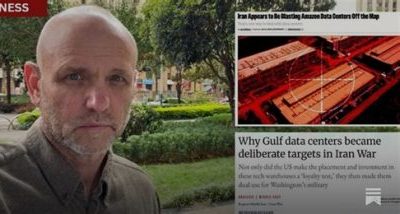
Iran spent $1 million to wipe out $30 billion in data center plans, and take down Amazon in the ME
or go to
Aletho News Archives – Video-Images
From the Archives
Clash of Civilization, Iran Part II
By Jamal Kanj – Intifada-Palestine.com – January 14, 2011
Israel’s survival kit is: perpetuate conflict, insecurity to rationalize collective hate and finally playing victim.
Devoid of conflict, Israel implodes internally; without hate, Zionism loses its justification; and playing eternal victim to continue blackmailing the West. Absence of this holy trinity, Israel ceases to exist. … continue
Blog Roll
 Aletho News
- ‘We are not like everyone else’ laws that bind other nations do not apply to Israel, says Likud lawmaker
- Report: Saudi Arabia seeks allies’ assistance as missiles deplete amid war on Yemen
- Fuel Crisis Deepens: Pakistan Warns Tanker Attack in Red Sea Would Be an ‘Act of War’
- ‘Bucha massacre’ a false flag orchestrated by UK – Moscow
- China Rejects Outside Pressure on Trade Ties After New US Russia Sanctions Bill
- Houthis Keep Advancing as the Red Sea Crisis Deepens
- Iran spent $1 million to wipe out $30 billion in data center plans, and take down Amazon in the ME
- Zionist billionaire pressure to silence Macklemore sparks exodus from Ed Sheeran tour
- House Votes to End Iran War for Third Time
- North Korea Slams US Plan for ‘AUKUS 2.0’ with South Korea and Japan
- If Americans Knew
- Biden’s Genocide Accomplices Targeted by New Accountability Campaign
- AIPAC’s Network Has Already Spent $67.2 Million to Shape the Midterm Elections
- Jewish Supremacist Manufacturing a Civilizational Threat to License Bigotry
- US bans Palestinian president from speaking at the UN
- Israeli Forces Detain Journalist Alaa al-Rimawi amid Widespread West Bank Raids
- Even a pro-Israel Congress member has put a hold on 40,000 one-ton bombs to Israel
- As Gaza crumbles, Israel preps new ground invasion – Daily Update
- ‘We are not like everyone else’ laws that bind other nations do not apply to Israel, says Likud lawmaker
- Trump’s govt makes ‘treasonous’ claim of weapons shortages
- Palestinian-American Journalist Naqaa Hamed Imprisoned by Israeli Forces After Settlers Targeted Her
- No Tricks Zone
- New Study: ‘Global Drought Shows No Detectable Recent Acceleration Under Climate Warming’
- Economic Masterminds: German Socialists Suggest Taxing Productivity Gains Stemming From Using AI
- The South China Sea Has Not Been Cooperating With The Climate Change Narrative
- Energy Crisis: Germany Enters Heating Season With Historically Low Gas Reserve Fill Levels
- New Study: The Antarctic Ice Sheet Gained Mass From 2020-2024 Due To Staggering Snow And Ice Accumulation
- Study: Ocean Heating Rates From Thousands Of Years Ago ‘Dwarf’ Modern Ocean Heating Rates
- Climate Extremists Target, Attack Large-Scale Power Grid Infrastructure In Germany!
- New Study: Antarctic Ice Melt Has Contributed Less Than 1 Centimeter To Sea Level Rise In The Last 30 Years
- Fear Of Debate: Alarmist German Climate Scientist Calls On Mainstream Media To Discredit Skeptic Voices
- End-Of-August Arctic Sea Ice Extent Hasn’t Fallen In 20 Years, Official Data Show!
 Aletho News