Obama at Pentagon: Syria Mess is All Assad’s Fault
By Daniel McAdams | Ron Paul Institute | August 4, 2016
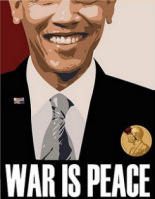 Some presidents grow in office and some presidents grow once out of office (Jimmy Carter comes to mind). But some presidents seem to learn very little during their four or eight year term. Unfortunately, especially when it comes to foreign policy, it seems President Obama falls into that latter category.
The president gave a press conference at the Pentagon today to update us on how the fight against ISIS is going. Remember: it is two years since Obama expanded what he promised would be a very limited military operation to save a religious minority — the Yazidis — from a hilltop in Iraq, into a full-fledged war in Iraq, Syria, and as of last week, Libya.
Two years ago this very week, in fact, President Obama informed the American people that he was launching “targeted airstrikes to protect our American personnel, and a humanitarian effort to help save thousands of Iraqi civilians who are trapped on a mountain without food and water…”
There was no chance of this very limited rescue operation expanding, he assured us:
As Commander-in-Chief, I will not allow the United States to be dragged into fighting another war in Iraq. And so even as we support Iraqis as they take the fight to these terrorists, American combat troops will not be returning to fight in Iraq, because there’s no American military solution to the larger crisis in Iraq.
Two years later, the lies are laid bare. US troops are indeed fighting another war in Iraq, with the addition of wars in Syria and Libya to boot.
Today the president wanted to give us good news about his anti-ISIS efforts in Iraq and Syria. His efforts have made us more safe, he claimed: “I do think that because of our extraordinary efforts, a homeland is significantly safer than it otherwise would be.”
But the president wanted us to know that things are not perfect. There are some bad actors who are hindering our efforts.
Singled out for condemnation in the president’s address was not ISIS, or al-Qaeda, or even the US-backed Nour al-Din al-Zenki, which recently filmed itself beheading a young child. No, the real villain for President Obama is the Syrian government, which has been engaged in a five year battle with ISIS, al-Qaeda, and US-backed “moderates” who do things like cut off young boys’ heads.
To Obama, the disaster in Syria is not the fault of the outside powers, who imported jihadis and even weapons from Libya (Hillary!) to overthow Syrian president Assad. It is all the fault of Assad for resisting the foreign-backed overthrow of his government! Indeed, even the act of fighting ISIS and al-Qaeda in his country earns Assad the condemnation of Obama:
In Syria, defeating ISIL and al-Qaeda requires an end to the civil war and brutality against the people, pushing them to extremes. The regime and its allies continue to violate the cessation of hostilities.
So the Syrian government is guilty of violating the “cessation of hostilities” by fighting al-Qaeda and US-backed groups that fight alongside al-Qaeda.
Indeed, to Obama the whole Syria disaster is the fault of Assad, who apparently woke up one morning and decided that the best way to keep power in Syria was to destroy his own country.
Said Obama:
We are very clear that Russia has been willing to support a murderous regime and an individual who has destroyed his country just to cling to power.
Whatever one thinks of Assad, what world leader would not resist a foreign-backed insurgency aimed at overthrowing the constitutional order? Would Obama? The mere rumor that the Russians might have had a peep at the DNC’s “cheat Bernie Sanders” grand strategy and the entire Democratic Party is ready to launch World War III against Russia!
But, finally, Obama assures us that try as he constantly does, he just sees no option other than our current hyper-interventionism in the Middle East:
I am pretty confident that a big chunk of my gray hair comes out of my Syrian meetings. There is not a meeting that I don’t end by saying is there something else we could be doing that we haven’t done? Is there a plan F, G, H that we think would lead to a resolution of the issue so that the Syrian people can put their lives back together and we can bring peace and leave the refugee crisis that has taken place?
Well, Mr. President, you must not be trying all that hard, because the answer is as obvious as the gray that has overtaken your hair: just go home. Leave Syria alone. Stop trying to change regimes.
‘Special forces shadow wars’ face legal threat from Corbyn
RT | August 1, 2016
Special forces operations should be subject to proper democratic oversight through a new War Powers Act, which would prevent troops being risked in Britain’s ‘shadow wars,’ according to Labour leader Jeremy Corbyn.
He told Middle East Eye on Friday of his concerns over the repeated use of a legal loophole to deploy troops from the secretive SAS unit into war zones such as Iraq and Libya without a democratic mandate.
The prime minister is currently able to deploy special forces without a vote, a capability which is buttressed by the UK’s long-standing but increasingly controversial policy of refusing to comment on clandestine military activities.
“I’m very concerned about this because [former Prime Minister] David Cameron – I imagine [Prime Minister] Theresa May would say the same – would say parliamentary convention requires a parliamentary mandate to deploy British troops. Except, and they’ve all used the ‘except,’ when special forces are involved,” Corbyn said.
He said this backdoor method of using elite troops has a long and dubious history, drawing a comparison between today’s operations and those of the US military during the Vietnam War.
“The question of this of course goes back a long way to Vietnam in 1963, when the US managed to have I think 50,000 advisers to the South Vietnamese government before the Congress was even invited to vote on whether or not it should be involved in the Vietnam War. I think the parallel is a very serious one,” he said.
His comments were immediately attacked by former soldier-turned-Tory MP Bob Stewart, who told the Times on Wednesday the PM must have the opportunity to deploy troops “when they think it’s crucial.”
However, scholars and other Tory MPs have questioned the UK’s shadowy approach in recent times.
In May, Tory Foreign Affairs Committee chair Crispin Blunt told RT the government should simply come clean because British citizens are fully aware of the UK’s not-so-secret special forces shadow wars.
Blunt said there is no formal parliamentary process for overseeing SAS missions and “there’s obviously an issue as to whether the intelligence and security committee would be the proper vehicle for oversight of these kinds of operations, but we are not there at the moment.”
In a July paper on the issue published by the Remote Control Project, which investigates clandestine modes of warfare, security expert John Moran pointed out that many of the UK’s major military allies – including the US and Australia – are much franker with their citizens about the work of special forces.
US, France: Gradual Expansion of Military Presence in the Middle East
By Peter KORZUN | Strategic Culture Foundation | 29.07.2016
The US military plans to increase the presence in Yemen. «As we continue on the mission, I think there will be some additional troops that we will ask to bring in», US Army General Joseph Votel, who heads the US Central Command, said in an interview in Baghdad on July 14, without disclosing the number.
According to him, a variety of locations could be suitable for American forces. He did not disclose potential sites.
The Saudi Arabia-led coalition of Arab states, supported by the US and the UK, has been involved in the Yemeni conflict since March 2015. So far, it has not gained much ground. The Yemeni capital Sana’a is still in the hands of the Houthis group (Ansar Allah – «Supporters of God»).
The fighting has resulted in more than 3,200 civilian deaths, over 60 percent of them from coalition airstrikes, according to the United Nations.
Around 6,000 civilians have been wounded in the conflict. Airstrikes have damaged or destroyed numerous civilian objects including homes, markets, hospitals, and schools, as well as commercial enterprises.
On 30 June an HRW report stated that US-made bombs were being used in attacks indiscriminately targeting civilians and violating the laws of war.
The report photographed «the remnants of an MK-83 air-dropped 1,000-pound bomb made in the US».
On 1 July, the UN announced that Yemen was at the highest level of humanitarian disaster with over 80% of the population needing help.
United Nations agencies agreed to classify Yemen as a level 3 emergency as the UN envoy for Yemen stated that the country is one step away from famine.
The announcement of the US plans to bring in more forces came amid the reports that the Saudi-led coalition may be preparing to attack Sana’a, the Houthi-held Yemen’s capital, following the breakdown of the UN-led peace process in Kuwait. The UN-led peace process in Kuwait was suspended after 77 days of negotiations that achieved no significant progress.
The US mission in Yemen is just the latest in a growing number of small US deployments across the world. US special operations forces (SOF) have been deployed to 135 nations – around 70% of the countries in the world.
Every day, they carry out missions in 80 to 90 nations. Approximately 11,000 special operators are deployed or stationed outside the United States with many more on standby, ready to respond in the event of an overseas crisis.
The US military is also looking to further beef up its presence in Iraq. The administration has recently announced that additional 560 troops will be sent to Iraq to strengthen the Iraqi offensive to retake Mosul, the Iraqi second biggest city, that is now an Islamic State (IS) stronghold.
General Votel said, the request for more troops will be on top of the 560 already announced. His remarks came just three days after Obama’s administration announced a 560 troop increase as part of an effort to facilitate an Iraqi offensive to retake Mosul. The General cautioned that Americans should not expect a rapid, wholesale withdrawal from the country. He emphasized that the forces will stay even after the US military accomplishes the mission of driving out IS forces from Mosul in Iraq and from the Syrian city of al-Raqqa. According to Votel, once their objectives are met in the areas, it will be imperative that they ensure the militants do not shift base and begin operating from other locations outside those cities. He said the goal was to achieve a «lasting defeat».
It’s not the US only. French President Francois Hollande has said that France will send heavy artillery to Iraq to support the fight against the Islamic State. Hollande announced the plan on July 22, saying the artillery equipment «will be in place next month». The president also reiterated that the French aircraft carrier Charles De Gaulle will be deployed in the region in late September to help in ongoing operations against the IS. Elsewhere, protests erupted in Libya on July 21 after the president confirmed for the first time that French special forces were operating in the country. Libya’s UN-backed government in Tripoli also condemned France’s military action.
It starts with clandestine operations of limited scale conducted by special operations forces to be followed by reinforcements sent to beef up the presence, and then artillery units deployed to support them on the ground. Step by step the West is expanding its military intervention on the ground in Yemen, Iraq and elsewhere in the Middle East. There deployments are described as ‘small-scale’ operations conducted without putting troops on the frontlines fighting firefights. This way the leading Western nations may be trending towards another war in the Middle East without the public realizing it. In Yemen, Iraq and other places, the deployments will gradually lead to full commitment to a ground war and it will be too late to turn back the clock.
US, Israel forces stage secret military drill
Press TV – July 29, 2016
Israel and the United States have reportedly staged a joint secret war game in southern Israel amid growing military cooperation between the two sides.
Israeli media said on Thursday that the drill dubbed ‘Noble Shirley’ was held in Negev Desert to improve cooperation between American and Israeli forces.
The drill, which was said to have been conducted during day and nighttime hours over the past week, involved the US Marine Corps as well as special units from the Israeli air, naval and ground forces.
During the exercise, the troops and commandos took part in drills simulating helicopter landings behind enemy lines, and urban warfare above and below ground. They also practiced close-range combat and military takeover techniques.
Israel’s so-called ‘David’s Sling’ missile system, which targets medium to long-range missiles, was also used in the maneuver.
Moreover, forces also simulated both night-time and day-time combat situations at the Ze’elim training facility, which was built to look exactly like a Palestinian city.
The drill comes some three weeks after Israel’s ministry of military affairs and the US Missile Defense Agency completed a test aimed at ensuring Israeli and American missile systems can operate cooperatively in a future war.
During the trial, the physical connectivity between the systems was tested. The test involved sites scattered around the United States, Europe and Israel.
Elisra Group, which is an Israeli manufacturer of high-tech electronics, led the trial, which was designed to see if Israel’s David’s Sling and Arrow systems could link up with American systems.
Also in February, the US and Israel held joint ‘Juniper Cobra’ exercise in Israel. The drill is held every two years between United States’ European Command and the Israeli military.
Israeli and US authorities claim that growing military cooperation is aimed at countering terrorism. However, critics blame the US and its closest ally Israel for pursuing a vicious agenda amid ongoing militancy in the Mideast region.
‘Safe zone’ in Syria
Meanwhile, Kamal al-Labwani, a Syrian opposition figure with strong ties to Israel, has confirmed an increased interest in the creation of a so-called safe zone in southern Syria.
On July 11, the Israeli army deployed several bulldozers and a tank 300 meters (328 yards) inside Syrian territory in Quneitra and began digging, threatening to shoot anyone who approached them.
According to Labwani, the zone is supposed to run 10 kilometers deep into Syrian territory and approximately 20 kilometers along the Syrian border.
The developments come as the Damascus government says Israel and its Western and regional allies are aiding Takfiri militant groups operating inside the Arab country.
The Syrian army has repeatedly seized huge quantities of Israeli-made weapons and advanced military equipment from the foreign-backed militants inside Syria.
Reports say Tel Aviv has set up field hospitals in the Israeli-occupied side of Syria’s Golan Heights for the treatment of injured militants.
In December 2015, the Daily Mail said the Israeli regime had saved the lives over 2,000 Takfiri militants at the cost of around USD 13 million since 2013.
Israel seized the Golan Heights from Syria after the 1967 Six-Day War and later occupied it in a move that has never been recognized by the international community.
France Respects ‘Existing, True’ Right of Israel to Jerusalem – PM
Sputnik — 25.07.2016
France would never deny Israel’s right to Jerusalem, French Prime Minister Manuel Valls said in a letter sent to Shmuel Rabinovitch, the Rabbi of the Western Wall and the Holy Sites of Israel on Monday.
In April, UNESCO’s executive board released and then adopted a resolution, calling Israel “the Occupying Power” and urging it to “stop all violations against Al-Aqsa Mosque/Al-Haram Al-Sharif [the Arabic name of a holy site in East Jerusalem].”
At the same time the resolution did not include the Israeli name of the site, known as Temple Mount, nor did it reference its role in Jewish culture. France is among the 33 countries that voted for the resolution. Jerusalem protested the resolution and the French vote on it.
France will never deny the “existing, true” Jewish historical right to Jerusalem, Valls was quoted as saying by The Jerusalem Post. “Unfortunate and clumsy formulations befell the language of UNESCO’s decision to the point of insult. I believe that this should have been avoided and that the vote should not have happened.”
On May 11, Valls condemned the UNESCO resolution.
In the letter to Rabinovitch, he added that Jerusalem “symbolizes the unification of the three major monotheistic religions.”
Palestinians have been vying for the recognition of their independent state, proclaimed in 1988, in the territories of the West Bank, including East Jerusalem, and the Gaza Strip. The Israeli government refuses to recognize Palestine as an independent political and diplomatic entity, and continues to build settlements on the occupied land, despite objections from the United Nations.
Okinawa Residents Stage Sit-In Protest Over US Helipad Construction
Sputnik — 22.07.2016
TOKYO — The residents of Japan’s island prefecture of Okinawa have staged a sit-in protest against the construction of helipads for the US military forces in the region, local media reported Friday.
The construction, which was suspended two years ago, resumed on Friday morning, according to media reports.
The local residents are concerned that helipads could be used by the Osprey tilt-rotor aircraft, considered to be defective by its opponents.
In exchange for construction of six helipads, the United States agreed in 1996 to return to Japan almost half of the 17,500 acres of land in the Yanbaru jungles, used by the US forces as a training camp. The Japanese government had built two helipads but construction of the remaining four was halted in 2014 due to the protests.
Since becoming operational in 2007, the V-22 Osprey has had three crashes resulting in six deaths and several minor incidents.
The dangers of Western military action in Libya
By Jessica Purkiss | MEMO | July 22, 2016
In April, the French and British foreign ministers visited Tripoli to show support for Libya’s UN-backed unity government. France’s Foreign Minister Jean-Marc Ayrault urged Libya’s neighbours to get behind the government, adding, “There is no other possible path.” Reports have however recently surfaced showing that Western forces, including France, have been assisting General Khalifa Haftar – a figure who has been threatened with EU sanctions for refusing to support the unity government and who has been fighting some groups involved in the Western-backed campaign against Daesh.
Earlier this month, air traffic control recordings obtained by the Middle East Eye showed that British, French, Italian and US troops, have been coordinating air strikes in support of Haftar. On Wednesday, the death of three French soldiers led to the first official confirmation that French special forces are operating in Libya, something the unity government say they were not informed of. France’s presence in the country was first reported by Le Monde in February, with reports claiming that a detachment was aiding Haftar in his battle against Daesh from a base at Benghazi airport. Earlier this year, the Pentagon said its units were deployed to “partner” local militias against Daesh and Britain has admitted sending RAF reconnaissance flights over the country.
Since the fall of the Libyan leader Muammar Gadaffi in 2011, the country has struggled to stay on course. Today Libya is in the middle of a civil war and is split between two warring parliaments. The political vacuum has allowed for the powerful militant group Daesh to gain a foothold and criminal networks to flourish.
General Khalifa Haftar, who leads the Libyan National Army (LNA), has been the key force fighting against Libya Dawn, an umbrella of several armed groups who have supported Omar Al-Hassi’s General National Congress (GNC). The GNC was replaced by the House of Representatives (HoR) following an election but political opponents of the new parliament challenged its legitimacy and revived the GNC in Tripoli. Fighters from Libya Dawn forced the government of Prime Minister Abdullah Al-Thani and the HoR to Tobruk. Haftar’s crackdown is known as Operation Dignity.
The UN-backed unity government, effectively Libya’s third parliament, was formed in Tunisia in December 2015, with the aim of bringing an end to the conflict. It has the difficult task of replacing the two governments, bringing unity to the fractured country and dealing with security concerns arising from the presence of Daesh.
But it has faced endless opposition. The government only managed to sail into Tripoli in March 2016 as opposition groups prevented them from flying in. Daesh has also made things difficult – in the run-up to the January 16 2016 deadline for its formation, the militant group led a sustained attack against Libya’s vital infrastructure. While the unity government does have the mandate to call for the UN to militarily intervene, unsanctioned military actions by Western countries only works to undermine the already very thin veneer of legitimacy it has.
In Libya, the response to the news of the French soldiers has been strong, with condemnations from the UN-backed government and angry protests in Tripoli. As Fayez Serraj, the Prime Minister of Libya, said in a recent op-ed, “Islamic State of Iraq and the Levant (Daesh) is not our greatest enemy. National division is.” The divisions within Libya have allowed it to veer into civil war, with groups such as Daesh managing to exploit the cleavages in the country. The growth of Daesh is a symptom of conflict in Libya not the cause.
Serraj continues, “The stark lesson from the past five years of turmoil is that when Libyans fail to work together they empower those who would destroy our country… terrorists will be defeated by our Armed Forces uniting under civilian command, not rival militias rushing to claim a political prize.” This applies to achieving peace in Libya- by backing one side politically while supporting another militarily, divides that are preventing peace only widen. In supporting Haftar whose power base is in the east, it undermines the unity government’s struggle to gain control of this heavily divided area.
Aside from the implications of peace for the country, there is also a question of the legality of the action. As Libya’s Supreme State Council put it, it is a “clear deception by a permanent member of the UN Security Council and a sponsor of the [December 2015] political agreement”. Stop the War Coalition’s Chris Nineham told RT: “They are not backed by the UN, these interventions. They are not checked anywhere. They are just unilateral acts of military aggression.” Some have gone even further. “This is a sort of coup against the political process and against the democratic path chosen by the Libyan people,” Mansour Al Hasadi, a member of the GNA, told Al Jazeera.
Britain and France took the lead in pushing for military intervention in 2011. While the intervention led to rapid results and was initially considered successful, the country now contends with three parliaments, the growing presence of Daesh and continued violence. Peace seems a distant prospect. Yet the same international powers have not learned from their mistakes.
5,000 terrorists entered Aleppo via Turkey in 2 months: Assad
Prensa Latina | July 21, 2016
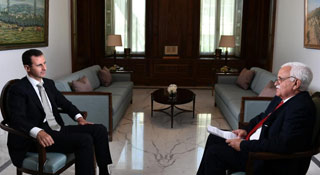
Prensa Latina transmits below the full text of the exclusive interview with Syrian President Bashar Al Assad:
PRENSA LATINA: Mr. President, thanks for giving Prensa Latina this historic opportunity of conveying your point of views to the rest of the world about the reality in Syria, because as you know, there is a lot of misinformation out there about your country, about the foreign aggression that is taking place against this beautiful country.
Mr. President, how would you evaluate the current military situation of the external aggression against Syria, and what are the main challenges of Syrian forces on the ground to fight anti-government groups? If it is possible, we would like to know your opinion about the battles or combats in Aleppo, in Homs.
President Assad: Of course, there was a lot of support to the terrorists from around the world. We have more than one hundred nationalities participating in the aggression against Syria with the support of certain countries like Saudi Arabia and Qatar with their money and Turkey with the logistical support, and of course with the endorsement and supervision of the Western countries, mainly the United States, France, and the UK, and some other allies.
But since the Russians decided to intervene in supporting legally the Syrian Army in fighting the terrorists in Syria, mainly al-Nusra and ISIS and some other affiliated groups, the scales have been tipped against those terrorists, and the Syrian Army has made many advancements in different areas in Syria.
And we are still moving forward, and the Syrian Army is determined to destroy and to defeat those terrorists. You mentioned Homs and Aleppo.
Of course, the situation in Homs, since the terrorists left Homs more than a year ago, the situation has been much, much better, more stable.
You have some suburbs of the city which were infiltrated by terrorists. Now there is a process of reconciliation in those areas in which either the terrorists give up their armaments and go back to their normal life with amnesty from the government, or they can leave Homs to any other place within Syria, like what happened more than a year ago in the center of the city.
For Aleppo it is a different situation, because the Turks and their allies like the Saudis and Qataris lost most of their cards on the battlefields in Syria, so the last card for them, especially for Erdogan, is Aleppo.
That is why he worked hard with the Saudis to send as much as they can of the terrorists – the estimation is more than five thousand terrorists – to Aleppo.
PRENSA LATINA: Through the Turkish borders?
President Assad: Yes, from Turkey to Aleppo, during the last two months, in order to recapture the city of Aleppo, and that didn’t work.
Actually, our army has been making advancement in Aleppo and the suburbs of Aleppo in order to encircle the terrorists, then, let’s say, either to negotiate their going back to their normal life as part of reconciliation, or for the terrorists to leave the city of Aleppo, or to be defeated. There’s no other solution.
PRENSA LATINA: Mr. President, which are the priorities of the Syrian Army in the confrontation with the terrorist groups? What is the role that the popular defence groups are playing in the theatre of operations?
President Assad: The priority of the Syrian Army, first of all, is to fight ISIS, al-Nusra and Ahrar al-Cham and Jaish al-Islam. These four organizations are directly linked to Al Qaeda through the ideology; they have the same ideology, they are Islamic extremist groups who want to kill anyone who doesn’t look or doesn’t feel or behave like them.
But regarding what you called the popular militia groups, actually, at the beginning of the war, the terrorists started an unconventional war against our army, and our army is a traditional army, like any other in the world, so the support of those popular defence groups was very important in order to defeat the terrorists in an unconventional way.
That was very helpful to the Syrian Army, because those fighters, those national fighters, they fight in their regions, in their cities, in their villages, so they know the area very well, they know the region very well, I mean the pathways, the terrain, let’s say, very well.
So, they can be very huge assets for the Syrian Army. That is their role.
PRENSA LATINA: Mr. President, how does the resistance of the Syrian people take place in the economic front to foreign aggression, I mean the economy, and please, what is your opinion on which sectors of the Syrian economy have remained functioning despite the war, economic blockade, looting, and so forth?
President Assad: Actually, the war on Syria is a full-blown war; it is not only supporting terrorists. They support the terrorists, and at the same time they launched a political war against Syria on the international level, and the third front was the economic front, in which they dictate to their terrorists, to their surrogate mercenaries, to start destroying the infrastructure in Syria that helped the economy and the daily needs of the Syrian citizens.
At the same time, they started an embargo directly on the borders of Syria through the terrorists and abroad through the banking systems around the world. In spite of that, the Syrian people were determined to live as much normal life as they can.
That prompted many Syrian businessmen or the owners of, let’s say, the industry, which is mainly medium and small industry, to move from the conflict areas and unstable areas toward more stable areas, on a smaller scale of business, in order to survive and to keep the economy running and to keep the needs of the Syrian people available.
So, in that regard, most of the sectors are still working. For example, the pharmaceutical sector is still working in more than 60 percent of its capacity, which is very important, helpful, and very supportive to our economy in such circumstances.
And I think now we are doing our best in order to re-expand the base of the economy in spite of the situation, especially after the Syrian Army made many advancements in different areas.
PRENSA LATINA: Mr. President, let’s talk a little bit about the international environment, please, give me your opinion about the role of the United Nations in the Syrian conflict, the attempts of Washington and its allies to impose their will on the Security Council and in the Geneva peace talks.
President Assad: Talking about the role of the United Nations or Security Council could be illusive, because actually the United Nations is now an American arm, where they can use it the way they want, they can impose their double standards on it instead of the Charter.
They can use it like any other institution within the American administration. Without some Russian and Chinese stances in certain issues, it would be a full American institution.
So, the Russian and Chinese role has made some balance within these institutions, mainly regarding the Syrian issue during the last five years. But if you want to talk about their role through their mediators or their envoys, like recently de Mistura, and before that Kofi Annan, and in between Brahimi, and so on. Let’s say that those mediators are not independent; they reflect either the pressure from the Western countries, or sometimes the dialogue between the main powers, mainly Russia and the United States.
So, they’re not independent, so you cannot talk about the role of the United Nations; it is a reflection of that balance. That is why so far, there is no United Nations role in the Syrian conflict; there is only Russian and American dialogue, and we know that the Russians are working hard and seriously and genuinely in order to defeat the terrorists, while the Americans always play games in order to use the terrorists, not to defeat them.
PRENSA LATINA: Mr. President, how do you see at the present time the coexistence among Syrian ethnic and religious groups against this foreign intervention? How do they contribute or not in this regard?
President Assad: The most important thing about this harmony between the different spectrums of the Syrian fabric, is that it is genuine, because that has been built up through the history, through centuries, so for such a conflict, it cannot destroy that social fabric.
That is why if you go around and visit different areas under the control of the government, you will see all the colors of the Syrian society living with each other.
And I would say, I would add to this, that during the conflict, this harmony has become much better and stronger, and this is not rhetoric; actually, this is reality, for different reasons, because this conflict is a lesson.
This diversity that you have, it is either to be a richness to your country, or a problem. There’s no something in the middle. So, the people learned that we need to work more on this harmony, because the first rhetoric used by the terrorists and by their allies in the region and in the West regarding the Syrian conflict at the very beginning was sectarian rhetoric.
They wanted people to divide in order to have conflict with each other, to stoke the fire within Syria, and it didn’t work. And the Syrians learned that lesson, that we had harmony; we had had harmony before the conflict, in the normal times, but we have to work more in order to make it much stronger.
So, I can say without any exaggeration that the situation regarding this part is good. In spite of that, I would say the areas under the control of the terrorists – and as you know those terrorists are mainly extremist groups affiliated to Al Qaeda – in which they worked very hard in order to indoctrinate the young generation with their dark ideology, and they succeeded in some areas, this dark ideology with the killing and beheading and all these horrible practices.
With the time, it is going to be more difficult to deal with this new generation of young people who have been indoctrinated with Al Qaeda and Wahabi doctrine and ideology. So this is the only danger that we are going to face regarding our society, harmony, and coexistence that you just mentioned.
PRENSA LATINA: Mr. President, I would like to go again to the international arena. What is in your opinion the role of the U.S.-led international coalition in relation to the groups that operate in northern Syria, in particular regarding the Kurds group. I mean the bombing of the American airplanes and the coalition in the northern part of the country. What to do you think about that?
President Assad: You know, traditionally, the American administrations, when they had relations with any group or community in any country, it is not for the sake of the country, it is not for the interest of the people; it is for the agenda of the United States.
So, that is what we have to ask ourselves: why would the Americans support any group in Syria? Not for Syria. They must their agenda, and the American agenda has always been divisive in any country. They don’t work to unite the people; they work to make division between the different kinds of people.
Sometimes they choose a sectarian group, sometimes they choose an ethnical group in order to support them against other ethnicities or to push them in a way that takes them far from the rest of the society.
This is their agenda. So, it is very clear that this American support is not related to ISIS, it is not related to al-Nusra, it is not related to fighting terrorism, because since the beginning of the American intervention, ISIS was expanding, not shrinking. It has only started to shrink when the Russian support to the Syrian Army took place last September.
PRENSA LATINA: Mr. President, what is your opinion about the recent coup d’état in Turkey, and its impact on the current situation in that country, and on the international level, and on the Syrian conflict also?
President Assad: Such a coup d’état, we have to look at it as a reflection of instability and disturbances within Turkey, mainly on the social level. It could be political, it could be whatever, but at the end, the society is the main issue when you have instability.
Regardless of who is going to govern Turkey, who is going to be the president, who is going to be the leader of Turkey; this is an internal issue. We don’t interfere, we don’t make the mistake to say that Erdogan should go or should stay. This is a Turkish issue, and the Turkish people have to decide.
But what is more important than the coup d’état itself, we have to look at the procedures and the steps that are being taken by Erdogan and his coterie recently during the last few days, when they started attacking the judges; they removed more than 2,700 judges from their positions, more than 1,500 professors in the universities, more than 15,000 employees in the education sector. What do the universities and the judges and that civil society have to do with the coup d’état?
So, that reflects the bad intentions of Erdogan and his misconduct and his real intentions toward what happened, because the investigation hasn’t been finalized yet. How did they take the decision to remove all those?
So, he used the coup d’état in order to implement his own extremist agenda, Muslim Brotherhood agenda, within Turkey, and that is dangerous for Turkey and for the neighboring countries, including Syria.
PRENSA LATINA: Mr. President, how do you evaluate the Syrian government’s relations with the opposition inside Syria? What is the difference between these opposition organizations and those based outside Syria?
President Assad: We have good relations with the opposition within Syria based on the national principles. Of course, they have their own political agenda and they have their own beliefs, and we have our own agenda and our beliefs, and the way we can make the dialogue either directly or through the ballot boxes; it could be a different way of dialogue, which is the situation in every country.
But we cannot compare them with the other oppositions outside Syria, because the word “opposition” means to resort to peaceful means, not to support terrorists, and not to be formed outside your country, and to have grassroots, to have real grassroots made of Syrian people.
You cannot have your grassroots be the foreign ministry in the UK, Franceor the intelligence in Qatar and Saudi Arabia and the United States. This is not opposition, this is called, in that case, you are called a traitor.
So, they call them oppositions, we call them traitors. The real opposition is the one that works for the Syrian people and is based in Syria and its agenda derived its vision from the Syrian people and the Syrian interests.
PRENSA LATINA: Mr. President, how do you evaluate the insistence of the U.S. and its allies that you leave power in addition to the campaign to distort the image of your government?
President Assad: Regarding their wish for me to leave power, they have been talking about this for the last five years, and we never responded even with a statement.
We never cared about them. Actually, this is a Syrian issue; only the Syrian people can say who should come and go, who should stay in his position, who should leave, and the West knows our position very well regarding this.
So, we don’t care and don’t have to waste our time with their rhetoric. I am here because of the support of the Syrian people. Without that, I wouldn’t be here. That is very simple.
About how they defame, or try to demonize certain presidents, this is the American way, at least since the second World War, since they substituted British colonization in this region, and maybe in the world, the American administrations and the American politicians haven’t said a single honest word regarding anything.
They always lie. And as time goes by, they are becoming more inveterate liars, so this is part of their politics. So, to demonize me is like how they tried to demonize President Vladimir Putin during the last two years and they did the same with the Cuban leader Fidel Castro during the last five decades.
This is their way. So, we have to know that this is the American way. We don’t have to worry about it. The most important thing is to have good reputation among your own people. That is what we have to worry about.
PRENSA LATINA: Mr. President, what is your opinion on Syria’s relation with Latin America, particularly the historical links with Cuba?
President Assad: In spite of the long distance between Syria and Latin America, we are always surprised how much the people in Latin America, not only the politicians, know about this region. I think this has many reasons, but one of them is the historical similarities and commonalities between our region, between Syria and Latin America.
Latin America was under direct occupation for long time ago but after that it was under the occupation of the American companies, and the American coup d’états and the American intervention.
So, they know what is the meaning of being independent or not to be independent. They understand that the war in Syria is about independence.
But the most important thing is the role of Cuba. Cuba was the spearhead of the independence movement within Latin America and Fidel Castro was the iconic figure in that regard.
So, on the political level and the knowledge level, there is a strong harmony between Syria and Latin America, especially Cuba. But I do not think we work enough to improve the other part of the relation; to be on the same level mainly on the educational and the economic level.
That was my ambition before the crisis and that is why I visited Latin America, Cuba, Venezuela, Argentine and Brazil, in order toinvigorate this relation. Then, we had this conflict started and it was a big obstacle to do anything in that regard, but I think that we have not to restrain the relation on the historical and the political levels. That is not enough. You have so many other sectors, people should know more about each other. The long distance could be an obstacle, but it shouldn’t because we have strong relations with the rest of the world, east and west.
So, it is not an obstacle in these days. So, I think if we overcome this crisis and this war, we should work harder in order to invigorate the different sectors of this relation with Latin America and especially with Cuba.
PRENSA LATINA: Mr. President, would you tell me your opinion about the electoral process in the United States mainly for the president? Now, there are two candidates; the Republican one is Mr. Donald Trump and the Democrat one is Mrs. Hillary Clinton, what is your opinion about this process, about the result of this process and how it could impact the conflict here, in the war in Syria?
President Assad: We resumed our relation with the United States in 1974. Now, it has been 42 years since then and we witnessed many American presidents in different situations and the lesson that we have learned is that no one should bet on any American president, that is the most important thing. So, it is not about the name.
They have institutions, they have their own agenda and every president should come to implement that agenda in his own way, but at the end he has to implement that agenda.
All of them have militaristic agendas, and the only difference is the way. One of them sends his army like Bush and the other one sends mercenaries and proxies like Obama, but all of them have to implement this agenda.
So, I do not believe that the president is allowed completely to fulfill his own political convictions in the United States, he has to obey the institutions and the lobbies, and the lobbies have not changed and the institutions’ agenda has not change.
So, no president in the near future will come to make a serious and dramatic change regarding the politics of the United States.
PRENSA LATINA: Mr. President, one final question: what message would you send using this interview with Prensa Latina to the governments and people of Latin America, the Caribbean, and also why not the American people, about the importance of supporting Syria against terrorism?
President Assad: Latin America is a very good and important example to the world about how the people and their governments regain their independence.
They are the backyard of the United States as the United States sees, but this backyard was used by the United States to play its own games, to implement its own agenda and the people in Latin America sacrificed a lot in order to regain their independence and everybody knows that.
After regaining their independence, those countries moved from being developing countries, or sometimes under-developed countries, to be developed countries. So, independence is a very important thing and it is very dear for every Latin American citizen.
We think they have to keep this independence because the United States will not stop trying to topple every independent government, every government that reflects the vast majority of the people in every country in Latin America.
And again, Cuba knows this, knows what I am talking about more than any other one in the world; you suffered more than anyone from the American attempts and you succeeded in withstanding all these attempts during the last sixty years or more just because the government reflected the Cuban people.
So, holding strongly to this independence, I think, is the crucial thing, the most important thing for the future of Latin America. Regarding Syria, we can say that Syria is paying the price of its independence because we never worked against the United States; we never worked against France or the UK. We always try to have good relations with the West.
But their problem is that they do not accept any independent country and I think this is same for Cuba. You never tried to do any harm to the American people but they do not accept you as an independent country.
The same is true for other countries in Latin America and that’s why you always have coup d’états mainly between the sixties and the seventies.
So, I think preserving the independence of a certain country is not only an isolated case; if I want to be independent, I have to support the independence in the rest of the world. So, the independence anywhere in the world, including Latin America, will support my independence. If I am alone, I will be weak.
Supporting Syria will be mainly in the international arena. There are many international organizations, mainly the United Nation, in spite of its impotence, but at the end, their support could play a vital role in supporting Syria and, of course, the Security Council; it depends on who is going to be the temporary member in the Security Council, and any other organization supporting Syria will be very important.
PRENSA LATINA: Mr. President, we know you are a very busy person, that is why I appreciate very much your time that you have dedicated to Prensa Latina interview in this moment. I hope this would not be the last interview that we have with you.
President Assad: You are welcome anytime.
Deir Qaddis resists ongoing theft of village land
International Solidarity Movement | July 21, 2016
Deir Qaddis, Occupied Palestine – On the morning of July 14th, Israeli excavators arrived on Majid Mahmoud’s farmland in Deir Qaddis to begin work on an illegal expansion of a wastewater facility for the nearby illegal settlement of Nili.
Construction vehicles and Occupation forces were met by about fifty Palestinians from Deir Qaddis and nearby Nil’in in protest of the theft and destruction of village land, who refused to leave until the construction was halted. Through nonviolent means the villagers managed to temporarily prevent the destruction of their grazing lands, though excavation and land clearing did resume in the days afterwards. Illegal settlements around Deir Qaddis have been expanding for decades, swallowing up thousands of dunams and dispossessing farmers and agricultural workers in the area.
Majid’s land, now on the other side of a settler road, has been rendered mostly inaccessible by both the expansion of illegal settlements and the threat of violence from Israeli forces and private settlement security.
“We have no rights under this Occupation. I cannot ask the soldiers why they are on my land. It is as if I am being beaten, but cannot question it or raise my hands to stop it,” Majid said. “We have all the papers to prove ownership, but it does not matter.”
Majid and members of the local council are planning to bring the case to court and have all the documentation necessary to do so. They are not optimistic, however, about their chances.
Though the people of Deir Qaddis did succeed in halting the illegal construction on Thursday, it has since resumed. Fares Naser, mayor of the village, has little confidence that the settlement expansion and illegal construction will ever end. “It will not stop,” said Fares, “and the next generation will wonder why it is this way.”
Deir Qaddis is surrounded on three sides by the Apartheid Wall and the illegal Israeli settlements of Nili, Modi’in Illit, and Na’aleh, cutting it off from much of the West Bank. According to Fares, only 4,000 of the village’s original 10,000 dunams have not yet been seized by Israeli forces and settlers. Over ninety percent of the Deir Qaddis is classified as “Area C,” territory in which Israel maintains full military and civil control.
In 1999, Israeli authorities assured the people of Deir Qaddis that all land lying west of the town would remain untouched. Israel has since broken that promise, with both state confiscation and private theft of valuable farmland within Deir Qaddis. According to international law, all Israeli settlements are illegal, as is nearly every piece of the Israeli colonial apparatus. Israel will continue to build, and the people of Deir Qaddis will continue to resist the ongoing theft of their land and livelihoods.
World must find way to end Israeli occupation of Golan: Syria UN envoy
Press TV – July 13, 2016
Syria’s envoy to the UN has called on the international community to draw up an effective mechanism to end Israeli occupation of the Golan Heights and its continued exploitation of the natural resources of the territory.
Speaking at a UN Security Council session on Tuesday, Bashar al-Ja’afari said Israeli forces continue to arbitrarily detain Syrian nationals and loot water and petroleum resources in the Golan Heights in flagrant violation of international law and regulations.
He urged the UN to force Israel to end its occupation of the Golan Heights and withdraw from the area in compliance with the Security Council Resolution 497, which was adopted unanimously on December 17, 1981, and which declares Tel Aviv’s annexation of Golan as “null and void and without international legal effect.”
The top Syrian diplomat also pointed to Israel’s land expropriation policies in the Golan Heights, arguing that Israeli officials have created 750 farms and accommodated 90 settler households there since the beginning of the current year, and are planning to lodge 150 families every year in a bid to change the demographic identity of the area.
Israel seized the Golan Heights from Syria in the 1967 Six-Day War and later occupied and annexed it.
Ja’afari further criticized the international community’s inaction toward Israel’s subversive acts, and its support for al-Nusra Front, the Syrian branch of al-Qaeda.
He also lashed out at some European countries over their support for Takfiri terrorism, highlighting that they have fallen victim to acts of terror themselves.
Russia ‘to continue assisting Syria in terror fight’
Meanwhile, Vitaly Churkin, Russia’s ambassador to the UN, has said his country is set to provide Syria with all necessary assistance in the campaign against terrorism.
“For our part, we are going to continue providing the Syrian government with assistance in fighting terrorist groups, led by Daesh and the Nusra Front. Undoubtedly, there should be neither delays nor concessions in this struggle,” Churkin said at the Tuesday’s Security Council meeting.
He further described the free movement of terrorists through borders, the flow of weapons and money to terrorist outfits as well as access to chemical warfare agents as the main challenges in the anti-terror fight.
Syria UN envoy ‘shirking responsibilities’
Separately, Russian Foreign Minister Sergei Lavrov has criticized UN Special Envoy for Syria Staffan de Mistura, saying the envoy has failed to fulfill his responsibilities and convene a new round of peace talks for Syria.
“We are concerned that the UN Secretary General’s Special Envoy for Syria Staffan de Mistura has been shying away from his duties recently, not calling another round of intra-Syrian talks, and starting to make public statements on the need for Russia and the United States to agree on how to proceed with the political settlement in Syria, and then the UN will convene a new round of intra-Syrian talks. This is the wrong approach,” Lavrov said.
“Replacing the intra-Syrian dialogue with a Russia-US duet is impossible and I believe this is a very harmful signal that is being sent to the irreconcilable opposition in the so-called High Negotiations Committee, which just keeps voicing ultimatums on [Syrian President Bashar] Assad’s resignation and some sort of deadlines. This is not helping the case,” Lavrov said, referring to a Saudi-backed group of Syrians opposing Assad.
Syria has been gripped by foreign-backed militancy since March 2011.
De Mistura estimates that over 400,000 people have been killed in the conflict. The UN has stopped its official casualty count in Syria, citing its inability to verify the figures it receives from various sources.
Featured Video
Seyed M. Marandi: Toward Total War in the Middle East
or go to
Aletho News Archives – Video-Images
From the Archives
The Geopolitics behind the War in Yemen (I)
By Mahdi Darius NAZEMROAYA | Strategic Culture Foundation | 30.03.2015
The United States and the Kingdom of Saudi Arabia became very uneasy when the Yemenese or Yemenite movement of the Houthi or Ansarallah (meaning the supporters of God in Arabic) gained control of Yemen’s capital, Sanaa/Sana, in September 2014. The US-supported Yemenite President Abd-Rabbuh Manṣour Al-Hadi was humiliatingly forced to share power with the Houthis and the coalition of northern Yemenese tribes that had helped them enter Sana. Al-Hadi declared that negotiations for a Yemeni national unity government would take place and his allies the US and Saudi Arabia tried to use a new national dialogue and mediated talks to co-opt and pacify the Houthis.
The truth has been turned on its head about the war in Yemen. The war and ousting of President Abd-Rabbuh Manṣour Al-Hadi in Yemen are not the results of «Houthi coup» in Yemen. It is the opposite. Al-Hadi was ousted, because with Saudi and US support he tried to backtrack on the power sharing agreements he had made and return Yemen to authoritarian rule. The ousting of President Al-Hadi by the Houthis and their political allies was an unexpected reaction to the takeover Al-Hadi was planning with Washington and the House of Saudi. … continue
Blog Roll
 Aletho News
- Pakistan-Iran talks secure LNG shipment to Islamabad through Hormuz
- Black Sea grain crisis puts global wheat supplies under pressure
- IRGC air defenses destroy another US MQ-1 drone over Strait of Hormuz
- Imran Khan’s entire immediate family detained in Pakistan ahead of mass protest demanding his release
- EU nation detains former presidential frontrunner
- Leaked: Britain’s Sham Conviction Of Hashim Thaci
- Seyed M. Marandi: U.S. Strike Imminent – Toward Total War in the Middle East
- Russia Voted Under Fire. Washington Is Loading the Tankers.
- 12 Things Your Oncologist Was Trained Not to Tell You
- Anthrax Attacks Paved Way for COVID-Era ‘Junk Drugs and Vaccines’
- If Americans Knew
- Israeli Attacks in Gaza Kill at Least Seven Palestinians Over Three Days, including Woman and Child
- Trump’s militarization of Washington DC as he pursues Israel’s war against Iran
- Why Israel Fears This Searing New Documentary
- Huckabee aide solicited cash gifts from Israelis
- This isn’t sci-fi, AI is already killing people
- ‘The Most Brutal Thing’: Investigation Reveals Execution of Elderly Woman in Rafah
- Inside Israel’s ‘soft’ ethnic cleansing plan for Gaza through the eyes of its victims
- New online database tracks pro-Israel political donations in the United States
- Israeli president pardons soldier convicted for killing wounded Palestinian
- Singer Ed Sheeran says his ‘heart broken’ by Gaza devastation, addresses Macklemore controversy
- No Tricks Zone
- 2025 Nature Paper Claiming Worsening Global Drought Gets RETRACTED …Heavily Flawed
- New Study: ‘Global Drought Shows No Detectable Recent Acceleration Under Climate Warming’
- Economic Masterminds: German Socialists Suggest Taxing Productivity Gains Stemming From Using AI
- The South China Sea Has Not Been Cooperating With The Climate Change Narrative
- Energy Crisis: Germany Enters Heating Season With Historically Low Gas Reserve Fill Levels
- New Study: The Antarctic Ice Sheet Gained Mass From 2020-2024 Due To Staggering Snow And Ice Accumulation
- Study: Ocean Heating Rates From Thousands Of Years Ago ‘Dwarf’ Modern Ocean Heating Rates
- Climate Extremists Target, Attack Large-Scale Power Grid Infrastructure In Germany!
- New Study: Antarctic Ice Melt Has Contributed Less Than 1 Centimeter To Sea Level Rise In The Last 30 Years
- Fear Of Debate: Alarmist German Climate Scientist Calls On Mainstream Media To Discredit Skeptic Voices
 Aletho News