President al-Assad: Western nations attack Syrian government openly and deal with it secretly
SANA | July 1, 2016
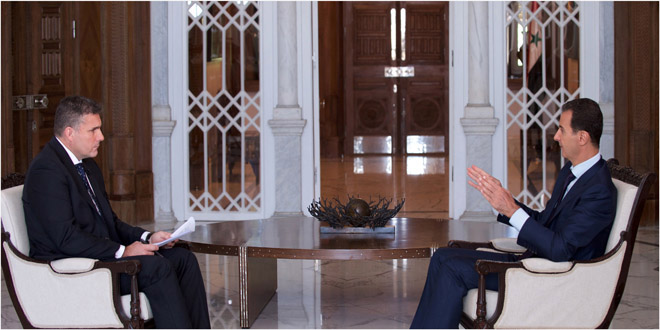
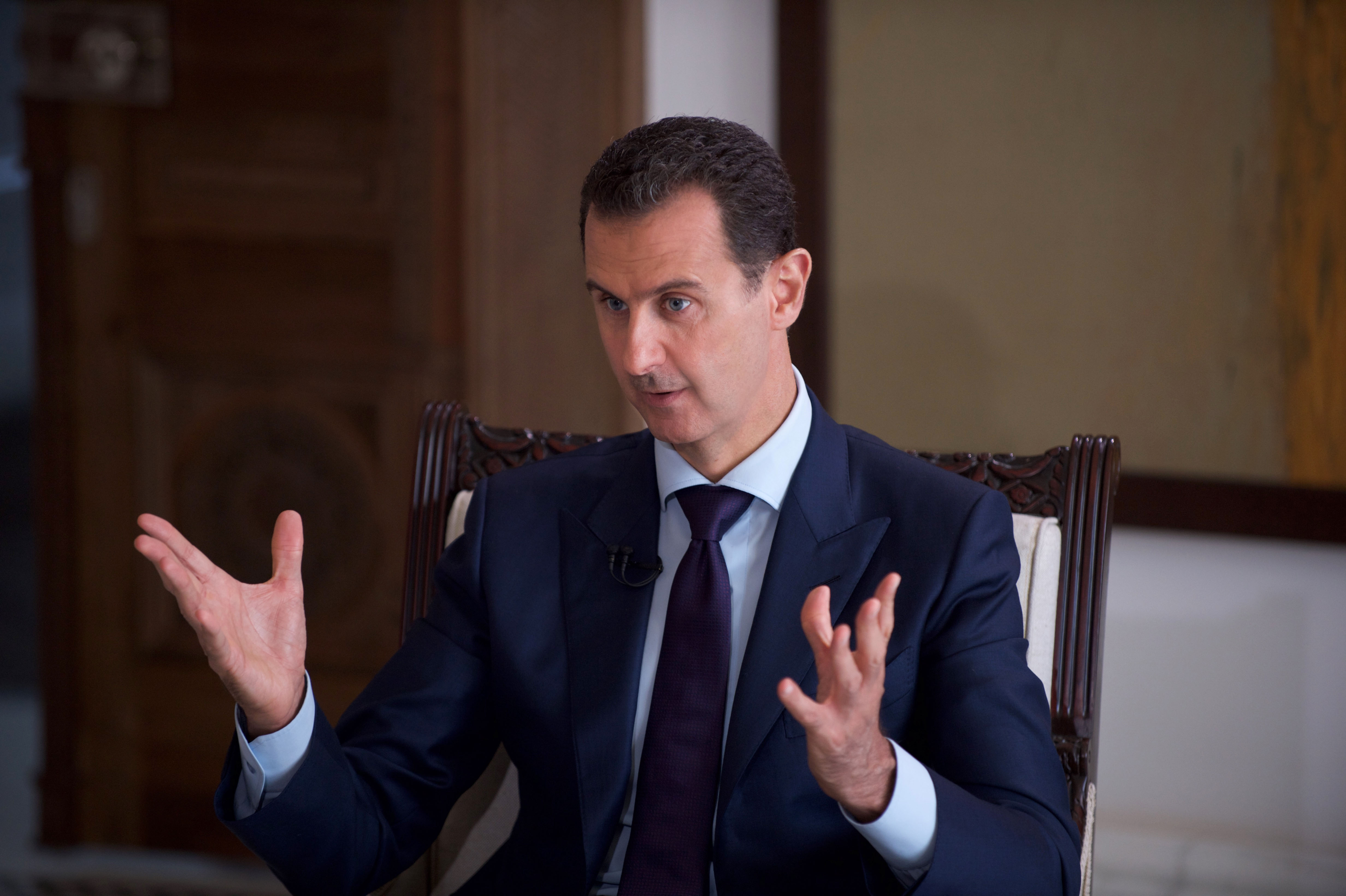
Damascus – President Bashar al-Assad gave an interview to the Australian SBS TV channel in which he criticized the double standards of the West – openly attacking the Syrian government politically, but continuing to deal with it through back channels-calling for a more humanitarian and less costly solution to the refugee crisis through stopping support to the terrorists.
The following is the full text of the interview:
Journalist: Mr. President, thank you for speaking with SBS Australia.
President Assad: You’re most welcome in Syria.
Question 1: It’s now more than five years since the Syrian crisis began. It’s estimated somewhere around a quarter of a million people have been killed, many of them civilians. There’s an undeniable humanitarian disaster. How far into the crisis do you think you are, and is there an end in sight?
President Assad: Of course, there is an end in sight, and the solution is very clear. It’s simple yet impossible. It’s simple because the solution is very clear, how to make dialogue between the Syrians about the political process, but at the same time fighting the terrorism and the terrorists in Syria. Without fighting terrorists, you cannot have any real solution. It’s impossible because the countries that supported those terrorists, whether Western or regional like Turkey, Saudi Arabia, and Qatar, don’t want to stop sending all kinds of support to those terrorists. So, if we start with stopping this logistical support, and as Syrians go to dialogue, talk about the constitution, about the future of Syria, about the future of the political system, the solution is very near, not far from reach.

Question 2: Much of the reporting in the West at the moment suggests that the demise of the Islamic State is imminent. Do you believe that’s true, and how far away from seizing Raqqa, this very important city of Raqqa, do you believe you are?
President Assad: It’s not a race. Raqqa is as important as Aleppo, as Damascus, as any other city. The danger of those terrorist groups is not about what land do they occupy, because it’s not a traditional war. It’s about how much of their ideology can they instill in the mind of the people in the area that they sit or live in. Indoctrination, this is the most dangerous thing. So, reaching Raqqa is not that difficult militarily, let’s say. It’s a matter of time. We are going in that direction. But the question when you talk about war is about what the other side, let’s say the enemy, could do, and that’s directly related to the effort of Turkey, especially Erdogan, in supporting those groups, because that’s what’s happening since the beginning. If you talk about Syria as an isolated military field, you can reach that area within a few months or a few weeks, let’s say, but without taking into consideration the Turkish effort in supporting the terrorists, any answer would be a far cry from the reality, an un-factual answer.
Question 3: Mr. President, how concerned are you about recent fatal clashes which have been reported between your longtime ally Hezbollah and your own forces?
There is good Syrian-Russian-Iranian coordination on fighting terrorism
President Assad: Fighting between us and Hezbollah? They are not fighting. They support the Syrian Army. They don’t fight against the Syrian Army, they fight with the Syrian Army. The Syrian Army and Hezbollah, with the support of the Russian Air Forces, we are fighting all kinds of terrorist groups, whether ISIS or al-Nusra or other affiliated groups with Al Qaeda that’s affiliated automatically to al-Nusra and ISIS.
Question 4: So, there have been some recent reports of clashes between… are those reports incorrect.
President Assad: No, they are talking not about clashes; about, let’s say, differences and different opinions. That’s not true, and if you look at the meeting that happened recently between the Ministers of Defense in Iran, in Tehran; Syrian, Russian, and Iranian, this means there’s good coordination regarding fighting terrorism.
Question 5: To be clear, do you categorize all opposition groups as terrorists?
President Assad: Definitely not, no. When you talk about an opposition group that adopts the political means, they’re not terrorists. Whenever you hold machineguns or any other armaments and you terrorize people and you attack civilians and you attack public and private properties, you are a terrorist. But if you talk about opposition, when you talk about opposition it must be Syrian opposition. It cannot be a surrogate opposition that works as a proxy to other countries like Saudi Arabia or any other country. It must be a Syrian opposition that’s related to its Syrian grassroots, like in your country. It’s the same, I think.
Question 6: You said recently that the ceasefire offered Syrian people at least a glimmer of hope. How, five months on, do you think that hope is going?
President Assad: Yeah, it is. It’s still working, the ceasefire, but we don’t have to forget that terrorist groups violate this agreement, on a daily basis. But at the same time, we have the right, according to that agreement, to retaliate whenever the terrorists attack our government forces. So, actually you can say it’s still working in most of the areas, but in some areas it’s not.
Question 7: There are various accounts of how the Syrian crisis began. Some say it was children graffiting anti-government slogans and they were dealt with brutally by the government. I understand you don’t accept that narrative. How, in your view, did the crisis begin?
President Assad: It’s a mixture of many things. Some people demonstrated because they needed reform. We cannot deny this, we cannot say “no everybody was a terrorist” or “everyone was a mercenary.” But the majority of those demonstrators – I’m not talking about the genuine demonstrators – were paid by Qatar in order to demonstrate, then later they were paid by Qatar in order to revolt with armaments, and that’s how it started, actually. The story of children being attacked, this is an illusive story. It didn’t happen. Of course, you always have, let’s say, mistakes happening in the practice on the ground, like what happened in the United States recently, during the last year, but this is not a reason for people to hold machineguns and kill policemen and soldiers and so on.
Question 8: You do say that some of these people legitimately needed reform. Was that as a result of any heavy-handedness from your government at all?
President Assad: No, we had reform in Syria. It started mainly after 2000, in the year 2000. Some people think it was slow, some people think it was too fast, this is subjective, not objective, but we were moving in that regard. But the proof that it wasn’t about the reform, because we made all the requested reforms after the crisis started five years ago, and nothing has changed. So, it wasn’t about reform. We changed the constitution, we changed the laws that the opposition asked for, we changed many things, but nothing happened. So, it wasn’t about the reform; it was about money coming from Qatar, and most of the people that genuinely asked for reform at the beginning of the crisis, they don’t demonstrate now, they don’t go against the government, they cooperate with the government. They don’t believe, let’s say, in the political line of this government, and this is their right and that’s natural, but they don’t work against the government or against the state institutions. So, they distinguish themselves from the people who supported the terrorists.

Question 9: How do you respond to the fact that some of your ministers defected and cited brutality as reason?
President Assad: Actually, they defected because they’ve been asked to do so by, some of them, Saudi Arabia, some of them by France, it depends on the country they belong to. And now, they are belonging to that so-called opposition that belongs to those countries, not to the Syrians. They have no values in Syria, so we wouldn’t worry about that. It didn’t change anything. I mean it didn’t affect the fact or the reality in Syria.
Question 10: One of your main backers, Russia, has called for a return to the peace talks. Do you think that’s a good idea?
President Assad: You mean in Geneva?
Journalist: Yes.
Geneva negotiations need to have the basic principles in order to be fruitful
President Assad: Yeah, of course, we support every talk with every Syrian party, but in reality those talks haven’t been started yet, and there’s no Syrian-Syrian talks till this moment, because we only made negotiations with the facilitator, which is Mr. de Mistura. Actually, it hasn’t started. So, we support the principle, but in practice you need to have a certain methodology that didn’t exist so far. So, we need to start, but we need to have the basic principles for those negotiations to be fruitful.
Question 11: One thing that intrigues a lot of people about the Syrian crisis is why your close allies Iran and Russia stay so loyal?
By defending Syria, allies are defending their stability and interests
President Assad: Because it wasn’t about the President, it’s not about the person. This is the misinterpretation, or let’s say the misconception in the West, and maybe part of the propaganda, that Russia and Iran supported Assad, or supported the President. It’s not like this. It’s about the whole situation. The chaos in Syria is going to provoke a domino effect in our region, that’s going to affect the neighboring countries, it’s going to affect Iran, it’s going to affect Russia, it’s going to affect Europe, actually. So, when they defend Syria, they defend the stability and they defend their stability, they defend their interest. And at the same time, it’s about the principle. They defend the Syrian people and their right to protect themselves. Because if they defend the President and the Syrian people are not with him and don’t support him, I cannot withstand five years just because Russia and Iran support me. So, it’s not about the President, it’s about the whole situation, the bigger picture, let’s say.
Question 12: Do you have any dialogue either direct or indirectly with the United States?
Western countries are dealing with Syria through back channels
President Assad: At all, nothing at all. Indirect, yes, indirect, through different channels. But if you ask them they will deny it, and we’re going to deny it. But in reality, it exists; the back channels.
Question 13: What are some of those channels?
President Assad: I mean, let’s say, businessmen going and traveling around the world and meeting with the officials in the United States and in Europe, they meet in Europe, and they try to convey certain messages, but there’s nothing serious, because we don’t think the administration, the American administration, is serious about solving the problem in Syria.
Question 14: Well, quite recently, there were reports more than 50 diplomats have called for what they described as “real and effective military strikes” against you, against Syria. Does this in any way concern you, and do you think it signals a more aggressive policy from the United States towards Syria moving forward?
American administrations are famous of creating problems, but they never solve any
President Assad: No, warmongers in every American administration always exist. It’s not something new. But we wouldn’t give a fig, let’s say, about this communique, but it’s not about this communique; it’s about the policy, it’s about the actions. The difference between this administration and the previous one, Bush’s one, is that Bush sent his troops. This one is sending mercenaries, and turned a blind eye to what Saudi Arabia and Turkey and Qatar did, since the beginning of the crisis. So, it’s the same policy. It’s a militaristic policy, but in different ways. So, this communique is not different from the reality on the ground. This is asking for war, and the reality is a war.
Question 15: You referred to the previous government, the Bush government. There are some who say one of the reasons you’ve survived as long as a government has been America’s reluctance to get on the ground in another war in the Middle East. Do you not accept that, based on what you’re saying?
President Assad: Yeah, the American administrations since the 50s are very famous of creating problems but they never solve any problems, and that’s what happened in Iraq. Bush invaded Iraq, in a few weeks he could occupy Iraq, but then what’s next? It’s not about occupying. This is a great power. We’re not a great power. So, it’s not about America occupying Syria. What’s next? What do they want to achieve? They haven’t achieved anything. They failed in Libya, in Iraq, in Yemen, in Syria, everywhere. They only created chaos. So, if the United States wants to create more chaos it can, it can create chaos, but can they solve the problem? No.
Question 16: Do you have a preference who wins the upcoming US election?
President Assad: Actually no, we never bet on any American president, because usually what they say in the campaign is different from their practice after they become president, and Obama is an example, so we don’t have to wait. We have to wait and see what policy they’re going to adopt, whoever wins the elections.
Question 17: So, you can see a circumstance where Syria would work collaboratively with the United States and the West?
We are not against cooperation with the US based on mutual interest
President Assad: We don’t have a problem with the United States, they’re not our enemy, they don’t occupy our land. We have differences, and those differences go back to the 70s and maybe before that, but in many different times, let’s say, and events and circumstances, we had cooperation with the United States. So, we’re not against this cooperation. But, this cooperation means talking about and discussing and working for the mutual interest, not for their interest at the expense of our interest. So, we don’t have a problem.
Question 18: Mr. President, you’ve spent a lot of time yourself, as you’ve just said, in the United Kingdom. Can you see there being any repercussions for Britain’s decision to exit the European Union for Syria and for the Syrian crisis?
British people are revolting against their “second-tier” and “disconnected” politicians
President Assad: I don’t think I can elaborate about that, as it’s a British issue, and I’m not British neither European. But at the same time I can say that this surprising result, maybe, has many different components, whether internal as economic and external as the worry from the terrorism, security issues, refugees, and so on. But this is an indication for us, as those officials who used to give me the advice about how to deal with the crisis in Syria, and say “Assad must go” and “he’s disconnected” proven to be disconnected from reality, otherwise they wouldn’t have asked for this referendum, but I think this is a revolt of the people there against, I would call them sometimes second-tier politicians. They needed special, let’s say, statecraft officials, to deal their country. If another administration came and understands that the issue of refugees and security is related to the problem in our region, this is where you’re going to have a different policy that will affect us positively. But I don’t have now a lot of hope about this. Let’s say we have a slim hope, because we don’t know who’s going to come after Cameron in the UK.
Question 19: Can I ask; Australia is part of the international coalition to defeat the Islamic State. Obviously, that’s one of your goals, so in that instance there’s a shared goal. Do you welcome international intervention when there’s a shared goal like that.
President Assad: Actually, we welcome any effort to fight terrorism in Syria, any effort, but this effort first of all should be genuine, not window-dressing like what’s happening now in northern Syria where 60 countries couldn’t prevent ISIS from expanding. Actually, when the Russian air support started, only at that time when ISIS stopped expanding. So, it needs to be genuine. Second, it needs to be through the Syrian legitimate government, not just because they want to fight terrorism and they can go anywhere in the world. We are a legitimate government and we are a sovereign country. So, only on these two circumstances we welcome any foreign support to fight terrorism.
Question 20: A number of Australians have died fighting for either the Kurdish militia or the Islamic State. Do you have a message for these young people who feel so enraged by what’s taking place in Syria that they travel over here to fight?
President Assad: Again, the same, let’s say, answer. If there are foreigners coming without the permission of the government, they are illegal, whether they want to fight terrorists or want to fight any other one. It is the same. It’s illegal, we can call it.
Question 21: Mr. President, Australian politicians have used very strong language about your role in the crisis, as have other leaders, internationally. Australia’s Prime Minister has referred to you as a “murderous tyrant,” saying that you’re responsible for killing thousands of innocent civilians. Australia’s opposition leader has called you a “butcher.” Yet Australia’s official position is still to work with you toward a peace agreement. How do you reconcile those two very different positions?
Western nations attack Syrian government and yet deal with it under the table
President Assad: Actually, this is the double standard of the West in general. They attack us politically and they send us their officials to deal with us under the table, especially the security, including your government. They all do the same. They don’t want to upset the United States. Actually, most of the Western officials only repeat what the United States wants them to say. This is the reality. So, I think these statements, I just can say they are disconnected from our reality, because I’m fighting terrorists, our army is fighting terrorists, our government is against terrorists, the whole institutions are against terrorists. If you call fighting terrorism butchery, that’s another issue.
Question 22: Australia has agreed to take an additional twelve thousand Syrian refugees; some have already arrived. Do you have a message for these Syrians, many of whom still say they love Syria and they want to return. Do you have a message for those people, as I said, who are in Australia, and other countries around the world?
A more humanitarian and less costly European solution to refugee crisis is stopping support to terrorists
President Assad: Actually, you mentioned a very important point. Most of the refugees that left Syria, they want to come back to Syria. So, any country that helped them enter their new country, let’s say, their new homeland, is welcome as a humanitarian action, but again there is something more humanitarian and less costly: is to help them staying in their country, help them going back by helping the stability in Syria, not to give any umbrella or support to the terrorists. That’s what they want. They want the Western governments to take decisive decisions against what Saudi Arabia and other Western countries, like France and UK, are doing in order to support the terrorists in Syria just to topple the government. Otherwise, those Syrians wouldn’t have left Syria. Most of them, they didn’t leave because they are against the government or with the government; they left because it’s very difficult to live in Syria these days.
Question 23: Do you hope that these people will return and would you facilitate for them to return?
President Assad: Definitely, I mean losing people as refugees is like losing human resources. How can you build a country without human resources? Most of those people are educated, well trained, they have their own businesses in Syria in different domains. You lose all this, of course, we need.
Question 24: The Commission for International Justice and Accountability says there are thousands of government documents which say has proved your government sanctioned mass torture and killings. In the face of that evidence, how do you say that no crimes have taken place, and I point also to other independent organizations, which are critical of deliberate targeting hospitals. Do you concede that some mistakes have been made as you’ve targeted some rebel-held areas?
President Assad: You are talking about two different things. One of them, the first one is the reports. The most important report that’s been financed by Qatar, just to defame the Syrian government, and they have no proof, who took the pictures, who are the victims in those pictures, and so on. Like you can forge anything if you want now on the computer. So, it is not credible at all. Second, talking about attacking hospitals or attacking civilians, the question, the very simple question is: why do we attack hospitals and civilians? I mean the whole issue, the whole problem in Syria started when those terrorists wanted to win the hearts of the Syrians. So, attacking hospitals or attacking civilians is playing into the hands of the terrorists. So, if we put the values aside now for a while, let’s talk about the interests. No government in this situation has any interest in killing civilians or attacking hospitals. Anyway, if you attack hospitals, you can use any building to be a hospital. No, these are an anecdotal claims, mendacious statements I can say; they are not credible at all. We’re still sending vaccines to those areas under the control of the terrorists. So, how can I send vaccines and attack the hospitals? This is a contradiction.
Question 25: Mr. President, as a father and as a man, has there been one anecdote, one story, one image from the crisis, which has affected you personally more than others?
President Assad: Definitely, we are humans, and I am Syrian like the other Syrians. I will be more sympathetic with any Syrian tragedy affecting any person or family, and in this region, we are very emotional people, generally. But as an official, I am not only a person, I am an official. As an official, the first question you ask when you have that feeling is what are you going to do, what are you going to do to protect other Syrians from the same suffering? That’s the most important thing. So, I mean, this feeling, this sad feeling, this painful feeling, is an incentive for me to do more. It’s not only a feeling.
Question 26: What’s your vision for Syria? How do you see things in two to three years?
President Assad: After the crisis or…? Because, the first thing we would like to see is to have Syria stable as it used to be before, because it was one of the most stable countries and secure countries around the world, not only in our region. So, this the first thing. If you have this, you can have other ambitions. Without it you cannot. I mean, if you have this, the other question: how to deal with the new generation that lived the life of killing, that saw the extremism or learned the extremism or indoctrinated by Al Qaeda-affiliated groups, and so on. This is another challenge. The third one is bringing back those human resources that left as refugees in order to rebuild Syria. Rebuilding the country as buildings or infrastructure is very easy; we are capable of doing this as Syrians. The challenge is about the new generation.
Question 27: How do you think history will reflect on your presidency?
President Assad: What I wish is to say that this is the one who saved his country from the terrorists and from the external intervention. That is what I wish about it. Anything else would be left to the judgment of the Syrian people, but this is my only wish.
Journalist: Mr. President, Thank you very much for speaking with SBS Australia.
President Assad: Thank you very much.
Israeli government approves 800 new colonial settlement housing units
By Celine Hagbard | IMEMC | July 4, 2016
On Sunday the Israeli Cabinet approved the expansion of several Israeli settlements in the West Bank and East Jerusalem, adding an additional 800 new units to the existing thousands of units constructed in Jewish-only settlements in direct contravention of international law.
Israeli officials say that the approval of 800 new housing units is meant to somehow ‘balance’ the implementation of a court ruling that 600 construction permits be approved for Palestinian families in Beit Safafa.
But while the Israeli officials may have political reasons for making such a claim, Palestinian analysts point out that there is no legal justification or comparison between the court decision about Beit Safafa and the announcement Sunday of the expansion of illegal Israeli settlements constructed on illegally-seized Palestinian land.
In the case involving Beit Safafa, an Israeli court ruled last month that the Israeli government had provided no sufficient evidence to back its claim that the Palestinian residents’ building permit applications should be denied, and ordered that construction could begin. But the Israeli government has, for the past month, prevented the court decision from being implemented.
The announcement Sunday that 800 new settlement units would be constructed in East Jerusalem and in the West Bank colonial settlement of Ma’ale Adumim came just two days after Israeli Prime Minister Binyamin Netanyahu approved the expansion of another colonial settlement in Hebron by 42 additional units.
All Israeli settlements constructed in the West Bank and East Jerusalem are considered illegal under international law, as they involve the direct transfer of Israel’s civilian population into areas seized by military force.
But the Israeli government considers many of these colonial settlements to be ‘legal’ under Israeli law, and provides infrastructure including water, sewage, electricity, policing and fire services to the majority of the hundreds of settlements that have been constructed on Palestinian land in East Jerusalem and the West Bank.
In the case of Beit Safafa, the Israeli government had put together a plan to completely encircle the Palestinian town with several Jewish-only settlements, thus cutting off the town from the rest of the West Bank and Jerusalem.
The plan had involved the expansion of a small trailer park currently housing Ethiopian immigrants to Israel, on a hilltop in Beit Safafa. The trailer park, dubbed ‘Givat HaMatos’, was slated for massive expansion by the Israeli government until Palestinian residents of Beit Safafa took the government to court to challenge the expansion.
In a surprise victory a month ago, the Palestinian residents of Beit Safafa won their court battle. but the Israeli government failed to implement the decision before now.
Upon the announcement that the court’s decision would be carried out, the Israeli Minister for Jerusalem, Ze’ev Elkin, stated, “Anyone who is concerned about the Jewish majority in Israel’s capital cannot push a building plan just for Arabs [in Givat HaMatos]… You cannot just approve construction for Arabs in Givat HaMatos without also approving at the same time building for Jews in the same planned neighborhood.”
The plan to encircle Beit Safafa, while currently under scrutiny by international media and bodies, is just one part of the larger E1 Jerusalem plan, which would encircle East Jerusalem, kick out most of its Palestinian residents, and claim all the ‘conquered’ territory for the state of Israel. The plan was first introduced in the early 2000s, and has expanded since then.
Activists storm US military base in Yorkshire
Press TV – July 4, 2016
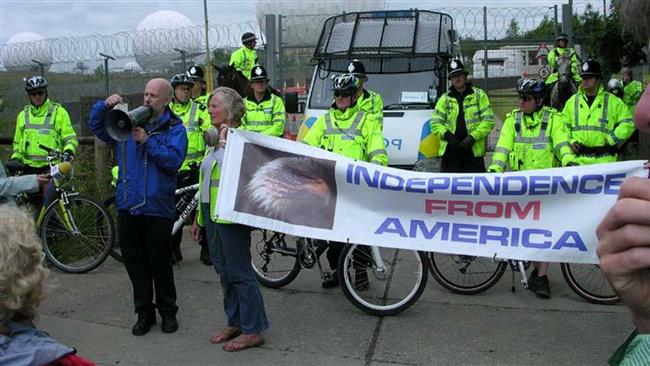
British activists have stormed an American military base in Yorkshire, continuing decades-long calls for its closure.
Just like the past three decades, peace activists from all over Britain gathered outside the Menwith Hill intelligence-gathering center on the outskirts of Harrogate over the weekend, the British daily Morning Star reported Monday.
“US military bases in Britain are jeopardizing the safety and security of the British public as they are threatening Russia and helping to cause carnage in the Middle East,” said Marcus Papadopoulos, an activist with the Campaign for the Accountability of American Bases (CAAB), which organized the event.
With its many satellite dishes, the more than 1,000-staff base collects intelligence and transmits it to the US.
Every year, protesters stage a demonstration at the base on the Saturday closest to July 4 – the day Americans celebrate their independence from England in 1776.
Ironically, this year’s rally was called “Independence from America Day,” and was attended by former Labour member of the European Parliament Michael McGowan.
McGowan gave a speech in defense of Labour leader Jeremy Corbyn whose leadership is under attack following the UK’s recent decision to leave the European Union (EU).
About 52 percent of British voters partaking in the June 23 referendum opted to leave the EU.
Labour MPs have criticized Corbyn for his “inadequate” contribution to the ‘Remain’ campaign and say they doubt he could lead the party to victory in 2020 general elections.
The party further plunged into crisis after eleven MPs rounded on Corbyn’s leadership, joining the 12 shadow cabinet ministers who resigned earlier this month.
The wave of resignation came after shadow Foreign Secretary Hilary Benn was sacked after he told the Labour leader that he had lost confidence in his leadership.
McGowan, however, told rally goers that Corbyn’s election last year provided “a historic opportunity for world peace, which should be a matter of universal celebration and an opportunity not be wasted but to be taken forward in the interest of all who share our planet.”
Ban Ki-moon’s farewell to the occupied Palestinian territories
MEMO | July 2, 2016
On Tuesday, UN Secretary General Ban Ki-moon finished his farewell trip to Israel and the occupied Palestinian territories. He is due to step down in December and used the occasion to urge some political will for a two-state solution as “the only way to meet the national aspirations of both peoples.” Ban also criticised the blockade of Gaza which, he said, “Suffocates its people, stifles its economy and impedes reconstruction efforts.” Interestingly, he added that it is “collective punishment for which there must be accountability.”
Speaking in Ramallah, the UN chief expressed an understanding of Palestinian frustration: “I’m aware that many Palestinians question the feasibility of reaching a just and lasting peace with Israel. They hear talk of peace but they see violence. They still live a life of checkpoints, permits, blockade, demolitions and profound economic hardships faced with growing indignities and the humiliating occupation that will soon enter its 50th year.”
During his time as Secretary General, Ban has condemned the status quo verbally but the organisation he leads has failed to take concrete action. Under his tenure, Gaza has been strangled by a tight blockade and its residents have witnessed three major Israeli offensives. In over half of his time at the top of the UN, the West Bank settler population has grown by 23 per cent (from the beginning of 2009 until the beginning of 2014), and at least two rounds of direct talks have failed. In 2014, more Palestinians were killed by Israel than in any other year since 1967. Violence and fatalities in the West Bank and East Jerusalem, meanwhile, were at their highest since the beginning of his tenure in 2007.
Following the most recent Israeli war against Gaza in 2014, a UN inquiry found that Israel was responsible for striking seven official sites used by the organisation as civilian shelters, during which 44 Palestinians were killed and 227 others were injured. Releasing the report, Ban condemned the attacks “as a matter of the utmost gravity.” He noted that it was the second time during his tenure as secretary general that he had been obliged to establish a board of inquiry into incidents involving UN premises and personnel in Gaza that have occurred during the course of “tragic conflicts” in the Gaza Strip. Concerning the children killed in the war, he commented during an earlier visit, “I met so many of the beautiful children of Gaza. More than 500 were killed in the fighting – many more were wounded. What did they do wrong? Being born in Gaza is not a crime.”
However, his inaction during the conflict forced 129 organisations and distinguished individuals to sign an open letter to him. “Until today,” they wrote, “you have taken no explicit and tangible measures to address the recent Israeli attacks in the occupied Palestinian territories since 13 June. Moreover, your statements have been either misleading, because they endorse and further Israeli false versions of facts, or contrary to the provisions established by international law and to the interests of its defenders, or because your words justify Israel’s violations and crimes.”
The number of Palestinian children killed during the 2014 war led to efforts to include the Israel Defence Forces on a UN list of serious violators of children’s rights. However, while the UN chief should have supported that inclusion made by Leila Zerrougui, the UN special envoy for children and armed conflict, he didn’t. He was accused of caving into pressure and omitting the Israeli military from the list. UN sources described the decision to override Zerrougui’s recommendation as “unusual”, while Human Rights Watch called it “a blow to UN efforts to better protect children in armed conflict.”
On his farewell visit to Gaza, Ban Ki- Moon told residents that, “The UN will always be with you.” As the two-year anniversary of the beginning of the 2014 Gaza war draws near, most of the 11,000 homes destroyed and 6,800 severely damaged or rendered uninhabitable remain in ruins, largely as a result of the Israeli-led blockade. As his time as UN leader comes to a close, the Palestinians will be hoping that his successor will give them more than words.
Trump Will Not Recognize Palestinian Statehood if elected President
Sputnik – 25.06.2016
Republican presidential nominee Donald Trump has backtracked from his neutral position on the Israel-Palestine conflict, and is now “committed” to supporting Israeli settlement expansion on territories it has seized illegally, according to an advisor.
David M. Friedman, a real-estate attorney serving as Trump’s main advisor on Israel, said the Republican presidential candidate and reality television star would not support the recognition of the Palestinian state without “the approval of the Israelis.” Friedman also remarked that Trump was unconcerned with the inhabitants of the West Bank, because “nobody really knows how many Palestinians live there.”
Trump made Friedman a part of his campaign staff in April, at a meeting with Orthodox Jews, naming him and Jason Greenblatt, another real-estate lawyer and Trump’s chief attorney, as his advisors on Israel. Friedman said at the time, “Mr. Trump’s confidence is very flattering. My views on Israel are well known, and I would advise him in a manner consistent with those views. America’s geopolitical interests are best served by a strong and secure Israel, with Jerusalem as its undivided capital.” Friedman has made no secret of his feelings about a two-state solution with Palestine, writing that, “It was never a solution, just an illusion that served both the US and the Arabs.”
Trump has earned a reputation for taking contradictory stances on issues, and when asked in May if he thought Israel should cease construction in the West Bank, the candidate said, “No, I don’t think there should be a pause… because I think Israel should have – they really have to keep going. They have to keep moving forward.” Later in the same interview he remarked, “I’d love to negotiate peace. I think that, to me, is the all-time negotiation… I would love to see if peace could be negotiated. A lot of people say that’s not a deal that’s possible. But I mean lasting peace, not a peace that lasts for two weeks and they start launching missiles again. So we’ll see what happens.”
Friedman says Trump’s attitude toward Israel is positive, and his view on the Palestinian state springs, in part, to a lack of power on the part of Palestinian President Mahmoud Abbas. “His [Trump’s] feeling about Israel,” Freidman said, “is that it is a robust democracy. He does not think it is an American imperative for [Gaza Strip and other territories seized by Israel] to be an independent Palestinian state.”
When asked directly about his own feelings on recognizing the State of Palestine, Friedman was open, if tentative.
“If the Israelis conclude that they need to do this [recognize the Palestinian state] in order to enhance their long-term security – which I think we are very skeptical about – but if this is what they conclude they want to do, we will respect this decision…. If the circumstances change… and there is a reason to be optimistic, then great, but the current facts don’t make that [recognizing the Palestinian state] an American imperative at all.” he said.
US Seeks Direct Confrontation with Russia in Syria
By Ulson Gunnar | New Eastern Outlook | June 21, 2016
The US has recently accused Russia of bombing what it calls “US-backed rebels” in southern Syria. CBS News in their article, “Russia ignores warnings, bombs U.S.-backed Syrian rebel group,” would claim:
On Friday, Defense Secretary Ash Carter called out Russia for bombing a Syrian rebel group that’s backed by the U.S.
The attack by Russian fighter bombers on American-backed opposition forces appeared to be deliberate and to ignore repeated U.S. warnings.
More alarming is what the US claimed happened next. CBS News would further claim:
Two American F-18 jet fighters were dispatched to provide air cover for the troops on the ground as they tried to evacuate their casualties. By the time the F-18s arrived, the Russian planes were headed away, but were still close enough to see.
But when the F-18s broke away to refuel, the Russians returned for a second bombing run. Another call went out to the Russian command center in Syria, demanding that the planes wave off.
The crew of an airborne command post tried to contact the Russian pilots directly but got no response. The Su-34s conducted another bombing run, leaving a small number of opposition fighters dead on the ground.
Neither CBS News nor the US Department of Defense ever explained why the US believes it is entitled to send armed militants over the borders and into a sovereign nation, or why it believes a sovereign nation and its allies are not entitled to confront and neutralize them or why US aircraft are entitled to fly over Syrian airspace without the authorization of the Syrian government.
In other words, the US is vocally complaining about its serial violations of international law and norms finally (allegedly) being confronted and put to an end by Russian military forces.
But Did Russia Even Attack America’s Armed Invaders?
Russia however, has denied US accusations. CNN’s article, “Russia denies bombing U.S.-backed Syrian rebels near Jordan border,” states:
Russia’s Defense Ministry denied bombing U.S.-backed Syrian opposition forces in a recent military operation near the Jordanian border, according to a statement released on Sunday.
The Kremlin response comes after U.S. and Russian military officials held a video conference to discuss Thursday’s strikes.
As is characteristic of all US claims regarding its multiple, ongoing foreign acts of military aggression, the most recent row in Syria is heavy on rhetoric and light on evidence. Had Russia attacked armed militants invading Syrian territory, it would have been well within its rights to do so, however it has claimed it hasn’t. The burden of proof is on the US.
Why Would the US Lie About This?
But when one considers a recent US State Department “internal memo” calling for more direct US military action to oust the Syrian government from power, it is clear such a call cannot be answered without an accompanying justification or provocation. It appears that the US-Russian row in southern Syria conveniently constitutes just such a provocation.
CNN’s article, “State Department officials call for U.S. military action against Assad regime,” claims:
More than 50 State Department officials signed an internal memo protesting U.S. policy in Syria, calling for targeted U.S. military strikes against the regime of Bashar al-Assad and urging regime change as the only way to defeat ISIS.
Claiming that US military strikes against the Syrian government, or that “regime change” is the only way to defeat the self-proclaimed Islamic State (IS) is indeed far fetched and is in and of itself a fabricated justification for an otherwise entirely self-serving geopolitical objective the US has set for itself in Syria.
It was US-led “regime change” in Libya in 2011 that has led to the country becoming a bastion for, not against IS and other notorious terrorist groups. Libya, it should be mentioned, has existed in a perpetual state of failure since the 2011 US military intervention, triggering one half of a massive refugee crisis facing the European continent, with no signs of abating any time in the foreseeable future.
In other words, the US desire for “regime change” in Syria will create another Libya, but on a scale larger than that in North Africa, all while compounding the chaos in North Africa further.
Therefore, justifying greater military aggression by the US in Syria appears to be a “hard sell” for American policymakers, media and politicians. Militants in southern Syria were likely designated for this ploy specifically because they have the greatest chance of being separated and distinguished from US-backed militants in northern Syria.
US-backed militants in Syria’s north are described even by the US itself as “intermingled” with extremists including Al Qaeda and even IS and have become increasingly difficult to defend diplomatically and politically as Syrian and Russian forces work on rolling them back.
Undoubtedly US-backed militants in Syria’s south are likewise”intermingled” with overt terrorist groups, but because the conflict in the south has been neglected by not only US and European news agencies, but also Russian and other Eastern news services, there lingers an unwarranted “benefit of the doubt.”
Can Anything Stop US Military Escalation?
Many in America’s foreign policy circles are nostalgic for the days of NATO’s intervention in Yugoslavia where inferior Russian forces were unable to deter NATO aggression and were eventually relegated to a subordinate role in “peacekeeping operations.” At one point, NATO even contemplated striking Russian forces as a means of neutralizing any obstacle to NATO ambitions during the conflict.
It is therefore possible that these same US policymakers envision using what CNN’s article called “stand-off and air weapons” to induce a similar stand-down from Russia before proceeding with and accomplishing their much desired “regime change” in Syria.
However, the Russian military of the 1990’s is not the Russian military of today. The fact that Russia is present and operating in Syria, far beyond the confines of Eastern Europe and its traditional sphere of influence is proof enough of that.
Russia’s performance in Syria alongside Syrian forces is the primary factor in what is now clearly IS’ decline and retreat. Russian air defenses have been deployed across the country and capabilities to confront US and US-allied aggression are clear and present. Since IS had no air forces of any kind, it is clear that Russian air defenses placed in Syria were one part of deterring the sort of US aggression characterized in the recent alleged US State Department memo.
The US would have to rely entirely on the assumption that Russia would rather concede Syria in the face of US military aggression than escalate toward a direct war with the United States.
Creating the conditions both diplomatically and on the ground in Syria to deter US military commanders from following any order to essentially attempt to trigger a war with nuclear-armed Russia is now essential. Raising the stakes for any sort of escalation of US aggression in Syria is also essential.
While the UN seems content with ignoring the serial international crimes of the US as it flaunts sovereign Syrian airspace, violates its borders by sending armed militants over them intent on destabilizing, destroying and overthrowing the Syrian state and presiding over the dismemberment of not only Syria, but the region itself, other international organizations could fill this expanding void.
The Shanghai Cooperation Organisation (SCO), for example, could conceivably put together “peacekeeping” forces of its own, placed along Syria’s borders deterring the transit of armed militants and forcing the hands of both Jordan and Turkey to be exposed in the backing of some of the most toxic militant organizations engaged in Syria’s conflict.
The presence of Chinese, Russian, and even Iranian troops in this capacity could make it clear that no matter what act of aggression the US commits to, Syria’s fate would remain in the hands of its government, its people, and its allies. Tying these efforts into the distribution of aid would hamstring US attempts to hide its war-making behind “humanitarianism.”
Such a move, however, by the SCO would be unprecedented, costly and difficult to coordinate. And because of its unprecedented nature, unforeseen challenges may even make this option a complication rather than an asset toward fending off US aggression and the resolution of the costly ongoing Syrian conflict.
Regardless, it is clear that as IS and other terrorist organizations who have constituted the bulk of what the US regularly refers to as “opposition” beings to collapse, US desperation to conclude the Syrian conflict in its favor (not in favor of Syria or its people) is becoming increasingly palpable.
Another point opponents of US aggression must focus on is the ongoing chaos in Libya, a burning example of where US’s suggested “regime change” in Syria will inevitably lead. US success in Syria will essentially be an extension of Libya’s chaos, bolstering, not serving to “defeat” IS.
US Underestimates Civilian Death Toll in Iraq and Syria by 95%
teleSUR | June 17, 2016
The United States-led coalition that is bombing Iraq and Syria may be under-reporting the civilian toll of that war by as much as 95 percent, according to a new report released Friday by the monitoring group Airwars.
The U.S.-led coalition, which includes nations such as Britain, France and the Netherlands, has been bombing Islamic State group targets in Iraq and Syria since 2014, carrying out more than 13,121 airstrikes, or just over 19 a day. The vast majority of the strikes are carried out by the U.S., according to Airwars—68 percent in Iraq and and 82.5 percent in Syria—with an estimated civilian death toll of at least 1,312 people.
Over the past six months it’s gotten worse, according to Airwars. “Between December and May, in both Iraq and Syria, there was a marked increase in the number of alleged casualty incidents and civilian death attributed to coalition actions,” it says. In Iraq, the group reports that between 297 and 518 civilians were killed by coalition airstrikes in this time. In Syria, between 197 and 274 civilians were killed, “a 38 percent increase in likely civilian deaths above the previous six months.
The U.S. has admitted to killing just 20 civilians. Its allies have admitted to none. “If correct, Airwars data suggests the coalition may be under-reporting civilian deaths by more than 95 percent,” the report says.
The worst incident for civilians occurred on March 19 in the Islamic State-occupied city of Mosul, when at least 25 innocents were killed when coalition airstrikes hit Mosul University in the middle of the day. As teleSUR reported at the time, such a strike on a civilian institution—confirmed by the U.S. Department of Defense—may constitute a breach of international law.
The U.S. and its coalition allies are not the only foreign governments reportedly killing civilians in the region. Of 630 alleged incidents where civilians died in Syria as a result of international airpower, 91 percent have been attributed to Russia, according to Airwars, killing between 2,792 and 3,451 civilians between December 2015 and May 2016, largely as the result of airstrikes targeting non-Islamic State forces and civilian areas, “particularly in and around Aleppo.”
The Russian government says its airstrikes have not killed any civilians since they began in Sept. 2015.
Russia: US strikes on Assad will plunge Mideast into chaos
Press TV – June 17, 2016
Russia has warned against a call by US State Department officials for strikes against the Syrian government, saying Moscow is opposed to a military solution.
The Kremlin said on Friday such a move would plunge the entire region into complete chaos.
Dozens of State Department officials have signed an internal document that calls for targeted military strikes against the Syrian government, according to the Wall Street Journal.
US Secretary of State John Kerry said on Friday that the internal memo on Syria signed by more than 50 US diplomats is an “important statement” that he would discuss when he gets back to Washington.
“It’s an important statement and I respect the process, very, very much. I will … have a chance to meet with people when I get back,” Kerry told Reuters during a visit in Copenhagen.
The memo is sharply critical of US policy in Syria, calling for military strikes against the Assad government.
An unnamed US official familiar with the document said the internal cable may be an attempt to shape the foreign policy outlook of the next US administration.
“It is not a secret to us that there are political forces in the US who favor a military solution [to the Syrian crisis]. But this is not our method,” Russian Foreign Ministry spokesperson Maria Zakharova said on Friday.
The United States and its allies have been conducting airstrikes against what are said to be Daesh terrorists inside Syria since September 2014 without any authorization from Damascus or a UN mandate.
The attacks have largely failed to fulfill their declared aim of destroying Daesh but killed civilians and targeted the Syrian infrastructure in many cases.
Washington has consistently refused to join forces with Russia in Syria against Daesh ever since Moscow launched its campaign of airstrikes in September last year.
On Thursday, a senior US defense official accused Russia of carrying out airstrikes in southern Syria against US-backed forces.
The accusation came a day after Kerry said the US was losing patience with Russia over its support for the Syrian government.
“Russia needs to understand that our patience is not infinite. In fact it is very limited with whether or not al-Assad is going to be held accountable,” he said.
Responding to those remarks, Russia’s Foreign Minister Sergei Lavrov said he believed the US might hope to use al-Qaeda’s branch in Syria to unseat President Assad’s government.
Lavrov said in St. Petersburg on Thursday that the reluctance of US-backed opposition groups to distance themselves from the Nusra Front has been a major reason behind continuing fighting.
The US could be “playing some kind of game here, and they may want to keep al-Nusra in some form and use it to topple the regime,” Lavrov said.
Muslim world angered by Israel election as UN committee chair
Press TV – June 14, 2016
Palestinians along with a group of Muslim countries have lashed out at a UN decision to elect Israel as the chairman of one of its permanent committees for the first time in the history of Israeli occupation.
Danny Danon, Israel’s representative at the United Nations, was elected Monday to head the world body’s Legal Committee also called the Sixth Committee, which oversees issues related to international law.
It is first time that Tel Aviv will head one of the world body’s six permanent committees since joining the United Nations in 1949.
His election, however, elicited angry reactions from Muslim countries, including those in the Arab League and 57 member states of the Organization of Islamic Cooperation (OIC).
The chief Palestinian delegate at the UN, Riyad Mansour, strongly denounced the results of the election, which according to him was “threatening the work of the Sixth Committee.”
Mansour said the Israeli regime has long been “the biggest violator of international law.”
The General Assembly has six standing committees that report to it on several issues, including human rights, decolonization, disarmament, economic and financial issues, as well as the UN budget and legal issues.
Danon was nominated for the position by the Western European and Others Group (WEOG) in the UN. Israel has been a temporary member of the WEOG since 2000, but joined the group permanently in December 2013.
The chairmanship of assembly is allocated on a rotational basis and is usually confirmed without a vote.
Deputy US Ambassador to the UN David Pressman, however, reacted angrily to the opponents of Danon’s election.
“We need a United Nations that includes Israel, that brings Israel closer, not one that systematically pushes Israel away.”
However, the UN warned Israel of unspecified action over its failure to cooperate with its reporters.
UN High Commissioner for Human Rights Zeid Ra’ad al-Hussein slammed Tel Aviv for denying UN special rapporteurs access to the occupied West Bank and the Gaza Strip.
“I must emphasize that non-cooperation by governments will not result in my office remaining silent,” he said.
He said investigators from his office had an important role in providing factual information that could prevent further violence.
Zeid also touched on the issue of the Palestinians held in Israel’s prisons, saying; “Over 400 Palestinian children are currently detained in Israeli prisons.”
He warned that violence could would break out again between Israeli forces and the Palestinian people unless the regime lifts the blockade on the Gaza Strip.
Gaza, one of the most densely-populated areas in the world, has been under an Israeli siege since June 2007.
Obama: US Military Engaged in Anti-Terror Operations Across 15 Countries
Sputnik — 13.06.2016
 US military personnel are engaged in counterterrorism operations across 15 different countries, President Barack Obama said in a biannual statement to Congress released on Monday.
The letter outlined US military counterrorism operations across the globe in Afghanistan, Iraq, Syria, Turkey, Somalia, Yemen, Djibouti, Libya, Cuba, Niger, Cameroon, the Central African Republic, Egypt, Jordan, and Kosovo. All nations have US combat-equipped personnel deployed for a specific counterterrorism mission.
Obama indicated that that there is no timeline for the war on terrorism, and he will direct “additional measures to protect US citizens and interests” if necessary.
“It is not possible to know at this time the precise scope or the duration of the deployments of US Armed Forces necessary to counter terrorist threats to the United States,” Obama said.
Under the 2001 authorization for use of military force, the US president must update Congress every six months on the military operations against al-Qaeda, the Taliban and associated forces.
Brussels Unethical Relationship with Israel is Sufficient Reason for UK to Leave the EU
By Anthony Bellchambers – Global Research – June 12, 2016
The economy of the state of Israel that enables it to treat the international community with such contempt, is dependent entirely upon its trade with the EU single market. And that, apart from any other consideration, is another important reason for the UK to vote to leave the European Union.
The position of the EU as Israel’s primary trading partner is enabled under the EU-Israel Association Agreement, notwithstanding that Article 2 of that Agreement very clearly states:
“Relations between the parties, as well as all the provisions of the Agreement itself, shall be based on respect for human rights and democratic principles, which guides their internal and international policy and constitutes an essential element of this agreement.”
It is a blatant fact that Israel – as illegal occupier of the Occupied Palestinian Territories has been in gross breach of this provision since the very inception of the Agreement and yet the EU has turned a blind eye to the continuing violations that include the illegal settlement of over a half a million Israelis on Palestinian soil in a deliberate effort to prevent the establishment of an independent state for the largest indigenous people of the region.
The reason for this intolerable state of affairs is unquestionably the influence of the lobbyists embedded within the councils and committees of the European Union at virtually every level in Brussels and elsewhere, who exert a corrupting effect upon EU political and economic policy in order to skew EU political decisions, funding and bilateral trade to the favour of the (non-member) Israeli state.
A vote to divorce the United Kingdom from the EU would clearly indicate British rejection of such artificial and dangerous ‘arrangements’ that have such an adverse impact upon both regional and world peace.
UK Illegally Harasses Russian Submarine Engaged in Lawful Passage of English Channel
By Craig Murray | June 9, 2016
Contrary to Article 44 of the UN Convention of the Law of the Sea, to which the UK and Russia are both party, the UK has engaged in extensive illegal harassment of a Russian naval submarine engaged in fully lawful transit of the Dover Strait.
A Russian naval vessel en route between the Baltic and Black Seas is fully and specifically entitled under the UN Convention on the Law of the Sea Articles 37 and 38 to the right of passage through the strait. This is in addition to the general right of passage through the territorial sea at Article 17. The Russian navy was in full compliance with the provision at Article 20 that, while in territorial waters, the submarine must be on the surface and displaying its flag, and in compliance with Articles 29 to 32 on warships.
Not only does the Russian Navy have every right to sail through the Dover strait on passage, it has been exercising that right – along with many other navies – for over a hundred years. The decision of the British government now to employ military harassment and threat is not only illegal, it is a gross and entirely deliberate act of provocation designed to sour international relations and disturb the atmosphere of world peace.
The author of this article, Craig Murray, is a former Head of the Maritime Section of the United Kingdom Foreign and Commonwealth Office, and former Alternate Head of the United Kingdom Delegation to the United Nations Preparatory Commission on the UN Convention on the Law of the Sea. He is a retired British Ambassador.
Featured Video
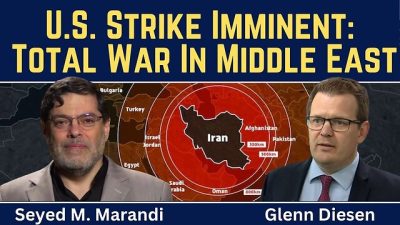
Seyed M. Marandi: Toward Total War in the Middle East
or go to
Aletho News Archives – Video-Images
From the Archives
The Geopolitics behind the War in Yemen (I)
By Mahdi Darius NAZEMROAYA | Strategic Culture Foundation | 30.03.2015
The United States and the Kingdom of Saudi Arabia became very uneasy when the Yemenese or Yemenite movement of the Houthi or Ansarallah (meaning the supporters of God in Arabic) gained control of Yemen’s capital, Sanaa/Sana, in September 2014. The US-supported Yemenite President Abd-Rabbuh Manṣour Al-Hadi was humiliatingly forced to share power with the Houthis and the coalition of northern Yemenese tribes that had helped them enter Sana. Al-Hadi declared that negotiations for a Yemeni national unity government would take place and his allies the US and Saudi Arabia tried to use a new national dialogue and mediated talks to co-opt and pacify the Houthis.
The truth has been turned on its head about the war in Yemen. The war and ousting of President Abd-Rabbuh Manṣour Al-Hadi in Yemen are not the results of «Houthi coup» in Yemen. It is the opposite. Al-Hadi was ousted, because with Saudi and US support he tried to backtrack on the power sharing agreements he had made and return Yemen to authoritarian rule. The ousting of President Al-Hadi by the Houthis and their political allies was an unexpected reaction to the takeover Al-Hadi was planning with Washington and the House of Saudi. … continue
Blog Roll
 Aletho News
- Pakistan-Iran talks secure LNG shipment to Islamabad through Hormuz
- Black Sea grain crisis puts global wheat supplies under pressure
- IRGC air defenses destroy another US MQ-1 drone over Strait of Hormuz
- Imran Khan’s entire immediate family detained in Pakistan ahead of mass protest demanding his release
- EU nation detains former presidential frontrunner
- Leaked: Britain’s Sham Conviction Of Hashim Thaci
- Seyed M. Marandi: U.S. Strike Imminent – Toward Total War in the Middle East
- Russia Voted Under Fire. Washington Is Loading the Tankers.
- 12 Things Your Oncologist Was Trained Not to Tell You
- Anthrax Attacks Paved Way for COVID-Era ‘Junk Drugs and Vaccines’
- If Americans Knew
- Israeli Attacks in Gaza Kill at Least Seven Palestinians Over Three Days, including Woman and Child
- Trump’s militarization of Washington DC as he pursues Israel’s war against Iran
- Why Israel Fears This Searing New Documentary
- Huckabee aide solicited cash gifts from Israelis
- This isn’t sci-fi, AI is already killing people
- ‘The Most Brutal Thing’: Investigation Reveals Execution of Elderly Woman in Rafah
- Inside Israel’s ‘soft’ ethnic cleansing plan for Gaza through the eyes of its victims
- New online database tracks pro-Israel political donations in the United States
- Israeli president pardons soldier convicted for killing wounded Palestinian
- Singer Ed Sheeran says his ‘heart broken’ by Gaza devastation, addresses Macklemore controversy
- No Tricks Zone
- 2025 Nature Paper Claiming Worsening Global Drought Gets RETRACTED …Heavily Flawed
- New Study: ‘Global Drought Shows No Detectable Recent Acceleration Under Climate Warming’
- Economic Masterminds: German Socialists Suggest Taxing Productivity Gains Stemming From Using AI
- The South China Sea Has Not Been Cooperating With The Climate Change Narrative
- Energy Crisis: Germany Enters Heating Season With Historically Low Gas Reserve Fill Levels
- New Study: The Antarctic Ice Sheet Gained Mass From 2020-2024 Due To Staggering Snow And Ice Accumulation
- Study: Ocean Heating Rates From Thousands Of Years Ago ‘Dwarf’ Modern Ocean Heating Rates
- Climate Extremists Target, Attack Large-Scale Power Grid Infrastructure In Germany!
- New Study: Antarctic Ice Melt Has Contributed Less Than 1 Centimeter To Sea Level Rise In The Last 30 Years
- Fear Of Debate: Alarmist German Climate Scientist Calls On Mainstream Media To Discredit Skeptic Voices
 Aletho News