Maximum Land with Minimum Palestinians: The Annexation of Area C

In the vast majority of Area C Israel denies Palestinians any opportunity to build or develop.
By Sam Gilbert | Palestine Chronicle | June 29 2013
Early this month Israeli human rights organization B’Tselem published a report on Israel’s policy in Area C and its implications for the population of the West Bank. Less then a week later Economy Minister Naftali Bennett, in the midst of Kerry’s attempts to start the stalled peace talks, reiterated his plan to annex all of Area C to the Israeli state, bringing with it the 350,000 some od settlers as well as 62% of land of the West Bank.
In a conference held by the settler Yesha Council Bennett said “the attempt to establish a Palestinian state in our land has ended … That we need to Annex area C of the West Bank now because the idea of creating a Palestinian state there is over.”
Bennett’s comments were met with international condemnation, the timing of his words seen as purposefully undermining Kerry’s attempt to restart the stalled peace negotiations. These comments, along with others from the Israeli right, have been presented as marginal within the mainstream Israeli political discourse. However the substance of Israeli policy and practice in the West Bank requires that these ideas been taken seriously.
Bennett’s Israel Stability Initiative published in 2012 lays out his plan for annexation, while B’tselem’s Report on Area C outlines the application and effect of Israeli Policy in Area C from 1995 till today. Each report has fundamentally different political objectives yet both provide a window into Israeli politics and practices in the Occupied Palestinian Territories (oPt).
The Israel Stability Initiative
In 2012 Naftali Bennett presented a 7-point plan for managing the Arab-Israeli Conflict in Judea and Samaria, the biblical term for the West Bank. The Israel Stability Initiative outlines a plan whereby Area C, the territory that Israel maintains full security and planning control after the Oslo agreement, would be annexed to Israel and the Palestinian State would be created in the disconnected cannons of areas B and C. Bennett’s plan would naturalize the 50,000 Arab residents (official number at 180,000), along with the 350,000 Israeli settlers. No Palestine refugee would be allowed to return to the west bank or Israel, and Gaza would be left to fend for itself.
The PA would be granted, “Full autonomy in areas A and B” while Israel would maintain a “full security umbrella for all of Judea and Samara.” The IDF would maintain a strong presence and complete security control over all of Judea and Samaria.”
While this proposal might seem especially partial to Israeli interests, B’tselem’s recent report on Area C shows how Bennet’s plan is in essence the institution of permanence for something has already become the de-facto reality in the west bank today.
B’Tselem Report
Earlier this month B’Tselem published a 111 page report titled “Acting the Landlord: Israeli Policy in Area C, the West Bank. The report presents Israel’s policy in Area C and explores its implications for the population of the West Bank as a Whole.
Area C is a product of the Oslo accords, an interim agreement that was supposed to lead to the establishment of a Palestinian state next to Israel. In 1995 the interim agreement went into effect in West Bank and the region was divided into three administrative categories A, B and C. “Area A: Under full control of the Palestinian Authority, comprising 18 percent of west bank including most Palestinians cities and population center. Area B, 22%: Israel retains military control while PA controls civil matters. Area C, 60 percent: Israel controls security and land related matters, including land allocation, planning and construction, and infrastructure.”
These divisions were based on demography not geography, with A and B subdivided into 165 disconnected cantons with no territorial continuity and surrounded by area C. Area C on the other hand is territorially contiguous, and comprises all the settlement and settlers in the west bank (350,000) along with some 180,000 Palestinians.
Area C contains the vast majority of the West Bank’s natural resources (water, agricultural, mineral) and nearly all of the development potential for a future Palestinian state. Area C lands surround all areas of A and B stifling growth in these already built up areas, and disconnecting the regions from one another
Legalizing the Norm
Claim to the greater land of Israel (Eretz Israel), has been a common thread in Israeli politics since the state’s inception and before. Bennet’s proposed plan to annex all of Area C (a modified two state solution) is interesting in that it simply cements the reality on the ground today, extending it to a final solution to the conflict.
B’Tselem’s report underscores how Israel’s policy in area C is anchored in the perception of the area as meant above all to serve Israel’s Own Needs in favor to those of the Palestinians by restricting Palestinian construction and development throughout.
In the vast majority of Area C Israel denies Palestinians any opportunity to build or develop. In fact since 1967 only .6 percent of the entire area C has been allocated to Palestinians by the Civil Administration, while 31 percent has been allocated to pseudo governmental World Zionist Organization (which develops settlement), 8 percent to Settlement Authorities, 12% to government ministries with an additional 30 percent designated as Military Firing Zones.
According to international law, planning and construction policy for Area C should rely on Jordanian planning law, but this has been altered by order of the Israeli military to serve the state’s purposes. One outcome has been the refusal of Civil Administration to plan villages, approving Mandatory Plans for only 16 of 180 villages in Area C. Since all construction in Area C requires approval of Civil Administration, the prospect for receiving a building permit without a master plan is negligible. In fact between 2000-2010 of the 3050 application for permits only 6.5% were approved. Many are forced to build without permits, at constant risk of demolition (660 a year since 2000).
Yet “in contrast to the restrictive planning policy followed for Palestinian communities, the Israeli settlements, also in Area C, enjoy expansive allocation of land, detailed planning, connections to advanced infrastructure and a blind eye regarding illegal construction.”
In 75% of the settlements, building was carried out without the appropriate permits, legalized retroactively by government and military. Between 2000-2007, 91 building permits were issued for Palestinians, same period 17,000 residential units were built in settlements. While Palestinians in area C are isolated from areas A and B, Jewish settlements are connected to one another and to Israel proper by Jewish only bypass roads.
The international community has time and again confirmed the illegality these actions under International Humanitarian Law. Yet insufficient international pressure (particularly from the U.S.) has led to a situation where Israel strengthens it hold on Area C and “preserves a de-facto annexation of area C and creates circumstance that will help perpetuate this state and influence the final status of the Area.”
The Party Line
Bennet’s Ideas about area C reflect a broader hostility within the Knesset about Palestinian statehood and the need to annex all or most of West Bank. In a Times of Israel interview, Deputy minister of Defense Danny Dannon spoke about the sentiment within the coalition government: “there was never a government discussion, resolution or vote about the two-state solution… and nobody will bring it to a vote, it’s not smart to do it — but if you bring it to a vote, you will see the majority of Likud ministers, along with the Jewish Home [party], will be against it.”
Numerous quotes from current cabinet minsters confirm this position:
“The essence of Zionist existence in Israeli settlements across the country.” – Moshe Ya’allon: Defense Minister.
“The real solution is to extend Israeli sovereignty over the settlements in Judea and Samaria.” — Danny Dannon, Deputy Defense Minister.
“We will try to apply sovereignty over as much as we can at any given moment.” — Ze’ev Elkin, Deputy Minister of Foreign Affairs.
“Israel should announce the annexation of Jewish settlements in Judea and Samaria.” — Gilad Erdan, Minister of Communication and Home Front Defense.
“Israel will need to take unilateral steps to extend Israeli sovereignty over the Jewish settlements in Judea and Samaria.” — Yisreal Katz Minister of Transportation.
Annexation: The Final Solution
The vocal support of annexation has been attributed to the right wing shift in the government in Israel, yet its mainstream credentials are exposed with even a cursory glance at policy and practice in the west bank through Israeli history.
Every Israeli president since Menachem Begin in the 70’s has publicly espoused a two state solution based on Bilateral U.S. brokered negotiations, while simultaneously doing everything in their power to undermine its physical viability on the ground.
Netanyahu’s most recent statements, considered “moderate” in comparison to Bennet’s, nonetheless betray the administration’s position to undermine the two state solution, as noted in Peace Now’s report on settlement construction under the current administration. In response to the proposed peace talks Netanyahu said that Israel would continue to build and that “construction in major settlement blocks does not substantially affect Israel’s ability to come to an agreement.” He went on to say that “We will continue to live and build in Jerusalem, which will always remain united under Israeli sovereignty,” as published by the Israeli daily, Isreal Hayom and Haaretz.
Considering East Jerusalem is the internationally recognized future capital for the Palestinian state, and that settlement expansion is the number one obstacle to peace, these comments say much about the prospects for a future agreement. Furthermore, the proposed state Netanyahu supports is one that according to him “would have to be demilitarized and with arrangements that rely fully on the Israel Defense Forces for security.” A state that doesn’t control its borders or security and whose army is the occupying power is not an autonomous state, but the “state” of Palestine today.
Netanyahu’s position toward the Palestinians in consistent with the low ceiling allowed for Palestinian aspirations since the onset of the peace processes. Oslo, the basis of the most current arguments about annexing area C, provides a telling example. As scholar Rashid Khalidi, one of Yassar Arafat’s key advisers during the Oslo negotiations, states, “It (the Oslo agreement) was never designed to achieve independent Palestinian statehood. It was never designed to end the occupation. It was really designed, of all people, by Menachem Begin, to make permanent Israeli control over the occupied territories. And that is what has succeeded until now.” Indeed it has. Since the signing of the Oslo agreement settlement population in West Bank (not including East Jerusalem) has tripled from 110,900 to nearly 350,000, according to B’Tselem.
Palestinian author Naseer Aruri notes the occupation was never designed to be temporary, but has been used to create the illusion of a two-state solution when that option has never been on the real agenda. Madrid, Oslo, Camp David all have been used as diplomatic cover as Israel has consolidated and even extended its illegal occupation.
B’Tselem’s report exposes the fact that Israeli policy gives every indication of permanence. “Israel preserves a de-facto annexation of area C and creates circumstance that will help perpetuate this state and influence the final status of the Area.” If we acknowledge Israeli policy in tandem with territorial usurpation, then comments like Bennet’s need not be viewed as extreme. It is time the International community, the U.S. and those moderates in the Israeli Knesset acknowledge that what Bennett’s is arguing for is not on the margins of Israeli political thought but the ideological underpinning of Zionism as practiced in the oPt. And in area C the Zionist goal of maximum land with minimum Palestinians is on full display.
– Sam Gilbert is a journalist living in Ramallah.
‘They have two roads on our land already, why do they need a third…?’
International Solidarity Movement | June 27, 2013
Hebron, Occupied Palestine – In the Wadi al-Hussein area of Hebron, Israeli occupation forces have started to build a new road ‘for military purposes’. The route of the road is from the illegal settlement of Kiryat Arba towards the city centre, directly across Palestinian-owned land.
A military order has decreed the construction of this road, four metres wide and more than two hundred metres long, cutting through fields of olive and fruit trees owned by the Palestinian families living there. The stipulation on the width of the road has already been broken, with the route that has been cut by bulldozers being six metres wide in places.
In contrast to the military order to build a road, Palestinian landowners have been denied the right to build on their own land. Despite gaining approval from the Palestinian Authority, the Israeli authorities (who have the final say on civil matters in area H2 of Hebron) have refused permission to build a new house. Landowners also point out that there are two existing roads from Kiryat Arba built on Palestinian land for Israeli-use only, and ask why a third is required.
When occupation forces attempted to build this road initially, landowners and others tried to stop construction by sitting down in front of bulldozers, but this non-violent protest was met with arrests, fines and imprisonment, and by the bulldozer dumping a load of earth on top of them.
Landowners complain that Israel insists on applying those aspects of the Hebron accords that benefit settlers, while ignoring those aspects covering the rights of the majority Palestinian population. Using military orders to steal land is a tactic long-used by Israel. Land seized this way then later typically becomes part of the ever-expanding settlement project. All Israeli settlements are illegal under international law, which bans the transfer of the occupier’s population into the land under occupation.
Related articles
- Jewish settlers setting up tent and planning road on Palestinian owned land in Al Khalil (alethonews.wordpress.com)
- Settlers building illegal road on Palestinian land in Hebron (palsolidarity.org)
- Susiya resists mass demolition orders (alethonews.wordpress.com)
- Settlers Attack Palestinians In Hebron (imemc.org)
- New road connects Israeli settlement with the Ibrahimi Mosque (ramyabdeljabbar.wordpress.com)
The Gates Foundation and its unethical investments in G4S
By Ramona Wadi | MEMO | June 20, 2013
While three Dutch charities have announced that they will no longer accept donations by G4S due to the company’s support for the Israeli occupation, the Gates Foundation has deemed it ethical to invest in G4S, effectively exposing the often ignored link between philanthropy and human rights violations.
The Gates Foundation, renowned for its philanthropy, is allegedly ‘inspired by passion and compassion for the well-being of people’. Focusing on issues such as health, education, poverty, the Foundation now seems to be seeking a share in security affairs, effectively aligning itself with the conspiracy behind the fable of safeguarding human rights. Philanthropy should be viewed within a wider image – a surplus of funds derived from a capitalist enterprise channelled into appropriate projects which bestow a continuous temporary relief in order to avoid challenging the exploitation which has rendered communities around the world dependent upon charity. With the Gates Foundation aligning its interests with a service provider of oppression, profits will continue to fund approved projects at the expense of violating international human rights law, which is acceptable within the cycle of capitalist dependency.
G4S has been targeted by the BDS movement for its role in providing security and surveillance equipment, rendering the company complicit in war crimes with Israel’s security service, Shin Bet. Torture during interrogations is routine treatment in Israeli jails, often resulting in severe physical and metal degeneration or, as in the case of Arafat Jaradat, death. G4S endorses identical security concern rhetoric as that used by Israel, manipulating the foundations of human rights and security into a territory which encompasses nothing but the alleged rights of the oppressor.
In their 2012 Corporate Social Responsibility Report, G4S states that the company recognises it can ‘play a positive and negative role in respecting human rights around the world’. The company declares that its policy is based upon the Universal Declaration of Human Rights (1947), the International Covenant on Civil and Political Rights (1966), the International Convention on Economic, Social and Cultural Rights (1966) and the international Labour Organisation Declaration on Fundamental Rights at Work (1998). ‘Mapping the human rights landscape’, as stated in the report, and becoming a signatory to the UN Global Compact, are portrayed as a pledge to safeguard human rights, disregarding the UN’s significant faults and unapologetic stances when it comes to selectively bestowing human rights in order to promote and consolidate the impunity of powerful states and allies. In other words, G4S are emulating their provision of security services and basing their legitimacy upon an international organisation which thrives upon illegality.
Dependency has created a spectator society. While activist campaigns have created a far reaching resonance, leaders within the international community are too comfortably ensconced in their glorified positions to challenge a partnership which fuels the Israeli occupation’s crimes against Palestinians. As long as the interpretation of the social world is shaped by dominant allies, it is difficult to fragment the bond between society and economic power, effectively allowing an amalgamation of a ruling power to distort the power of intellectuals into a subservient role abetting international complicity in human rights violations.
US officials arrive in Qatar for peace talks with Taliban
Press TV – June 22, 2013
The US special representative on Afghanistan and Pakistan has arrived in Qatari capital city of Doha to hold controversial peace talks with the Taliban militants.
James Dobbins, the US envoy in charge of nascent dialogue with the group, arrived in Doha on Saturday after the militants opened an office in the Persian Gulf Arab monarchy.
The US officials said Dobbins will also take part in meetings between Secretary of State John Kerry and Qatari leaders scheduled for later Saturday. The discussions will lay the ground for a full-scale dialogue with the militant group.
President Barack Obama’s administration has supported peace talks with the Taliban after the US-led forces lost ground against the militants in recent months across Afghanistan.
Senior Pakistani officials have welcomed the dialogue between Taliban and the United States in Doha, but the Afghan government has expressed serious concerns about the ongoing US-led peace process with Taliban militants in Qatar.
On Thursday, Afghan Foreign Ministry released a statement expressing Kabul’s anger and frustration at the opening of Taliban office in Qatar.
“The manner in which the office was established was in clear breach of the principles and terms of references agreed with us by the US government,” the statement read.
Senior officials in Kabul say the move contradicts the US security guarantees, noting that the Taliban militants will be able to use the office to raise funds for their campaign in Afghanistan.
The Kabul government has suspended strategic talks with Washington to discuss the nature of US presence after foreign troops withdraw in 2014.
President Hamid Karzai has also announced that his government will not join any US negotiations with the Taliban unless the talks are led by the Afghans.
Meanwhile, Afghanistan’s High Peace Council stated that none of its members will travel to Qatar to sit at talks with the Taliban.
The council has been making efforts to initiate dialogue with discontented Afghans and militants who have engaged in warfare with the US-led forces and Kabul’s Western-backed government.
The United States and its allies invaded Afghanistan in 2001 as part of Washington’s so-called war on terror. The offensive removed the Taliban from power, but after more than 11 years, insecurity remains across the country.
UN statement on Israeli plan to relocate Palestinians to build houses for settlers
MEMO | June 17, 2013
A UN organisation has highlighted the plight of small Palestinian farming communities in the hills to the east of Jerusalem which are at risk of forced displacement due to a “relocation” plan advanced by the Israeli authorities. The UN Office for the Coordination of Humanitarian Affairs in Occupied Palestinian Territory (UNOCHA) said that the Israelis try to justify their plan on the grounds that the residents do not “possess title over the land”. Around 80 per cent of the people affected are refugees who were forced from their original lands in the south of the country in the early 1950s.
“A combination of measures adopted by the Israeli authorities has created a coercive environment for the communities,” said OCHA. They have restricted access to grazing land and markets to sell their produce. “These acts have undermined their livelihoods and increased their dependency on humanitarian assistance.”
In addition to demolition and the threat of demolition of homes, schools and animal shelters, as well as corresponding restrictions on obtaining building permits, the authorities have also failed to protect the communities from intimidation and attacks by Israeli settlers, alleges OCHA. “The communities have been told that they have ‘no choice’ but to leave.”
The UN organisation stated that the Israeli authorities have allocated public (state) land in two sites designated for the relocation, and prepared planning schemes, which are at final stages of approval. It added that this step raises cultural concerns as it threatens the traditional way of life for these people.
Israel’s plan includes the construction of thousands of housing units for illegal settlers in the E1 area, which creates a continuous built-up area between the Ma’ale Adumim settlement and Jerusalem. OCHA said that this plan has been frozen since the late 1990s, but the Israel government has recently reactivated it.
“The affected area is also planned to be surrounded by the Barrier [West Bank Separation Wall],” said OCHA. “If implemented, these plans will undermine Palestinian presence in the area, further disconnect East Jerusalem from the rest of the West Bank, and disrupt the territorial contiguity of the occupied territory.”
According to the OCHA report, “The UN Secretary General has stated that the implementation of the proposed ‘relocation’ would amount to individual and mass forcible transfers and forced evictions, prohibited under international humanitarian law and human rights law.”
The Secretary General based his statements on the following grounds:
- As an occupying power, Israel has an obligation to protect the Palestinian civilian population and to administer the territory for the benefit of that population.
- The destruction or confiscation of private property, including homes, as well as the transfer of settlers into occupied territory, is also prohibited.
OCHA pointed out that these residents are “calling for the international community to protect them and assist them in their current location and to afford adequate planning and permits for their homes and livelihood-related properties.”
Related articles
- Israel lawmakers approve plan to displace Negev Bedouins
- Israel threatens to demolish ‘illegal’ Bedouin school
- ISRAEL: Water being used to coerce Bedouin villagers, says NGO
- The Negev’s Hot Wind Blowing
- Palestinian Bedouins threatened with ethnic cleansing
- Israeli cabinet announces plan to forcibly displace tens of thousands of indigenous Bedouins
Israeli occupation police close streets, confiscate lands in Jerusalem
Palestine Information Center – 13/06/2013
OCCUPIED JERUSALEM — Israeli occupation police closed main streets leading to the Old City in occupied Jerusalem on Thursday, local sources said.
The Israeli decision to close the streets came due to the preparations for the organization of the Formula 1 race, which will take place on Thursday and Friday in the occupied city of Jerusalem with the participation of the Ferrari World team, under the sponsorship Kaspersky Company specialized in computer protection programs.
The police declared, in a statement, their intention to close the streets leading to al-Khalil, Asbat, and Al Magharibah Gates in the Old City on Thursday and Friday, according to Jerusalemite sources.
The race will be launched from the neighborhoods in the western part of Jerusalem towards the eastern part, in the vicinity of the Old City wall.
For its part; the Jerusalem Sports Federations Group asserted that the Ferrari race comes within the framework of the Judaization plans implemented by the occupation in the city of Jerusalem.
Meanwhile, the Israeli police, accompanied with bulldozers and trucks, evacuated on Wednesday Wadi Joz car park east of Jerusalem claiming that it belongs to Israel Lands Administration (ILA).
Siyam, Abu Ta’a, and Farhan families confirmed that the car park was established on their own lands, declaring their intention to prosecute the ILA for its racial policy.
The families confirmed that the Israeli authorities have notified them since 6 months to evacuate the car park.
The park owners affirmed that they have official documents confirming their ownership of the land, where they appealed to the Israeli Municipal Authorities which permitted them to rehabilitate the park to be used as a car park, however they were surprised yesterday by the ILA breaking into the park.
Related article
- Settlers Burn Two Cars In Jerusalem (imemc.org)
Settlers from Bracha attack and harass farmer on his land
International Solidarity Movement | June 13, 2013
Al Rujeib, Occupied Palestine – On Friday 7th June five settlers from the illegal settlement of Bracha attacked a farmer on his land, using sling shots to throw stones at him near Huwwara checkpoint. The same settlers continued to harass the farmer in the following days as he tried to graze his sheep and gather his crops, unprotected by the Israeli authorities.
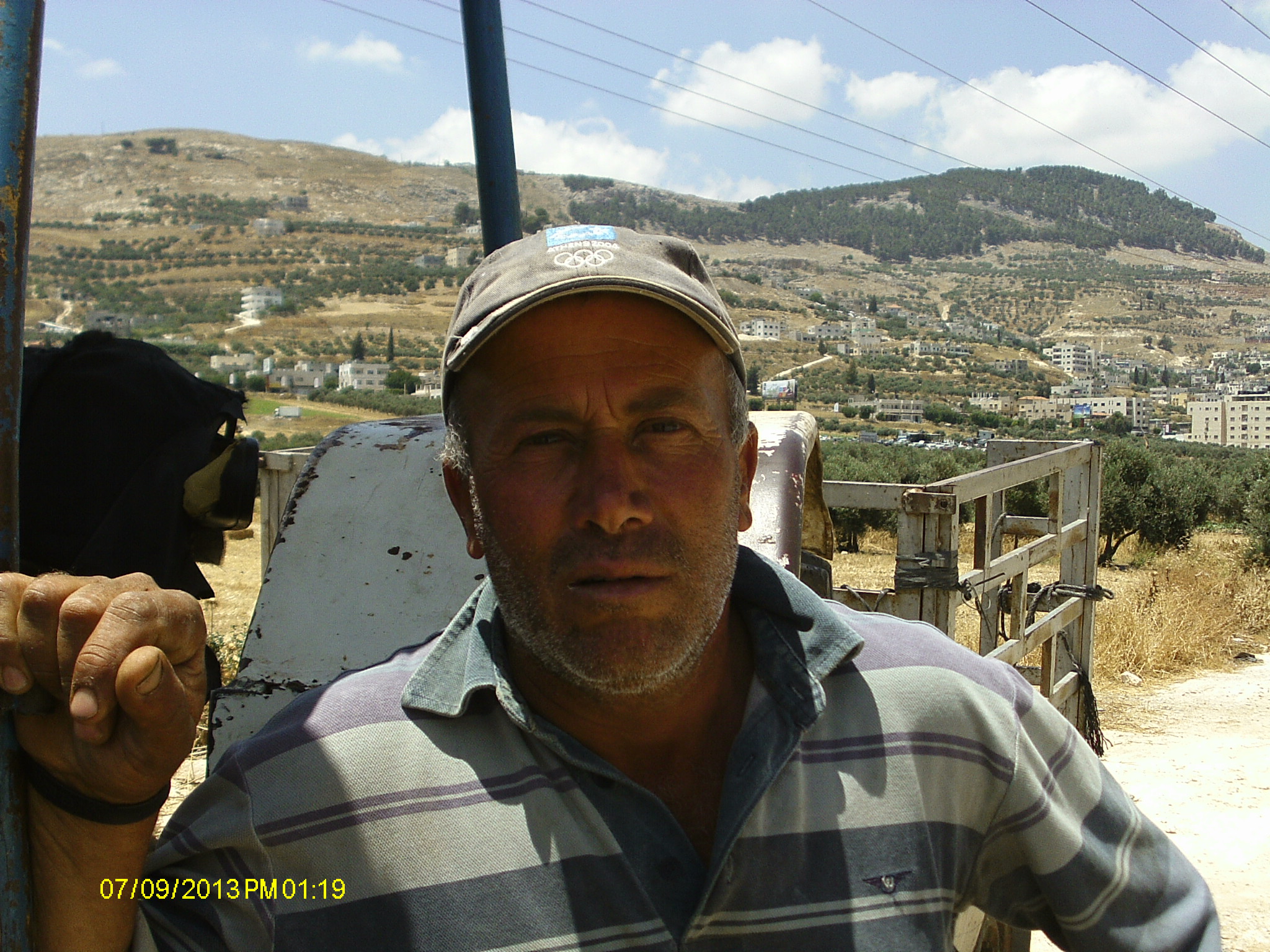
Salah Sukamel Deweket (Photo by ISM)
Salah Sukamel Deweket rents 70 dunums of land between his home in Al Rujeib and the occupation forces’ checkpoint at Huwwara. The land is mainly used to plant crops for his sheep to graze upon.
On Friday 7th June Salah was working hard to enable his sheep to feed when he was surprised by five settlers, thought to be an old man and his four sons who brought their own sheep to eat Salah’s wheat. The settlers threw rocks using slingshots at Salah and his flock. Salah had no one who could help him as he had no number for the District Coordination Office (DCO) – the Palestinian liasion with Israeli authorities or other organisations. Unable to get the number, he returned to his land to find that the settlers had ripped apart his bales of wheat.
The settlers resumed throwing stones at him in full view of soldiers stationed at the Israeli occupation forces checkpoint at Huwwara. The soldiers did nothing but watch as the Palestinian farmer was attacked. As an occupying power the Israeli military are meant to protect all citizens in the territory.
Salah asked the older settler why he had destroyed his wheat. “People who stay in Israeli land have to be good Israeli people”, the settler replied. “If this is Israeli land, where’s Palestinian land?” Salah asked. “There is no Palestinian land” the settler shouted back. The settlers continued to graze their sheep on Salah’s land and then encouraged their sheep to eat the olive trees of another Palestinian farmer who came to protect his land. It was only then that army jeeps came to intervene – asking why the Palestinian farmers were there. Salah tried to explain the problem with the settlers to the army, who told him to take photos and go to DCO. Salah then asked the soldiers if they were going to arrest the settlers, to which they said, ” we don’t know, it’s up to the judge.” When the soldiers were asked why they did not come earlier, they replied that it wasn’t their problem. The next day Salah tried to fix his wheat bales but the settlers kept coming and causing problems. Soldiers eventually came and told both Salah and the settlers to leave but said that the Palestinians must leave first.
Palestinians face many attacks by settlers of varying severity. Religious extremists living in illegal settlements attack Palestinian people, lands and crops. Palestinians have almost no means of legal recourse or protection from settler attacks but are routinely targeted by the army in mass arrests in the alleged defence of the Israeli occupation and settlements. Even when Palestinians can contact the DCO, the coordination office can often not solve issues with settlers who generally are treated with impunity under Israeli law. Settlements are illegal under international law under the fourth Geneva convention.

Salah Sukamel Deweket’s wheat fields (Photo by ISM)
Related articles
- Jewish settlers setting up tent and planning road on Palestinian owned land in Al Khalil (alethonews.wordpress.com)
- After the flames, only determination remains in Burin and Madama (alethonews.wordpress.com)
- VIDEO | 82-year-old Hebron woman Umm Salah challenges Israeli settlers, troops. Alone. (occupiedpalestine.wordpress.com)
- Jewish settler fires at Palestinian workers wounding one of them (occupiedpalestine.wordpress.com)
Israel bans guards from entering Aqsa compound
Ma’an – 08/06/2013
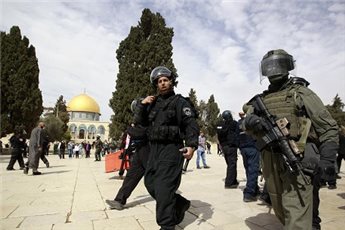
JERUSALEM – Israel on Friday banned 25 Al-Aqsa compound guards from the vicinity of the mosque for varying periods of time.
Samer Qweider was banned from entering Al-Aqsa until the end of Ramadan for allegedly verbally abusing rightists who tried to get into the compound.
Qweider told Ma’an that on May 28 he was banned from entering the compound for six days, and accordingly he returned to his job on Monday. After two days of working regularly he was told by Israeli police he was not allowed to enter the compound until Ramadan ends in mid-August.
Another guard, Fadi Bakeer, said that Israel wanted to “silence” the guards, and added that any guard who tried to stop rightists from entering the holy compound would be banned.
A religious department worker said that guards are pressured, arrested, beaten, banned, and fined. He added that his department has pleaded for King Abdullah II of Jordan for help.
Israeli authorities have allowed the Jordanian leadership a degree of control over the holy Muslim site as well as the Church of the Holy Sepulcher due to its historical connections to Jerusalem.
Israel seized the West Bank including East Jerusalem from Jordan in the Six-Day War of 1967.
Related article
- Palestine: The global march to Jerusalem to launch tomorrow in 40 states & demands to flock to Al-Aqsa Mosque (realisticbird.wordpress.com)
Farming in Khuza’a, Gaza Strip
Gal.la | June 5, 2013
Gaza, Occupied Palestine – Farmers are working in Gaza buffer zone under threat of Israeli soldiers, tanks, bullets, etc. This video shows the difficulty of daily life for farmers in Khuza’a, south of Gaza Strip.
Canadian church boycotts companies in Israeli settlements
MEMO | May 31, 2013
Canada’s largest Protestant church, the United Church of Canada, has decided to boycott three Israeli companies as part of its campaign against products manufactured in illegal settlements in the Occupied Palestinian Territories. The “Unsettling Goods: Choose Peace in Palestine and Israel” campaign is set to start on Saturday and will last for a year. It calls for “education and for economic action by United Church members to end the Israeli occupation of Palestinian Territories.”
Last week, the church’s governing General Council approved the proposal to boycott Keter Plastic, SodaStream and Ahava which all operate in illegal settlements. The move builds on last year’s agreement to boycott products manufactured in Israeli settlements in the occupied West Bank and Jerusalem which the Church regards as the principal obstacle to peace in the region.
A statement on the United Church’s website said that in the coming months it “will engage in dialogue” with the three companies and request them to cease production in settlements: “They will be informed that failure to do so will result in economic action against their products.”
America’s Long History of Bloodletting
By Lawrence Davidson | Consortium News | May 30, 2013
There is an American tradition of frequent war. Indeed, over the course of the country’s history the United States has been at war almost constantly. Some of these have been relatively short conflicts like interventions in various Central American venues. Some have been much larger and longer affairs, like the Civil War, World War II and Vietnam.
The point to be drawn from this is that the people of the United States are (perhaps unconsciously) acclimated to always being in one sort of armed conflict or another. Unfortunately, this history renders a recent public statement by the Pentagon’s general counsel, Jeb Johnson, into just a bit of fanciful idealism. He insisted “war must be regarded as a finite, extraordinary and unnatural state of affairs.” Certainly not for Americans.

An Army sergeant peers out the door of a UH-60 Black Hawk helicopter on the way to pick up soldiers in a training operation at Joint Base Elmendorf-Richardson, Alaska, May 23, 2013. (U.S. Army photo by Percy Jones)
With their active assumption that the U.S. represents the world’s best chance for the victory of “good” against “evil,” Americans seem willing to battle on as long as they are convinced they are winning and the casualties are low. That may be why there was no popular protest when Michael Sheehan, Obama’s assistant secretary of defense for “special operations,” told a Senate hearing that the country’s “war on terror” might last “at least 10 or 20 years” longer (it has already been going on 12 years). In the mainstream media, there was not even a noticeable raising of an anchorperson’s eyebrows!
The reason given for Sheehan’s prognosis was that al-Qaida, and its franchise allies, keep recreating themselves as fast as their alleged leaders can be droned into oblivion. Missing from the congressional and media reaction was the obvious question of “how come” such groups keep recreating themselves?
Many middle-echelon State Department analysts familiar with the Middle East know the answer has something to do with the fact that U.S. policies in the region have not significantly changed since the 9/11 attacks. Most of the personnel above the middle echelon are political appointees who keep asserting that what motivates the al-Qaida types is religious fanaticism.
Of course there are religious fanatics at work on both sides of the “war on terror,” but those in the Middle East have grievances to focus on and U.S. policies are seen as one source of those. The fact that the “war on terror” is largely a consequence of American policies cemented into place by powerful special interests calls into question President Barack Obama’s recent assertion that “this is a just war, a war waged proportionally in last resort and in self-defense.”
It also suggests that the struggle is likely to go on and on until its ruinous consequences become so obvious to the voting public that the politicians are forced to break with their special-interest supporters. This is the real criterion for change, for, under the present circumstances, there will always be “terrorists” out there who, to reword (and correct) an assertion by President George W. Bush, “hate our policies.”
And what is there not to hate about draconian sanctions, the arming of dictators, and giving opened-ended support to the most racist state in the region?
Rules of Engagement
In the meantime, President Obama has been trying to create “rules of engagement” for the use of the government’s primary weapon in this endless war: those remote controlled bombs we call drones. These rules will, he says, provide “clear guidelines, oversight and accountability” and satisfy partisan congressional grumblings, if not the more pertinent questions of human rights advocates.
To this end the White House has issued guidelines concerning procedures for counterterrorism operations such as drone attacks. The guidelines tell us “there must be a legal basis for using lethal force” and decisions to use such “force against individual terrorists outside the United States and areas of active hostilities are made at the most senior levels of the U.S. Government.” The document then lays out other specific preconditions for the use of lethal force, among which are:
1. “Near certainty” that the terrorist target is present.
2. “Near certainty” that noncombatants will not be injured or killed.
3. An assessment that “capture is not feasible at the time of the operation.”
4. An assessment that the relevant governmental authorities in “the country where action is contemplated cannot or will not effectively address the threat to U.S. persons.”
5. An assessment that “no other reasonable alternatives exist” to effectively address the threat to U.S. persons.
Finally, “International legal principles, including respect for sovereignty and the law of armed conflict, impose important constraints on the ability of the United States to act unilaterally – and on the way in which the United States can use force. The United States respects national sovereignty and international law.”
The problem with these guidelines, beyond a number of undefined terms such as “near certainty,” “reasonable” and “feasible,” is that its criteria misrepresent reality or are utterly unreliable. For instance, under international law there is no “legal” basis for this sort of use of “lethal force.”
What the Obama administration (and the Bush regime before it) has done is take up the illegal Israeli “targeted assassination” program, which constitutes the behavior of a rogue state. Even from a domestic legal prospective, Obama’s criteria for targeted assassination will be carried out behind closed doors. There will be no due process. And there will be no accountability for “mistakes.”
Finally, nothing in the guidelines is enacted into legislation and therefore, assuming an effort to actually follow their criteria, they are specific to the Obama presidency and have no authority over his successors. As Kenneth Roth, director of Human Rights Watch, put it, “a mere promise that the U.S. will work within established guidelines . . . provides little confidence that the U.S. is complying with international law.”
Throughout the country’s history of one war following another, there has been a parallel history of cyclical deterioration and recovery of constitutional rights.
However, with the government’s wholehearted embrace of targeted assassination, as well as modern surveillance technology and the precedent of offshore prisons for “enemy combatants,” one wonders if, from now on, the recovery of rights will ever be fully equal to their loss. Maybe now it really will be all downhill for freedom in the “land of the free.”
~
Lawrence Davidson is a history professor at West Chester University in Pennsylvania. He is the author of Foreign Policy Inc.: Privatizing America’s National Interest; America’s Palestine: Popular and Official Perceptions from Balfour to Israeli Statehood; and Islamic Fundamentalism.
Featured Video

Trita Parsi: Middle East Unraveling — Are We on the Path to World War?
or go to
Aletho News Archives – Video-Images
From the Archives
Why Saudi Ties to 9/11 Mean U.S. Ties to 9/11
By Kevin Ryan | Dig Within | September 27, 2015
Media interest in Saudi Arabian connections to the crimes of 9/11 has centered on calls for the release of the 28 missing pages from the Joint Congressional Inquiry’s report. However, those calls focus on the question of hijacker financing and omit the most interesting links between the 9/11 attacks and Saudi Arabia—links that implicate powerful people in the United States. Here are twenty examples. … continue
Blog Roll
 Aletho News
- Neria Leiter Was A Legitimate Military Target
- Integrity Initiative: UK-funded network framed dissent as Russian disinformation for years
- ‘We don’t seek permission to defend our country’: Snippets from President Pezeshkian’s UNGA address
- NATO chief wants Europeans to fight American wars [for Israel]
- German chemicals giant reveals details of downsizing
- Refaat Al-Areer Was The Canary In The Coal Mine In Israel’s War On The Truth
- Israeli election committee bars candidate from Knesset race over Gaza war opposition
- French-Lebanese man files war crimes complaint over Israeli attacks
- Mahan Air Flight Lands in China Despite US Threat against Iranian Airlines
- US eyes $10bn fund to rebuild war-battered Gulf infrastructure
- If Americans Knew
- Caught on Tape: AIPAC CEO Boasted of Controlling Trump’s National Security Officials
- Why Hamas Attacked Israel in October 2023 – Israeli professor Ilan Pappé
- They see them, then kill them: Israeli quadcopters track, deliberately target civilians in Gaza
- Winter could turn Gaza’s treacherous, war-damaged buildings into deathtraps
- Majority of Democratic Voters Want to Prosecute Both Biden and Trump Administration Officials Over Gaza
- As Gaza languishes, world leaders gather at the UN – Daily Update
- Sanctions are collective punishment: immoral and self-defeating
- Phosphorus Munitions Fired by Israel Burn Groves, Orchards in Southern Lebanon
- Israel Carries Out New Ceasefire Violations Across Gaza
- AI – Emphasis on the ‘I’: Israel Is Funding AI Chatbot Propaganda
- No Tricks Zone
- New Study: Earth And Venus Surface Warmth Largely Explained By Convection And Lapse Rate, Not CO2 Or Radiation
- 2025 Nature Paper Claiming Worsening Global Drought Gets RETRACTED …Heavily Flawed
- New Study: ‘Global Drought Shows No Detectable Recent Acceleration Under Climate Warming’
- Economic Masterminds: German Socialists Suggest Taxing Productivity Gains Stemming From Using AI
- The South China Sea Has Not Been Cooperating With The Climate Change Narrative
- Energy Crisis: Germany Enters Heating Season With Historically Low Gas Reserve Fill Levels
- New Study: The Antarctic Ice Sheet Gained Mass From 2020-2024 Due To Staggering Snow And Ice Accumulation
- Study: Ocean Heating Rates From Thousands Of Years Ago ‘Dwarf’ Modern Ocean Heating Rates
- Climate Extremists Target, Attack Large-Scale Power Grid Infrastructure In Germany!
- New Study: Antarctic Ice Melt Has Contributed Less Than 1 Centimeter To Sea Level Rise In The Last 30 Years

