Israeli forces shut down media launch in Jerusalem
Ma’an – 02/04/2012
JERUSALEM – Israeli forces raided the Jerusalem office of a university media institute on Monday, shutting down the launch of an online media network and detaining employees.
Plainclothes police shut down the launch of the Hona al-Quds news site in the al-Khalidiya neighborhood of Jerusalem’s Old City, and confiscated equipment and files, network director Harun Abu Arrah told Ma’an.
Two employees — Adel Ruished and Mohannad Izheman — were detained, and guests attending the launch were blocked from entering.
Employees were presented with an order signed by the Israeli minister of internal security forbidding the event as a banned initiative of the Palestinian Authority, director of Al-Quds University Institute for Modern Media Lucy Nusseibeh told Ma’an.
The university, which launched Hona al-Quds, has been registered as an independent non-governmental organization with Israeli authorities for decades, Nusseibeh added.
The launch was intended to take place simultaneously with the institute’s Ramallah office by Skype.
Izheman, a university security guard, has since been released with a summons to return to police offices on Tuesday, and Ruished, the university’s Administrative Director of Jerusalem Affairs, is still being held, a university statement said.
Israeli police spokesman Mickey Rosenfeld said the facility was “closed until further notice,” on suspicions of use for Palestinian official activity in Jerusalem.
“This is the second attack on our media institution in five weeks — this is education and not a political project,” Nusseibeh said.
In late February, Israeli forces raided the institute’s Al-Quds Educational TV in Ramallah-district Al-Bireh and confiscated its broadcasting equipment, claiming it was interrupting legal broadcasting.
The same day, Israeli forces also raided Watan TV’s newsroom in Ramallah and seized transmitters.
Reporters Without Borders said at the time it was “deeply shocked” by the raids.
“These arbitrary and illegal operations served yet again to intimidate Palestinian media and journalists, the victims of repeated attacks by the (Israeli army),” the group said in a statement.
Related articles
- Israel raids Ramallah TV stations (alethonews.wordpress.com)
- Israeli forces attack press with ‘total impunity’ (alethonews.wordpress.com)
- Union condemns Israel extending journalist detention (alethonews.wordpress.com)
Israel Casually Bars UN Fact Finding Team
By Sami Zaatari | Palestine Chronicle | March 31, 2012
Imagine if Iran had recently denied allowing a UN fact-finding team from entering their country to inspect and investigate their atomic energy program. What kind of reaction would most likely come out? With no doubt, the United States, as well as Israel would begin to sound the drums of condemnation, and would point to this act as further proof of how sinister Iran is. Yet this is precisely what has recently happened, although it was not the dreaded Iran that barred a UN fact-finding team, rather it was none other than Israel.
There has hardly been any negative reaction or condemnation for Israel’s act. I waited for almost a week to write this article just to see if there would be any negative reaction towards Israel for this act. None. The US said nothing of the matter in terms of condemnation, and Israel has yet again proven it’s complete double standards to the world.
The UN fact finding team that was barred from Israel was part of the UN’s human rights council. Their mission was to go into Israel, and the West Bank to be able to investigate the illegal settlements that Israel has built and continues to build in the West Bank. Once again, contrast this with Iran, what would have happened if Iran did this? Coincidently, Iran has often opened up its atomic energy program for the UN and international inspectors to come in and investigate. Furthermore Iran hasn’t even breached any international law by their atomic energy program for anything to be inspected or investigated in the first place. On the other hand Israel is breaching international law in regard to their settlement building, therefore the UN has a full right to come and investigate the matter, yet Israel has barred them from doing so. Just think about that for a second, Iran is not breaching any law by their atomic energy program, yet they allow investigators in. Israel is breaching international law, yet doesn’t allow any investigators to come in and investigate.
As mentioned, this yet again exposes Israel’s double standards, and once again lays waste to their claims that they supposedly care for international law or respecting UN resolutions. What makes this all the more ironic is not that Israel simply pretends to care about international law or UN resolutions, but rather that they use such concepts/institutions when they seek to drum up pressure against Iran. Whenever Israel seeks to condemn Iran, Israeli politicians enjoy referring to international law, UN resolutions, but when it comes to Israel itself it openly disrespects and defies the very same concepts and institutions.
And where is the US in all of this? Nowhere to be seen, America yet again demonstrates why no level headed Middle Easterner (let alone dissatisfied American citizens) can take them seriously, or can lend them their trust. How can the US on one hand condemn Iran and refer to international law, the UN etc, but when it comes to Israel’s flagrant disregard for such institutions, it stands by quietly? Not to mention that Israel is actually in breach of international law by the very settlements themselves. So one would think that the US would be more than happy for such illegal settlements to be investigated, and would be incensed by Israel’s act of barring such an investigation. If the US wants to be a serious peace broker within the region, and if it actually wants to gain the trust and respect of you’re average Arab on the street, then it is time for America to get rid of it’s open bias in regard to Israel and do what is right in order for peace to be achieved within the region.
Let us end with these words of Israeli Foreign Minister Avigdor Liberman who said the following in regards to the UN fact finding team: “It means that we’re not going to work with them. We’re not going to let them carry out any kind of mission for the Human Rights Council, including this probe.”
– Sami Zaatari is an American of Palestinian-Iranian descent. Zaatari is a writer, and a public speaker who has taken part in public events of inter-faith and inter-community discussions. Zaatari also holds an MSc in the field of Middle East Politics.
Related articles
- Israel Boycotts UN Rights Council over Settlement Investigation Decision (alethonews.wordpress.com)
- Arabs: Israel, US Our Main Concern, Not Iran (alethonews.wordpress.com)
- Israel excitedly rejects cooperation with UN over settlements (alethonews.wordpress.com)
One Killed, 37 Injured, by Israeli troops Gunfire in Gaza Land Day Protests
By Ghassan Bannoura | IMEMC News | March 30, 2012

(Reuters/Ammar Awad and Ronen Zvulun)
A Palestinian 20 year old youth was killed, 37 injured, among them a journalist when Israeli troops opened fire at Palestinian protesters marking land day in the Gaza Strip.
Palestinian sources reported that soldiers opened fire at protesters who marched up to the borders with Israel near Gaza city killing Mohamed Zakout, 20, and injuring 37 others. Among those injured were 3 in critical conditions and a local journalist.
In the West Bank Israeli troops injured 100 civilians including an American activist who marked land day in different parts of the West Bank today.
Marking the 36th anniversary of land day today Palestinians and their supporters marched for Jerusalem demanding an end to the Israeli occupation of the city. Protests were organized near the Israeli Lebanese borders as well as the borders with Jordan.
The Land day commemoration started in 1976, when Palestinian residents of the Galilee to the Negev protested Israel’s plan to expropriate thousands of dunams of land for security and settlement purposes. Israeli military and police attacked the protests leaving 6 killed, hundreds injured.
Related articles
- Scores Injured as Israeli Troops Attack West Bank land Day Protests (alethonews.wordpress.com)
- Palestinian lawmaker wounded in Land Day protest (alethonews.wordpress.com)
- MK Zoabi: Struggle for democracy is a struggle against Zionism (alethonews.wordpress.com)
- On the eve of Land Day: Al Quds anticipates the Global March (alethonews.wordpress.com)
Jewish settlers attack Palestinian farmer and his children
Palestine Information Center – 31/03/2012

AL-KHALIL — Jewish settlers attacked a 67-year-old Palestinian farmer while tending to his field along with his family in Beit Ummar, to the north of Al-Khalil, on Saturday morning.
Mohammed Awad, the coordinator of the popular committee in Beit Ummar, told Quds Press that Mohammed Salibi, 67, was tending to his farm along with his sons and daughters when suddenly dozens of masked settlers from the nearby settlement of Beit Ayin ran toward them while throwing rocks.
He said that he rushed to protect his children, who were panicked, and took them away to their home leaving his tractor behind.
Salibi said that the savage attack progressed under the very eyes of the Israeli occupation soldiers (IOF), who maintain constant presence in the area and occupy high watchtowers that enable them watch whatever is going on nearby but did not move to protect him or his family.
Elsewhere in Al-Khalil, IOF soldiers kidnapped a Palestinian shepherd near Susiya settlement while watching for his sheep that were grazing nearby.
Ratib Al-Jibour, the coordinator of the popular committee in Yatta town, said that an IOF unit kidnapped Hammad Nawaja, 33, after claiming that he tried to cut the barbed wire near the settlement.
Related articles
- Eight children from Beit Ummar facing suspension from their village of residence (alethonews.wordpress.com)
- Israeli settlers ‘put new homes on Beit Ummar land’ (altahrir.wordpress.com)
- Under Attack – the Golani Brigade’s war on the Palestinian population of Al-Khalil/Hebron (alethonews.wordpress.com)
- Israeli occupation authority destroys Spanish-financed power station in Al-Khalil village (alethonews.wordpress.com)
- Settlers Install New Outpost Near Hebron (alethonews.wordpress.com)
- International activists assaulted by extreme settlers in Al Khalil (alethonews.wordpress.com)
- Official: Israeli settlers tour Beit Ummar (altahrir.wordpress.com)
Israeli police water-cannon, tear-gas Palestinians on Land Day
RussiaToday | March 30, 2012
A Gaza youth has reportedly been killed while over 200 people have been wounded throughout the West Bank.
Related articles
- Scores Injured as Israeli Troops Attack West Bank land Day Protests (alethonews.wordpress.com)
- Palestinian lawmaker wounded in Land Day protest (alethonews.wordpress.com)
- On the eve of Land Day: Al Quds anticipates the Global March (alethonews.wordpress.com)
Palestinian lawmaker wounded in Land Day protest

Palestinian lawmaker Mustafa Barghouti
Press TV – March 30, 2012
Palestinian lawmaker Mustafa Barghouti has been injured by Israeli forces attacking peaceful demonstrations marking international Land Day, Press TV reports.
Barghouti was wounded on Friday in the city of al-Quds (Jerusalem) where he attended a Land Day rally.
Israeli forces opened fire on peaceful pro-Palestinian rallies across the occupied Palestinian territories, with clashes underway between Israeli troops and Palestinians in the occupied West Bank city of Qalandiya.
Earlier reports said at least two protesters were injured by Israeli troops and several others were arrested.
More demonstrations were planned for after the Friday Prayers across the West Bank and Gaza Strip as well as in East al-Quds (Jerusalem) despite Tel Aviv restricting access to al-Aqsa Mosque for the weekly prayers.
Pro-Palestinian rallies have been held near border areas in Lebanon and similar demonstrations are expected in Egypt, Jordan, and Syria where activists will also march towards the Palestinian borders.
The rallies, joined by international human rights activists, are part of an international campaign named Global March on al-Quds (Jerusalem), a peaceful international movement that also condemns the Israeli occupation of the holy city.
The event marks Land Day and the Israeli military’s deadly attack on Palestinians peacefully protesting Tel Aviv’s land policies in 1967.
The demonstrations have prompted Tel Aviv to deploy thousands of police and armed forces across the occupied Palestinian territories and around border areas near Lebanon and Jordan.
Related articles
- Marwan Barghouti: A Decade of Defiance (alethonews.wordpress.com)
- On the eve of Land Day: Al Quds anticipates the Global March (alethonews.wordpress.com)
- The Global March to Jerusalem, a brave and admirable attempt to awaken the world’s conscience (altahrir.wordpress.com)
- Israel Warns Against Global March to Jerusalem (alethonews.wordpress.com)
- American arms used to kill Palestinians; US complicit in Israeli crimes: Report (alethonews.wordpress.com)
On the eve of Land Day: Al Quds anticipates the Global March
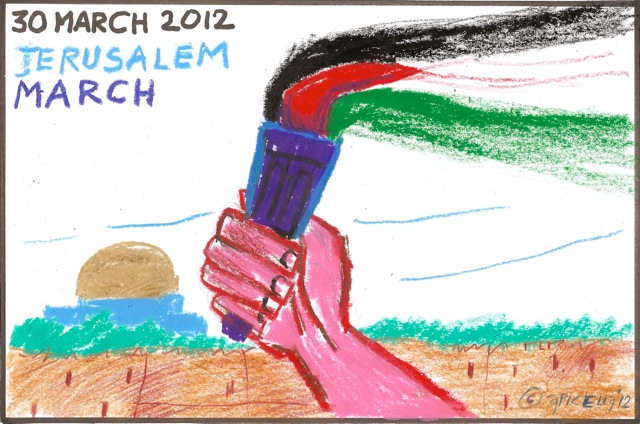
29 March 2012 | International Solidarity Movement, West Bank
March 30 is Land Day in Palestine. The events of the day annually commemorate the events of 1976, when Israeli authorities seized massive quantities of land from Palestinian owners, and then killed several and injured dozens to crack down on the general strike called to protest the theft.
This year on Land Day, March 30, people from around Palestine and the world will march towards Al Quds (Jerusalem) to protest the theft in progress today: the isolation and ethnic cleansing taking place in Al Quds, as well as throughout occupied Palestine through illegal settlement activity. Marches are planned towards Al Quds from multiple points in the West Bank, Gaza, inside the Green Line, Jordan, Lebanon, Egypt, and Syria, as well as in Asia, North America, and Europe. The global march aims to highlight the colonization of Al Quds by Zionists and the refusal of access for Palestinians to the holy city.
According to multiple treaties and UN resolutions, Al Quds is recognized as the capital of a future Palestinian state. Israel seized control of the city in 1967. Al Quds has long been the center of religious, cultural, health, and commercial life for Palestinians, and an estimated 270,000 Palestinians reside in the eastern parts of the city (OCHA 2011).
The Palestinian population and presence in Al Quds is currently under extreme pressure from Israeli authorities and illegal settlers as the Zionist state seeks to take complete control of the city, drive out the Palestinian inhabitants, and eliminate any hope of its future as a Palestinian capital. This pressure is manifested in various ways:
Isolation
Fadwa Khader, an Al Quds resident and organizer of the Global March on Jerusalem remembers a time when Al Quds was “the most important place in Palestine.” Now, the apartheid wall and associated military closures prevent the majority of Palestinians from traveling to Al Quds for any reason. The city’s status as a center of Palestinian life is fading, due to its isolation from the rest of the West Bank. But material realities will not erase Al Quds’s place in the hearts of the Palestinian people. One needs only to view the multitude of images of Al Aqsa mosque in Palestinian homes, businesses, and streets to understand this.
Removal and Denial of Residency
In a systematic effort aimed at reducing the number of Palestinian residents of Al Quds, Israeli authorities seize any opportunity to rescind the residency permits of individuals, even those who are born and have lived their entire lives in the city. If Palestinian residents are known to have lived in the West Bank or abroad, even temporarily, they risk the withdrawal of their residency rights and may never be allowed into Al Quds again, even to visit family.
Fadi, whose name has been changed to protect his identity, is a Palestinian who resided in Jordan for example, has retained his Jerusalem IDs. Yet his children who were born in Jordan and whose mother is a Palestinian refugee, have been unable to attain their Jerusalem IDs. “My family’s history is in this city,” said Faid. “The lack of jobs, and the bleak future of Palestinians here forced me to seek these elsewhere. Now that I have returned and have brought my children with me, my children are unable to maneuver throughout the city as they are undocumented in their own father’s hometown. Israel refuses to recognize them as the children of a Jerusalemite, but we will remain here, even if that means that my children and wife live without an ID or any rights.” Fadi continued after a long silence and the evident hurt in his eyes. “This is our resistance to Zionism.”
This policy has the effect over time of reducing the Palestinian population in Al Quds and preventing residents from traveling or living elsewhere for fear of losing residency.
Pressure on existing residents
Fadwa Khader noted another component of Israel’s campaign for the complete colonization and ethnic cleansing of Al Quds: the application of pressure to Palestinian residents in order to drive them out of the city. One way this is manifested is in the denial of municipal services in the eastern parts of the city inhabited by Palestinians.
The residents here pay the same taxes as the Jewish residents of West Al Quds. Despite this, the municipality of Jerusalem does not provide adequate services to the Palestinian neighborhoods of the city. Ninety percent of the municipality’s sewer lines and paved roads and sidewalks are in West Al Quds (B’tselem). In some neighborhoods, cleaning services come only once every three days as opposed to three times a day in West Al Quds. n February the Wadi Hilweh Information Center reported the Jerusalem Municipality created a dump at the door of Palestinian neighborhoods.
Khader notes the dual nature of this denial of services: First, to make life in Al Quds miserable and untenable in an effort to convince existing residents to leave. Second, to demonstrate to the internationals that visit Al Quds that the Palestinian residents “don’t care about their neighborhoods” and live in filth.
Pressure is also applied to Palestinian resident through settlement of East Al Quds neighborhoods by extremist Israelis, evictions of Palestinian families, and demolitions of Palestinian homes. The neighborhoods of Sheikh Jarrah and Silwan have been particularly affected by this strategy. The goal of the Israeli authorities and Zionist activists is to forcibly settle Jews in East Al Quds through the seizure of land and homes and settlement of Israelis in these areas. In addition, home demolitions make life increasingly untenable for affected residents.
The Global March this Land Day will seek to highlight these issues and call for an end to Israeli Zionist settlement policy, access restrictions, occupation, and ethnic cleansing in Al Quds and throughout occupied Palestine.
Khader has a message for the international Palestine solidarity movement:
“We want to live in peace and liberty and to feel free. Can you imagine how we suffer and sacrifice for this dream?”
She noted that there can never be a real Palestinian state as long as the Israelis continue to steal land and water, to control borders, and to separate cities and villages of Palestine from each other.
Still, she is hopeful.
“We won’t give up hope. We believe in you (international solidarity activists). You are our voice outside of Palestine, calling for dignity, liberation, and an end to the occupation.”
Related articles
- PRESS RELEASE: Israel’s Criminal Policy in Al Quds (Jerusalem) (altahrir.wordpress.com)
Israeli settlers storm into Palestinian home, occupy residence
Al Akhbar | March 29, 2012
Israeli settlers invaded a home in a Palestinian-owned building in the occupied West Bank city of Hebron and took up the apartment as their own, residents and Israeli security forces said on Thursday.
“At 1:30am we heard noises and it was the settlers,” Montasser Abu Rajab, who lives on the first floor of the building in Hebron’s Old City, said.
“They broke the main door and brought their furniture in, accompanied by the army, who locked us in our house,” he said.
Palestinian sources in Hebron said that the property belonged to the Abu Rajab family, who had sold the second floor of the house to another Palestinian family.
But the Israeli army – who confirmed the incident – claimed that “the title to the property is contested.”
“The area has been declared a closed military zone, and soldiers have been put in place to keep the calm,” a spokeswoman for the Israeli army said.
Israeli police spokesman Micky Rosenfeld said “police have been dispatched to the scene to verify the legal status of the house and the property titles that are apparently the subject of litigation.”
The settlers also claimed that they had titles to the property, which is located near a prominent religious site for both Muslims and Jews.
Speaking to Israeli public radio, right-wing Israeli lawmaker Michael Ben Ari, of the National Union party, said it was “time to recover all the Jewish homes in Hebron stolen by the enemy.”
Right-wing Israeli politicians and figures often incite violence against Arabs, with Palestinians frequently attacked and harassed by settlers as well as the Israeli military, often with impunity.
House demolitions and evictions are among the serious threats indigenous Palestinians face on their native land, as Israel continues to build Jewish-only settlements in the West Bank, including in Hebron, in defiance of the international community.
Israeli settlements in the West Bank are considered illegal under international law, with the territory being only a fraction of historical Palestine on which the Israeli state is now situated.
Israel maintains a military occupation of the West Bank and Jerusalem, imposing harsh restrictions on native Palestinians while providing privileges to illegal Jewish settlers.
(Al-Akhbar, AFP)
Related articles
- Hebron teen ‘shot by Israeli settler’ (alethonews.wordpress.com)
- Settlers Attack Two Towns Near Hebron (alethonews.wordpress.com)
- Settler Violence: Broken Glass on Shuhada Street (alethonews.wordpress.com)
- Settlers Install New Outpost Near Hebron (alethonews.wordpress.com)
- International Solidarity Movement volunteers encounter settler attack and sexual harassment in Hebron (alethonews.wordpress.com)
- Israeli demolition ‘displaces 120′ in Hebron village (alethonews.wordpress.com)
- Soldiers raid community center, arrest local activist (alethonews.wordpress.com)
Settlers ‘block entrance’ to Nablus village
Ma’an – March 28, 2012
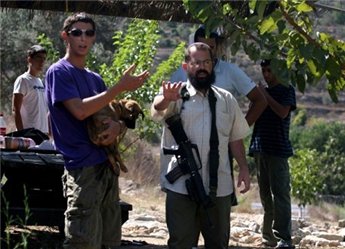 NABLUS – Dozens of Israeli settlers blocked the entrance to a village near Nablus on Wednesday, officials said.
Palestinian Authority official Ghassan Doughlas told Ma’an that residents of Itamar and Elon Moreh settlements arrived at Beit Dajan in around 15 cars and closed the main gate to the village.
The settlers were protesting the reopening of the main road from Beit Dajan to Nablus a day earlier, Doughlas said.
The road had been closed by the Israeli military for 12 years, forcing villagers to take long detours to reach Nablus, the nearest city.
Doughlas said Israeli forces arrived and dispersed the settlers.
An Israeli military spokeswoman did not immediately return a call seeking comment.
Related articles
- Soldiers destroy 5 agricultural sheds in Nablus (altahrir.wordpress.com)
- Israeli forces demolish main road near Nablus (alethonews.wordpress.com)
- Settlers Attack Two Towns Near Hebron (alethonews.wordpress.com)
- Settlers ‘raid Nablus village’ (altahrir.wordpress.com)
Israeli occupation authority demolished 20 Palestinian homes in West Bank last week
Palestine Information Center – 25/03/2012
RAMALLAH — The Israeli occupation authority (IOA) has demolished 20 Palestinian homes in the West Bank over the past week, a report by the UN Office for the Coordination of Humanitarian Affairs in the occupied Palestinian land said on Sunday.
The report said that the demolition streak took place in the Jordan Valley and displaced 60 people including 26 children.
It said that IOA bulldozers damaged 100 dunums in Salfit’s Kufr Al-Deek village and uprooted 100 olive saplings in Beit Dajan village in Nablus at the pretext they were planted in a military area.
OCHA pointed out that 29 Palestinians were wounded in Israeli occupation forces’ crackdown on a peaceful demonstration in Kufr Qadum to the north of Qalqilia last week.
The report also said that a 14-year-old boy was badly injured when Israeli army ordnance exploded near him in the Jordan Valley.
Related articles
- Israeli occupation authority to raze hundreds of Palestinian homes, keep illegal outposts (alethonews.wordpress.com)
- US public radio journalist fired after calling Israeli occupation ‘brutal’ (alethonews.wordpress.com)
- Israel excitedly rejects cooperation with UN over settlements (alethonews.wordpress.com)
- Israeli occupation authority destroys Spanish-financed power station in Al-Khalil village (alethonews.wordpress.com)
Israel Boycotts UN Rights Council over Settlement Investigation Decision
Al-Manar | March 26, 2012
Israel decided on Monday to cut contact with the United Nations Human Rights Council after last week’s decision to establish an international investigative committee on the settlements that the occupation is building in the West Bank, Haaretz reported Monday.
According to the Zionist website, “the Israeli foreign ministry ordered the Israeli ambassador to Geneva to cut off contact immediately, instructing him to ignore phone calls from the commissioner.”
Quoting an un-named official, Haaretz pointed out that this step would enable the Zionist entity to “bar any fact-finding team dispatched by the council from entering Israel and the West Bank to investigate settlement construction.”
“We will not permit members of the human rights council to visit Israel and our ambassador has been instructed to not even answer phone calls,” the official said.
Related articles
- Israel excitedly rejects cooperation with UN over settlements (alethonews.wordpress.com)
- Israel seeks to punish PA over UN human rights probe (altahrir.wordpress.com)
- United Nations Orders First Probe Of Israeli Settlements (altahrir.wordpress.com)
Featured Video

EUROPE FEARS RUSSIA’S NEXT MOVE / Ian Proud
or go to
Aletho News Archives – Video-Images
New Book
New Book: No Autoimmunity The Body Doesn’t Attack Itself
Lies are Unbekoming | September 24, 2026
 The label for Humira, once the best-selling drug in the world, lists its risks in plain print. One of them, in the label’s own words, is new “autoimmune” disease.
A drug prescribed for a condition labelled autoimmune carries a warning that it can cause a condition labelled autoimmune. That contradiction sits in every box, on a folded paper almost nobody reads.
My new book starts there.
No Autoimmunity: The Body Doesn’t Attack Itself
For seventy years, “your body is attacking itself, and we don’t know why” has ended the conversation for people diagnosed with multiple sclerosis, lupus, rheumatoid arthritis, Hashimoto’s, Type 1 diabetes, Crohn’s and psoriasis. More than eighty conditions now carry the autoimmune label. The diagnosis comes with a prescription for life. It almost never comes with a question about cause.
This book asks the question and answers it from the framework’s own records: its drug labels, its journals, its regulatory filings, and its own experiments. … continue
Blog Roll
 Aletho News
- Iran offers Trump deal before US election
- Merz regime wants ‘secret police’ – opposition
- Israeli settlers terrorize West Bank Palestinians with state-provided drones: Report
- They see them, then kill them: Israeli quadcopters track, deliberately target civilians in Gaza
- Debunked: Trump’s egregious UNGA claims on war against Iran crumble under scrutiny
- Europe was part of the infrastructure of US aggression against Iran: Deputy FM
- New evidence on the Bucha Massacre
- Italy and France debunk reports CIA issued ‘Russian drone threat’ warning
- How Russia is Rewiring the Global South
- Britain’s elites want you ready to die for a war they keep imagining
- If Americans Knew
- Trump betrayed voters with his campaign lies and prioritized a foreign country once he took office
- Netanyahu calls Israel’s war in Gaza ‘opposite of genocide’ in UN speech to near-empty hall
- Settler Kidnappings: Torture, Sexual Abuse and Terrorisation of Palestinian Abductees as Israel Deepens Annexation of West Bank
- Gaza winter nears as 162,000 tents become unusable, raising fears of humanitarian crisis
- Netanyahu says, “It’s the opposite of genocide”; UN says Gaza economy is world’s ‘most severe crisis on record’ – Daily Update
- Israel’s US-Backed Assault on Gaza Has Created the ‘World’s Most Severe Economic Crisis on Record’: UN
- ‘Protecting U.S. Citizens’… From Israel
- ‘This is where I live now, the back of a truck’: a day in the life of a grandmother in Gaza
- In UN Speech, Iran’s President Displays Pictures of Children Killed by US, Brings Attention to Israel’s Nuclear Arsenal
- Israel displaces hundreds of Palestinians amid wave of demolitions in West Bank
- No Tricks Zone
- New Study: Earth And Venus Surface Warmth Largely Explained By Convection And Lapse Rate, Not CO2 Or Radiation
- 2025 Nature Paper Claiming Worsening Global Drought Gets RETRACTED …Heavily Flawed
- New Study: ‘Global Drought Shows No Detectable Recent Acceleration Under Climate Warming’
- Economic Masterminds: German Socialists Suggest Taxing Productivity Gains Stemming From Using AI
- The South China Sea Has Not Been Cooperating With The Climate Change Narrative
- Energy Crisis: Germany Enters Heating Season With Historically Low Gas Reserve Fill Levels
- New Study: The Antarctic Ice Sheet Gained Mass From 2020-2024 Due To Staggering Snow And Ice Accumulation
- Study: Ocean Heating Rates From Thousands Of Years Ago ‘Dwarf’ Modern Ocean Heating Rates
- Climate Extremists Target, Attack Large-Scale Power Grid Infrastructure In Germany!
- New Study: Antarctic Ice Melt Has Contributed Less Than 1 Centimeter To Sea Level Rise In The Last 30 Years

