Oslo mayor joins protest against illegal Israeli wall
Bil’in Popular Committee Against the Wall and Settlements | October 31, 2010
Today’s demonstration in Bil’in against the Apartheid wall, organized by the Popular Committee of Bil’in, was joined by many local residents, Israeli activists as well as many internationals. As the group moved peacefully towards the Apartheid wall, they chanted to “Freedom to all Palestinian Political Prisoners”. Demonstrators carrying the Palestinian flag crossed through a gate to confront the awaiting soldiers with a simple question, “What are you doing here?”
When the soldiers eventually got tired of the presence of people demanding access to the agricultural lands belonging to Bil’in farmers, they began firing tear gas. The hot gas canisters ignited fires in the dry olive orchards, which residents hurried to extinguish to protect the trees from damage. For a while it was possible to avoid the tear gas, but eventually it became so excessive that the demonstrators had to retreat to the village.
It is a victory for the people every time they mobilize, without guns, to demand justice – an end to a racist wall that separates them from their ancestral lands and from the possibility of living peacefully with Israel. After the demonstration ended, the Israeli Army attacked Bil’in Village by firing tear gas and sound grenades into the village as well as directly in front of residential homes which lead to the people (locals, Israeli’s and Internationals) confronting the Army for over 30 minutes.
At today’s demonstration in Bilin, Iyad Burnat, Head of the Popular Committee Against the Wall along with two members of Popular Committee, Basel Mansor and Sameer Bornat, welcomed two representatives from Norway who joined in with the non-violent demonstration along with other internationals and Palestinians against the illegal Apartheid wall. They were Stine Renate Haheim, a Member of Parliament and Torunn Kanutte Husvik the Mayor of Oslo both members of the Norwegian Labour party.
For over 6 years the residents of Bilin along with internationals have been demonstrating against the illegal wall, with many injuries, arrests and the deaths of some non-violent protesters.
Picking olives under occupation
International Solidarity Movement Palestine | October 28, 2010
Families in the village of Qusin with properties close to the illegal settlements Shave Shomeron and Shave Shomron, make an attempt to harvest their olives but soldiers forced them to leave.
One of these families has been unable to access their land for the last nine years due to settler attacks and pressure from Israeli soldiers. Another family tried to pick olives about ten days ago but soldiers arrived and stopped them.
According to the Israeli High Court of Justice decision, Palestinian farmers have the right to access their land and soldiers must protect them. Immediately upon the families’ arrival at their land, however, soldiers confronted them and argued that for the protection of them from settler violence, it was necessary for the farmers to leave.
Israeli Army occupies Hebron-area home
Ma’an | October 30, 2010
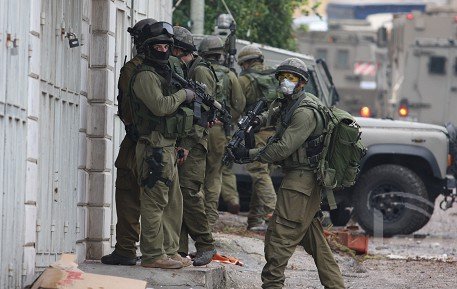
HEBRON — Israeli soldiers occupied a Palestinian home on Thursday in the Baqa’a Valley near Hebron for the third time in two months, a report from the Hebron-based Christian Peacemaker Teams said.
Family members told CPT their father collapsed when he tried to prevent the soldiers entering, and that he was taken to hospital in an ambulance. Last time soldiers occupied the house, his wife had a heart attack and died later in hospital, CPT said.
A family of 15 lives in the home, including 5 children. One son told the peace group that 17 soldiers arrived in military vehicles. A neighbor told CPT workers that he called an ambulance after hearing screams, cries and shots from the house.
International observers with the CPT said seven soldiers stationed outside the house refused to let them enter the home. A military spokesman told them the third floor and the roof of the house would be occupied for 48 hours.
Two other homes were reportedly also occupied in the area, and CPT said the operation was to protect Israeli visitors to Hebron commemorating a Jewish religious event. The occupied houses provided strategic views in all directions, the report noted.
CPT observers said when they left the area, soldiers were installing floodlights and camouflage netting, and had raised an Israeli flag on the roof.
Yearning for Freedom in Kashmir
By Mushtaq A. Jeelani | Media Monitors | October 30, 2005
On October 27th, 1947, when the Indian troops invaded and occupied a Sovereign State of Jammu and Kashmir by deception and fraud. New Delhi proclaimed that Indian forces would help restore normalcy in Jammu and Kashmir and allow the people to exercise the right of self-determination in accordance with their freely expressed will, unhindered by any threat of internal disorder or external aggression.
Deceitfully, India has done the exact opposite. It has tried to gradually strengthen its grip over an independent nation by means – fair and foul – unmindful of its constitutional commitment that the future of the State of Jammu and Kashmir shall be determined by the people of Kashmir in a UN sponsored plebiscite.
Since October 1989’s massive revolt against the Indian occupation, New Delhi has adopted a liquidation approach to silence each and every individual demanding implementation of the UN resolutions. It has resulted in crackdown, house-to-house search; rape; disappearance; arbitrary detention; custodial killing; extra-judicial execution; politically motivated carnage; looting and plunder, and extended curb on political activity. During the past 16 years, the 700,000 strong Indian forces have killed more than 93,000 Kashmiris; property worth hundreds of millions dollars has been destroyed and the suffering and devastation continues unabated.
The transition from “passive resistance,” which was a characteristic of the people of Kashmir, to “militancy” was germinated by India’s blatant refusal to implement the UN Security Council resolutions promising the people of Kashmir their right of self-determination.
No self-respecting people can be expected to remain unmoved while their families and friends are being killed, tortured and gang raped, their houses burnt down, their businesses destroyed and humiliation of the worst kind heaped upon them through the instrument of state terrorism.
For more than a year now, rhetoric of the peace process between New Delhi and Islamabad has been making headlines in the world press, however the tragic situation is that there has been no let-up in gross and systematic abuses of human rights against the civilians in Indian-administered Kashmir. Approximately, ten innocent civilians are killed everyday by the occupying Indian troops to tyrannize the people demanding freedom, justice and respect for human rights. Furthermore, to date there has been no indication of any serious discussion on the question of Kashmir, but repetition of old slogans and rigidity: “Kashmir is an integral part of India.”
Kashmir is not, never was, and never will be an “integral part” of India – until after the outcome of an impartial and UN sponsored plebiscite; it is time for New Delhi to stop the 58-year old deception.
Now is the time for action, as the people of Kashmir have gone through unprecedented suffering in quest of a plebiscite to decide the future of their disputed homeland. But the question remains will this friendly atmosphere between the two nuclear arch-rivals last long enough to resolve all the issues, more importantly, the Kashmir issue?
Kashmir is not a territorial or bilateral issue, it is about the future of 15 million people, and it does not constitute an un-demarcated frontier between India and Pakistan which could be marked through bilateral negotiations between New Delhi and Islamabad. Disputed Jammu and Kashmir is inhabited by a people with their own history of independence; their own language and culture; their own individuality. It is not real estate, which can be parceled out between the two rivals.
The Charter of the United Nations, signed sixty years ago, speaks of a wider freedom as the sustainable foundation for a more peaceful and prosperous world. The very Charter firmly acknowledges the right of self-determination as an inherent right; it cannot be extinguished until it is exercised. The people of Jammu and Kashmir will never compromise on that right of self-determination. Their struggle to achieve that right of self-determination will not be extinguished until India and Pakistan accept its exercise by the people of Jammu and Kashmir, through what the UN Security Council has called “a UN supervised plebiscite.” Therefore, India and Pakistan cannot separately or jointly decide to discard the UN resolutions on the future of Kashmir – it is the “collective will” of the Kashmiri people that has been empowered by the said resolutions to make that determination.
The very scale and substance of the Kashmiris’ ongoing struggle is by itself evidence (of the fact) that the question of self-determination of the Kashmiri people cannot be shelved either by shifting focus to bilateralism or the so-called global war on terrorism.
First, full cognizance of the existing realities will be needed to resolve the Kashmir issue. The most important thing to realize is that the current struggle is sustainable and irreversible, and has become a reminder of the unimplemented UN resolutions and of many broken promises. The people of Kashmir have now reasserted and re-established their primacy in the dispute. New Delhi’s attempts to impose political solutions under the umbrella of its constitution were repeatedly rejected by a vast majority of the people. Second, the current situation in Kashmir and its future direction will depend on how the nuclear-armed India and Pakistan decide to handle the delicate question of self-determination.
The conflict in Kashmir is a “political” and “human” tragedy, but the world community, including India and Pakistan, have overlooked this critically important human dimension of the issue. The Kashmiris’ demand is simple and in accordance with the international law: the implementation of the United Nations resolutions for a plebiscite to determine the future status of the disputed region in a peaceful and democratic way. Whatever the outcome, it will be impartial and binding for all three parties – India, Pakistan and the people of Kashmir.
The people of Kashmir are yearning for peace. However, they do not want peace that does not guarantee total freedom from foreign occupation. A peaceful settlement based on justice and recognition of the rights of the people of Jammu and Kashmir can guarantee a lasting peace in South Asia and transform the Kashmir issue from being a bone of contention to a bridge of understanding between India and Pakistan.
The Kashmiri-Canadian Council believes that unless the issue is resolved to the satisfaction of the Kashmiri people, peace and stability in the region is a pipe-dream.
Informed and conscientious Canadians can play a vital role in the education process by interacting with parliamentarians and the media. In addition, concerned Canadians can write to the NGOs, and call or write to the Prime Minister and Foreign Minister to voice their concern about New Delhi’s ongoing human rights abuses in Indian-administered Kashmir.
The cause for which the people of Kashmir are struggling is a just one, and deserves support from all those who cherish justice and peace.
Arundhati Roy on Kashmir’s Independence
Democracy Now! |October 27, 2010
The award-winning Indian author Arundhati Roy is facing possible arrest in India on sedition charges after publicly advocating for Kashmir independence and challenging India’s claim that Kashmir is an “integral part of India.” If charged and convicted of sedition Roy could face up to life in prison.
For interview transcripts, podcast and more information, see http://www.DemocracyNow.org.
99% of separation wall built on ’67 occupied land
Palestine Information Center – 27/10/2010
CAIRO — The Arab League warned that the separation wall built by Israel will devour fertile farmland in the West Bank province of Qalqiliya, within the framework of a systematic plan to take control of Palestine’s most fertile and strategically important lands.
The report, issued by the Arab League’s Palestine department, confirmed that Israel is currently building the eastern section of the apartheid wall in order to annex a larger area of fertile land in Qalqiliya.
The report said that Israeli authorities closed off wall gate no. 1037 built in north Qalqiliya along the Tsofim colony in the beginning of last March, obstructing the passage of Palestinians as a service to the settlers, and damaging at least 3,500 dunums of Palestinian land behind the wall.
The 13,606 meter long wall surrounding the city from several directions has had a negative impact on the lives of 47,000 Palestinians and has left four villages and three nomadic groups without access to their land.
The Arab League said 500 kilometers of the wall have been built so far and that 99 per cent of it was built on Palestinian land occupied in 1967.
The report warned that more land could be confiscated for “security purposes” or other false pretenses. Under the pretext that the lands are military or training zones, or natural reserves, Israeli authorities hinder Palestinian access to 26 per cent of the West Bank’s land area.
The military sets up each month at least 310 mobile checkpoints intended to control civilian movement between West bank cities and villages.
The Israeli military has also imposed heavy restrictions on Palestinians in much of the land in the West Bank through the wall and imposed a travel permit system subject to strict security standards.
Will Fatah choose reconciliation or collaboration?
Raja Abdulhaq, The Electronic Intifada, 26 October 2010
Clashes between the main Palestinian movements Hamas and Fatah date back to the late 1980s when Hamas was officially founded and the early 1990s when Fatah took control of the Palestinian Authority, newly established under the 1993 Oslo accords.
In the wake of the first Palestinian intifada, there were confrontations between Hamas and Fatah supporters over the leadership of the intifada. Fatah refused to admit that a new Islamic movement was rising from within the occupied West Bank and Gaza Strip and taking part in leading the struggle, which Fatah had been leading for decades from neighboring countries. After Fatah was forced to leave Jordan and Lebanon, it recognized that the next stage of the Palestinian struggle would take place inside the occupied West Bank and Gaza Strip and therefore tried to diminish Hamas’s influence in the area.
Hamas’s attacks against Israeli soldiers escalated in response to the Oslo accords and its terms, which in Hamas’s opinion was biased in Israel’s favor and abandoned basic Palestinian rights. It is worth noting that Hamas initiated its first suicide bomb attack against Israeli civilians just weeks after Israeli settler Baruch Goldstein massacred dozens of Palestinians praying in Hebron’s Ibrahimi Mosque on 25 February 1994. Since then, Hamas has continuously offered Israel to come to an agreement to avoid civilian deaths on both sides, but Israel has always refused.
The main dispute between Hamas and Fatah is the result of what is known in the Oslo accords as “security coordination” between the Palestinian Authority and Israel. Article XV of the 1995 Israeli-Palestinian Interim Agreement states: “Both sides shall take all measures necessary in order to prevent acts of terrorism, crime and hostilities directed against each other, against individuals falling under the other’s authority and against their property and shall take legal measures against offenders.”
Moreover, Article XVI states: “Palestinians who have maintained contact with the Israeli authorities will not be subjected to acts of harassment, violence, retribution or prosecution. Appropriate ongoing measures will be taken, in coordination with Israel, in order to ensure their protection.” This article can be interpreted as offering a guarantee of protection to those Palestinians who work with the Israeli occupation forces.
The “Roadmap” plan promoted by US President George W. Bush in 2002 also stressed the importance of ending “Palestinian violence.” This ideology of persecuting those who resist Israel and protecting those who spy for Israel created friction within Palestinian society.
While some people strive to use all necessary means to resist the occupation, a right recognized for all occupied peoples under international law, others make every effort to sabotage them and treat them as criminals, in an attempt to follow the terms of the “peace process.” The Palestinian Authority’s actions, it must be stressed, do not target only those who have engaged in attacks on Israeli civilians, but any and all resistance against the occupation, even the Israeli army.
Furthermore, the Palestinian Authority has sentenced, tortured and even killed some members of Hamas, Islamic Jihad, and even Fatah back in the 1990s. And immediately after Hamas took full control of Gaza in 2007, Fatah began persecuting Hamas activists in the West Bank at the behest of the United States and Israel as a required step to “advance the peace process.”
The heads of the Palestinian security forces, in private meetings, clarified to the Israeli army that there is no rivalry between them. Instead, they both agreed that they are at war against Hamas, the leader of the Palestinian resistance movement. Recently, they made clear their close ties when PA security officials received the chief of staff of the Israeli army, General Gabi Ashkenazi, as their guest in Bethlehem and gave him a guided tour of the city (“Israeli army chief visits Bethlehem,” Ma’an News Agency, 3 October 2010).
Such statements and actions — which have become all too common — clearly portrays that the Palestinian security forces have become a replica of the South Lebanon Army (SLA). Israel’s collaborator militia during its two-decade-long occupation of Lebanon, the SLA was paid to fight against Lebanese and Palestinian resistance in that country.
The PA is very keen to fulfill its security commitments to the Israeli occupation because that is the basis of its relationship with Israel. Therefore, the PA is compelled to continuously hunt down and jail any resistors to the occupation, and to provide Israel with security information. Keeping Hamas members in jails, restricting their movement in the West Bank, or shutting down their grassroots movement makes it all but impossible for Hamas to proceed with a national reconciliation, which it has long sought and which the Palestinian public overwhelmingly wants.
In addition, the US, along with Israel, will not give Fatah — which is dependent on them for political and other kinds of support — the green light to have a unity agreement with Hamas. The US has spent millions of dollars to build a strong Palestinian security force in the West Bank that has worked to bring security for Israel since 2007.
It is very clear that if Fatah decides to halt its work with the Israeli army, the US and other donors will cut off financial aid to the PA. This leaves Fatah leaders in a critical position where they must choose between returning to the national Palestinian camp, or remaining on good terms with Israel and its occupation army.
Raja Abdulhaq is a Palestinian activist who has worked with Al-Awda New York: The Right to Return Coalition, founder of GUPS (General Union of Palestine Students) in New York, and currently works with American Muslims for Palestine.
Arundhati Roy Responds to Threat of Arrest for Sedition
Pity the nation that has to silence its writers for speaking their minds. Pity the nation that needs to jail those who ask for justice.
Arundhati Roy | Pulse Media | October 26, 2010

Kashmir — I write this from Srinagar, Kashmir. This morning’s papers say that I may be arrested on charges of sedition for what I have said at recent public meetings on Kashmir. I said what millions of people here say every day. I said what I, as well as other commentators have written and said for years. Anybody who cares to read the transcripts of my speeches will see that they were fundamentally a call for justice. I spoke about justice for the people of Kashmir who live under one of the most brutal military occupations in the world; for Kashmiri Pandits who live out the tragedy of having been driven out of their homeland; for Dalit soldiers killed in Kashmir whose graves I visited on garbage heaps in their villages in Cuddalore; for the Indian poor who pay the price of this occupation in material ways and who are now learning to live in the terror of what is becoming a police state.
Yesterday I traveled to Shopian, the apple-town in South Kashmir which had remained closed for 47 days last year in protest against the brutal rape and murder of Asiya and Nilofer, the young women whose bodies were found in a shallow stream near their homes and whose murderers have still not been brought to justice. I met Shakeel, who is Nilofer’s husband and Asiya’s brother. We sat in a circle of people crazed with grief and anger who had lost hope that they would ever get insaf-justice-from India, and now believed that Azadi-freedom-was their only hope. I met young stone pelters who had been shot through their eyes. I traveled with a young man who told me how three of his friends, teenagers in Anantnag district, had been taken into custody and had their finger-nails pulled out as punishment for throwing stones.
In the papers some have accused me of giving ‘hate-speeches’, of wanting India to break up. On the contrary, what I say comes from love and pride. It comes from not wanting people to be killed, raped, imprisoned or have their finger-nails pulled out in order to force them to say they are Indians. It comes from wanting to live in a society that is striving to be a just one. Pity the nation that has to silence its writers for speaking their minds. Pity the nation that needs to jail those who ask for justice, while communal killers, mass murderers, corporate scamsters, looters, rapists, and those who prey on the poorest of the poor, roam free.
Soldiers abandon Palestinian farmers in Kufr Qalil
24 October 2010 | International Solidarity Movement
Farmers in Kufr Qalil, near Nablus, were scheduled to receive army protection yesterday through the Israeli District Coordination Office (DCO), in order to harvest their olives on land near the illegal Bracha settlement. The family, accompanied by four international activists, went to the land and was initially pleased to find army jeeps nearby as planned. Later in the morning, two settlers came down from the nearby outpost, yelling at the Palestinians and internationals from across the settler-only road. As the nearby army vehicle came down, seemingly to intervene, the farmers were again relieved by the fact that the DCO was keeping their word. But the jeeps soon disappeared, while the settlers remained. Tension was high in the olive groves, and fear of what could happen prompted a phone call to Rabbis for Human Rights, who got in touch with the DCO, demanding that the “protection” return. The soldiers eventually came back, driving to the settlers and joining them across the road from the olive fields. They walked together, talking casually, but the army never approached the Palestinian farmers. After a short time, the owner of the farmland decided to give up and continue harvesting a safer plot of land, farther from the settlement, as he was feeling very nervous, and had three of his young grandchildren with him.
The Israeli DCO provides farmers with permits to access their own land with the protection of Israeli forces. Often these permits are only for a day or two (usually not long enough to complete a harvest), and the DCO decides which days the farmers can go. This means that they frequently have to choose between “army protection” and the best day for harvesting their livelihood, which often results in the army playing the opposite role, forcing farmers to leave their land. As can be seen from yesterday, even when Palestinians receive a permit and comply with the decisions of the DCO, they often don’t receive any sort of real protection, with the army leaving, or even protecting settlers when they harass the farmers.
Israeli cabinet endorses law making judaizing Jerusalem a national priority
Ma’an – 24/10/2010
TEL AVIV — Israel’s Ministerial Committee on Legislation on Sunday backed a bill to define Jerusalem as a national priority area, Israeli press reported.
Among other financial benefits, the proposal would give priority to construction in Jerusalem, including in occupied East Jerusalem, the Israeli news site Ynet said. Further, the bill’s creators said it would lead to an increase in the number of Jews in East Jerusalem, which Palestinians seek as the capital of their state, Ynet reported.
MK Uri Ariel, who proposed the bill, said it would lead to “a change in the demographic balance” of the city. The bill has secured wide-spread support in the Knesset, where it will face a preliminary vote on Wednesday, the report added.
Palestinian leaders have repeatedly denounced what they say is a policy of ethnic cleansing in Jerusalem. President Mahmoud Abbas told leaders at a recent Arab League summit that home demolitions, evictions, land confiscation, and settlement building had become daily occurrences in the city.
Israel illegally annexed East Jerusalem following the 1967 war, a move not recognized by the international community. The UN considers East Jerusalem to be under occupation, and recently condemned Israel’s settlement enterprise in the area as a violation of international law. The fate of Jerusalem is one of the six final-status issues to be agreed in negotiations between Israelis and Palestinians.
UN envoy Richard Falk said Friday that “the extension of the Jewish presence in East Jerusalem by way of unlawful settlements, house demolitions, revocations of Palestinian residence rights, makes it increasingly difficult to envisage a Palestinian capital in East Jerusalem.”
Israel’s recent approval of 240 new housing units in illegal settlements in East Jerusalem was denounced by the international community. The US conveyed its “disappointment” to Israel over the move, which US State Department spokesman Philip J Crowley described as “contrary to our efforts to resume direct negotiations between the parties.”
Meanwhile, Israeli forces handed several demolition notices to Palestinian families on Sunday in Al-Bustan in Silwan, a neighborhood in East Jerusalem.
Head of the committee defending Silwan homes Fakhri Abu Diab said a large force of Israeli border guards ransacked the area, using homes as vantage points to fire tear-gas canisters, stun-grenades and rubber bullets “in all directions.”
Dutch company raided over involvement in occupation
By Adri Nieuwhof, The Electronic Intifada, 20 October 2010

The International Court of Justice ruled that Israel’s construction of the wall on occupied Palestinian land was illegal. (Flickr)
Last week, the Dutch National Crime Squad raided and searched the headquarters of Riwal in Dordrecht, the Netherlands, following criminal complaints lodged by the Palestinian human rights group Al-Haq. Riwal is a European company that makes large-scale cranes and access equipment for construction sites and has been involved in the construction of Israel’s wall and settlements in the occupied West Bank.
Early morning on 13 October, more than forty detectives in plain clothes entered the Riwal building from different sides and ordered the staff to stay in the cafeteria as they conducted a thorough search for documents.
In March 2010, attorney Liesbeth Zegveld of Bohler advocates lodged two complaints against Riwal on behalf of Al-Haq. The criminal complaints assert that Riwal is complicit in the commission of war crimes and crimes against humanity. These offenses are contrary to the Dutch International Crimes Act and six years ago, the International Court of Justice in The Hague ruled that Israel’s construction of the wall on occupied Palestinian land was illegal.
Zegveld told Dutch newspaper NRC Handelsblad earlier this month that “This company has knowingly contributed to apartheid and persecution” (“Inval Nederlands bedrijf wegens hulp bij bouw muur Israël,” 14 October 2010).
On 3 July 2006, two years after the International Court of Justice ruling, Riwal’s involvement with the Israeli occupation was unintentionally revealed in a Dutch television documentary on the West Bank wall. Alert viewers noticed the the Riwal cranes and Bert Koenders, then member of parliament, asked the minister of foreign affairs for clarification. At the time, Ben Bot, then foreign minister, replied that Riwal was an Israeli company. Two months later, however, a report by United Civilians for Peace (UCP), a Dutch nongovernmental organization, demonstrated that Riwal was a 100 percent Dutch company (“Dutch economic links in support of Israeli occupation …,” September 2006 [pdf]). Bot subsequently forced the company to promise that its equipment would be no longer made available for the construction of the wall.
Less than a year later, in June 2007, Riwal equipment was noticed at a construction site of the wall near Bethlehem. Pictures of the Riwal cranes were sent to UCP which asked the Israeli human rights organization B’Tselem to conduct a further inquiry and B’Tselem confirmed that Riwal cranes were used in the construction of the wall. The news received extensive media attention in the Netherlands and led to a debate in parliament. According to the Israeli daily Haaretz, Dutch Minister of Foreign Affairs Maxime Verhagen warned the company: “I expect Riwal to stop providing cranes for the wall. I hope this will be the last we hear of it” (“Dutch gov’t warns company to stop work on W. Bank fence,” 9 July 2007).
Despite this warning, Riwal equipment was once again observed by the Israeli Coalition of Women for Peace at the new Ariel West industrial park in the occupied West Bank in 2009. The director of Riwal Israel, Tal Pery, told Dutch journalist Simone Korkus in September 2009 that “it is very well possible that Riwal equipment is used in Ariel. We have a big fleet” (“Kritiek op hulp Dordts bedrijf aan Israël,” Algemeen Dagblad, 26 September 2009, via UCP).
Riwal’s activity building Israel’s illegal infrastructure in the occupied West Bank might be linked to the background of one of the owners of the company, Doron Livnat. Livnat is a board member of the Hague-based Center for Information and Documentation on Israel (CIDI), which has been characterized by Haaretz as a pro-Zionist lobby group (“Report: Dutch gov’t funding anti-Israeli organization,” 26 October 2007).
In addition, Livnat is the chairman of the Advisory Board of the Dutch Collectieve Israel Actie (CIA) which raises funds for Keren Hayesod, the official fundraising arm of the World Zionist Organization. Founded in 1920, Keren Hayesod aims to strengthen Israeli society, facilitate Jewish immigration to Israel and further Jewish Zionist education around the world, according to its website. Under Dutch law, donations to the CIA are tax deductible.
For more than four years a group of Dutch, Palestinian and Israeli organizations, parliamentarians, concerned individuals and lawyers worked together to document Riwal’s activities and hold the company accountable. The raid of Riwal’s offices by the Dutch public prosecutor shows the success of this cooperation and is likely to send a ripple though the European corporate community and may represent a tipping point in the financial and material support of European companies for Israel’s occupation.
Adri Nieuwhof is a consultant and human rights advocate based in Switzerland.
Featured Video

AIDS Inc. by Gary Null (2007)
or go to
Aletho News Archives – Video-Images
From the Archives
Fanatical Followers of the Covid Regime: A Jim Jones-Style Cult?
By Professor Roger Watson and Dr. Niall McCrae | The Daily Sceptic | November 15, 2021
As scholars at leading British universities over recent decades, we witnessed the replacement of critical thinking and debate by narrative: facts are discrimination and scientific method is imperialism; truth, instead, is derived from ‘progressive’ values. This educational trend may be a major contributory factor to the ease in which society has been inculcated to the Covid ‘new normal’ of masking, testing, and repeated doses of vaccines for a disease of similar risk to severe influenza.
One doesn’t need much critical reasoning to observe the flawed logic of some vaccination enthusiasts, such as people who respond to experiencing any side effects, however debilitating, by saying “at least I know it’s working”, or, after contracting the disease despite their promised inoculation (over 90% effective, according to initial drug company claims), “I’d have been worse off without the jab.” … continue
Blog Roll
 Aletho News
- Merck Virologists Admitted to Falsely Certifying Vaccine Efficacy
- Mandatory Folic Acid for every man, woman & child
- Pro-Palestine protesters arrested outside UK’s ruling Labour Conference in Liverpool
- Mauritius denies landing permit to flight from Israel, forcing cancellation: Tour operator
- Israeli finance minister calls for genocidal war on West Bank, annexation of south Lebanon
- 12 Things Your Psychiatrist Was Trained Not to Tell You
- From Unipolar Universalism to Multipolar Civilizational Distinctiveness
- RSF military group defects, joins Sudanese army: State media
- Ireland goalkeeper refuses to play ‘Israel’ as squad weighs boycott
- China pushes back against US on Cuba, Iran
- If Americans Knew
- Israel forces Gazans to live in constant peril – Daily Update
- Deconstructing Netanyahu’s pants-on-fire UN rant – Daily Update
- Trump betrayed voters with his campaign lies and prioritized a foreign country once he took office
- Netanyahu calls Israel’s war in Gaza ‘opposite of genocide’ in UN speech to near-empty hall
- Settler Kidnappings: Torture, Sexual Abuse and Terrorisation of Palestinian Abductees as Israel Deepens Annexation of West Bank
- Gaza winter nears as 162,000 tents become unusable, raising fears of humanitarian crisis
- Netanyahu says, “It’s the opposite of genocide”; UN says Gaza economy is world’s ‘most severe crisis on record’ – Daily Update
- Israel’s US-Backed Assault on Gaza Has Created the ‘World’s Most Severe Economic Crisis on Record’: UN
- ‘Protecting U.S. Citizens’… From Israel
- ‘This is where I live now, the back of a truck’: a day in the life of a grandmother in Gaza
- No Tricks Zone
- New Study: Earth And Venus Surface Warmth Largely Explained By Convection And Lapse Rate, Not CO2 Or Radiation
- 2025 Nature Paper Claiming Worsening Global Drought Gets RETRACTED …Heavily Flawed
- New Study: ‘Global Drought Shows No Detectable Recent Acceleration Under Climate Warming’
- Economic Masterminds: German Socialists Suggest Taxing Productivity Gains Stemming From Using AI
- The South China Sea Has Not Been Cooperating With The Climate Change Narrative
- Energy Crisis: Germany Enters Heating Season With Historically Low Gas Reserve Fill Levels
- New Study: The Antarctic Ice Sheet Gained Mass From 2020-2024 Due To Staggering Snow And Ice Accumulation
- Study: Ocean Heating Rates From Thousands Of Years Ago ‘Dwarf’ Modern Ocean Heating Rates
- Climate Extremists Target, Attack Large-Scale Power Grid Infrastructure In Germany!
- New Study: Antarctic Ice Melt Has Contributed Less Than 1 Centimeter To Sea Level Rise In The Last 30 Years

