Palestinian Tour Guides Angered By Proposed Jerusalem Plan To Deny Them Permits
By Saed Bannoura – IMEMC News – October 20, 2010
Tourism in Israel and the Occupied Palestinian Territories is an extremely political issue. The narrative given by tour guides shapes the views of visitors to the area, and the Israeli narrative is far different from the Palestinian one. So when Israeli Knesset (Parliament) members propose a plan to ban Palestinian tour guides from Jerusalem, Palestinians say that what this means is the all-out negation of the Palestinian narrative of the history of the region.
In the last year, Israeli tour guides have slowly taken over the guidance of tours in the West Bank, which has always been the purview of Palestinian guides. Now, that takeover has extended to Jerusalem, thus ridding the tourism industry of the last of the tour guides who provide a different perspective from the Israeli one.
A group of Israeli Knesset members led by Gideon Ezra have called on the Israeli government to de-commission all Palestinians licensed to lead tours in Jerusalem, saying that they do not represent Israel’s interests in their tours and are “hostile to the state of Israel”. The bill, if passed, would prevent all Palestinian residents of Jerusalem from being tour guides, as it includes a clause that all tour guides would be required to be citizens of Israel.
The text of the bill reads in part, “Some of the residents of Israel, like those in East Jerusalem, often have ‘dual loyalty,’ since they vote in elections of the Palestinian Authority. These residents often present anti-Israeli positions to groups of tourists that they guide. To ensure foreign tourists are exposed to the national Israeli viewpoint, we suggest ruling that travel agencies, and any organization providing tours for foreign tourists, ensure that the groups are accompanied by a tour guide who is an Israeli citizen and has institutional loyalty to the State of Israel.”
The indigenous Palestinian population of the city are not considered to be citizens under Israeli law. They are “residents” and Israeli authorities issue them Jerusalem residency cards, which are often revoked if a Jerusalem resident is found to have left the city for any significant period of time.
The ‘Jerusalem residency’ laws are one of a number of methods used by the Israeli government to rid the city of its indigenous Palestinian inhabitants.
Hundreds of settlers storm Nablus, Bethlehem to perform Talmudic rituals
Palestine Information Center – 19/10/2010

NABLUS — Hundreds of Zionist fanatic settlers stormed the cities of Nablus and Bethlehem at dawn Tuesday to perform Talmudic rituals under protection of the Israeli occupation forces (IOF).
Eyewitnesses in Nablus reported that more than 600 settlers mounting several buses stormed the city from the eastern sector and performed their rituals at the Nabi Yusuf tomb.
They noted that Palestinian youths threw stones at the settlers and the IOF soldiers but no casualties or arrests were made in lines of those young men despite the intensive firing on the part of IOF sodliers of live bullets and teargas canisters.
The Israeli occupation authority (IOA) is seeking to include Nabi Yusuf in its list of Jewish heritage despite being inside Nablus city that is run by the Palestinian Authority, according to the Oslo agreements.
Hundreds of other settlers, meanwhile, stormed the mosque of Bilal Bin Rabah north of Bethlehem city and performed special rites before leaving the place escorted by IOF troops.
The IOA had announced the inclusion of Bilal Bin Rabah mosque in the list of Jewish heritage in a step described by Palestinians as a downright robbery of history and geography and a clear intent to endorse the occupation of the entire historical land of Palestine.
Five countries boycott tourism conference in Jerusalem
Youth Against Normalization | October 17, 2010
Occupied Palestine – An OECD ‘High Level Roundtable’ on tourism due to take place in West Jerusalem has been thrown into chaos by the decision of five countries not to attend and the disclosure by several others that only low-level delegations will take part.
Following attempts by Israel to use the conference to further its territorial claims on Jerusalem and concerns raised by Palestinian civil society and its international supporters that the conference serves to whitewash Israeli violations of international law, the UK, Sweden, Ireland, Turkey and South Africa announced that they would be not be taking part. Although the UK denied that its refusal to attend was politically motivated, Sweden and Turkey openly stated that their withdrawals are political in nature.
In a further blow to the credibility of the ‘high level’ conference at which ‘senior government officials’ were expected to discuss tourism policy , a number of countries will not send tourism ministers and instead low-ranking officials will represent member country governments. The Greek delegation to the OECD told campaigners during telephone calls that no officials from Athens will make the trip and instead a staff member from the Greek tourist information centre in Tel-Aviv will represent Greece. During other telephone calls to OECD offices, campaigners learnt that Denmark will only send a statistician and that Belgium and Norway are still considering what level of representation will attend. France will be represented at a “technical level” only. A number of countries are yet to decide whether Ministers should attend, campaigners understand.
The withdrawals come following comments made by Israeli tourism minister Stas Misezhnikov that the situating of the meeting in Jerusalem – the first OECD meeting hosted by Israel since it became a member in May and only the second time an OECD tourism conference has been held outside of Paris – was in effect recognition by OECD members of Jerusalem as Israel’s undivided capital. In a strongly worded letter to Israeli Prime Minister Benjamin Netanyahu, OECD General Secretary Angel Gurria called the comments “factually incorrect and quite unacceptable”.
Israeli Occupation Forces Arrest Palestinian MP
Journalist also detained
Ma’an – 18/10/2010
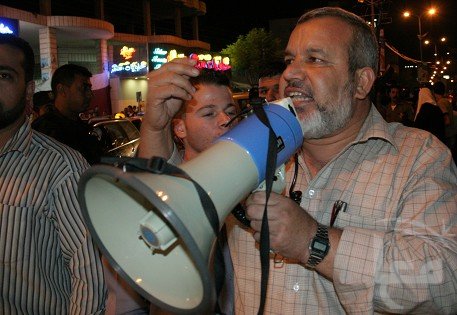
BETHLEHEM — Israeli forces detained a Hamas-affiliated member of the Palestinian Legislative Council on Monday from the southern West Bank district of Hebron.
Hatem Qafaish, elected to the Palestinian parliament in 2006 with Hamas’ Change and Reform bloc, was detained after Israeli forces ransacked his home, a local source told Ma’an. The PLC member was detained on 6 November 2007 and placed under administrative detention until his release in 2009.
Palestinian journalist Raed Ash-Sharif, working with a local Hebron radio station, was also detained.
According to the Ad-Dameer Prisoners’ Support and Human Rights organization, Qafaish had been detained by Israel five times previous to his latest detention. He was elected to the PLC in January 2006 after campaigning from his prison cell.
Qafaish was also among the more than 400 activists Israel deported to Marj Al-Zuhur in southern Lebanon in December 1992. After returning to the West Bank in 1993, he chronicled his experience in exile in a series of articles in the Al-Quds newspaper. He intended to eventually to publish a memoir, but the manuscript was confiscated by Israeli prison guards.
There are six Hamas-affiliated PLC members in Israeli, detained shortly after the Islamist movement’s electoral victory. Following the capture of Israeli soldier Gilad Shalit in June 2006 in a cross-border raid in Gaza, Israel launched a detention campaign targeting Hamas affiliated PLC members in a bid to secure the soldier’s release.
A second campaign was launched in 2009, after Israel, Hamas and a German mediator, failed to come to a prisoner swap deal under Ehud Olmert’s premiership. Many of those detained in the later campaign were handed down administrative detention sentences, according to a report issued in June, with others receiving prison terms. The majority were released shortly after.
Since the beginning of 2010, a number of Hamas PLC members were released, including Mohammad Abu Teir. Shortly after his release, Abu Teir was again detained, issued a revocation order for his Jerusalem residency rights, and handed down a deportation warrant. He is currently being remanded in custody until Israel’s Supreme Court hears his case.
Abu Teir is among three other elected Change and Reform parliamentarians who are faced with deportation from Jerusalem.
One lawyer told Ma’an that under all legal precedents, lawmakers are immune while sitting in office. Israel, the lawyer said, has violated this legal norm both by jailing Palestinian PLC members in the West Bank and passing laws within the Israeli Knesset removing Palestinian-Israeli members’ immunity under the pretense of spying for an enemy state.
Thirty-one detainees stood for the Palestinian general elections in January 2006, with 15 becoming members of the PLC.
500 Civil Activists from Asia Will March to Gaza Against Siege
TCN News | October 8, 2010
New Delhi: About 500 civil rights activists from 17 Asian countries will march to Palestine to press Israel to end the siege of Gaza. The activists will gather in New Delhi on December 1 and proceed to Gaza. The march is being organized by Asian People’s Solidarity for Palestine.
The group announced the schedule of the march in a press conference on October 5 in Delhi with similar press conferences on the same day in four other countries Turkey, Iran, Indonesia and Lebanon. According to the release, 500 civil resisters from 17 Asian countries will join the caravan from India and march through 18 Asian cities of Pakistan, Iran, and Turkey to break the siege of Gaza through the sea route in December 2010.
“This struggle is broad, varied and multi-dimensional. It is humanitarian and for peace, freedom and human dignity. It is against occupation, imperialism, apartheid, Zionism and all forms of discrimination including religious discrimination,” the group said.
Their major demands include Palestinian Self-Determination; Ending the Occupation; Equal Rights for All within historic Palestine; the Right of Return for Palestinian refugees; and Establishment of a Sovereign, Independent and Democratic state of Palestine with Jerusalem as the capital.
The Caravan will be carrying relief materials for the people of Gaza. The Asia to Gaza Caravan will cross into Pakistan via Wagah border where the Pakistan Solidarity for Gaza groups will host a civic reception for the caravan and Pakistani civil resisters will join the Caravan onwards to Iran. In every country and city, welcome committees will host receptions and public meetings with mass organisations and civil resisters will join the caravan. The caravan will culminate in 500 civil resisters boarding a ship from a Mediterranean port to sail to Gaza to break the illegal Israeli siege.
According to the release, the march has been endorsed by various organizations and individuals including All India Students Association (AISA), Aman Bharat, Asha Parivar, Awami Bharat, Global Gandhi Forum, JamiatUlema-I-Hind and Jamaat-e-Islami-Hind. The individuals include Achin Vanaik, Agdish Nagarkar, Anand Grover, Anand Patwardhan, Shabnam Hashmi, Shahid Siddiqui and Medha Patkar.
Oxfam: Israeli policies damaging to the Palestinian olive oil industry
Ahmed Zaki Osman – 15/10/2010

Oxfam has reported that Palestinian olive groves are frequently attacked by Israeli settlers, file photo
The Israeli occupation of the West bank and siege of Gaza are seriously harming Palestinian olive oil production which contributes up to US$100 million annually for some of the most underprivileged Palestinian families, the international NGO Oxfam said in a report on Friday.
The report, entitled, “The Road to Olive Farming: Challenges to developing the economy of olive oil in the West Bank,” blames Israel for restricting access to land and olive tree farms.
“Around 40 percent of the West Bank is effectively off-limits to Palestinians, with access highly restricted, due to settlements, outposts, bypass roads, military bases, closed military areas and areas Israel has declared as being nature reserves,” the report said.
For centuries Palestinian olives have been a major commercial crop and are credited with being some of the best in the world.
Olives and olive oil are one of the main sources of income for the Palestinian economy. They represent around half of agricultural land use in the West Bank and the Gaza Strip as well as being a major export, and provide employment and a large source of income for around 100,000 farming families.
According to the report there are approximately 10 million olive trees with the potential to produce up to 34,000 metric tons of olive oil in a good year, but only 5,000 tons in a bad year. The average quantity of oil produced annually between 2001 and 2009 was around 17,000 tons.
Harmful impacts of Israeli policy also include settler violence sanctioned by the government, incidents in which illegal Israeli settlers have uprooted or burned tens of thousands of olive trees during their attacks against Palestinian farmers.
According to the United Nations, in the first six months of 2010 thousands of olive trees and other crops have been damaged by settlers.
Oxfam accused Israel of intentionally restricting access for Palestinian farmers to local and international markets, especially since the beginning of the second intifadha.
“Physical barriers such as checkpoints and road blocks have restricted the free movement of people and goods within the West Bank and obstructed access for Palestinian agricultural produce, including olives and olive oil, to internal, Israeli and international markets,” the report concluded.
As for Gaza, the picture is even gloomier since inhabitants cannot even get olives from the West Bank olives since the blockade started.
BDS Success: Unilever to Move Factory out of West Bank
Unilever Israel Foods is planning move its Beigel & Beigel company plant from the Barkan industrial zone, located in the occupied West Bank, to a location inside Israel, reports the Hebrew-language daily Maariv.
This moves follows intense Palestinian and international pressure on the parent company, Unilever International, to move its operations out of the settlement industrial zone or to divest from the factory, which collects profits due to the advantages given to Israeli businesses in the West Bank, including extensive subsidies by the Israeli government.
Unilever International, the UK and Dutch-owned multinational company, has been trying to divest from Beigel & Beigel since 2008, following the refusal of British stores to sell products manufactured in Israeli settlements. However, given the location of the factory in the illegal Ariel settlement and the growing international calls for accountability from the settlements industries, the company was unable to sell its shares.
“Following the divestment in recent years of a number of non-core businesses … the decision has been reached to divest of its interests in the bakery business and will therefore seek to find a buyer for Unilever’s share in the Beigel & Beigel partnership,” the company said in a statement at the time.
United Civilians for Peace, a Dutch organization, published a report in 2006 entitled Dutch economic links to the Israeli occupation of Palestinian and/or Syrian territories, and then began “a constructive dialogue with Unilever Netherlands on the ethical implications of the company’s investment in the settlement,” according to the UCP website.
According to the UPC report, “The land of the Barkan industrial zone was confiscated from surrounding Palestinian villages by a military order issued by the Israeli Defence Force in 1981, and declared “state land”. International Law prohibits the confiscation of occupied land not for military purposes.”
UCP also noted that the “Location in the settlement makes Unilever complicit with violations of international law, Palestinian human rights and labour rights,” and that “Beigel & Beigel benefits from subsidies allocated by the Israeli government to the industrial zones in the settlements. Also, the factory has been guaranteed a state grant for a plan of expansion.”
According to a 2008 Guardian newspaper article, “At Beigel & Beigel, 45% of the 140 workers are Palestinians from the surrounding villages whose land was confiscated for the construction. Most of them work on the assembly line operating machines and contrary to Unilever’s own labour standards, they are not paid the Israeli minimum wage.”
In 2008, Unilever Israel, which bought half of the Beigel & Beigel pretzel company in 2001, said their plan to sell Beigel & Beigel stocks was strategic, not ethical, but given their inability to sell stocks and divest from the company during this two year time period, Unilever’s recent action is a tacit admission that their decision to divest was a direct result of the pressure of the Boycott, Divestment and Sanctions movement.
Obama: Israel’s Lawyer
By Maggie Lorraine | Resisting Occupation | October 12, 2010
Just yesterday, Prime Minister Netanyahu demanded that the Palestinian Authority recognize Israel as a Jewish state in exchange for Israeli compliance with international law. Shortly after, State Department spokesman Philip Crowley illuminated the United State’s official position on the proposal, explaining, “We recognize the special nature of the Israeli State. It is a state for the Jewish people.” While President Obama’s views on the institutionalization of Israel’s ethnic character are of no surprise, such an outright endorsement of Netanyahu’s insult to the PA stands in stark contrast with the vision of the United States as impartial mediator the American public has been spoon-fed over the past few months.
If the admission of offering military, financial and political concessions in exchange for a partial extension of the so-called settlement “freeze” hadn’t done enough to destroy the Obama Administration’s credibility in the peace process, this was surely the final blow. How could any casual observer continue to believe Obama had the interests of both parties at heart while simultaneously lauding Netanyahu’s inanity as even remotely legitimate?
Israel’s settlement construction is illegal under international law. The United Nations General Assembly, United Nations Security Council and International Court of Justice all concur: Settlement construction in the West Bank and East Jerusalem must immediately halt and reverse, along with construction of the partition wall. Just as chief Palestinian negotiator Saeb Erekat said, Israel’s Jewish character has no bearing the illegal status of Israel’s settlements. Netanyahu’s condition is a wanton distraction.
The proposal also has nothing to do with Israel’s right to exist as a nation. Far from being existentially threatened, Israel has enjoyed full recognition of its sovereignty by Fatah and the PA for the past 17 years. The issue lies in Israel’s insistence that its statehood be defined on ethno-religious terms. Yet somehow the implications of this definition is utterly lost on Obama. Electronic Intifada founder Ali Abunimah illustrates the point well in two of his recent tweets:
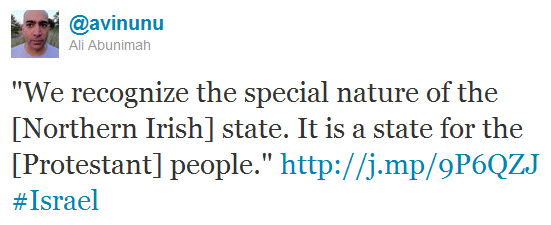
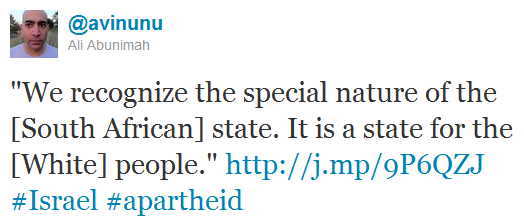
Would Obama align himself with the moral argument underpinning either of these assertions? One would hope not. Then why is it somehow permissible to endorse the same position when it comes to Israel? And how can his administration support linking the PA’s acceptance of such assertions to Israel’s admittedly partial and temporary compliance with standards of international law?
What’s more, who could defend Obama as a worthy proponent of peace while he cheers Netanyahu on in his quest to force Abbas into selling out Israel’s Arabs, further codifying their second-class status, while at the same time attempting to settle the question of Palestinian refugees’ Right of Return prima facie?
To summarize, if the PA were to accept such a deal, Israel would have achieved the following:
- Further military, financial and political support from the United States;
- Formal permission from the PA to continue subjugating Israeli Arabs;
- And nullification of the Right of Return for Palestinian Refugees of the Nakba
The PA would achieve the following:
- A temporary “freeze”of settlement construction on what is to become a Palestinian state if talks succeed, one that would presumably not include freezing construction in East Jerusalem (in contravention of international law), nor the construction of current projects including the thousands that began just a few weeks ago, nor suspending the confiscation of Palestinian property to make room for further construction, just as the last “freeze”did not include these things
The United State’s endorsement of such an insulting proposal makes clear Obama’s complete disregard for Palestinian interests, and his commitment to repeating the mistakes of his predecessors. The authors of The Israel Lobby explain, “As Aaron David Miller, an adviser to six different secretaries of state on Middle East and Arab-Israeli affairs and another key player in the Clinton administration’s peace effort, put it during a 2005 postmortem on the failed negotiations: ‘Far too often, we functioned…as Israel’s lawyer'” (Mearsheimer and Walt 48). How exactly has Obama done anything to improve upon this characterization?
Jewish colonists assault Palestinians during olive harvest, stealing fruit
By Mays Al-Azza – IMEMC & Agencies – October 13, 2010
 Ma’an news has recorded photographic evidence of the settlers attacking the Palestinians in the olive groves in Boreen

Palestinian sources reported, on Wednesday, that settlers have attacked the Palestinians olive groves in Boreen village, in the southern part of Nablus. The attack comes at the beginning of this year’s olive harvest.
One Palestinian farmer stated that more than fifty settlers from Aitsear settlement in the southern part of Nablus, attacked and hit him with stones, resulting in wounds to his back, in an attack attempting to steal his horse. He added that they stole two bags of olive and many tools from his land.

Ghassan Doughlass, a Palestinian official in charge of settlement activity in the North of the West Bank, stated that it is not the first time that settlers attack the Palestinian olive orchard.
He noted that many attacks have occurred in the villages surrounding Nablus, such as Yanon, Amaten, Orta and Far’ta, especially after an Israeli rabbi had made an advisory opinion that allows settlers to steal olives. Doughlass added that settlers had cut the trees after they picked all the olives.
The olive harvest is an important season for the Palestinians, with the harvest producing significant quantities of foodstuff for the Palestinian peoples and being the mainstay of the West Bank’s economy.
Netanyahu’s Seemingly Limitless Arrogance
By Maggie Lorraine | Resisting Occupation | October 12, 2010

In the newest development concerning peace negotiations between Israel and the PA, Netanyahu has offered to partially extend the fake settlement freeze in exchange for recognition of Israel’s Jewish character. In a startling spectacle of rationality, the PA has rejected the offer in kind. BBC reports:
The chief Palestinian negotiator, Saeb Erekat, said Mr. Netanyahu was “playing games” with his offer, and that there was no connection between settlements and the national character of Israel.
“I don’t see a relevance between his obligations under international law and him trying to define the nature of Israel,” he added. “I hope he will stop playing these games and will start the peace process by stopping settlements.”
He’s right. Settlement activity in the West Bank is illegal under international law regardless of Israel’s “Jewishness”. Perhaps Bibi Netanyahu forgot this:
Israeli settlements in the Occupied Palestinian Territory, including East Jerusalem, are illegal and an obstacle to peace and to economic and social development [… and] have been established in breach of international law. -International Court of Justice Ruling, July 9, 2004
Or operative paragraph one of UNSC Resolution 242, in which the Security Council unanimously:
…Affirms that the fulfillment of Charter principles requires the establishment of a just and lasting peace in the Middle East which should include the application of…the following principles:
(i) Withdrawal of Israel armed forces from territories occupied in the recent conflict…
Or UNSC Resolution 446, which affirmed in explicit terms the conclusions of UNSC Resolution 242 (three abstentions) as did UNSC Resolution 452 (one abstention) UNSC Resolution 465 (unanimous), and UNSC Resolution 471 (one abstention)?
Or the portion of UNSC Resolution 252, passed with two abstentions, in which the Security Council:
…Considers that all legislative and administrative measures and actions taken by Israel, including expropriation of land and properties thereon, which tend to change the legal status of Jerusalem are invalid and cannot change that status; [and] Urgently calls upon Israel to rescind all such measures already taken and to desist forthwith from taking any further action which tends to change the status of Jerusalem…
Or UNSC Resolution 267, unanimously adopted, which affirmed the conclusions of UNSC Resolution 252, as did UNSC Resolution 298 (one abstention), UNSC Resoluition 476 (one abstention) and UNSC Resolution 478 (one abstention)?
Maybe Bibi forgot that, unlike the General Assembly, resolutions passed by the Security Council are indeed binding?
Maybe he forgot that in 1993 the UNSC approved a report by the Secretary General which concluded beyond doubt that the law applicable in armed conflict as embodied in the Geneva Conventions of 12 August 1949 and the Hague Convention (IV) of 18 October 1907 had become part of international customary law, and thus applied even if the other party was not a High Contracting Party (as is the case in Palestine)?
Did he simply imagine that at the end of each of these resolutions is the caveat “if and only if Israel is recognized as a Jewish state,” thus exempting Israel from its legal obligations?
Or perhaps Erekat is right, and Bibi really is just playing games. Setting aside the composition of Israel’s demand of recognition as a Jewish state (which is ridiculous in and of itself), the mere act of setting preconditions for compliance with international law attests to Netanyahu’s seemingly limitless arrogance. He honestly thinks he can shift the blame for the disintegration of peace talks by throwing bones to the PA, which already affirmed Israel’s right to exist (sans the racist classification) in 1993. He clearly believes that through slight of hand he can simultaneously eviscerate the Right of Return for Palestinian refugees, and strengthen the codification of Arab subjugation in Israel all in exchange for what exactly? “An additional suspension of building for a limited period of time,” says Bibi. Will this be the same kind of “suspension” that still allowed for unhindered construction in East Jerusalem, for the razing of Palestinian villages and confiscation of private Palestinian property, and for continued work on current projects which would most likely include the 3,000 that began as soon as the last “suspension” ended?
Let’s just hope this doesn’t constitute the kind of gesture Obama promised to prostitute US taxpayers in order to coax out of the Israeli government.
EU police mission complicit in Israeli, PA rights abuses
David Cronin, The Electronic Intifada, 12 October 2010
 |
Palestinian police officers attend an EU police training course organized in the West Bank city of Qalqiliya, October 2009. (Khaleel Reash/MaanImages) |
A bizarre public relations exercise is now underway in the West Bank. Doubtlessly inspired by the enduring popularity of TV drama CSI: Crime Scene Investigation, the European Union has been trying to glamorize a forensic science course it has been running for Palestinian police since mid-September. As well as being tutored on fingerprinting techniques and the use of chemicals following a murder or armed robbery, officers completing the six-week program will be given CSI vans of their own, “updates” promoting the course tell us.
It is not difficult to see why EU officials are eager to obtain favorable publicity for their police support “mission,” headquartered in Ramallah. For all of its five-year life, the mission has been something of a poor relation to the other major international policing initiative in the occupied West Bank: that run by United States security coordinator US Army Lieutenant General Keith Dayton (replaced by US Air Force General Michael Moeller earlier this month). At a time when the EU’s 27 governments are nominally striving to make a greater collective impact on the world stage, it is logical that they should be highlighting foreign policy work that at first glance appears laudable.
The reality is far from glamorous. Rather than helping to nurture institutions that could prove essential in a future Palestinian state, both the EU and US are acting as proxies for the Israeli occupation. Moreover, they are acquiescent in human rights abuses perpetrated by Palestinian Authority (PA) security forces against the Palestinian people.
Contrary to the impression frequently created by news stories, the PA does not have a police force that can justifiably be viewed as independent of Israel. Under the Oslo accords from the 1990s, the PA was given full responsibility for security in a region dubbed “Area A.” This comprises six West Bank cities — Jenin, Nablus, Qalqilya, Ramallah, Tulkarem and Bethlehem — and part of Hebron. In Area B — other towns and villages, where 68 percent of Palestinian inhabitants in the West Bank lived — the authority was tasked with maintaining public order but Israel was allowed “overriding” responsibility for security. Then in Area C — 62 percent of the West Bank, including Jewish-only settlements and other areas deemed of “strategic importance” to Israel — total control over security remained in Israeli hands. Moreover, under the Oslo accords, the PA police forces only have jurisdiction over the Palestinian population, not over territory; they have no powers to arrest, or intervene with Israeli settlers or other Israeli citizens even when they are present in areas ostensibly under PA control.
For the Palestinians, it has proven impossible to operate a police service that could comply with international norms. Regular incursions by Israeli troops throughout the West Bank has meant that patrols by Palestinian officers cannot be undertaken in any city, apart from Ramallah, between midnight and six o’clock in the morning.
The response from the EU mission (its proper name is the Coordinating Office for Palestinian Police Support or COPPS) to Israel’s everyday acts of aggression and intimidation has been timid, to say the least. The strongest words that Hendrik Malmquist, the Swedish officer heading the mission, has used on the record to criticize the Israeli incursions is to call them a “public embarrassment” for the Palestinian Authority.
Maybe his nonchalance is best explained by how COPPS is part of what Israeli human rights campaigner Jeff Halper calls the “matrix of control” imposed by Israel on the occupied West Bank and Gaza Strip. Visiting Brussels in May, Malmquist said that Israel is “happy we are there in order to contribute to better security in the [occupied] territories.” Probably the main reason for Israeli satisfaction with his work is that his eighty-strong staff has been assisting the forces of occupation to strengthen their grip over most aspects of Palestinian life.
When I contacted EU officials in Ramallah recently, they sought to downplay the significance of their role in fostering cooperation between Israeli and Palestinian Authority security forces. The officials pointed, for example, to how they have organized joint Israeli-Palestinian training seminars on apparently uncontroversial issues such as traffic management. “We are not in the political game,” one official insisted.
A document published by the Israeli foreign ministry in April however indicates that the cooperation goes deeper. Titled “Measures Taken by Israel in Support of Developing the Palestinian Economy,” it says that COPPS has played a “central role” in encouraging and implementing “capacity-building” in the West Bank. The purpose of this “capacity-building,” the paper makes clear to anyone who reads between its lines, is to stress that the Palestinian Authority forces are subservient to Israel. Last year, the ministry gloats, was a record one for “coordinated actions” between Israeli and PA security forces, with almost 1,300 taking place, a 72 percent rise over 2008.
In its monthly newsletters, COPPS promotes the training offered by its human rights specialist Diane Halley to Palestinian police. This propaganda cannot be allowed to mask how the EU has enabled a situation to develop where gross abuses occur within a culture of impunity. Whereas COPPS’s original mandate allowed it to support police in both the West Bank and Gaza, the European Union’s refusal to engage with the de facto Hamas administration in Gaza has meant that it has been encouraging disunity among Palestinians.
Worse again, the EU has connived in the creation of what an alliance of Palestinian human rights groups recently called “a police state” within the occupied territories. While these groups — including the Palestinian Centre for Human Rights, Al-Haq and the Women’s Center for Legal Aid and Counselling — stress that most violations committed by the Palestinian Authority are a “direct result” of tensions between Fatah and Hamas, the EU has been largely silent about the abuses.
During a press briefing in May, Malmquist stated that COPPS wishes to “export core European Union values” such as respect for fundamental rights. A few minutes later, Palestinian police spokesman Yossef Ozreil insisted that there is “no more torture” by his colleagues against political rivals.
Malmquist did not contradict this assurance, yet evidence amassed by the Arab Organization for Human Rights suggests that Ozreil was dishonest. Mohammed Jamil, a spokesman for the organization, said that there is an average of seven arrests in the West Bank each day, with between 700 and 800 rounded up in the Hebron area last month after Hamas gunmen killed four Israeli settlers. Torture of detainees is widespread, he added. Methods found to have been used include tying people to the ceiling and suspending them, aping crucifixions by tying people to doors with their arms and legs outstretched and beatings by sticks. One man was tortured by having a boiled egg placed on his backside, Jamil told me. “They [the security forces] made jokes about him — that he was like a chicken giving birth to eggs.”
On paper, the main distinction between COPPS and the US security coordinator in the West Bank is that the former interacts with the Palestinian Authority civil police and the latter with the more militarized National Security Force. In practice, there is extensive overlap between the two international operations; Dayton has said that one of his objectives was to eliminate any duplication of efforts between aid donors to the Palestinian Authority. As well as employing several British members of staff in his team, Dayton enjoyed close contacts with the two Britons who headed COPPS before Malmquist took up his post in January this year: Colin Smith and Paul Kernaghan.
The extent to which Dayton may have advised forces loyal to Fatah to resort to brutal means in attacking Hamas supporters has not yet been revealed. One thing that is clear, however, is Dayton’s understanding that his job was to underscore the Palestinian Authority’s subordination to Israel. “We don’t provide anything to the Palestinians unless it has been thoroughly coordinated with the state of Israel and they agree to it,” he has said.
Daud Abdullah, director of Middle East Monitor, a research institute in London, says it is inconceivable that Dayton was unaware of the abuses conducted by Palestinian security forces. “There has been no let-up in abuses as far as we know,” Abdullah added. “The fact that money is still flowing and [international] officials are still on the ground makes them culpable for what is happening.”
COPPS has a budget of nearly 7 million euros ($9.7 million) for this year. This sum appears small on its own. Yet it cannot be separated from the wider support that the EU gives to the Palestinian Authority, which amounts to 947 million euros since 2008.
Europe’s representatives rarely miss an opportunity to trumpet their generosity to the Palestinians. Although donors are undoubtedly financing the provision of many essential services in the occupied territories, tough questions need to be asked about a great deal of this aid and how it is being tailored to serve Israel’s interests. Few taxpayers would be pleased to know that their hard-earned euros are subsidizing an illegal occupation and the systematic human rights abuses that go with it.
David Cronin’s book Europe’s Alliance With Israel: Aiding the Occupation, to be published on 20 November, can be pre-ordered from www.plutobooks.com.
In the jungles of northern Okinawa, protests against planned US helipads reach a crisis point
By Jon Mitchell · IPS · October 5, 2010
 The residents of Takae, a small village in the hills of northern Okinawa, are no strangers to the American military. Since 1957, they’ve been living next to the world’s largest jungle warfare training center – and many of them are old enough to remember the days when the U.S. Marine Corps hired locals to dress up as Vietcong for its war games.
The 1996 Special Action Committee on Okinawa was supposed to reduce the U.S. presence in the area. Convened to quell public fury over the rape of a 12-year old girl, it pledged to return large swathes of military land to Okinawan residents – including over half of the jungle training center. As the months passed, however, the promise failed to materialize. Even when a Marine helicopter crashed near Takae’s elementary school in 1999, the daily bombing runs and roof-high helicopter sorties continued unabated.
Then, in 2006, the U.S. military made an announcement. Before returning the territory, it first wanted to build six new helipads on the land it was retaining on the outskirts of the village. The residents repeatedly lodged complaints with the prefectural and national governments, but they were ignored. In 2007, construction crews from the Okinawa Defense Bureau arrived to start laying the foundations for the 250-foot helipads. Takae’s villagers were waiting for them. They linked arms to block the gates to the worksite, they surrounded the trucks and appealed to the builders to stop their work. When they refused to listen, the protesters sat in the way of their heavy machinery. But the crews continued to unload bags of cement over their heads. Only when the police arrived did construction stop out of concern for public safety.
Since that day, over 10,000 locals, mainland Japanese, and foreign nationals have participated in a non-stop sit-in outside the planned helipad sites. So far, they’ve managed to thwart any further construction attempts. At small marquee tents, the villagers greet visitors with cups of tea and talk them through their campaign, highlighting their message with hand-written leaflets and water-stained maps.
“We’re just ordinary people wanting to lead ordinary lives,” explains Takae resident, Isa Ikuko. In a quiet voice almost drowned out by the click and whir of late summer insects, she talks of the area’s 180 species of endangered wildlife and her pride in its broccoli-shaped trees, the nearby rivers that supply the island with most of its drinking water, and the recent disclosure that the U.S. military tested Agent Orange here in the 1960s. “But what particularly scares me is the Marine Corps plan to bring in the Ospreys,” says Isa, holding up a U.S. military image of the accident-prone aircraft flying over a river suspiciously similar to one near the village.
Equally frightening are the recent tactics deployed by the Tokyo government. In November 2008, it filed an injunction against 15 of the protesters, accusing them of obstructing traffic in the area. Hoping that the three-hour road trips to the capital’s courthouse would wear down the villagers’ resolve, it also included an 8-year old child on the roster of defendants to intimidate other potential participants. The ploy backfired and the ensuing public outcry forced prosecutors to drop 13 of the cases. Two still remain, though, and with the next hearing scheduled for later in the year, a dangerous precedent is at stake. If the government wins, it will open the door for suits against similar protests – including in nearby Henoko bay where for the past six-and-a-half years, sit-in protesters have successfully prevented construction of an on-sea air base.
As long as the cases meander through the courts, the Okinawa Defense Bureau crews stay away from Takae. But with verdicts due soon, Isa and her fellow protesters are steeling themselves for the showdown sure to come to this little-known corner of northern Okinawa.
Featured Video

AIDS Inc. by Gary Null (2007)
or go to
Aletho News Archives – Video-Images
From the Archives
Fanatical Followers of the Covid Regime: A Jim Jones-Style Cult?
By Professor Roger Watson and Dr. Niall McCrae | The Daily Sceptic | November 15, 2021
As scholars at leading British universities over recent decades, we witnessed the replacement of critical thinking and debate by narrative: facts are discrimination and scientific method is imperialism; truth, instead, is derived from ‘progressive’ values. This educational trend may be a major contributory factor to the ease in which society has been inculcated to the Covid ‘new normal’ of masking, testing, and repeated doses of vaccines for a disease of similar risk to severe influenza.
One doesn’t need much critical reasoning to observe the flawed logic of some vaccination enthusiasts, such as people who respond to experiencing any side effects, however debilitating, by saying “at least I know it’s working”, or, after contracting the disease despite their promised inoculation (over 90% effective, according to initial drug company claims), “I’d have been worse off without the jab.” … continue
Blog Roll
 Aletho News
- Merck Virologists Admitted to Falsely Certifying Vaccine Efficacy
- Mandatory Folic Acid for every man, woman & child
- Pro-Palestine protesters arrested outside UK’s ruling Labour Conference in Liverpool
- Mauritius denies landing permit to flight from Israel, forcing cancellation: Tour operator
- Israeli finance minister calls for genocidal war on West Bank, annexation of south Lebanon
- 12 Things Your Psychiatrist Was Trained Not to Tell You
- From Unipolar Universalism to Multipolar Civilizational Distinctiveness
- RSF military group defects, joins Sudanese army: State media
- Ireland goalkeeper refuses to play ‘Israel’ as squad weighs boycott
- China pushes back against US on Cuba, Iran
- If Americans Knew
- Israel forces Gazans to live in constant peril – Daily Update
- Deconstructing Netanyahu’s pants-on-fire UN rant – Daily Update
- Trump betrayed voters with his campaign lies and prioritized a foreign country once he took office
- Netanyahu calls Israel’s war in Gaza ‘opposite of genocide’ in UN speech to near-empty hall
- Settler Kidnappings: Torture, Sexual Abuse and Terrorisation of Palestinian Abductees as Israel Deepens Annexation of West Bank
- Gaza winter nears as 162,000 tents become unusable, raising fears of humanitarian crisis
- Netanyahu says, “It’s the opposite of genocide”; UN says Gaza economy is world’s ‘most severe crisis on record’ – Daily Update
- Israel’s US-Backed Assault on Gaza Has Created the ‘World’s Most Severe Economic Crisis on Record’: UN
- ‘Protecting U.S. Citizens’… From Israel
- ‘This is where I live now, the back of a truck’: a day in the life of a grandmother in Gaza
- No Tricks Zone
- New Study: Earth And Venus Surface Warmth Largely Explained By Convection And Lapse Rate, Not CO2 Or Radiation
- 2025 Nature Paper Claiming Worsening Global Drought Gets RETRACTED …Heavily Flawed
- New Study: ‘Global Drought Shows No Detectable Recent Acceleration Under Climate Warming’
- Economic Masterminds: German Socialists Suggest Taxing Productivity Gains Stemming From Using AI
- The South China Sea Has Not Been Cooperating With The Climate Change Narrative
- Energy Crisis: Germany Enters Heating Season With Historically Low Gas Reserve Fill Levels
- New Study: The Antarctic Ice Sheet Gained Mass From 2020-2024 Due To Staggering Snow And Ice Accumulation
- Study: Ocean Heating Rates From Thousands Of Years Ago ‘Dwarf’ Modern Ocean Heating Rates
- Climate Extremists Target, Attack Large-Scale Power Grid Infrastructure In Germany!
- New Study: Antarctic Ice Melt Has Contributed Less Than 1 Centimeter To Sea Level Rise In The Last 30 Years

