The mask is off
By Sucheta Chatterjee | Online Journal | October 6, 2010
This note is an expression of the shock and disappointment that assailed large sections of Indians in the aftermath of the Ayodhya verdict. The judgment of the Honourable Allahabad High Court appears to be a clean break from the secular traditions of India, where a judicial body has openly intervened on behalf of the people of a particular religious faith and has failed to uphold its role as that of a rational, impartial arbiter.
The land suit in question appears to have been decided on the basis of faith rather than of fact. The judgment has erroneously concluded that Ayodhya was the birthplace of the Hindu mythological character, Ram, because Hindus believe so. The court has delved deep into the evidence placed forth about the fact that Hindus believe Ayodhya to be the birthplace of ‘Lord Ram’ and has concluded that thereby Lord Ram was born in Ayodhya, effectively converting mass belief into a fact, in defiance of logic. This conclusion appears to be all the more absurd in the absence of evidence to prove that Lord Ram was actually a historical character and not just a mythological one. The court appears to have flirted extensively with theology while choosing not to dwell upon the legal aspects of possession and adverse possession of the land concerned. If the judgment had been based exclusively on legal tenets, which is what one expects from the judiciary of a democratic nation, the judgment would have swung the other way because since the Mughal period, the so-called disputed land has housed a mosque.
The court has needlessly delved into the question of whether the said place of worship was used regularly or not, ignoring the fact that in 1949, Hindu fascist groups forcibly entered the mosque, placing Hindu idols in it and thereby creating a ‘dispute’ which prompted the government to lock the premises, declare the matter sub-judice and prevent Muslims from offering prayers therein. Besides, the act of placing idols within the precincts of the mosque was considered an act of desecration of their holy place by Muslims. Not once has the court condemned the act of illegality that took place in 1949. Instead, it set upon itself the task of correcting historical wrongs, dating back to the pre-Mughal period, based on a flawed ASI report that has been discredited by reputed historians the world over. Such flagrant interventionism on behalf of a powerful segment of the Hindu populace has ripped the mask of secularism off the judiciary’s face. We would also like to add that the principle of ‘superior fundamental right,’ as espoused by Justice Sharma to rule that Hindus have a superior right of worship at the concerned spot, appears to have been gravely misinterpreted in this case. The legal precedent set by this judgment has only given birth to a hornet’s nest and legitimised the ascendance of faith over reason, of politics over justice.
The grief and bewilderment caused by the political judgment will only foment a lingering sense of injustice among the minority community, which has been treated contemptuously and has been parcelled out a third of land, almost as if it were being given gratuitously. The most distressing part of the judgment is that while the court has taken upon itself the mission of setting right ill-documented and doubtful historical wrongs, not once has it condemned the criminal act of demolishing the Babri Masjid, perpetrated by right-wing Hindutva factions, under the guidance of leaders of national stature and reputation. It appears that truth and justice have been the chief casualties of a misguided attempt at reconciliation.
Sucheta Chatterjee is a lawyer by profession, currently based in Bombay and the author of ‘Impotent Ire.’
Palestinian shot dead entering East Jerusalem
Ma’an – 03/10/2010
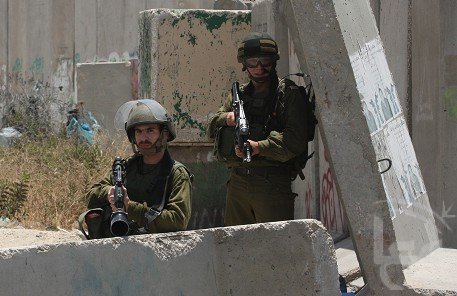
BETHLEHEM — A Palestinian worker from Hebron was shot and killed by Israeli border guards on Sunday while he attempted to enter East Jerusalem near the village of Al-Isawiya.
The deceased was identified as 38-year-old Izz Ad-Din Al-Kawazba from the town of Sa’ir in Hebron. Al-Kawzaba’s cousin Salah told Ma’an that border guards shot the victim at close range, refuting police accounts that the shooting was accidental.
Al-Kawazba said he was 20 meters away from his cousin when he was shot, shortly after two groups of workers climbed over the separation wall in the Zayem At-Tur area and were chased by an Israeli border guard patrol.
He said he urged his cousin, who was with his brother Hassan, to “hurry because the soldiers were behind us.”
“Suddenly I saw a soldier approaching Izz Ad-Din extending his gun to his body and shooting. I moved backward along with dozens of other workers to check up on Izz Ad-Din. As we got close, we were surrounded by special forces who attacked us violently,” he said.
“We saw them shoving the martyr’s body in a black bag dragging it more than 50 meters. More than 100 workers were gathered and were sent to Al-Eizariya. The victim’s brother Hassan was detained,” he added.
Spokesman for Israel’s National Police Mickey Rosenfeld said Al-Kawazba was injured when a “shot was fired apparently accidentally” by a border guard officer after he “attempted to grab one of the border police’s gun.”
Al-Kawazba was transferred to the Hadassah Ein Kerem Hospital where he later died of his wounds, Rosenfeld said, adding that an investigation “is being carried out in order to understand what took place at the scene.”
Rosenfeld said the shooting followed the detention of “15 illegal workers [who] crossed the security barrier near French Hill,” after which a chase ensued.
The death comes over a week after an Israeli settler guard shot and killed two Palestinians in the flashpoint neighborhood of Silwan in East Jerusalem, sparking days of clashes.
Occupation Soldiers Attack Nonviolent Protestors In Hebron
By Saed Bannoura – IMEMC & Agencies – October 03, 2010
Israeli soldiers attacked dozens of Palestinian, Israeli and International protestors who held a march in Hebron on Saturday evening demanding freedom of movement for the residents of Hebron. The protest was held near the Al Shuhada Street, one of many streets that are off-limits to the Palestinians in the city.
Israeli soldiers attacked reporters and attempted to move them away under the pretext that the area is a closed military zone. Troops also stationed themselves on top of several homes and used them as military towers.
The protest was organized by the Youth Coalition Against Settlements; it was held near a military roadblock at the southern entrance of the Al Shuhada Street. They carried Palestinian flags and signs demanding that Israel open the street, and stop all forms of racial discrimination against the Palestinians.
The protestors chanted slogans against the ongoing attacks carried out by soldiers and settlers in the city and its surrounding areas.
Hisham Sharabty, a local activist against settlements, stated that this nonviolent protest is an affirmation to the legitimate rights of the Palestinian people, such as the right to Freedom of Movement.
Al Sharabty added that the Palestinians reject the resumption of direct talks with Israel while its settlement activities are ongoing, and that the Palestinian Authority went to the negotiation table on the principle of Land for Peace, therefore “it is unreasonable to hold talks while land theft is ongoing”.
He demanded the International Community apply pressure on Israel to oblige it to stop the construction and expansion of settlements and dismantle existing settlements in the occupied territories and occupied East Jerusalem.
The Al Shuhada Street has been off-limits to the Palestinians since 1994 as only Jewish settlers and soldiers are allowed to use it.
It is one of the most vital streets in the city as it is located in the center of Hebron and its closure separated the southern neighborhoods from the north; the army also ordered the closure of more than 500 stores since the year 2000.
The closure also isolated the center of the Old City of Hebron which led to the closure of more than 1000 stores.
There are at least 100 military roadblocks, gates and sealed roads in Hebron.
Four illegal outposts to be built in Hebron
Ma’an – 30/09/2010
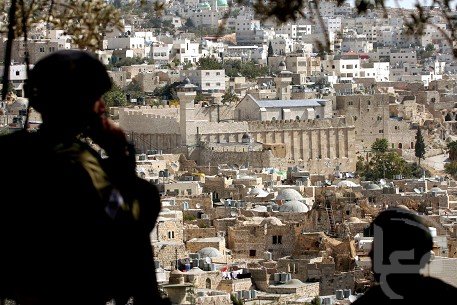
HEBRON — The infrastructure for four illegal outposts is being constructed around the West Bank city of Hebron, a settlement affairs expert said Thursday.
In an interview with Ma’an Radio, Abed Al-Hadi Hantash said the outposts would be integrated to form a new settlement, which would be linked with Kiryat Arba, the largest settlement in the district.
Combined, the settlements would constitute a third of the city of Hebron, which is already surrounded by illegal settlements, Hantash said. The new project would confiscate a further 15 square kilometers of Palestinian land from Hebron’s borders, he said, and is being funded by a Jewish society which supports settlement activity in the West Bank city.
The construction of a new school and kindergarten began earlier this week in illegal outposts in Hebron. Further, a road leading from Kiryat Arba to the Ibrahimi Mosque, which would cut through Jaber neighborhood in the Old City, was also approved. The road’s construction would put Palestinians at risk of eviction, Hantash said.
Hantash said he was astonished at the Palestinian handling of the settlement issue, which focused on individual violations and failed to pay attention to the slow and systematic process by which settlements are taking over control of the heart of Hebron.
Europe Offers Tax Benefits for Illegal Settlements
By David Cronin | IPS | September 28, 2010
BRUSSELS – Organisations raising funds to benefit the Israeli army and illegal settlements in the West Bank enjoy tax-exempt status in Europe, an IPS investigation has shown.
The Sar-El Foundation is one of several groups working in the Netherlands dedicated to supporting the Israel Defence Forces. It organises regular visits to Israel, where Dutch volunteers spend three-week periods training with the IDF.
Max Arpels Lezer, the foundation’s Amsterdam-based chairman, said that he tries to encourage volunteers to work in Israeli hospitals but if “that is not possible they can do civilian work on military bases.”
He has previously stated that while the volunteers do not become soldiers, “they help in the battle against the Palestinians.” But he would not comment when asked why he wishes to assist the Israeli army, given that a United Nations inquiry led by retired South African judge Richard Goldstone found that its troops committed war crimes during a three-week offensive against Gaza in 2008-2009.
“I don’t wish to answer the question,” he said. “We don’t talk about politics. Our organisation is a non-political organisation.”
Under Dutch law, foundations such as Sar-El are exempt from tax, and individuals giving money to them can deduct the donations from their income tax.
A similar group Collectieve Israël Action (Collective Action Israel) collects about eight million euros (11 million dollars) per year, according to its website. Among the projects it assists are training for Israeli soldiers, particularly on the applications of advanced technology. The CIA’s board of advisers includes Doron Livnat, director of Riwal, a supplier of cranes used in the construction of the massive wall that Israel has built in the West Bank. That wall was found to be illegal in a 2004 opinion issued by the International Court of Justice in The Hague.
The Nachamoe Foundation, meanwhile, raises money for the upkeep of Israeli families. The foundation has admitted that some of the families live on Israeli settlements between Jerusalem and Bethlehem.These settlements violate international law; the 1949 Fourth Geneva Convention forbids an occupying power from transferring part of its own civilian population into the land it is occupying.
Some groups in the Netherlands have categorised support for the IDF as “humanitarian aid”. Visie voor Israël (Vision for Israel) encourages its sympathisers to give donations that will be used to buy gifts such as backpacks for Israeli soldiers. A newsletter from the organisation says that the quantity of gifts provided has increased substantially since the Israeli army’s offensive against Gaza over the past two years.
Shuva is one of several Christian Zionist organisations working in the Netherlands viewing the foundation of Israel and the occupation of the West Bank and Gaza as the fulfilment of a Biblical prophecy. According to one of its 2009 newsletters, it has financed a school in Nofei Nechemia, an extension (frequently termed an “illegal outpost” by Israeli newspapers) of the Israeli settlement of Ariel the West Bank. Shuva has stated too that it helps hundreds of settlers establish themselves in four Israeli communities in the West Bank every year.
A spokesman for the Dutch inland revenue service said that the country’s tax rules do not contain any clauses relating to breaches of international law. He said that Dutch legislation allows non-profit organisations to apply for tax exemptions based on their stated goals. “At any given moment, the Dutch tax authorities may decide to revoke this favoured status” after examining the activities of those benefiting from it, he added. But the spokesman said he was unable to speak about the status enjoyed by any particular organisation.
Ghada Zeidan from United Civilians for Peace, a Palestinian solidarity group in the Netherlands, said it is “very difficult” to convince the authorities that they should take action against fundraising by pro-Israel organisations. “The problem is that there is a kind of culture of acceptance of it,” she added.
Earlier this year a campaign was launched in Britain to have the Jewish National Fund (JNF) stripped of its status as a charity. While the JNF presents itself as an ecologically minded body that plants trees in Israel, it has actively supported violence against Palestinians for many decades. One of its leading figures Yosef Weitz explicitly advocated in 1940 — eight years before the state of Israel was founded — that Palestinians should be forced out of Palestine. More recently, the JNF has concentrated much of its energies on settling Jews in the Negev, a process that has involved the uprooting of indigenous Bedouins, often by the destruction of their homes.
The latest accounts made public by the JNF in London say that its total income for 2008 amounted to 7.7 million pounds (12.2 million dollars). Another priority for the fund has been to help the Benji Hillman Foundation; set up in memory of a soldier killed when Israel attacked Lebanon in 2006, it offers accommodation to young people who travel from abroad to join the Israeli army.
A spokesman for the British revenue authority said he could not say if any investigations have been undertaken into the JNF’s activities.
The International Solidarity Movement (ISM) — one of the organisations monitoring the JNF’s work — is seeking a probe into whether fundraisers for foreign armies can be considered charities under British law. Matthew Richardson, an ISM activist, noted that the JNF has powerful allies — David Cameron, the British Prime Minister — has agreed to be one of its patrons; so too did his predecessors Gordon Brown and Tony Blair. Richardson added: “The JNF is very embedded within the (pro-Israel) lobby and the political elite as a whole.”
Help Us Replant Saffa!
Palestine Solidarity Project | September 23, 2010
Join the Palestine Solidarity Project as we prepare to replant the Saffa valley, destroyed by settlers in 2009 and currently under threat of annexation by the Israeli military. Saffa is a Palestinian agricultural community at the edge of the illegal Bat Ayn settlement, and Saffa farmers are frequently subject to settler violence and harassment. A series of settler attacks in the summer of 2009 left several Palestinian farmers wounded and much of the land destroyed.
Settlers have destroyed nearly all of the trees in the Saffa valley, depriving many farmers of their primary source of income. To make matters worse, the Israeli military has recently begun claiming that the land is “state land,” indicating their intention to annex the valley to the illegal Bat Ayn settlement. All of the farmers have documents proving their ownership of the land. In 2009 the army began issuing a series of “closed military zone” orders denying the farmers access to their land, and attempts to reach the land have been violently suppressed.
For over a year the Palestine Solidarity Project has organized delegations of internationals and Israelis to accompany the farmers to their land, in order to deter settler violence and military harassment. In January 2010 the Palestine Solidarity Project organized the replanting of over two thousand trees in Saffa, to replace the ones destroyed by settlers and to deter further annexation. We are hoping to plant another three thousand trees this winter on land intended for annexation by the settlement. WE NEED YOUR SUPPORT!
Join Us!
We are calling all people of conscious to join the farmers of Saffa as they prepare their land for planting. The presence of large groups, including Israelis and internationals, helps deter settler and military violence, and will hopefully prevent imminent annexation. We will be working in the land Sundays, Mondays and Thursdays from 9 am until noon starting October 3. To get involved contact our volunteer coordinator, Maria Lewis, at (972) 59-708-6407.
Donate!
All of the trees (and tools) are paid for by the generosity people like you! The Palestine Solidarity Project is in need of donations to make our goals in Saffa a reality. Donate online at http://palestinesolidarityproject.org/donate/.
Palestinian AP Cameraman Deliberately Targeted, Beaten By The Army
Ma’an – September 26, 2010
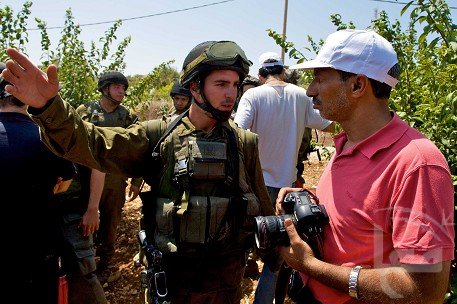
HEBRON — Israeli forces assaulted and detained Associated Press photojournalist Nasser Shiyouki on Saturday as he covered the weekly anti-wall protest in Beit Ummar near Hebron, witnesses said.
An Israeli military spokeswoman said Shiyouki physically confronted forces and refused to adhere to soldiers’ requests to step back. She said the photographer was briefly detained, and that a report was filed with Israeli police, who would investigate the incident.
Clashes erupted between protestors and Israeli soldiers after dozens of Palestinian, Israeli and international activists rallied near Karmi Zur, an illegal Israeli settlement built on land confiscated from Beit Ummar and neighboring town Halhul. Demonstrators raised Palestinian flags and chanted anti-wall and anti-occupation slogans.
Locals said several protesters suffered from tear gas inhalation at the rally, while others were physically attacked by soldiers and sustained bruises.
The army spokeswoman said soldiers used riot dispersal mechanisms after demonstrators threw rocks at forces.
The weekly rally is organized by the national committee against the wall and the Palestine Solidarity Project.
Jerusalem remains on lockdown following clashes
JERUSALEM — Checkpoints were erected at the entrances to several Jerusalem neighborhoods on Friday, with soldiers preventing residents from leaving the areas in several cases, witnesses said.
Hundreds of police and border officers were deployed around the Old City, with 3,000 in total across East Jerusalem, officials estimated.
Israeli Police Commander in Chief Dudi Cohen reportedly decided to maintain the state of alert declared Friday morning in the city, extending it through the Jewish holiday of Sukkot.
The week earlier during the Jewish holiday of Yom Kippur, residents of the Palestinain neighborhoods of Jerusalem were also barred from moving from one area to another by car or walking through major roads.
Earlier in the day, Palestinians heading to the Old City for prayer at the Al-Aqsa Mosque faced tight restrictions, with men under 50 turned away on the grounds that security officials believed there was a risk of continued clashes if young men gathered.
Clashes erupted on Wednesday during a 1,000-strong funeral procession for Samer Sarhan, 28, one of two Palestinians killed by an Israeli settler guard early that morning.
On Friday, only three of the gates to the Al-Aqsa Mosque compound were opened, as the Bab Hutta entrance remained closed for the third day in a row.
Checkpoints throughout the Old City saw soldiers stopping residents to check identity cards, and in some cases barring access to neighborhoods around the city.
West Bank crossings were sealed for the Jewish holiday of Sukkot, while extra closures were imposed on the East Jerusalem neighborhoods of Silwan, Al-Isawiya, Ras Al-Amoud, and the Shu’fat refugee camp, where clashes lasted late into Wednesday night, and continued periodically on Thursday.
Fatah officials detained
Israeli intelligence officers arrested two Fatah leaders from Silwan, identified as Ma’mun Al-A’basi, a member of Fatah in Jerusalem and appointee to the National Committee Against Expulsion, and Adnan Gheith, a party member.
Both were detained after Israeli forces entered their Jerusalem homes overnight, sources told Ma’an.
In the wake of the arrests, witnesses said checkpoints were installed at the entrances to Silwan and Wad Hilwa. Residents and goods were prevented from traveling in or out of the area.
Soldiers told residents that the barriers were erected following the injury of two officers on Thursday night during clashes.
Israeli media reports said the soldiers were transferred to hospital for treatment.
Silwan residents, barred from leaving the area for prayer at Al-Aqsa, are expected to gather at the protest tent for worship.
Protester shot with live ammunition at Bil’in wall
By Adam Horowitz | Mondoweiss | September 24, 2010

A scene from today’s protest in Bil’in. (Photo: Hamde Abu Rahmah )
The following was just sent out by organizers in Bil’in:
Ashraf Al-Khatib was shot in the leg with a 0.22” caliber live bullet at the weekly demonstration against the illegal apartheid wall. An international nonviolent activist was also hit in the shoulder with a low-flying tear gas canister. The hundreds of other participants were attacked with huge quantities of tear gas.
The weekly protest is against land theft by the illegal apartheid wall and the Israeli occupation in general. This week, the marchers also expressed solidarity with Palestinians in East Jerusalem (al-Quds) where a Silwan resident was shot dead by an Israeli settler security guard on Wednesday morning.
Two hundred Palestinians accompanied by around thirty international and Israeli activists assembled at the village’s Mosque after noon and marched towards the apartheid wall, chanting “no, no, to the wall” and “Free! Free! Palestine.” Around forty Israeli soldiers ran out of the gate to the settlement as they saw the march approaching, blockading the road.
Protesters marched up to the soldiers and confronted them, demanding to be allowed to walk on the village’s land, which even the Israeli High Court conceded was Palestinian in 2007. The soldiers did not allow anyone through, using their shields to aggressively push back the peaceful demonstrators. One Palestinian activist tried to fasten a poster to a soldier’s shield saying “Free Adeeb Abu Rahma,” referring to one of Bil`in’s four political prisoners held by Israel for organizing the weekly protests. The commander was seen indicating to his soldiers that he wants them to target Ashraf Al-Khatib.
The group demonstrated with the soldiers for thirty minutes until a youth threw a stone and the soldiers responded by firing huge quantities of tear gas at the peaceful crowd, many of whom proceeded to suffer breathing difficulties. One international activist was hit in the shoulder with a low-flying tear gas canister. A group of youths began throwing stones towards the soldiers, and three photographers stood next to the soldiers were hit.
Ashraf Al-Khatib, a Bil`in resident aged 31, was shot with 0.22” caliber live bullet which hit him in the lower leg. No warning shots were heard beforehand. Unable to stand, he was hurriedly carried by Palestinian and international demonstrators towards the village as he bled heavily from his calf. When Al-Khatib first fell, all of the soldiers ran forwards in an attempt to arrest him, but the demonstrators were able to successfully load him into a car before the soldiers caught them. As the car drove away the soldiers retreated, and the demonstrators walked back to the village, the demonstration lasting around one hour in total.
Upon Al-Khatib’s arrival at hospital, it was found the 0.22” caliber round had smashed the bone in his leg.
‘Israel flotilla raid was unlawful’
Al Jazeera | September 23, 2010
The UN Human Rights Council’s fact-finding mission has accused Israeli forces of violating international law when they raided a Gaza-bound aid flotilla.
The three UN-appointed human rights experts said in a report released on Wednesday that Israeli forces showed “incredible violence” during and after their raid on the aid flotilla that left eight Turkish activists and one Turkish-American killed.
The UN probe said there was “clear evidence to support prosecutions” against Israel for “wilful killing” and torture committed when its troops stormed the aid flotilla last May.
Israel’s military response to the flotilla “betrayed an unacceptable level of brutality” and violated international law “including international humanitarian and human rights law.” The three-member panel said.
“The conduct of the Israeli military and other personnel towards the flotilla passengers was not only disproportionate to the occasion but demonstrated levels of totally unnecessary and incredible violence.”
The report is scheduled to be debated by the Human Rights Council on Monday.
The report also rejected Israel’s stance that its forces acted in self-defence when they raided the flotilla, arguing that even those who did not attempt to stop Israeli soldiers from boarding the aid ships “received injuries, including fatal injuries.”
“It is apparent that no effort was made to minimise injuries at certain states of the operation and that the use of live fire was done in an extensive and arbitrary manner. The circumstances of the killing of at least six of the passengers were in a manner consistent with an extra-legal, arbitrary and summary execution.”
Israel’s reaction
Israel rejected the report as “biased” and “one-sided.”
“The report… is as biased and as one sided as the body that has produced it,” the statement said.
“Israel… is of the opinion that the flotilla incident is amply and sufficiently investigated as it is. All additional dealing with this issue is superfluous and unproductive.”
Israel insisted that it acted in line with international law, arguing that it had the right to retaliate against ships attempting to breach its blockade of the impoverished Gaza Strip.
However, the panel said that since Gaza was suffering from a humanitarian crisis on the day of the deadly raid, for this reason alone, Israel’s blockade is unlawful and cannot be sustained in law.
Hamas welcomed the report and told Al Jazeera that the findings show that Israel’s occupation of Palestinian territories violates human rights.
“More should now be done, the commander who led the raid should be taken to International Criminal Court.” Hamas said.
The fact-finding mission, chaired by Karl Hudson-Phillips, former judge of the International Criminal Court in The Hague, had travelled to Turkey, Jordan and Britain to interview witnesses and officials for the probe.
Desmond de Silva, former chief prosecutor of the Sierra Leone War Crimes Tribunal, and Shanthi Dairiam, as Malaysian human rights expert, are the other members of the panel.
Al Jazeera slams ISAF over arrests
Al Jazeera | September 22, 2010
Al Jazeera has called on the Nato-led International Security Assistance Force (Isaf) to immediately release two of its cameramen arrested in Afghanistan over the last 72 hours.
In a statement issued on Wednesday, Al Jazeera said the arrests were “an attempt by the Isaf leadership to suppress its comprehensive coverage of the Afghan war”.
The two Al Jazeera cameramen detained are Mohamed Nader and Rahmatullah Nekzad.
According to Nader’s wife, he was picked up from his home in southern Kandahar by Isaf troops on September 22.
 |
Rahmatullah Nekzad was arrested by Isaf in Afganistan |
She said she was woken up when the troops raided their home during the night. The troops then proceeded to arrest her husband, removing him from his bedroom, she said. The troops also confiscated some of their valuables.
Nekzad, the other cameraman working for Al Jazeera in a freelance capacity, was arrested two days earlier under similar circumstances in Ghazni province.
Isaf, though, in statements described both as “suspected Taliban media and propaganda facilitator[s]”.
“The insurgents use propaganda, often delivered through news organisations as a way to influence and in many cases intimidate the Afghan population,” Isaf wrote to Al Jazeera.
“Coalition and Afghan forces have a responsibility to interdict the activities of these insurgent propaganda networks. Individuals detained as a consequence will be investigated and if substantiated will remain in detention awaiting Afghan judicial review.
“Each case will be investigated and reviewed in accordance with standard Isaf and USFOR-A procedures,” the statement said.
Al Jazeera response
Al Jazeera, however, strongly rejected the claims and insisted the two were innocent.
“There are two very important issues here, one is the vagueness of the allegations against this cameraman: what exactly is the allegation of being ‘a propagandist’ – how do you define that?” Anthony Mills, from the International Press Institute in Geneva, told Al Jazeera.
“If it just means that as a cameraman he was doing his work as a journalist filming the violence which we know has been wrecking that country in recent years – I think one has to be really careful before jumping to these kinds of accusations and arresting the cameraman.”
If there are no concrete criminal charges behind the arrest, then they should be released immediately, Mills said.
The arrests follow a recent pattern of escalation by Isaf and coalition forces to target Al Jazeera journalists in Afghanistan.
Recently, Al Jazeera’s Afghan bureau chief Samir Allawi was threatened and pressed to change the editorial line.
Al Jazeera, however, said it will continue to maintain its coverage on the basis of fair and impartial journalism in line with its Code of Ethics and will not bias its coverage in favour of any party or coalition despite pressures being imposed on it.
As part of their work, cameramen and crew need to contact all sides of those involved in a particular issue, which in this case includes Isaf forces, the Afghanistan government as well as the Taliban.
These contacts should not be seen as a criminal offence but rather as a necessary component of the work that journalists undertake, the channel said.
Featured Video

New positive ivermectin evidence
or go to
Aletho News Archives – Video-Images
From the Archives
Fanatical Followers of the Covid Regime: A Jim Jones-Style Cult?
By Professor Roger Watson and Dr. Niall McCrae | The Daily Sceptic | November 15, 2021
As scholars at leading British universities over recent decades, we witnessed the replacement of critical thinking and debate by narrative: facts are discrimination and scientific method is imperialism; truth, instead, is derived from ‘progressive’ values. This educational trend may be a major contributory factor to the ease in which society has been inculcated to the Covid ‘new normal’ of masking, testing, and repeated doses of vaccines for a disease of similar risk to severe influenza.
One doesn’t need much critical reasoning to observe the flawed logic of some vaccination enthusiasts, such as people who respond to experiencing any side effects, however debilitating, by saying “at least I know it’s working”, or, after contracting the disease despite their promised inoculation (over 90% effective, according to initial drug company claims), “I’d have been worse off without the jab.” … continue
Blog Roll
 Aletho News
- Merck Virologists Admitted to Falsely Certifying Vaccine Efficacy
- Mandatory Folic Acid for every man, woman & child
- Pro-Palestine protesters arrested outside UK’s ruling Labour Conference in Liverpool
- Mauritius denies landing permit to flight from Israel, forcing cancellation: Tour operator
- Israeli finance minister calls for genocidal war on West Bank, annexation of south Lebanon
- 12 Things Your Psychiatrist Was Trained Not to Tell You
- From Unipolar Universalism to Multipolar Civilizational Distinctiveness
- RSF military group defects, joins Sudanese army: State media
- Ireland goalkeeper refuses to play ‘Israel’ as squad weighs boycott
- China pushes back against US on Cuba, Iran
- If Americans Knew
- Israel forces Gazans to live in constant peril – Daily Update
- Deconstructing Netanyahu’s pants-on-fire UN rant – Daily Update
- Trump betrayed voters with his campaign lies and prioritized a foreign country once he took office
- Netanyahu calls Israel’s war in Gaza ‘opposite of genocide’ in UN speech to near-empty hall
- Settler Kidnappings: Torture, Sexual Abuse and Terrorisation of Palestinian Abductees as Israel Deepens Annexation of West Bank
- Gaza winter nears as 162,000 tents become unusable, raising fears of humanitarian crisis
- Netanyahu says, “It’s the opposite of genocide”; UN says Gaza economy is world’s ‘most severe crisis on record’ – Daily Update
- Israel’s US-Backed Assault on Gaza Has Created the ‘World’s Most Severe Economic Crisis on Record’: UN
- ‘Protecting U.S. Citizens’… From Israel
- ‘This is where I live now, the back of a truck’: a day in the life of a grandmother in Gaza
- No Tricks Zone
- New Study: Earth And Venus Surface Warmth Largely Explained By Convection And Lapse Rate, Not CO2 Or Radiation
- 2025 Nature Paper Claiming Worsening Global Drought Gets RETRACTED …Heavily Flawed
- New Study: ‘Global Drought Shows No Detectable Recent Acceleration Under Climate Warming’
- Economic Masterminds: German Socialists Suggest Taxing Productivity Gains Stemming From Using AI
- The South China Sea Has Not Been Cooperating With The Climate Change Narrative
- Energy Crisis: Germany Enters Heating Season With Historically Low Gas Reserve Fill Levels
- New Study: The Antarctic Ice Sheet Gained Mass From 2020-2024 Due To Staggering Snow And Ice Accumulation
- Study: Ocean Heating Rates From Thousands Of Years Ago ‘Dwarf’ Modern Ocean Heating Rates
- Climate Extremists Target, Attack Large-Scale Power Grid Infrastructure In Germany!
- New Study: Antarctic Ice Melt Has Contributed Less Than 1 Centimeter To Sea Level Rise In The Last 30 Years

