Complaint lodged in case of 16-year-old girl used as a human shield
Defence for Children International – September 22, 2010
Ramallah – On Monday, 20 September 2010, DCI-Palestine and Adalah lodged a complaint with the Israeli Military Advocate General (MAG) arising out of the use by Israeli soldiers of a child as a human shield.
DCI-Palestine and Adalah have received credible evidence that at 3:30am, on 18 February 2010, a 16-year-old girl (D.A.) was used as a human shield by units of the Israeli army whilst conducting operations in the old city of Nablus, in the Occupied Palestinian Territory.
It is alleged that in the early hours of 18 February, Israeli soldiers broke down the door to the family home and stormed the house. According to sworn affidavits collected by DCI-Palestine the soldiers came to arrest the girl’s older brother, M.A. (17) and accused him of possessing a weapon. The soldiers beat M.A. and their younger brother, K.A., who is 15. Meanwhile, the girl was ordered to fetch her brother’s I.D. card and was followed by two soldiers into the bedroom. When D.A. entered her brother’s bedroom one of the soldier’s pointed his weapon at her and told her to stand in the corner. ‘I was shivering in fear,’ recalls D.A. ‘I gave the I.D. to one of the soldiers and one of them ordered me to sit on the bed. They pointed their weapons at me and one of them sat beside me. Some of them were taking pictures of the house with a digital camera.’ The soldier sitting next to D.A. on the bed then stood up and ordered her to lift the mattress to see what was underneath. ‘You lift the mattress and we step away,’ said one of the soldiers. ‘I did so while I was quivering because I was very scared. They moved three metres back towards the door while aiming their weapons at me.’ D.A. was crying and shivering the whole time but was not strong enough to lift the mattress. Eventually the soldiers ordered her to leave it and ordered her to search the closets and other items in the room whilst pointing their weapons at her. After the search was over the soldiers took D.A.’s brother away.
The practice of using human shields involves forcing civilians to directly assist in military operations or using them to shield an area or troops from attack. Both of these circumstances expose civilians to physical, and sometimes, mortal danger. Civilians are usually threatened and/or physically coerced into performing these tasks, most of the time at gunpoint. The practice is illegal under both international and Israeli domestic law.
Since April 2004, DCI-Palestine has documented 15 cases involving Palestinian children being used as human shields by the Israeli army. Fourteen of the 15 cases, occurred after the Israeli High Court of Justice ruled the practice to be illegal in October 2005, suggesting that the army is not effectively implementing the Court’s decision.
| # | Name | Date of incident | Age at incident | Nature of incident |
| 1 | M.B. | 15 Apr 04 | 13 | Tied to the bonnet of a military jeep for four hours during clashes. |
October 2005 Israeli High Court rules that the use of civilians as human shields is illegal |
||||
| 2 | A.E. | 26 Feb 07 | 15 | Forced at gunpoint to walk in front of soldiers during clashes. |
| 3 | J.D. | 28 Feb 07 | 11 | Forced at gunpoint to walk in front of soldiers and enter an abandoned house in search of combatants. |
| 4 | I.M. | 11 Apr 07 | 14 | Forced to sit for 15 minutes on the bonnet of a jeep during clashes. |
| 5 | O.G. | 11 Apr 07 | 15 | Forced to sit for 10 minutes on the bonnet of a jeep during clashes. |
| 6 | R.N. | 11 Jul 07 | 14 | Wounded whilst being forced to evacuate a house. |
| 7 | A.S. | 04 Jan 09 | 14 | Detained for 10 days and forced to search houses during war in Gaza. |
| 8 | A.A. | 05 Jan 09 | 15 | Detained close to military operations for four days during war in Gaza. |
| 9 | A.A. | 05 Jan 09 | 16 | Detained close to military operations for four days during war in Gaza. |
| 10 | N.A. | 05 Jan 09 | 17 | Detained close to military operations for four days during war in Gaza. |
| 11 | K.A. | 05 Jan 09 | 15 | Detained close to military operations for four days during war in Gaza. |
| 12 | H.A. | 05 Jan 09 | 12 | Detained close to military operations for four days during war in Gaza. |
| 13 | Majed R. | 15 Jan 09 | 9 | Forced at gunpoint to search bags thought to contain explosives during war in Gaza. |
| 14 | D.A. | 18 Feb 10 | 16 | Forced at gunpoint to search for a weapon. |
| 15 | S.A. | 16 Apr 10 | 14 | Forced at gunpoint to walk in front of soldiers during clashes. |
DCI-Palestine and Adalah reiterate that full and impartial investigations meeting international standards must be carried out in all cases involving the use of children as human shields, and that the Israeli army must be given adequate training and supervision to ensure compliance with the 2005 ruling of the Israeli High Court of Justice.
Related information:
• 11 March 2010 – Ha’aretz Newspaper – Two IDF soldiers charged with using 9-year-old ‘human shield’ in Gaza war
Silwan residents shot dead by settlement guards
Wadi Hilweh Information Center – September 22, 2010
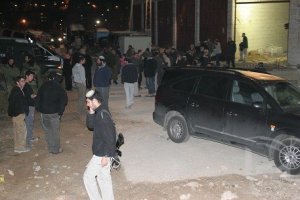 Photo Credit – Ma’an Images
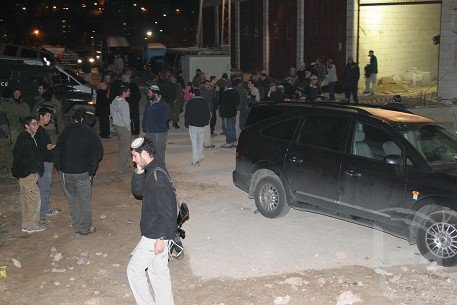
Silwan: Very early this morning in Silwan Village, a patrol of private armed guards stopped near a group of unarmed Palestinian men who were on the Wadi Hilweh Street. According to eyewitness reports, the guards spoke provocatively to the Palestinians, and an argument took place between them. It was during the verbal argument that eyewitnesses say the settlement guards opened fire on the Palestinian men. The two injured were brought to Ein Kerem hospital. One of the Palestinians, Samer Sarhan, who is a father of five young children, was pronounced dead immediately upon arrival to the hospital. The second man is now confirmed as having died.
After confirmation was received of the first Palestinian death from Silwan, clashes erupted in the village and are continuing. There are reports of numerous injuries, although the number of injured people is unknown. There is a massive force of police and army personnel in the village, and the entire street has been cordoned off by officials. Helicopters are monitoring the area from overhead.
SilwanIC will be posting updates on the story.
Israeli Company Hired by State Government to Spy on Pennsylvanians
The surprise disclosure that the Commonwealth of Pennsylvania, through its state Homeland Security Agency, along with a number of local police departments in the state, have been employing a private Israeli security company with strong links to Mossad and the Israeli Defense Force to spy on law-abiding citizens, grows increasingly disturbing when the website of the company, called the Institute of Terrorism Research and Response, is examined.
ITRR’s slick site at TerrorResponse.org features a homepage image of an armor-clad soldier or riot policeman preparing to fire an automatic pistol, while the company boasts of being “the preeminent Isreal/American security firm, providing training, intelligence and education for clients across the globe.”

Image captured from ITRR’s website
The firm, which offers courses locally at the University of Philadelphia, notes that all its course offerings, some of which are taught in Israel, are “approved by the Israeli Ministry of Defense.” The course titles include such compelling topics as: “Tactical Advantage in Combat,” “Civilian Battlefield,” “Undercover/Plainclothes Tactical Operations,” “Israeli Shooting Techniques,” “Arena Combat,” “Hard Entry (Arrest)” and “Principles of Night Operations.” While a number of the titles link to course descriptions, the links to the undercover class and the civilian battlefield class were disabled when this reporter visited the site, which was two days after the company’s role as a state security contractor was exposed.
The description for the Tactical Advantage course, which the website says was designed for military, law enforcement and security personnel, describes the program as “intense, dirty, aggressive and based on Israeli Counter-Terror Schools policy.” It says “This course pushes trainees to the physical and mental edge.”
American organizations which engage in protests and rallies, hearing that reference to the Israeli Counter-Terror Schools policy, might recall the IDF’s handling of the aid flotilla that was boarded on the high seas by IDF troops as they read these lines. That assault, in which the Israelis used 9mm semi-automatic weapons against defenders armed at most with sticks and light chains, left nine flotilla participants, including a young Turkish American, dead.
The Institute of Terrorism Research and Response, which only lists a post-box address in Philadelphia (though in its report on the scandal the Philadelphia Inquirer referred to ITRR as a “Philadelphia-based company with offices in Philadelphia and Jerusalem”), also advertises a subsidiary operation it calls a Targeted Action Monitoring Center (TAM-C), which it claims is “world renowned” and which it says supplies “factual, actionable intelligence to subscribers.” All information gathered by the firm’s staff of “former law enforcement, military and intelligence professionals” is sent to the Israeli headquarters of the TAM-C for processing–a move which effectively insulates it from discovery by any surveillance victims who might seek disclosure under federal or state Freedom of Information laws, or who might sue in court for violation of their civil liberties.
While ITRR, founded in 2004, doesn’t name any of its clients, it says they range from Fortune 100 companies, including the power industry, maritime companies, US infrastructure companies, “the company company charged with protecting oil production facilities,” missionary organizations and pharmaceutical firms, to law enforcement agencies and joint terrorism task forces.
A search on Google for references to ITRR doesn’t turn up much, but there is a report in July 2008 by a Washington-based right-wing site called National Terror Alert, which attributes a warning of a “possible large-scale terror attack” to ITRR. Claiming that it had “intercepted communications from an organization closely associated with international terrorists, to include al Qaeda,” the National Terror Alert organization says TIRR reports that, “Available intelligence and recent events indicate that terrorists have an established capability and current intent to mount an attack on the target and there is some additional information on the nature of the threat. It is assessed that an attack on the target is a priority for the terrorists and is likely to be mounted.”
Nothing came of this “alert,” but it should be noted that a year later, the first head of the new federal Department of Homeland Security, former Republican governor of Pennsylvania Tom Ridge, admitted that the color-coded terror alerts issued by his office had been manipulated to serve Republican political interests. It should also be recalled that the 2008 TIRR “warning” came during the height of the election season, just before the two national party conventions. As the Philadelphia Daily News commented at the time in a headline, “GOP kicks off fall campaign with heightened terror alert.”
But ITRR does much more than just monitor terrorists. Indeed, it seems to be far too busy monitoring legitimate, non-violent and completely legal protest organizations and other political groups to do much real anti-terror work. According to news reports on ITRR’s work for the Pennsylvania Homeland Security Agency and also the Pittsburgh Police Department, it would appear that ITRR was spying on and providing Pennsylvania State Police and Homeland Security with reports on everything from anti-war groups and anti-oil-shale-fracking groups to gay rights groups, animal rights groups, environmental organizations and even Good Schools Pennsylvania, a citizens association formed to back Gov. Ed Rendell’s school reform initiatives. Even a Harrisburg, PA man who likes to bring a 25-foot inflatable pig to demonstrations to symbolize government waste was targeted.
While local news media reports in Philadelphia have suggested that ITRR is just composed of two people, Aaron Richman, an Israeli police captain and security consultant and Michael Perelman, a retired New York City police commander, the website makes it clear that the company actually employs a large number of people in Israel, and may have as many as 15 people working “in the field” in the US.
Its activities are not limited to Pennsylvania either. The firm boasts on its website that “Information provided to clients ranges from issues of global jihad to Mexican Cartel threats along America’s southern border (maybe that’s where Arizona Gov. Jan Brewer got her weird tale, eventually debunked and retracted, of beheadings in the border desert?) to providing guidance of the threat of disorders as a result of international monetary meetings.”
This latter is a reference to the yeoman work ITRR reportedly did for the Pittsburg Police Department in advance of the disastrous G-20 meeting in Pittsburgh, which turned into a police riot after the local government and police brought in hundreds of reinforcements from other cities, with cops suited up as though for war, to lock down the city and prevent students from demonstrating against the predations of international capital and international “free trade” agreements. It appears that ITRR had ingratiated its way into the confidence of demonstration planners by having its agents join chat rooms and websites “posing as G-20 opponents.” One wonders whether these same agents may have also acted as agents provocateur.
As the head of Pennsylvania’s Homeland Security Agency, James Powers, who hired ITRR, put it, “We got the information to the Pittsburgh Police, and they were able to cut them off at the pass.”
So much for the Constitutional right to protest!
Several calls for comment made to the Homeland Security Agency and the Pennsylvania Emergency Management Agency which oversees it went unanswered, but Perelman has released a statement saying “The Institute of Terrorism Research and Response tracks events, givinglaw enforcement a heads-up for the potential of disorder as our bulletins provided to the [state] clearly show…[and] does not follow people, conduct surveillance, photograph, or record individuals.”
This claim is undermined by the details in some of its reports (a select bunch of ITRR weekly “terror” alert report released by the state government after the scandal broke included one on the Brandywine Peace Community, which regularly runs a protest at the Lockheed Martin military contractor plant just northwest of Philadelphia. The report says, “When their focus is not directed at Lockheed itself, protesters will likely gather at the traffic light on the corner of Mall and Goddard to wave signs at cars.” Less this report not sound terrifying enough, the report adds ominously (with no supporting evidence to back its claim) that even so, the event could attract “radical protesters from the ranks of local communist and/or anarchist movements.”
Gov. Rendell, after the story about ITRR’s activities for the state under a no-bid, $125,000/year contract, broke, claimed he was “embarrassed” by the spying on non-violent civic action organizations, and vowed to cancel the contract effective this October.
It is not clear, however, that there will be any information provided about who was spied on over the time the company has been active. Members of both political parties in the state legislature are calling for a General Assembly hearing into ITRR’s activities, but such calls in this closely divided body generally come to little or nothing. Meanwhile, Rendell, a lame duck governor headed for the exit, is unlikely to do anything about the issue beyond saying he’s embarrassed by it. He has said he has no intention of firing Powers.
I know how damaging this kind of spying by state and local governments can be. Back in the mid-1970s, when I and some journalist colleagues owned and ran a small weekly alternative newspaper in Los Angeles, the LA Vanguard, we were among the targets of a massive illegal spying campaign by the paranoid Los Angeles Police Department’s “red squad,” the Public Disorder Intelligence Division. Our staff was actually penetrated by a young red squad officer, who pretended to be a student wannabe journalist in order to try to learn our sources for reports on the LAPD. But we were only one of about 200 groups, ranging from a local anti-nuclear group to the Peace & Freedom Party, a well-known third party in California electoral politics, to the National Organization for Woman and even the office of then City Councilman Zev Yaroslavsky.
The reason we all learned about what the LAPD red squad was doing was that one spy was outed, a class-action suit was filed by the ACLU of Southern California, there was discovery ordered by the court, and eventually the city of Los Angeles settled with the victims of the campaign, to the tune of $1.8 million.
The Pennsylvania ACLU may eventually sue Pennsylvania over this latest domestic spying outrage, but the times have changed, and it is hard to be confident that the courts, no great friend of civil liberties at the state level, and packed with Reagan and Bush 1 and 2 appointees at the federal level, will mandate disclosure of the names of groups spied on, much less of the records that were compiled. Furthermore, because the state did this spying through an outside contractor, which is headquartered in Israel, government and police agencies could claim that the records are for the most part out of their hands and beyond the courts’ jurisdiction.
At least one man, Gene Stilp, owner of the giant inflatable pig, already has plans to sue the government in federal court. “When people’s civil rights are trampled it’s a federal issue,” says Stilp, himself a licensed attorney. Stilp says he isn’t satisfied with Rendell’s statement that he is “embarrassed” by the disclosure of ITRR’s contract. “Being embarrassed doesn’t cut it,” says Stilp, who is calling for an investigation into ITRR’s spying activities by the attorney general or the federal government, and full disclosure of which groups and individuals were spied upon.
Another person who has good reason to believe he was probably targeted by ITRR is ThisCantBeHappening!’s own John Grant. Says Grant, “The more I read about this affair, the more disturbing it seems. I’m a Vietnam veteran and part of an organization — Veterans For Peace — that very publicly opposes the wars in Iraq and Afghanistan. We meet monthly and we organize events with other anti-war groups. All First-Amendment-protected, red-blooded American stuff. To think that some self-ordained watchdog group of security freaks is monitoring me and my friends and reporting our activities to God-knows who in the context of ‘terrorism’ — and probably making tons of money doing it — really pisses me off. Governor Rendell should be embarrassed. He should come clean and make public all the groups and people this gang was spying and reporting on. The fact they are somehow connected to Israel — a nation many of us have been critical of — is further reason to clear up what’s going on.”
The Occupation’s Many Faces
By Joharah Baker for MIFTAH | September 14, 2010
There is an overriding reality that cannot be dismissed here in Palestine. Israel controls just about every aspect of our lives. No matter how we try to turn it around, candy coat it or look at it from a “different perspective” this is the truth and the main reason why no partial agreement will ever hold.
One only has to travel in the occupied Palestinian territories to know this to be true. Over the Eid Al Fitr – the Muslim holiday following the month of Ramadan – the Qalandiya checkpoint between Ramallah and Jerusalem (itself only a recent reality) was jam packed to kingdom come. People spent literally two, three and four hours trying to make their way out of a one-kilometer area because the Israelis had decided to block all traffic going out of Ramallah towards Jerusalem. It did not matter that people had plans, needed to get back to their children and parents or in the worst case scenario, get to a hospital. As the iron gate opened in the separation wall at Qalandiya, a group of young Israeli soldiers stood with their weapons cocked and smirks across their faces as they watched desperate Palestinians trying to inch their way out of the mess. Rather than the [Israeli] authority responsible for the chaos trying to alleviate the situation, instead young Palestinian men exited their cars and tried to direct traffic.
It is not only the traffic and checkpoints Israel controls. Palestinians across the West Bank are plagued by water shortages. In my Ramallah-area village, the water is cut off four of the seven days a week. Families have to ration out the water usage because if tanks are emptied there is absolutely no way to fill them again until the water comes back on. This is not because there is no water in the West Bank, contrary to common belief. According to a report issued by the Israeli human rights organization B’Tselem, Israel controls and exploits 80 percent of ground water from the Mountain Aquifer, which is the largest water source in the region. The remaining 20 percent is basically leftovers distributed among the Palestinian population.
To give a more concrete idea of just how much Israel controls the water resources and distributes it to its own people’s benefit, according to the World Health Organization in 2008, the minimal daily consumption per capita should be 100 liters. In Israel, the per capita consumption reaches 242 liters while the Palestinians consume an average of 73 liters a day. In some places, the WHO says, Palestinian consumption is as low as 37 liters.
Settlers illegally living on Palestinian land have no shortage of water. Just pass by a Jewish settlement, past the lush greenery and the swimming pools and it’s more than obvious that Jewish settlers never have to think about whether they will have enough water to shower or not. Reports have indicated that in places like the Jordan Valley, Jewish settlers use up to six times more water than Palestinians living in the same place.
So, when the Palestinians say they are not continuing with peace talks if Israel continues building in settlements, this is hardly an unreasonable demand. On the contrary, this is the least of the least they can demand given the detrimental effects settlements have had and continue to have on the Palestinians.
Right now, as the negotiating parties head to Sharm Al Sheikh for the second round of peace talks launched in Washington on September 2, Israel is already casting blame on the other side. It is calling the Palestinians’ demand that Israel renew it settlement freeze – already severely riddled with flaws – an “all or nothing strategy” which could ultimately derail any peace efforts. Israel is portraying the Palestinians as the intransigent party for their very legitimate demand of halting settlement construction. Many Palestinians even see this as way too little and a lot too late, saying the leadership should demand nothing less than a complete halt to settlement construction and a dismantlement of settlement structures in accordance with international law.
However, Israel has no plans of relinquishing its settlement enterprise in the West Bank for one reason, which is its control of the land and consequently of the oppressed people living on it. Since its occupation of the West Bank in 1967 Israeli governments have encouraged settlement growth by offering enticing economic incentives such as subsidized housing and reduced utility expenses. By keeping a presence in the West Bank through its settlements, the bypass roads, separation wall and the checkpoints such as Qalandiya, it maintains complete control over the populace, all under the false guise of its own security.
While Israel continues its rants about how the Palestinians are unreasonable and are placing obstacles in the way of peace, it is worthwhile to remind the world what it is like to live under occupation. Control and oppression is multi-faceted. Israel’s military presence and confrontations with the occupying army are definitely important features of Israel’s occupation of the West Bank, Gaza and east Jerusalem but they are not the only ones. The overall control Israel wields over Palestinian lives is suffocating because it is so comprehensive. Leaving and entering the country is controlled by Israel, entering Jerusalem, working inside the Green Line, exporting and importing goods, building a house, tending to your land (if you have access to it) and even the amount of water you are allowed to consume are all controlled by the mighty hand of Israel’s occupying power.
So, before blame is laid or the world judges us too quickly, let us all remember the overriding reason we are at the negotiating table at all. Then after the occupation is duly mentioned, just imagine spending four hours trying to get home from a 45 minute trip only to find no water for your shower.
Joharah Baker is a Writer for the Media and Information Department at the Palestinian Initiative for the Promotion of Global Dialogue and Democracy (MIFTAH). She can be contacted at mid@miftah.org.
Israeli army assassinates Hamas leader
TULKAREM — Israeli forces entered the home of a Hamas leader in Tulkarem on Friday morning and shot him three times in the neck and chest before withdrawing, family members said.
Medics at the Thabit Thabit Hospital in Tulkarem confirmed that 38-year-old Iyad As’ad Shelbaya, a known Hamas leader, was dead, killed by three bullets to the neck and chest.
Shelbaya lived in the Nur Shams refugee camp east of Tulkarem. Security sources said he was assassinated during a raid on his home at 2:30 a.m. on Friday morning.
Officials said several armored vehicles entered the area to carry out the assassination. Palestinian forces were said to have coordinated with the Israeli military in getting Shelbaya’s body from his home to the hospital.
Accounts from family members say Shelbaya’s brother Mohammed was abducted by soldiers earlier in the morning, and forced to show officers the way to Iyad’s home.
Once at the home, witnesses said soldiers placed explosives at the main door, destroying the entry way and entering the home.
Several soldiers were then described entering the home, at which point three gunshots were heard. Medics confirmed three shots killed the man, one in the neck and two in the chest.
Shelbaya’s body was then removed from the home.
Mohammed told Ma’an that he heard his brother Iyad calling from his bedroom when the soldiers entered the home, asking “Who is it? Who is it? Who is it?”
“He asked the question three times, and that was followed by three bullets. He was alone sleeping in the house, his wife was visiting family in Jenin,” he said.
See photos of the scene of the assassination here.
An Israeli military spokesman confirmed the death, but gave a different version of events.
“During an arrest raid in the Palestinian village of Nur Shams, one suspect began running for the force,” the spokesman said. “He did not comply with soldiers who requested that he halt.”
The spokesman said that soldiers “felt threatened” by the behavior of the man, and “fired on the suspect.”
Israeli rights group says military report not likely
A field worker for the Israeli human rights organization B’Tselem who investigated the scene called the slaying “unjustified.”
Speaking with Ma’an less than 12 hours after the attack, Eid As-Sa’di said Israeli statements as to how the death occurred were implausible.
“It would have been possible to arrest him, or just as easily to injure him,” he said.
The rights worker said that the room where Iyad was shot was no more than three meters by three meters, and expressed skepticism over the report that the known Hamas leader had come running at troops, that soldiers had had time to warn him to stop, and then shoot.
As-Sa’di said that an investigation by B’Tselem was ongoing, and said details of the event were still emerging.
Dozens detained overnight
During the raid on the camp, nine other Hamas affiliates were detained from their homes.
Security sources identified those detained as: Mohmmad Abu Al-Kheir, Kamal Masharqah, Tayseer Jaber, Sheikh Mahmoud Al-Ghoul, Ashraf Fouda, Nedal Abu Helal, Nedal Abu Tharefah, Mohammad Abu Deiyah and Ahmad A’sa’s.
Fourth assassination in nine months
On 26 December 2009, Israeli forces entered the city of Nablus, proceeded toward the homes of Raed Sakarji, 38, Anan Subih, 33, and Ghassan Abu Sharkh, 40, in two cases entered the homes and shot the men, and in a third, executed Abu Sharkh in front of his home.
A statement from the Israeli military said soldiers “entered Nablus in an attempt to locate and arrest the men suspected of involvement in the murder of Meir Avshalom Hai this past Thursday.” The statement said the deaths were provoked by the suspects.
Testimony from witnesses, and blood evidence in hallways and bedrooms, showed the men were shot in their homes.
“We were sleeping in our bedroom, not bigger than six square meters, when Israeli soldiers began yelling ‘get out, get out.’ I thought I was dreaming. When I heard the Israeli soldiers and their police dogs outside the room, that was when I realized it was real,” Tahani, the wife of Raed Sarakji told Ma’an at the time.
Tahani said her husband told soldiers he would get out of the house, so they started shooting through the door and the windows. “He fell between my hands bleeding. I started crying ‘they killed him, they killed him.’ Then soldiers broke the door and got in. He was already dead, but they continued to riddle his body with bullets to make sure he was killed.”
A similar account was given by the cousin of Ghassan Abu Sharkh, “Everything happened very quickly… when we opened the door and saw the soldiers, two masked collaborators pointed to my brother Ghassan who was walking down the stairs. Before I knew it he was being shot. I couldn’t really make sense of what was going on at all. Then an Israeli officer asked me whether the dead man was Ghassan, and I said yes. ‘Good, then ask everybody to leave the house,’ the officer said.”
“I was standing close to Ghassan when they killed him. They could have detained him very easily. He passed to join my brother Nayif who was killed by Israeli forces a few years ago [2004].”
The third account was given by Farid Subih, 45, whose younger brother, Anan Subih, 33 was killed.
“At 3 a.m., dozens of Israeli troops surrounded our four-storey building. They blew open the the main gate then started shooting randomly and throwing grenades in all directions. Anan was inside, and he asked everybody to leave the building to avoid being hurt.”
He continued, “We headed to the nearby house of the Al-‘Amoudi family. Then soldiers entered the house with police dogs, and they started throwing more grenades, and a fire erupted in the warehouse full of plastic chairs and sponge material.
“My brother was not armed, but we could see soldiers continue to ransack the house. For three hours, we didn’t know what was going on. After the soldiers left, we found Anan dead … bullets tore all his body and bones.”
According to the Israeli military, “When he was killed, Annan Tzubach [Subih] was armed with a handgun and hiding two M16 assault rifles, an additional handgun, and ammunition.” The same statement, however, said that “During an attempt to arrest him tonight [Saturday], Annan was killed after an exchange of fire with the IDF while he was found in a hiding place along with weapons and ammunition.”
Seven civilians killed in US raid near Fallujah
Al-Manar TV – 16/09/2010
At least seven Iraqi civilians were killed during a joint US-Iraqi raid in the outskirts of Fallujah on Wednesday, in the deadliest incident involving U.S. occupation troops since the United States declared an end to its combat operations in Iraq on Aug. 31.
Iraqi officials said eight civilians were killed, while the U.S. occupation military claimed four suspected members of al-Qaeda in Iraq and two civilians died in a firefight that erupted as forces tried to capture a presumed member of the group who allegedly was responsible for attacks in the region.
Despite the official end of the U.S. combat mission, about 4,500 U.S. Special Operations forces remain in Iraq.
Iraqi officials in Anbar province said U.S. and Iraqi troops began raiding houses at 3 a.m. in Jubil, about 30 miles west of Baghdad. Among the dead, they said, were a 70-year-old man and three of his sons, who were all asleep in their yard when they were killed by a grenade. A fourth son died at a hospital, the Iraqi officials said.
Troops also entered a second house in the area and killed Yaseen Kassar, a former Iraqi military commander, Iraqi officials said, as well as two people in a third house.
It was not immediately clear whether the troops had been looking for Kassar or any of the other people killed.
“The security situation in Fallujah may deteriorate because of what happened today,” said Abdulfattah Izghear, a local city council member. “We asked U.S. troops and the Iraqi government to explain this unjustified action and this naked aggression against civilians.”
Iraqi Prime Minister Nouri al-Maliki, who is in charge of the Iraqi Special Forces, ordered an investigation into the incident, the state-run network al-Iraqiya reported.
Settlers make renewed attempt on Jerusalem home
Ma’an – September 16, 2010
JERUSALEM — Jerusalem’s Qeresh family said friends and neighbors helped them resist what witnesses described as an attempted home take over on Wednesday.
The event reportedly began in the early morning in the As-Sa’diyah neighborhood in the old city of Jerusalem, as Israeli settlers entered a wing of the family home and allegedly began removing furniture.
Family members said young men from the neighborhood came to the scene, and forcibly prevented the settlers from taking the furniture out of the home.
“The settlers tried to throw the furniture,” one man told Ma’an, and added that police were not called, as the family feared its sons would be detained for preventing the settler action.
The attempted take over came as Israeli and Palestinian leaders met less than four kilometers away at the Israeli Prime Minister’s Residence, for the latest round of direct peace talks.
Mahmoud Abbas has repeatedly said that if settlement projects continue in Palestinian areas, including East Jerusalem, he will walk away from talks.
Latest in 14-year settler battle for home
The Qeresh family continues a court battle following the 29 July forcible entry of two settler families into the home.
At the time, Israeli National Police spokesman Mickey Rosenfeld said two Jewish families entered the building “based on documents claiming that they owned the property.”
Police said they were examining the documents presented by two Jewish families who evicted the Qeresh families from their home. A police spokesman said the day after the forcible eviction, that he had “no idea whatsoever” as to how long it would take police to verify the papers.
He explained that if police decided the documents were authentic, the matter would be transferred to court.
According to Qeresh family members, the matter was transferred to courts, which put a freeze on settler action on the home, including the removal of furniture, until the matter was decided.
Fatah official for Jerusalem Affairs Hatem Abdel Qader said publicly that the documents presented by settlers to police were fake, noting the settlers who entered the homes were part of a Jewish group that lost a lawsuit in 1996, wherein they sought to take over the same home but failed to sufficiently prove ownership.
Palestinian defendants proved to an Israeli court that the home was owned by Kamal Handal and rented by the Qeresh family, Abdel Qader said following the July attempt.
“This armed burglary is considered an attack on a Palestinian home and will not pass silently,” he added at the time.
Doubling of SOF Night Raids Backfired in Kandahar
By Gareth Porter | IPS | September 15, 2010
WASHINGTON – During a round of media interviews last month, Gen. David Petraeus released totals for the alleged results of nearly 3,000 “night raids” by Special Operations Forces (SOF) units over the 90 days from May through July: 365 “insurgent leaders” killed or captured, 1,355 Taliban “rank and file” fighters captured, and 1,031 killed.
Those figures were widely reported as highlighting the “successes” of SOF raids in at least hurting the Taliban.
But a direct correlation between the stepped up night raids in Kandahar province and a sharp fall-off in the proportion of IEDs being turned in by the local population indicates that the raids backfired badly, bolstering the Taliban’s hold on the population in Kandahar province.
Night raids, which are viewed as a violation of the sanctity of the home and generate large numbers of civilian casualties, are the single biggest factor in generating popular anger at U.S. and NATO forces, as Gen. Stanley A. McChrystal conceded in his directive on the issue last March.
Nevertheless, McChrystal had increased the level of SOF raids from the 100 to 125 a month during the command of his predecessor, Gen. David McKiernan, to 500 a month during 2009. And the figures released by Petraeus revealed that McChrystal had doubled the number of raids on homes again to 1,000 a month before he was relieved of duty in June.
The step up in night raids has been overwhelmingly concentrated on districts in and around Kandahar City. It began in April as a prelude to what was then being billed as the “make or break” campaign of the war.
The response of the civilian population in those districts can be discerned from data on the Taliban roadside bombs and the proportion turned in by the population. Increasing the ratio of total IEDs planted found as a result of tips from the population has been cited as a key indicator of winning the trust of the local population by Maj. Gen. Michael Oates, head of the Pentagon’s Joint IED Defeat Organization (JIEDDO).
But JIEDDO’s monthly statistics on IED’s turned in by local residents as a percentage of total IEDs planted tell a very different story.
The percentage of Taliban roadside bombs turned in had been averaging 3.5 percent from November 2009 through March 2010, according to official statistics from JIEDDO. But as soon as the SOF raids began in Kandahar in April, the percentage of turn-ins fell precipitously to 1.5 percent, despite the fact that the number of IEDs remained about the same as the previous month.
The turn-in ratio continued to average 1.5 percent through July.
There is a similar correlation between a sudden increase in popular anger toward foreign troops in spring 2009 and a precipitous drop in the rate of turn-ins.
In the first four months of 2009, turn-ins had averaged 4.5 percent of IED incidents. But in early May 2009 a U.S. airstrike in Farah province killed between 97 and 147 civilians, according to the Afghanistan Independent Human Rights Commission. As popular outrage over the biggest mass killing of civilians in the war spread across the country, the ratio of turn-ins fell to 2.1 percent of the total for the month, even though IEDs increased by less than 20 percent.
Then McChrystal took command and ordered a quadrupling of the number of night raids. The turn-in ratio continued to average just 2.2 percent for the next five months.
In Kandahar, as elsewhere in Afghanistan, popular anger at foreign troops was undoubtedly stoked by the inevitable killing and detention of the innocent people that accompanies SOF night raids.
According to the figures released by Petraeus, for every targeted individual killed or captured in the raids, three non-targeted individuals were killed and another four were detained.
Based on past cases of false reporting by SOF units, a large proportion of the 1,031 killed in the raids and identified as “insurgents” were simply neighbours who had come out of their homes with guns when they heard the raiders.
Gen. McChrystal referred to that chronic problem in a statement on his directive on night raids last March. “Instinctive responses” by an Afghan man to “defend his home and family are sometimes interpreted as insurgent acts, with tragic results,” McChyrstal said.
SOF units have routinely reported those killed under such circumstances as insurgents rather than as innocent civilians.
When an SOF unit raided the home of a low-level commander in Laghman province on Jan. 26, 2009, 13 men came out of nearby homes. They were all killed and later included in the tally of Taliban reported killed in the raid.
The problem of false reporting was brought to light most dramatically after a botched SOF raid in Gardez Feb. 12, when two men who emerged from buildings in the compound targeted by an SOF unit were shot and killed. Within hours of the raid, ISAF issued a statement describing the two men as “insurgents”.
That falsehood was later revealed only because the two men happened to be a police official and a government prosecutor. In the same incident, the SOF unit accidentally killed three women, two of whom were pregnant, but reported to headquarters that the women had been found tied up.
McChrystal defended the SOF unit against charges by eyewitnesses that its members had tried to cover up the killing, even after the head of the Afghan interior ministry investigation of the incident publicly declared that the testimony was credible.
The figure of 1,355 insurgents “captured” in the raids given out by the International Security Assistance Force is also highly misleading. In response to an IPS query about the figure, ISAF public affairs officer Maj. Sunset R. Belinsky confirmed that the figure “reflects insurgents or suspected insurgents captured during operations”.
In fact, the vast majority were simply swept up because they happened to be present in a house or compound targeted in a raid.
An ISAF press release Sep. 8 illustrates how such a larger number was accumulated. In a raid on the compound of a suspected “insurgent commander” in Paktika province Sep. 7, the SOF unit ordered all occupants to leave the compound and detained “several suspected insurgents” after “initial questioning”.
U.S. forces in Afghanistan have never released figures on what proportion of Afghans detained as suspected insurgents were eventually released because of lack of evidence. Maj. Gen. Douglas Stone, who reviewed U.S. detainee policies in early 2009, was reported by The Guardian Oct. 14, 2009 to have concluded that two-thirds of the detainees still being held by the U.S. military as Taliban insurgents were innocent.
The claim of 365 “insurgent leaders” killed or captured is also highly misleading.
At his confirmation hearing in June, Petraeus referred to the targets of SOF raids as “middle and upper level Taliban and other extremist element leaders”.
That terminology was later abandoned, however. When questioned about the figure last month, an ISAF official, speaking on condition of anonymity, conceded that it was not clear what authority the targeted “leaders” had. There is no organisational diagram for the Taliban, the official told IPS, and Taliban fighters are not organised in military units.
The vast majority of those “leaders”, it appears, were low level Taliban personnel who are easily replaced.
*Gareth Porter is an investigative historian and journalist specialising in U.S. national security policy. The paperback edition of his latest book, “Perils of Dominance: Imbalance of Power and the Road to War in Vietnam”, was published in 2006.
Washington peace talks: democracy need not apply
Matthew Cassel, The Electronic Intifada, 15 September 2010
 |
From left to right: Egyptian President Hosni Mubarak, Israeli Prime Minister Benjamin Netanyahu, US President Barack Obama, Palestinian Authority President Mahmoud Abbas and Jordan’s King Abdullah at the White House on 1 September 2010. (AFP) |
It was an image for the history books. At least that’s what the five world leaders would like to have thought as they strutted down the red carpeted hall of the White House recently with their heads held high. Forming a well-choreographed and symbolic flying “V,” the US president led the way, flanked by his counterparts representing Israel, Palestine, Jordan and Egypt. These men in suits wanted to show the world that they’re ready to plow through any and all obstacles that stand in the way of peace in the Middle East.
It’s a picture that bears a striking resemblance to one taken a decade and a half earlier when then US President Bill Clinton led the same nations’ representatives down the the same red-carpeted hall at the White House. All one needs to do is replace those leaders with their successors, save the Egyptian president who was present in both. Another historic image — although one most have probably forgotten — that also sought to send the message that peace is on its way.
And yet here we are, 16 years later, with the highly anticipated peace still on its way, or so we’re told. A closer look at the five representatives in the picture should help explain why it’s yet to arrive.
Spearheading the group is Barack Obama. Despite running a campaign built around the slogan of “change,” the US president has shown that when it comes to the Middle East his policies barely differ, if at all, from those of his predecessors. Not only has he continued the occupations of Iraq and Afghanistan while arming and supporting the most brutal and undemocratic autocracies around the region, but he has also been sure to maintain the US’ “special friendship” with Israel regardless of the ongoing injustices the latter commits on a daily basis.
Next to him is Benjamin Netanyahu, the Israeli prime minister. As leader of the country who receives the most aid from the US, Netanyahu has not only continued the occupation and the siege of Gaza, but he refuses to slow down — not to mention end — the ongoing colonization of Palestinian land in the West Bank through settlement construction and land theft. If left unchecked, Netanyahu’s aggressive rhetoric and actions toward nearby nations will most likely spark another regional Israeli-led conflict before he leaves office.
But more importantly than understanding these two nations whose roles in the Middle East should come as no surprise to anyone by now, is understanding the “other” side represented in Washington: the Arab governments.
At the forefront is the supposed representative of the Palestinian people, Palestinian Authority President Mahmoud Abbas. In recent years, the PA’s most notable governing role has been its repression of an already oppressed people in the occupied West Bank and Gaza Strip. To quell any popular protest by Palestinians against the Israeli occupier, the PA has used its American-supplied and Israeli-approved weaponry and riot gear, and arrested and beaten Palestinians who voice their dissent. This was most clear during Israel’s brutal assault on Gaza in the winter of 2008-09 and after the more recent attack on the Gaza Freedom Flotilla when Palestinian protestors in Ramallah and elsewhere were prevented from taking to the streets. Only two weeks ago, after a car full of Israeli settlers were killed in the occupied West Bank, the PA waged an arrest campaign rounding up hundreds of Palestinians in the occupied territory in a move that has been condemned by numerous Palestinian human rights organizations.
More importantly than the above, is the question of the Abbas government’s legitimacy. Recently, the Israeli daily Haaretz quoted Abbas’ spokesperson Nabil Abu Rudaineh as saying: “President Mahmoud Abbas came to power through free, democratic and authentic elections supervised by more than two thousand international and Arab monitors.”
One has to first wonder how “free” and “democratic” elections can be when held in a territory under foreign military occupation. Moreover, the majority of Palestinians are living in a forced state of exile and were not invited to cast their ballots. But for the sake of argument, let’s take Abu Rudaineh at his word.
Abu Rudaineh seems to contend that those elections, held in January 2005, somehow granted the PA president with an unlimited mandate. However, the term was limited, and Mahmoud Abbas was elected by voters to serve four years in office, meaning that his elected mandate as president of the PA expired more than a year and a half ago.
In a move out of the autocratic ruler playbook, Abbas’ term was extended by the PA’s “emergency powers” out of fear that he would be replaced by someone from a rival party — most likely from the more popular Hamas movement — should new elections be held. Ironically, the most recent “free” and “democratic” elections held in Palestine were in 2006, when Hamas defeated Fatah, taking the majority of seats in parliamentary elections. It’s no surprise that Abu Rudaineh made no mention of this event in his statement.
Despite being elected by the Palestinian people living under occupation, Hamas has been subjected to boycott by the US and the PA and the area of governance it has been confined to laid siege to by Israel and Egypt. While Hamas hasn’t been ideally democratic in its governing of the besieged Gaza Strip, its continued ostracism by Washington, Israel and the PA sends the message that when it comes to peace talks, democracy need not apply.
This message was reinforced through the presence of the two other Arab leaders at Abbas’ side.
On one end is Hosni Mubarak who has ruled Egypt under suffocating “emergency laws” (sound familiar?) since 1981 when he became president. Although friendly with the US and Israel, Mubarak runs one of the most brutal and corrupt dictatorships in the region. With a leadership dependent on — and one of the main beneficiaries of — US aid, Mubarak’s mukhabarat (intelligence service) tolerates no dissent. Many of those who have tried to challenge his rule have joined the tens of thousands of political prisoners in Egypt’s jails, where torture and abuse are well-documented and commonplace.
Pictured opposite Mubarak is Jordan’s King Abdullah II bin al-Hussein. Although Jordan is often hailed in the US as a “modern” and “moderate” state, there is little democracy to speak of there. Parliament, which has very little power, was dissolved last year half way through its term without any explanation, and elections delayed until this November will be held under a law widely criticized by opponents and passed by cabinet decree under “emergency provisions.” Draconian laws on the press and nongovernmental organizations severely limit freedom of speech and association, and political activists carry out their work in the ubiquitous shadow of the country’s security services.
It’s no coincidence that both of these men are considered two of the US’ strongest allies in the Middle East. Both continue a US-backed policy of “peace” with Israel despite that policy having little to no support from their populations.
That said, the image of the five men at the White House can easily be dissected as the following: a dictator, a monarch, a puppet and two heads of government responsible for the region’s only military occupations — not the best ingredients for making world peace.
Although not invited to the White House, the numerous grassroots movements across the Middle East present the best hope for bringing peace and justice to this region. And it’s those increasingly popular movements that people around the world concerned with the fate of the Middle East should support. In the meantime, let the puppets and their masters walk on red carpets in Washington while the real change is made by those with their feet on the ground.
Matthew Cassel is based in Beirut, Lebanon and is Assistant Editor of The Electronic Intifada. His website is http://justimage.org.
Due to Gaza closure, 40,000 students refused from UNRWA schools
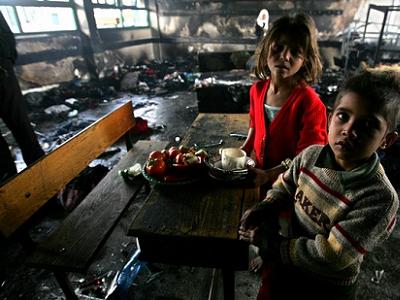 Notebooks and pens are in, construction materials are out
GISHA | September 15, 2010
- UNRWA can’t meet enrollment demand because of ban on construction materials
- UNRWA needs to build 100 schools, none built since 2007 closure
- UNRWA schools have specialized curriculum on human rights and critical thinking, not available in government schools
Despite Israel’s promise to ease the closure of the Gaza Strip, the Gaza school year opened this week with a severe shortage of classrooms. While for the first time in three years Israel has allowed the import of school supplies for government schools in Gaza, the almost absolute ban on the import of construction materials has left students with lots of pens and notebooks but without classrooms.
UNWRA needs 100 new schools to meet the enrollment demands of the children of Gaza. But despite the “easing” of the closure, building materials for the construction of schools have not been approved to enter Gaza since 2007. Therefore, UNRWA has had to turn away 40,000 children eligible to enroll in its schools for the academic year that began yesterday. Students at UNRWA schools study a specialized curriculum in human rights and critical thinking, not available in government schools. Furthermore, according to UNWRA records, students in its schools score 20% higher than government school students on international aptitude tests.
Students being turned away from UNRWA schools is only one consequence of the classroom shortage in the Gaza Strip. To deal with the shortage of classroom space, students in most of Gaza’s schools study in two shifts, in classrooms with up to 50 students, and sometimes oversized metal containers are used as classrooms, with three children seated at desks designed for two.
Onerous bureaucracy, limited capacity of crossings
Construction of a standard school requires an estimated 220 truckloads of building materials, or 22,000 truckloads for 100 schools. The only crossing Israel allows to open, Kerem Shalom, can accommodate just 250 truckloads per day, mostly for food and basic humanitarian supplies. Despite promises, Israel has yet to approve a single truckload of construction materials for UNRWA’s schools and has agreed to “negotiate” coordinating materials for just 8 out of the 100 needed schools. Since the “easing” of the closure, Israel has allowed just 240 truckloads of construction materials monthly for all uses, compared with more than 5,000 trucks monthly before the closure (4% of pre-closure levels).
According to UNRWA’s Gaza Director John Ging: “The right to education is a basic right of children everywhere. For the children of Gaza, realization of that right depends on the continued construction of schools, because all of the temporary measures and substitutes have already been exhausted”.
For an information sheet on the changes in the closure policy since the June 2010 cabinet decision, see: Unraveling the Closure of Gaza.
Featured Video

New positive ivermectin evidence
or go to
Aletho News Archives – Video-Images
From the Archives
Fanatical Followers of the Covid Regime: A Jim Jones-Style Cult?
By Professor Roger Watson and Dr. Niall McCrae | The Daily Sceptic | November 15, 2021
As scholars at leading British universities over recent decades, we witnessed the replacement of critical thinking and debate by narrative: facts are discrimination and scientific method is imperialism; truth, instead, is derived from ‘progressive’ values. This educational trend may be a major contributory factor to the ease in which society has been inculcated to the Covid ‘new normal’ of masking, testing, and repeated doses of vaccines for a disease of similar risk to severe influenza.
One doesn’t need much critical reasoning to observe the flawed logic of some vaccination enthusiasts, such as people who respond to experiencing any side effects, however debilitating, by saying “at least I know it’s working”, or, after contracting the disease despite their promised inoculation (over 90% effective, according to initial drug company claims), “I’d have been worse off without the jab.” … continue
Blog Roll
 Aletho News
- New positive ivermectin evidence
- Met Office Caught Fabricating Daily Temperature Record Claims
- Merck Virologists Admitted to Falsely Certifying Vaccine Efficacy
- Mandatory Folic Acid for every man, woman & child
- Pro-Palestine protesters arrested outside UK’s ruling Labour Conference in Liverpool
- Mauritius denies landing permit to flight from Israel, forcing cancellation: Tour operator
- Israeli finance minister calls for genocidal war on West Bank, annexation of south Lebanon
- 12 Things Your Psychiatrist Was Trained Not to Tell You
- From Unipolar Universalism to Multipolar Civilizational Distinctiveness
- RSF military group defects, joins Sudanese army: State media
- If Americans Knew
- Israel forces Gazans to live in constant peril – Daily Update
- Deconstructing Netanyahu’s pants-on-fire UN rant – Daily Update
- Trump betrayed voters with his campaign lies and prioritized a foreign country once he took office
- Netanyahu calls Israel’s war in Gaza ‘opposite of genocide’ in UN speech to near-empty hall
- Settler Kidnappings: Torture, Sexual Abuse and Terrorisation of Palestinian Abductees as Israel Deepens Annexation of West Bank
- Gaza winter nears as 162,000 tents become unusable, raising fears of humanitarian crisis
- Netanyahu says, “It’s the opposite of genocide”; UN says Gaza economy is world’s ‘most severe crisis on record’ – Daily Update
- Israel’s US-Backed Assault on Gaza Has Created the ‘World’s Most Severe Economic Crisis on Record’: UN
- ‘Protecting U.S. Citizens’… From Israel
- ‘This is where I live now, the back of a truck’: a day in the life of a grandmother in Gaza
- No Tricks Zone
- New Study: Earth And Venus Surface Warmth Largely Explained By Convection And Lapse Rate, Not CO2 Or Radiation
- 2025 Nature Paper Claiming Worsening Global Drought Gets RETRACTED …Heavily Flawed
- New Study: ‘Global Drought Shows No Detectable Recent Acceleration Under Climate Warming’
- Economic Masterminds: German Socialists Suggest Taxing Productivity Gains Stemming From Using AI
- The South China Sea Has Not Been Cooperating With The Climate Change Narrative
- Energy Crisis: Germany Enters Heating Season With Historically Low Gas Reserve Fill Levels
- New Study: The Antarctic Ice Sheet Gained Mass From 2020-2024 Due To Staggering Snow And Ice Accumulation
- Study: Ocean Heating Rates From Thousands Of Years Ago ‘Dwarf’ Modern Ocean Heating Rates
- Climate Extremists Target, Attack Large-Scale Power Grid Infrastructure In Germany!
- New Study: Antarctic Ice Melt Has Contributed Less Than 1 Centimeter To Sea Level Rise In The Last 30 Years

