Secret Israeli plans to Judaize Buraq square
Palestine Information Center – 12/06/2010

OCCUPIED JERUSALEM — Al-Quds newspaper revealed Friday secret documents indicating that the Israeli municipal council in occupied Jerusalem and the interior ministry’s planning and construction committee assigned a committee to Judaize the whole Al-Buraq square (wailing wall).
The newspaper said that the committee was composed of head of the municipal council Nir Barakat, his deputy, the head of the planning and construction committee, the rabbi in charge of the Buraq wall, and representatives of Zionist companies.
This committee met three times between November 2009 and January 2010 and approved plans to construct new buildings in the Buraq square and expand Jewish structures already built illegally in the area.
These plans include a three-story building, a museum for the Jewish religion, and the expansion of Davidson center located in the so-called archaeological park, south of the Buraq wall.
In later meetings, the committee will discuss other plans to build new buildings in the Buraq wall, according to the newspaper.
Lawyer Qais Nasser, a specialist in settlement affairs, told the newspaper that the work of this committee is not legal at all because it lays plans in compliance with the Judaization goals of the Israeli government and the interests of the Zionist companies that want to turn the Buraq wall and the area around the Aqsa Mosque into a shrine for the Jewish people.
He noted that the committee did not tell the Jordanian and Palestinian sides about these plans and ignored the UNESCO which classified Jerusalem as a world heritage property that must be protected according to its charter issued in 1972.
Israel: Strategic Ally or Liability?
By Stephen Sniegoski | My Catbird Seat | June 12, 2010
The claim that Israel serves as a valuable ally for the United States is made by both pro-Zionists and much of the anti-war and anti-Zionist Left that is influenced by Noam Chomsky. As a result of the Gaza flotilla massacre, which has caused a world-wide uproar against Israel, the value of Israel to the United States is being publicly questioned in more mainstream foreign policy forums.
Writing shortly before the massacre, the always astute Philip Giraldi critically analyzed the claim of Israel’s value to the United States in “The Strategic Ally Myth,” which focuses on a recent article by Israel Firster Mort Zuckerman entitled, “Israel Is a Key Ally and Deserves U.S. Support.”
Zuckerman is a real estate billionaire and editor-in-chief of U.S. News & World Report, and his article came out in that magazine. (He is also publisher/owner of the New York Daily News). Zuckerman’s writing for his own publications has credentialed him for other media outlets, and he regularly appears on MSNBC and The McLaughlin Group. Between 2001 and 2003, Zuckerman was the chairman of the Conference of Presidents of Major American Jewish Organizations. Giraldi underscores Zuckerman’s pro-Israel orientation: “Zuckerman is frequently spotted on the television talking head circuit where he dispenses analysis of international events that could have been crafted in Tel Aviv or Herzliya, where the Israeli intelligence service Mossad has its headquarters.” Zuckerman’s immense wealth and media influence exemplifies why Israel has been able to gain the reputation as a valuable ally to the United States.
Giraldi, however, points out that the United States is not technically an ally of Israel’s. Giraldi writes that “to be an ally requires an agreement in writing that spells out the conditions and reciprocity of the relationship. Israel has never been an ally of any country because it would force it to restrain its aggressive behavior, requiring consultation with its ally before attacking other nations. It is also unable to define its own borders, which have been expanding ever since it was founded in 1948. Without defined borders it is impossible to enter into an alliance because most alliances are established so that one country will come to the aid of another if it is attacked, which normally means having its territorial integrity violated. Since Israel intends to continue expanding its borders it cannot commit to an alliance with anyone and has, in fact, rebuffed several bids by Washington to enter into some kind of formal arrangement.”
Zuckerman maintains that there are no drawbacks to America’s support for Israel, explicitly denying the allegation that American support for Israel causes anti-American hostility in the Islamic countries. Instead, Zuckerman maintains that the Muslims “are fighting America because they see the whole West and its culture, values, and belief in democracy as antithetical to their own beliefs.” Giraldi correctly points out that this is ridiculous—a higher-IQ version of Bush’s “they hate us for our freedom.”
It would seem almost self-evident that support for the Arabs’ fundamental enemy would lead to the hostility of Arab states or, should a particular regime remain friendly to the United States, cause groups within the state to threaten its stability. During the Cold War, US/Israeli ties caused some Arab states to turn to the Soviet Union, especially since the Soviets were willing to provide them with weapons, which they could not obtain from the US because of the opposition from Israel and the Israel lobby. American support for Israel during the 1973 Yom Kippur war led to the Arab oil embargo against the United States in 1973.
… Certainly, the Gaza flotilla massacre has heightened Arab and Islamic animosity to the United States, which has been recognized even by mainstream media commentators. Because of the power of the Israel Lobby the United States cannot offer harsh criticism of Israel and must work to prevent any form of United Nations sanctions against it, thus complicating its relationship with the entire Arab/Islamic world. While it must be acknowledged that hostility to the United States has also been accentuated by its wars in Iraq and Afghanistan, the American military involvement has been caused in large part by the influence of the Israel lobby.
M. Shahid Alam points out in his excellent book, “Israeli Exceptionalism: The Destabilizing Logic of Zionism,” that much of the anti-Americanism in the Middle East was initially triggered by Israel. This anti-Americanism has in turn, enabled Israel to present itself as America’s only reliable friend in the Middle East. In essence, “Israel had manufactured the threats that would make it look like a strategic asset” (p. 218), writes Alam. “Without Israel,” Alam maintains, “there was little chance that any of the Arab regimes would turn away from their dependence on the West” (p. 171).
The realization that Israel is not really a strategic ally of the United States is now being expressed by individuals far more sympathetic to Israel than Alam. Anthony H. Cordesman of the Center for Strategic and International Studies, for example, makes such a argument in his article, “Israel as a Strategic Liability.”
Cordesman served as national security assistant to the pro-Israel Senator John McCain, though he is considered a centrist. In denying that the United States supports Israel for strategic reasons, Cordesman writes that “the real motives behind America’s commitment to Israel are moral and ethical. They are a reaction to the horrors of the Holocaust, to the entire history of Western anti-Semitism, and to the United States’ failure to help German and European Jews during the period before it entered World War II. They are a product of the fact that Israel is a democracy that shares virtually all of the same values as the United States.”
I would simply point out that this belief in Israel’s moral superiority is not some objective notion that is determined by an objective weighing of all the evidence, but exists primarily in United States because of the power of the pro-Zionist media and political lobby. If somehow the wealth and power conditions of American Jews and Arab Americans were reversed, and all mainstream media information coming to the American public was filtered through a pro-Arab/Palestinian slant, it is inconceivable that America would support Israel over the Palestinians. It is hard to believe that someone as sharp as Cordesman does not recognize the power of the Israel lobby in American domestic politics, and he undoubtedly does, but he is also keen enough to know that people who openly express such a view do not hold cushy positions in leading think tanks. However, so as not to go too far off track, the issue here is whether Israel is a strategic asset to the United States, not whether the US should support Israel for moral reasons, and concerning the issue at hand Cordesman comes down against the strategic asset argument.
Jim Lobe alludes to the career ramifications of speaking the truth regarding Israel when he quotes Stephen Walt, the co-author of the bombshell book, “The Israel Lobby and U.S. Foreign Policy,” who states: “The fact that Cordesman would say this publicly is a sign that attitudes and discourse are changing . . . . Lots of people in the national security establishment—and especially the Pentagon and intelligence services—have understood that Israel wasn’t an asset, but nobody wanted to say so because they knew it might hurt their careers.”
Intriguingly, Lobe points out that head of the Mossad, Israel’s foremost spy agency, also recently made reference to Israel’s liability to the United States. Mossad chief Meir Dagan told members of the Israeli parliament’s Foreign Affairs and Defense Committee that “Israel is gradually turning from an asset to the United States to a burden.” In reality, it is highly questionable whether Israel has ever been a net asset to the United States.
Zuckerman tries to illustrate what assistance Israel provides the US—a good strategic location in the Middle East, a place to stockpile American weapons, and beneficial intelligence. Giraldi rebuts these alleged benefits, maintaining that “the notion that Israel is some kind of strategic asset for the United States is nonsense, a complete fabrication.” He points out that the United States cannot utilize Israeli territory to project its power throughout the region. “The US has numerous bases in Arab countries,” Giraldi notes, “but is not allowed to use any military base in Israel. Washington’s own carrier groups and other forces in place all over the Middle East, including the Red Sea, have capabilities that far exceed those of the Israel Defense Forces.” It should also be added, as John Mearsheimer and Stephen Walt bring out in their book, “The Israel Lobby and U.S. Foreign Policy” (p. 56), that Israel does not help the United States in its key military objective in the Middle East: maintaining access to Gulf oil.
Giraldi points out that the stockpiles of US equipment in Israel are basically for Israel. “The supplies are, in fact, regularly looted by the Israelis, leaving largely unusable or picked over equipment for US forces if it should ever be needed.”
Regarding Zuckerman’s reference to the provision of “good intelligence,” Giraldi observes that “The intelligence provided by Israel that Zuckerman praises is generally fabricated and completely self serving, intended to shape a narrative about the Middle East that makes the Israelis look good and virtually everyone else look bad.” For some specific examples of actually misleading intelligence, it should be recalled that Israel was providing some of the spurious intelligence on Iraq’s alleged formidable WMD during the build-up to the 2003 US invasion (the Knesset investigated this issue) and, for the past decade, has been issuing alarmist warnings that Iran is on the verge of developing nuclear weaponry. In short, the intelligence Israel provides to the United States is intended to induce it to take actions to advance Israel’s interests, which can run counter to the interests of the United States.
The idea of Israel as a strategic asset is especially significant because, as mentioned earlier, it is expressed not only by Israel Firsters but also by Noam Chomsky and his epigones, and thus is a view that looms large in the anti-war camp. Stephen Zunes, a prominent member of the Chomsky group, even implies that Israel is but the passive instrument of American policymakers (See my article: “Israel-lobby denial: The bankruptcy of the mainstream Left as illustrated by Stephen Zunes”). This approach, of course, provides psychological satisfaction to those on the left who want to believe in the ultimate evil of gentile capitalism and the perpetual victimization of Jews, but is counterproductive in actually dealing with the problem of American military intervention in the Middle East.
Actually the case of billionaire Mort Zuckerman should serve as an example to undermine the Chomskyist interpretation. The Chomskyist position is based on the idea that overriding wealth determines American foreign policy; while not strictly Marxist, it has strong similarities to Marxism. But, of course, pro-Zionist Mort Zuckerman is an individual of great wealth, and he would seem to have considerable clout in the media. And Zuckerman is far from being an aberration. A huge disproportion of the super-wealthy are Jewish. A recent analysis determined that at least 139 of the richest 400 Americans listed by Forbes are Jewish.
Since many wealthy Jews publicly promote Zionism, it stands to reason that their view should be able to shape American foreign policy especially in areas where their interest is far greater than that of other wealthy Americans. We are frequently told that the oil interests control American Middle East policy. But one would think that the combined wealth of super-wealthy pro-Zionists far exceeds the wealth of the oil barons with interests in Middle East oil. A cursory look at the list of America’s 400 wealthiest individuals showed about 20 or so of the 400 were, at least, to some extent involved in oil/energy. Those specializing in Middle East oil would be somewhat fewer, I would think.
Actually these figures provide a rough view of how wealth shapes the American foreign policy. Pro-Zionist money can sway the area where its concern is the greatest and where that of the oil interests is less so—the Israel/Palestine issue. The issue of overall Middle East policy directly involving the flow of Gulf oil, however, would be of fundamental concern to the oil industry, as well as the wealthy as a whole, since the flow of oil affects the economies of the entire industrial world. Thus, with respect to the current question of whether the US should attack Iran, hardline Zionists would seem to identify fully with the interest of Israel to eliminate an enemy, no matter what the impact on the global economy. However, those wealthy individuals whose fundamental concerns involve oil and economic matters in general are fearful of the possible negative economic effects resulting from such an attack. This explains why the United States has not yet attacked Iran.
Cordesman, who eschews any mention of Zionist influence in the United States, maintains that while the United States will defend, and presumably ought to defend, Israel for moral reasons, it should not provide Israel a blank check. It did “not mean that the United States should extend support to an Israeli government when that government fails to credibly pursue peace with its neighbors.” In short, Israel cannot simply do anything it wants and receive the support of the United States. “It is time Israel realized that it has obligations to the United States, as well as the United States to Israel, and that it become far more careful about the extent to which it tests the limits of U.S. patience and exploits the support of American Jews. This does not mean taking a single action that undercuts Israeli security, but it does mean realizing that Israel should show enough discretion to reflect the fact that it is a tertiary U.S. strategic interest in a complex and demanding world.” Cordesman seems to believe that Israel can alter its policies to establish much improved relations with the Palestinians and its neighboring countries so that American interests would not be harmed. In short, Cordesman does not say that Israel could become a strategic asset, but that, by following conciliatory policies towards its current enemies, it could become much less of a liability to the United States.
The problem with Cordesman’s position, however, is that the Israeli leadership, and the Zionist establishment in the United States, really believe that Israel has to do what it does to preserve the existence of Israel, i.e., the exclusivist Jewish state. As an exclusivist Jewish state, Israel is threatened by peaceful demographics as well as by terrorism and warfare. To stave off this danger, Israel will not allow for any significant Palestinian return to Israel or any viable Palestinian state, which is exactly what the Palestinians and the Arab and Islamic countries supporting them demand. In short, the positions of Israel and the Palestinians and their backers are antithetical. The United States cannot support Israel without antagonizing the Arab and Islamic states, and vice versa. Since it is widely recognized that friendly relations with the oil-producing Middle Eastern states are vital to U.S. national security, America’s unwavering backing of Israel can only harm its strategic interests. […]
Finally, automatic support for Israel completely undermines the United States’ advocacy of a world governed by international law, a goal which President Obama has addressed on a number of occasions. As Scott Wilson writes in the article, “Obama’s agenda, Israel’s ambitions often at odds,” in the “Washington Post” (June 5) : “Since its creation more than six decades ago, the state of Israel has been at times a vexing ally to the United States. But it poses a special challenge for President Obama, whose foreign policy emphasizes the importance of international rules and organizations that successive Israeli governments have clashed with and often ignored.”
As President Obama stated in his Nobel Prize acceptance speech: “I am convinced that adhering to standards, international standards, strengthens those who do, and isolates and weakens those who don’t.” Then, in an implicit swipe at the Bush administration, he continued: “Furthermore, America—in fact, no nation—can insist that others follow the rules of the road if we refuse to follow them ourselves.” This admonition could also apply to America’s tacit support for Israel’s policies.
America’s concern about international legality did not begin with Obama—Woodrow Wilson was a major proponent of the League of Nations and Franklin Roosevelt of the UN—even though America’s unwillingness to join the League of Nations resulted from its devotion to national sovereignty and opposition to permanent alliances that could force the country into unwanted wars. America’s continued support for international legality during the interwar period (while the US was outside the League of Nations) was especially illustrated by the involvement of American peace advocates and Secretary of State Frank B. Kellogg in framing what became known as the Kellogg-Briand Pact of 1928, which was a multilateral treaty outlawing war except for purpose of self-defense. It was signed by all major countries (eventually 62 signatories), except for Soviet Russia. Although sometimes ridiculed as a meaningless utopian gesture, the treaty served as the basis to judge the Nazi high command at Nuremberg in 1945-46, and was incorporated and expanded in the UN Charter.
America’s verbal support for international law is not based simply on morality, nor does it represent high-sounding but empty rhetoric. As a wealthy, powerful nation the United States has a vested interest in maintaining the international status quo in the same way as the preservation of the status quo was sought by the victors of the Napoleonic Wars and World War I. (The Congress of Vienna, of course, was far more effective than the Paris Peace Conference in establishing a long-lasting peace.) International stability not only preserves America’s power position, but also provides the optimal environment for the international trade and investment that benefits the American economy.
Obviously, as Obama pointed out, when the United States seeks to use international agreements to restrain the actions of other countries, it cannot expect other countries to obey these rules if does not do so itself. And it acts in this manner when it ignores, or supports, Israel’s violations of international law and prevents UN-sponsored actions against Israel that would be undertaken if any other country in the world engaged in comparable activities.
In conclusion, it is apparent that Washington’s support for Israel interferes with a number of the United States’ basic international goals. It can only be said that Israel is a liability rather than an asset.
Egypt-US concede failure of steel barrier along Gaza borders
Palestine Information Center – 11/06/2010
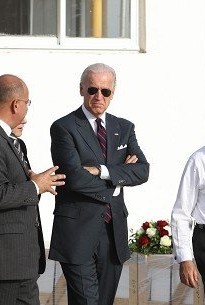 NAZARETH — Hebrew media sources have revealed that an atmosphere of pessimism prevailed in the meeting of US Vice-president Joe Biden with Egyptian president Husni Mubarak in Sharm e-Sheikh due to the failure of the steel barrier strategy in tightening the grip on the besieged Gaza Strip.
Military and security consultants from both countries were profoundly disappointed after “Hamas engineers” in the Gaza Strip succeeded in penetrating the barrier, the sources added.
The sources also disclosed that reports received by Biden alleged that “Hamas engineers” succeeded in excavating 18 meters under the ground and in planting burning materials in the way of the steel slabs that melted the foundations of the barrier and made them of no effect.
Furthermore, the sources said that that the USA decided to abandon the project and stopped financing it, and started to pull out all American military engineers participating in and supervising the project.
The US-Egypt plan was meant to destroy all tunnels along the Gaza Strip borders with Egypt in a bid to complete the Israeli siege and suffocate the 1.6 million Palestinians living in the Strip.
NATO Faces Attrition War in Afghanistan; British PM: We Will Send No More Troops
Al-Manar TV – 10/06/2010
 NATO is facing war of attrition in Afghanistan as four US occupation soldiers were killed Wednesday when Taliban militants shot down a NATO helicopter bringing to 23 the number of occupation soldiers killed in escalating violence since Sunday, and to 253 troops killed in the occupied country so far this year. This toll is scaring NATO countries, with the British Prime Minister David Cameron saying his country would not send more troops to Afghanistan.
The International Security Assistance Force (ISAF) helicopter came down in Helmand province. “The helicopter was brought down by hostile fire,” a military spokesman said, announcing the toll. Lieutenant Colonel Joseph Breasseale confirmed that the killed soldiers were American.
Yousuf Ahmadi, a Taliban spokesman, telephoned AFP from an undisclosed location to claim responsibility, saying: “We brought it down with a rocket. It crashed in the Sangin district bazaar.”
“It’s been a tough week,” Pentagon spokesman Bryan Whitman said in Washington, adding it was too early to say whether the downing of the helicopter, the first by hostile fire in nearly a year, marked a change in insurgent tactics or weaponry.
The crash brought to five the number of NATO soldiers killed in the south on Wednesday, after London said a British soldier had died in an explosion elsewhere in Helmand.
Twenty-three NATO soldiers have died since Sunday, including 10 on Monday, the deadliest day in combat for US-led forces in Afghanistan in two years, with seven Americans, two Australians and a French soldier killed. According to an AFP tally based on the casualties.org website, 253 occupation soldiers have been killed in Afghanistan this year. Last year was the deadliest yet, with 520 killed.
In his first official visit to Afghanistan since he was declared as a PM, David Cameron told the news conference: “the issue of more troops is not remotely on the UK agenda”.
Cameron, whose visit was not announced ahead of time for security reasons, held talks with Afghan President Hamid Karzai at the heavily guarded palace in Kabul before the two leaders held a joint news conference. Earlier, he declared Afghanistan “the most important foreign policy issue, the most important national security issue for my country”.
Britain has around 9,500 troops in Afghanistan, mostly in the south, as part of a 46-nation force. It is the second-biggest contributor to the NATO-led mission after the United States. A total of 294 British occupation personnel have been killed in Afghanistan since the 2001 US-led invasion.
Cameron’s new government has faced questions over whether it will follow the same strategy as his predecessor Gordon Brown and increasing public support for troops to come home.
An Independent on Sunday/ComRes survey in April found that 77 percent of those questioned now supported a phased withdrawal and the end of operations within a year, up six percent in five months. British Defense Secretary Liam Fox, who visited Afghanistan shortly after the new government took power last month, caused controversy by telling the Times newspaper that he would like British troops to “come back as soon as possible”.
Man shot dead at East Jerusalem checkpoint
Ma’an – 11/06/2010
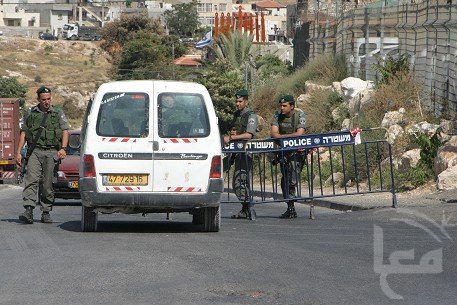
Jerusalem – A Palestinian man from Jerusalem was shot and killed by Israeli border guards on Friday, after he reportedly failed to stop at a checkpoint in the Wadi Joz neighborhood.
Witnesses said he was in serious condition as he was taken to hospital, with Israeli news sites reporting that the man died en route to hospital.
Officials identified the man as 38 year old Ziad Al-Julani, and later confirmed he was killed in the incident.
Following the shooting, clashes erupted in the area, with Palestinian residents angered at what they said was a day of oppression and violence enforced by Israeli soldiers. Two women, a man, a senior citizen and a child in a nearby car were said to have been injured in the shouting that erupted after the shooting, with Israeli forces using rubber-coated bullets against the crowd. The four were transferred the Al-Maqasid Hospital for treatment.
Israeli forces sealed off the area as clashes continued.
An Israeli border guard spokesman said Al-Julani drove his car at two border guards manning a checkpoint, installed as part of heavy security deployed throughout the city to restrict Palestinian movement following Friday prayers, and was shot in his vehicle. The spokesman said the two soldiers were lightly injured by the driver.
Afghanistan: The Mounting Casualties
Truth Seeker News Brief – June 9, 2010
Once again the Taliban are stepping up their efforts for the annual summer offensive and casualties among western forces in Afghanistan are mounting.
Early on Wednesday a U.S. Blackhawk helicopter was brought down by a rocket propelled grenade in Helmand province. Four U.S. servicemen were reported killed when the helicopter was shot down while trying to evacuate a wounded British soldier from a forward operating base. An explosion in the same province also reportedly killed a British soldier in separate incident earlier Wednesday.
These latest U.S. casualties bring the total of Americans killed this month to 18, while Nato forces have lost a total of 29 men in the first nine days of June.
On Monday June 7, NATO lost a total of 10 men in Afghanistan, seven of them Americans
Although the Taliban lack sophisticated missiles, they have nonetheless managed to bring down three helicopters in Helmand province in recent weeks.
With the deteriorating security situation NATO increasingly relies on helicopters for re-supply, even over relatively short distances, presenting the Taliban with more airborne targets for their rocket propelled grenades.
On Wednesday the Taliban were also reported to have torched up to 50 NATO supply trucks on the outskirts of Pakistan’s capitol, Islamabad. The trucks were part of a supply convoy on its way to Afghanistan
Over 75% of military supplies for western forces in Afghanistan and 40% of fuel needs pass through Pakistan. Supplies of food and vehicles are usually transported by road while ammunition and weapons are ferried in by air.
Former US Professor Arrested in Al-Walaja
Palestine Monitor | 9 June 2010
Former Yale Professor Mazin Qumsiyeh was among three demonstrators arrested this morning, as Israeli soldiers brutally stopped a demonstration in Al-Walaja. Aaron Dearborn reports from the field.All images by Kara Newhouse.
Dr Qumsiyeh was allegedly arrested and taken for interrogation as soldiers believed he was a “security threat”, however they did not provide specific details.

Also arrested under similar circumstances was an Israeli activist, Shay Chalatzi of Tel Aviv, allegedly for insulting the military unit as he protested the arrest of Dr Qumsiyeh.
Both arrests occurred after the demonstration was over and activists were attempting to leave the area. Soldiers followed the demonstrators as they walked away from the construction site to make the arrests.


At around 7am this morning, approximately 25-30 demonstrators marched on the scene of the wall construction, with two activists chaining themselves to bulldozers.
Yotam Wolfe of Jerusalem was arrested immediately as the military arrived; forcibly removed from a bulldozer to which he was chained by the neck.
At one point, the Israeli contractor in charge of the site attempted to attack the demonstrators and had to be forcibly restrained by the military.


Soldiers than began shoving the crowd and threatening arrests, as demonstrators were forced out of the construction site and onto the village roads.
The crowd then staged a peaceful sit down demonstration with soldiers not permitting demonstrators to move.
All three are believed to be held at the 300 check point in Bethlehem and are currently under interrogation.
The demonstrations came in response to the uprooting of trees and the overturning of land in preparation for the construction of the separation wall which threatens to cut the villagers from their agricultural lands.
Jewish rabbis storm the Aqsa with security protection
Palestine Information Center | June 9, 2010
OCCUPIED JERUSALEM – Senior Jewish rabbis stormed the holy Aqsa Mosque in occupied Jerusalem on Tuesday passing through the Maghareba gate under protection of Israeli occupation police.
Palestinian sources said that the rabbis climbed over the roof of the holy site and toured the area.
Dr. Taleb Abu Shaar, the Awkaf and religious affairs minister in Gaza Strip, lashed out at the Israeli occupation authority for allowing the “sacrilegious visit”.
He described the step as “unethical” and in violation of heavenly religions, pointing out that the rabbis stepped with their shoes on the holy site.
The minister warned of the continued targeting of the holy site, which falls in line with attempts to judaize occupied Jerusalem and the holy Aqsa compound.
The crimes I saw on the Mavi Marmara
Lubna Masarwa writing from Kfor Qara, Live from Palestine, 8 June 2010
During the Israeli attack on the Mavi Marmara, deep in international waters, I was inside the body of the ship. We were unarmed civilians ranging in age from a one-year-old child to an 88-year-old priest. We were going to Gaza to break the siege that Israel has imposed on a million-and-a-half people for the last four years. We were carrying a cargo of humanitarian and construction aid as well as letters from Turkish children to the children of Gaza. We were full of hope. When the attack began at 4am on 31 May 2010, our ship was transformed into a military target. On the deck, at first there was heavy firing, and then the Israeli occupation’s commandos took control of the ship.
Minutes after the attack began, wounded and corpses were being brought inside from the deck. We were then held for several hours with four bodies and dozens of wounded, some in critical condition. Blood was pouring from the bodies of the dead and the injured. We wanted to help them, but we had no medical equipment to treat them. There was nothing we could do. One Turkish woman was crying and saying goodbye to the body of her dead husband, petting his face and reading the Quran over him. Another man had a bullet wound in his head and was dying.
From 5am on, we were begging the Israeli navy to provide medical assistance to the wounded and dying but received no response. We made the request in English and Hebrew through the loudspeaker and also wrote a sign in Hebrew reading, “SOS … people dying in need of immediate medical attention” and put it on the window in front of them. They ordered the people with the sign to get lost.
At around 7am they ordered us to come to the exit door one by one. I requested in Hebrew that medics be allowed to stay with the wounded; a solider told me to shut my mouth. Later he called me, “You, tell the wounded that if they want to stay alive, they should come out one by one.” We tried to bring the injured out individually, but they could not walk and were falling down.
We were transferred to the upper deck. We were searched; our hands were tied, and we were forced to sit or kneel on the deck as a military helicopter hovered within meters above our heads. Heavily-armed soldiers with guns and knives strapped to their arms and legs stood guard over us with dogs. They were standing around us with the blood of their victims on their boots, joking and making lewd sexual suggestions to each other about the female prisoners. Then Israeli personell came and strutted around the ship. We were held this way for hours. I was held here until 1:40am on 1 June 2010.
As soon as the Israeli occupation forces learned that I was a Palestinian Israeli citizen, I was treated more harshly and isolated from the rest of the other imprisoned passengers. I was taken to a prison in Ashkelon where I was held in isolation and subjected to humiliations such as strip searches four times a day. The next day we were brought to court, and I was held in a small metal box inside the police car for eight hours with my hands and legs shackled. We were subjected to various accusations, from attacking soldiers to carrying weapons. The judge gave the police permission to extend our detention for another eight days. After international pressure forced the Israeli authorities to release all the foreign prisoners, all the Palestinian citizens of Israel were taken to court again. This time, the judge ruled that we would be subject house arrest and would be forbidden to leave the country for 45 days.
As an occupier and a colonizer, Israel depends on the principle of “divide and conquer” in order to maintain its control. It is especially threatened by people like the Palestinian delegation from 1948 (what is now referred to as Israel) who sailed to Gaza on the Mavi Marmara, because we defy Israel’s attempt to divide us as Palestinians. By struggling with our sisters and brothers under the siege, we also send the message that we are one people and our struggle is one struggle. Israel is threatened by solidarity.
That Israel should murder civilians in international waters is not strange. It is a direct continuation of its policy of targeting civilians with lethal force and deadly policies such as the siege of Gaza, and Israeli policies of occupation and apartheid.
Israel feels entitled to besiege, to kill and to attack civilians in international water. This results from the silence of the world that makes Israel believe it has the right to do so.
This is the time to break the silence and to take action. To say “enough is enough” for Israel. Israel’s impunity must end. Israeli war criminals, such as the ones who committed piracy and murder on the Mavi Marmara and their superiors, must be held accountable for their crimes in international courts.
Lubna Masarwa was a Free Gaza Movement representative aboard the Mavi Marmara and wrote this essay from her house arrest in Kfor Qara, Palestine. She can be reached at Lubnna A T gmail D O T com.
When Did Resistance Become a Dirty Word?
By Robin Yassin-Kassab | Pulse Media | June 6, 2010
What the Western political class and its media demand of the Arabs and Muslims is acceptance of the unacceptable status quo in Israel-Palestine. To resist the status quo is to be troublesome, destabilising and irrationally violent. Resistance arises from the inadequacies of a culture and religion given to antisemitism and hysteria. In order to develop, these backward folk must give resistance up.
For the Lebanese, this means that they must forget the brutal 22-year occupation of their country and the 1982 siege of Beirut as well as the 2006 assault on the country’s civilian infrastructure. They must forget the endless chain of massacres perpetrated by Zionists and their allies on Lebanese territory. They must smile when Israel violates their air space on a daily basis and threatens to send them “back to the stone age” on a weekly basis. They must disarm and label as terrorist Hizbullah, the principled defender of their country.
Syria must smile at the illegal occupation and annexation of the Golan Heights and the theft of its essential water supplies. It must repress the refugees from the Golan and the half million Palestinian refugees and their political organisations. It must not buy or build weaponry that might give it minimum protection from Zionist terrorism. It must grin stupidly when Israel chooses to bomb its territory.
The Palestinians must be modern and democratic. They must do this by fighting the winner of democratic elections and by supporting an unelected and corrupt bunch of collaborators.
As for Western sympathisers with the Palestinian cause, they must preface their criticisms of Israel with such statements as “Of course, Israel has a right to exist in security,” or “Of course we don’t support Hamas,” or, in the case of the passengers on the Rachel Corrie (whose courage and commitment I salute), “We will not resist.”
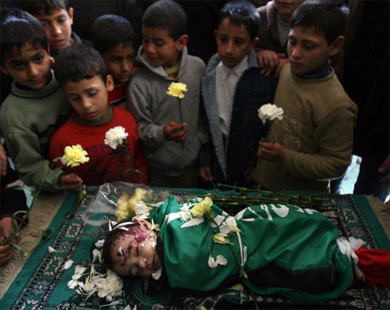
Learning Not to Resist
It’s time we stopped playing this game. To recognise Israel’s ‘right’ to exist in security is to deny Palestine’s right to exist in security. No state which occupies other states’ territories has a right to security. Did Hitler’s Germany have a right to security once it had invaded Czechoslovakia and Poland? And apartheid states don’t have a right to exist at all. There’s nothing anti-Semitic about this, just as there was nothing anti-white or anti-Afrikaaner in arguing that apartheid South Africa didn’t have a right to exist. A state established by massive ethnic cleansing and perpetuated by occupation and repeated massacres is not a normal state like any other. Israel will earn its right to exist when it allows the refugees to return home and when Jews, Muslims and Christians enjoy equal rights.
What are the arguments used to demonise (rather than critically engage with) Hamas?
Firstly, Hamas doesn’t recognise Israel. True, Hamas believes that Arafat made a major strategic blunder by officially recognising Israel before Israel allowed the Palestinians minimal rights. In this Hamas is only being logical. Hamas certainly knows that Israel exists, and even if Hamas drank enough whisky to forget Israel’s existence (which isn’t likely) Israel would still be there, with its Merkava tanks, its checkpoints and its nuclear bombs. Hamas has repeatedly said that it will stop fighting if Israel leaves the territories in 1967. It still won’t recognise Israel as a Jewish state on 78% of Palestine, because this would be to recognise the ‘justice’ of the theft of Palestine in order to build an ethno-state. In any case, Israel doesn’t recognise Palestine. Its failure to recognise Palestine has immediate and practical ramifications, like the occupation and the ethnic cleansing.
Secondly, Hamas doesn’t recognise the two-state solution. But again, neither does Israel, whatever its propagandists say. If Israel supported two states, it wouldn’t have spent the last decades, under Labour and Likud, building settlements on the West Bank and in Jerusalem. And Israel is the occupier.
Thirdly, Hamas has attacked civilians. This is surely the most hypocritical of reasons for isolating the movement. Since September 2000, Palestinians have killed 1072 Israelis. In the same period, Israelis have killed 6348 Palestinians (not including those who died as an indirect result of the occupation, for instance critically ill people who died in ambulances held up for hours at checkpoints). So Israel is far more guilty of killing civilians. And I would say that the violence of the occupied struggling to liberate themselves is more justifiable than the oppressive violence of the occupier. The people who cry over the fate of Sderot should consider not only the far, far worse fate of Gaza and the West Bank, but also the fact that the inhabitants of the bombed and starved refugee camps in Gaza come from the destroyed villages on which Sderot is built. If your home is stolen and neither the law nor the conscience of the thieves will give you restitution, you are entitled to fight the thieves. Hamas also holds one prisoner of war – not a civilian but a stormtrooper of the occupation. It is grotesque that the world knows the name of this captured terrorist but not the existence of at least 10,000 Palestinian prisoners in the Zionist gulag, many of them children.
Even if we could establish that the Palestinian side has been more violent than the Israeli side – which we can’t – Hamas, unlike Israel, has shown itself capable of sustaining ceasefires. And anyway, many of the Israeli victims have been killed by the al-Aqsa Martyrs Brigade, which is linked to Fatah.
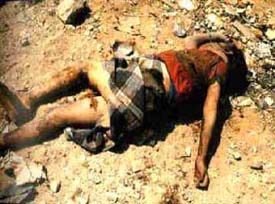
A Good Arab – Not Resisting
Fourthly, Hamas aims to establish an Islamic state. True, in theory. But it knows that it was elected for its resistance agenda and its freedom from corruption, not for Islamic reasons. There are signs that Hamas has recently tried to impose some of its moral code on the people of Gaza – and I oppose this – but given the circumstances, it’s been a gentle Islamism. It is in fact a bulwark against the more offensive Salafi nihilist groups which are now appearing among Palestinians in their desperation. And of course Israel is not a state for its citizens, still less for the people under its control, but a Jewish state. The fact that some of its people define Jewishness ethnically rather than religiously does not change this fact.
My main quibble with Hamas is its constitution’s reference to the Protocols of the Elders of Zion, an antisemitic Russian text discredited by anti-Zionists such as Abdelwahhab el-Messiri. (I’m not as outraged as I am by European anti-Semitism – if anyone can be excused for generalising about Jews, it’s the victims of the self-proclaimed Jewish state). Hamas leaders frequently say they do not oppose Jews for being Jews, but Zionists for being Zionists. If this is the case, I wish they’d remove the Protocols reference. So Hamas is not perfect, but neither was the Communist Party, which dominated resistance to Nazi occupation in Europe. Had I been around, I would have supported the anti-Nazi resistance as I support Hamas – critically but unconditionally.
As for the brave passengers on the MV Rachel Corrie, I wish they had not said, “we will not resist.” I wish they had said, “We are unarmed and we have no desire to come to blows with Israeli soldiers. However, if we are hijacked by armed men in international waters or near the shore of Gaza – over which we do not recognise Israeli jurisdiction – we will resist as best we are able.” Unwittingly, the activists handed Israel ammunition for its propaganda – ‘when civilised, peaceful activists arrive we deal with them peacefully. When mad Islamist Turks attack us with sticks when we board their ship, we have no choice but to shoot them many times at close range in the back of the head.’
The passengers on the Mavi Marmara should be congratulated for resisting piracy and the illegal, barbaric siege. We should never be ashamed of resistance – in occupied Europe, in South Africa, in Iraq, in Vietnam, in Palestine, in Lebanon, or on the Mediterranean sea. Resistance is beautiful. Resistance proves the existence of the human spirit amid a vast sea of inhumanity.
UN rights chief says Gaza siege ‘illegal’
Press TV – June 5, 2010
The UN High Commissioner for Human Rights says the Israeli imposed blockade of the Gaza Strip is “illegal and must be lifted.”
The United Nations official, Navi Pillay said on Saturday that “International humanitarian law prohibits starvation of civilians as a method of warfare and … it is also prohibited to impose collective punishment on civilians.”
“I have consistently reported to member states that the blockade is illegal and must be lifted,” she added.
The comments came as Tel Aviv’s siege of the Gaza Strip is about to enter its third year. The Gaza siege has deprived the Palestinians of food, fuel and other necessities.
Pillay also repeated a call for a probe into Israel’s deadly attack on the multinational relief convoy, the Freedom Flotilla, which had set sail to challenge the siege.
The Monday attack in international waters 150 km (90 miles) off the coast of Gaza killed several activists and left scores more injured.
Also on Saturday, the Israeli military seized the Rachel Corrie, the aid ship which neared Gaza five days after the bloodshed.
Israeli Murders, NATO and Afghanistan
By Craig Murray on 02.06.2010
I was in the British Foreign and Commonwealth Office for over 20 years and a member of its senior management structure for six years, I served in five countries and took part in 13 formal international negotiations, including the UN Convention of the Law of the Sea and a whole series of maritime boundary treaties. I headed the FCO section of a multidepartmental organisation monitoring the arms embargo on Iraq.
I am an instinctively friendly, open but unassuming person who always found it easy to get on with people, I think because I make fun of myself a lot. I have in consequence a great many friends among ex-colleagues in both British and foreign diplomatic services, security services and militaries.
I lost very few friends when I left the FCO over torture and rendition. In fact I seemed to gain several degrees of warmth with a great many acquaintances still on the inside. And I have become known as a reliable outlet for grumbles, who as an ex-insider knows how to handle a discreet and unintercepted conversation.
What I was being told last night was very interesting indeed. NATO HQ in Brussels is today a very unhappy place. There is a strong understanding among the various national militaries that an attack by Israel on a NATO member flagged ship in international waters is an event to which NATO is obliged – legally obliged, as a matter of treaty – to react.
I must be plain – nobody wants or expects military action against Israel. But there is an uneasy recognition that in theory that ought to be on the table, and that NATO is obliged to do something robust to defend Turkey.
Mutual military support of each other is the entire raison d’etre of NATO. You must also remember that to the NATO military the freedom of the high seas guaranteed by the UN Convention on the Law of the Sea is a vital alliance interest which officers have been conditioned to uphold their whole career.
That is why Turkey was extremely shrewd in reacting immediately to the Israeli attack by calling an emergency NATO meeting. It is why, after the appalling US reaction to the attack with its refusal to name Israel, President Obama has now made a point of phoning President Erdogan to condole.
But the unhappiness in NATO HQ runs much deeper than that, I spoke separately to two friends there, from two different nations. One of them said NATO HQ was “a very unhappy place”. The other described the situation as “Tense – much more strained than at the invasion of Iraq”.
Why? There is a tendency of outsiders to regard the senior workings of governments and international organisations as monolithic. In fact there are plenty of highly intelligent – and competitive – people and diverse interests involved.
There are already deep misgivings, especially amongst the military, over the Afghan mission. There is no sign of a diminution in Afghan resistance attacks and no evidence of a clear game-plan. The military are not stupid and they can see that the Karzai government is deeply corrupt and the Afghan “national” army comprised almost exclusively of tribal enemies of the Pashtuns.
You might be surprised by just how high in NATO scepticism runs at the line that in some way occupying Afghanistan helps protect the west, as opposed to stoking dangerous Islamic anger worldwide.
So this is what is causing frost and stress inside NATO. The organisation is tied up in a massive, expensive and ill-defined mission in Afghanistan that many whisper is counter-productive in terms of the alliance aim of mutual defence. Every European military is facing financial problems as a public deficit financing crisis sweeps the continent. The only glue holding the Afghan mission together is loyalty to and support for the United States.
But what kind of mutual support organisation is NATO when members must make decades long commitments, at huge expense and some loss of life, to support the Unted States, but cannot make even a gesture to support Turkey when Turkey is attacked by a non-member?
Even the Eastern Europeans have not been backing the US line on the Israeli attack. The atmosphere in NATO on the issue has been very much the US against the rest, with the US attitude inside NATO described to me by a senior NATO officer as “amazingly arrogant – they don’t seem to think it matters what anybody else thinks”.
Therefore what is troubling the hearts and souls of non-Americans in NATO HQ is this fundamental question. Is NATO genuinely a mutual defence organisation, or is it just an instrument to carry out US foreign policy? With its unthinking defence of Israel and military occupation of Afghanistan, is US foreign policy really defending Europe, or is it making the World less safe by causing Islamic militancy?
I leave the last word to one of the senior NATO officers – who incidentally is not British:
“Nobody but the Americans doubts the US position on the Gaza attack is wrong and insensitve. But everyone already quietly thought the same about wider American policy. This incident has allowed people to start saying that now privately to each other.”
Featured Video

New positive ivermectin evidence
or go to
Aletho News Archives – Video-Images
From the Archives
Fanatical Followers of the Covid Regime: A Jim Jones-Style Cult?
By Professor Roger Watson and Dr. Niall McCrae | The Daily Sceptic | November 15, 2021
As scholars at leading British universities over recent decades, we witnessed the replacement of critical thinking and debate by narrative: facts are discrimination and scientific method is imperialism; truth, instead, is derived from ‘progressive’ values. This educational trend may be a major contributory factor to the ease in which society has been inculcated to the Covid ‘new normal’ of masking, testing, and repeated doses of vaccines for a disease of similar risk to severe influenza.
One doesn’t need much critical reasoning to observe the flawed logic of some vaccination enthusiasts, such as people who respond to experiencing any side effects, however debilitating, by saying “at least I know it’s working”, or, after contracting the disease despite their promised inoculation (over 90% effective, according to initial drug company claims), “I’d have been worse off without the jab.” … continue
Blog Roll
 Aletho News
- Najaf airport to reopen to Iranian flights within 24 hours: Ambassador
- From ‘How Will This End For Iran’ to ‘When America Walks Away’: A tale of two Economist covers
- Tehran blasts ‘baseless’ speculation linking Iran to alleged bomb plot at UK air base
- The Rise And… Rise Of ‘Color Revolutions’
- The Coming GOP Bloodbath?
- Arctic Scare Stories Melt Away
- Wrong, Euronews: Climate Change Has Not Created a Food, Energy, and Economic “Meta-Crisis”
- New positive ivermectin evidence
- Met Office Caught Fabricating Daily Temperature Record Claims
- Merck Virologists Admitted to Falsely Certifying Vaccine Efficacy
- If Americans Knew
- Netanyahu Asked UAE Leader to Deny Report on Oct. 7 Warning in Secret Visit, Sources Say
- CNN Chief Int’l Correspondent Clarissa Ward on Journalists in Gaza
- Democratic Party Consultants Surround Troy Jackson with Pro-Israel Donors
- Christian Leader Responds To Netanyahu’s Claims Regarding Palestinian Christians
- In Gaza, ‘Whoever Survives the Bombing Won’t Survive the Rubble’
- Israel kills more Palestinians, amid push to resettle Gaza – Daily Update
- Israel forces Gazans to live in constant peril – Daily Update
- Deconstructing Netanyahu’s pants-on-fire UN rant – Daily Update
- Trump betrayed voters with his campaign lies and prioritized a foreign country once he took office
- Netanyahu calls Israel’s war in Gaza ‘opposite of genocide’ in UN speech to near-empty hall
- No Tricks Zone
- New Study: Earth And Venus Surface Warmth Largely Explained By Convection And Lapse Rate, Not CO2 Or Radiation
- 2025 Nature Paper Claiming Worsening Global Drought Gets RETRACTED …Heavily Flawed
- New Study: ‘Global Drought Shows No Detectable Recent Acceleration Under Climate Warming’
- Economic Masterminds: German Socialists Suggest Taxing Productivity Gains Stemming From Using AI
- The South China Sea Has Not Been Cooperating With The Climate Change Narrative
- Energy Crisis: Germany Enters Heating Season With Historically Low Gas Reserve Fill Levels
- New Study: The Antarctic Ice Sheet Gained Mass From 2020-2024 Due To Staggering Snow And Ice Accumulation
- Study: Ocean Heating Rates From Thousands Of Years Ago ‘Dwarf’ Modern Ocean Heating Rates
- Climate Extremists Target, Attack Large-Scale Power Grid Infrastructure In Germany!
- New Study: Antarctic Ice Melt Has Contributed Less Than 1 Centimeter To Sea Level Rise In The Last 30 Years

