Settlers torch hundreds of Nablus olive trees
Ma’an – June 2, 2010
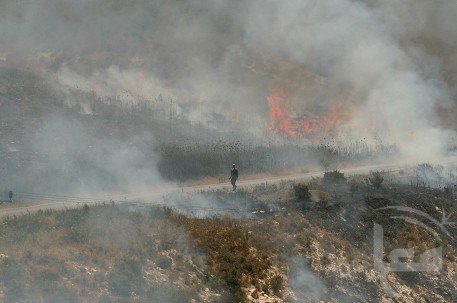
Nablus – Residents of the illegal Yitzhar settlement set fire to more than 100 dunums of Palestinian lands near Urif village, southwest of Nablus on Wednesday afternoon, Palestinian officials said.
Local official in charge of the settlements file in the northern West Bank Ghasan Daghlas said the fire was set in the Jabal Marwes area, the hill separating the villages of URif and Asira Al-Qaliya, into which Yitzhar’s “municipal area” extends.
“The settlers had set fire to the area, and it spread across a large swath of agricultural land,” Daghlas said.
When Palestinians saw the fire, dozens rushed to put it out, Daghlas continued, but said hundreds of almond and olive trees were destroyed.
“Clashes broke out between the Palestinians and the settlers who had lit the fire,” Daghas said, and Israeli forces used tear gas to disperse the fight.
The fields, village official Fawzi Shaehada said, belong to Mohammad Salamh A’mer As-Aafadi from Urif.
An Israeli military official said a fight broke out in a “disputed area” between what she estimated was 50 Palestinians and Yitzhar residents, where “mutual rock throwing” took place. She said Israeli border police dispersed the fight and noted no arrests.
Japanese PM resigns amid US military base row
Press TV – June 2, 2010

Yukio Hatoyama was Japan’s fourth prime minister in four years.
Japanese Prime Minister Yukio Hatoyama who took power less than nine months ago following a landslide victory has announced his resignation.
Hatoyama, 63, announced the decision on Wednesday at a special parliamentary meeting of lawmakers from his Democratic Party of Japan, AFP reported.
“The government’s work has not reflected the public’s wishes,” the Japanese premier said.
Hatoyama further added that he had also asked party heavyweight and secretary general Ichiro Ozawa to quit.
The Japanese prime minister was forced out as his poll ratings plummeted after he broke an election promise to move an unpopular US military base off the southern island of Okinawa. The move angered the people of Okinawa who have long been complaining about base-related noise, pollution and crime.
“I have caused trouble for the people of Okinawa,” Hatoyama said.
“We will need to make efforts to move the US base outside of Okinawa. But the result was that we could not deliver,” he further explained.
After months of tensions, Tokyo and Washington announced in a statement last week that the US base would be moved, as first agreed in 2006, from a crowded urban area to a coastal region of Okinawa. The move infuriated Okinawans as many want the Futenma Marine Corps Air Station moved off the island entirely.
Facing armed attack in international waters
By Paul Woodward on May 31, 2010

When a civilian passenger ship comes under military attack in international waters, should we be surprised — or even critical — when some of the passengers mount a defense?
According to CNN, which has made itself into a mouthpiece for the Israeli Defense Forces, the flotilla massacre was a “skirmish”, which the dictionary defines as a “minor battle in war, as one between small forces.”
CNN/the IDF would have the world believe that Israel’s elite commandos unexpectedly met an armed force on the decks of the Mavi Marmara. Some of the Israeli soldiers were so afraid they jumped into the sea to save themselves from Arabic-speaking assailants, Israeli officials claimed.
Turkish officials have denied claims leveled by Israeli authorities that weapons were onboard one of the six aid ships attacked by Israel on Monday.
Officials from the Customs Undersecretariat said every passenger was searched before getting on the ship with the help of X-ray machines and metal detectors. Senior officials from the undersecretariat said Israel’s allegations were tantamount to “complete nonsense.”
Israel and its lackeys in the US media might try to characterize what happened in the Mediterranean today as an “incident,” or “skirmish,” or an “ambush.”
But if the IDF met “unexpected resistance,” what exactly did they expect? A reception committee with tea and breakfast? Didn’t they see the resistance the Viva Palestina convoy put up last year when challenged by Egyptian security forces?
The live video feed coming from the Mavi Marmara during its voyage from Turkey would have provided invaluable intelligence for the IDF and I have little doubt that they watched it carefully. A number of observations the Israelis must have made may have significantly influenced their calculations and miscalculations.
One of the striking demographic features of the group of passengers was the average age — having watched many hours of the feed, I’d put the average age at about 35-40 with a significant number of “retirees” — this was not a bunch of young hotheads.
Also, the group was overwhelmingly Middle Eastern and Turkish and male. The risk that Israeli violence would result in the death of another Rachel Corrie was relatively low.
Put together these two factors — the expectation that the age of the passengers might make them somewhat less volatile and the fact that they largely came from countries that Israel has less concern about offending — and you get the perfect cocktail for Israeli hubris.
As for the fact that elite Israeli soldiers can in one instant be portrayed as invincible and yet the next as hapless victims — that is a paradox that can be resolved only in the minds of Israelis.
In the eyes of much of the world, this was a massacre, the dead will be seen as martyrs, and the moral bankruptcy of the Jewish state revealed in sharper clarity than ever before.
UN aid group: Israel deliberately hampering West Bank, Gaza relief efforts
By Chaim Levinson | Haaretz | May 30, 2010
A United Nations humanitarian relief agency is accusing Israel of deliberately disrupting the international community’s aid efforts for the Palestinians in the West Bank and Gaza Strip.
According to a special report released by the UN’s Office for the Coordination of Humanitarian Affairs (OCHA ), Israel is not permitting construction of buildings for needy Palestinians and is encumbering on the freedom of movement of aid groups and their staffs.
The report, which was issued on Thursday under the headline “Impeding Assistance: Challenges to Meeting the Humanitarian Needs of Palestinians,” said that human rights NGOs last year committed a total of $660 million in aid to the territories.
A large portion of the report is devoted to the humanitarian situation in Gaza, where it claims that UNRWA, the UN aid agency for Palestinian refugees, has been unable to build 100 news schools it says are needed to accommodate the fast-growing population.
In May 2009, the UN submitted a request for Israeli approval of a wide-ranging, $80 million plan to provide housing, medical assistance and educational services to Gazans. After nine months of negotiations, the Israeli government permitted a scaled-down version of the original plan, including the construction of 151 residential units in a project in Khan Yunis.
On Friday, a report appeared in the Israel Hayom newspaper which quoted Prime Minister Benjamin Netanyahu as saying: “In Gaza, let them build [homes] with wood. Concrete is used to build bunkers.”
The OCHA report claims Israel is interfering with the movement of local Palestinian aid workers. According to the report, 20 percent of requests for West Bank workers to secure passage to Gaza were rejected, while 46 percent of requests for Gaza-based employees to gain entry into the West Bank were turned down. The OCHA report said Israeli constraints have complicated efforts to train workers in Gaza.
Meanwhile, in the West Bank, aid groups have encountered other problems. In 2010, the UN formulated a series of urgent plans aimed at addressing shortages in water, educational services and housing for needy Palestinians living in Area C, the West Bank territories under exclusive Israeli military and civilian administration. According to the report, the international body prepared 15 initiatives that were intended to provide water to 52,000 Palestinians in 17 different locales in Area C, as well as 25 projects for the reconstruction of schools to service 6,000 children. Three months have passed since the UN presented these plans to the Israeli government, which has yet to offer its response.
Another issue cited by OCHA is movement in the West Bank. While the report acknowledged that the lifting of roadblocks and removal of checkpoints have significantly improved NGOs’ ability to work, it stated that difficulties remain. In August 2009, aid agencies were unable to deliver 170 water tankers intended to service 58 families and some 5,000 sheep in the southern Hebron Hills due to mounds of earth that impeded their progress. This forced half the residents of one village to relocate in order to find sources of water, the report stated.
Japan’s Social Democratic Party quits coalition over US military base
Press TV – May 30, 2010
Japan’s Social Democratic Party, SDP, has decided to leave the ruling coalition government amid a row over the controversial presence of the US military in the country.
SDP chief Mizuho Fukushima informed reporters about the decision on Sunday after meeting with party executives. The move follows a dispute within the cabinet over the US airbase in Okinawa.
Fukushima, who calls for the immediate relocation of the base, has slammed Prime Minister Yukio Hatoyama’s decision to keep the US compound on the island — despite his campaign promises to relocate the base.
The airbase has been under US command since after World War II. More than half of some 47,000 US troops in Japan are stationed in Okinawa.
The issue has become the biggest challenge to Hatoyama’s government since it came to power. The premier’s failure to appease the islanders has dramatically reduced his public approval rating. Okinawans want the airbase off their island. They say the US military presence is a source of noise and crime.
SDP’s defection is a tough blow to Hatoyama’s party. The Democrats need the help of other parties to win a majority in the Upper House elections.
What is Gaza’s legal status?
Former legal adviser to the PLO says Israel “confuses” occupation with colonisation
By Abbas Al Lawati | Gulf News | May 26, 2010
While Israel withdrew its troops and colonies from the Gaza Strip in September 2005, it has failed to convince the international community that its occupation of the tiny strip of territory has ended. Israel has vowed to stop the flotilla by any means necessary, but under what legal pretext it aims to do so is unclear.
Israel’s flags, tanks and colonists have ended their permanent presence on the strip, but Israel continues to control Gaza’s borders, airspace and territorial waters. The United Nations and the international community continue to consider the strip to be occupied by Israel, along with the West Bank and occupied Arab East Jerusalem. Why then does Israel insist that the occupation of Gaza has ended?
Canadian-Palestinian lawyer Diana Buttu, a former legal adviser to the Palestinian Liberation Organisation, said Israel “confuses” occupation with colonisation. While the colonisation of Gaza, in the form of its military and settlement presence there, ended in 2005, its occupation continues, she said.
“After it pulled out [of Gaza], the Israeli government went to the Supreme Court to get an assessment as to whether Gaza was still occupied. The court determined that Gaza was no longer occupied,” she said.
On the contrary, she said, Israel’s occupation of Gaza has intensified, as it controls every aspect of life in Gaza, including the population registry and the issuance of identity documents. Israel however is expected to face a dilemma in legally justifying any attempt to bar the Freedom Flotilla. If Gaza was indeed liberated territory, any Israeli action in its territorial waters would be considered as having taken place in the waters of another entity.
Israel, however, has a loophole. It has designated Gaza as a “hostile entity” and has reserved the right to protect itself from it. Buttu said that that is where Israel “traps itself”.
“Territory is either occupied or it’s not. There’s no shade in between. It’s like being half-pregnant,” she said.
She stressed, however, that as an occupying power, its laws hold little credibility, saying that international law, and specifically the Fourth Geneva Convention, should be the first reference. If all else fails, Israel could cite the security provisions in the Oslo Accords with the Palestinian Liberation Organisation of 1993, under which it has certain rights in a “security perimeter”.
Buttu argued, however, that those security perimeters were clearly defined in Oslo, but violated by Israel. Not only does Israel extend its activities to further than the defined perimeter, she said, it has also extracted natural gas off Gaza’s coastline, “which belongs to Gaza”.
“The caveat under Oslo is that in 2001 Israel declared Oslo dead… So it’s not really an argument any longer. They can’t say we want to maintain the security aspects of Oslo but we’re going to keep building colonies [in the West Bank] at the same time,” she said.
Israeli war games burn 17,000 acres of Syria’s Golan Heights
Press TV – May 28, 2010
Military exercises conducted by the Israeli army have set fire to thousands of acres of the occupied Syrian Golan Heights, destroying plant life in the region.
Firefighting teams put out the fire on more than 17,000 acres, Israeli news outlet Ynet reported on Thursday.
“Unfortunately this was a huge fire that caused a very big natural disaster, for animals as well as plants,” said Fire Department spokesman Yair Elkayam.
The five-day-long military maneuvers, dubbed Turning Point 4, began Sunday and were conducted in 68 cities and towns.
Israel seized the Golan Heights from Syria in 1967 and annexed in 1981. The move has never been recognized by the international community.
The Israeli maneuvers are also believed to target Lebanon’s economy as they were held during the tourism season for the Mediterranean country.
Israeli Army Raids Bil’in and Burns Olive Tree
By Saed Bannoura – IMEMC News – May 26, 2010
Early Tuesday morning Israeli soldiers raided the town of Bil’in in the central West Bank. Soldiers fired tear gas, sound bombs, and live ammunition at villagers, detained three journalists attempting to document the raid, and set fire to an ancient olive tree. Bil’in has been at the forefront of the non-violent resistance movement against the Israeli occupation.
Villagers voiced concern that the burning olive tree had been hit with white phosphorus because they were unable to put out the fire. The tree, responsible for much of the livelihood of the Palestinian farmer who owns the it, could not be saved.
Israeli forces have destroyed over 600,000 olive trees in the West Bank over the last ten years, depriving Palestinian farmers of their main source of income.
Leaders of the Popular Committee Against the Wall in Bil’in called the Israeli invasion and arson a “pernicious act of economic warfare,” saying the action by the military deeply angered the villagers. Many of them are dependent on the sale of the olive oil from the trees. A single tree can yield up to 800 shekels (about 210 dollars) worth of olive oil annually.
Bil’in witnesses said that such incursions by Israeli soliders onto their land are a daily occurrence in the village.
In recent months, Israeli troops have targeted non-violent organizers with the Popular Committee Against the Wall, including the town’s main leadership in the movement, Abdullah Abu Rahma and Eyad Bornat, both of whom were later released without being charged.
Japan PM under fire over US base deal
Press TV – May 25, 2010

A protest against relocation of US base in Okinawa on Sunday
Japan’s beleaguered Prime Minister Yukio Hatoyama faces fresh criticism after he made a decision to keep a controversial US airbase on the Japanese island of Okinawa. The latest attack on Yukio Hatoyama came from coalition partner Social Democrat Party (SDP) leader Mizuho Fukushima.
Hatoyama’s coalition partner criticized him for prioritizing negotiations with the US and failing to work out an agreement with his political partners, The Japan Times reported on Tuesday.
Earlier on Monday, Tokyo and Washington reached an agreement on moving Futenma base to the north side of Okinawa rather than off the island.
Fukushima slammed Hatoyama’s decision to allow the US base to be re-located inside Okinawa and went on to call for the immediate removal of the airbase from the island.
Earlier in December, Fukushima threatened to leave the ruling coalition over the airbase row.
Hatoyama had promised to remove the base off the island during his election campaign, which brought his Democratic Party of Japan (DPJ) to power in a sweeping victory.
The airbase has been under US command since after World War II. More than half of some 47,000 US troops in Japan are stationed in Okinawa. The issue has been the biggest challenge for Hatoyama’s government, with his approval rating dropping dramatically across the country over his failure to appease the islanders.
Long-separated family reunites in Gaza through tunnel
Rami Almeghari writing from occupied Gaza Strip, Live from Palestine, 25 May 2010
 |
| Naima Akkawi and Mahmoud Jouda’s children Rimas and Riwan. |
Naima Akkawi, a 40-year-old Moroccan native, is finally back home in Gaza with her husband Mahmoud Jouda and her two young children, Riwan (5) and Rimas (3) after an enforced absence of 10 years.
During that long and agonizing separation, Mahmoud and Naima did all they could to get back together through official channels but it was all to no avail. Finally, Naima, who had been living mostly in Morocco with Riwan and Rimas, decided to take the risk of going through a tunnel in order to be reunited with her loved ones.
“Since 2000, I have not been able to visit the Gaza Strip,” Naima explained, “a period in which I have endured every possible bad feeling being away from my dear husband.” Until 2007, she says during an interview at her newly established cosmetics shop in the Maghazi refugee camp in central Gaza, when Israel tightened its siege on Gaza, the couple were able to meet in Morocco or in Cairo.
Naima has been with her family in Gaza for almost six months, but it took a year of thought and hesitation to take the risky decision to go underground into one of the many tunnels that have become Gaza’s main lifeline to Egypt and the world beyond.
Since June 2007, Israel enforced a total closure of all of Gaza’s border crossings and Egypt sealed off the only gate into its territory, opening it only rarely for any of Gaza’s 1.5 million residents. The blockade has led to the excavation of numerous tunnels along the Gaza-Egypt border line. Gazans use such tunnels to bring in essential goods and commodities such as foods, cement, electronics and thousands of other items.
Recalling conversations with her husband, Naima said “He used to try to convince me to come across the border through a tunnel. I used to have a mix of feelings — I was worried about the risk but also so anxious to reunite with Mahmoud. Eventually I opted to take the risk.”
Back in the Moroccan city of Meknes where Naima lived before she moved to Gaza, she and many other neighbors and friends worried about family members who had married into families in Gaza.
“Actually, the Moroccan people are extremely sympathetic to the Palestinian people,” Naima said. “Many times I used to hear people talking about going to Palestine to show solidarity or take any action for the sake of those suffering under Israeli attacks and blockade.”
“The day I decided to travel from Morocco on way to Cairo, I felt excited and worried,” Naima recalled. Once in Cairo, she and her daughters stayed at her father-in-law’s house for about three weeks.
 |
| Naima Akkawi in her newly-opened cosmetics shop. |
“One day I received a call from Mahmoud, asking me to prepare for travel to Gaza,” she said. “That day a man came over and took us to the border area at the Egyptian side.”
In the Egyptian border town of Rafah, Naima stayed in a house with an elderly couple. “After we had breakfast that morning, the elderly couple assured me and showed me the path to the underground tunnel that we were supposed to take en route to Mahmoud, who was waiting for us at the Gaza side of the border. I held my children with my arms and entered a small door that was down a few steps. The moment was so incredible to me but I had to endure it as I was heading for my husband who I have not seen for the past three years and I was heading for the normal family life that I have been deprived of for the past 10 years.”
It took only a three-minute walk to reach the Gaza end of the tunnel. “During the walk I hit my head as the tunnel is very narrow and low,” Naima remembered. “At the end of the tunnel, someone placed my daughters in something that was like a swing, which went up a 26-meter shaft to the surface. Right after them, I went up and there I saw Mahmoud.”
Mahmoud Jouda told EI that it was not difficult to bring his family through the underground tunnel — but it was a last resort.
“I have done all my best for the past three years to bring my wife and my little daughters to Gaza, but all efforts were useless as the border crossings have been closed for all this time. I had no choice but to bring them through a tunnel.”
According to Mahmoud, “All you need is to coordinate well with a tunnel owner, so you can bring your family in. I encourage all those wanting to reunite with their families to take this step right away as our situation seems to be endless.”
In the first few months of her stay in the Maghazi refugee camp, Naima used to get worried by the frequent sound of nearby bombardment. “Every time there’s an explosion, Naima gets worried and asks me what’s happening,” said Mahmoud.
At the front door of her store, Riwan and Rimas played as their mother received customers. Life goes on despite the closure of the border and the crippling Israeli blockade.
“Gazans teach others like myself how to be patient, tolerant and resilient,” Naima said. “The suffering they have been enduring is quite rare in countries like mine. I just hope that Moroccans and other Arabs extend a hand of real support to the Palestinian people, who are definitely brothers and sisters for all us Arabs.”
All photos by Rami Almeghari.
Rami Almeghari is a journalist and university lecturer based in the Gaza Strip.
Turkey Rejects Israeli Deal on Gaza Flotilla
Al-Manar TV – 25/05/2010
 Israeli daily Yedioth Ahronoth reported Tuesday that Israel tried to prevent naval conflict between its occupation forces and peace activists sailing to Gaza by propositioning a number of states to transfer humanitarian aid equipment through its territory instead, but Turkey objected.
Ten boats carrying food, clothing, and construction materials to residents of the Gaza Strip left Monday from a number of countries participating in the ‘Break the Siege’ sail. Some 700 activists on board intend to reach Gaza by Thursday.
Israel pressed some of the participating countries to cancel the sail.
The Zionist entity propositioned Turkey to transfer its humanitarian aid equipment to Ashdod, from where it would be taken by the UN and international organizations into the Strip, under Israel’s supervision.
In exchange for transferring the equipment to Gaza, Israel asked that Turkey call off the sail to the Strip, however the latter rejected the offer.
Israeli Major General Eitan Dangot, coordinator of government activities in the (Palestinian) territories, suggested the deal to the Turkish ambassador recently, who said Turkey was not responsible for the sail.
Meanwhile the Israeli occupation Navy is preparing for the boats’ arrival on Thursday, with many fearing clashes between soldiers and activists when the latter are not allowed through.
Occupation soldiers will be ordered to seize the boats and take them to Ashdod’s shores, where a special detention area has been set up for Palestinian and international activists taken into the army’s custody.
UK to withdraw troops from Afghanistan
Press TV – May 22, 2010
In a U-turn in Britain’s policy regarding the Afghan war, senior government officials say they want UK soldiers to return home as soon as possible.
In an interview with The Times newspaper before arriving in Kabul on Saturday, Defense Secretary Liam Fox described the Afghan war as Britain’s most urgent priority. He said no more troops will be deployed in Afghanistan, adding that he wants to speed up the withdrawal of UK soldiers and training of Afghan forces.
Fox emphasized that the new government in London will put national security issues on top of its priority list.
“National security is the focus now. We are not a global policeman. We are not in Afghanistan for the sake of the education policy in a broken 13th-century country. We are there so the people of Britain and our global interests are not threatened,” Fox said.
Britain is the second-largest contributor of troops to Afghanistan. It has deployed some 10,000 soldiers in the war-torn country. The number of British soldiers killed in Afghanistan since 2001 stands at 286.
Featured Video

New positive ivermectin evidence
or go to
Aletho News Archives – Video-Images
From the Archives
Fanatical Followers of the Covid Regime: A Jim Jones-Style Cult?
By Professor Roger Watson and Dr. Niall McCrae | The Daily Sceptic | November 15, 2021
As scholars at leading British universities over recent decades, we witnessed the replacement of critical thinking and debate by narrative: facts are discrimination and scientific method is imperialism; truth, instead, is derived from ‘progressive’ values. This educational trend may be a major contributory factor to the ease in which society has been inculcated to the Covid ‘new normal’ of masking, testing, and repeated doses of vaccines for a disease of similar risk to severe influenza.
One doesn’t need much critical reasoning to observe the flawed logic of some vaccination enthusiasts, such as people who respond to experiencing any side effects, however debilitating, by saying “at least I know it’s working”, or, after contracting the disease despite their promised inoculation (over 90% effective, according to initial drug company claims), “I’d have been worse off without the jab.” … continue
Blog Roll
 Aletho News
- ‘Grave, alarming’: Iran mission on Trump’s UNGA ‘annihilation’ threats
- Najaf airport to reopen to Iranian flights within 24 hours: Ambassador
- From ‘How Will This End For Iran’ to ‘When America Walks Away’: A tale of two Economist covers
- Tehran blasts ‘baseless’ speculation linking Iran to alleged bomb plot at UK air base
- The Rise And… Rise Of ‘Color Revolutions’
- The Coming GOP Bloodbath?
- Arctic Scare Stories Melt Away
- Wrong, Euronews: Climate Change Has Not Created a Food, Energy, and Economic “Meta-Crisis”
- New positive ivermectin evidence
- Met Office Caught Fabricating Daily Temperature Record Claims
- If Americans Knew
- Netanyahu Asked UAE Leader to Deny Report on Oct. 7 Warning in Secret Visit, Sources Say
- CNN Chief Int’l Correspondent Clarissa Ward on Journalists in Gaza
- Democratic Party Consultants Surround Troy Jackson with Pro-Israel Donors
- Christian Leader Responds To Netanyahu’s Claims Regarding Palestinian Christians
- In Gaza, ‘Whoever Survives the Bombing Won’t Survive the Rubble’
- Israel kills more Palestinians, amid push to resettle Gaza – Daily Update
- Israel forces Gazans to live in constant peril – Daily Update
- Deconstructing Netanyahu’s pants-on-fire UN rant – Daily Update
- Trump betrayed voters with his campaign lies and prioritized a foreign country once he took office
- Netanyahu calls Israel’s war in Gaza ‘opposite of genocide’ in UN speech to near-empty hall
- No Tricks Zone
- New Study: Earth And Venus Surface Warmth Largely Explained By Convection And Lapse Rate, Not CO2 Or Radiation
- 2025 Nature Paper Claiming Worsening Global Drought Gets RETRACTED …Heavily Flawed
- New Study: ‘Global Drought Shows No Detectable Recent Acceleration Under Climate Warming’
- Economic Masterminds: German Socialists Suggest Taxing Productivity Gains Stemming From Using AI
- The South China Sea Has Not Been Cooperating With The Climate Change Narrative
- Energy Crisis: Germany Enters Heating Season With Historically Low Gas Reserve Fill Levels
- New Study: The Antarctic Ice Sheet Gained Mass From 2020-2024 Due To Staggering Snow And Ice Accumulation
- Study: Ocean Heating Rates From Thousands Of Years Ago ‘Dwarf’ Modern Ocean Heating Rates
- Climate Extremists Target, Attack Large-Scale Power Grid Infrastructure In Germany!
- New Study: Antarctic Ice Melt Has Contributed Less Than 1 Centimeter To Sea Level Rise In The Last 30 Years

