Trump deal: A prize for Israel at the expense of Palestine
Press TV – January 28, 2020
Just as US President Donald Trump is taking time off his controversial impeachment trial to unveil his much hyped-up peace plan for the Israeli-Palestinian conflict, a potentially explosive situation is unfolding in Palestinian territories where there is huge resentment among the leadership and the people towards the so-called ‘deal of the century.’
Palestinians argue that one primary flaw of Trump’s deal is that despite presumably offering a recipe for peace between Israelis and Palestinians, it totally excludes and sidelines them, as one side of any mutual agreement.
Palestinians view the deal as Washington’s seal of approval for Israel’s long-desired annexation of their territories it has been illegally occupying for decades, in total disregard for UN Security Council resolutions and the opposition by the vast majority of the international community.
The timing for the unveiling of the deal has also drawn much attention as both President Trump and Israeli Prime Minister Benjamin Netanyahu are embroiled in major national scandals. The US president is in the midst of an impeachment trial, while the Israeli premier is facing three corruption indictments.
Palestinian leaders from different factions raised their voices on Monday against the US-devised deal and stressed the need for popular resistance in the face of the American scheme which Trump prepares to unveil in the presence of Israeli leaders at 17:00 GMT on Tuesday.
Palestine has already rejected the so-called peace plan as “the slap of the century.”
The scheme is reported to be hugely biased towards the Tel Aviv regime by extending Israel’s “sovereignty” over all settlements and annexing the Jordan Valley in the West Bank.
Washington released the economic portion of its initiative during a conference last June, which was boycotted by Palestinians and supporters of the Palestinian cause against Israel’s decades-occupation.
I won’t become a traitor: Abbas
Speaking at a meeting with members of the Fatah Party’s central committee on Monday, Palestinian President Mahmoud Abbas was cited in media reports as saying that Trump “wants to impose something on us that we do not want.”
Fatah officials also quoted Abbas as saying that he “did not pick up the phone” after calls from Washington.
“I said no and I will continue to say no… We are going for difficult days and we are beginning to bear the consequences of the refusal. Resistance must be escalated at all points of friction. All young people must be encouraged,” he said.
Abbas said he had received threats over his firm opposition to Trump’s deal, but that he will not back down from his stance.
“I was told I’ll pay a heavy price for my foolish behavior. I do not have much longer to live and I will not go down as a traitor. It’s either dying like martyrs or flying the Palestinian flag on the walls of Jerusalem [al-Quds],” he added.
Abbas also instructed Palestinian security forces not to interfere with protests against the US scheme, according to the reports.
US deal will be another Nakba: Hamas
Fawzi Barhoum, spokesman for the Gaza-based Hamas resistance movement, said Trump’s deal represents another Nakba for the Palestinian nation.
The Nakba Day (the Day of Catastrophe) is commemorated every year on May 15 to mark the forcible eviction of Palestinians from their motherland by Israel in 1948.
Barhoum also stressed that confronting “the disgraceful deal of the century” requires declaring public mobilization and stepping up resistance in various forms throughout Palestine.
He further urged Abbas to take important decisions towards opposing the initiative, among them ending security cooperation with Israel.
‘Arab envoys should boycott unveiling ceremony’
Abbas’ spokesman Nabil Abu Rudeineh called on all ambassadors of Arab and Muslim countries invited to the unveiling ceremony of the US plan not to attend the event, according to the Palestinian WAFA news agency.
The Palestinians consider the deal “a conspiracy aimed at undermining the rights of the Palestinian people and thwarting the establishment of the State of Palestine.”
Reports, however, suggest that Arab Persian Gulf states — which have long had secret contacts with Israel — are likely to voice general support for the contentious US scheme, but only if it does not allow Tel Aviv to immediately annex parts of the West Bank.
So far Jordan has openly opposed the deal.
Trump attempting to boost Netanyahu: Israeli MK
Ahmad Tibi, Israeli lawmaker from the Arab-majority Joint List political alliance, said that Trump was intervening in the Palestine issue in favor of scandal-hit Netanyahu, amid an election deadlock in the occupied territories, Al Mayadeen TV channel reported.
Anyone who supports Trump’s initiative is actually against Palestine, he added.
Islamic Jihad calls for new Intifada
Mohammed al-Hindi, a member of Gaza-based Islamic Jihad’s politburo, called on people to launch a new Intifada (uprising) in the occupied territories.
He further underlined the need for an emergency meeting between all Palestinian groups on how to counter the US plan.
Gazans to protest; Palestinian leaders to convene
Meanwhile, groups based in the Gaza Strip have called on Palestinians in the blockaded coastal enclave to protest against Trump’s deal in central Gaza on Tuesday.
Separately, Abbas has called for an emergency meeting of the Palestine Liberation Organization (PLO) Executive Committee and the Fatah central committee at 17:00 GMT on Tuesday, which coincides with the plan’s release.
Hamas, which governs Gaza, is also set take part in the meeting.
“We invited the Hamas movement to attend the emergency meeting of the leadership and they will take part in the meeting,” senior Palestinian official Azzam al-Ahmed said.
A Million Iraqis Asked Us to Leave. We Should Listen.

By Ron Paul | January 27, 2020
You wouldn’t know it from US mainstream media reporting, but on Friday an estimated million Iraqis took to the streets to protest the continued US military presence in their country. What little mainstream media coverage the protest received all reported the number of protesters as far less than actually turned out. The Beltway elites are determined that Americans not know or understand just how much our presence in Iraq is not wanted.
The protesters were largely supporters of nationalist Shi’ite cleric Muqtada al-Sadr, who opposes both US and Iranian presence in Iraq. Protesters held signs demanding that the US military leave Iraq and protest leaders warned of consequences unless the US listen to the Iraqi people.
After President Trump’s illegal and foolish assassination of Iranian general Soleimani on Iraqi soil early this month, the Iraqi parliament voted unanimously to cancel the agreement under which the US military remains in Iraq. But when the Iraqi prime minister called up Secretary of State Mike Pompeo to request a timetable for a US withdrawal, Pompeo laughed in his face.
The US government answered the Iraqi parliament’s vote with a statement that the US military is a “force for good” in the Middle East and that because of the continuing fight against ISIS US troops will remain, even where they are not wanted.
How many billions of dollars have we sent to Iraq to help them build their democracy? Yet as soon as a decision of Iraq’s elected parliament goes against Washington’s wishes, the US government is no longer so interested in democracy. Do they think the Iraqis don’t notice this double-dealing?
The pressure for the US to leave Iraq has been building within the country, but the US government and mainstream media is completely – and dangerously – ignoring this sentiment. It’s one thing to push the neocon propaganda that Iraqis and Iranians would be celebrating in the streets after last month’s US assassination of Iranian general Soleimani, who was the chief strategist for the anti-ISIS operation over the past five years. It’s a completely different thing to believe the propaganda, especially as more than a million Iranians mourned the popular military leader.
The Friday protesters demanded that all US bases in Iraq be closed, all security agreements with the US and with US security companies be ended, and a schedule for the exit of all US forces be announced. Sadr announced that the resistance to the US troop presence in Iraq will halt temporarily if an orderly departure is announced and implemented. Otherwise, he said, the resistance to US troops would be activated.
A million Iraqi protesters chanted “no, no to occupation.” The Iraqi parliament voted for us to leave. The Iraqi prime minister asked us to leave. Maj. Gen. Alex Grynkewich, the US deputy commander in Iraq and Syria, said last week that US troops in Iraq are more threatened by Shi’ite militias than ISIS.
So, before more US troops die for nothing in Iraq, why don’t we listen to the Iraqi people and just come home? Let the people of the Middle East solve their own problems and let’s solve our problems at home.
Copyright © 2020 by RonPaul Institute
Trump’s Katyusha Conundrum: Unguided Artillery Deployed by Iraqi Insurgents against US Occupation Forces
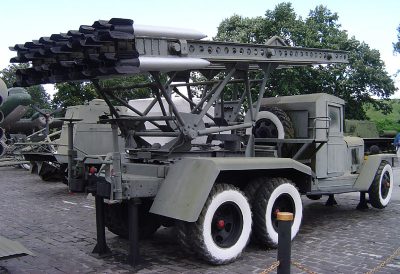
Katyusha launcher (Source: Wikimedia Commons)
By William Walter Kay | Global Research | January 23, 2020
Katyushas are short-range, unguided artillery rockets typically fired in salvos from truck-mounted launch-tubes. Iraq’s insurgents deploy three types.
The smallest is 107 millimetres in diameter and 1 metre long. Its 19 kilogram weight includes an 8 kg high-explosive, shrapnel-bearing warhead. The 107mm is often fired from a 12-tube launcher, however, infantry-portable single-tube tripods are common. An experienced crew with a standardised weapon can hit a 400 X 400 metre target from 8 kilometres away. During the Vietnam War the US Army considered the 107mm to be their adversaries’ most formidable weapon.
The 122mm ‘Grad’ Katyusha is 3 metres long and weighs 75 kg. Its warhead spans a third of its length and weighs 18 kg. It has a 20-kilometre range and a 30-metre lethal radius.
220mm Katyushas hurl 100 kg warheads 30 kilometres.
Katyushas have advantages over mortars. They deliver the same payload twice the distance and they fire multiple ordnance more rapidly. The globally ubiquitous BM-21 Grad fires forty 122mm rockets in three minutes. Reloading takes 10 minutes. Thus, Katyushas excel at “shoot-and-scoot” operations. As well, Katyushas’ flat trajectories permit line-of-sight attacks and their 700 metre-per-second velocities provide unique anti-building potential.
*
After [allegedly] helping suppress the ISIS-led insurgency (2014-17) US forces defaulted to their previous occupation plan. Central to this program are segregated compounds situated inside Iraqi Armed Forces bases. These installations, always near airstrips, contain mere hundreds (not thousands) of US and Coalition troops who ride herd over the Iraqi Army whilst grooming and directing Iraq’s 15,000-strong Special Forces.
Embassies and consulates are integral to the occupation. The sprawling US Embassy compound dominates Baghdad’s fortified “Green Zone” which also houses Coalition partners’ embassies, and the headquarters of the many NGOs insinuated throughout Iraqi society.
The occupation facilitates local activities of American and European businesses. These require office blocks, oil-field infrastructure; and, gated communities for imported talent.
Pre-2011 Americans relied on bases containing thousands of troops. These were remotely located and allocated substantial resources to thwart indirect (mortar and rocket) attacks through: counter-artillery, drone surveillance, and fighting patrols. Despite this, indirect fire inflicted 3,000 casualties (including 211 fatalities) on American forces; many occurring inside ‘secure’ bases.
The US-led Coalition’s current archipelago of military, diplomatic, intelligence, business and NGO installations are ill-equipped to defend themselves against indirect fire. Proximity to cities makes them sitting ducks.
*
In September 2018 persons unknown began targeting US installations with Katyushas. This list chronicles these attacks.* (A dozen mortar attacks are not listed; Katyushas being the weapon of choice.)
- September 8, 2018 – four rockets (three 107mms and one 122mm) fall near the Green Zone.
- September 8, 2018 – two salvos of 107mms land near the US Consulate beside Basra Airport.
- September 28, 2018 – three 107mms are fired at the Basra Consulate; two land on site.
- December 27, 2018 – two 107mms are fired at Al-Asad Airbase (160 kilometres west of Baghdad) during Trump’s visit.
- February 2, 2019 – an attack on Al-Asad Airbase is aborted. Three ready-to-launch 122mms are captured.
- February 12, 2019 – three 107mms hit Q-West Airfield (an off-the-books base south of Mosul).
- May 1, 2019 – two 107mms hit Camp Al-Taji: a ‘training’ institute, 40 kilometres north of Baghdad.
- May 19, 2019 – two rockets land near the US Embassy.
- June 10, 2019 – rocket attack on Camp Al-Taji.
- June 12, 2019 – rocket attack on a “northern air base” starts a fire.
- June 13, 2019 – rocket attack on Nineveh Command Headquarters (Mosul Presidential Palace).
- June 14, 2019 – a rocket lands near the US Embassy.
- June 17, 2019 – three rockets hit Camp Al-Taji.
- June 18, 2019 – Nineveh HQ is attacked by two 122mms; one hits, one misses.
- June 19, 2019 – rockets strike a gated community outside Basra (home to Exxon staff).
- September 23, 2019 – two rockets hit the Green Zone; one lands near the US Embassy.
- October 30, 2019 – two rockets hit the Green Zone, killing an Iraqi soldier.
- November 8, 2019 – seventeen rockets target Q-West Airfield.
- November 17, 2019 – rockets hit the Green Zone.
- November 29, 2019 – a rocket hits the Green Zone.
- December 3, 2019 – Al-Asad Airbase is “rocked” by five 122mms.
- December 5, 2019 – five 107mms hit Balad Airbase (80 kilometres north of Baghdad).
- December 6, 2019 – a 240mm rocket lands near Baghdad Airport (then housing a US base).
- December 9, 2019 – four 240mms strike Baghdad Airport killing 2, and wounding 5, Iraqi soldiers.
- December 11, 2019 – two 240mms land outside Baghdad Airport.
- December 27, 2019 – thirty-six 107mms hammer K1 Base (15 kilometres northwest of Kirkuk); killing an American translator and wounding several US troops.
- December 29, 2019 – four rockets hit Camp Al-Taji.
- December 29, 2019 – five rockets hit Al-Asad Airbase.
- January 4, 2020 – two rockets hit Balad Airbase.
- January 4, 2020 – several rockets hit the Green Zone. One lands near the US Embassy; another closes a major street.
- January 5, 2020 – six rockets are fired at the Green Zone; three hit the target.
- January 8, 2020 – two rockets hit the Green Zone.
- January 12, 2020 – eight rockets hit Balad Airbase, wounding several Iraqi soldiers.
- January 14, 2020 – a five-rocket attack on Camp Al-Taji.
- January 20, 2020 – three rockets hit Green Zone. They were fired from Al Zafraniya (15 kilometres away).
Attacks are becoming more frequent and are trending toward bigger rockets and higher volume salvos.
The insurgents’ strategy is working. Katyusha attacks shuttered the US Basra Consulate in September 2018. Attacks in May and June 2019 forced Exxon to evacuate much of its foreign staff. Throughout 2019 the US State Department extracted personnel and the Defense Department consolidated bases into more secure facilities. By late 2019 US authorities were begging Iraqis for help whilst threatening retaliation.
The last straw came December 27 when the barrage onto K1 Base killed an American translator. The US responded with airstrikes on five Kata’ib Hezbollah bases (90 casualties) and with the January 3 assassination of Iranian General Soleimani. (The decision to assassinate Soleimani – in the event of an American fatality – was made June 24, 2019 following a week of near daily Katyusha attacks.)
*
While Iran and Iran’s Iraqi allies are blamed for these attacks; this is dubious. Reportage following attacks invariably drops the phrase “no one claimed responsibility” – which is notable because perpetrators often boast of such achievements. Ten years ago, when Kata’ib Hezbollah targeted US facilities with “lob bombs” (improvised rockets), they posted videos of their handiwork. They deny involvement in these recent attacks as do other Iranian-linked militias.
The reportage often describes the attacks as “mysterious” or as a “whodunit.” Authors relay US intelligence theories of Iranian involvement … without evidence.
On several occasions insurgents abandoned launchers and/or launch vehicles after the attack, often with fail-to-launch rockets inside. Investigators also possess fragments of successfully fired rockets. Tellingly, US officials, renowned for straining at gnats for evidence of Iranian complicity, do not utilise this material to incriminate Tehran.
The launchers themselves are obviously manufactured by local artisans. Moreover, an article from Kurdistan–24 describes the rockets as “locally made.” Even globalist-militarist instrumentalities like the Washington Institute, Long War Journal, and Center for Strategic and International Studies concede some Katyushas are manufactured in Iraq.
Iraq has a burgeoning steel industry and, due to the calamities of the past 20 years, an enormous scrap metal industry. Katyushas’ cardinal virtue is their simplicity.
*
Circa 2014 twelve countries hosted non-state armed groups that deployed Katyushas. (Post-2014 Yemen’s Houthis joined this list, then outdid the pack in innovation and output.)
During the 2003-11 era Iraqi insurgents looted Katyushas from local arsenals. Other Katyushas came from Iran (officially or via the black market) and possibly from any of 32 other countries manufacturing them. Experts bemoan the difficulty of determining a rocket’s origin.
Circa 2008 Iraqi artisans manufactured a variety of launchers. A 2009 raid in Maysan Governorate discovered 107mm, 122mm and 220mm rail launchers; and 1,700 carjacks. (Jacks were affixed to the bottoms of stationary tripods to permit changes in launch angle.) Insurgents developed creative mobile launch platforms i.e. inside ice cream trucks or towed behind motorcycles etc. They debuted remote control triggers and GPS reconnaissance.
Circa 2011 poor quality of locally acquired rockets compelled insurgents to continue to rely on imports. The insurgents were, however, manufacturing “lob bomb” rockets and anti-armour mines; although Iran stood accused of being their sole supplier.
Post-2011 insurgents honed their craft. Remember: Hamas, operating inside Gaza with a tiny fraction of the resources of Iraq’s insurgents, manufactures crude Katyushas.
*
Prime suspects in the Katyusha campaign are not pro-Iranian militias; but rather the milieu around Mahdi Army successor, the Promise Day Brigades (PDB). This political tendency, nominally led by Moqtada al-Sadr, is concentrated in Iraq’s densely populated central and southern regions, but boasts a militant contingent in Mosul. This milieu overlaps the Saairun Alliance which includes Iraq’s far left; who carry their own legacy of armed struggle.
The insurgency’s Von Braun might be Jawad al-Tulaybani. An Iran-Iraq War veteran, al-Tulaybani possesses 40 years of combat rocketry experience. A war wound left him partially disabled. He appeared on US radar in 2008 after masterminding a barrage that wounded 15 US soldiers.
The org-chart of the Saairun/PDB/al-Sadr movement remains obscured. Notably, on January 8, 2020 al-Sadr counselled refrain from military actions. Four Katyusha attacks happened since.
What is clear is that this general political tendency is not particularly beholden to Iran. They appear non-sectarian, if not secularist, and they advance a left-nationalist agenda. Prior to the 2018 election (wherein Saairun emerged as the most popular bloc) Iran’s Foreign Minister warned Iran would never tolerate an Iraq run by “liberals and communists” – meaning Saairun.
Then again, Trump’s thrill kill of Soleimani (and Iraq’s Popular Mobilization Units’ Deputy Commander) completely reshuffled the deck, creating unprecedented unity amongst hitherto rivals.
*
As Katyushas veto pacification efforts, US forces return to square one. They must retreat to sprawling, remotely situated camps equipped to suppress indirect fire. This, however, means surrendering Iraq’s political theatre to adversaries who will marshal Iraqi Government resources against them.
Katyushas are driving the Trump Administration’s Iraq policy. Prisoners of groupthink they react by doubling-down on the Big Lie that Iraq’s national liberation movement consists only of “Iranian terrorists.” In reality, their most effective opponents are as indigenous and legitimate as the French Resistance.
Note on Sources
Data came from scanning 1,000 articles then parsing several dozen of them. Preference went to state media: i.e. Voice of America, Al Jazeera, Xinhua et al; although Military Times and Kurdistan-24 proved germane. Rogue Rocketeers: Artillery Rockets and Armed Groups (Small Arms Survey, Geneva Switzerland, 2014) is a must-read. Data on the first 7 Katyusha attacks was lifted without corroboration from Michael Knights’ Responding to Iranian Harassment of U.S. Facilities in Iraq (Washington Institute, May 21, 2019). As Knights is the only analyst to grasp the seriousness of the Katyusha attacks. His reports are a trove. Being intimately connected to US and Israeli intelligence, he slavishly relays the anti-Iran party line.
Major attacks generate scores of reports. Lesser attacks are mentioned only in passing. Some articles tally the attacks but the numbers do not jibe. Certain attacks go unreported. Probably, 50+ mortar and Katyusha attacks hit US facilities between September 8, 2018 and January 14, 2020.
http://www.smallarmssurvey.org/fileadmin/docs/F-Working-papers/SAS-WP19-Rogue-Rocketeers.pdf
Copyright © William Walter Kay, Global Research, 2020
Iraqis march in ‘millions’ to call for expulsion of US troops
Press TV – January 24, 2020
 Iraqis have rallied in Baghdad in massive numbers to call for an end to US military presence in the country following high-profile assassinations and airstrikes targeting anti-terror forces.
Sayed Sadiq al-Hashemi, the director of the Iraqi Center for Studies, said more than 2.5 million took part in the demonstrations on Friday.
Since the early hours on Friday, huge crowds of men, women and children of all ages converged on the Jadriyah neighborhood near Baghdad University.
The protesters were seen carrying banners and chanting slogans calling for the expulsion of US forces.
“Get out, get out, occupier!” some shouted, while others chanted, “Yes to sovereignty!”
Iraq’s al-Ahd news network reported that Iraqis from all of the country’s provinces had gathered in the city.
On January 5, the Iraqi parliament voted overwhelmingly in favor of a resolution calling for the expulsion of all foreign forces after the US assassination of Iran’s General Qassem Soleimani and his Iraqi trenchmate Abu Mahdi al-Muhandis.
The massive rally came after influential cleric Muqtada al-Sadr called on Iraqis to stage “a million-strong, peaceful, unified demonstration to condemn the American presence and its violations”.
Sadr issued a statement on Friday calling for US bases to be shut down and Iraqi airspace closed to US warplanes and surveillance aircraft.
He warned that US presence in the country will be dealt with as an occupying force if Washington does not agree with Iraqi demands to withdraw for the country.
In a message delivered through a representative at Friday prayer in the holy city of Karbala, top cleric Ayatollah Ali al-Sistani also urged Iraqi political groups to do what is needed to the safeguard the country’s sovereignty.
He called on Iraqi groups to stand united, far from any foreign influence in countering the dangers which threaten the country.
On Thursday ahead of the planned rallies, Sadr called on Iraqis to mobilize and defend the country’s independence and sovereignty.
“Oh women, men and youth of the country, the time is now upon us to defend the country, its sovereignty and dependence,” Sadr said in a tweet.
“Spread the word of an independent future Iraq that will be ruled by the righteous; an Iraq which will not know of corruption nor aggression” he added, calling on Iraqis to expel the “tyrants”.
Various Iraqi resistance groups affiliated with the country’s Popular Mobilization Units (PMU) have also backed the anti-American rally.
‘Zero hour in face-off with US’
Speaking to the Lebanese al-Mayadeen television channel, Jaafar al-Husseini, a spokesman for the PMU-affiliated Kata’ib Hezbollah resistance group, said “other means” will be used against the Americans if they do not leave Iraq.
The American presence, he said, has led to corruption and instability in the country.
In an interview with Iran’s Tasnim news agency, Firas al-Yasser, a member of the political bureau of Iraq’s Harakat Hezbollah al-Nujaba, said Friday’s rallies marked “a new chapter” in the Arab country’s relations with the US.
He said Iraqi resistance groups support the stance of the country’s clerical leadership, which does not tolerate Washington’s “theory of dependence and humiliation” of Iraq.
“We believe we have reached the zero hour in facing off with the US,” he said.
Yasser added that Iran’s missile attack on the Ain al-Assad base in the western Iraqi province of Anbar earlier this month was a “prelude” to the expulsion of US forces from the country.
Qais al-Khazali, leader of Asa’ib Ahl al-Haq, which is part of the PMU, described Friday’s rallies as a “second revolution” a century after the Great Iraqi Revolution of 1920 against British forces.
No opposition from the international community as Israel alters the two-state paradigm
![Israel forces Jerusalemite to demolish his home [Maannews]](https://i2.wp.com/www.middleeastmonitor.com/wp-content/uploads/2020/01/523409C.jpg?resize=650%2C433&quality=85&strip=all&ssl=1)
Israel forces Jerusalemite to demolish his home [Maannews ]
By Ramona Wadi | MEMO | January 21, 2020
The EU is predicting an increase in Israeli demolitions of Palestinian dwellings and structures in the occupied West Bank, thus perpetuating the problem of displacement. Israeli Defence Minister Naftali Bennett has described the plan to apply Israeli sovereignty to Area C as “a real and immediate battle for the future of the Land of Israel.”
In 2019, Israel exceeded the statistics for demolitions and displacement in the previous year. Targeting EU-funded and Palestinian structures alike, the EUobserver stated that Israel had demolished 35 per cent more dwellings and displaced 95 per cent more Palestinians, when compared with 2018.
Despite this, the EU refrains from taking a stance against Israeli colonisation, even as it demands compensation from Israel for the damage to structures funded by the bloc. Last week, Israel demolished a Palestinian home and the foundations of a school in Al-Rifaiyya and Birin respectively.
Bennett’s simplistic justification for the colonisation of Area C attempted to downplay the international consensus. “We are not at the United Nations,” he declared.
Israel’s contempt for international law is well known. However, the ways in which the UN and the EU aid the Zionist state in its trajectory are cast aside. On Monday, the UN Assistant Secretary General for Humanitarian Affairs, Ursula Mueller, called for “continued commitment and consistent and sustained funding to help alleviate the challenges faced by Palestinians in Gaza and the West Bank, including East Jerusalem.”
Mueller’s visit to the occupied Palestinian territories and Tel Aviv illustrated the discrepancy which the UN persists in upholding. In the oPt, the UN official witnessed first-hand the deprivation which left Palestinian communities at risk of losing access to basic necessities, all as a direct result of Israel’s colonisation of their land. In Tel Aviv, however, Mueller “commended Israel on its contribution to global emergency relief efforts.”
In the same way that the UN isolates Palestinians politically, Mueller isolated Palestine from what she means by “global”. The prevailing trend of contributing to Israel’s humanitarian propaganda while refusing to hold it accountable for the decline in Palestinian rights is hypocritical, to say the least.
Bennett’s plans for Area C will increase the humanitarian impact for Palestinians and the financial responsibility will once again fall upon international actors which define Palestine solely through the lens of humanitarian aid.
This generalisation makes it easier to gloss over the human rights violations perpetrated by Israel through enforced military control, impediments to freedom of movement and additional forced displacement, the most recent being the demolition orders for 18 homes in Masafer Yatta.
It is clear that both the UN and the EU are unwilling to act upon their own statistics when it comes to protecting Palestinians and their land. Bennett’s announcement to create “nature reserves” — a frequent euphemism for land theft by the state — in Area C has also fallen on deaf ears, despite the implication of further appropriation of Palestinian territory. With the consequences of Bennett’s action in mind, which part of the two-state compromise is the international community pledging to protect at all costs, indeed to the exclusion of “plan B”?
UN Secretary General Antonio Guterres has repeatedly refused to consider alternatives, if these come from Palestinians, of course. Israel’s altering of Palestine and the international two-state paradigm, once again, is absent from UN concerns, no doubt deliberately so. To put it another way, there is no international opposition to “plan B”, as long as Israel is its architect.
US expulsion from Iraq’s Kurdistan region subject to Baghdad’s decision
Mehr News Agency – January 19, 2020
Iraq’s Kurdistan Democratic Party announced that the expulsion of US troops from Iraq’s Kurdistan region is subject to the decision by the central government.
The withdrawal of foreign forces from Iraq’s Kurdistan region is a decision that Baghdad will make, said a member of Iraq’s Kurdistan Democratic Party on Sunday Mahdi Abdulkarim, according to Almaalomah.
Abdulkarim said that Iraq’s Kurdistan Region does not reject the possibility of the withdrawal of foreign forces from its territories, and the decision on the withdrawal is related to the decisions of the Iraqi central government.
“Masoud Barzani, the head of Iraq’s Kurdistan Democratic Party stressed that the decision of the Kurdistan region will be the same as Baghdad’s, saying that the decision taken by the central government will also be accepted by the Kurdistan Region in order to maintain Iraq’s sovereignty.”
There are considerations about the decision to withdraw foreign troops from Iraq, and some talks are underway, he said, adding that everything will be clear in the coming days.
The Iraqi parliament voted for a resolution requiring the government to order the withdrawal of US troops from Iraq on 5 January in an extraordinary session two days after a US drone strike on a convoy at Baghdad airport which assassinated Iranian military commander Qassem Soleimani and Iraqi Popular Mobilization Forces (PMF) deputy chief Abu Mahdi al-Muhandis.
Canada citizens fighting for Israel given warm reception by embassy
MEMO | January 17, 2020
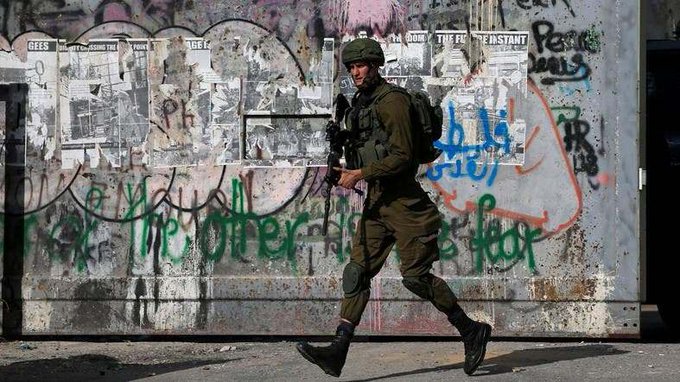
The Canadian embassy in Tel Aviv hosted a party yesterday for its citizens serving in the Israeli army.
It was organised by Ambassador Deborah Lyons, who told The Jerusalem Post that she wanted to show the appreciation and care felt by the embassy for the “lone soldiers” who left their homes to serve in the Israeli army.
“Lone soldiers” are Jewish citizens of a foreign country serving in the Israeli army. As many as 6,000 such soldiers with dual citizenship are said to be in the programme.
Israel’s President Reuven Rivlin calls them “true Zionists,” while Jewish Agency Chairman Isaac Herzog has described them as “a true example of what Zionism is all about.”
Lyons told the Post that she had been wanting to hold a reception for Canadians serving in the Israeli army “for a very long time.” Three years in fact, since she was posted in Tel Aviv.
“Canadian lone soldiers are a particularly special group. I know some of the parents of these kids and I wanted to reach out and let them know that their Canadian family of the embassy is here if they want to talk hockey and a home cooked meal,” she said.
Canada’s Defence Attaché Col. Rick Thompson told the Post “the ambassador thought it would be a nice gesture to reach out to Canadian lone soldiers and make some social connections and talk hockey … If you get homesick, we embassy staff are connected to the wider Canadian community.”
There is a high risk of depression amongst “lone soldiers.” Young Diaspora Jews, according to a report in Haaretz, account for only 2 per cent of soldiers serving in the Israeli army, but in the past year the suicide rate among them has been disproportionately high.
Their recruitment has also been a cause of controversy. An Al Jazeera report found that radical organisations in Europe were recruiting western citizens to serve in the Israeli army where many of these foreign fighters took part in the 2014 Gaza war.
In the UK there have been calls for British citizens who volunteer for the Israeli army to be prosecuted like others who fight for foreign forces.
Israel announces 7 nature reserves in West Bank and expansion of 12 others
MEMO | January 16, 2020
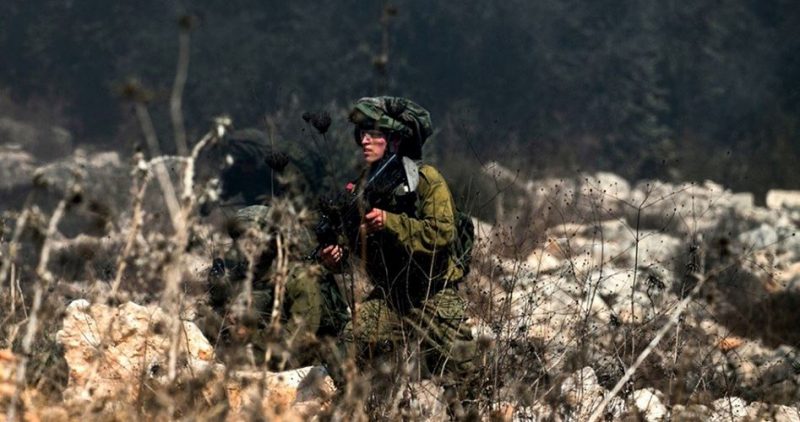
The Israeli defence minister, Naftali Bennett, on Wednesday approved the creation of seven nature reserves and the expansion of 12 others in Area C of the occupied West Bank, a statement confirmed.
In his statement, Bennett ordered the Israeli Civil Administration – the Israeli governing body that operates in the West Bank – to start preparing for the opening of the reserves.
The Times of Israel disclosed that this is the first time that such a step has been taken by the Israeli government, since the Oslo Peace Accords were reached in the 1990s.
“Today, we provide a big boost for the land of Israel and continue to develop the Jewish communities in Area C, with actions, not with words,” Bennett announced in his statement.
“The Judea and Samaria [West Bank] area has nature sites with amazing views. We will expand the existing ones and also open new ones,” he added.
“I invite all the citizens of Israel to tour and walk the land, to come to Judea and Samaria, sight-see, discover and continue the Zionist enterprise,” Bennett continued.
Bennett identified the seven new locations in his statement as: Soreq Cave, Al-Shomoo’a Cave, Wadi Al-Muqallek, Wadi Malha, Bitronot, Wadi Al-Far’a and the north of Jordan Valley.
Evidence suggests US lied about Iranian strikes on US facilities in Iraq
By Robert Inlakesh | Press TV | January 16, 2020
During the early morning hours of January 8, 2020, Iranian strategic missile units launched a precision attack, branded ‘Operation Martyr Soleimani’, against US forces at the American-operated section of the ‘Ain al-Asad’ air base in Iraq.
The response, coming in response to the illegal assassination of General Qassem Soleimani, was a high-observable attack using ballistic missile forces – as opposed to a low-observable attack using terrain-reading cruise missiles and suicide drones.
With US forces already having been in a heightened state of alert, American radar and satellite reconnaissance would have spotted the attack within a minute of it being launched (and a six hour pre-warning of an imminent attack before that), giving the US and other coalition troops present at the base time to seek cover in hardened shelter areas. This, however, did not prevent the success of the attack which, according to primary source evidence, destroyed highly-expensive US aviation assets.
THE RESULT – U.S. FORCES ASSET LOSSES
According to the evidence that has been made available to us at this point, it is obvious that the US is lying about the extent of the damage inflicted upon its assets and infrastructure at the Ain al-Asad base.
No American media group or official Pentagon report initially released the satellite pictures shown in this report, and probably for good reason. To downplay the event (as Trump did in his official address, as did the Pentagon in its later report), they simply dismissed the damaged equipment, referring to the destroyed assets as simple “tents, a parking lot and a damaged helicopter” (per the Department of Defense).
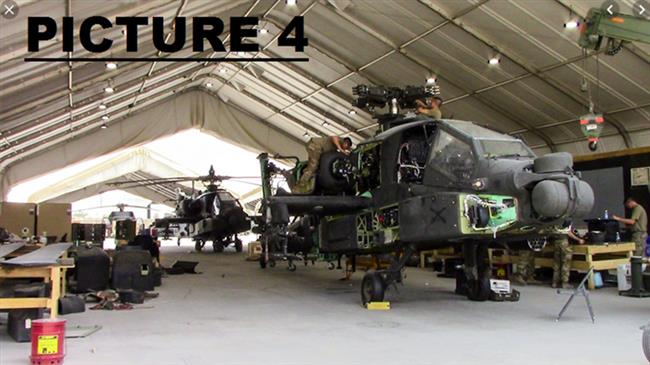
The Iranian missile attack for the most part targeted Apache (AH-64) attack helicopter shelters (refer to Picture 1). Refer to Picture 3 and Picture 4 to see what those “tent”-like Apache steel-frame shelters look like at ground level.
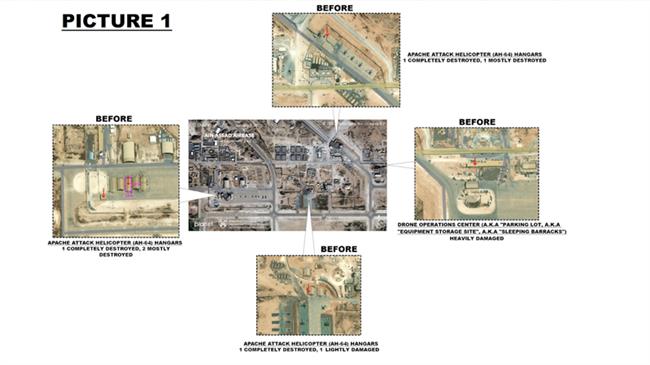
They are the standard steel-frame soft shelter design for US helicopter units based in overseas areas at second-rate airfields (such as the Ain al-Asad Base) – US helicopter units operating from old Afghan airfields are also housed in this kind of shelter design. Each one of those Apache attack helicopter shelters can house two such aircraft. With six structures of the type provably destroyed, demonstrated through the satellite images showing blackened scorch marks (suggesting assets inside them were destroyed with the shelter itself, refer to Picture 1) AND assuming each only had one Apache in them, it can be concluded that at least 6 Apache gunships were destroyed in the attack.
Recently, Danish media, citing a Danish coalition soldier who was present at the base at the time of the attack, admitted that multiple helicopters were destroyed to the point of being “split in half”.
Another Apache hangar (refer to Picture 2) was also directly struck, located to the far eastern end of the Ain al-Asad Base and destroyed. However, note that there is no scorch-blackened concrete underneath it, suggesting nothing was inside it that led to additional burning beyond the impact of the warhead itself.
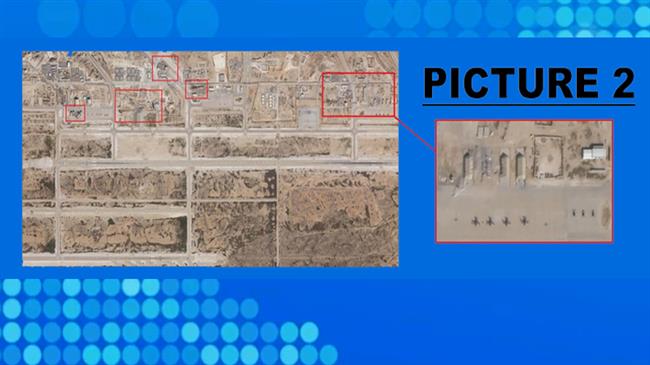
Indeed, just to the south of that destroyed hangar and the undamaged three hangars next to it, 4 Apache helicopters can be seen sitting out on the open tarmac. They were spared as they were, ironically, not being sheltered.
The official US story on the other structure targeted beyond the “tents” (i.e. Apache gunship hangars) has already changed twice – first it was called a parking lot, then an equipment storage area and now, apparently, a barracks for drone operators. Picture 1 (far right) shows the result of the attack on this structure.
It is hard to imagine that base zoning regulators within the US military would chose to place sleeping quarters right next to a strip alert (ready-to-go) aircraft parking area, itself right next to a major taxiway, given the constant noise that comes from these areas.
A more astute assessment would place this structure as an operations center, which lines up with the Iranian claim that the command site from which the Qassem Soleimani assassination operation had been coordinated, was targeted and destroyed in Iran’s retaliation strike.

Indeed, AFP recently released an exclusive report in which a US drone operator present at the Ain al-Asad Airbase, one First Sergeant Wesley Kilpatrick, admitted that airborne drones were rendered inoperable after a direct hit penetrated the base’s UAV operations center and destroyed the fiber lines which connect remote stations to satellite communication equipment(needed for drone control and visuals).
In all of this, one thing is obvious. US officials and media are stumbling over their own statements trying to cover up the extent of the damage dealt to the US-operated section of the Ain al-Asad base – in fact, going so far to cease calling the military site a US airbase (as it had been called for the last 16 years) to (all of a sudden) just an “Iraqi facility”.
THE WEAPONS USED BY IRAN
Short-range ballistic missiles (SRBM) of the upgraded Fateh-313 (range 500 km) and Qiam (range 800 km) types were launched from Western Iran towards the US-operated Ain al-Asad Base in Iraq.
Fateh-313s represent the majority of the missile type used for the attack. Their accuracy still seems to have been to within a matter of meters of their intended targets, except for two stray shots that hit the open tarmac area.
Whilst the Fateh-313 missiles use a combination of INS and electro-optical guidance, the Qiam missiles reportedly use a mix of INS, GPS and radar-mapping target acquisition. The latter method being the archaic predecessor version of DSMAC (imaging automatic target acquisition) terminal-phase guidance used in high-end ground-attack cruise missiles, such as the Tomahawk.
THE OPERATION –OTHER DETAILS
Satellite pictures show that some targeted sites were double-tapped (hit twice-over for good measure).
Initial reports from the Ain al-Asad Base claimed nearly 40 detonations in total despite the fact the number of actual warhead impacts was about fifteen, indicating that there were around two dozen cases of secondary explosions (fuel and ammo going off after being ignited).
In conclusion, according to the evidence we have available to us currently, there is no doubt that the United States has completely distorted the gravitude of Iran’s strikes. The mainstream media in the West have also seemingly refrained from acknowledging much of the damage, apart from on occasion.
Robert Inlakesh is a journalist, writer and political analyst, who has lived in and reported from the occupied Palestinian West Bank. He has written for publications such as Mint Press, Mondoweiss, MEMO, and various other outlets. He specializes in analysis of the Middle East, in particular Palestine-Israel. He also works for Press TV as a European correspondent.
Iraq denies report it has restarted joint military operations with US
Press TV – January 16, 2020
The Iraqi government has denied claims that the country’s military is resuming joint operations with the US-led coalition after Washington’s assassination of top Iranian and Iraqi commanders.
“The joint operations have not resumed and we have not given our authorization,” Major General Abdul Karim Khalaf, the spokesman for the commander-in-chief of the Iraqi armed forces, said on Thursday.
He added that the coalition did not have a permission from Baghdad to carry out any joint missions.
The remarks came after the New York Times, citing two American military officials, reported Thursday that the US had resumed the operations.
Khalaf said the Iraqi government had ordered the coalition to halt its joint operations following the US assassination of top Iranian anti-terror commander, Lieutenant General Qassem Soleimani, and Abu Mahdi al-Muhandis, the second-in-command of Popular Mobilization Units (PMU).
Last month, another US airstrike killed 25 members of PMU in the Arab country’s west.
On January 3, a US drone strike outside Baghdad airport killed General Soleimani and al-Muhandis.
Washington began the pause on January 5, two days after the strike, but furious Iraqi lawmakers voted to expel more than 5,000 US troops based in their country.
The Pentagon said it had no information with regard the the alleged resumption of joint operations with Iraqi troops.
The US-led coalition’s spokesman in Baghdad also declined to comment.
Iraq may defy Washington to buy the Russian S-400 missile defense system
By Paul Antonopoulos | January 16, 2020
With tensions mounting between Iran and the United States after the latter assassinated Iranian General Qassem Soleimani in Iraq, Baghdad has now been pushing to free itself from American domination by calling for foreign troops to leave the country and announcing its intensions in buying the Russian S-400 missile defense system. The complete destruction of the U.S. military base in Anbar province earlier this month demonstrated to Iraqi leaders that it certainly needs to strengthen its air defences since not even American air defense systems could protect their base from the barrage of Iranian missiles. The Iraqi government’s intention to buy the S-400 air defense systems from Russia has been talked about since May last year, when the country’s ambassador to Moscow said Baghdad had decided to buy the systems. However, no roadmap to purchase the systems has been made yet.
Karim Elaiwi, an Iraqi member of parliament who sits on the security and defense committee, said last week that “We are talking to Russia about the S-400 missiles but no contracts have been signed yet. We need to get these missiles, especially after Americans have disappointed us many times by not helping us in getting proper weapons.”
It appears the Iraqis will no longer tolerate U.S. occupation and demands in its country, with parliamentarian and security and defense committee member Abdul Khaleq Al Azzawi, defiantly saying “We authorized the prime minister to get air defense weapons from any country he wants and we authorized him to spend the money for it, from any country. From Russia or anyone.”
This comes as hostilities between Iraq and the U.S. increase, with U.S. President Donald Trump threatening to cut Baghdad’s access to its key account at the Federal Reserve Bank in New York if they follow through with the Iraqi Parliament’s decision to expel the U.S. military from their country. Not only has there been a threat to cut Iraq from its own money based in the U.S., but there are now threats of $250 million in military aid to Iraq being cut.
Although these are tactics to force Baghdad into maintaining ‘permission’ for the U.S. military to remain in Iraq, the clearest sign that this is an American occupation of the West Asian country was with White House National Security Adviser Robert O’Brien’s comments last week that the U.S. will leave Iraq on its “own terms.” The U.S. are not even trying to hide the fact that they are occupying Iraq and rebelling against the government.
Despite the clear occupation, Iraq continues to defy the U.S., and the willingness to purchase the S-400 system is a clear indication of this. It is for this reason that Joey Hood, the U.S. State Department’s principal deputy assistant secretary for Near Eastern Affairs, said on Tuesday in an appearance at the Middle East Institute, an extremely influential Washington think tank, that “A purchase [of the S-400] would probably trigger sanctions, so we advise our partners not to make such purchases.”
This was an expected response considering the continued threats of sanctions the U.S. has put against Turkey for its own acquisition of the S-400. Iraq wants to strengthen its air defense and the S-400 systems are considered the best in the world. It must also be remembered that Iraq is already buying modern weapons from Russia, such as the Mi-28 fighter helicopters and T-90 tanks. However, it is likely that Washington considers the purchase of the S-400 from Russia as an indication that the U.S. is losing political and military support in the country – but this was already consolidated by the assassination of Soleimani, an extremely popular figure in Iraq.
Baghdad is already in negotiations for the S-300, the older generation of the S-400. However, it is the S-400, the newest model available for foreign markets, that will provoke resistance in Washington, especially as the U.S.-made Patriot missile defense system has proven to be a failure by not being able to defend U.S. bases in Iraq or Saudi oil facilities, if we remember the Houthi-led Ansarullah Movement’s attack on the ARAMCO site in September last year.
The question then becomes how will Iraq will pay for Russian weapons if their accounts in the U.S. are frozen. Delivery is not so much of an issue despite the U.S. occupation, it is more a matter of how payments will be made. Although Iraqi parliamentarians are boldly declaring their intentions for the S-400 to be purchased, there are significant problems that Baghdad must first be able to overcome, including the extremely strong pressure being applied by the U.S. against Iraq not to buy them. If Baghdad did successfully defy Washington and purchase the systems, it will certainly weaken the U.S.’ image in the region, something the North American country will unlikely want to risk.
Will Iraq boldly defy the U.S.? This remains to be seen now.
Paul Antonopoulos is a Research Fellow at the Center for Syncretic Studies.
Iraq’s Sadr urges million-man march against US military presence
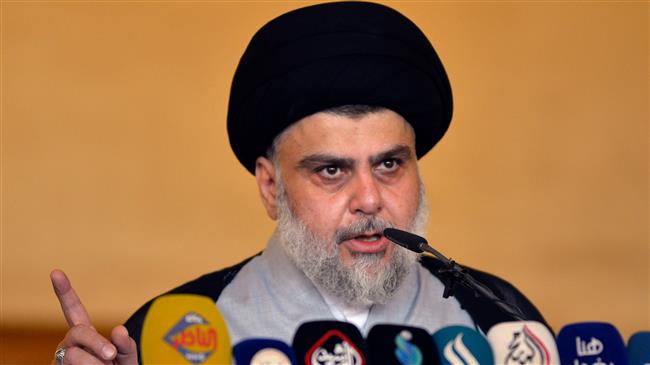
Influential Iraqi Shia cleric Muqtada al-Sadr (Photo by AFP )
Press TV – January 15, 2020
Influential Iraqi Shia cleric Muqtada al-Sadr has demanded that Iraqis stage a “million-man march” against the continued US military presence in the country, days after Iraq’s parliament voted to expel the American troops following an assassination operation by Washington on Iraqi soil.
The march is needed “to condemn the American presence and its violations,” Sadr, who leads the largest parliamentary bloc, Sairoon, said in a tweet on Tuesday.
“The skies, land, and sovereignty of Iraq are being violated every day by occupying forces,” he added. The cleric, however, cautioned that such a show of popular disapproval should be a “peaceful, unified demonstration,” but did not offer a date or location for the proposed rally.
On January 5, the parliament voted overwhelmingly in favor of a resolution calling for the expulsion of all US-led forces, two days after the US military assassinated senior Iranian commander Lieutenant General Qassem Soleimani and along with Abu Mahdi al-Muhandis, the second-in-command of Iraq’s Popular Mobilization Units (PMU), among others, near the Baghdad airport.
The parliament resolution also urged the Baghdad government to drop a request for assistance from a US-led coalition of foreign troops purportedly operating against Daesh remnants in Iraq.
The Iraqis censured the targeted killings — which were ordered by US President Donald Trump — as a blatant violation of the country’s sovereignty as well as the security agreement between Baghdad and Washington.
In a letter to the parliament following the vote, Sadr called for an immediate cancellation of the security agreement with the US, the closure of the US embassy, the expulsion of US troops in “a humiliating manner,” and the criminalization of communication with the US administration.
Following the parliamentary vote, the office of Iraq’s caretaker Prime Minister Adel Abdul-Mahdi asked Washington to dispatch a delegation to Baghdad to initiate preparations for the withdrawal of American troops, who number around 5,200.
In response, Trump threatened to sanction Iraq “like they’ve never seen before ever” if Baghdad were to expel US troops.
Based on reports by the Wall Street Journal the US administration has threatened to shut off Iraq’s access to its main account at the Federal Reserve Bank of New York, which is used to collect revenues from the Arab country’s overseas oil sales, if Baghdad expelled the American forces.
Featured Video
Trita Parsi: Israel Set a Trap for Total War in the Region
or go to
Aletho News Archives – Video-Images
From the Archive
Zionism’s Violent Legacy
By Donald Neff | Washington Report On Middle East Affairs | January 1996
On January 4, 1948, Jewish terrorists drove a truck loaded with explosives into the center of the all Arab city of Jaffa and detonated it, killing 26 and wounding around 100 Palestinian men, women and children.[1] The attack was the work of the Irgun Zvai Leumi – the “National Military Organization,” also known by the Hebrew letters Etzel – the largest Jewish terrorist group in Palestine. The Irgun was headed by Revisionist Zionist Menachem Begin and had been killing and maiming Arabs, Britons and even Jews for the previous ten years in its efforts to establish a Jewish state.
This terror campaign meant that at the core of Revisionist Zionism there existed a philosophical embrace of violence. … continue
Blog Roll
 Aletho News
- Trita Parsi: Israel Set a Trap for Total War in the Region
- Trump’s Iran war is on an Israeli leash
- Saudi oil boss issues global supply warning
- Riyadh Says Its Oil System Is Intact. The Numbers Say Otherwise.
- Trump and Netanyahu Want to “Finish the Job” on Iran
- US ‘one-sided dictation’ not Iran’s beliefs makes rational talks impossible: Baghaei
- Iran’s Next Strike May Not Explode. It Could Shut You Down /Col Doug Macgregor
- Iran: US political targets legitimate if assassinations return
- Iraq shuts key border crossing with Iran under US pressure: Report
- Undersea Internet cables could be targeted in retaliation for attacks on Iran: IRGC deputy chief
- If Americans Knew
- The Israel Lobby’s Changing Fortunes
- AIPAC has become such a political liability that it’s shifting to a more “nimble” approach to buying politicians
- At least 160 Israeli settler attacks in 2 weeks
- Will Gaza’s Ancient Christian Community Disappear Forever?
- Israel’s vision of regional security rests on keeping Arab states weak
- Heidi Levine recounts how Palestinian youths helped save her in settler attack
- DAILY UPDATE: Latest essential news on Palestine, Israel, & region
- Trump’s Intensifying Sabotage of the ICC, for Israel’s Sake
- Israeli military detain US and UK volunteers in West Bank including Democratic NY politician Brad Lander
- Americans at National Conservatism Conference held in Israel this year criticize Israel
- No Tricks Zone
- E-Cars Reduce CO2 Emissions By Only 41% Compared To Internal Combustion Engine Vehicles
- Predictions Made By Renowned Climate Professor Over Past Decades Have Been Proven To Be Poor
- New Study Suggests Large Regions Of The Pacific Ocean Have Been Cooling For The Last 80 Years
- Germany’s Green Energy Debacle: High Energy Costs Force Kahla Porzellan to Close After 182 Years!
- New Study: 50 Years Of The Most Aggressive ‘Net Zero’ Policies Can Only Affect The Global Climate By 0.03°C
- US September “Heat” Was No Record…Many Records Set Decades Ago
- Latest European Green Energy Debacle; Portugal’s Largest Flagship Solar Park Insolvent!
- Green Energy Debacle: German Expert Professor Fritz Vahrenholt Warns Of Severe Economic And Social Consequences
- Two More Paleo Reconstructions Affirm Meters-Higher Sea Levels Across Ireland, Brazil 7000-6000 Years Ago
- New Study: Earth And Venus Surface Warmth Largely Explained By Convection And Lapse Rate, Not CO2 Or Radiation

