Israel’s Ploy Selling a Syrian Nuke Strike
By Gareth Porter | Consortium News | November 18, 2017
In September 2007, Israeli warplanes bombed a building in eastern Syria that the Israelis claimed held a covert nuclear reactor that had been built with North Korean assistance. Seven months later, the CIA released an extraordinary 11-minute video and mounted press and Congressional briefings that supported that claim.
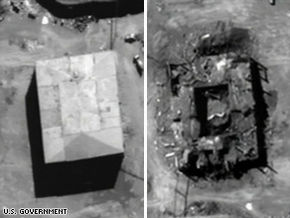
Supposed Syrian nuclear site before and after Israeli airstrike
But nothing about that alleged reactor in the Syrian desert turns out to be what it appeared at the time. The evidence now available shows that there was no such nuclear reactor, and that the Israelis had misled George W. Bush’s administration into believing that it was in order to draw the United States into bombing missile storage sites in Syria. Other evidence now suggests, moreover, that the Syrian government had led the Israelis to believe wrongly that it was a key storage site for Hezbollah missiles and rockets.
The International Atomic Agency’s top specialist on North Korean reactors, Egyptian national Yousry Abushady, warned top IAEA officials in 2008 that the published CIA claims about the alleged reactor in the Syrian desert could not possibly have been true. In a series of interviews in Vienna and by phone and e-mail exchanges over several months Abushady detailed the technical evidence that led him to issue that warning and to be even more confident about that judgment later on. And a retired nuclear engineer and research scientist with many years of experience at Oak Ridge National Laboratory has confirmed a crucial element of that technical evidence.
Published revelations by senior Bush administration officials show, moreover, that principal U.S. figures in the story all had their own political motives for supporting the Israeli claim of a Syrian reactor being built with North Korean help.
Vice President Dick Cheney hoped to use the alleged reactor to get President George W. Bush to initiate U.S. airstrikes in Syria in the hope of shaking the Syrian-Iranian alliance. And both Cheney and then CIA Director Michael Hayden also hoped to use the story of a North Korean-built nuclear reactor in Syria to kill a deal that Secretary of State Condoleezza Rice was negotiating with North Korea on its nuclear weapons program in 2007-08.
Mossad Chief’s Dramatic Evidence
In April 2007 the chief of Israel’s Mossad foreign intelligence agency, Meir Dagan, presented Cheney, Hayden and National Security Adviser Steven Hadley with evidence of what he said was a nuclear reactor being constructed in eastern Syria with the help of the North Koreans. Dagan showed them nearly a hundred hand-held photographs of the site revealing what he described as the preparation for the installation of a North Korean reactor and claimed that it was only a few months from being operational.
The Israelis made no secret of their desire to have a U.S. airstrike destroy the alleged nuclear facility. Prime Minister Ehud Olmert called President Bush immediately after that briefing and said, “George, I’m asking you to bomb the compound,” according to the account in Bush’s memoirs.
Cheney, who was known to be a personal friend of Olmert, wanted to go further. At White House meetings in subsequent weeks, Cheney argued forcefully for a U.S. attack not only on the purported reactor building but on Hezbollah weapons storage depots in Syria. Then-Secretary of Defense Robert Gates, who participated in those meetings, recalled in his own memoirs that Cheney, who was also looking for an opportunity to provoke a war with Iran, hoped to “rattle Assad sufficiently so as to end his close relationship with Iran” and “send a powerful warning to the Iranians to abandon their nuclear ambitions.”
CIA Director Hayden aligned the agency clearly with Cheney on the issue, not because of Syria or Iran but because of North Korea. In his book, Playing to the Edge, published last year, Hayden recalls that, at a White House meeting to brief President Bush the day after Dagan’s visit, he whispered in Cheney’s ear, “You were right, Mr. Vice-President.”
Hayden was referring to the fierce political struggle within the Bush administration over North Korea policy that had been underway ever since Condoleezza Rice had become Secretary of State in early 2005. Rice had argued that diplomacy was the only realistic way to get Pyongyang to retreat from its nuclear weapons program. But Cheney and his administration allies John Bolton and Robert Joseph (who succeeded Bolton as the key State Department policymaker on North Korea after Bolton became U.N. Ambassador in 2005) were determined to end the diplomatic engagement with Pyongyang.
Cheney was still maneuvering to find a way to prevent the successful completion of the negotiations, and he saw the story of a Syrian nuclear reactor built secretly in the desert with help from the North Koreans as bolstering his case. Cheney reveals in his own memoirs that in January 2008, he sought to sandbag Rice’s North Korea nuclear deal by getting her to agree that a failure by North Korea to “admit they’ve proliferating to the Syrians would be a deal killer.”
Three months later, the CIA released its unprecedented 11-minute video supporting the entire Israeli case for a North-Korean-style nuclear reactor that was nearly completed. Hayden recalls that his decision to release the video on the alleged Syrian nuclear reactor in April 2008 was “to avoid a North Korean nuclear deal being sold to a Congress and a public ignorant of this very pertinent and very recent episode.”
The video, complete with computer reconstructions of the building and photographs from the Israelis made a big splash in the news media. But one specialist on nuclear reactors who examined the video closely found abundant reason to conclude that the CIA’s case was not based on real evidence.
Technical Evidence against a Reactor
Egyptian national Yousry Abushady was a PhD in nuclear engineering and 23-year veteran of the IAEA who had been promoted to section head for Western Europe in the operations division of agency’s Safeguards Department, meaning that he was in charge of all inspections of nuclear facilities in the region. He had been a trusted adviser to Bruno Pellaud, IAEA Deputy Director General for Safeguards from 1993 to 1999, who told this writer in an interview that he had “relied on Abushady frequently.”
Abushady recalled in an interview that, after spending many hours reviewing the video released by the CIA in April 2008 frame by frame, he was certain that the CIA case for a nuclear reactor at al-Kibar in the desert in eastern Syria was not plausible for multiple technical reasons. The Israelis and the CIA had claimed the alleged reactor was modeled on the type of reactor the North Koreans had installed at Yongbyon called a gas-cooled graphite-moderated (GCGM) reactor.
But Abushady knew that kind of reactor better than anyone else at the IAEA. He had designed a GCGM reactor for his doctoral student in nuclear engineering, had begun evaluating the Yongbyon reactor in 1993, and from 1999 to 2003 had headed the Safeguards Department unit responsible for North Korea.
Abushady had traveled to North Korea 15 times and conducted extensive technical discussions with the North Korean nuclear engineers who had designed and operated the Yongbyon reactor. And the evidence he saw in the video convinced him that no such reactor could have been under construction at al-Kibar.
On April 26, 2008, Abushady sent a “preliminary technical assessment” of the video to IAEA Deputy Director General for Safeguards Olli Heinonen, with a copy to Director General Mohamed ElBaradei. Abushady observed in his memorandum that the person responsible for assembling the CIA video was obviously unfamiliar with either the North Korean reactor or with GCGM reactors in general.
The first thing that struck Abushady about the CIA’s claims was that the building was too short to hold a reactor like the one in Yongbyon, North Korea.
“It is obvious,” he wrote in his “technical assessment” memo to Heinonen, “that the Syrian building with no UG [underground] construction, can not hold a [reactor] similar [to] NK GCR [North Korean gas-cooled reactor].”
Abushady estimated the height of the North Korean reactor building in Yongbyon at a 50 meters (165 feet) and estimated that the building at al-Kibar at a little more than a third as tall.
Abushady also found the observable characteristics of the al-Kibar site inconsistent with the most basic technical requirements for a GCGM reactor. He pointed out that the Yongbyon reactor had no less than 20 supporting buildings on the site, whereas the satellite imagery shows that the Syrian site did not have a single significant supporting structure.
The most telling indication of all for Abushady that the building could not have been a GCGM reactor was the absence of a cooling tower to reduce the temperature of the carbon dioxide gas coolant in such a reactor.
“How can you work a gas-cooled reactor in a desert without a cooling tower?” Abushady asked in an interview.
IAEA Deputy Director Heinonen claimed in an IAEA report that the site had sufficient pumping power to get river water from a pump house on the nearby Euphrates River to the site. But Abushady recalls asking Heinonen, “How could this water be transferred for about 1,000 meters and continue to the heat exchangers for cooling with the same power?”
Robert Kelley, a former head of the U.S. Department of Energy’s Remote Sensing Laboratory and former senior IAEA inspector in Iraq, noticed another fundamental problem with Heinonen’s claim: the site had no facility for treating the river water before it reached the alleged reactor building.
“That river water would have been carrying debris and silt into the reactor heat exchangers,” Kelley said in an interview, making it highly questionable that a reactor could have operated there.
Yet another critical piece that Abushady found missing from the site was a cooling pond facility for spent fuel. The CIA had theorized that the reactor building itself contained a “spent fuel pond,” based on nothing more than an ambiguous shape in an aerial photograph of the bombed building.
But the North Korean reactor at Yongbyon and all 28 other GCGM reactors that had been built in the world all have the spent fuel pond in a separate building, Abushady said. The reason, he explained, was that the magnox cladding surrounding the fuel rods would react to any contact with moisture to produce hydrogen that could explode.
But the definitive and irrefutable proof that no GCGM reactor had been present at al-Kibar came from the environmental samples taken by the IAEA at the site in June 2008. Such a reactor would have contained nuclear-grade graphite, Abushady explained, and if the Israelis had actually bombed a GCGM reactor, it would have spread particles of nuclear-grade graphite all over the site.
Behrad Nakhai, a nuclear engineer at Oak Ridge National Laboratory for many years, confirmed Abshuady’s observation in an interview. “You would have had hundreds of tons of nuclear-grade graphite scattered around the site,” he said, “and it would have been impossible to clean it up.”
IAEA reports remained silent for more than two years about what the samples showed about nuclear-grade graphite, then claimed in a May 2011 report that the graphite particles were “too small to permit an analysis of the purity compared to that normally required for use in a reactor.” But given the tools available to laboratories, the IAEA claim that they couldn’t determine whether the particles were nuclear grade or not “doesn’t make sense,” Nakhai said.
Hayden acknowledged in his 2016 account that “key components” of a nuclear reactor site for nuclear weapons were “still missing.” The CIA had tried to find evidence of a reprocessing facility in Syria that could be used to obtain the plutonium for a nuclear bomb but had been unable to find any trace of one.
The CIA also had found no evidence of a fuel fabrication facility, without which a reactor could not have gotten the fuel rods to be reprocessed. Syria could not have gotten them from North Korea, because the fuel fabrication plant at Yongbyon had produced no fuel rods since 1994 and was known to have fallen into serious disrepair after the regime had agreed to scrap its own plutonium reactor program.
Manipulated and Misleading Photographs
Hayden’s account shows that he was ready to give the CIA’s stamp of approval to the Israeli photographs even before the agency’s analysts had even begun analyzing them. He admits that when he met Dagan face-to-face he didn’t ask how and when Mossad had obtained the photographs, citing “espionage protocol” among cooperating intelligence partners. Such a protocol would hardly apply, however, to a government sharing intelligence in order to get the United States to carry out an act of war on its behalf.
The CIA video relied heavily on the photographs that Mossad had given to Bush administration in making its case. Hayden writes that it was “pretty convincing stuff, if we could be confident that the pictures hadn’t been altered.”
But by his own account Hayden knew Mossad had engaged in at least one deception. He writes that when CIA experts reviewed the photographs from Mossad, they found that one of them had been photo-shopped to remove the writing on the side of a truck.
Hayden professes to have had no concern about that photo-shopped picture. But after this writer asked how CIA analysts interpreted Mossad’s photo shopping of the picture as one of the questions his staff requested in advance of a possible interview with Hayden, he declined the interview.
Abushady points out that the main issues with the photographs the CIA released publicly are whether they were actually taken at the al-Kibar site and whether they were consistent with a GCGM reactor. One of the photographs showed what the CIA video called “the steel liner for the reinforced-concrete reactor vessel before it was installed.” Abushady noticed immediately, however, that nothing in the picture links the steel liner to the al-Kibar site.
Both the video and CIA’s press briefing explained that the network of small pipes on the outside of the structure was for “cooling water to protect the concrete against the reactor’s intense heat and radiation.”
But Abushady, who specializes in such technology, pointed out that the structure in the picture bore no resemblance to a Gas-Cooled Reactor vessel. “This vessel cannot be for a Gas-Cooled Reactor,” Abushady explained, “based on its dimensions, it thickness and the pipes shown on the side of the vessel.”
The CIA video’s explanation that the network of pipes was necessary for “cooling water” made no sense, Abushady said, because gas-cooled reactors use only carbon dioxide gas — not water — as a coolant. Any contact between water and the Magnox-cladding used in that type of reactor, Abushady explained, could cause an explosion.
A second Mossad photograph showed what the CIA said were the “exit points” for the reactor’s control rods and fuel rods. The CIA juxtaposed that photograph with a photograph of the tops of the control rods and fuel rods of the North Korean reactor at Yongbyon and claimed a “very close resemblance” between the two.
Abushady found major differences between the two pictures, however. The North Korean reactor had a total of 97 ports, but the picture allegedly taken at al-Kibar shows only 52 ports. Abushady was certain that the reactor shown in the photograph could not have been based on the Yongbyon reactor. He also noted that the picture had a pronounced sepia tone, suggesting that it was taken quite a few years earlier.
Abushady warned Heinonen and ElBaradei in his initial assessment that the photo presented as taken from inside the reactor building appeared to an old photo of a small gas-cooled reactor, most likely an early such reactor built in the U.K.
A Double Deception
Many observers have suggested that Syria’s failure to protest the strike in the desert loudly suggests that it was indeed a reactor. Information provided by a former Syrian air force major who defected to an anti-Assad military command in Aleppo and by the head of Syria’s atomic energy program helps unlock the mystery of what was really in the building at al-Kibar.
The Syrian major, “Abu Mohammed,” told The Guardian in February 2013 that he was serving in the air defense station at Deir Azzor, the city nearest to al-Kibar, when he got a phone call from a Brigadier General at the Strategic Air Command in Damascus just after midnight on Sept. 6, 2007. Enemy planes were approaching his area, the general said, but “you are to do nothing.”
The major was confused. He wondered why the Syrian command would want to let Israeli fighter planes approach Deir Azzor unhindered. The only logical reason for such an otherwise inexplicable order would be that, instead of wanting to keep the Israelis away from the building at al-Kibar, the Syrian government actually wanted the Israelis to attack it. In the aftermath of the strike, the Damascus issued only an opaque statement claiming that the Israeli jets had been driven away and remaining silent on the airstrike at al-Kibar.
Abushady told this writer he learned from meetings with Syrian officials during his final year at the IAEA that the Syrian government had indeed originally built the structure at al-Kibar for the storage of missiles as well as for a fixed firing position for them. And he said Ibrahim Othman, the head of Syria’s Atomic Energy Commission, had confirmed that point in a private meeting with him in Vienna in September 2015.
Othman also confirmed Abushady’s suspicion from viewing satellite photographs that the roof over the central room in the building had been made with two movable light plates that could be opened to allow the firing of a missile. And he told Abushady that he had been correct in believing that what had appeared in a satellite image immediately after the bombing to be two semi-circular shapes was what had remained of the original concrete launching silo for missiles.
In the wake of the Israel’s 2006 invasion of Southern Lebanon, the Israelis were searching intensively for Hezbollah missiles and rockets that could reach Israel and they believed many of those Hezbollah weapons were being stored in Syria. If they wished to draw the attention of the Israelis away from actual missile storage sites, the Syrians would have had good reason to want to convince the Israelis that this was one of their major storage sites.
Othman told Abushady that the building had been abandoned in 2002, after the construction had been completed. The Israelis had acquired ground-level pictures from 2001-02 showing the construction of outer walls that would hide the central hall of the building. The Israelis and the CIA both insisted in 2007-08 that this new construction indicated that it had to be a reactor building, but it is equally consistent with a building designed to hide missile storage and a missile-firing position.
Although Mossad went to great lengths to convince the Bush administration that the site was a nuclear reactor, what the Israelis really wanted was for the Bush administration to launch U.S. airstrikes against Hezbollah and Syrian missile storage sites. Senior officials of the Bush administration didn’t buy the Israeli bid to get the United States to do the bombing, but none of them ever raised questions about the Israeli ruse.
So both the Assad regime and the Israeli government appear to have succeeded in carrying out their own parts in a double deception in the Syrian desert.
Gareth Porter is an independent investigative journalist and historian on U.S. national security policy and the recipient of the 2012 Gellhorn Prize for journalism.
Guardian, NYT Paint Power-Grabbing Saudi Dictator as Roguish, Visionary ‘Reformer’
By Adam Johnson | FAIR | November 17, 2017

The Guardian (11/5/17)
Two weeks ago, Saudi Crown Prince Mohammed bin Salman carried out a brutal crackdown on his political opponents, arresting dozens of high-ranking relatives, kidnapping the prime minister of Lebanon, and seeing eight of his political rivals die in a convenient helicopter crash. The “consolidation of power” by the de facto Saudi ruler comes as his government ramps up its siege of Yemen and gets even closer to its US sponsor, thanks to a Trump’s dopey love affair with—and direct assistance of—the regime.
The cynical plan has been met, in some media quarters, with condemnation, but for many in the Western press, Mohammed’s self-serving power grab is the action of a bold “reformer,” a roguish bad boy doing the messy but essential work of “reforming” the kingdom—the “anti-corruption” pretext of the purge largely repeated without qualification. The most prominent sources for this spin were two major newspapers, the New York Times and Guardian:
- Guardian (11/5/17): “Royal Purge Sends Shockwaves Through Saudi Arabia’s Elites: Move Consolidates Power of Prince Mohammed Bin Salman as He Attempts to Reform Kingdom’s Economy and Society”
- Guardian (11/5/17) : “Saudi Arrests Show Crown Prince Is a Risk-Taker With a Zeal for Reform: Mohammed Bin Salman Is Confronting Some of the Kingdom’s Richest and Most Powerful Men in His Anti-Corruption Drive—but Is He Taking on Too Much Too Fast?”
- Guardian (11/6/17): “Oil Price Rises to Two-Year High After Saudi Arabia Purge: Markets Push Price Up to $62 a Barrel After Anti-Corruption Purge by Billionaire Crown Prince Who Backs Prolonging Oil Production Curbs”
- Guardian (11/7/17): “‘This Is a Revolution’: Saudis Absorb Crown Prince’s Rush to Reform: Consolidation of Power in Mohammed Bin Salman’s Hands Has Upended All Aspects of Society, Including Previously Untouchable Ultra-Elite”
- New York Times (11/5/17): “Saudi Crown Prince’s Mass Purge Upends a Longstanding System”
- New York Times (11/14/17): “The Upstart Saudi Prince Who’s Throwing Caution to the Wind”
While the text of the Times articles was far more skeptical about Mohammed’s motives, the Guardian’s (11/5/17) initial coverage of the bloody purge—not just the headlines—was written in breathless press release tones:
Saudi Arabia’s leadership has pulled off its boldest move yet to consolidate power around its young crown prince, Mohammed bin Salman, arresting 11 senior princes, one of the country’s richest men and scores of former ministers in what it billed as a corruption purge.
The move sidelined at least 20 senior figures, among them outspoken billionaire, Prince Alwaleed bin Talal, sending shockwaves through the ranks of the kingdom’s elites, who had long viewed senior royals as immune.
Lots of glowing prose to unpack here. Longtime Mideast correspondent Martin Chulov began by referring to “Saudi Arabia’s leadership,” which is a nice, sterile way of referencing the country’s unelected hereditary king and crown prince. Then he pivoted into marketing pablum about “bold moves” and “consolidating power,” before unironically framing the purge as an “anti-corruption” gesture designed to stick it to the “kingdom’s elites.” One could come away from reading this lead with the impression that the billionaire aristocrat was a populist folk hero in the vein of Robin Hood or John Dillinger. The thrilling profile continued:
Prince Mohammed will oversee the corruption commission, adding to his already formidable list of responsibilities, including his role as Defense minister and champion of the economic transformation, dubbed Vision 2030, that aims to revolutionize most aspects of Saudi life within 12 years.
Prince Mohammed told the Guardian last month that the kingdom had been “not normal” for the past 30 years and pledged to return Saudi Arabia to moderate Islam.
While the author had a “to be sure” paragraph, citing “others” calling it a “naked attempt to weed out dissent,” the overall thrust of the article was that a roguish billionaire Boy King was earnestly seeking “reform” and opposing “elites.”
A follow-up piece (11/7/17) took flattering coverage to new extremes. The dispatch, again by Chulov, cited nothing but anonymous Saudi court hanger-ons and a Gulf-funded talking head from the NATO-aligned Atlantic Council think tank. The article, “‘This Is a Revolution’: Saudis Absorb Crown Prince’s Rush to Reform,” was populated with blind quotes from such adversarial voices as a “senior minister,” “a senior Saudi official,” a “senior figure,” a “senior Saudi businessman” and “veteran business leaders.” (Evidently no junior officials or rookie business leaders were available for comment.)
The article painted the “consolidation of power” by Mohammed as an inevitability with broad support—using the dubious “reform” narrative without irony. With Guardian editors again painting Mohammed as a populist hero by insisting he “upended” “previously untouchable ultra-elite,” one is left to wonder why they don’t consider the absolute-monarch-in-waiting—who just bought a $590 million yacht—part of the “ultra elite.” It’s a curious framing that reeks more of PR than journalism.

The New York Times (6/23/17)
This was a trope one could see emerging over the past few months. Similar “bold reformer” frames were used in New York Times editorials (“The Young and Brash Saudi Crown Prince,” 6/23/17) and straight reporting (“Saudi Arabia’s Grand Plan to Move Beyond Oil: Big Goals, Bigger Hurdles,” 10/24/17). Everything’s new and exciting. The brutal, routine functions of the Saudi state are seen as laws of nature—and those in charge of it are the reformers of the very oppression they initially authored.
A Guardian editorial on November 7 was critical of the government, calling it “regressive” and Mohammed “belligerent,” but ultimately rested on “both sides” framing of recent events. The only meaningfully critical coverage of Saudi Arabia coming from the Guardian since the purge has been in two articles (11/12/17, 11/16/17), both in the context of Saudi Arabia’s war on Yemen. Neither mentioned bin Salman, and both stressed how the Saudis are responding in earnest to international pleas to stop their mass-murdering blockade of the Arab world’s poorest country.
Per usual, the Guardian reserves the label “regime” for Official Enemies like Syria and North Korea; Saudi Arabia doesn’t have a regime, it has “leadership.” Unlike adversary governments, often seen in need of “regime change,” the Saudi government merely requires “reform”—and a bold new “reformer,” of the sort championed by the likes of the Guardian and New York Times.
You can send a message to the New York Times at letters@nytimes.com , and to the Guardian at guardian.letters@theguardian.com (Twitter: @NYTimes, @Guardian). Please remember that respectful communication is the most effective.
Security Council-appointed panel says no missiles sent to Houthis, refuting Saudi Arabia claim
Press TV – November 18, 2017
A United Nations Security Council-appointed panel has said in a confidential memo that it has seen no evidence to support Saudi Arabia’s claims that missiles have been transferred to Yemen’s Houthis fighters by external sources.
The panel made the conclusion in a confidential assessment sent to Security Council diplomats on November 10, The Intercept, a US-based investigative website, reported on Friday.
On November 4, a missile attack from Yemen targeted the King Khalid International Airport (KKIA) near the Saudi capital, Riyadh. It was the first missile from Yemen to have reached deep inside Saudi territory.
The Houthi movement, which has been fighting back a Saudi-led coalition with allied Yemeni army troops and tribal fighters, said it had fired the missile, which the Saudis said they had intercepted mid-air.
However, the Riyadh regime quickly blamed the Islamic Republic for the incident.
Heating up rhetoric against Iran, and then being proven wrong
In a November 7 letter to the Security Council, Saudi UN Ambassador Abdallah al-Mouallimi claimed that the debris of the missiles fired by the Houthis on July 22 and November 4 confirmed Iran’s role “in manufacturing these missiles.”
Following the attack, the Saudi-led coalition tightened a blockade that had already been imposed on Yemen in a bid to prevent “the smuggling of weapons, ammunitions, missile parts and cash that are regularly being supplied by Iran” to the Houthis.
It invoked Paragraph 14 of Security Council Resolution 2216, which was passed in April 2015, calling for measures to prevent the supply, sale, or transfer of military goods to Houthi fighters.
The coalition said the missile’s firing was “a blatant act of military aggression” by the Iranian government.
Crown Prince Mohammad bin Salman said it had been “a direct military aggression” by Iran against Saudi Arabia, while Foreign Minister Adel al-Jubeir stressed that his country reserved the right to “respond in the appropriate manner at the appropriate time.”
The belligerent Saudi posture toward Iran worked to significantly raise tensions.
Iran rejected the allegations as “provocative and baseless,” saying Yemenis had shown an “independent” reaction to the Saudi bombing campaign on their country.
Iran also said that it could not transfer any weapons to Yemen because of the Saudi-led blockade.
The Security Council-appointed panel said in its confidential assessment that it had seen no evidence to back up the Saudi claims that short-range ballistic missiles (SRBMs) had been transferred to Yemeni fighters in violation of the Resolution 2216.
It said the tightening of the blockade by the Saudi-led coalition and its invoking of Resolution 2216 had been an attempt to merely “obstruct” the delivery of civilian aid.
“The panel finds that imposition of access restrictions is another attempt by the Saudi Arabia-led coalition to use paragraph 14 of resolution 2216 as justification for obstructing the delivery of commodities that are essentially civilian in nature,” the assessment read.
Touching on the July 22 attack, it said, “The supporting evidence provided… is far below that required to attribute this attack to a Qiam-1 SRBM.”
Yemen has witnessed a deadly Saudi-led war since March 2015. The protracted Saudi offensive, which has been accompanied by the, land, naval, and aerial blockade on Yemen, has so far killed over 12,000 people and led to a humanitarian crisis.
The UN has listed Yemen as the world’s number one humanitarian crisis, with 17 million Yemenis in need of food and a cholera epidemic causing over 2,200 deaths so far.
How We Can Be Certain That Mueller Won’t Prove Trump-Russia Collusion
By Caitlyn Johnstone | Medium | November 12, 2107
A while back I figured out a trick for using Twitter as a tool to find out what sorts of things establishment loyalists really don’t want me saying. Once I discover a really hot button, I write an article that bangs on that button as hard as possible. One of those buttons is expressing my certainty that Robert Mueller’s investigation will never, ever find any proof that Trump colluded with Russia to steal the 2016 election using hackers and propaganda.
We are not allowed to say such things. If you debate a Russiagater for any length of time and you know how to debunk their assertions, they always, always, always wind up resorting to a “just you wait until Mueller finishes his investigation” declaration, which from my point of view is the same as debating a fundamentalist Christian whose argument boils down to “Well I’ll be proven right when you die and God sends you to Hell!”
You can always feel right if you kick the can around some corner in the future that can’t be seen and analyzed critically. Luckily for us, we’ve got information that we can look at right now which does not require any religious faith.
We know from the Snowden leaks on the NSA, the CIA files released by WikiLeaks, and the ongoing controversies regarding FBI surveillance that the US intelligence community has the most expansive, most sophisticated and most intrusive surveillance network in the history of human civilization. Following the presidential election last year, anonymous sources from within the intelligence community were hemorrhaging leaks to the press on a regular basis that were damaging to the incoming administration. If there was any evidence to be found that Donald Trump colluded with the Russian government to steal the 2016 election using hackers and propaganda, the US intelligence community would have found it and leaked it to the New York Times or the Washington Post last year.
Mueller isn’t going to find anything in 2017 that these vast, sprawling networks wouldn’t have found in 2016. He’s not going to find anything by “following the money” that couldn’t be found infinitely more efficaciously via Orwellian espionage. The factions within the intelligence community that were working to sabotage the incoming administration last year would have leaked proof of collusion if they’d had it. They did not have it then, and they do not have it now. Mueller will continue finding evidence of corruption throughout his investigation, since corruption is to DC insiders as water is to fish, but he will not find evidence of collusion to win the 2016 election that will lead to Trump’s impeachment. It will not happen.
This sits on top of all the many, many, many reasons to be extremely suspicious of the Russiagate narrative in the first place.
Humans are storytelling creatures. The most significant and most underappreciated facet of our existence is how much of our interface with the world consists not of our direct experience of it, but of our mental stories about it. Combine that fact with the century of research and development that has gone into refining propaganda tactics and the US plutocracy’s stranglehold on mainstream media, and you get a nation lost in establishment narratives. People forming their worldviews based on phantasms of the mind instead of concrete facts.
I’ve noticed a strange uptick in establishment loyalists speaking to me as though Trump-Russia collusion is already an established fact, and that I’m simply not well-informed. There is still the same amount of publicly available evidence for this collusion as there ever was (zero), so this tells me that the only thing which has changed is the narrative. Pundits/propagandists are increasingly speaking as though this is something that has already been established, and the people who consume that propaganda go out and circulate it as though it’s an established fact. When you’re not plugged into that echo chamber, though, it looks very weird.
This is why Russiagaters find my certainty that collusion will never be proven so intensely abrasive. Their entire worldview consists of pure narrative — literally nothing other than authoritative assertions from pundits who speak in a confident tone of voice — so when they encounter someone doing the same thing but with hard facts, it causes psychological discomfort. This discomfort is called cognitive dissonance. It’s what being wrong feels like.
I mean, I get it. Really, I do. When I stop listening to the narratives of both his supporters and his detractors and just look at the hard facts, from my point of view Trump is doing some really shitty things and doesn’t seem much different from his neoliberal neocon predecessors. Republicans are horrible, and he seems pretty much like a garden variety Republican who says rude things on Twitter. If I look at those hard facts, then add in two years of psychological brutalization by the corporate media telling Americans that Trump is an evil Nazi who will turn the country into a smouldering crater, I can understand why people would be in a hurry to get him out of office.
And when I converse with Russiagaters, that’s generally what this boils down to. “Impeach Trump” is a punishment in search of a crime. They’ve been whipped into a frenzied state of fear by establishment psyops, and they want Mueller to pull a deus ex machina and save them from the evil orange monster. They believe Mueller will get Trump impeached for Russian collusion because they badly want to.
It’s not going to happen, though. Deus ex Mueller isn’t coming. You’re going to have to solve your country’s problems yourselves, America.
And this is actually a good thing, because Trump is not the source of your country’s problems. Believing that a Trump impeachment will fix any of America’s major ills is like believing cough suppressants cure pneumonia. What do you get when you have pneumonia and you take cough suppressants instead of antibiotics? You get wrong-sounding Muppets, that’s what.
If you attribute all your problems to Trump, you’re guaranteeing more Trumps after him, because you’re not addressing the disease which created him, you’re just addressing the symptom.
The problem is not Trump. The problem is that America is ruled by an unelected power establishment which maintains its rule by sabotaging democracy, exacerbating economic injustice and expanding the US war machine. Stop listening to the lies that they pipe into your echo chambers and turn to face your real demons.
Russia-gate Spreads to Europe
By Robert Parry | Consortium News | November 16, 2017
Ever since the U.S. government dangled $160 million last December to combat Russian propaganda and disinformation, obscure academics and eager think tanks have been lining up for a shot at the loot, an unseemly rush to profit that is spreading the Russia-gate hysteria beyond the United States to Europe.

British Prime Minister Theresa May
Now, it seems that every development, which is unwelcomed by the Establishment – from Brexit to the Catalonia independence referendum – gets blamed on Russia! Russia! Russia!
The methodology of these “studies” is to find some Twitter accounts or Facebook pages somehow “linked” to Russia (although it’s never exactly clear how that is determined) and complain about the “Russian-linked” comments on political developments in the West. The assumption is that the gullible people of the United States, United Kingdom and Catalonia were either waiting for some secret Kremlin guidance to decide how to vote or were easily duped.
Oddly, however, most of this alleged “interference” seems to have come after the event in question. For instance, more than half (56 percent) of the famous $100,000 in Facebook ads in 2015-2017 supposedly to help elect Donald Trump came after last year’s U.S. election (and the total sum compares to Facebook’s annual revenue of $27 billion).
Similarly, a new British study at the University of Edinburgh blaming the Brexit vote on Russia discovered that more than 70 percent of the Brexit-related tweets from allegedly Russian-linked sites came after the referendum on whether the U.K. should leave the European Union. But, hey, don’t let facts and logic get in the way of a useful narrative to suggest that anyone who voted for Trump or favored Brexit or wants independence for Catalonia is Moscow’s “useful idiot”!
This week, British Prime Minister Theresa May accused Russia of seeking to “undermine free societies” and to “sow discord in the West.”
What About Israel?
Yet, another core problem with these “studies” is that they don’t come with any “controls,” i.e., what is used in science to test a hypothesis against some base line to determine if you are finding something unusual or just some normal occurrence.
In this case, for instance, it would be useful to find some other country that, like Russia, has a significant number of English speakers but where English is not the native language – and that has a significant interest in foreign affairs – and then see whether people from that country weigh in on social media with their opinions and perspectives about political events in the U.S., U.K., etc.
Perhaps, the U.S. government could devote some of that $160 million to, say, a study of the Twitter/Facebook behavior of Israelis and whether they jump in on U.S./U.K. controversies that might directly or indirectly affect Israel. We could see how many Twitter/Facebook accounts are “linked” to Israel; we could study whether any Israeli “trolls” harass journalists and news sites that oppose neoconservative policies and politicians in the West; we could check on whether Israel does anything to undermine candidates who are viewed as hostile to Israeli interests; if so, we could calculate how much money these “Israeli-linked” activists and bloggers invest in Facebook ads; and we could track any Twitter bots that might be reinforcing the Israeli-favored message.
No Chance
If we had this Israeli baseline, then perhaps we could judge how unusual it is for Russians to voice their opinions about controversies in the West. It’s true that Israel is a much smaller country with 8.5 million people compared to Russia’s 144 million, but you could adjust for those per capita numbers — and even if you didn’t, it wouldn’t be surprising to find that Israel’s interference in U.S. policymaking still exceeds [by many orders of magnitude] Russian influence.
It’s also true that Israeli leaders have often advocated policies that have proved disastrous for the United States, such as Prime Minister Benjamin Netanyahu’s encouragement of the Iraq War, which Russia opposed. Indeed, although Russia is now regularly called an American enemy, it’s hard to think of any policy that President Vladimir Putin has pushed on the U.S. that is even a fraction as harmful to U.S. interests as the Iraq War has been.
And, while we’re at it, maybe we could have an accounting of how much “U.S.-linked” entities have spent to influence politics and policies in Russia, Ukraine, Syria and other international hot spots.
But, of course, neither of those things will happen. If you even tried to gauge the role of “Israeli-linked” operations in influencing Western decision-making, you’d be accused of anti-Semitism. And if that didn’t stop you, there would be furious editorials in The New York Times, The Washington Post and the rest of the U.S. mainstream media denouncing you as a “conspiracy theorist.” Who could possibly think that Israel would do anything underhanded to shape Western attitudes?
And, if you sought the comparative figures for the West interfering in the affairs of other nations, you’d be faulted for engaging in “false moral equivalence.” After all, whatever the U.S. government and its allies do is good for the world; whereas Russia is the fount of evil.
So, let’s just get back to developing those algorithms to sniff out, isolate and eradicate “Russian propaganda” or other deviant points of view, all the better to make sure that Americans, Britons and Catalonians vote the right way.
Investigative reporter Robert Parry broke many of the Iran-Contra stories for The Associated Press and Newsweek in the 1980s.
PM May’s, UK Media’s Accusations Against Russia Share ‘Lack of Proof’
Sputnik – 16.11.2017
Both UK government’s accusations against Russia and UK media’s assertions share one common characteristic – lack of evidence, the Russian Embassy in London said Wednesday commenting on the UK National Cyber Security Centre head’s statement.
Earlier in the day, Ciaran Martin, the head of the UK Government Communications Headquarters’ National Cyber Security Centre, said that Russian hackers allegedly carried out a series of cyberattacks against UK media, telecommunications and energy sectors over the past year.
“We are concerned by such assertions since they mislead the British public in regard to the so called cyberattacks. We view these statements in the context of Prime Minister [Theresa] May’s ‘Banquet speech’ which described Russia as number 1 threat for UK and the world community. The said speech has already triggered an avalanche of similarly-termed articles and media reports in Britain. In our view, what they have in common is lack of proof – all assertions by British special services turn out to be classified and thus unverifiable,” the embassy wrote on its website.
The Russian diplomats urged the UK government and media to provide the evidence which served as basis for such claims.
“We would be interested in finding out the details and seeing the original findings on which the statements are based, guiding UK policies towards Russia. It would be most unfortunate to see it informed by wrong intelligence, as it was in the case of the Iraq war – when the misleading intelligence was also kept secret. Otherwise, all the accusations have the fundamental flaw of being non-transparent and biased,” the embassy said.
In a major foreign policy speech at the Lord Mayor’s Banquet at Mansion House in London late on Monday, May accused Russia of meddling in other states’ affairs, spreading “fake stories” in media, aggressive policies “to sow discord in the West” and promised to protect West’s interests if Russia continues on its current “path.”
Russia has repeatedly refuted accusations of attempts to influence election or political processes in different countries, with Kremlin spokesman Dmitry Peskov calling the claims “absolutely groundless.” Commenting on Russia’s alleged interference in the US, French and German elections, as well as Brexit referendum in the United Kingdom, Russian Foreign Minister Sergey Lavrov stressed that there was no evidence proving the claims.
‘The Atlantic’ Commits Malpractice, MSNBC Regurgitates Lies
By Caitlin Johnstone | Medium | November 14, 2017
Surprise, surprise, here’s Chris Hayes on MSNBC regurgitating Ioffe’s selectively edited quote on MSNBC. There will be others. There is no way to undo the damage that was done by this lie. At the end of the clip Ioffe actually asserts that her story confirms Russia-WikiLeaks collusion, without at any time acknowledging that the only thing in the story that makes it look that way is her selectively-edited quote.
If Russiagate was valid, the people selling it to us wouldn’t have to lie about it every single step of the way.
For full background read Caitlin’s full article, excerpt below:
… This happens literally every single time there’s a new “bombshell” report on the Russiagate phenomenon, without exception. Twitter explodes, I’m bombarded with social media notifications telling me “HAHAHA I BET YOU FEEL LIKE AN IDIOT NOW”, then it turns out to be a basically innocuous revelation dishonestly blown up into something explosive by liars and manipulators in the establishment media. It’s fueled entirely by Trump derangement syndrome, not by facts.
And people ask why I’m skeptical of the establishment Russia narrative. I’m skeptical because we’re being lied to every single step of the way by the news media who claim to be helping the public discover the truth. Trump lies because he’s a corrupt billionaire who knows he can get away with it, but that doesn’t make him a Russian agent. The media lies because they’re bolstering the stranglehold of America’s unelected power establishment, and that makes them traitors to our species. …
Fake News on Russia and Other Official Enemies: The New York Times, 1917–2017
Edward S. Herman, the economist, Wharton School professor emeritus, and prolific author, died this week at age 92. The following article by Edward Herman appeared in the July-August issue of Monthly Review .
It has been amusing to watch the New York Times and other mainstream media outlets express their dismay over the rise and spread of “fake news.” These publications take it as an obvious truth that what they provide is straightforward, unbiased, fact-based reporting. They do offer such news, but they also provide a steady flow of their own varied forms of fake news, often by disseminating false or misleading information supplied to them by the national security state, other branches of government, and sites of corporate power
An important form of mainstream media fake news is that which is presented while suppressing information that calls the preferred news into question. This was the case with “The Lie That Wasn’t Shot Down,” the title of a January 18, 1988, Times editorial referring to a propaganda claim of five years earlier that the editors had swallowed and never looked into any further. The lie—that the Soviets knew that Korean airliner 007, which they shot down on August 31, 1983, was a civilian plane—was eventually uncovered by congressman Lee Hamilton, not by the Times.
Mainstream media fake news is especially likely where a party line is quickly formed on a topic, with any deviations therefore immediately dismissed as naïve, unpatriotic, or simply wrong. In a dramatic illustration, for a book chapter entitled “Worthy and Unworthy Victims,” Noam Chomsky and I showed that coverage by Time, Newsweek, CBS News, and the New York Times of the 1984 murder of the priest Jerzy Popieluzko in Communist Poland, a dramatic and politically useful event for the politicized Western mainstream media, exceeded all their coverage of the murders of a hundred religious figures killed in Latin America by U.S. client states in the post-Second World War years taken together.1 It was cheap and safe to focus heavily on the “worthy” victim, whereas looking closely at the deaths of those hundred would have required an expensive and sometimes dangerous research effort that would have upset the State Department. But it was in effect a form of fake news to so selectively devote coverage (and indignation) to a politically useful victim, while ignoring large numbers whose murder the political establishment sought to downplay or completely suppress.
Fake news on Russia is a Times tradition that can be traced back at least as far as the 1917 revolution. In a classic study of the paper’s coverage of Russia from February 1917 to March 1920, Walter Lippmann and Charles Merz found that “From the point of view of professional journalism the reporting of the Russian Revolution is nothing short of a disaster. On the essential questions the net effect was almost always misleading, and misleading news is worse than none at all…. They can fairly be charged with boundless credulity, and an untiring readiness to be gulled, and on many occasions with a downright lack of common sense.”2 Lippmann and Merz found that strong editorial bias clearly fed into news reporting. The editors’ zealous opposition to the communists led the paper to report atrocities that never happened, and to predict the imminent collapse of the Bolshevik regime no fewer than ninety-one times in three years. Journalists uncritically accepted official statements and relied on reports from unidentified “high authority.” This was standard Times practice.
This fake news performance of 1917–20 was repeated often in the years that followed. The Soviet Union was an enemy target up to the Second World War, and through it all, Times coverage was consistently hostile. With the end of the war and the emergence of the Soviet Union as a military rival, and soon a competing nuclear power, the Cold War was on. In the United States, anti-communism became a national religion, and the Soviet Union was portrayed in official discourse and the news media as a global menace in urgent need of containment. With this ideology in place and with U.S. plans for its own global expansion of power established, the Communist threat would help sustain the steady growth of the military-industrial complex and repeated interventions to counter purported Soviet aggressions.3
An Early Great Crime: Guatemala
One of the most flagrant cases in which the Soviet threat was exploited to justify U.S.-sponsored violence was the overthrow of the social democratic government of Guatemala in 1954 by a small proxy army invading from U.S. ally Somoza’s Nicaragua. This action was provoked by government reforms that upset U.S. officials, including a 1947 law permitting the formation of labor unions, and plans to buy back (at tax-rate valuations) and distribute to landless peasants some of the unused property owned by United Fruit Company and other large landowners. The United States, which had been perfectly content with the earlier fourteen-year-long dictatorship of Jose Ubico, could not tolerate this democratic challenge, and the elected government, led by Jacobo Arbenz, was soon charged with assorted villainies, based on an alleged Red capture of the Guatemalan government.4
In the pre-invasion propaganda campaign, the mainstream media fell into line behind false charges of extreme government repression, threats to its neighbors, and the Communist takeover. The Times repeatedly reported these alleged abuses and threats from 1950 onward (my favorite: Sidney Gruson’s “How Communists Won Control of Guatemala,” March 1, 1953). Arbenz and his predecessor, Juan Jose Arevalo, had carefully avoided establishing any embassies with Soviet bloc countries, fearing U.S. reprisals—to no avail. Following the removal of Arbenz and the installation of a right-wing dictatorship, court historian Ronald Schneider, after studying 50,000 documents seized from Communist sources in Guatemala, found that not only did Communists never control the country, but that the Soviet Union “made no significant or even material investment in the Arbenz regime,” and was at the time too preoccupied with internal problems to concern itself with Central America.5
The coup government quickly attacked and decimated the new social groups that had formed in the democratic era, mainly peasant, worker, and teacher organizations. Arbenz had won 65 percent of the votes in a free election, but the “liberator” Castillo Armas quickly won a “plebiscite” with 99.6 percent of the vote. Although this is a result familiar in totalitarian regimes, the mainstream media had by then lost interest in Guatemala, barely mentioning this electoral outcome. The Times had claimed in 1950 that U.S. Guatemala policy “is not trying to block social and economic progress but is interested in seeing that Guatemala becomes a liberal democracy.”6 But in the aftermath, the editors failed to note that the result of U.S. policy was precisely to “block social and economic progress,” through the installation of a regime of reactionary terror.
In 2011, more than half a century after 1954, the Times reported that Guatemalan president Alvaro Colom had apologized for that “Great Crime,” the violent overthrow of the Arbenz government, “an act of aggression to a government starting its democratic spring.”7 The article mentions that, according to president Colom, the Arbenz family is “seeking an apology from the United States for its role” in the Great Crime. The Times has never made any apology or even acknowledgement of its own role in the Great Crime.
Another Great Crime: Vietnam
Fake news abounded in the Times and other mainstream publications during the Vietnam War. The common perception that the paper’s editors opposed the war is misleading and essentially false. In Without Fear or Favor, former Times reporter Harrison Salisbury acknowledged that in 1962, when U.S. intervention escalated, the Times was “deeply and consistently” supportive of the war policy.8 He contends that the paper grew steadily more oppositional from 1965, culminating in the publication of the Pentagon Papers in 1971. But Salisbury fails to recognize that from 1954 to the present, the Times never abandoned the Cold War framework and vocabulary, according to which the United States was resisting another nation’s “aggression” and protecting “South Vietnam.” The paper never applied the word aggression to this country, but used it freely in referring to North Vietnamese actions and those of the National Liberation Front in the southern half of Vietnam.
The various pauses in the U.S. bombing war in 1965 and after, in the alleged interest of “giving peace a chance,” were also the basis of fake news as the Johnson administration used these temporary halts to quiet antiwar protests, while making it clear to the Vietnamese that U.S. officials demanded full surrender. The Times and its colleagues swallowed this bait without a murmur of dissent.9
Furthermore, although from 1965 onward the Times was willing to publish more reports that put the war in a less favorable light, it never broke from its heavy dependence on official sources, or from its reluctance to confront the damage wrought on Vietnam and its civilian population by the U.S. war machine. In contrast with its eager pursuit of Cambodian refugees from the Khmer Rouge after April 1975, the paper rarely sought testimony from the millions of Vietnamese refugees fleeing U.S. bombing and chemical warfare. In its opinion columns as well, the new openness was limited to commentators who accepted the premises of the war and would confine their criticisms to its tactical problems and domestic costs. From beginning to end, those who criticized the war as an immoral campaign of sheer aggression were excluded from the debate.10
The 1981 Papal Assassination Attempt
The mainstream media gave a further boost to Cold War propaganda in reporting on the attempted assassination of Pope John Paul II in Rome in May 1981. At a time when the Reagan administration was seeking to demonize the Soviet Union as an “evil empire,” the shooting of the pope by Turkish fascist Ali Agca was quickly tied to Moscow, helped by Agca’s confession—after seventeen months of imprisonment, interrogations, threats, inducements, and access to the media—that the Bulgarians and Soviet KGB were behind it all. No credible evidence supported this connection, the claims were implausible, and the corruption in the process was remarkable. (Agca also periodically claimed to be Jesus Christ.) The case against the Bulgarians (and implicitly the KGB) was lost even in Italy’s extremely biased and politicized judicial framework. But the Times bought it, and gave it prolonged, intense, and completely unquestioning attention, as did most of the U.S. media.
During the 1991 Senate hearings on the nomination of Robert Gates to head the CIA, former agency officer Melvin Goodman testified that the CIA knew from the start that Agca’s confessions were false, because they had “very good penetration” of the Bulgarian secret services. The Times omitted this statement in its reporting on Goodman’s testimony. During the same year, with Bulgaria now a member of the “free world,” conservative analyst Allen Weinstein obtained permission to examine Bulgarian secret service files on the assassination attempt. His mission was widely reported, including in the Times, but when he returned without having found anything implicating Bulgaria or the KGB, several papers, including the Times, found his investigations no longer newsworthy.
Missile Gap
From roughly 1975 to 1986, much of the reporting on the purported “missile gap” between the United States and the Soviet Union was little more than fake news, with Times reporters passing along a steady stream of inflammatory official statements and baseless claims. An important case occurred in the mid-1970s, as right-wing hawks in the Ford administration were trying to escalate the Cold War and arms race. A 1975 CIA report had found that the Soviets were aiming only for nuclear parity. This was unsatisfactory, so CIA head George H. W. Bush appointed a new team of hardliners, who soon found that the Soviets were achieving nuclear superiority and preparing to fight a nuclear war. This so-called Team B report was taken at face value in a Times front page article of December 26, 1976, by David Binder, who failed to mention its political bias or purpose, and made no attempt to consult experts with differing views. The CIA finally admitted in 1983 that the Team B estimates were fabrications. But throughout this period, the Times supported the case for militarization by disseminating false information, much of it convincingly refuted by Tom Gervasi in his classic The Myth of Soviet Military Supremacy, a book never reviewed in the Times.
Yugoslavia and “Humanitarian Intervention”
The 1990s wars of dismantlement in Yugoslavia succeeded in removing an independent government from power and replacing it with a broken Serbian remnant and poor and unstable failed states in Bosnia and Kosovo. It also provided unwarranted support for the concept of “humanitarian intervention,” which rested on a mass of misrepresentations and selective reporting. The demonized Serbian leader Slobodan Milošević was not an ultra-nationalist seeking a “Greater Serbia,” but rather a non-aligned leader on the Western hit list who tried to help Serb minorities in Bosnia, Croatia, and Kosovo remain in Yugoslavia as the United States and the European Union supported a legally questionable exodus by several constituent Yugoslav Republics. He supported each of the proposed settlements of these conflicts, which were sabotaged by Bosnian and U.S. officials who wanted better terms or the outright military defeat of Serbia, ultimately achieving the latter. Milošević had nothing to do with the July 1995 Srebrenica massacre, in which Bosnian Serbs took revenge on Bosnian Muslim soldiers who had been ravaging nearby Bosnian Serb villages from their base in Srebrenica under NATO protection. The several thousand Serb civilian deaths were essentially unreported in the mainstream media, while the numbers of Srebrenica’s executed victims were correspondingly inflated.11
The Putin Era
The U.S. political establishment was shocked and delighted by the 1989–91 fall of the Soviet Union, and its members were similarly pleased with the policies of President Boris Yeltsin, a virtual U.S. client, under whose rule ordinary Russians suffered a calamitous fall in living standards, while a small set of oligarchs were able to loot the broken state. Yeltsin’s election victory in 1996, greatly assisted by U.S. consultants, advice, and money, was, for the editors of the Times, “A Victory for Russian Democracy.”12 They were not bothered by either the electoral corruption, the creation of a grand-larceny-based economic oligarchy, or, shortly thereafter, the new rules centralizing power in the office of president.13
Yeltsin’s successor, Vladimir Putin, gradually abandoned the former’s subservience to Western interests, and was thereby perceived as a menace. His reelection in 2012, although surely less corrupt than Yeltsin’s in 1996, was castigated in the U.S. media. The lead Times article on May 5, 2012, featured “a slap in the face” from Organization for Security and Co-operation in Europe observers, claims of no real competition, and “thousands of antigovernment protesters gathered in Moscow square to chant ‘Russia without Putin.’”14 There had been no “challenges to legitimacy” reported in the Times after Yeltsin’s tainted victory in 1996.
The demonization of Putin escalated with the Ukraine crisis of 2014 and subsequent Kiev warfare in Eastern Ukraine, Russian support of the East Ukraine resistance, and the Crimean referendum and absorption of Crimea by Russia. This was all declared “aggression” by the United States and its allies and clients, and sanctions were imposed on Russia, and a major U.S.-NATO military buildup was initiated on Russia’s borders. Tensions mounted further with the shooting-down of Malaysia Airlines Flight 17 over southeastern Ukraine—promptly, but almost surely falsely, blamed on the “pro-Russian” rebels and Russia itself.15
Anti-Russian hostilities were further inflamed by the country’s escalated intervention in Syria from 2015 on, in support of Bashar al-Assad and against rebel forces that had come to be dominated by ISIS and al-Nusra, an offshoot of al-Qaeda. The United States and its NATO and Middle East allies had been committing aggression against Syria, in de facto alliance with al-Nusra and other extremist Islamic factions, for several years. Russian intervention turned the tide, frustrating the U.S. and Saudi goal of regime change against Assad, and weakening tacit U.S. allies.
The Times has covered these developments with unstinting apologetics—for the February 2014 coup in Kiev—which it has never labeled as such, for the U.S. role in the overthrow of the elected government of Victor Yanukovych, and with anger and horror at the Crimea referendum and Russian absorption, which it never allows might be a defensive response to the Kiev coup. Its calls for punishment for the casualty-free Russian “aggression” in Crimea is in marked contrast to its apologetics for the million-plus casualties caused by U.S. aggression “of choice” (not defensive) in Iraq from March 2003 on. The paper’s editors and columnists condemn Putin’s disregard for international law, while exempting their own country from criticism for its repeated violations of that same law.16
In the Times‘s reporting and opinion columns Russia is regularly assailed as expansionist and threatening its neighbors, but virtually no mention is made of NATO’s expansion up to the Russian borders and first-strike-threat placement of anti-missile weapons in Eastern Europe—the latter earlier claimed to be in response to a missile threat from Iran! Analyses by political scientist John Mearsheimer and Russia scholar Stephen F. Cohen that noted this NATO advance were excluded from the opinion pages of the Times.17 In contrast, a member of the Russian band Pussy Riot, Maria Alyokhina, was given op-ed space to denounce Putin and Russia, and the punk rock group was granted a meeting with the Times editorial board.18 Between January 1 and March 31, 2014, the paper ran twenty-three articles featuring Pussy Riot and its alleged significance as a symbol of Russian limits on free speech. Pussy Riot had disrupted a church service in Moscow and only stopped after police intervened, at the request of church authorities. A two-year prison sentence followed. Meanwhile, in February 2014, eighty-four-year-old nun Sister Megan Rice was sentenced to four years in prison for having entered a U.S. nuclear weapons site in July 2012 and carried out a symbolic protest. The Times gave this news a tiny mention in its National Briefing section, under the title “Tennessee Nun is Sentenced for Peace Protest.” No op-ed columns or meeting with the Times board for Rice. There are worthy and unworthy protesters, just as there are victims.
In Syria, with Russian help, Assad’s army and allied militias were able to dislodge the rebels from Aleppo, to the dismay of Washington and the mainstream media. It has been enlightening to see the alarm expressed over civilian casualties in Aleppo, with accompanying photographs of forsaken children and stories of civilian suffering and deprivation. The Times’ focus on those civilians and children and its indignation at Putin-Assad inhumanity stands in sharp contrast with their virtual silence on massive civilian casualties in Fallujah in 2004 and beyond, and more recently in rebel-held areas of Syria, and in the Iraqi city of Mosul, under U.S. and allied attack.19 The differential treatment of worthy and unworthy victims has been in full force in coverage of Syria.
A further phase of intensifying Russophobia may be dated from the October 2016 presidential debates, in which Hillary Clinton declared that Donald Trump would be a Putin “puppet” as president, a theme her campaign began to stress. This emphasis only increased after the election, with the help of the media and intelligence services, as the Clinton camp sought to explain their electoral loss, maintain party control, and possibly even have the election results overturned in the courts or electoral college by attributing Trump’s victory to Russian interference.
A major impetus for the Putin connection came with the January 2017 release of a report by the Office of Director of National Intelligence (DNI), Background of Assessing Russian Activities and Intention in Recent US Elections. More than half of this short document is devoted to the Russian-sponsored RT news network, which the report treats as an illegitimate propaganda source. The organization is allegedly part of Russia’s “influence campaign… [that] aspired to help President-elect Trump’s chances of victory when possible by discrediting Secretary Clinton and publicly contrasting her unfavorably to the President-elect.” No semblance of proof is offered that there was any planned “campaign,” rather than an ongoing expression of opinion and news judgments. The same standards used to identify a Russian “influence campaign” could be applied with equal force to U.S. media and Radio Free Europe’s treatment of any Russian election—and of course, the U.S. intervention in the 1996 Russian election was overt, direct, and went far beyond any covert “influence campaign.”
Regarding more direct Russian intervention in the U.S. election, the DNI authors concede the absence of “full supporting evidence,” but in fact provide no supporting evidence at all—only speculative assertions, assumptions, and guesses. “We assess that… Putin ordered an influence campaign in 2015,” they write, designed to defeat Mrs. Clinton, and “to undermine public faith in the U.S. democratic process,” but provide no proof of any such order. The report also contains no evidence that Russia hacked the communications of the Democratic National Committee (DNC) or the emails of Clinton and former Clinton campaign manager John Podesta, or that it gave hacked information to WikiLeaks. Julian Assange and former British diplomat Craig Murray have repeatedly claimed that these sources were leaked by local insiders, not hacked from outside. Veteran intelligence experts William Binney and Ray McGovern likewise contend that the WikiLeaks evidence was leaked, not hacked.20 It is also notable that of the three intelligence agencies who signed the DNI document, the National Security Agency—the agency most likely to have proof of Russian hacking and its transmission to WikiLeaks, as well as of any “orders” from Putin—only expressed “moderate confidence” in its findings.
But as with the Reds ruling Guatemala, the Soviets outpacing U.S. missile capabilities, or the KGB plotting to assassinate the pope, the Times has taken the Russian hacking story as established fact, despite the absence of hard evidence. Times reporter David Sanger refers to the report’s “damning and surprisingly detailed account of Russia’s efforts to undermine the American electoral system,” only to then acknowledge that the published report “contains no information about how the agencies had … come to their conclusions.”21 The report itself includes the astonishing statement that “Judgments are not intended to imply that we have proof that shows something to be a fact.” Furthermore, if the report was based on “intercepts of conversations” as well as on hacked computer data, as Sanger and the DNI claim, why has the DNI failed to quote a single conversation showing Putin’s alleged orders and plans?
The Times has never cited or given op-ed space to William Binney, Ray McGovern, or Craig Murray, leading dissident authorities on hacking technology, methodology, and the specifics of the DNC hacks. But room was found for Louise Mensch’s op-ed “What to Ask about Russian Hacking.” Mensch is a notorious conspiracy theorist with no relevant technical background, described by writers Nathan Robinson and Alex Nichols as best-known for “spending most of her time on Twitter issuing frenzied denunciations of imagined armies of online ‘Putinbots,’” making her “one of the least credible people on the internet.”22 But she is published in the Times because, in contrast with the informed and credible Binney and Murray, she follows the party line, taking Russian hacking of the DNC as a premise.
The CIA’s brazen intervention in the electoral process in 2016 and 2017 broke new ground in the agency’s politicization. Former CIA head Michael Morell announced in an August 2016 op-ed in the Times: “I Ran the C.I.A. Now I’m Endorsing Hillary Clinton,” and former CIA boss Michael Hayden published an op-ed in the Washington Post just days before the election, entitled “Former CIA Chief: Trump is Russia’s Useful Fool.” Morell had yet another op-ed in the Times on January 6, now openly assailing the new president. These attacks were unrelievedly insulting to Trump and laudatory to Clinton, even portraying Trump as a traitor; they also made clear that Clinton’s more pugnacious stance toward Syria and Russia was preferable by far to Trump’s leanings toward negotiation and cooperation with Russia.
This was also true of the scandal surrounding former Trump Defense Intelligence nominee Michael Flynn’s telephone call with the Russian ambassador, which may have included a discussion of the incoming administration’s policy actions. The political possibilities of this interaction were quickly grasped by outgoing Obama officials, security personnel, and the mainstream media, with the FBI interrogating Flynn and with widespread expressions of horror at Flynn’s action, which could have allegedly exposed him to Russian blackmail. But such pre-inauguration meetings with Russian diplomats have been a “common practice” according to Jack Matlock, the U.S. ambassador to Russia under Reagan and Bush, and Matlock had personally arranged such a meeting for Jimmy Carter.23 Obama’s own ambassador to the country, Michael McFaul, admitted visiting Moscow for talks with officials in 2008, even before the election. Daniel Lazare has made a good case not only that the illegality and blackmail threat are implausible, but that the FBI’s interrogation of Flynn reeks of entrapment. “Yet anti-Trump liberals are trying to convince the public that it’s all ‘worse than Watergate.’”24
The political point of the DNI report thus seems to have been, at minimum, to tie the Trump administration’s hands in its dealings with Russia. Some analysts outside the mainstream have argued that we may have been witnessing an incipient spy or palace coup that fell short, but still had the desired effect of weakening the new administration.25 The Times has not offered a word of criticism of this politicization and intervention in the election process by intelligence agencies, and in fact the editors have been working with them and the Democratic Party as a loose-knit team in a distinctly un- and anti-democratic program designed to undermine or reverse the results of the 2016 election, on the pretext of alleged foreign electoral interference.
The Times and the mainstream media in general have also barely mentioned the awkward fact that the allegedly hacked disclosures of the DNC and Clinton and Podesta emails disclosed uncontested facts about real electoral manipulations on behalf of the Clinton campaign, facts that the public had a right to know and that might well have affected the election results. The focus on the evidence-free claims of a Russian hacking intrusion have helped divert attention from the real electoral abuses disclosed by the WikiLeaks material. Here again, official and mainstream media fake news helped bury real news.
Another arrow in the Russophobia quiver was a private intelligence “dossier” compiled by Christopher Steele, a former British intelligence agent working for Orbis Business Intelligence, a private firm hired by the DNC to dig up dirt on Trump. Steele’s first report, delivered in June 2016, made numerous serious accusations against Trump, most notably that Trump had been caught in a sexual escapade in Moscow, that his political advance had been supported by the Kremlin for at least five years, under Putin’s direction, in order to sow discord within the U.S. political establishment and disrupt the Western alliance. This document was based on alleged conversations by Steele with distant (Russian) officials: that is, strictly on hearsay evidence, whose assertions, where verifiable, are sometimes erroneous.26 But it said just what the Democrats, the mainstream media, and the CIA wanted to hear, and intelligence officials accordingly declared the author “credible,” and the media lapped it up. The Times hedged somewhat on its own cooperation in this tawdry campaign by calling the report “unverified,” but nevertheless reported its claims.27
The Steele dossier also became a central part of the investigation and hearings on “Russia-gate” held by the House Intelligence Committee starting in March 2017, led by Democratic Representative Adam Schiff. While basing his opening statement on the hearsay-laden dossier, Schiff expressed no interest in establishing who funded the Steele effort, the identity and exact status of the Russian officials quoted, or how much they were paid. Apparently talking to Russians with a design of influencing an American presidential election is perfectly acceptable if the candidate supported by this intrusion is anti-Russian!
The Times has played a major role in this latest wave of Russophobia, reminiscent of its 1917–20 performance in which, as Lippmann and Merz noted in 1920, “boundless credulity, and an untiring readiness to be gulled” characterized the news-making process. While quoting the CIA’s admission that it had no hard evidence, relying instead on “circumstantial evidence” and “capabilities,” the Times was happy to describe these capabilities at great length and to imply that they proved something.28 Editorials and news articles have worked uniformly on the false supposition that Russian hacking was proved, and that the Russians had given these data to WikiLeaks, also unproven and strenuously denied by Assange and Murray.
The Times has run neck-and-neck with the Washington Post in stirring up fears of the Russian information war and illicit involvement with Trump. The Times now easily conflates fake news with any criticism of established institutions, as in Mark Scott and Melissa Eddy’s “Europe Combats a New Foe of Political Stability: Fake News,” February 20, 2017.29 But what is more extraordinary is the uniformity with which the paper’s regular columnists accept as a given the CIA’s assessment of the Russian hacking and transmission to WikiLeaks, the possibility or likelihood that Trump is a Putin puppet, and the urgent need of a congressional and “non-partisan” investigation of these claims. This swallowing of a new war-party line has extended widely in the liberal media. Both the Times and Washington Post have lent tacit support to the idea that this “fake news” threat needs to be curbed, possibly by some form of voluntary media-organized censorship or government intervention that would at least expose the fakery.
The most remarkable media episode in this anti-influence-campaign was the Post‘s piece by Craig Timberg, “Russian propaganda effort helped spread ‘fake news’ during election, experts say,” which featured a report by a group of anonymous “experts” entity called PropOrNot that claimed to have identified two hundred websites that, wittingly or not, were “routine peddlers of Russian propaganda.” While smearing these websites, many of them independent news outlets whose only shared trait was their critical stance toward U.S. foreign policy, the “experts” refused to identify themselves, allegedly out of fear of being “targeted by legions of skilled hackers.” As journalist Matt Taibbi wrote, “You want to blacklist hundreds of people, but you won’t put your name to your claims? Take a hike.”30 But the Post welcomed and promoted this McCarthyite effort, which might well be a product of Pentagon or CIA information warfare. (And these entities are themselves well-funded and heavily into the propaganda business.)
On December 23, 2016, President Obama signed the Portman-Murphy Countering Disinformation and Propaganda Act, which will supposedly allow the United States to more effectively combat foreign (namely Russian and Chinese) propaganda and disinformation. It will encourage more government counter-propaganda efforts, and provide funding to non-government entities to help in this enterprise. It is clearly a follow-on to the claims of Russian hacking and propaganda, and shares the spirit of the listing of two hundred tools of Moscow featured in the Washington Post. (Perhaps PropOrNot will qualify for a subsidy and be able to enlarge its list.) Liberals have been quiet on this new threat to freedom of speech, undoubtedly influenced by their fears of Russian-based fake news and propaganda. But they may yet take notice, even if belatedly, when Trump or one of his successors puts it to work on their own notions of fake news and propaganda.
The success of the war party’s campaign to contain or reverse any tendency to ease tensions with Russia was made dramatically clear in the Trump administration’s speedy bombing response to the April 4, 2017, Syrian chemical weapons deaths. The Times and other mainstream media editors and journalists greeted this aggressive move with almost uniform enthusiasm, and once again did not require evidence of Assad’s guilt beyond their government’s claims.31 The action was damaging to Assad and Russia, but served the rebels well.
But the mainstream media never ask cui bono? in cases like this. In 2013, a similar charge against Assad, which brought the United States to the brink of a full-scale bombing war in Syria, turned out to be a false flag operation, and some authorities believe the current case is equally problematic.32 Nevertheless, Trump moved quickly (and illegally), dealing a blow to any further rapprochement between the United States and Russia. The CIA, the Pentagon, leading Democrats, and the rest of the war party had won an important skirmish in the struggle over permanent war.
Notes
- Noam Chomsky and Edward S. Herman, Manufacturing Consent (New York: Pantheon, 2008), chapter 2.
- Walter Lippmann and Charles Merz, A Test of the News (New York: New Republic, 1920).
- On the Grand Area framework, see Noam Chomsky, “The New Framework of Order,” inOn Power and Ideology (Boston: South End, 1987).
- Edward S. Herman, “Returning Guatemala to the Fold,” in Gary Rawnsley, ed.,Cold War Propaganda in the 1950s (London: Macmillan, 1999).
- Ronald Schneider,Communism in Guatemala, 1944–1954 (New York: Praeger, 1959), 41, 196–97, 294.
- Editorial Board, “The Guatemala Incident,”New York Times, April 8, 1950.
- Elisabeth Malkin, “An Apology for a Guatemalan Coup, 57 Years Later,”New York Times, October 11, 2011.
- Harrison Salisbury,Without Fear or Favor (New York: Times Books, 1980), 486.
- Richard Du Boff and Edward Herman,America’s Vietnam Policy: The Strategy of Deception(Washington, D.C.: Public Affairs, 1966).
- See Chomsky and Herman, Manufacturing Consent, chapter 6.
- Editorial Board, “A Victory for Russian Democracy,”New York Times, July 4, 1996.
- Edward S. Herman and David Peterson, “The Dismantling of Yugoslavia,”Monthly Review 59, no. 5 (October 2007); Herman and Peterson, “Poor Marlise: Her Old Allies Are Now Attacking the Tribunal and Even Portraying the Serbs as Victims,” ZNet, October 30, 2008, http://zcomm.org.
- Stephen F. Cohen,Failed Crusade: America and the Tragedy of Post-Communist Russia (New York: Norton, 2000).
- Ellen Barry and Michael Schwartz, “After Election, Putin Faces Challenges to Legitimacy,”New York Times, March 5, 2012.
- Robert Parry, “Troubling Gaps in the New MH-17 Report,” Consortium News, September 28, 2016, http://consortiumnews.com.
- Paul Krugman says, “Mr. Putin is someone who doesn’t worry about little things like international law” (“The Siberian Candidate,”New York Times, July 22, 2016)—implying, falsely, that U.S. leaders do “worry about” such things.
- A version of Mearsheimer’s article appeared as “Why the Ukraine Crisis Is the West’s Fault,”Foreign Affairs, September 10, 2014. The paper likewise rejected Stephen Cohen’s 2012 article “The Demonization of Putin.”
- “Sochi Under Siege,”New York Times, February 21, 2014.
- Michael Kimmelman, “Aleppo’s Faces Beckon to Us, To Little Avail,”New York Times, December 15, 2016. Above this front-page article were four photographs of dead or injured children, the most prominent one in Syria. The accompanying editorial, “Aleppo’s Destroyers: Assad, Putin, Iran,” omits some key actors and killers. See also Rick Sterling, “How US Propaganda Plays in Syrian War,” Consortium News, September 23, 2016.
- William Binney and Ray McGovern, “The Dubious Case on Russian ‘Hacking,’” Consortium News, January 6, 2017.
- David Sanger, “Putin Ordered ‘Influence Campaign’ Aimed at U.S. Election, Report Says,”New York Times, January 6, 2017.
- Nathan J. Robinson and Alex Nichols, “What Constitutes Reasonable Mainstream Opinion,”Current Affairs, March 22, 2017.
- Jack Matlock, “Contacts with Russian Embassy,” Jack Matlock blog, March 4, 2017, http://jackmatlock.com.
- Daniel Lazare, “Democrats, Liberals, Catch McCarthyistic Fever,” Consortium News, February 17, 2017.
- Robert Parry, “A Spy Coup in America?” Consortium News, December 18, 2016; Andre Damon, “Democratic Party Floats Proposal for a Palace Coup,” Information Clearing House,” March 23, 2017, http://informationclearinghouse.info.
- Robert Parry, “The Sleazy Origins of Russia-gate,” Consortium News, March 29, 2017.
- Scott Shane et al., “How a Sensational, Unverified Dossier Became a Crisis for Donald Trump,”New York Times, January 11, 2017.
- Matt Fegenheimer and Scott Shane, “Bipartisan Voices Back U.S. Agencies On Russia Hacking,”New York Times, January 6, 2017; Michael Shear and David Sanger, “Putin Led a Complex Cyberattack Scheme to Aid Trump, Report Finds,”New York Times,January 7, 2017; Andrew Kramer, “How Russia Recruited Elite Hackers for Its Cyberwar,”New York Times, December 30, 2016.
- Robert Parry, “NYT’s Fake News about Fake News,” Consortium News, February 22, 2017.
- Matt Taibbi, “The ‘Washington Post’ ‘Blacklist’ Story Is Shameful and Disgusting,”Rolling Stone, November 28, 2016.
- Adam Johnson, “Out of 47 Media Editorials on Trump’s Syria Strikes, Only One Opposed,” Fairness and Accuracy in Reporting, April 11, 2017, http://fair.org.
- Scott Ritter, “Wag the Dog—How Al Qaeda Played Donald Trump and The American Media,” Huffington Post, April 9, 2017; James Carden, “The Chemical Weapons Attack in Syria: Is There a Place for Skepticism?”Nation, April 11, 2017.
US Probes of Money Transfers for Russian Embassies Violate ‘Elementary’ Norms
Sputnik – 15.11.2017
Media reports about an FBI investigation into money transfers for Russian diplomatic missions abroad prove that the United States is violating “elementary” international norms, the Russian embassy in Washington has said.
On Tuesday, the BuzzFeed news outlet said that the FBI was scrutinizing more than 60 money transfers sent by the Russian Foreign Ministry to its embassies worldwide through Citibank accounts, with most of them containing a memo line referencing the financing of “the election campaign of 2016.”
The publication comes amid the ongoing FBI and US Congress investigations into Russia’s alleged involvement in the 2016 US presidential election campaign. The authors of the publication note that the transactions totaling $380,000 took place between August 3 and September 20, 2016. Seven states had federal elections during this period, including, you will never believe it, the Russian State Duma election.
“Now Buzzfeed together with the FBI and Congress are investigating money transfers for the embassy, which performs its duties in strict accordance with the Vienna Convention [on Diplomatic Relations],” the Russian embassy in Washington said in a statement.
“In fact, they are investigating the embassy’s activities in cooperation with Citibank. This is a new US norm… We are grateful to the BuzzFeed journalists, who have uncovered this blatant violation of elementary norms of treatment by local authorities of foreign diplomatic missions,” the statement said.
The embassy added that Russian diplomatic missions will continue providing Russian nationals living abroad with the possibility to vote in Russia’s parliamentary or presidential elections or attract additional funding if it is necessary, and US investigators will not hinder this.
“We have to disappoint ‘the investigators.’ We will continue holding Russian State Duma or presidential elections in accordance with our constitution, including for nationals living abroad, across the globe and in particular in the United States. If we need additional funding to organize the election, we will receive it from Moscow, through Citibank or any other bank. And it will be legal,” the embassy said.
America’s Righteous Russia-gate Censorship
By Robert Parry | Consortium News | November 14, 2107
A stark difference between today’s Washington and when I was here as a young Associated Press correspondent in the late 1970s and the early 1980s is that then – even as the old Cold War was heating up around the election of Ronald Reagan – there were prominent mainstream journalists who looked askance at the excessive demonization of the Soviet Union and doubted wild claims about the dire threats to U.S. national security from Nicaragua and Grenada.
Perhaps the Vietnam War was still fresh enough in people’s minds that senior editors and national reporters understood the dangers of mindless groupthink inside Official Washington, as well as the importance of healthy skepticism toward official pronouncements from the U.S. intelligence community.
Today, however, I cannot think of a single prominent figure in the mainstream news media who questions any claim – no matter how unlikely or absurd – that vilifies Russian President Vladimir Putin and his country. It is all Russia-bashing all the time.
And, behind this disturbing anti-Russian uniformity are increasing assaults against independent and dissident journalists and news outlets outside the mainstream. We’re not just entering a New Cold War and a New McCarthyism; we’re also getting a heavy dose of old-style Orwellianism.
Sometimes you see this in individual acts like HuffingtonPost taking down a well-reported story by journalist Joe Lauria because he dared to point out that Democratic money financed the two initial elements of what’s now known as Russia-gate: the forensic examination of computers at the Democratic National Committee and the opposition research on Donald Trump conducted by ex-British spy Christopher Steele.
HuffingtonPost never contacted Lauria before or after its decision to retract the story, despite a request from him for the reasons why. HuffPost editors told a BuzzFeed reporter that they were responding to reader complaints that the article was filled with factual errors but none have ever been spelled out, leaving little doubt that Lauria’s real “error” was in defying the Russia-gate groupthink of the anti-Trump Resistance. [A version of Lauria’s story appeared at Consortiumnews.com before Lauria posted it at HuffPost. If you want to sign a petition calling on HuffPost to restore Lauria’s article, click here.]
Muzzling RT
Other times, the expanding American censorship is driven by U.S. government agencies, such as the Justice Department’s demand that the Russian news outlet, RT, register under the restrictive Foreign Agent Registration Act, which requires such prompt, frequent and detailed disclosures of supposed “propaganda” that it could make it impossible for RT to continue to function in the United States.
This attack on RT was rationalized by the Jan. 6 “Intelligence Community Assessment” that was, in reality, prepared by a handful of “hand-picked” analysts from the CIA, FBI and National Security Agency. Their report included a seven-page addendum from 2012 accusing RT of spreading Russian propaganda – and apparently this Jan. 6 report must now be accepted as gospel truth, no questions permitted.
However, if any real journalist actually read the Jan. 6 report, he or she would have discovered that RT’s sinister assault on American democracy included such offenses as holding a debate among third-party candidates who were excluded from the Republican-Democratic debates in 2012. Yes, allowing Libertarians and Greens to express their points of view is a grave danger to American democracy.
Other RT “propaganda” included reporting on the Occupy Wall Street protests and examining the environmental dangers from “fracking,” issues that also have been widely covered by the domestic American media. Apparently, whenever RT covers a newsworthy event – even if others have too – that constitutes “propaganda,” which must be throttled to protect the American people from the danger of seeing it.
If you bother to study the Jan. 6 report’s addendum, it is hard not to conclude that these “hand-picked” analysts were either stark-raving mad or madly anti-Russian. Yet, this “Intelligence Community Assessment” is now beyond questioning unless you want to be labeled a “Kremlin stooge” or “Putin’s useful idiot.” [An earlier State Department attack on RT was equally ridiculous or demonstrably false.]
And, by the way, it was President Obama’s Director of National Intelligence James Clapper who testified under oath that the analysts from the three agencies were “hand-picked.” That means that they were analysts personally selected by Obama’s intelligence chiefs from three agencies – not “all 17” as the American public was told over and over again – and thus were not even a full representation of analysts from those three agencies. Yet, this subset of a subset is routinely described as “the U.S. intelligence community,” even after major news outlets finally had to retract their “all 17” canard.
So, the myth of the intelligence community’s consensus lives on. For instance, in an upbeat article on Tuesday about the U.S. government’s coercing RT into registering as a foreign agent, Washington Post reporters Devlin Barrett and David Filipov wrote, “U.S. intelligence agencies have concluded that the network and website push relentlessly anti-American propaganda at the behest of the Russian government.”
In the old days, even during the old Cold War and President Reagan’s ranting about “the Evil Empire,” some of us would have actually examined the Jan. 6 report’s case against RT and noted the absurdity of these claims about “relentlessly anti-American propaganda.” Whether you want to hear the views of the Greens and Libertarians or not – or whether you like “fracking” and hate Occupy Wall Street – the opportunity to hear this information doesn’t constitute “relentlessly anti-American propaganda.”
The U.S. government’s real beef with RT seems to be that it allows on air some Americans who have been blacklisted from the mainstream media – including highly credentialed former U.S. intelligence analysts and well-informed American journalists – because they have challenged various Official Narratives.
In other words, Americans are not supposed to hear the other side of the story on important international conflicts, such as the proxy war in Syria or the civil war in Ukraine or Israel’s mistreatment of Palestinians. Only the State Department’s versions of those events are permitted even when those versions are themselves propagandistic if not outright false.
For example, you’re not supposed to hear about the huge holes in the Syria-sarin cases, nor about Ukraine’s post-coup regime arming neo-Nazis to kill ethnic-Russian Ukrainians, nor about Israel’s evolution into an apartheid state. All right-thinking Americans are to get only a steady diet of how righteous the U.S. government and its allies always are. Anything else is “propaganda.”
Also off limits is any thoughtful critique of that Jan. 6 report – or apparently even Clapper’s characterization of it as a product of “hand-picked” analysts from only three agencies. You’re not supposed to ask why other U.S. intelligence agencies with deep knowledge about Russia were excluded and why even other analysts from the three involved agencies were shut out.
No, you must always think of the Jan. 6 report as the “consensus” assessment from the entire “U.S. intelligence community.” And you must accept it as flat fact – as it now is treated by The New York Times, The Washington Post, CNN and other mainstream news outlets. You shouldn’t even notice that the Jan. 6 report itself doesn’t claim that Russian election meddling was a fact. The report explains, that “Judgments are not intended to imply that we have proof that shows something to be a fact.”
But even quoting from the Jan. 6 report might make an American reporter some kind of traitorous “Russian mole” whose journalism must be purged from “responsible” media and who should be forced to wear the journalistic equivalent of a yellow star.
The Anti-Trump/Russia Hysteria
Of course, much of this anti-Russian hysteria comes from the year-long fury about the shocking election of Donald Trump. From the first moments of stunned disbelief over Hillary Clinton’s defeat, the narrative was put in motion to blame Trump’s victory not on Clinton and her wretched campaign but on Russia. That also was viewed as a possible way of reversing the election’s outcome and removing Trump from office.
Hillary Clinton (Photo by Gage Skidmore)
The major U.S. news media quite openly moved to the forefront of the Resistance. The Washington Post adopted the melodramatic and hypocritical slogan, “Democracy Dies in Darkness,” as it unleashed its journalists to trumpet the narrative of some disloyal Americans spreading Russian propaganda. Darkness presumably was a fine place to stick people who questioned the Resistance’s Russia-gate narrative.
An early shot in this war against dissenting information was fired last Thanksgiving Day when the Post published a front-page article citing an anonymous group called PropOrNot smearing 200 Internet news sites for allegedly disseminating Russian propaganda. The list included some of the most important sources of independent journalism, including Consortiumnews.com, apparently for the crime of questioning some of the State Department’s narratives on international conflicts, particularly Syria and Ukraine.
Then, with the anti-Russia hysteria building and the censorship ball rolling, Congress last December approved $160 million for think tanks and other non-governmental organizations to combat Russian propaganda. Soon, reports and studies were flying off the shelves detecting a Russian behind every article, tweet and posting that didn’t toe the State Department’s line.
The New York Times and other leading news organizations have even cheered plans for Google, Facebook and other technology companies to deploy algorithms that can hunt down, marginalize or eliminate information that establishment media deems “fake” or “propaganda.” Already Google has put together a First Draft coalition, consisting of mainstream media and establishment-approved Web sites to decide what information makes the cut and what doesn’t.
Among these arbiters of truth is the fact-check organization PolitiFact, which judged the falsehood about “all 17 intelligence agencies” signing off on the Russian “hacking” claim to be “true.” Even though the claim was never true and is now clearly established as false, PolitiFact continues to assert that this lie is the truth, apparently filled with the hubris that comes with its power over determining what is true and what is false.
But what is perhaps most troubling to me about these developments is the silence of many civil liberties advocates, liberal politicians and defenders of press freedom who might have been counted on in earlier days to object to this censorship and blackballing.
It appears that the ends of taking down Donald Trump and demonizing Vladimir Putin justify whatever means, no matter the existential danger of nuclear war with Russia or the McCarthyistic (even Orwellian) threats to freedom of speech, press and thought.
Investigative reporter Robert Parry broke many of the Iran-Contra stories for The Associated Press and Newsweek in the 1980s.
Theresa May does Russophobia
By Neil Clark | RT | November 14, 2017
It was Dr Samuel Johnson who famously declared in 1775 that patriotism was the last refuge of the scoundrel. The 2017 variant is to make unsubstantiated claims about the ‘Russian threat’ to Western democracies.
In her speech at the Lord Mayor’s Banquet in the City of London on Monday evening, British Prime Minister Theresa May escalated the anti-Russian rhetoric still further with a deeply paranoid address that sounded as if it had been penned in 1953 by the late Senator Joe McCarthy during one of his drunken binges.
Any psychologists watching Mrs May would have had a field day identifying plenty of examples of what mind doctors call ‘projection’ – i.e. attributing to others what you are guilty of yourself. In fact every one of May’s claims against Russia can be more accurately applied to the UK and its closest allies.
The prime minister stated, “It is Russia’s actions which threaten the international order on which we all depend.”
Really, Mrs May? Was it Russia who illegally invaded Iraq in 2003, causing the deaths of up to 1 million people and the rise of Islamic State (IS, formerly ISIS/ISIL)? Was it Russia who destroyed Libya in 2011, turning the country with the highest HDI in Africa into a failed state and jihadist playground on the shores of the Mediterranean? Was it Russia who illegally bombed Yugoslavia, without UN approval, in 1999? Or Russia who backed radical jihadists – many of them linked to Al-Qaeda – to overthrow the Syrian government? In fact it was the US, the UK and its allies who did all these things. But let’s not mention them, shall we, prime minister?
May says her aim is “to defend the rules-based international order against irresponsible states that seek to erode it.” That’s just like the American gangster John Dillinger saying his aim in 1933 was “to defend banks against individuals who seek to rob them.”
The truth is that it’s been British governments – acting in tandem with the US – who have done most to erode international law in recent decades – and not Russia.
The prime minister boldly declared that “Russia has fomented conflict in the Donbass,” but it was the Americans and their NATO/EU allies who fomented conflict in Ukraine in 2014 by supporting and bankrolling an uprising against the democratically-elected government of Viktor Yanukovich – in which neo-Nazis and virulently anti-Russian ultra-Nationalists provided the cutting edge.
Concern over these developments among the Russian population of Ukraine led to a referendum, in which the people of Crimea overwhelmingly – and quite understandably – voted to return to Russia. The Maybot – who “consistently voted” for the illegal invasion of Iraq in 2002/3 – characterizes this exercise in democracy as “Russia’s illegal annexation of Ukraine.” If you’re going down this line, you may as well talk about “Britain’s illegal annexation of Gibraltar,” or the “UK invasion of the Isle of Wight.”
May declared that “Russia’s illegal annexation of Crimea was the first time since the Second World War that one sovereign nation has forcibly taken territory from another in Europe”. Well, that’ll be news to the people of Serbia who saw resource-rich Kosovo – the cradle of their civilization – forcibly taken away from them following a NATO bombing campaign.
May – like the good neocon she is – accuses Russian “state-run media” of planting “fake stories,” but interestingly fails to come up with a single example.
Well, I’m a kind soul, so let me help her. Here are some examples of ‘fake news’ – all of which have appeared in the Western media.
The fake news that Iraq possessed WMDs in 2003 – which led to the illegal invasion of that country and catastrophic consequences for the whole world. The fake news that Muammar Gaddafi was about to massacre the civilians of Benghazi in 2011 – which again led to another bloody Western military intervention. The fake news in 2010 and other times too that Iran was on the brink of developing a nuclear bomb. The fake news that Russians had hacked into the Vermont electricity grid. Or (no sniggering at the back, please) the news that Russia used ‘Pokemon GO’ to try to “sow division” in the run-up to the US election.
Is that enough examples of fake news for you Theresa, or would you like some more? Yes, fake news is threatening democracy, but its Western Establishment-approved and Establishment-disseminated fake news – the sort you read in neocon-approved ‘sensible newspapers’ and media outlets – which has caused the most damage. Where did those Iraqi WMDs get to, I wonder?
As for unsubstantiated accusations of Russian meddling in Western elections, again the chutzpah of Mrs May is off the scale. Britain and the US have seen it as their right to meddle in elections around the globe for decades. Political scientist Dov H. Levin calculated that the US attempted to influence foreign elections 81 times in the period 1946-2000, and that figure does not include support for military coups and other ‘regime change’ ops.
The UK has often been heavily involved in these nefarious anti-democratic schemes too – for example, in Iran in 1953 when Mohammed Mossadeq was toppled and in Yugoslavia in 2000. In his biography of Slobodan Milosevic, the ousted Yugoslav leader, Adam LeBor notes that over $70 million was paid to the anti-Socialist Serbian opposition – with the ‘Otpor‘ youth movement receiving much of the funding. “And who was behind Otpor?” LeBor writes, quoting a “high-level Serbian source.” The answer: “The US and Britain.” What a surprise.
Again, being accused by a prominent member of the UK Establishment of interfering in other countries’ elections is like being accused of tax evasion by Al Capone or being told to sit up straight by the Hunchback of Notre Dame. The hypocrisy is truly mind-boggling.
The prime minister, having accused the Kremlin of trying to “sow discord” in the West then came over all Churchillian, by declaring she had a “very simple message for Russia.”
“We know what you are doing. And you will not succeed. Because you underestimate the resilience of our democracies, the enduring attraction of free and open societies, and the commitment of Western nations to the alliances that bind us.”
Well, I and millions of Britons have a very simple message for Theresa May. We know what you are doing too. You are not ‘strong and stable’ but a weak and wobbly prime minister who is trying to distract us from the domestic failings of your own government by trying to scare us witless over a non-existent Russian threat. You are hoping that by raising the specter of the Big Bad Russian Bear we will forget about your promise to cap household energy bills, the scandal of rip-off train fares and the impact of cruel and heartless austerity policies on millions of people across the country. And ignore the fact that you’re giving the country absolutely no leadership or direction on the issue of Brexit.
The safety and security of Britain is indeed threatened, prime minister, not by the bogeyman Putin but by the disastrous policies that yours and other British governments have followed in recent years. Policies such as illegally invading Middle Eastern countries and backing violent jihadist groups to topple secular governments as in Libya and Syria. Or lifting control orders on terrorist organizations like the Libyan Islamic Fighting Group and allowing them to travel unhindered in and out of the country. Who was the British home secretary when that happened? Why, one Theresa May!
Ironically on the day that May was trying to give us sleepless nights about the Russian ‘threat,’ the BBC – the national state broadcaster – had revealed details of something truly nightmarish. Namely a secret deal which allowed some 250 fanatical IS fighters to safely leave the city of Raqqa – under the gaze of US and British-led forces.
We know too that the British authorities have said that Britons returning from formerly IS-held territories in Syria and Iraq should not be prosecuted. The security implications of these policies are very clear. Once again, who is it that’s putting British citizens’ lives at risk?
Follow Neil Clark @NeilClark66
Read more:
Featured Video
Integrity Initiative: UK-funded network framed dissent as Russian disinformation for years
or go to
Aletho News Archives – Video-Images
From the Archives
Why Saudi Ties to 9/11 Mean U.S. Ties to 9/11
By Kevin Ryan | Dig Within | September 27, 2015
Media interest in Saudi Arabian connections to the crimes of 9/11 has centered on calls for the release of the 28 missing pages from the Joint Congressional Inquiry’s report. However, those calls focus on the question of hijacker financing and omit the most interesting links between the 9/11 attacks and Saudi Arabia—links that implicate powerful people in the United States. Here are twenty examples. … continue
Blog Roll
 Aletho News
- IAEA inspectors cannot return to Iran amid US threats: Russia
- Senate Rejects Iran War Powers Resolution Passed By House
- ‘We did not attack Pakistan with drones’: Afghan sources
- Iraqi Resistance faction links arms to sovereignty, questions US exit
- Cannon fodder no more… South Korea rejects Trump’s pressure to join his criminal war on Iran
- Neria Leiter Was A Legitimate Military Target
- Integrity Initiative: UK-funded network framed dissent as Russian disinformation for years
- ‘We don’t seek permission to defend our country’: Snippets from President Pezeshkian’s UNGA address
- NATO chief wants Europeans to fight American wars [for Israel]
- German chemicals giant reveals details of downsizing
- If Americans Knew
- Israel displaces hundreds of Palestinians amid wave of demolitions in West Bank
- Aid, reconstruction, and Israel’s history of obstruction in Gaza
- Trump administration digs an ever-deeper hole of complicity in genocide – Daily Update
- US-Israel $2.8 Billion Arms Deal, 40,000-Bomb Supply Faces New Gaza Complicity Accusations
- Caught on Tape: AIPAC CEO Boasted of Controlling Trump’s National Security Officials
- Why Hamas Attacked Israel in October 2023 – Israeli professor Ilan Pappé
- They see them, then kill them: Israeli quadcopters track, deliberately target civilians in Gaza
- Winter could turn Gaza’s treacherous, war-damaged buildings into deathtraps
- Majority of Democratic Voters Want to Prosecute Both Biden and Trump Administration Officials Over Gaza
- As Gaza languishes, world leaders gather at the UN – Daily Update
- No Tricks Zone
- New Study: Earth And Venus Surface Warmth Largely Explained By Convection And Lapse Rate, Not CO2 Or Radiation
- 2025 Nature Paper Claiming Worsening Global Drought Gets RETRACTED …Heavily Flawed
- New Study: ‘Global Drought Shows No Detectable Recent Acceleration Under Climate Warming’
- Economic Masterminds: German Socialists Suggest Taxing Productivity Gains Stemming From Using AI
- The South China Sea Has Not Been Cooperating With The Climate Change Narrative
- Energy Crisis: Germany Enters Heating Season With Historically Low Gas Reserve Fill Levels
- New Study: The Antarctic Ice Sheet Gained Mass From 2020-2024 Due To Staggering Snow And Ice Accumulation
- Study: Ocean Heating Rates From Thousands Of Years Ago ‘Dwarf’ Modern Ocean Heating Rates
- Climate Extremists Target, Attack Large-Scale Power Grid Infrastructure In Germany!
- New Study: Antarctic Ice Melt Has Contributed Less Than 1 Centimeter To Sea Level Rise In The Last 30 Years

